
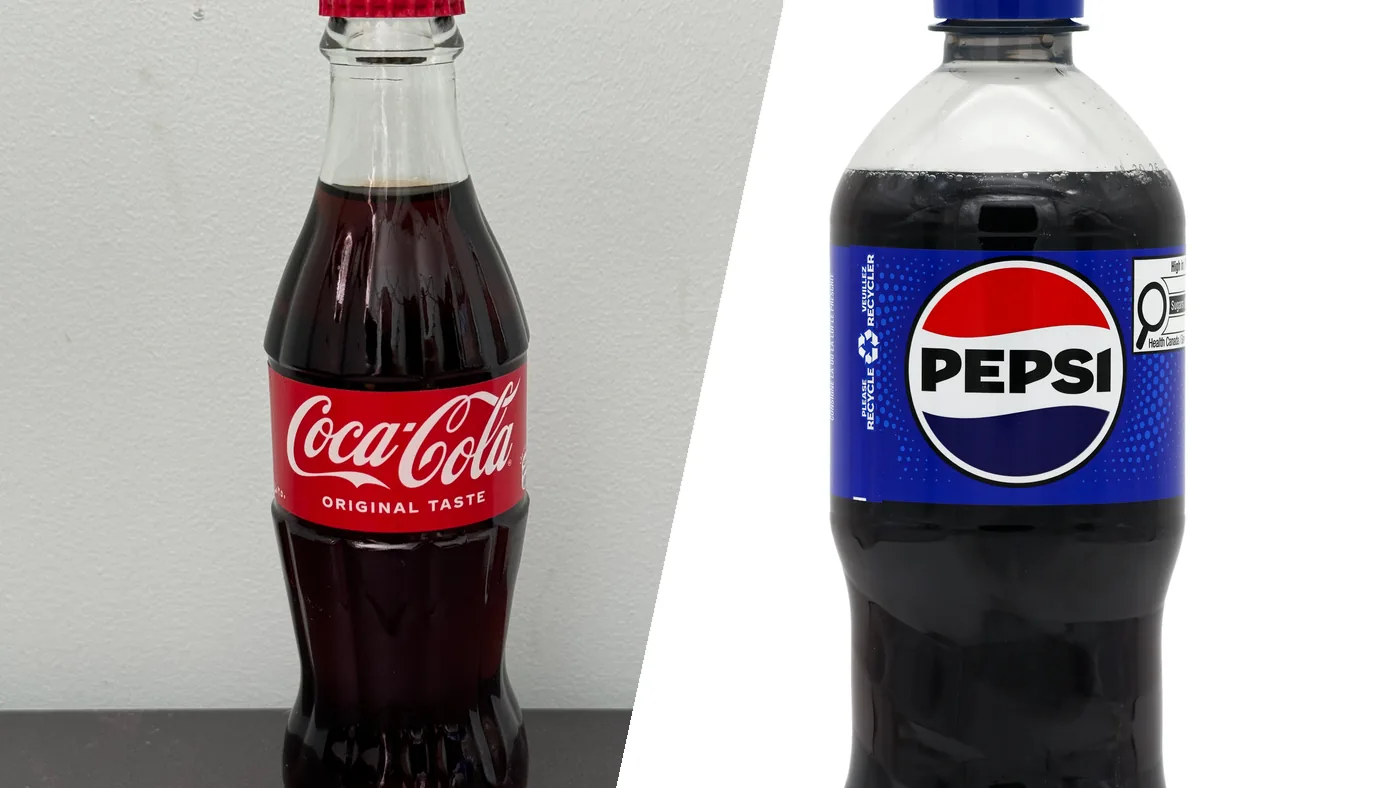
Coca-Cola turned 140 this year. John Pemberton served the first glass at Jacobs' Pharmacy in Atlanta on 8 May 1886, and the company still keeps the date as Founders Day.1 Pepsi began seven years later and 500 miles up the coast, as a New Bern pharmacist's syrup called Brad's Drink, renamed Pepsi-Cola on 28 August 1898.2
Two drugstore colas, one of the longest-running commercial fights in America, and a problem for anyone trying to settle it: the two products are almost the same product. They meet in the fifteen rankings below.
Coke and Pepsi sell nearly identical brown liquid, so any list holding both stops measuring the drink and starts measuring the advertising, the snack aisle, or the size of the mistake.
Coca-Cola vs Pepsi: the one list that asks it straight
Every other ranking here comes at the two brands sideways. This one puts sixteen soft drinks in a row and asks which is best, with both colas in the field.
Coca-Cola Classic is the biggest single soda brand in America. Beverage Digest's 2025 sales-volume data gave it 18.5% of the US market, more than double the next brand.3
Pepsi spent that same year climbing, moving up to third place past Sprite. The brand between the two colas is Dr Pepper, at 8.8%.3
That third name matters, because this ranking is not a two-horse race. Mountain Dew, Fanta, root beer and ginger ale are all on it, and a voter who dislikes cola never has to pick either brand.
Pepsi Zero Sugar and the recipe PepsiCo rewrote
The zero-sugar aisle is where the two colas sit closest together, because both are chasing the same drinker away from sugar rather than away from each other.
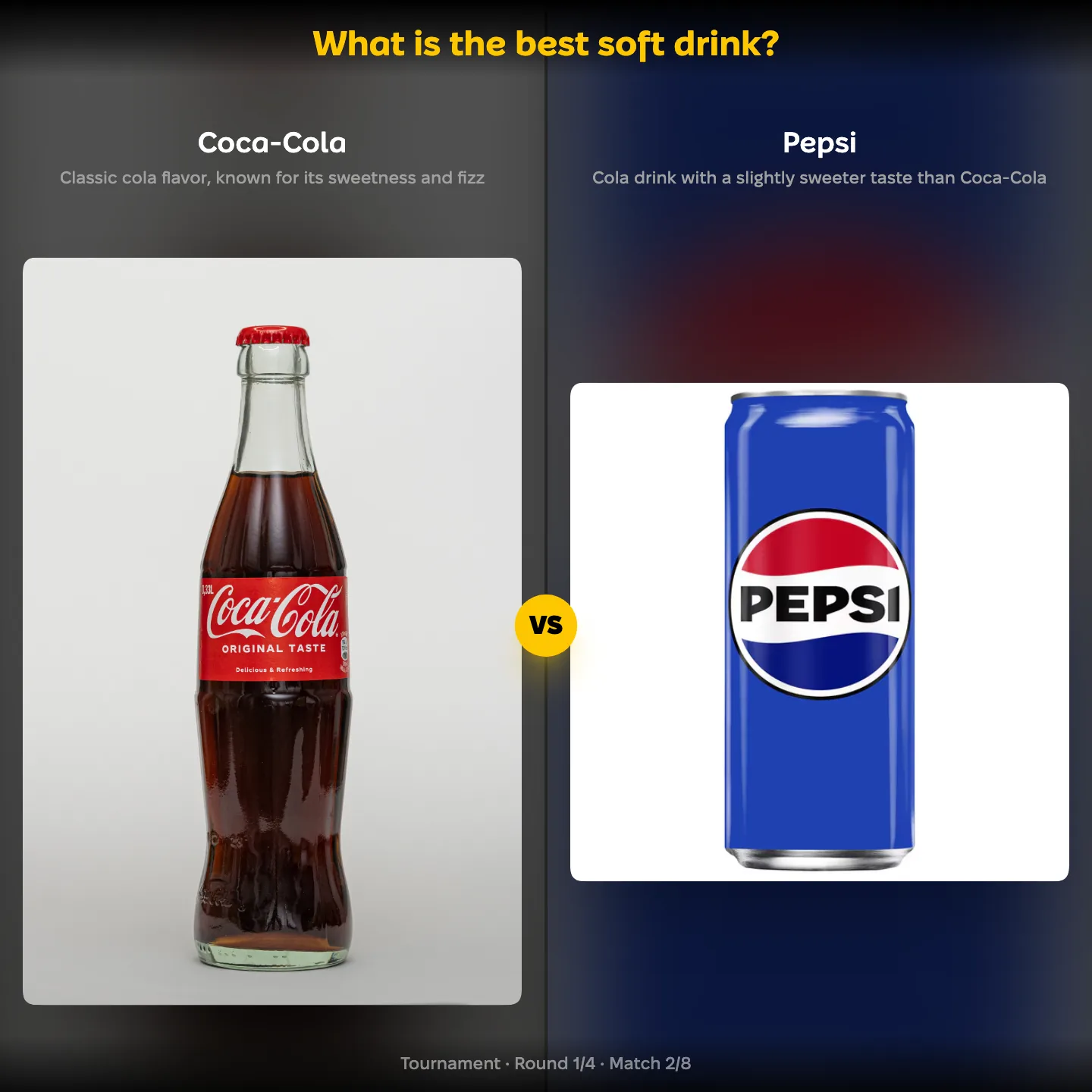
PepsiCo reformulated Pepsi Zero Sugar in 2023, cutting the caffeine, dropping the ginseng and changing the sweetener system.4
Coca-Cola Zero Sugar answers a different brief. It is built to taste like the red can rather than like a diet drink, which is also why Diet Coke survives beside it on the same ranking with a deliberately different flavour.
Beyond the two colas the list runs to Dr Pepper Zero Sugar, Sprite Zero, Diet Mountain Dew and Zevia, so a vote here can be about sweeteners rather than about brands.
Mean Joe Greene vs Cindy Crawford
Super Bowl advertising is the one arena where both companies spent a fortune for decades, so a ranking of the game's best commercials was always going to hold both.
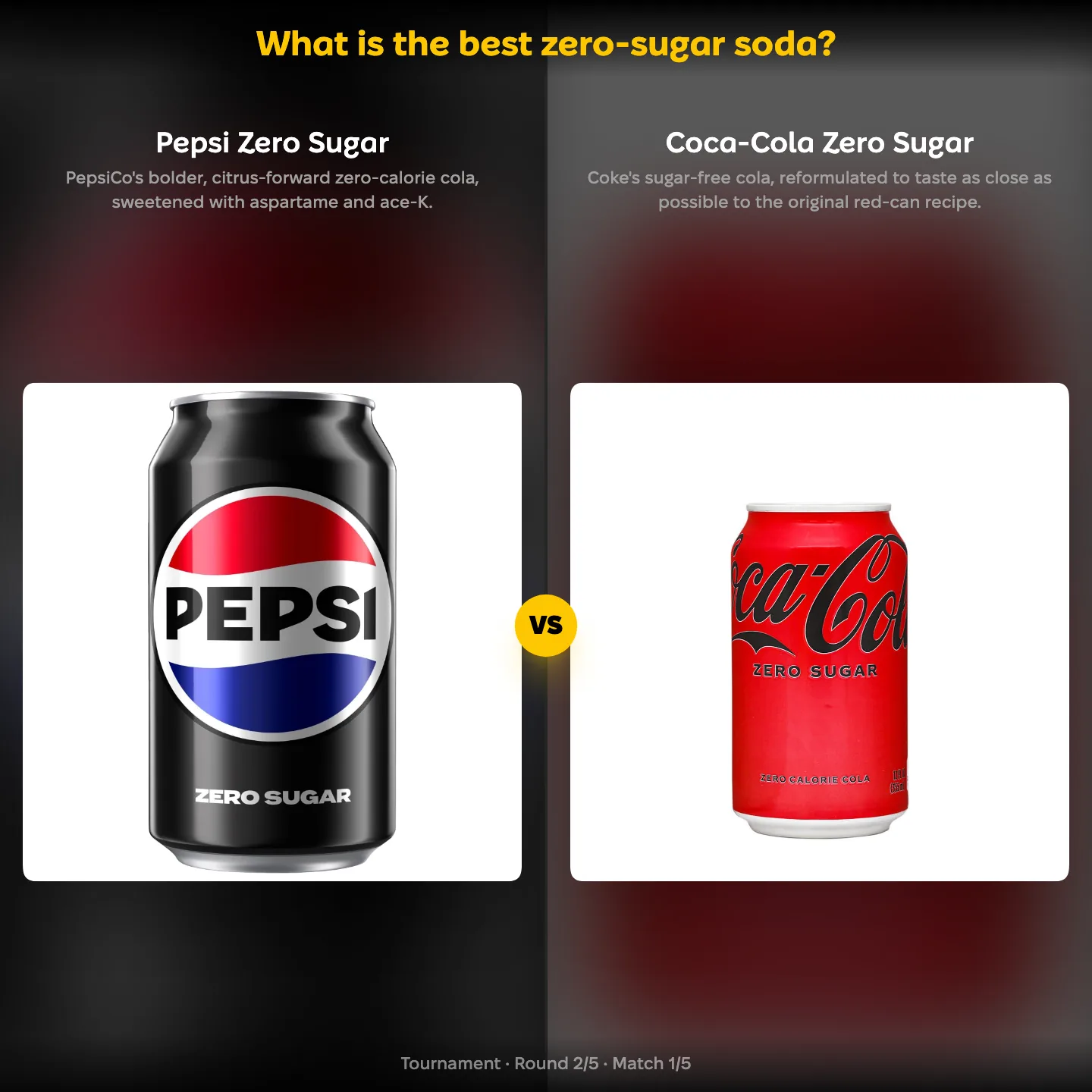
Coca-Cola's entry is "Hey Kid, Catch!", in which a battered Pittsburgh Steelers lineman trades his jersey for a kid's Coke. It first aired on 1 October 1979 and proved popular enough that Coca-Cola ran it again during Super Bowl XIV in 1980.5
Pepsi's entry is Cindy Crawford stepping out of a car at a roadside stop to buy a can, from the 1992 game.6 Pepsi later bought the stage itself: it signed for the halftime show in 2012 as part of a ten-year agreement valued at $2 billion, then walked away from the sponsorship in 2022.7
The company on this list is heavy. Apple's "1984", Budweiser's frogs, Wendy's "Where's the Beef" and Volkswagen's small Darth Vader are all in it, and Coca-Cola has a second entry with "America the Beautiful".
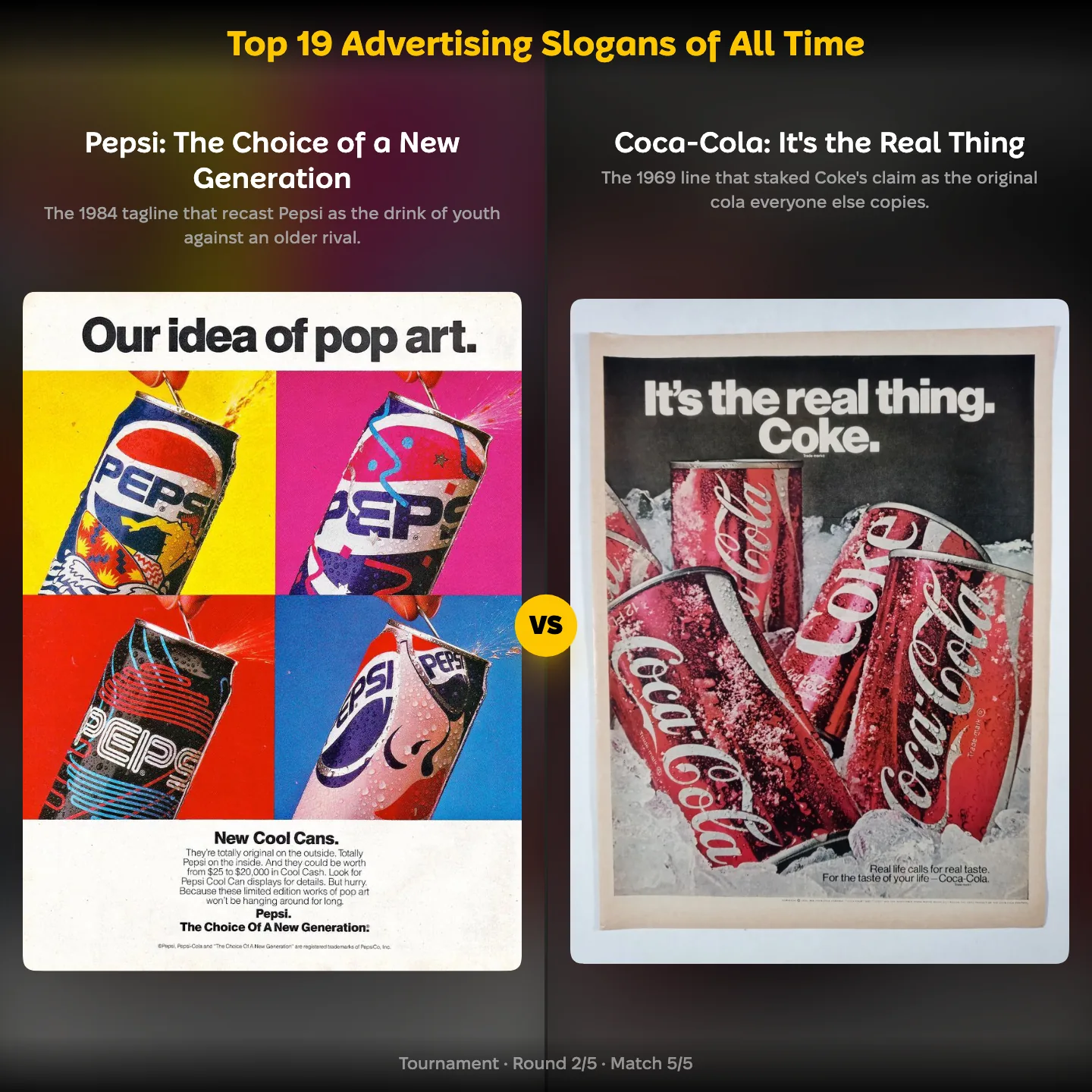
"It's the Real Thing" and "The Choice of a New Generation"
Slogans are where the two brands stop selling the same thing, because each line makes a claim the other cannot copy.
Coca-Cola's is about the product: the original cola, the one everybody else is imitating.
Pepsi's line never argues that the drink is better. It argues that the drinker is younger, which is the only move available to a brand that arrived second and has stayed second in the cola aisle.
Neither is the biggest name here. Nike's "Just Do It", De Beers' "A Diamond Is Forever" and MasterCard's "Priceless" all compete in the same nineteen, and none of them had to sell sugar water to do it.
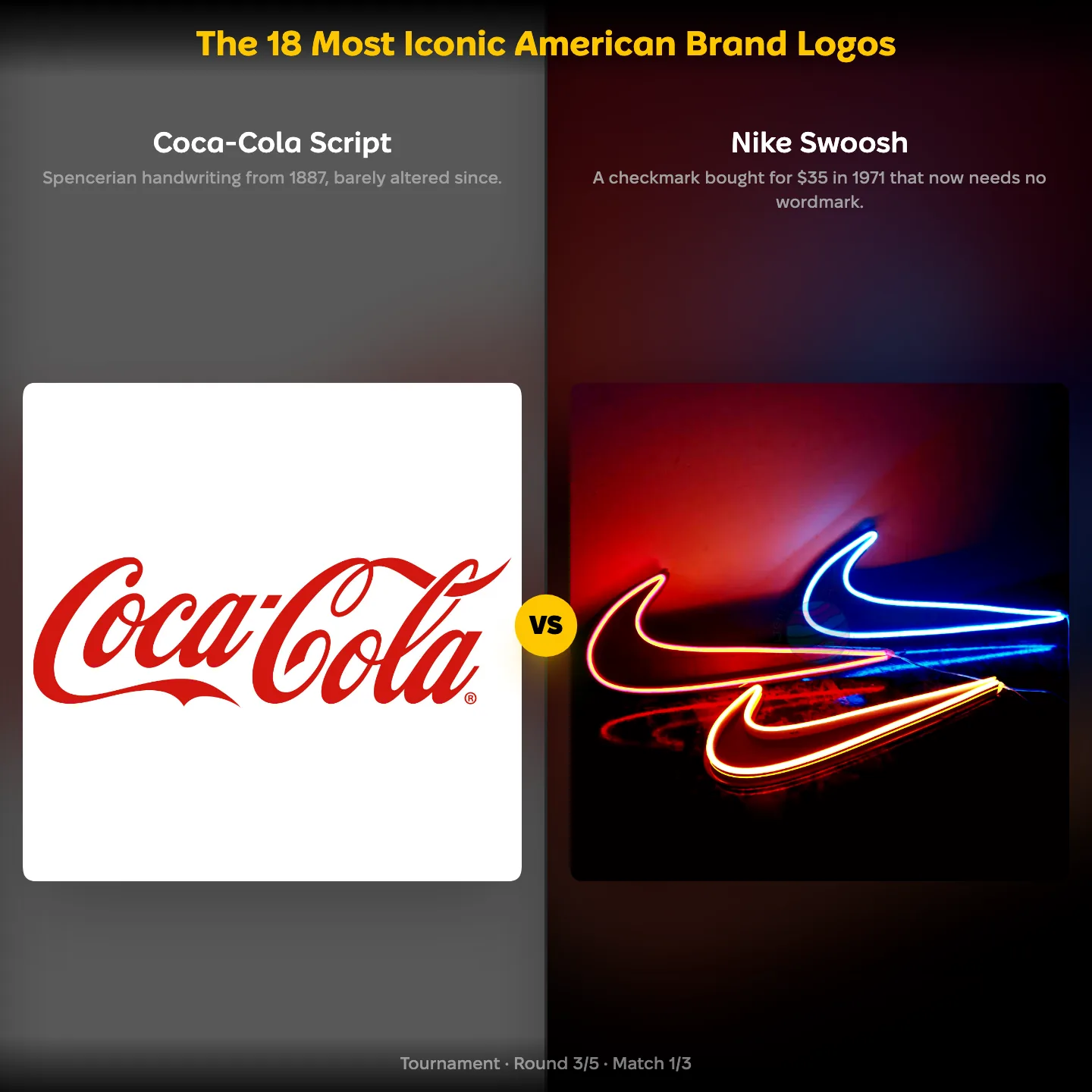
The Coca-Cola script, and the logo Pepsi keeps redrawing
Twice in this article a ranking holds one brand and not the other. Here the missing name is Pepsi.
The Coca-Cola Script is Spencerian handwriting from the 1880s that the company has barely touched since. This ranking of iconic American brand logos puts it beside the Golden Arches, the Nike Swoosh and the FedEx arrow.
Pepsi is not, and the reason is in its own design history: the globe has been redrawn so many times that no single version has been in front of Americans for the run the script has had.
Continuity is a strange kind of asset. Coca-Cola's logo is famous partly because nobody at the company was ever allowed to improve it.
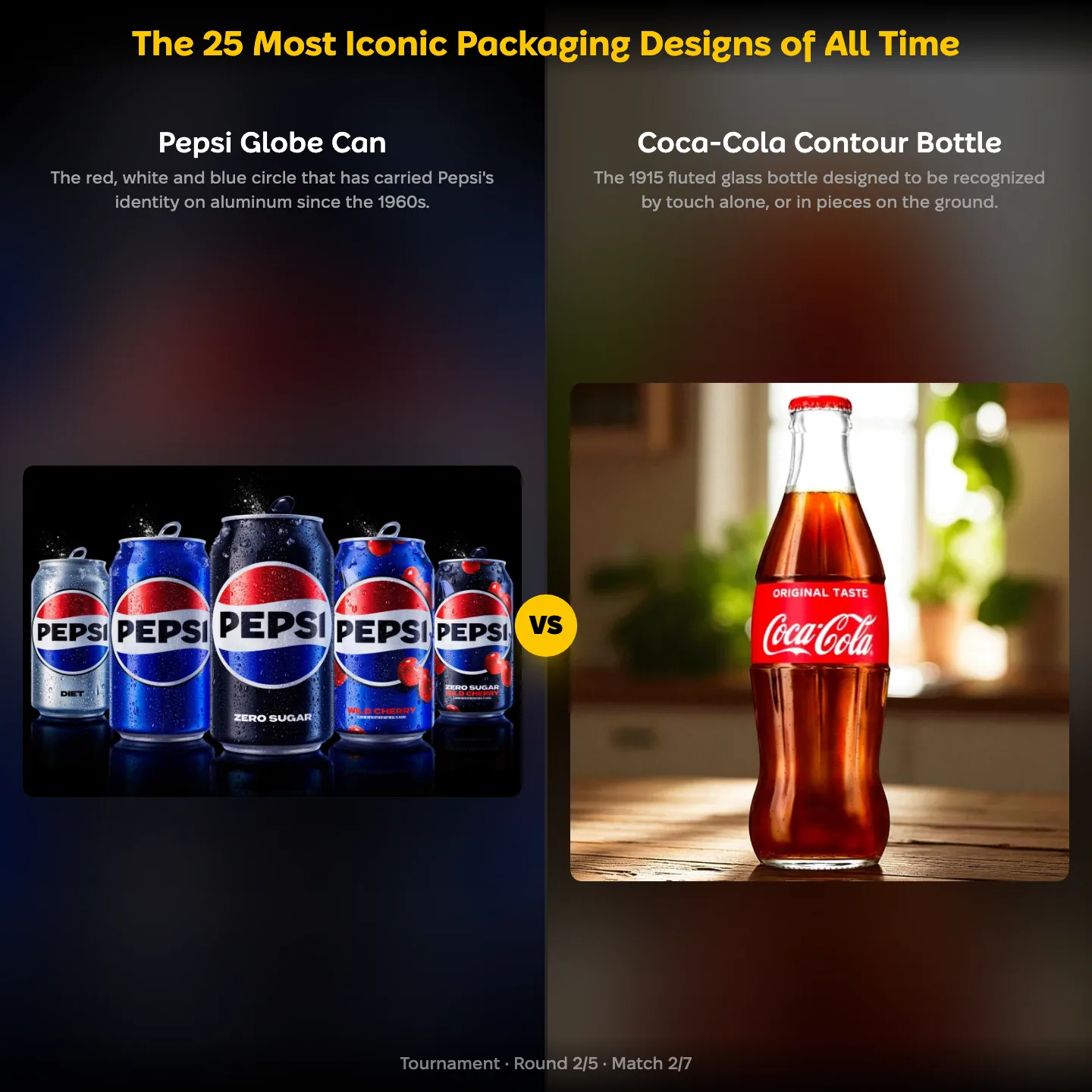
The contour bottle vs the Pepsi globe
Packaging is the one category where a soda company can out-design a jewellery box, and both brands are in this ranking of twenty-five containers.
Coca-Cola ran a competition in 1915 asking glassmakers for a bottle so distinct that a person would know it "by feel in the dark or lying broken on the ground". The Root Glass Company of Terre Haute won it, and the design patent was granted on 16 November 1915.8
Pepsi's contribution is flatter and more modern: the red, white and blue circle on aluminium, a piece of graphic design rather than a shape you could identify blindfolded.
Everything else in the twenty-five belongs in a museum: the Tiffany blue box, the Campbell's soup can, the Absolut bottle, the Toblerone carton, the Pez dispenser.
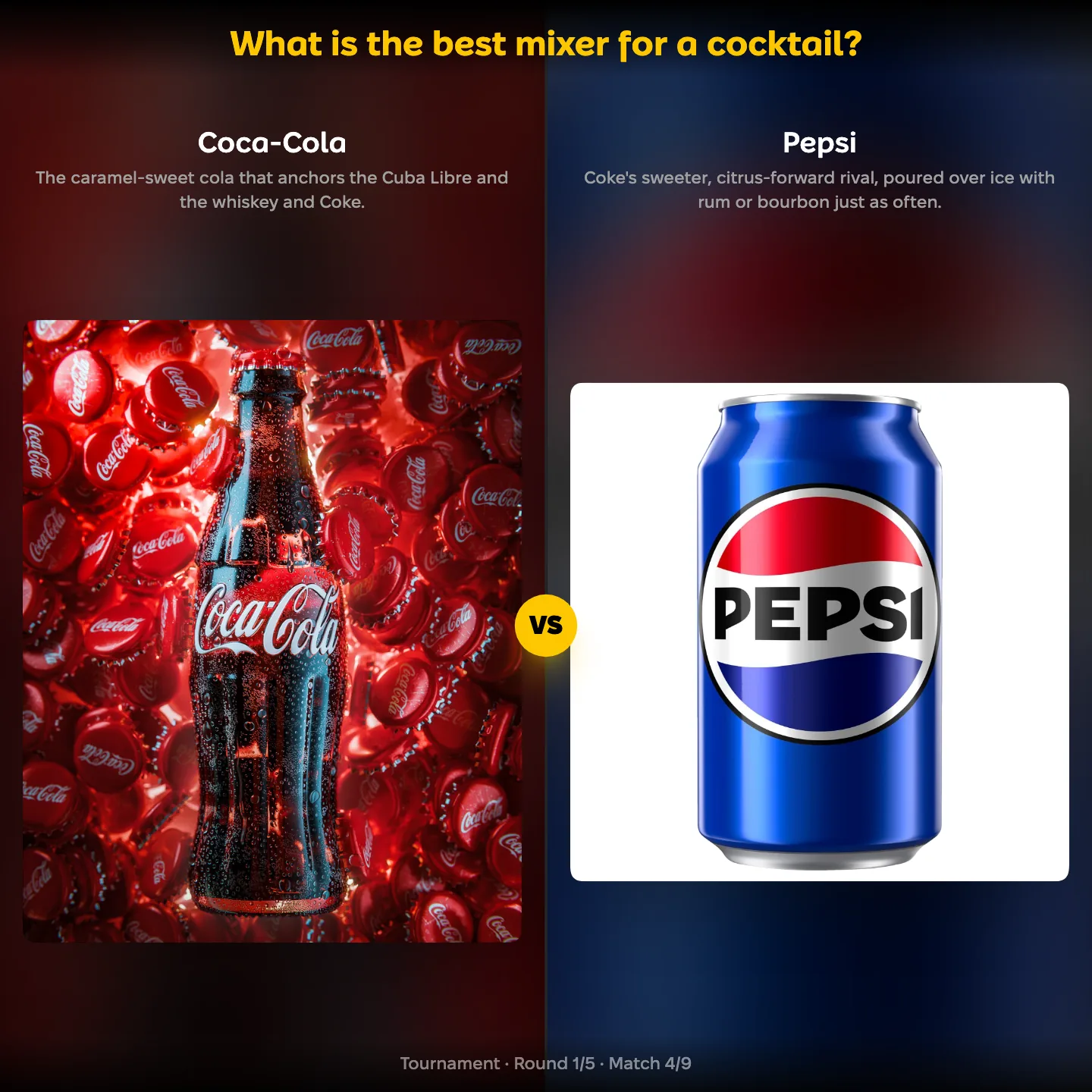
Rum and Coke: the cocktail with a brand in its name
Bar rankings are supposed to be about tonic, ginger beer and citrus. Both colas are on this one anyway.
Coca-Cola has an advantage no marketing department engineered: a standard drink carries its name. Rum and Coke, or Cuba Libre with lime, is ordered by brand rather than by category.
Pepsi mixes perfectly well and gets ordered that way almost never, which is what a hundred years of second place buys you in a bar.
The list itself is unimpressed by both. Tonic water, ginger beer, lime juice and simple syrup are the workhorses of most cocktail menus.
Pizza night: the pairing that splits by fountain
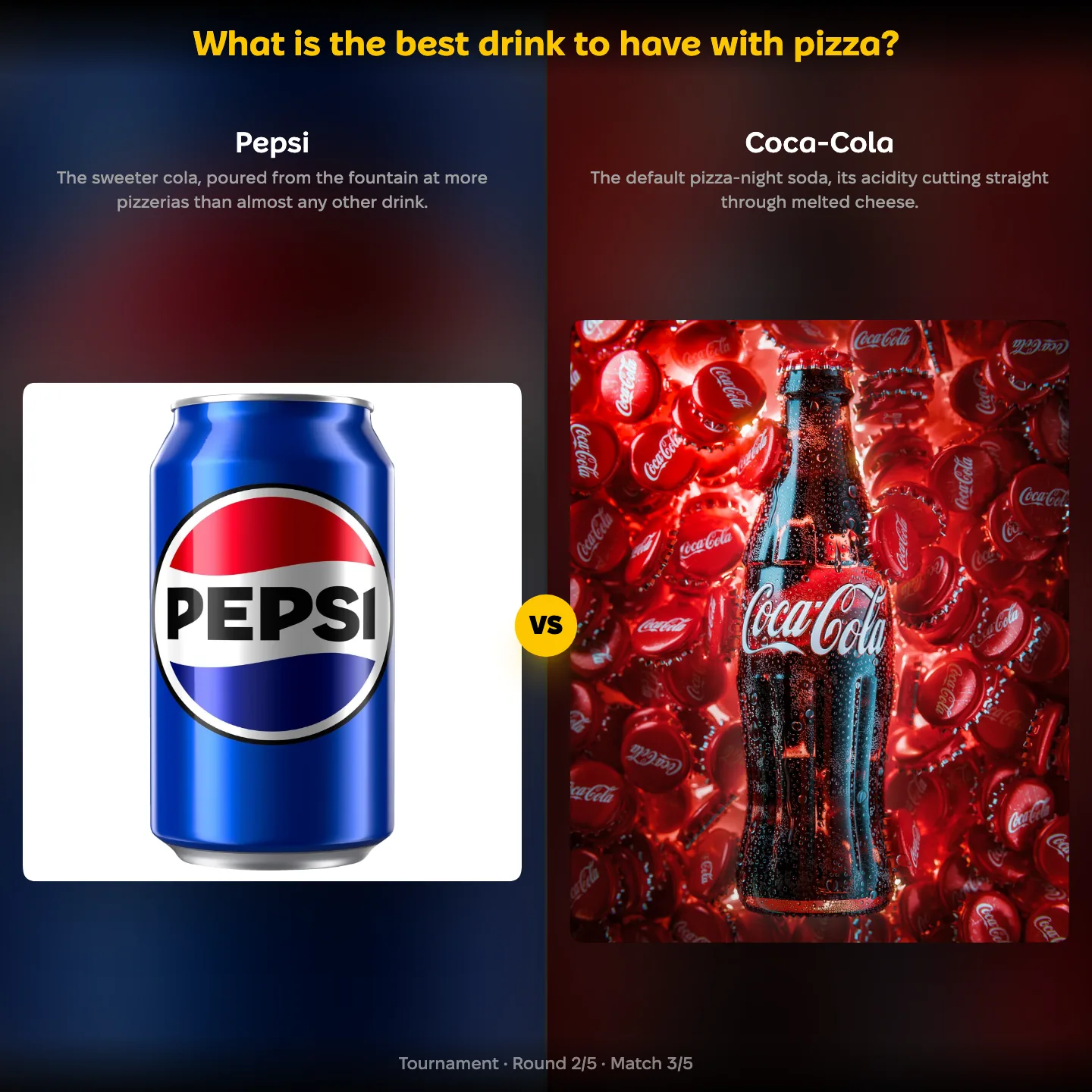
Pizza is the meal most likely to be eaten with whichever cola the restaurant happens to pour, so a ranking of pizza drinks puts Coca-Cola and Pepsi in the same bracket by accident of supply.
Pepsi's sweeter, more citrus-forward profile has a case against tomato and melted cheese. Coca-Cola's higher acidity has the opposite case, cutting through the fat instead of matching it.
The field is wider than soda: cold lager, Chianti, iced tea and lemonade are all in it, and any of them can end a cola's run.
Gatorade vs Powerade: the fight neither logo appears in
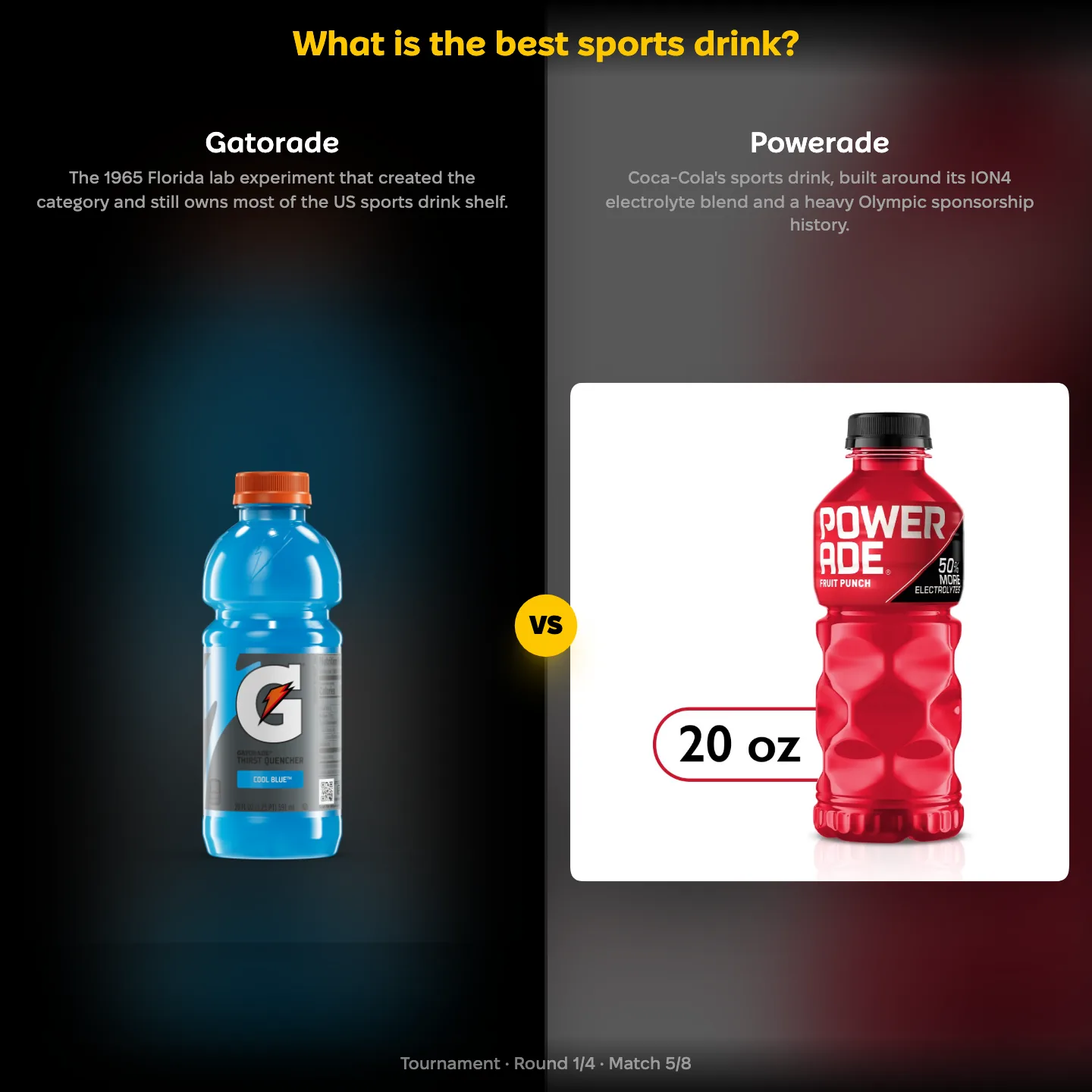
The Cola Wars stopped being about cola a long time ago. On the sports-drink ranking neither the Coca-Cola script nor the Pepsi globe is visible, and both companies are still fighting.
Gatorade was invented at the University of Florida's College of Medicine by a team led by Dr Robert Cade, after they found the football players' electrolytes out of balance. It was first used in an October 1965 Gator victory, and it is a PepsiCo brand today.9
Powerade is Coca-Cola's answer, built around a different electrolyte blend and a long history of Olympic sponsorship.
Coca-Cola also owns BodyArmor, which sits on the same list, so this is one ranking where the company can lose to itself.
Aquafina vs Dasani: same tap, two labels
Bottled water is the strangest front in the fight, because the two companies are selling a product with no flavour to argue about.
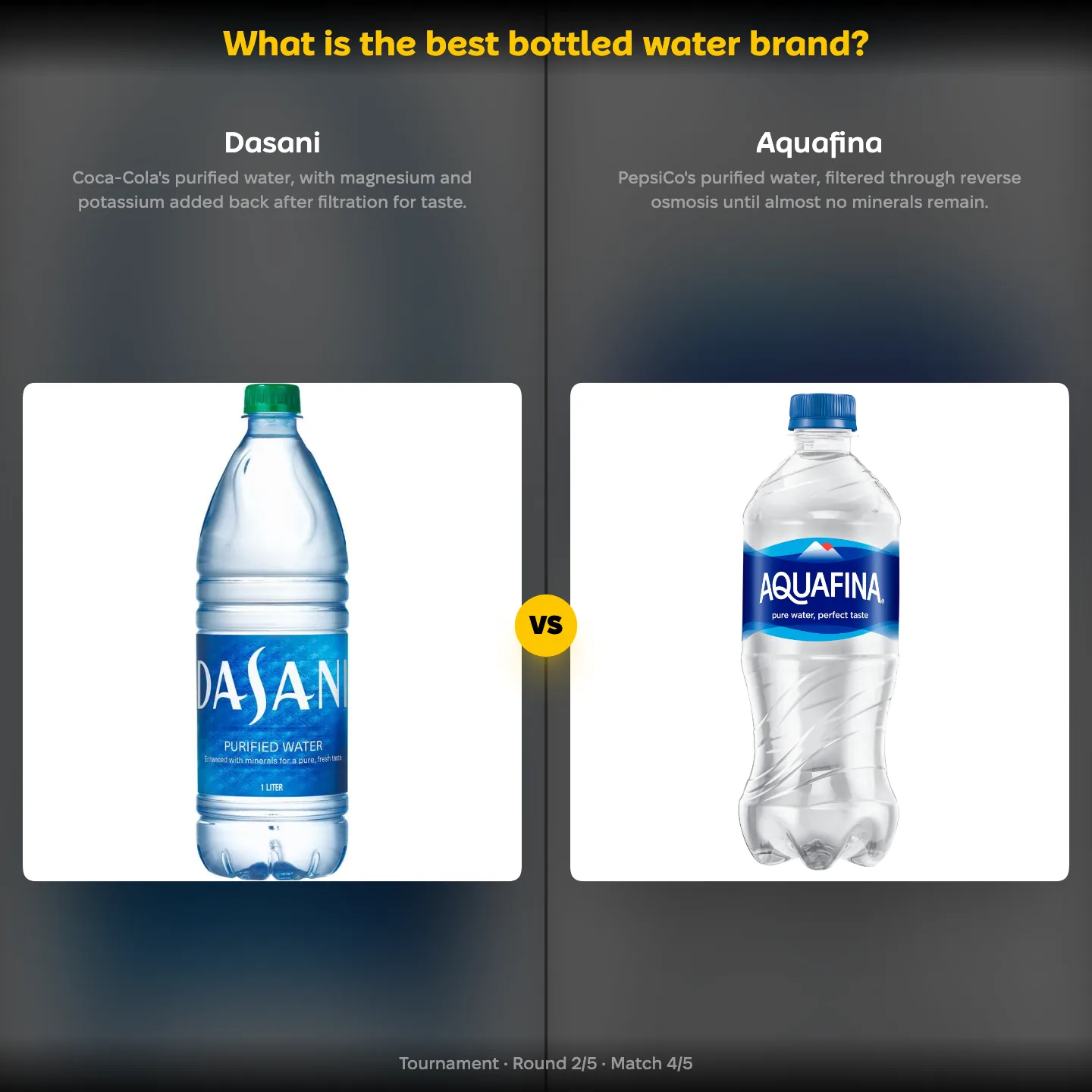
Aquafina is PepsiCo's purified water and Dasani is Coca-Cola's. Both take municipal supply through reverse osmosis, and Dasani adds a mineral blend back afterwards for taste.
That makes them the outsiders on a ranking led by places. Fiji, Evian, Voss, Acqua Panna and Poland Spring all sell a spring, a glacier or a volcano, which is a story neither cola company can tell about a filtration plant.
Smartwater, also Coca-Cola's, competes here too. So does Liquid Death, whose entire pitch is that bottled water branding had become ridiculous.
Sprite vs Starry: the category Pepsi keeps re-entering
Lemon-lime is the aisle where Coca-Cola holds the position Pepsi holds nowhere else, and PepsiCo has now spent decades attacking it.
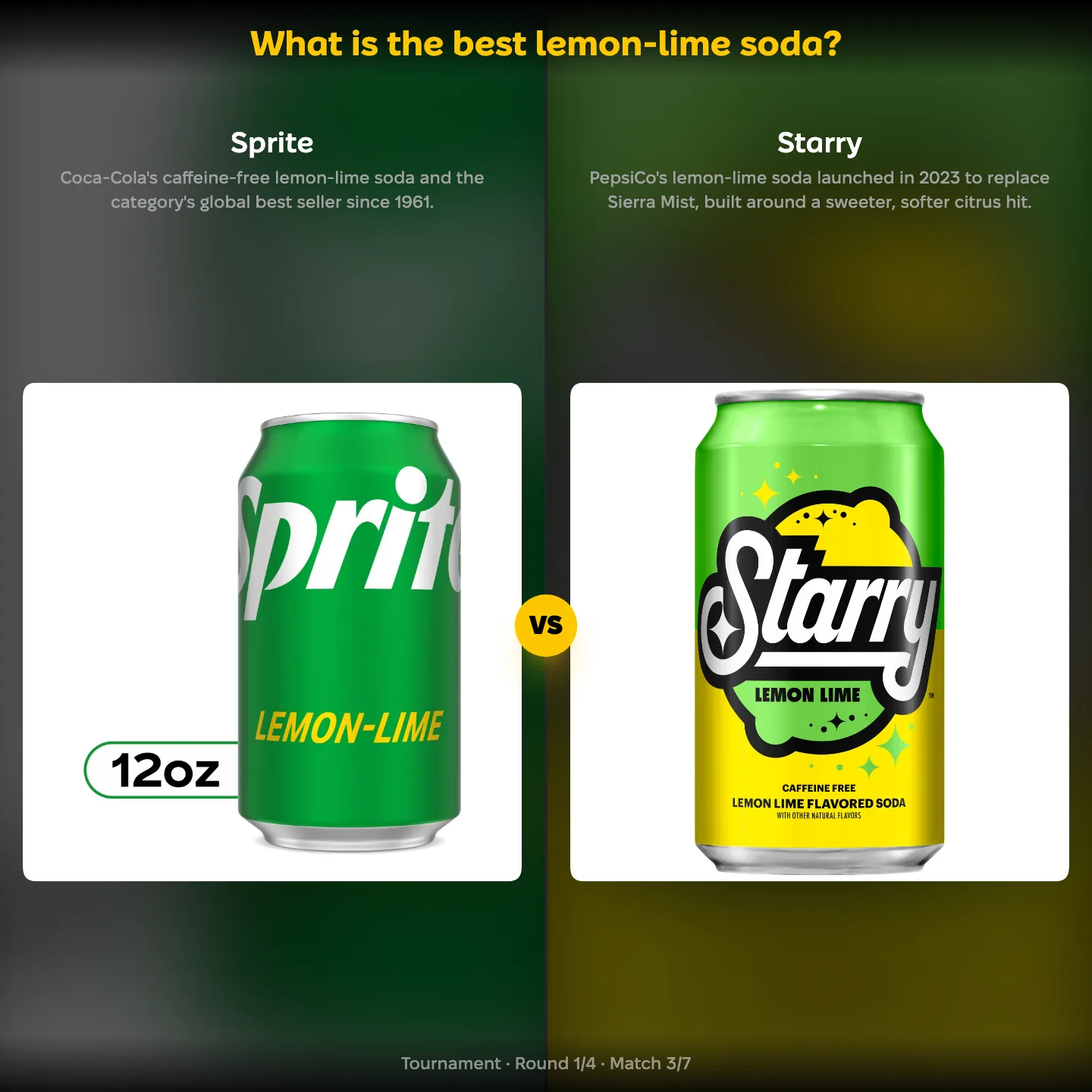
Sprite has been Coca-Cola's caffeine-free lemon-lime soda since the 1960s and is the category's global best seller.
Starry is PepsiCo's newest attempt. It launched in 2023 in place of Sierra Mist, and the company's own framing was that it wanted to give people "a choice in an area that's been dominated by one brand for years".4
The ranking quietly records the whole campaign: Sierra Mist and Mist Twst are both still on it, next to Starry, which replaced them.
Doritos: the aisle Coca-Cola never entered
This is the other half-empty ranking, and this time Coca-Cola is the brand that cannot enter.
PepsiCo's other half is Frito-Lay, which is why Doritos, Lay's, Cheetos, Tostitos, Ruffles, Fritos and SunChips are all on a ranking of snack brands. Seven of the sixteen options belong to Pepsi's parent company.
Coca-Cola has no equivalent. It sells drinks, and a shopper filling a snack bowl has no reason to think about it at all.
That asymmetry runs the other way too, which is why the Super Bowl ranking earlier holds a Doritos commercial: PepsiCo can buy airtime in a game as a snack company, not just as a cola.
New Coke vs Crystal Pepsi: 79 days and a clear cola
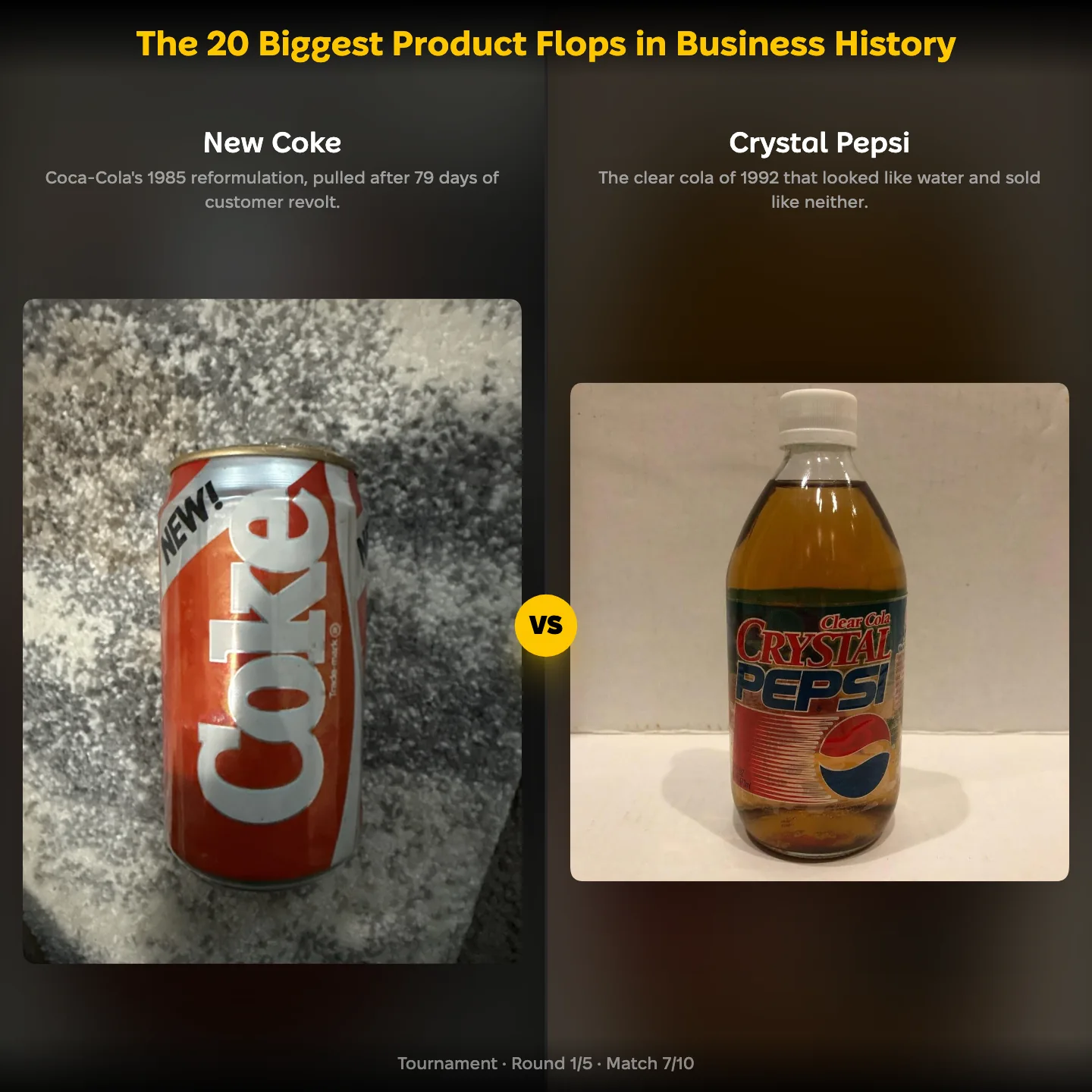
Both companies have made a mistake big enough for a business-school syllabus, and both mistakes are on this ranking of twenty product flops.
Coca-Cola announced a new formula on 23 April 1985. The complaints were immediate: the consumer hotline went from around 400 calls a day to 1,500, and the original recipe came back as Coca-Cola Classic on 11 July, 79 days later. In the two days after the reversal the hotline took 31,600 calls.10
Crystal Pepsi is the quieter failure. A clear cola from the early 1990s, it looked like water, tasted like cola and confused nearly everyone who bought it, and it was gone within about two years.
The company here is brutal: the Ford Edsel, the Microsoft Zune, Google Glass, the Segway, the Fire Phone and Quibi, most of which cost far more than a soda recipe.
New Coke is still the more interesting entry, because the reversal worked. A company that had to be told by phone what its own recipe was worth came out of it knowing something no market research had told it.
Surge came back because fans bought a billboard
Discontinued sodas get a fondness that living ones never earn, and this ranking is stocked from both companies' back catalogues.
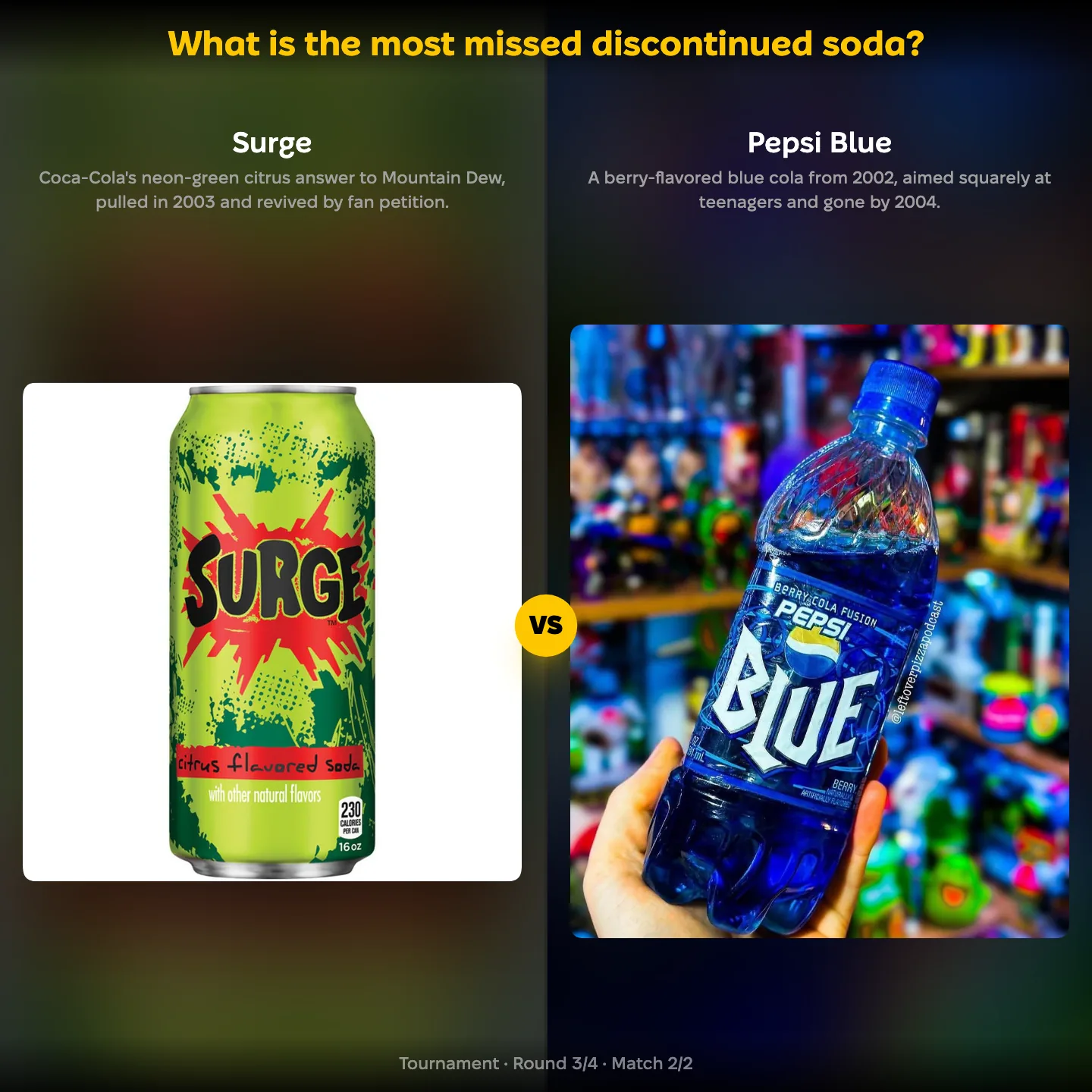
Surge was Coca-Cola's neon-green answer to Mountain Dew, pulled in 2003. Fans built a campaign around it, gathered more than 128,000 followers on Facebook, and spent nearly $4,000 on a billboard near Coca-Cola's Atlanta headquarters. The company brought it back on 15 September 2014 as an Amazon exclusive, and it sold out in about an hour.11
Pepsi's entries are stranger. Crystal Pepsi, Pepsi Blue, Pepsi Twist and Josta are all on the list, which is a lot of discontinued experiments for one company.
Tab, OK Soda, Vault and Sprite Remix fill out the rest, and every one of them belonged to Coca-Cola or PepsiCo. Nostalgia here is entirely their product.
The Cola Wars, against every other rivalry
The last ranking is the only one where Coca-Cola and Pepsi are not two options. They are one, listed together as a single entry called the Cola Wars.
That entry is up against Netflix vs Blockbuster, Nintendo vs Sega, Boeing vs Airbus, Nike vs Adidas and Intel vs AMD.
Most of those have an ending. Blockbuster is gone, Sega left the console business, and the arguments about them are historical. The Cola Wars have no ending, which is either the entry's strongest claim or its weakest, depending on whether a rivalry is supposed to produce a winner.
What is actually being measured
Fifteen rankings, and the cola only decides two of them. The rest are settled by a bottle patent, a snack aisle, a filtration plant, a 1979 commercial and a recipe change that lasted 79 days.
All fifteen are decided two options at a time. The order that emerges is the sum of thousands of small decisions, not one big verdict.
If there is a comparison the fifteen above missed, the ranking for it does not exist yet. Write the question and let other people fight over it.
More rankings, more angles
- McDonald's Is on 14 Different Lists — the other American brand that shows up everywhere
- How Chocolate Ends Up on 15 Unrelated Lists — one ingredient, fifteen categories
- Cheese, Ranked Many Ways — from pizza topping to French cheeseboard
- Starbucks vs Dunkin': 1950 in Quincy, 1971 in Seattle — Seattle against New England, cup by cup
Sources
- The Coca-Cola Company — Founders Day 2026, 140 years since 8 May 1886: coca-colacompany.com (checked 2026-08-13)
- NC Department of Natural and Cultural Resources — Brad's Drink becomes Pepsi-Cola, 28 August 1898: dncr.nc.gov (checked 2026-08-13)
- Atlanta Journal-Constitution, reporting Beverage Digest's 2025 US sales-volume data — Coca-Cola Classic 18.5%, Dr Pepper 8.8%, Pepsi up to third: ajc.com (checked 2026-08-13)
- FoodNavigator — PepsiCo's 2023 reformulation of Pepsi Zero Sugar and the replacement of Sierra Mist with Starry: foodnavigator.com (checked 2026-08-13)
- Best Classic Bands — the Coca-Cola "Mean Joe Greene" commercial, first aired 1 October 1979 and shown at Super Bowl XIV: bestclassicbands.com (checked 2026-08-13)
- SuperBowl-Ads — the 1992 Pepsi Super Bowl commercial starring Cindy Crawford: superbowl-ads.com (checked 2026-08-13)
- Marketing Dive — Pepsi's halftime-show sponsorship, signed in 2012 as a ten-year, $2bn agreement and ended in 2022: marketingdive.com (checked 2026-08-13)
- The Coca-Cola Company — the 1915 contour-bottle competition and the design patent granted 16 November 1915: coca-colacompany.com (checked 2026-08-13)
- University of Florida — Gatorade's birthplace, Dr Robert Cade's team and the October 1965 first use: research.ufl.edu (checked 2026-08-13)
- The Coca-Cola Company — New Coke, 23 April to 11 July 1985 and the consumer hotline figures: coca-colacompany.com (checked 2026-08-13)
- GeekWire — Surge's return on 15 September 2014 as an Amazon exclusive, the fan campaign and the sell-out: geekwire.com (checked 2026-08-13)