
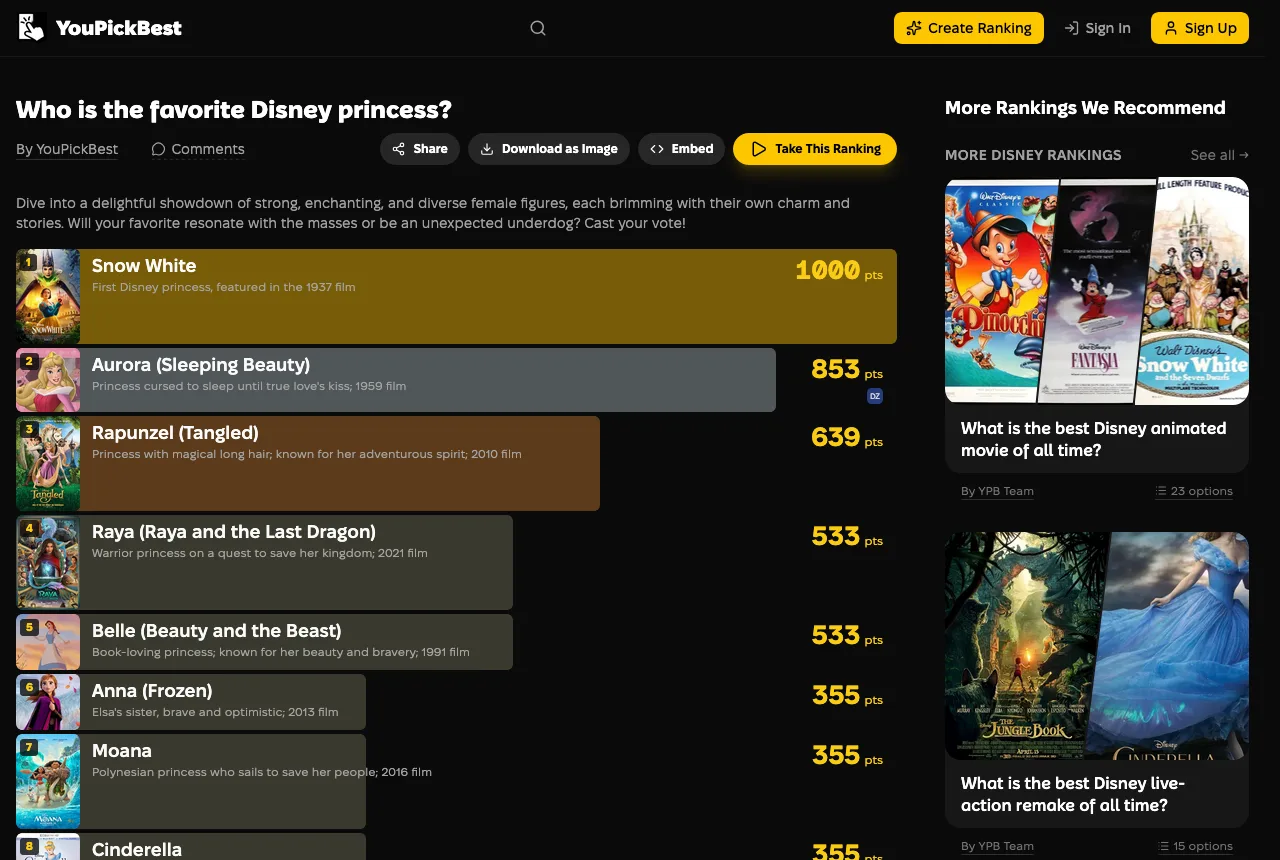
Every option in a YouPickBest ranking is scored on a 0–1000 scale. The top option always reads 1000, and everything below it is measured against that figure. An option that wins as often as it loses reads 500 or more, depending on how strong the leader is. An option that has played without winning a single matchup reads 0, and one nobody has voted on yet has no score at all. None of this is a vote count: the number is built from win rate, how deep an option gets, and the spread of opponents it has beaten.
The short version: The leader is pinned at 1000 and the field is scaled beneath it, so a score reads as a distance from the best option rather than a total of anything. Win rate does most of the work. Deep runs and a wide list of beaten opponents add small bonuses on top.
Why the leader is always 1000
Scores are relative. After each completed session, every option's raw rating is recalculated, the strongest rating in that ranking is set to 1000, and the others are scaled beneath it. Gaps in win rate are stretched before the scaling, so real differences stay visible instead of everything crowding into the top hundred points. Only the leader can read 1000. An option just behind it tops out at 999, so rounding never manufactures a tie at the top, although two options with genuinely equal records still share a number.
A fixed ceiling makes the standings readable without any of the underlying arithmetic. The distance between 1000 and 820 tells you how clear the leader is. It also means one option can score differently in two rankings: a pizza topping that dominates a soft field will score lower against a strong one, because the competition sets the bar.
What goes into a score
Three things feed the rating, and they carry very different weights. Vote count is not one of them. It sits next to the score on a results row, and it never lifts it.
How often it wins
Win rate is most of the score — the share of matchups an option wins out of the matchups it played. Small samples are pulled toward 50%: before the share is taken, every option gets three virtual wins and three virtual losses. Two wins from two matchups count as 62.5% rather than 100%, and the pull fades as real matchups pile up. Eight wins in ten beats three wins in ten, whatever the vote totals behind them. That is how a little-known option that quietly wins most of its matchups can finish above a famous one that keeps losing the close ones.
How far it gets
Surviving longer earns a small extra. Reaching a bracket final is worth more than an early exit, and in King of the Hill a long unbeaten run on screen earns the equivalent. The bonus is sized to reward options that hold up under pressure, not to let one good run outweigh a weak overall record.
Who it beats
Beating a wide field counts too. Each distinct opponent an option has defeated adds a small amount. Ten different rivals beaten says more than the same rival beaten ten times, so the score favours options that have proved themselves against the whole list rather than one convenient victim.

Why a bracket win and a long streak count the same
The two modes are calibrated against each other so neither one pays better. Taking a whole bracket is worth roughly what a fifty-match unbeaten run in King of the Hill is worth.
That calibration is deliberate — people play whichever mode they like, and the results do not tilt toward whichever format happened to be popular that week. A score stays a statement about the option, not about the format it was voted in.
What doesn't count
Two rules keep the numbers honest.
- Unfinished sessions are ignored. A rating updates only when a session is completed. Abandon a play halfway through and nothing you clicked is recorded.
- Replays don't stack. Play a ranking a second time and your previous run is rolled back before the new one is applied. Voting the same way repeatedly adds nothing.
So the number moves for one reason: options are winning their matchups. Those matchups come from head-to-head voting.
The fastest way to get a feel for the scale is to watch it work on a question you chose yourself. Publish a ranking, send it to a few people, and read the numbers afterwards.
Common questions
Why isn't the score just the number of votes?
Because a vote total would only measure exposure. An option shown in more matchups would drift upward without winning anything. Win rate and the identity of the beaten opponents measure performance instead.
Why is the top option always 1000?
Because a relative scale needs an anchor. Fixing the strongest option at 1000 makes the gaps between places readable at a glance. Change the field around it and the same option can land on a different number.
What does a score near 500 mean?
Roughly an even record in a ranking with a dominant leader. Win rates are stretched around 50% and then scaled to the leader, so an even record reads exactly 500 only when the leader wins about three matchups in four. Against a weaker leader the same record reads higher.
Does replaying a ranking stack up extra points?
No. The earlier result is removed, and the fresh one counts in its place. Repeating the same picks changes nothing.
Do unfinished rankings count?
No. A session has to be completed before it affects anything. Quit partway and the ranking stays exactly as it was.
Why does an option show 0?
It has played matchups but has not won one yet. The first win lifts it off zero.
Why do some options have no score?
Nobody has voted on them yet. An option gets a number after its first matchup.
More on how voting works
- King of the Hill Voting: How Winner-Stays Ranking Works — why the order of challengers can change the winner
- Bracket vs Pairwise Voting: Which Finds the True Favourite? — Bradley–Terry, Elo and the luck of the draw
- How Head-to-Head Voting Works (and Why It Beats Polls) — one click per matchup, then the next pair