
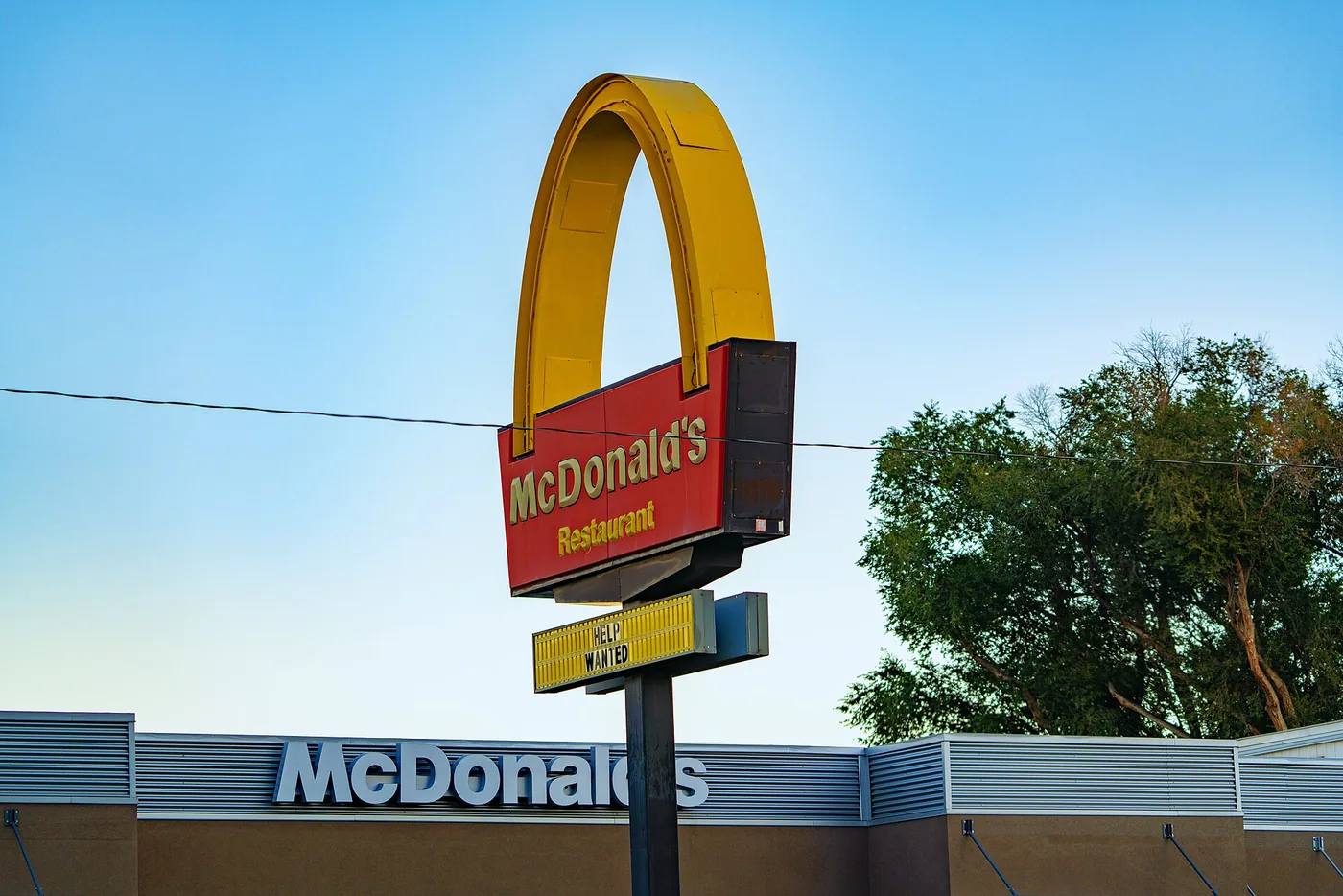
In its 2025 annual report McDonald's counted 45,356 restaurants in more than a hundred countries, 95% of them run by franchisees, on $139.4 billion of systemwide sales.1
A company that size stops being a restaurant and becomes a unit of measurement. It shows up on lists about burgers, and then on lists about coffee, logos, cartoon characters, plastic toys and documentary films — categories it never applied to join.
This year it is trying to be a burger again. The Big Arch, two quarter-pound patties under three slices of white cheddar, reached American restaurants on 3 March 2026 and is planned for nearly every market by the end of the year.2
We built fourteen rankings around it. Some are about hamburgers. Several are not about food at all.
McDonald's did not put itself on the coffee list, the logo list or the documentary list. A company this size gets entered by everyone else.
Chick-fil-A vs McDonald's: 13,706 restaurants against a service reputation
The broadest question first: the best fast food chain in America, with fifteen names in the field.
McDonald's arrives with scale. 13,706 of those restaurants are in the United States, more than any other burger chain runs, and no competitor sells breakfast, burgers, coffee and dessert to as many people in a day.
Chick-fil-A arrives with the opposite case. It sells one protein, closes every Sunday, and has spent years at the top of customer-satisfaction surveys — a chain that competes on how the transaction feels rather than on how many of them happen.
In-N-Out, Five Guys, Raising Cane's and Whataburger all sit in the same field, each of them regional in a way McDonald's stopped being in the 1960s.
Burgers only, and In-N-Out is in the room
Narrow the same field to burger chains and the company that sells more hamburgers than anyone has a harder time.
In-N-Out has never owned a freezer, cuts its potatoes on site, and has kept roughly the same menu since 1948. Culver's sells a Wisconsin butter burger with frozen custard beside it.
McDonald's sells a burger built to taste identical in Boise and Bangkok. That is an extraordinary logistical achievement and a poor answer to a question about flavour.
The Big Arch is its attempt at an answer, and the first week in American restaurants moved traffic 2.2% year on year.3 Real, and small for a company of this size.
A question about the brand, not the beef
Sixteen burger brands, and the question is what the name is worth rather than what the sandwich tastes like.
Brand is the category where McDonald's has no real rival. The Golden Arches are recognised in more countries than most national flags, and the company spends more on advertising than most of the field combined.
Five Guys and Shake Shack are doing something narrower and newer: Shake Shack began as a hot dog cart in Madison Square Park in 2001 and turned scarcity into the pitch.
White Castle is the outlier worth naming. It opened in 1921, two decades before the McDonald brothers opened in San Bernardino, and it invented most of what the industry later copied.
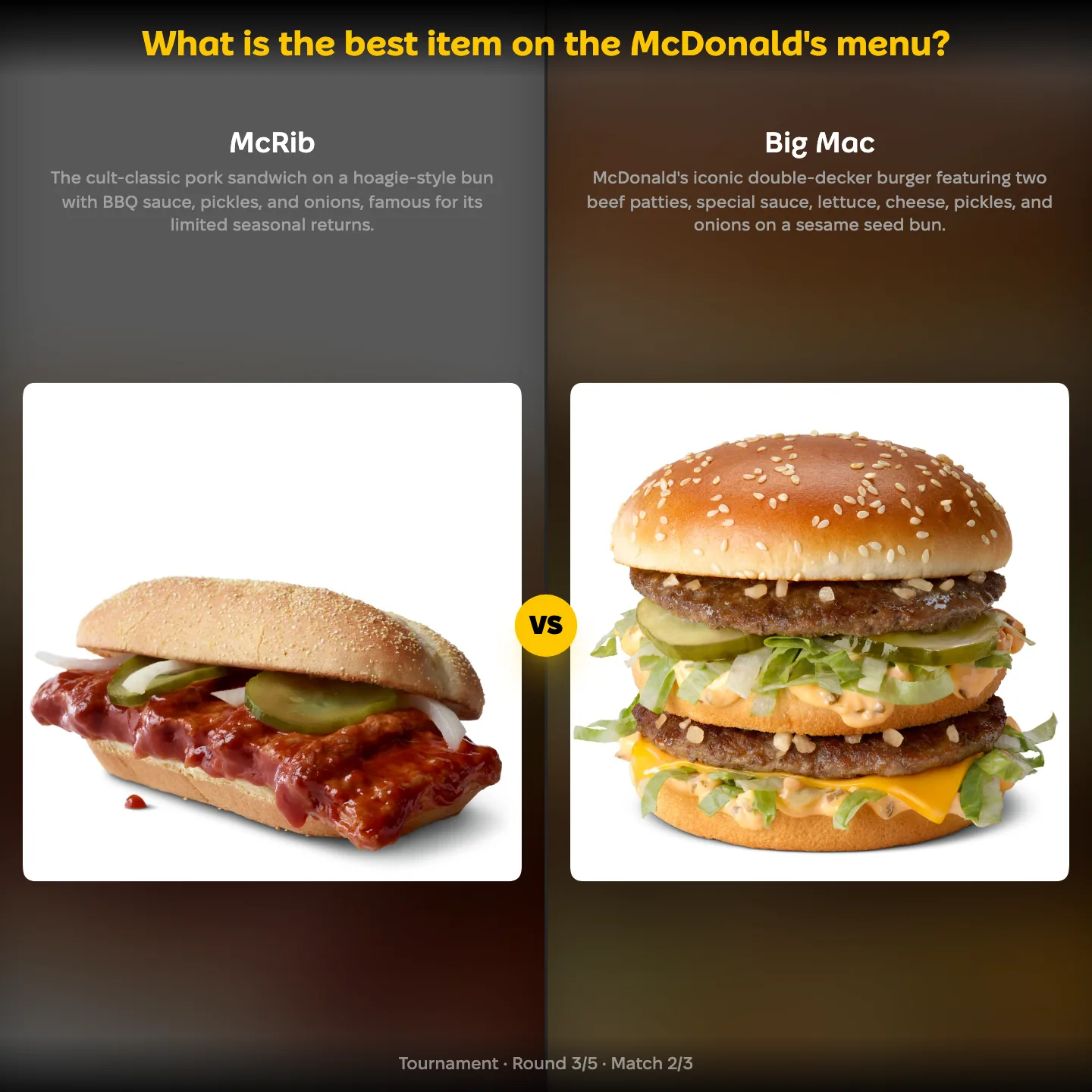
Big Mac vs McRib: one menu arguing with itself
Here the competition is internal. Seventeen McDonald's items, no rivals, and every matchup is one part of the menu against another.
The Big Mac was not invented in a corporate test kitchen. Franchisee Jim Delligatti put a double-decker burger on his own menu in Uniontown, Pennsylvania, in 1967, and the company took it national the following year.
The McRib works the opposite way. It has no fixed place on the menu at all, disappears for years, and returns to a genuine wave of internet attention — a sandwich whose scarcity is the product.
Then there are the items nobody defends in public and everybody orders: hash browns, the apple pie, the Shamrock Shake in March.
The fries are the one thing nobody argues about
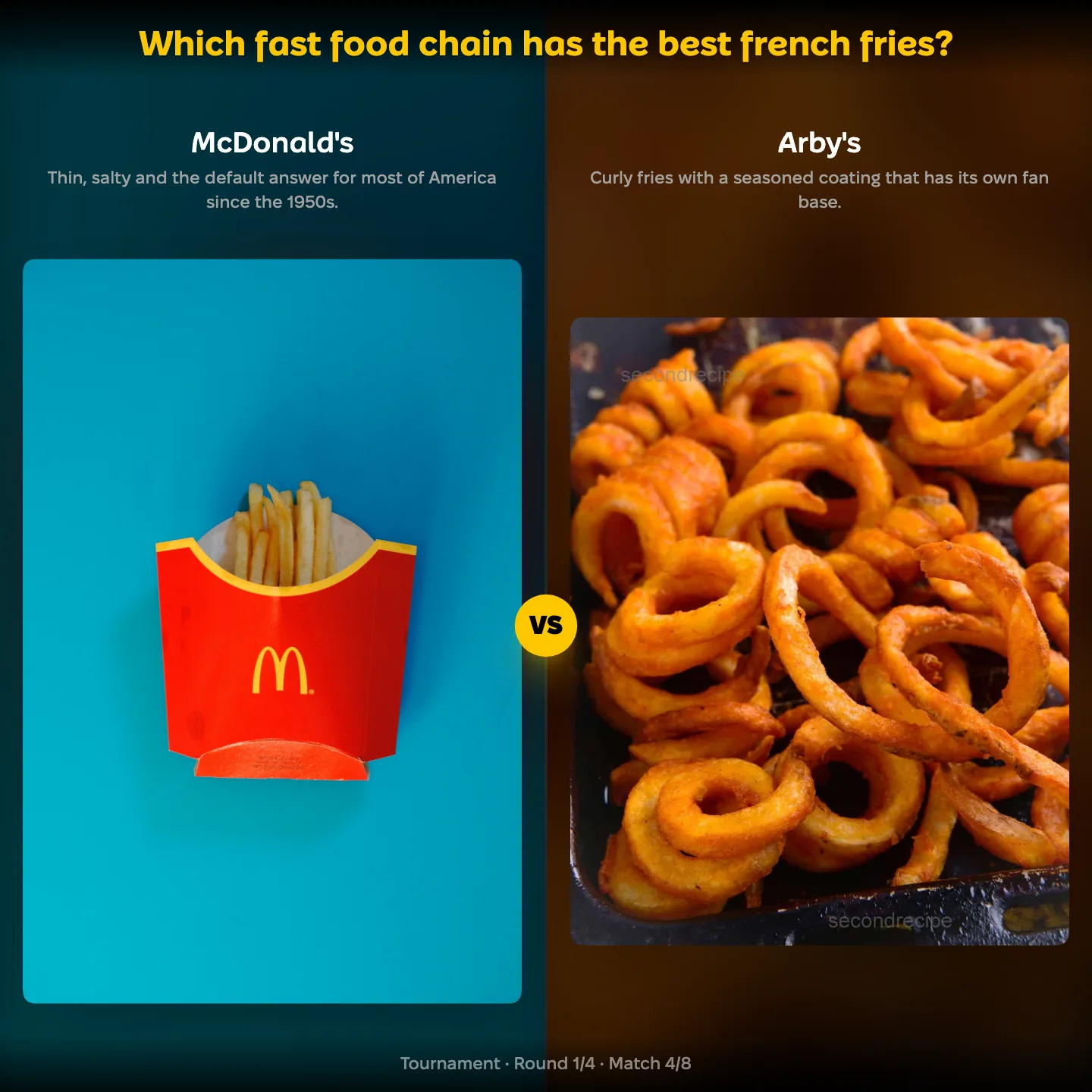
Every chain sells fries. One of them sells a fry people order on its own, with no food attached.
McDonald's fries are thin, heavily salted and identical everywhere. Nowhere in this article does the company need less explaining.
The specialists went sideways instead: Arby's curly, Chick-fil-A's waffle cut, the batter coating Checkers and Rally's put on theirs so they survive the bag.
Waffle House, Bojangles and breakfast at 4am
Move the clock to the morning and the field changes almost completely.
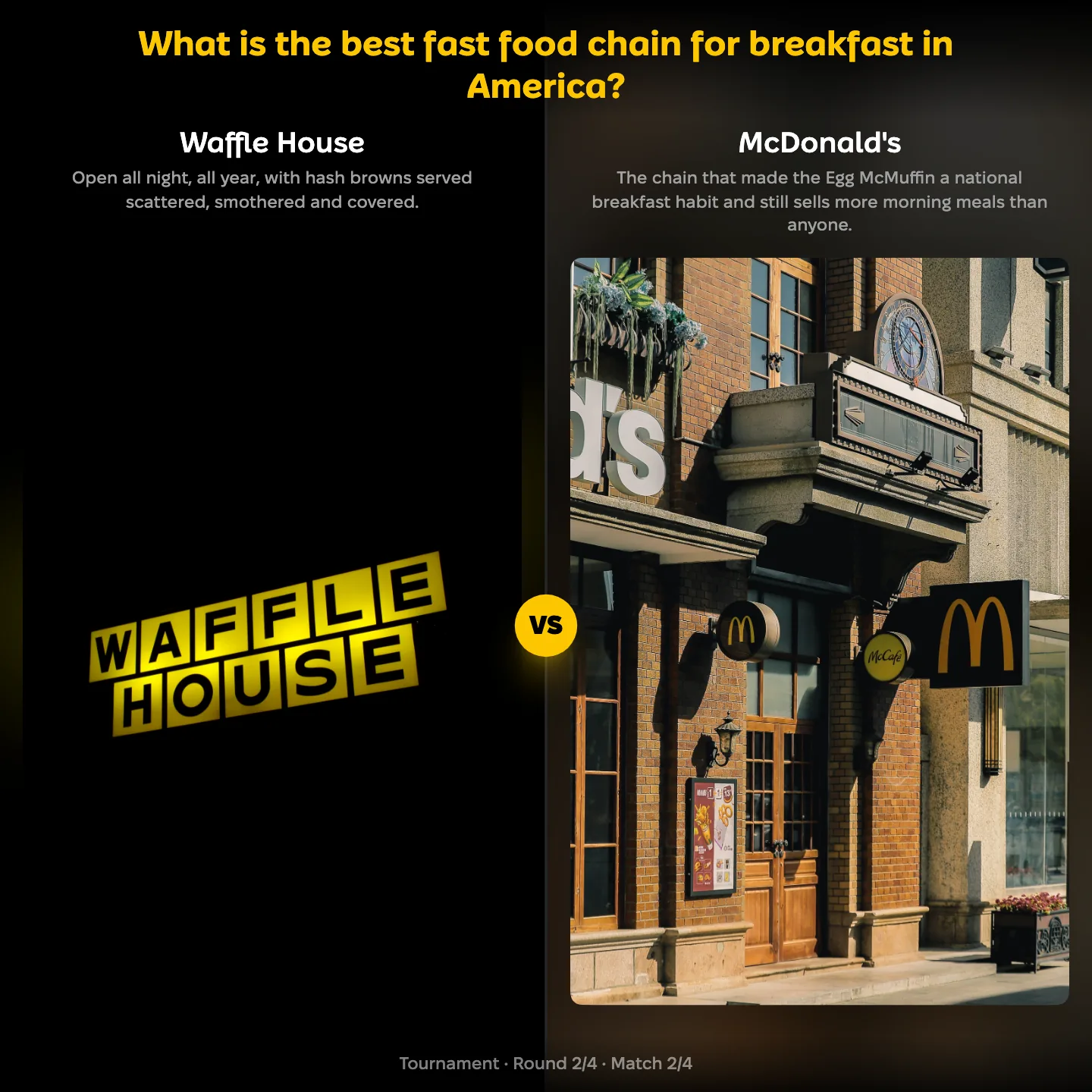
The Egg McMuffin made McDonald's the default American breakfast, and the company still sells more morning meals than any competitor. Its 2026 drinks push added Refreshers and crafted sodas to a menu already built around coffee.
The regional specialists are the interesting part of this list. Bojangles and Biscuitville make biscuits from scratch, and Biscuitville closes at 2pm because breakfast is the entire business. Waffle House never closes at all.
Then there is the chain that quietly wins mornings without selling food at all: Dunkin', and behind it Starbucks, whose customers arrive for the drink and take the sandwich as an afterthought.
McCrispy vs Popeyes: the sandwich war that started without McDonald's
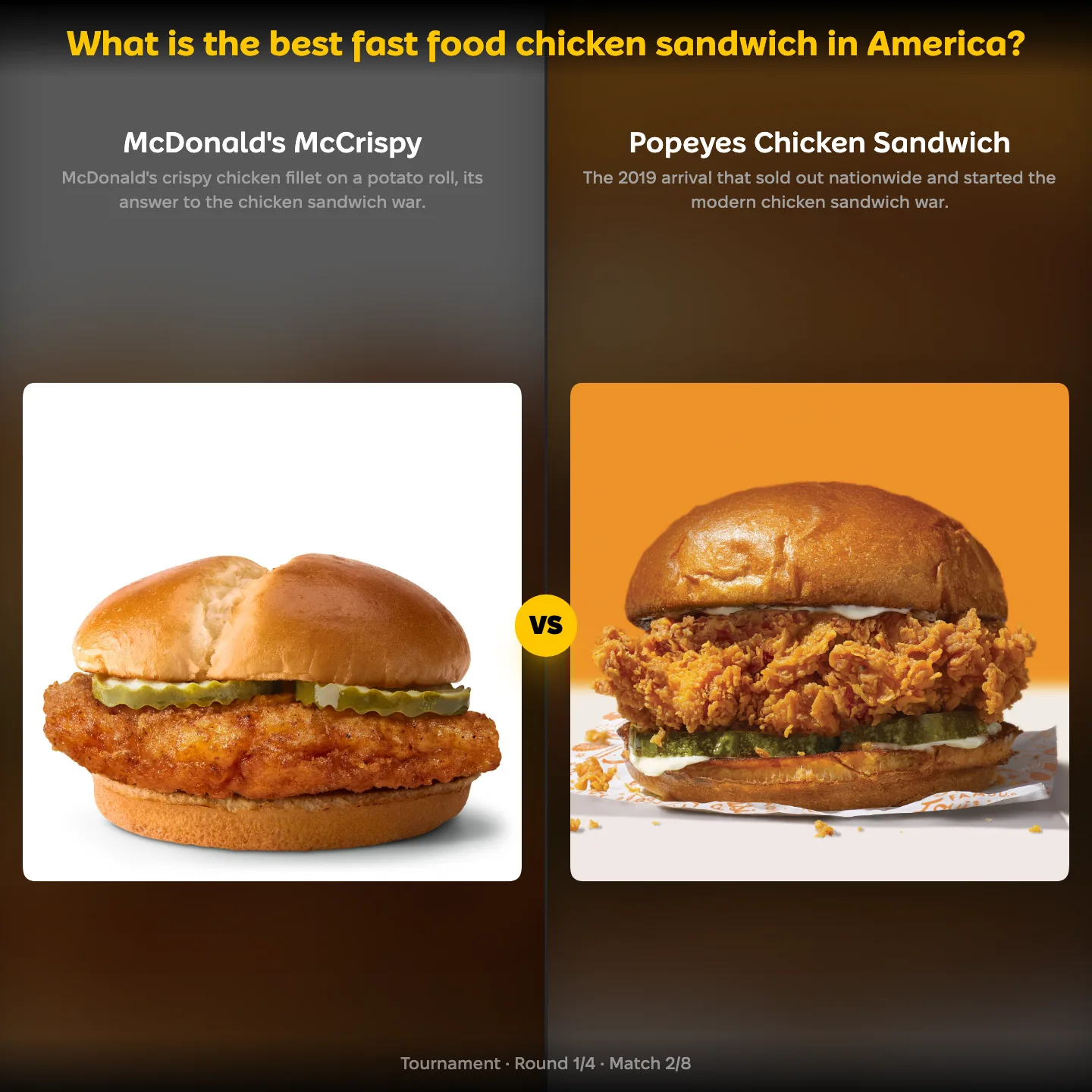
The modern chicken sandwich fight began on 12 August 2019, when Popeyes put a fillet on a brioche bun. The chain had stocked seven weeks of supply and sold out nationwide in two.4 McDonald's was not part of it.
Chick-fil-A had defined the format decades earlier, with a pressure-cooked fillet and two pickle slices, and Popeyes attacked it directly. Wendy's, KFC, Shake Shack and Zaxby's all reformulated inside two years.
McDonald's answer arrived later as the McCrispy, on a potato roll, and in 2026 the company extended it with McCrispy Strips. Arriving third to a category you did not create is a different position from the one it holds in burgers.
The newest names on the list are the ones with no national footprint at all: Dave's Hot Chicken, which grew out of a Los Angeles parking lot, and Jollibee, which came from Manila.
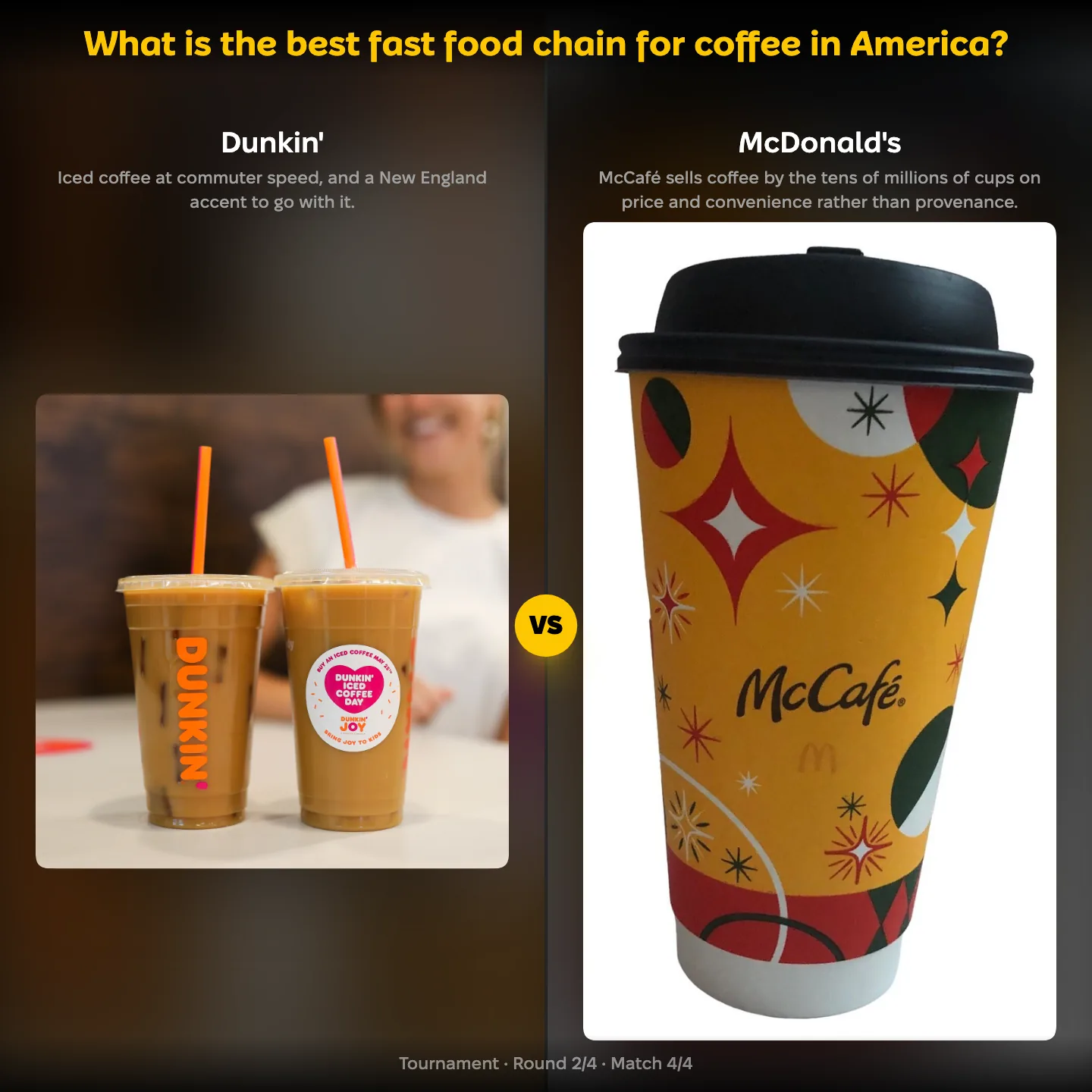
McDonald's sells coffee in volumes no independent roaster will ever approach, on price and on the fact that there is a drive-thru window every few miles.
Volume is not craft, and this ranking is where the two come apart. Starbucks built an entire vocabulary for ordering espresso. Peet's opened in Berkeley in 1966, five years before Starbucks, and taught American cities what a dark roast was.
Dunkin' competes on neither craft nor price but on speed, which is closer to what McCafé actually does.
Coffee loyalty, meanwhile, stays stubbornly local: Dutch Bros from Oregon, Caribou from Minnesota, Wawa in Philadelphia, and a 7-Eleven pot that has fuelled more night shifts than all of them.
The Egg McMuffin enters as a food, not a chain
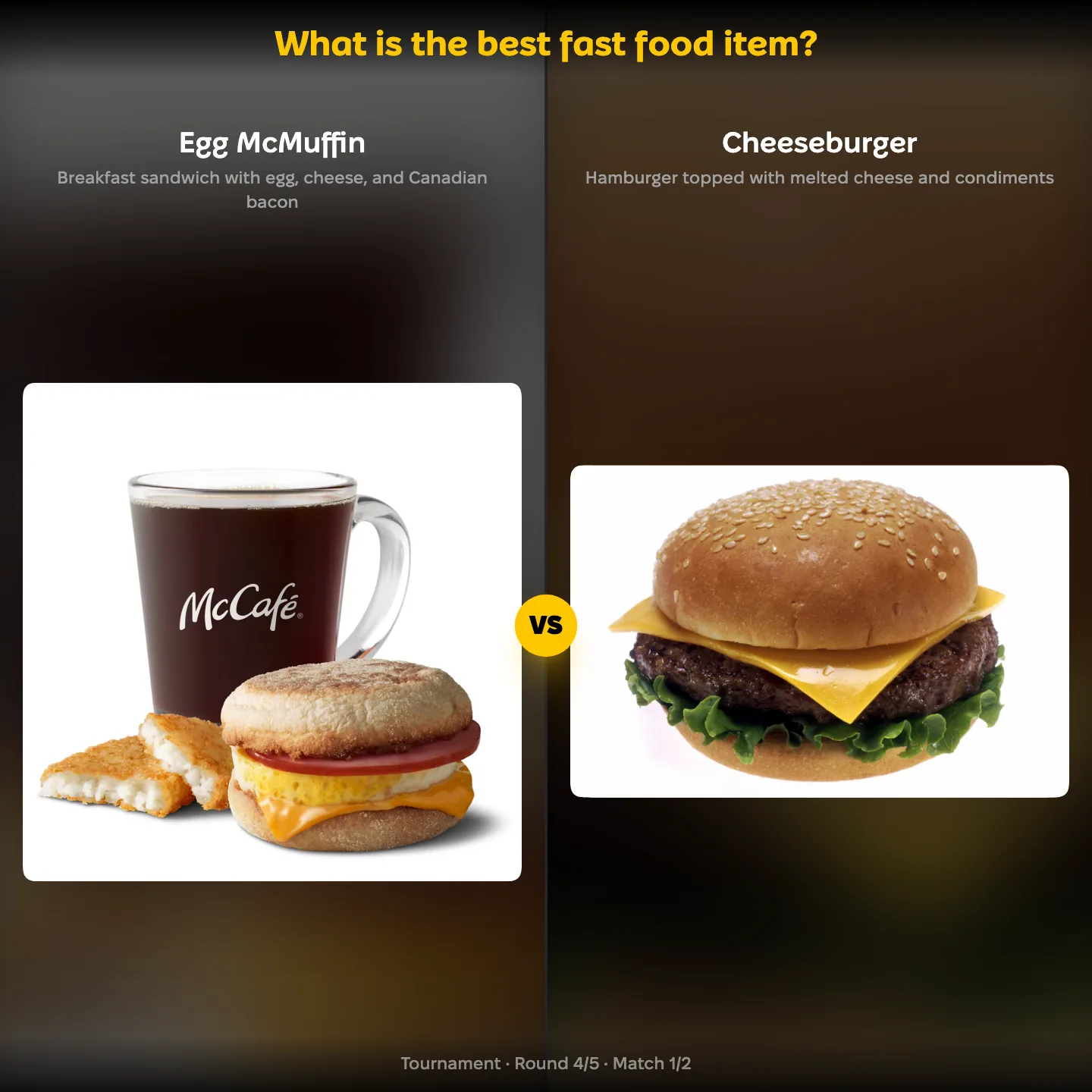
Thirty-two options here, and almost every one is generic: fries, tacos, a cheeseburger, a milkshake, onion rings. Only one carries a brand name.
The Egg McMuffin is there because it is not really a McDonald's product any more. It is a category. Herb Peterson built it in Santa Barbara in 1972 to put eggs Benedict inside a muffin, and every breakfast sandwich sold anywhere since is a variation on his idea.
Nothing else on the McDonald's menu has managed that. A Big Mac is a Big Mac; an Egg McMuffin is what a lot of people call the whole genre.
The company it keeps here is instructive: fried chicken, pizza, tacos, donuts. Foods older than the industry that sells them.
Golden Arches vs Coca-Cola script: judged as design
Now the food is irrelevant. Eighteen American logos, judged on how well a shape carries a company.
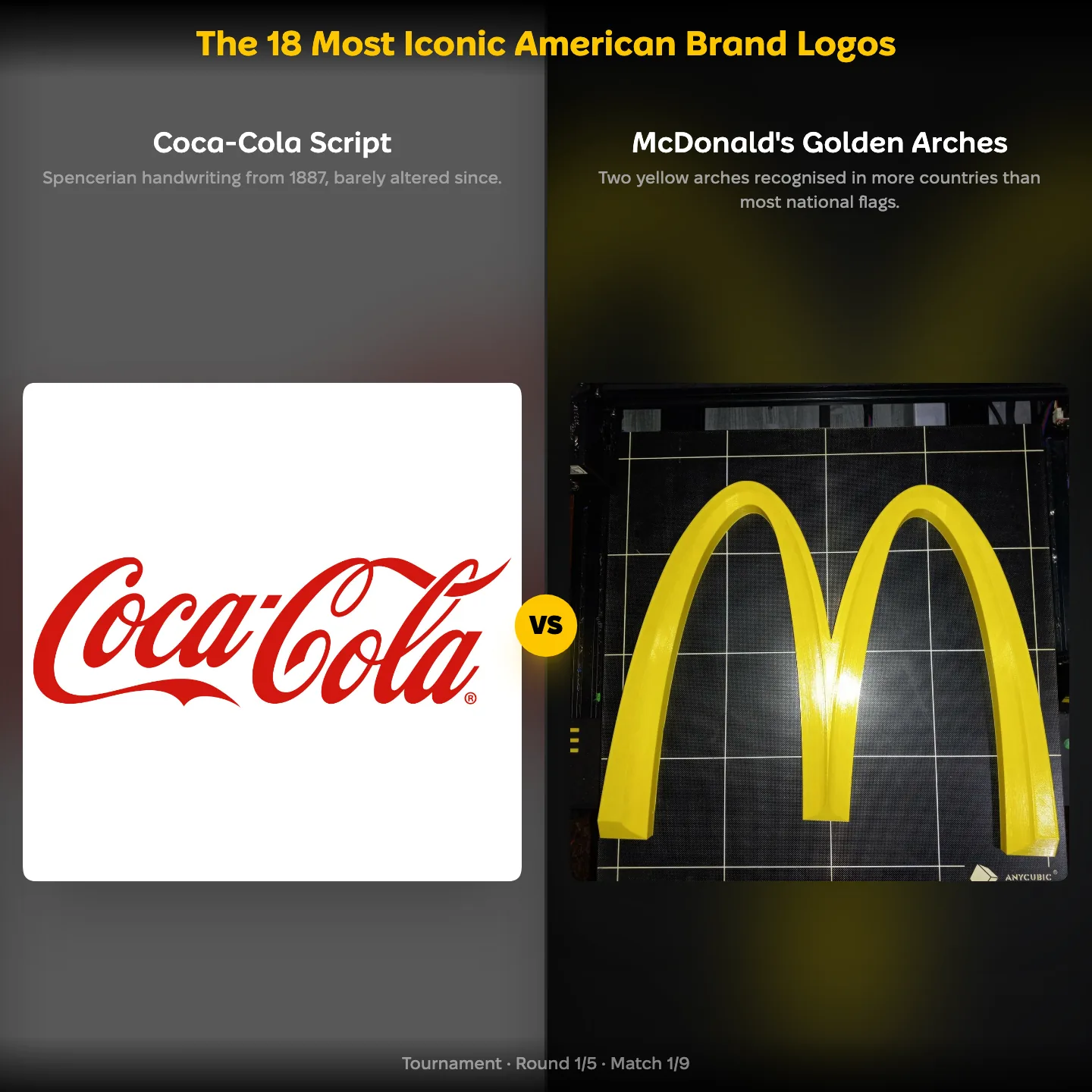
The Golden Arches started as architecture. The 1953 restaurant design in Phoenix had two real yellow arches holding up the building, and the logo is a drawing of a structure that used to exist. It is one of very few marks in the world that works with no name attached.
The competition is heavy. Coca-Cola has used the same Spencerian handwriting since 1886, the year the drink was first sold in an Atlanta soda fountain.5 Nike bought the Swoosh for $35 in 1971. Apple removed its rainbow stripes and lost nothing.
The most interesting neighbours are the ones that stopped needing words: the Playboy bunny, the Michelin Man, the Harley-Davidson bar and shield that people have tattooed on themselves.
Ronald McDonald, Grimace and the Hamburglar walk into one list
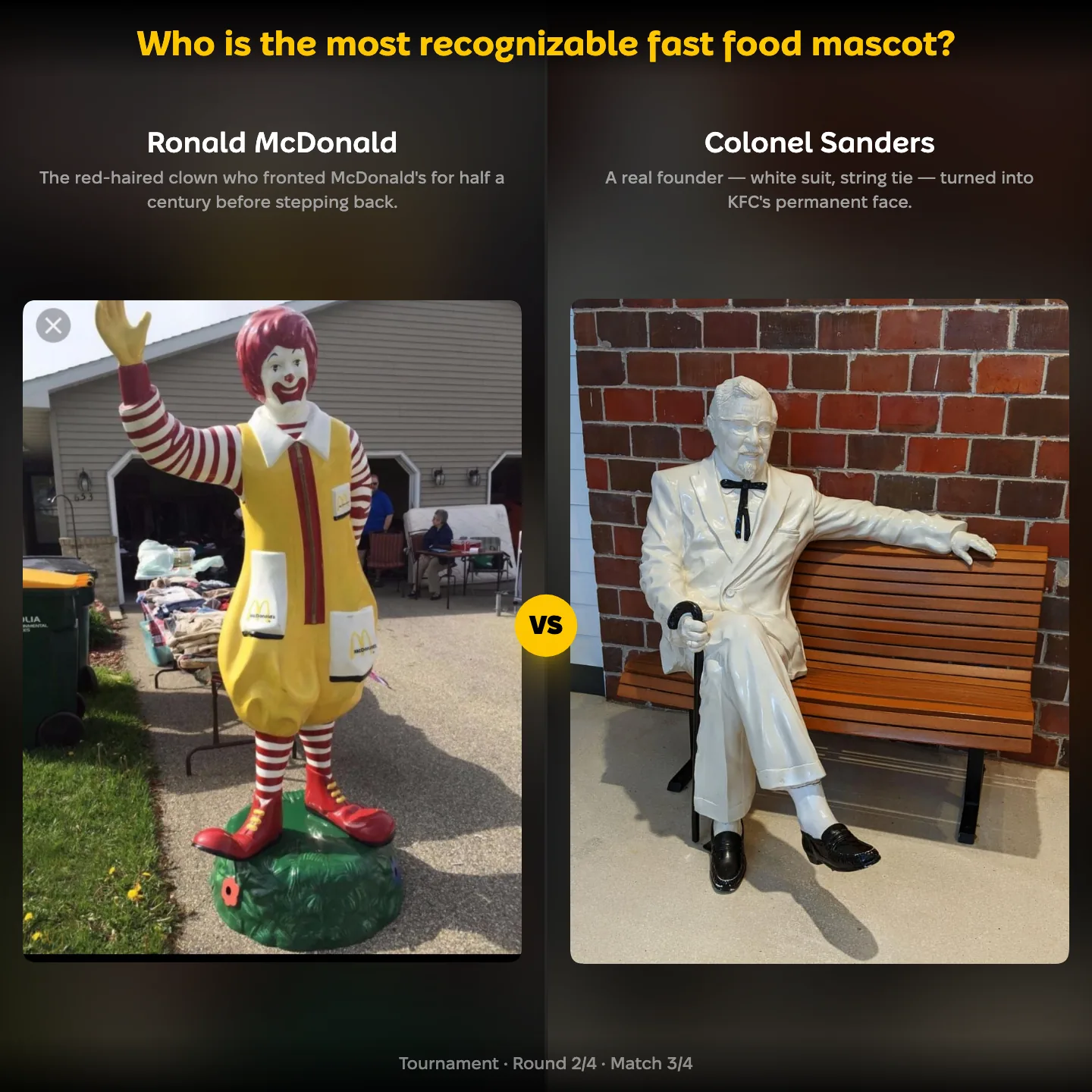
Four of the fourteen candidates on this list work for the same employer. That is why the list is in the article.
Ronald McDonald fronted the brand for roughly half a century before the company quietly stepped him back from advertising. Grimace, invented as a milkshake thief, got a second life in 2023 when a birthday shake became an internet event that had nothing to do with McDonald's marketing plan.
Colonel Sanders is the strongest rival here, and for an unusual reason: he was a real person who franchised his own recipe at 62 and then sold his likeness with the company.
Everything else here is 1980s advertising archaeology: Domino's Noid, Jack Box and his exploding boardroom, and the Chick-fil-A cows who have been misspelling EAT MOR CHIKIN on billboards since 1995.
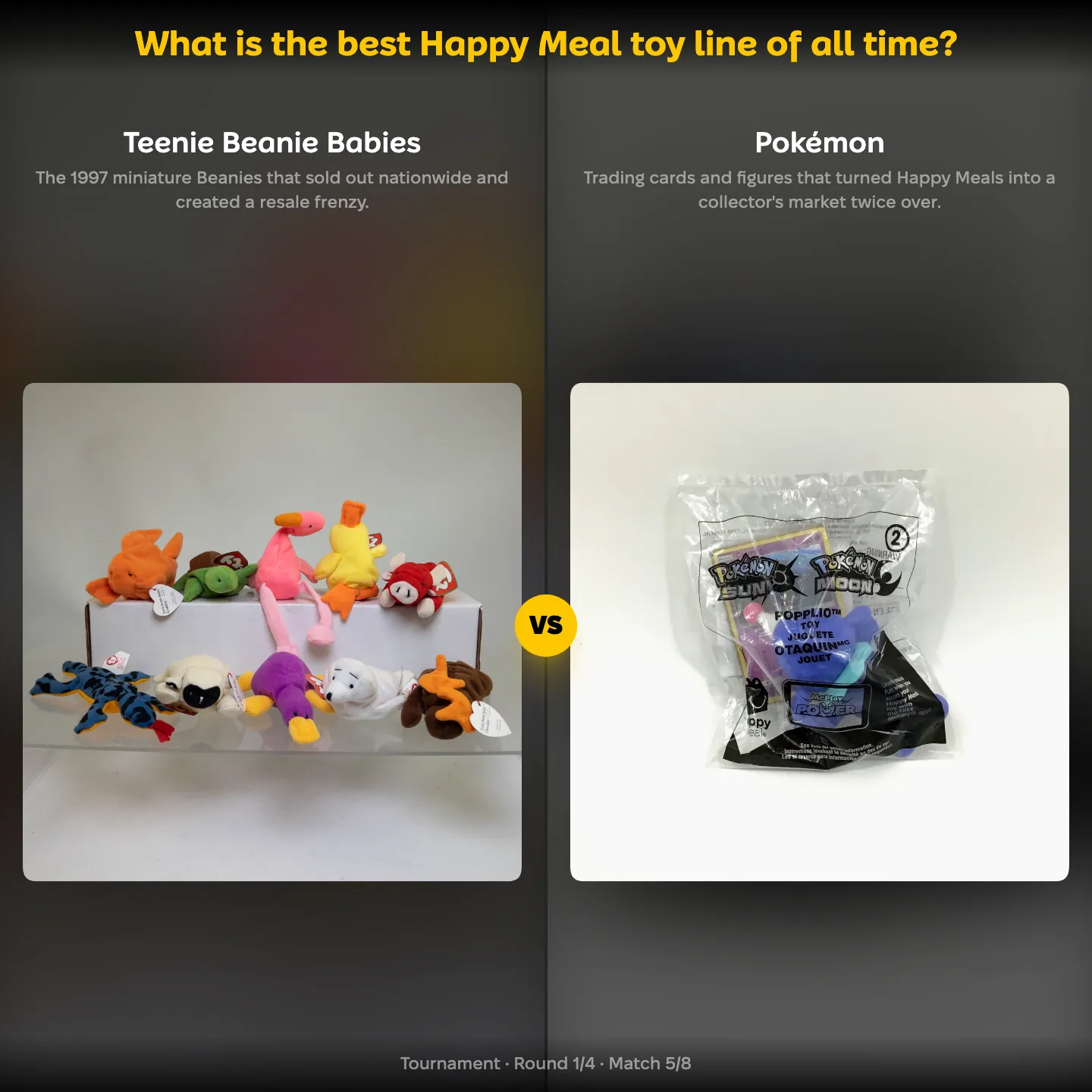
Pokémon, Beanie Babies and the Happy Meal as currency
The Happy Meal went national in June 1979 as the Circus Wagon, with a burger, fries, a drink and a toy that was mostly a cardboard puzzle or a plastic top. It became one of the largest toy distribution systems on earth.
Two runs turned it into a market. The 1997 Teenie Beanie Babies sold out nationwide and moved onto resale listings within days. The Pokémon tie-ins did it again, twice, and 2026 brought a card-based Happy Meal timed to the franchise's 30th anniversary.
Some of the toys were genuinely well designed. The Changeables turned a carton of fries into a robot at the height of Transformers, and the 1995 Inspector Gadget set built one figure across a run of meals.
The 2026 Stranger Things box shows how the format has changed: twelve collectible figures, themed packaging and a QR code that opens a digital game. The toy is now a distribution channel for a franchise rather than a prize at the bottom of a box.
That is also the argument against most of these runs. A Furby made of hard plastic is a marketing object; the Changeables were a genuinely clever piece of industrial design.
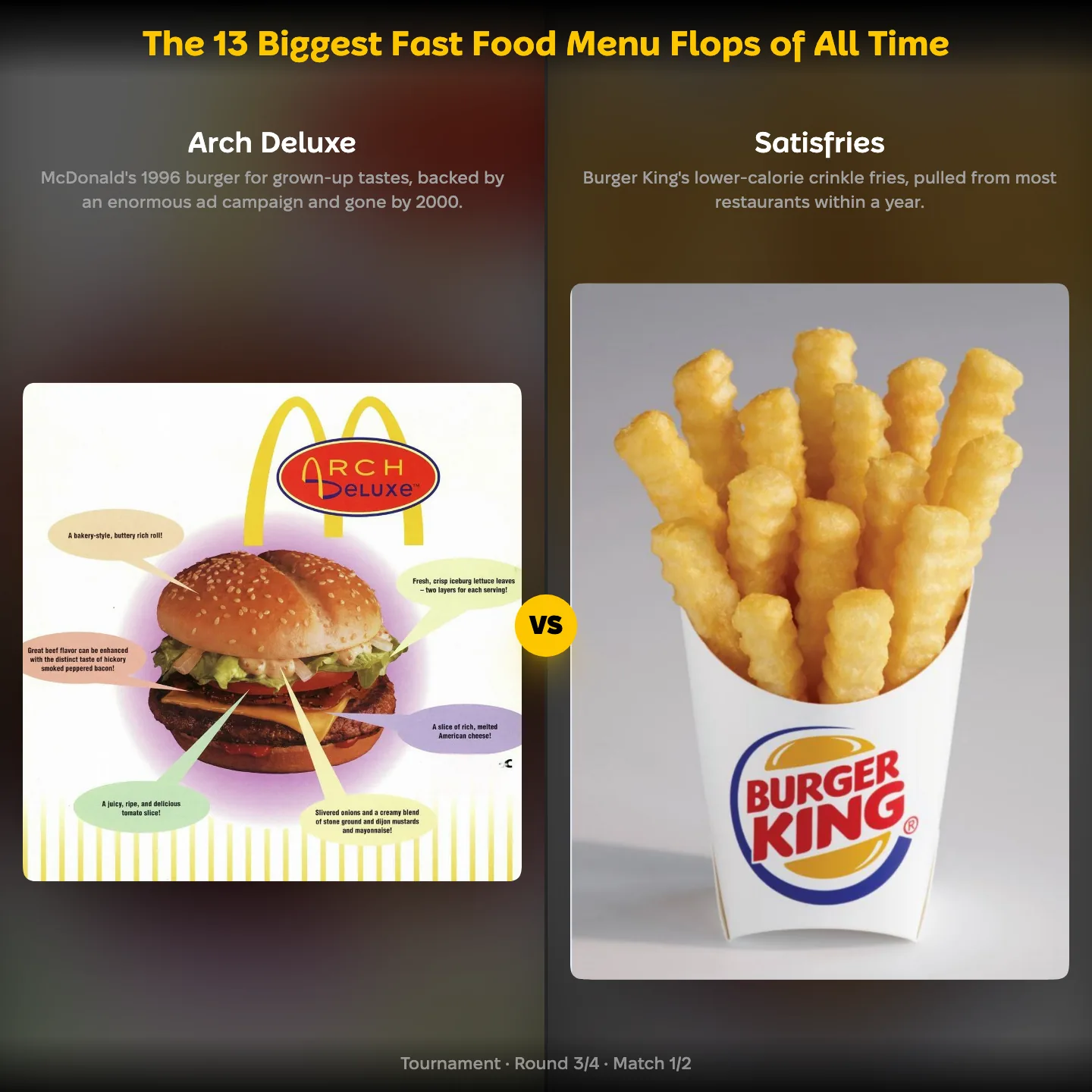
Arch Deluxe, 1996: the burger for grown-up tastes
An inverted ranking, and McDonald's holds three of the thirteen entries.
The Arch Deluxe was sold as the burger with the grown-up taste, launched in 1996 behind a marketing campaign that ran into the hundreds of millions of dollars, and it failed on research that had asked the wrong customers what they wanted.6
The other two are the McLean Deluxe, a 91% fat-free burger bulked out with seaweed extract, and McDonald's Pizza, which was a reasonable product killed by how long it took to bake.
Everyone else on the list has a comparable story, and most of them are about the kitchen rather than the recipe. Burger King's Satisfries, a lower-calorie crinkle fry, lasted about a year. Pizza Hut's Priazzo was a stuffed deep-dish pizza that arrived with heavy advertising and could not be assembled at drive-thru speed. Wendy's ran an all-you-can-eat Superbar inside a burger restaurant until the labour arithmetic caught up with it.
Failure in this industry is almost always an operations problem wearing a menu item's clothes. The Arch Deluxe needed a different bun, a different sauce and a different cooking routine, all of it landing on franchisees who were already running the fastest kitchen in the country.
Super Size Me: the list where McDonald's is the antagonist
The last ranking is about cinema, and McDonald's is in it as the thing the film is attacking.
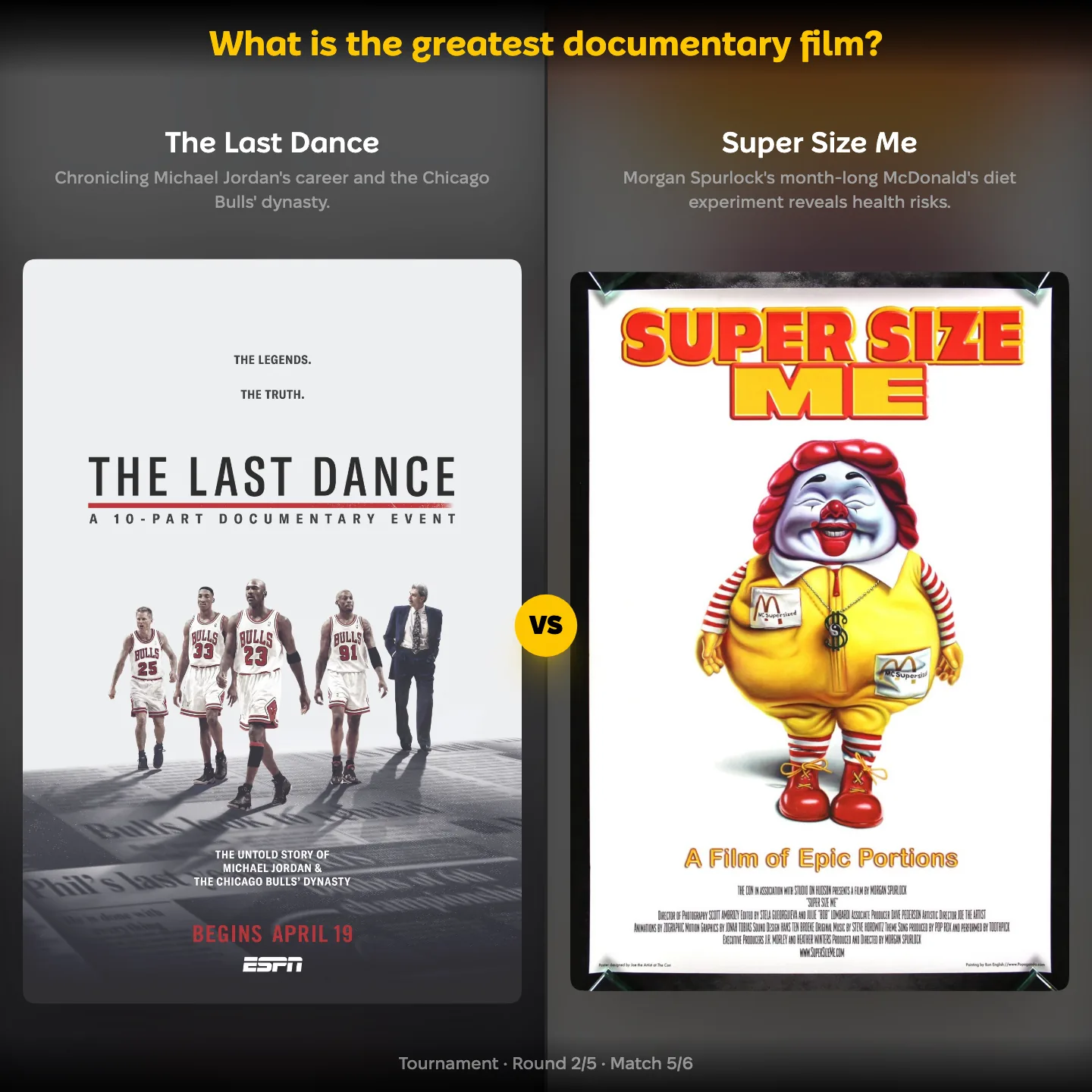
Morgan Spurlock ate nothing but McDonald's for thirty days in 2003 and released Super Size Me in 2004. He gained more than twenty pounds, alarmed his own doctors, and made the most commercially successful case against a menu ever filmed.
The company it sits among is serious documentary: The Act of Killing, Citizenfour, The Fog of War, Free Solo, The Last Dance. Spurlock's film is the one in that group whose subject is a corporation rather than a person, a war or a wild animal.
Of the fourteen rankings here, this is the one where nobody put McDonald's on the list to flatter it. The film is on it because it worked: within a few years the industry was pulling trans fats, printing calorie counts and adding salads that almost nobody ordered.
Blackfish did the same thing to SeaWorld and Food, Inc. to industrial agriculture, so the pattern is not unique. What is unusual is the size of the target.
Fourteen categories, one company that had to be included in all of them
Nothing here required McDonald's to be excellent. It required McDonald's to be unavoidable — in coffee, in toys, in graphic design, in a documentary about its own food. A smaller company gets left off most of those lists, and nobody notices.
None of that is levelling off. The same annual report sets the target at 50,000 restaurants by the end of 2027, which the company says would be the fastest unit growth in its history.1
Every ranking here works by comparing two options at a time until an order appears, so your own answer to any of these takes about a minute.
If your local chain belongs in one of these arguments and is missing from it, build the ranking that puts it there.
More rankings, more angles
- How Chocolate Ends Up on 15 Unrelated Lists — one ingredient, from desserts to candy brands
- Pizza: Naples Made It, Detroit Squared It, Chicago Went Deep — the other food sold by the billion
- Cheese: One Ingredient, 15 Job Descriptions — one ingredient with fifteen job descriptions
- Starbucks vs Dunkin': 1950 in Quincy, 1971 in Seattle — Seattle against New England, cup by cup
Sources
- McDonald's Corporation — 2025 Form 10-K: restaurant and franchise counts, US restaurants, $139.4bn systemwide sales, and the 50,000-restaurant target for 2027: sec.gov (checked 2026-08-03)
- Nation's Restaurant News — Big Arch US launch date, build and global rollout plan: nrn.com (checked 2026-08-03)
- Nation's Restaurant News — Big Arch first-week US traffic, 2.2% year on year (Placer.ai data): nrn.com (checked 2026-08-03)
- The Takeout — Popeyes chicken sandwich timeline: 12 August 2019 launch, seven weeks of stock, sold out in two: thetakeout.com (checked 2026-08-03)
- The Coca-Cola Company — company history, the 1886 Atlanta soda fountain: coca-colacompany.com (checked 2026-08-03)
- The Takeout — the Arch Deluxe launch, its marketing spend and the research behind the failure: thetakeout.com (checked 2026-08-03)