
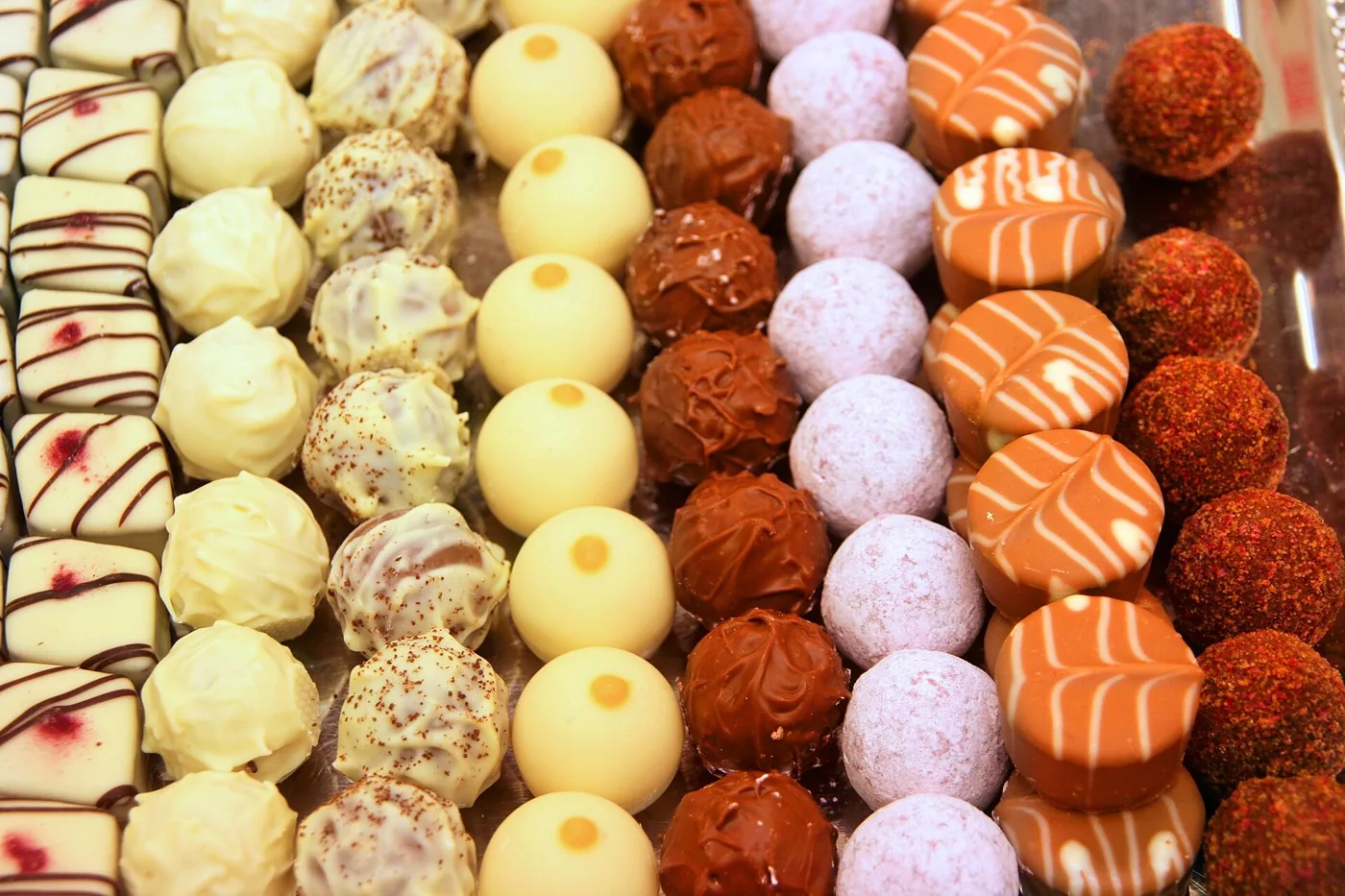
Chocolate was a drink long before anyone thought to bite it, and it is now the most reshaped ingredient in the kitchen. Two countries grow about half of it: the International Cocoa Organization put Côte d'Ivoire at 1.85 million tonnes and Ghana at 600,000 for the 2024/25 crop, out of a world total of 4.84 million.1 The price of that crop wrote the food trade's biggest story of the decade, and cocoa finished the last trading day of December 2024 at US$11,441 a tonne in London and US$11,545 in New York after a year of heat, drought and harmattan winds across West Africa.2
Fifteen rankings on this site carry chocolate among their options. It qualifies for hardly any of them as itself.
Chocolate enters the dessert list as a cake, the drinks list as a mug, the cereal aisle as a puff and the film list as a title. No other ingredient has to change shape to be judged at all.
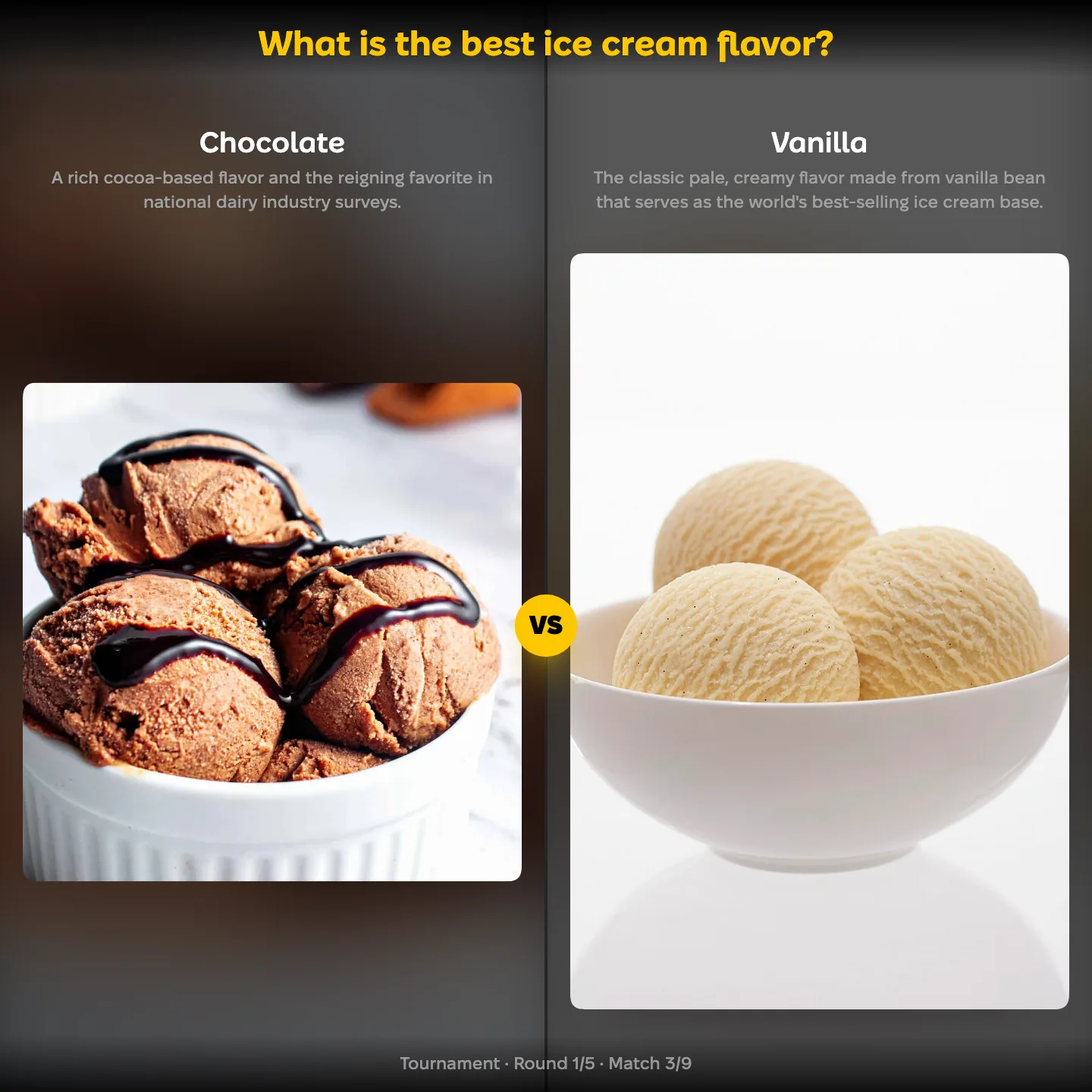
Chocolate vs vanilla: America changed its mind in 2026
The ice cream flavour ranking is the one place chocolate competes as itself. No cake around it, no wrapper, no wafer.
Its rival there has just been overtaken. The International Dairy Foods Association asked 2,205 American adults in April 2026 which flavour they liked best, and chocolate came back at number one ahead of butter pecan, with vanilla third; vanilla had held the top spot two years earlier.3
Reach is the other half of chocolate's case. Of the seventeen flavours on the list, three more are chocolate wearing something else: mint chocolate chip, chocolate chip cookie dough, and rocky road, which adds marshmallow and nuts to the same base.
Vanilla has no such family.
To enter the world's dessert list, chocolate has to become a cake
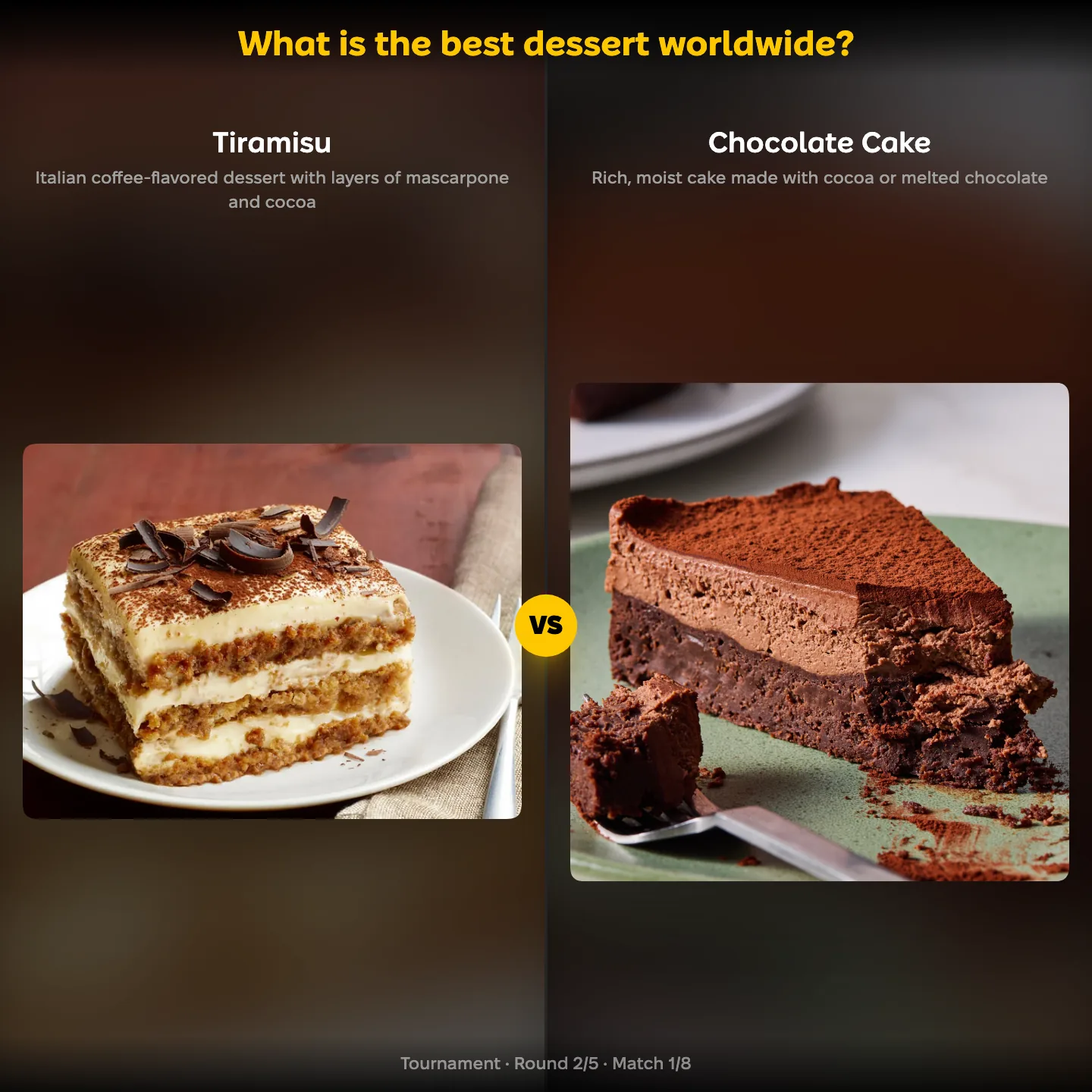
The best-dessert-worldwide ranking holds 31 options from a dozen cuisines, and chocolate cannot enter it as chocolate. It has to arrive as a chocolate cake or a chocolate mousse — a recipe rather than an ingredient.
Chocolate cake is younger than most people assume. Europeans were drinking cocoa daily for generations before anyone thought to bake it into a sponge.
Its opponent here is Italian and younger still. Tiramisu is a 20th-century invention built on mascarpone, coffee and savoiardi biscuits, and it has travelled far enough that most countries now treat it as a local dessert.
The list also holds baklava, flan, churros, pavlova and Japanese-style cheesecake. On a global dessert list, chocolate is one tradition among many rather than the default.
Snickers vs Kit Kat: twenty-four bars, all of them chocolate
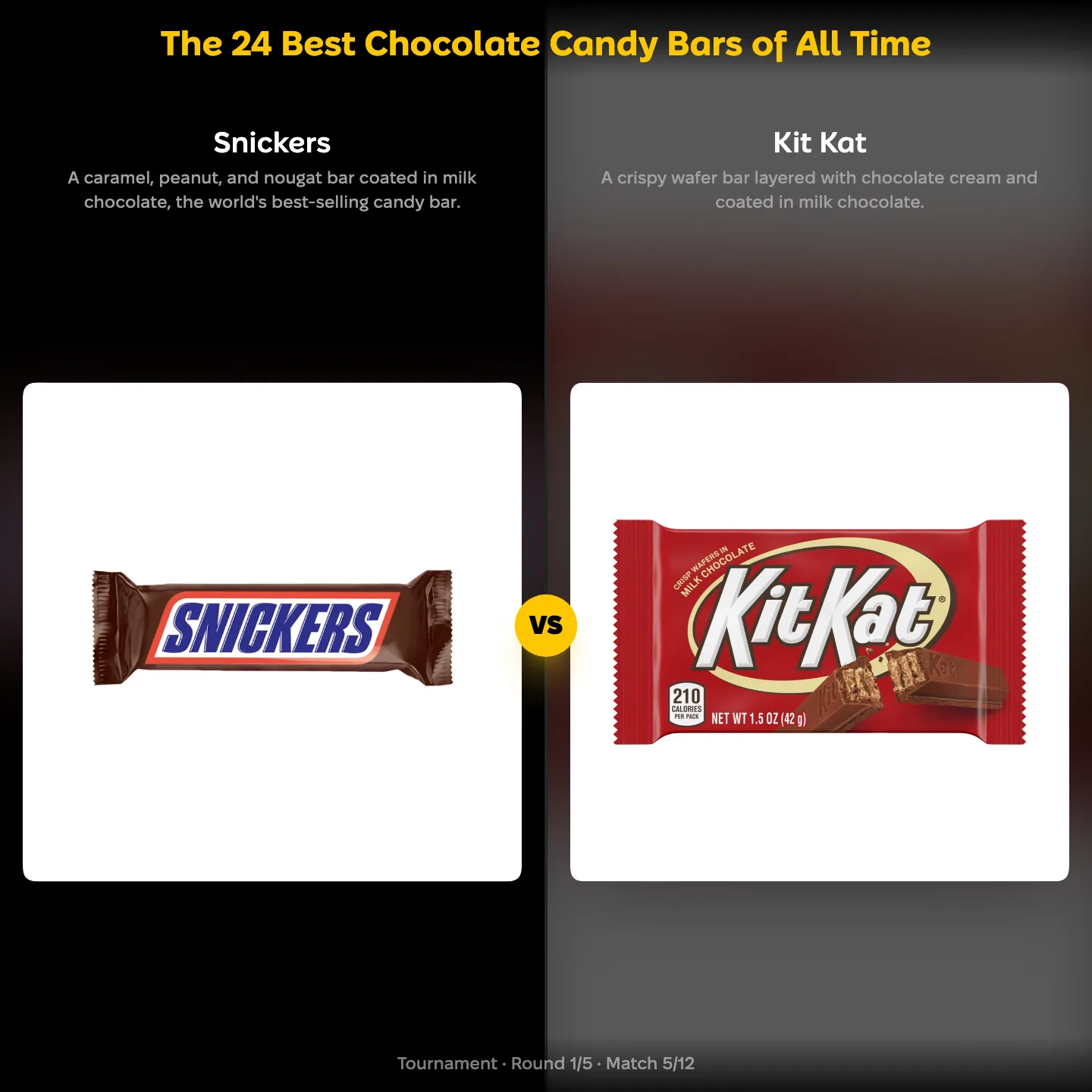
The chocolate candy bar ranking is where the ingredient stops being the question and becomes the category. Every one of its 24 options is chocolate, so the comparison moves to whatever sits inside the shell.
Snickers has been running since 1930, the year Mars launched it.4 Peanuts, caramel and nougat make it the most heavily engineered bar on the list.
Kit Kat came out of Rowntree's in York in 1935 under the name Chocolate Crisp and took its current one in 1937.5 Nestlé makes it everywhere except the United States, where Hershey has sold it since 1970.6 Its structure is the opposite of Snickers: wafer, air, and a thin chocolate shell.
Toblerone, Butterfinger, Kinder Bueno and Cadbury Dairy Milk fill out the field, which spans four countries and about a century of confectionery.
Ferrero Rocher is a present, Reese's is a purchase
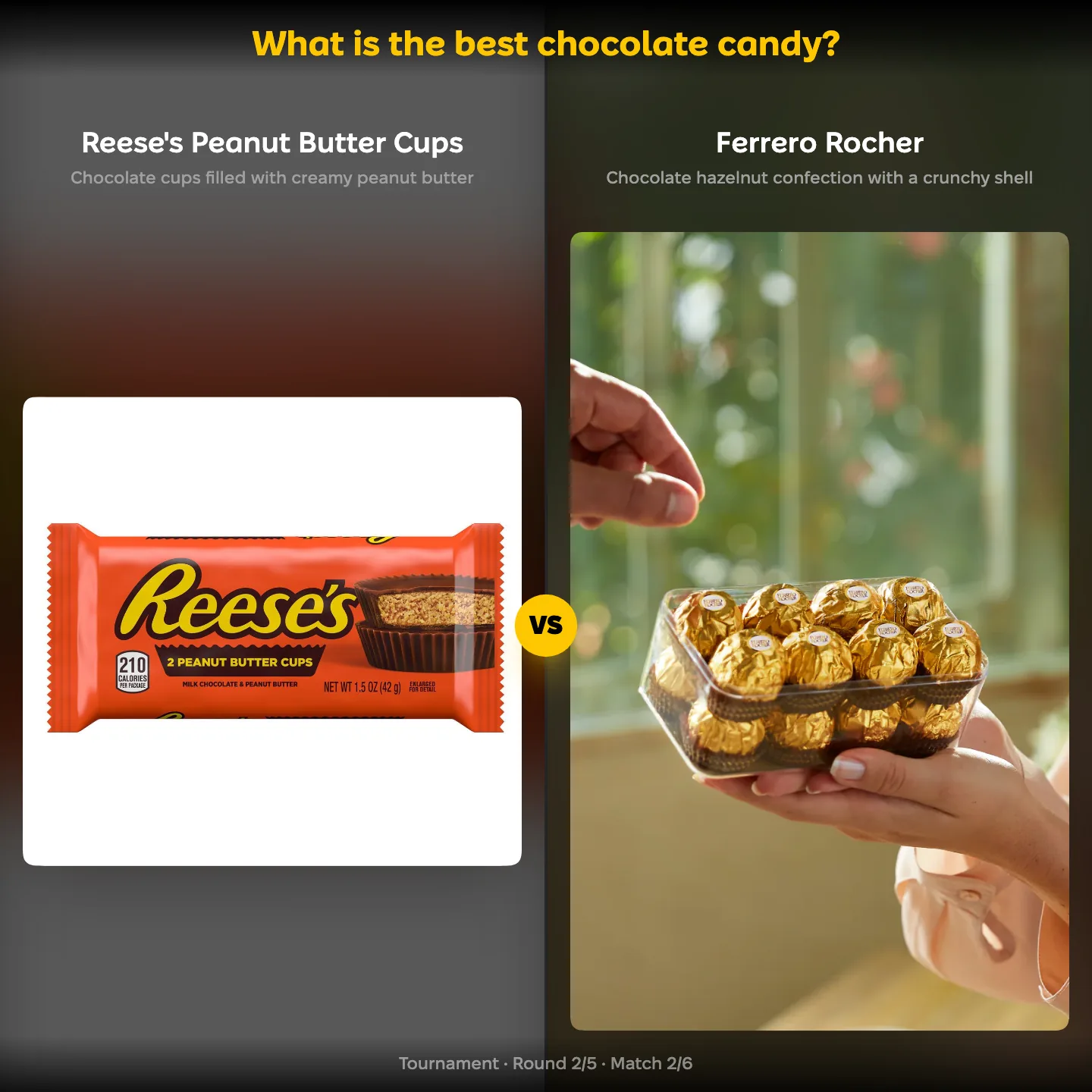
The best chocolate candy ranking mixes two businesses that share nothing but cocoa: boxed confectionery bought as a gift, and wrapped sweets bought at a till.
Ferrero Rocher belongs to the first. Ferrero created it in 1982 in Alba, in the hills of Piedmont,7 and what it sells is a hazelnut, a wafer shell, gold foil and a shape made to be handed to someone.
Reese's Peanut Butter Cups belong to the second. H.B. Reese, a former Hershey employee, invented them in 1928, and his sons sold the business to Hershey in 1963.6
Godiva, Lindt, Tootsie Rolls and Whoppers are on the same list — a price range of roughly twenty to one for the same raw material.
Valrhona, Godiva and chocolate as a company
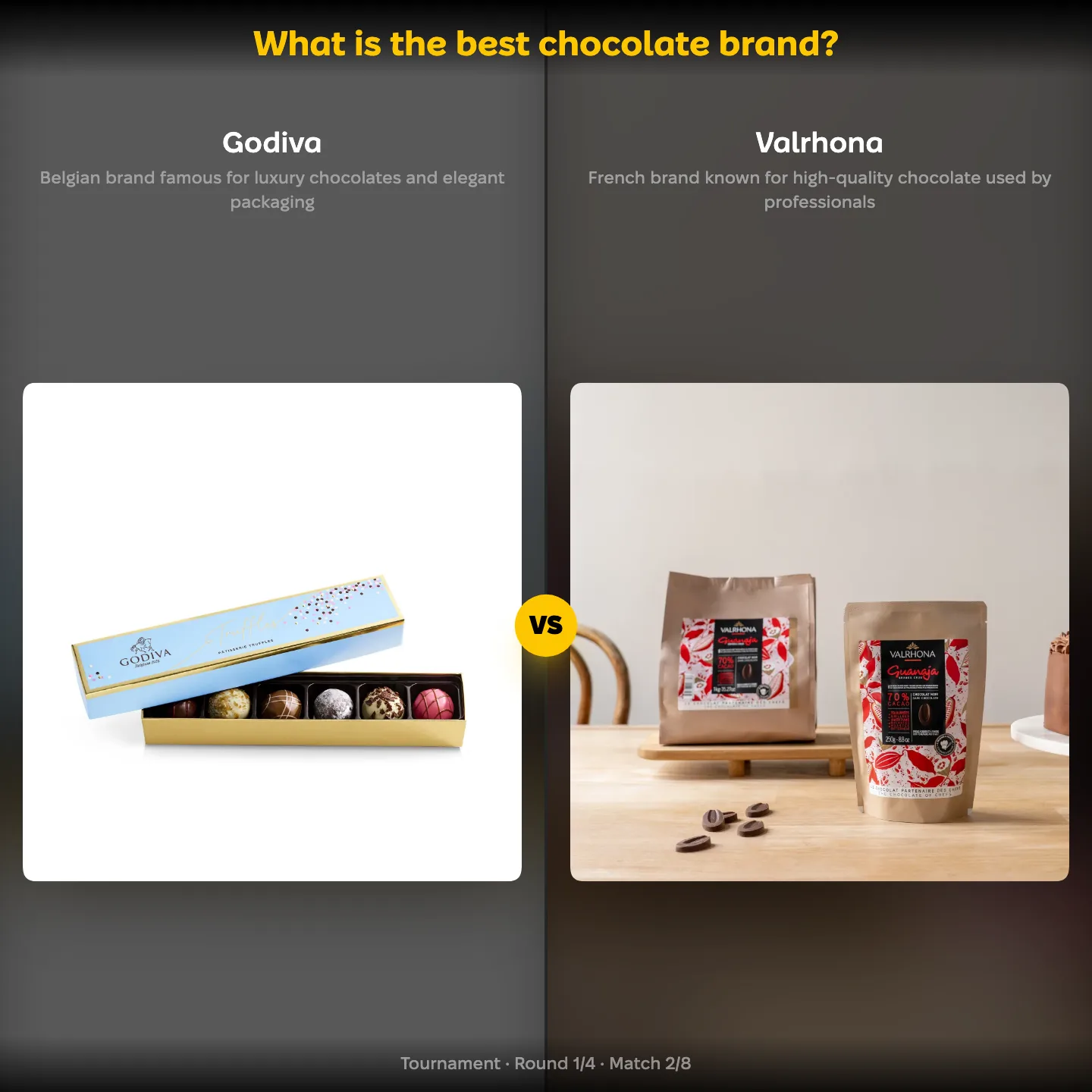
Ask for the best chocolate brand and the options stop being food. They are firms, most of them older than the packaging they are known for.
Valrhona is the one professionals name. It sells couverture to kitchens rather than bars to shoppers, and its Guanaja label is a fixture in restaurant desserts.
Godiva went at it from the other end. It made the gift box the product, and the ballotin and the shop window do work the recipe alone would not.
Cadbury, Hershey's, Milka, Nestlé and Mars sit on the same list, which weighs a chef's supplier against companies selling chocolate by the hundred thousand tonnes.
All of them answer to the bean price, and it has been moving fast. Cocoa in London slid from about US$6,320 to US$5,808 a tonne over October 2025 alone,8 while shoppers felt none of the relief — the US Department of Agriculture put sugar and sweets 6.9% higher in June 2026 than a year earlier and forecasts a 7.2% rise across 2026.9
Sachertorte, Vienna, 1832
The best chocolate dessert ranking removes the ingredient as a variable. All 15 options are chocolate, so what gets compared is method.
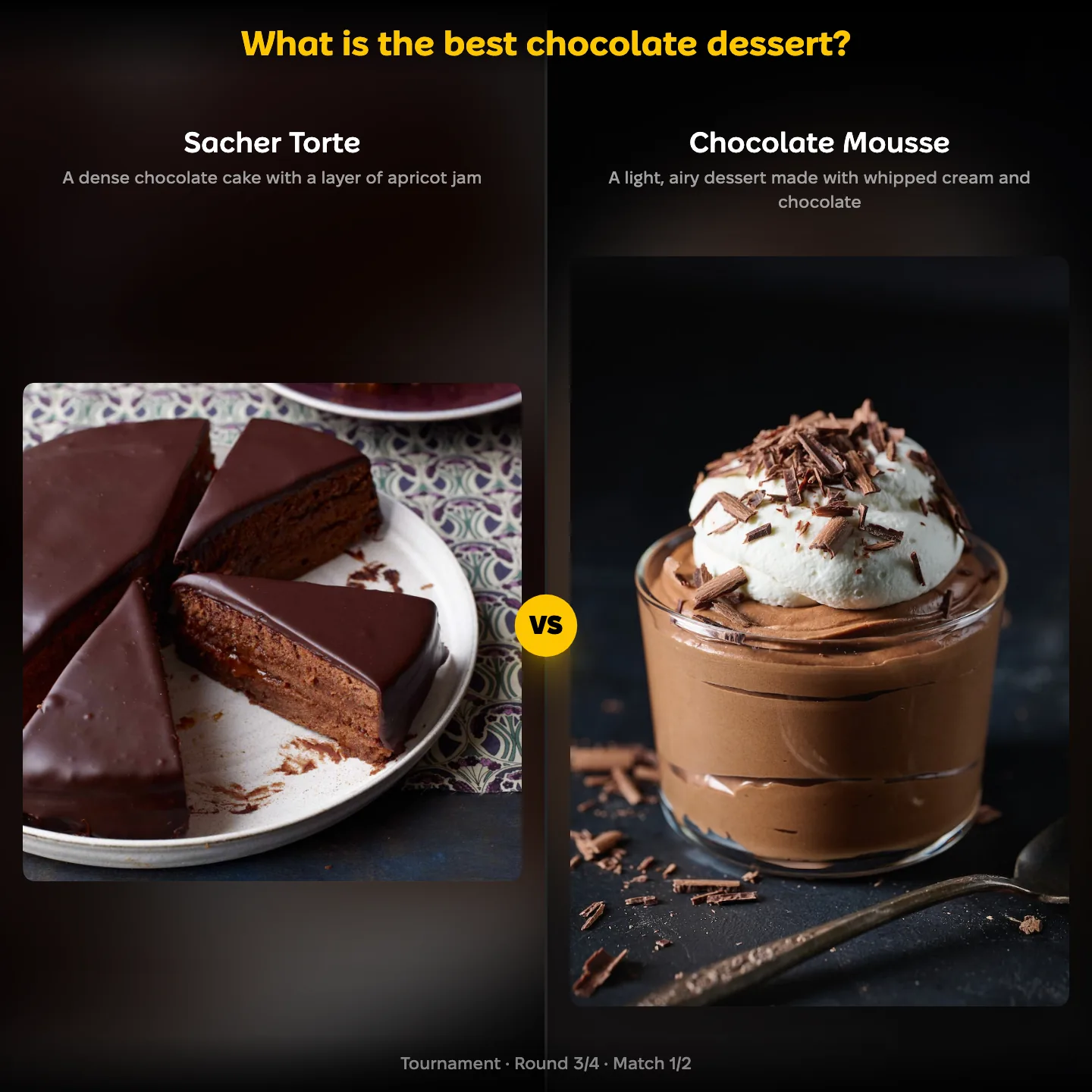
Sachertorte has the best-documented origin on the list. Hotel Sacher's own account has the court chef falling ill in Prince Metternich's kitchen in 1832 and a 16-year-old apprentice, Franz Sacher, standing in for him.10
Chocolate mousse is the opposite discipline: no baking, no assembly, just eggs, cream and air. It sits closer to a technique than a recipe, which is why no single kitchen claims it.
Lava cake, soufflé, ganache, truffles and fondue complete a list that is really about what heat and air do to the same bar.
M&M's Milk Chocolate is the control group
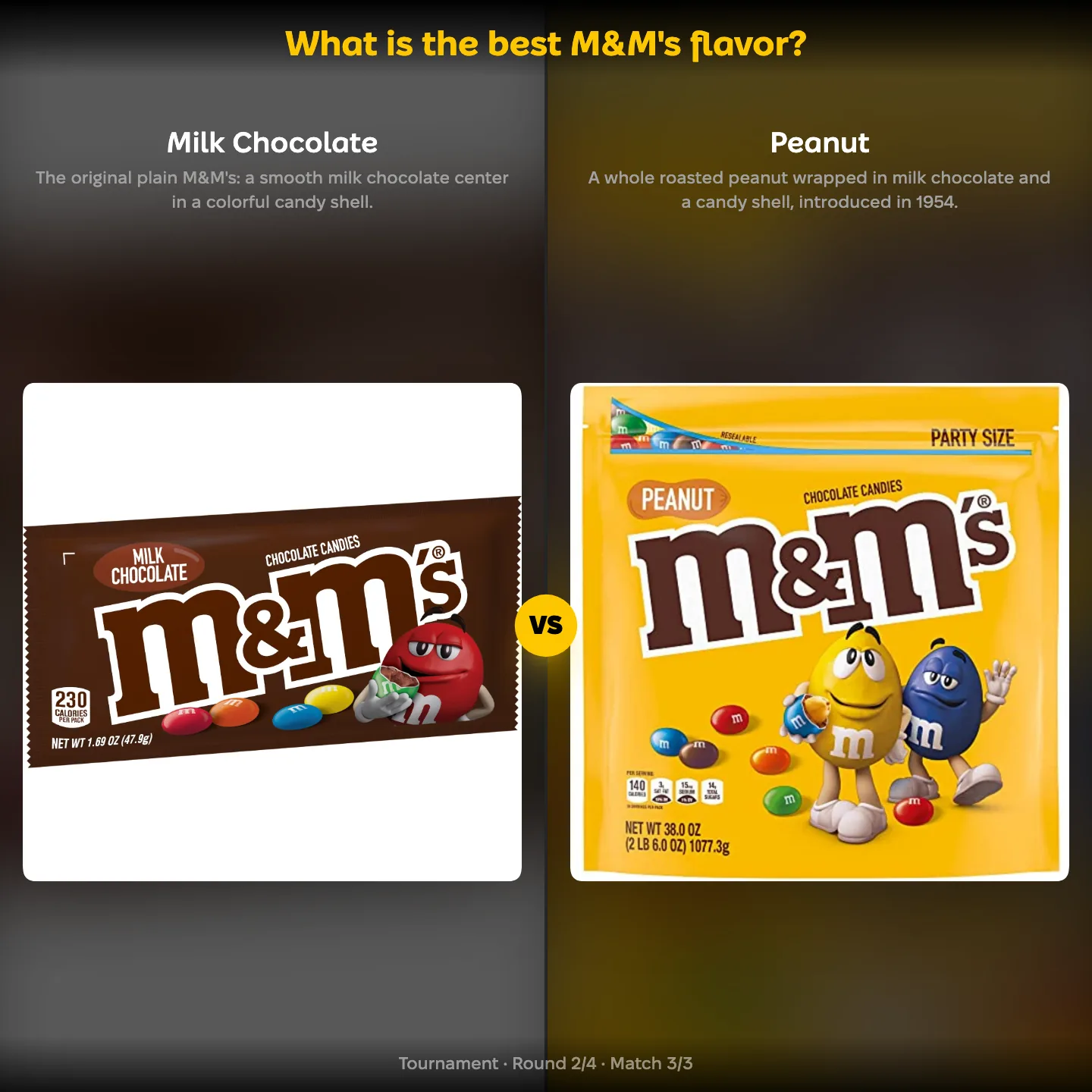
The M&M's flavour ranking shrinks the question to eleven variants of one sweet, and Milk Chocolate is the original against which the other ten get measured.
The sweet was built for the army before it was built for shops. Mars first made M&M's for the US military in 1941 and only launched the brand to the public in 1945,4 because the sugar shell survived heat a bare bar would not.
Peanut has been the main rival ever since. It changes the texture, the size and the calorie count, and it is why the plain version needs a name at all.
Dark Chocolate, Almond, Caramel, Pretzel, Crunchy Cookie and Fudge Brownie make up the rest, in a ranking where chocolate is the constant and everything else is the variable.
At the Dairy Queen drive-through, chocolate becomes a chunk
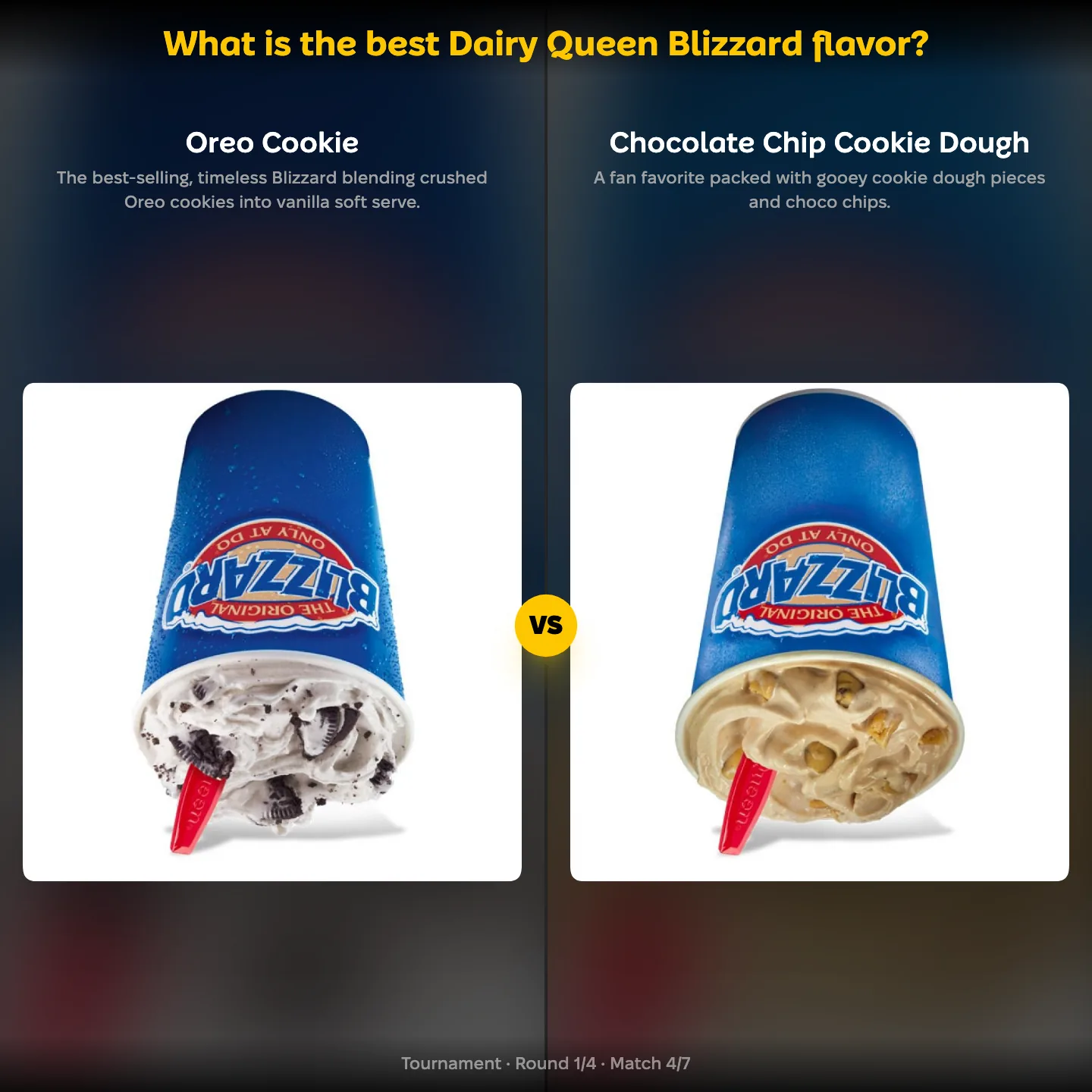
The Dairy Queen Blizzard ranking is a fast-food list, and it treats chocolate as an inclusion rather than a flavour: something broken into soft serve by the spoonful.
Chocolate Chip Cookie Dough works that way. The dough carries the chocolate, and the chocolate arrives in pieces small enough to survive the machine that flips the cup upside down.
Oreo Cookie does the same job with a biscuit that is itself chocolate.
Snickers, Butterfinger, Heath, Reese's and Turtle Pecan Cluster round out a menu where almost every option is a chocolate product that used to be sold as a bar.
A supporting role, measured by what it improves
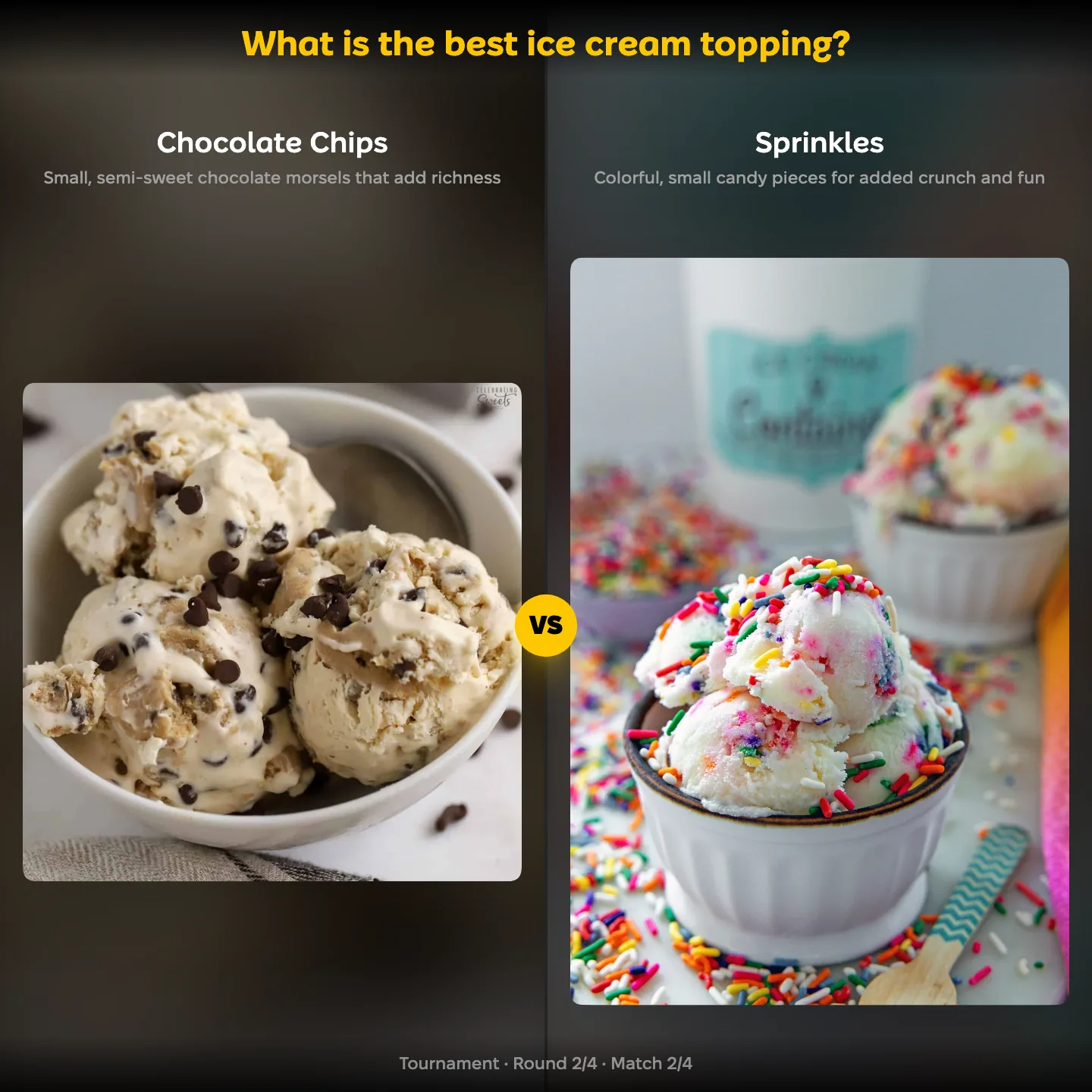
The best ice cream topping ranking asks the smallest question chocolate faces in this article. The test is what a spoonful does to the scoop underneath.
Chocolate chips are a shape invented for baking that ended up on sundaes. They exist because a cookie recipe needed chopped chocolate, and the pieces held their edges.
Sprinkles answer a different brief. Their job is colour and crunch rather than taste.
Hot fudge, caramel sauce, whipped cream, crushed Oreos and brownie pieces make up the rest, and four of the fourteen options are chocolate in some form. The ingredient is over-represented here precisely because it works as a supporting part.
Hot chocolate against coffee, water and tea
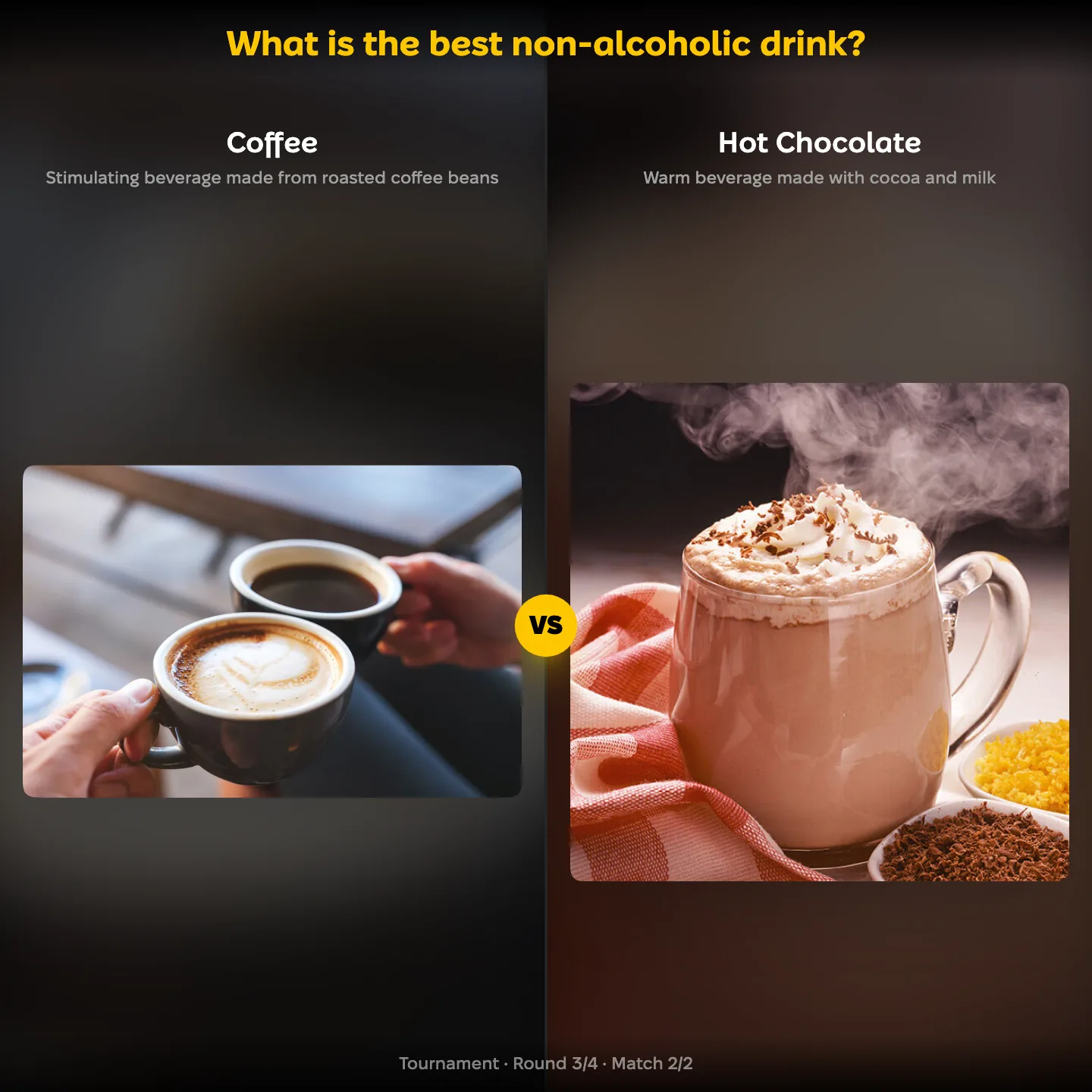
The best non-alcoholic drink ranking returns chocolate to what it was for most of its history. Cacao was drunk in Mesoamerica long before Europe saw a bean, and Europe drank it for two centuries before anyone pressed it into a bar.
Hot chocolate enters that list against water, milk, juice and tea — a harder field than any dessert list.
Coffee is the specific problem. It owns the morning, helped by caffeine that chocolate carries only in traces.
Sixteen drinks are on the list, and hot chocolate is the only one that is also a dessert, a bar and a cake elsewhere in this article.
Breakfast is where chocolate has to pass as cereal
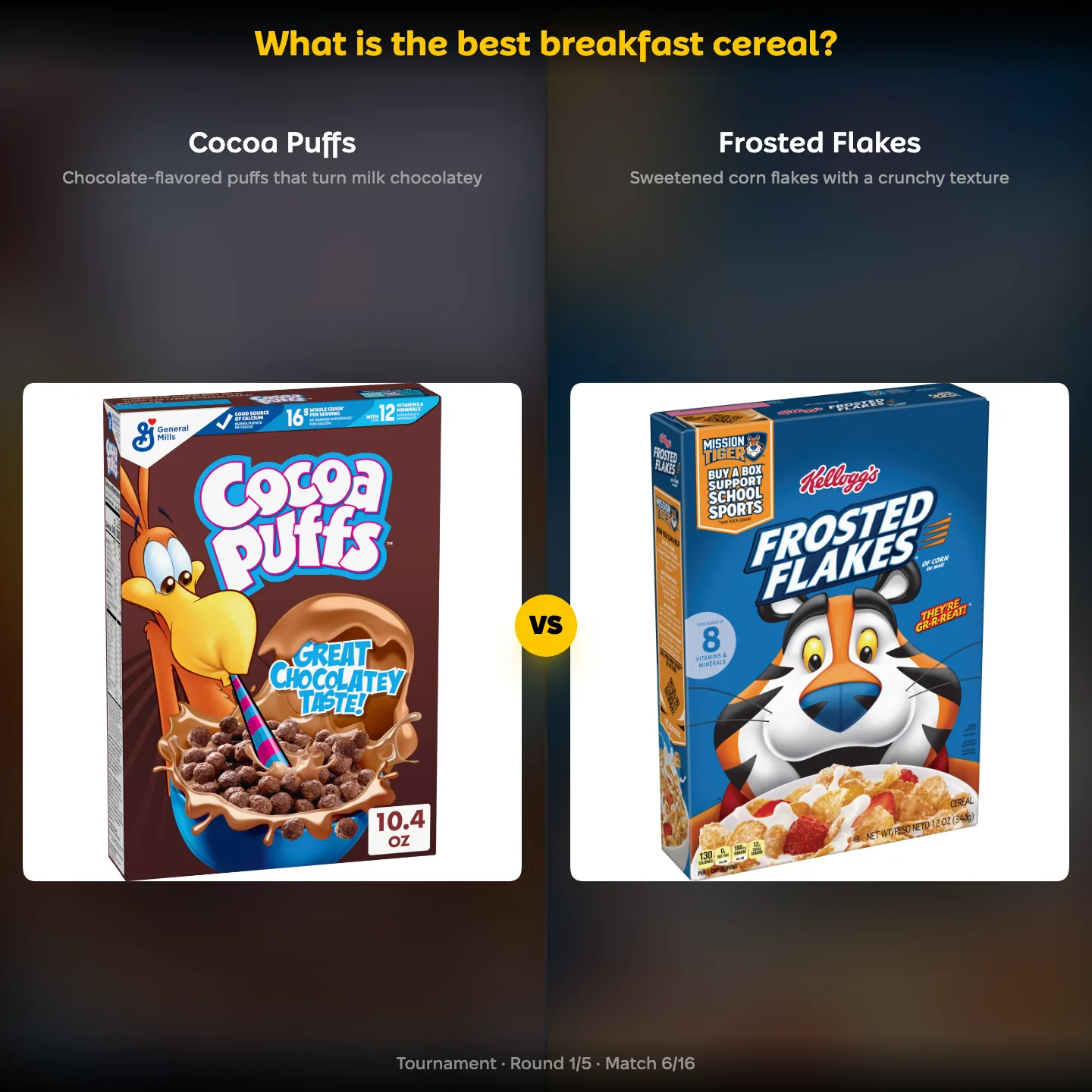
The best breakfast cereal ranking has 31 options and puts chocolate in the strangest position it holds anywhere: a confectionery ingredient applied to the first meal of the day.
Cocoa Puffs are how it gets in. General Mills built them out of the same wave of sweetened cereals that turned a grain product into something closer to a dessert.
Frosted Flakes made that turn first. Kellogg's sugar-coated corn set the template the cocoa versions copied, with Tony the Tiger on the box.
The list is dense with chocolate under other names: Cocoa Pebbles, Cookie Crisp, Reese's Puffs, Oreo O's, Count Chocula. Cheerios, Corn Flakes, Raisin Bran and muesli hold the line for breakfast as breakfast.
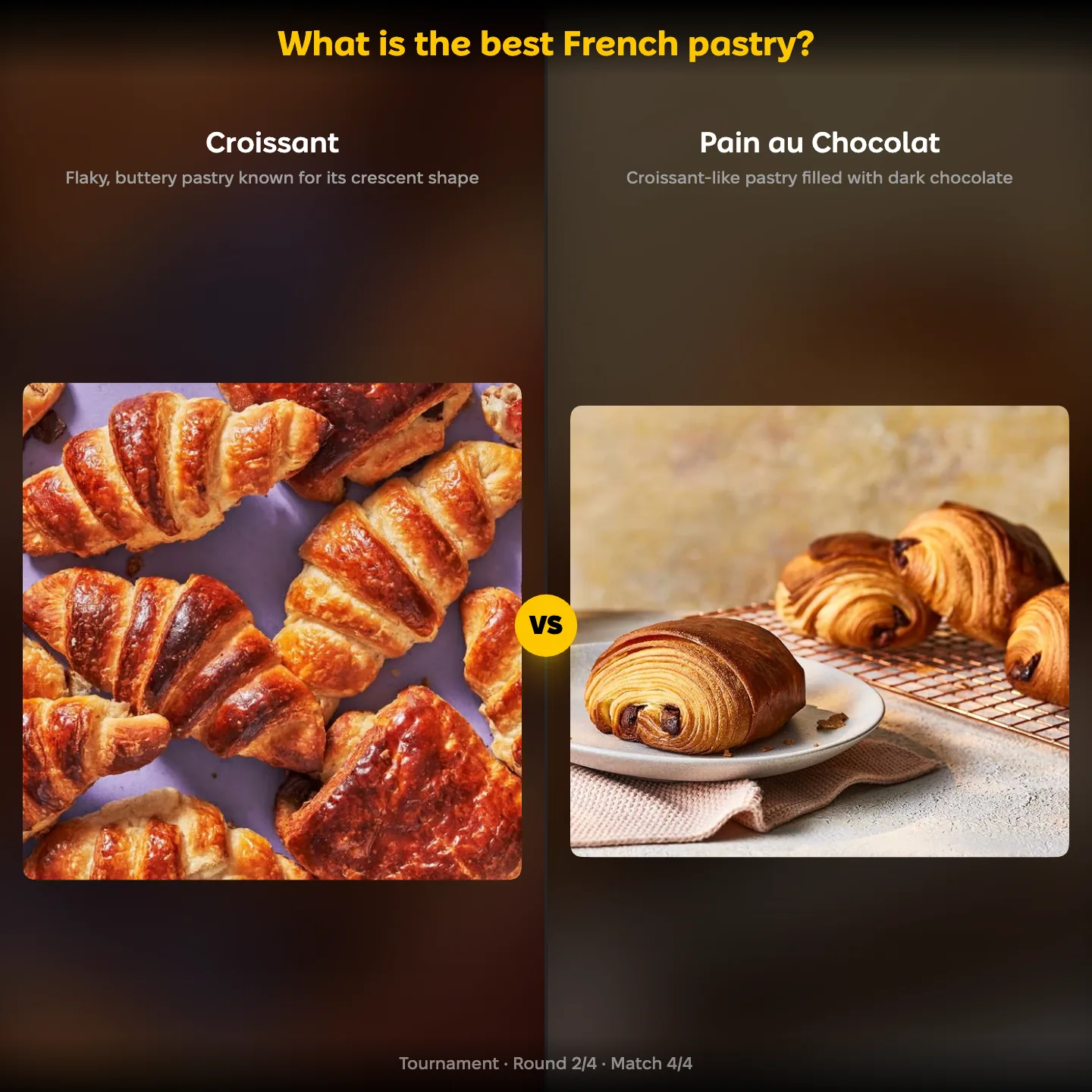
Pain au chocolat vs croissant, and the chocolatine amendment
The best French pastry ranking is a geography question, and chocolate appears in it as a bar folded into dough. Pain au chocolat is one of two viennoiseries made from the same laminated pastry.
The croissant is the other, and it is the incumbent. Its Austrian ancestor, the kipferl, reached Paris with a Viennese bakery in the 19th century, and the croissant has been the default French breakfast since.
Pain au chocolat also carries a naming dispute the croissant does not. Across the south-west it is a chocolatine, and on 17 May 2018 ten deputies led by Aurélien Pradié tabled amendment 2064 to the EGALIM farming bill, asking that popular regional names be recognised in French law and citing the chocolatine as their example. The National Assembly rejected it nine days later.11
Macarons, éclairs, canelés, Paris-Brest and tarte au citron make up a list where chocolate is not the theme. It is one filling among fruit, cream and caramel.
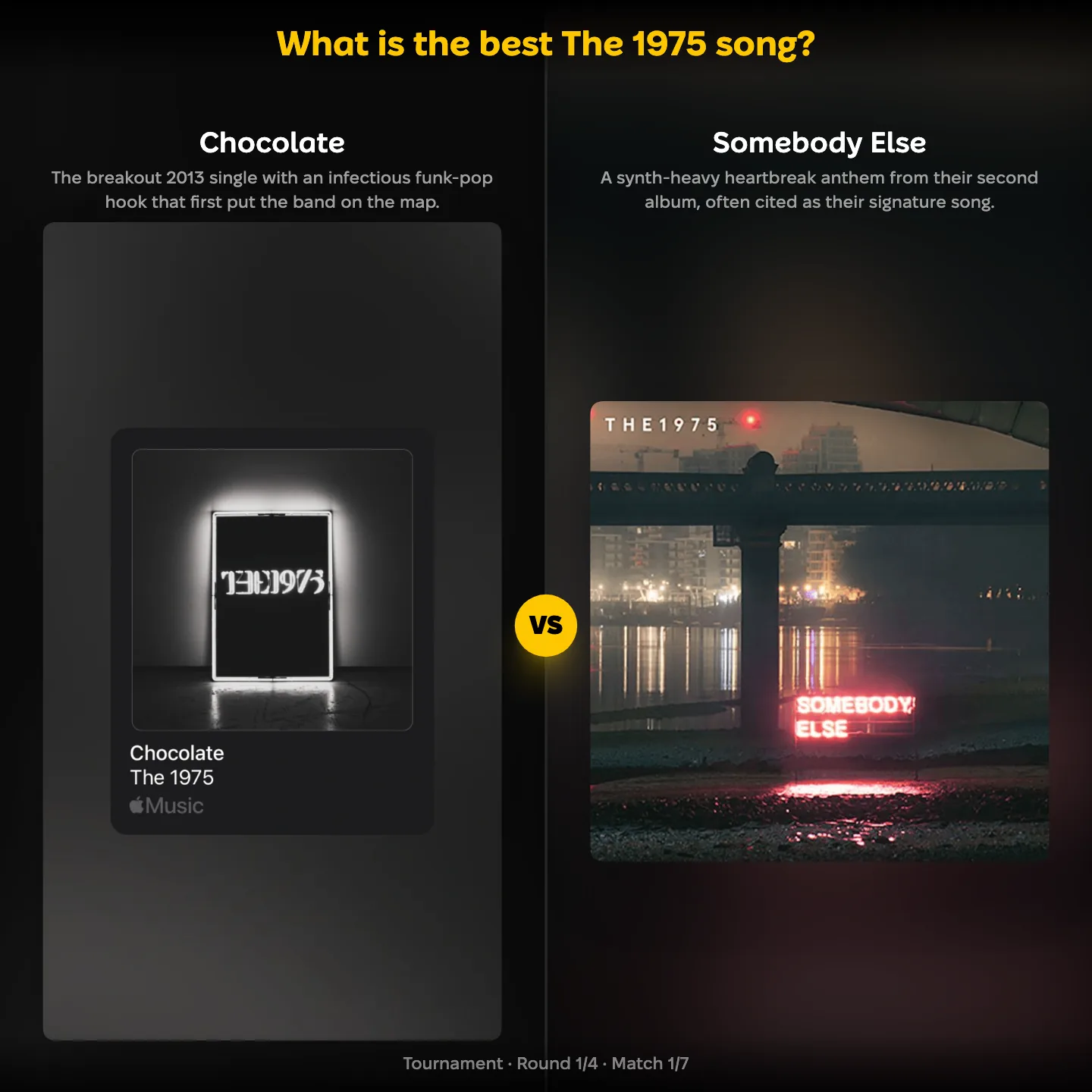
The 1975 wrote a song called Chocolate
The best The 1975 song ranking contains no food at all, and chocolate is on it anyway.
"Chocolate" was the Manchester band's breakout single. It first charted in the UK on 9 February 2013, peaked at number 19, and spent 35 weeks inside the Top 100.12
The word in the title is not the ingredient. The band have said the song uses chocolate as slang, and its story is teenagers driving around a small town avoiding the police.
"Somebody Else", "Robbers", "Love It If We Made It" and "Sex" are the competition, in a ranking where the chocolate reference is a coincidence of vocabulary.
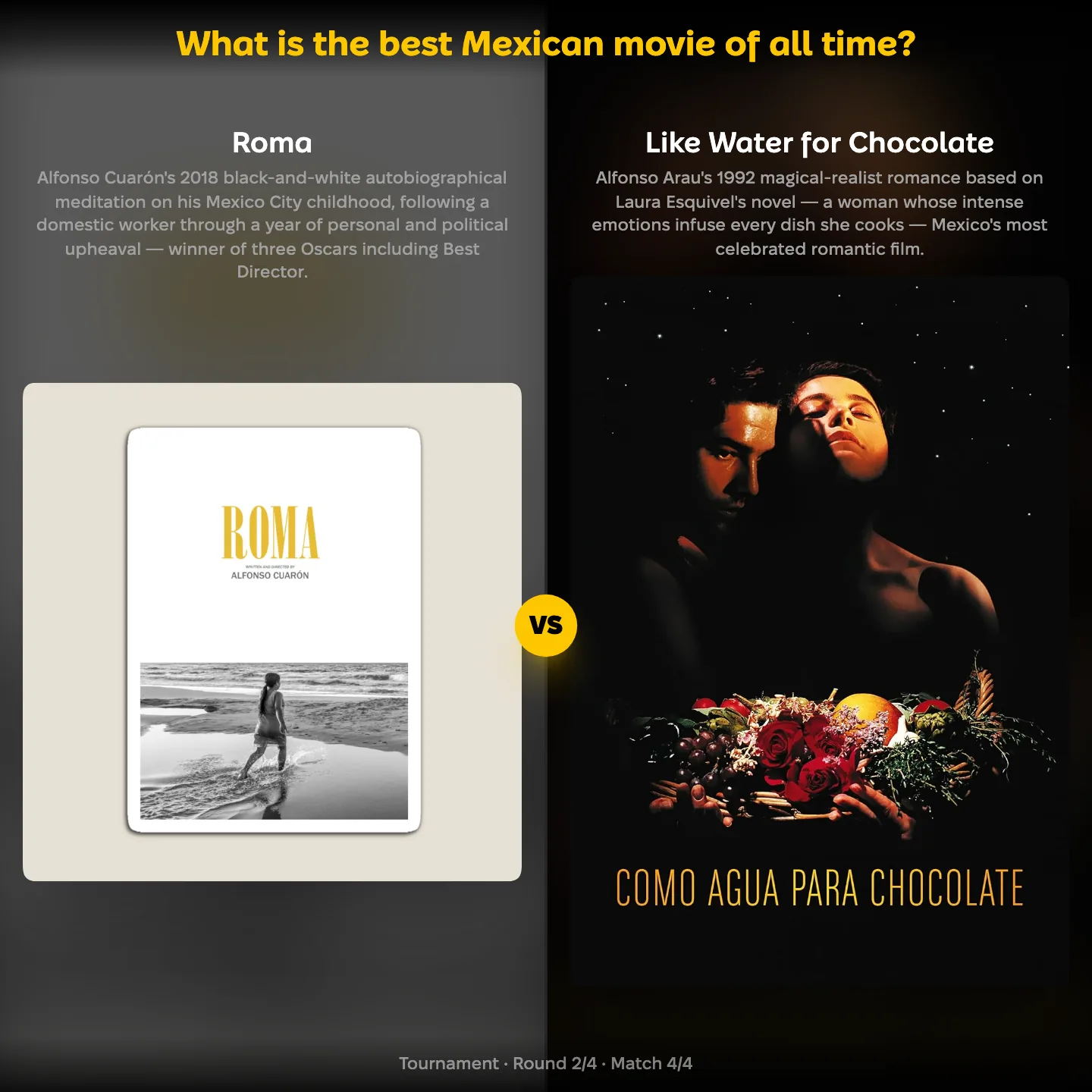
Like Water for Chocolate, up against Roma
The best Mexican movie ranking is where chocolate arrives as literature. Like Water for Chocolate took its title from como agua para chocolate, hot chocolate made with water and a Spanish idiom for being at boiling point.
The film did more for Mexican cinema abroad than its plot suggests. Alfonso Arau directed it from Laura Esquivel's novel, and its recipe-per-chapter structure is why food and magic realism still travel together.
Its opponent here is the modern benchmark. Alfonso Cuarón's Roma took three Oscars in February 2019, at the Academy's 91st ceremony: directing, cinematography, and foreign language film for Mexico.13
Amores Perros, Y Tu Mamá También, Macario and Guillermo del Toro's Cronos are on the same list, the strongest company chocolate keeps anywhere in this article.
Willy Wonka is Timothée Chalamet's outlier
The last ranking makes chocolate a person. The best Timothée Chalamet movie role list holds eight parts, and one of them is Willy Wonka, the chocolatier Roald Dahl invented and Chalamet played in the 2023 prequel.
Wonka worked as a commercial proposition. It took $634.5 million worldwide around a character already played by Gene Wilder and Johnny Depp.14
The other seven parts are the problem. Paul Atreides in Dune is the role that made Chalamet a lead, and Elio in Call Me by Your Name brought him his first Academy Award nomination.
Lee in Bones and All, Laurie in Little Women and Nic Sheff in Beautiful Boy are also on the list. Against those, the chocolate part is the outlier — a fitting last word on an ingredient that keeps ending up in categories it was not built for.

One ingredient, fifteen different questions
Chocolate has no home category. It is a scoop in one list, a recipe in the next, a company after that, then a mug, a puff, a filling, a song and a film, and every one of those lists admits it on that list's own terms. Fifteen sets of options here, fifteen versions of the same ingredient, each order arrived at by choosing between pairs.
Chocolate belongs to whichever category you put it in. Build the list that settles your version.
More rankings, more angles
- Nobody Ranks McDonald's the Same Way Twice — fries, logos, Happy Meal toys, one documentary
- Cheese: One Ingredient, 15 Job Descriptions — topping, side, dessert, national dish
- How to Create a Head-to-Head Ranking — build your own in a few minutes
- What Is Japan Best At? Depends Which List You Read — a country as cuisine, kimono and album
Sources
- International Cocoa Organization — Quarterly Bulletin of Cocoa Statistics, Vol. LI, No. 1 (cocoa year 2024/25, published 28 February 2025): production of cocoa beans in thousand tonnes, with Côte d'Ivoire at 1,850 and Ghana at 600 against a world total of 4,840, and Africa at 71.5% of world output: icco.org (checked 2026-08-03)
- International Cocoa Organization — Cocoa Market Report for December 2024: the nearby contract closed the last trading day of the year at US$11,441 per tonne in London and US$11,545 in New York, with elevated temperatures, La Niña and harmattan winds cited as the drivers: icco.org (checked 2026-08-03)
- International Dairy Foods Association — National Ice Cream & Frozen Novelty Trends Survey, conducted with Morning Consult among 2,205 US adults on 7–9 April 2026: chocolate first, butter pecan second, vanilla third, after vanilla took the top spot two years earlier: idfa.org (checked 2026-08-03)
- Mars, Incorporated — company history timeline: the Snickers brand launched in 1930; the first M&M's Plain Chocolate Candies were made for the US military in 1941, with the brand launched to the general public in 1945: mars.com (checked 2026-08-03)
- Nestlé — 90 years of KitKat: launched in 1935 by Rowntree's of York as Chocolate Crisp and renamed KitKat in 1937: nestle.com (checked 2026-08-03)
- The Hershey Company — candy and snack timeline: Reese's Peanut Butter Cups invented in 1928, the business sold to Hershey by H.B. Reese's sons in 1963, and Kit Kat sold by Hershey in the United States since 1970: hersheyland.com (checked 2026-08-03)
- Ferrero — the history of Ferrero Rocher: created in 1982 in Alba, in the hills of Piedmont: ferrerorocher.com (checked 2026-08-03)
- International Cocoa Organization — Cocoa Market Report for October 2025: London prices fell from around US$6,320 to US$5,808 per tonne over the month, New York from US$6,686 to US$6,133: icco.org (checked 2026-08-03)
- US Department of Agriculture, Economic Research Service — Food Price Outlook: prices for sugar and sweets were 6.9% higher in June 2026 than in June 2025 and are forecast to rise 7.2% across 2026 (prediction interval 5.8–8.7%): ers.usda.gov (checked 2026-08-03)
- Hotel Sacher, Vienna — the Original Sacher-Torte: created in 1832 when the court chef fell ill in Prince Metternich's kitchen and the 16-year-old apprentice Franz Sacher stood in: sacher.com (checked 2026-08-03)
- Assemblée nationale — amendment no. 2064 to the EGALIM bill (text no. 902), tabled 17 May 2018 by Aurélien Pradié and nine co-signatories, seeking recognition of popular regional appellations and citing the chocolatine; rejected 26 May 2018: assemblee-nationale.fr (checked 2026-08-03)
- Official Charts Company — "Chocolate" by The 1975: first charted 9 February 2013, peak position 19, 35 weeks in the Official Singles Chart top 100: officialcharts.com (checked 2026-08-03)
- Academy of Motion Picture Arts and Sciences — 91st Academy Awards, 24 February 2019: Roma won Directing and Cinematography (Alfonso Cuarón) and Foreign Language Film for Mexico: oscars.org (checked 2026-08-03)
- Box Office Mojo — Wonka (2023): worldwide gross of $634,502,312, of which $218,402,312 domestic: boxofficemojo.com (checked 2026-08-03)