
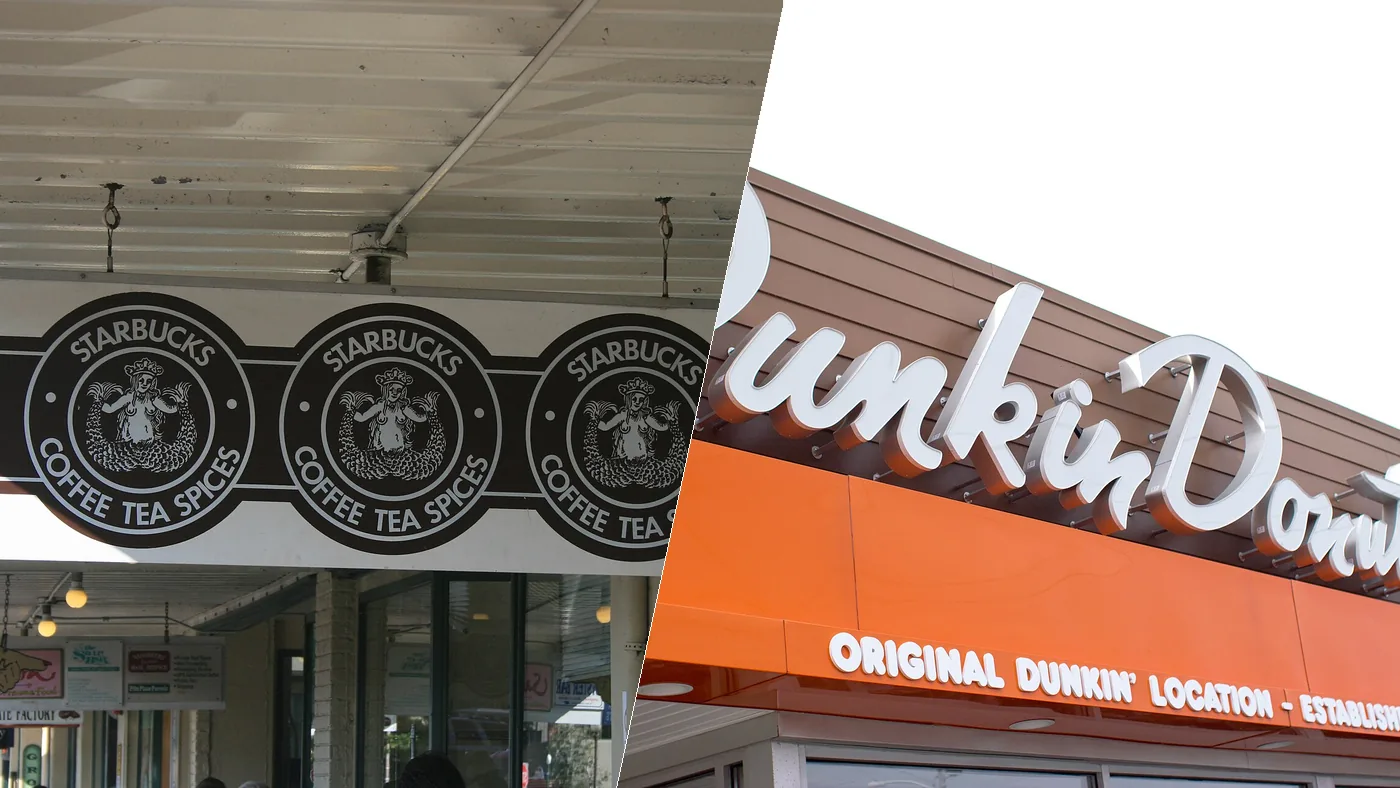
Dunkin' put pumpkin back on its menu on 19 August 2026.1 Starbucks brought the Pumpkin Spice Latte back six days later.2 That gap is the rivalry in miniature: one chain moves first, the other moves late and owns the season anyway.
They start from opposite coasts and opposite ideas of what coffee is for. Dunkin' opened as a doughnut counter in Quincy, Massachusetts, selling coffee to people on their way somewhere else. Starbucks opened at Pike Place Market in Seattle in 1971, selling beans to people who wanted to stay.
Fifteen of the rankings here carry both names. A couple carry one name and pointedly leave out the other.
One company built a room you sit in and the other built a window you drive past, and no single list can measure both.
Starbucks and Dunkin' on the same list as McDonald's
The widest list either of them appears on ranks the 21 chains Americans eat at most often, and neither of them sells a burger.
Starbucks is there on scale. It ended June 2026 with 41,304 stores worldwide, and the 16,933 in the United States make up 41% of that estate.3
Dunkin' is there with more than 14,200 restaurants across nearly 40 markets, the great majority of them within reach of an American commuter.1
McDonald's, Chick-fil-A and Taco Bell are the names this ranking is really about. Two coffee chains sitting inside a burger category is the first sign that "fast food" stopped meaning food some time ago.
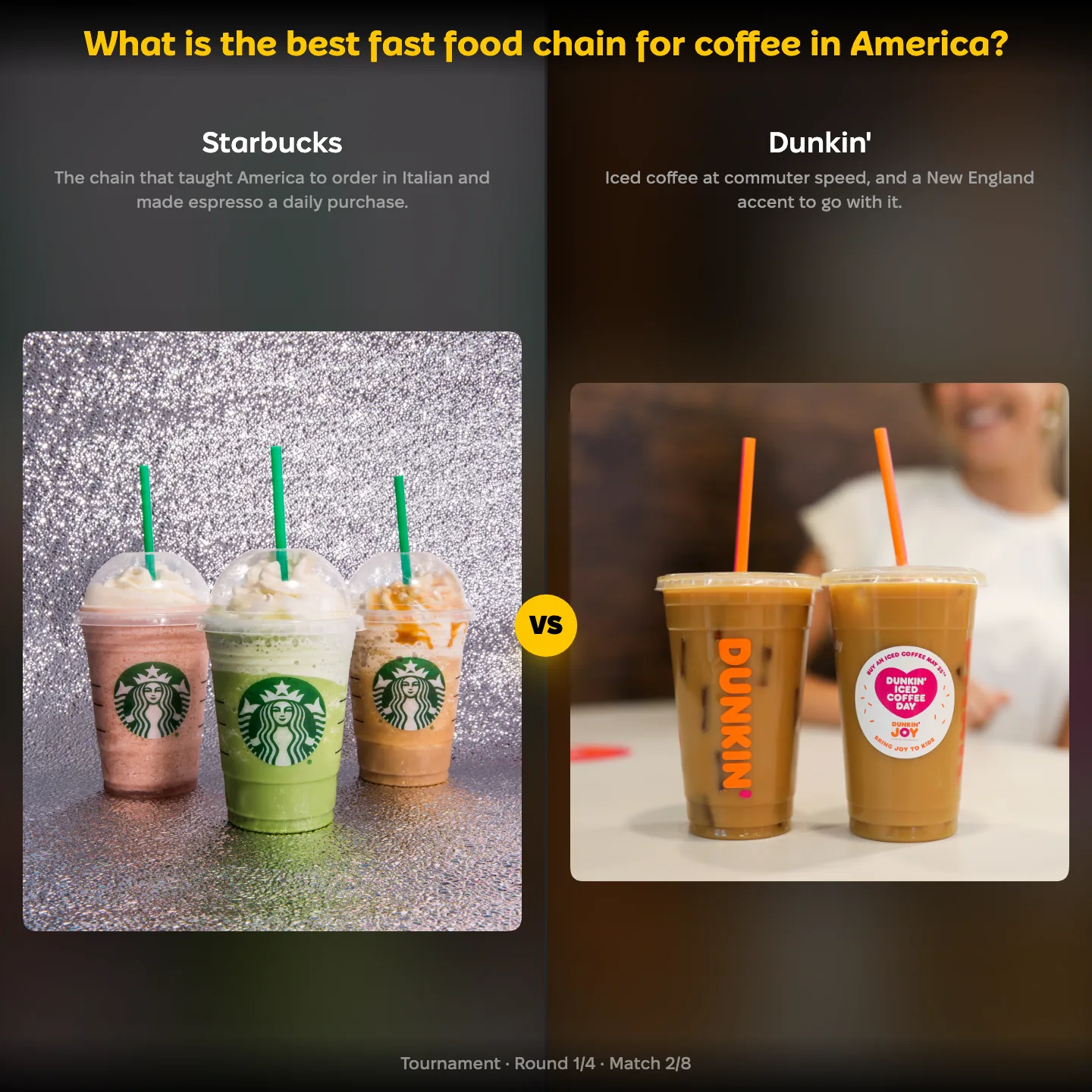
Starbucks vs Dunkin': chain coffee, with Dutch Bros listening
Strip away the food and this is the head-to-head in its purest form: fifteen American chains judged on the coffee itself.
Starbucks argues from the menu. Chairman and chief executive Brian Niccol calls the turnaround "Back to Starbucks" and describes the goal as "reclaiming the third place"; global comparable store sales rose 7.9% in the quarter that ended on 28 June 2026.3
Dunkin' argues from price and pace. It calls itself the largest coffee and donuts brand in the United States,1 and it has sold that position since April 2006 with four words written by the Boston agency Hill Holliday: America Runs on Dunkin'.4
Dutch Bros, Tim Hortons, Peet's, Caribou and McDonald's share the field, and they answer both of the big two. Plenty of Americans buy their daily coffee from a company that thinks of itself as something else entirely.
Breakfast is Dunkin's home ground, and McDonald's is standing on it
Move the question from coffee to breakfast and the field doubles: sixteen chains, most of them selling eggs before half past ten.
Dunkin' was built for this hour. Wake-Up Wraps, a sausage-egg-and-cheese croissant, and a counter arranged so the order is finished before a queue can form behind it.
Starbucks reaches breakfast from the other direction, with sous-vide egg bites and a Bacon, Gouda & Egg sandwich sold to people who were already standing in line for a drink.
McDonald's has been the reference point since the Egg McMuffin arrived in 1972, and Chick-fil-A, Whataburger and Bojangles all carry regional claims. This is the section where treating the morning as a contest between two chains is at its least convincing.
The Pumpkin Spice Latte is 23 years old this season
Starbucks did not invent pumpkin-flavoured coffee. It invented the date in the calendar. The Pumpkin Spice Latte went through a market test in about 100 stores across the United States and Canada in 2003 and became the company's most successful seasonal drink.5
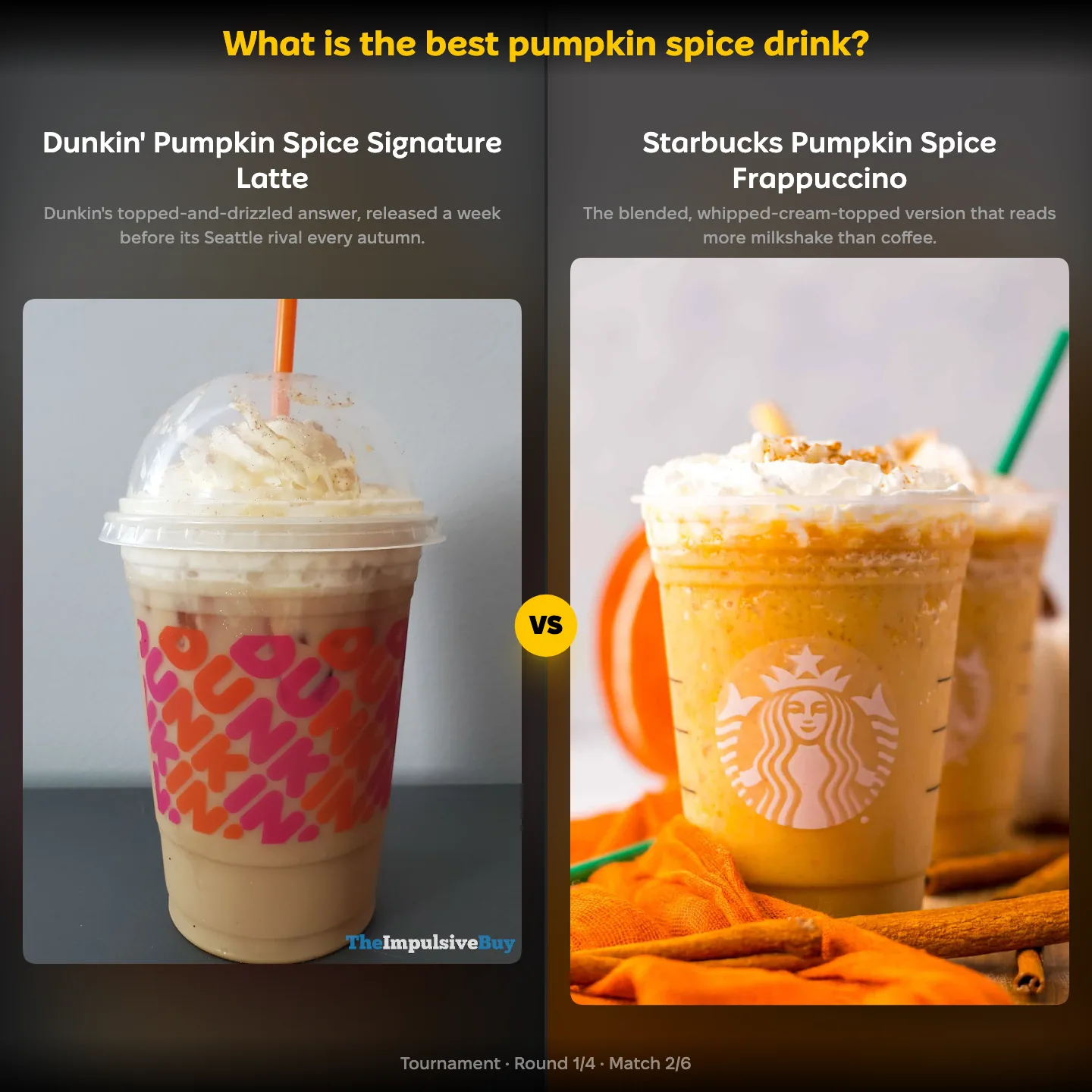
What surrounds it now is a menu rather than a cup. The 2026 autumn line-up added an Iced Pumpkin Cream Shaken Espresso, a Pumpkin Spice Chai, an Iced Pumpkin Cream Matcha and a cider-and-chai hybrid called the Chaider, alongside the blended Frappuccino version in the frame below.2
Dunkin' fields a Pumpkin Spice Signature Latte, a Pumpkin Cloud Dunkalatte, a Pumpkin Pie Coffee Chiller and a pumpkin swirl that goes into any coffee on the menu.1
The ranking reaches past both of them, to homemade versions, pumpkin beer, pumpkin hot chocolate and a matcha crossover that did not exist five years ago. Pumpkin season outgrew the two companies that started it.
Starbucks vs Dunkin' on the list nobody wants to win
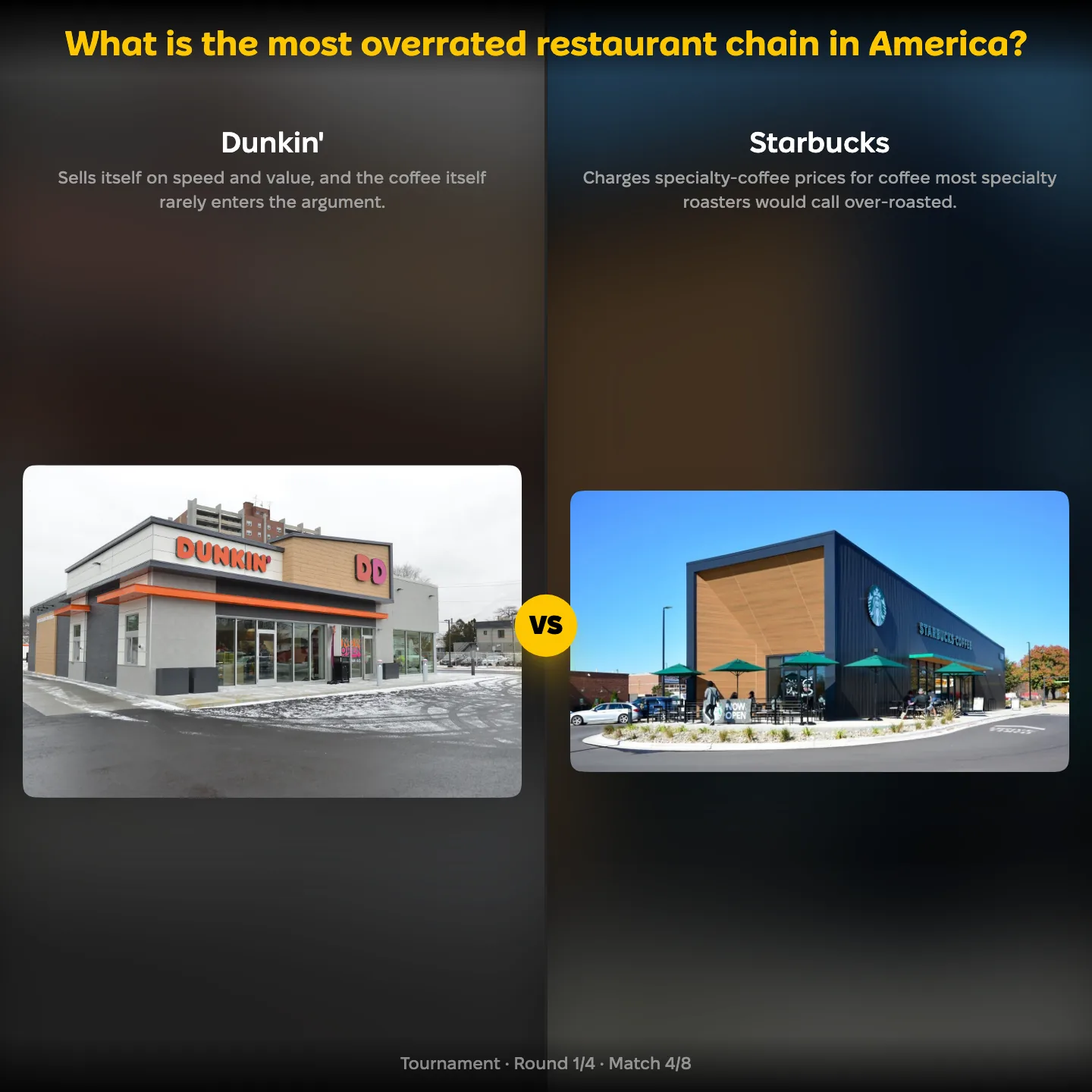
Sixteen American chains, one question: which is praised louder than it earns?
The case against Starbucks is the price gap. It charges specialty-coffee money for a roast most specialty roasters would call too dark, and it is still the busiest coffee counter in the country.
The case against Dunkin' is thinner, and the thinness is the point. Almost nobody claims Dunkin' coffee is good; they claim it is fast and cheap, which is the defence the company wrote for itself.
The Cheesecake Factory, Chipotle, In-N-Out and Sweetgreen share the list, and each has a fanbase that would put a coffee chain above it. Being overrated requires being rated first.
Egg McMuffin, Wake-Up Wrap, chicken biscuit
Narrow breakfast down to a single sandwich and the field changes shape again.
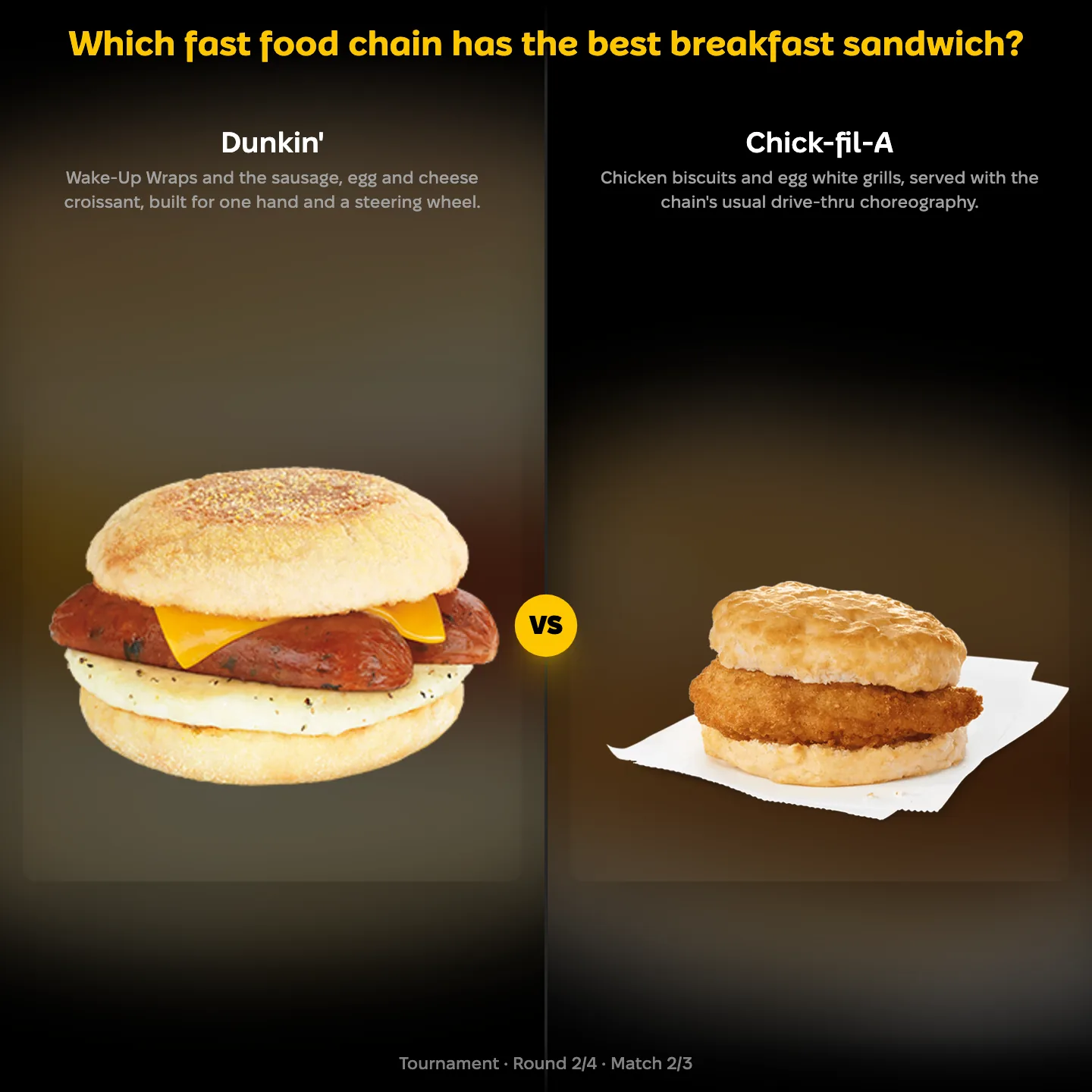
Dunkin's entry is portable by design. A Wake-Up Wrap is small enough to finish at a red light, which is a specification rather than a recipe.
Starbucks brings the Bacon, Gouda & Egg sandwich, priced above most of the field and aimed at a customer who is buying a drink first and food second.
The frame below skips both of those and goes to the matchup the ranking is really about — Dunkin' against a Chick-fil-A chicken biscuit, with the 1972 McDonald's muffin somewhere behind. Neither coffee chain is the favourite here, and both belong on the list.
Stumptown and Chameleon got to cold brew first
Cold brew was a specialty-roaster product long before it was a chain product.
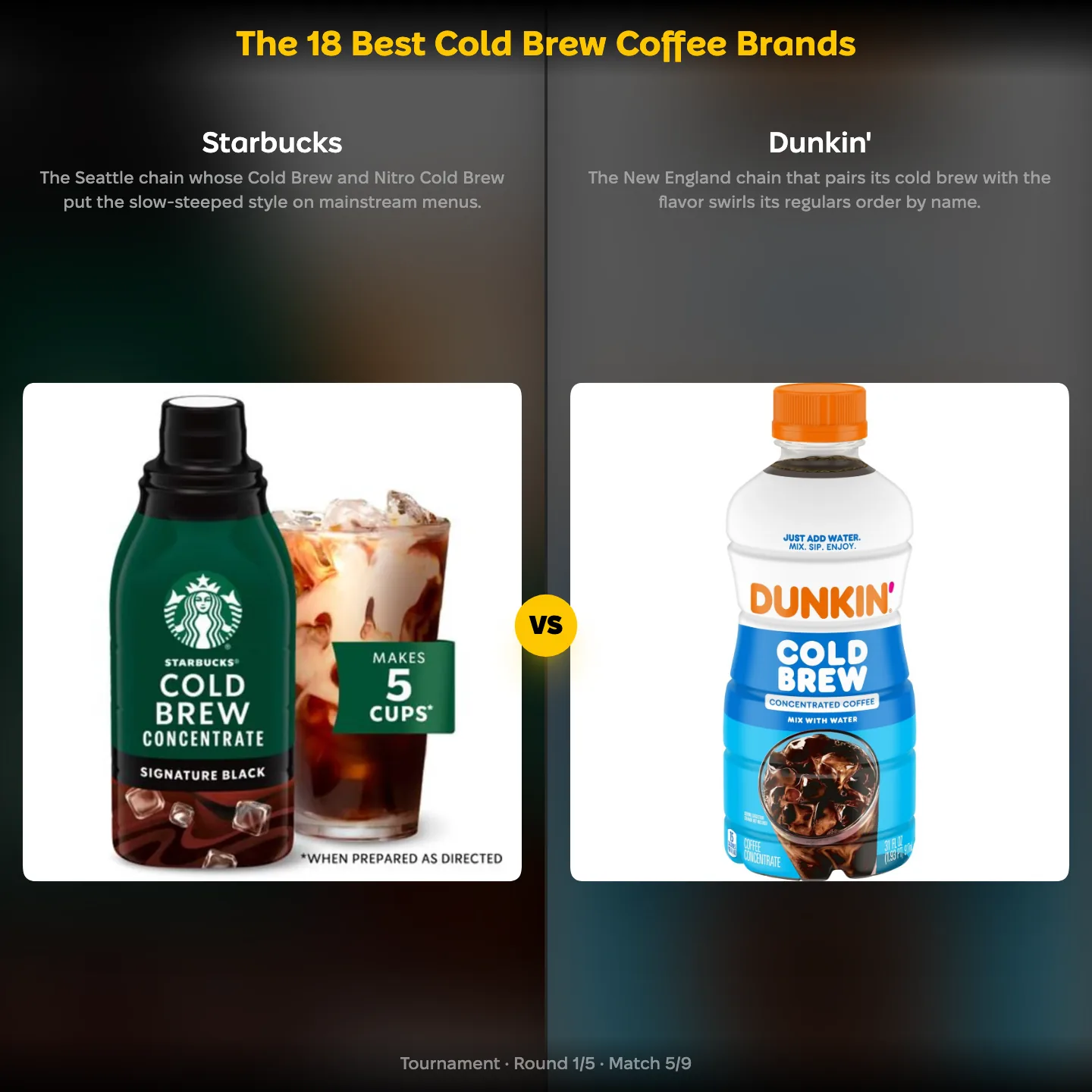
Stumptown's stubby bottles, Chameleon's black concentrate and La Colombe's cans defined the category while the two big chains were still selling iced coffee poured over yesterday's brew.
Starbucks and Dunkin' now sit in the same supermarket aisle as all of them, in bottles built for a home fridge. Arriving late and arriving enormous is the whole story on this list.
Peet's taught Starbucks to roast, and still competes with it
Twenty-five roasters ranked on specialty drinks, which is the category Starbucks built its entire menu around.
Peet's is the awkward name on it. Alfred Peet trained the Starbucks founders in Berkeley, and Peet's has spent the fifty years since selling against the company it taught.
Dunkin' is on the list too, among Blue Bottle, Intelligentsia, Onyx and Counter Culture. It is the only entry whose customers would not use the phrase "specialty drink" for what they ordered.
Chick-fil-A owns the drive-thru clock
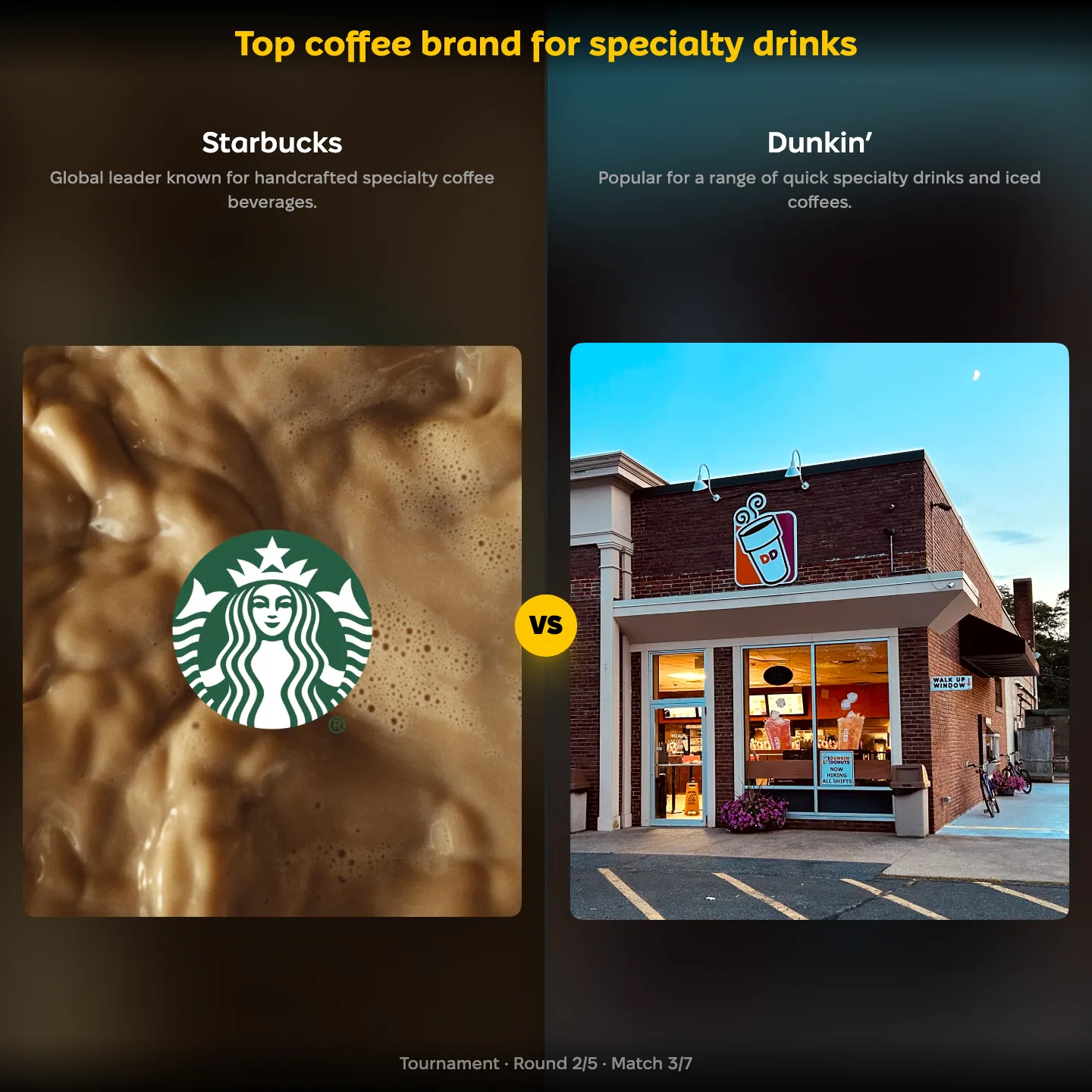
The drive-thru is the one product both companies design actual buildings around, and neither of them is the benchmark.
Dunkin' holds the structural advantage. A short menu makes a short line, and the coffee often reaches the window before the payment finishes.
Starbucks has the opposite problem, and it built it on purpose. A lane designed for a twelve-word order is a lane that stops moving.
Chick-fil-A runs two lanes with staff standing outside in the rain holding tablets; Dutch Bros sends someone to the car window and treats the wait itself as the service. Fourteen chains compete on this measure, and neither coffee giant sets the standard.
Costco's $1.50 hot dog is the value benchmark
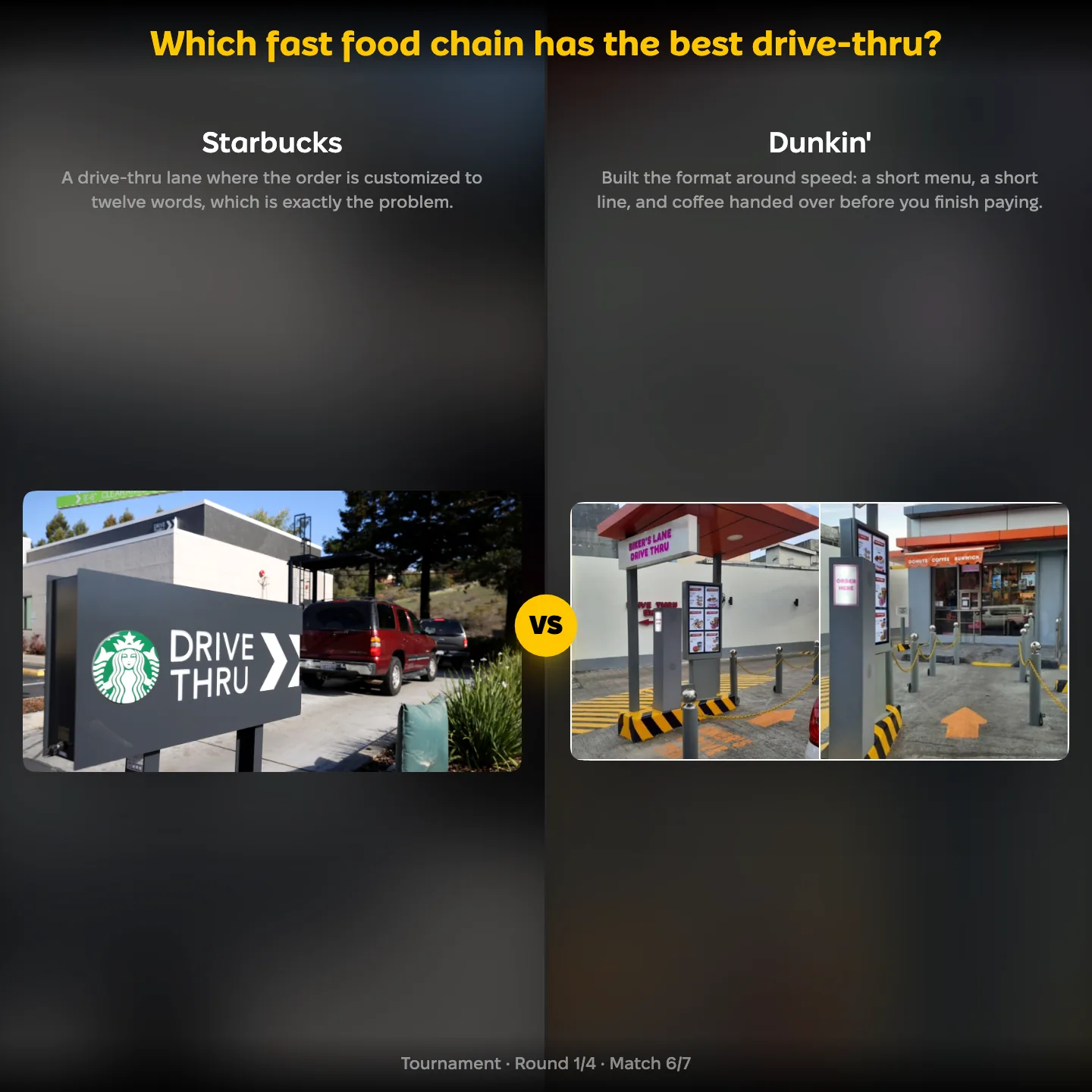
Value is the axis where both chains are weakest, because the competition here is not a coffee shop.
Costco has sold a hot dog and a soda for $1.50 since 1985 and has never moved the price. Little Caesars hands over a whole pizza with no waiting.
Dunkin' at least argues on this ground, priced to be a daily habit rather than a treat. Starbucks does not argue on it at all.
Starbucks Rewards vs Dunkin' Rewards
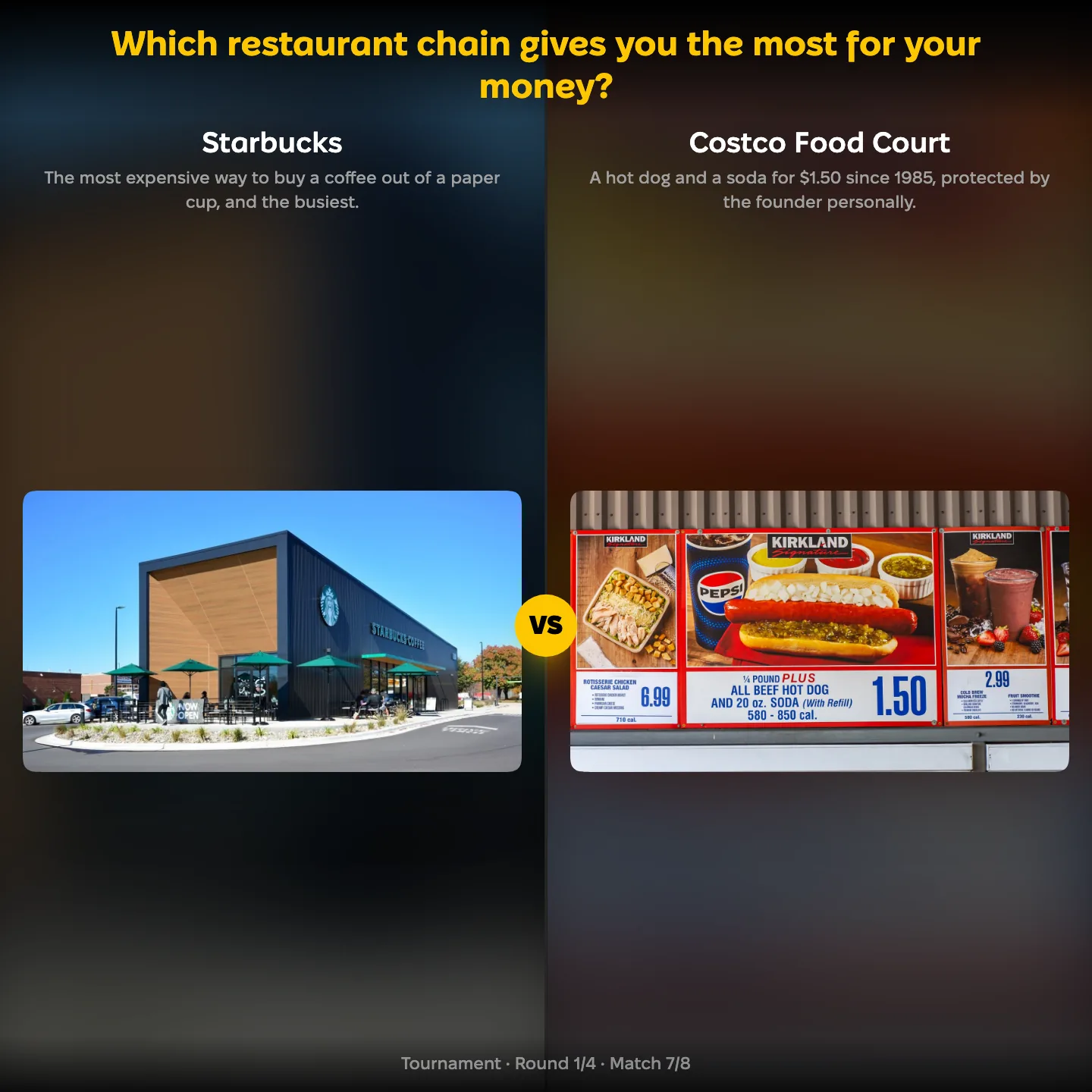
Fourteen restaurant loyalty programs are ranked here, and one of them rewrote the whole category.
Starbucks Rewards is a stored-balance app as much as a points scheme. Customers load money onto it in advance and leave it there, which is why every rival now ships a screen of tiers and stars.
Dunkin' Rewards was rebuilt in 2022 out of the older DD Perks, trading a free drink per visit for points per dollar and boosted days, a change its regulars have never fully forgiven.
Panera's Sip Club beats both on pure arithmetic with a flat monthly fee for unlimited drinks, if you go often enough to use it. Chipotle, Taco Bell and Chick-fil-A are ranked alongside them, and neither coffee chain starts with a lead.
Starbucks vs Dunkin': who wants you to stay?
Here the two companies are not competing at all. They are answering different questions.
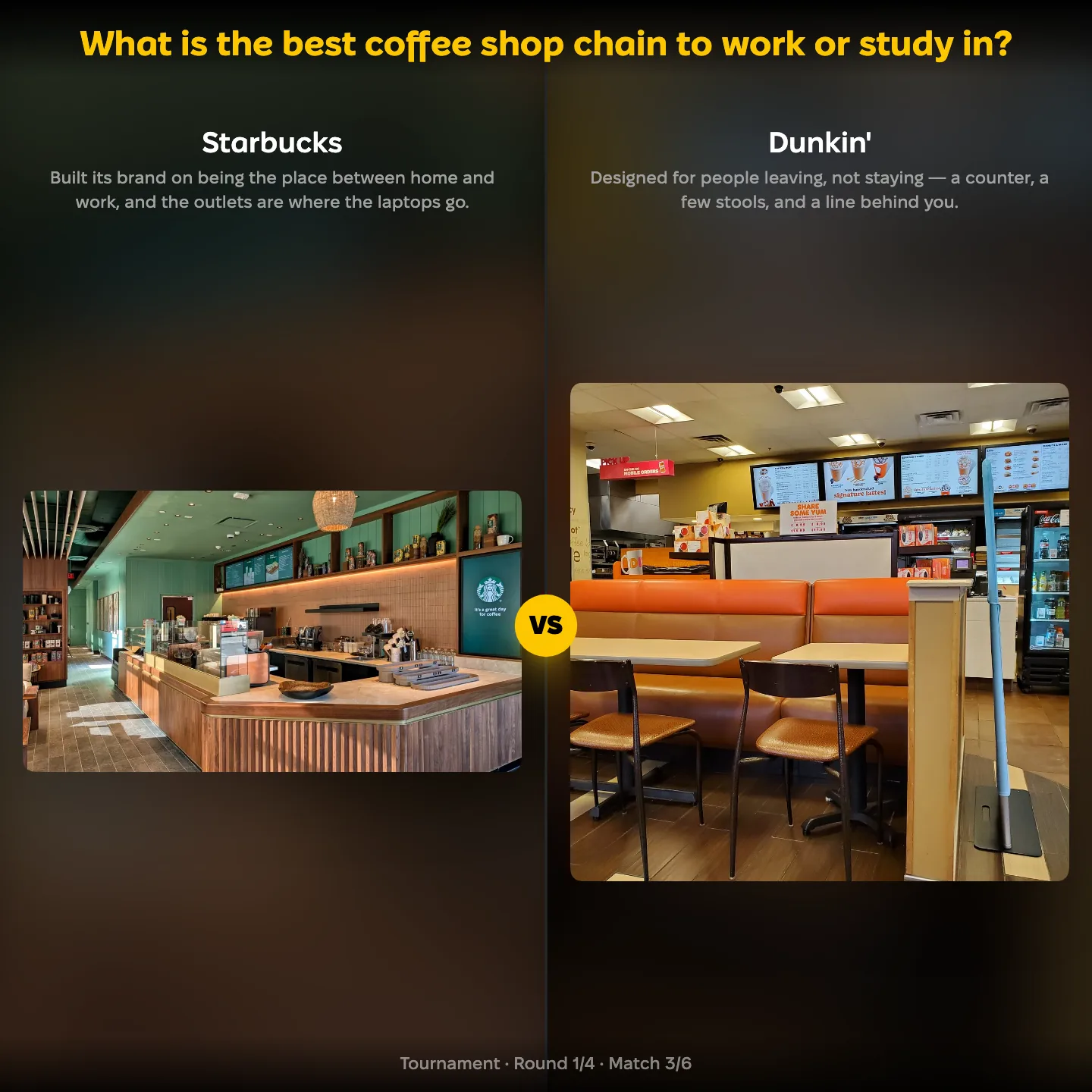
The "third place" is Starbucks' own phrase, borrowed from sociology and now written into its earnings calls; Brian Niccol named it as the goal in July 2026.3 Armchairs, power outlets and a name written on a cup are the product being sold.
Dunkin' was designed for the reverse. A counter, a few stools, a line behind you, and a brand built on the assumption that you are already leaving.
Twelve chains are ranked, and the most honest entry is the last one: the independent cafe with the handwritten wifi password and a two-hour limit taped to the door. Dutch Bros and Scooter's Coffee barely have seating at all, which puts them closer to Dunkin' than to Starbucks.
Krispy Kreme vs Dunkin': the word Dunkin' dropped in 2018
This is the list Starbucks cannot enter.
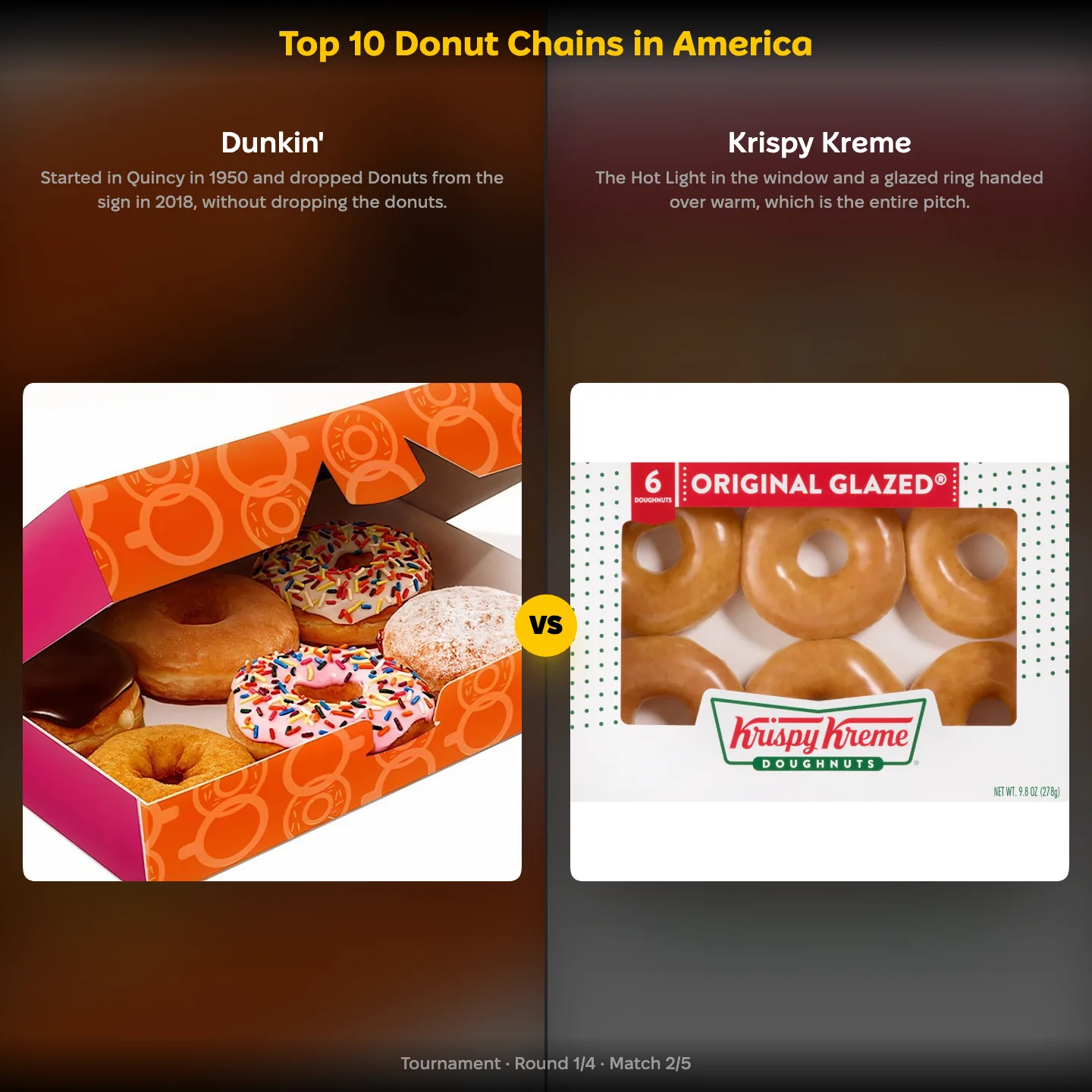
Dunkin' began as the Open Kettle in Quincy, Massachusetts in 1948. William Rosenberg renamed it Dunkin' Donuts in 1950 after noticing customers dunking, signed the first franchise agreement in Worcester in 1955, and the company shortened its name to Dunkin' in 2018 to sell itself as a beverage business.6 The doughnuts stayed on the menu regardless.
Krispy Kreme sells one product handed over warm, with a light in the window to announce that it is. Ten chains make the cut, most of them fiercely regional: Shipley in Houston since 1936, Voodoo's pink box in Portland, Randy's giant rooftop ring in Inglewood.
Starbucks sells pastries and does not appear here at all, which is the clearest single statement of the difference between the two companies. One is a coffee brand that also sells food. The other is a food brand that turned into a coffee brand and kept the food.
The Starbucks Siren next to the Nike Swoosh
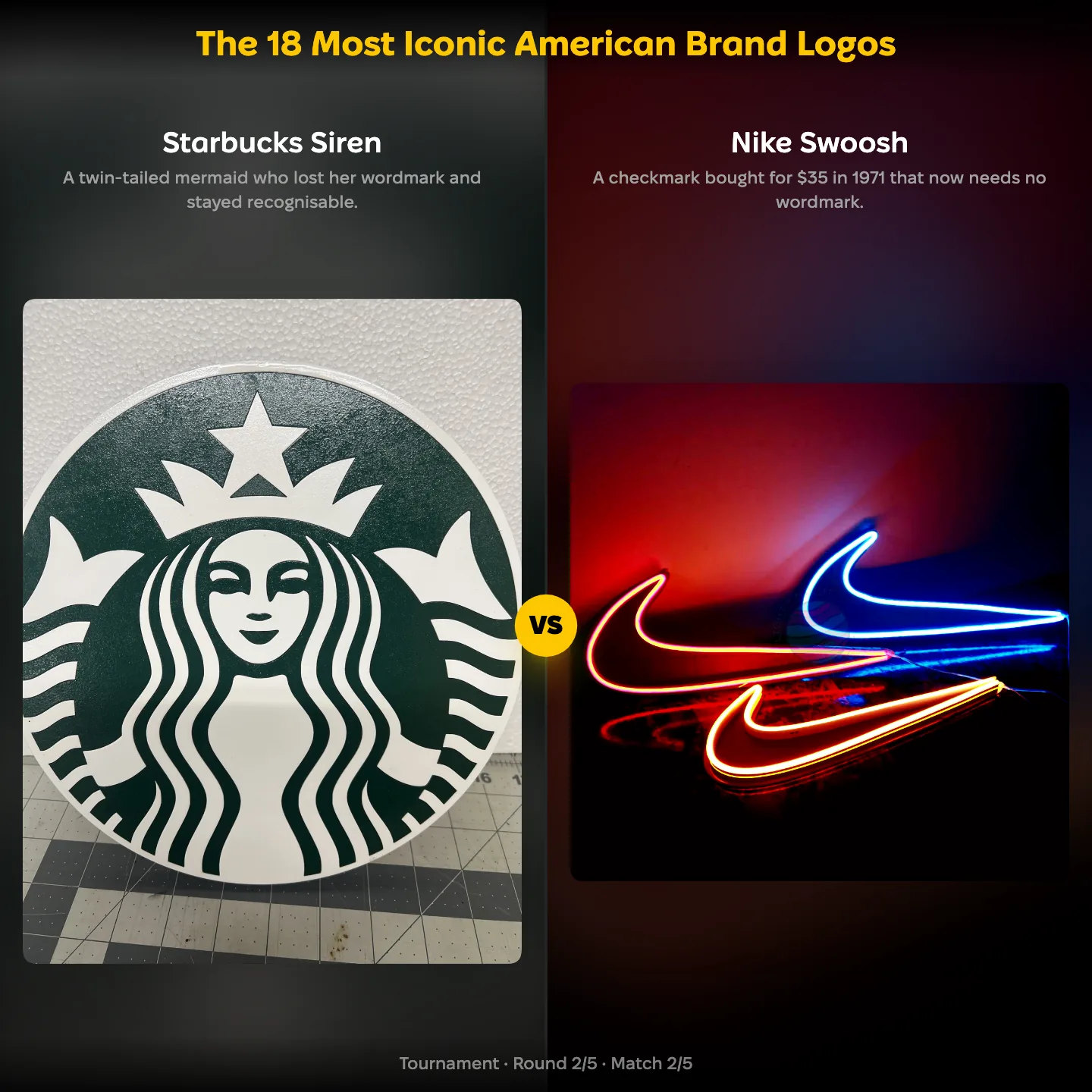
Eighteen American brand logos, ranked as design rather than as business.
The Siren is on it: a twin-tailed mermaid that lost its wordmark in 2011 and stayed recognisable, which is exactly the test this list applies.
Dunkin's orange-and-pink lettering is nowhere on it. One of these companies made a symbol; the other made a colour scheme, and only one of them survives being taken off the sign.
Luckin Coffee reached 30,000 stores in eight years
Take the question outside America and the two-chain framing collapses on contact.
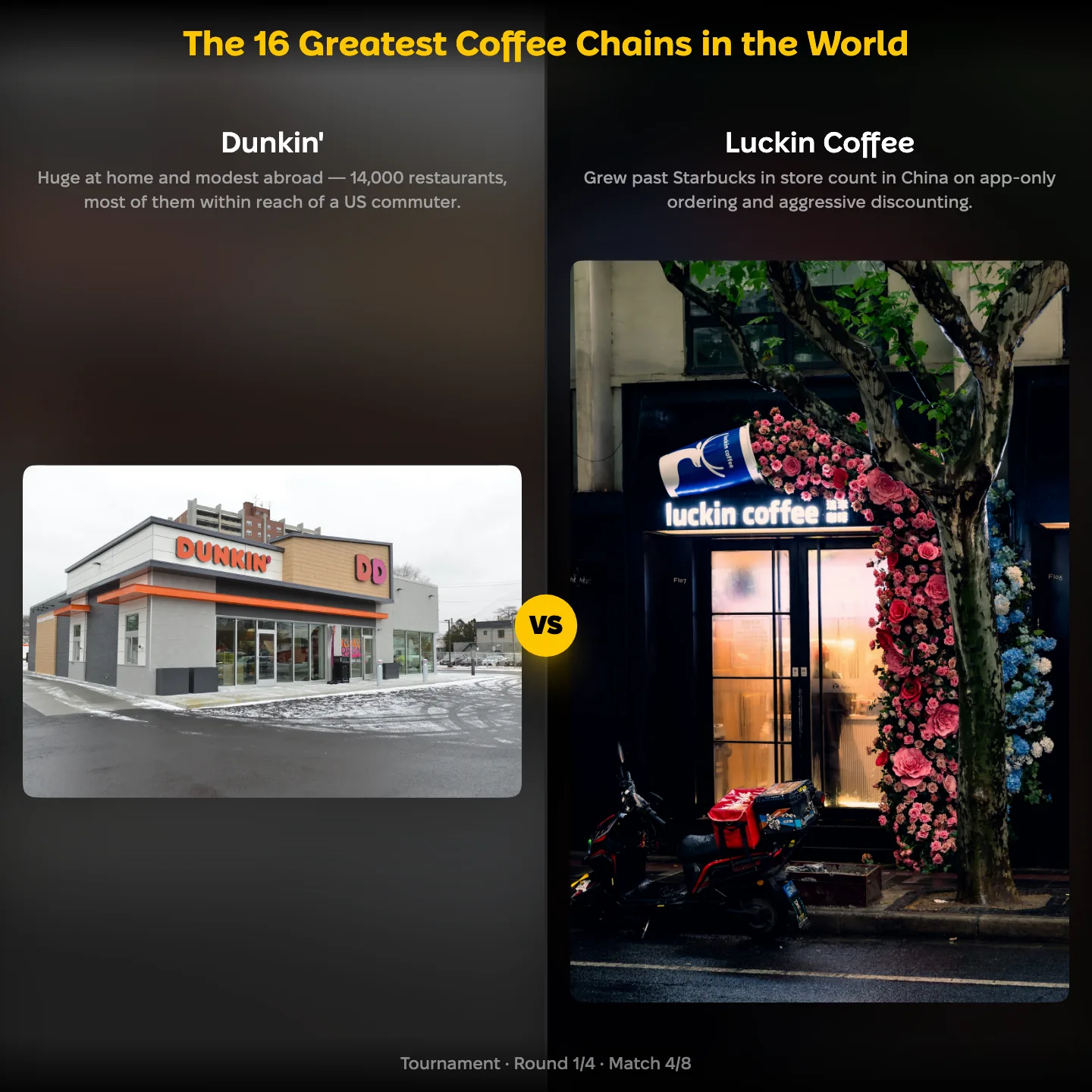
Starbucks is genuinely global: 59% of its 41,304 stores are outside the United States.3 Dunkin' is not. Its estate covers nearly 40 markets but leans hard on American commuters.1
Luckin Coffee opened its 30,000th location in February 2026, eight years after it started and roughly six times faster than Starbucks managed the same number, on app-only ordering and permanent discounting.7 Tim Hortons is a Canadian identity marker before it is a coffee brand. Doutor sells standing-counter espresso to Japanese commuters, Juan Valdez is owned by Colombian growers, and Kopi Kenangan opened thousands of Indonesian outlets inside a decade.
On a world list Dunkin' is a regional chain. That is a description of where it chose to be big, not a complaint.
Two chains, two different clocks
Across fifteen lists the two companies almost never fail on the same axis. Starbucks is measured on what it built inside the store; Dunkin' on how quickly you got back out of it. Neither measurement is available to the other one.
The scale keeps moving anyway: Starbucks told investors in July 2026 it expects 600 to 650 net new coffeehouses worldwide this financial year, which is more locations than most chains have in total.3
If the format is new to you, each of these lists gets built by putting two names against each other, over and over.
Have a third chain you would defend against both? Nobody has built that one yet.
More rankings, more angles
- Nobody Ranks McDonald's the Same Way Twice — the chain both of these sit beside
- Coca-Cola vs Pepsi: The Cola Wars, Ranked 15 Ways — the other American brand war
- Coffee: Best Drink in the World? 14 Lists, From Ethiopia to Kopi Luwak — the bean behind both chains, on 14 lists
- Beer Has a 1516 Recipe and a 2026 Problem — the drink with the oldest recipe on the shelf
Sources
- Dunkin' press room — 2026 fall menu launch date, the pumpkin line-up, and the company's own description of its founding year and restaurant count: news.dunkindonuts.com (checked 2026-08-25)
- New York Family — Starbucks' 2026 autumn menu and the Pumpkin Spice Latte return date: newyorkfamily.com (checked 2026-08-25)
- Starbucks Corporation, Q3 fiscal 2026 earnings release filed with the SEC — store counts, US share, comparable sales, the chief executive's "third place" comment and full-year store guidance: sec.gov (checked 2026-08-25)
- Dunkin' press room, 10 April 2006 — launch of the "America Runs on Dunkin'" campaign by Hill Holliday: news.dunkindonuts.com (checked 2026-08-25)
- Smithsonian Magazine — the Pumpkin Spice Latte's 2003 market test and its status as Starbucks' most successful seasonal drink: smithsonianmag.com (checked 2026-08-25)
- Inspire Brands, "Dunkin' Through the Decades" — the Open Kettle in 1948, the 1950 renaming by William Rosenberg, the 1955 franchise agreement and the 2018 name change: stories.inspirebrands.com (checked 2026-08-25)
- Nikkei Asia, 13 February 2026 — Luckin Coffee's 30,000th store and the pace of its expansion against Starbucks: asia.nikkei.com (checked 2026-08-25)