
Head-to-head voting ranks a group of things by putting two of them against each other and asking which one you prefer. You never see the whole field. You see one matchup, pick a winner, and the next matchup loads. Each pick is a vote, and the votes accumulate into a ranked list. Every ranking on YouPickBest is voted this way, whatever the size of the field.
The short version: Sorting twenty things into order is a hard question. The same job, handed over as twenty easy questions, is a game. Head-to-head voting does that conversion, then adds up what everybody picked.
What is head-to-head voting?
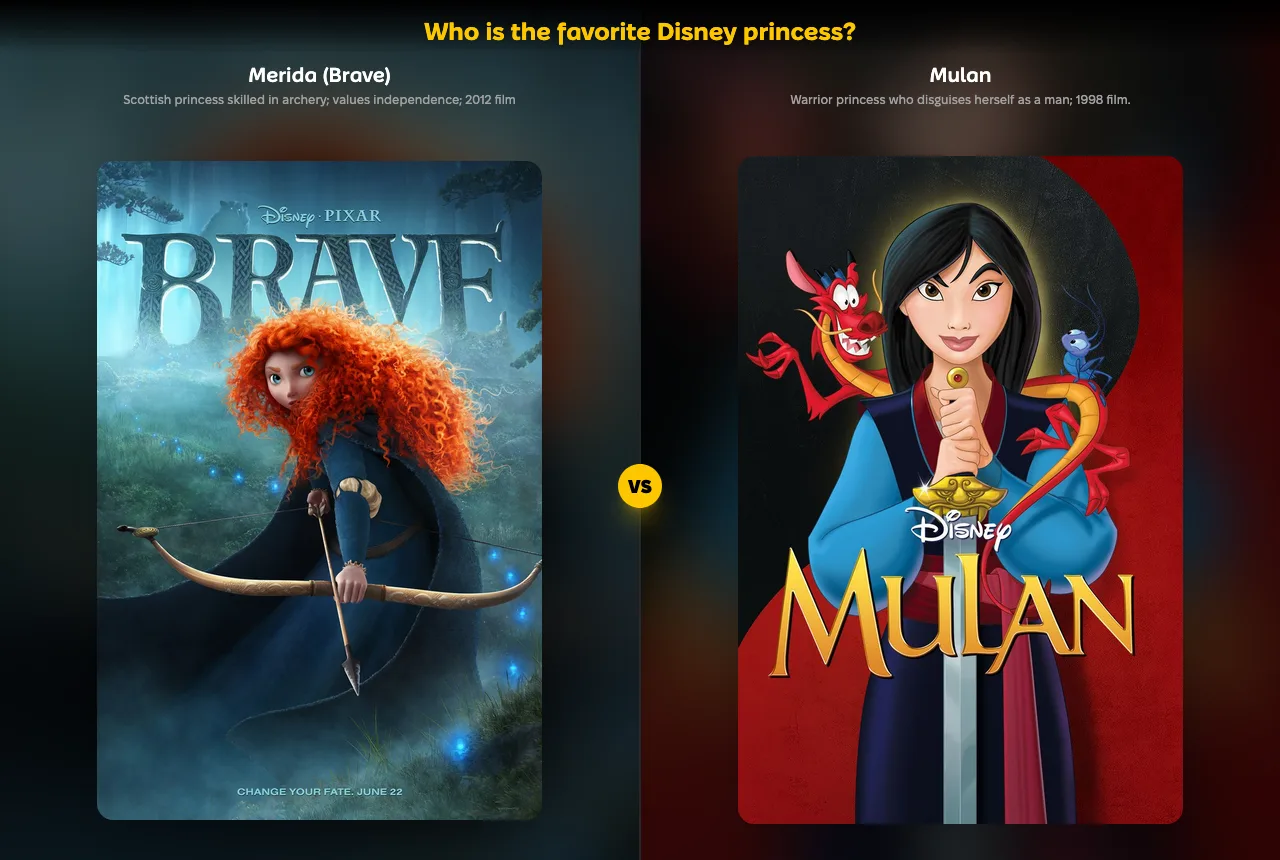
Playing a ranking looks like this: two options on screen, one of them gets your click, another pair replaces them. That is the whole interface.
Nobody asks for a number, a justification, or a mental model of the full list. You answer the question in front of you, and the sorting happens somewhere else.
How one pick becomes a ranking
One vote carries almost no information — this beat that, once, in front of one person.
Each matchup is filed as a win for one option and a loss for the other. As people play, an option builds a record: how often it wins, which opponents it has beaten, how long it survives. Options that keep winning climb. Options that keep losing drop. The more votes a ranking collects, the less its order moves.
Picks only reach the ranking once you finish the run they belong to. Walk away in the middle and the matchups you answered are discarded, which keeps half-played sessions from nudging anything.
Why it beats star ratings and polls
Most rating systems ask for a score in isolation: five stars for this, three for that. Scores drift. A 3 from one person and a 3 from another rarely mean the same thing, and once averaged, almost everything lands in the same narrow band. You get a list where nothing is separated from anything else.
A two-way choice removes the guesswork. The question stops being how good something is and becomes which of these two you would keep. People answer that honestly and fast, and the answers pull the field apart.
| Star ratings and polls | Head-to-head voting | |
|---|---|---|
| What you are asked | Score each item on a scale | Pick the better of two |
| Effort per item | High: you judge it alone | Low: one quick click |
| How results spread | Everything clusters near the average | Strong and weak pull apart |
| Easy to game | Yes, pile votes on a favourite | Harder, an option has to win matchups |
The two ways to vote
YouPickBest runs two modes, and both feed the same ranking.
- Bracket pairs the whole field off, advances the winners, and shrinks the rounds until one option is left holding the trophy.
- King of the Hill keeps the winner on screen and swaps in a random challenger for the loser, again and again.
A bracket suits anyone who wants a champion at the end. King of the Hill suits anyone who wants to burn through a lot of picks. The choice you make inside a matchup is identical either way.
Where the final order comes from
A results page is not a raw tally. Every option ends up with a score between 0 and 1000, worked out from its win rate, how deep it goes, and how many different opponents it has beaten.
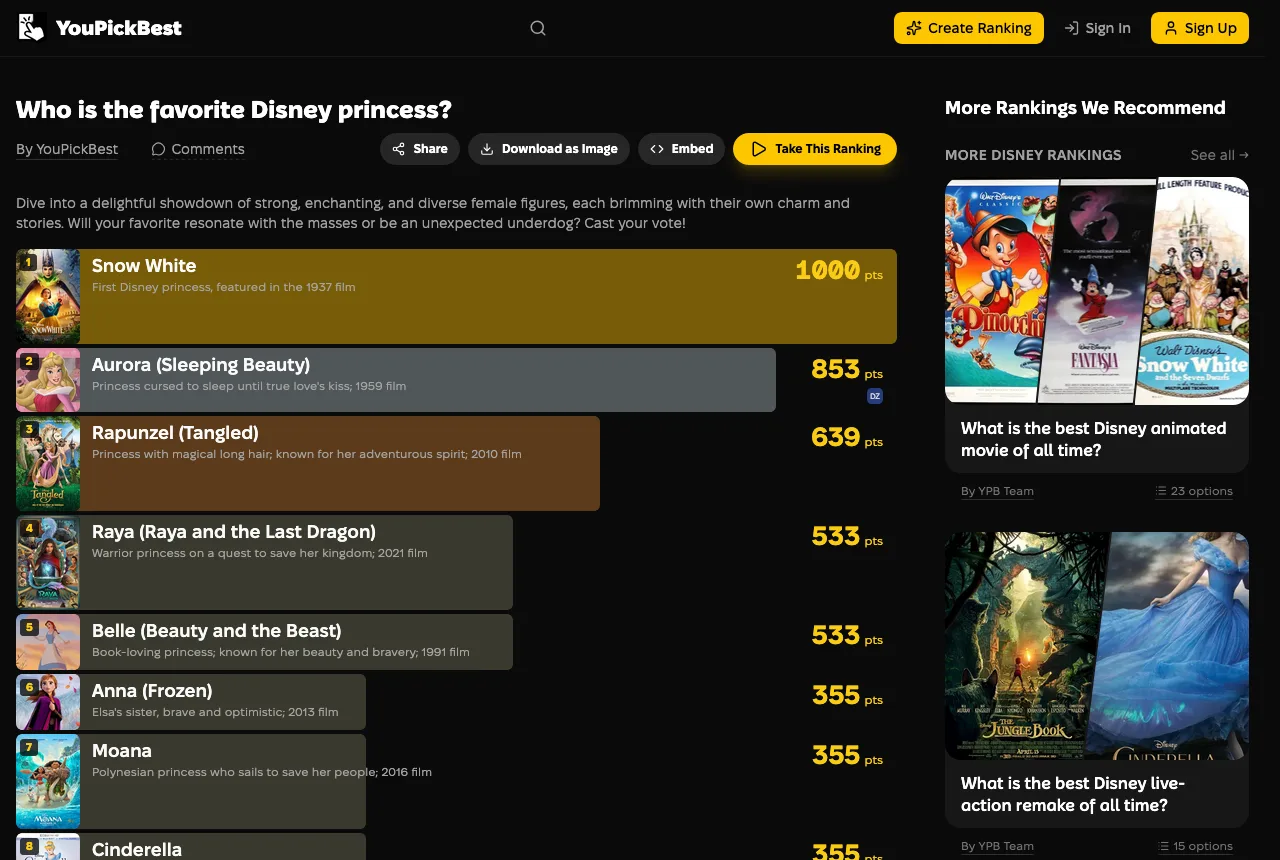
The full calculation, including why the leader always reads 1000, is in how rankings are scored. Comparing options in pairs also has a proper research name, pairwise comparison, and a history that predates the web by decades.
Nothing here needs an account. Pick a ranking, answer the matchups, and find out whether the crowd agrees with you.
Common questions
Is head-to-head voting the same as a bracket?
No. A bracket is one way to run it — pairs, winners advance, rounds shrink. You can also vote in a loose stream of random pairs, which is what King of the Hill does. YouPickBest has both.
Do I have to compare every possible pair?
No. The order forms without anybody seeing the full set of combinations. Every extra vote sharpens it a little, and a handful of matchups per voter is enough.
Can I change my vote later?
Yes. Replay a ranking and your new result replaces the old one. Nothing is counted twice, and the timestamp of your first play is kept.
Why not just use a 1-to-5 star rating?
Because a five-point scale invites everyone to sit near the middle of it. Two options placed against each other leave no middle to sit in, so the results separate.
More on how voting works
- King of the Hill Voting: How Winner-Stays Ranking Works — the winner stays, as on a Street Fighter II cabinet
- Bracket vs Pairwise Voting: Which Finds the True Favourite? — 15 picks for 16 options, and what they prove
- What Is Pairwise Comparison? The Simple Way to Rank Anything — the method behind chess ratings, explained
- Add a ranking to your blog — the same voting, inside your own post