
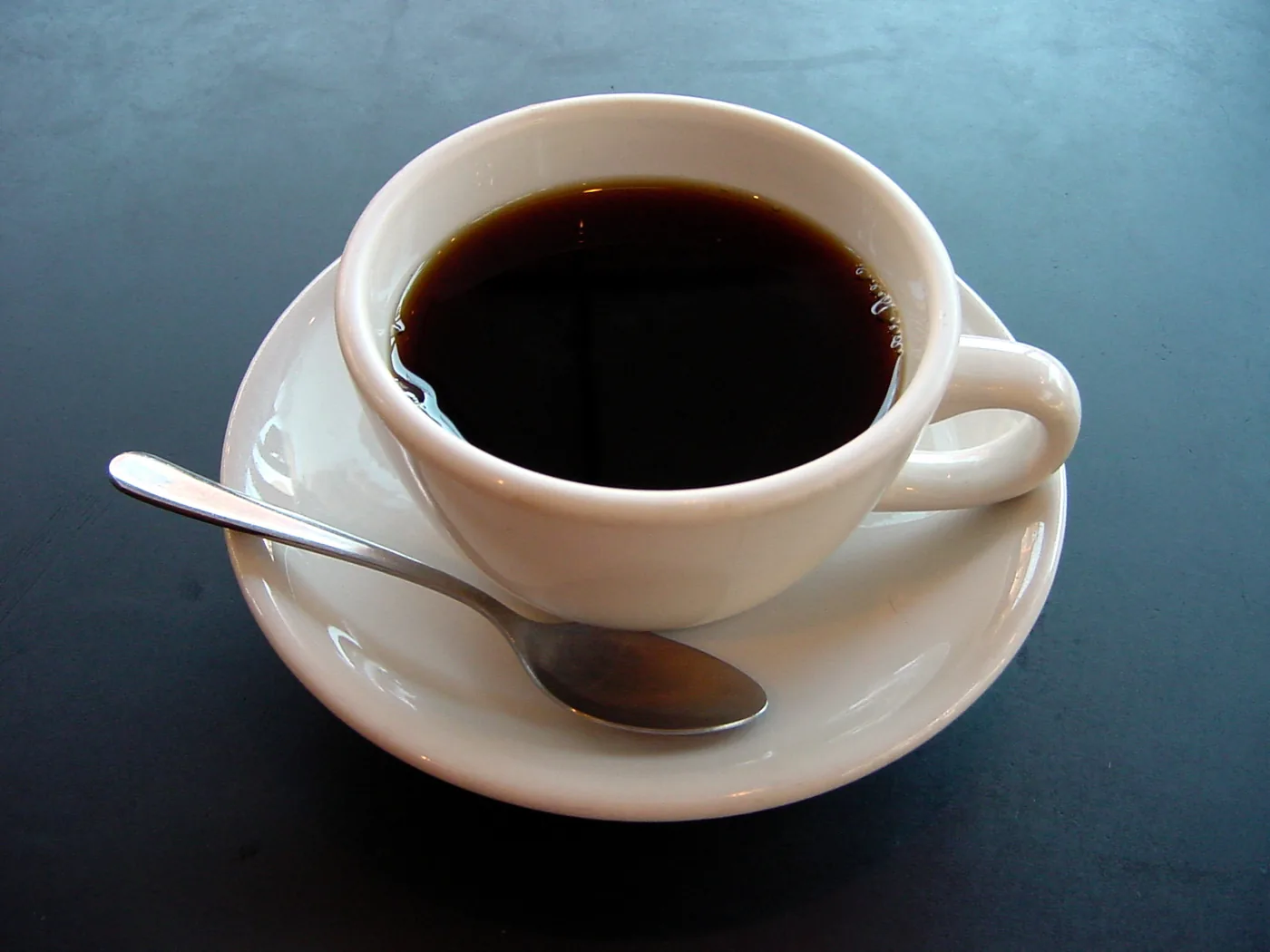
The United States marks National Coffee Day on 29 September, and International Coffee Day follows on 1 October. The National Coffee Association timed its autumn figures for the occasion: in September 2026, 66% of American adults said they had drunk coffee the day before. No other beverage reached that share, tap and bottled water included.1
Worldwide demand is still climbing. The US Department of Agriculture expects consumption to reach a record 179.7 million 60-kilogram bags in the 2026/27 season.2
A drink on that scale plays many parts: a smell from childhood, a colonial cash crop, a sitcom set, the subject of a cantata. The 14 rankings below put coffee next to tea, crude oil, Shakira and the microwave oven.
Coffee makes its strongest case on smell and history, and its weakest wherever someone asks who pays for the cup.
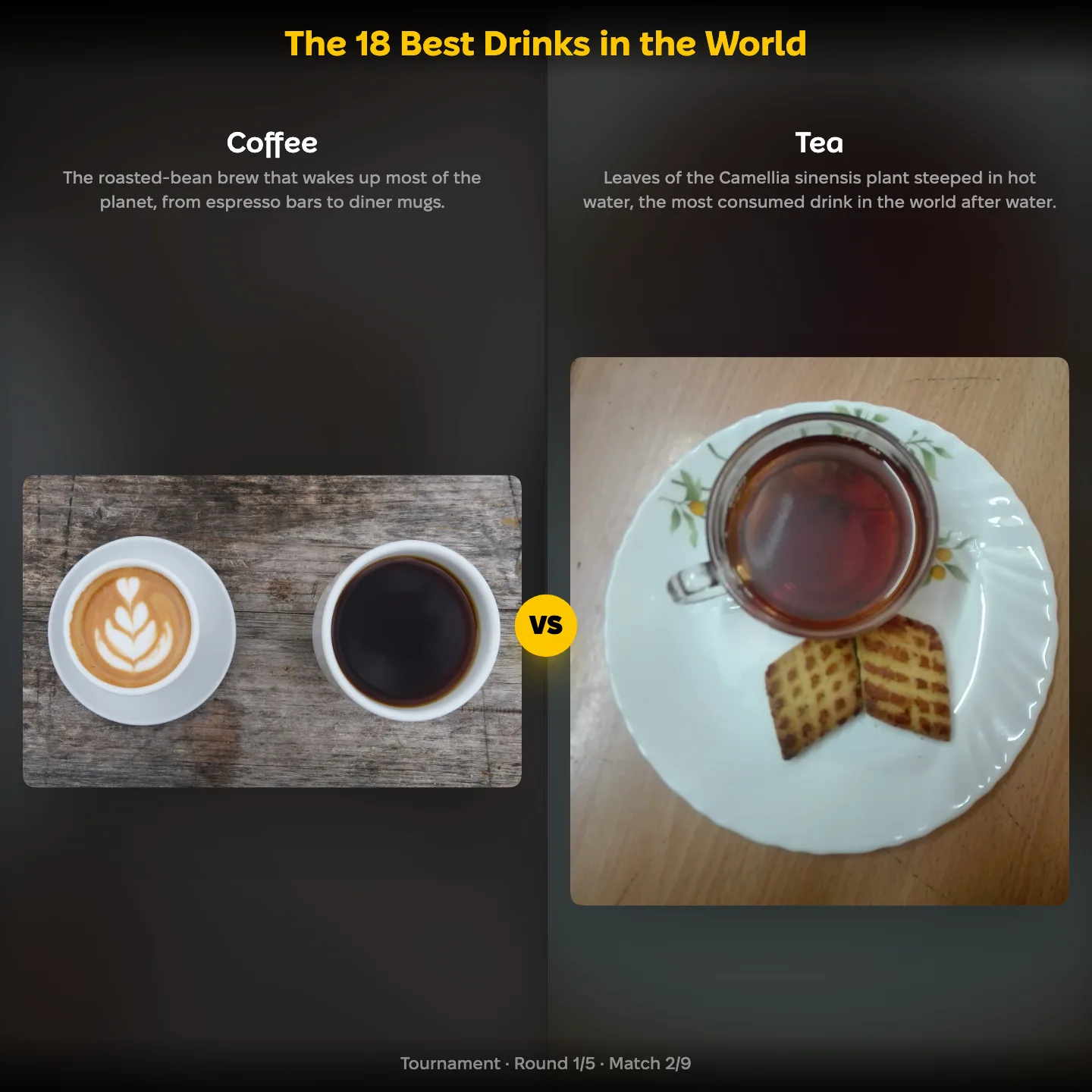
Coffee vs Tea: two drinks that split the world
The 18 Best Drinks in the World puts coffee in the same field as water, beer, wine, Coca-Cola, champagne, yerba mate and bubble tea.
Tea has a claim that is hard to dispute. The UN Food and Agriculture Organization calls it the most consumed beverage on the planet after water.3 It is the everyday drink of Britain, China and India, and China was brewing it for centuries before coffee crossed from Ethiopia to Yemen.
Coffee rests on the morning routine. Across North America, Scandinavia and Brazil, the day usually starts with a cup of it.
The other entries compete on different grounds. Water keeps people alive, wine and beer mark celebrations, hot chocolate belongs to childhood.
The smell of coffee: 800 compounds in one cup
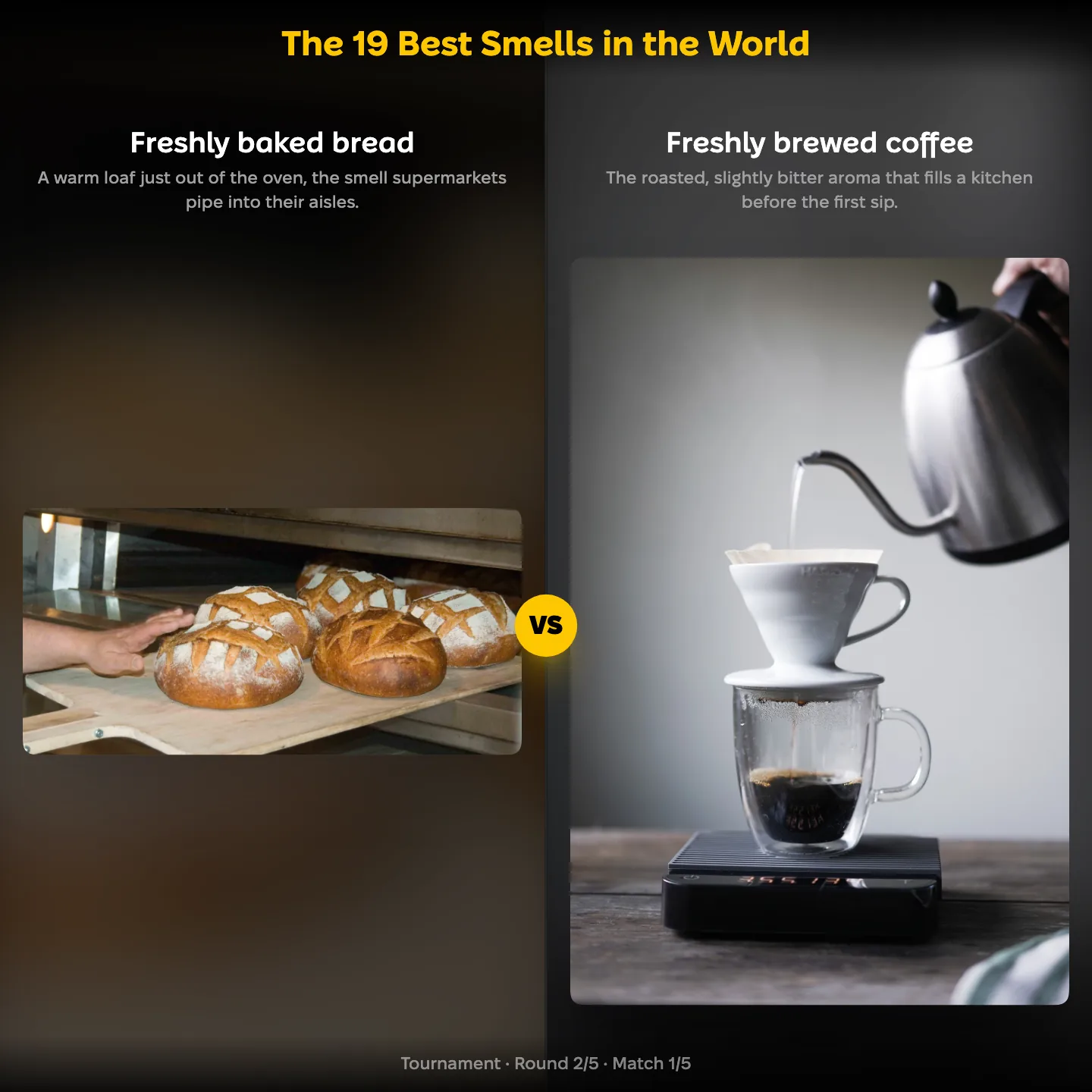
In The 19 Best Smells in the World, freshly brewed coffee shares the list with rain, fresh bread, cut grass, sizzling bacon, campfire smoke and old books.
Coffee's aroma has complicated chemistry behind it. A 2015 review in the Journal of Food Science and Technology counted more than 800 volatile compounds in roasted coffee, of which about 40 produce the smell people recognize.4
Freshly baked bread is the closest rival. Both smells come from heat and from the same Maillard reaction, in which sugars bond with proteins: coffee in the roaster's drum, bread in its crust.
Rain and cut grass are the two smells on the list that nobody can buy in a shop.
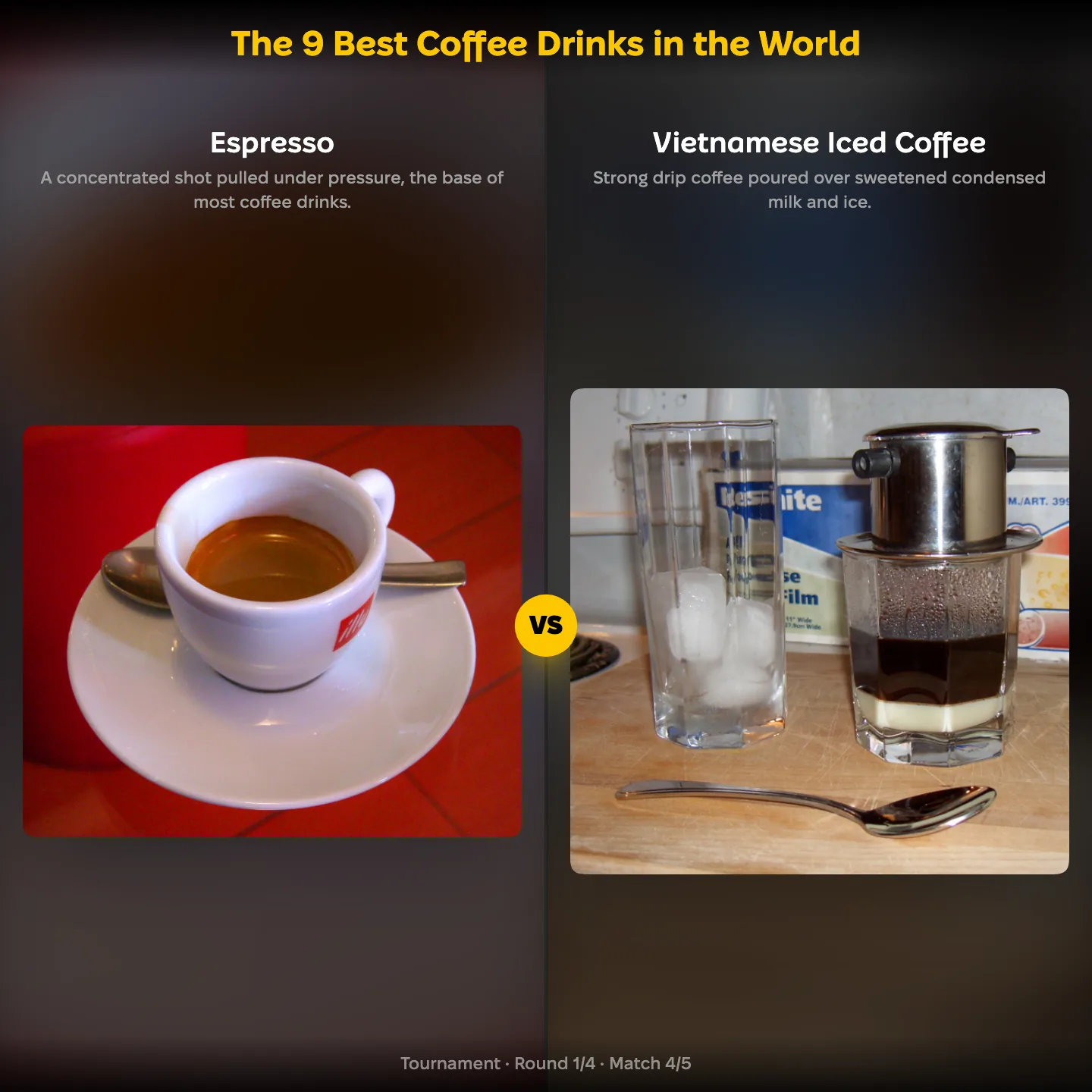
Espresso vs Vietnamese iced coffee
Here the question goes to coffee itself: which of nine drinks is best. The list holds espresso, cappuccino, latte, flat white, macchiato, cortado, affogato, Turkish coffee and Vietnamese iced coffee.
Espresso is the base of nearly everything else on it. The story starts in Turin, where Angelo Moriondo patented "new steam machinery for the economic and instantaneous confection of coffee beverage" in 1884. His machine brewed in bulk. Single-shot espresso, brewed straight into the cup, came from Luigi Bezzera in the early 1900s.5
Vietnamese iced coffee drips through a small metal phin filter onto condensed milk and is then poured over ice.
Turkish coffee is the oldest drink in the lineup. Affogato is technically a dessert: a scoop of ice cream drowned in espresso.
Pods vs pour-over: how Americans actually brew
The ranking of brewing methods has 15 entries, from espresso, the French press and the moka pot to the Turkish cezve, the Vietnamese phin and instant coffee.
The National Coffee Association tracks what people really use at home. In fall 2025, among Americans who had coffee the previous day, 38% made it in a drip machine, 23% in a single-cup pod brewer, 17% as cold brew and 11% on an espresso machine.6
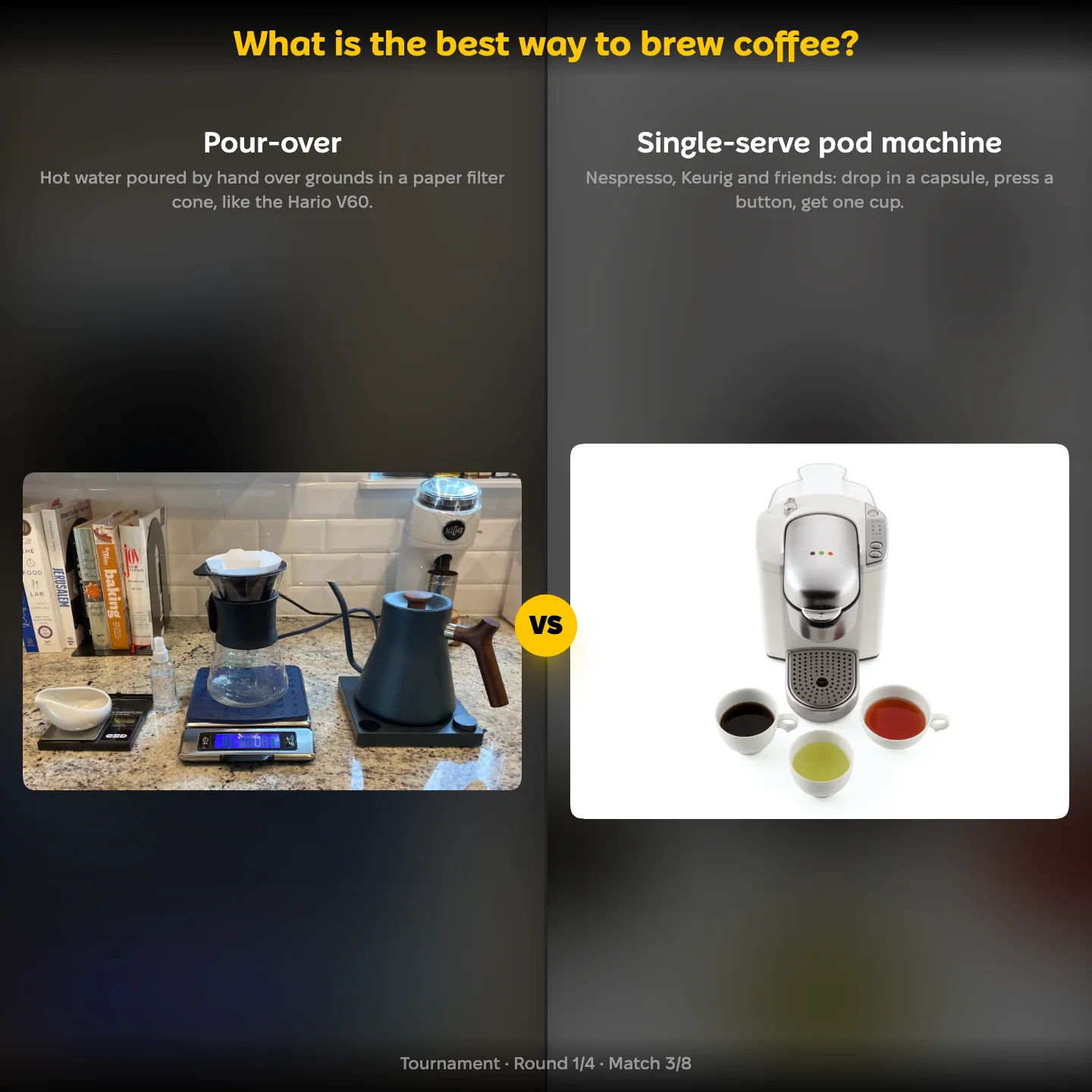
The pod machine is the most convenient entry and the easiest to attack. One button makes one cup, and every cup leaves behind a plastic or aluminum capsule.
Pour-over asks for a scale, a gooseneck kettle, a paper filter and a few minutes of hands-on work for every cup.
Ethiopia vs Brazil: the birthplace and the biggest harvest
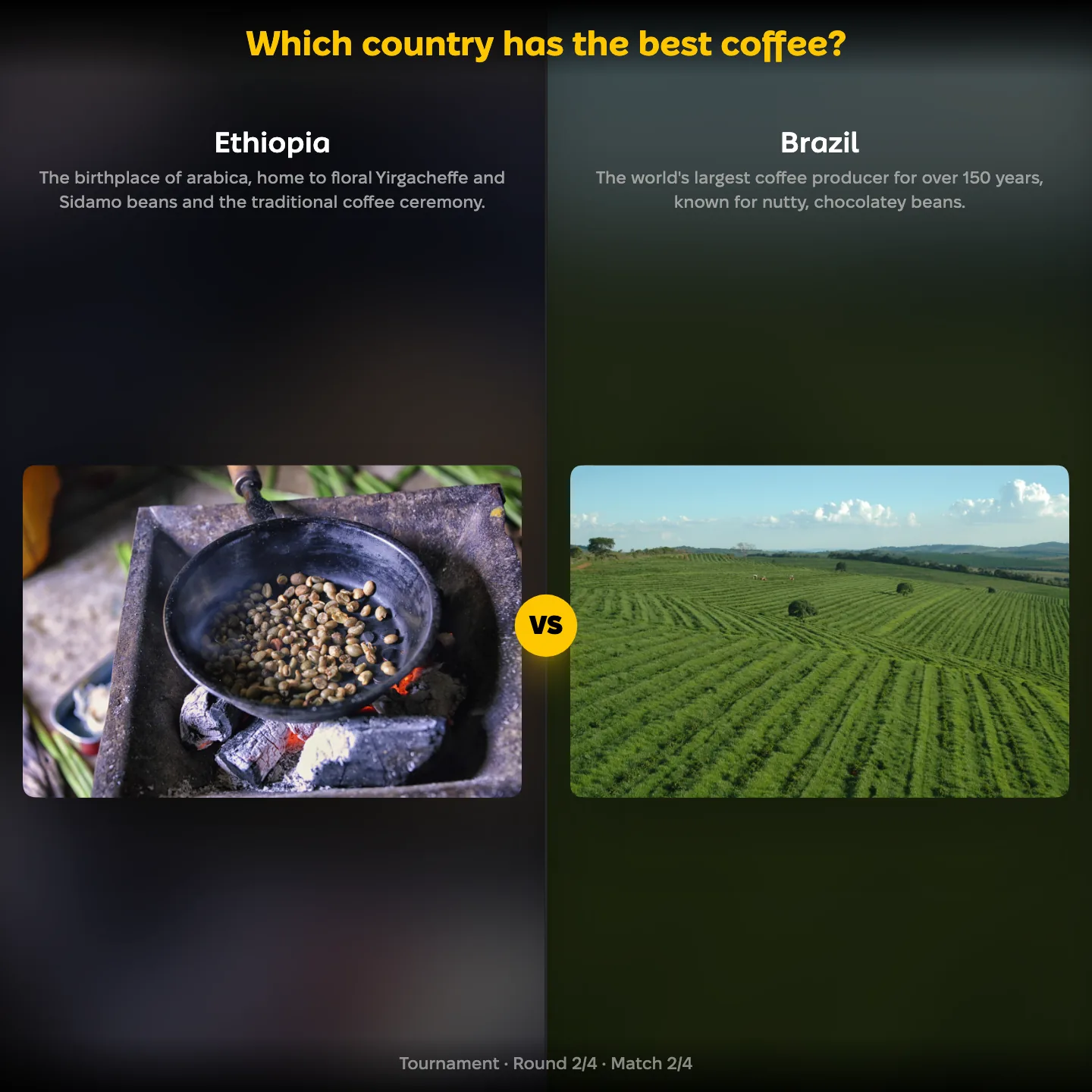
The ranking of coffee nations has 16 entries, among them Ethiopia, Colombia, Brazil, Kenya, Jamaica, Panama, Yemen and Vietnam.
Ethiopia is regarded as the home of arabica, whose wild trees grow in the southwestern Kaffa region. Kaldi the goatherd, whose goats grew lively after eating red berries, belongs to legend; the plant really did start here. Coffee then crossed the Red Sea to Yemen, where, by tradition, Sufis were the first to brew it to stay awake through night prayers. The Ethiopian crop is still growing, and the USDA expects a record 12.1 million bags in 2026/27.2
Brazil's claim is volume. The USDA forecasts a record 71.9 million bags there, nearly 40% of the world harvest.2
The priciest coffee grows in Panama. At the 2025 Best of Panama auction, a washed Geisha from Hacienda La Esmeralda sold for a record $30,204 per kilogram.7
Colombia: Shakira, García Márquez and Juan Valdez
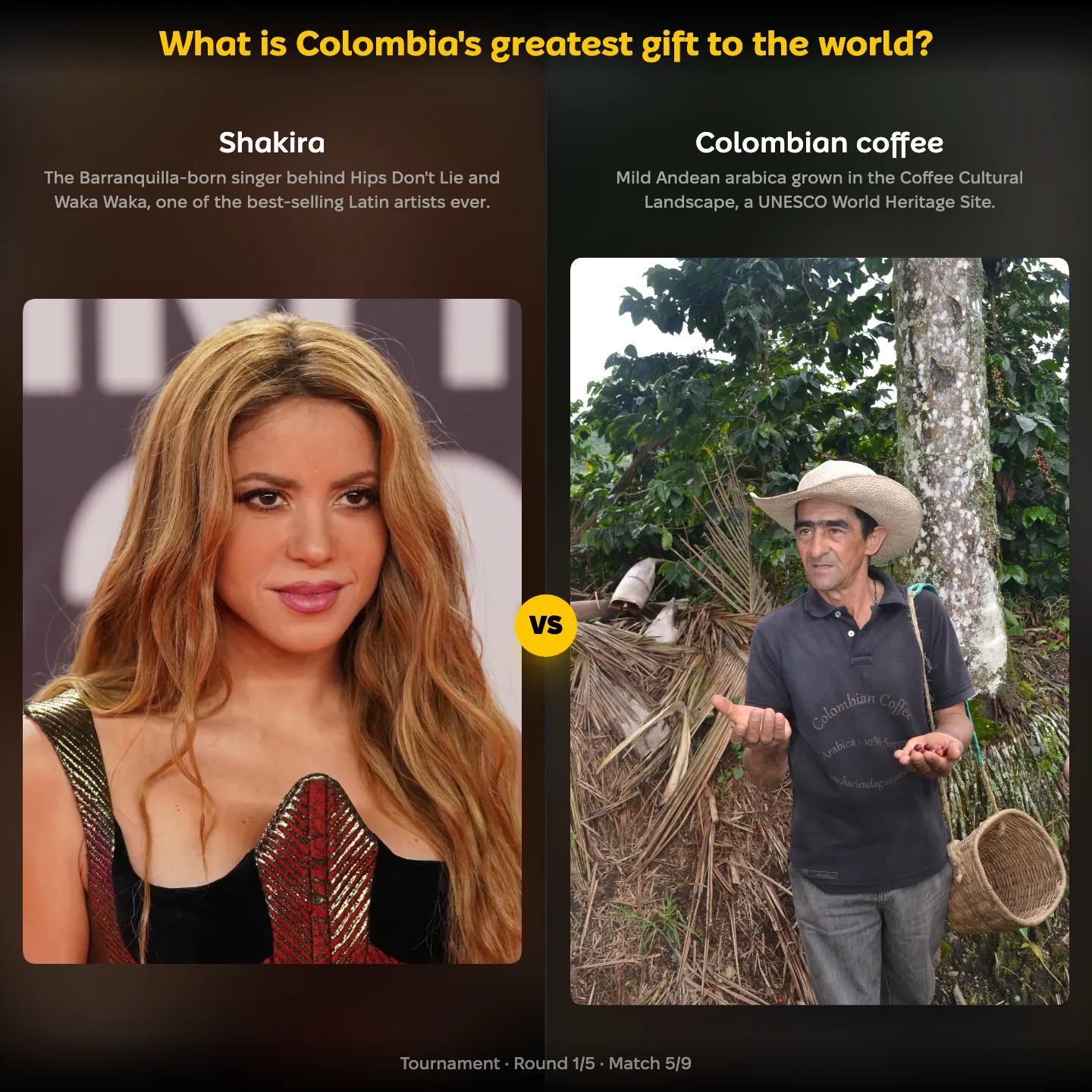
This ranking asks what Colombia has given the world. Colombian coffee competes with Shakira, Gabriel García Márquez, Fernando Botero, cumbia, arepas, emeralds and Carlos Valderrama.
Colombian coffee has a face of its own. The National Federation of Coffee Growers created Juan Valdez, the farmer with his mule Conchita, in 1960 so that shoppers could tell pure Colombian coffee from blends. The federation says the character now stands for 540,000 coffee-growing families.8
The country remains one of the largest producers. In the same USDA outlook, Colombia comes third in the world after Brazil and Vietnam.2
The rivals are formidable. García Márquez is a Nobel laureate in literature, Shakira's "Waka Waka" is remembered from the World Cup in South Africa, and cumbia is danced across Latin America.
Japan's canned coffee, since 1969
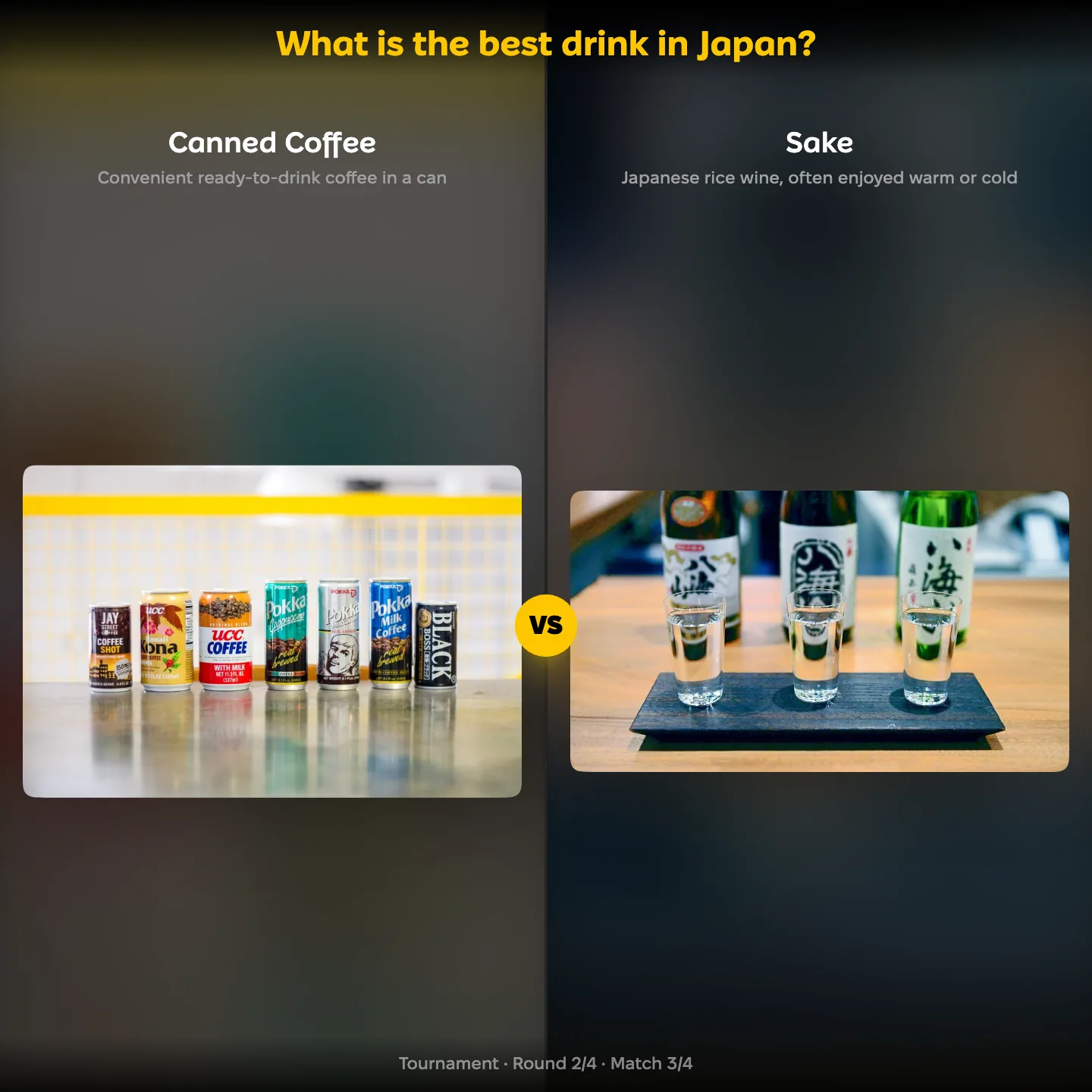
In the ranking of Japanese drinks, coffee is outnumbered. Green tea, matcha, hojicha, barley tea, sake, Ramune soda and Calpico all line up against it.
Japan has a coffee format of its own. UCC says it launched the world's first canned coffee drink, coffee with milk, in April 1969.9
Canned coffee now comes hot or cold from vending machines, and the list carries two brands beside the general category: Boss and UCC.
Kopi luwak vs caviar
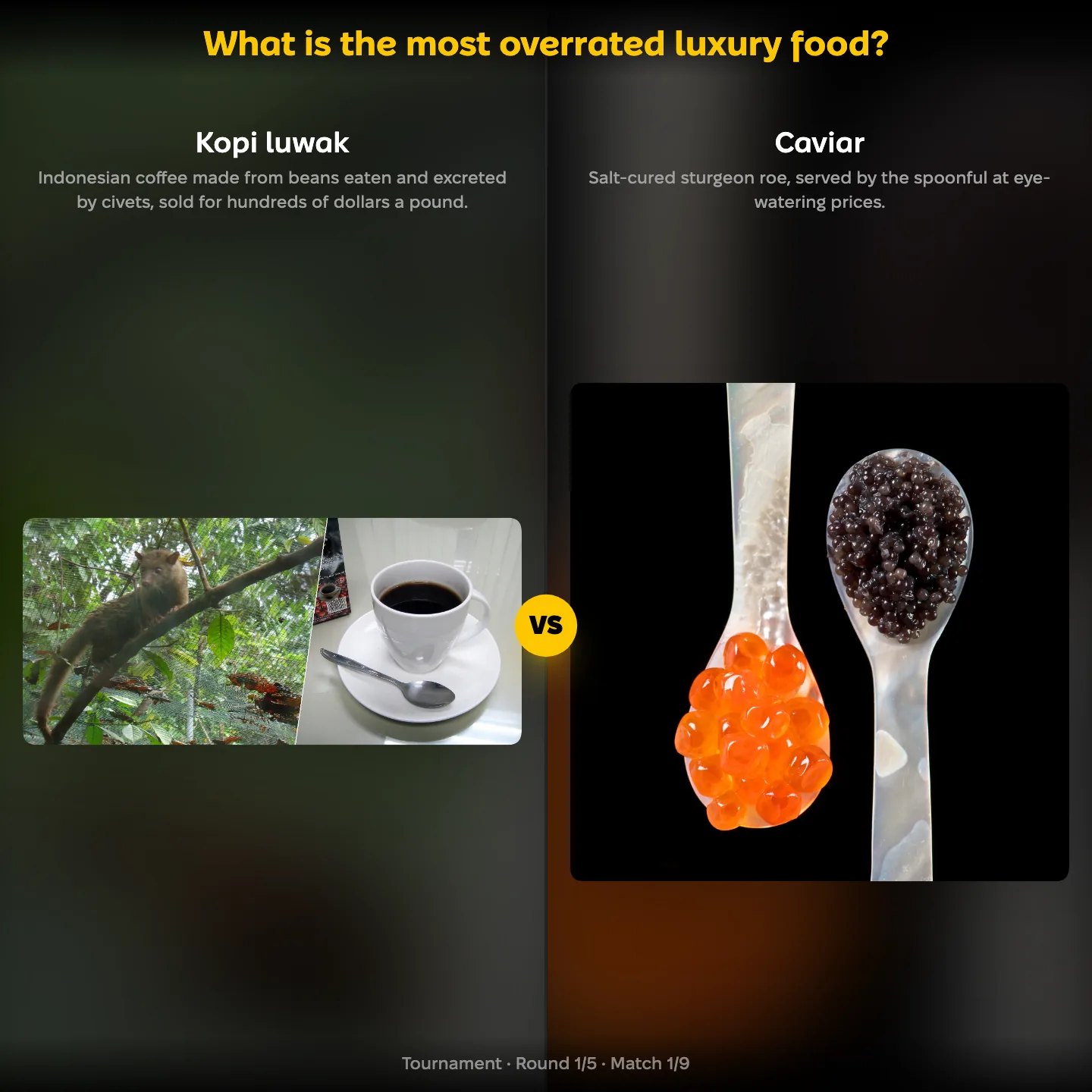
This ranking flips the question: which luxury food is the most overrated. Coffee enters through kopi luwak, made from beans that an Asian palm civet has eaten and excreted.
Kopi luwak is sold as a rarity, yet on many farms the animals live in cages. In 2016 researchers from Oxford University and World Animal Protection inspected 16 plantations on Bali, and none met basic animal-welfare requirements. National Geographic reported that a cup can cost as much as $80 in the United States.10
Caviar and truffles are expensive because they are hard to obtain. Yubari melons and gold-leaf dishes are mostly bought as gifts or for the photo.
For coffee this is the most uncomfortable list in the set, because the price here is paid by animals.
Oil and coffee: the second-commodity myth
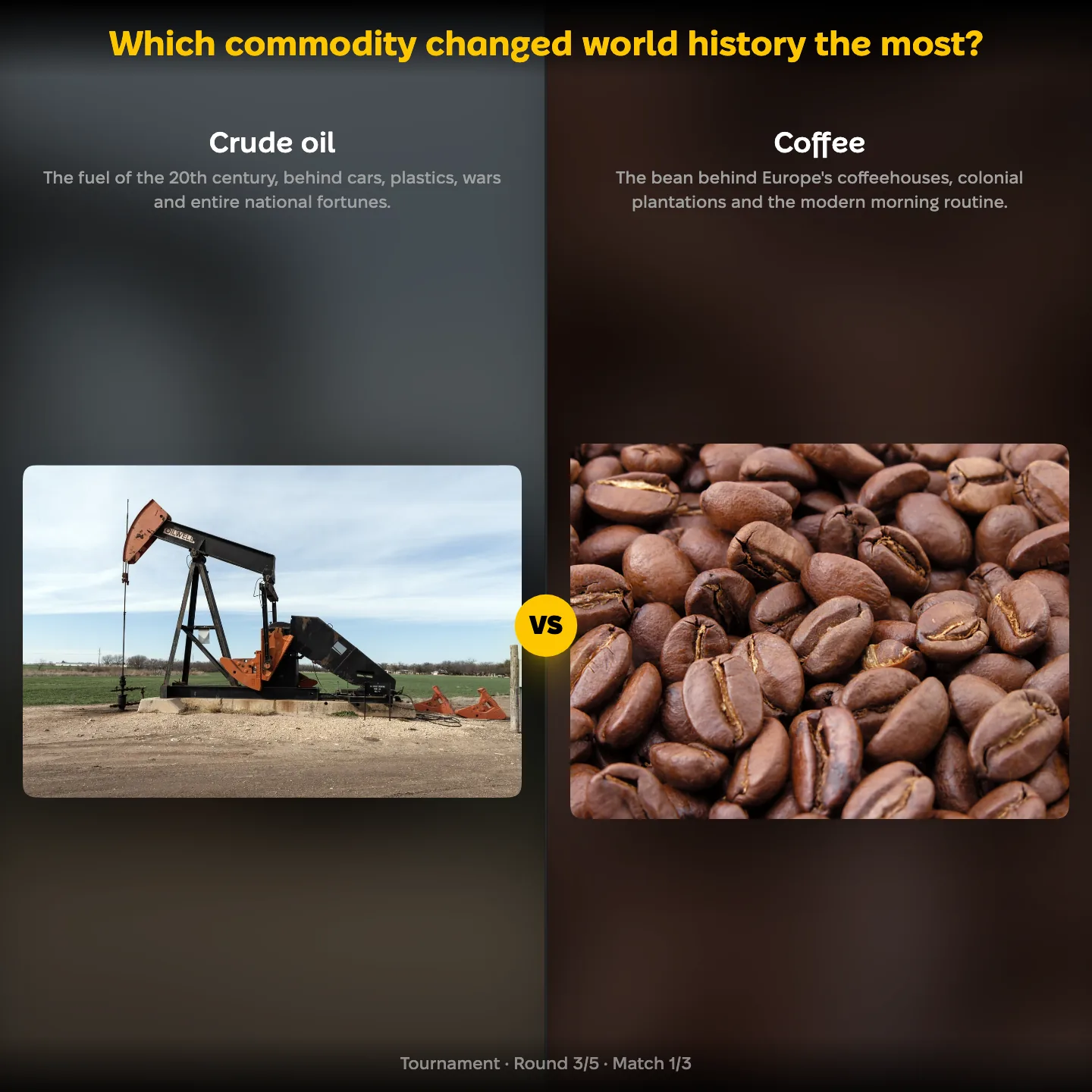
The ranking of commodities that changed history places coffee beside crude oil, sugar, salt, spices, cotton, silk, gold and coal.
Coffee is often called the world's second most traded commodity after oil. PolitiFact checked that line in 2017 and rated it Pants on Fire: world coffee exports were worth $19 billion to $23 billion a year, against $788 billion for oil in 2015. World Bank economist John Baffes told the fact-checkers the claim was true around 1970, before grains and metals overtook coffee.11
Coffee's price is set on the futures market. In February 2025 arabica rose to a record $4.30 a pound, Reuters reported.12
Coffee's historical contribution is the coffeehouse. In 17th-century London people met in them to swap news, deals and shipping reports, and Edward Lloyd's coffeehouse grew into the Lloyd's insurance market.
Sugar, cotton and coffee also share a darker past. For centuries all three were grown on plantations worked by enslaved people.
Mr. Coffee, 1972: the machine that retired the percolator
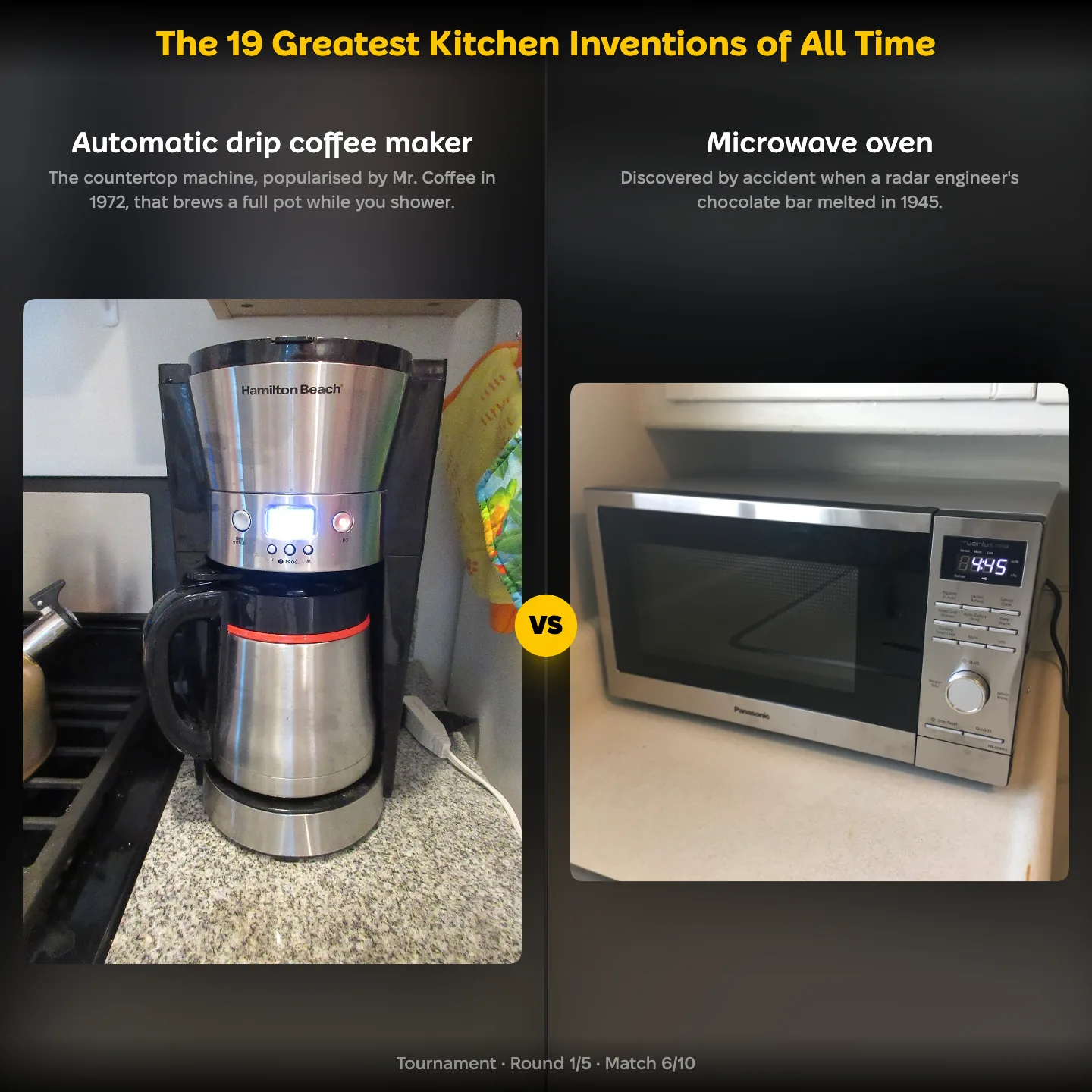
The automatic drip coffee maker is one of The 19 Greatest Kitchen Inventions of All Time, alongside the refrigerator, the microwave oven, the dishwasher, the toaster and the air fryer.
The home version came out of Cleveland. In 1972 Vincent Marotta and Samuel Glazer began selling the Mr. Coffee machine, and until then most Americans had made coffee in a percolator. From 1973 Joe DiMaggio fronted the ads, and by April 1974 more than a million machines had been sold.13
Its rivals on this list carry more weight. The refrigerator changed how people keep food, and the microwave changed how they reheat it.
Central Perk vs Monk's Café
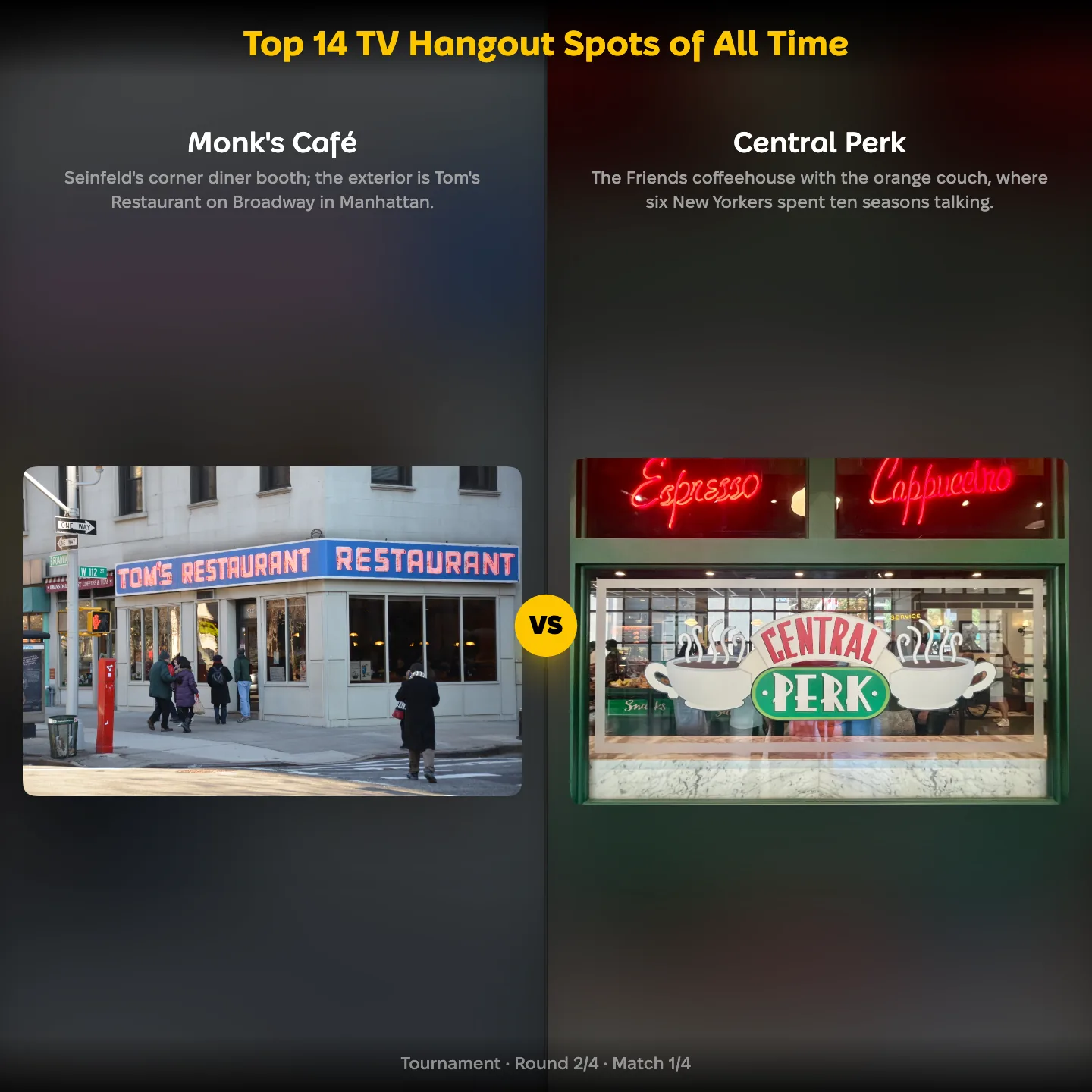
The ranking of TV hangout spots holds 14 places, including the bar from Cheers, Moe's Tavern from The Simpsons, the Double R Diner from Twin Peaks, The Beef from The Bear and the Rovers Return from Coronation Street.
Central Perk is the coffeehouse from Friends, where six friends spent ten seasons on an orange couch.
Its main rival is Monk's Café from Seinfeld. The exterior shots came from Tom's Restaurant on Broadway in New York, the diner that also inspired Suzanne Vega's "Tom's Diner", a song that also appears in the coffee-songs ranking further down this page.
The two 1990s New York sets stand on opposite sides of the old Friends vs Seinfeld debate. In one, coffee comes in oversized mugs; in the other, breakfast is ordered in a corner booth.
From Bach to Sabrina Carpenter: songs about coffee
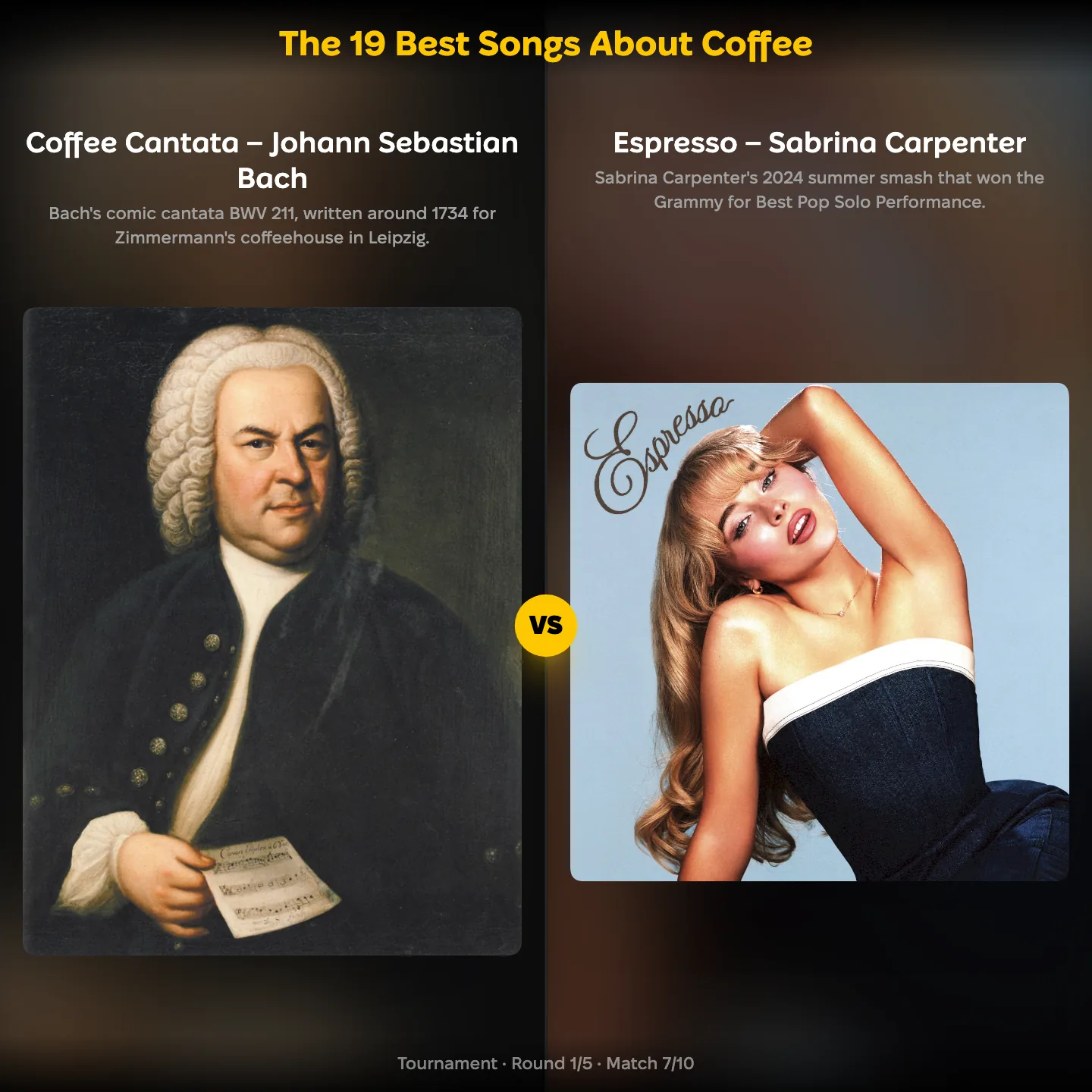
The coffee-songs ranking spans almost three centuries. Between Bach and Sabrina Carpenter it holds Frank Sinatra, Bob Dylan, Otis Redding, Blur, Suzanne Vega and Peggy Lee.
Bach wrote the Coffee Cantata around 1734 for concerts at Zimmermann's coffeehouse in Leipzig.14 It is a comic scene: a father forbids his daughter to drink coffee, and she sings that coffee is sweeter than a thousand kisses.
Sabrina Carpenter's "Espresso" was the hit of summer 2024. In the song coffee is a metaphor, and the singer keeps her lover up at night the way a strong espresso would.
The 20th century brings Peggy Lee's "Black Coffee", about a sleepless night, and Bob Dylan's "One More Cup of Coffee" from the album Desire.
Coffee Talk: a late-night café in an alternate Seattle
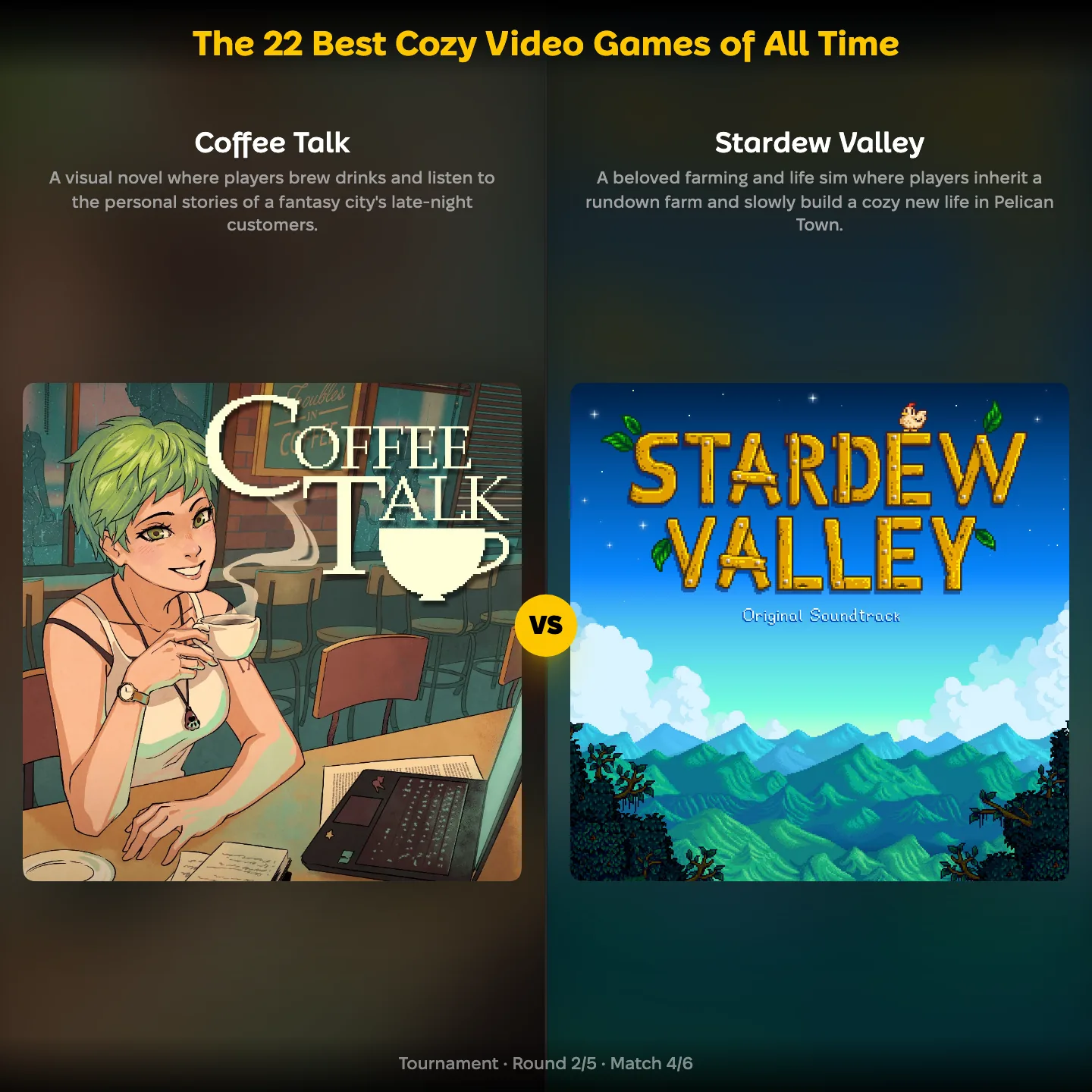
Cozy games do without enemies and timers, and in a ranking of 22 of them coffee is represented by Coffee Talk.
It is a visual novel from the Indonesian studio Toge Productions. The player runs the counter of a late-night café in an alternate Seattle, where elves, orcs and mermaids live alongside humans, brewing drinks and listening to the customers' stories.
Its rivals on the list, Stardew Valley, Animal Crossing and The Sims 4, offer a whole life on a farm, an island or in a house. Coffee Talk fits behind a single counter.
Legends & Lattes: an orc opens a coffee shop
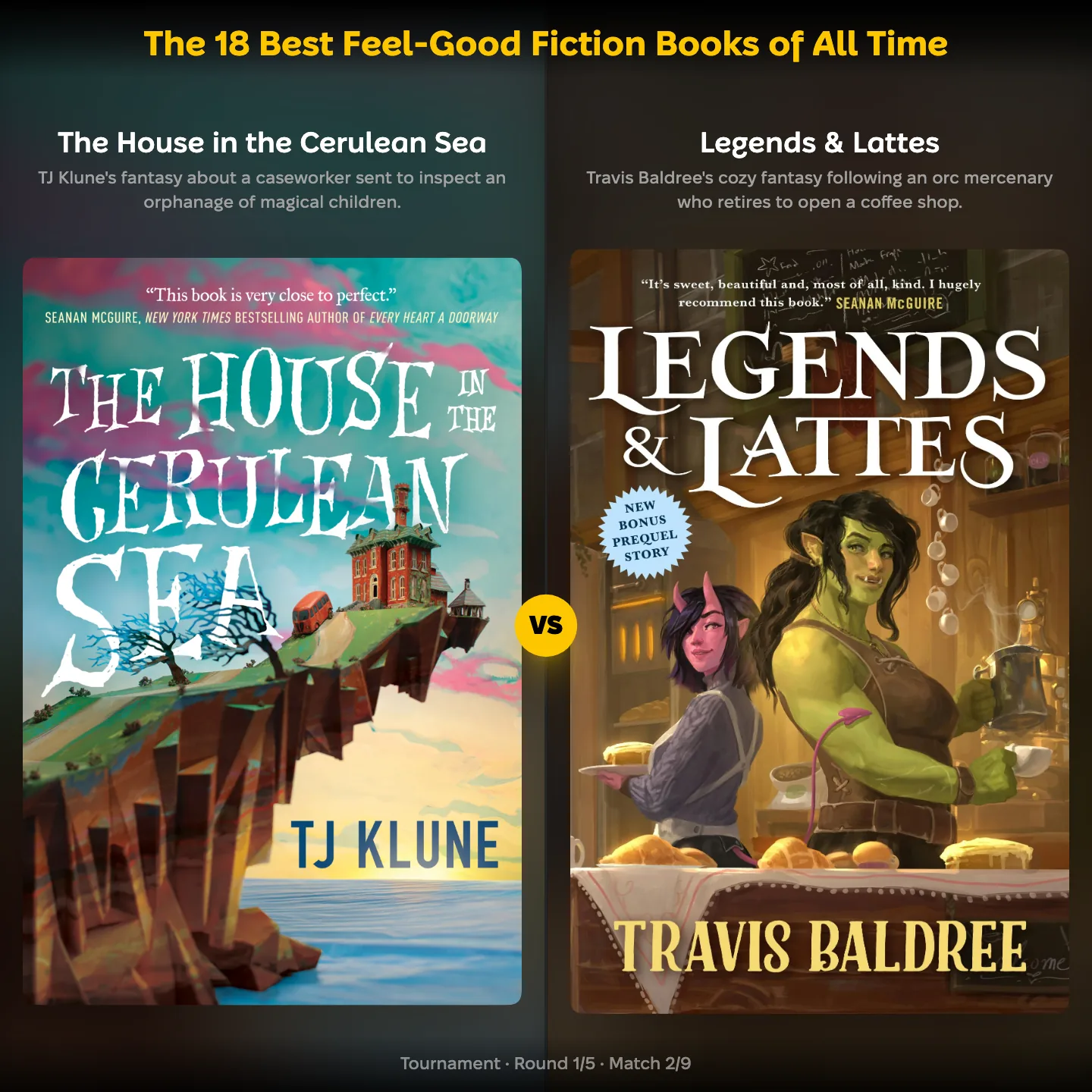
The ranking of 18 feel-good novels includes Fredrik Backman's A Man Called Ove and Anxious People, and TJ Klune's The House in the Cerulean Sea.
Coffee arrives with Travis Baldree's Legends & Lattes. Viv, an orc mercenary, leaves her band and opens the first coffee shop in the city of Thune, where nobody has heard of coffee.
The book began as a self-published novel and in 2023 made the Hugo shortlist for Best Novel. Baldree himself won that year's Astounding Award for Best New Writer.15
Klune's novel is the closest match in genre: another fantasy about kindness and a found family.
One cup, fourteen lists
Coffee runs from a smell people know before they ever taste it to the cages on Bali where civets pay for a rare cup. Its strengths are the chemistry of its aroma and the history of the coffeehouse; its weak points are the price and the conditions it is grown in. The site turns questions like these into an order by showing two options per screen, a method laid out in our explainer on pairwise comparison.
Got a coffee question of your own, such as the best roast or your city's favorite café? It can become a ranking.
More rankings, more angles
- Starbucks vs Dunkin': Which Coffee Chain Is Better? 15 Lists — two American chains in pumpkin season
- Best Alcoholic Drink? Where Beer Lands on 16 Lists — beer for the 191st Oktoberfest
- Coca-Cola vs Pepsi Rivalry: The Cola Wars on 15 Lists — Coca-Cola at 140, and two famous flops
Sources
- National Coffee Association USA — National Coffee Data Trends, fall 2026: 66% of American adults drank coffee in the past day, more than any other beverage: ncausa.org (checked 2026-09-28)
- USDA Foreign Agricultural Service — Coffee: World Markets and Trade, July 2026: 2026/27 consumption and production forecasts, crops in Brazil, Vietnam, Colombia and Ethiopia: fas.usda.gov (checked 2026-09-28)
- FAO — International Tea Day: tea is the most consumed beverage in the world after water: fao.org (checked 2026-09-28)
- Rattan S. et al. — Journal of Food Science and Technology, 2015, 52(9): more than 800 volatile compounds identified in roasted coffee: ncbi.nlm.nih.gov (checked 2026-09-28)
- Smithsonian Magazine — the history of the espresso machine: Angelo Moriondo's 1884 patent, Luigi Bezzera's single-shot espresso: smithsonianmag.com (checked 2026-09-28)
- National Coffee Association USA — National Coffee Data Trends, fall 2025: coffee preparation methods in the US: ncausa.org (checked 2026-09-28)
- UPI — record price at the 2025 Best of Panama auction, Hacienda La Esmeralda Geisha: upi.com (checked 2026-09-28)
- Juan Valdez — official site: character created by Colombia's National Federation of Coffee Growers in 1960, 540,000 coffee-growing families: juanvaldez.com (checked 2026-09-28)
- UCC Ueshima Coffee — company history, April 1969: ucc.co.jp (checked 2026-09-28)
- National Geographic — WildCRU (Oxford) and World Animal Protection study of 16 Bali plantations, US price per cup, 29 April 2016: nationalgeographic.com (checked 2026-09-28)
- PolitiFact — fact-check of the claim that coffee is the second most traded commodity after oil, 8 May 2017: politifact.com (checked 2026-09-28)
- Reuters (via Investing.com) — arabica futures record of $4.2995 a pound on 11 February 2025: investing.com (checked 2026-09-28)
- Wikipedia — Mr. Coffee: 1972 launch, founders, Joe DiMaggio commercials, sales by April 1974: en.wikipedia.org (checked 2026-09-28)
- Netherlands Bach Society — BWV 211, the Coffee Cantata, around 1734, Zimmermann's coffeehouse in Leipzig: bachvereniging.nl (checked 2026-09-28)
- The Hugo Awards — 2023 finalists and winners: Legends & Lattes a Best Novel finalist, Astounding Award to Travis Baldree: thehugoawards.org (checked 2026-09-28)