
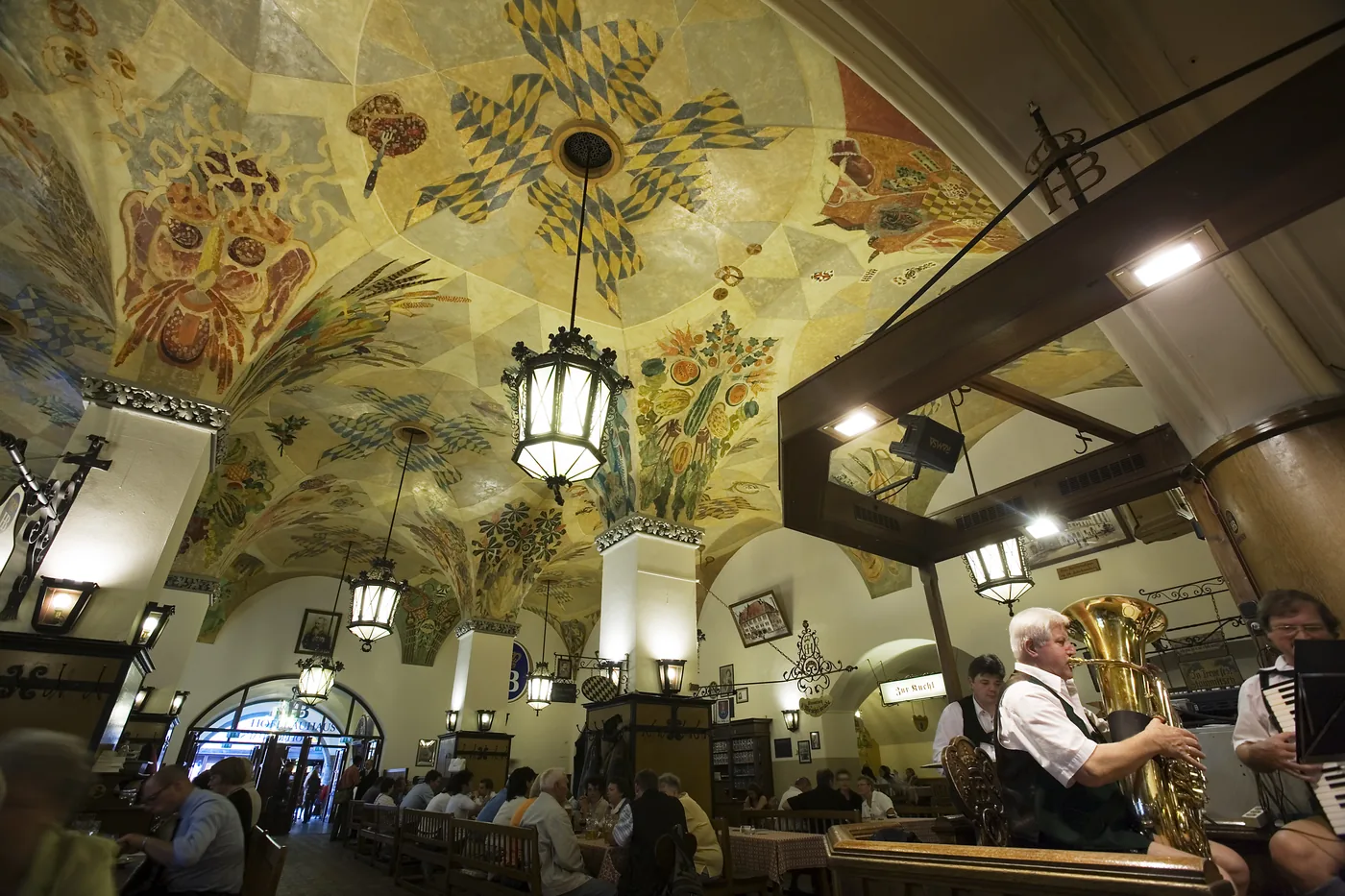
On 19 September the Mayor of Munich taps a barrel at the Schottenhamel tent and the 191st Oktoberfest begins, running until 4 October across 38 tents on the Theresienwiese.1 Last year's edition poured about 6.5 million litres to roughly 6.5 million visitors.2
Beer is the only drink that is simultaneously a 500-year-old legal recipe, a national statistic, a global brand portfolio and a night out. This page gathers sixteen rankings that all hold beer. No two of them mean the same thing by the word.
Beer is four arguments wearing one word, and every ranking quietly picks a different one to judge.
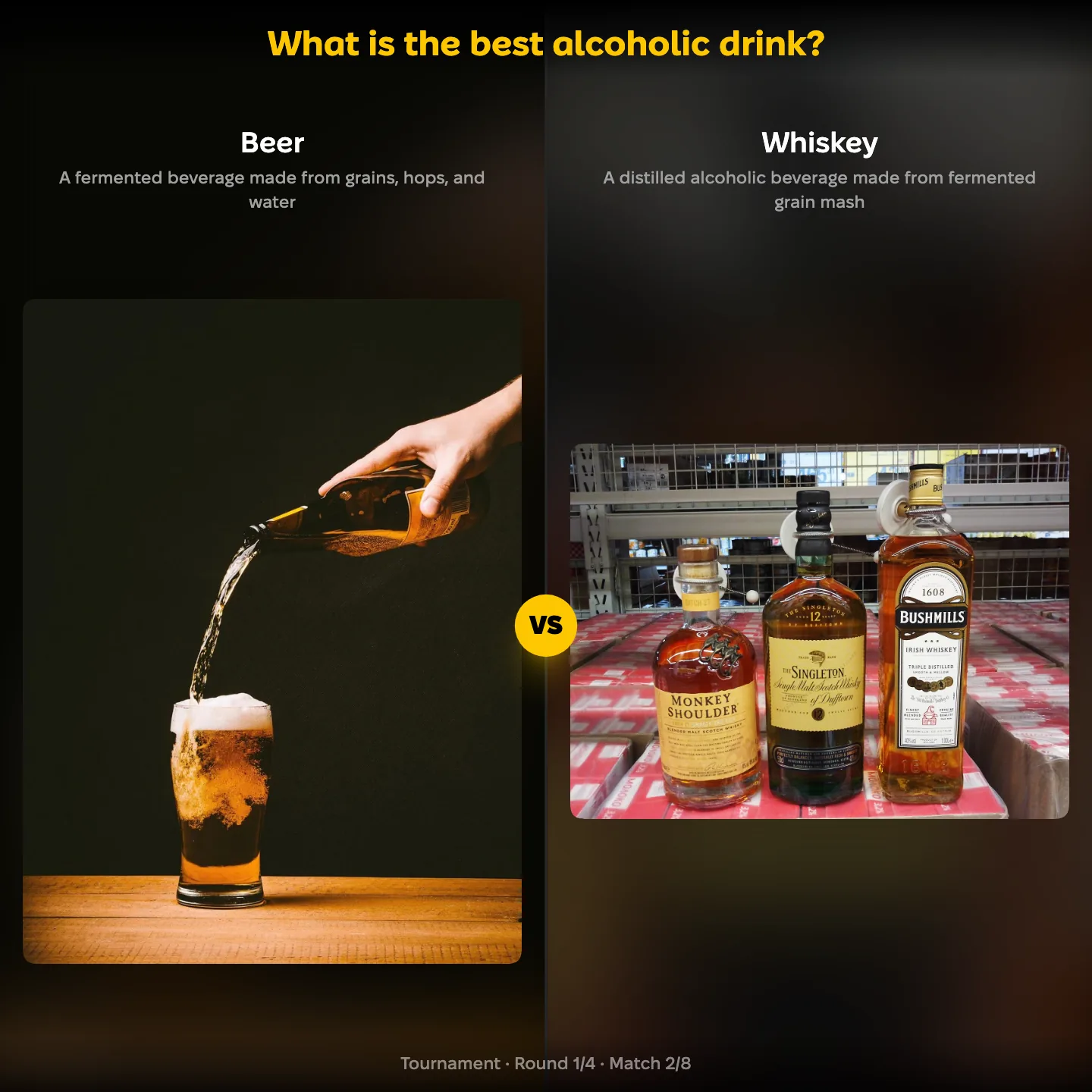
Beer vs Whiskey: the drink that has to win the whole bar
Before beer can be sorted by style, brand or country, it has to get past a much broader question: what is the best alcoholic drink at all?
The company here is not other beers. It is wine, whiskey, vodka, tequila, gin and champagne, plus six cocktails that borrow from them.
Beer's case is volume and occasion. Worldwide consumption reached roughly 194.12 million kilolitres in 2024, a scale no spirit approaches.3 It is the drink people order without deciding anything.
The counter-case is that the same ubiquity works against it. A Manhattan or an Old Fashioned is a choice; a beer is often the absence of one.
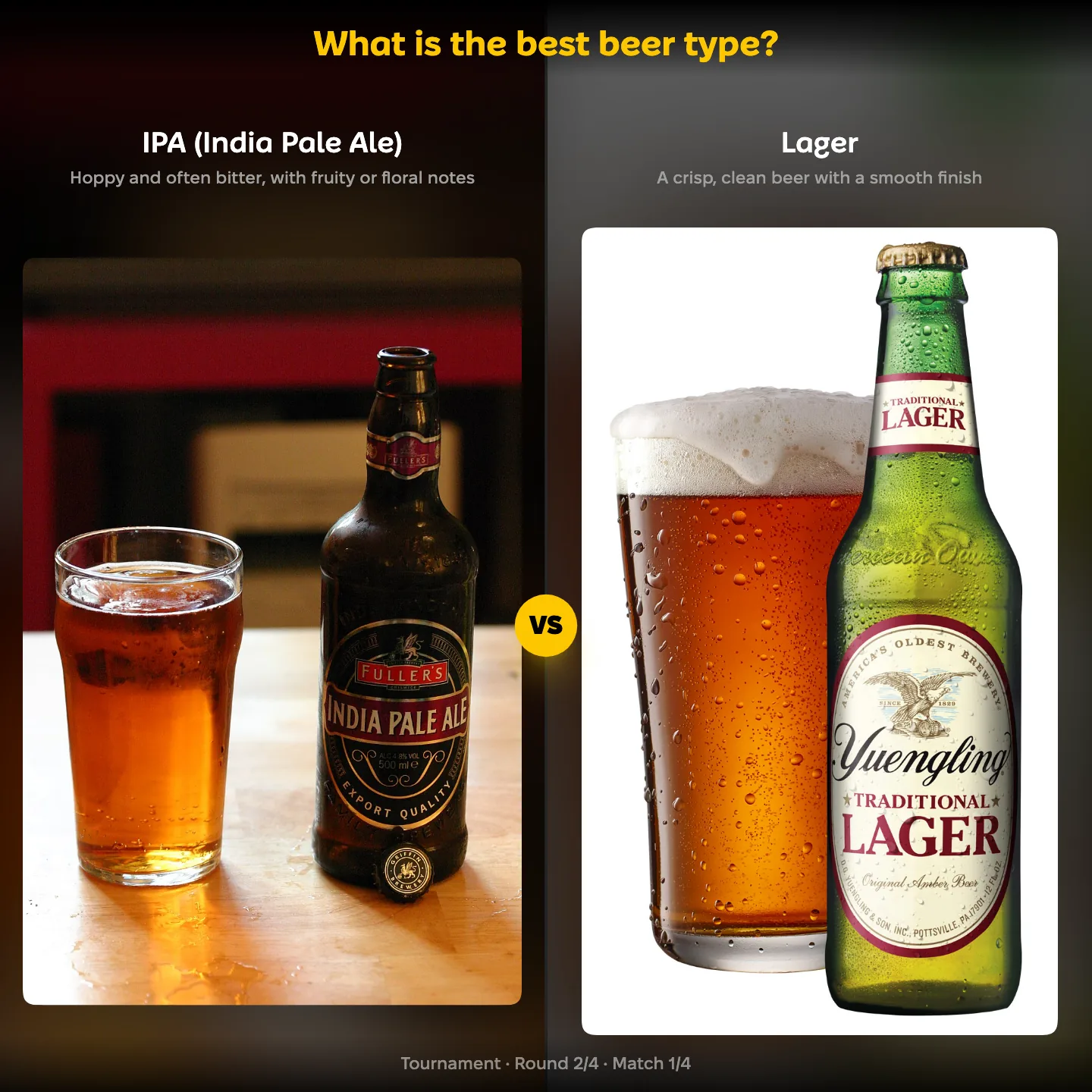
Lager vs IPA: one style is 92% of the world
Narrow the question to style and beer stops being one thing. The list holds Kölsch, Schwarzbier, saison, sour, bock and ten more.
Lager is the incumbent by an enormous margin. The pale lager family accounts for roughly 92% of global beer volume, which makes every other entry here a minority interest.4
The IPA is the style that changed what the word "craft" means in English, and it carries the bitterness most casual drinkers still complain about.
Beneath those two the field splits along national lines: Hefeweizen and Bock from Bavaria, Kölsch from Cologne, stout and porter from the British Isles, saison from Wallonia.
Guinness vs Modelo: thirty-two brands on one shelf
Styles are abstract. Brands are what people actually buy, and this ranking holds thirty-two of them.
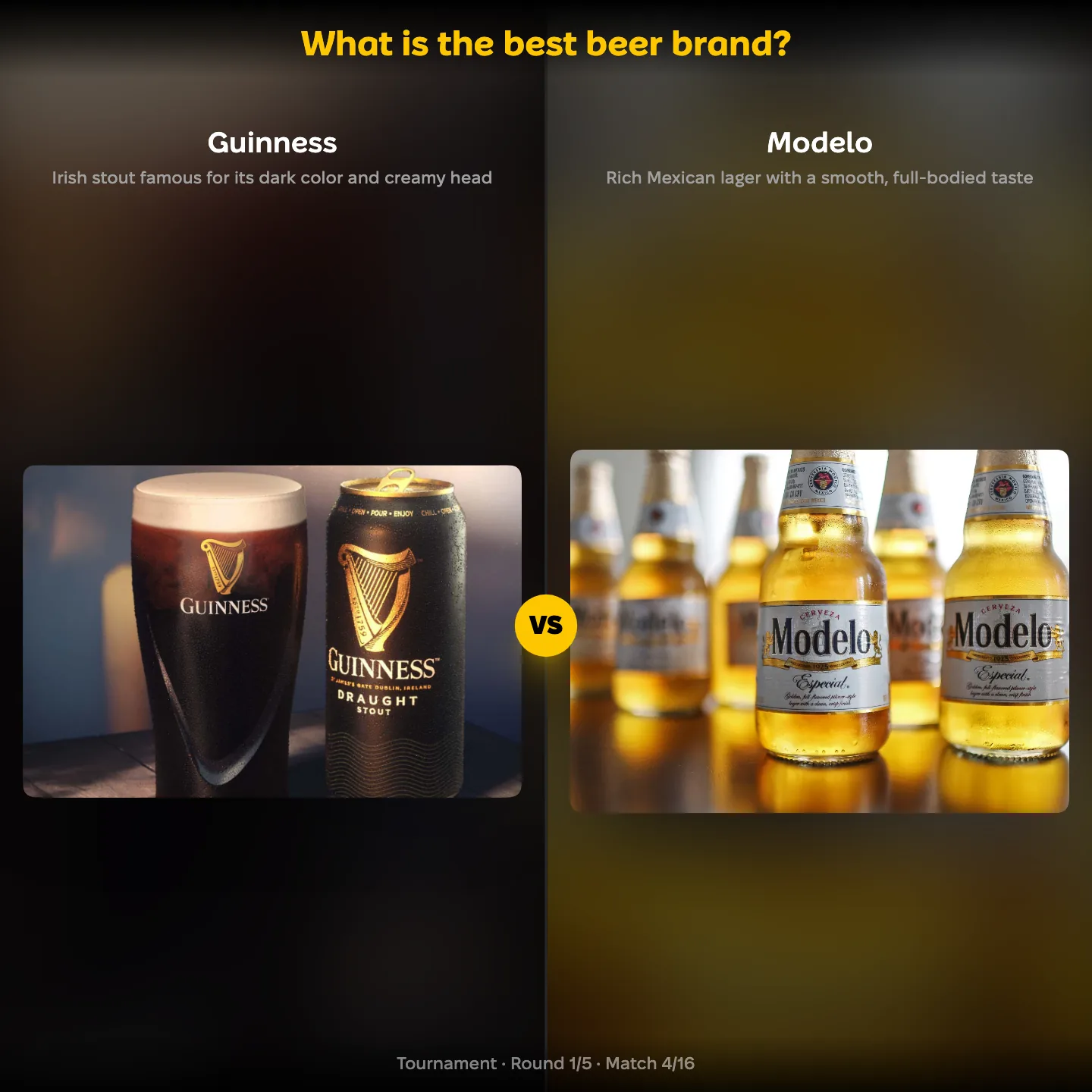
Guinness is the outlier in the group: a 4.2% Irish stout sold on a two-part pour and a 119.5-second wait, in a field otherwise dominated by pale lager.
Modelo comes at it from the other direction. The Mexican lager has led American beer sales by dollar value since mid-2023, ending Bud Light's long run at the top.
Beyond those two the shelf turns into a world map: Asahi, Sapporo and Kirin from Japan, Tsingtao from China, Castle Lager from South Africa, Brahma and Skol from Brazil, Pilsner Urquell from Plzeň, and Chimay and Duvel from Belgian monasteries and family breweries.
Czech Republic vs Germany: 148.8 litres a head
Ask which country does beer best and the answer depends entirely on which number you accept.
The Czech Republic drank 148.8 litres per person in 2024 and has led the world on that measure every year since 1993, thirty-two consecutive years in a row.3 It also invented the pilsner, in Plzeň in 1842, which is the template for most beer now brewed anywhere.
Germany's case is breadth rather than per-capita volume: a brewing law five centuries old, more than a thousand breweries, and the largest beer festival in the world.
Two other answers are on the list and both are statistical. China has drunk more beer in total than any other country for twenty-two consecutive years, with the United States second.3 Belgium and Ireland argue on culture instead, which is the argument the smaller countries here have to make.
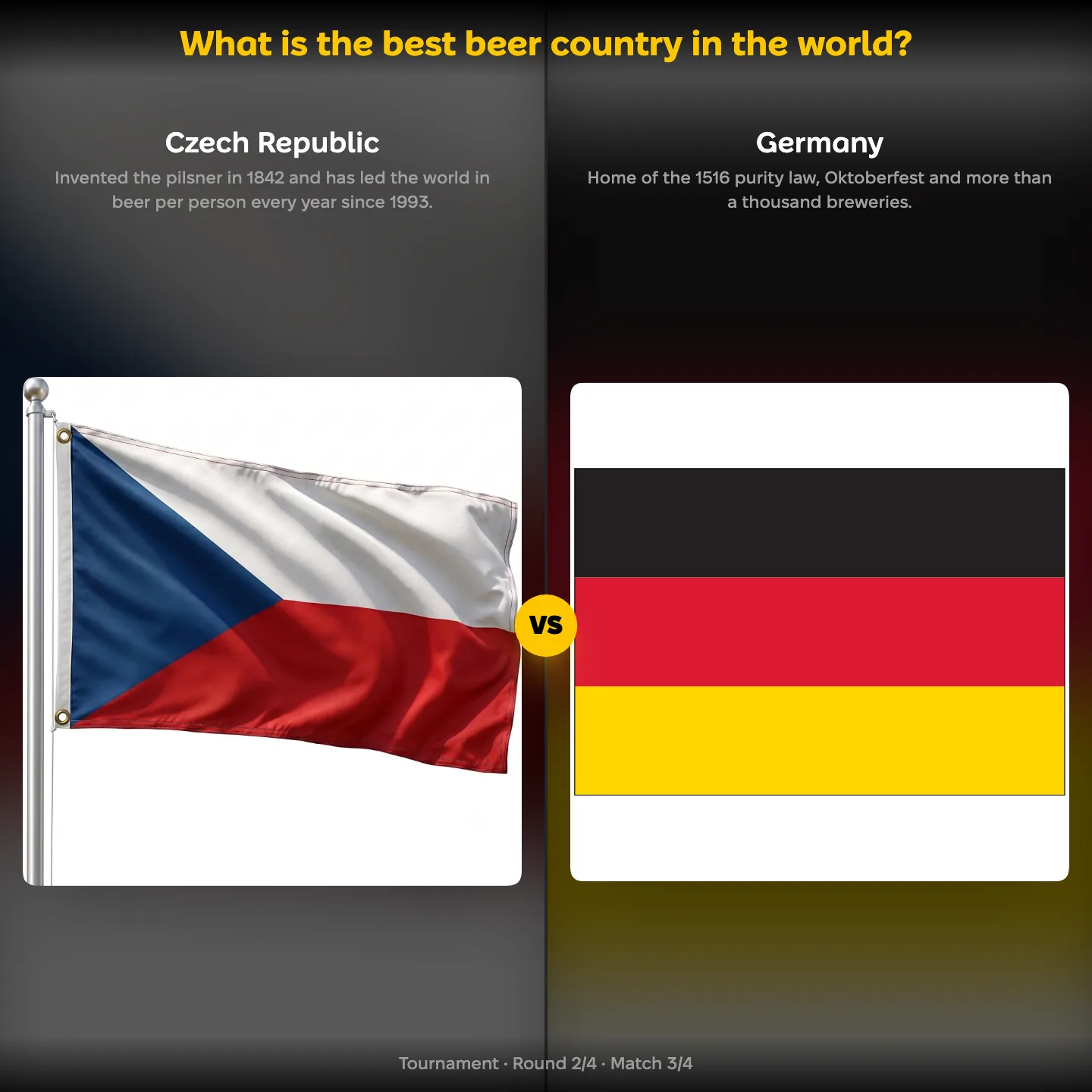
Weihenstephan Has Been Brewing Since 1040
The German list runs to sixteen, and almost all of them are still made to a rule written on 23 April 1516, when Duke Wilhelm IV decreed at Ingolstadt that beer could contain only barley, hops and water.5
Weihenstephaner has the oldest claim in the group. Beer has been brewed on the Weihenstephan hill in Freising since 1040, which the Bavarian State Brewery advertises as the world's longest continuous brewing operation.6
Augustiner has the local loyalty instead of the historic claim. It is Munich's oldest independent brewery and the beer Münchners order at Oktoberfest while visitors order the brands they recognise.
The strangest entry is Aecht Schlenkerla Rauchbier from Bamberg, malted over beechwood so the beer tastes of a campfire. No other German beer in this group comes near it.
That is the German argument in one list. Bitburger, Warsteiner and Jever are three straightforward pilsners from three different corners of the country; Kölsch is served in Cologne in 200ml glasses a waiter keeps replacing, and Düsseldorf answers with a copper altbier forty minutes up the Rhine. Germany is not one beer culture defending a single rule.
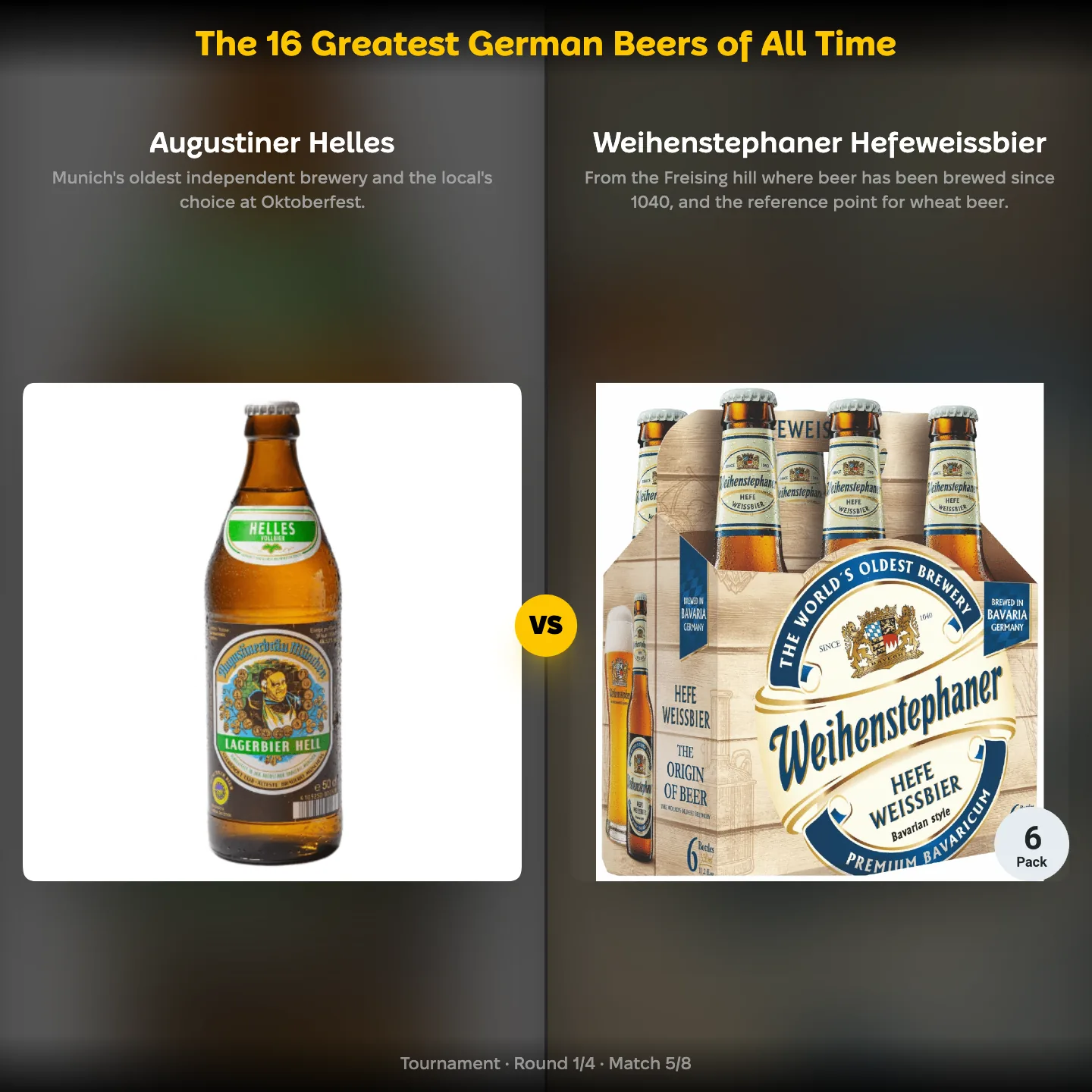
Oktoberfest Against Rio Carnival, Holi and Mardi Gras
This is the ranking where beer stops being a drink and becomes an event. Oktoberfest is one of twenty-three entries, and the other twenty-two have nothing to do with brewing.
Rio's Carnival draws crowds Munich cannot match. Holi and Diwali are religious festivals with centuries behind them. La Tomatina is a tomato fight, and the Wife Carrying World Championship is exactly what it says.
Oktoberfest's claim is scale plus regularity: sixteen days, 38 tents, and attendance measured in millions every year since 1810.1
It is also the only festival on this list whose product is sold by the litre. Six and a half million of them last year, from six Munich breweries that are the only ones allowed to pour there.2
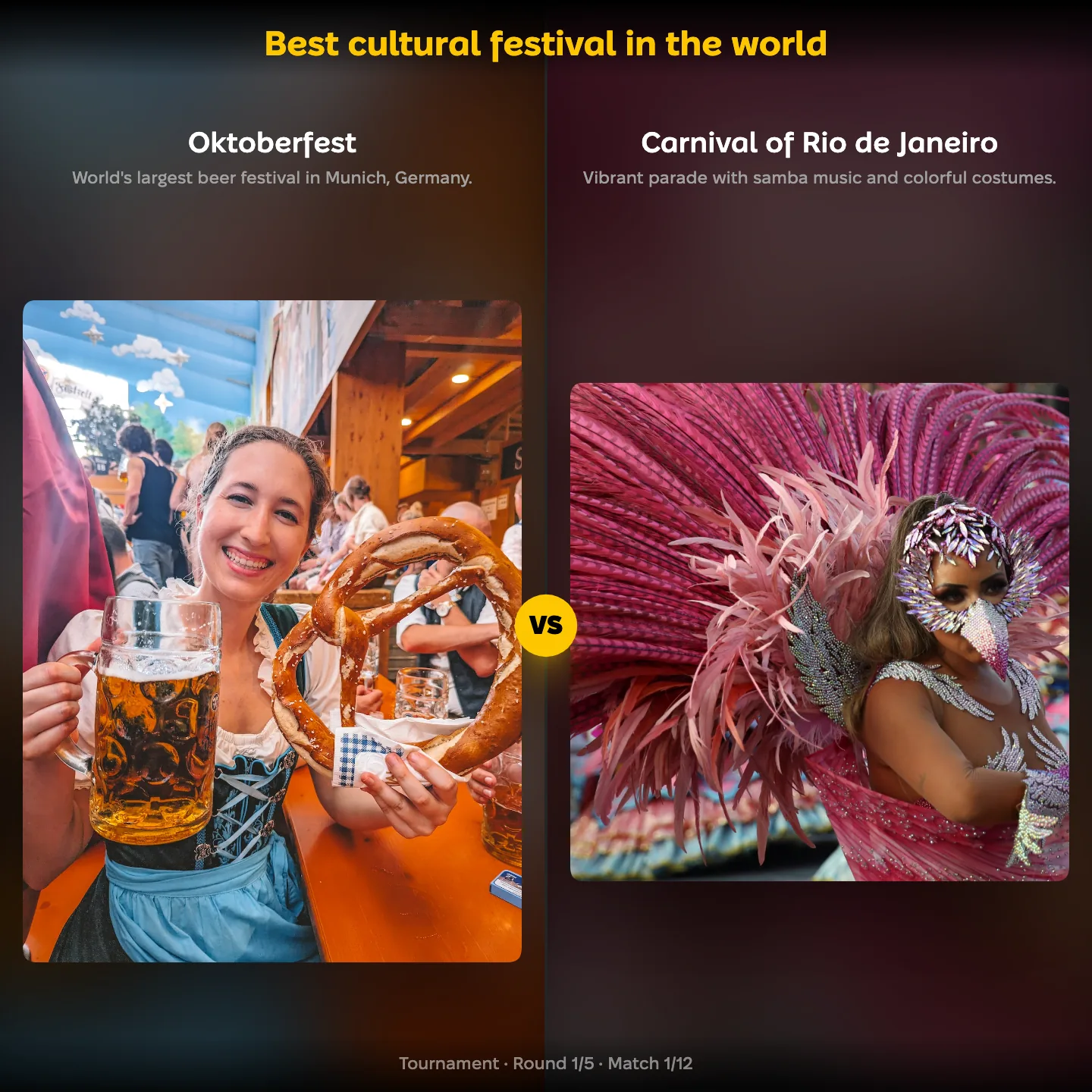
Milwaukee vs Portland: the city beer built, and the city that rebuilt it
American beer has two geographies, and this ranking of cities holds both.
Milwaukee is the old one. Pabst, Schlitz, Miller and Blatz made the city synonymous with brewing, and the baseball team is still called the Brewers.
Portland is the new one. Oregon's largest city carries the nickname Beervana and packs more breweries inside its limits than most American states manage in total.
Between them sit the specialists: San Diego, where the West Coast IPA became a style rather than a recipe; Asheville, a mountain town of 95,000 that talked two of the country's biggest craft breweries into building East Coast plants there; and St. Louis, where Anheuser-Busch has stabled its Clydesdales since 1852.
9,578 Craft Breweries, and 481 of Them Closed Last Year
American craft brewing is the largest experiment beer has ever run, and it is contracting for the first time in a generation. The Brewers Association counted 9,578 operating craft breweries in 2025, down 2.9%, with 300 openings against 481 closings, the second straight year in which closures outpaced openings.7
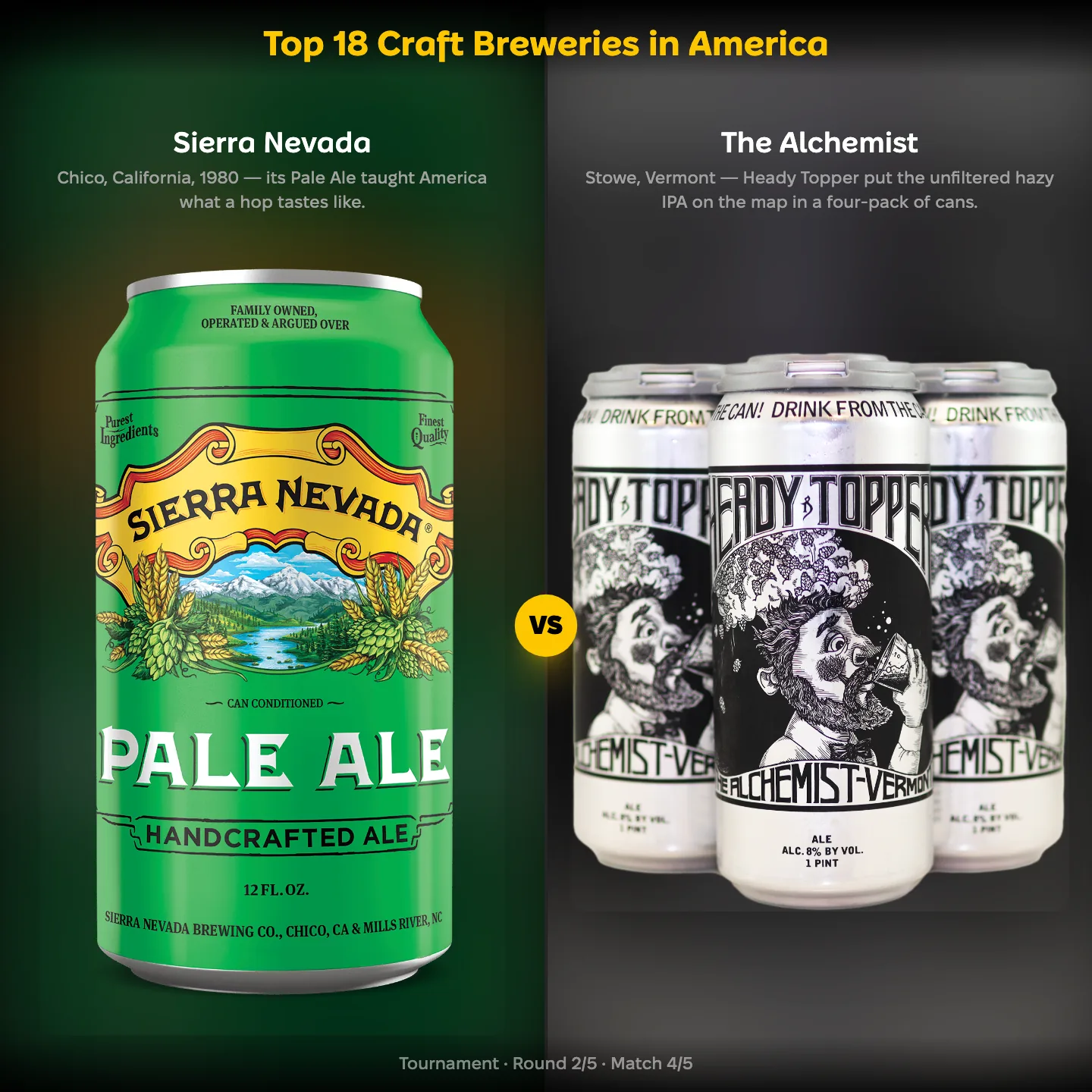
Sierra Nevada is where the story starts. Ken Grossman opened it in Chico, California in 1980, and its Pale Ale taught a generation of American drinkers what a hop tastes like.
The Alchemist is the opposite model. A small Vermont brewery whose Heady Topper is sold mostly on site, it made the unfiltered hazy IPA a thing people drive hours for.
Between those poles the list holds every strategy the industry tried. Samuel Adams scaled without selling; Goose Island sold to Anheuser-Busch and gave American brewing its barrel-aged stout anyway; Anchor Steam in San Francisco is the brewery historians point at when they date the whole movement to 1965. Tree House runs the newest playbook: no distribution at all, and a queue in the rain instead.
The numbers underneath them are stranger than the decline suggests. Craft's share of American beer actually rose last year, to 13.4% by volume, because the overall beer category fell faster, by 5.7%.7 Craft is losing drinkers more slowly than beer is.
Westvleteren 12 vs Cantillon: the beer UNESCO protects
Belgium is the country that made beer a heritage listing. UNESCO inscribed Belgian beer culture on its Representative List of the Intangible Cultural Heritage of Humanity in 2016, citing roughly 1,500 beers made by different fermentation methods.8
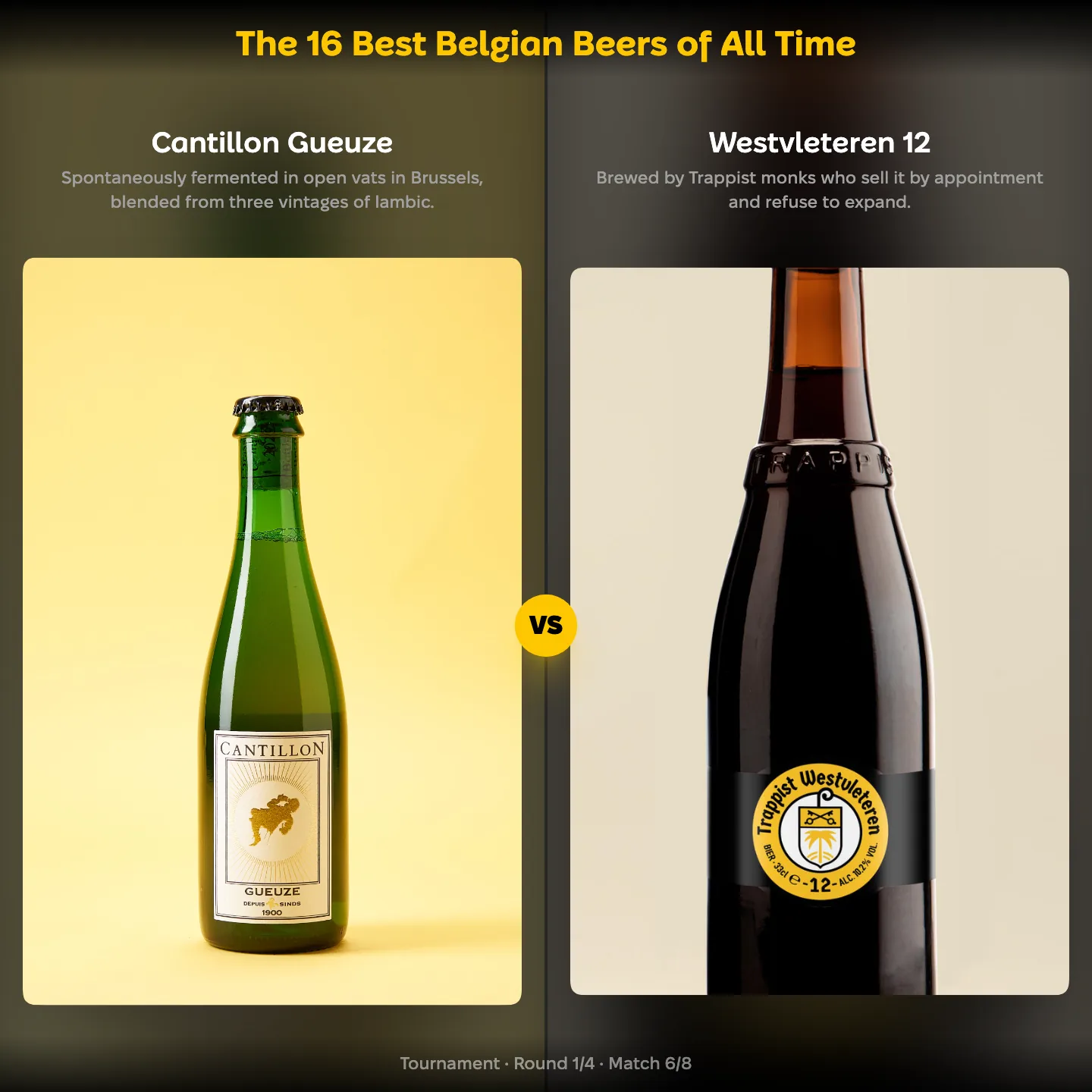
Westvleteren 12 is the scarcity end of that culture. The Trappist monks of Sint-Sixtus sell it by appointment, in limited quantities, and have consistently refused to expand production.
Cantillon is the other extreme, and the harder drink. Its gueuze is fermented by wild yeast caught from the Brussels air, aged in oak, then blended from three vintages of lambic, and it comes out sour enough to divide a table.
Around those two the list holds the styles Belgium exported to everyone else. Westmalle named the tripel. Duvel gave the golden strong ale a glass shaped to hold its foam. Saison Dupont is the farmhouse template every American brewer copies, and Rodenbach's oak-aged Flemish red is where sour beer stopped being a fault.
Hoegaarden is the survival story. Pierre Celis revived the witbier in 1966, after the style had died out completely, in a village that had lost its last brewery a decade earlier. It is now brewed at industrial scale and sold in most countries on earth.
Corona vs Peroni: the list nobody wants to lead
Beer has one ranking where being near the top is an accusation rather than a compliment. This is it.
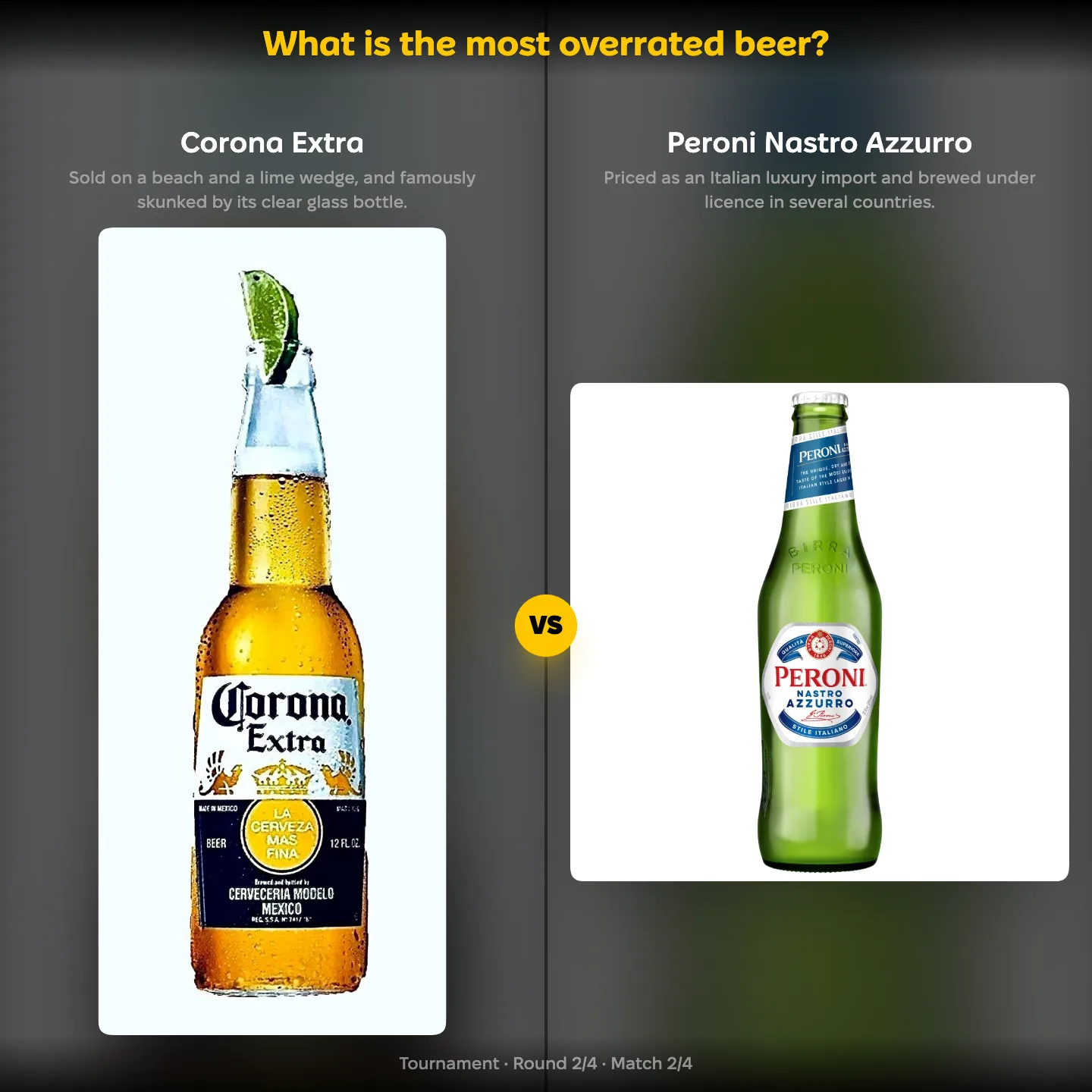
Corona is the obvious candidate. It is sold on a beach, a lime wedge and a clear glass bottle that lets light in, which is the fastest way known to give beer its skunked aroma.
Peroni Nastro Azzurro arrives with the opposite complaint. It is priced and styled as an Italian luxury import, and brewed under licence in several countries that are not Italy.
The other thirteen entries are all large, all successful, and all accused of something: Bud Light of a recipe engineered to taste of as little as possible, Stella Artois of its pricing, Guinness Draught of theatre, Blue Moon of being sold as craft while owned by Molson Coors, Michelob Ultra of being a gym membership with a bottle cap.
Non-Alcoholic Beer Just Passed Ale
The fastest-moving thing in beer is the version without any. Non-alcoholic beer was projected to overtake ale as the world's second-largest beer category by volume during 2025, and the drinks analyst IWSR expects it to grow about 8% a year through 2029 while ale slides 2% a year.4
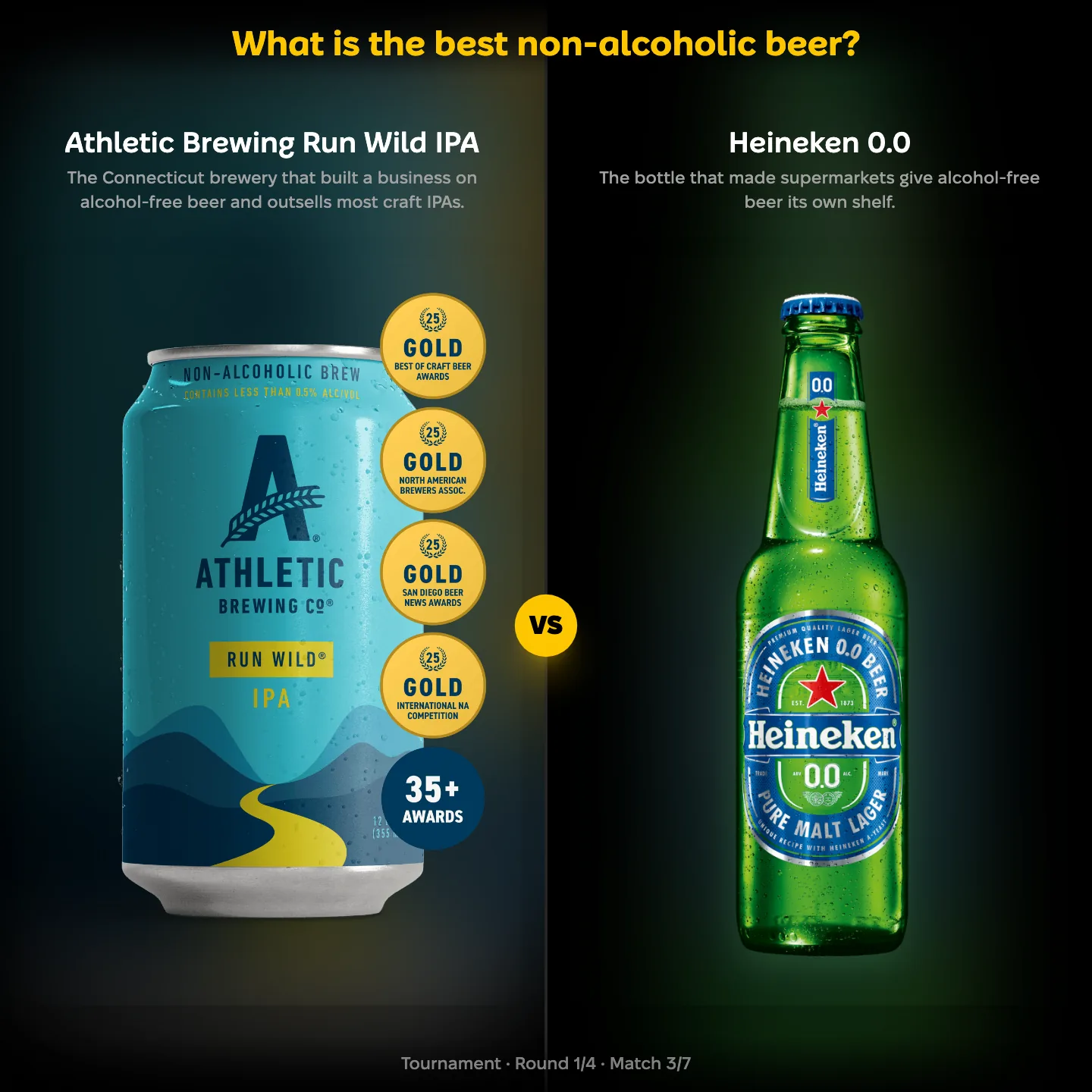
Athletic Brewing is the brand that proved the market. The Connecticut company brews nothing but alcohol-free beer and outsells plenty of full-strength craft IPAs doing it.
Heineken 0.0 is the incumbent answer. It arrived with supermarket distribution most craft brands never get, and it is the bottle that gave alcohol-free beer its own shelf rather than a corner of one.
Fourteen brands compete here. The oldest is Clausthaler, brewed alcohol-free in Germany since 1979. The category spent four decades as a punchline before anyone called it growth.
The Pretzel, the Bratwurst and Half a Roast Chicken
Beer has an eating problem, in the sense that it is almost never drunk alone.
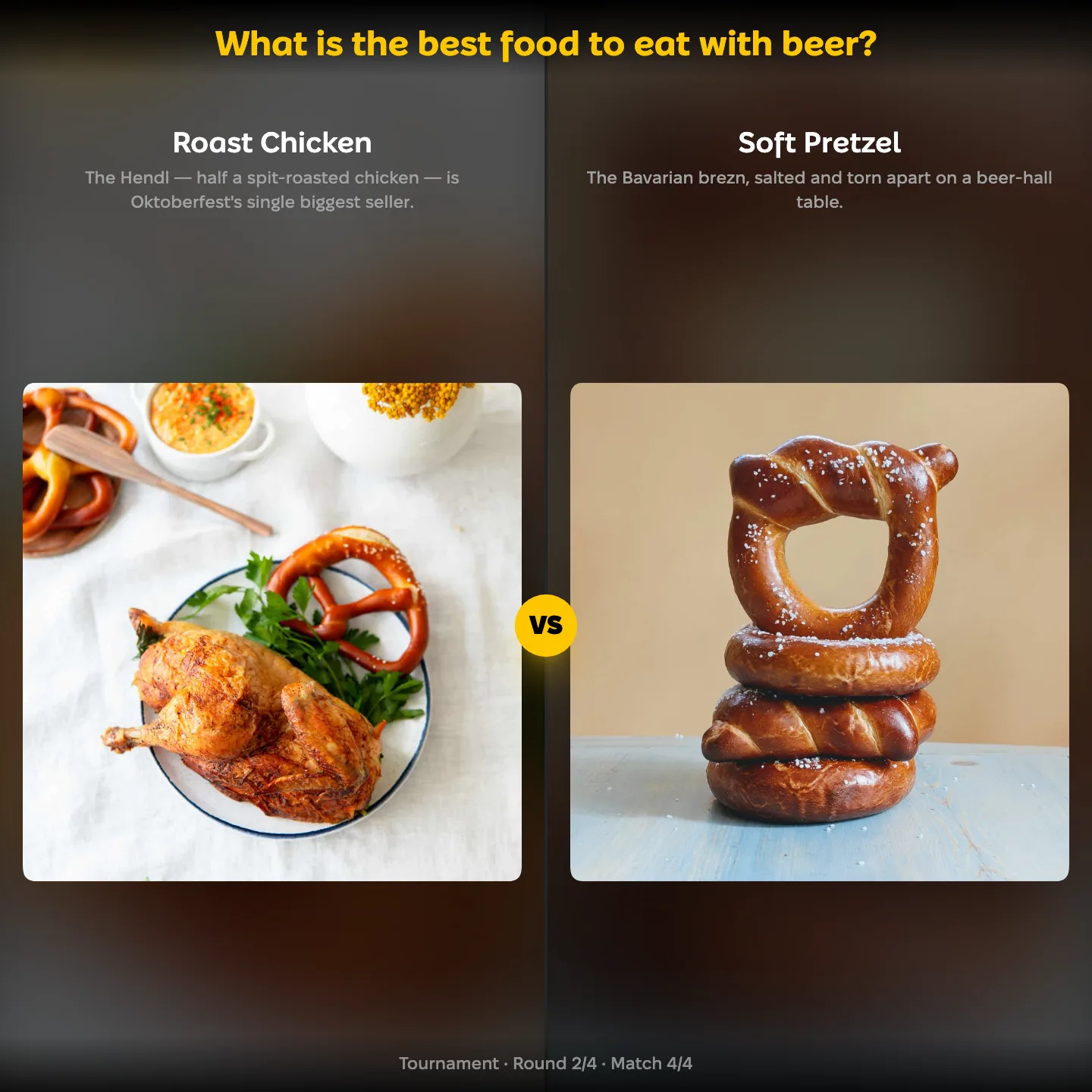
The Bavarian answer is on this list twice. A salted brezn is what the reader pictures, but roast chicken is what Oktoberfest actually sells, by the half bird, in numbers second only to the beer.
The American answer is saltier and fried: buffalo wings, nachos, cheeseburgers and Wisconsin cheese curds, all engineered to keep a glass moving.
The food list runs long, and its two most interesting entries are regional. Belgium cooks mussels in its own beer and serves them with frites; Berlin slices a sausage under curry ketchup and hands it over standing up.
Budweiser's Frogs vs Guinness's Surfer
Beer advertising has outlived most of the beers it sold, and twelve of its best-known thirty-second films are on this list.
Budweiser's frogs croaked "Bud-weis-er" across a swamp at the 1995 Super Bowl and gave the brand a decade of merchandise. Adweek later called the campaign one of the most iconic in alcohol advertising.
Guinness went the other way with "Surfer" in 1999: black-and-white waves turning into white horses, built entirely around the idea that waiting for the pour is the point.
The rest is a catalogue of catchphrases that escaped their ads. "Whassup?" became a greeting, "Stay thirsty, my friends" became a meme, and Carlsberg's "probably the best beer in the world" has been running unfinished since 1973.
Duff Beer vs Butterbeer: the beers that do not exist
Eleven beers on this list have never been brewed, and several of them are better known than beers that have.
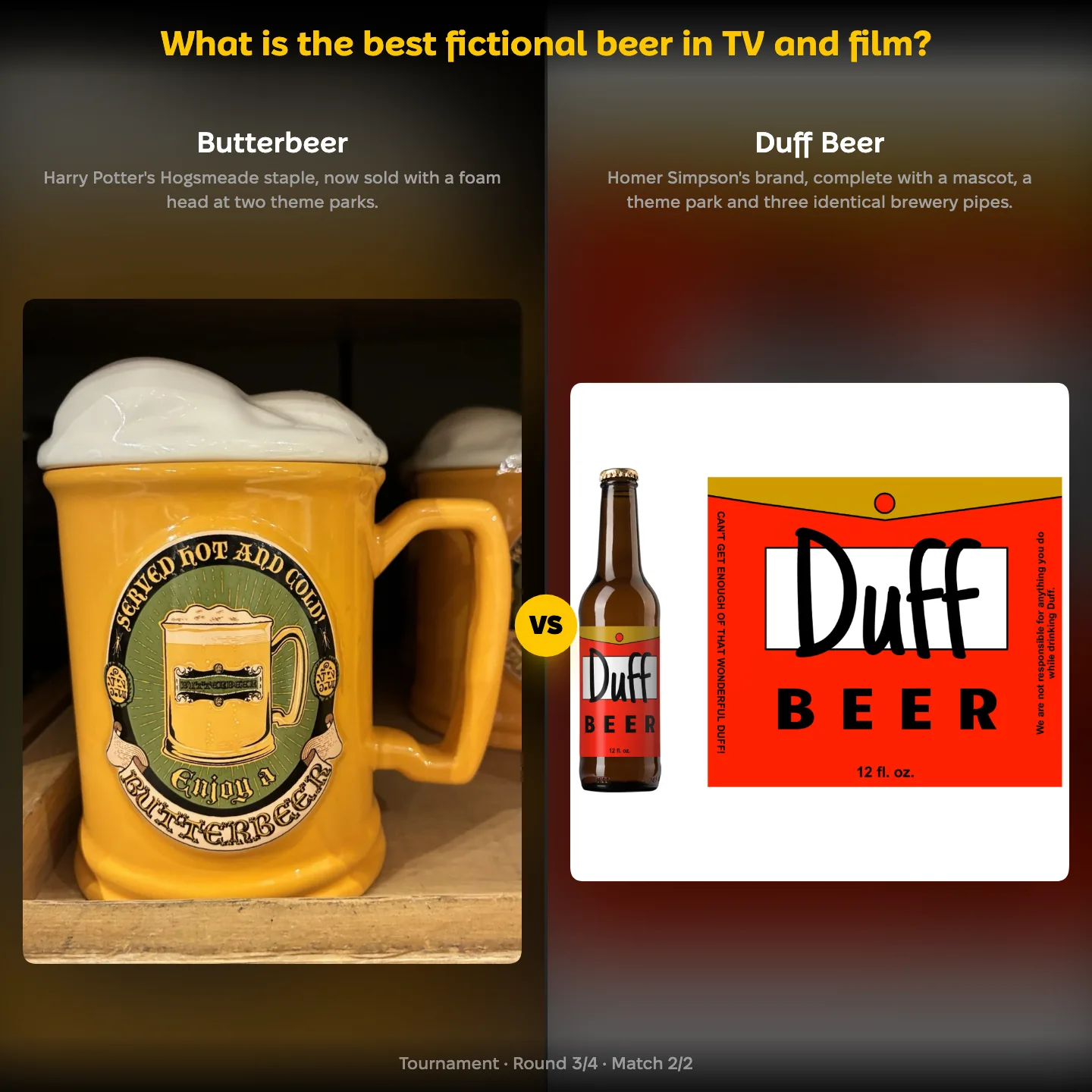
Duff is the benchmark. Homer Simpson's brand has a mascot, a running joke about three identical brewery pipes feeding Duff, Duff Lite and Duff Dry, and a real bar at Universal Studios.
Butterbeer sits oddly beside it. Hogsmeade's drink is barely a beer at all, and no other name here can be ordered with a foam head at two theme parks.
The most-seen name on the list is the one nobody knows. Heisler is not a joke but a prop brand, invented so productions could put a beer on screen without clearing a real label, and it has appeared in hundreds of shows.
"Friends in Low Places" vs "One Bourbon, One Scotch, One Beer"
Fifteen drinking songs, and they divide by country.
John Lee Hooker's blues order, which George Thorogood turned into a bar-band standard, itemises. Garth Brooks, in 1990, gets a whole room singing a second verse nobody knows.
Germany contributes the shortest entry and the loudest. "Ein Prosit" is two lines, played by a tent band roughly every fifteen minutes so six thousand people can stand, toast and sit down again.
The Maß Weighs More Than a Kilo Before It Is Filled
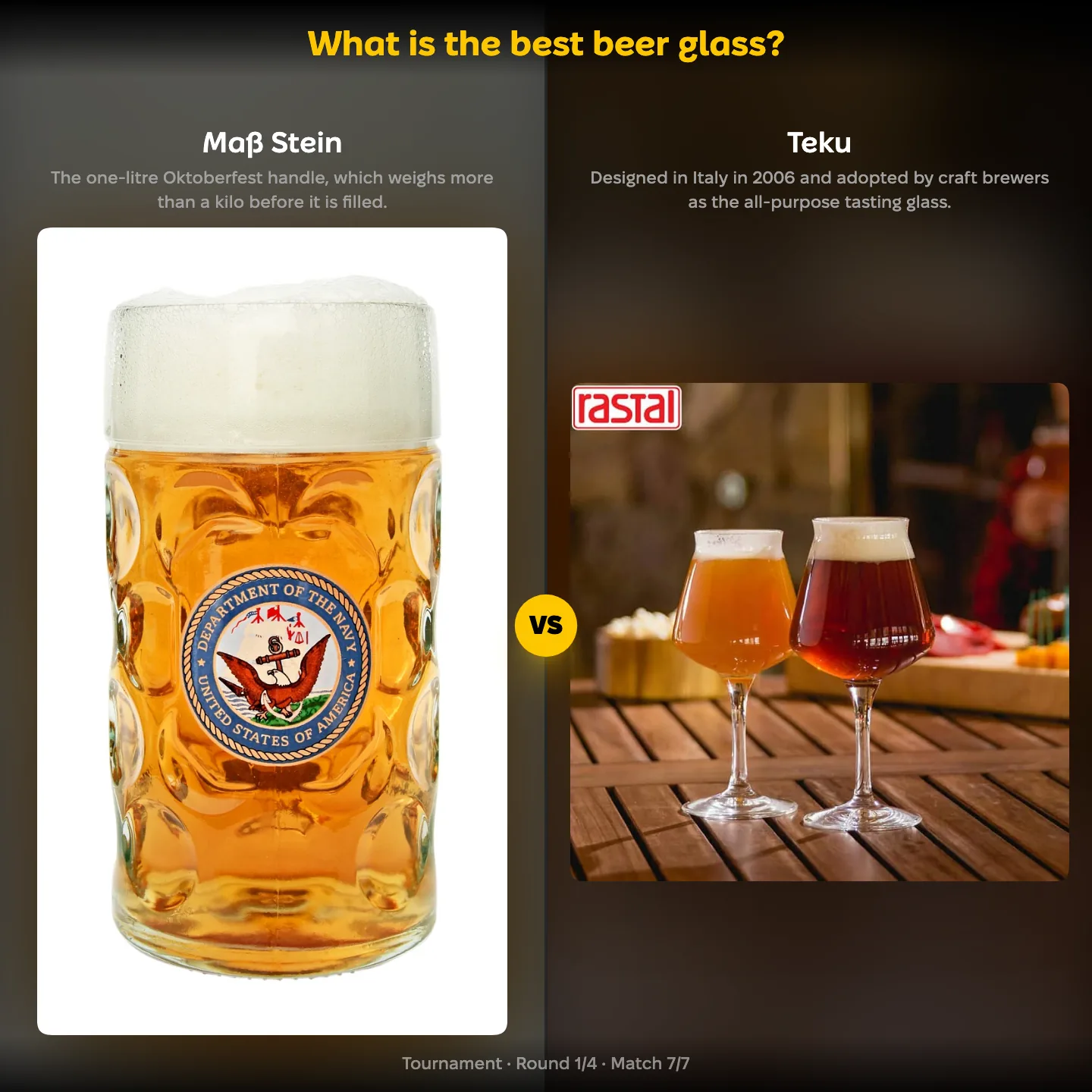
Beer's narrowest question is also the one drinkers defend most stubbornly: what should it be served in?
The Maß is the Oktoberfest answer. A litre of beer in a dimpled glass handle, heavy enough before it is poured that carrying six of them is a job people train for.
The Teku is the modern one. Designed in Italy in 2006 and adopted by craft brewers as an all-purpose tasting glass, it exists to concentrate aroma rather than volume.
Fourteen vessels are on the list, and two of them are jokes that people still drink from: the Kwak coachman's glass, which cannot stand without a wooden holder, and the yard, which empties into your face if you rush the last third.
Sixteen Lists, and Beer Is a Different Product in Each
A recipe written in 1516, a Czech statistic running since 1993, a Belgian heritage listing, a shrinking American industry and a category that did not exist commercially until 1979: these are not variations on one subject. They are separate products sharing a word.
It is why the sixteen rankings above can disagree and all be defensible. Each asks beer to be a different thing, and each reader marks it against a different one. Judging two options at a time is what lets sixteen incompatible questions produce sixteen usable orders.
Choose whichever of the sixteen matches the beer you drink, and settle it. Better still, build a seventeenth. The beer question nobody has written down is where the disagreement actually lives.
More rankings, more angles
- Starbucks vs Dunkin': 1950 in Quincy, 1971 in Seattle — the other drink Americans argue about daily
- Coca-Cola vs Pepsi: The Cola Wars, Ranked 15 Ways — 140 years of the same shelf fight
- Pizza: Naples Made It, Detroit Squared It, Chicago Went Deep — the food half of every beer order
Sources
- muenchen.de, the City of Munich's official portal — 191st Oktoberfest dates, tent count and the Schottenhamel barrel tapping: muenchen.de (checked 2026-09-15)
- Oktoberfest.de — Oktoberfest 2025 summary: visitor numbers and litres of beer served: oktoberfest.de (checked 2026-09-15)
- Kirin Holdings, Global Beer Consumption by Country in 2024 — Czech per-capita litres and the 32-year run, China's 22 consecutive years at the top of total volume, and world consumption in kilolitres: kirinholdings.com (checked 2026-09-15)
- CNBC, reporting IWSR data — non-alcoholic beer overtaking ale as the second-largest beer category, lager's share of global volume, and the growth forecasts to 2029: cnbc.com (checked 2026-09-15)
- Historisches Lexikon Bayerns — the 1516 Bavarian purity law, its date, place and permitted ingredients: historisches-lexikon-bayerns.de (checked 2026-09-15)
- Bayerische Staatsbrauerei Weihenstephan — brewery history and the 1040 claim: weihenstephaner.de (checked 2026-09-15)
- Brewers Association — 2025 US craft brewing figures: operating breweries, openings and closings, craft volume, craft share and the overall beer category: brewersassociation.org (checked 2026-09-15)
- UNESCO Intangible Cultural Heritage — Beer culture in Belgium, inscribed 2016: ich.unesco.org (checked 2026-09-15)