

Friends and Seinfeld shared a network, a decade and a Thursday night, and thirty years later they are still being filed into the same lists. Netflix's five-year global licence for Seinfeld expires on 1 October 2026, while Friends is still charting for that same service in half a dozen countries.6 The Writers Guild of America placed Seinfeld second on its list of the best-written series ever and Friends twenty-fourth.3
That gap should settle the argument. Thirteen rankings say it does not.
Put Friends and Seinfeld on the same list and the winner changes with the criterion: warmth takes the comfort lists, cruelty takes the writing ones.
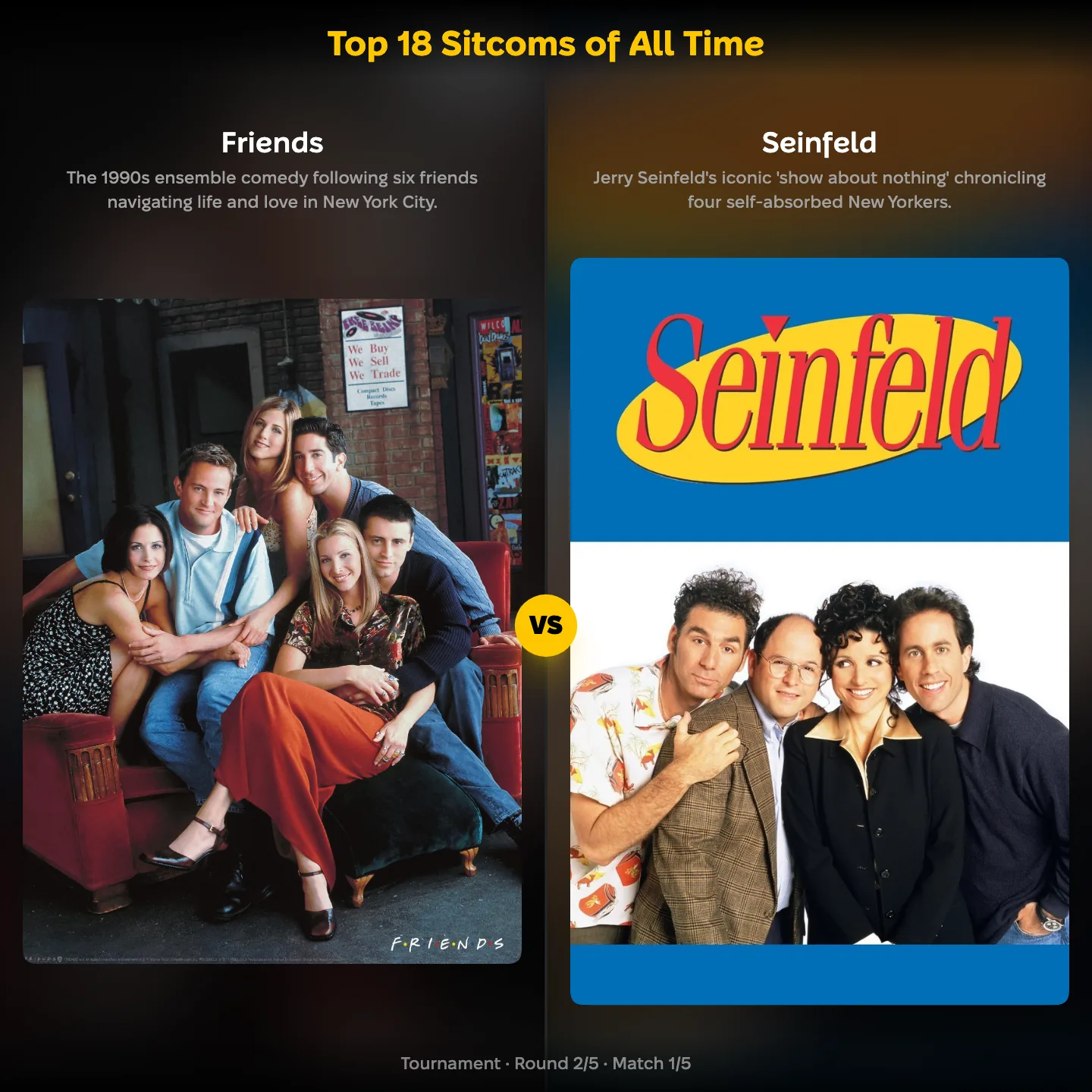
Friends vs Seinfeld: the sitcom shortlist both make
Every general sitcom list starts in the same place, and this one holds eighteen shows, Cheers and Brooklyn Nine-Nine included.
Seinfeld arrives with the critical record. Nine seasons, no hugging and no learning, and a writers' room whose rule was that the characters never grow.
Friends arrives with the audience. Ten seasons of six people who do grow, marry each other, and end up somewhere different from where they started.
Then it gets awkward for both of them. The Office, Frasier, Arrested Development and The Simpsons each have constituencies who would put their show first and treat the whole Friends-Seinfeld question as a warm-up.
Cheers, Frasier and NBC's Thursday night
Restrict this to a single network and the company changes completely.
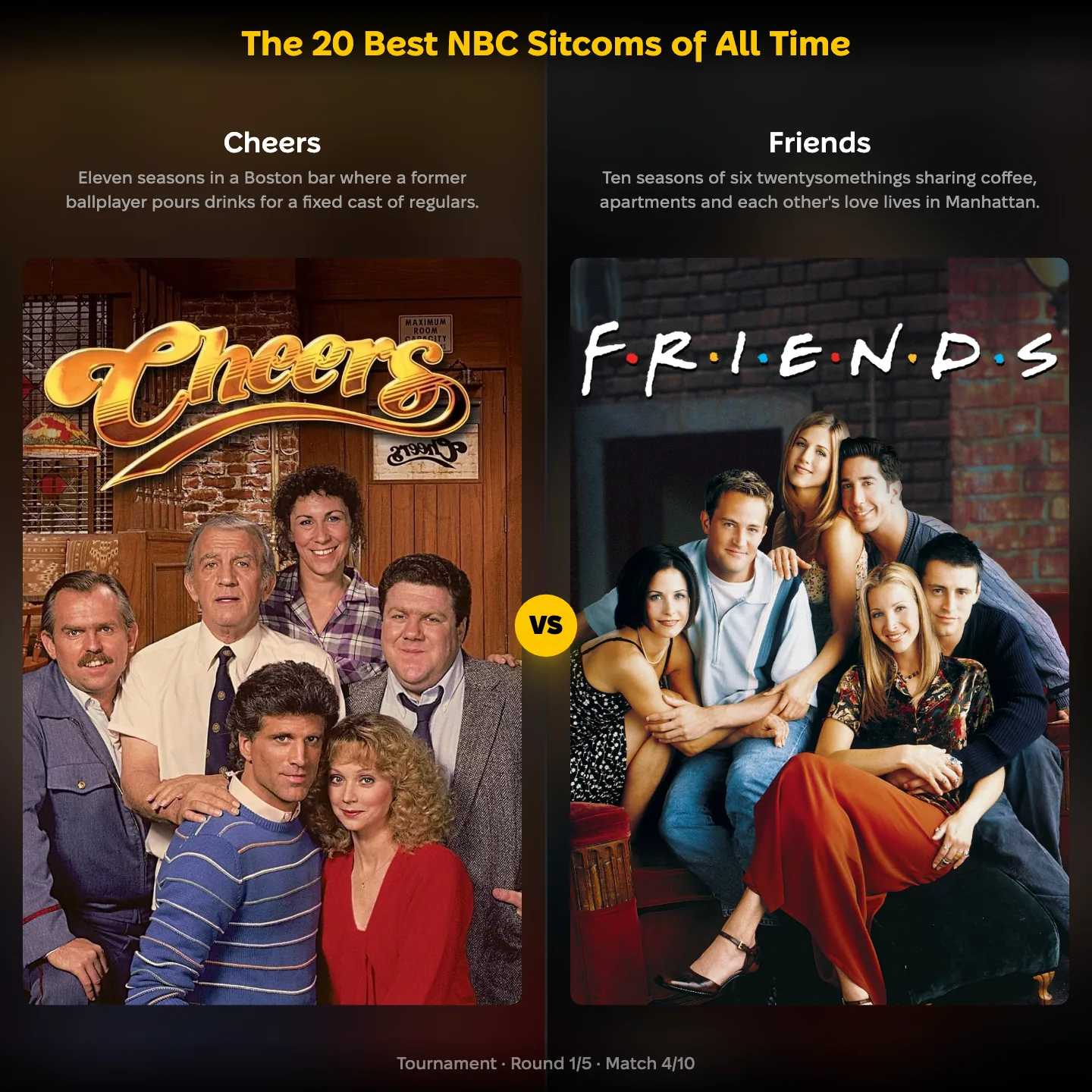
NBC built "Must See TV" around Friends at eight and Seinfeld at nine, and for four seasons the two ran back to back on the same evening. Neither had to beat the other for a slot; they were each other's lead-in.
Cheers is the show that made that block possible, eleven seasons in a Boston bar, and Frasier is the spinoff that carried it into the next decade. Both sit in this ranking, and both have a claim neither Friends nor Seinfeld can make: they won more than one Outstanding Comedy Series.
Twenty NBC comedies are here in total, including The Office, 30 Rock, Parks and Recreation and Taxi. A network that produced all of those does not have an obvious best half-hour.
Seinfeld vs The Simpsons: television in the 1990s
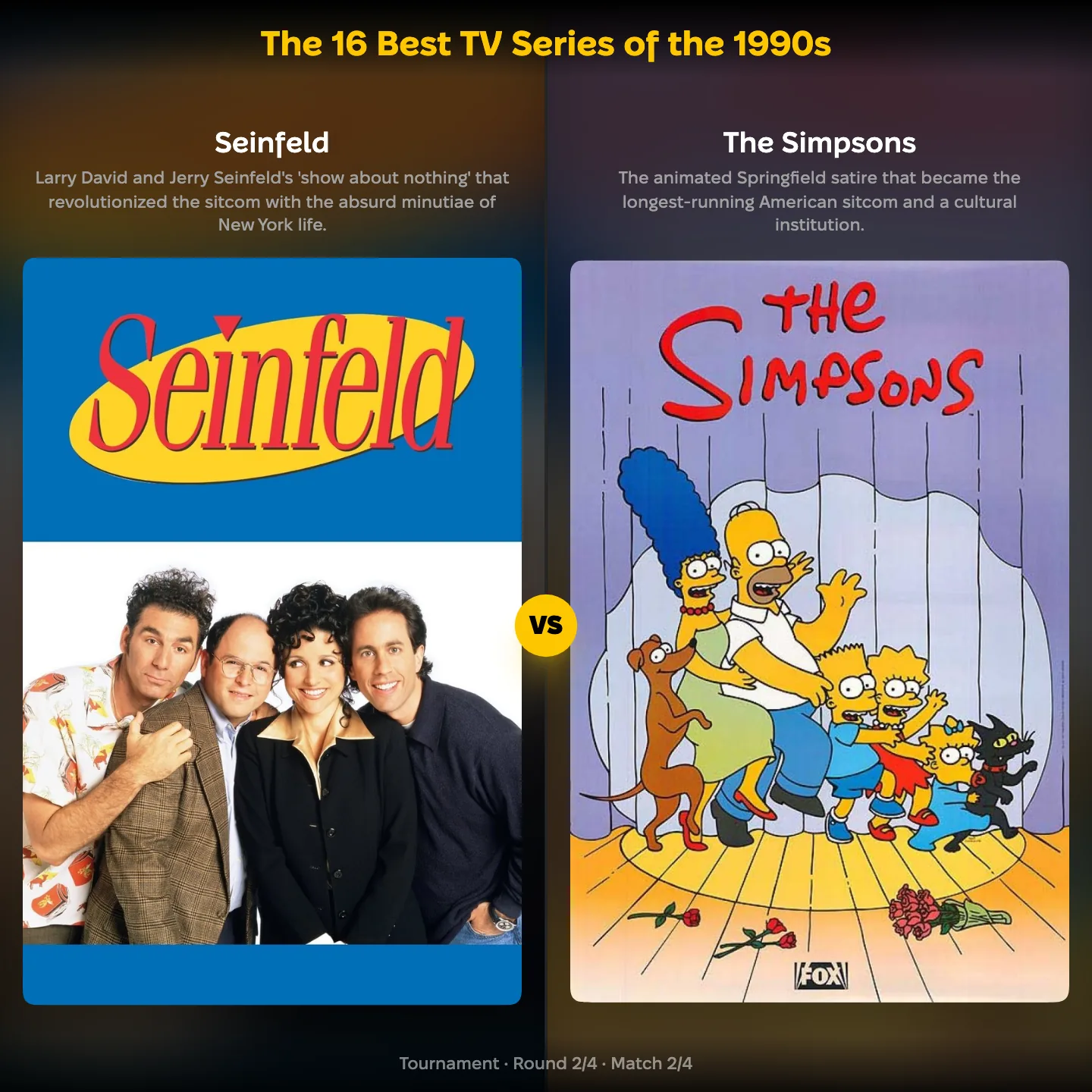
Open the decade to everything and the sitcoms are competing with Twin Peaks, The X-Files and the first two seasons of The Sopranos.
Seinfeld has the hard evidence. It finished the 1994–95 season first in the Nielsen ratings with an average of 19.6 million households a week, the first time an NBC Thursday comedy had topped the chart.7
Friends finished eighth that year, in its debut season, which is a remarkable place for a new show and still seven places behind.7
The Simpsons spent the same decade inventing a different kind of comedy on a different network, and ER outdrew both of them for most of it. Here the 1990s stop being a two-horse race.
The shows nobody turns off: Friends, The Office and the rewatch economy
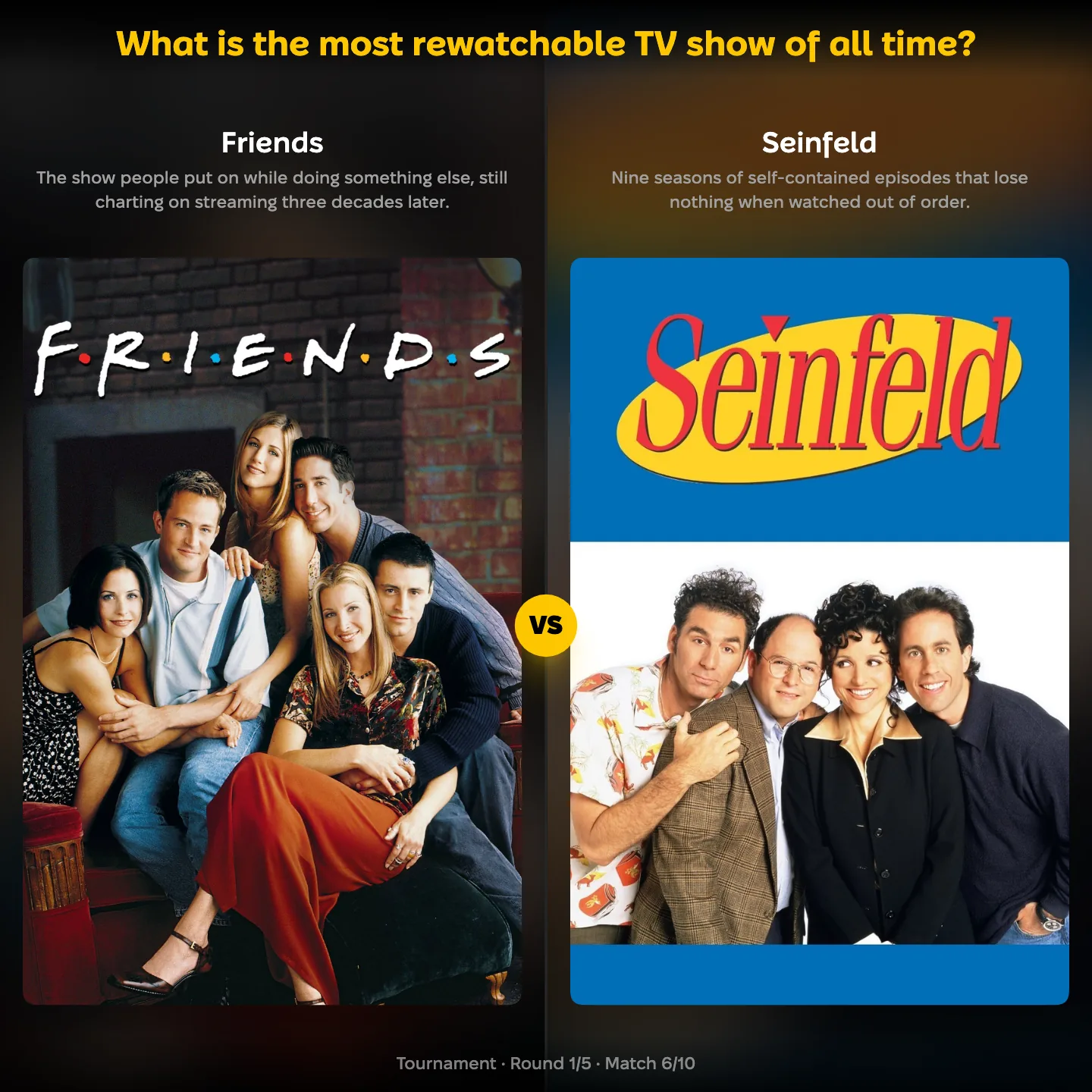
Rewatchability is the criterion streaming services pay real money for, and Friends stops being the runner-up the moment it applies.
Netflix bought all 180 episodes of Seinfeld on a five-year exclusive global deal that took effect in 2021, after losing Friends and The Office to their studios' own services.5 Seinfeld's structure suits the format: nothing carries over, so any episode is an entry point.
Friends went the other way and won anyway. It has serialised relationships, an order that matters, and it was still among Netflix's most-watched titles in Australia, Belgium, Denmark, Greece and New Zealand in July 2026 — twenty-two years after it ended, on a service that does not exclusively own it.8
Then there is The Office, which is what a generation actually put on in the background, and Gilmore Girls, Parks and Recreation and Brooklyn Nine-Nine behind it. Comfort is a competitive category.
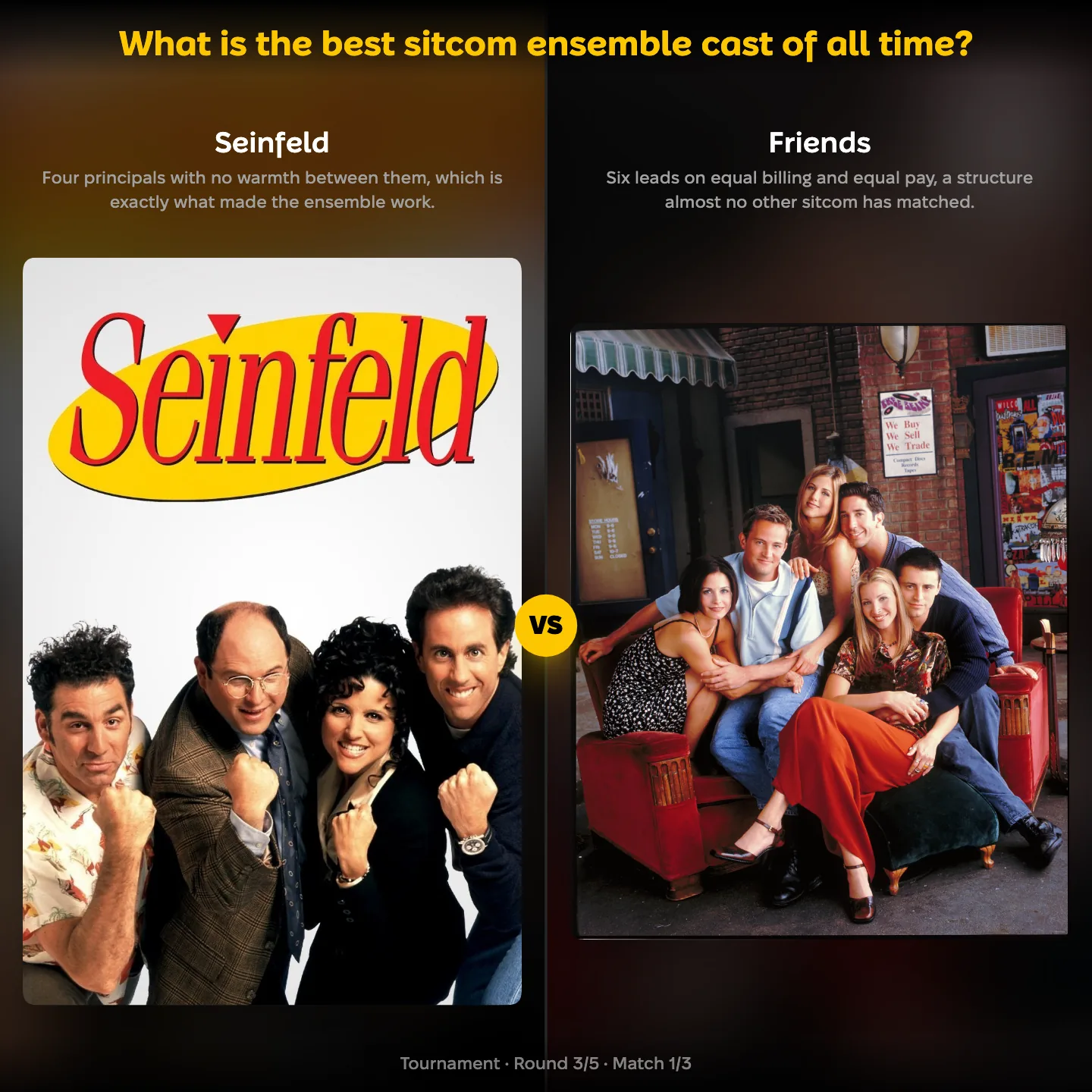
Six leads against four: the Friends and Seinfeld ensembles
Casting is the part of a sitcom nobody can fix in the edit, and these two solved it in opposite directions.
Friends ran six people at identical billing for ten years, and the cast negotiated as a single bloc rather than individually. No other American sitcom has held a six-way balance that long.
Seinfeld ran four and gave them nothing to like about each other. Jerry, George, Elaine and Kramer are held together by proximity, not affection, which is why the show could put them on trial in its own finale.
The competition is stiff enough that neither is safe. Cheers survived losing its female lead and kept working; The Office turned a documentary conceit into a dozen full characters; Taxi assembled Danny DeVito, Christopher Lloyd, Judd Hirsch and Andy Kaufman in one garage.
Seinfeld, Friends and the lines that entered the language
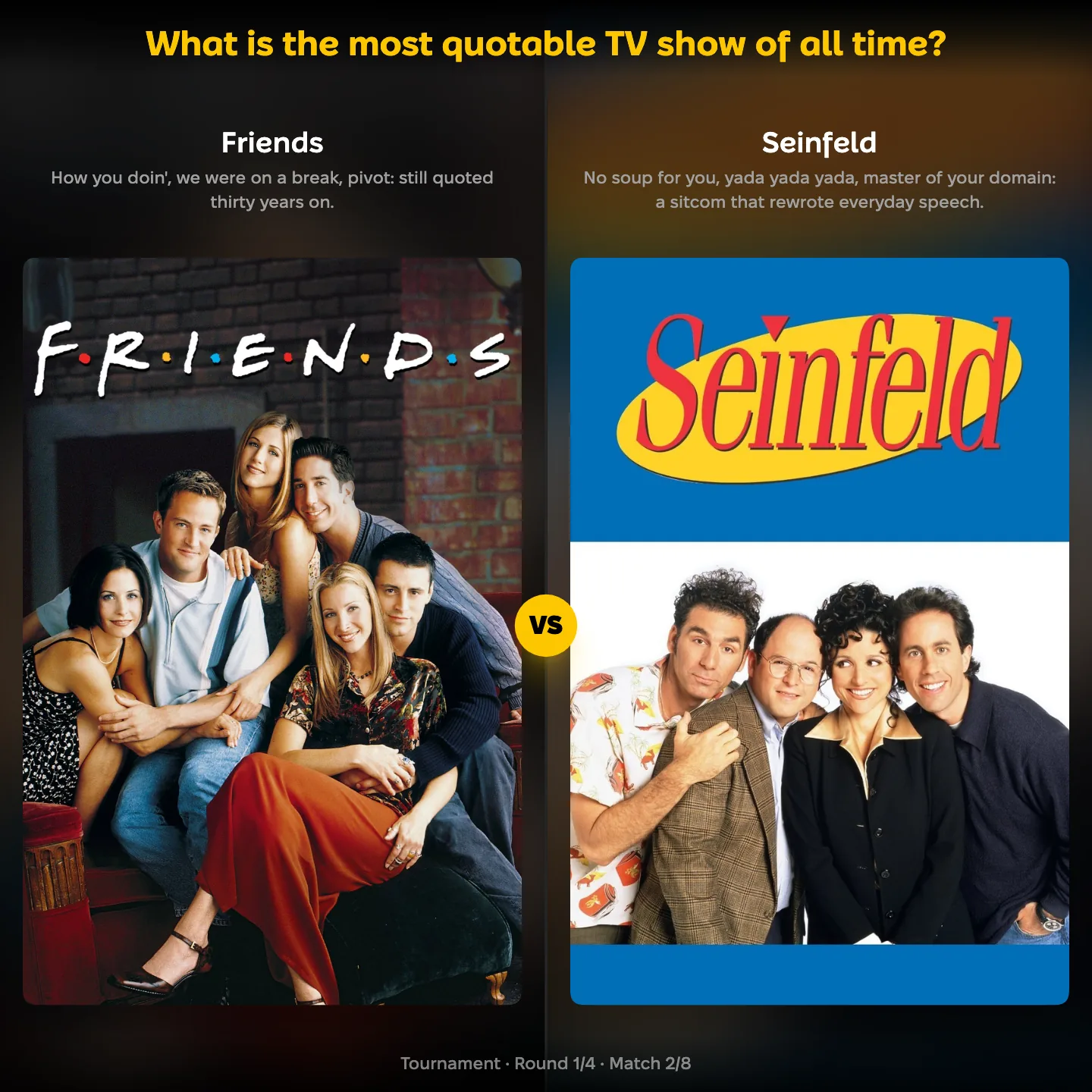
Both shows put phrases into English, which is rarer than it sounds and almost impossible to plan.
Seinfeld gave the language "no soup for you", "yada yada yada", "master of your domain", "close talker" and an entire invented holiday. Festivus now has a Wikipedia entry, an aluminium pole and people who celebrate it.
Friends gave it "how you doin'", "we were on a break" and "pivot", which have had a second life on social platforms that did not exist when the show aired.
The Simpsons is the problem for both of them here, since it has had eight hundred episodes to work with, and The Office and Arrested Development arrived late with catchphrases that a younger audience uses more often than either of these.
Manhattan twice over: Seinfeld's city and the Friends apartment
Both shows are set in New York, and they are set in two cities that barely overlap.
Seinfeld's Manhattan is a series of small municipal humiliations: the queue for soup, the parking garage, the Chinese restaurant, the marble rye. Tom's Restaurant on Broadway at 112th stood in for Monk's Café and now gets photographed by tourists who never ate there.
The Friends version is a West Village apartment nobody on those salaries could afford, with a coffee house downstairs that always has the good sofa free. The building at Bedford and Grove is the other pilgrimage stop.
Seventy years of New York sitcoms sit alongside them: I Love Lucy, Taxi, The Odd Couple, All in the Family in Queens, Living Single in a Brooklyn brownstone a year before Friends premiered, and 30 Rock inside the building where NBC actually works.

The Rembrandts vs the Fresh Prince theme
This is the first ranking where only one of the two shows qualifies, and the absence is the story.
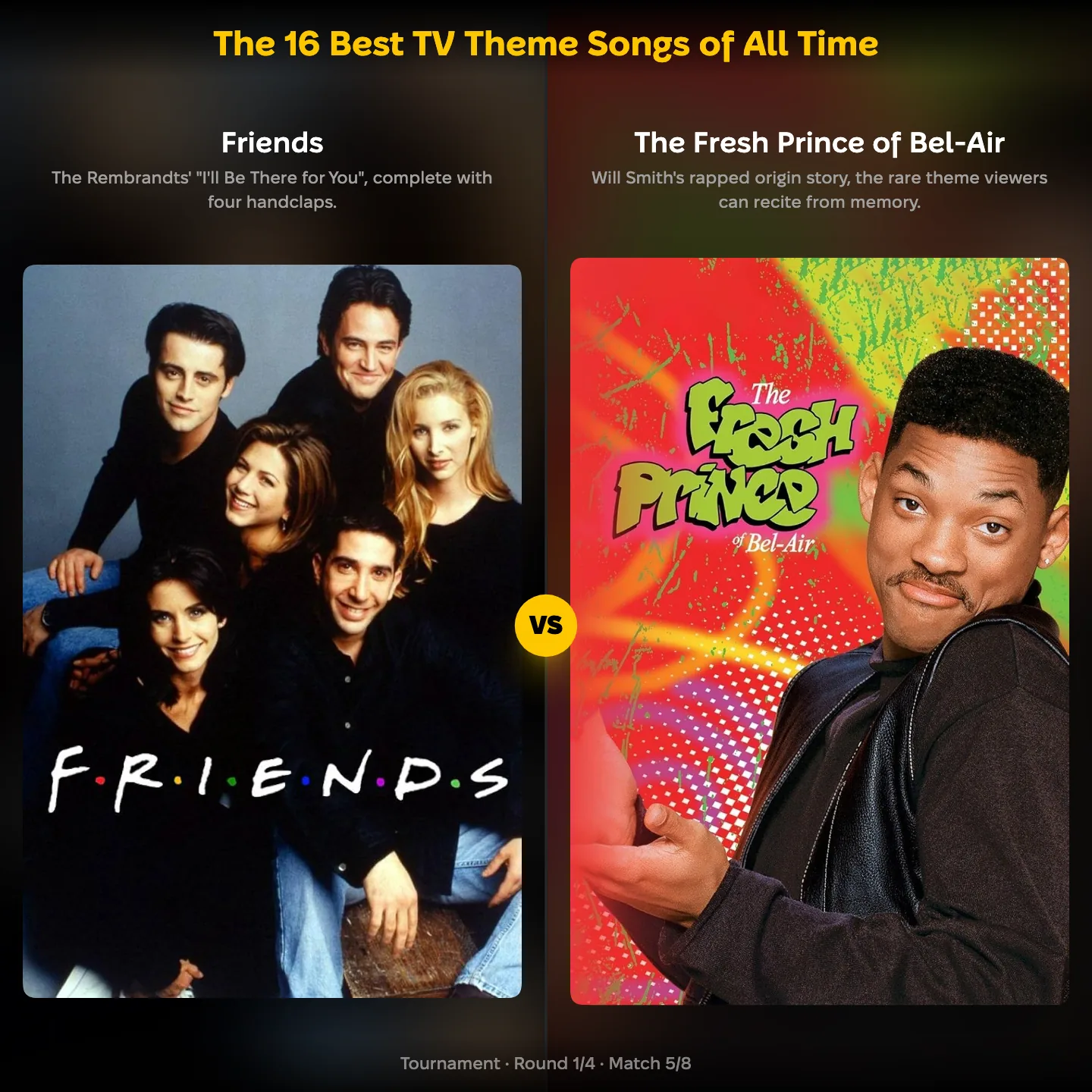
The Rembrandts' "I'll Be There for You" is here, four handclaps and all, and it charted as a single in its own right.
Seinfeld's theme is a slap bass line, re-recorded for almost every episode to fit Jerry's stand-up. Instantly recognisable, and nobody has ever hummed it on purpose.
Friends is on the list. Seinfeld was never in this competition.
Kramer vs Joey Tribbiani
Stop ranking shows and start ranking people, and both casts fragment into individual candidates.
Ten of the nineteen names in this ranking come from Friends and Seinfeld, which is the clearest measure of how much of the decade's comedy these two shows were carrying.
Kramer is the purest argument for Seinfeld: a neighbour with no visible income who enters through the door as though it owed him money. Joey Tribbiani is the Friends equivalent, a failing actor whose two-word greeting is the most repeated line either show produced.
They are not alone in there. Steve Urkel was a one-episode guest who took over Family Matters, Al Bundy spent the decade as the anti-father, and Frasier and Niles Crane brought a vocabulary neither of these two shows attempted.

Michael Richards, Matthew Perry and the supporting-actor Emmy
The Television Academy spent the 1990s handing this category to the same block of Thursday-night comedies, and the tallies are where the Friends and Seinfeld records diverge hardest.
Seinfeld collected 10 Emmys from 68 nominations and won Outstanding Comedy Series once, in 1993.1 Michael Richards took the supporting-actor award three times for a part with no backstory and no job.
Friends collected 6 Emmys from 62 nominations and won the top comedy prize once, in 2002.2 Matthew Perry, who gave the show its sarcastic register and arguably its voice, never won one at all.
Jason Alexander is the third data point. He was nominated again and again for George Costanza, the part Larry David wrote out of his own life, and he went home empty-handed every time.
Fifty years of supporting work are stacked against all three of them here: Danny DeVito and Christopher Lloyd sharing one Taxi garage, David Hyde Pierce winning four times as Niles Crane, John Ratzenberger turning a walk-on audition into eleven seasons of Cliff Clavin, Nick Offerman on Parks and Recreation. The award record and the affection record do not line up, which is the whole reason to hold a separate vote.

Chandler Bing vs Ross Geller: the fight inside Friends
Seinfeld is absent from this one, and Friends supporters will tell you it is the harder vote of the two.
Chandler Bing is the consensus pick in most fan polls, a data analyst whose job nobody could name and whose delivery became the show's default register.
Ross Geller is the one people fight about. He is the palaeontologist with three divorces, the break, and a jealous streak that reads worse now than it did in 1997.
Gunther, Janice and Richard Burke are on the list too, which only happens when a show runs long enough for its background parts to acquire fans.

Elaine Benes vs Selina Meyer: the career Seinfeld started
Julia Louis-Dreyfus joined Seinfeld in 1990 as its only woman and left in 1998 with a body of work most sitcom actors would take as a complete career.
Elaine Benes is the Seinfeld entry, nine seasons of a character written to be exactly as selfish as the three men around her, which was not how sitcoms were writing women at the time.
Selina Meyer is the reason this ranking exists at all. Veep gave Louis-Dreyfus a role that eclipsed the one that made her, and Friends has no comparable case: none of its six leads found a second part that competes with the first.
That is an argument for Seinfeld in a place nobody looks for one. The show did not just produce a better-written series; it produced the cast member with the largest career after it.

The Seinfeld finale, and the list Friends never joined
One ranking here rewards absence, and Friends is absent.
Seinfeld's 1998 finale put the four leads on trial for being bad people and replayed old episodes as courtroom evidence. It drew 76.2 million viewers and a reaction that has not softened in twenty-eight years.4
Friends ended in 2004 with Rachel getting off the plane, in front of 51.1 million viewers, roughly two thirds of the Seinfeld audience.4 Nobody argues about it, which is precisely the point: the safe ending kept it off this list.
For scale: only MAS*H, with 105 million, and Cheers, with 80.4 million, had ever pulled a bigger goodbye than Seinfeld's.4 Nine seasons of refusing to sentimentalise anything, and then the largest room the show ever played.
Game of Thrones, Lost, Dexter and How I Met Your Mother are the modern company, and The Sopranos is here for a cut to black that half its audience mistook for a cable fault. Ending a show people love is the hardest job in television, and the boldest attempts are the ones that get punished.

Thirteen lists, two very different shows
Seinfeld holds the writing, the awards and the second act; Friends holds the theme tune, the rewatch and the ending nobody wanted to change. Ask which is better and you get a fight. Ask which belongs on a list about New York, or NBC, or comfort viewing, or a career after the show, and the names swap places without either side conceding anything.
Every ranking above is built out of two-way choices, the way you would build your own. The order shifts without anybody changing their mind about either show.
If there is a pair you have been arguing about since the nineties, put them on a list and see which questions each of them survives.
More rankings, more angles
- The Simpsons: 800 Episodes, 17 Different Lists — the sitcom that outlasted both of these
- Star Trek Turns 60. No Two Lists Agree Where It Belongs — six decades, no fixed genre
- Breaking Bad vs The Sopranos, Ranked Side by Side — a desert road against a New Jersey diner
- The Office vs Parks and Rec: One Began as the Other — Scranton against Pawnee, one creator each
Sources
- Television Academy — Seinfeld awards record (68 nominations, 10 Emmys, Outstanding Comedy Series 1993): televisionacademy.com (checked 2026-08-07)
- Television Academy — Friends awards record (62 nominations, 6 Emmys, Outstanding Comedy Series 2002): televisionacademy.com (checked 2026-08-07)
- Writers Guild of America — 101 Best Written TV Series, Seinfeld at 2 and Friends at 24: wga.org (checked 2026-08-07)
- Nielsen Media Research figures for the Friends and Seinfeld finales, reported at the time: foxnews.com (checked 2026-08-07)
- Screen Daily — Netflix's five-year exclusive global deal for all 180 Seinfeld episodes, effective 2021: screendaily.com (checked 2026-08-07)
- TheWrap — Seinfeld's Netflix licence ends on 1 October 2026: yahoo.com (checked 2026-08-07)
- The Spokesman-Review, April 1995 — Seinfeld first in the 1994–95 Nielsen season with 19.6 million households a week, Friends eighth: spokesman.com (checked 2026-08-07)
- CBR, citing FlixPatrol — Friends among Netflix's most-watched titles in several countries, July 2026: cbr.com (checked 2026-08-07)