
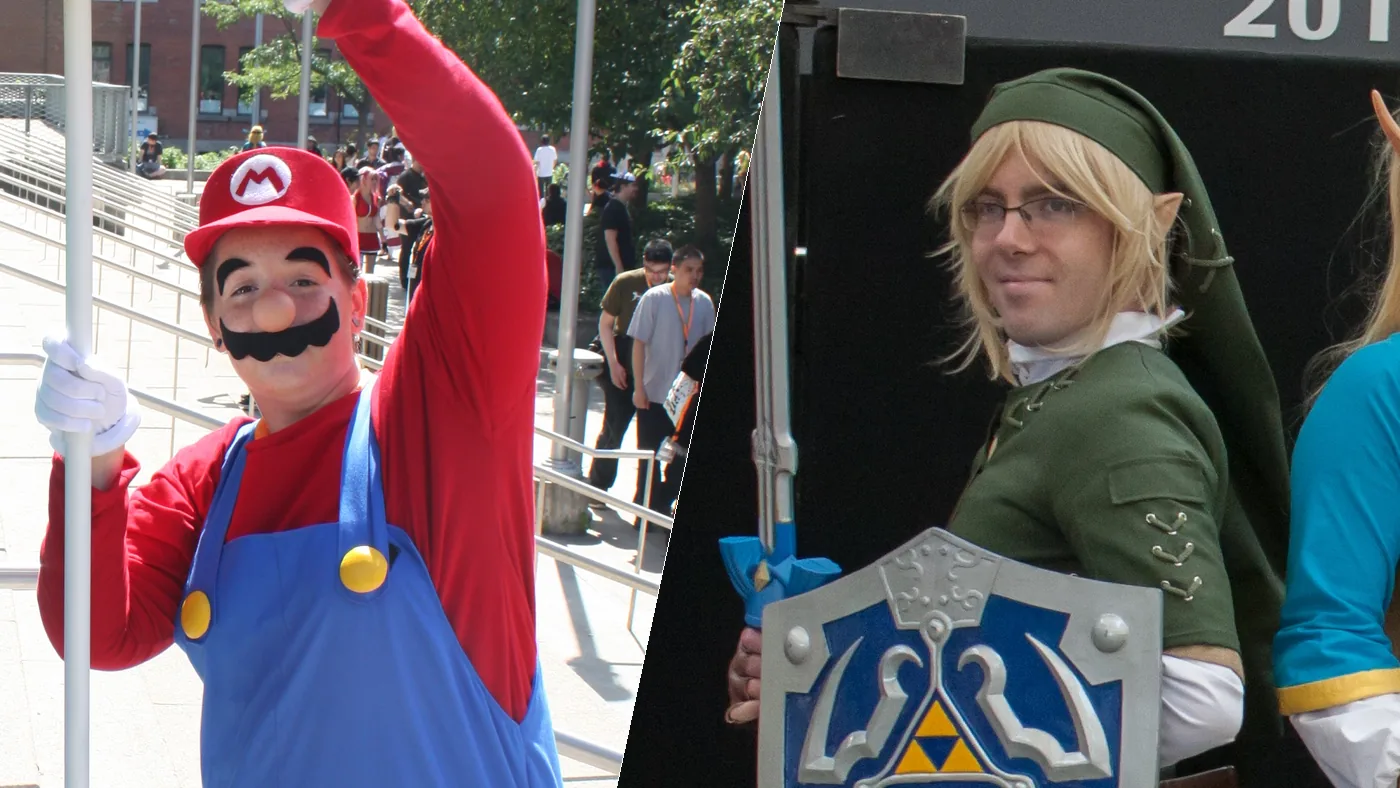
Super Mario and The Legend of Zelda came out of the same team at Nintendo thirteen months apart — Super Mario Bros. in September 1985, The Legend of Zelda in February 1986. They have shared every console, every "greatest ever" list and every playground argument since.
Sales are not close: the Mario franchise has passed 945 million units, Zelda 182 million.
Critical prestige runs the other way. Ocarina of Time still holds the highest Metacritic score of any video game.
Below, the two of them meet in 16 rankings, and the question changes underneath them every time.
Ask which franchise sold more and you get one name. Ask which single game is the best ever made and you get the other. Neither answer is wrong.
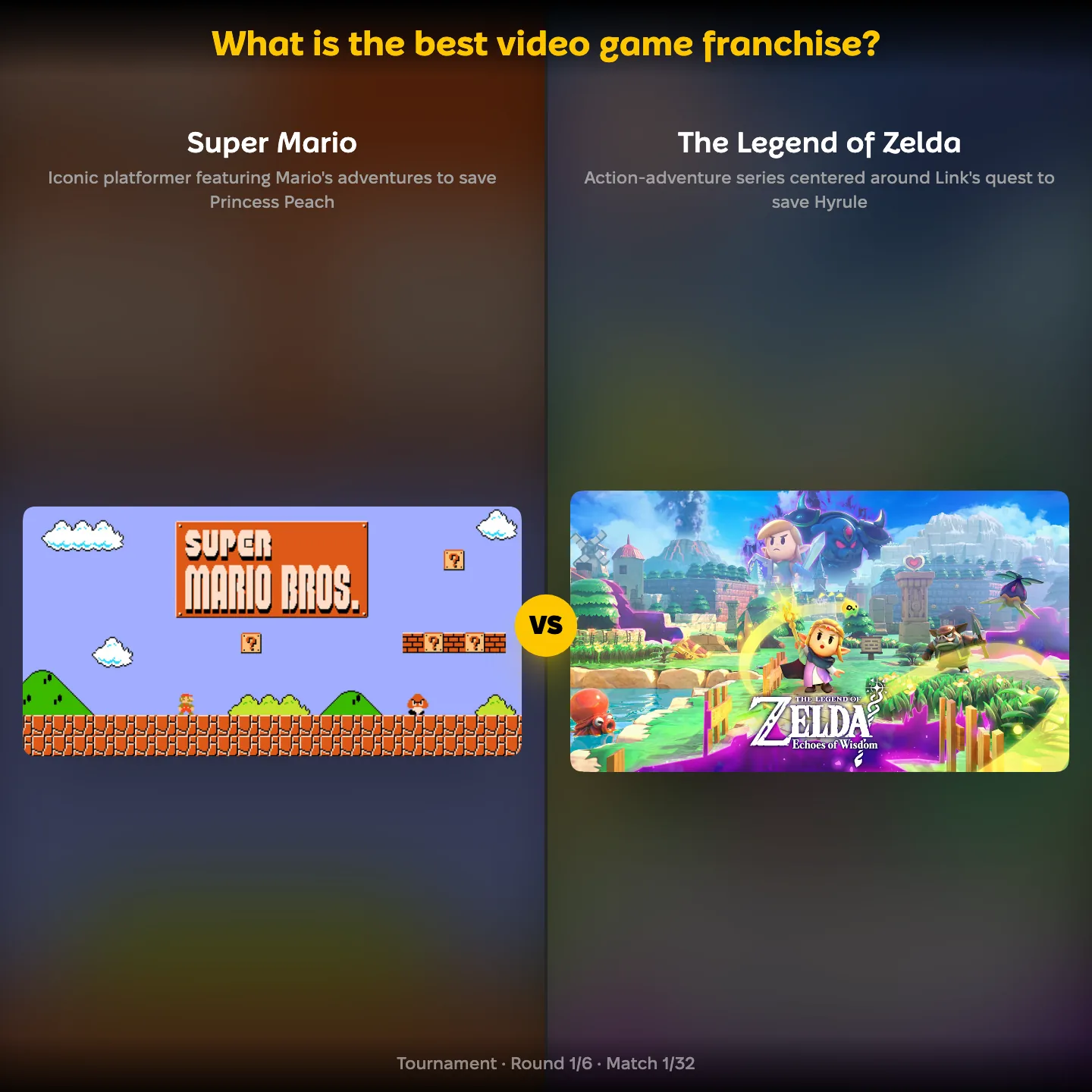
The franchise question, asked straight
Sixty-four franchises are on this list. Super Mario and The Legend of Zelda are two of the four or five anyone expects to see near the front.
Mario has the numbers: 945 million units across platformers, karts, parties and sports spin-offs. No video game franchise has sold more.
Zelda's case is not about volume. Its 182 million units come with a run of entries reviewers keep calling the best-designed games of their generation.
Pokémon, Grand Theft Auto and Call of Duty are on the same list, and all three outsell Zelda comfortably. One screen, the whole argument: one franchise built for scale, one built for reverence.
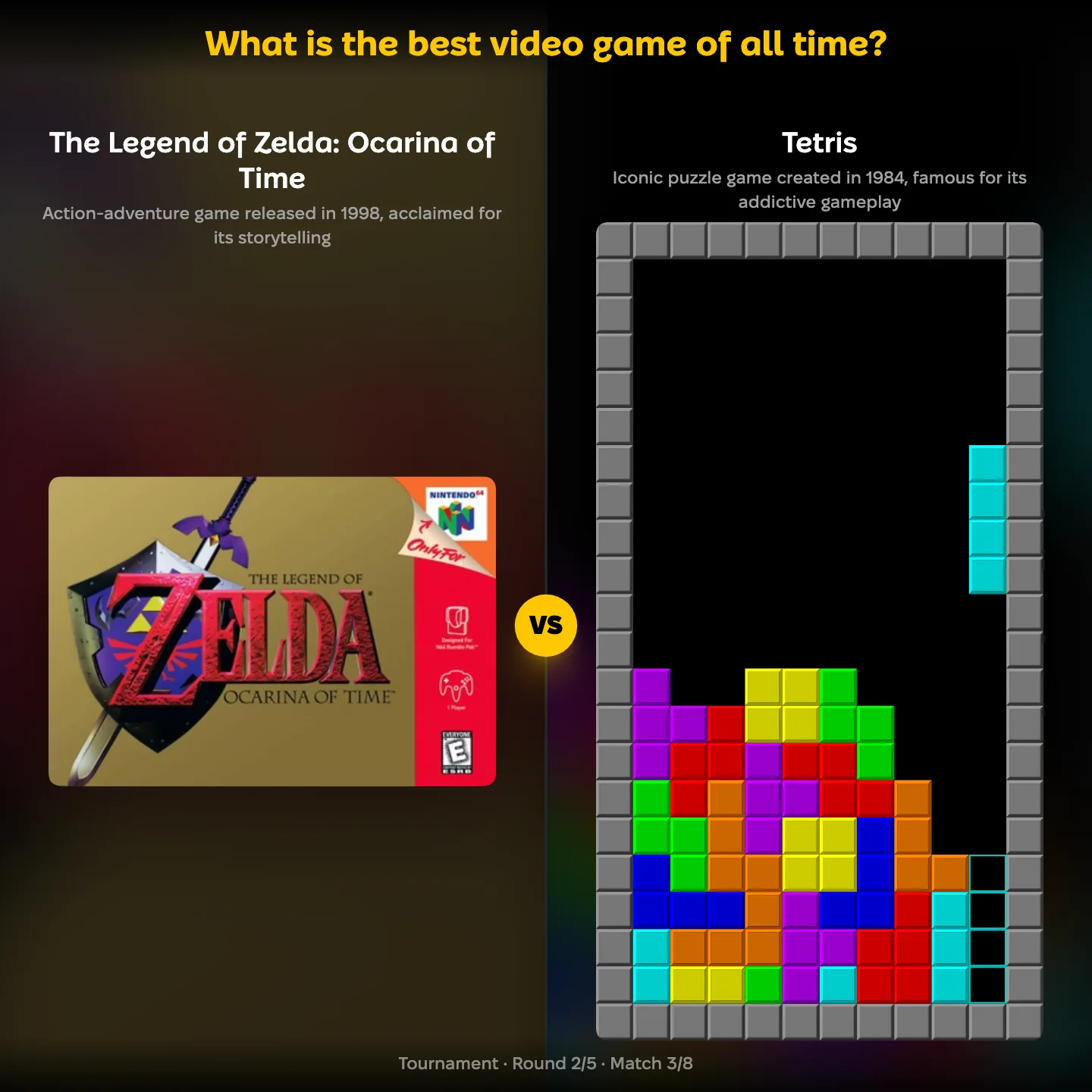
The best single game ever made
Narrow it from franchises to one game and the pair gets one entry each: Super Mario Bros. for Mario, Ocarina of Time for Zelda. Zelda's argument is strongest here. Ocarina of Time carries a 99 on Metacritic, the highest aggregate score the site has ever given a game, unmatched since 1998.
Super Mario Bros. has a different claim: it pulled home consoles out of the 1983 crash and taught a generation what a platformer was.
Thirty other candidates crowd in behind them, including Tetris, Chrono Trigger and Half-Life 2, and any of those can carry a list like this. Mario and Zelda are arguing over second place in a field that also contains a Soviet puzzle game.
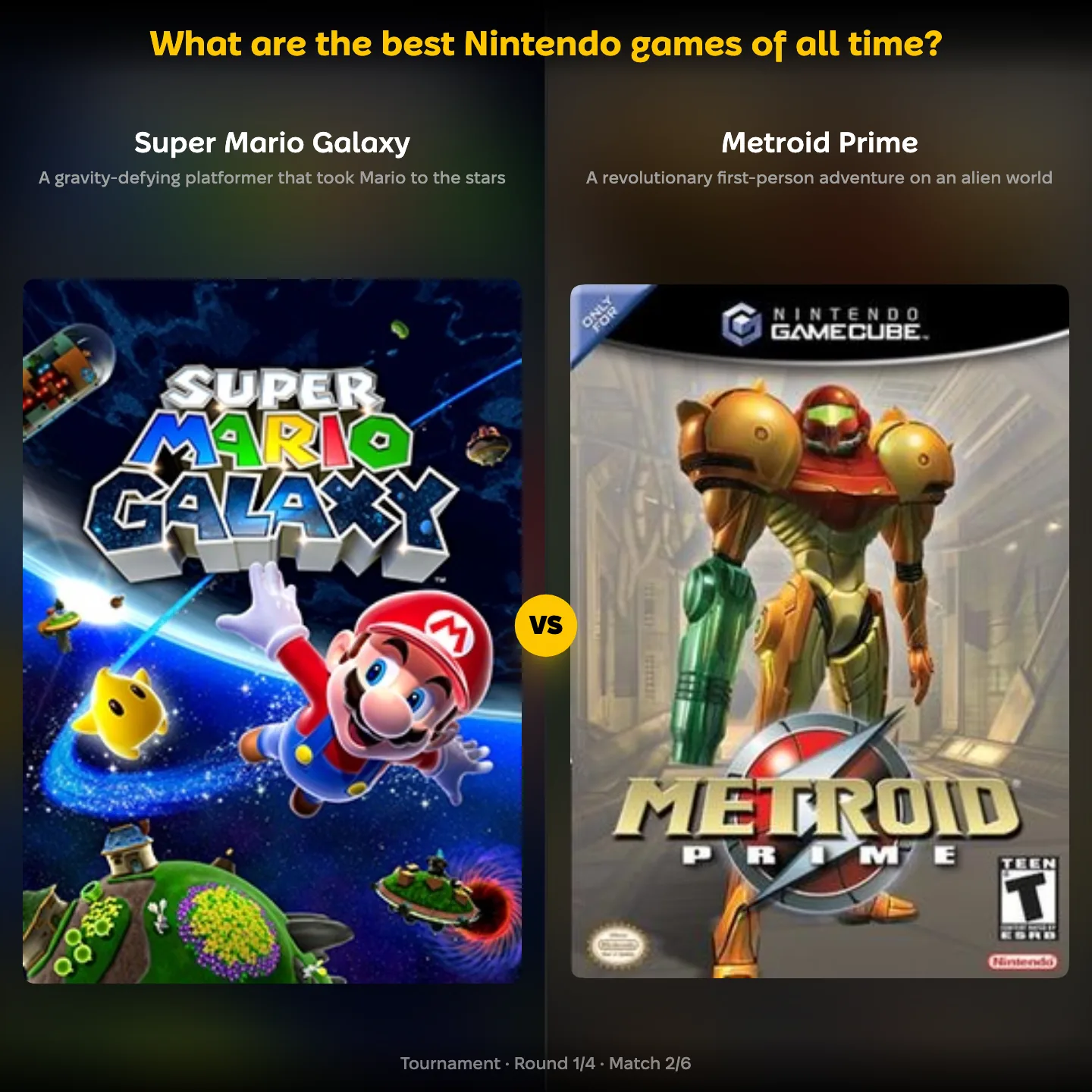
Narrow it to Nintendo's own shelf
Restrict the field to Nintendo's own output and the pair gets company it cannot dismiss. Super Mario Galaxy, Super Mario Bros. 3 and Super Mario World are here for Mario; Ocarina of Time and Breath of the Wild for Zelda.
Super Metroid, Metroid Prime and Pokémon Red & Blue take the next three slots. Nintendo obsessives reach for Metroid Prime when they want to argue that neither headline franchise made the company's best game.
Twelve options leave nowhere for a weak entry to hide. "Best Nintendo game" and "best Mario or Zelda game" turn out to be different questions.
Take the games away and rank the characters
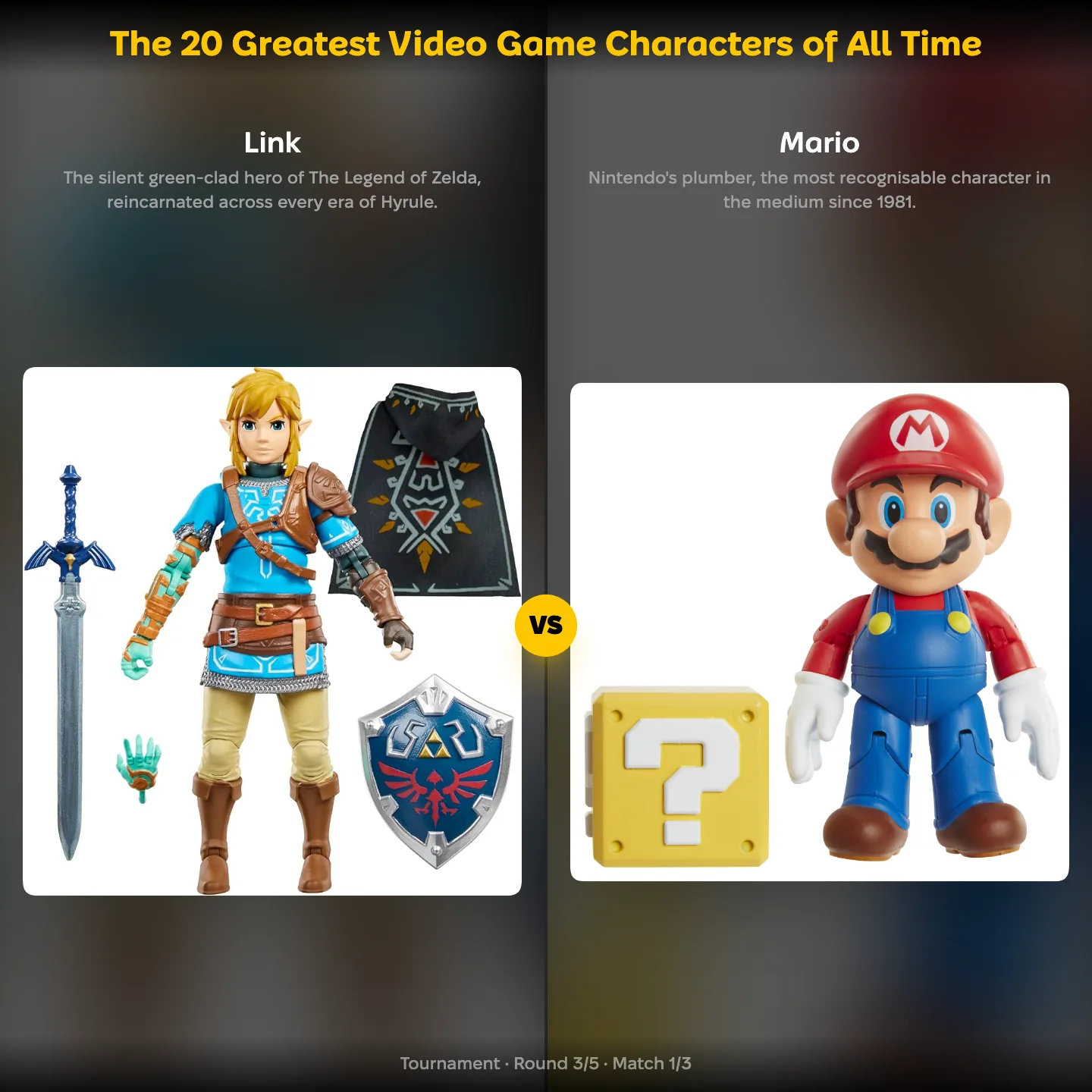
Strip out the software and the argument becomes Mario against Link: the plumber who debuted as "Jumpman" in the 1981 Donkey Kong arcade cabinet against the swordsman who has been reincarnated in every era of Hyrule since 1986.
Guinness World Records puts Mario first and Link second, which matches the wider consensus. Mario's advantage is simple — he is a face, and Link is a role.
Pikachu, Lara Croft, Master Chief, Solid Snake and Kratos are on this ranking too, plus Princess Zelda and Bowser. Both franchises appear more than once.
Link's counter-argument is that his silence is the point. A character built to be inhabited rather than watched has a harder job becoming iconic, and he managed it anyway.
One man started both of them
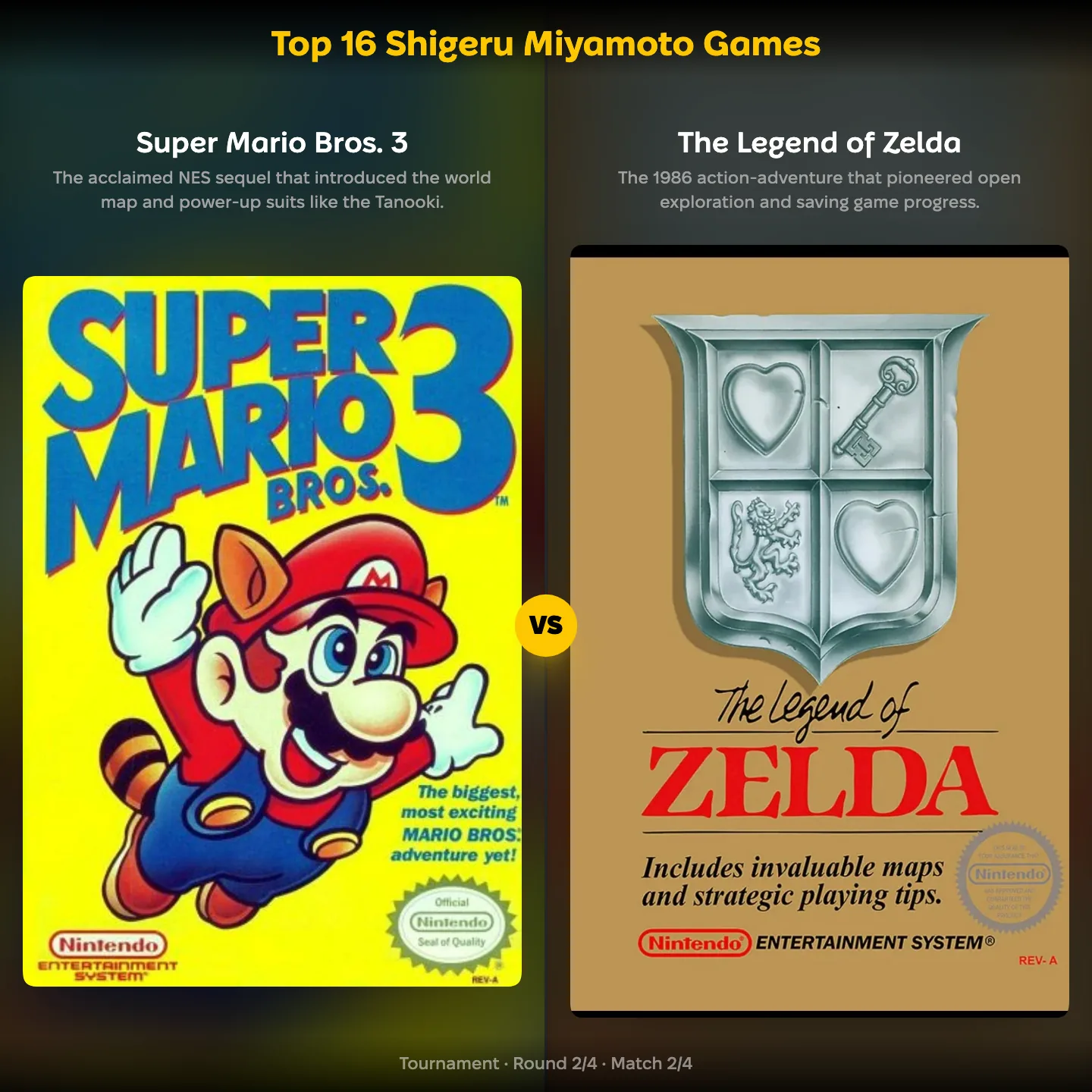
Shigeru Miyamoto designed Super Mario Bros. and The Legend of Zelda in the same building thirteen months apart. Same author, same era, same constraints — the fairest fight in the article.
Eleven of the sixteen entries belong to the two franchises: Super Mario Bros., Bros. 3, World, 64, Galaxy and Odyssey on one side, the 1986 original, A Link to the Past, Ocarina of Time and Majora's Mask on the other.
Donkey Kong, Pikmin and Star Fox take the remaining slots, and they matter — Miyamoto's reputation rests on more than two inventions.
The split reveals a division of labour. Miyamoto tested movement in Mario and curiosity in Zelda.
Now rank the music instead
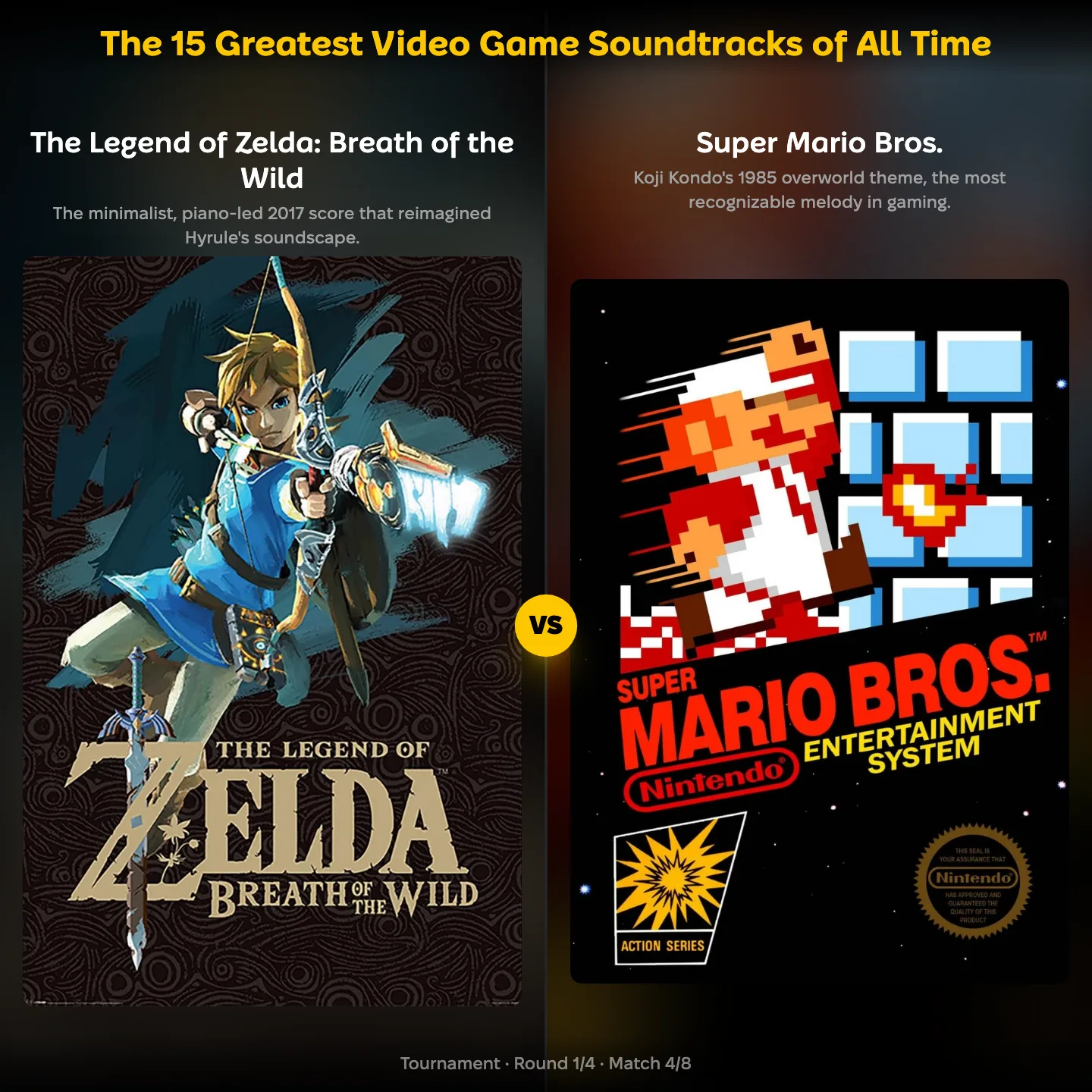
Change the question to sound and the balance moves. Koji Kondo wrote both franchises' signature themes — the Super Mario Bros. overworld loop in 1985, Zelda's overture a year later — and then the two series went in opposite directions.
Mario's music stayed brief, bright and loopable, built for a screen you die on repeatedly.
Zelda's grew into full orchestral scores. Breath of the Wild dropped melody altogether for sparse piano that only appears when you stop moving.
Final Fantasy VII, Chrono Trigger and Halo share this list with Ocarina of Time. Mario's theme is the most recognisable melody the medium has produced; nobody hums a score they were meant to feel.
The generation where both went 3D
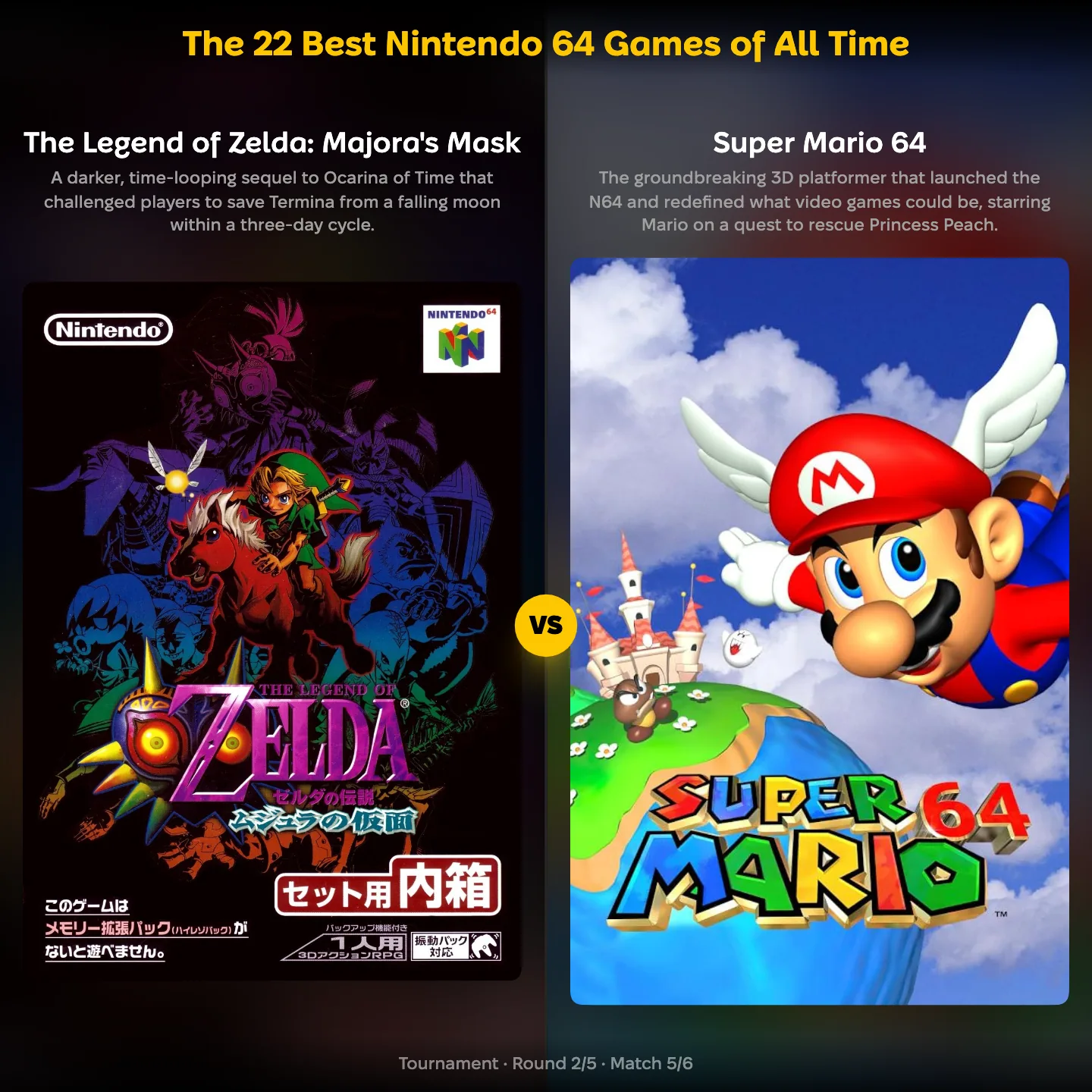
The Nintendo 64 handed Super Mario and The Legend of Zelda the same problem at the same time: how does a 2D series work in three dimensions?
Super Mario 64 launched with the console in 1996 and answered first. It invented the analogue-stick camera language 3D platformers still use.
Ocarina of Time answered in 1998 with Z-targeting. Majora's Mask followed in 2000 with a three-day clock and a falling moon — the strangest game Nintendo has ever put its name to.
Twenty-two games are on this list, including GoldenEye 007, Mario Kart 64 and Paper Mario, so both franchises appear more than once. This is the generation where the two series stopped being alternatives and became templates.
The 16-bit pair everyone remembers
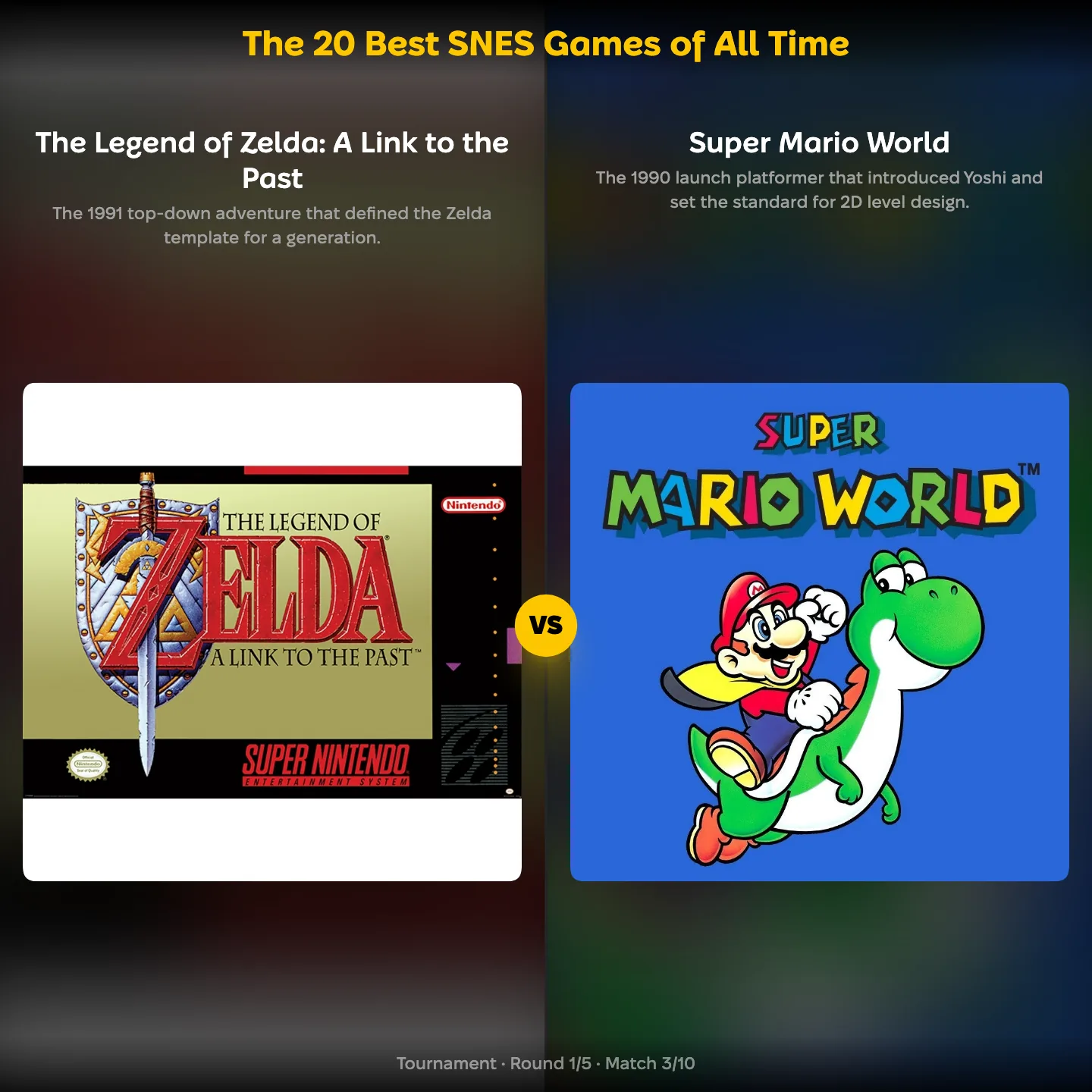
The Super Nintendo gave both franchises the entry their fans defend hardest.
Super Mario World arrived with the console in 1990, introduced Yoshi, and still sets the reference point for 2D level design.
A Link to the Past followed in 1991 and fixed the Zelda template so thoroughly that the series spent two decades iterating on it rather than replacing it.
Super Metroid, Chrono Trigger, Final Fantasy VI and EarthBound are on the same list, and any serious ranking of SNES games puts at least two of them near the front. On no other console did Nintendo's own franchises face this much competition from third-party studios.
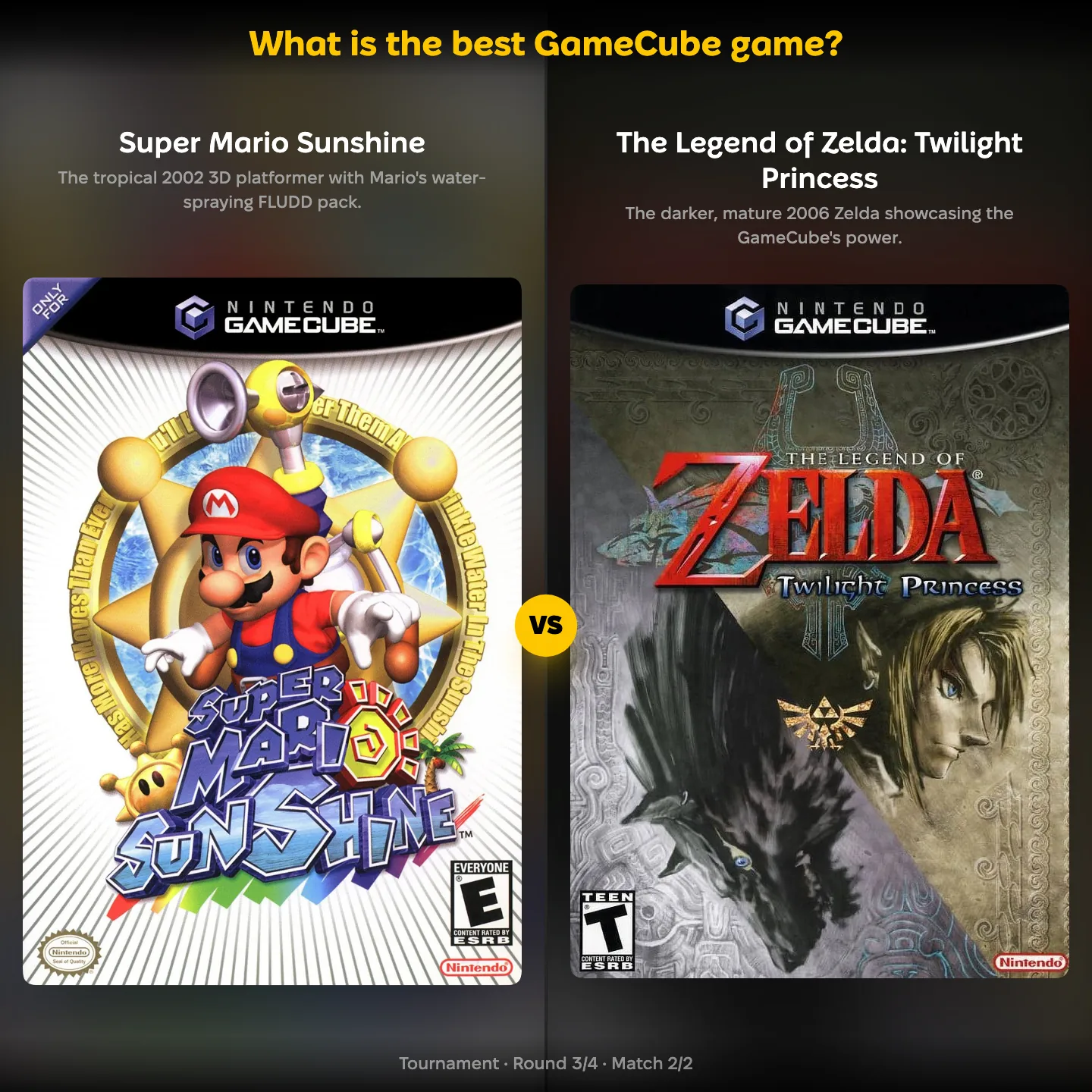
The GameCube is the one generation where the two franchises were not on level terms.
Super Mario Sunshine arrived in 2002 with a water-jetpack called FLUDD and a tropical setting. Mario's own fans still argue about it harder than about any other 3D entry.
Zelda got two games on the same console: The Wind Waker in 2002, with a cel-shaded look that was mocked on announcement and praised ever after, and Twilight Princess in 2006, with the darker tone the mockers had asked for.
Metroid Prime, Resident Evil 4 and Super Smash Bros. Melee sit on the same list. For Mario this is the soft spot in an otherwise unbroken run of 3D entries — the part of the argument Zelda supporters reach for first.
Two franchises on a monochrome screen
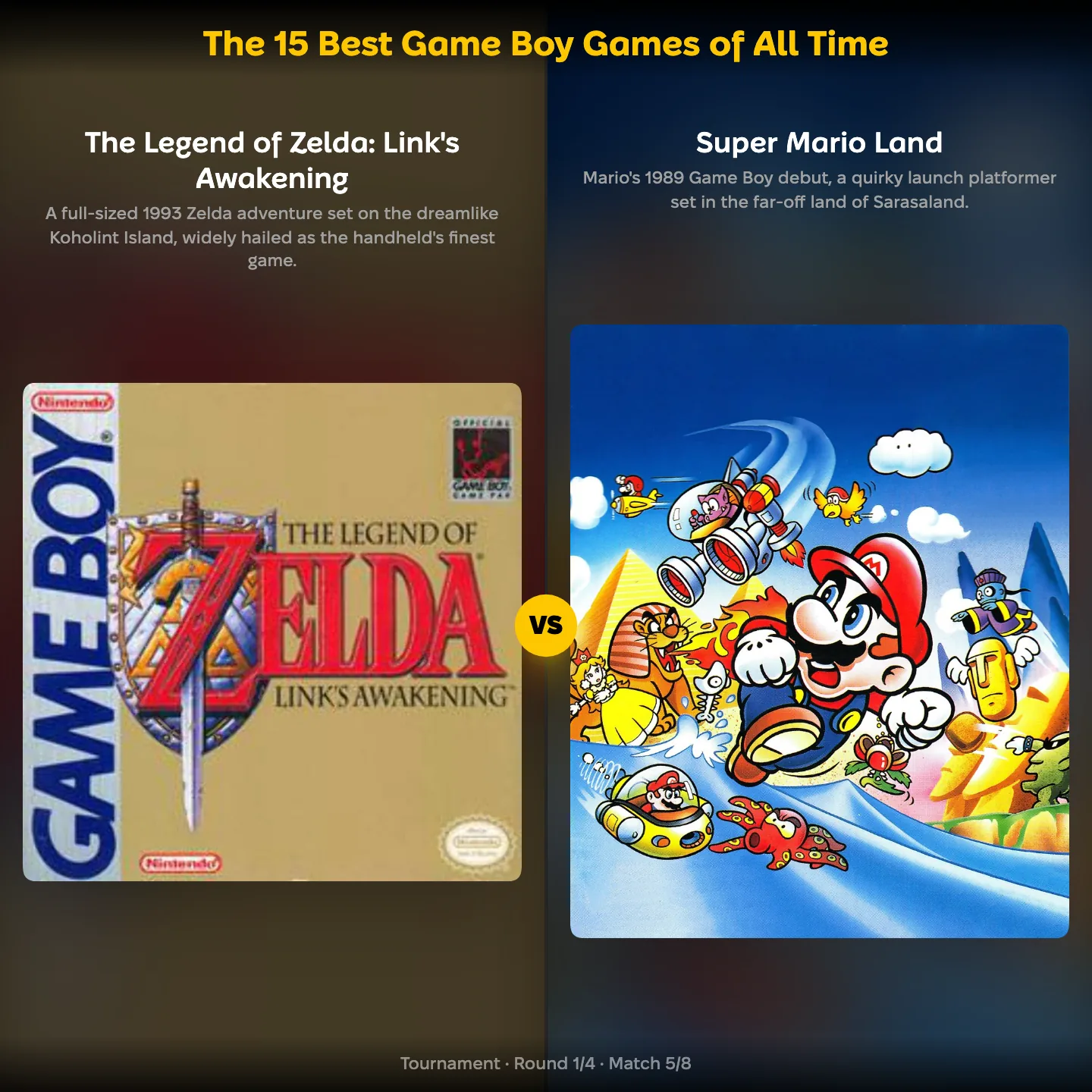
Shrink both series to four shades of green and the pecking order changes again.
Super Mario Land launched with the Game Boy in 1989. It is set in Sarasaland, with a different princess and enemies Mario never met again — a launch title made by a different team, and it shows.
Link's Awakening arrived in 1993 and did the opposite. It delivered a full-sized Zelda adventure on a handheld, on the dreamlike Koholint Island, and reviewers routinely name it the finest game on the system.
Tetris, Pokémon Red and Metroid II share this list, and Tetris sold the hardware better than either franchise did. Nintendo took the small screen seriously for Link before it did for Mario.
The re-releases nobody defends
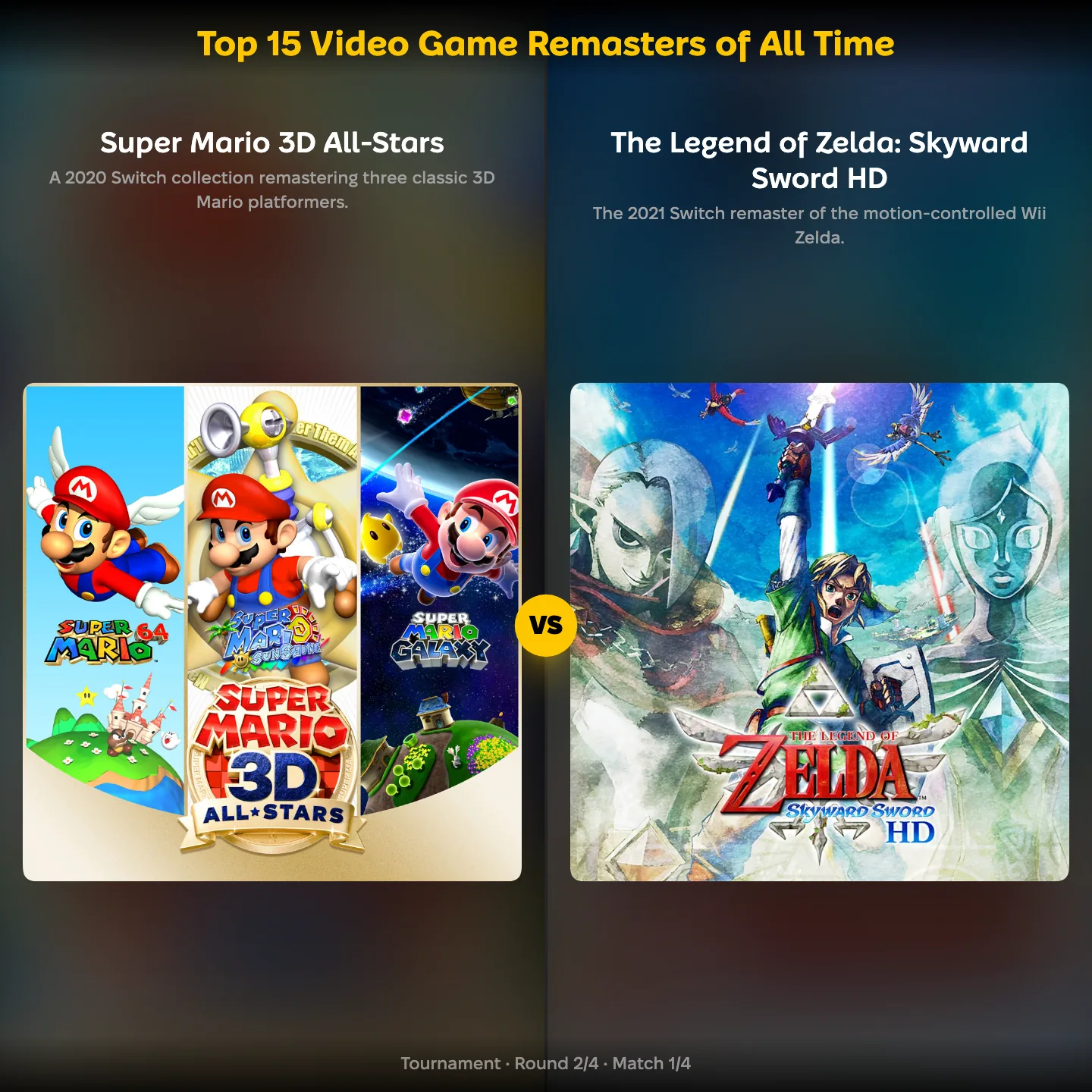
Every long franchise eventually sells you its own back catalogue. This is where both Super Mario and The Legend of Zelda look worst.
Super Mario 3D All-Stars bundled three classics on Switch in 2020 and barely touched them. Nintendo then pulled it from sale on 31 March 2021 — a deadline on a preservation product, aimed at the people most likely to buy it.
Skyward Sword HD followed in July 2021. It cleaned up the most divisive 3D Zelda without addressing a single complaint about it.
The same list holds remasters that did the job properly, including the Resident Evil and Shadow of the Colossus rebuilds. Neither Nintendo franchise has an answer here, and the Ocarina of Time remake announced in June 2026 suggests Nintendo knows it.
A ranking Zelda cannot enter
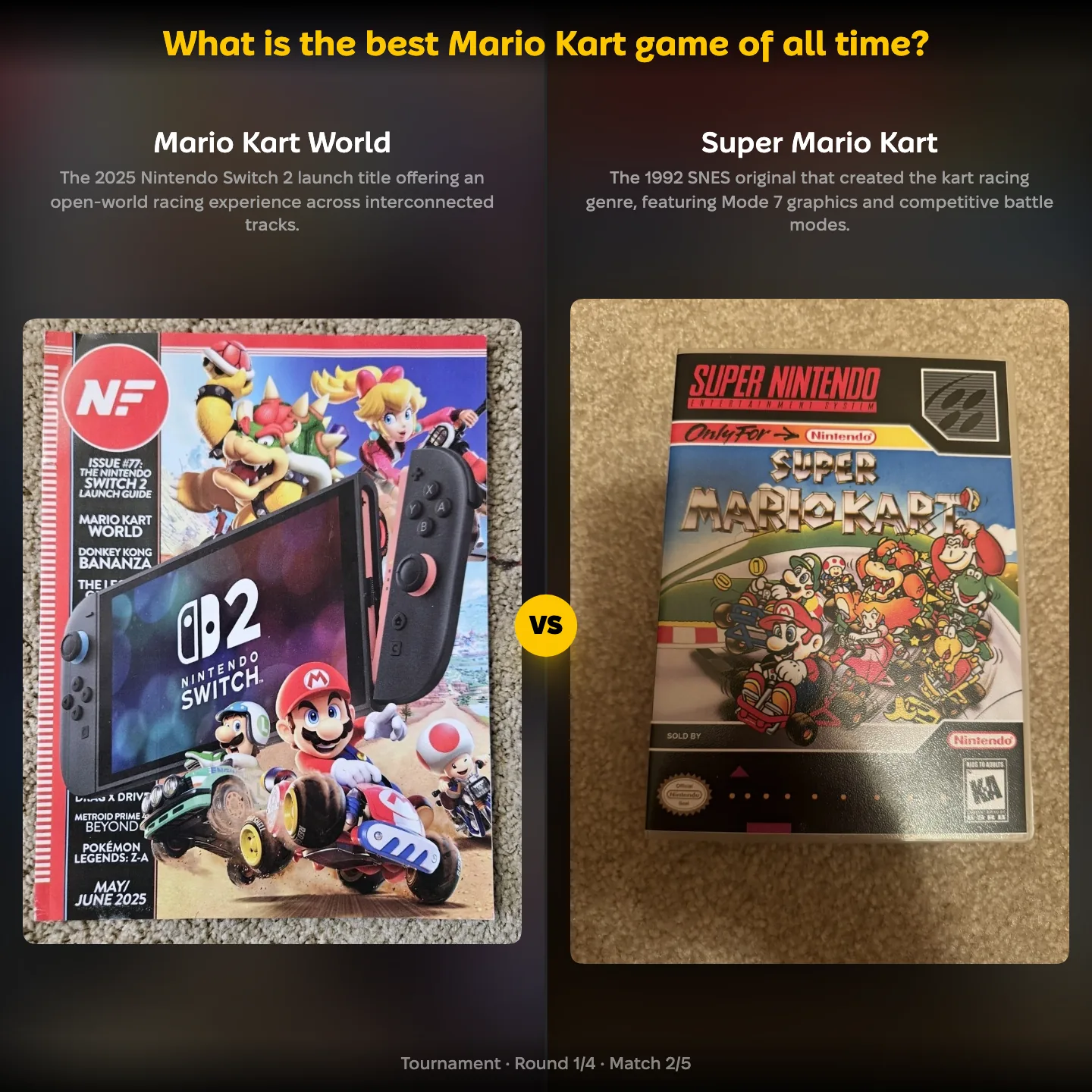
Mario Kart marks the clearest structural difference between the two franchises. Mario spun off into karts, parties, tennis and RPGs; The Legend of Zelda never spun off into anything that stuck.
Ten Mario Kart games are on this list, from the 1992 Super Mario Kart that invented the genre to Mario Kart World. World launched with the Switch 2 on 5 June 2025 and sold 14.70 million copies by 31 March 2026, against 19.86 million machines shipped — the best-selling game on the console.
Hyrule has no equivalent. That gap explains why Mario's franchise total runs five times Zelda's: half of it was never a platformer.
Zelda's counter-argument is that the series never diluted itself. This ranking shows what dilution looks like when it works.
Mario is already a film franchise. Zelda is nine months away
Here the gap is a calendar, not a judgement.
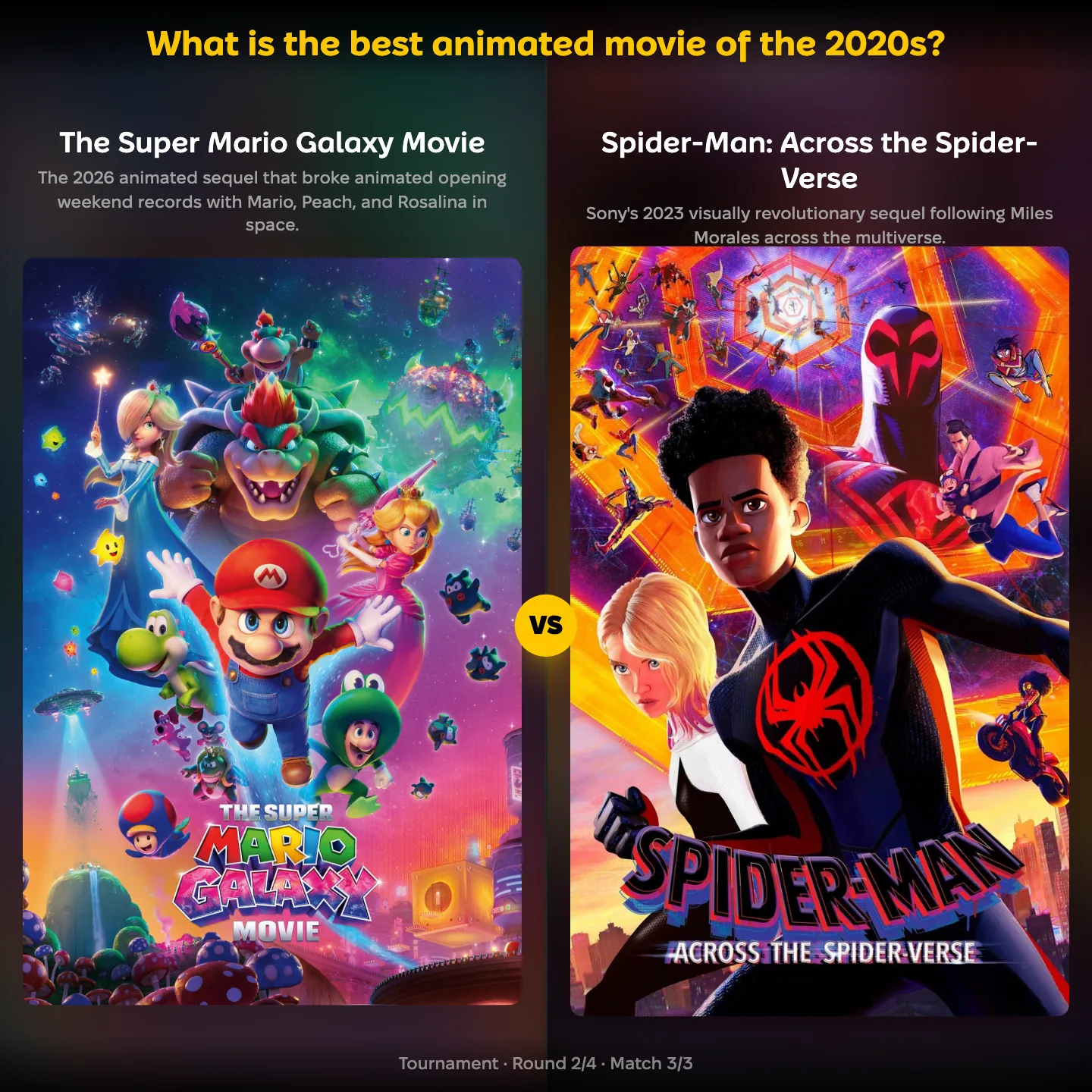
The Super Mario Galaxy Movie opened on 3 April 2026 and became the first release of the year to pass a billion dollars at the box office. That puts Mario on a list of animated films alongside Spider-Man: Across the Spider-Verse, Soul, Encanto and The Boy and the Heron.
The Legend of Zelda is absent, because its film does not exist yet. Wes Ball's live-action adaptation, with Bo Bragason as Zelda and Benjamin Evan Ainsworth as Link, wrapped filming in New Zealand in April 2026 and opens on 30 April 2027.
Both franchises are film franchises now. Only one of them has a film.
The open world Mario never built
Here is the list with no Super Mario on it at all.
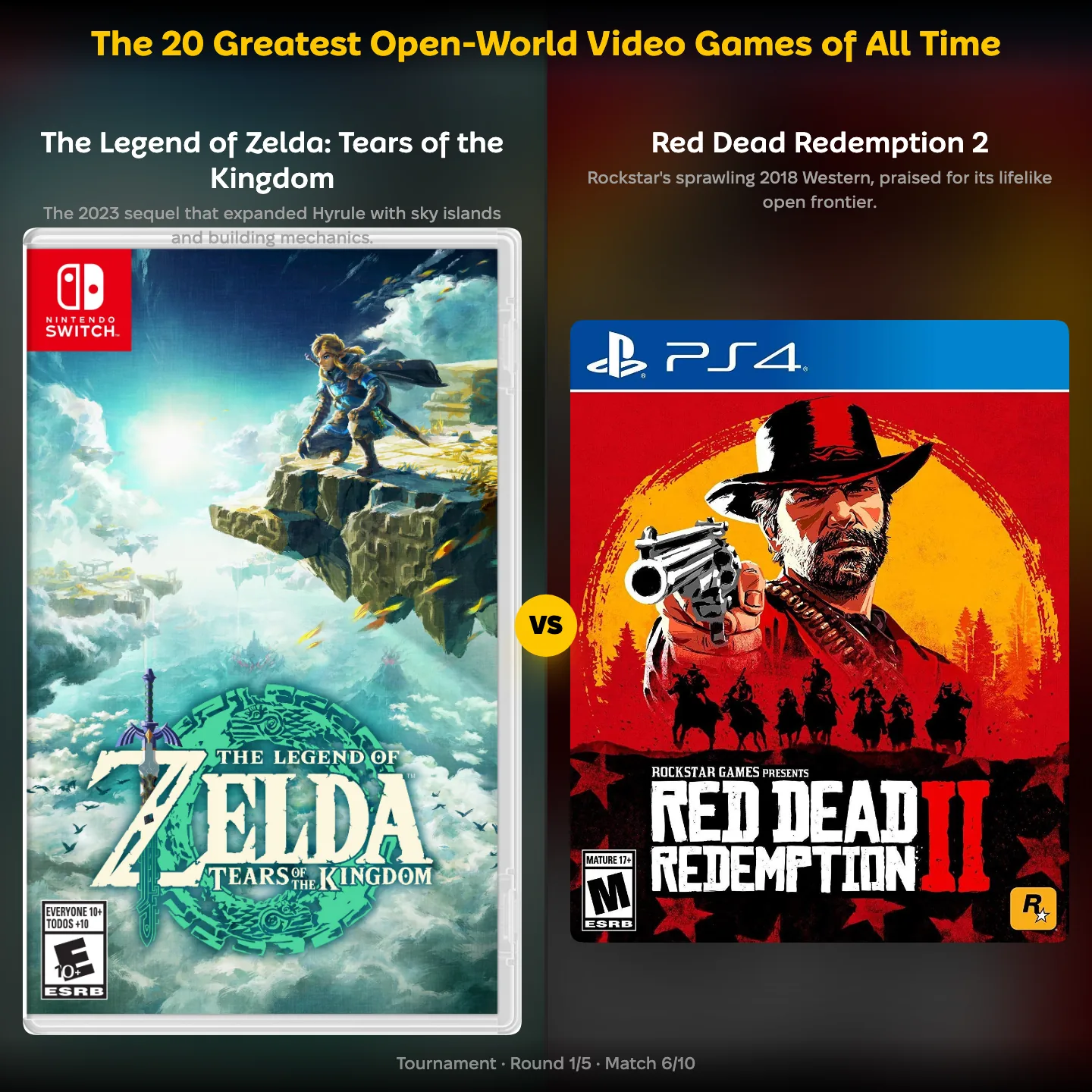
Breath of the Wild in 2017 and Tears of the Kingdom in 2023 put The Legend of Zelda into a category the franchise had not competed in since 1986. They did it well enough that the comparison set is Red Dead Redemption 2, Skyrim, The Witcher 3 and Elden Ring rather than anything Nintendo made.
Mario has nothing to enter. Super Mario Odyssey is a set of self-contained sandboxes, not a continuous world, and that is a design choice rather than a failure — Mario is about mastering a small space, Zelda about being lost in a large one.
Twenty games are on this list. Zelda is the only Nintendo franchise among them.
Mario against Mario
Take The Legend of Zelda out of the room and Super Mario still cannot agree with itself.
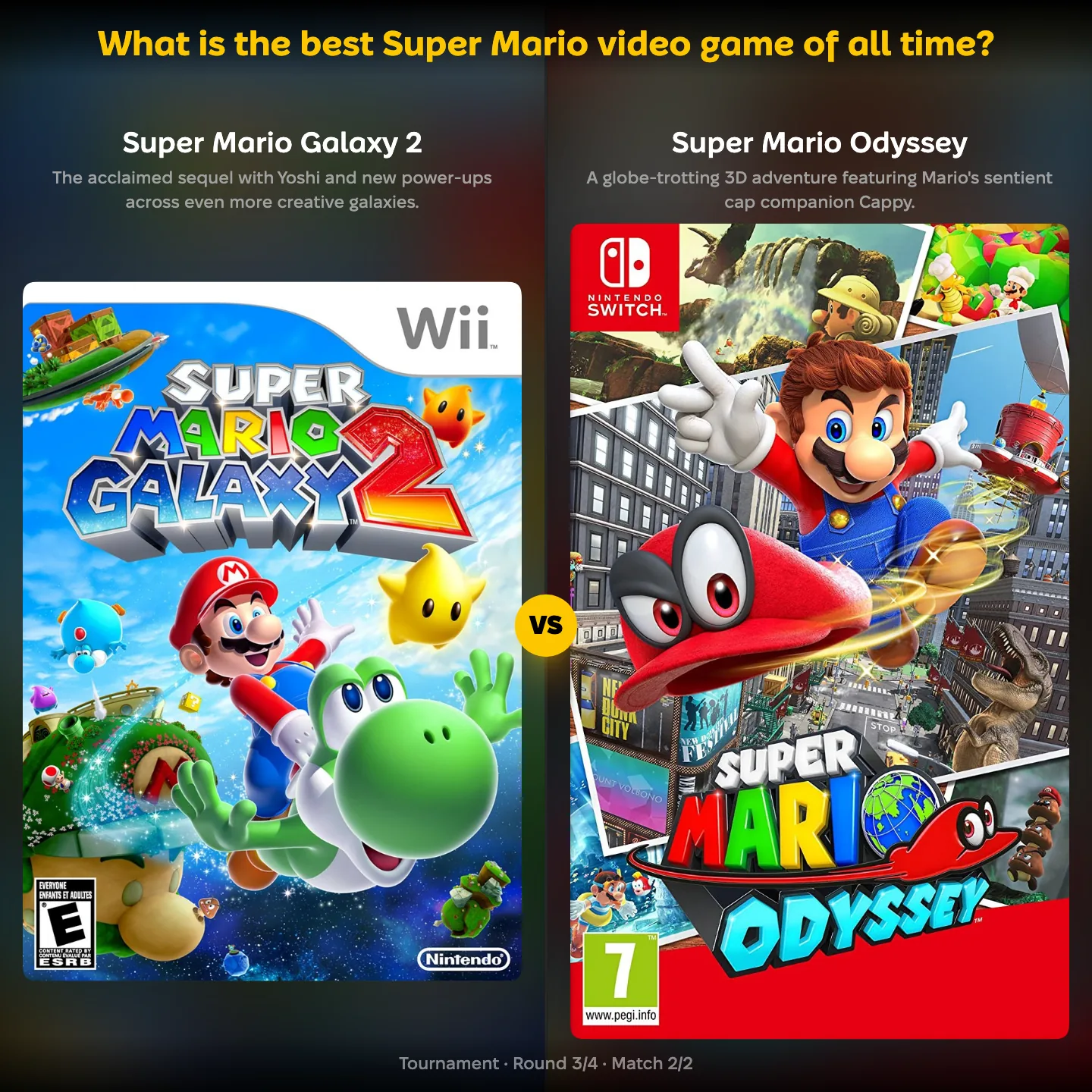
Eleven mainline entries are on this list, from the 1985 original through Bros. 3, World, 64, Sunshine, Galaxy, Galaxy 2, 3D World, Odyssey and the Super Mario RPG detour. Each generation of players nominates whichever one they met first.
Galaxy 2 is the connoisseurs' pick, Odyssey the modern one, Bros. 3 the one that never loses an argument outright. Sunshine is here as well, which is the honest thing to do with a catalogue this long.
The internal fight is as unresolved as the fight with Zelda. The problem is the question, not the franchise.
Zelda against Zelda
Hyrule gets the same treatment, and the split is sharper than Mario's.
Fourteen entries run from the 1986 original through A Link to the Past, Ocarina of Time, Majora's Mask, The Wind Waker, Twilight Princess, Skyward Sword, Breath of the Wild and Tears of the Kingdom. The series divides into two design philosophies with 2017 as the border.
Everything before Breath of the Wild is a sequence of dungeons in a fixed order. Everything after is a landscape you are turned loose in.
Ocarina of Time carries the reviews, Breath of the Wild carries the sales, and A Link to the Past carries the people who think the series peaked in two dimensions. Super Mario has no equivalent schism — his games got bigger, not different.
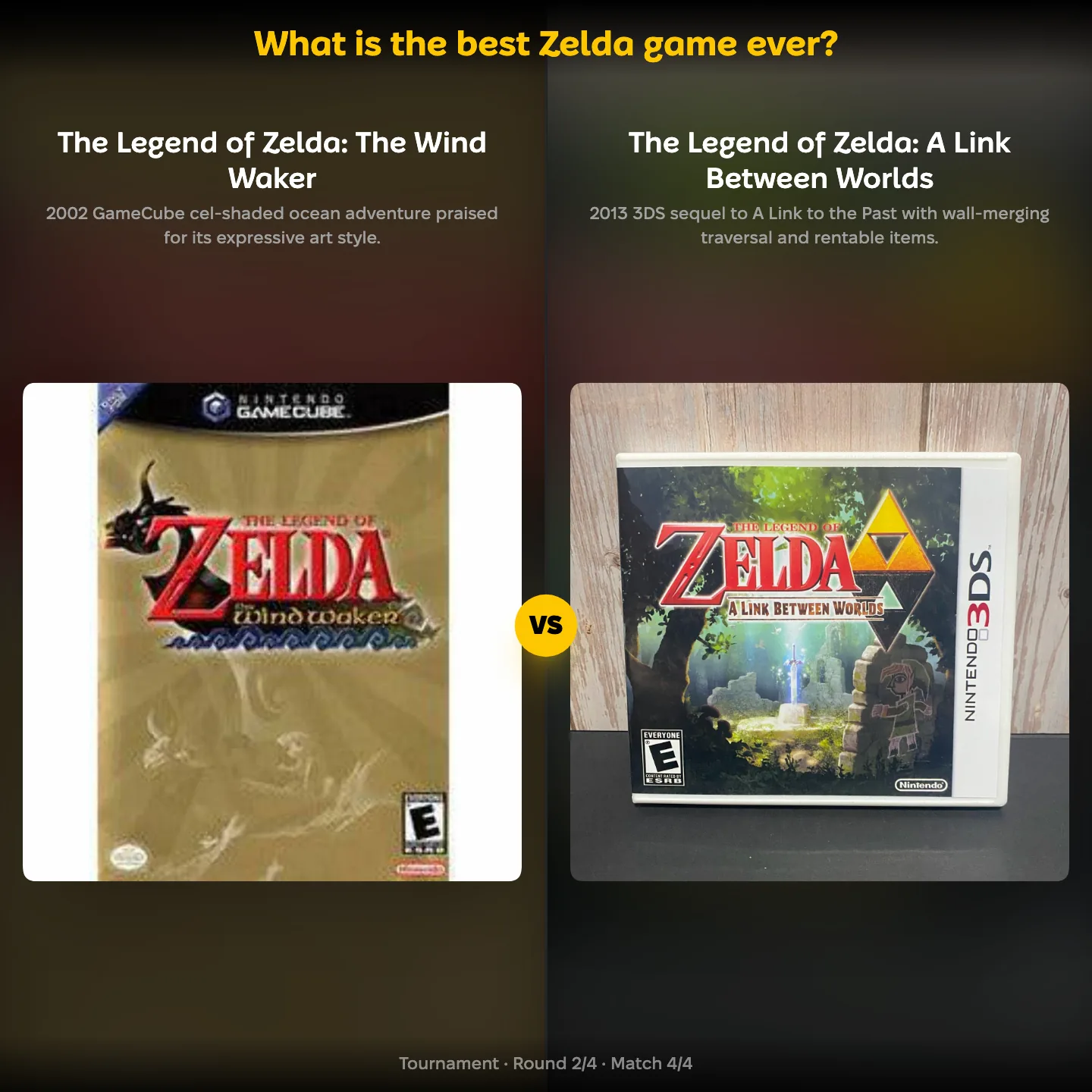
The argument doesn't settle, it just changes shape
Super Mario and The Legend of Zelda are not separated by the answer. They are separated by the question — sales, reviews, music, hardware generation, spin-offs, films — and each question points somewhere different.
Forty years of this argument has produced no result. So pick the version of it you actually care about. It's the same trick behind every ranking here — judging things two at a time.
All 16 rankings, in one place:
- What is the best video game franchise?
- What is the best video game of all time?
- What are the best Nintendo games of all time?
- The 20 Greatest Video Game Characters of All Time
- Top 16 Shigeru Miyamoto Games
- The 15 Greatest Video Game Soundtracks of All Time
- The 22 Best Nintendo 64 Games of All Time
- The 20 Best SNES Games of All Time
- What is the best GameCube game?
- The 15 Best Game Boy Games of All Time
- Top 15 Video Game Remasters of All Time
- What is the best Mario Kart game of all time?
- What is the best animated movie of the 2020s?
- The 20 Greatest Open-World Video Games of All Time
- What is the best Super Mario video game of all time?
- What is the best Zelda game ever?
Pick the question you actually care about, and vote it out.
More rankings, more angles
- How Many Ways Can You Rank Dwayne "The Rock" Johnson? — the same format, screen edition
- How Rankings Are Scored: The 1000-Point System — what the numbers on a results page mean
- How Head-to-Head Voting Works (and Why It Beats Polls) — why pairs beat a checkbox list