
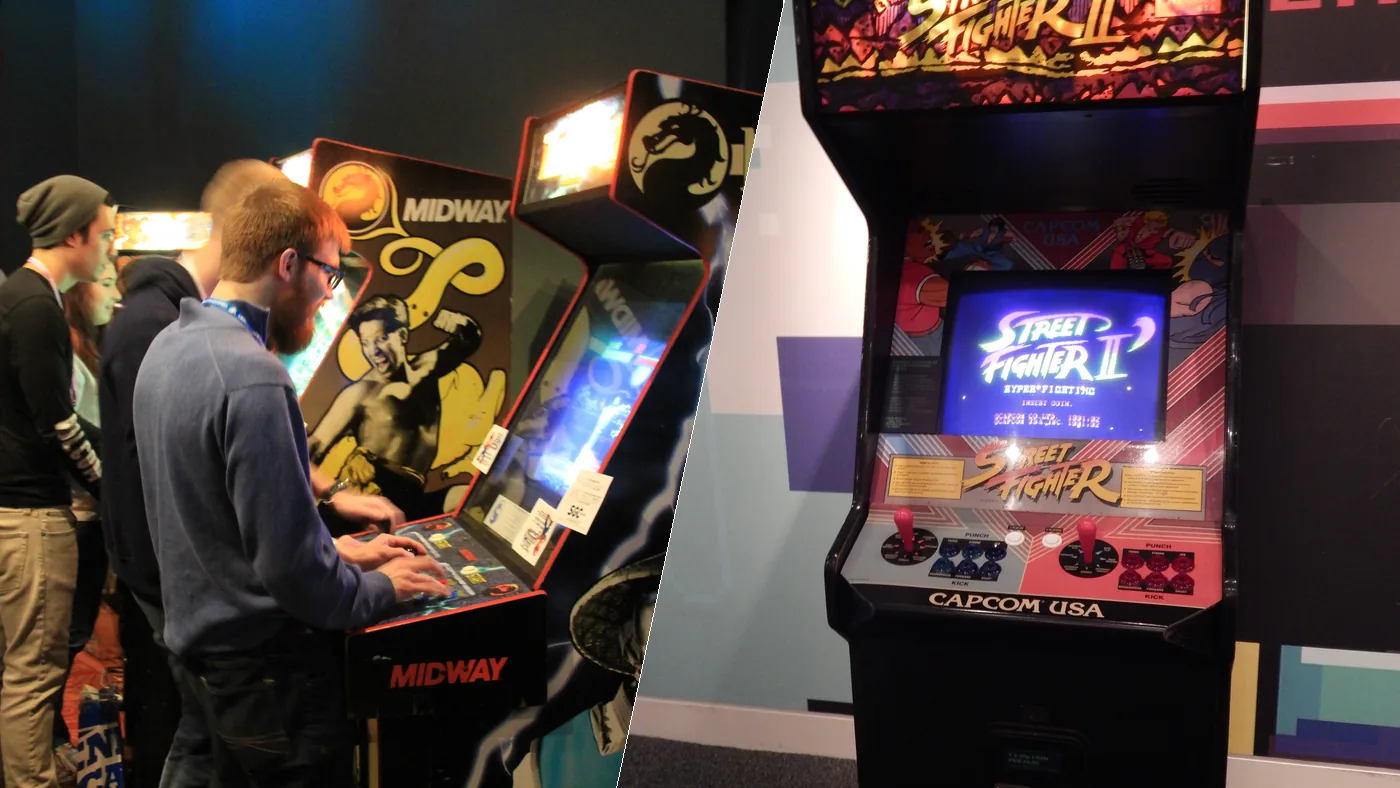
Street Fighter II reached arcades in March 1991. Mortal Kombat followed the next year, after Midway handed Ed Boon and John Tobias a brief for a combat game inside twelve months — an instruction the two of them read as a response to what Capcom had just done to the arcade floor.1
Both franchises have a live-action film in 2026. Mortal Kombat II opened in May. Street Fighter, directed by Kitao Sakurai with Andrew Koji as Ryu and Jason Momoa as Blanka, opens on 16 October, and its story is set in 1993 — the year Mortal Kombat's home ports shipped and a US Senate subcommittee began asking what was inside them.2
Mortal Kombat exists because Street Fighter II did, and fifteen lists cannot agree whether that makes it the heir or the imitator.
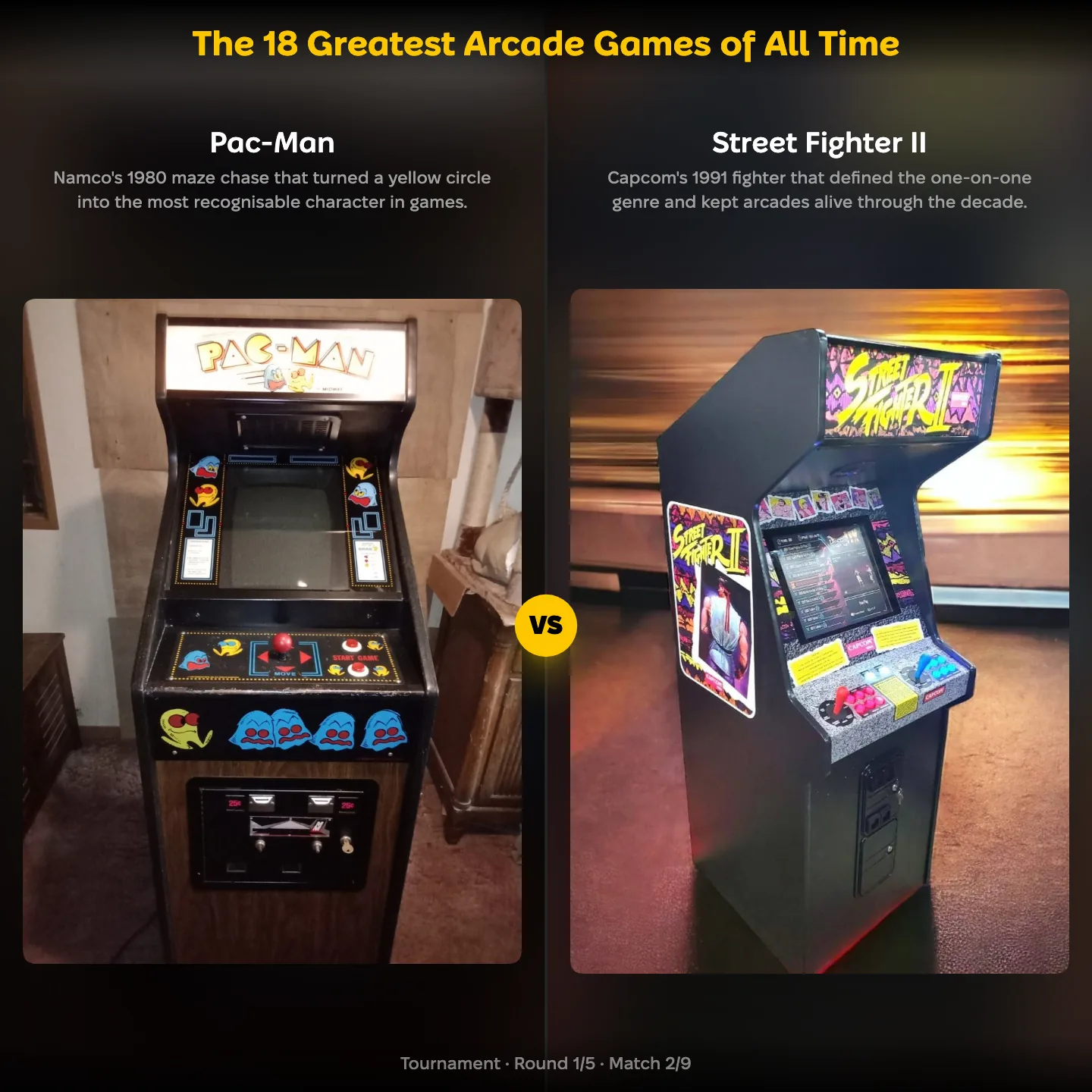
Pac-Man vs Street Fighter II: the cabinets that paid the rent
Ranking the greatest arcade games means ranking coin-op machines, not home releases, and the field runs from 1978 to the late 1990s.
Street Fighter II belongs near the front of it on volume alone. Capcom moved more than 200,000 cabinets worldwide, and the game is routinely described as having prolonged the life of a business that was dying when it arrived.3
Mortal Kombat has the harder case here, because its defining features are the ones a 1992 cabinet could show and a 1980 cabinet could not: digitised actors, blood, a finishing move performed after the round was already won.
The company both games are keeping is the reason neither wins easily. Pac-Man, Space Invaders, Donkey Kong and Asteroids were already historical objects by the time Capcom shipped a fighting game, and Ms. Pac-Man alone outsold most of what came after it.
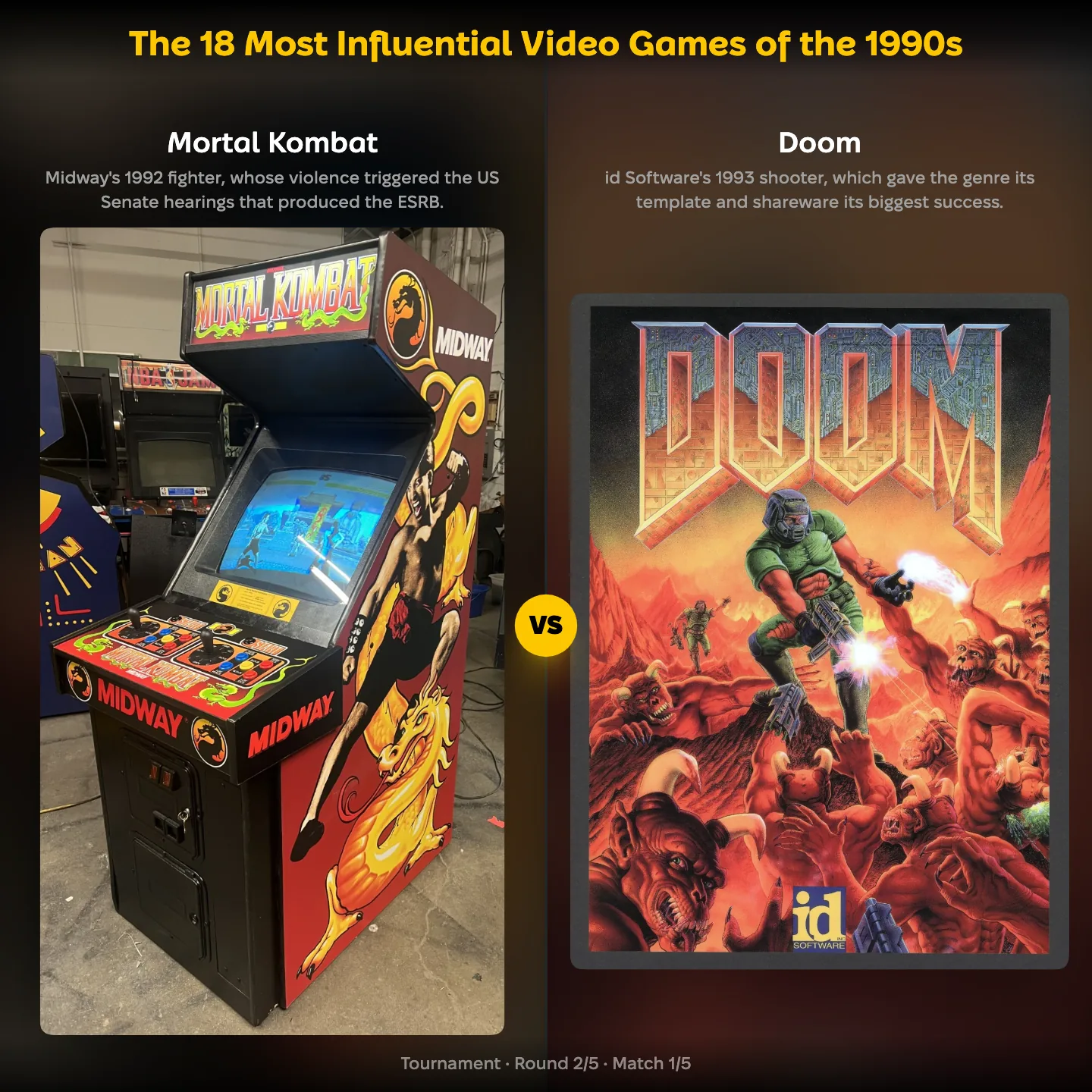
Doom, Mortal Kombat and the games the 1990s copied
Influence is a different test from quality. Street Fighter II has the longest paper trail on it: the game is widely credited with creating the modern fighting game and with moving competitive play away from high scores and towards two people at one machine.3
Mortal Kombat's influence ran outside the medium. It produced a ratings board, which no other game on this list can claim.
Doom, Super Mario 64, Ocarina of Time and Final Fantasy VII crowd the top of this one. Each rewrote a genre rather than joining one, and three of the four arrived after both fighters had already peaked.
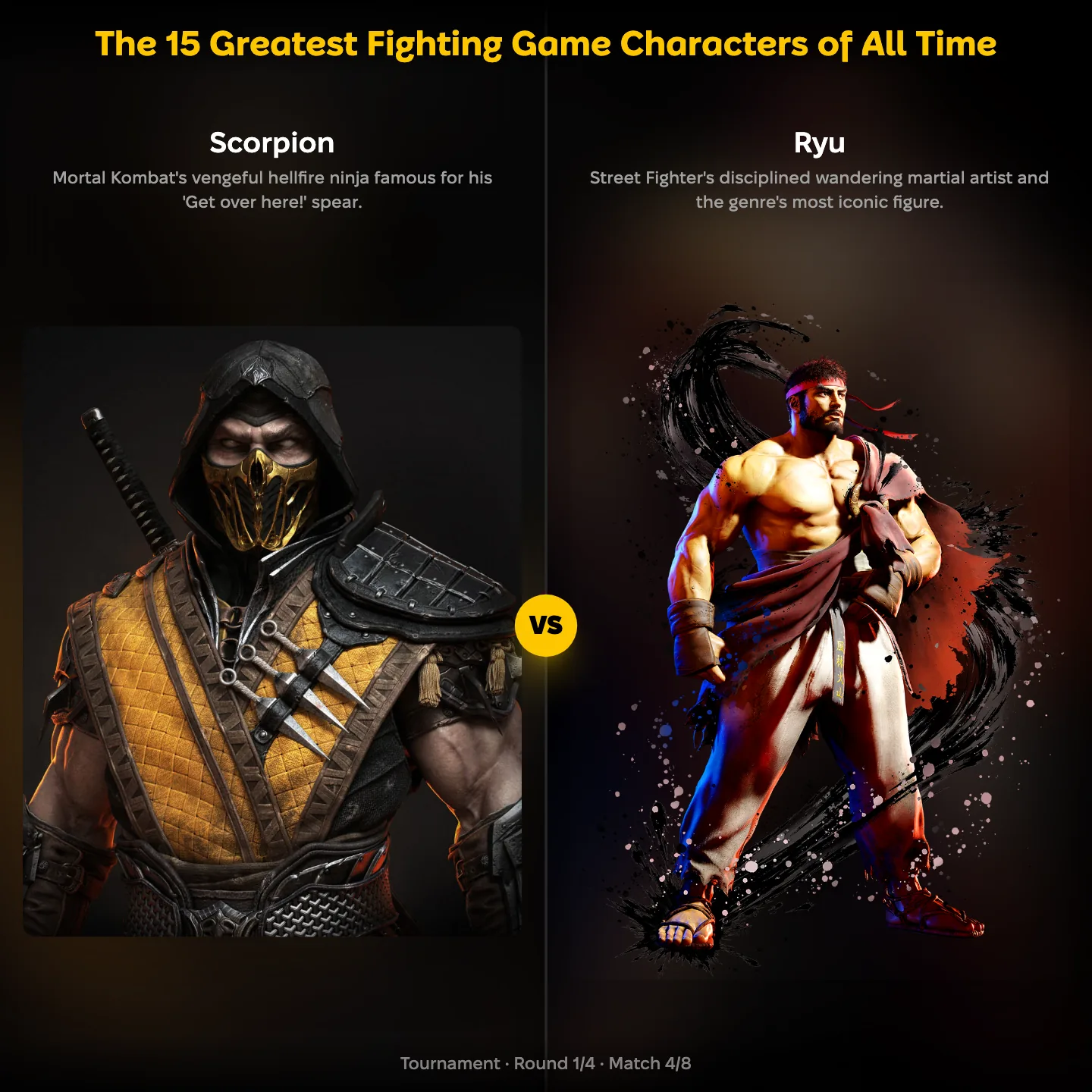
Ryu vs Scorpion: the two faces on every fighting-game poster
Fifteen characters, and the two franchises supply eight of them between them.
Street Fighter sends Ryu, Chun-Li, Akuma and Cammy. Ryu is the genre's default protagonist in the same way a plumber is platforming's: white gi, red headband, a move set other games copied wholesale.
Mortal Kombat sends Scorpion, Sub-Zero, Liu Kang and Raiden. Scorpion is the one name from either franchise that a person can quote without having played a fighting game, because "Get over here!" outlived the machine it came from.
Terry Bogard, Sol Badguy, Jin Kazama and Morrigan are what stop this being a two-horse list. Tekken and The King of Fighters built characters people cosplay too.
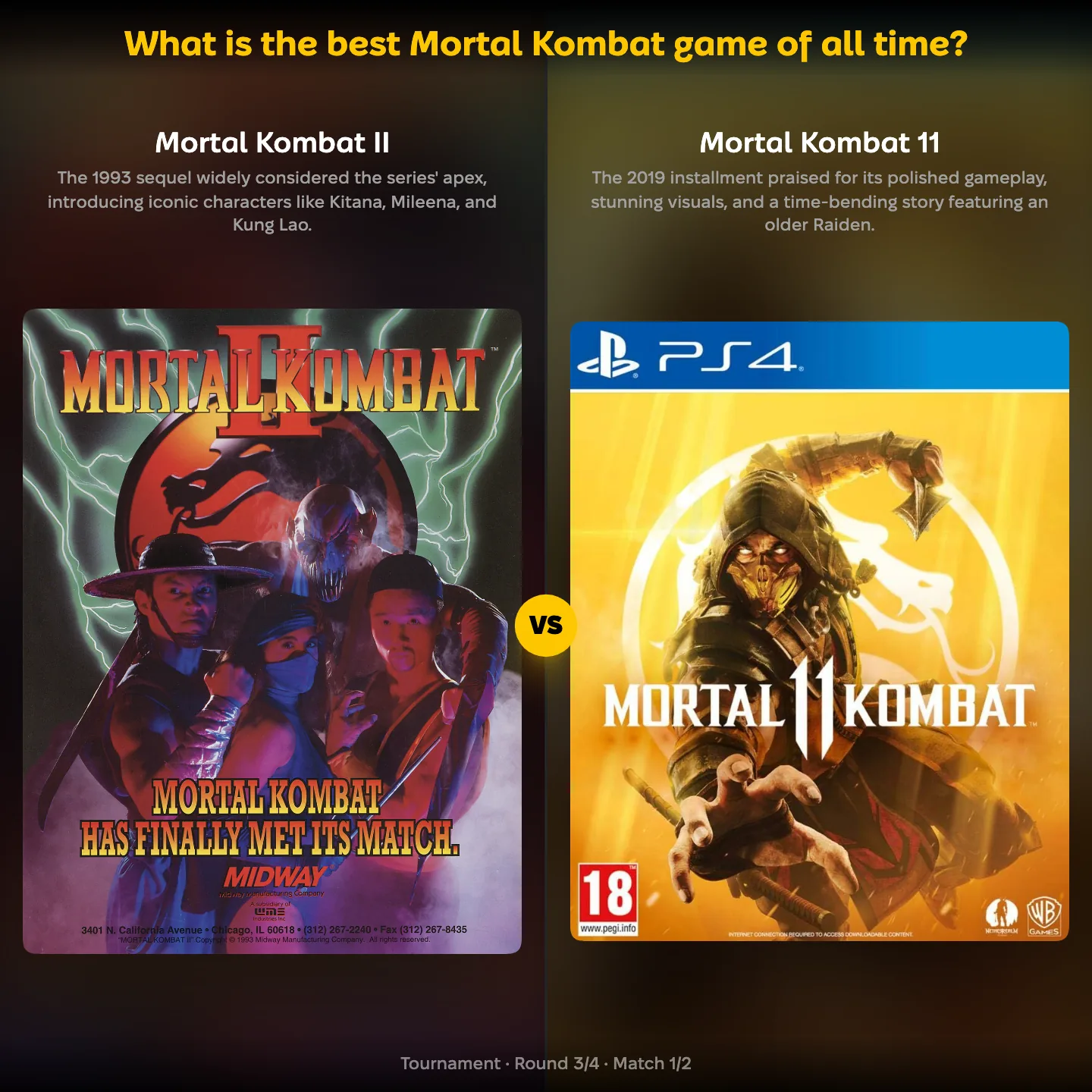
Mortal Kombat II and the argument inside one franchise
Twelve games, thirty-one years, and no Street Fighter anywhere near it.
Mortal Kombat II is the 1993 sequel most players name when asked where the series peaked; Mortal Kombat 11 is the commercial peak, and Mortal Kombat 1 is the current entry.
A franchise that has rebooted its own timeline three times gives its fans plenty to disagree about. Street Fighter has re-numbered itself six times and never once undone its own history, which is a different way to run a long series.
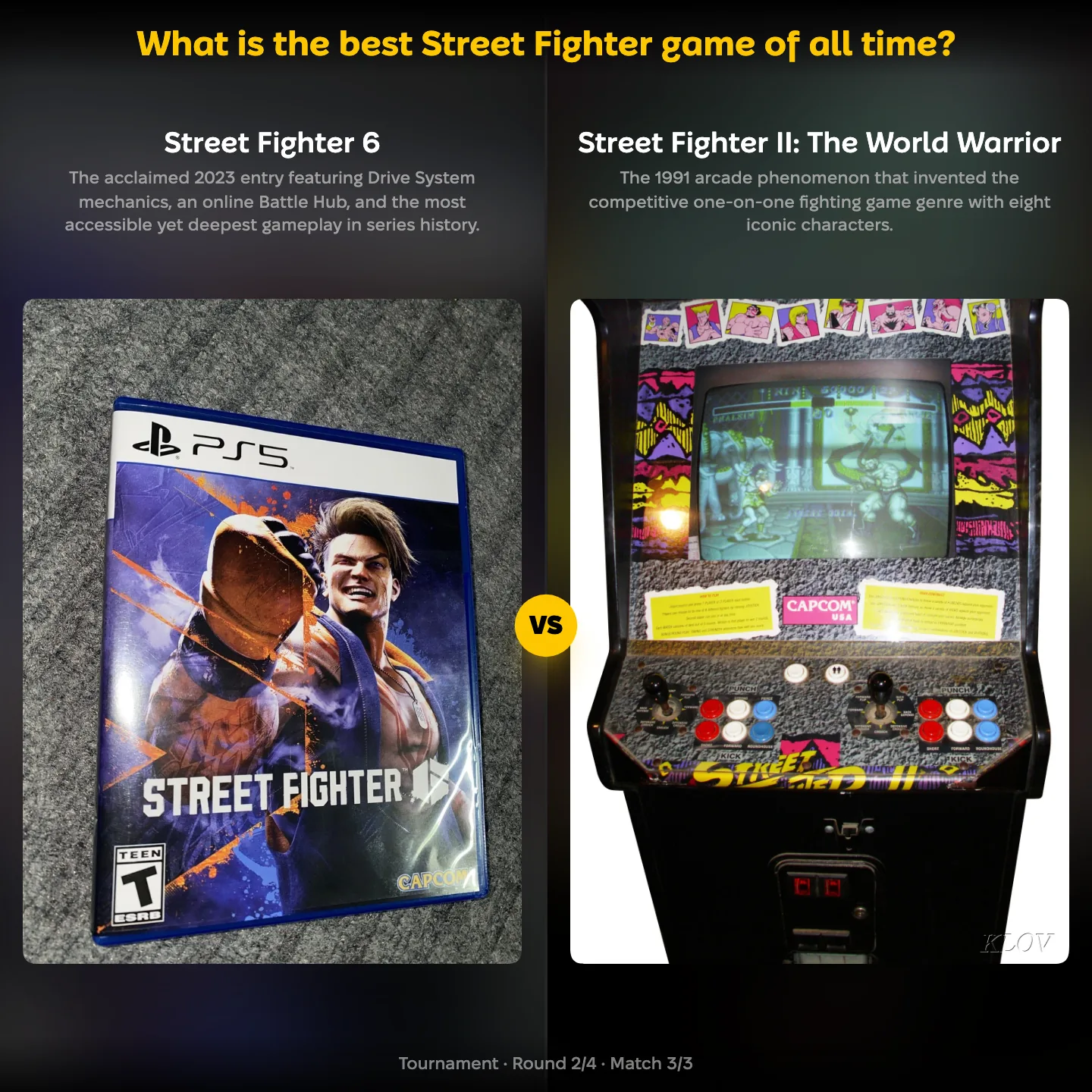
Street Fighter II vs Street Fighter 6: thirty-two years apart
The same question asked of the other side, and Street Fighter's version of it is harder than Mortal Kombat's, because the series keeps producing credible answers.
Street Fighter II: The World Warrior is the origin and the commercial monster: its Super NES port sold more than 6.3 million cartridges and stayed Capcom's best-selling single game for the next two decades.3
Street Fighter 6 arrived in 2023 with modern controls that let a newcomer throw a fireball within a minute of picking up the pad. That is a different sort of achievement from shifting six million cartridges.
Third Strike has the strongest claim of all among people who play the genre seriously, and Super Turbo still runs at tournaments thirty years on.
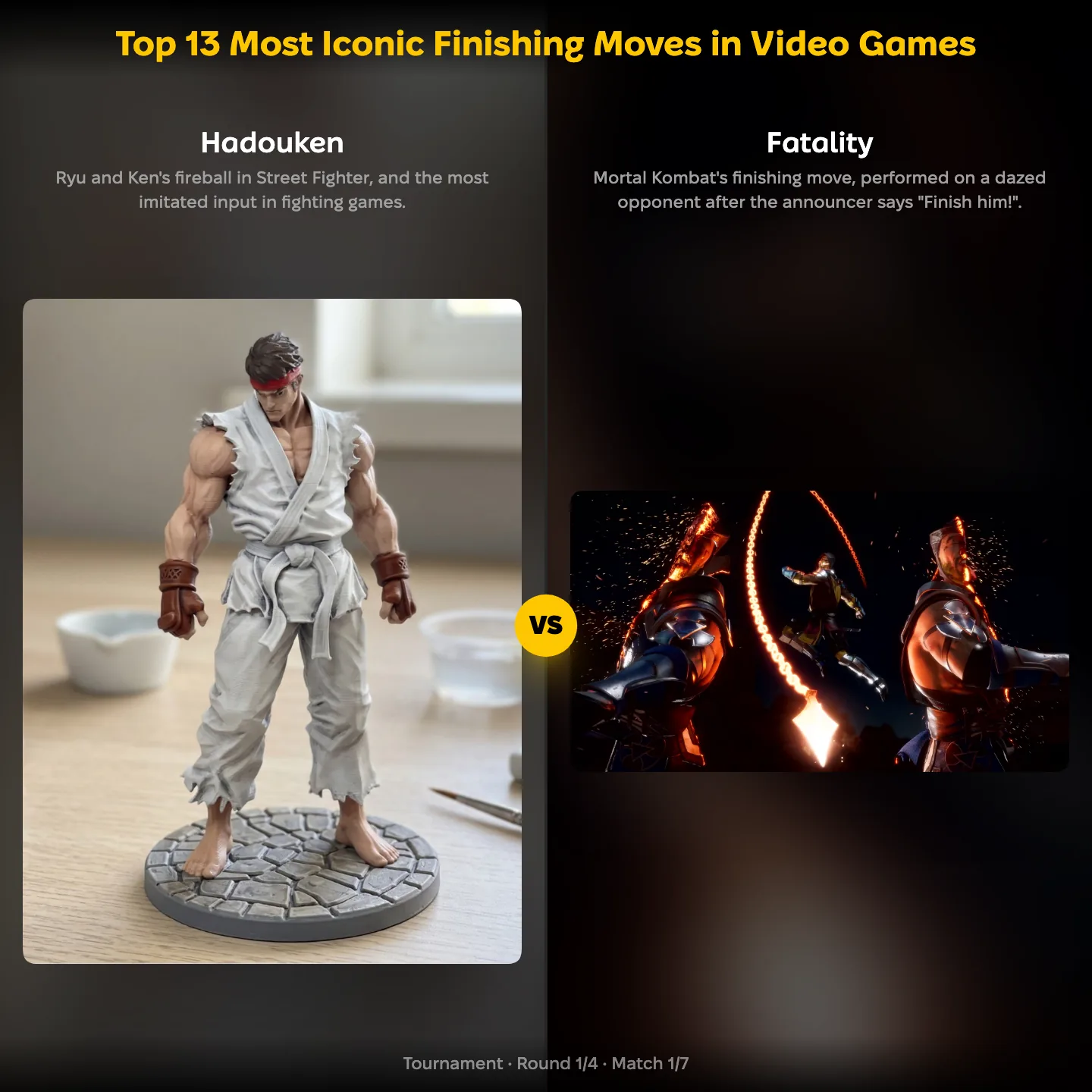
Fatality and Hadouken: two words that escaped the arcade
A finishing move is the part of a fighting game that survives outside it, and here Mortal Kombat and Street Fighter compete with their own vocabulary instead of their catalogues.
Hadouken is an input: quarter-circle forward, punch. It is the motion the entire genre standardised on, and Street Fighter has three entries on this list because Shoryuken and the Spinning Bird Kick travelled almost as far.
Fatality sits outside the fight. It is a reward for having already won, a second act Midway added because the brief was to answer Street Fighter II, and matching Capcom's inputs was never going to be the way to do that.1
Outside the two franchises the list widens fast. Skyrim's Fus Ro Dah, Doom's Glory Kill and Captain Falcon's wind-up punch are all quotable, and none of them needed an arcade to become so.
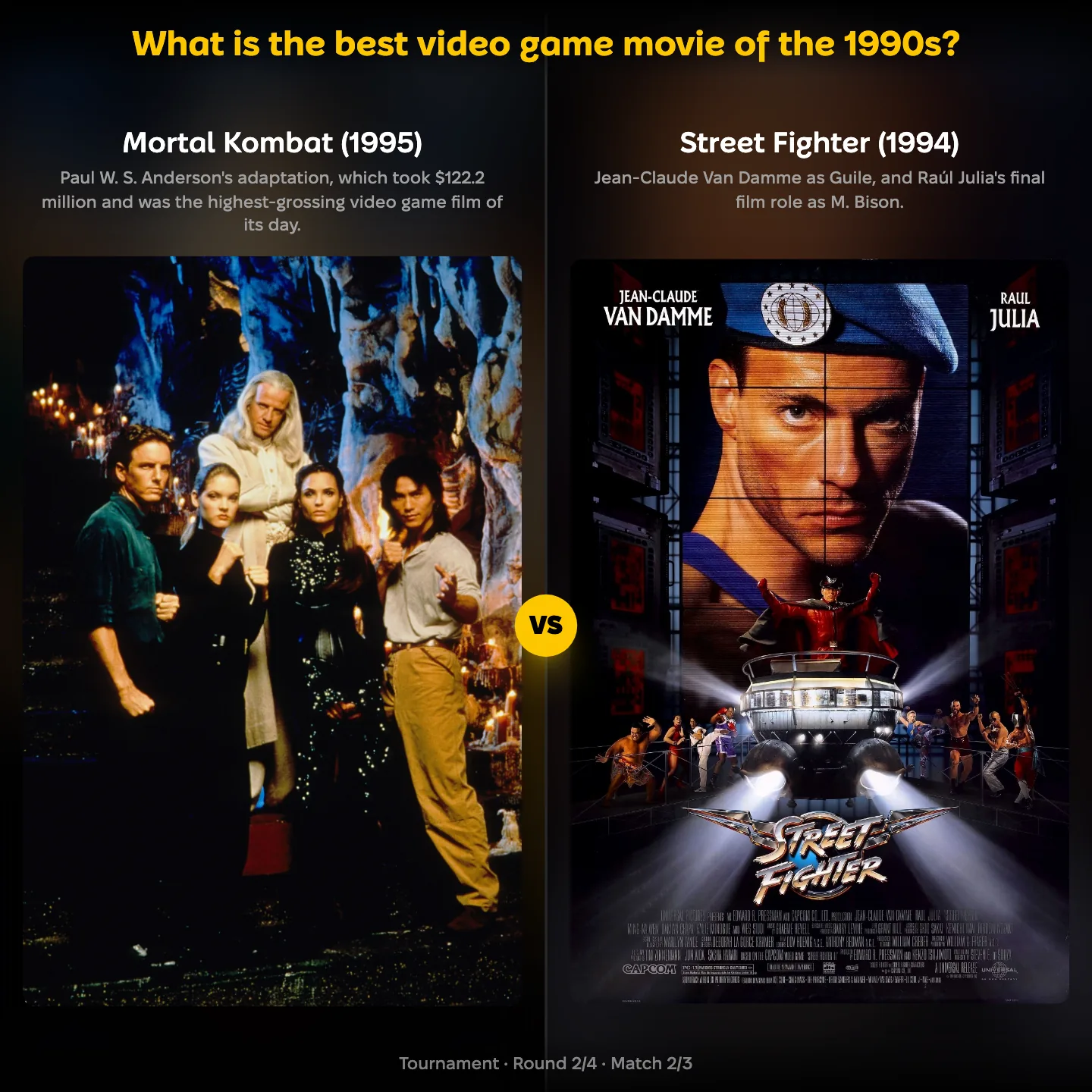
Mortal Kombat (1995) vs Street Fighter (1994): Hollywood's first attempts
Fourteen months apart, both franchises got a live-action film, and neither studio had a template to work from.
Street Fighter went first, in December 1994, with Jean-Claude Van Damme as Guile. It took $99.4 million worldwide against a $35 million budget and 11% on Rotten Tomatoes, and it was Raúl Julia's final film — he died two months before release, and the picture is dedicated to him.4
Mortal Kombat followed in August 1995 under Paul W. S. Anderson, took $122.2 million, and became the highest-grossing video game adaptation made to that point.5 Thirty-one years later the sequel, Mortal Kombat II, took $129.5 million on an $80 million budget.6
The decade's other attempts are why this ranking is not a two-way fight. Super Mario Bros. came first and failed hardest, Pokémon: The First Movie eventually took the box-office record off Mortal Kombat, and the animated Street Fighter II film is the one a lot of people rate above every live-action entry here.
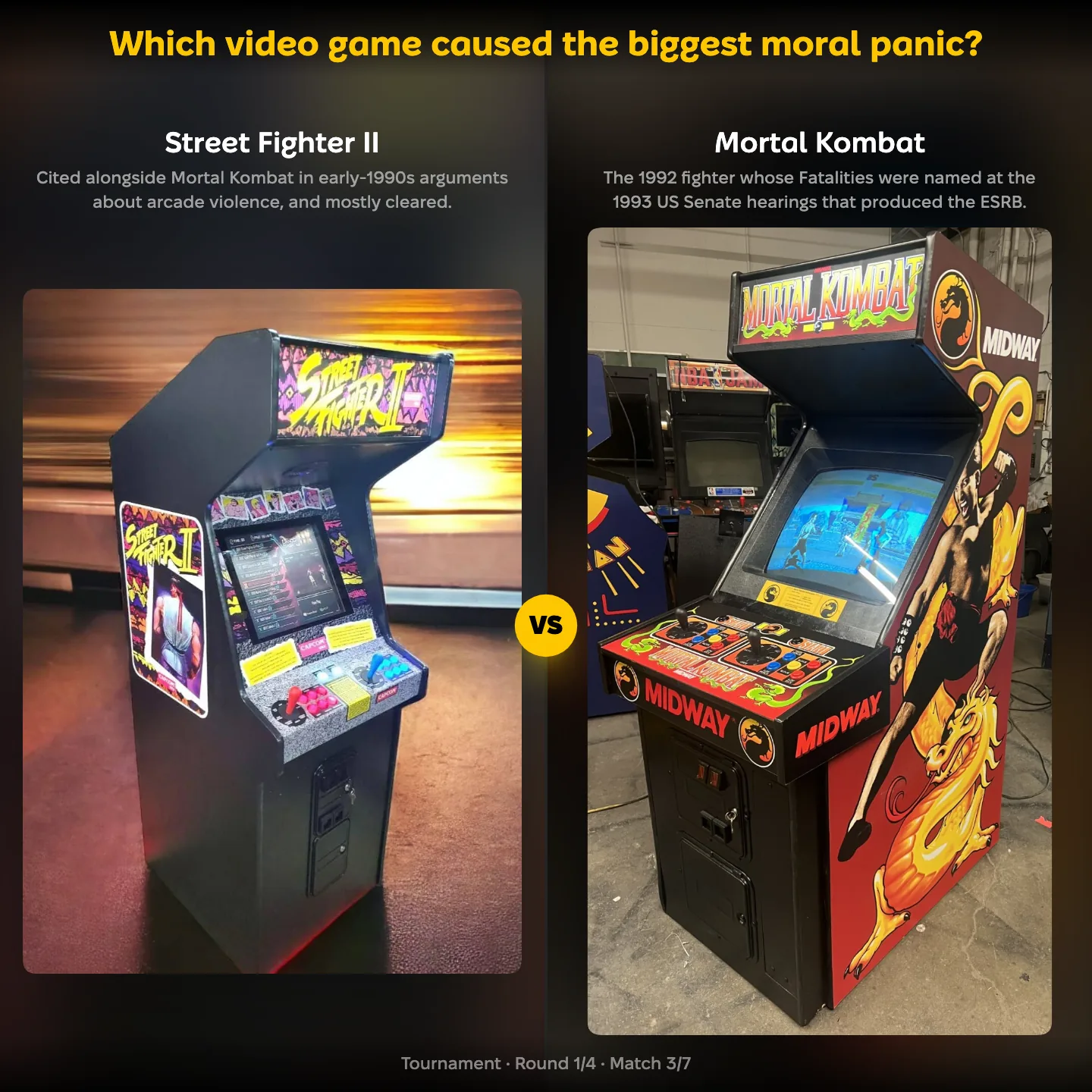
The 1993 Senate hearings: the list Street Fighter II stays off
On 13 September 1993 — "Mortal Monday" — Mortal Kombat shipped to the SNES, Genesis, Game Boy and Game Gear on the same day. Nintendo replaced the blood with sweat; Sega hid the uncensored version behind a cheat code, ABACABB, named after a Genesis album. Sega's version was the best-selling console game of the year.1
Three months later Senators Joe Lieberman and Herb Kohl opened hearings on violence in games. The industry was given a year to rate itself and produced the ESRB, which is why every game box in an American shop still carries a letter in a corner.7
Street Fighter II was named in the same period and came out of it more or less untouched. Capcom's fighters knocked each other down; nobody tore a spine out.
That is the section where Mortal Kombat's win is unambiguous and also the one it would least like to have. Night Trap sat beside it in the same hearings, and Doom, Grand Theft Auto III and Manhunt inherited the argument afterwards.
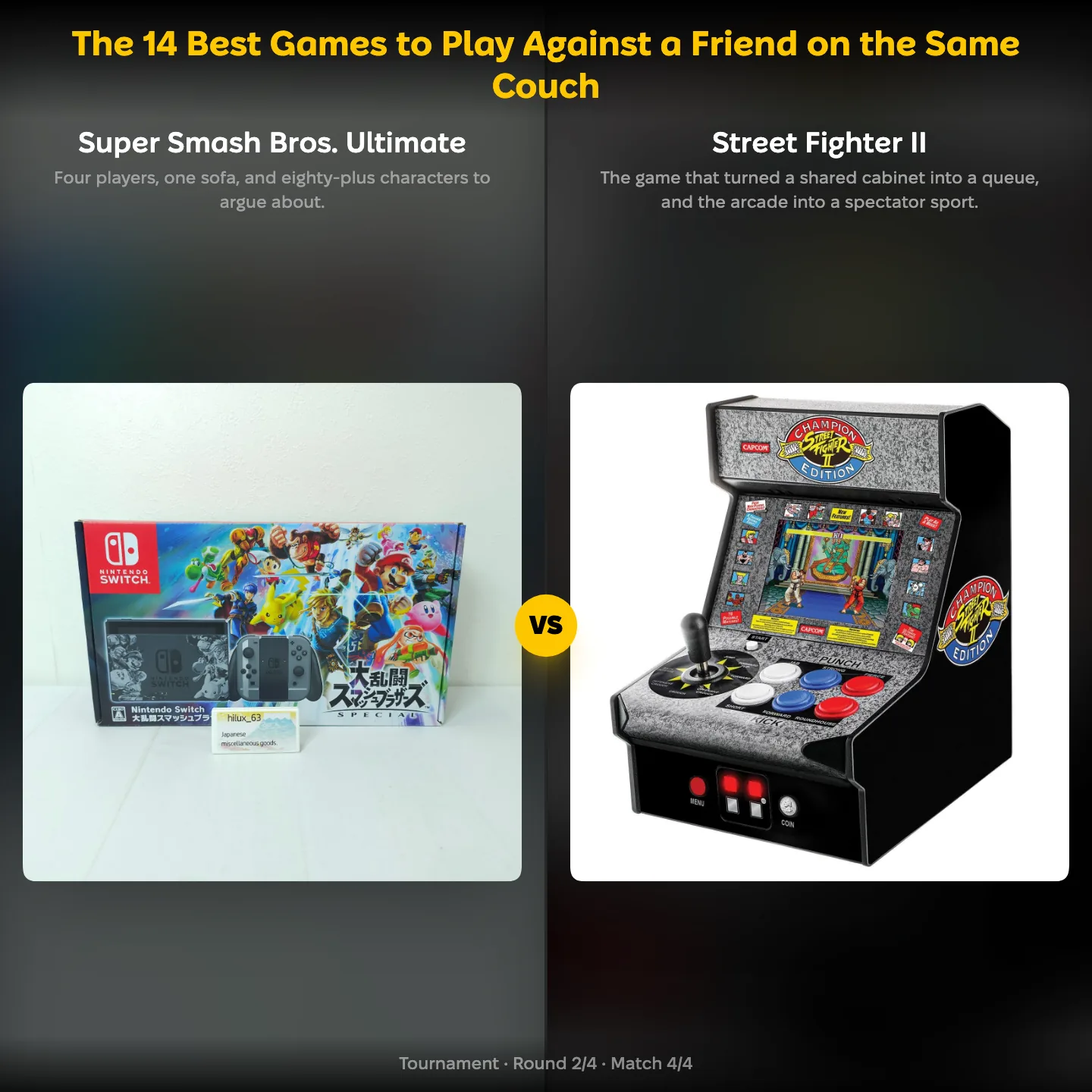
Super Smash Bros. Ultimate and the sofa both franchises built
Two-player fighting was an arcade format before it was a living-room one, and Street Fighter II is the game that turned a shared cabinet into a queue.
Mortal Kombat II is the entry most people associate with the second controller at home, for the straightforward reason that it was the one worth owning after Mortal Monday.
Nintendo took the format and widened it. Smash Ultimate, Mario Kart 8 Deluxe and Mario Party all seat four, which a fighting game cannot.
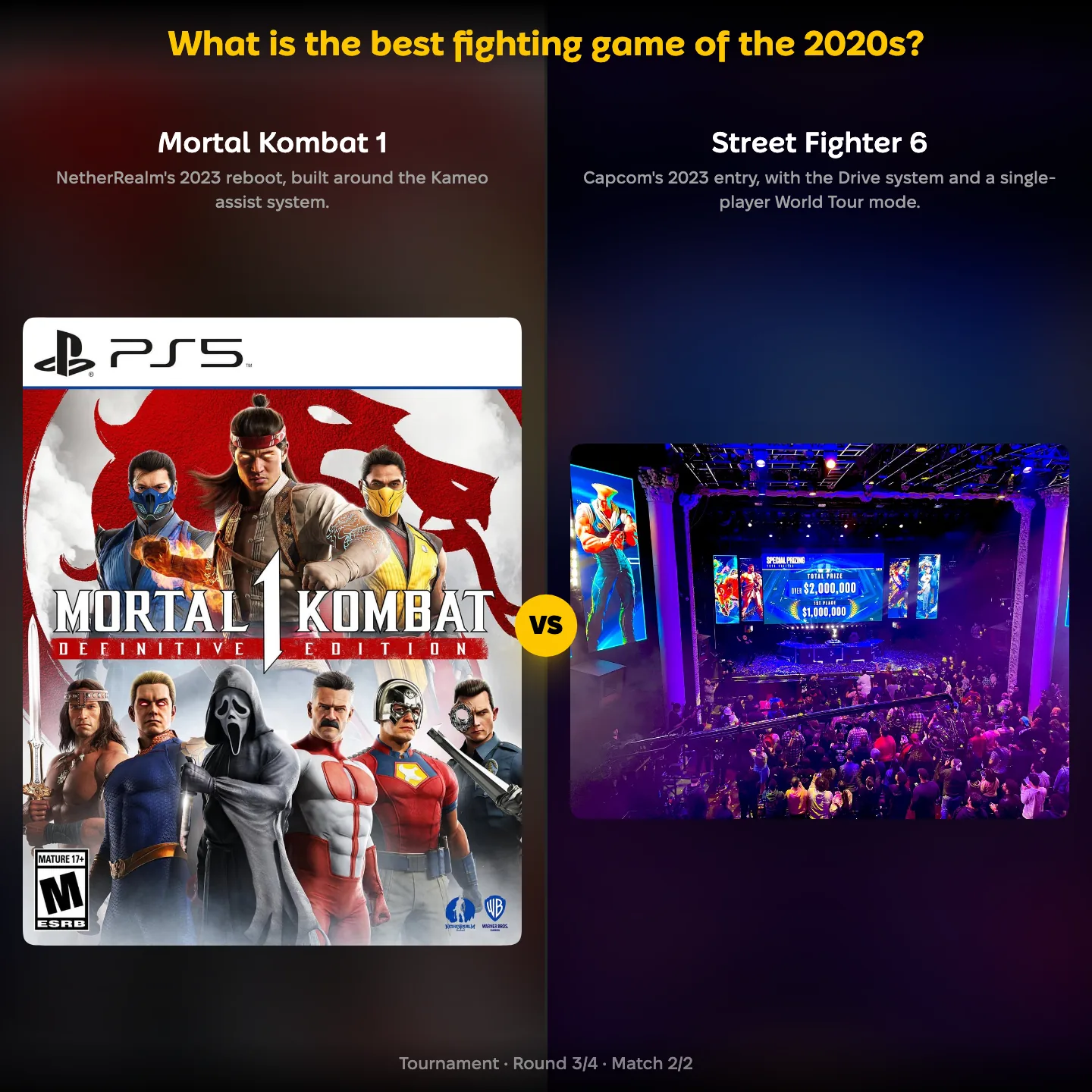
Mortal Kombat 1 vs Street Fighter 6: the 2020s rematch
Thirty-two years after the first exchange, both franchises shipped a new entry within four months of each other.
Street Fighter 6 came in June 2023 with the Drive system, a single-player World Tour mode and an online lobby the series had never had. Mortal Kombat 1 followed in September with Kameo fighters, an assist mechanic borrowed from the crossover games Capcom used to make.
The field around them is deeper than it was in 1992. Tekken 8, Guilty Gear Strive and The King of Fighters XV are all in this ranking, and rollback netcode has done more for the genre in five years than any single release.
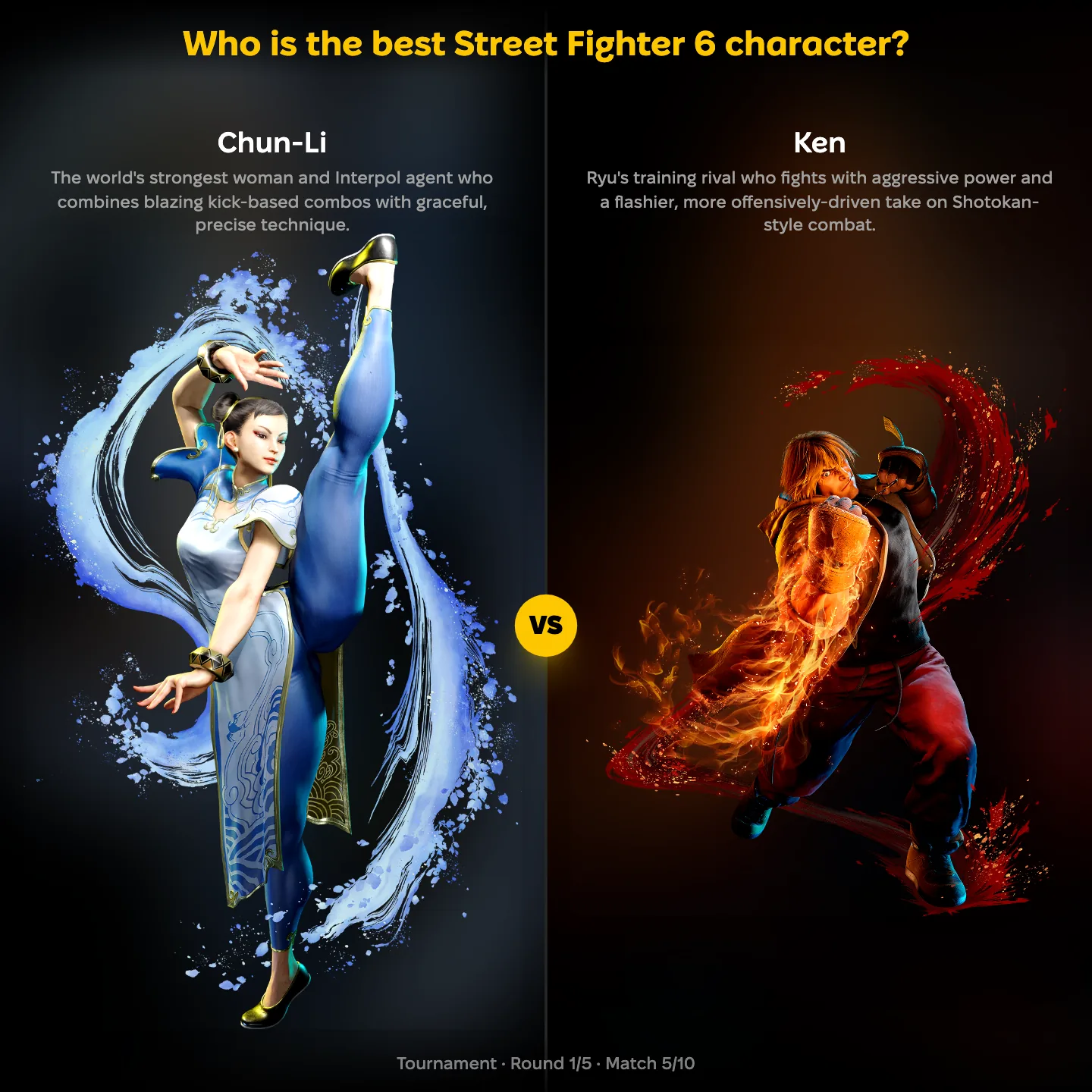
Twenty fighters in Street Fighter 6, and two of them are from 1991
No Mortal Kombat character qualifies here. That absence is why the ranking belongs in this article.
Street Fighter 6 launched with eighteen fighters and has kept adding them, including Terry Bogard and Mai Shiranui on loan from SNK. Ryu, Chun-Li, Guile, Zangief, Blanka, Dhalsim and E. Honda were all on the 1991 cabinet and are all still on the roster.
Mortal Kombat has never kept a cast that stable. It kills characters off and brings them back through timeline resets instead.
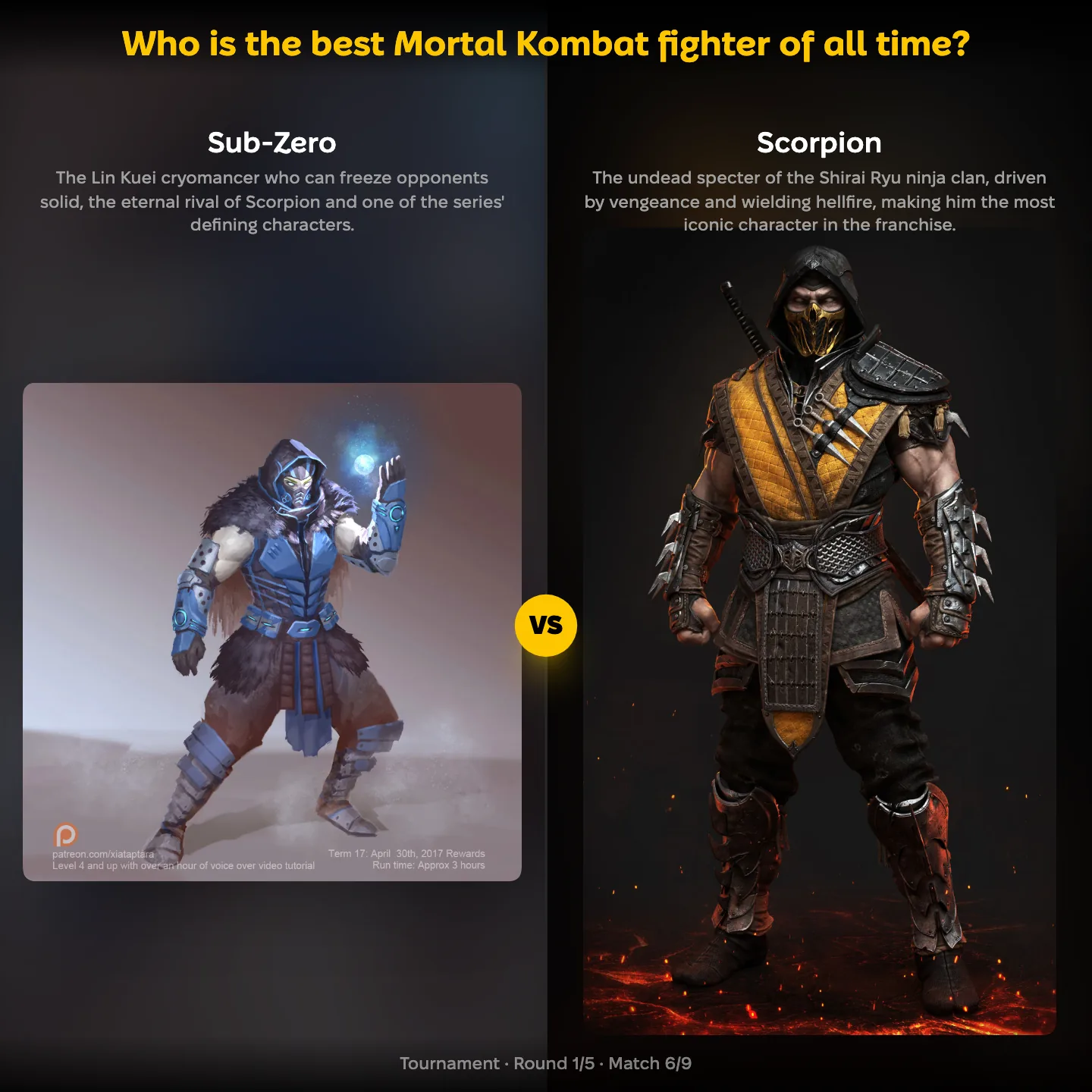
Scorpion vs Sub-Zero: the rivalry inside the rivalry
Mortal Kombat's own roster contains a feud older than most of the franchise, and no Street Fighter character is eligible to interrupt it.
Scorpion and Sub-Zero were palette swaps of the same 1992 sprite, given opposite colours and a blood feud, and they have carried the marketing ever since. Seventeen fighters are on this list and those two have been on the cover of nearly every game.
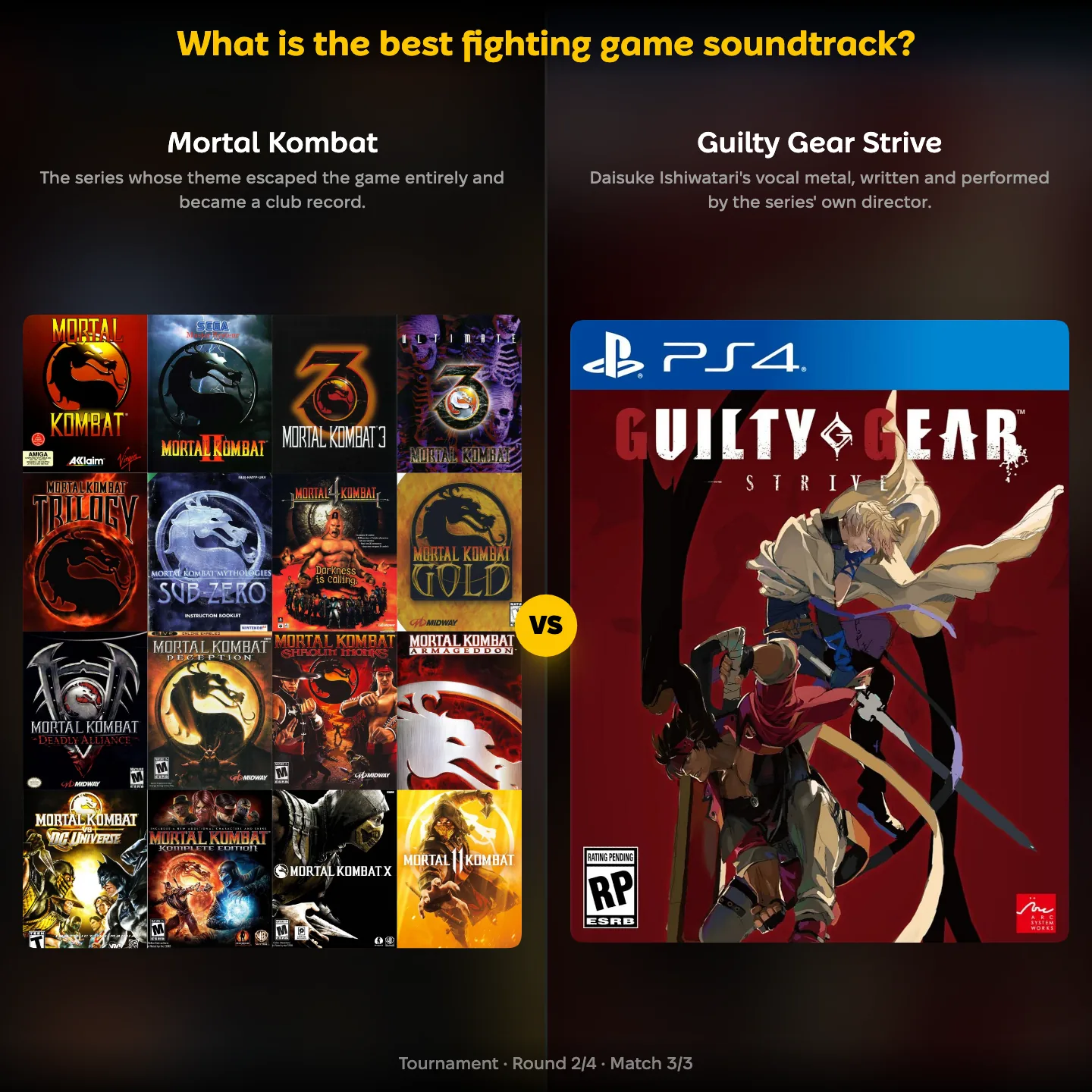
Guilty Gear, Mortal Kombat and the theme that left the arcade
Street Fighter II gave every world warrior a stage theme built around their country, written by Yoko Shimomura before she scored Kingdom Hearts. Those twelve pieces are the most hummed music the genre has produced.
Mortal Kombat did something stranger. Its theme became a dance record, charted, and was still being played in clubs by people who had never touched the cabinet.
Guilty Gear Strive is the specialist's answer and a good reason this is not a two-way list: Daisuke Ishiwatari writes and performs the vocal metal himself, while also directing the series.
Third Strike's hip-hop score and Marvel vs. Capcom 2's lounge jazz are the other two that people still stream on their own.
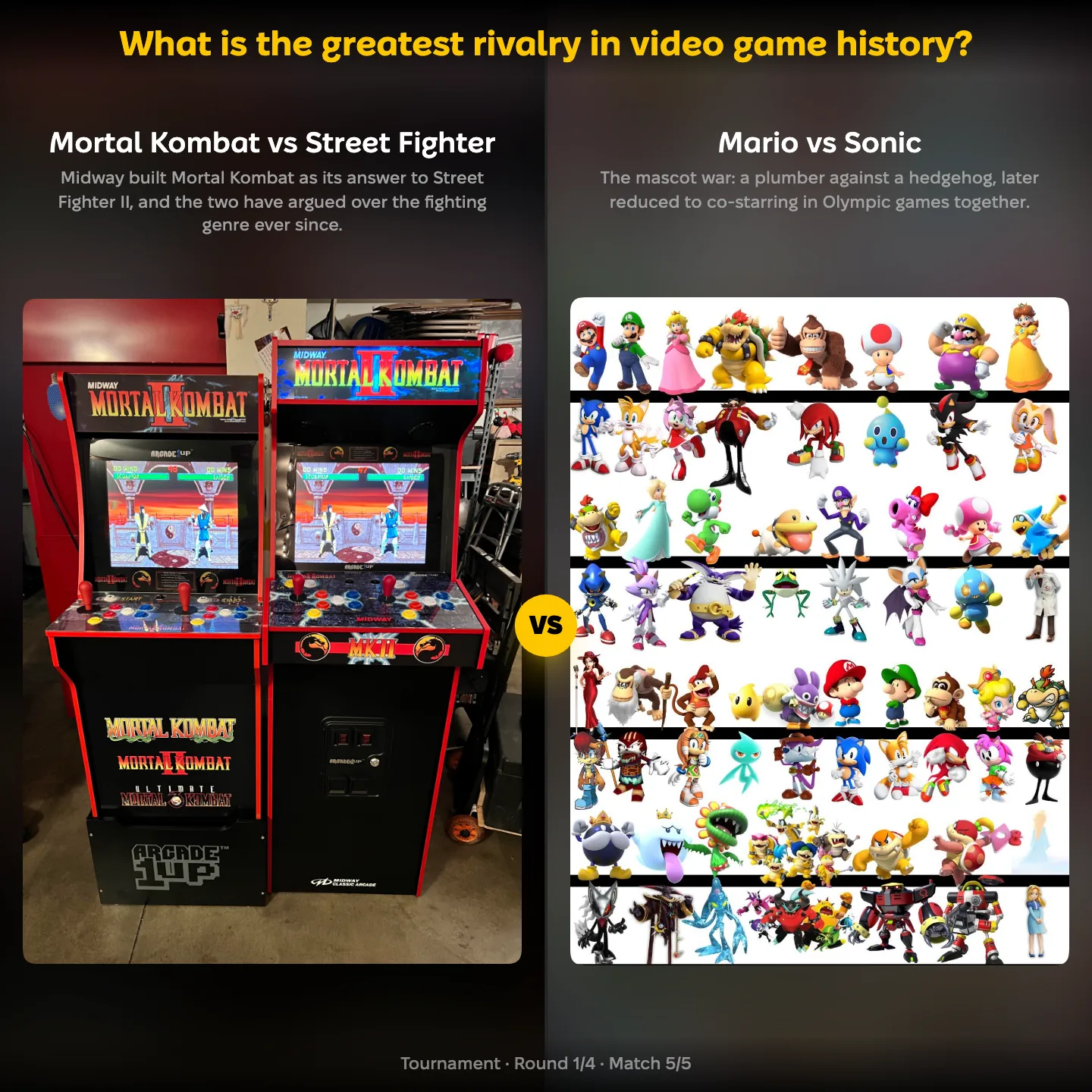
Mario vs Sonic: the rivalry list that contains this rivalry
This ranking asks which feud in games is the biggest, and Mortal Kombat vs Street Fighter is one entry on it rather than the frame around it.
The competition is stiff. Nintendo against Sega was fought in television adverts and on playgrounds. PlayStation against Xbox has run for five console generations. Mario against Sonic ended with the two of them sharing an Olympic licence.
What the fighting-game feud has that the others lack is a documented cause. Nintendo did not commission Mario because Sonic existed — Sonic came second. Mortal Kombat was ordered into existence with Street Fighter II named in the brief.
Daigo against Justin Wong is the outlier here, and the most-watched clip in competitive gaming came out of it.
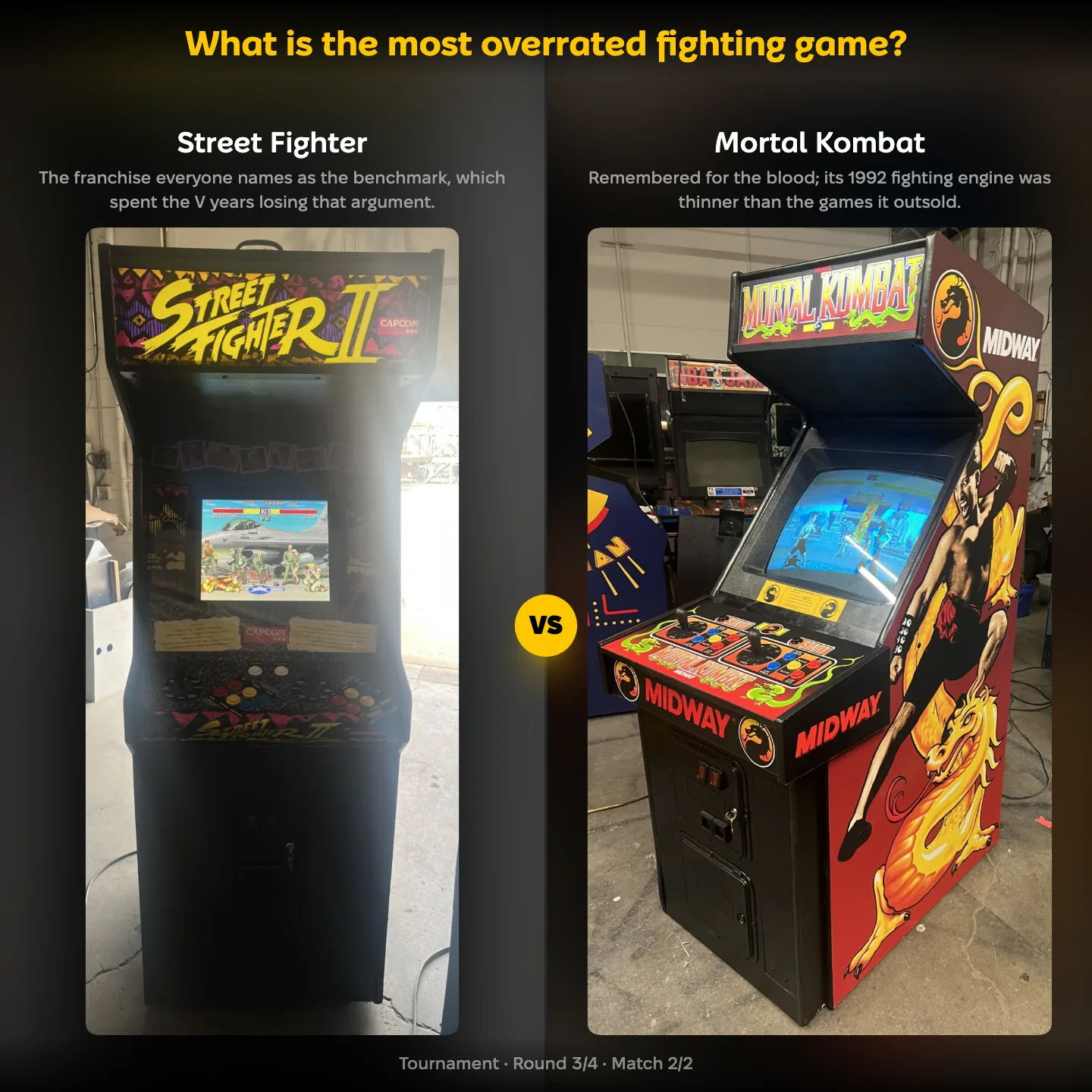
The most overrated fighting game: where fame counts against you
Invert the question and both franchises become candidates, because the charge is being famous for more than you delivered.
Mortal Kombat is the easier target. The blood did the selling in 1992, and the fighting engine underneath it was thinner than the games it outsold.
Street Fighter's case is more recent. The series is the benchmark everyone names, and it spent the Street Fighter V years failing to look like one, launching in 2016 without an arcade mode and rebuilding itself in public.
Smash Melee, Tekken 7 and Marvel vs. Capcom 2 are all here too, each defended fiercely by the people who play it most. A game needs a reputation worth attacking before anybody bothers calling it overrated.
Two cabinets, still arguing
Midway got what it asked for. The order behind Mortal Kombat was twelve months and a machine that could stand next to Street Fighter II, and what came back did not out-fight Capcom so much as out-shout it, loudly enough that the industry rewrote its own rules around the noise.
Both franchises are still shipping games and still shipping films, and the fifteen lists above put them in fifteen different relationships to each other.
Each of those lists is built out of single matchups between two options, which is how two things that were never quite the same kind of game can be measured against each other at all.
If there is a pairing you have opinions about, the tools to build it are on the site.
More rankings, more angles
- PlayStation vs Xbox vs Nintendo, Ranked — the console war, three ways
- Super Mario vs The Legend of Zelda — one studio, two franchises, no truce
- Sonic the Hedgehog, Ranked Many Ways — Sega's answer to a plumber, measured
Sources
- Wikipedia — Mortal Kombat (1992 video game): the development brief Ed Boon and John Tobias were given, the 13 September 1993 "Mortal Monday" launch, the ABACABB blood code and the Genesis port's sales: en.wikipedia.org (checked 2026-09-22)
- Wikipedia — Street Fighter (2026 film): release date of 16 October 2026, director, cast and the 1993 setting: en.wikipedia.org (checked 2026-09-22)
- Wikipedia — Street Fighter II: the March 1991 arcade release, 200,000+ cabinets, 6.3 million SNES cartridges, and its standing as the most influential fighting game: en.wikipedia.org (checked 2026-09-22)
- Wikipedia — Street Fighter (1994 film): $99.4 million worldwide on a $35 million budget, 11% on Rotten Tomatoes, and Raúl Julia's final role: en.wikipedia.org (checked 2026-09-22)
- Wikipedia — Mortal Kombat (1995 film): $122.2 million worldwide and its standing as the highest-grossing video game adaptation of its time: en.wikipedia.org (checked 2026-09-22)
- Wikipedia — Mortal Kombat II (film): the 8 May 2026 release, $129.5 million worldwide and the $80 million production budget: en.wikipedia.org (checked 2026-09-22)
- Wikipedia — 1993–1994 United States Senate hearings on video games: the Lieberman and Kohl hearings and the creation of the ESRB: en.wikipedia.org (checked 2026-09-22)