

Capcom released the ninth main Resident Evil, Requiem, on 27 February 2026, inside the series' thirtieth-anniversary year.1 Three decades of sequels, remakes, ports and spin-offs have now sold 213 million copies, which makes horror the most profitable thing Capcom does.2 Zach Cregger's live-action reboot for Sony opens in September, so the anniversary finishes in cinemas.
Thirty years also leaves Resident Evil eligible for lists with almost nothing in common. The fourteen below cover horror, one publisher's shelf, three consoles, a headset, and the films where the money and the reviews point in opposite directions.
Capcom keeps demolishing Resident Evil and building it again, so these fourteen lists are not judging one series. They are judging which Resident Evil counts.
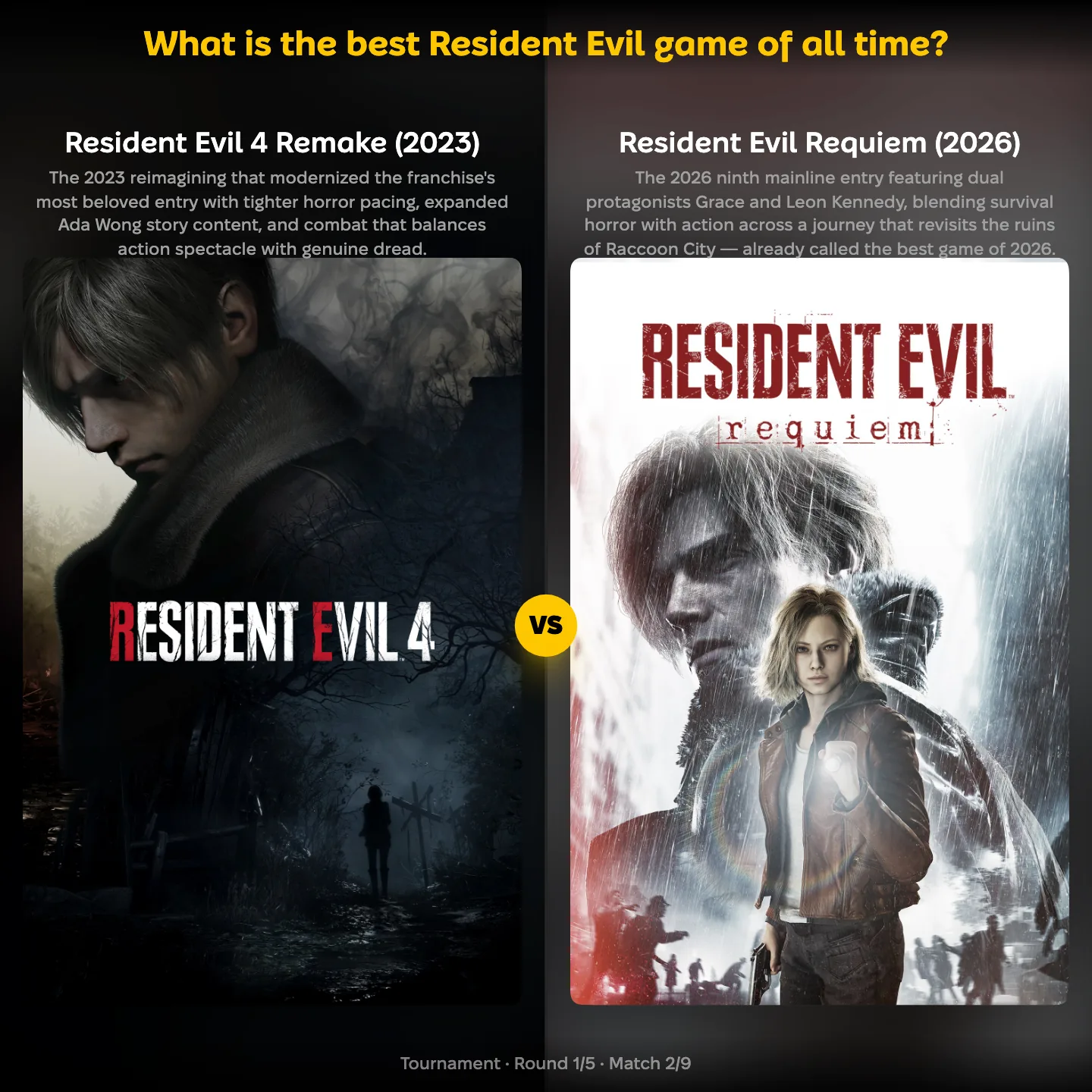
Resident Evil 4 vs Requiem: seventeen games, thirty years
Seventeen Resident Evil releases stand against each other here, from the 1996 PlayStation original to Requiem.
Resident Evil 4 is the usual answer. Its 2005 over-the-shoulder camera was copied so widely that Gears of War, Dead Space and The Last of Us all carry its fingerprints, and the 2023 remake sold that camera to a second generation of players.
Requiem has the newer claim. Capcom announced on 16 March 2026 that it had passed six million copies, faster than any Resident Evil before it.3
The awkward entries are in here too. Resident Evil 5 and 6 pushed the series so far towards action co-op that Capcom started over with the first-person Resident Evil 7 in 2017, and that reset splits the seventeen into a before and an after.
Silent Hill 2 vs Resident Evil 4: the genre Capcom named
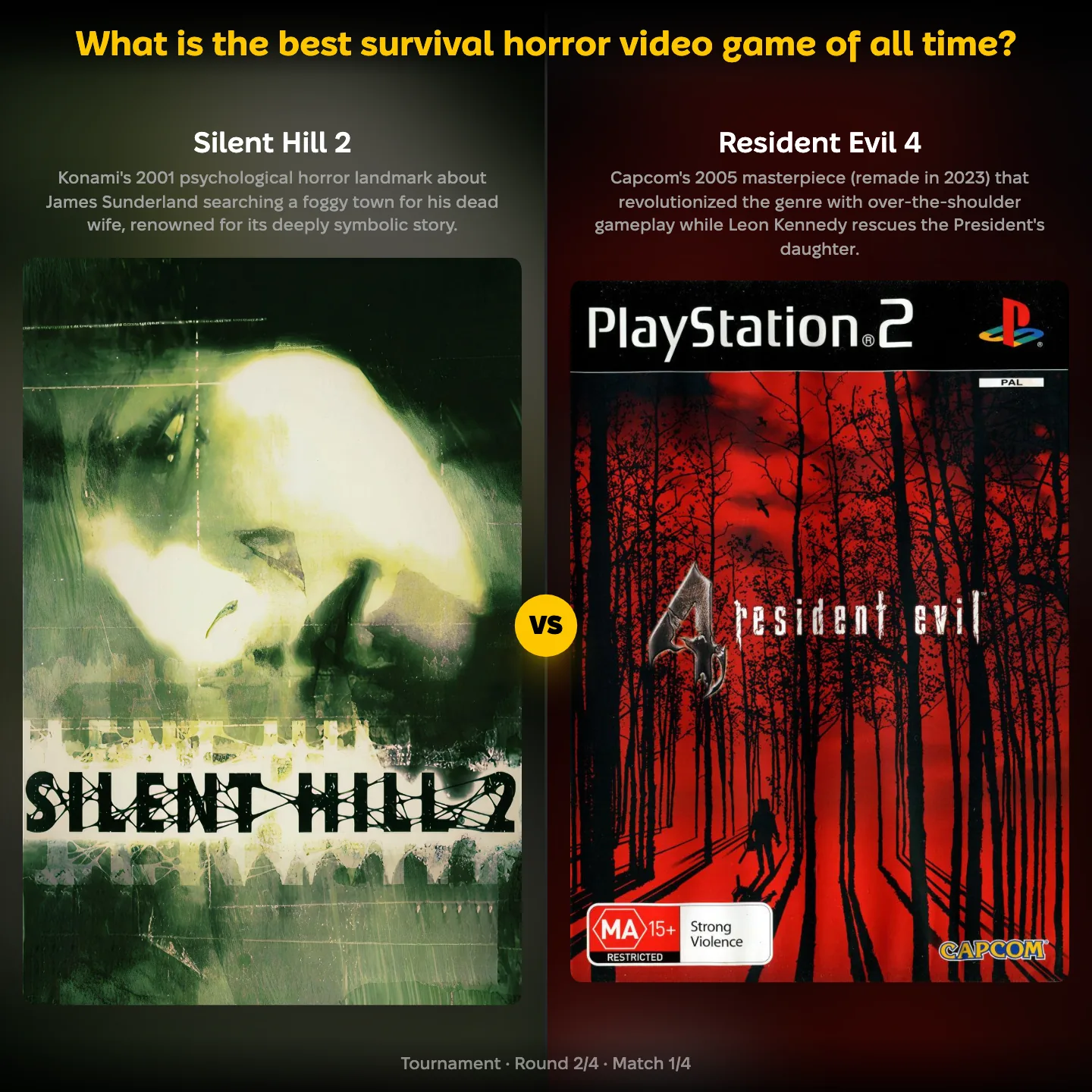
Survival horror is the one category Resident Evil can claim to have invented. The words are on the 1996 game's title screen, and they attached themselves to everything that followed.
Two Resident Evil games stand in this field, Resident Evil 4 and Resident Evil 2. Most series get one entry in the genre they helped start.
Silent Hill 2 is why the category stays contested. Konami's 2001 game argues on atmosphere rather than mechanics, and it has never dropped off a survival-horror list since.
Drop the word survival and Alien: Isolation walks in
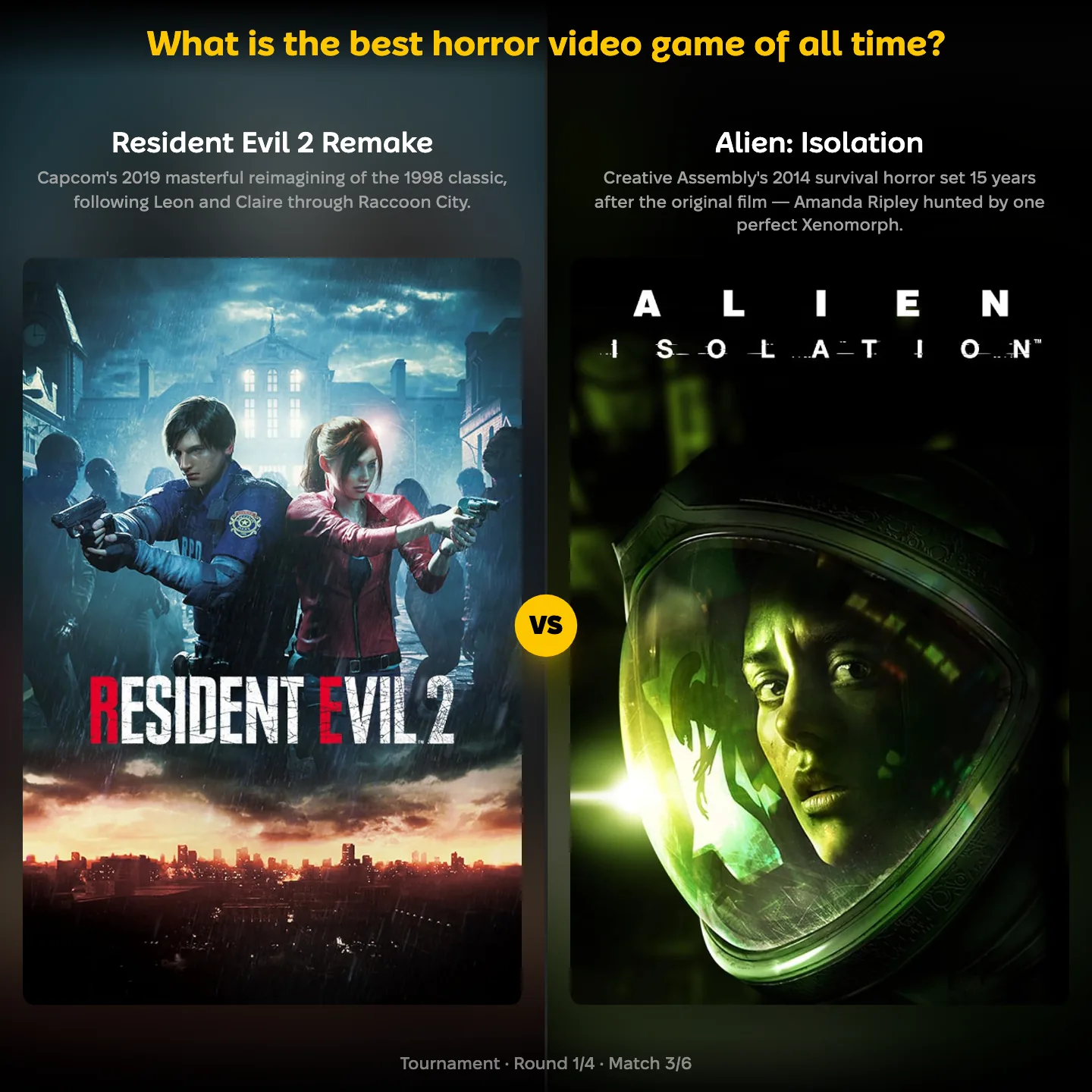
Horror in games covers walking simulators, immersive sims and jump-scare clips, so this ranking asks Resident Evil to hold its ground against all of them at once.
The 2019 Resident Evil 2 remake carries the series here, and it carries the series everywhere: 19.75 million copies, more than any other Resident Evil ever made, for a rebuilt 1998 game about a police station nobody can leave.2
Alien: Isolation makes the opposite case. Creative Assembly's 2014 game gave players almost no weapons and one unkillable pursuer, which is a purer definition of horror than anything Capcom has shipped.
Five Nights at Freddy's and P.T. hold their places on one idea each. P.T. was a demo and Five Nights at Freddy's began as one man's project, and neither of them had to keep a thirty-year-old series alive afterwards.
Street Fighter II is on Capcom's own shelf too
Resident Evil is Capcom's biggest series by a wide margin. Monster Hunter has sold 131 million copies and Street Fighter 60 million, and Resident Evil has outsold the two of them combined.2
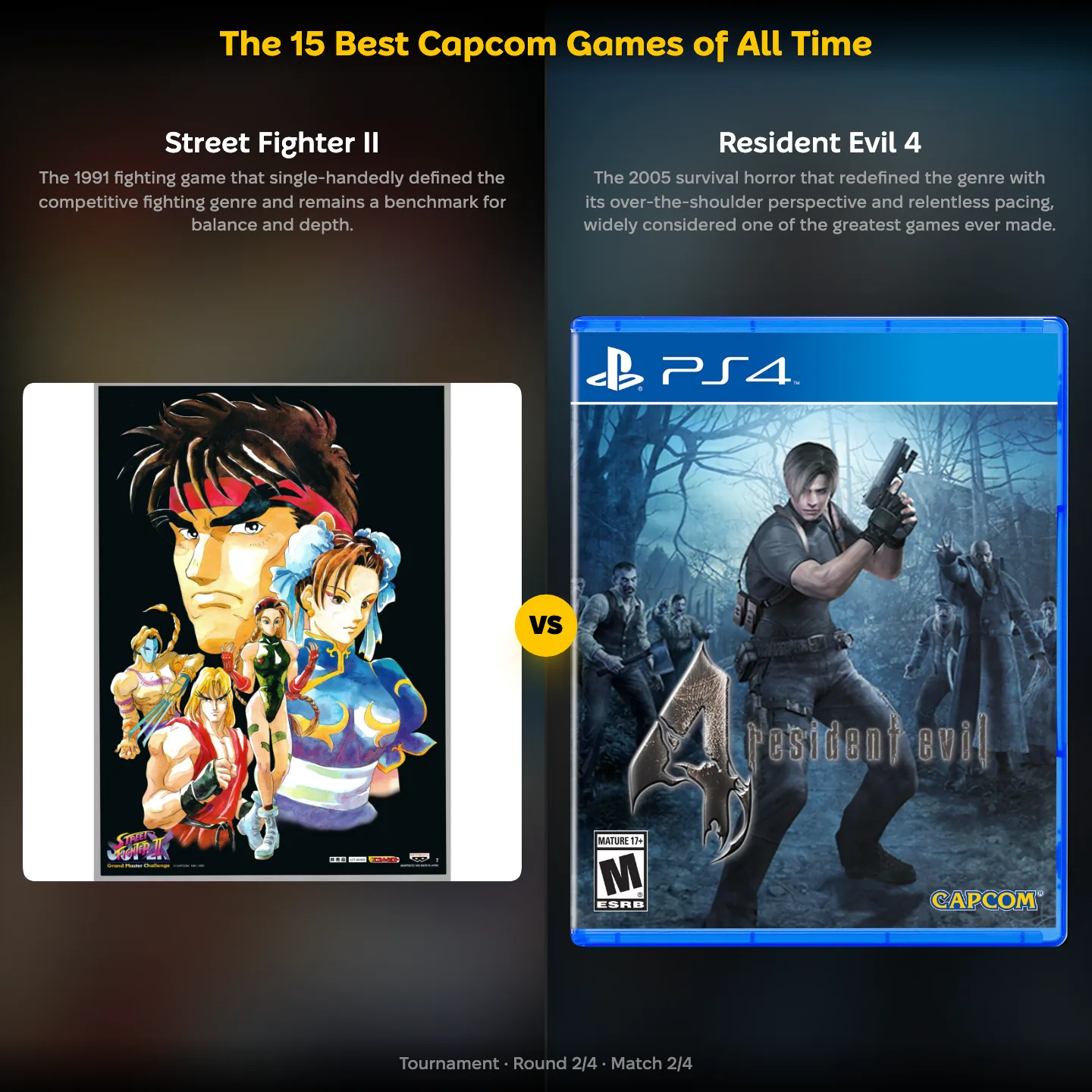
Sales are not the question on a ranking of the publisher's fifteen best games. Three Resident Evil titles are in it anyway: Resident Evil 4, the Resident Evil 2 remake and Resident Evil Village, a bigger presence than any other Capcom series gets.
Street Fighter II is the serious rival. The 1991 arcade game invented competitive fighting games as a genre and as a spectator sport, and nothing Capcom has released since has changed an industry that completely.
The shelf runs deeper than most people remember: Devil May Cry, Mega Man 2, Okami, Phoenix Wright, Dino Crisis. Dino Crisis came from Shinji Mikami, who directed the first Resident Evil, running his own formula again with dinosaurs instead of zombies.
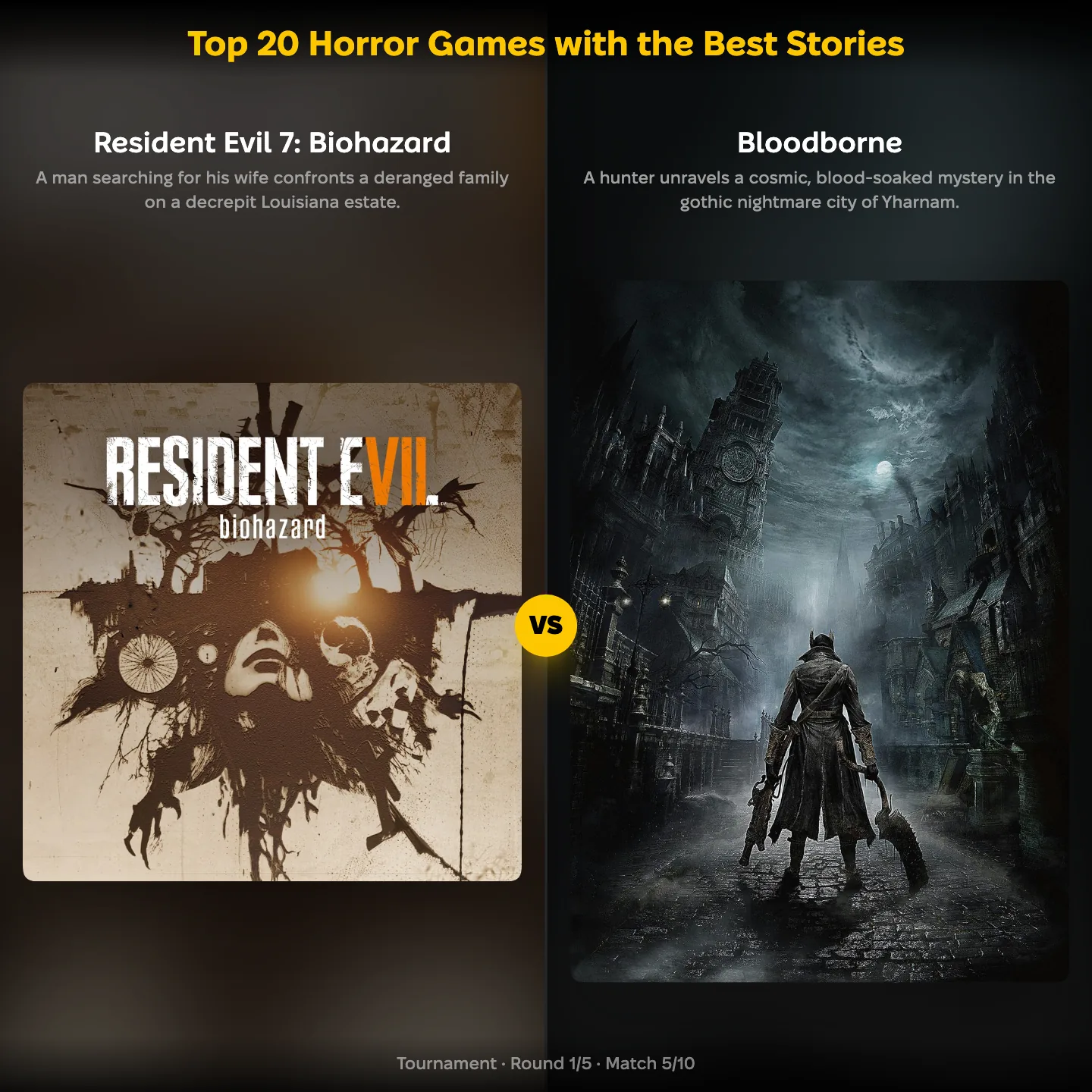
Resident Evil 7 vs Bloodborne: ask about the writing
Resident Evil's dialogue is famous for the wrong reasons. "You were almost a Jill sandwich" gets quoted more than any line the series wrote on purpose, so a ranking of horror games with the best stories is not friendly ground.
Resident Evil 7 makes the strongest case. Its 2017 story shrank from a global conspiracy to one family in a rotting Louisiana house, and the smaller scale gave the writing somewhere to go.
Bloodborne belongs to a different school. FromSoftware's 2015 game hides its cosmic-horror plot in item descriptions and architecture, then leaves the player to assemble it.
Silent Hill, Signalis and Fatal Frame II are quieter and stranger than anything with the Umbrella logo on it. What Resident Evil brings to this field is conviction: thirty years of escalating nonsense delivered without a single wink at the audience.
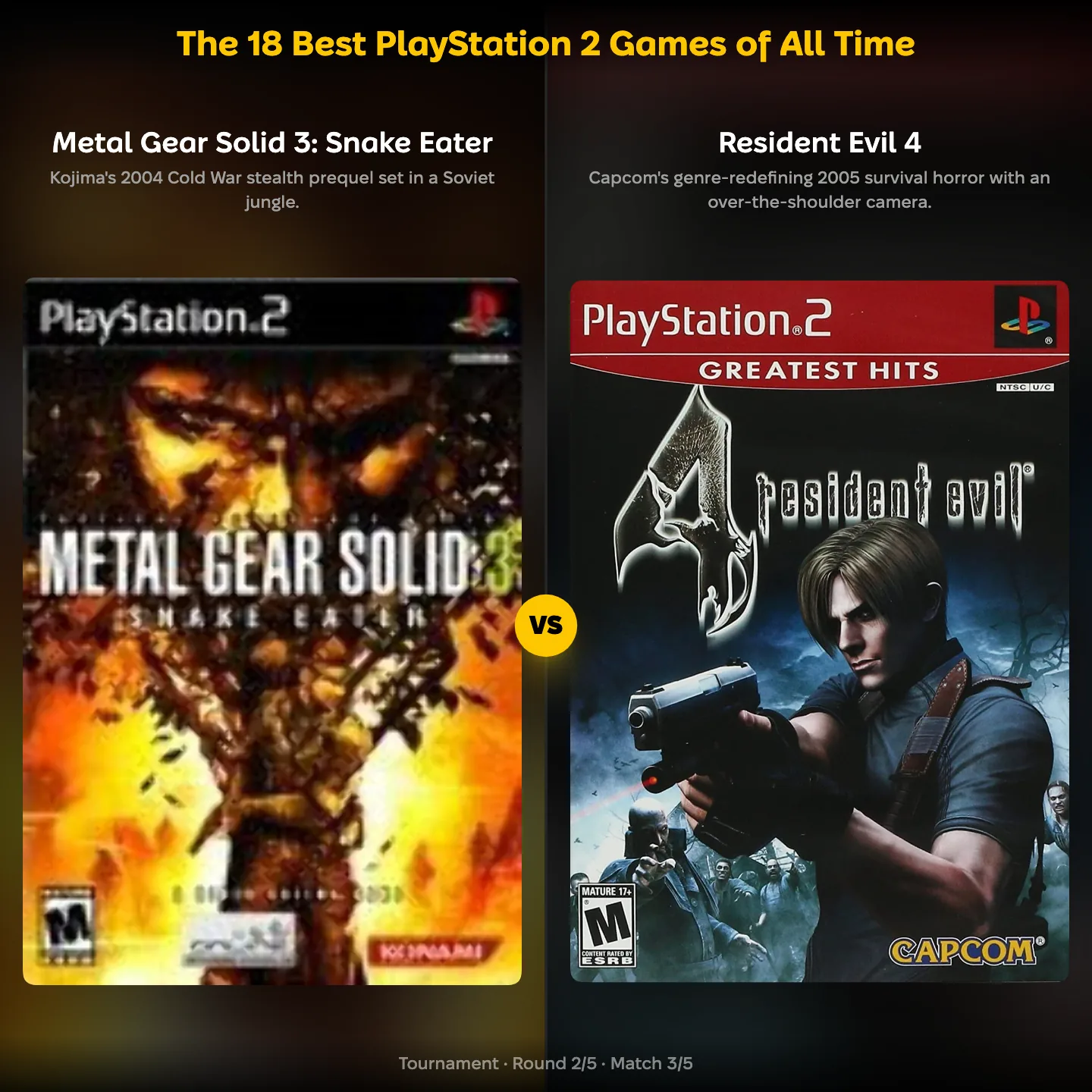
PlayStation 2, 2005: the hardest library Resident Evil walks into
Resident Evil 4 came out on the GameCube in January 2005 and reached the PlayStation 2 before the year was over, which is how it joins a ranking of the eighteen best PS2 games.
That library is the toughest room the series enters. Sony had sold 150 million PS2 consoles by the end of January 2011, and the shelf holds Grand Theft Auto: San Andreas, Shadow of the Colossus, God of War II and Final Fantasy X.4
Metal Gear Solid 3 is the direct comparison. Kojima's 2004 game solved the problem Resident Evil 4 solved, which was how to make a control scheme from the 1990s feel modern, and solved it with camouflage and patience instead of a camera over the shoulder.
Silent Hill 2 is in this field as well. The PS2 is the one console where both great survival-horror series get judged beside everything else that generation produced.
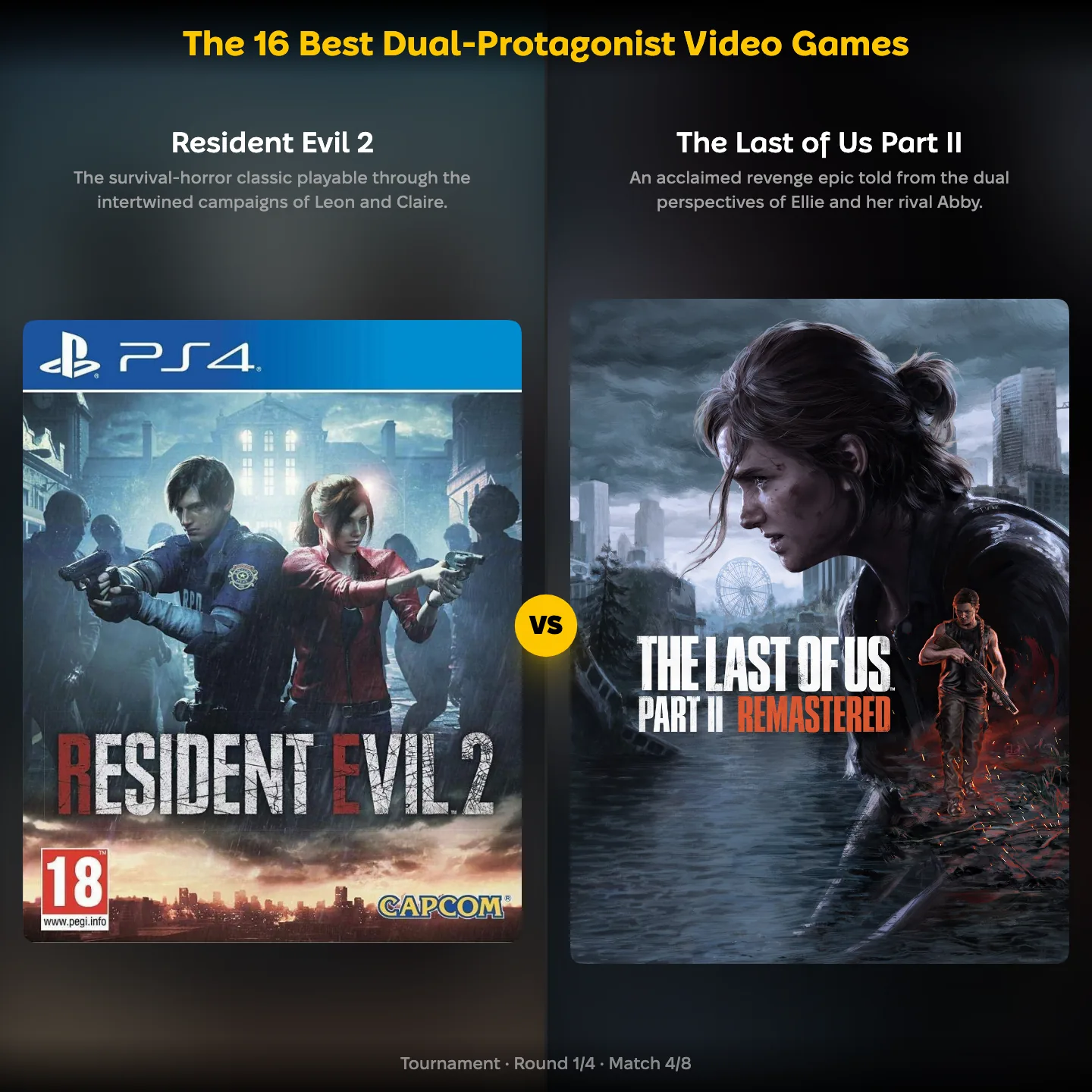
Leon and Claire, 1998: two campaigns on one disc
Resident Evil 2 shipped in January 1998 with Leon Kennedy and Claire Redfield as separate scenarios, each seeing a different slice of the same night. That is a structural idea rather than a horror one, and it earns the game a place among the sixteen best dual-protagonist games.
Capcom still trusts the trick twenty-eight years later. Requiem's two playable characters are the FBI analyst Grace Ashcroft and Leon S. Kennedy, who walked into the Raccoon City police department as a rookie cop on his first day.5
The Last of Us Part II turns the same structure into a weapon. Naughty Dog's 2020 game hands the player the antagonist for half its runtime, which is a harder thing to ask of an audience than a second campaign.
Resident Evil Zero runs the strangest version: two characters swapped mid-level, sharing one inventory. Around them sit It Takes Two, Portal 2, Banjo-Kazooie and Jak and Daxter, which is unusually cheerful company for a game about a viral outbreak in a police station.
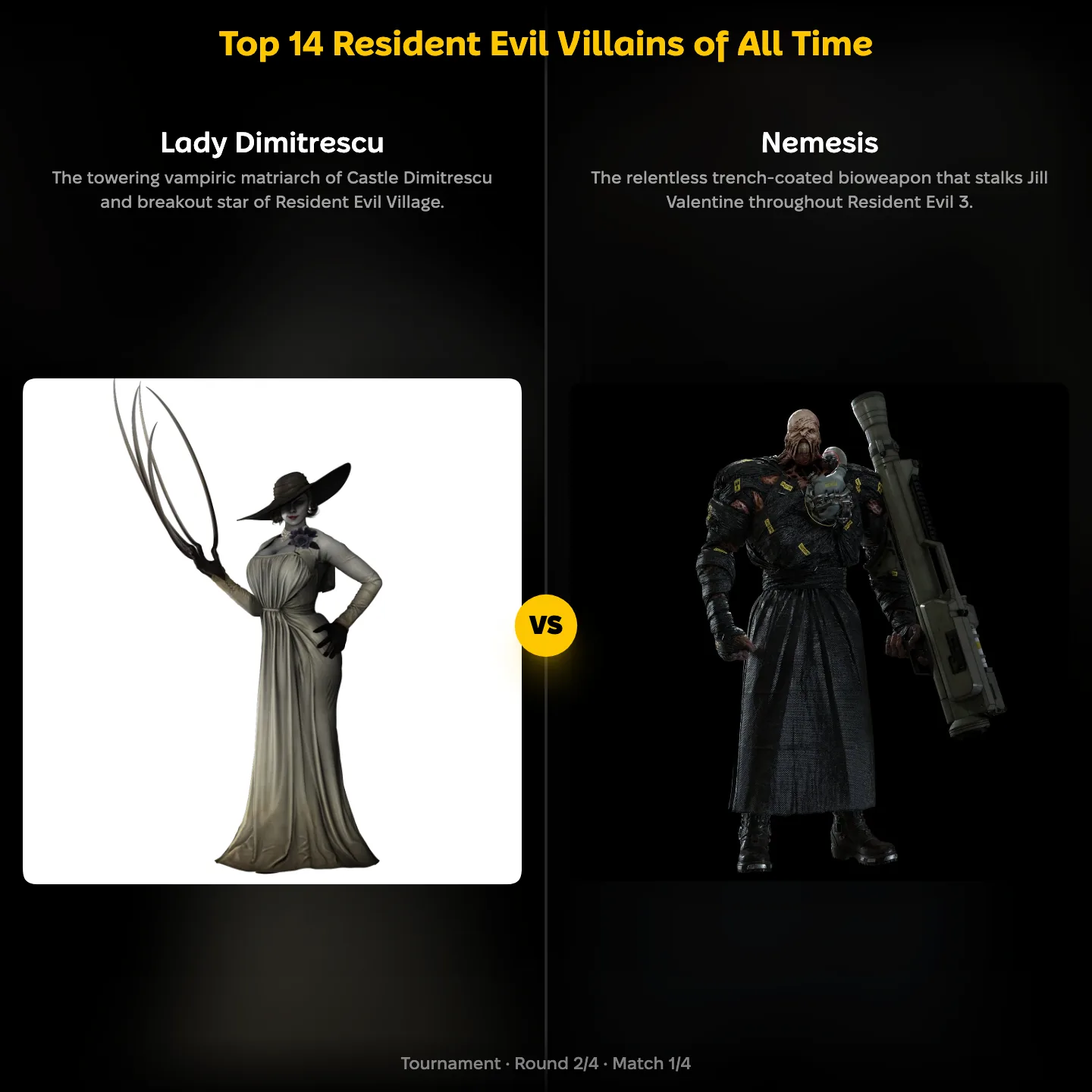
Nemesis, Mr. X and Lady Dimitrescu get their own bracket
Zoom all the way in and Resident Evil becomes a field of fourteen against itself. Three decades of villains have given Capcom more recognisable monsters than most horror cinema manages.
Nemesis is the purest of them. The Resident Evil 3 antagonist from 1999 follows Jill Valentine between areas instead of waiting in a room for her, and Mr. X inherited the idea in the Resident Evil 2 remake twenty years later.
Lady Dimitrescu is the newest and the least likely. Capcom added a vampire countess who stands taller than the doorways of her own castle to Resident Evil Village in 2021, and she has been the face of that game ever since.
Behind them is a bench of corporate horror: Albert Wesker's sunglasses and betrayals across six games, William Birkin, Mother Miranda, Ozwell E. Spencer, and the Umbrella Corporation that paid for the outbreak in the first place.
Psychological horror belongs to Silent Hill
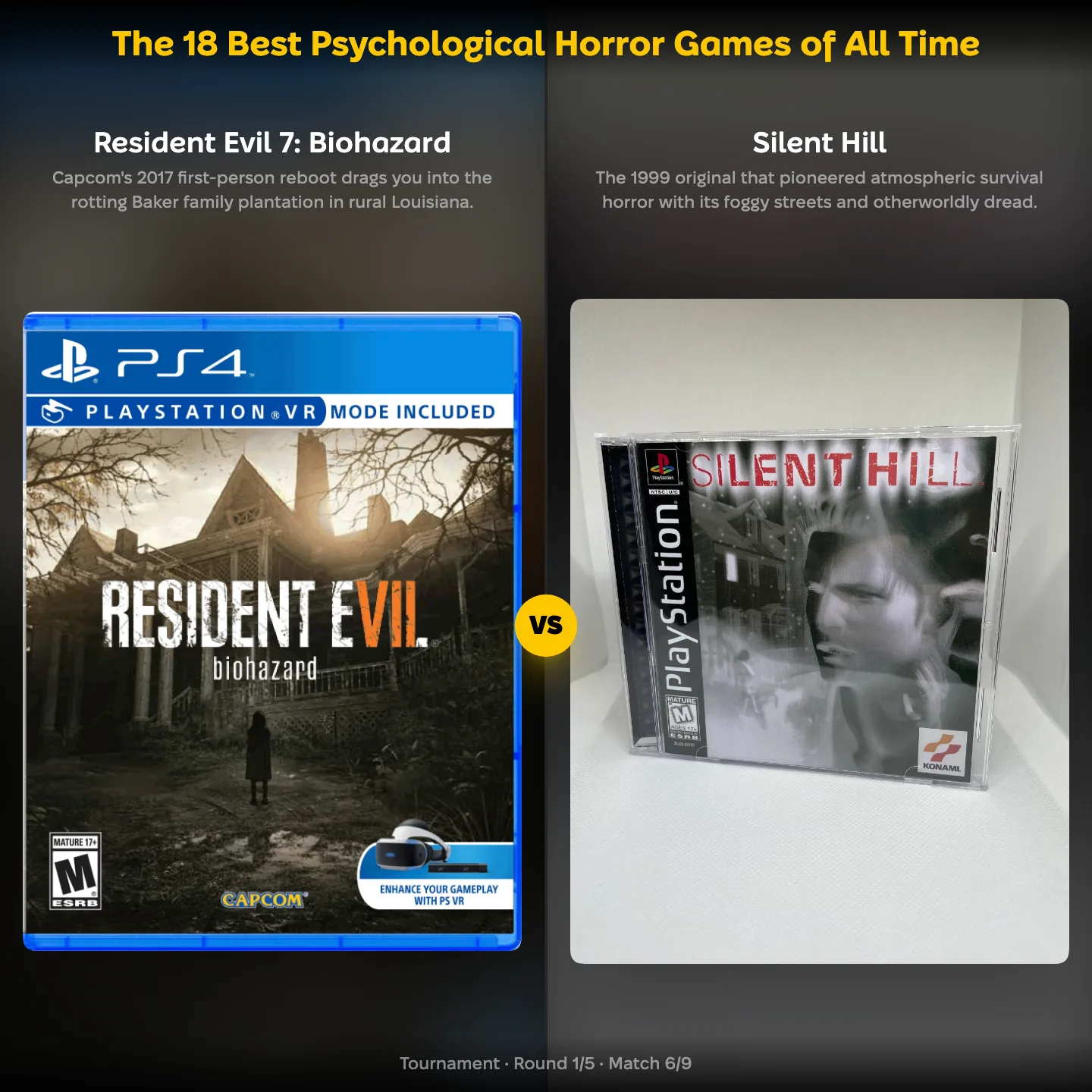
Psychological horror is where Resident Evil runs out of road. A ranking of eighteen psychological horror games holds exactly one Capcom entry, the first-person Resident Evil 7, and that scarcity is an honest measure of what the series actually does.
Resident Evil is action horror. It hands the player a knife, a handgun and a route out, and the tension comes from managing those three things rather than from doubting what you are seeing.
Silent Hill built the other tradition. Konami's 1999 original made the town a projection of the protagonist's guilt, and Silent Hill 2 turned that into the template the rest of this field works from.
Amnesia, SOMA, Signalis, Alan Wake 2 and Layers of Fear all push further in the same direction. Resident Evil 7 qualifies because Capcom took the camera off Ethan Winters' shoulder, put it behind his eyes and locked the farmhouse door.
Resident Evil 4 VR Mode, given away free on PS VR2
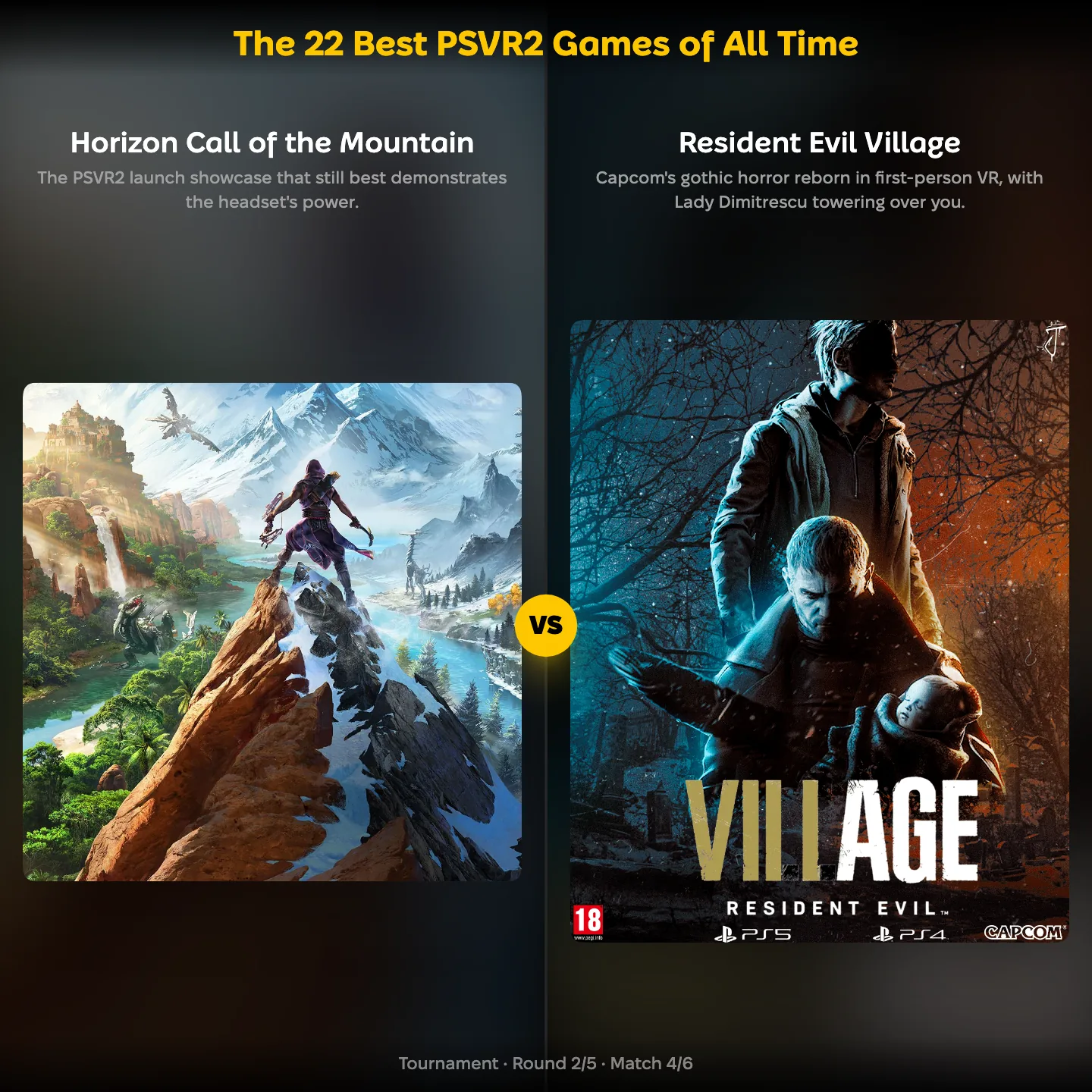
Virtual reality should be hostile to a series built on fixed camera angles. Resident Evil has two entries among the twenty-two best PSVR2 games instead: Resident Evil Village and the Resident Evil 4 remake, each with a full VR conversion rather than a bolted-on mini-game.
Capcom gave the Resident Evil 4 version away. VR Mode arrived on 8 December 2023 as free downloadable content for anyone who already owned the game and the headset, and it covers the whole main campaign.6
Horizon Call of the Mountain is the purpose-built alternative. Sony commissioned it as a PS VR2 launch title, designed for the headset from the first sketch instead of adapted to it afterwards.
Gran Turismo 7, Beat Saber, Kayak VR: Mirage and Walkabout Mini Golf fill in the rest. A first-person Resident Evil is the only thing on that shelf people take the headset off early to escape, which is more or less the design brief.
Code: Veronica sold 1.14 million on a dying Dreamcast
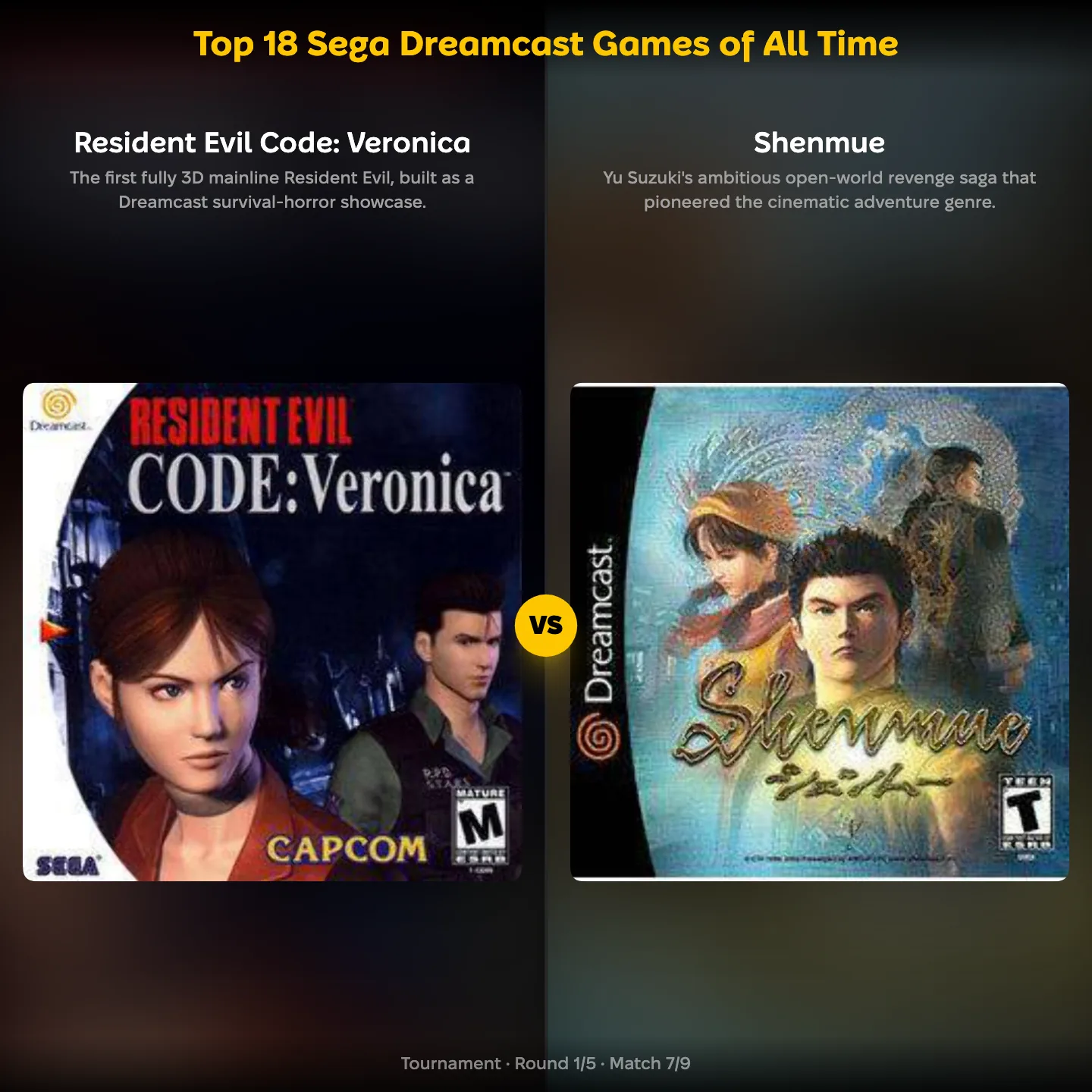
Resident Evil Code: Veronica reached the Sega Dreamcast in February 2000 as the first fully 3D game in the series, and Capcom's own sales table stops at 1.14 million copies for it.7 The Resident Evil 2 remake sold seventeen times as many.
That gap is a hardware accident rather than a verdict on the game. Code: Veronica continued the Claire Redfield and Albert Wesker story directly, Sega abandoned the Dreamcast in 2001 on its way out of the console business, and most players met the game years later through ports.
Shenmue is the Dreamcast's other famous casualty. Yu Suzuki's open-world experiment shipped to an installed base that was already shrinking underneath it.
Jet Set Radio, Crazy Taxi, Soul Calibur, Rez and Samba de Amigo are Sega at its most inventive. A Capcom horror series is the outsider on a shelf remembered for colour and noise.
Anderson's six films vs The Super Mario Bros. Movie
Resident Evil holds a strange record. The films that made it a household name are also the worst-reviewed work the franchise has produced.
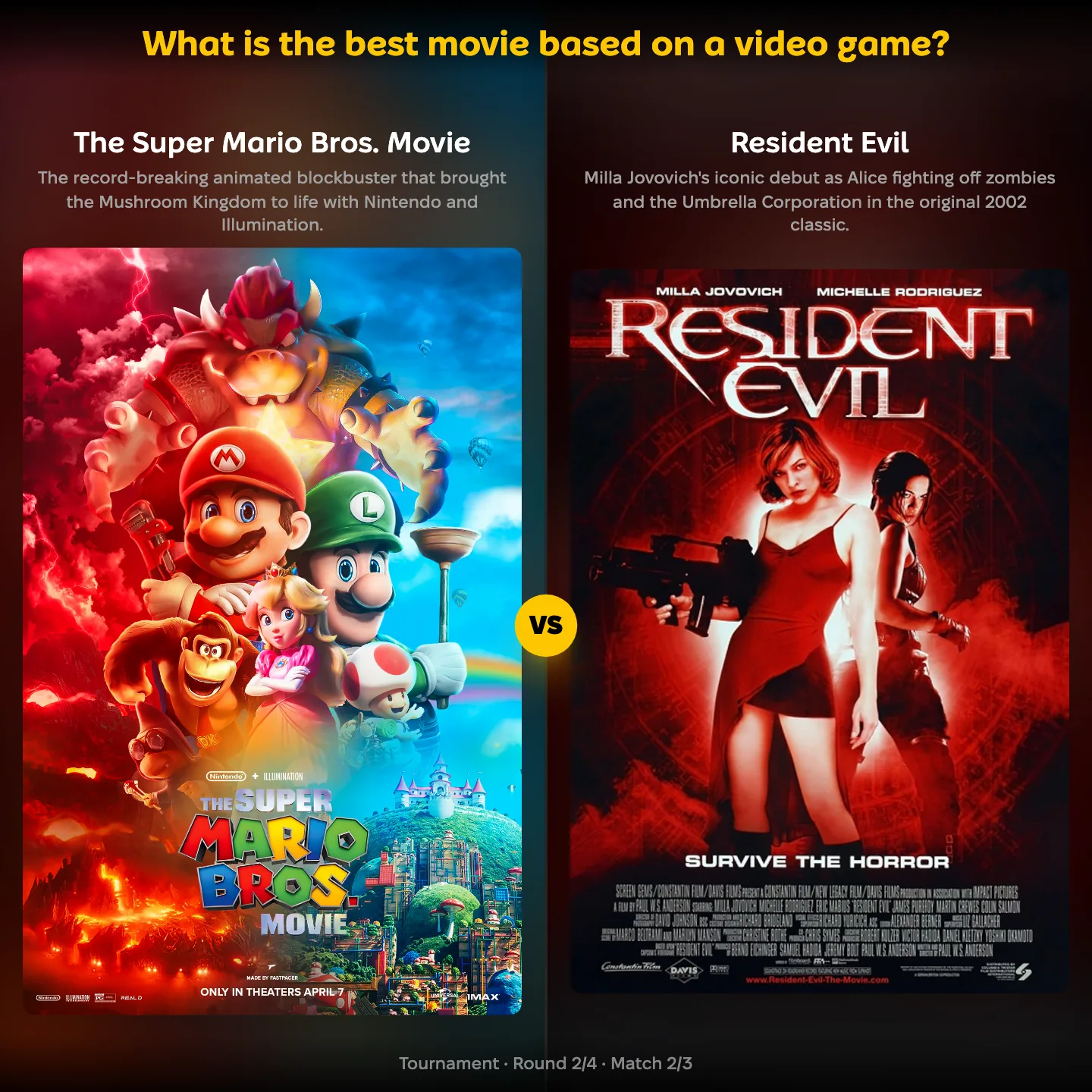
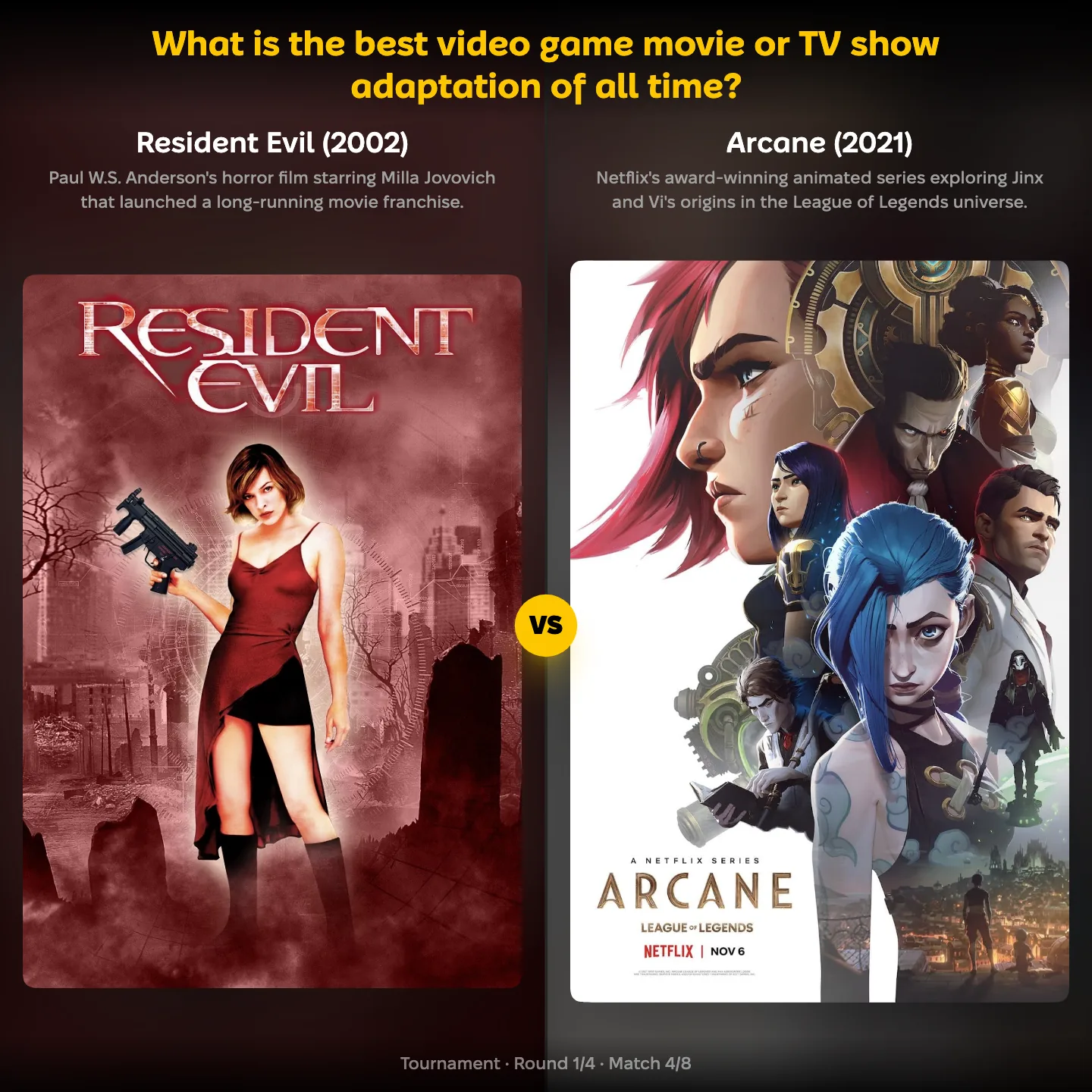
Paul W. S. Anderson's 2002 original is the entry on this ranking of films based on games. It invented a character, Alice, who appears in no Resident Evil game, and Milla Jovovich carried her through five sequels to The Final Chapter, which took $312.2 million worldwide, the biggest gross of the six.8
The Super Mario Bros. Movie shows what the format looks like when it works commercially and critically at the same time. Illumination's 2023 film took $1.36 billion, more than four times the biggest Resident Evil film.9
Detective Pikachu, Sonic the Hedgehog, Uncharted, Warcraft, Assassin's Creed and Need for Speed round out the twelve. Resident Evil belongs in that company as the series that proved game films could make money long before anyone proved they could be good.
Arcane and The Last of Us moved the standard
Television changed what an adaptation is expected to be, and this ranking makes the 2002 Resident Evil film stand next to fifteen years of prestige series.
Arcane is the clearest marker of the shift. Riot Games and Fortiche's Netflix series has won eight Primetime Emmys and took Outstanding Animated Program in 2022 and again in 2025.10
The Last of Us did it in live action. HBO's series has nine Emmys, eight of them won at the 2023 ceremony, with Naughty Dog's story largely intact and Pedro Pascal in the lead.11
Fallout, Cyberpunk: Edgerunners, Castlevania and the 1994 Street Fighter film mark out the rest of the range. Resident Evil sits between the two eras: the franchise that opened the door for game adaptations, then spent twenty years being the reason people distrusted them.
Eight Resident Evil films, and Zach Cregger's ninth
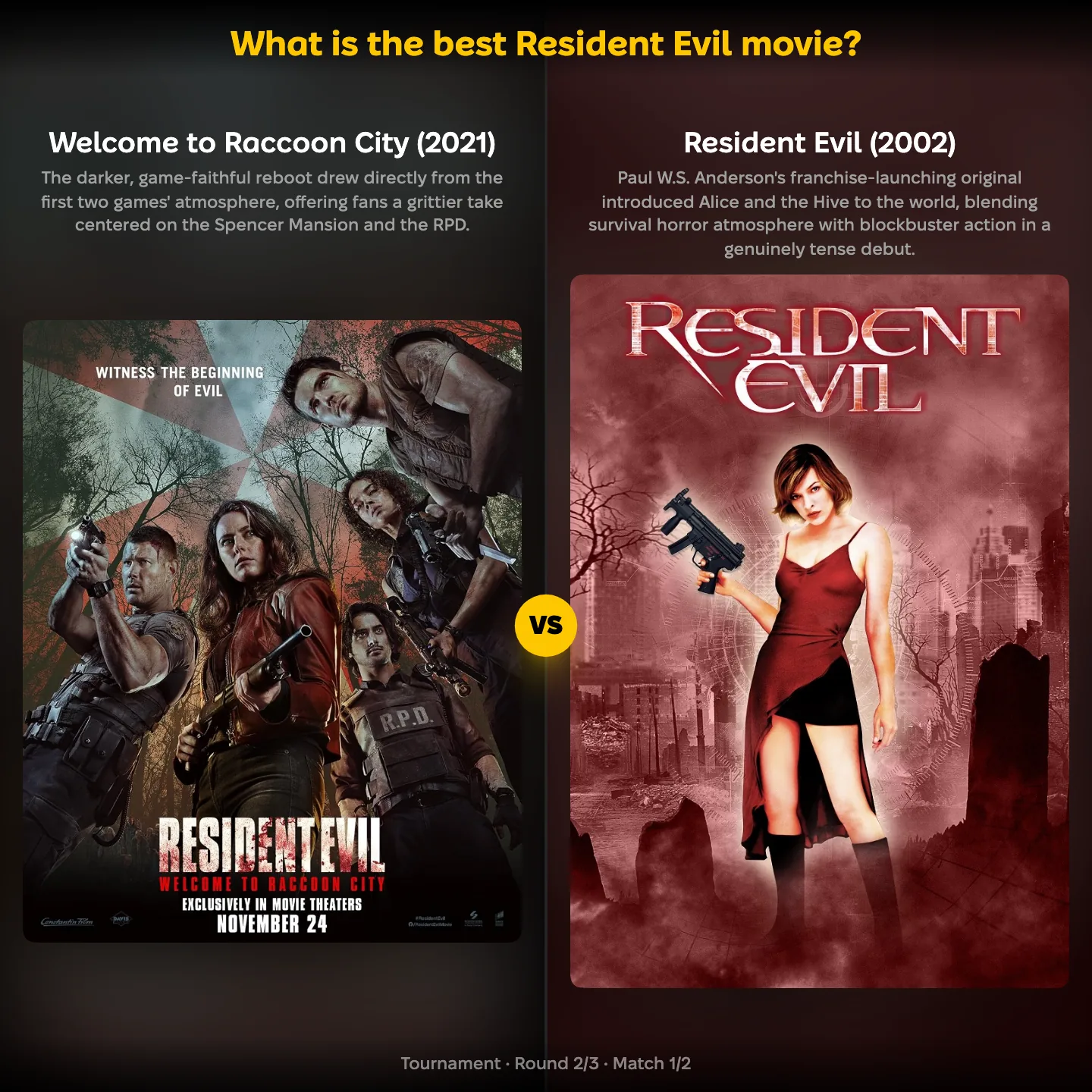
Eight Resident Evil films exist: Anderson's six with Milla Jovovich, the 2021 reboot attempt Welcome to Raccoon City, and the 2023 animated feature Death Island.
Welcome to Raccoon City tried the opposite approach to Anderson's. Johannes Roberts went back to the 1998 games for plot and characters, kept the Spencer mansion and the police station, and got no sequel out of it.
The Anderson films had no such loyalty and no such trouble. Alice was invented for the screen, the game cast turned up as guests, and the formula held for fourteen years.
A ninth film opens on 18 September 2026, directed by Zach Cregger for Sony, with Austin Abrams as Bryan, a medical courier whose night collapses around him.12 Nothing in the synopsis mentions Alice, Raccoon City or Umbrella.
Resident Evil Veronica arrives in 2027
Capcom announced on 8 June 2026 that the chapter stranded on the Dreamcast is coming back: Resident Evil Veronica, a remake of the 2000 original, rebuilt in RE ENGINE for release in 2027.13 Rebuilding is what this series does instead of ageing, which is why fourteen questions can produce fourteen different Resident Evils without any of them being wrong. The orders themselves come out of a much simpler mechanism than Umbrella's paperwork.
Decide which Resident Evil you would defend, then build the ranking that forces everyone else to defend theirs.
More rankings, more angles
- Super Mario vs The Legend of Zelda: 16 Rankings, One Argument — one designer started both series
- Final Fantasy Is a Different Genre on Every List — numbered sequels that share almost nothing
- 35 Years of Sonic the Hedgehog, Ranked 16 Ways — also ranked as a kart racer and a pinball
- PlayStation vs Xbox vs Nintendo, Ranked Side by Side — three consoles, one shelf
Sources
- Capcom — press release announcing Resident Evil Requiem, the ninth main installment in the series, for release on 27 February 2026 during the franchise's 30th anniversary year: capcom.co.jp (checked 2026-08-03)
- Capcom — Q1 results presentation for the fiscal year ending March 2027 (three months ended 30 June 2026): cumulative Resident Evil series sales of 213 million units, Monster Hunter 131 million and Street Fighter 60 million, and lifetime unit sales of 19.75 million for the 2019 Resident Evil 2: capcom.co.jp (checked 2026-08-03)
- Capcom — press release of 16 March 2026: worldwide sales of Resident Evil Requiem exceed 6 million units, the fastest a title in the series has reached the milestone: capcom.co.jp (checked 2026-08-03)
- Sony Interactive Entertainment — press release: PlayStation 2 sales reached 150 million units worldwide as of 31 January 2011: sonyinteractive.com (checked 2026-08-03)
- Xbox Store — official Resident Evil Requiem listing naming FBI analyst Grace Ashcroft and Leon S. Kennedy as the two playable characters, released 27 February 2026: xbox.com (checked 2026-08-03)
- PlayStation.Blog — Resident Evil 4 VR Mode released 8 December 2023 as free DLC for owners of the game and PS VR2, covering the full main story campaign: blog.playstation.com (checked 2026-08-03)
- Capcom — Platinum Titles sales data as of 31 March 2026: Resident Evil Code: Veronica, Dreamcast, February 2000, 1.14 million units, and the original Resident Evil, PlayStation, March 1996: capcom.co.jp (checked 2026-08-03)
- Box Office Mojo — Resident Evil: The Final Chapter, worldwide gross $312,242,626: boxofficemojo.com (checked 2026-08-03)
- Box Office Mojo — The Super Mario Bros. Movie (2023), worldwide gross $1,360,783,214: boxofficemojo.com (checked 2026-08-03)
- Television Academy — Arcane awards record: eight Primetime Emmy wins, including Outstanding Animated Program in 2022 and 2025: televisionacademy.com (checked 2026-08-03)
- Television Academy — The Last of Us awards record: nine Primetime Emmy wins, eight of them at the 2023 ceremony: televisionacademy.com (checked 2026-08-03)
- Sony Pictures — official Resident Evil film site: released 18 September 2026, directed by Zach Cregger, starring Austin Abrams as medical courier Bryan: residentevil.movie (checked 2026-08-03)
- Capcom — press release of 8 June 2026: Resident Evil Veronica, a remake of the 2000 Resident Evil Code: Veronica built in RE ENGINE, scheduled for release in 2027: capcom.co.jp (checked 2026-08-03)