
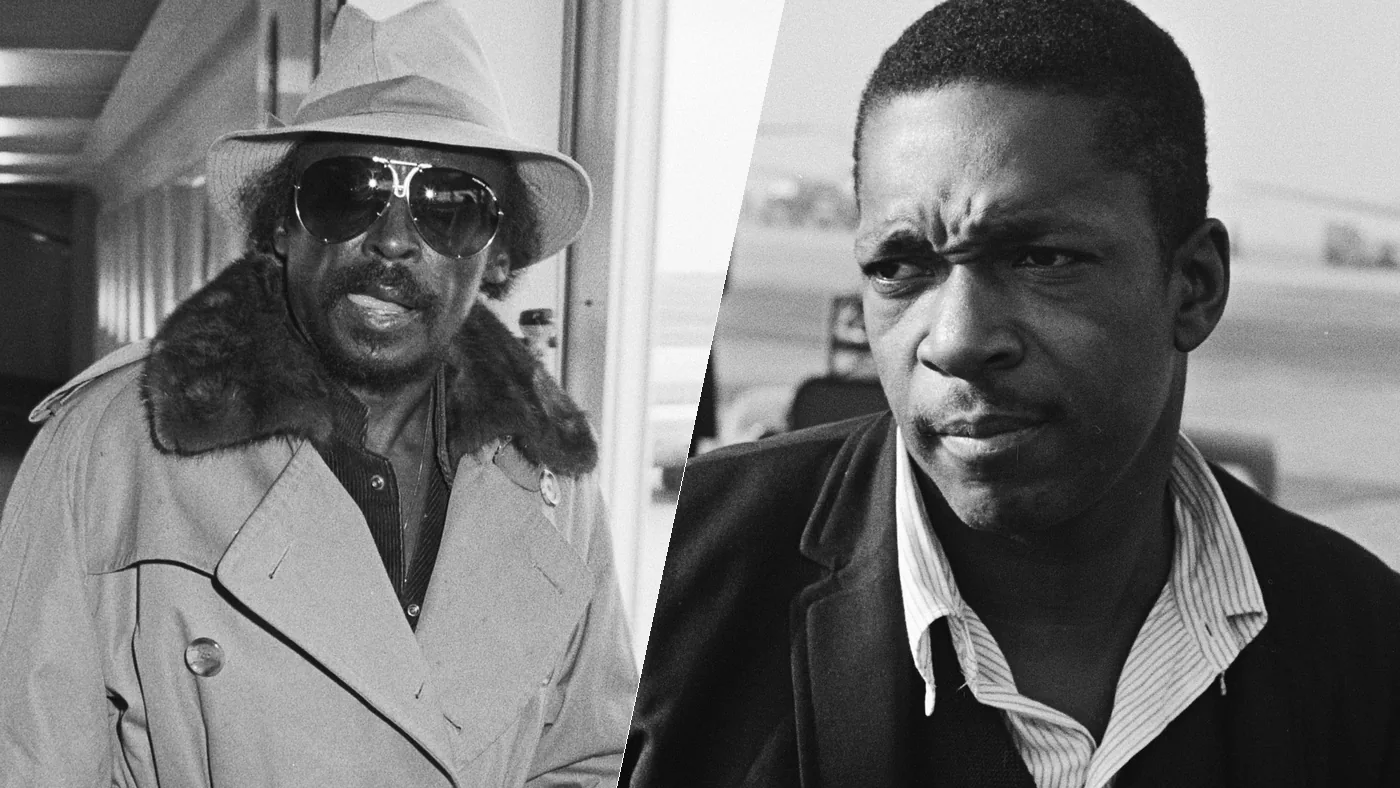
Both men were born in 1926, which makes this a double centenary year.2 John Coltrane turns 100 on 23 September, and his estate has built a year-long programme around the date, ending with a symphonic concert at the Hollywood Bowl on the birthday itself.1 Miles Davis's own centenary falls in the same twelve months, with far less built around it.
They are also difficult to separate on purpose. Coltrane spent five years in Davis's band, and the tenor saxophone on Davis's most famous record is his.
Coltrane plays on the album that wins most "greatest jazz record" lists, so every ranking that separates these two has to decide whether it is measuring the bandleader or the horn.
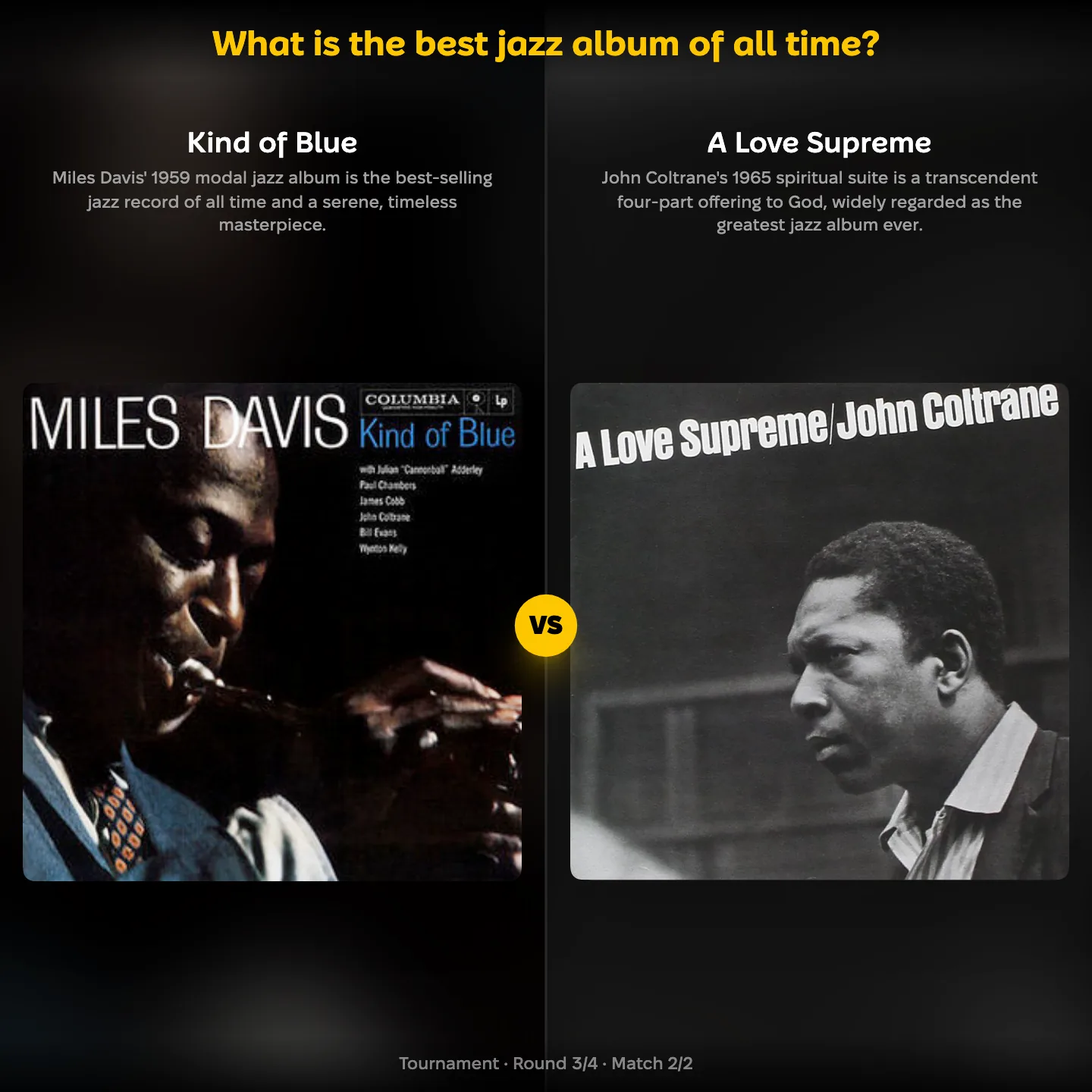
Kind of Blue vs A Love Supreme: the argument in two covers
The broadest question in the music puts the same two records at the front, and they are not comparable objects.
Davis made Kind of Blue in two 1959 sessions, and it became the best-selling jazz album ever recorded — an album so widely owned that it sits in houses with no other jazz in them.3 Its reputation is built on ease: you can put it on and not listen, and it survives that.
A Love Supreme was cut in a single session on 9 December 1964, at Rudy Van Gelder's studio in Englewood Cliffs, with the quartet Coltrane had spent four years assembling — McCoy Tyner, Jimmy Garrison, Elvin Jones.4 It is a devotional suite in four parts, and it does not survive being ignored.
Mingus, Rollins and Brubeck sit beside them, and that is the useful part of the question: more than two records have a claim.
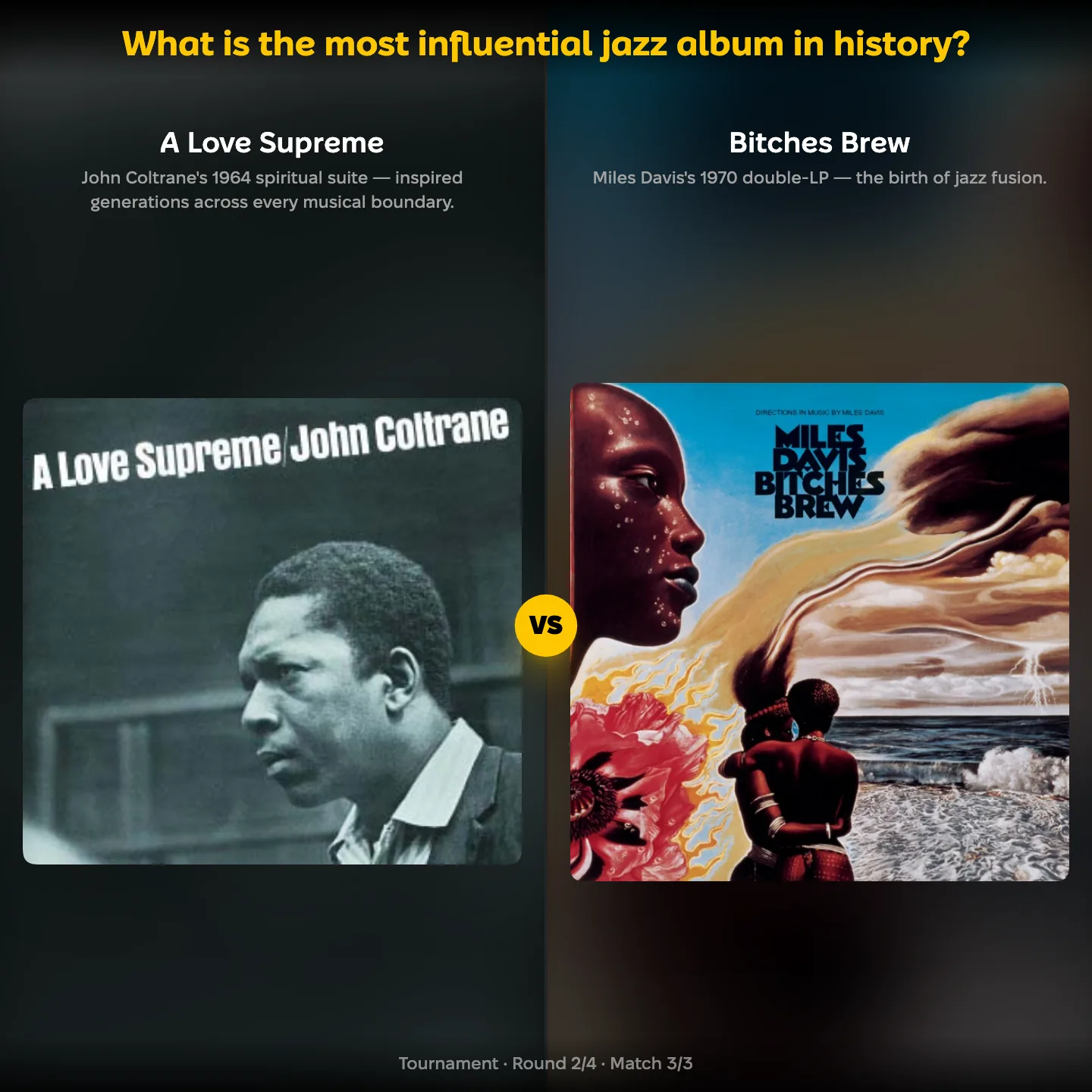
Birth of the Cool, Bitches Brew and the records that moved the music
Ask which record moved the music rather than which is best, and the pair rearranges immediately.
Davis has four entries here, and they point in four directions: Birth of the Cool named a style, Kind of Blue made modal playing standard practice, Sketches of Spain imported orchestral writing, Bitches Brew opened the door to electric instruments. Nobody else in jazz has that spread.
Coltrane has two, and they are narrower and deeper. Giant Steps set a harmonic problem that saxophonists still use as a test, and A Love Supreme gave a generation of players permission to treat the music as devotional rather than entertainment.
Ornette Coleman's The Shape of Jazz to Come did something neither of them attempted: it removed the chord changes altogether.
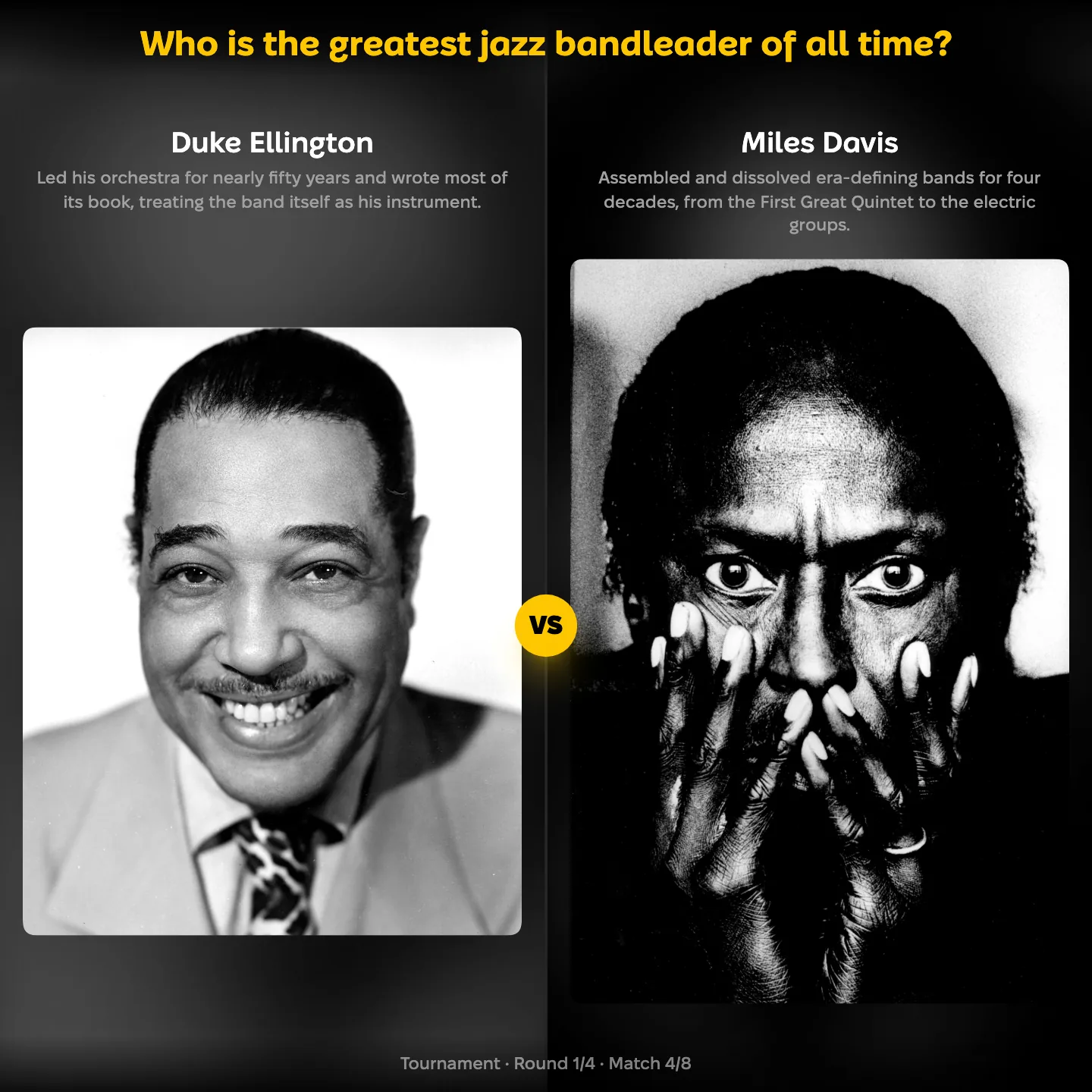
Duke Ellington, and what a bandleader actually does
Running a band is a separate craft from playing in one, and the swing era gets in the way of both men here.
Duke Ellington held an orchestra together for nearly fifty years and wrote most of what it played. Count Basie built a rhythm section that every big band afterwards copied. Art Blakey ran the Jazz Messengers as a school and put more musicians into the profession than any other bandstand.
Davis has the strongest case among the moderns, because he did it repeatedly: the First Great Quintet, the Gil Evans orchestral records, the Second Great Quintet, then the electric groups, each with a different roster and a different sound.
Coltrane led for seven years rather than forty, which is the shape of a career cut short rather than a weakness. What he did in that time was assemble one group so distinctive that people name it as a unit.
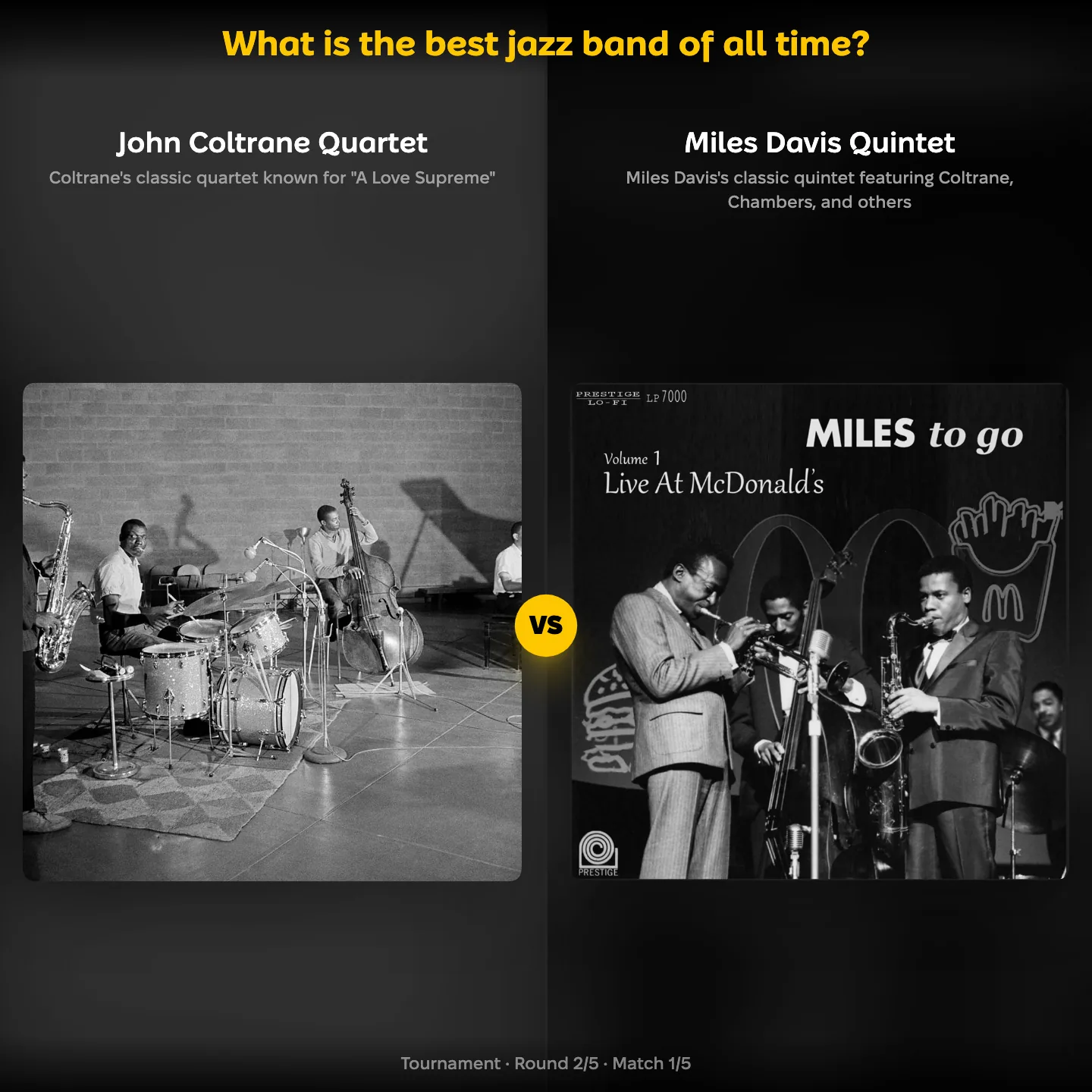
The Miles Davis Quintet vs the John Coltrane Quartet
Here the two men appear as institutions rather than players, and the frame is the cleanest head-to-head in the article.
Coltrane joined Davis in 1955 and left in 1960.2 The quintet he played in — Davis, Coltrane, Red Garland, Paul Chambers, Philly Joe Jones — is the group most often meant by "hard bop", and Davis fired him from it in 1957 over his heroin use before taking him back the following year. Everything Coltrane is famous for came after that dismissal.
The John Coltrane Quartet is the band he built once he left, and it is the one specialists argue for hardest. Tyner, Garrison and Jones played with him almost nightly for four years, and the interplay they developed is the reason people talk about the group as a single instrument rather than four musicians.
Davis's bands were also a school. The alumni run from Coltrane and Bill Evans through Herbie Hancock and Wayne Shorter to Chick Corea, and several of them appear elsewhere in this article under their own names.
Art Blakey's Jazz Messengers, the Dave Brubeck Quartet and Weather Report all outlasted both of these bands.
Sheets of sound against the notes Miles Davis left out
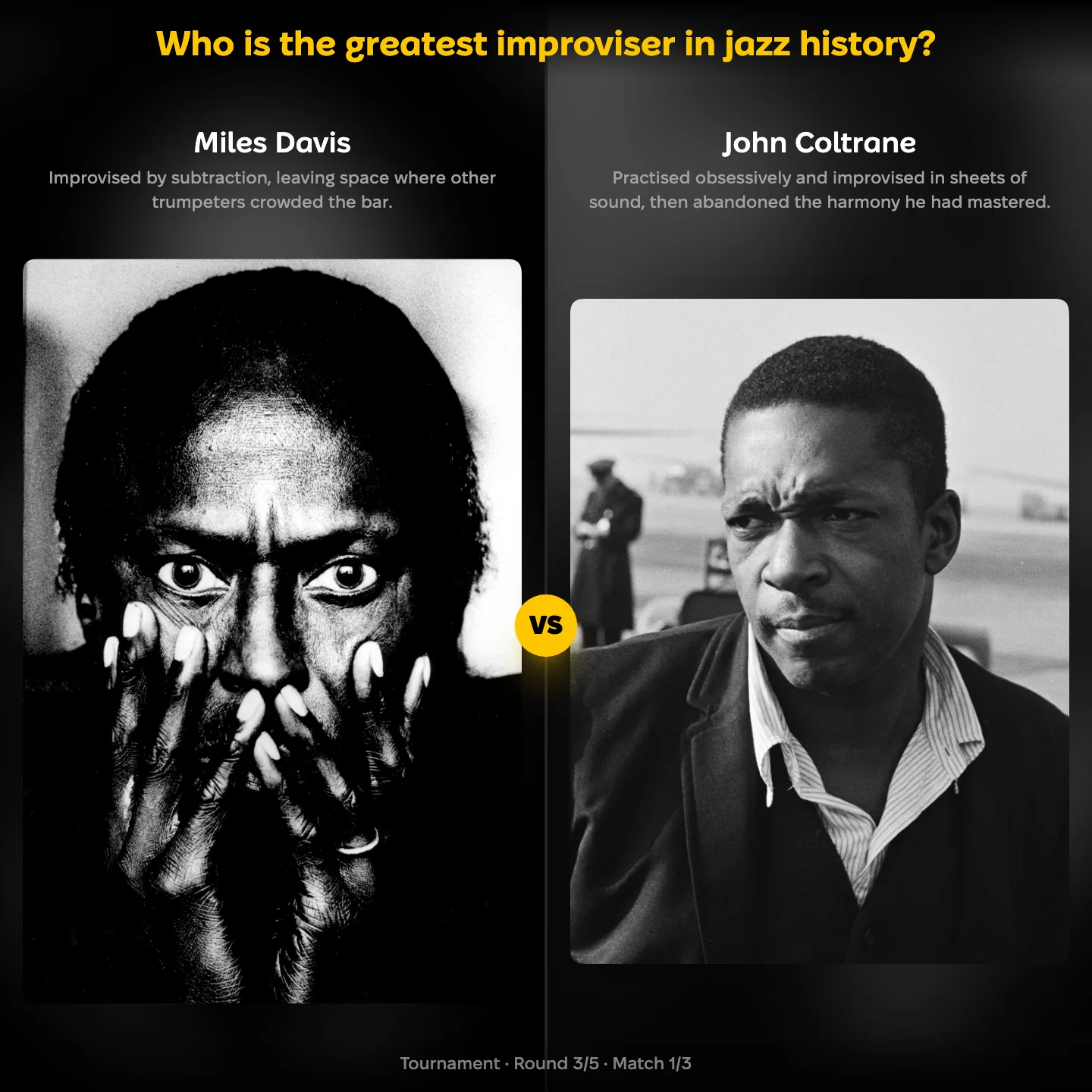
Improvisation is the one contest where the two men are doing opposite things with the same minutes.
Coltrane practised to the point of obsession and played long, dense lines that critics of the day called sheets of sound, a phrase meant as description and usually received as complaint.
Davis built his reputation on what he did not play. He entered late, left gaps, and made a virtue of a tone that other trumpeters would have considered thin.
Charlie Parker sits above both of them in most expert accounts, and Louis Armstrong invented the thing they are being judged on: before the Hot Fives, the extended solo was not really what jazz was for.
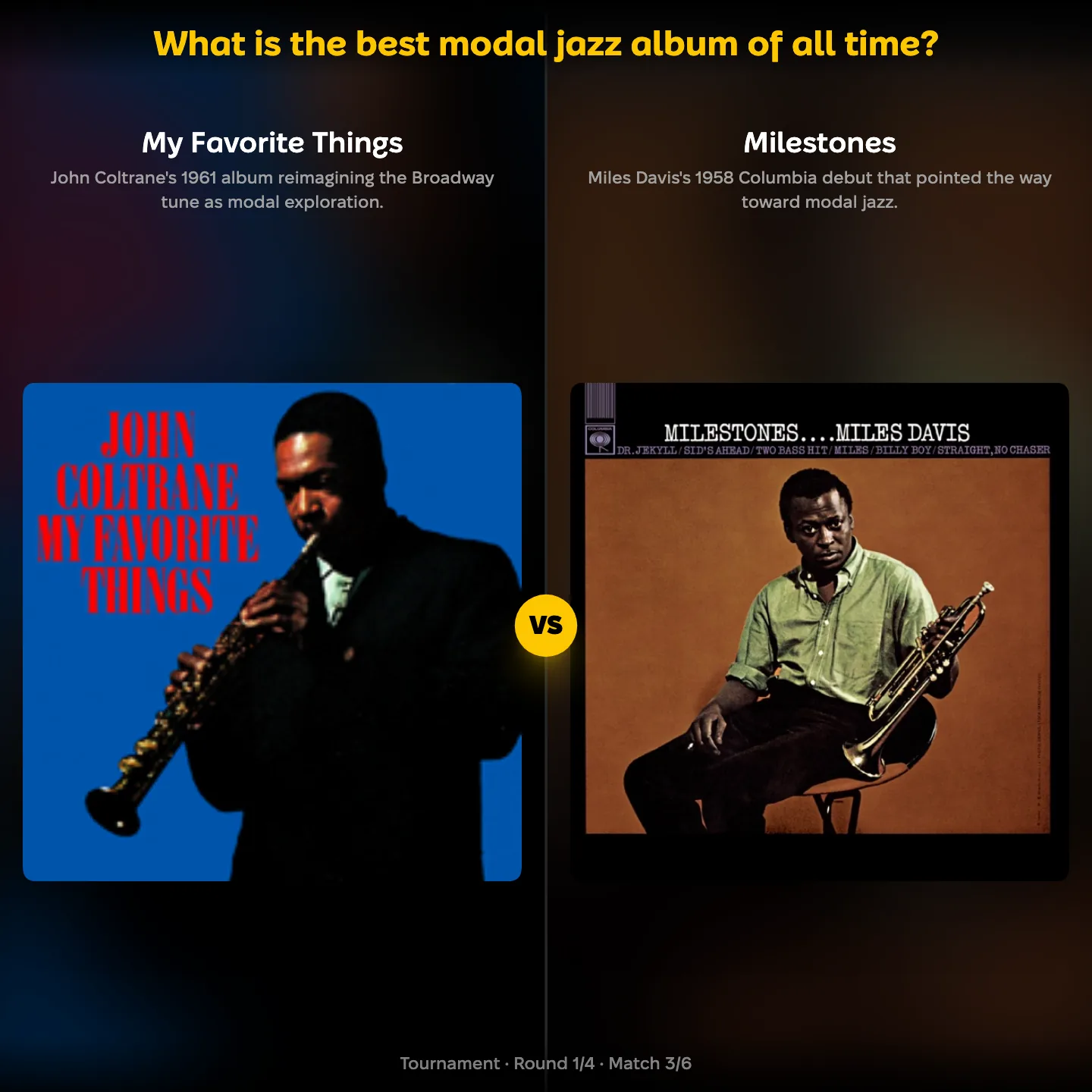
Milestones vs My Favorite Things: modal jazz, two ways
Davis got to modal playing first. Milestones in 1958 and Kind of Blue the following year replaced fast-moving chord sequences with a scale and a lot of room, which is why the records sound calm.
Coltrane used the same freedom to go the other way: his 1960 version of My Favorite Things turns a show tune into a fourteen-minute vehicle, and the calm is entirely gone.
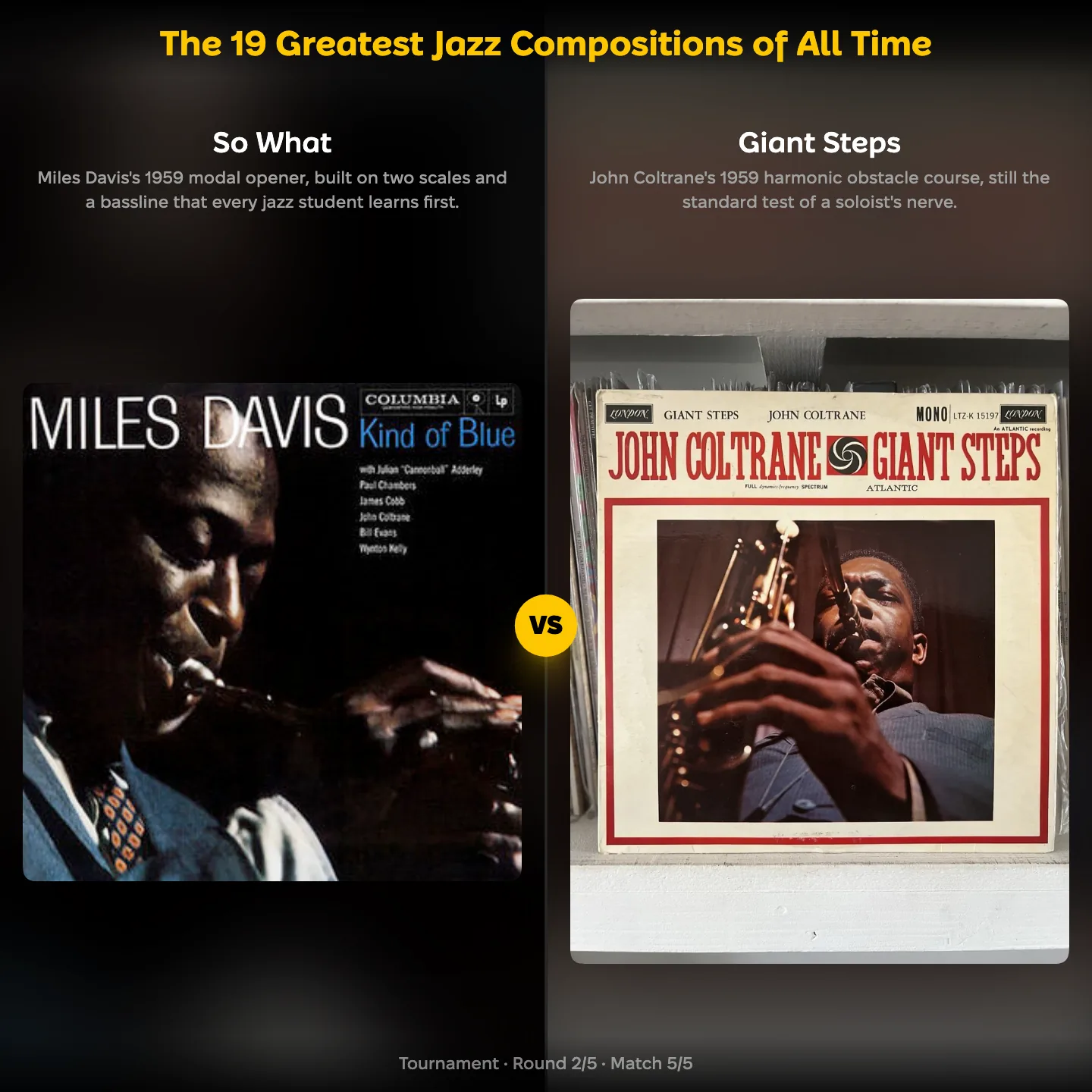
So What and Giant Steps: the two tunes every student learns
Writing is a separate contest from playing, and jazz musicians tend to be blunter about it.
"So What" is Davis's most-played composition and possibly the most forgiving piece in the repertoire: two scales, a famous bassline, and enough space that a beginner can sound competent on it.
"Giant Steps" is the opposite by design. Coltrane wrote a chord sequence that moves through three key centres at speed, and it has been the standard test of a soloist's nerve ever since.
Thelonious Monk is the complication. "'Round Midnight" is the most recorded piece any jazz musician has written, and Monk's tunes turn up in the repertoire far more often than either man's do.
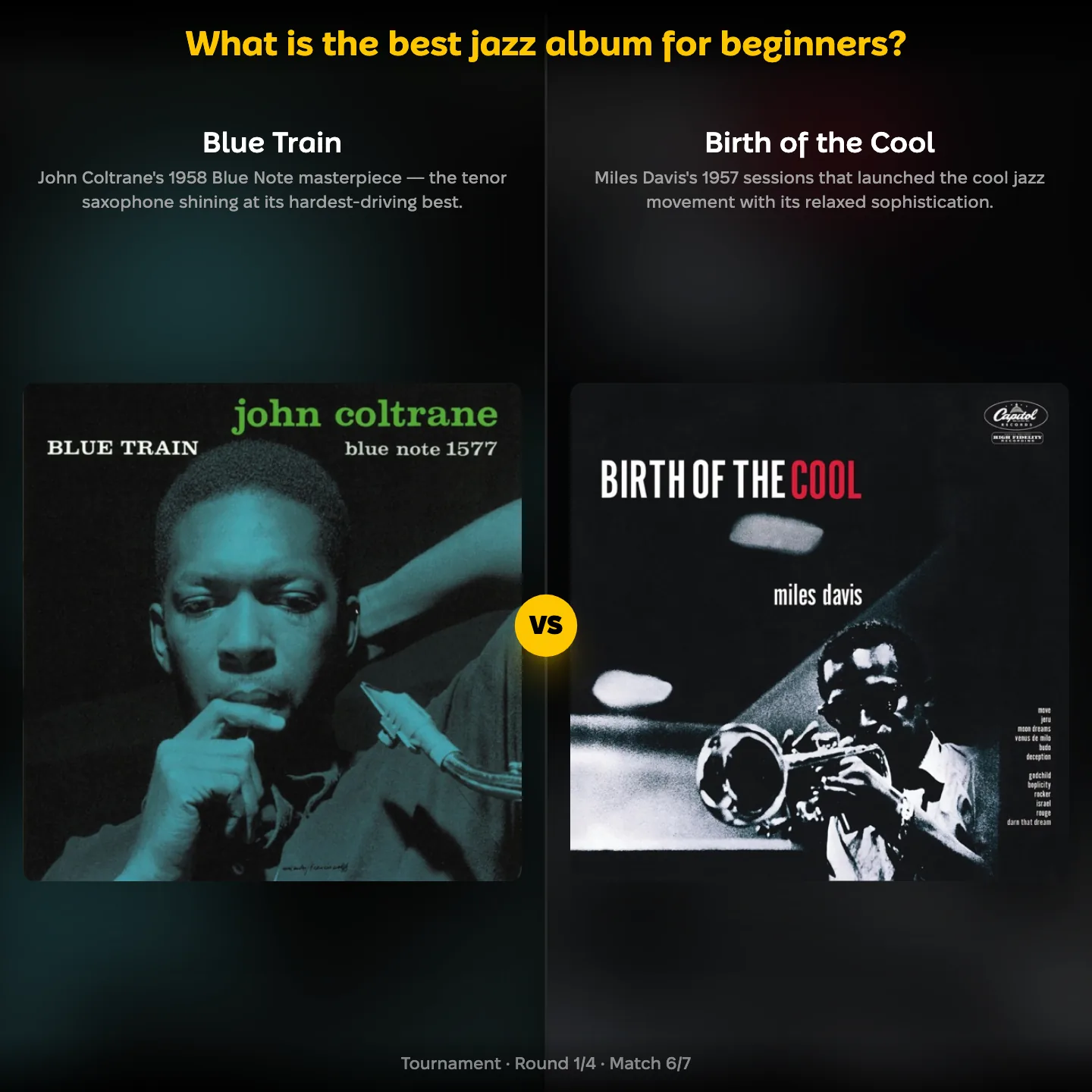
Blue Train, and the record you hand a beginner
The entry-point question is not about greatness at all. It asks which record makes somebody want a second one.
Blue Train is Coltrane's answer and an oddity in his catalogue: recorded on 15 September 1957, it is the only session he ever led for Blue Note.5 It is also the most straightforwardly enjoyable thing he made — hard bop with tunes, recorded during the year Davis had let him go.
Davis has two entries, and Birth of the Cool is the interesting one, because it is a compilation of sessions from 1949 and 1950 that nobody heard as a landmark at the time.
Brubeck's Time Out and Getz and Gilberto's bossa nova record are also here, and both have introduced more people to jazz than anything either man recorded.
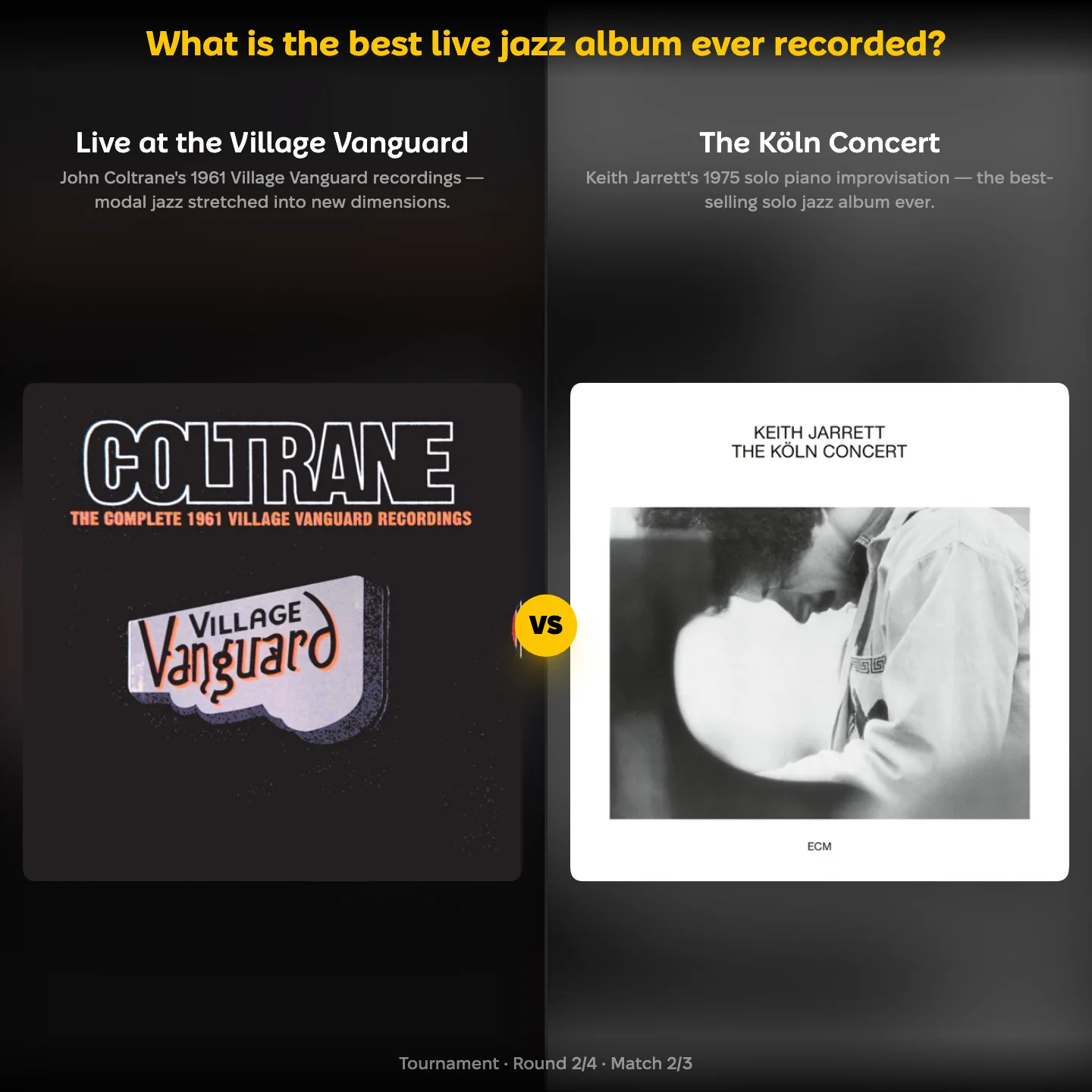
The Village Vanguard, the Köln Concert and the live problem
On stage the field widens, and both men lose ground to musicians who were simply better at being watched.
Coltrane's 1961 Village Vanguard recordings are the strongest live case either of them has: this is where the quartet stretched pieces past twenty minutes and where the "anti-jazz" complaints started. Davis is represented by Agharta, an electric double album recorded in Osaka in 1975 that is nobody's introduction to anything.
Then there is Keith Jarrett, who walked on stage in Cologne with a piano he had not asked for and improvised the best-selling solo piano record ever made.
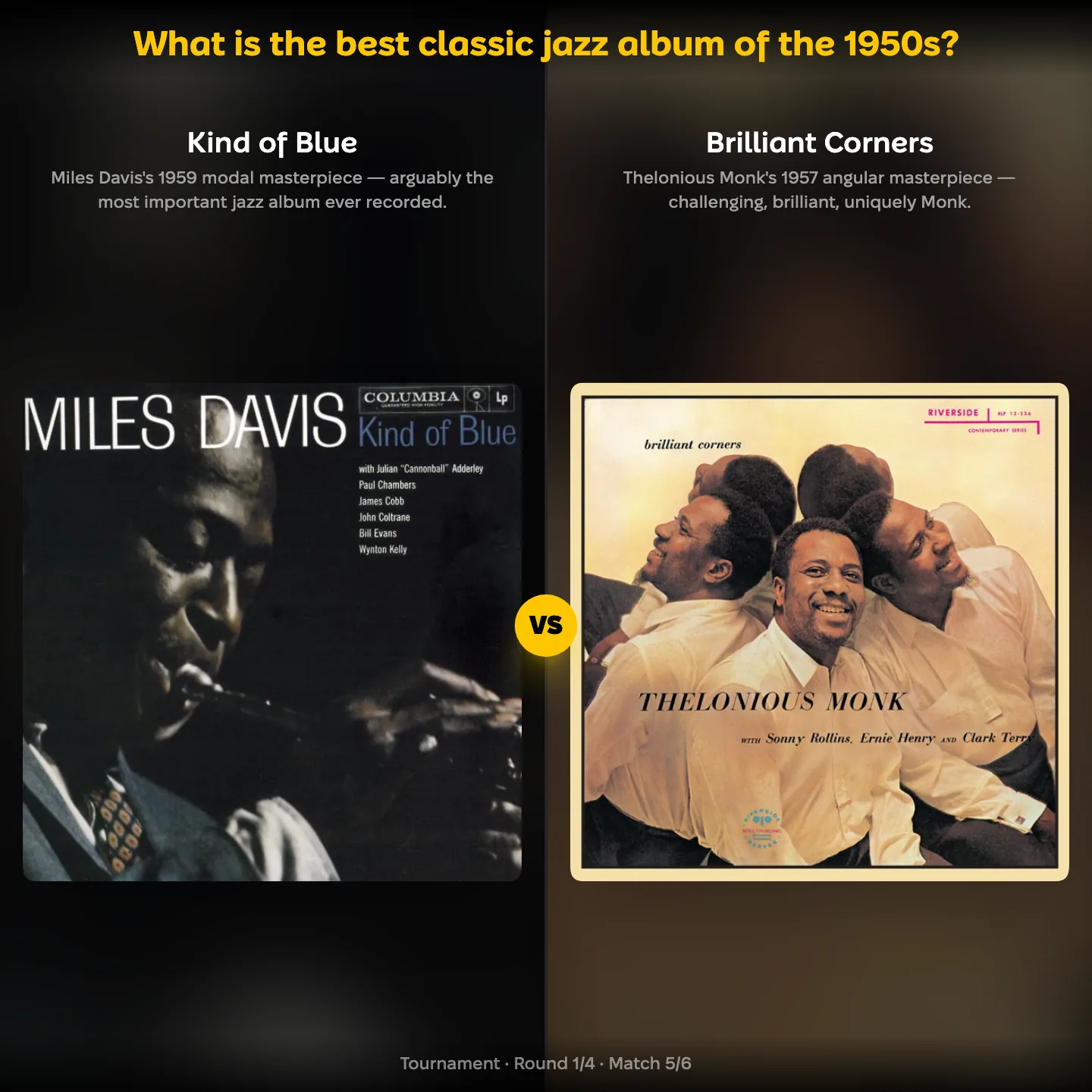
The 1950s list John Coltrane is not on
Sort jazz by decade and the pair come apart completely. This list has two Miles Davis albums on it and nothing led by Coltrane.
That is not an oversight. Through most of the fifties Coltrane was a sideman: in Davis's quintet, briefly with Thelonious Monk, and off the road entirely in 1957 while he dealt with his addiction. The records with his name on the spine had not arrived yet.
Davis spent the same decade making Birth of the Cool, Milestones and Kind of Blue, plus three orchestral albums with Gil Evans.
Sonny Rollins, Monk and Ahmad Jamal fill out the list, and Jamal is worth naming for a reason that runs straight back to Davis: Davis told anyone who asked that Jamal's use of space was where he got his own.
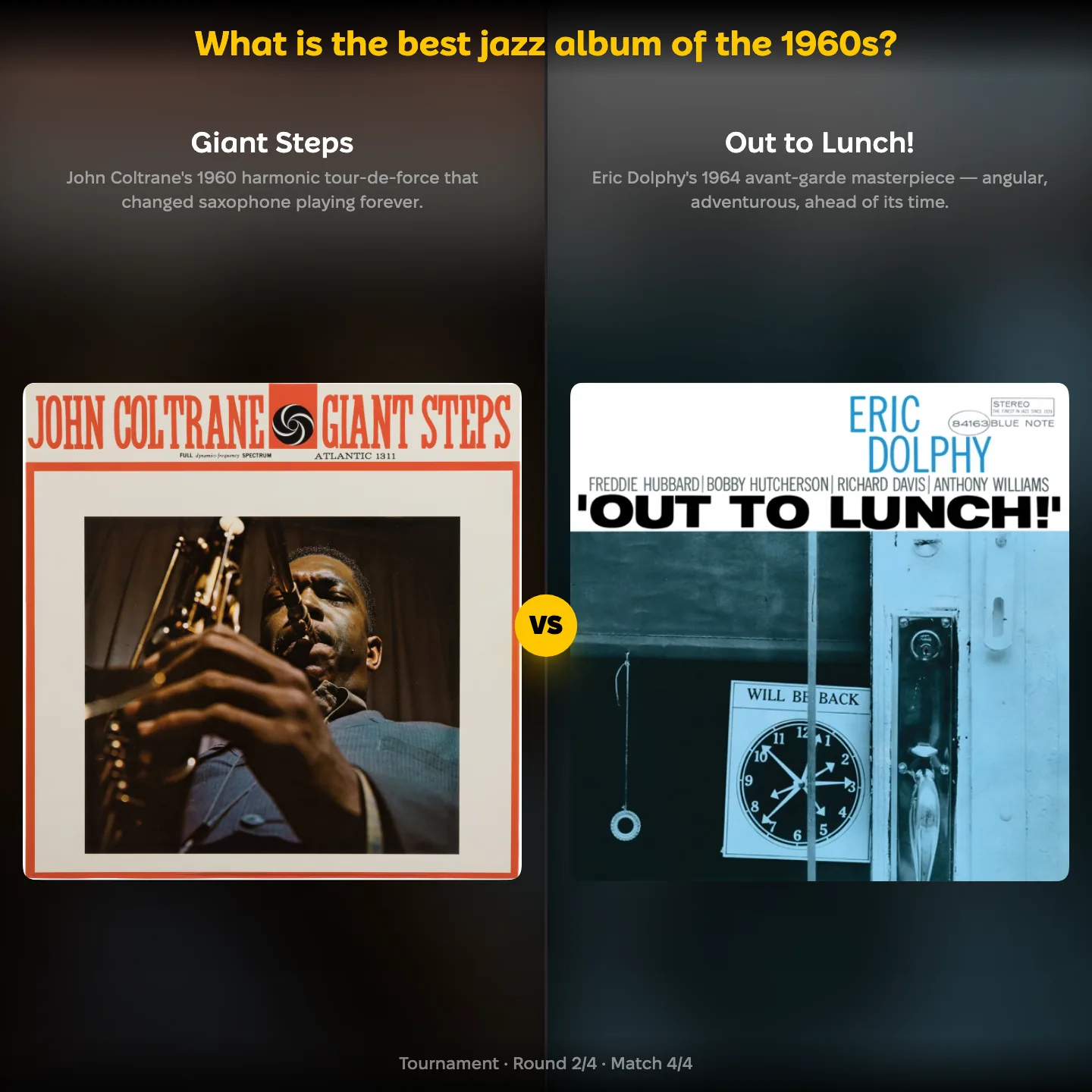
The 1960s list Miles Davis is not on
Move on ten years and the absence swaps sides.
Coltrane has three entries here. Giant Steps, A Love Supreme and Ascension map his whole second career, from the hardest chord sequence in the repertoire to the point where he abandoned chord sequences.
A Love Supreme is also the commercial outlier of the three. It was certified platinum in 2021, the first jazz album of the 1960s to reach the mark, fifty-six years after it was made.6
Davis made Sketches of Spain, E.S.P., Miles Smiles and Nefertiti in the same decade. Not one of those four appears here. The Second Great Quintet is remembered the way difficult things usually are: admired by musicians, rarely the record anyone puts on.
Eric Dolphy, Herbie Hancock and Charles Mingus take the rest of the places.
Bitches Brew and the genre Coltrane never heard
Fusion is the one list here that Coltrane could never have been on, because he died in 1967 and the music did not exist yet.
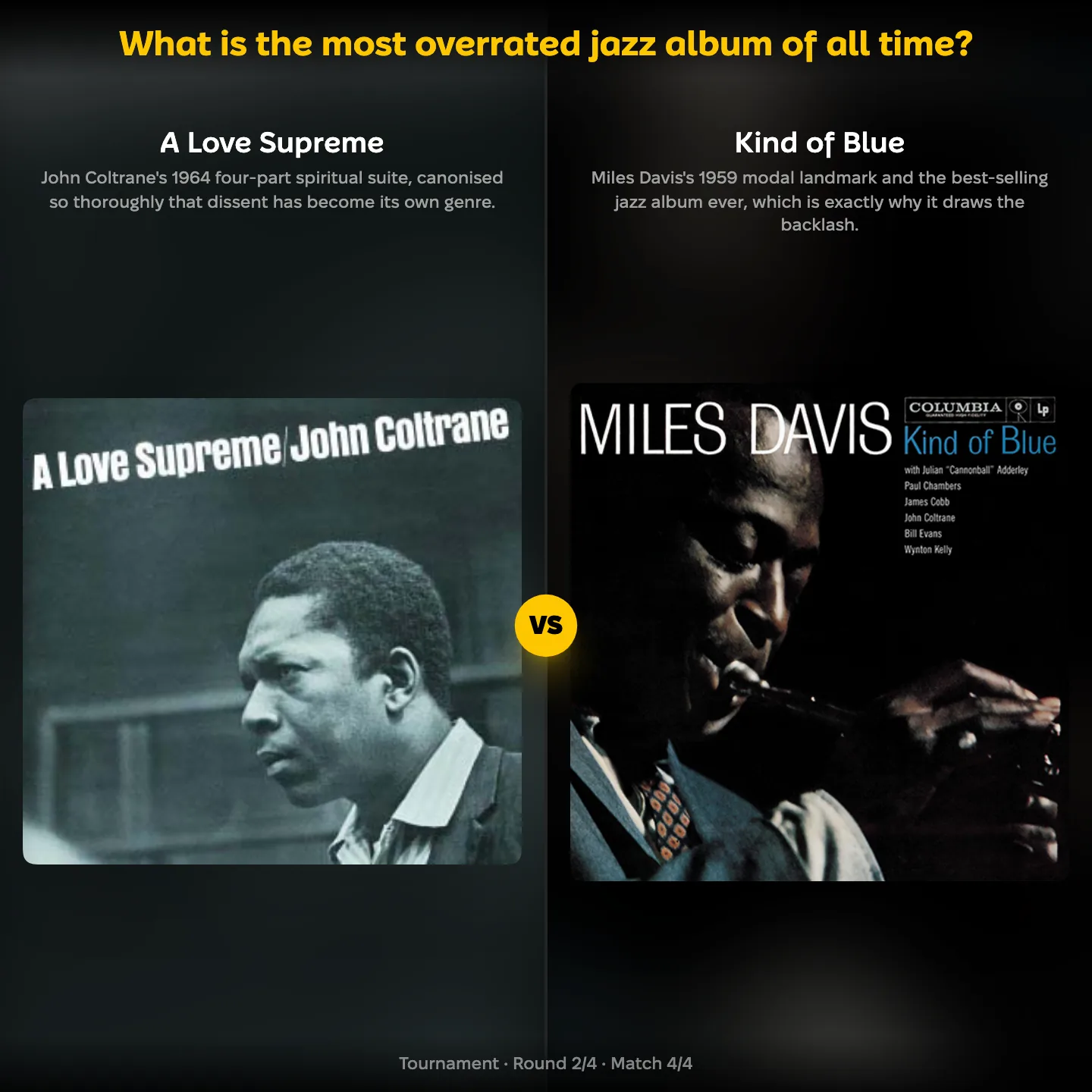
Davis is on it three times. In a Silent Way in 1969, Bitches Brew the year after, and Agharta in 1975: a five-year run in which he replaced acoustic bass with electric, hired guitarists, and lost a large part of the audience he had spent two decades building.
The Recording Academy gave Bitches Brew a Grammy for Best Jazz Performance – Large Group Or Soloist With Large Group in 1971, and the album became Davis's first gold record in 1976, six years after release.7 Twenty years of acclaimed acoustic albums had not managed that; the record critics called a betrayal did it.
Weather Report, the Mahavishnu Orchestra and Return to Forever were all founded by musicians who had played on those Davis sessions. His claim rests less on making the best fusion record than on the fact that most of the rival candidates were made by people he had hired.
The counter-argument for Coltrane is arithmetic rather than merit: every record on this list was made after his funeral.
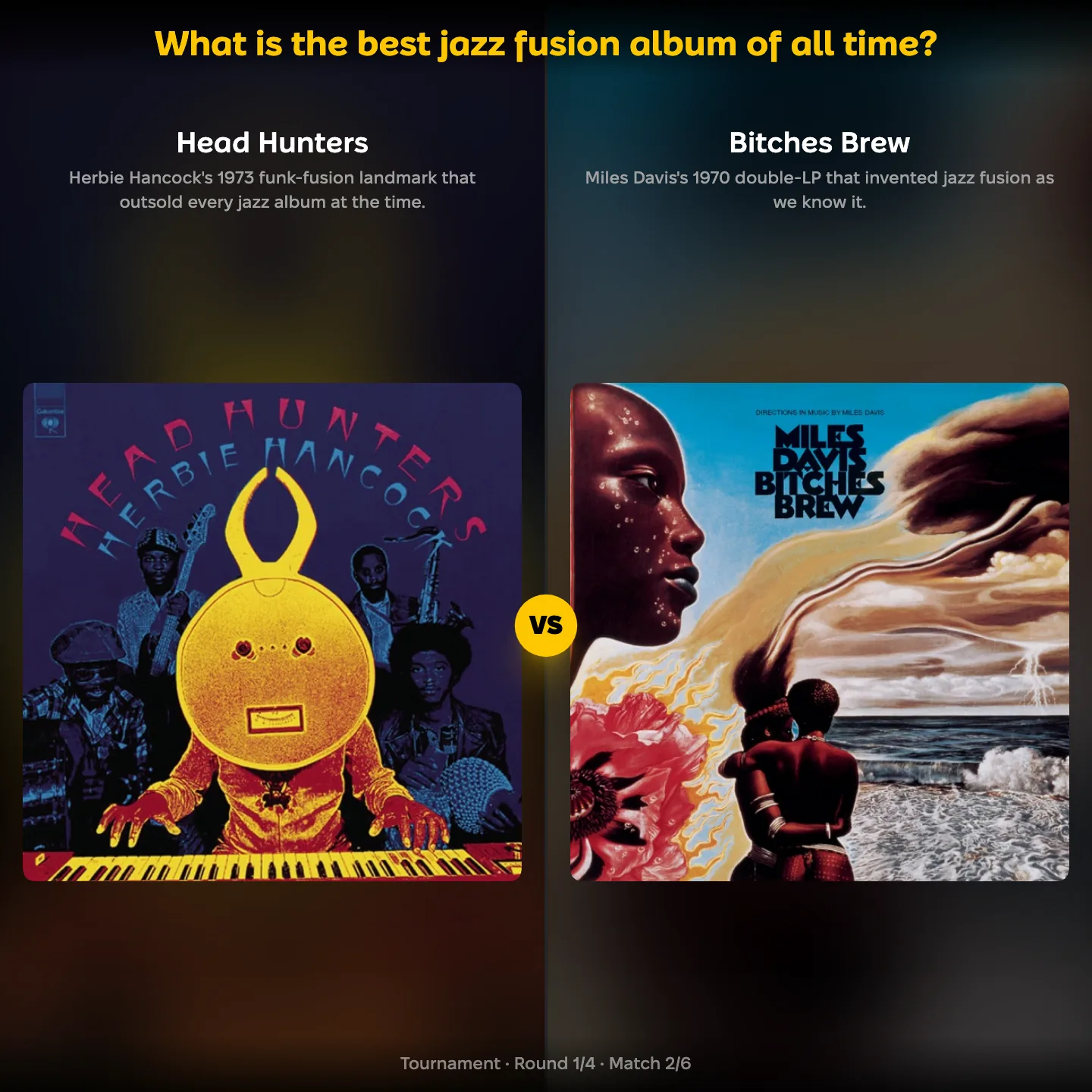
Charlie Parker vs John Coltrane on the saxophone's own list
Narrow the question to one instrument and Davis disappears, which makes this Coltrane's best-supported entry in the article.
Coltrane's standing here rests on more than records. In 2007 the Pulitzer board gave him a posthumous Special Citation for his improvisation and his place in the history of the music — an award that had almost never gone to a jazz musician.8
Charlie Parker is the obstacle, and it is a large one. Parker built the vocabulary that Coltrane learned, and he did it a decade earlier.
Sonny Rollins, Lester Young and Coleman Hawkins are also on the list, and Hawkins deserves the attention least likely to reach him: his 1939 recording of "Body and Soul" is the reason tenor players stopped stating the melody.
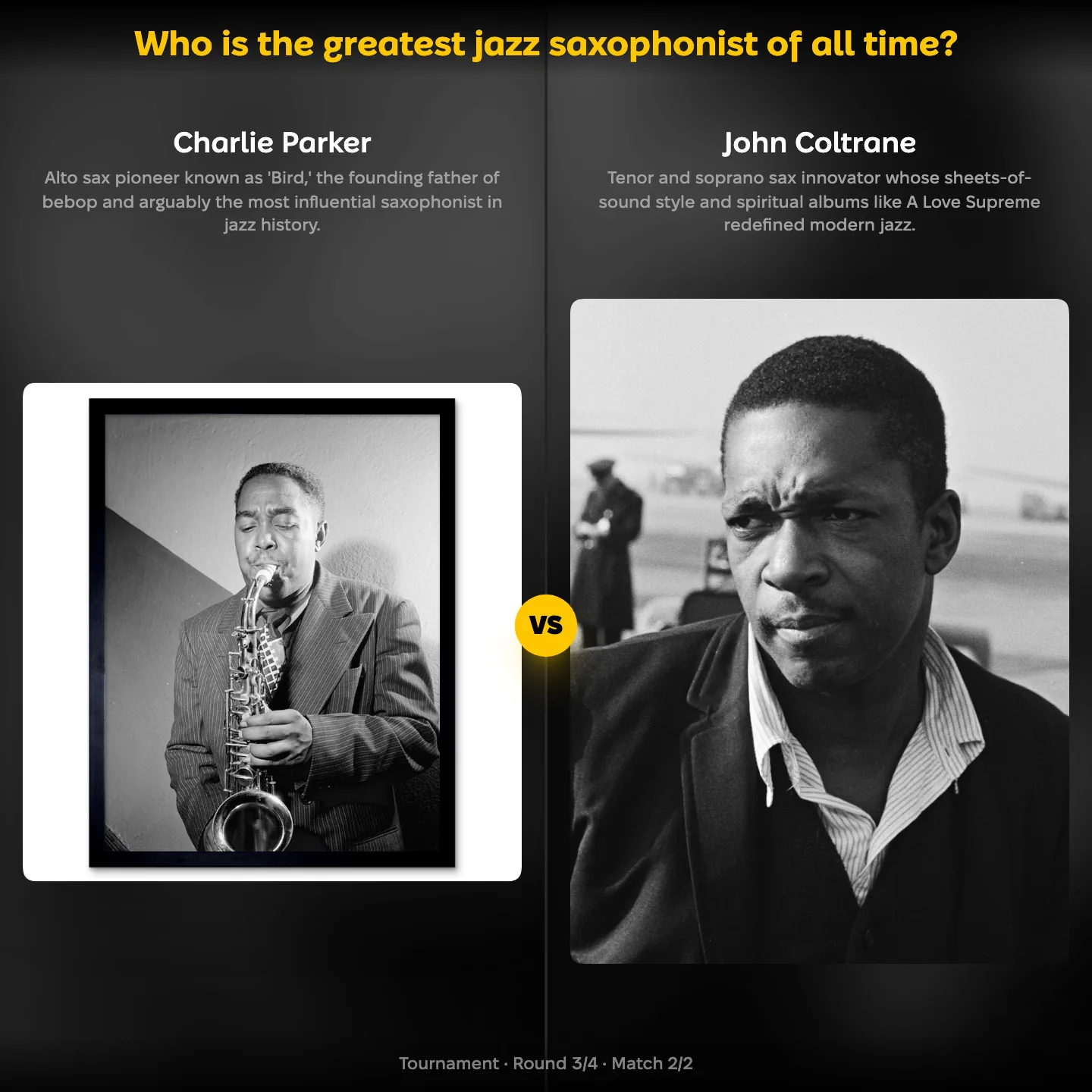
Alice Coltrane, Pharoah Sanders and what A Love Supreme started
Spiritual jazz is a category that mostly exists because of one record, and Davis is nowhere near it.
Coltrane wrote A Love Supreme at the house in Dix Hills, Long Island, where he lived with Alice Coltrane and their children from 1964 until his death.9 His 1966 album Meditations joins it, which shows how quickly the devotional turn hardened into a body of work.
Alice Coltrane appears twice under her own name, and Pharoah Sanders four times. Both played with Coltrane and both kept going for decades after he stopped.
Davis was making music about cities and electricity in the same years. No version of this category has room for him, which measures how far apart the two had travelled by 1966.
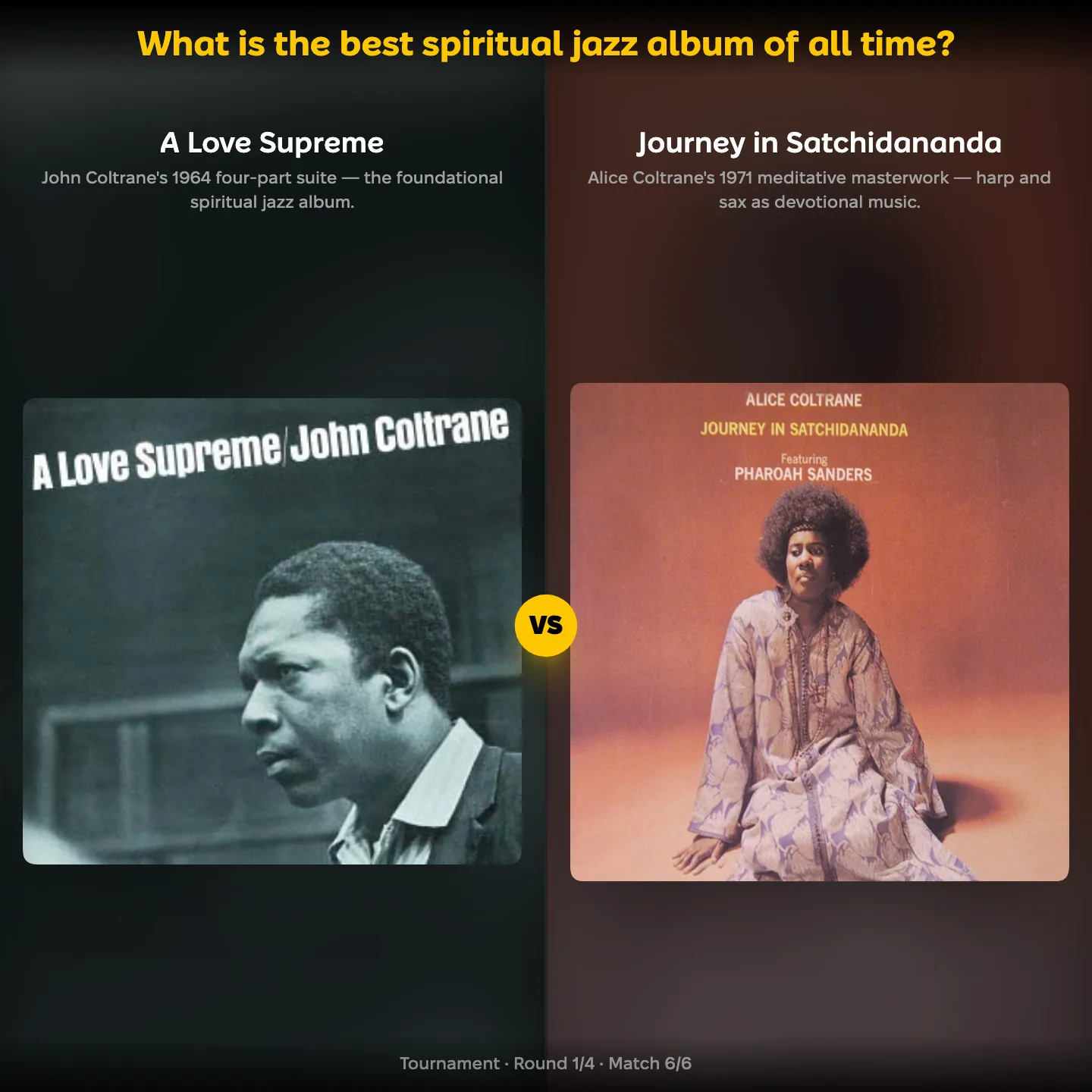
The price of Kind of Blue
Canonisation has a bill attached, and it arrives as a list like this one.
Davis's Kind of Blue and Coltrane's A Love Supreme are the obvious candidates for exactly the reason they win everything else: a record recommended to every newcomer for sixty years accumulates people who resent being told.
The complaints are specific rather than vague. Kind of Blue gets called dinner-party jazz by listeners who prefer Davis at his most difficult. A Love Supreme gets called a sermon by people who wanted the quartet's playing without the theology.
Brubeck's Time Out, Hancock's Head Hunters and Ornette Coleman's Free Jazz draw the same complaint for three different reasons: too neat, too commercial, too abrasive.
The sideman question never closes
Fifteen lists, and the split runs along a seam neither man chose: Davis had thirty-one more years to keep changing, Coltrane had seven to go as deep as he could into one idea. Sort by decade, by instrument, by influence or by who wrote the harder tune, and the two of them trade places without either one being wrong.
The Dix Hills house opens to visitors for the first time during the centenary year, which is a reasonable way to settle nothing at all.9
Each of these lists is built from straight head-to-head comparisons, so a small change to the question moves everything under it. Pick the question you find hardest and go and answer it.
More rankings, more angles
- The Beatles vs The Rolling Stones: 16 Lists That Can't Agree — the other rivalry that refuses to resolve
- Metallica: 20 Million Copies, One Snare Nobody Forgives — a band judged by its worst-loved sound
- What Kind of Best Is Michael Jackson? — one career, fifteen incompatible categories
Sources
- John Coltrane official site — COLTRANE 100 centennial programme and the 23 September 1926 birth date: johncoltrane.com (checked 2026-09-03)
- University Musical Society — both men born in 1926, and Coltrane's five years as a sideman in Davis's band between 1955 and 1960: ums.org (checked 2026-09-03)
- Miles Davis official site — Kind of Blue as the best-selling jazz album of all time and its RIAA multi-platinum certification: milesdavis.com (checked 2026-09-03)
- Universal Music — A Love Supreme recorded in a single session on 9 December 1964 at Van Gelder Studio with McCoy Tyner, Jimmy Garrison and Elvin Jones: universalmusic.ca (checked 2026-09-03)
- Blue Note Records — Blue Train, recorded 15 September 1957 and Coltrane's only session as a leader for the label: bluenote.com (checked 2026-09-03)
- Variety — A Love Supreme certified platinum in 2021, the first jazz album of the 1960s to reach the mark: variety.com (checked 2026-09-03)
- The Recording Academy — Bitches Brew, its 1971 Grammy for Best Jazz Performance – Large Group Or Soloist With Large Group, and Davis's first gold record in 1976: grammy.com (checked 2026-09-03)
- DownBeat — John Coltrane's posthumous Pulitzer Prize Special Citation, 2007: downbeat.com (checked 2026-09-03)
- The John and Alice Coltrane Home — the Dix Hills house where A Love Supreme was written, and its opening to visitors during the 2026 centennial: thecoltranehome.org (checked 2026-09-03)