
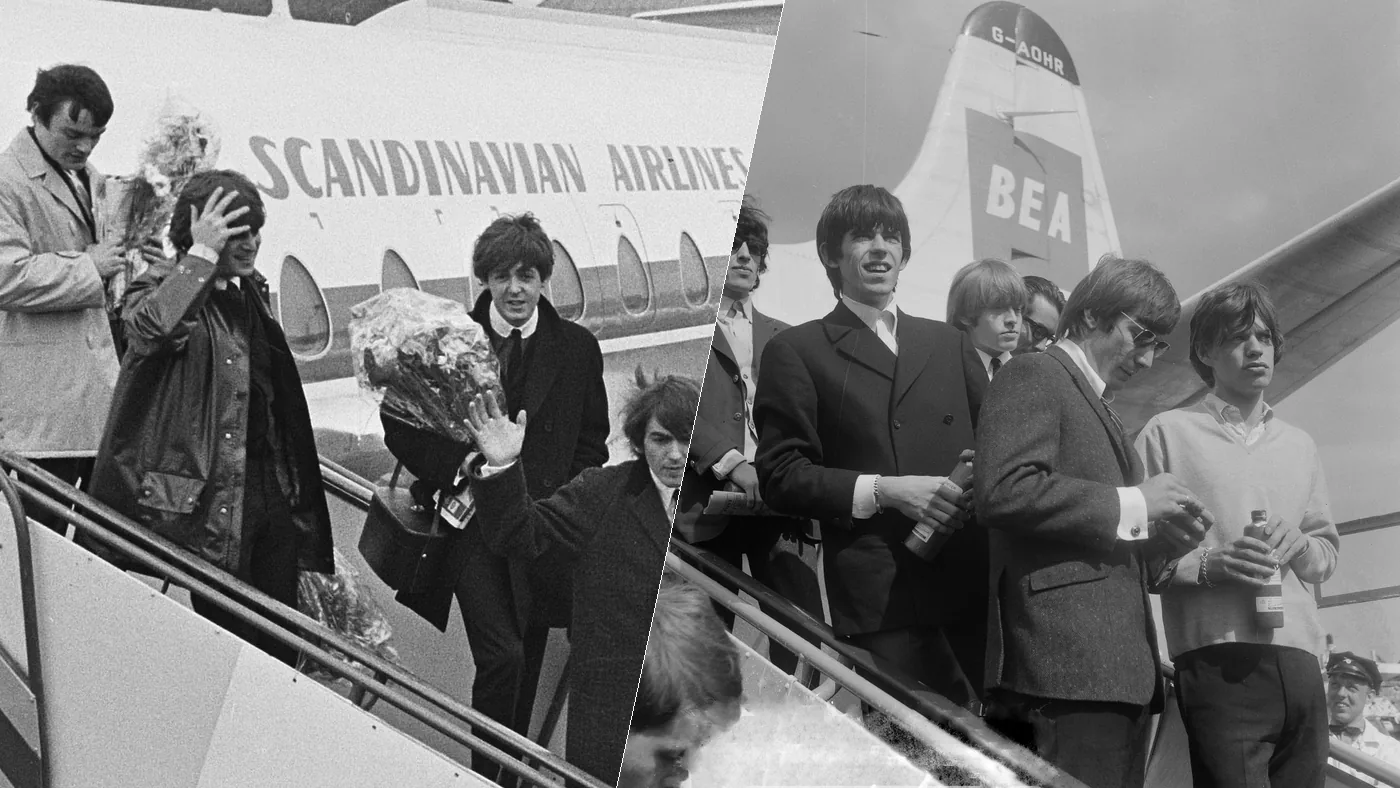
The Rolling Stones' second single was written by the band they have been compared to ever since. John Lennon and Paul McCartney handed them "I Wanna Be Your Man" in the autumn of 1963; it entered the UK chart on 20 November and stopped at number 12, the first Stones record to reach the top twenty.1
Sixty-three years later the two catalogues arrived at the same number. Foreign Tongues gave the Stones their fifteenth UK Number 1 album in July 2026, drawing them level with The Beatles, with only Robbie Williams ahead of both.2
The 16 rankings below hold both bands. Some of them cover seven years of recording, and some cover a career that has not stopped yet.
The Beatles were sold as the band your parents could like and the Stones as the band they could not. Six decades later that piece of marketing still decides which of these lists each one lands on.
The Beatles vs The Rolling Stones: a billion records against six decades
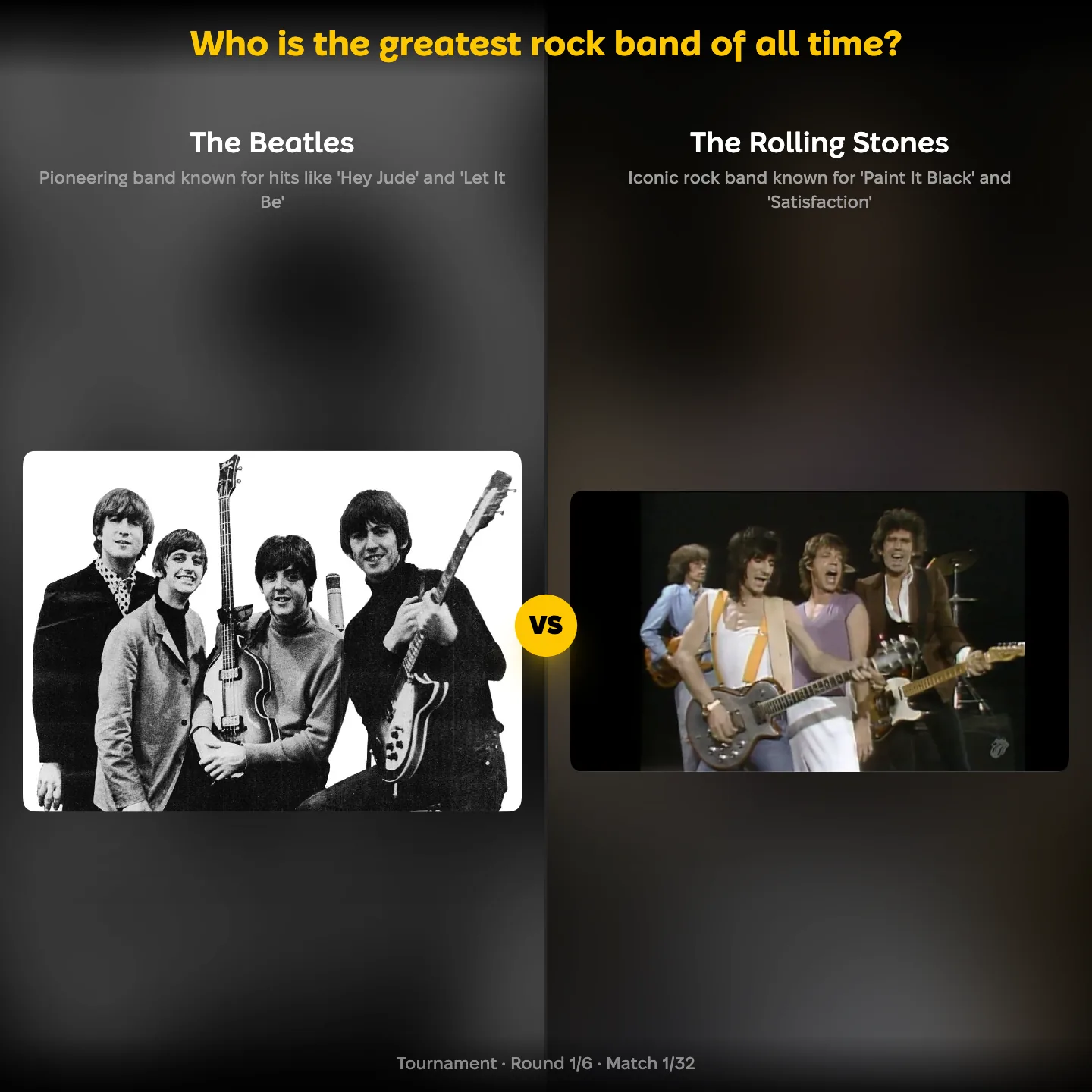
The widest question either band gets asked is "greatest rock band of all time", and this ranking runs to 64 names.
The Beatles hold the commercial record. EMI estimated their all-time sales at over one billion discs and tapes, the figure Guinness World Records cites in listing them as the best-selling group there has been.3
The Rolling Stones hold the thing The Beatles never got: duration. Mick Jagger inducted The Beatles into the Rock & Roll Hall of Fame in 1988,4 and Pete Townshend inducted the Stones the year after that,5 by which point The Beatles had been broken up for nineteen years and the Stones had four more decades of records ahead of them.
Led Zeppelin, Queen, Pink Floyd and Nirvana are on the same list of 64 — before either of these bands reaches the other, it has to get past most of rock.
Led Zeppelin, Queen and Pink Floyd make Britain the harder question
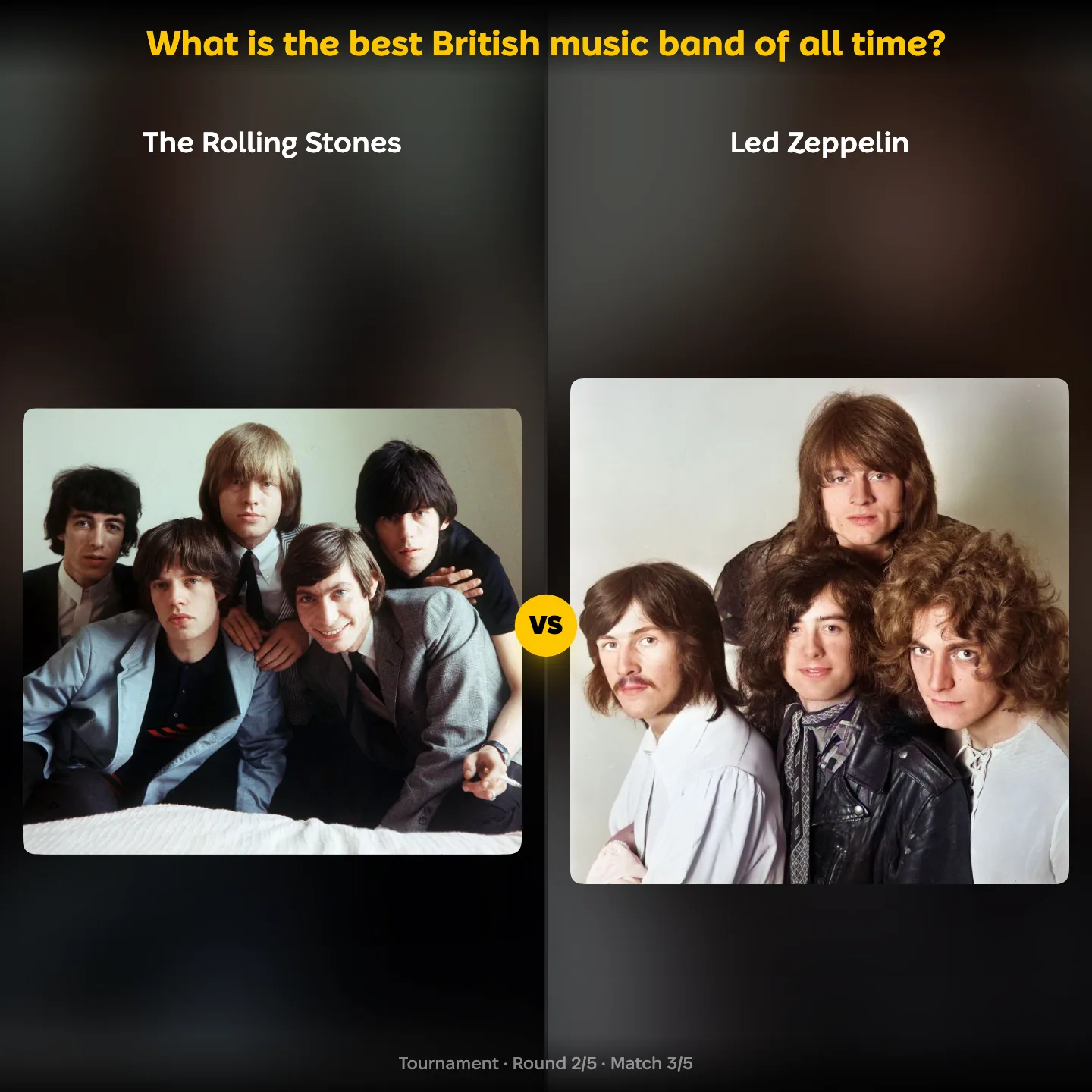
Both bands are British, so a British-only list should be where the argument has nowhere to hide. The Beatles came out of Liverpool; the Stones formed in London in 1962.
Britain narrows nothing. It also produced Led Zeppelin, Queen, Pink Floyd, Black Sabbath and The Who, and all five are among this ranking's twenty names.
Cutting the field from 64 to 20 raises the average opponent instead of lowering it. The two most famous names in British music now have Robert Plant and Freddie Mercury in front of them before they get anywhere near each other.
Led Zeppelin travel furthest of the five. Four musicians, a run of albums from 1969 to 1979, and a live reputation that outlived the band by decades.
Classic rock is a radio format, and The Who fit it better than The Beatles
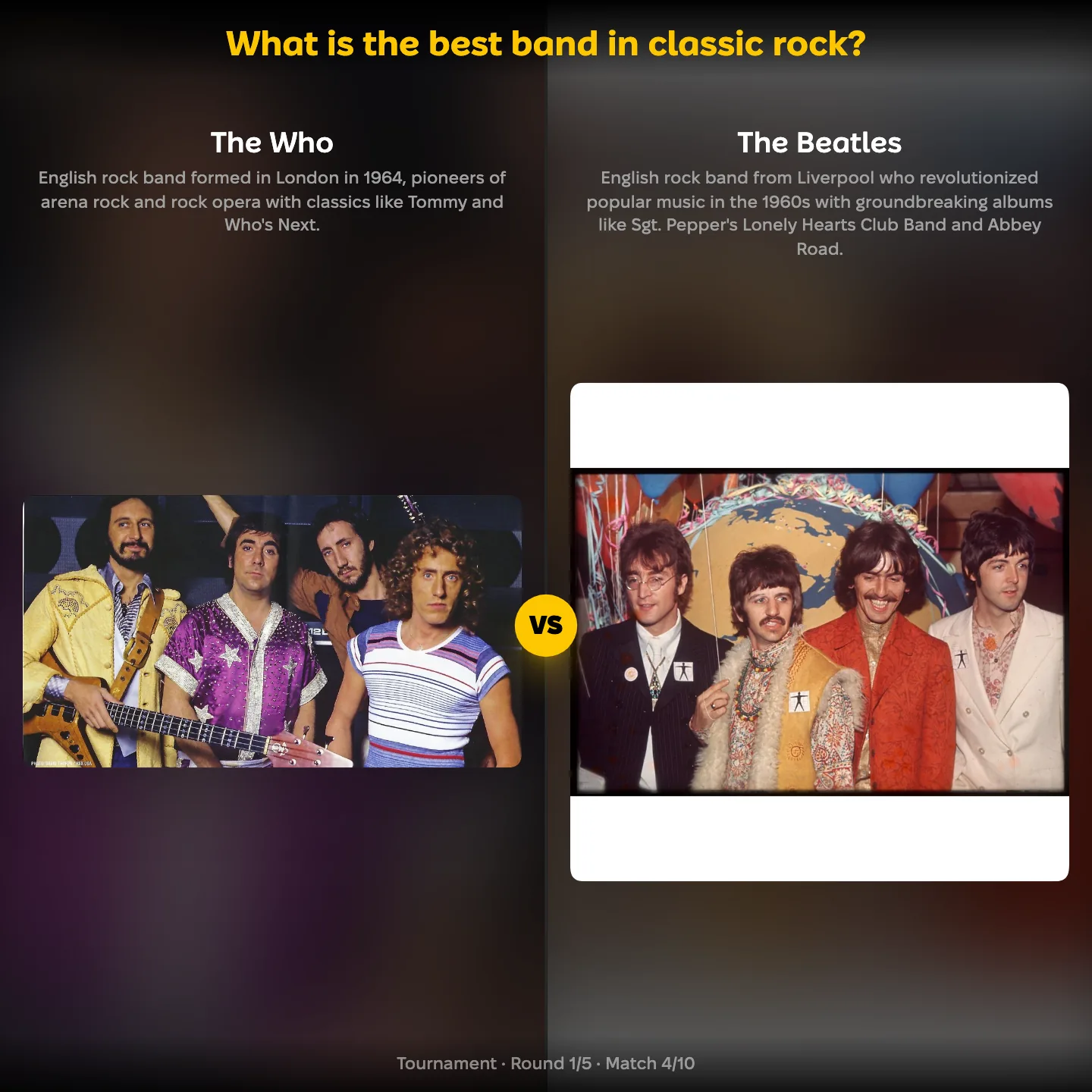
Classic rock is a format, not a period. American FM programmers assembled it through the 1970s and 1980s around guitar bands with long careers and big live followings.
The Rolling Stones are the ideal case for the format. Riffs, tours, decades, and a back catalogue a station can rotate forever.
The Beatles fit it badly. They played their last ticketed concert at Candlestick Park in San Francisco on 29 August 1966,6 a decade before the format existed, and half their catalogue sits closer to studio pop than to arena rock.
The Who are on this list too, and they are what the category rewards: formed in London in 1964, Tommy in 1969, and a reputation built on volume in a room rather than precision in a studio.
Abbey Road, Revolver and Exile on Main St.: seven records, two bands
At album level neither of them gets a single entry. This ranking of 64 albums holds seven between them.
The Beatles have four: Abbey Road, Revolver, the White Album and Sgt. Pepper's, which took Album of the Year at the 1968 Grammy Awards.7
The Rolling Stones have three: Exile on Main St., Let It Bleed and Sticky Fingers. The Recording Academy has all three in the Grammy Hall of Fame, along with Beggars Banquet.8
Seven entries between two bands is a problem for both of them rather than a compliment to either. Four beloved records in one list give a band four ways to split the people who love it — one undisputed masterpiece gives none of that difficulty.
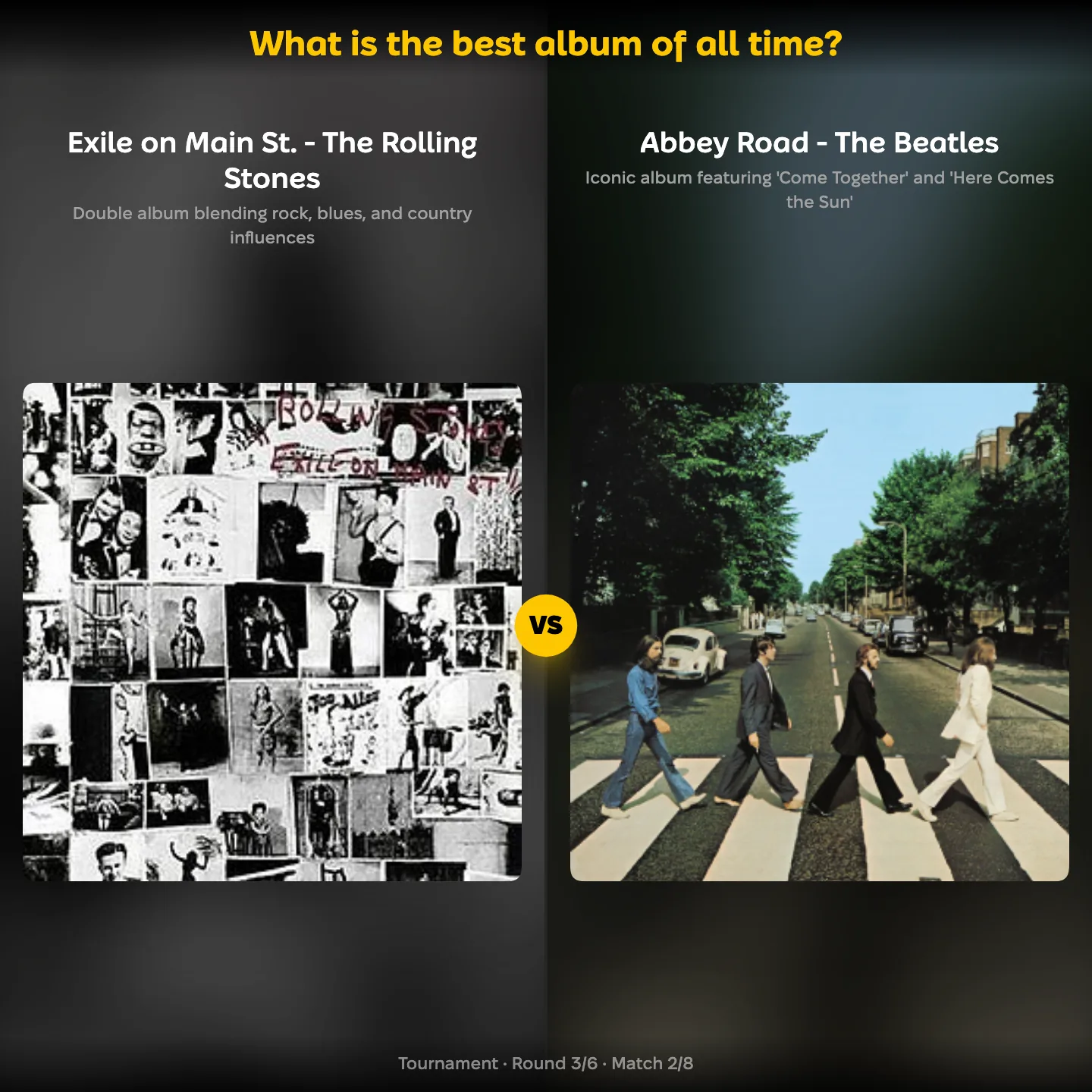
Revolver or Exile on Main St. for the rest of your life
The desert-island question judges the same records by a different rule. It asks which one you could live with on repeat for years, a separate matter from which is the greater achievement.
Revolver is the usual Beatles answer, more often than Sgt. Pepper's is. Fourteen songs, no concept, nothing that needs explaining, and the sound of four musicians finding out what a studio could do.
Exile on Main St. is the Stones' answer, and it wins on sheer volume: eighteen tracks cut largely in the basement of a rented villa in the south of France, murky enough that people are still finding things in it.
The desert-island rule treats perfection badly. A flawless forty-minute record can be exhausting by the tenth listen; a sprawling, half-audible double album rarely is.
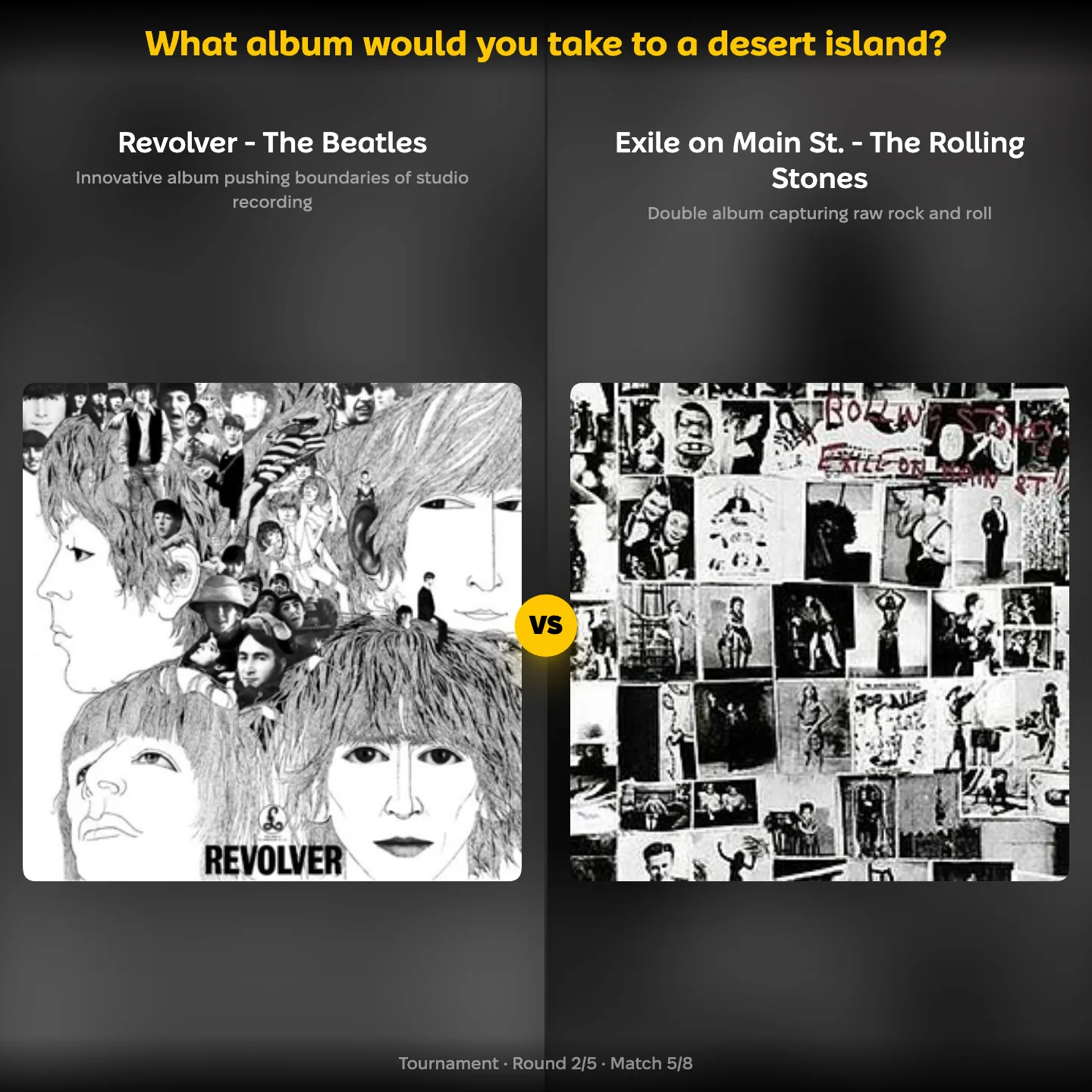
Beggars Banquet and Let It Bleed against four Beatles records
The 1960s is the one decade both bands spent entirely at full strength, so a 1960s album list comes closest here to matched conditions.
The 1960s list still comes out lopsided. The Beatles put four records into this ranking's fifteen; the Stones put two, Beggars Banquet from 1968 and Let It Bleed from 1969, both of which the Recording Academy later inducted into its Hall of Fame.8
Beggars Banquet is where the Stones dropped psychedelia and went back to the blues, and it carries "Sympathy for the Devil" and "Street Fighting Man". Its sleeve has a story of its own: the original design photographed a lavatory wall, Decca refused it, and the record shipped in a plain engraved invitation instead.
Four entries against two is not the same as being twice as good. It is a recording career of seven years against a band that was still finding its register in 1968.
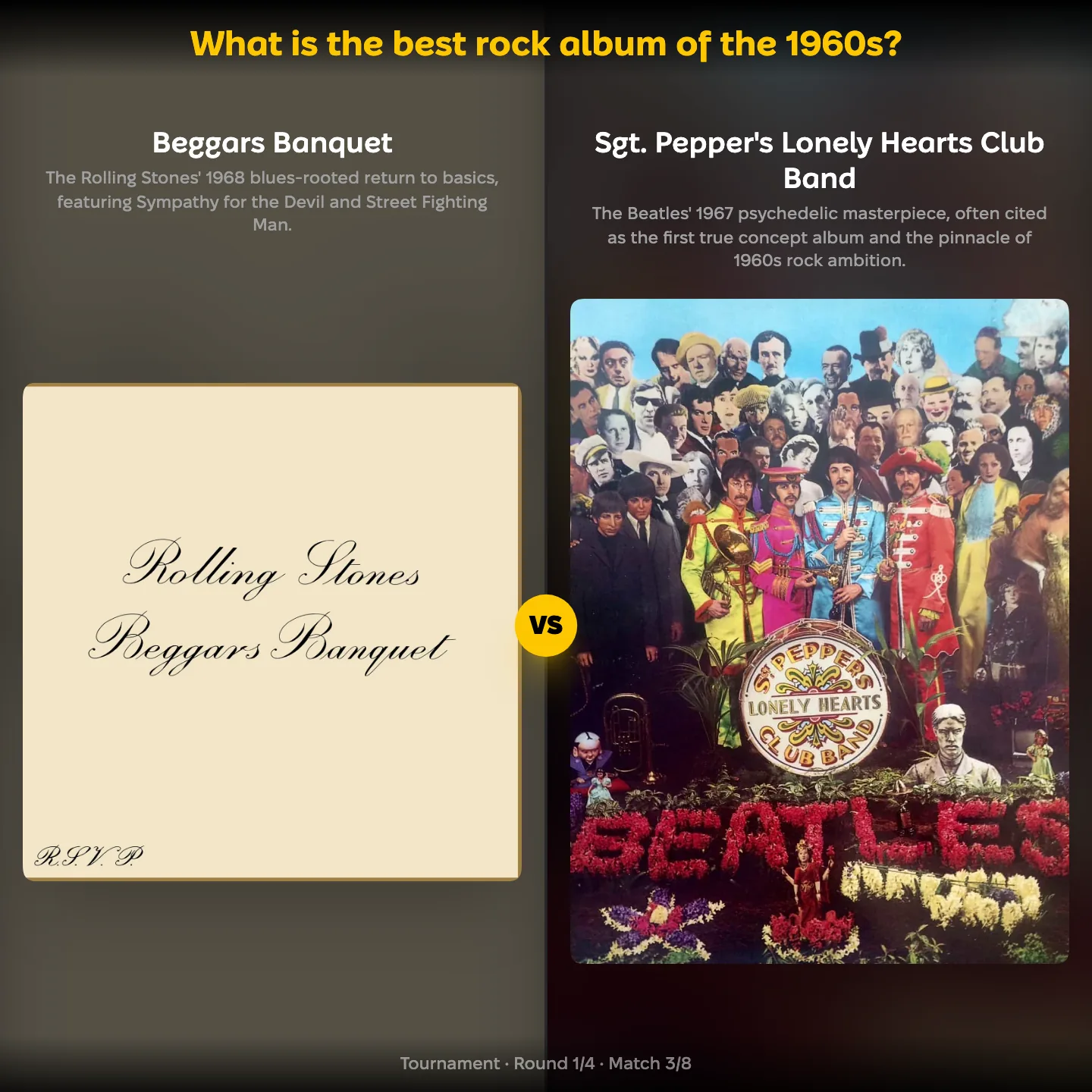
Bob Dylan's "Like a Rolling Stone" against "Hey Jude" and "Gimme Shelter"
Songs stop this being a two-band race, because one great single needs no career behind it.
The Beatles bring "Hey Jude", seven minutes long with a four-minute singalong coda that no radio programmer had asked for. "A Day in the Life" and "Strawberry Fields Forever" are in the same 18.
The Rolling Stones bring "Gimme Shelter" and "(I Can't Get No) Satisfaction", a riff Keith Richards taped half-asleep in a hotel room and expected to throw away. "Satisfaction" has a Hall of Fame entry of its own.8
Bob Dylan arrives with "Like a Rolling Stone", six minutes long in 1965, which broke the three-minute radio convention before either band tried. Jimi Hendrix, The Who and The Kinks are in there too, and none of them need a discography to make the case.
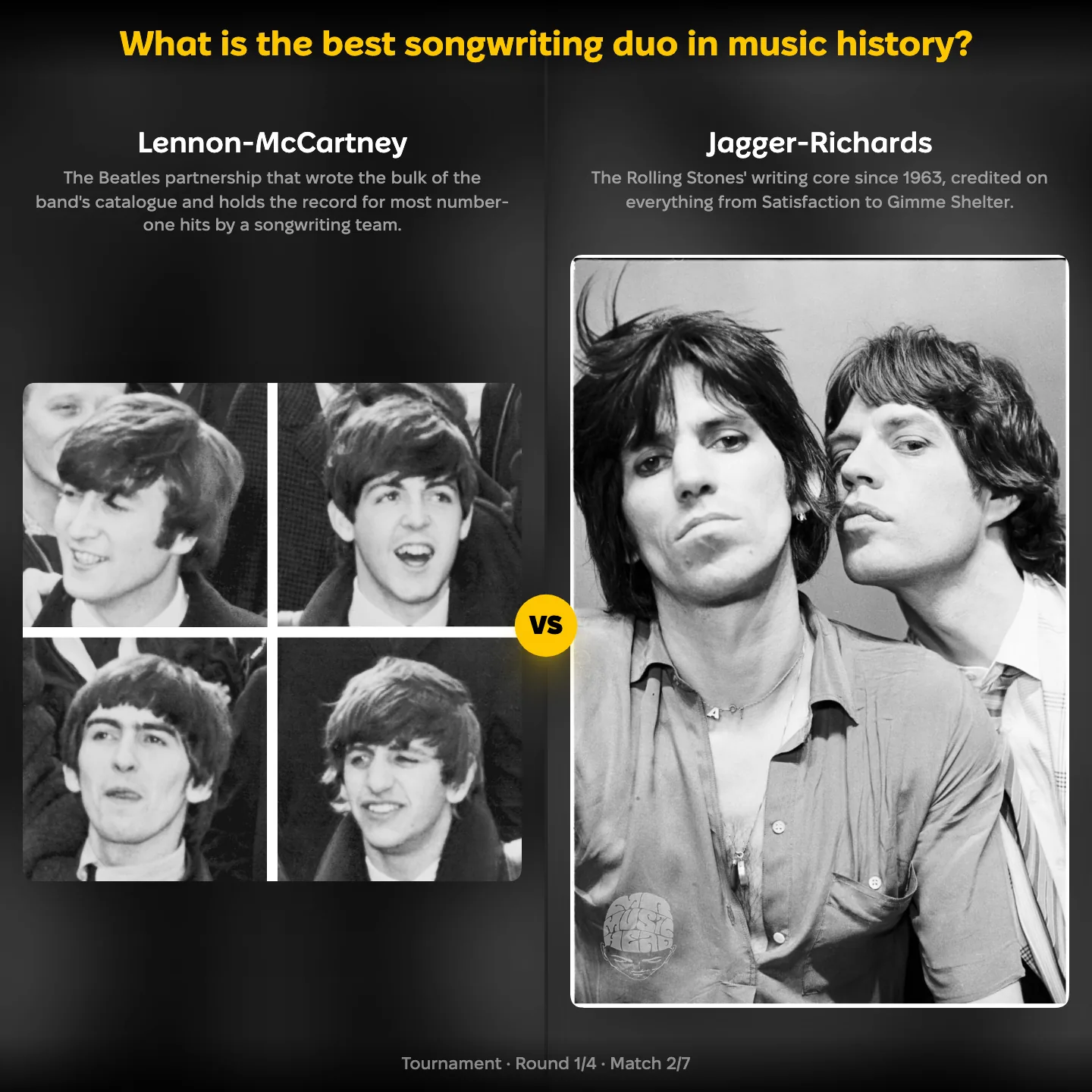
Lennon–McCartney vs Jagger–Richards: 18 UK Number 1 singles against 8
This ranking takes the bands out and puts the credit lines in, a narrower test and one both partnerships pass.
Lennon–McCartney set the benchmark. The Official Charts Company credits The Beatles with 18 UK Number 1 singles and 70 weeks at the top of the chart,9 almost all of it written by the two of them.
Jagger–Richards have been the Stones' writing core since 1963. Their band's chart record opens with "Come On" on 31 July 1963 and reaches eight UK Number 1 singles,10 and the partnership exists because Lennon and McCartney gave them a song and Andrew Loog Oldham decided that would not happen twice. McCartney's name is on Stones records at both ends of the story: he is among the guests on Foreign Tongues.14
The other credit lines are the interesting part. Elton John and Bernie Taupin have written together since 1967, mostly by post; Gerry Goffin and Carole King wrote for other people's voices; Jerry Leiber and Mike Stoller more or less invented the job.
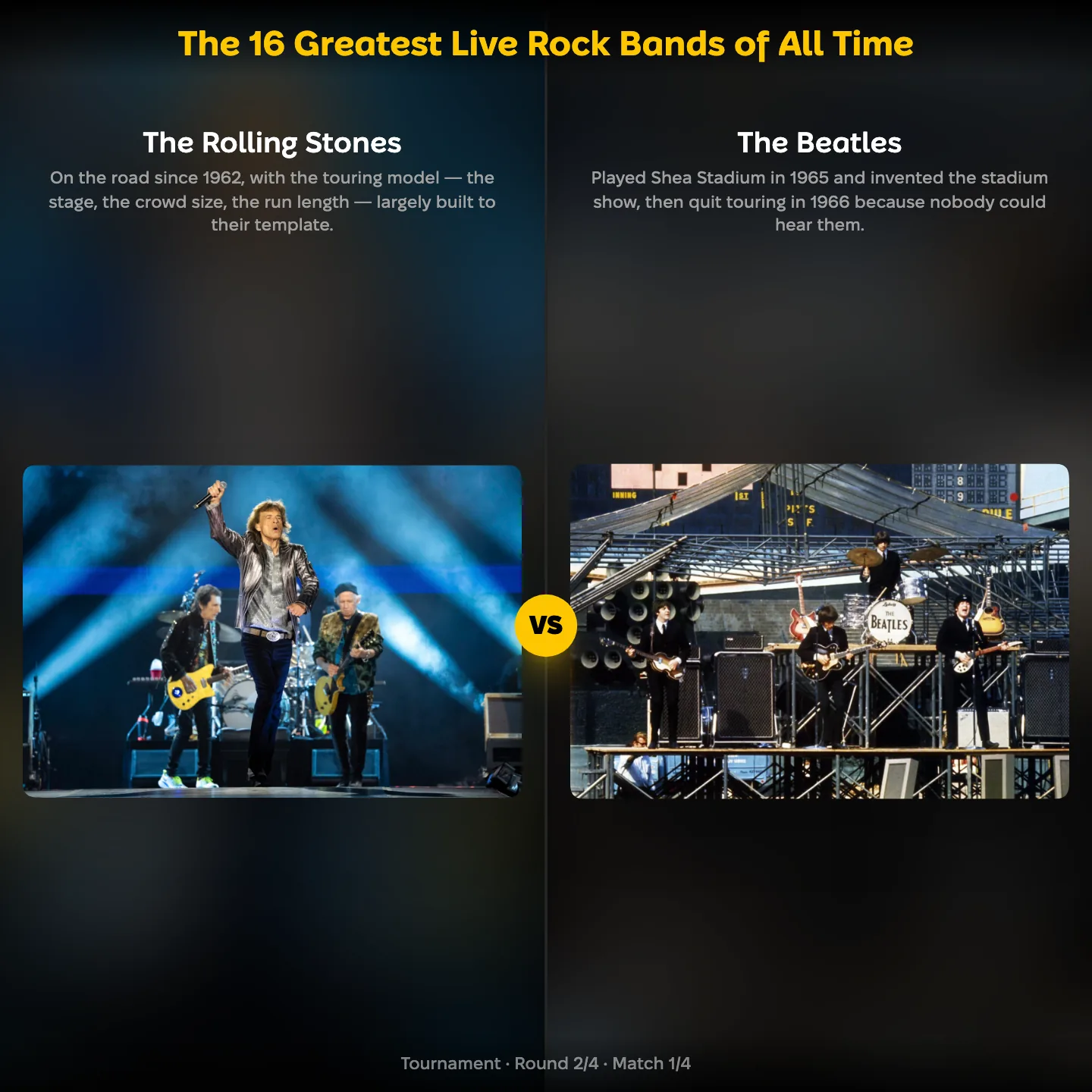
Candlestick Park, 1966 against A Bigger Bang, 2005–07
Live work is the one comparison here with money attached to it, and the two bands are not on the same scale.
The Beatles invented the form and then quit it. Their Shea Stadium show on 15 August 1965 was the first major stadium rock concert,11 and thirteen months later they walked off in front of a paying audience for the last time.6
The Rolling Stones went the other way. Their A Bigger Bang tour of 2005–07 grossed $558,255,524, which stood as the highest gross by any group until U2's 360° Tour passed it at $736,421,584.12
Neither of them owns this list of 16. Bruce Springsteen and the E Street Band play three and four hours without a fixed setlist, and Queen are on it largely for one set at Wembley in 1985.
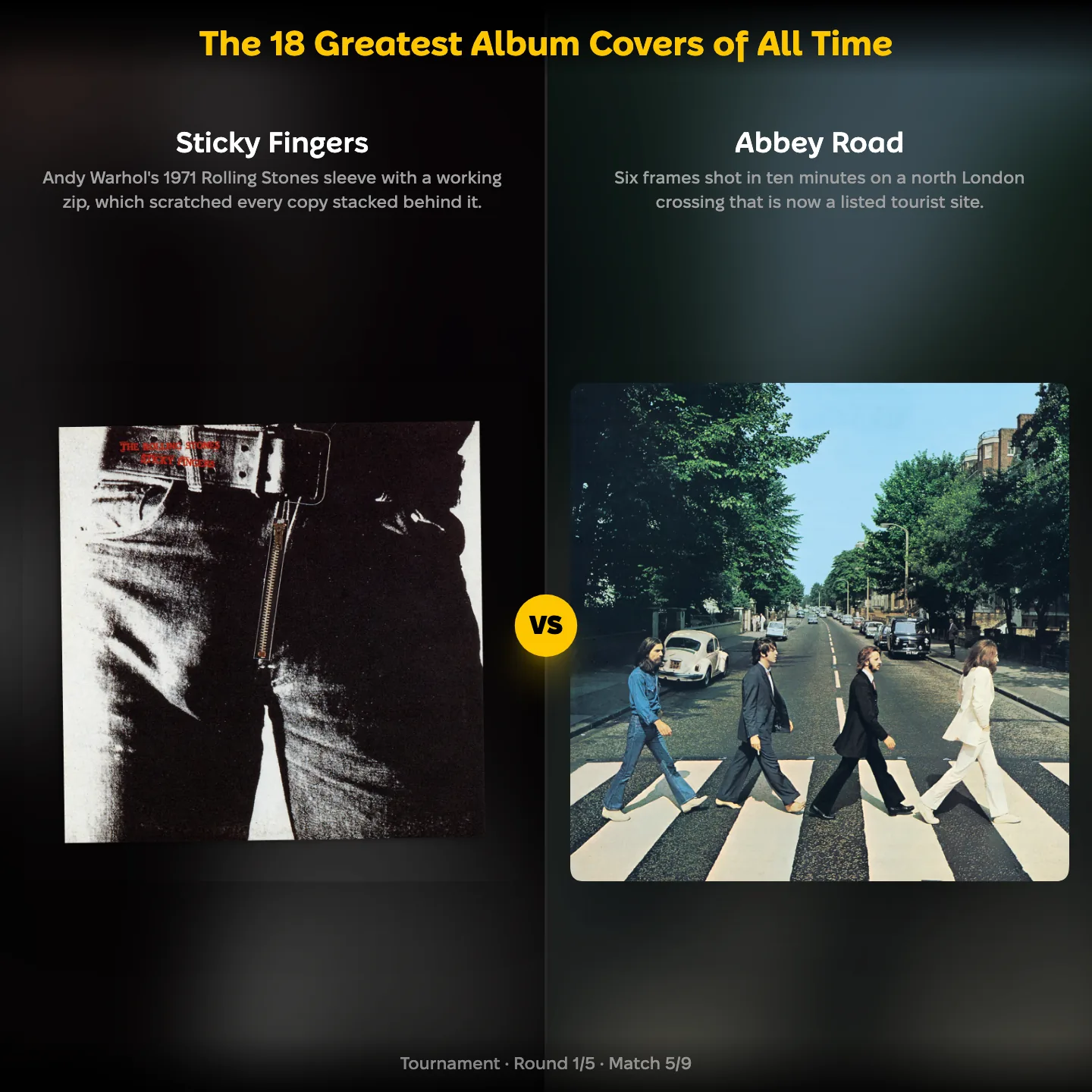
Peter Blake's Sgt. Pepper crowd against Andy Warhol's Sticky Fingers zip
Album covers judge the packaging and ignore the record, which sounds trivial until you notice both bands hired fine artists for the job.
The Beatles commissioned Peter Blake and Jann Haworth in 1967, and the pop-art crowd of cut-out faces those two built won the Recording Academy's award for Best Album Cover, Graphic Arts.7 Abbey Road is in the same 18, and tourists still queue to walk over the crossing it was photographed on.
The Rolling Stones hired Andy Warhol for Sticky Fingers in 1971 and got a working zip, which scratched every copy stacked behind it in the shops.
Both bands also face sleeves that made their name with no famous band attached: the Hipgnosis prism for Pink Floyd, Peter Saville's pulsar plot for Unknown Pleasures, and Warhol's banana for The Velvet Underground.
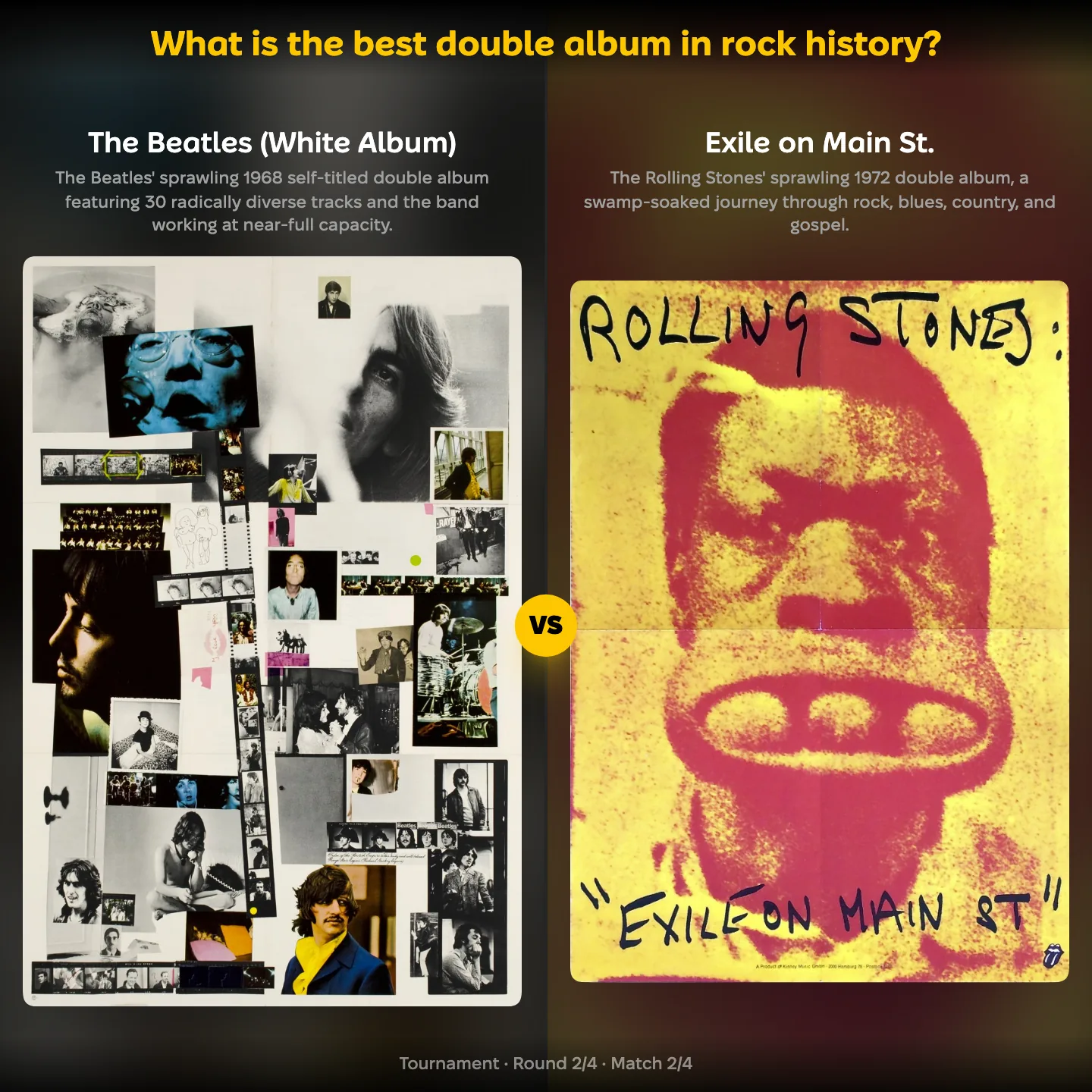
The White Album vs Exile on Main St.: one entry each
The double album is the one category that gives each band exactly one record, so the split-vote problem disappears.
The Beatles' entry is the White Album, 1968: thirty tracks, four musicians working largely in separate rooms, and a record that is either the fullest portrait of a band or the sound of one coming apart.
The Stones' entry is Exile on Main St., 1972, with vocals buried so far down in the mix that its reputation took a decade to catch up with it.
The two records make opposite arguments for the format. One says a double album should hold everything a band can do; the other says it should sound like a single long night.
"A Day in the Life" vs "Yellow Submarine", with the Stones nowhere in it
Some rankings have no room for the other side. This one is 32 Beatles songs, and the Rolling Stones are absent from it.
This ranking asks which version of the same band you prefer. "A Day in the Life" ends Sgt. Pepper's with two unfinished fragments joined by a forty-piece orchestral crescendo. "Yellow Submarine" is a children's song sung by the drummer.
Both are The Beatles, three years apart — no list of 32 songs can hold a band that contained both without contradicting itself somewhere.
The catalogue also keeps growing without the band in it. "Now And Then", built from a John Lennon home demo, won Best Rock Performance at the 2025 Grammy Awards, fifty-five years after the split, and it is one of eight Grammys The Beatles have won from 25 nominations.13
"Sympathy for the Devil" and "Paint It Black" settle it between themselves
Thirty-two Rolling Stones songs with no Beatles in the field is the mirror of the previous ranking, and a fairer test of the Stones than any shared list gives them.
"Sympathy for the Devil" opens Beggars Banquet in 1968 as a samba whose narrator introduces himself politely and turns out to be the Devil. "Paint It Black" is two years earlier and much simpler: a sitar, a minor key, and a number one on both sides of the Atlantic.
"Gimme Shelter", "Brown Sugar" and "Start Me Up" are in the same 32, which is the useful part. The Stones' singles run across four decades where The Beatles' run across seven years.
The length of the Stones' run cuts both ways. A list this long has room for the 1980s, and the 1980s are where the phrase "not their best period" was invented.
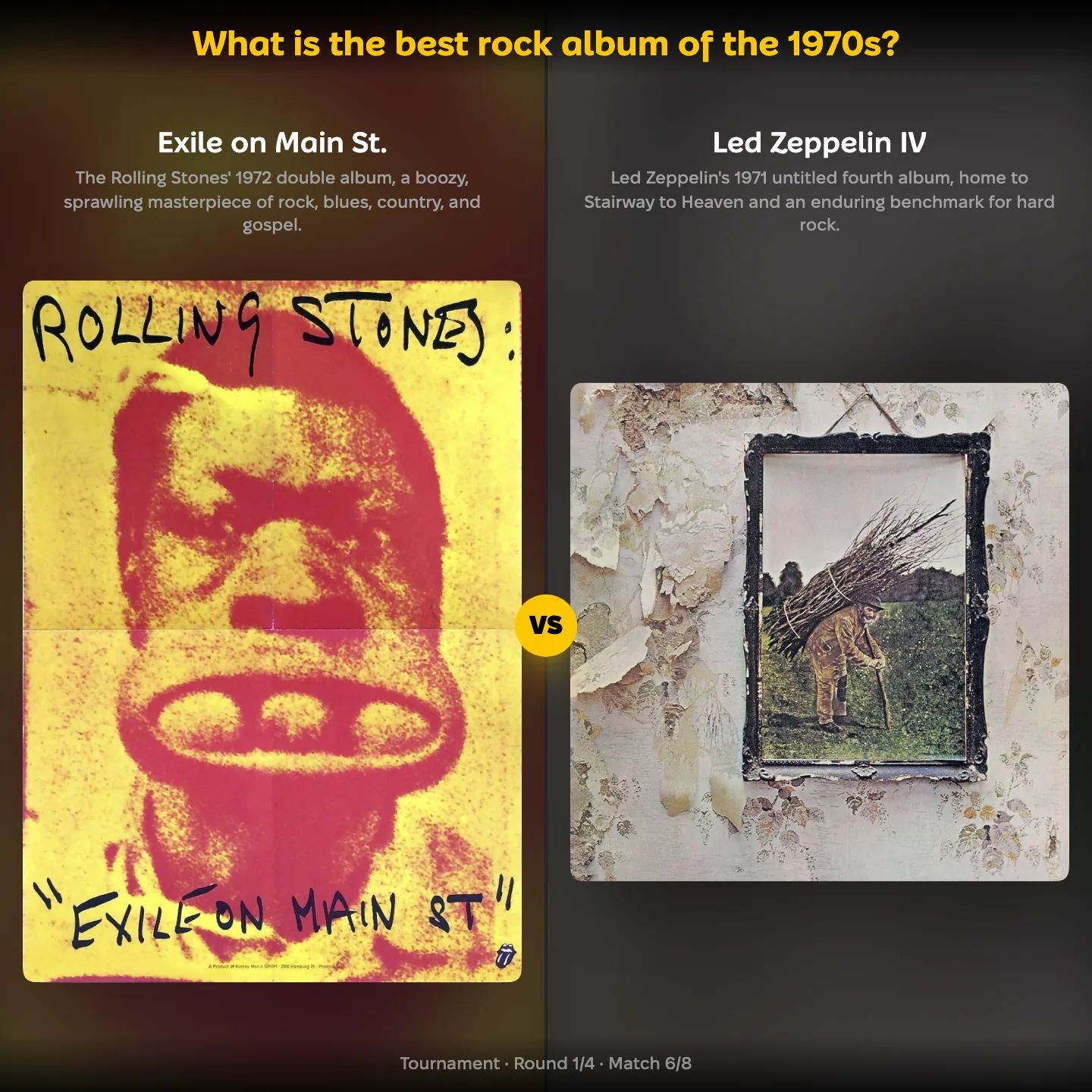
Sticky Fingers, Exile and Some Girls: the decade The Beatles missed
The 1970s list needs no opinion at all. The Beatles broke up in April 1970 and have nothing to enter in it.
The Rolling Stones spent the decade at their peak: Sticky Fingers in 1971, Exile on Main St. in 1972, Some Girls in 1978. Some Girls brought the band their first Grammy nomination, for Album of the Year.8
The 1970s are the ten years this comparison does not cover, and a large part of why the two careers are so hard to weigh against each other. One of them is closed and countable; the other keeps filing new evidence.
The Stones do not own this decade either. The Dark Side of the Moon, Led Zeppelin IV and Rumours are all among the options.
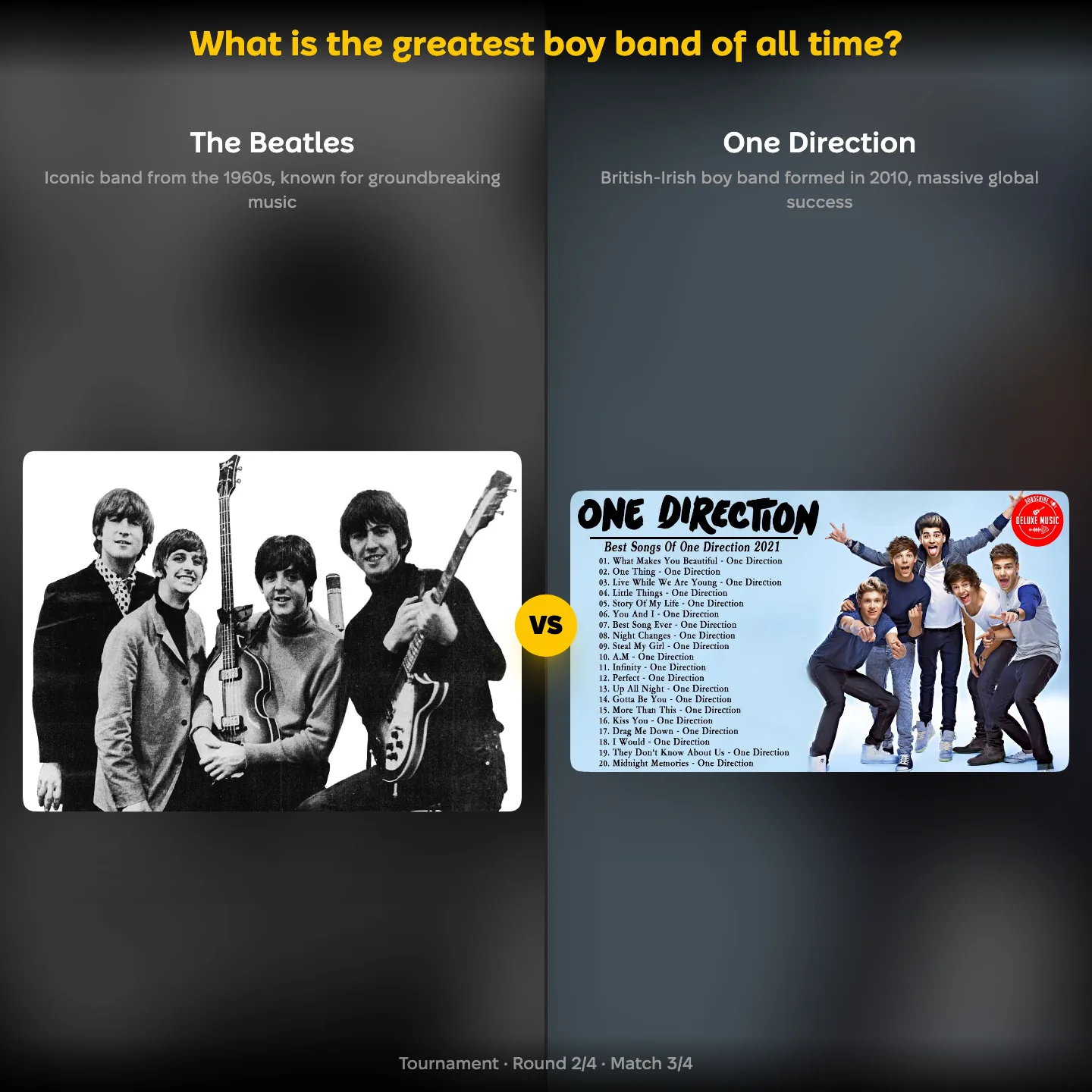
One Direction, the Jackson 5 and The Beatles in matching suits
Every list so far has flattered somebody. This one puts The Beatles in a boy-band ranking with One Direction, the Backstreet Boys, *NSYNC and the Jackson 5.
The claim is not absurd, which is what makes it uncomfortable. Four young men, matching suits, a manager who built the image, and audiences loud enough to drown the band out — "I Want to Hold Your Hand" sold 12 million copies worldwide and remains the biggest single they ever had.4
The Rolling Stones do not appear here, and were never going to. They were marketed from the start as the group your parents would not want in the house, the same industry playing the opposite card.
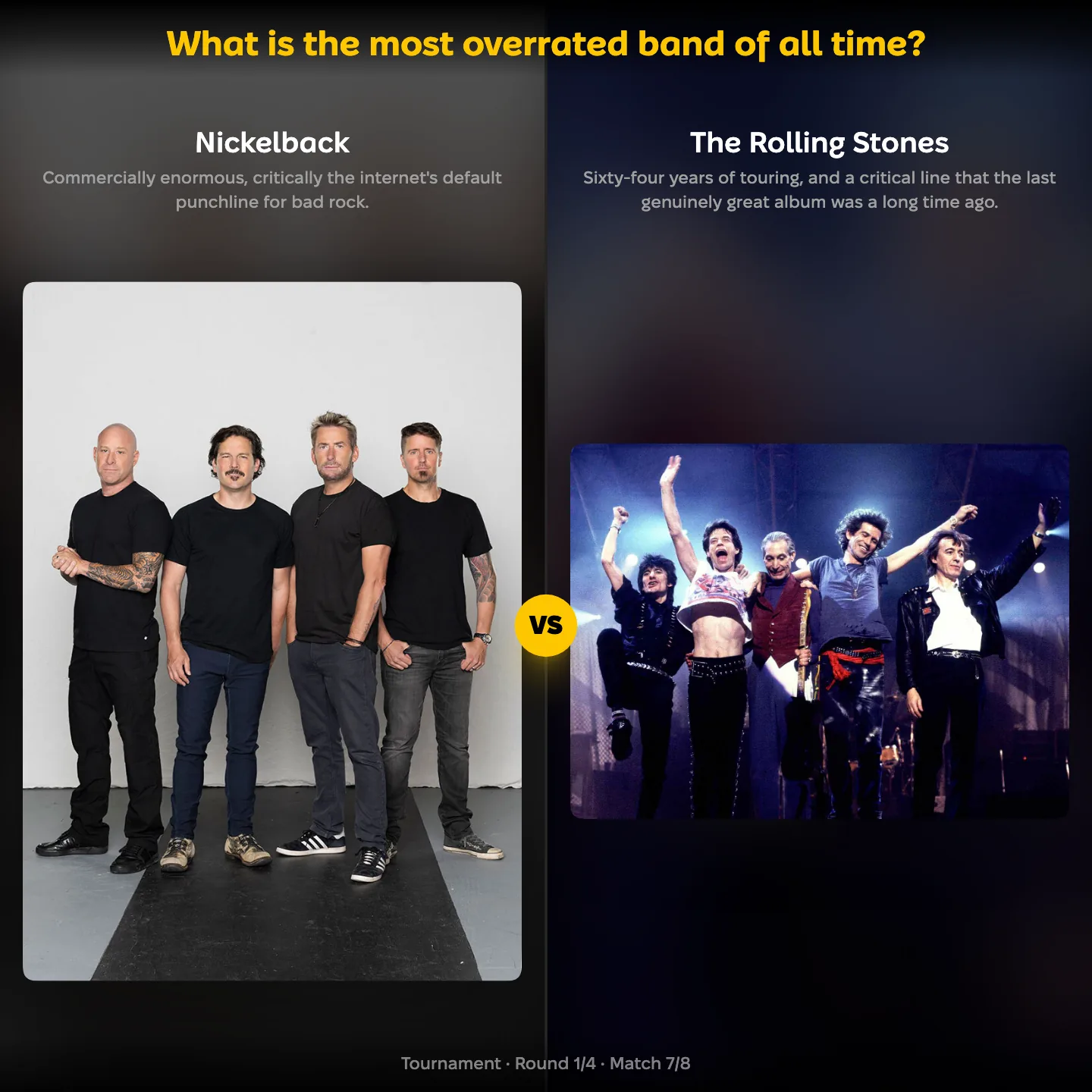
The packaging still sorts them. One of these bands shares a list with One Direction; the other shares one with Nickelback.
Nickelback, U2 and Oasis: the list where fame is the entry requirement
The last ranking inverts the criterion. It asks which reputations run further than the records underneath them, a different question from which records are good.
The Beatles are the obvious entry precisely because they win everything else. A band named greatest in almost every list ever compiled has the largest possible gap to defend.
The Rolling Stones have the opposite exposure. Sixty-four years is a long time to keep a reputation topped up, and the critical line about their last genuinely great record usually points somewhere in the 1970s. Eric Clapton handed them a Lifetime Achievement Award in 1986, and their four competitive Grammy wins include Hackney Diamonds in 2025.8
Nickelback, Coldplay, U2 and Oasis fill out the same 16, which is the point of the exercise. Getting on this list at all requires being famous enough to be overrated, and both of these bands clear that bar without trying.
The Beatles keep the awards, the Stones keep the calendar
Sixteen questions, and the 1963 packaging decision keeps showing through the answers. The Beatles take the boy-band list and the Grammy for a sleeve; the Stones take the touring money and a place among the overrated. Nothing either band recorded afterwards moved them off those lists.
Only one half of this rivalry can still move, because only one of the two bands has records left to release. To see how an order like this gets built, here is what happens when you settle one pair at a time.
And if the record you would defend to the death is Some Girls rather than Revolver, that is a ranking waiting to be built.
More rankings, more angles
- Beyoncé Doesn't Rank the Same Way Twice — 35 Grammys, four Album of the Year defeats
- How Many Ways Can You Rank Madonna? — one Golden Globe, five Razzies
- Miles Davis vs John Coltrane: Who Wins Which List? — both born 1926, one Kind of Blue
- Metallica: 20 Million Copies, One Snare Nobody Forgives — a Library of Congress album and a snare drum
Sources
- Official Charts Company — "I Wanna Be Your Man" by the Rolling Stones: peak position 12, first chart date 20 November 1963, 16 weeks on the chart: officialcharts.com (checked 2026-08-03)
- Official Charts Company — Foreign Tongues gives the Rolling Stones their 15th Official Number 1 album, level with The Beatles on 15 apiece, with only Robbie Williams ahead on 16: officialcharts.com (checked 2026-08-03)
- Guinness World Records — best-selling group: The Beatles, with all-time sales estimated by EMI at over one billion discs and tapes: guinnessworldrecords.com (checked 2026-08-03)
- Rock & Roll Hall of Fame — The Beatles inducted in 1988 as performers, inducted by Mick Jagger, and "I Want to Hold Your Hand" as their best-selling single at 12 million copies worldwide: rockhall.com (checked 2026-08-03)
- Rock & Roll Hall of Fame — The Rolling Stones inducted in 1989 as performers, inducted by Pete Townshend: rockhall.com (checked 2026-08-03)
- The Beatles (official site) — the last ticketed Beatles concert, Candlestick Park, 29 August 1966: thebeatles.com (checked 2026-08-03)
- The Recording Academy — 10th Annual Grammy Awards: Album of the Year and Best Album Cover, Graphic Arts (Peter Blake and Jann Haworth) for Sgt. Pepper's Lonely Hearts Club Band: grammy.com (checked 2026-08-03)
- The Recording Academy — The Rolling Stones: four Grammy wins from 13 nominations including Best Rock Album for Hackney Diamonds in 2025, the 1986 Lifetime Achievement Award presented by Eric Clapton, the first nomination (Album of the Year for Some Girls, for 1978), and the Grammy Hall of Fame entries for Beggars Banquet, Let It Bleed, Sticky Fingers, Exile on Main St. and "(I Can't Get No) Satisfaction": grammy.com (checked 2026-08-03)
- Official Charts Company — The Beatles: 18 UK Number 1 singles and 70 weeks at Number 1: officialcharts.com (checked 2026-08-03)
- Official Charts Company — The Rolling Stones: eight UK Number 1 singles, first chart entry "Come On" on 31 July 1963: officialcharts.com (checked 2026-08-03)
- The Beatles (official site) — the Shea Stadium concert of 15 August 1965 as the first major stadium rock concert: thebeatles.com (checked 2026-08-03)
- Guinness World Records — highest-grossing music tour by a group: U2's 360° Tour at $736,421,584, which passed the $558,255,524 grossed by the Rolling Stones' A Bigger Bang tour of 2005-07: guinnessworldrecords.com (checked 2026-08-03)
- The Recording Academy — The Beatles: eight Grammy wins from 25 nominations, including Best Rock Performance for "Now And Then" in 2025: grammy.com (checked 2026-08-03)
- Official Charts Company — Foreign Tongues announced for 10 July, with guest appearances including Paul McCartney: officialcharts.com (checked 2026-08-03)