
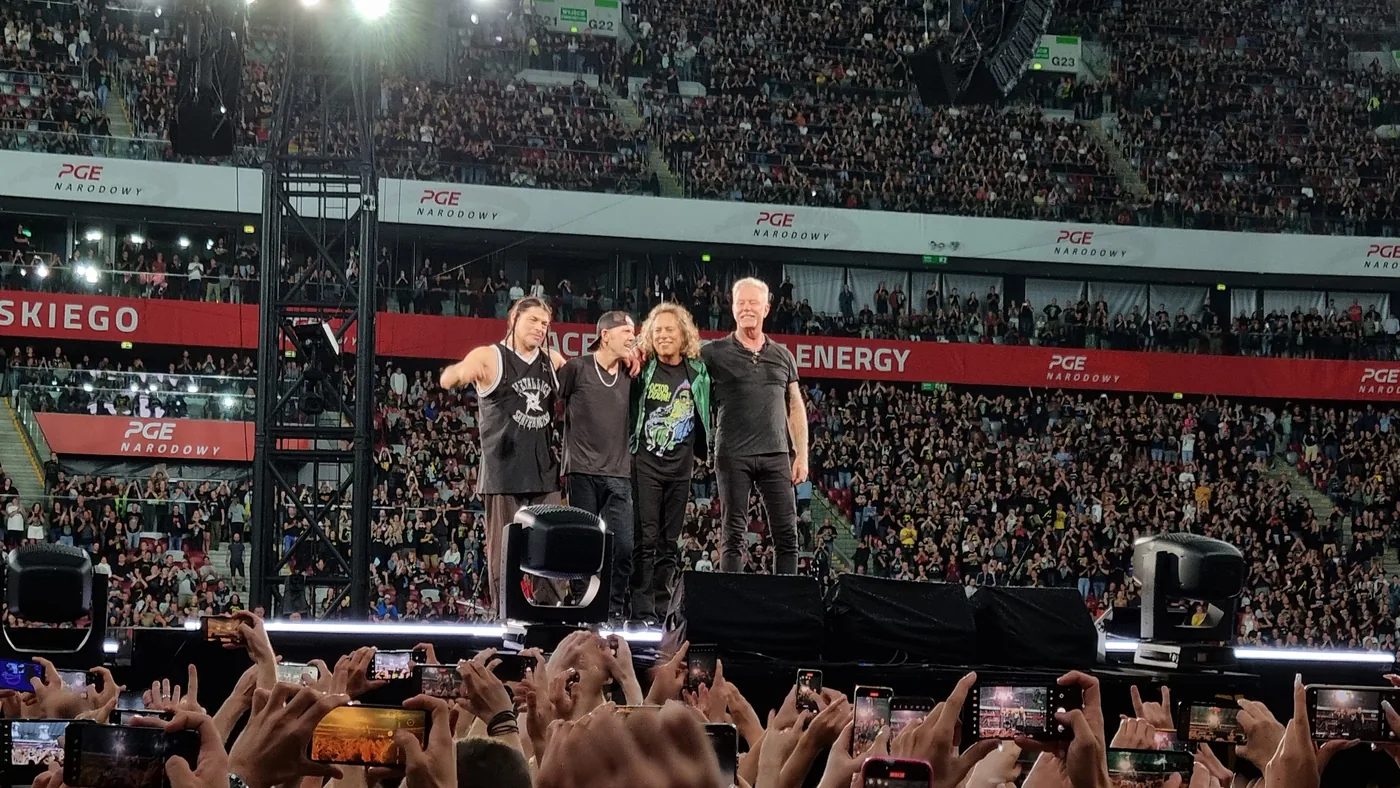
Metallica have one album preserved by the United States government and one album their own fans use as shorthand for failure. Master of Puppets joined the Library of Congress National Recording Registry in 2016, the first heavy metal record ever chosen for preservation.1 St. Anger arrived in 2003 with a snare drum sound that fans still imitate as a joke. On 1 October 2026 the same four-piece opens a Las Vegas residency at the Sphere called Life Burns Faster.2
Fifteen of the rankings here contain the band or one of its records. The obvious categories come first.
Metallica are the rare band whose canon and whose punchline sit on the same shelf, and each list reaches for a different one.
The Beatles, U2 and a thrash band from California
The widest question here asks for the best music band of all time, and it puts twenty names on the table: the Beatles, Led Zeppelin, Pink Floyd, Queen, Coldplay, Metallica.
Nineteen of those twenty come from outside metal. Being the biggest act in your own genre counts for nothing in a field this wide. The category asks a different question of Metallica than every other ranking in this article.
Institutional recognition is on their side. Metallica were inducted into the Rock Hall in 2009, in a class with Run-DMC, Jeff Beck and Bobby Womack, which put a thrash band into the same Cleveland building as most of the names beside them here.3
The counter-argument is the Beatles, and it is not a close one for most voters. Eight years of recorded output against four decades of touring is a comparison with no shared unit.
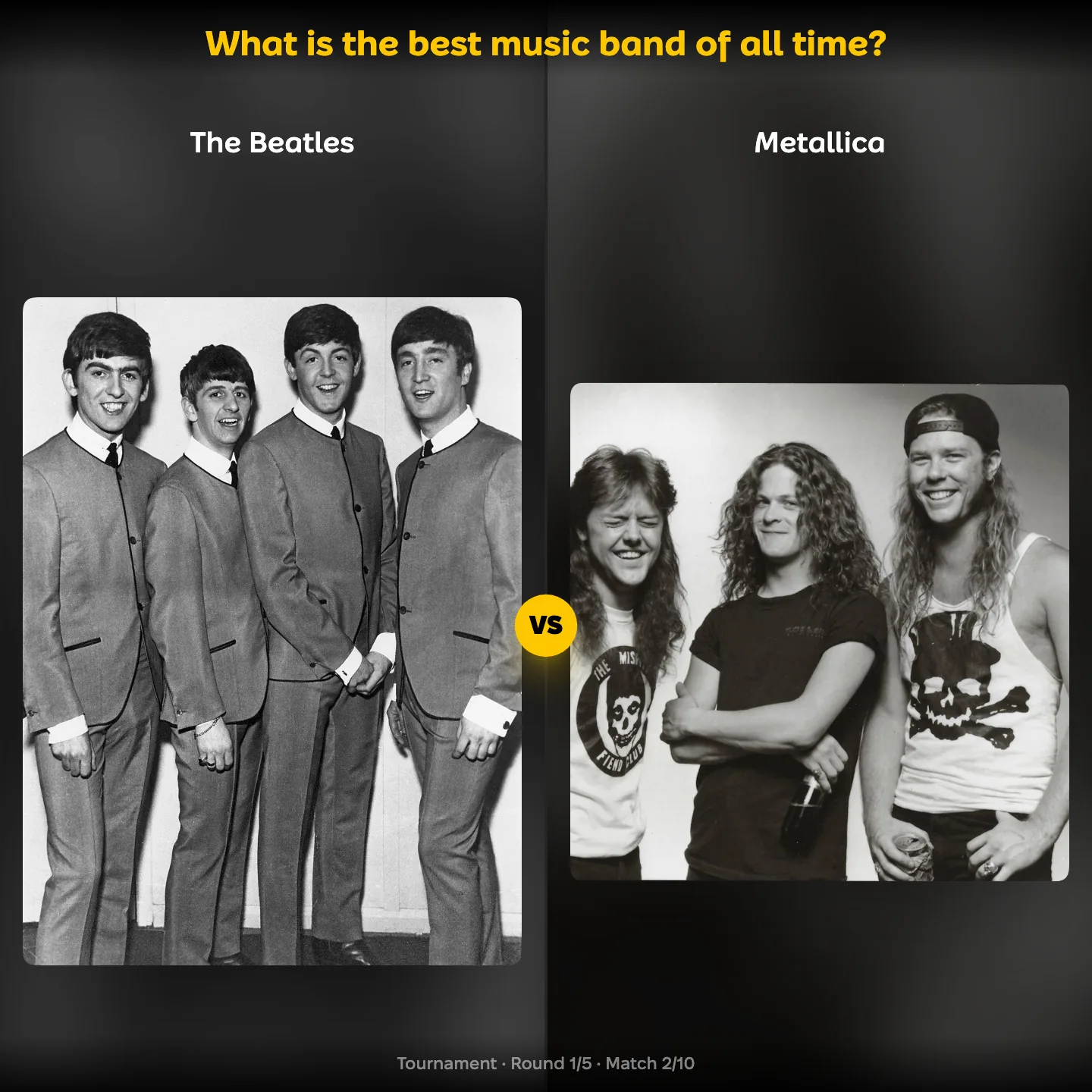
Metallica vs Black Sabbath, filed under rock
Narrow the category from music to rock and the field changes shape rather than size. Seventeen bands, and now Black Sabbath, Rush and The Clash are in the room.
Black Sabbath are the awkward neighbour. They invented the genre Metallica later sold to the world, which makes any list containing both a question about credit versus reach.
Metallica also carry a reputation problem that no other band on this list has. In April 2000 they sued Napster, and that July Lars Ulrich told the Senate Judiciary Committee that the service's business model was "like old-fashioned trafficking in stolen goods".4 Twenty-six years later some listeners still hold it against them.
Guns N' Roses, Radiohead and Pearl Jam fill out the middle of the field, none of them with a comparable enemy.
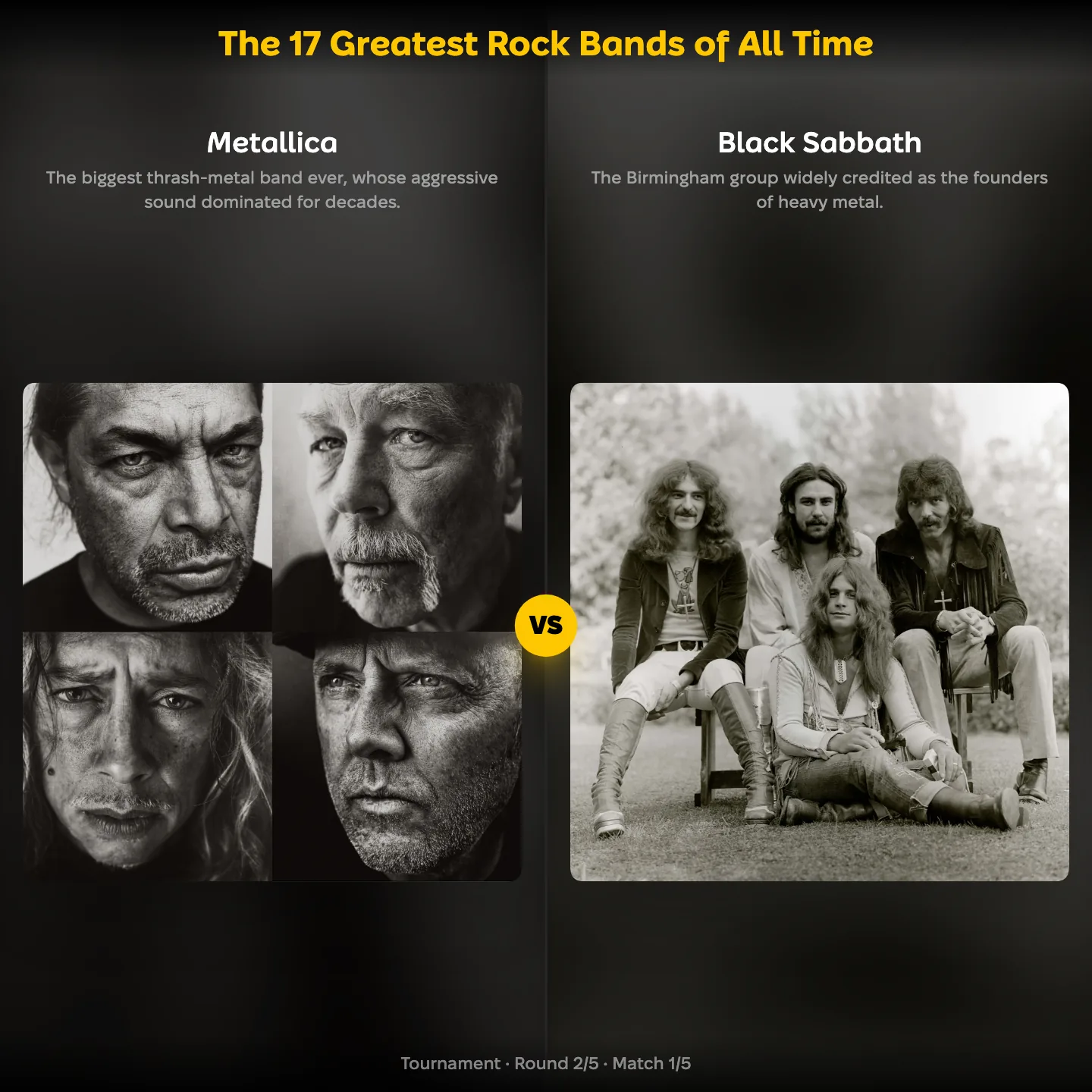
The best American band: Nirvana, the Eagles, Metallica
Add one word to the question and half the competition disappears. No Beatles, no Zeppelin, no Queen: the best American band is a twenty-name list of Nirvana, the Eagles, Aerosmith, R.E.M., the Ramones and Metallica.
Metallica qualify by an accident of classified advertising. Lars Ulrich placed an ad for metal musicians in a Los Angeles paper in 1981, James Hetfield answered it, and the band formed that October with Ron McGovney on bass.5
Nirvana are the sharper rival here, and the frame above is not a coincidence of geography. Two American bands, both from the era when a guitar act could still sell ten million copies of one record, both with a dead member at the centre of the story.
The Grateful Dead, Talking Heads and the Velvet Underground are the influence picks in this field rather than the volume ones.
Iron Maiden vs Metallica: the home category
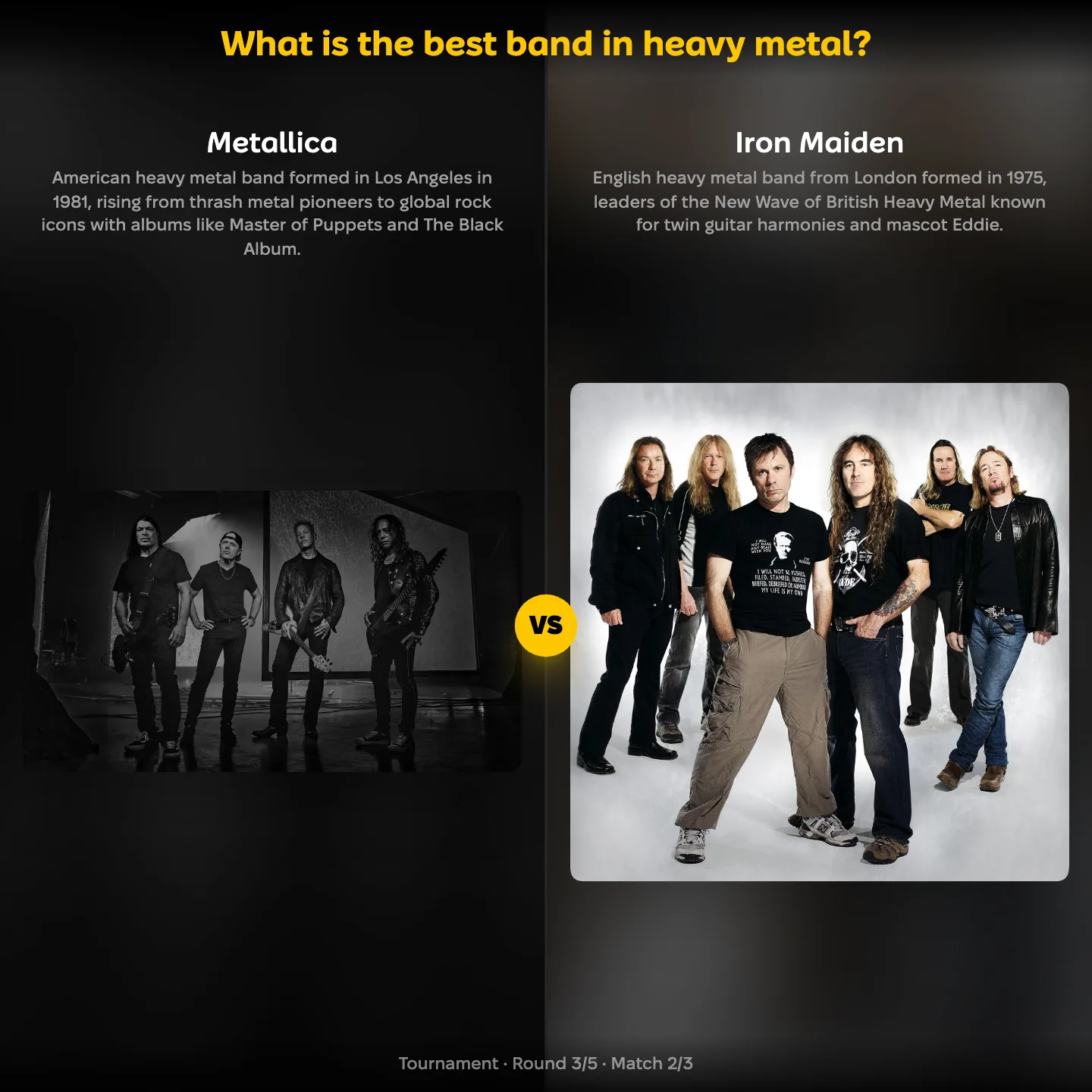
This is the ranking Metallica were built for: nineteen bands, all metal, Black Sabbath and Iron Maiden at the front of the queue.
Maiden formed in London in 1975 and led the New Wave of British Heavy Metal that Metallica grew up copying, then out-sold.
The other three of thrash's Big Four are here too. Slayer were faster, Megadeth were built by a guitarist Metallica fired, and Anthrax were funnier.
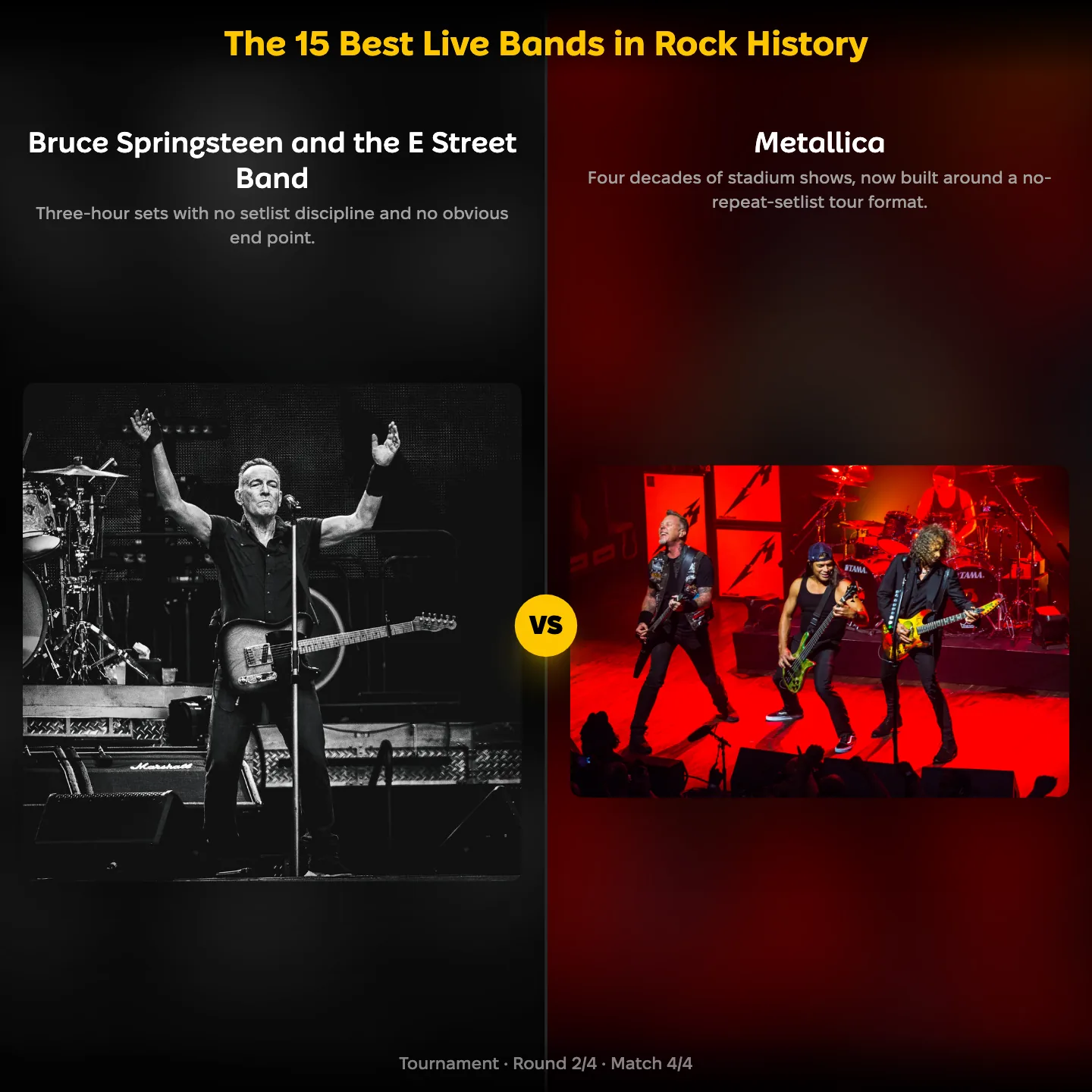
Springsteen, Queen and the M72 tour
Studio albums are one measure. Two hours in a stadium is another, and this list is fifteen bands who are argued about for what they do on a stage: Queen, Pink Floyd, Rammstein, the Grateful Dead, Metallica.
Metallica's case is recent and enormous. The M72 tour opened in Amsterdam in April 2023, has played to some four million people, and runs on a "No Repeat Weekend" format in which the two nights of a stand share no songs.6
Bruce Springsteen's E Street Band are the counter-case, built on a different theory of a concert: three hours, no pyrotechnics, nothing to hide behind.
Then there is Queen, who need twenty-one minutes at Live Aid in 1985 and nothing else. A list like this rewards a single unrepeatable night as readily as four decades of them.
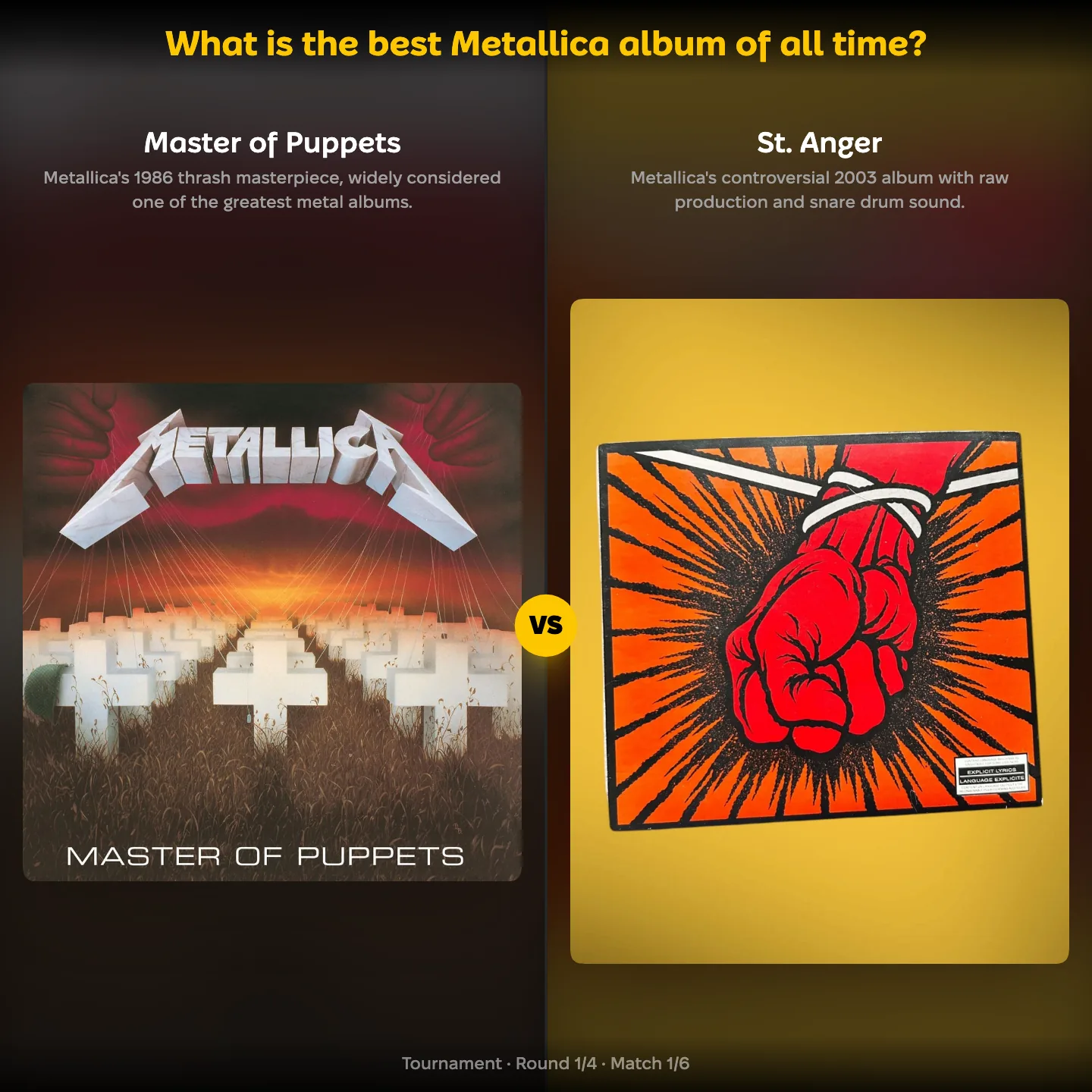
Master of Puppets vs St. Anger: the range inside one band
Now the subject becomes the question. Eleven Metallica albums, from Kill 'Em All in 1983 to 72 Seasons in 2023, and the reader has to rank the band against itself.
The frame picks the two poles on purpose. Master of Puppets is the record the Library of Congress preserved; St. Anger is the one whose snare drum has its own comedy genre.
St. Anger is not, however, a record the industry rejected. Its title track won Best Metal Performance at the 2004 Grammys, and that fact makes an eleven-album ranking harder rather than easier.7
Load is the real dividing line in this list. In 1996 the band cut their hair, slowed down and made a blues-rock album, and thirty years later that decision still splits the same fanbase down the middle. ReLoad followed in 1997 from the same sessions, which means a fifth of the catalogue on offer here comes from one argument.
72 Seasons, released in April 2023, is the newest entry and the one with no settled reputation yet. It arrived four decades after Kill 'Em All, made by four men in their late fifties and sixties.
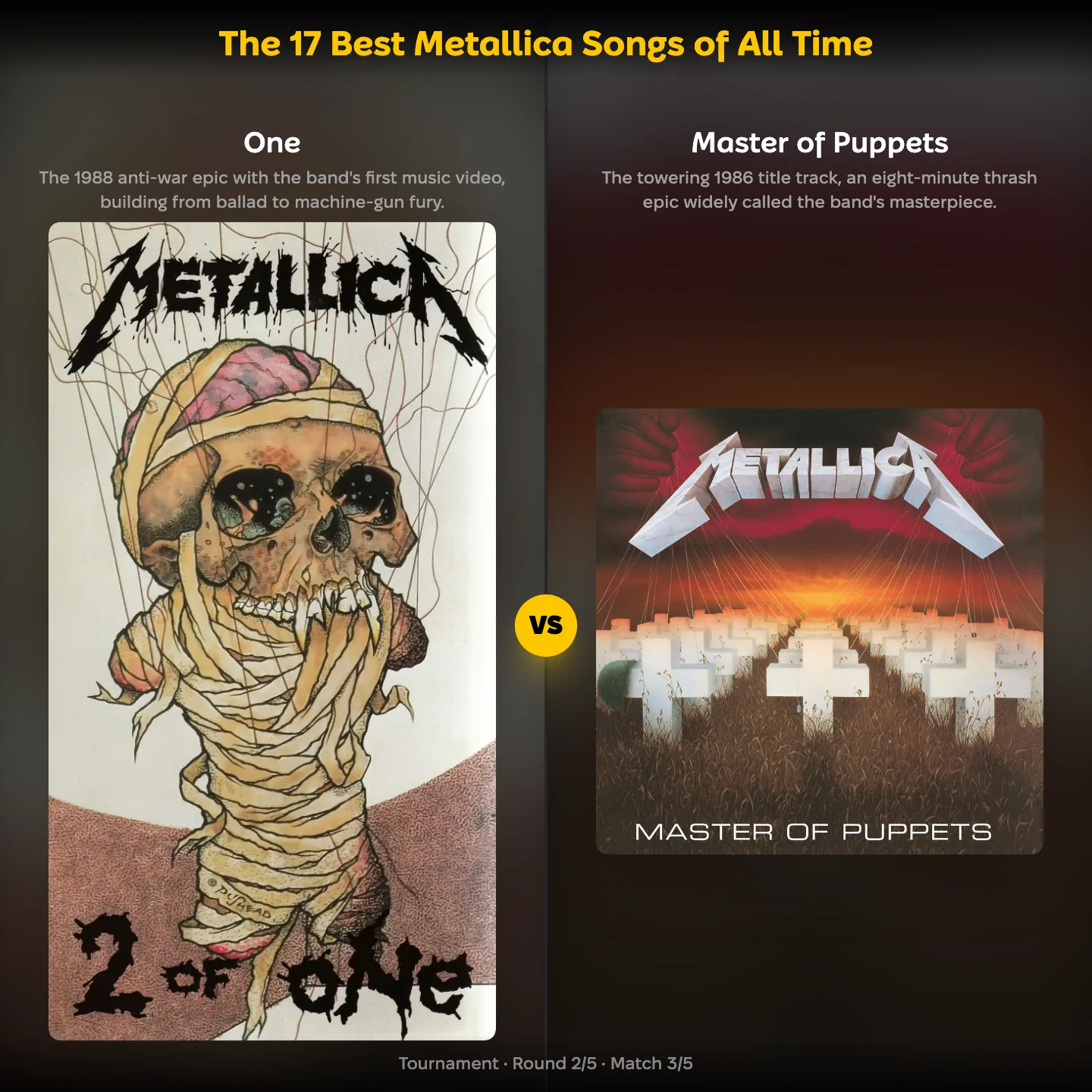
"One" vs "Master of Puppets": the eight-minute problem
Seventeen Metallica songs, and the two the frame shows are the two that a casual listener and a lifer would each name first.
"One" is the crossover. It was the band's first music video, released in January 1989 and built around footage from Johnny Got His Gun, and it won Metallica their first Grammy the following year.8
"Master of Puppets" is the other kind of case: eight and a half minutes, no single, no video, and the song most bands on the metal list would name as the ceiling.
Underneath those two sit "Battery", "Creeping Death" and "Blackened", which is where the ranking stops being about hits and starts being about what a fan puts on first.
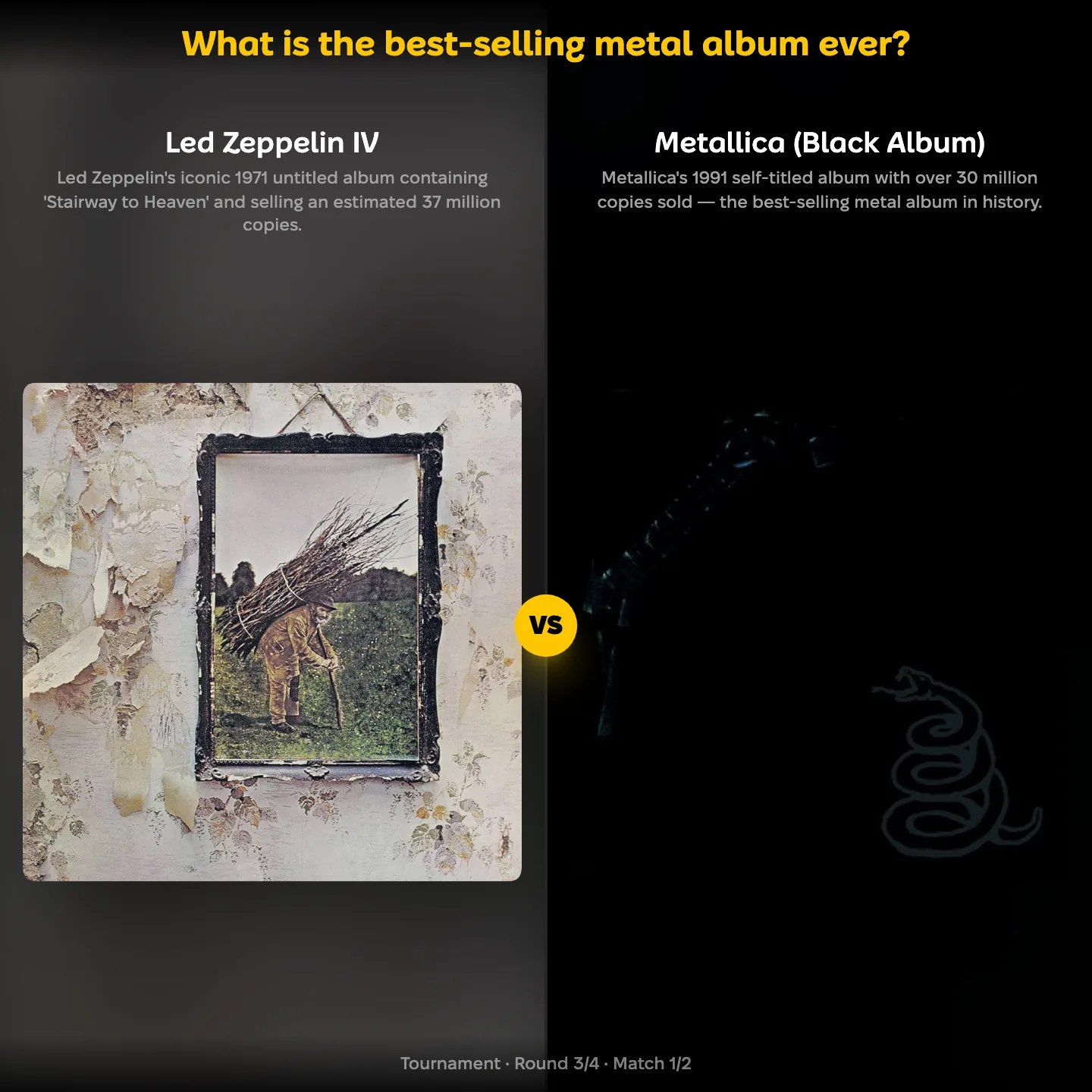
Led Zeppelin IV vs the Black Album: 20 times platinum
Commerce is the one measure where Metallica have no serious rival inside metal. Thirteen albums are on this list, and the self-titled 1991 record appears alongside Led Zeppelin, AC/DC and Def Leppard.
The numbers are extreme. The RIAA certified Metallica twenty times platinum in May 2025, and it remains the biggest-selling album of the SoundScan era, across every genre.9
Led Zeppelin IV is the opposition the frame chose, and it is the fairest one: an album from 1971 that has had twenty extra years to sell.
The genre question is the real fight. Half the field here, Hysteria and Slippery When Wet included, is arguably hard rock rather than metal, which turns a sales ranking into a definitions ranking.
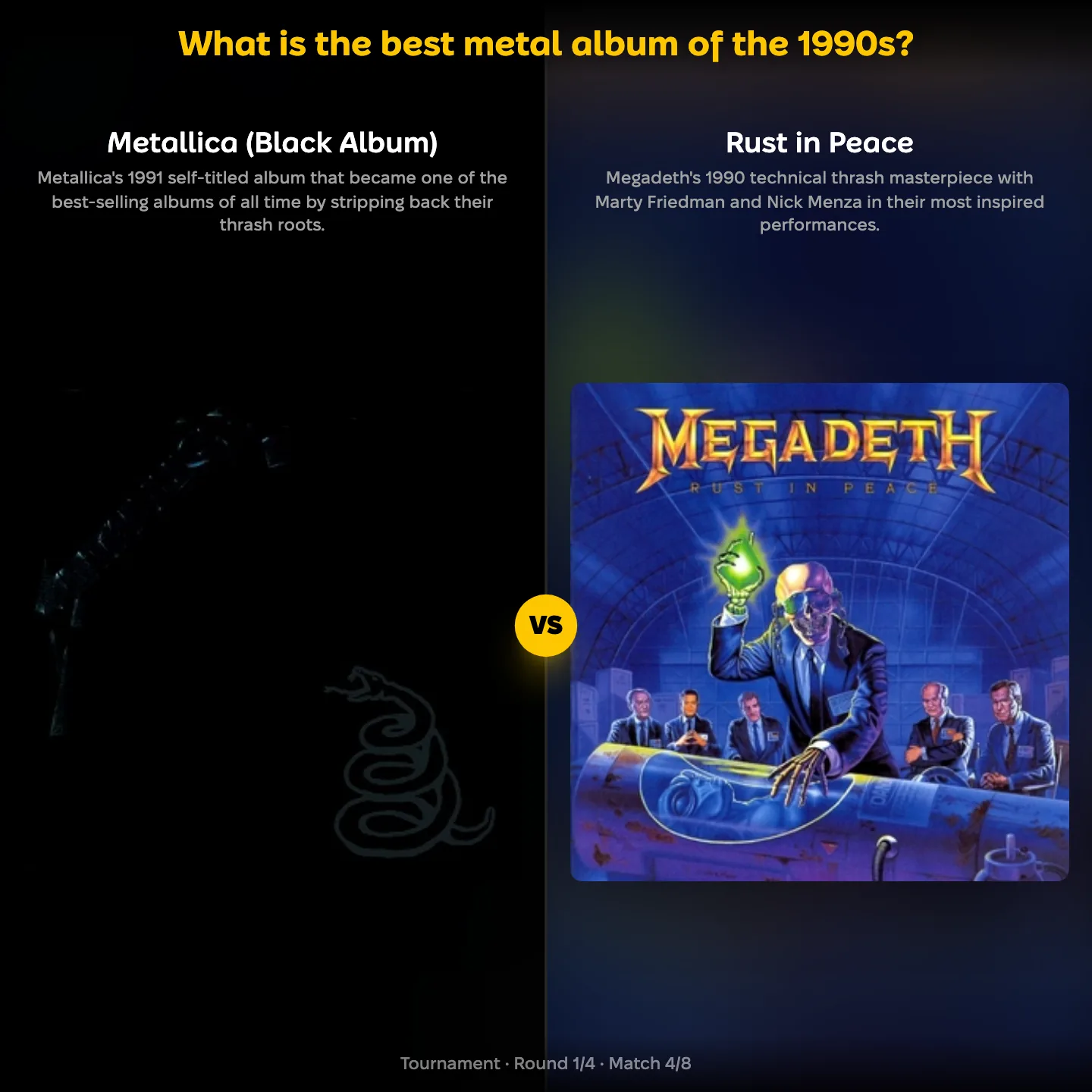
Rust in Peace and the 1990s: Megadeth against Metallica
The 1990s metal list is fifteen albums deep and contains almost nothing that sounds like the others: Pantera's Vulgar Display of Power, Tool's Ænima, Death's Human, Mayhem's De Mysteriis Dom Sathanas.
Metallica's entry is the 1991 self-titled album, and it is here on different grounds than in the sales list. This is the record where the band stopped writing eight-minute songs and started writing four-minute ones.
Megadeth's Rust in Peace is the pointed comparison. Dave Mustaine was Metallica's lead guitarist until they fired him in 1983, and his 1990 album is the one that thrash purists hold up as what Metallica stopped doing.
Cowboys from Hell and Slaughter of the Soul close out the decade, by which point the genre had split into groove and death metal and left the arenas to one band.
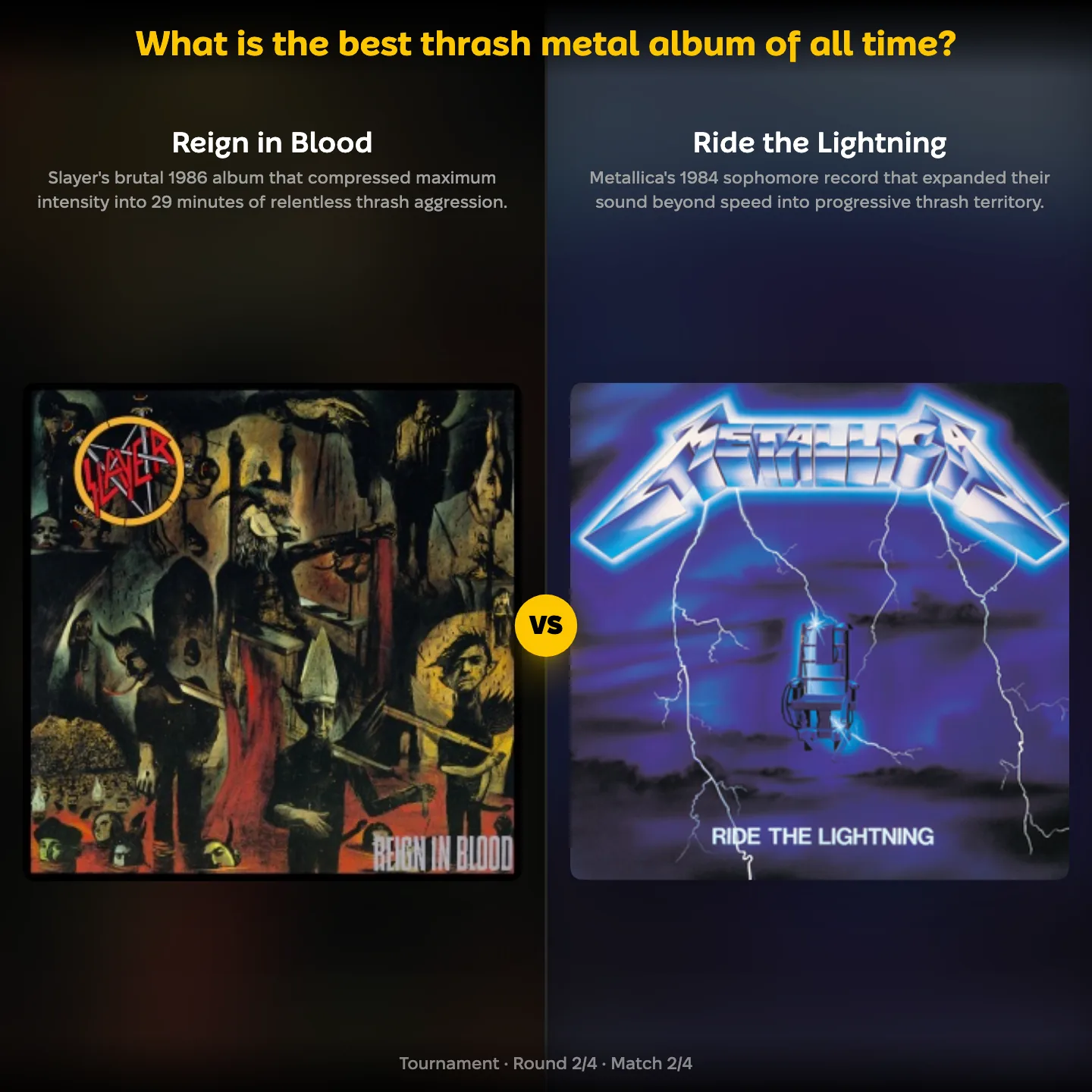
Reign in Blood vs Ride the Lightning: Slayer's bracket
Thrash is the subgenre Metallica helped build, and it is also where their records start competing with each other. Four of the fifteen albums on this list are theirs: Kill 'Em All, Ride the Lightning, Master of Puppets and ...And Justice for All.
Ride the Lightning from 1984 is the interesting one to put forward. It is the album where a fast band added acoustic intros, key changes and an instrumental that runs almost nine minutes, a year before anyone called that progressive.
Slayer's Reign in Blood is the standing counter-claim. Twenty-nine minutes, ten songs, no melody offered, and a very large number of people think that is what thrash is supposed to be.
Megadeth, Exodus, Testament and Kreator all sit in this field. Thrash is the hardest album list here for one reason: every record in it emerged from the same two scenes inside three years.
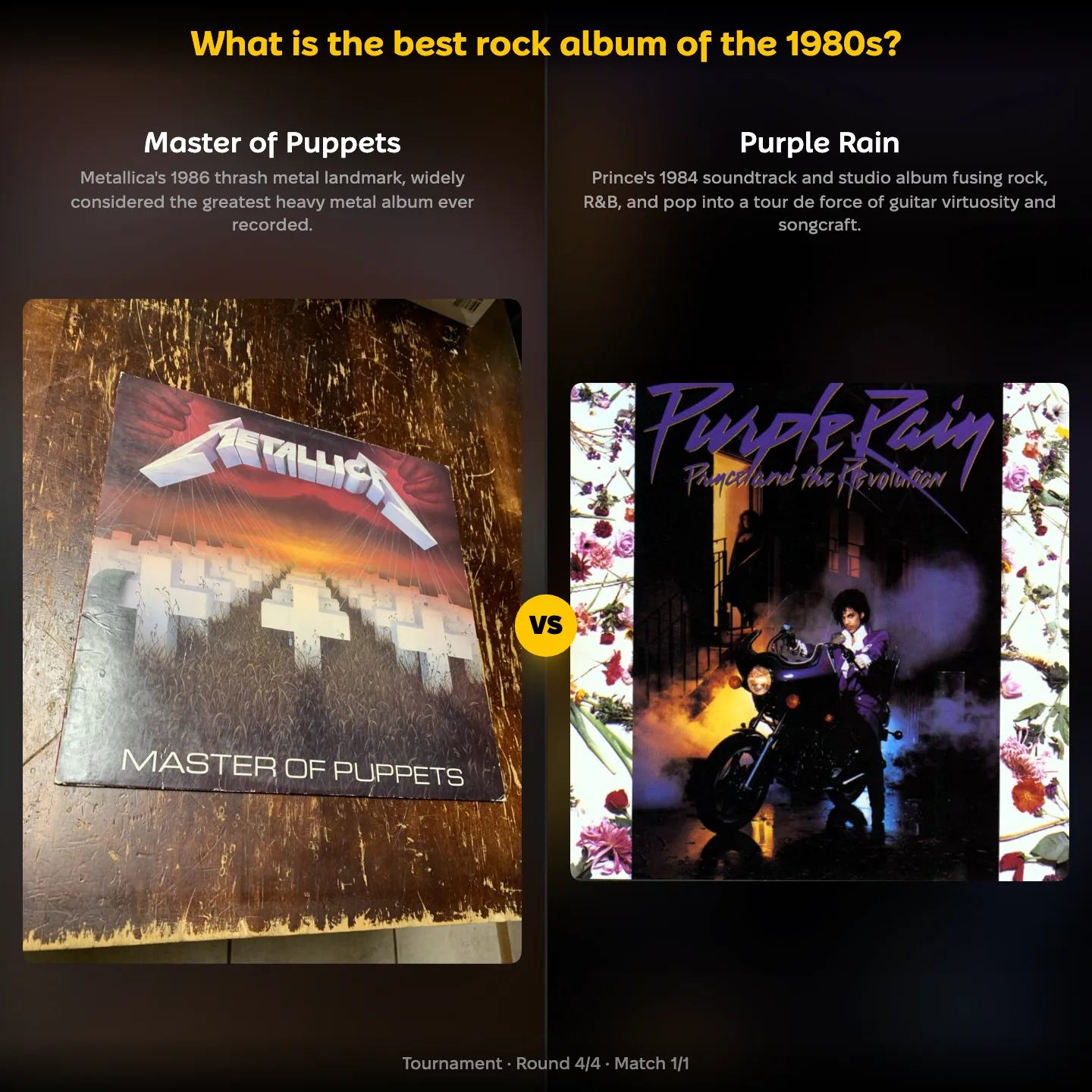
Purple Rain, The Joshua Tree and one thrash record
Here is the list where Metallica are the outsider. Fifteen rock albums of the 1980s, and fourteen of them were made by bands you could play on daytime radio in 1986.
Master of Puppets was released on 3 March 1986 and sold nothing like the records around it at the time. Its RIAA certification only moved to eight times platinum in 2025, decades after Purple Rain and Back in Black had done their selling.9
Prince is the opponent the frame picked because he is the opposite proposition: a 1984 soundtrack album that was a film, a tour and a number-one single at once.
The Joshua Tree, Born in the USA and Synchronicity fill out a decade in which a thrash album from California was not supposed to be a contender at all. That is precisely why it belongs on the list now.
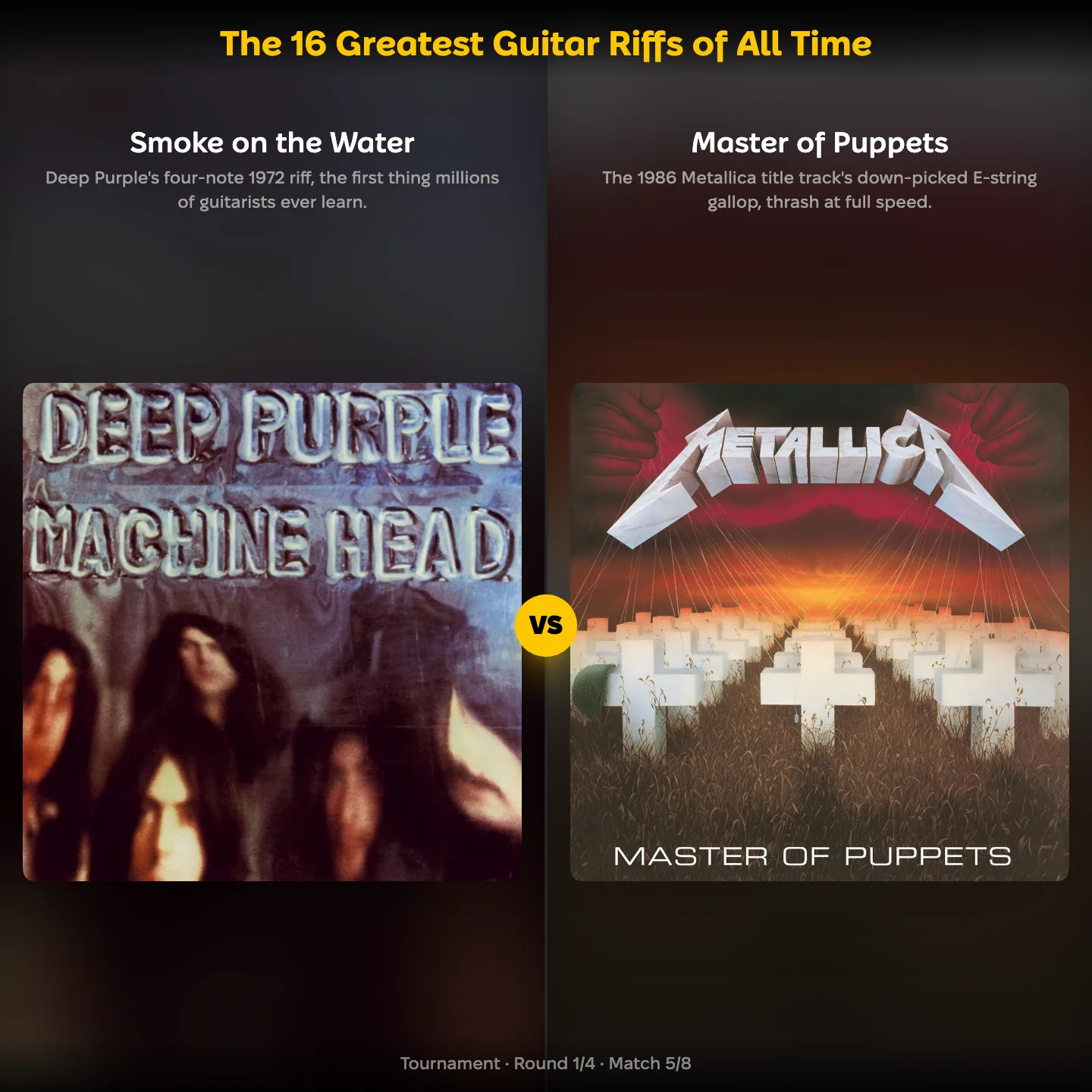
Smoke on the Water vs Master of Puppets: sixteen riffs
A riff list is not an album list in miniature. It rewards four bars a beginner can play badly and still recognise.
Metallica have two entries: "Enter Sandman", which carried the band onto daytime radio in 1991, and the title track of Master of Puppets, the down-picked E-string gallop guitar teachers use to explain right-hand stamina.
Deep Purple's "Smoke on the Water" is the benchmark, and unbeatable on one metric. It is the first thing millions of guitarists ever learn.
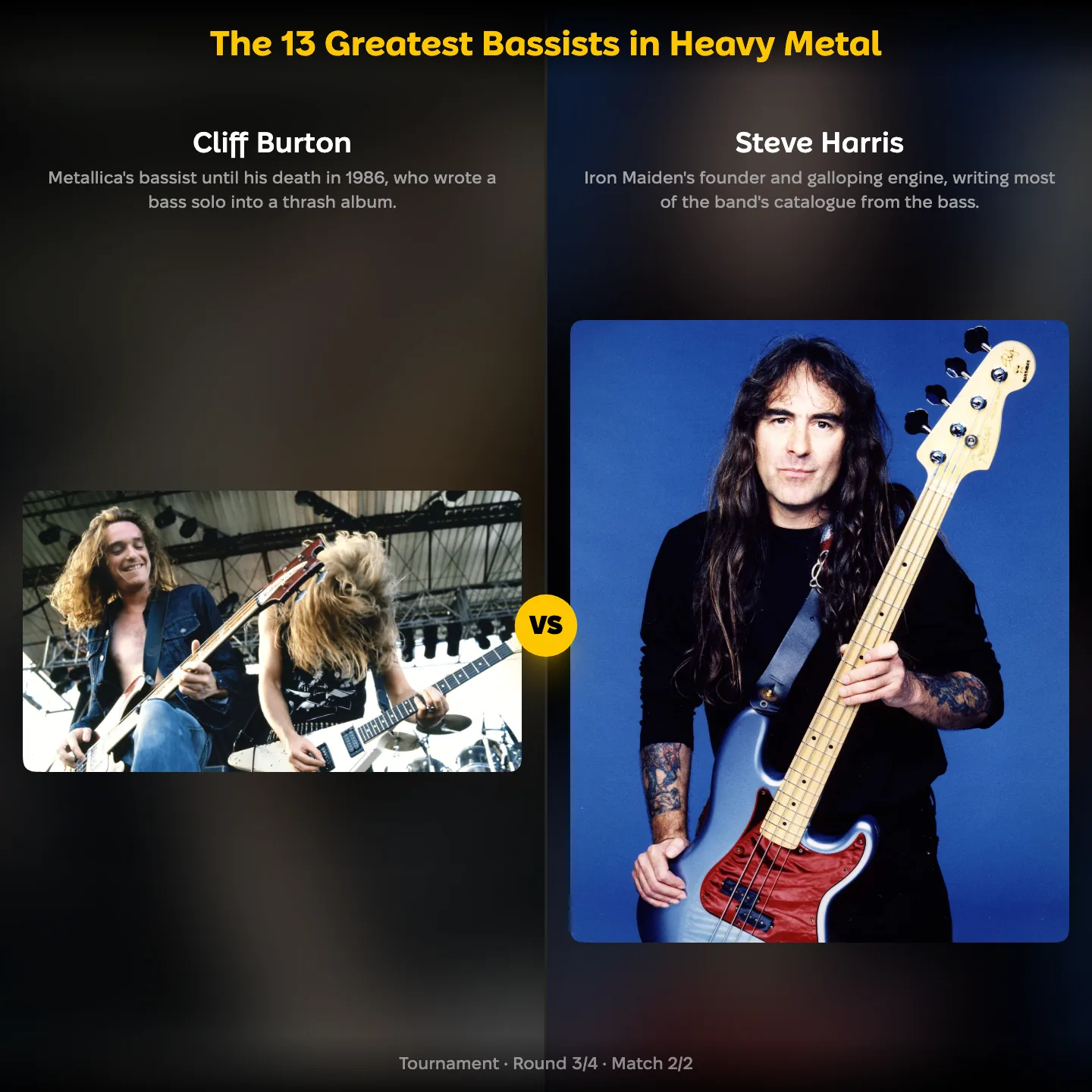
Cliff Burton vs Steve Harris: the bass players
Thirteen metal bassists, and three of them played in Metallica. That is not padding: the band has had a bass problem, a bass tragedy and a bass reinvention.
Cliff Burton is the reason this list exists in the shape it does. He died on 27 September 1986, aged 24, when the tour bus rolled over in Sweden on the Damage, Inc. tour, months after playing on Master of Puppets.10 Forty years later he is still the name people reach for first.
Jason Newsted took the job in 1986 and held it until 2001; Robert Trujillo has had it since 2003. The Hall of Fame lists all three of them alongside Hetfield, Ulrich and Hammett.3
Steve Harris is the strongest objection. Iron Maiden's founder writes most of the band's material from the bass, which is a different claim than being the most-mourned player in the genre.
Geezer Butler and Lemmy Kilmister complicate it further. Butler wrote Black Sabbath's lyrics as well as their bass lines; Lemmy played a Rickenbacker through a guitar stack until it stopped sounding like a bass at all.
Bass is also the instrument where a short career can still win the argument. Burton played on three albums; Harris has played on seventeen.
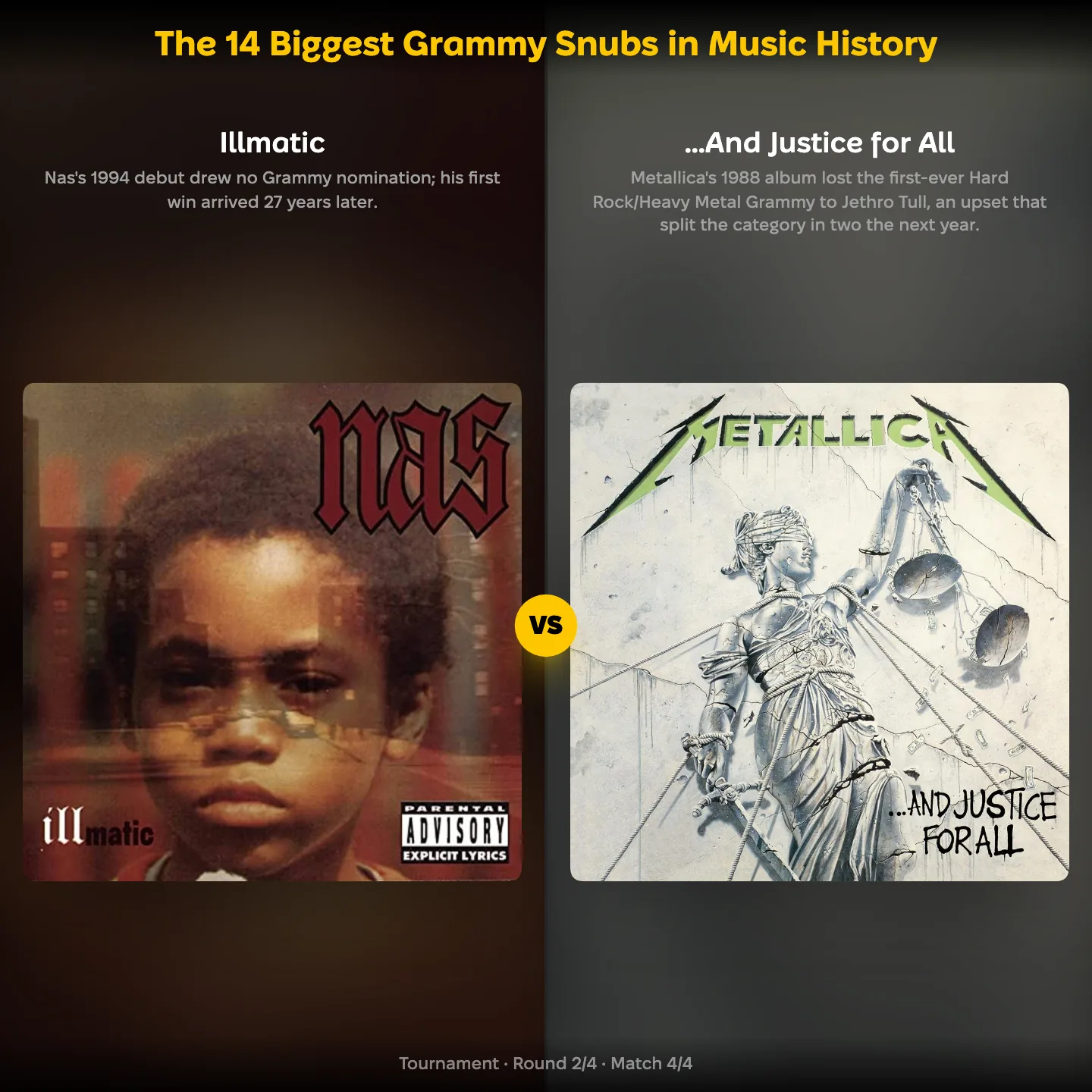
The 1989 Grammy: Jethro Tull beat ...And Justice for All
Some categories are about achievement. This one is about the times an institution got it wrong, and Metallica supply the textbook case.
On 22 February 1989 the Recording Academy handed the first Best Hard Rock/Heavy Metal Performance award to Jethro Tull's Crest of a Knave over ...And Justice for All. Alice Cooper opened the envelope and assumed he had been handed the one from rehearsal.11 The Academy split the category into separate hard rock and metal awards for the following year.12
Metallica collected that one immediately, taking their first Grammy for "One" in 1990.8 A snub corrected inside twelve months is a strange kind of snub.
Illmatic, Purple Rain, Kid A and Exodus are the company in this list, and none of those artists got their category rewritten for them. Nas waited 27 years for a first win, and Bob Marley never received a nomination for Exodus at all. Losing loudly, with the presenter retelling it for thirty years, is a lighter fate than never being nominated — the fairest objection to Metallica topping a list like this.
Metallica's own reaction has aged better than the award did. Their label had already printed 10,000 in-store sheets calling the album a Grammy winner, and Lars Ulrich's proposal was to sticker every one of them "Grammy Award Loser".12
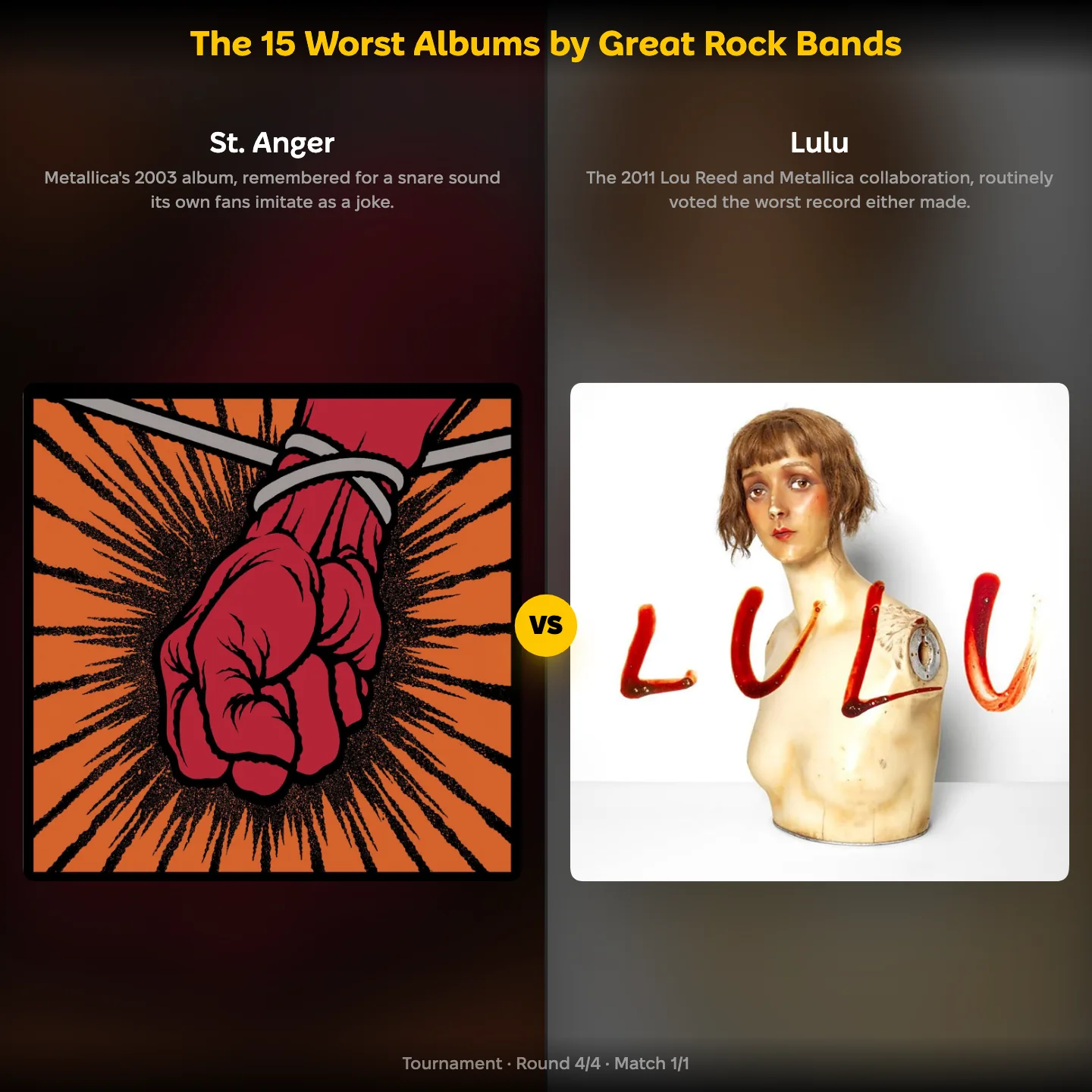
St. Anger, Lulu and the list no band wants
The last ranking inverts the question, and Metallica are one of the few bands who supply three candidates for it.
St. Anger is the famous one. Producer Bob Rock has said he spent about fifteen minutes getting the snare sound that became the album's defining feature, and two decades of fan videos have been built on it.7
Lulu, the 2011 collaboration with Lou Reed, is the frame's other half and the harsher entry. It was Lou Reed's last studio album, released two years before his death, and neither fanbase has claimed it since.
Around them sits a museum of bad decisions: Kiss with an orchestra, Queen going disco, Black Sabbath without Sabbath. A band needs a long enough career to end up here, which is its own backhanded qualification.
Forty years of Puppets, and fifteen different answers
A band that spends four decades in public accumulates categories rather than a position. Metallica are a preserved national recording, a definitions problem in a sales list, a footnote in a decade of pop albums, and a punchline about a snare drum, and all four of those descriptions hold.
That is what a site built on comparing two records at a time does to a big subject: it stops asking how good a band is and starts asking which question you meant.
Pick the version of Metallica you actually care about and vote that one out.
More rankings, more angles
- The Beatles vs The Rolling Stones: 16 Lists That Can't Agree — the other British band argument
- What Kind of Best Is Michael Jackson? — one catalogue, sixteen categories
- Eminem Is on Every Rap List. Never in the Same Place — Detroit, and the same problem
- Led Zeppelin Left Their Best-Selling Album Untitled — no UK singles, no title on the sleeve
Sources
- ABC News — Master of Puppets is the first heavy metal recording added to the Library of Congress National Recording Registry, 2016: abc.net.au (checked 2026-08-20)
- Sphere Entertainment — Metallica: Life Burns Faster at Sphere, Las Vegas, opening 1 October 2026: sphereentertainmentco.com (checked 2026-08-20)
- Rock & Roll Hall of Fame — Metallica, inducted 2009 as Performer, six listed members: rockhall.com (checked 2026-08-20)
- CNN transcript — Lars Ulrich's testimony before the Senate Judiciary Committee, 11 July 2000: cnn.com (checked 2026-08-20)
- Metal Forces Magazine — Metallica formed in October 1981 after Lars Ulrich's Los Angeles newspaper advertisement: metalforcesmagazine.com (checked 2026-08-20)
- Blabbermouth — the M72 World Tour opened in Amsterdam in April 2023, has played to some four million people, and kept its No Repeat Weekend format into 2026: blabbermouth.net (checked 2026-08-20)
- GRAMMY.com — St. Anger's title track won Best Metal Performance in 2004, and the snare sound Bob Rock built in about fifteen minutes: grammy.com (checked 2026-08-20)
- GRAMMY.com — "One" was Metallica's first music video and won the band's first Grammy, Best Metal Performance, in 1990: grammy.com (checked 2026-08-20)
- Consequence — the RIAA certified Metallica's Black Album twenty times platinum on 28 May 2025, still the biggest-selling album of the SoundScan era, with Master of Puppets moving to eight times platinum: consequence.net (checked 2026-08-20)
- Metal Forces Magazine — Cliff Burton died on 27 September 1986, aged 24, in a tour bus crash in Sweden: metalforcesmagazine.com (checked 2026-08-20)
- Louder — Jethro Tull's Crest of a Knave beat ...And Justice for All to the first Hard Rock/Heavy Metal Grammy on 22 February 1989, and the category was split the next year: loudersound.com (checked 2026-08-20)
- Ultimate Classic Rock — the Recording Academy split the Hard Rock/Metal category in two for 1990 and gave Best Metal Performance to Metallica for "One"; Lars Ulrich on the 10,000 in-store sheets and the "Grammy Award Loser" sticker: ultimateclassicrock.com (checked 2026-08-20)