
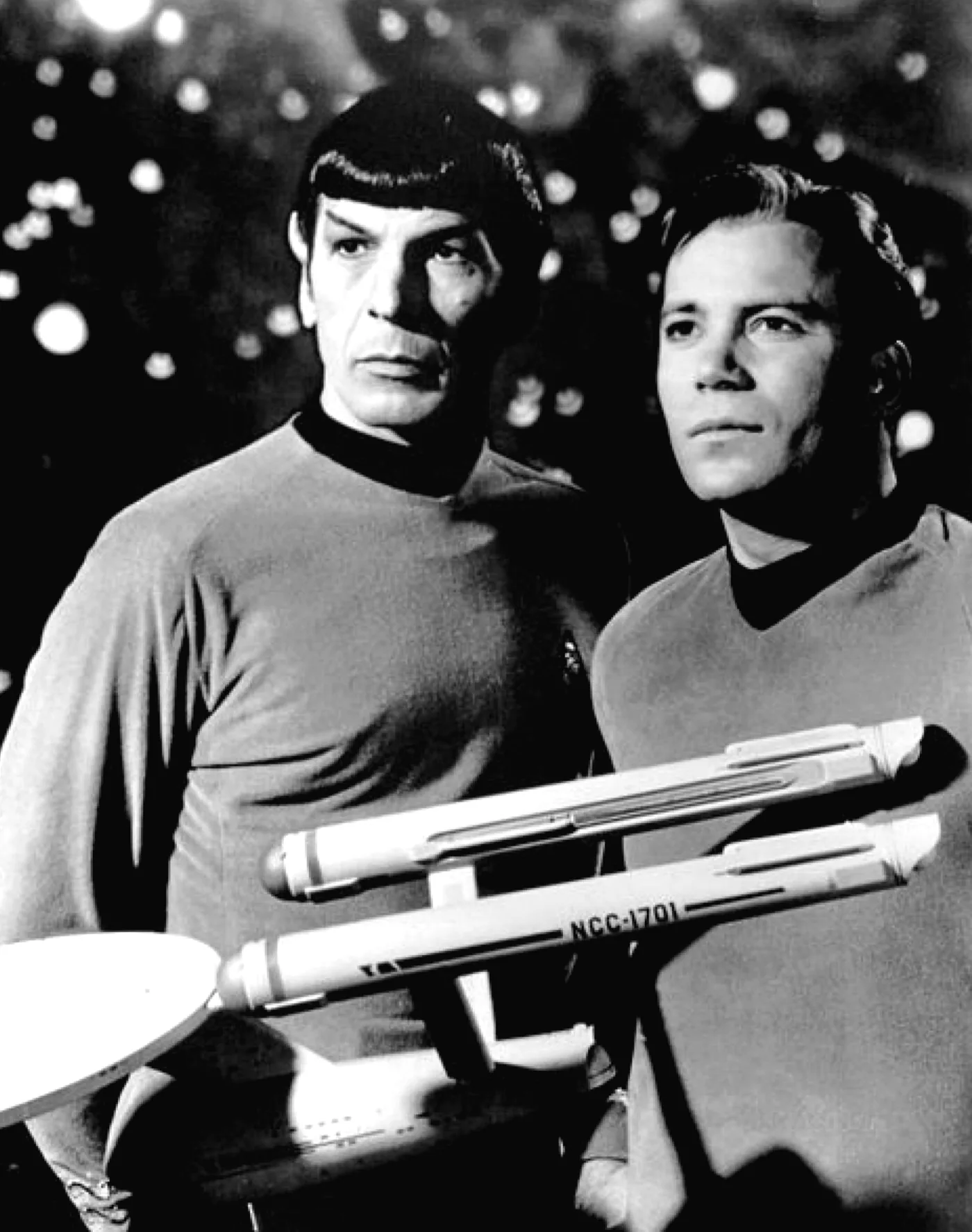
Star Trek Day falls on 8 September, and in 2026 it counts sixty years since "The Man Trap" went out on NBC.1 The show behind that date lasted three seasons and 79 episodes before NBC dropped it.2
Being cancelled turned out to be a formality. The films, the spin-offs and the streaming era all grew out of a programme that had already been taken off the air once.
Which is how a cancelled 1960s adventure show ends up on lists assembled for completely unrelated reasons: prestige drama, film sequels, orchestral scores, spacecraft design, a British actor's filmography. Sixteen of them are below.
Every one of these lists catches Star Trek at a different age: the 1966 show nobody handed a trophy to, the 1982 film the Library of Congress now preserves, the cadet series that premiered in January.
The Next Generation among the prestige dramas
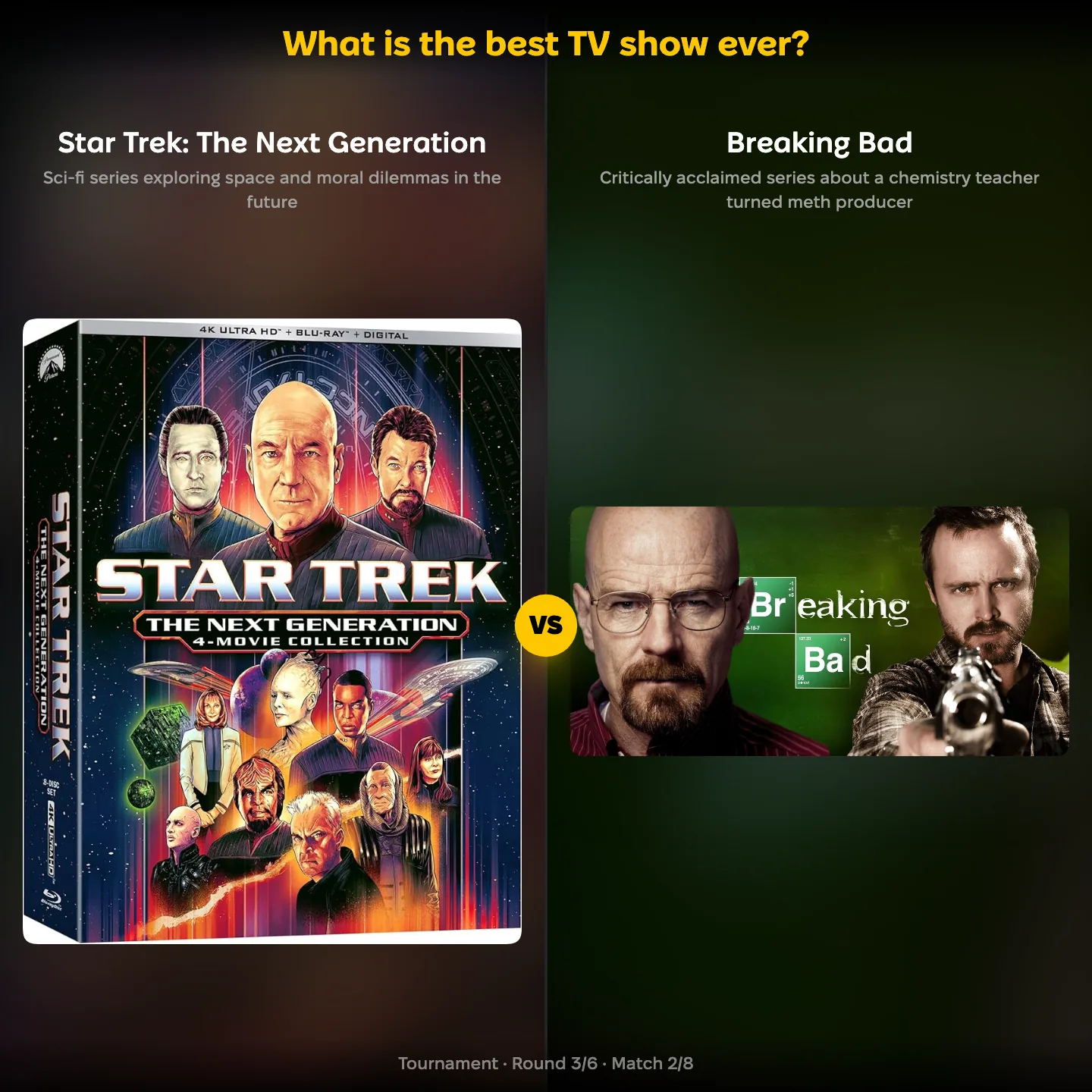
"What is the best TV show ever?" is the broadest question on this site: 64 shows, every genre, no era limit. Star Trek's entry is The Next Generation, which ran 178 episodes across seven seasons between 1987 and 1994.3
It is a strange fit and a defensible one. The competition is Breaking Bad, The Sopranos and The Wire: serialised prestige drama, mostly post-2000, mostly about morally compromised men.
The Next Generation is none of that. An episodic syndicated show with a bald diplomat in the captain's chair, it debated ethics weekly instead of showing consequences.
The Television Academy took it seriously all the same. It collected 58 nominations and 17 Emmys, and in 1994 a nomination for Outstanding Drama Series.4 Nearly every win was a craft award: visual effects, sound, hairstyling, makeup.
Thirteen films, filed beside Marvel and James Bond
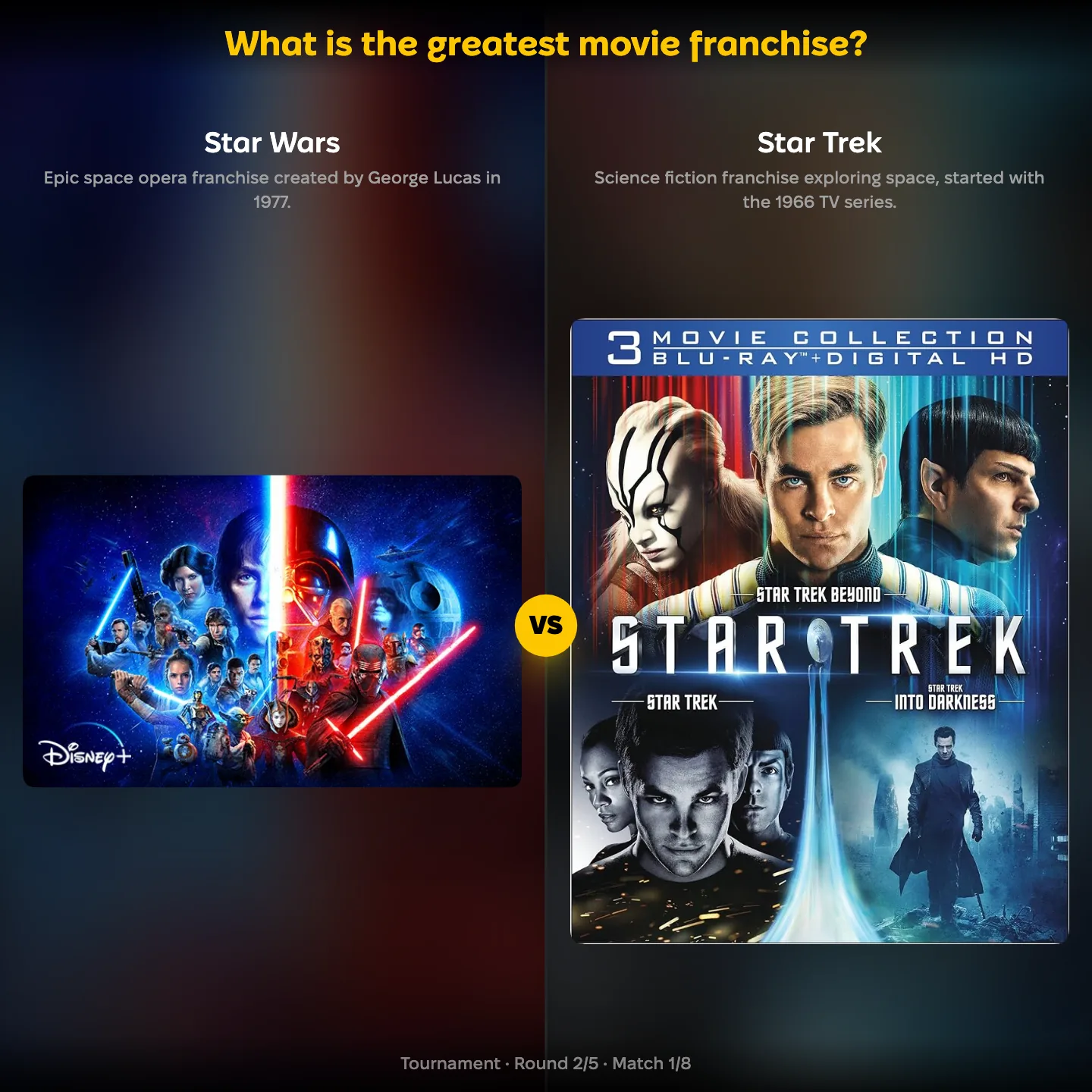
Move Star Trek onto a list of movie franchises and the terms change. This ranking holds 32 of them, the Marvel Cinematic Universe and James Bond included.
Star Trek's film run is longer than most: thirteen releases between December 1979 and July 2016, of which only the two made after the 2009 recast cleared $200 million in North America.5
The films were always the second job. Trek built its audience on television, and the movies were made for viewers who already knew these people: The Wrath of Khan continues a story from a 1960s episode and assumes you remember it.
Star Wars, a few slots away, did it in the other order, a film first and everything else afterwards. That sequence accounts for most of the distance between them on a list of franchises.
One franchise, three entries on the same sci-fi list
Restrict the field to science-fiction television and Star Trek stops being a single entry. The Next Generation, Deep Space Nine and The Original Series all appear separately on this 16-show list.
The Original Series earned its place late. The Television Academy nominated it 13 times in the 1960s and gave it nothing, including Outstanding Dramatic Series in both 1967 and 1968 and Leonard Nimoy for Spock three years running; the recognition finally arrived in 2018, as a Governors Award.6
Deep Space Nine is the entry critics push hardest: 176 episodes between 1993 and 1999,7 set on a fixed station rather than a ship.
Doctor Who takes one slot despite running since 1963 — the list treats it as one continuous show, which is precisely the accounting Star Trek escapes.
178 episodes against 176: The Next Generation and Deep Space Nine
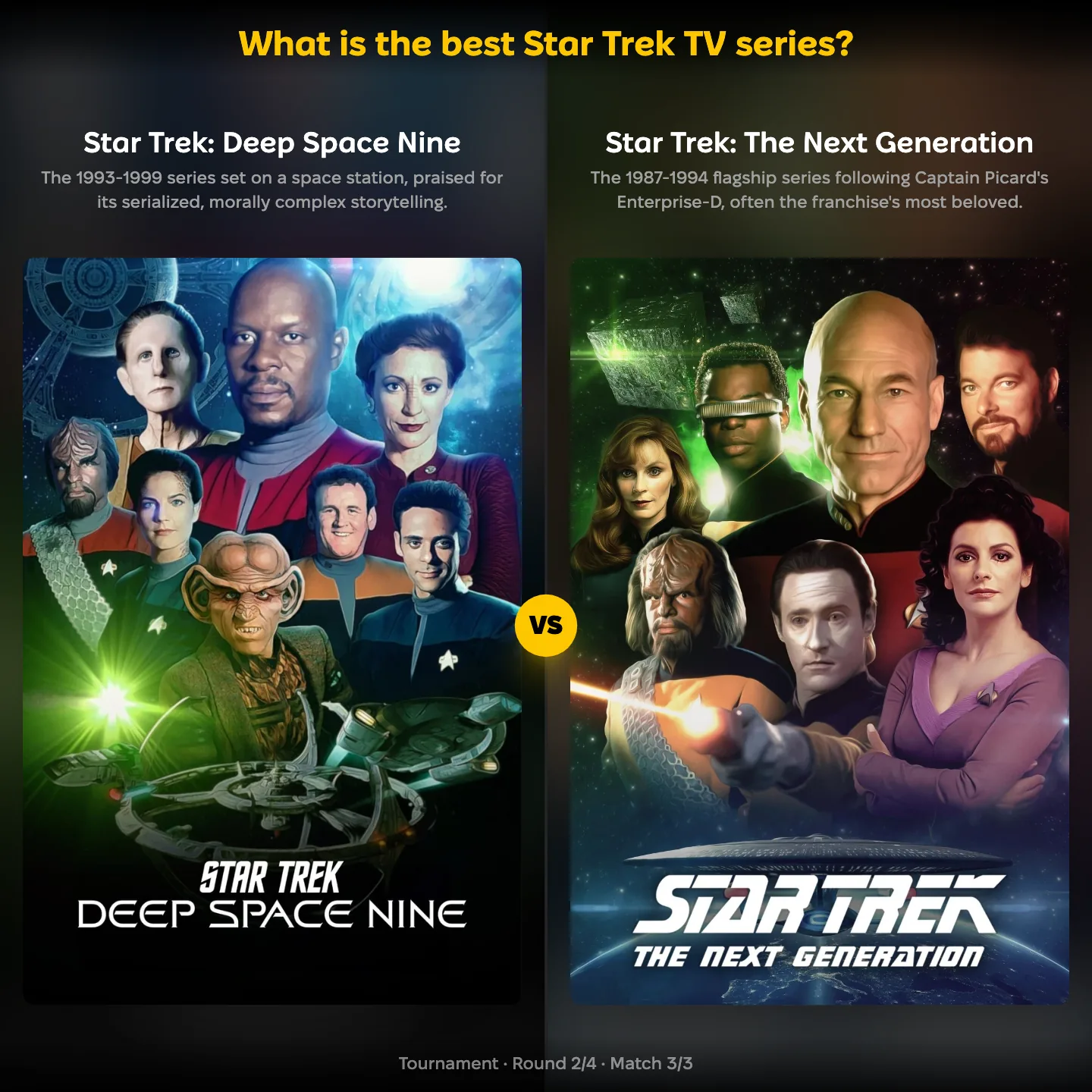
Take the rest of television away and rank the Star Trek series against each other. Eleven shows are in this one, and the argument between the first two is the oldest the fandom has.
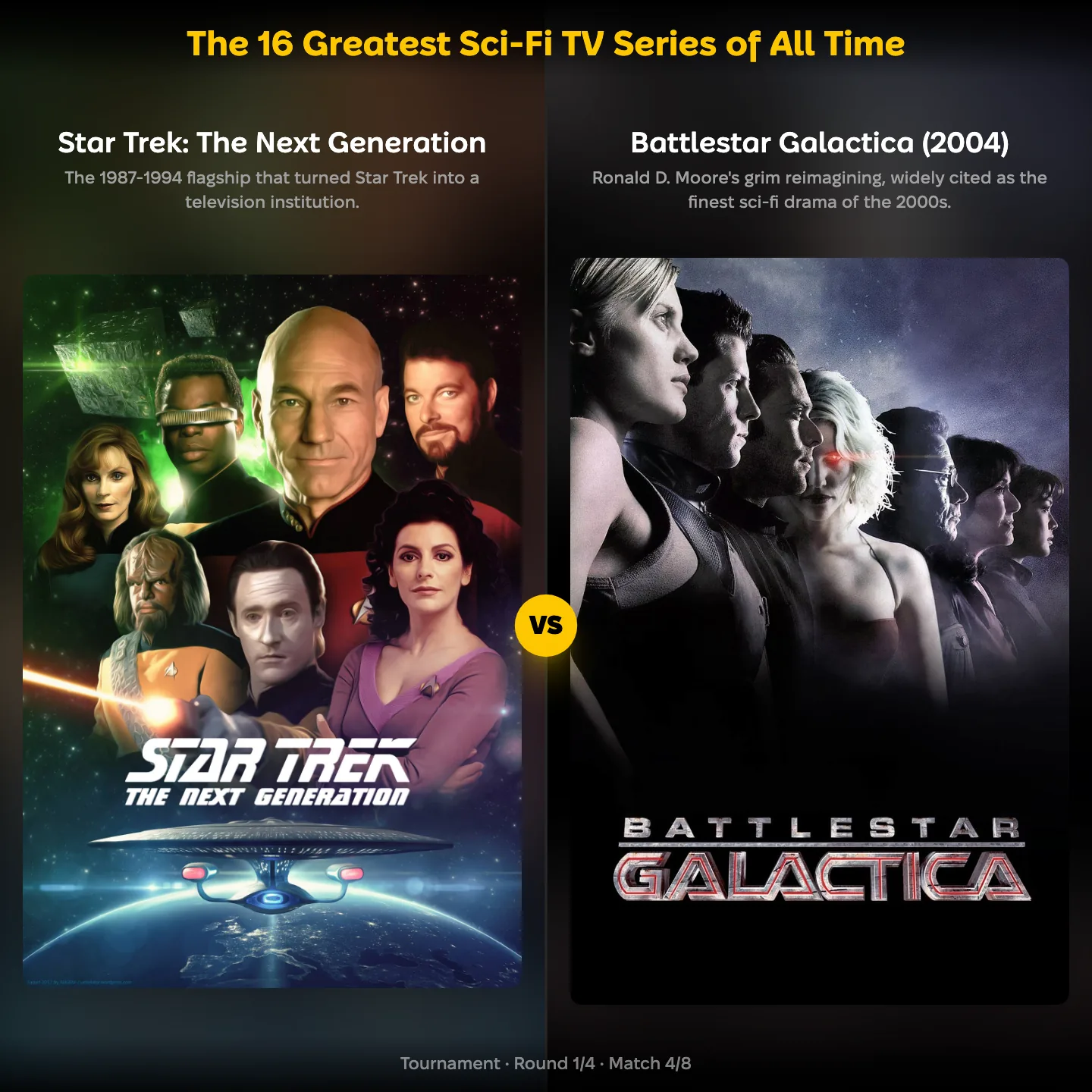
The Next Generation is the popular answer, with seven seasons and 178 episodes behind it and the distinction of proving that Trek worked without Kirk and Spock.3
Deep Space Nine is the critics' answer, and it very nearly matched that run: seven seasons, 176 episodes, ending in 1999.7 It stayed in one place, told a serialised war story before serialised television was normal, and never drew The Next Generation's audience.
Then there is everything else: Voyager, Enterprise, the animated comedy Lower Decks, and a 1973 cartoon that spent decades outside canon.
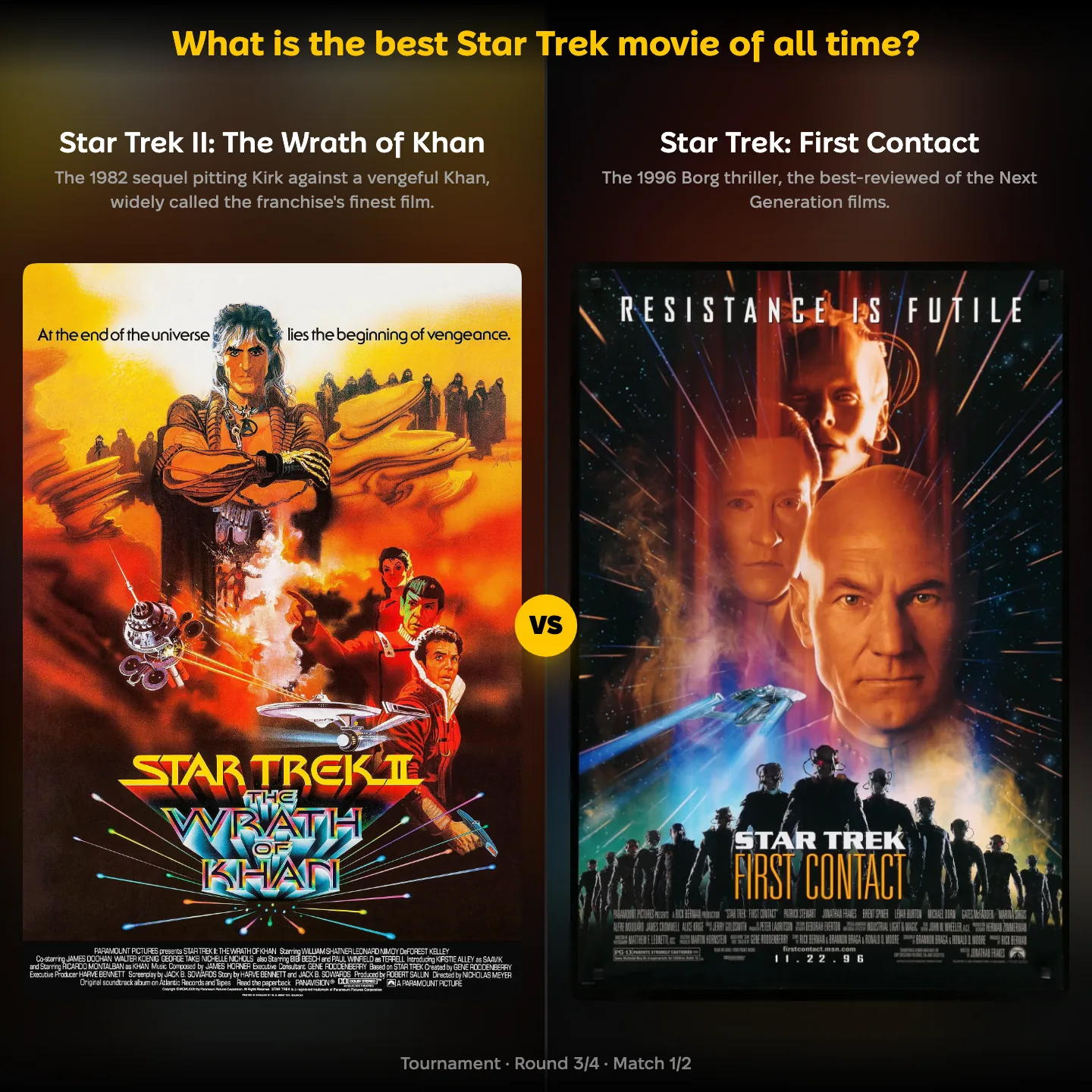
All thirteen films, from The Motion Picture to Beyond
Star Trek's film run splits by cast: six with the original crew from 1979 to 1991, four with the Next Generation crew, three after the 2009 recast.5
The Wrath of Khan (1982) is the consensus peak, and the Library of Congress agreed in December 2024, making it the first Star Trek film in the National Film Registry and citing Nicholas Meyer's direction, James Horner's score and Ricardo Montalbán's antagonist.8
First Contact (1996) is the other one with real defenders. Jonathan Frakes directed it while playing Riker in it, and its $92.0 million in North America is the best of the four Next Generation films.5
The remaining entries include the whale comedy of The Voyage Home and two the fandom now uses as cautionary tales.
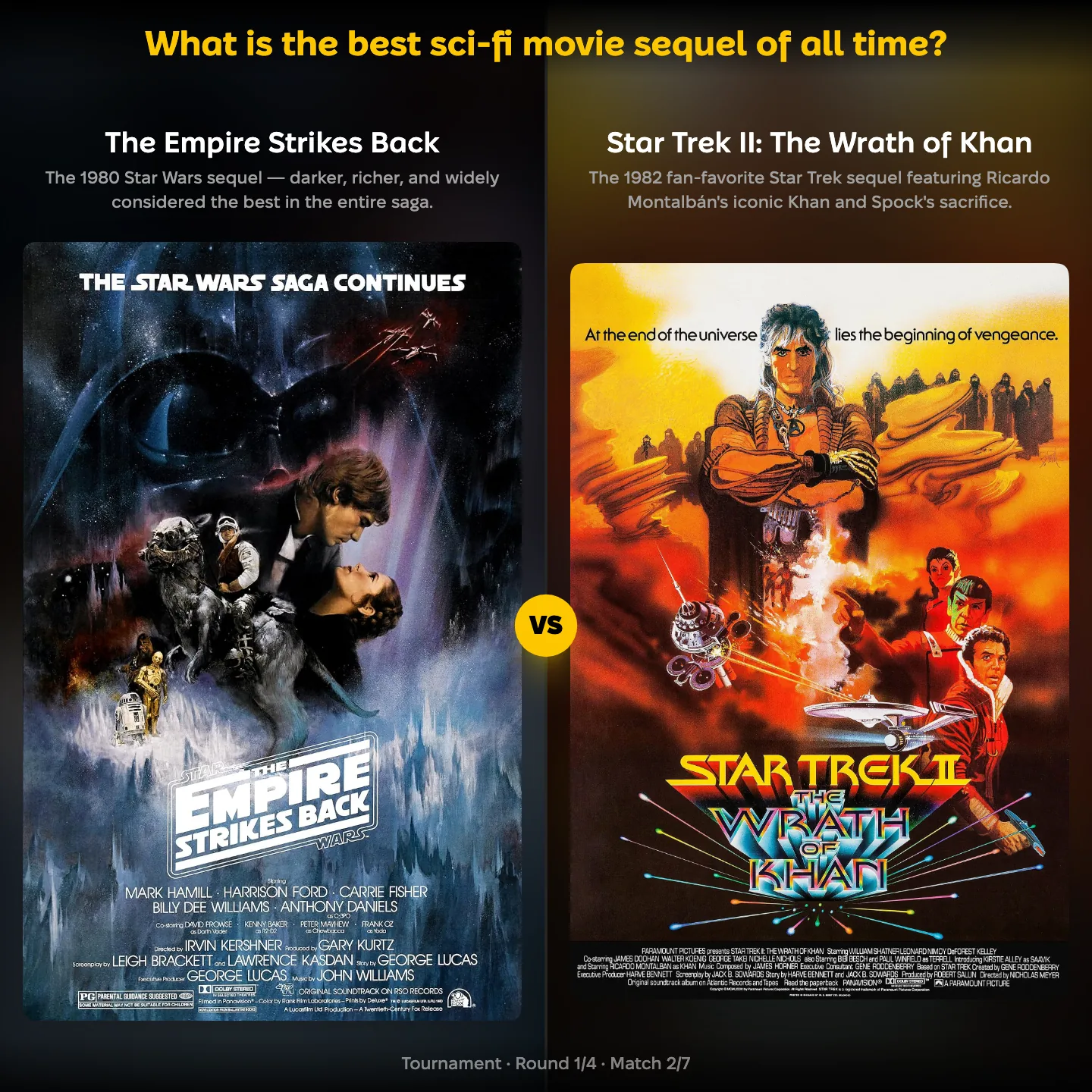
The Wrath of Khan against The Empire Strikes Back
Science-fiction sequels are the narrowest film category Star Trek belongs to, and the one it was practically designed for.
The Wrath of Khan is a preserved national film, which nothing else in the franchise can claim.8 It followed a slow, expensive 1979 debut and swapped the philosophy for a revenge story about growing old.
The obstacle is The Empire Strikes Back, released two years earlier and routinely called better than the film it continues.
Aliens, Terminator 2 and Blade Runner 2049 sit in the same 16, so the ceiling in this category is unusually high and placing anywhere in it means something.
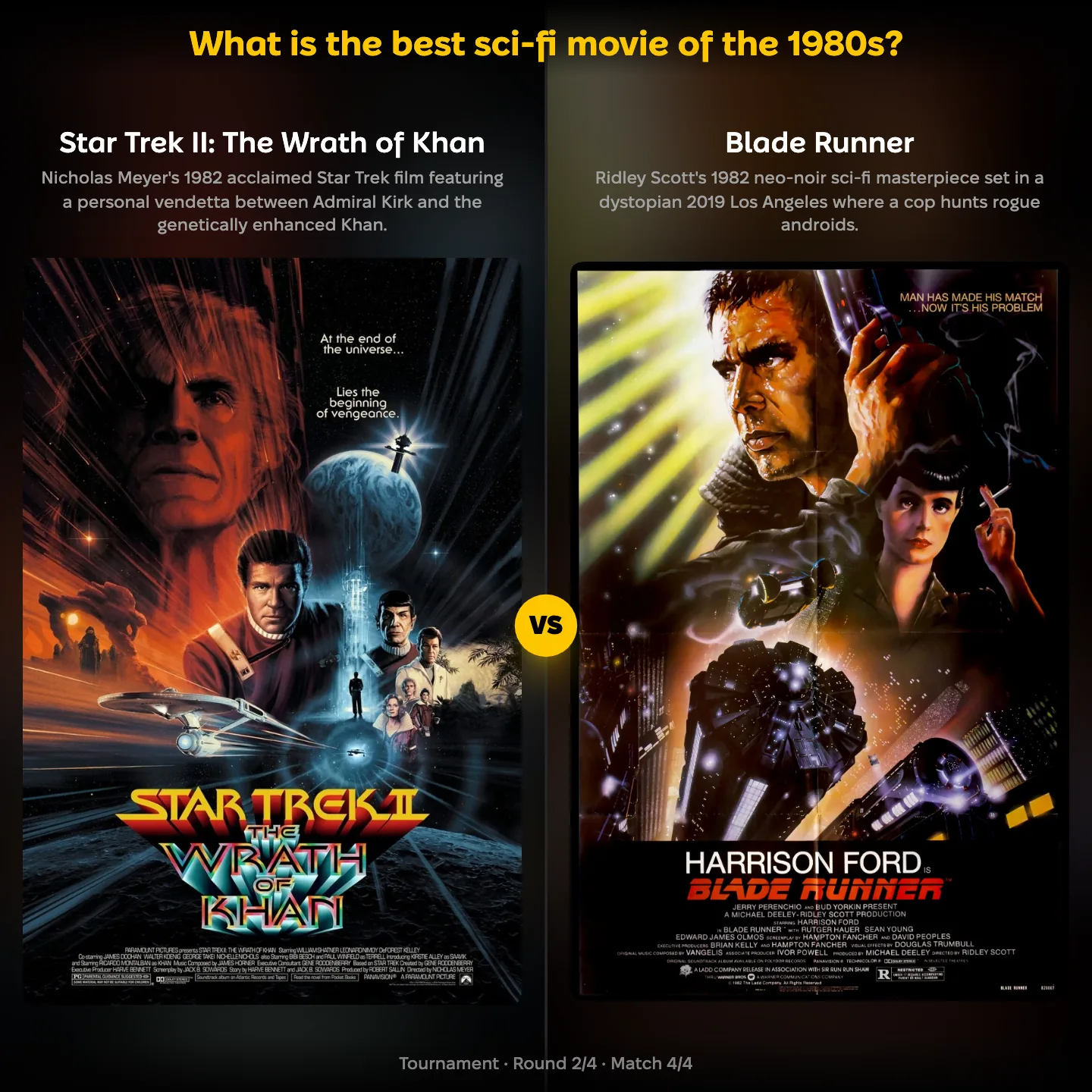
Khan in the decade of Blade Runner and Aliens
Keep The Wrath of Khan and swap the question: best sequel becomes best science-fiction film of the 1980s. The company gets much harder.
The 1980s were the densest decade the genre has had in cinemas. Blade Runner, The Terminator, E.T., Aliens, The Thing, RoboCop, Akira and Back to the Future all arrived inside eight years.
Against that, a 1982 sequel built on a television episode is a specialist pick. Its best qualities reward viewers who already know the characters: Montalbán's grievance, the submarine staging of the battles, the price of Spock's death.
The box office made the same point at the time. The Wrath of Khan took $78.9 million in North America, less than the 1979 film it was made to rescue.5
The Enterprise has an accession number
This ranking is about neither a show nor a film. It judges 16 fictional spacecraft as objects.
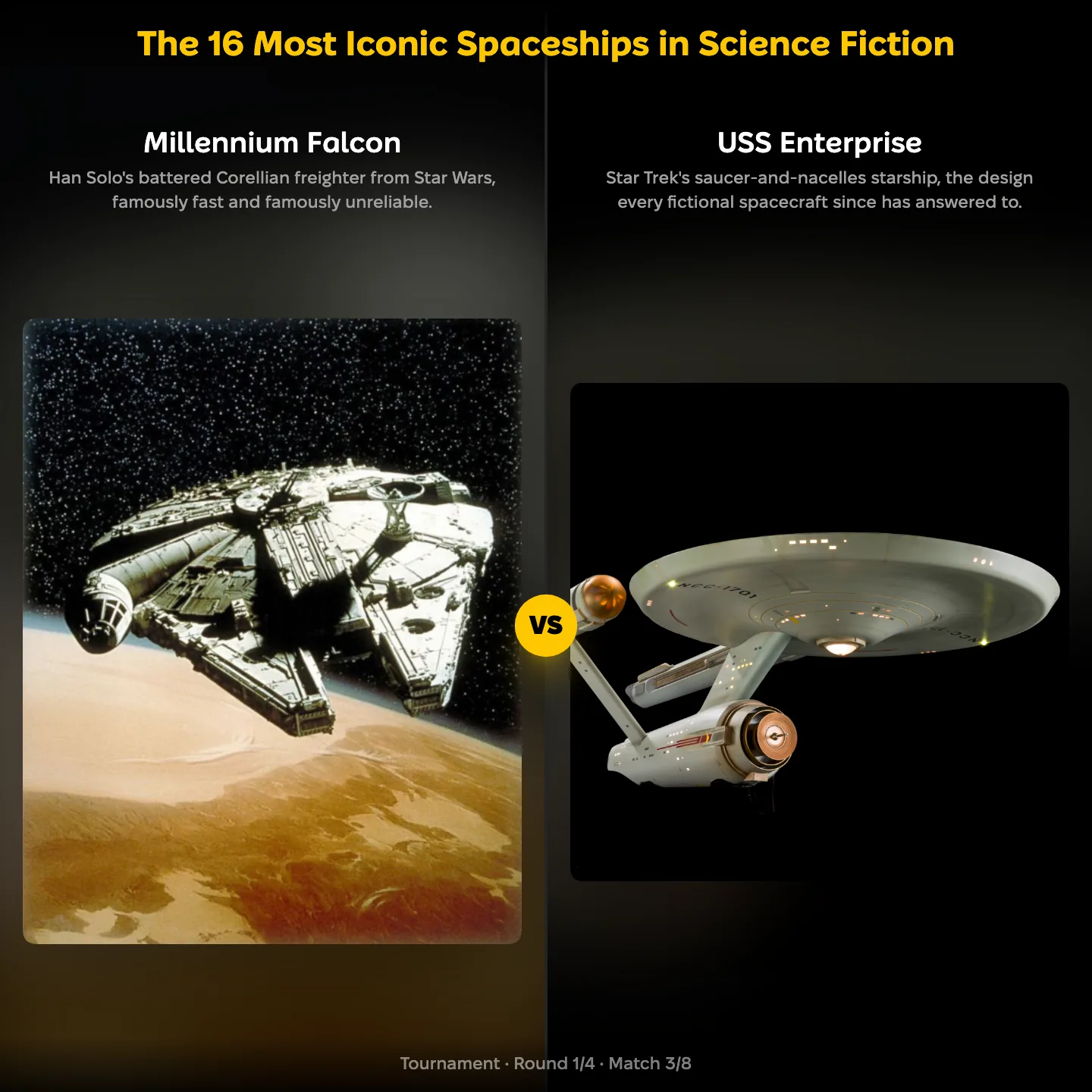
The USS Enterprise is one of them and also a museum holding: Walter M. Jefferies designed the ship to Gene Roddenberry's brief, and the 11-foot filming model has belonged to the Smithsonian since Paramount donated it in 1974, on display in the Boeing Milestones of Flight Hall.9 The Television Academy noticed the drawing too: Jefferies is named on the show's 1969 Emmy nomination for art direction.6
The Millennium Falcon is the counter-argument. It is the ship people can draw from memory, and it works by breaking the saucer-and-nacelles arrangement the Enterprise made standard.
The other options are stranger than the category sounds — a police box, a moon-sized weapon, a towing vessel and a delivery van from Futurama.
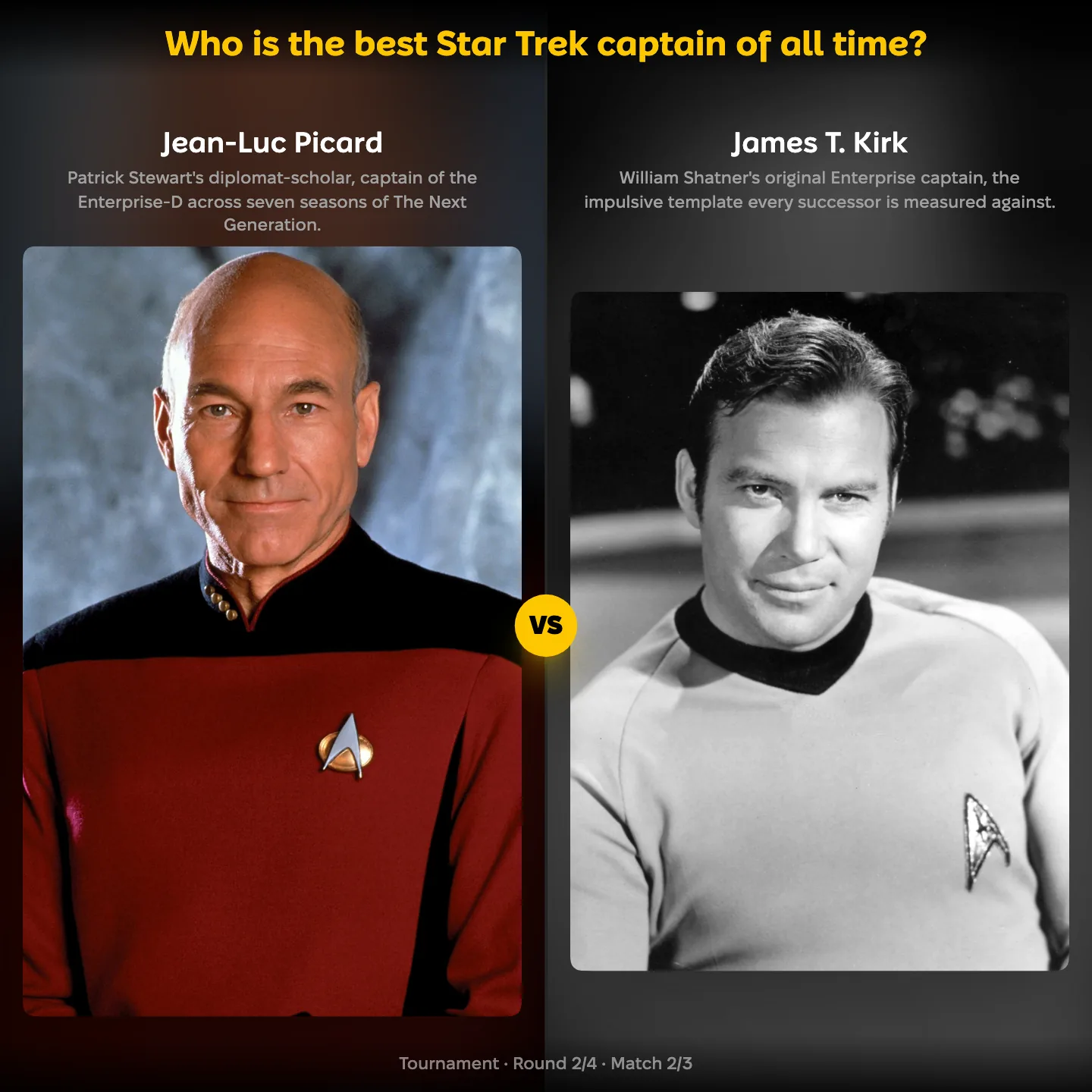
Picard, Kirk, Sisko, Janeway, Pike
Every Star Trek series is organised around whoever holds the command chair, so ranking ten captains comes close to ranking the shows with the personalities pushed forward.
Jean-Luc Picard has the most screen time of anyone in the field. Patrick Stewart played him across 178 episodes3 and all four Next Generation films, then again in a series carrying his own name.
James T. Kirk got there first, and the rest are defined against him. William Shatner played him in seven of the thirteen films,5 and the impulsive-captain reputation comes more from parody than from the episodes.
The list also holds Benjamin Sisko, who spent his series running a war, Kathryn Janeway, stranded on the wrong side of the galaxy, and Christopher Pike, currently in command on Strange New Worlds.
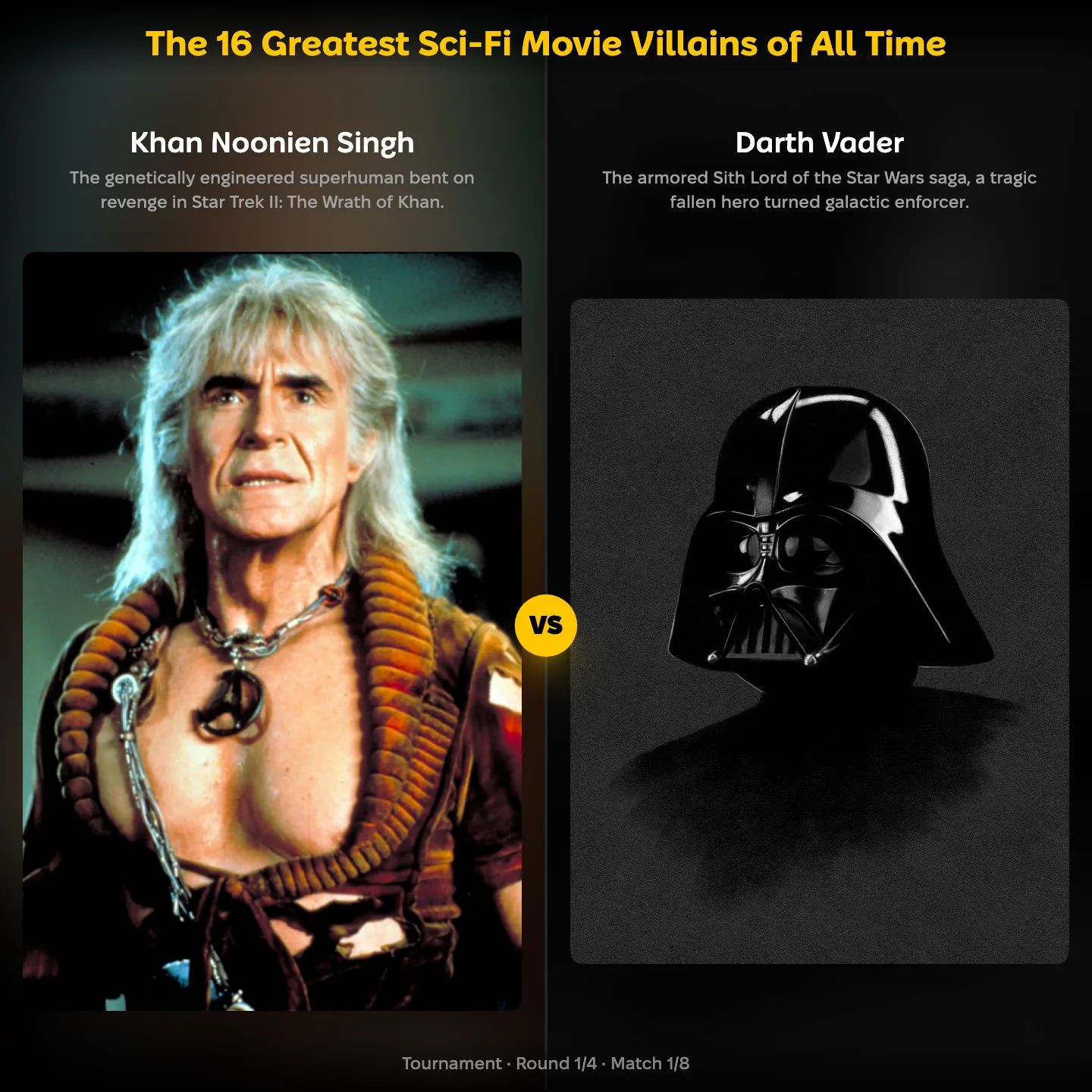
Khan Noonien Singh, built out of two performances
A ranking of the greatest science-fiction villains is not a natural home for a franchise about diplomacy. Star Trek's entry is Khan Noonien Singh.
Khan is unusual here because he barely exists on film. Ricardo Montalbán played him in one episode of the original series, "Space Seed", and then once more in the 1982 sequel the Library of Congress preserves partly for that performance.8
Two appearances is the whole case, and it holds. Khan is assembled from grievance and Melville quotations, and he never shares a scene with Kirk in the film — the two of them trade threats by viewscreen for the entire picture.
The company is punishing. Darth Vader, the Xenomorph, HAL 9000, Agent Smith and Roy Batty are the permanent fixtures of this category, and most of them carry a film on their own.
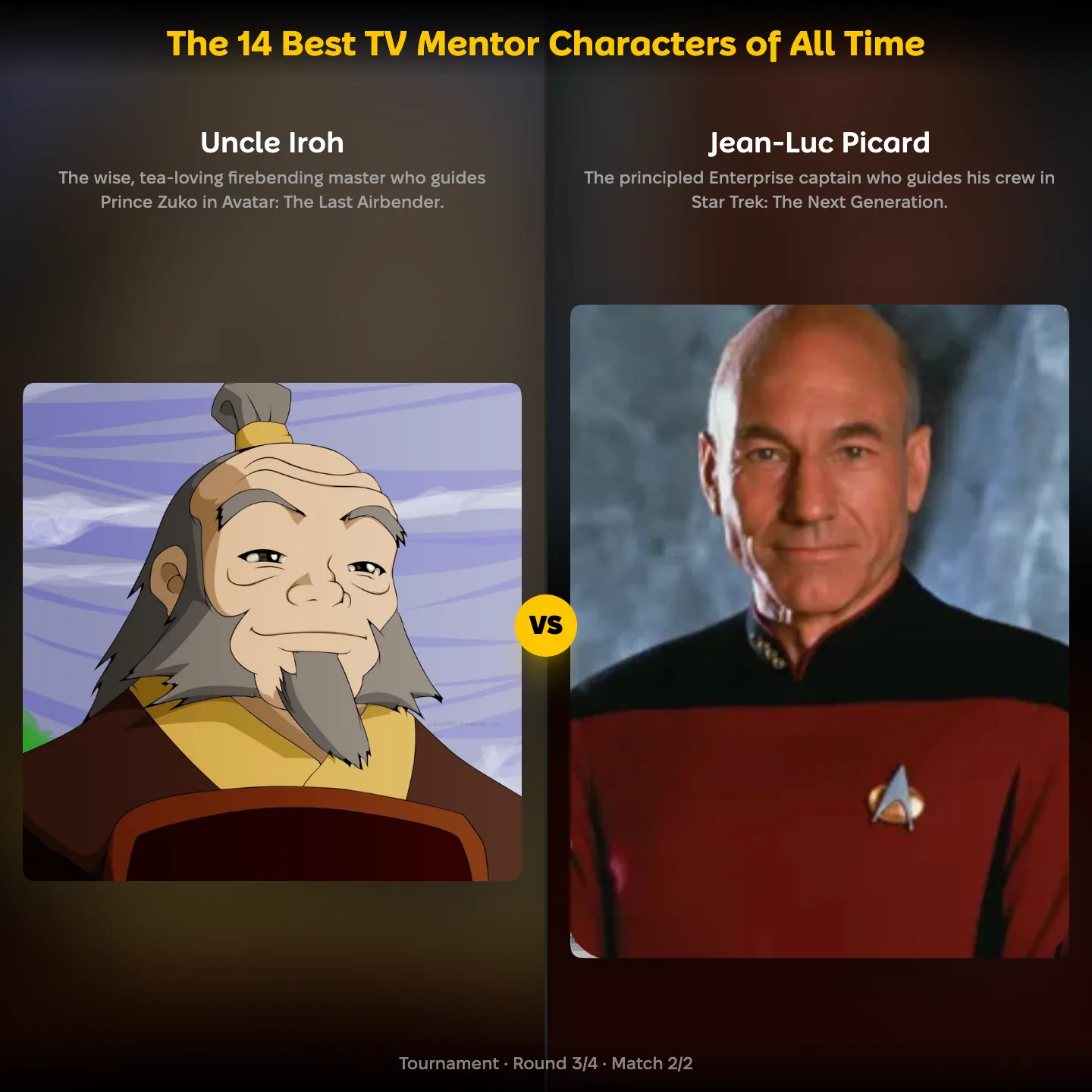
A list about teachers, and a starship captain qualifies
Here is a ranking with no science fiction in its premise: the best mentor characters on television. Star Trek's entry is Jean-Luc Picard again, doing an entirely different job.
Picard belongs because The Next Generation was structurally a workplace show about people learning to do their work. Wesley Crusher, Data and Worf all had arcs made of Picard explaining something to them, usually at length.
Uncle Iroh from Avatar: The Last Airbender is the name every version of this list carries, and he is the harder act to follow: a mentor whose lessons arrive as tea metaphors rather than lectures.
Mr. Feeny, Ted Lasso and Rupert Giles fill out a category that ignores genre completely and sorts by tone instead.
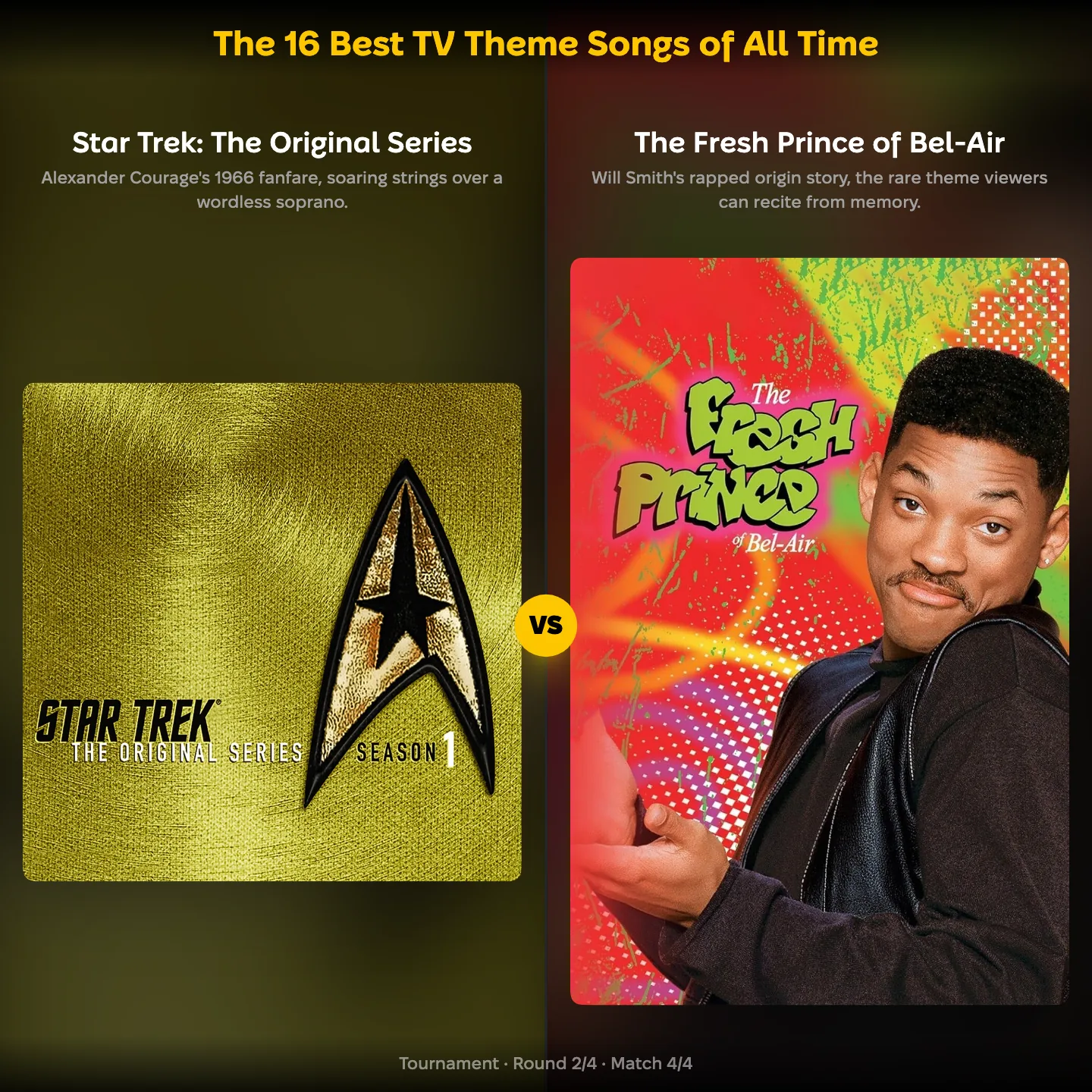
Alexander Courage's only Emmy is not for this
Judge Star Trek on its theme tune and the franchise shrinks to one piece of 1966 orchestration: a rising fanfare, strings, and a wordless soprano line no other television theme has tried to copy.
Alexander Courage wrote it, and the Television Academy has never given him anything for it. His single Emmy came in 1988, for music direction on a Julie Andrews Christmas special, and his two nominations were for a live ceremony broadcast and an episode of Medical Center.10
What it stands beside works differently. Cheers has a singalong chorus and The Fresh Prince of Bel-Air has a rapped origin story, and both hand the listener a tune to repeat.
A wordless fanfare is a harder sell than a chorus, whatever it started.
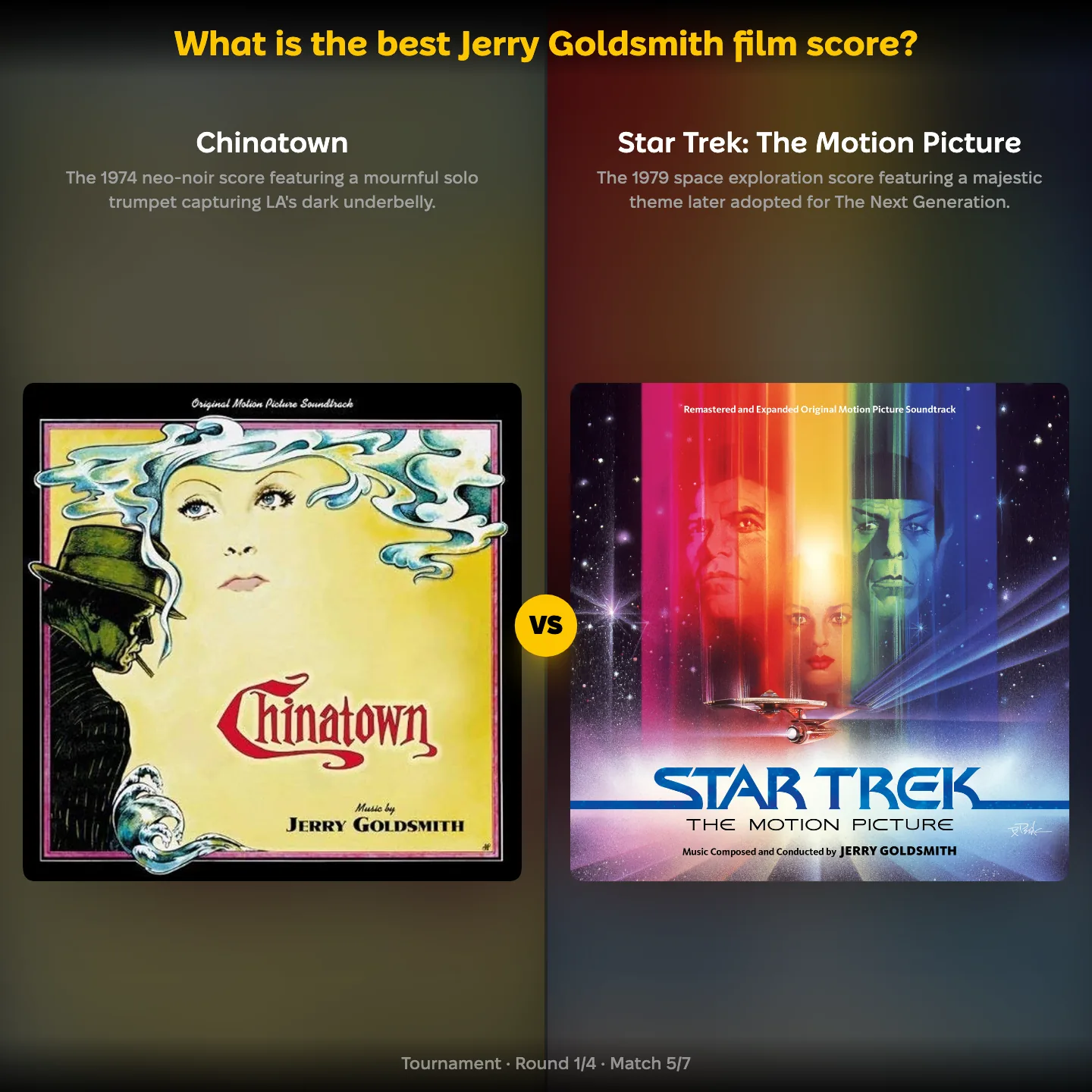
Jerry Goldsmith's catalogue, where Trek is one line
This ranking belongs to Jerry Goldsmith, not to Star Trek. He scored Star Trek: The Motion Picture in 1979, and here that is one credit among thirteen.
It is also the credit that kept renewing itself. In 1995 the Television Academy gave Goldsmith the Emmy for main title theme music for Star Trek: Voyager, ahead of the themes to ER, Friends and Chicago Hope.11
Inside his own catalogue the competition is severe: Chinatown, Planet of the Apes, Alien, The Omen and L.A. Confidential.
Filed under Goldsmith, Star Trek is not a franchise at all. It is one film score from 1979 and one television theme from 1995.
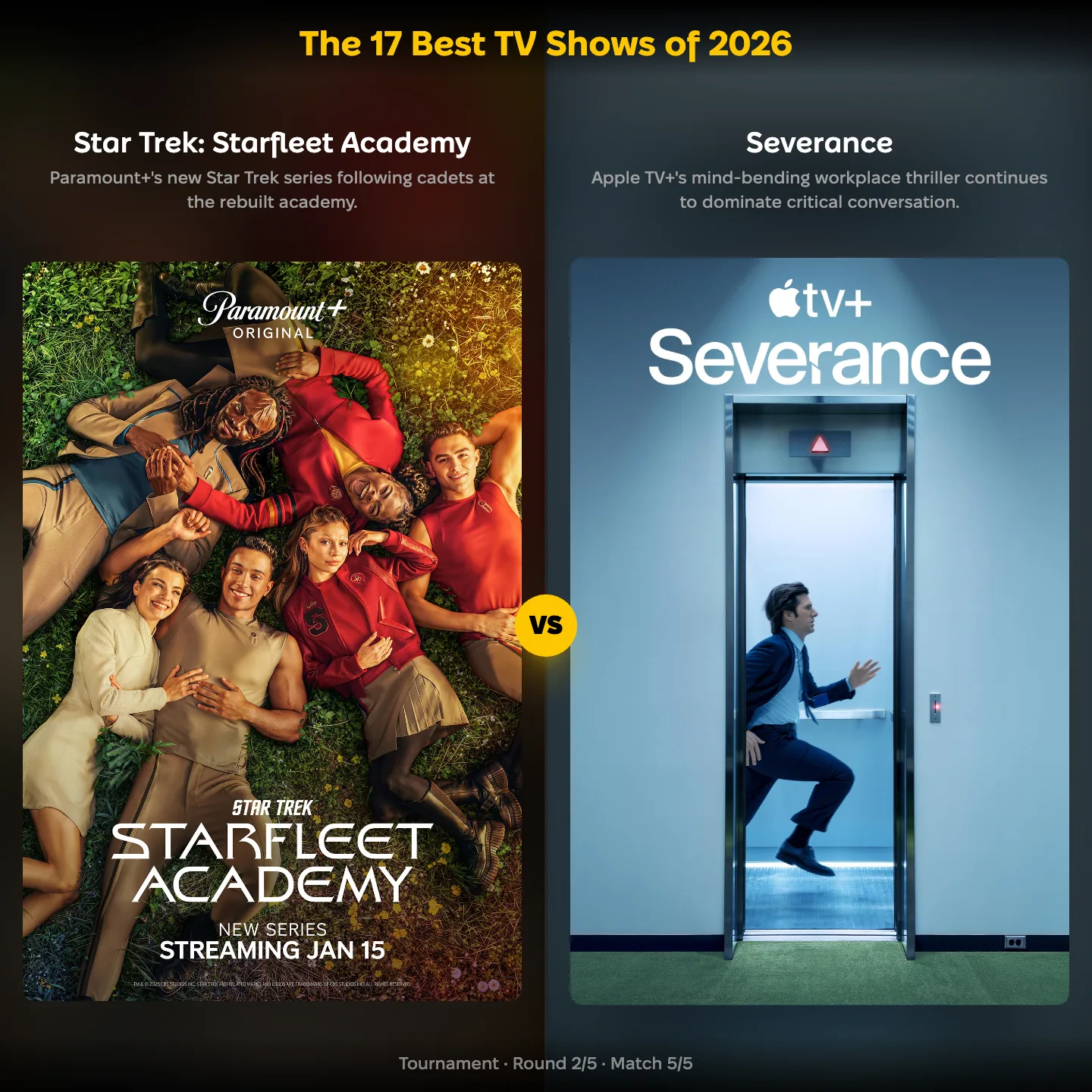
Starfleet Academy arrived in January
Most of this article is history. This ranking is not: it covers television broadcast in 2026, and Star Trek is on it.
Star Trek: Starfleet Academy opened with two episodes on 15 January 2026 and ran ten of them weekly to a 12 March finale, with Holly Hunter as the Academy's chancellor and Paul Giamatti recurring as the season's antagonist.12 It is the franchise's first young-adult Trek, set at the school instead of on a ship.
It was not the only Trek on air this year. Strange New Worlds returned for a fourth season on 23 July 2026, ten episodes again, running weekly to a finale on 24 September.13
The competition is the current prestige slate: Severance, The Bear and House of the Dragon. A show descended from a 1966 pilot is the outsider in that room.
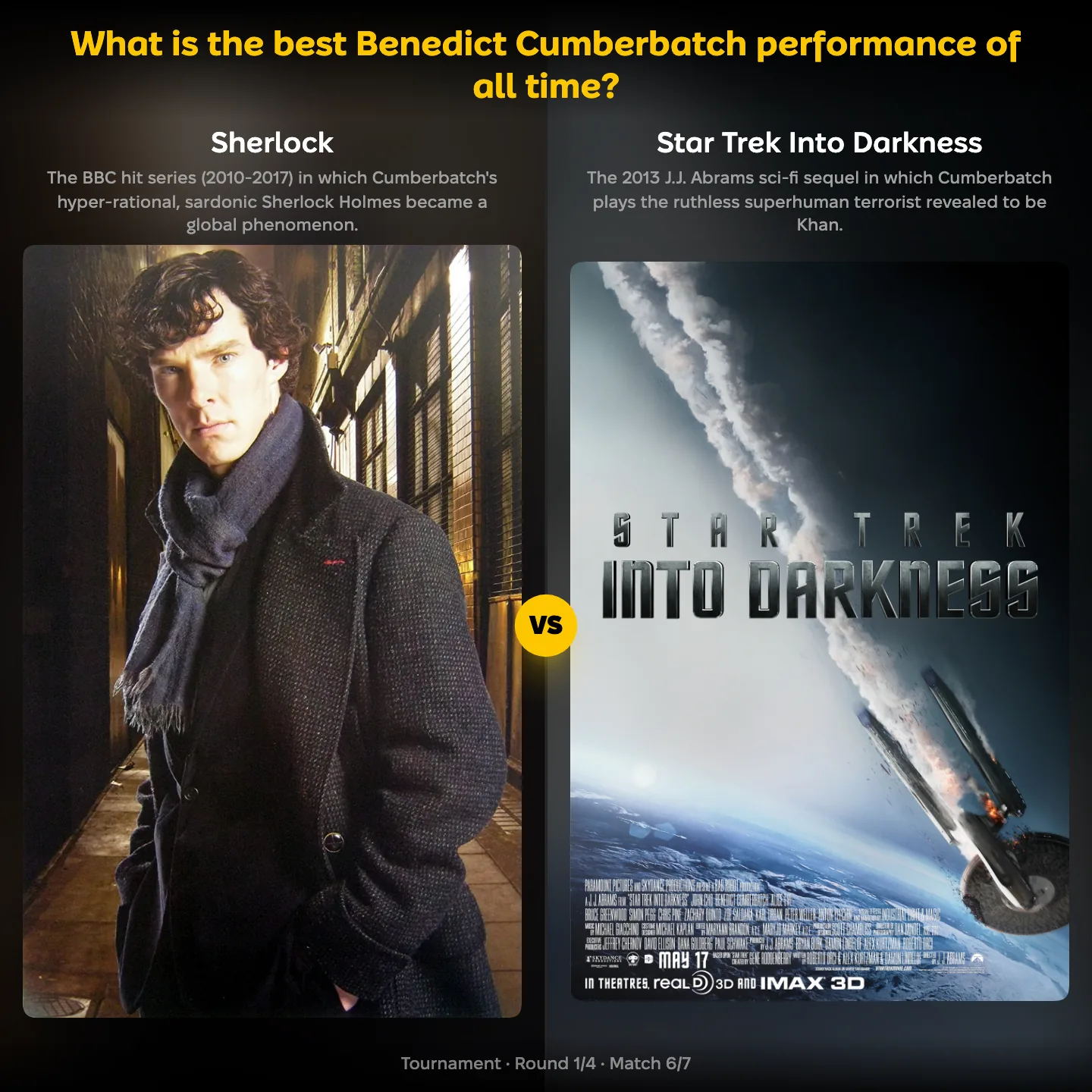
Fourteen Cumberbatch roles, one of them Khan
On this ranking Star Trek is not the subject. Benedict Cumberbatch is, and Trek is one of fourteen roles competing for attention.
Star Trek Into Darkness (2013) cast him as a reimagined Khan, a decision the production denied publicly for months before release. It is still fought over — a British actor playing a character written as a Sikh, in a part Ricardo Montalbán had made his own.
Commercially the gamble worked. Into Darkness took $228.8 million in North America, behind only the 2009 film across the whole franchise.5
Sherlock, The Imitation Game, The Power of the Dog and 12 Years a Slave are the other names on the list, which is difficult company for a blockbuster villain.
Nemesis and The Final Frontier on the list nobody wants
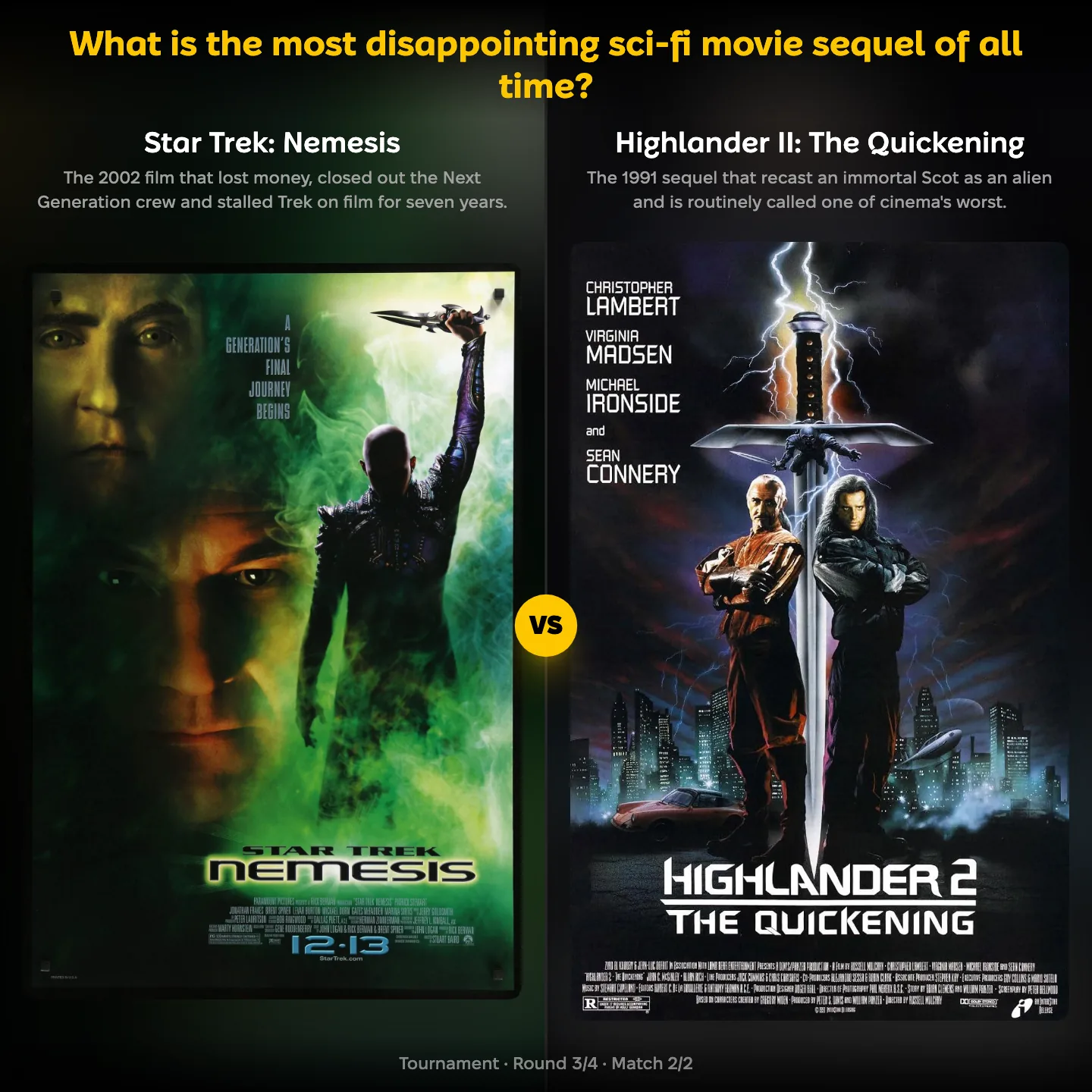
The honest way to finish is with a list no one wants to be on: which science-fiction sequel disappointed hardest. Star Trek supplies two of the fourteen entries.
Star Trek: Nemesis (2002) is the serious one. It took $43.3 million in North America, the lowest of the thirteen films, and it ended the Next Generation cast's run in cinemas; seven years went by before the franchise returned, recast.5
Star Trek V: The Final Frontier (1989) is the other. William Shatner directed it, the plot involved meeting God at the centre of the galaxy, and it still out-grossed Nemesis by nine million dollars.5
Highlander II, Terminator: Genisys and Alien: Resurrection round out the fourteen, which is company of a kind.
What Star Trek Day is counting
Sixteen questions, and Star Trek answers to a different name in each: a syndicated drama, a film series, a silhouette, a command chair, a composer's credit, a January premiere.
The filing is not finished. Strange New Worlds has six episodes left before Paramount+ ends it,14 which leaves one more season for other people's lists to place.
Every order on this site is produced by a long run of two-name choices.
And if you would defend Deep Space Nine over The Next Generation to the last, that is a ranking worth building.
More rankings, more angles
- Star Wars: 16 Lists, 16 Different Answers — Vader, a theme park and a waistcoat
- The Lord of the Rings Changes Category From List to List — Howard Shore, Viggo Mortensen, eleven games
- Game of Thrones: 59 Emmys, One Ending Nobody Agrees On — 59 Emmys and a disputed finale
- The Simpsons: 800 Episodes, 17 Different Lists — 800 episodes, seventeen different categories
Sources
- Paramount+ — Star Trek 60th anniversary guide, on "The Man Trap" airing on NBC on 8 September 1966 and the anniversary date of 8 September 2026: paramountplus.com (checked 2026-08-03)
- StarTrek.com — Star Trek: The Original Series, 3 seasons, 79 episodes, 1966–1969: startrek.com (checked 2026-08-03)
- StarTrek.com — Star Trek: The Next Generation, 7 seasons, 178 episodes, 1987–1994: startrek.com (checked 2026-08-03)
- Television Academy — Star Trek: The Next Generation awards record: 58 nominations, 17 wins, and the 1994 Outstanding Drama Series nomination: televisionacademy.com (checked 2026-08-03)
- Box Office Mojo — Star Trek franchise: thirteen films released December 1979 to July 2016 and their North American grosses, including The Motion Picture ($82.3m), The Wrath of Khan ($78.9m), First Contact ($92.0m), The Final Frontier ($52.2m), Nemesis ($43.3m), Star Trek 2009 ($257.7m) and Into Darkness ($228.8m): boxofficemojo.com (checked 2026-08-03)
- Television Academy — Star Trek (NBC, 1966–69) awards record: 13 nominations and no wins, Outstanding Dramatic Series in 1967 and 1968, Leonard Nimoy nominated in 1967, 1968 and 1969, Walter M. Jefferies named on the 1969 art direction nomination, and the 2018 Governors Award: televisionacademy.com (checked 2026-08-03)
- StarTrek.com — Star Trek: Deep Space Nine, 7 seasons, 176 episodes, 1993–1999: startrek.com (checked 2026-08-03)
- Library of Congress — 2024 National Film Registry announcement, 17 December 2024, naming Star Trek II: The Wrath of Khan the first Star Trek film added and crediting Nicholas Meyer, James Horner and Ricardo Montalbán: newsroom.loc.gov (checked 2026-08-03)
- Smithsonian National Air and Space Museum — Star Trek Starship Enterprise Studio Model: principal designer Walter "Matt" Jefferies, the 11-foot model, donated by Paramount in 1974, on display in the Boeing Milestones of Flight Hall: airandspace.si.edu (checked 2026-08-03)
- Television Academy — Alexander Courage: one Emmy win, for music direction in 1988, and nominations in 1987 and 1973: televisionacademy.com (checked 2026-08-03)
- Television Academy — Outstanding Individual Achievement in Main Title Theme Music, 1995: Jerry Goldsmith wins for Star Trek: Voyager against ER, Friends, Chicago Hope and My So-Called Life: televisionacademy.com (checked 2026-08-03)
- StarTrek.com — Star Trek: Starfleet Academy trailer and premiere announcement: two episodes on Thursday 15 January, a 10-episode season, finale on 12 March, Holly Hunter as Chancellor of Starfleet Academy, Paul Giamatti in the cast: startrek.com (checked 2026-08-03)
- Paramount+ — Star Trek: Strange New Worlds season 4: premiered Thursday 23 July 2026, 10 episodes, weekly to the finale on 24 September: paramountplus.com (checked 2026-08-03)
- StarTrek.com — Paramount+ announces a fifth and final six-episode season of Star Trek: Strange New Worlds: startrek.com (checked 2026-08-03)