
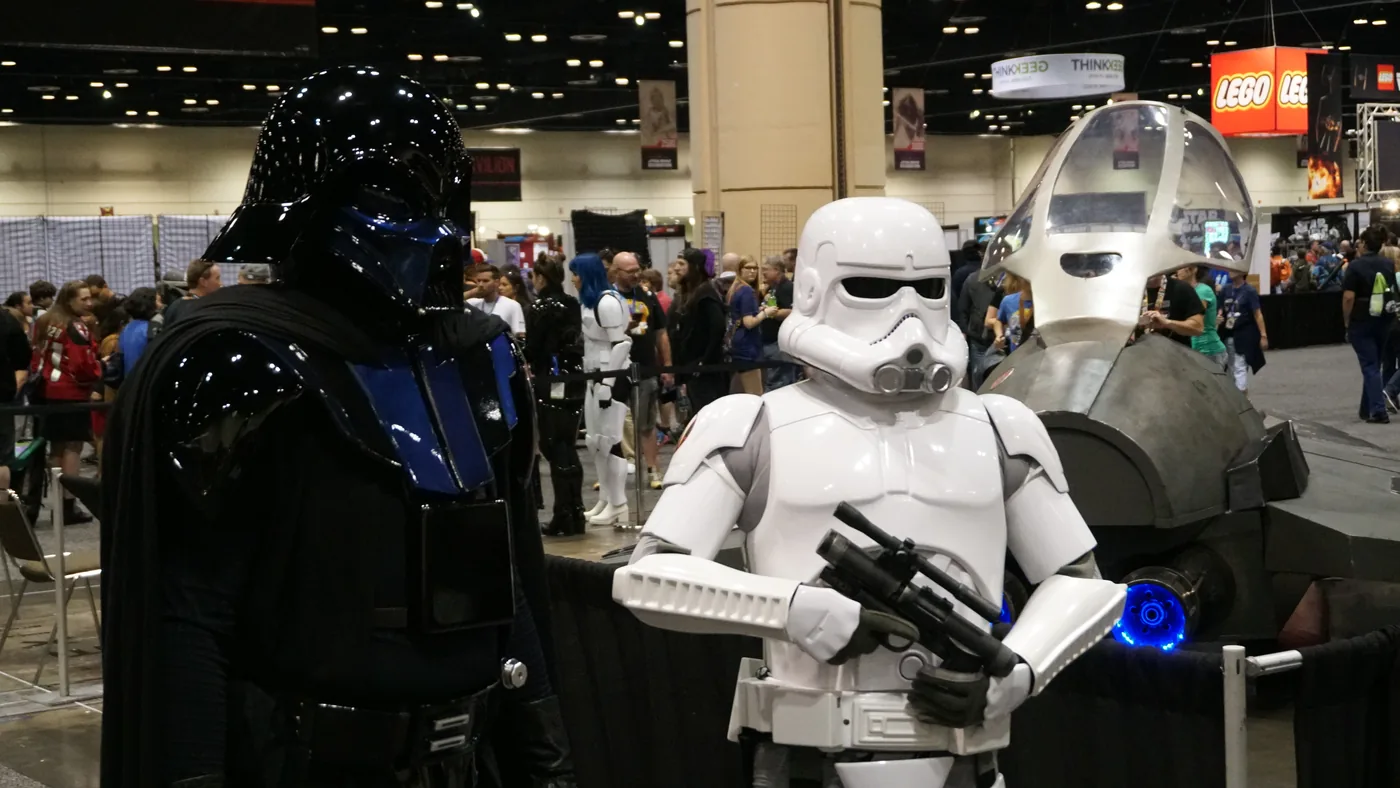
Star Wars opened on 25 May 1977 and has been filing itself under new categories ever since.1 It is a film series, a television slate, a video-game catalogue, a theme-park land and a Disney+ launch title. The newest film, The Mandalorian and Grogu, reached cinemas on 22 May 2026, three days short of the first one's forty-ninth birthday.2
That spread is the awkward part. Narrow the question and the same two words come to mean something else: a genre, one entry in John Williams's catalogue, three credits on a busy actor's CV.
Star Wars wrote the rules for one of the lists below and squeezes onto another as Han Solo's waistcoat.
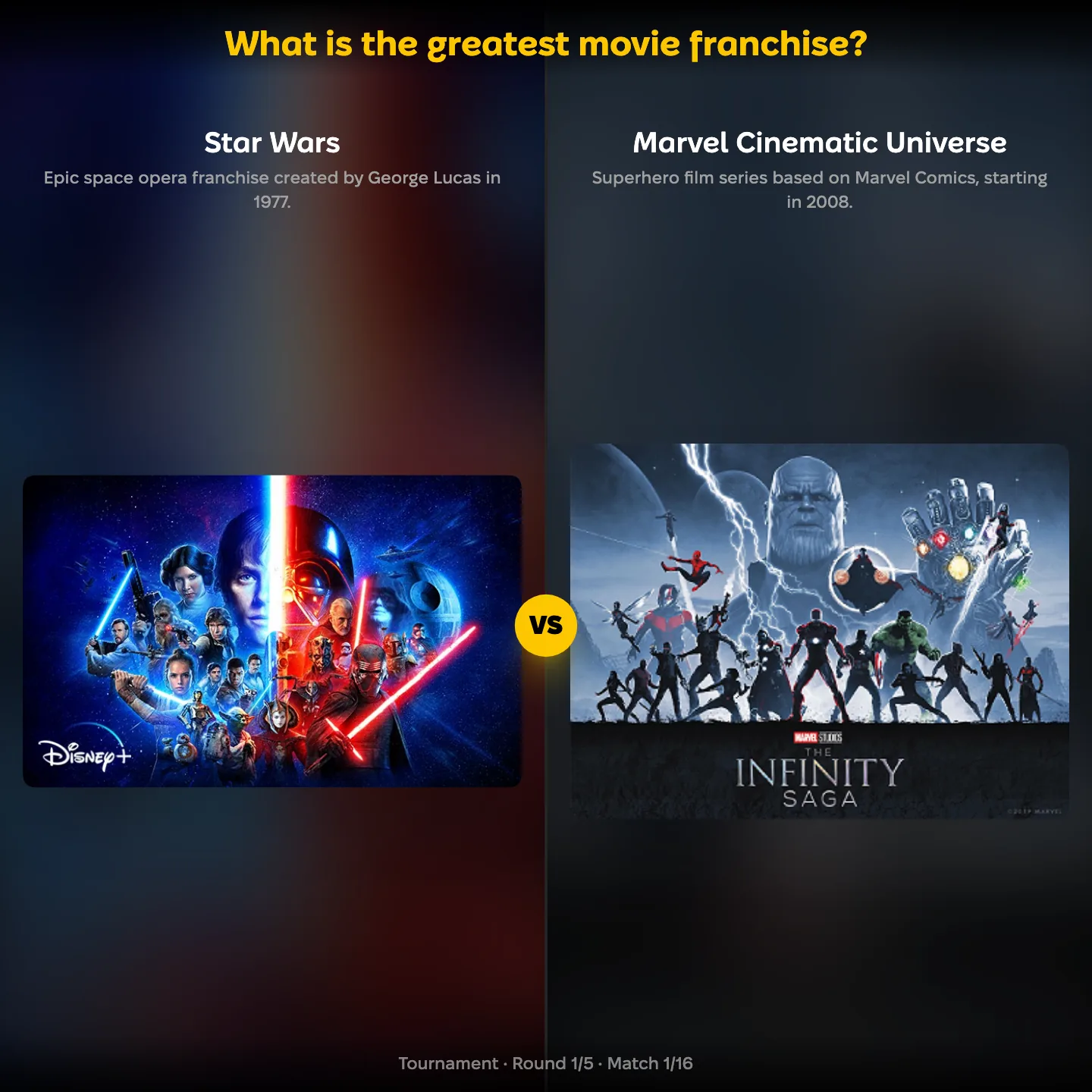
Star Wars vs the Marvel Cinematic Universe
The widest question in the article asks which film series is the greatest, which sets Star Wars beside James Bond, Harry Potter, Star Trek, Middle-earth and Marvel's Infinity Saga.
Star Wars has the longest run of anything in that company. George Lucas released the first film in 1977, and Lucasfilm has put new Star Wars pictures into cinemas in five separate decades.
Marvel has volume. The Marvel Cinematic Universe began in 2008, thirty-one years behind, and has released far more films in far less time.
The biggest single release either side has managed is still The Force Awakens, which tops Box Office Mojo's all-time North American chart on $936,662,225, ahead of Avengers: Endgame.3 This is also the only question in the article where Star Wars competes as the whole franchise instead of as one item taken out of it.
Eleven films, and the row that never ends
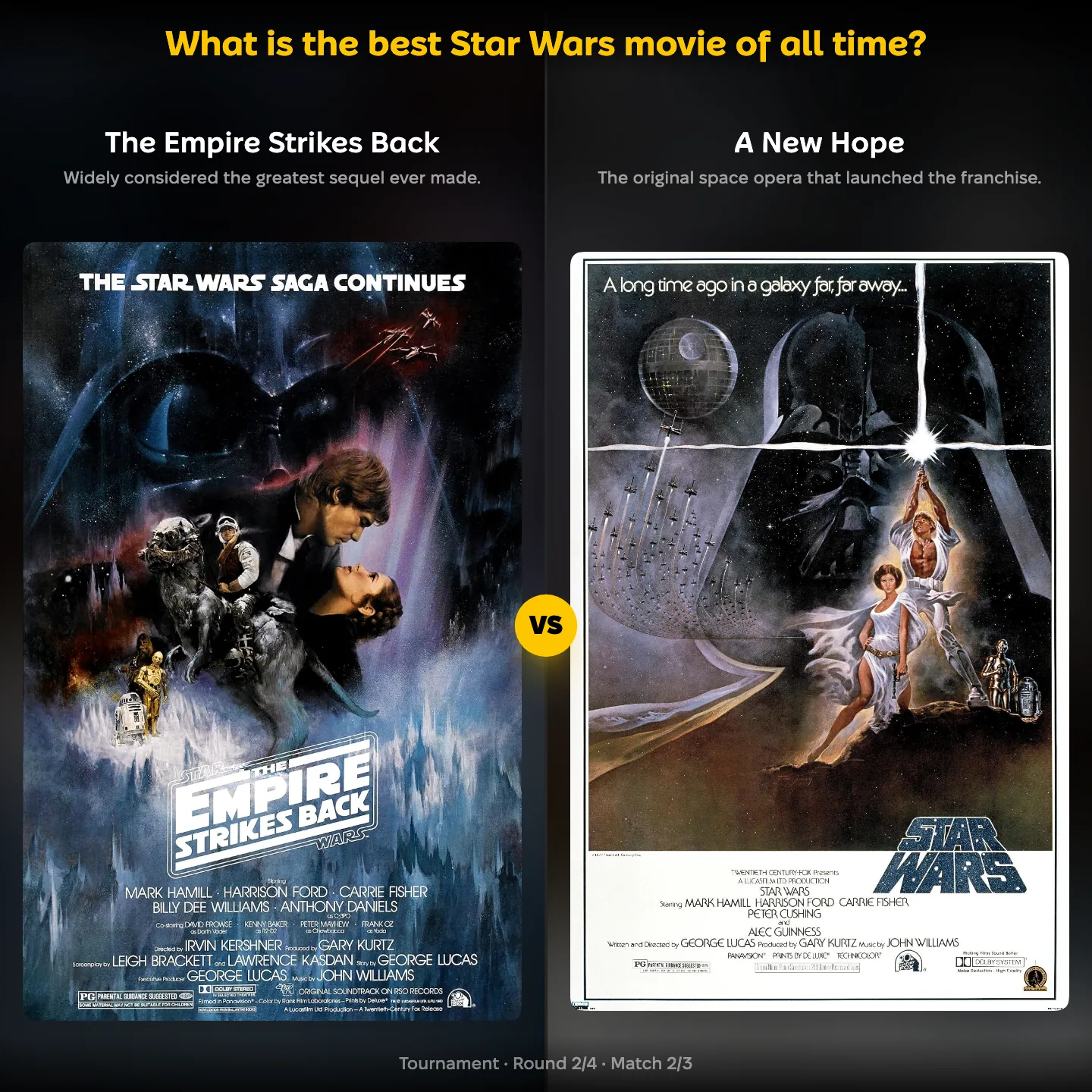
Here Star Wars stops competing with anybody else. The eleven films in this ranking run from A New Hope in 1977 to Solo in 2018, and every option carries the same brand.
The Empire Strikes Back is the usual answer. Irvin Kershner directed it in 1980, and it gave the saga its darkest turn and its most quoted line.
A New Hope has the claim on consequence rather than craft. It took ten nominations at the 50th Academy Awards and won six of them, and Ben Burtt accepted a Special Achievement Award for the film on top of that.4
Nine more films are in the field: three prequels between 1999 and 2005, three sequels between 2015 and 2019, and Rogue One and Solo, which divide opinion in opposite directions. Whichever film a reader would put first, the field is the only one in the article where losing still means being a Star Wars film.
Back to the Future vs the original trilogy
This ranking judges trilogies instead of films, so A New Hope, The Empire Strikes Back and Return of the Jedi enter as one object, released in 1977, 1980 and 1983.
Judged as a set, the case is consistency plus an ending. The Library of Congress has taken all three into the National Film Registry, in 1989, 2010 and 2021, so the preservation argument covers the whole run rather than the famous middle.5
Back to the Future is the awkward rival. Robert Zemeckis made three films in five years from 1985, kept the same cast and the same internal rules, and finished the story on purpose.
The Godfather, The Dark Knight and Middle-earth are on the list too, and two of those were designed as trilogies from the first page. Nothing in 1977 guaranteed a second Star Wars film, let alone a third, which makes the original three a trilogy discovered rather than planned.
Space opera: the genre Star Wars furnished
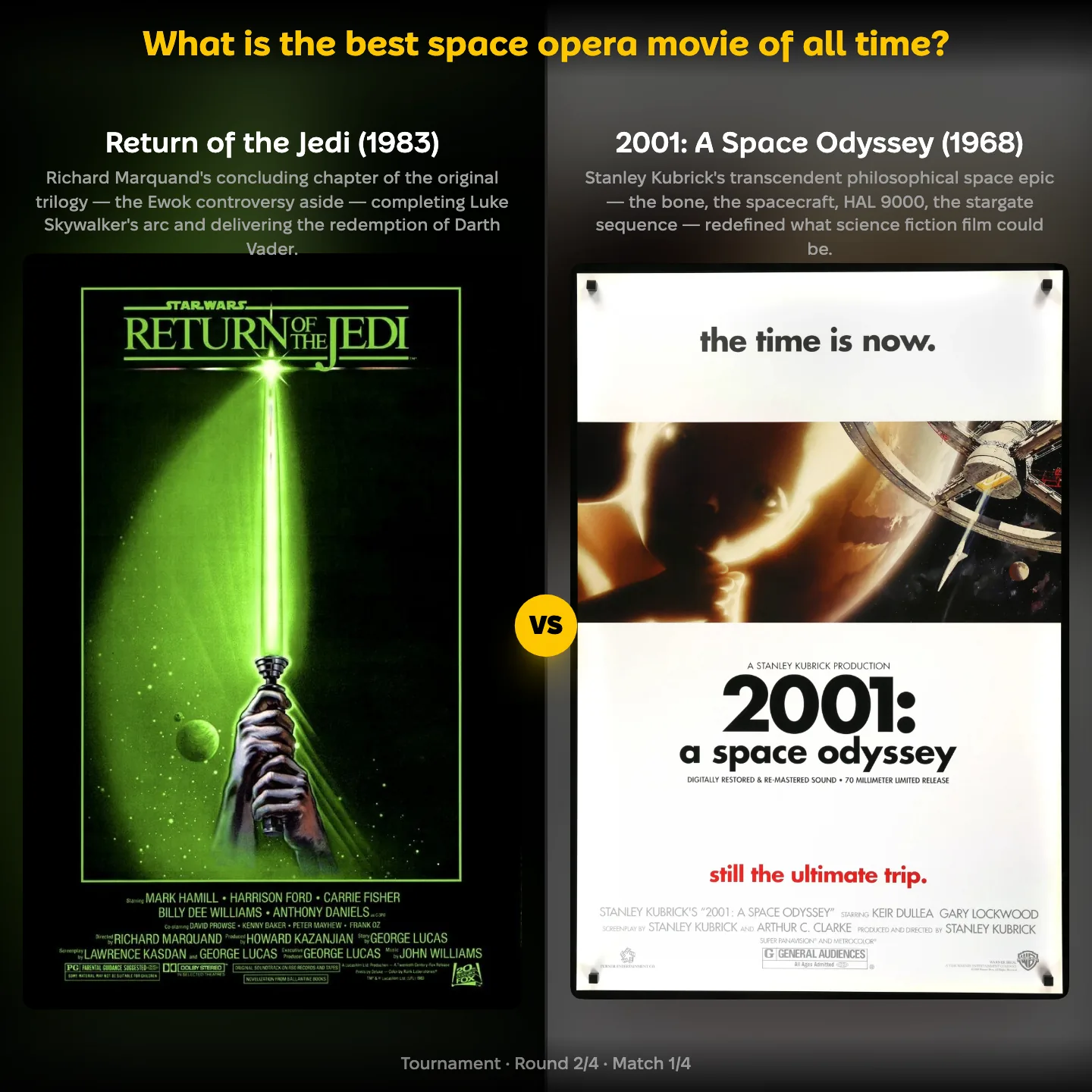
Space opera is the one category Star Wars can claim to have furnished. The 1977 film took the Saturday-serial format, moved it into orbit, and set the shape that later entries answer to.
All three original films are options here, which is unusual for any franchise on a genre list.
2001: A Space Odyssey is the objection. Stanley Kubrick released it in 1968, nine years earlier, and treated space as vast and indifferent rather than as somewhere to fly a fighter.
Interstellar, both Dune films, Avatar and Guardians of the Galaxy fill out the field. Guardians borrows the Star Wars register most openly, down to the wisecracking pilot and the non-human co-pilot.
Blade Runner, Aliens and Empire in the 1980s
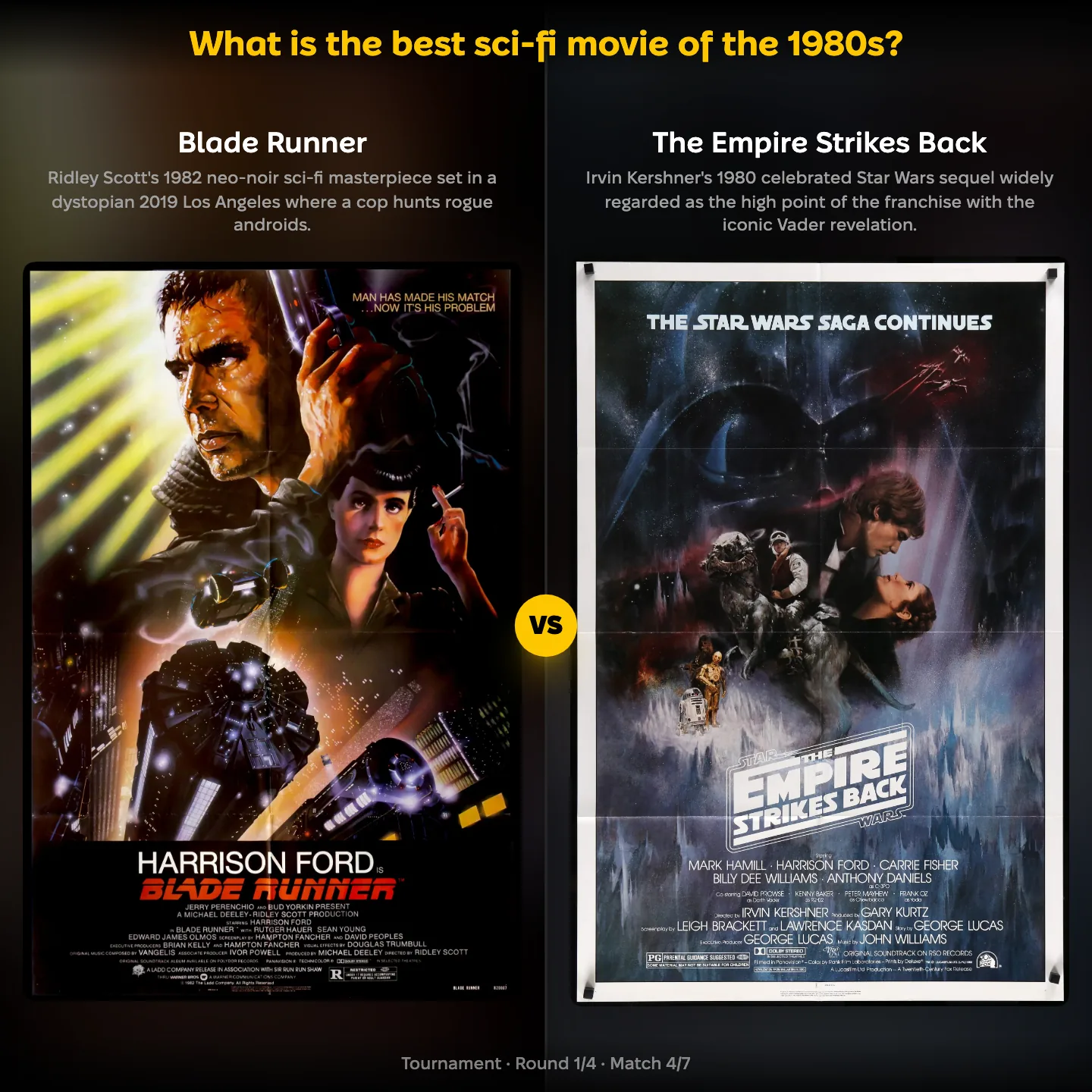
Narrow the field to science fiction released in the 1980s and Star Wars has exactly one entry, The Empire Strikes Back.
Empire arrived in 1980 as the rare middle chapter that deepens a story instead of stalling it, and Industrial Light & Magic had to shoot the Hoth battle with stop-motion models because no other technique would move an Imperial walker convincingly.
Ridley Scott's Blade Runner is the film most often used against it. Released in 1982, it lost money, then spent forty years being reappraised.
Aliens, The Terminator, E.T., The Thing, RoboCop and Akira are in the field as well. Empire is the only one of them that had to work as somebody's second act, which is a difficulty none of its rivals were handed.
John Williams was nominated twice for the same award
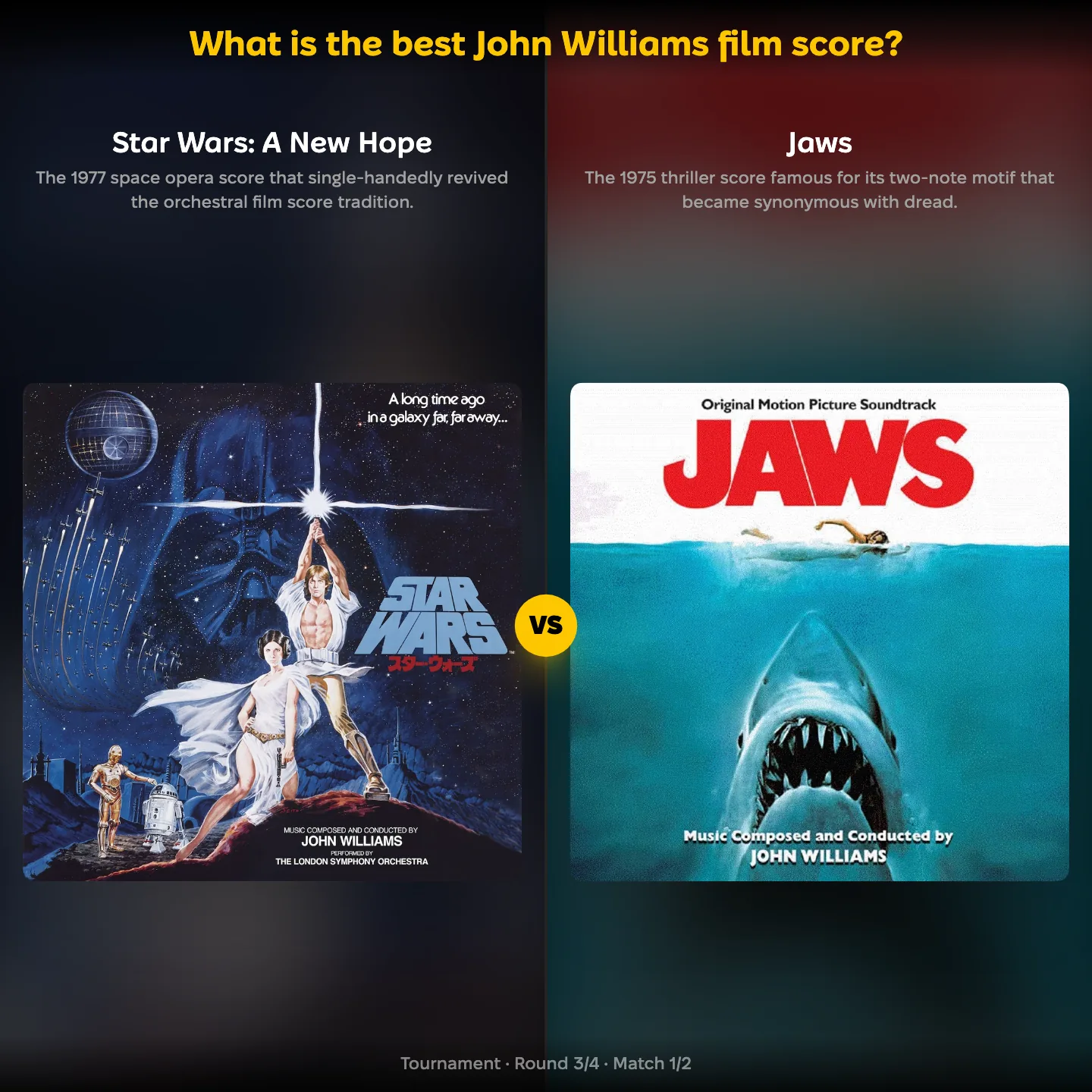
This ranking is not about Star Wars. It asks which John Williams score is his best, and the 1977 fanfare is one option among the composer's own work.
At the 50th Academy Awards Williams held two of the five nominations for Original Score, one for Star Wars and one for Close Encounters of the Third Kind, and he won with Star Wars.4 The score also did something unfashionable, putting a full orchestra back into a Hollywood that was drifting towards pop songs and synthesisers.
Jaws is the problem. Williams took the same category for it two years earlier, at the 48th Academy Awards, and he did it with two notes.6
E.T. and Schindler's List are options too. Inside one composer's catalogue the Star Wars fanfare loses its advantage of scale, because everything it is up against was written by the same man.
The Godfather Part II is the sequel with the Best Picture
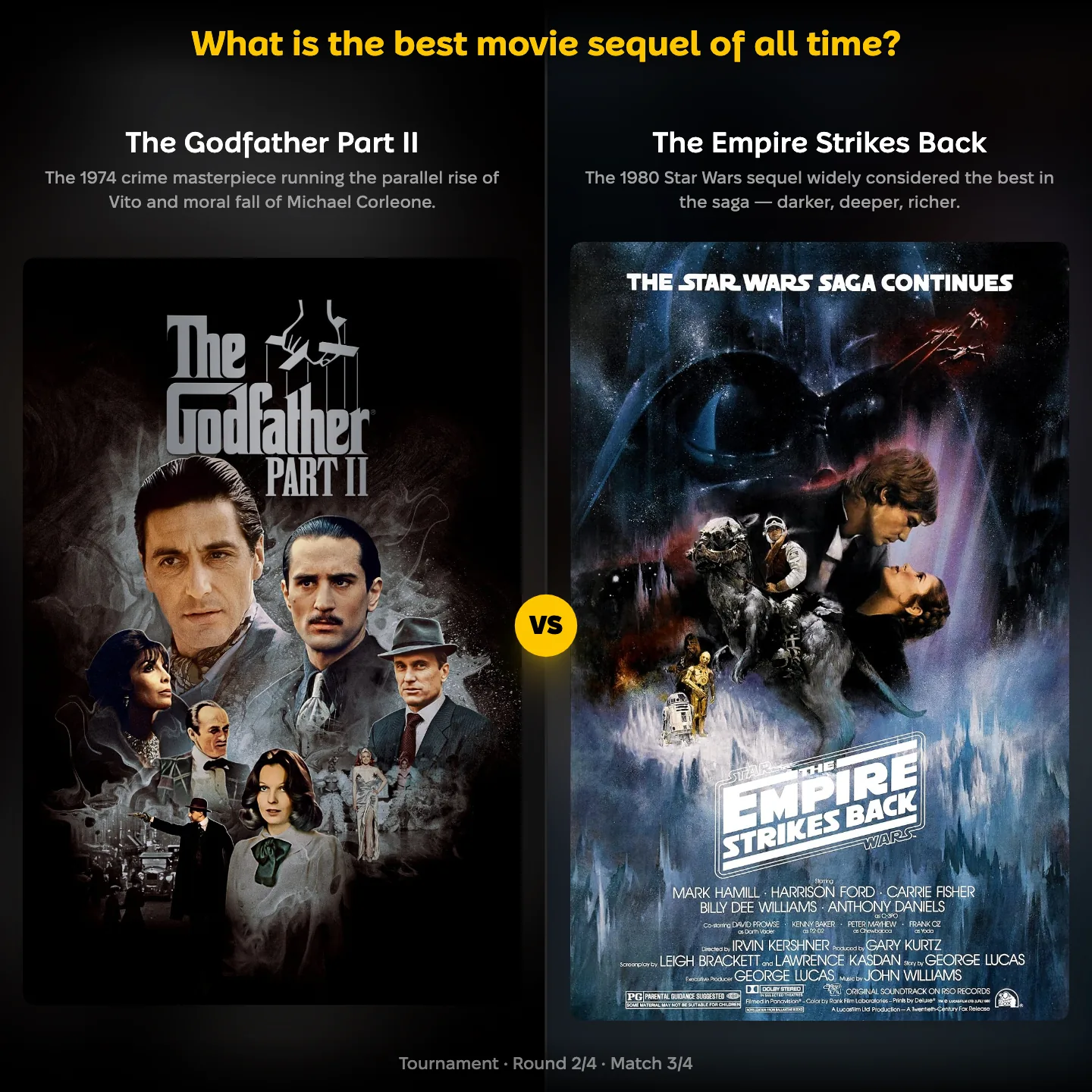
Before 1980 a sequel was assumed to be the lesser thing, a cash-in on a hit. The Empire Strikes Back broke that assumption, which is why it appears among the best sequels ever made.
Empire managed it by getting darker instead of bigger. The heroes lose, Han Solo leaves the film frozen in carbonite, and audiences waited three years to find out what happened next.
The Godfather Part II holds the trophy the whole franchise lacks. Coppola's 1974 film won Best Picture at the 47th Academy Awards;7 the Star Wars nomination three years later lost to Annie Hall.4
Terminator 2, Aliens, Toy Story 3, Spider-Man 2 and Avengers: Endgame complete the field. Most of them were commissioned in a business that already took a strong sequel for granted, and Empire is a large part of why it does.
AFI put Darth Vader behind Hannibal Lecter and Norman Bates
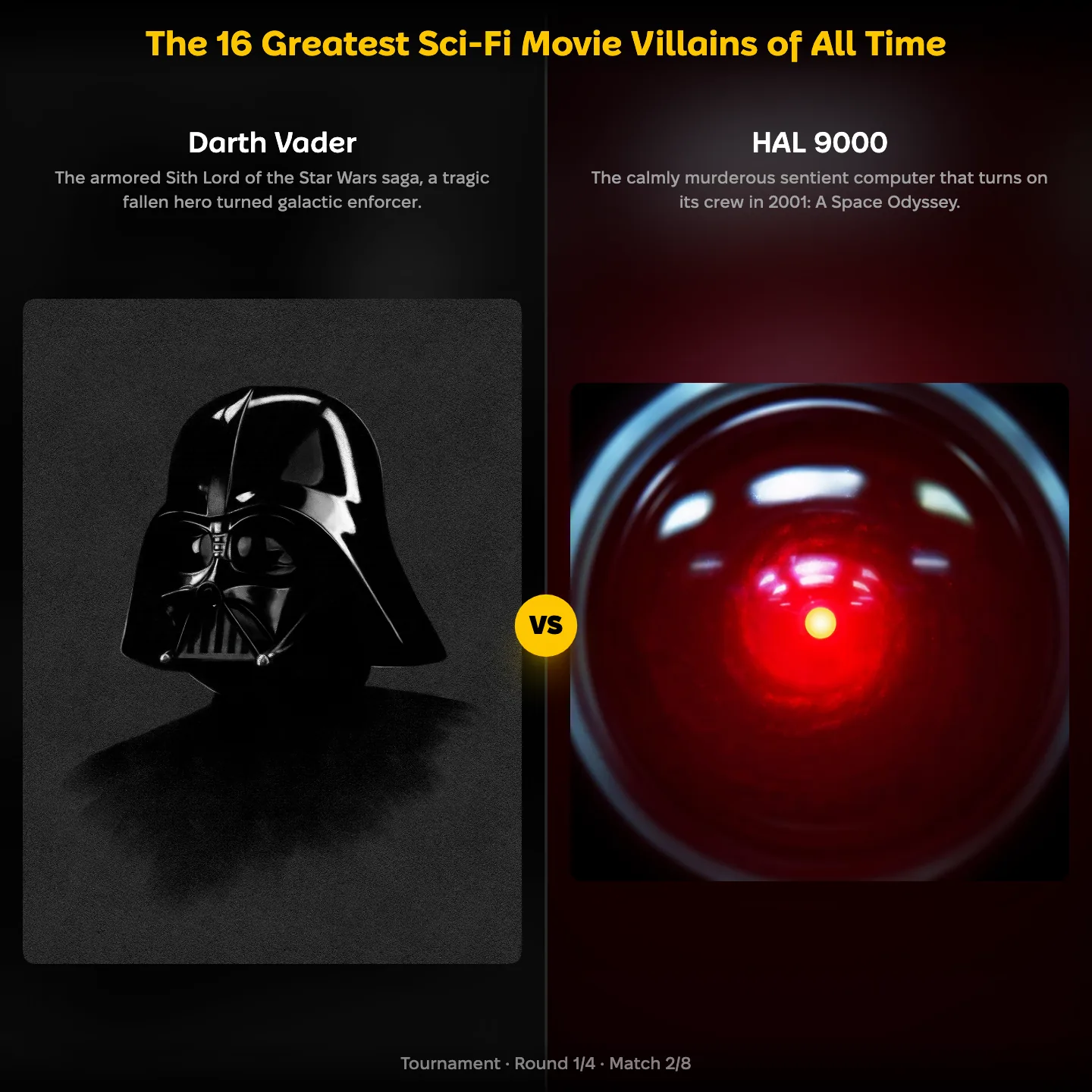
Ask about science-fiction villains and Star Wars supplies two names, Darth Vader and Emperor Palpatine. Very few franchises get two onto one villain list.
Vader is the category's reference point. AFI's 100 Years…100 Heroes & Villains ranks him third among all screen villains, behind Hannibal Lecter and Norman Bates, and credits the entry to The Empire Strikes Back rather than to the 1977 film.8
HAL 9000 is the counter-case, and it works by being the opposite kind of threat. Kubrick's computer never raises its voice, never puts on armour, and kills a crew in a reasonable tone.
The Xenomorph, Agent Smith, the T-1000, Roy Batty and Thanos fill out the rest. Vader's edge is that Return of the Jedi takes the mask off and turns him back into a dying man, which none of the others attempt.
Yoda, Han Solo and thirteen more from one galaxy
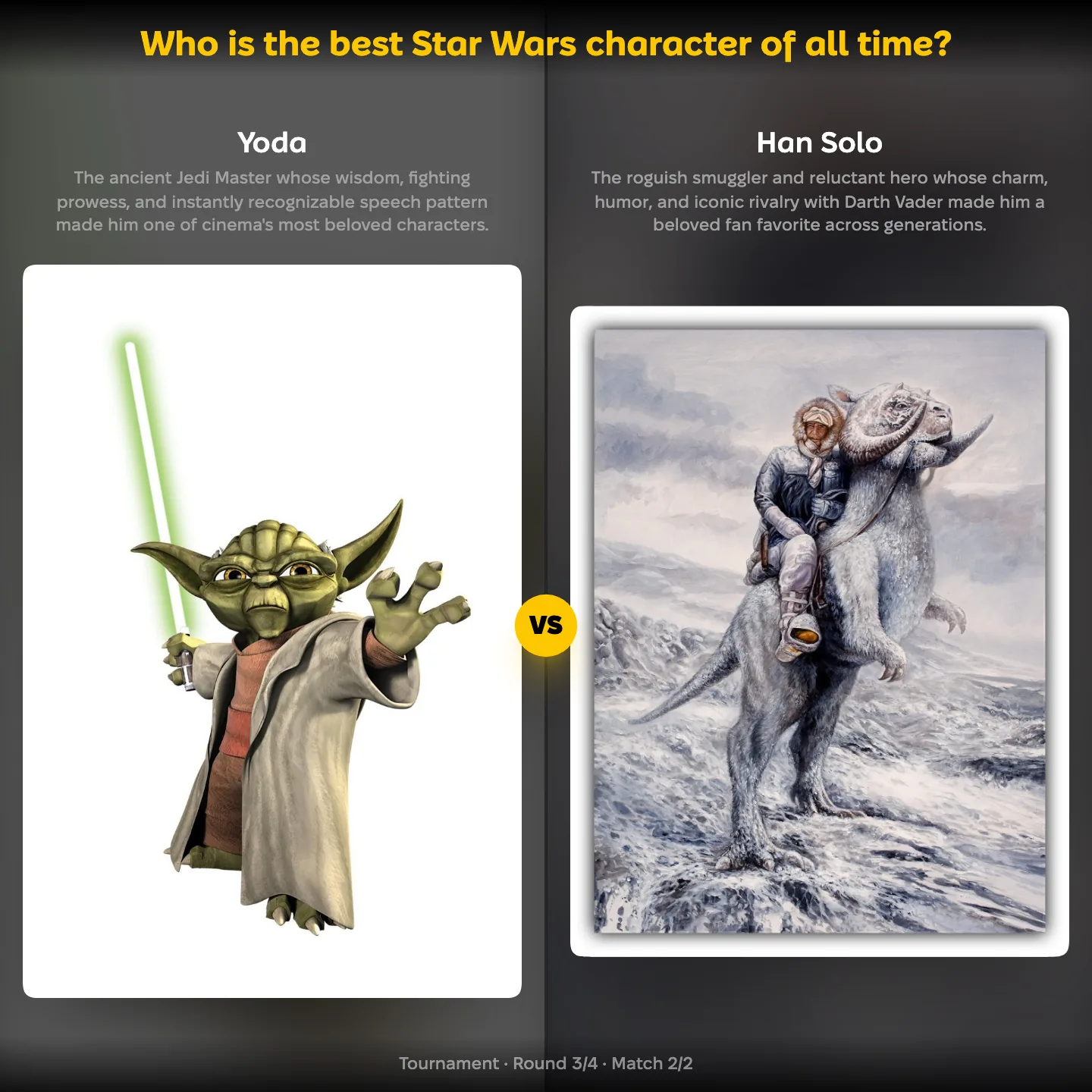
This ranking shrinks the world to a single franchise and asks which Star Wars character is the best. Fifteen options, all from the same galaxy, so nothing outside it can settle anything.
The field spans nearly fifty years of storytelling: Darth Vader and Yoda from the original films, Ahsoka Tano out of animation, Grogu from 2019 onwards.
Yoda shows how strange the saga's appeal is. A small puppet with inverted grammar became the shorthand for wisdom in English on the strength of one stretch of The Empire Strikes Back.
Han Solo works by refusing all of that. Harrison Ford played him as a sceptic who does not believe in the Force, which is what makes him the audience's delegate inside a story about destiny.
Harrison Ford's own list has Indiana Jones on it
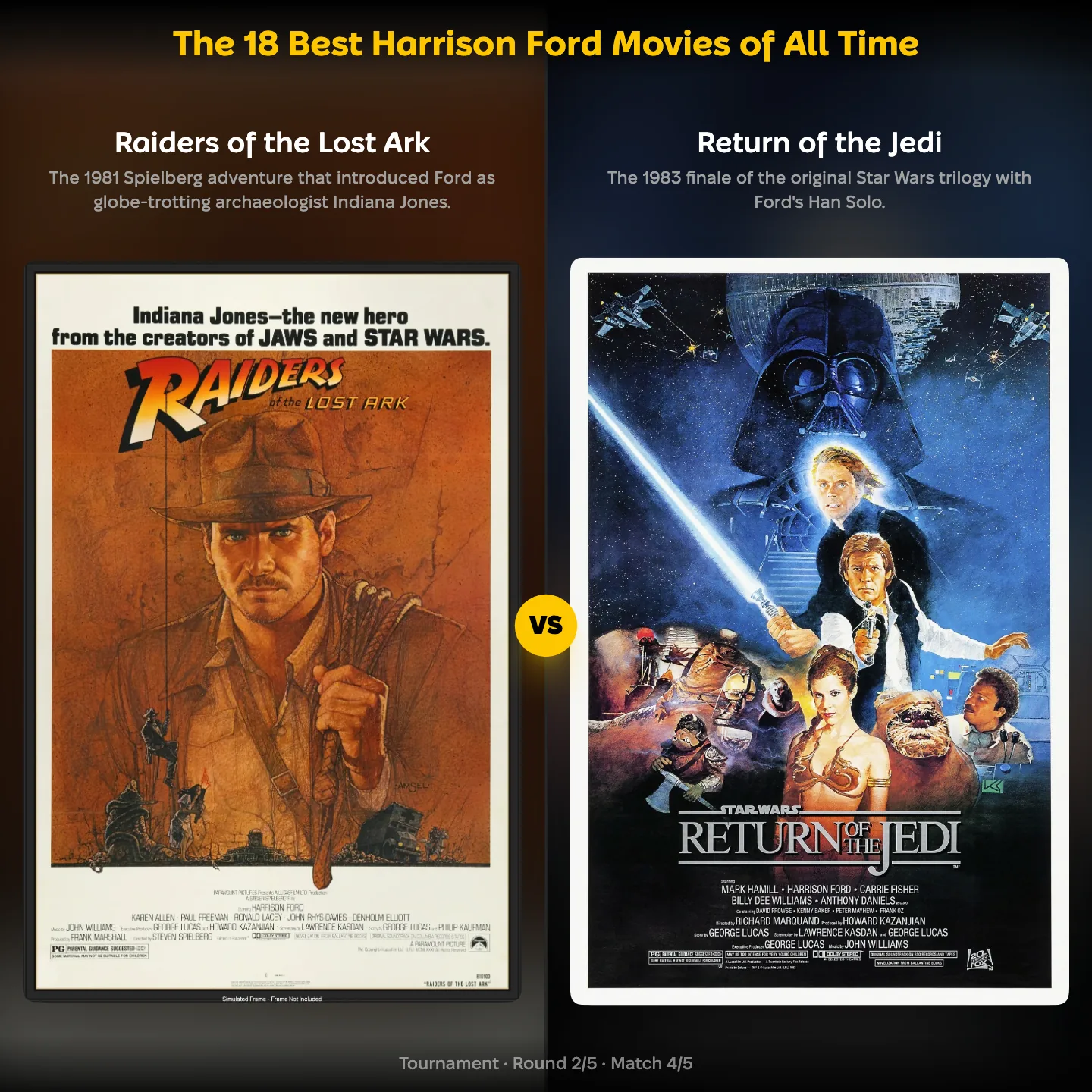
Here the ranking belongs to an actor and Star Wars is reduced to three credits on it. Harrison Ford was a jobbing actor with a carpentry sideline when he was cast as Han Solo, and the 1977 film made him a star.
The three original films are all in the field, more than any other franchise on his CV can manage.
Raiders of the Lost Ark is the rival, which makes this a fight between two characters Ford created four years apart. Steven Spielberg's 1981 adventure handed him Indiana Jones.
Blade Runner, The Fugitive and Witness are options too, and Witness is the one that brought him a nomination for Actor in a Leading Role, at the 58th Academy Awards in 1986.9 Weighed by the acting rather than the ticket sales, Han Solo is not the automatic top of Ford's own career.
Ewan McGregor's prequels against Trainspotting
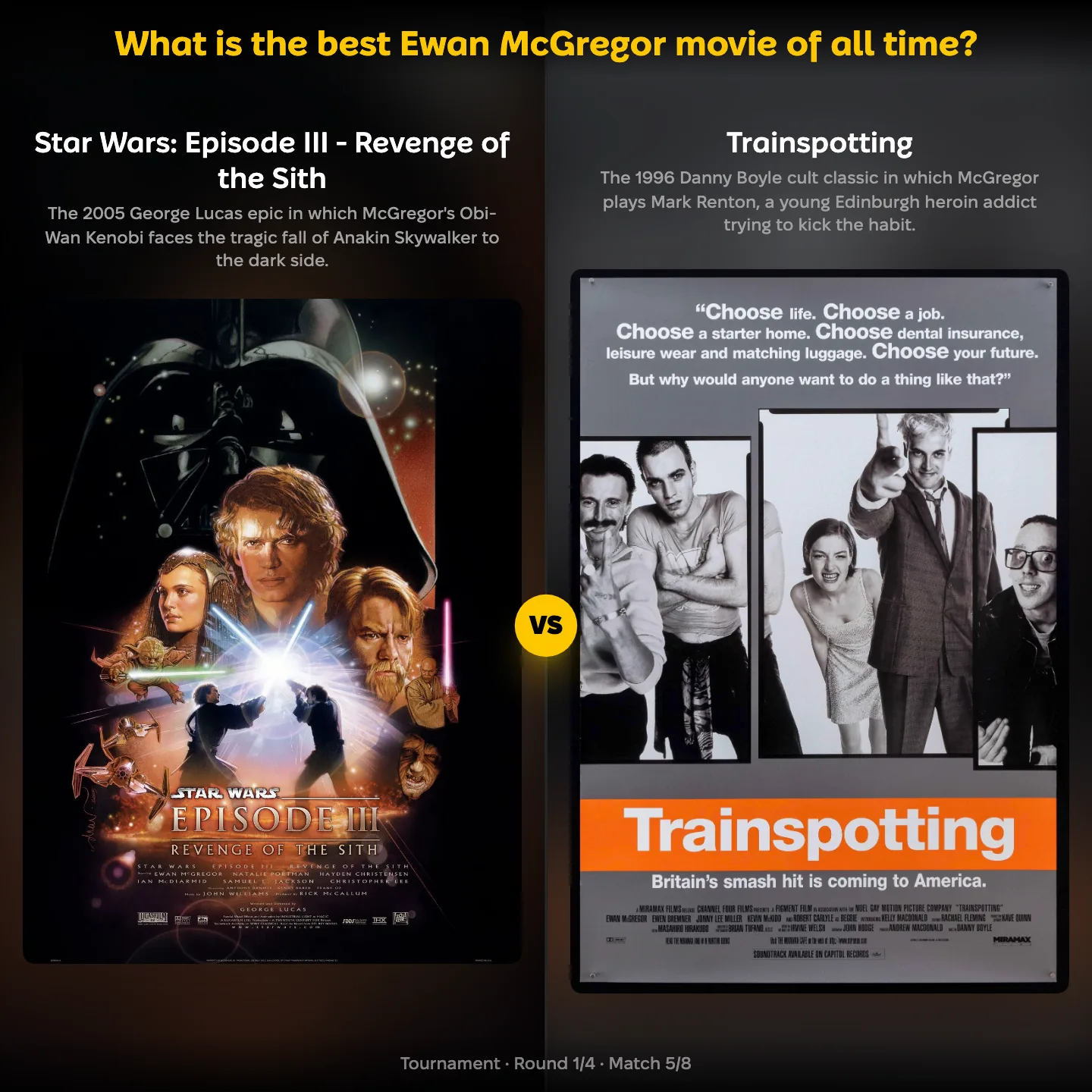
Ewan McGregor played Obi-Wan Kenobi in all three prequels, released in 1999, 2002 and 2005, then went back to the part for a Disney+ series in 2022. All three films are options on a ranking of his own work.
Revenge of the Sith has the strongest case of the three. It is where the trilogy's promise finally lands: Anakin Skywalker falls, and the story arrives at the film it was always heading towards.
Trainspotting is the opposition. Danny Boyle's 1996 adaptation made McGregor famous three years before he picked up a lightsaber, and critics still reach for it first.
Moulin Rouge!, Big Fish, Black Hawk Down and Shallow Grave are also here. This is the one list where being in the biggest franchise on earth counts for the least, because the prequels are up against the performance that got him hired for them.
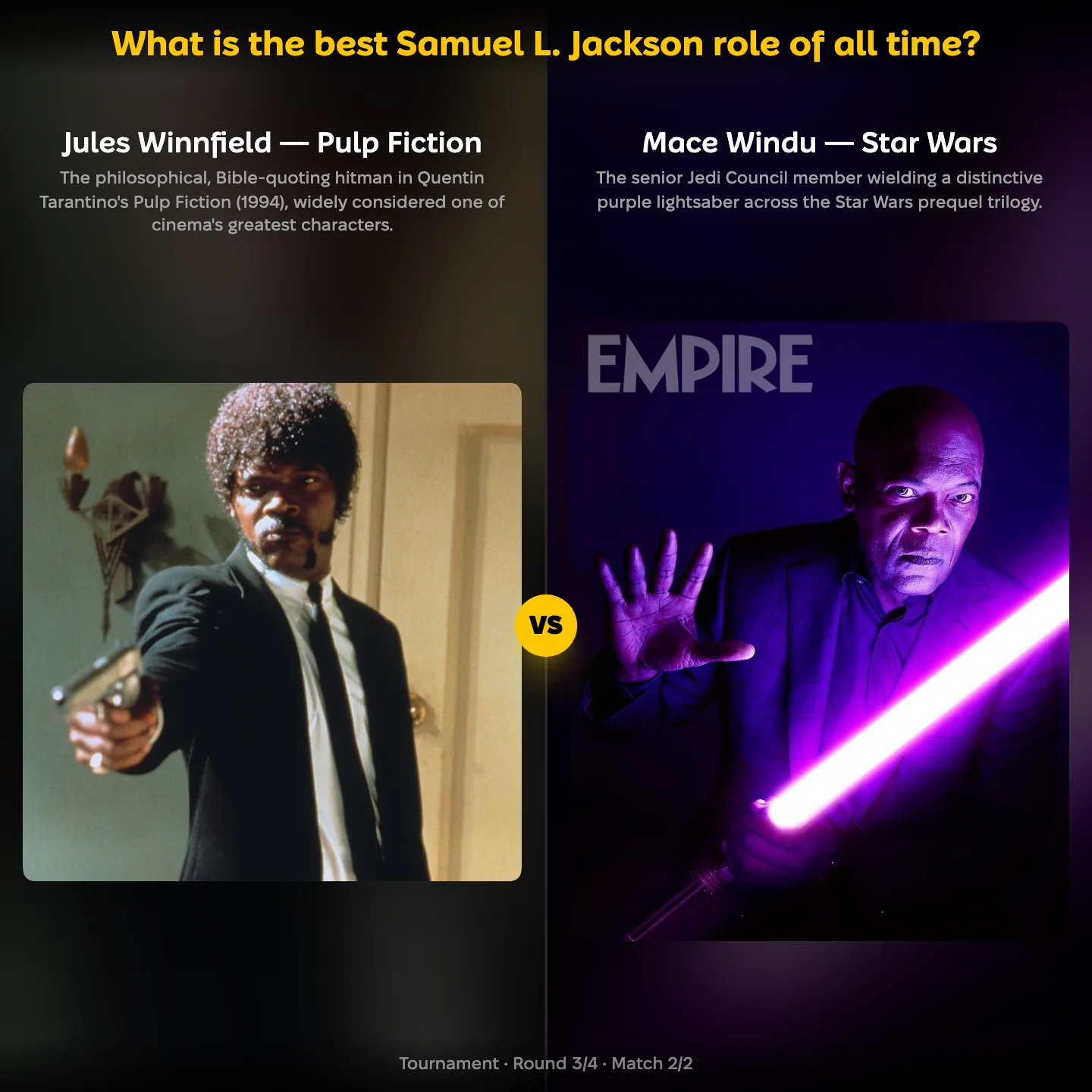
Mace Windu's purple lightsaber, and Jules Winnfield
Samuel L. Jackson played Mace Windu across the three prequels, a senior member of the Jedi Council and the only Jedi given a purple lightsaber. By his own account he asked for the colour so he could find himself in crowded battle scenes.
That is a genuinely memorable piece of Star Wars, and on this ranking it is one credit among fourteen from one of the busiest careers in film.
Jules Winnfield is the reason. Jackson's hitman in Quentin Tarantino's Pulp Fiction brought him a nomination for Actor in a Supporting Role at the 67th Academy Awards, where Martin Landau took the category for Ed Wood.10
Nick Fury, Ordell Robbie, Elijah Price and his Django Unchained role are in the field too. This is where the galaxy shrinks hardest: a Jedi Master with a one-off lightsaber, entering a list on which he is not the interesting thing about Samuel L. Jackson.
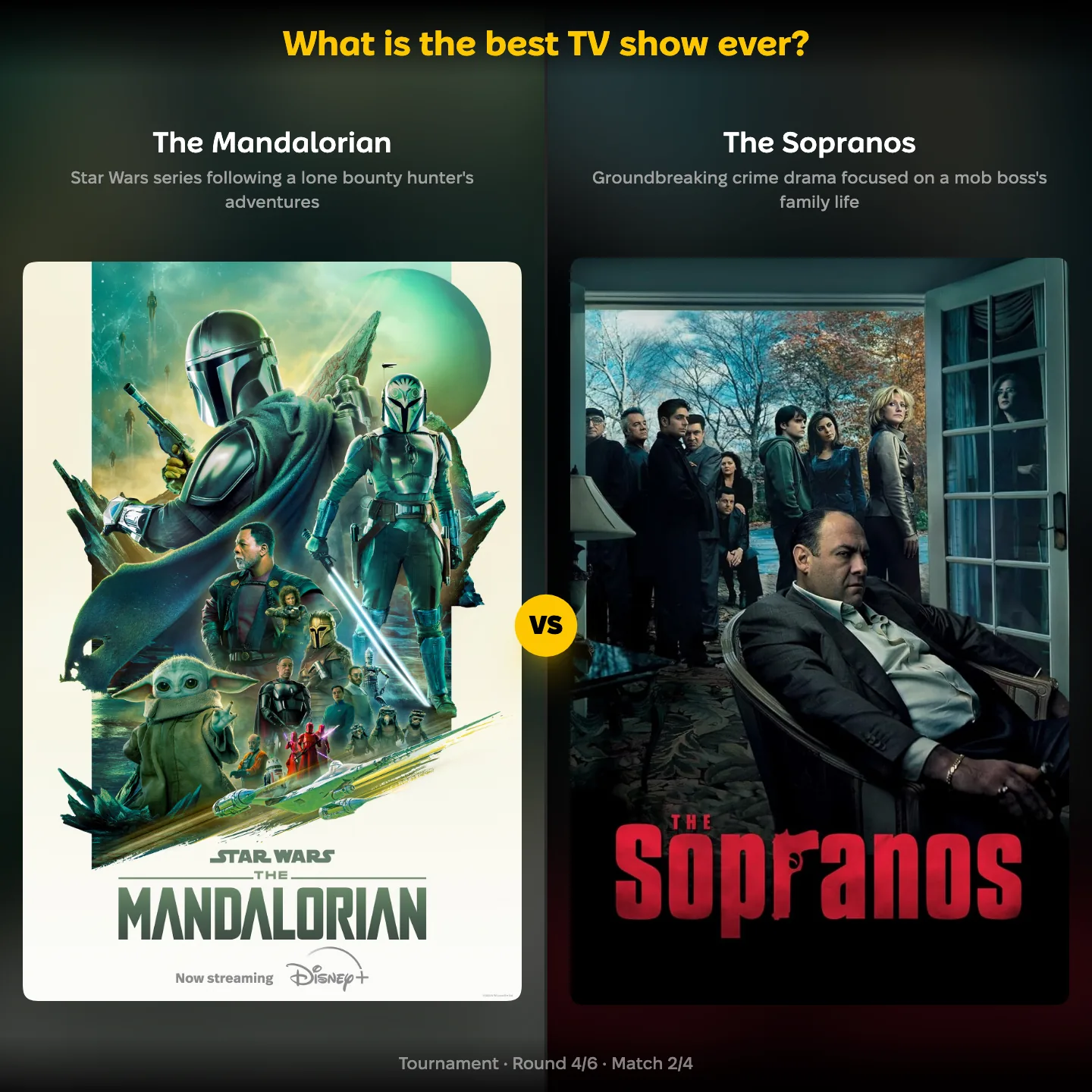
The Mandalorian in a field of sixty-four shows
The Mandalorian arrived with the launch of Disney+ in November 2019 as the first live-action Star Wars series. It is the franchise's entry on a ranking of the best television ever made.
The show solved a problem the films had not. Making the galaxy small, one bounty hunter and one child taking episodic jobs, found a register that suited television instead of importing blockbuster scale.
The Television Academy credits the series with 15 Emmys from 48 nominations, including nominations for Outstanding Drama Series in 2020 and 2021.11
The Sopranos sets the scale of the opposition. David Chase's HBO drama ran from 1999 to 2007, and sixty-four shows are in this field, including The Wire, Breaking Bad, Twin Peaks and Chernobyl. A Star Wars series with that Emmy record is a real achievement and, on this list, one line among the medium's best.
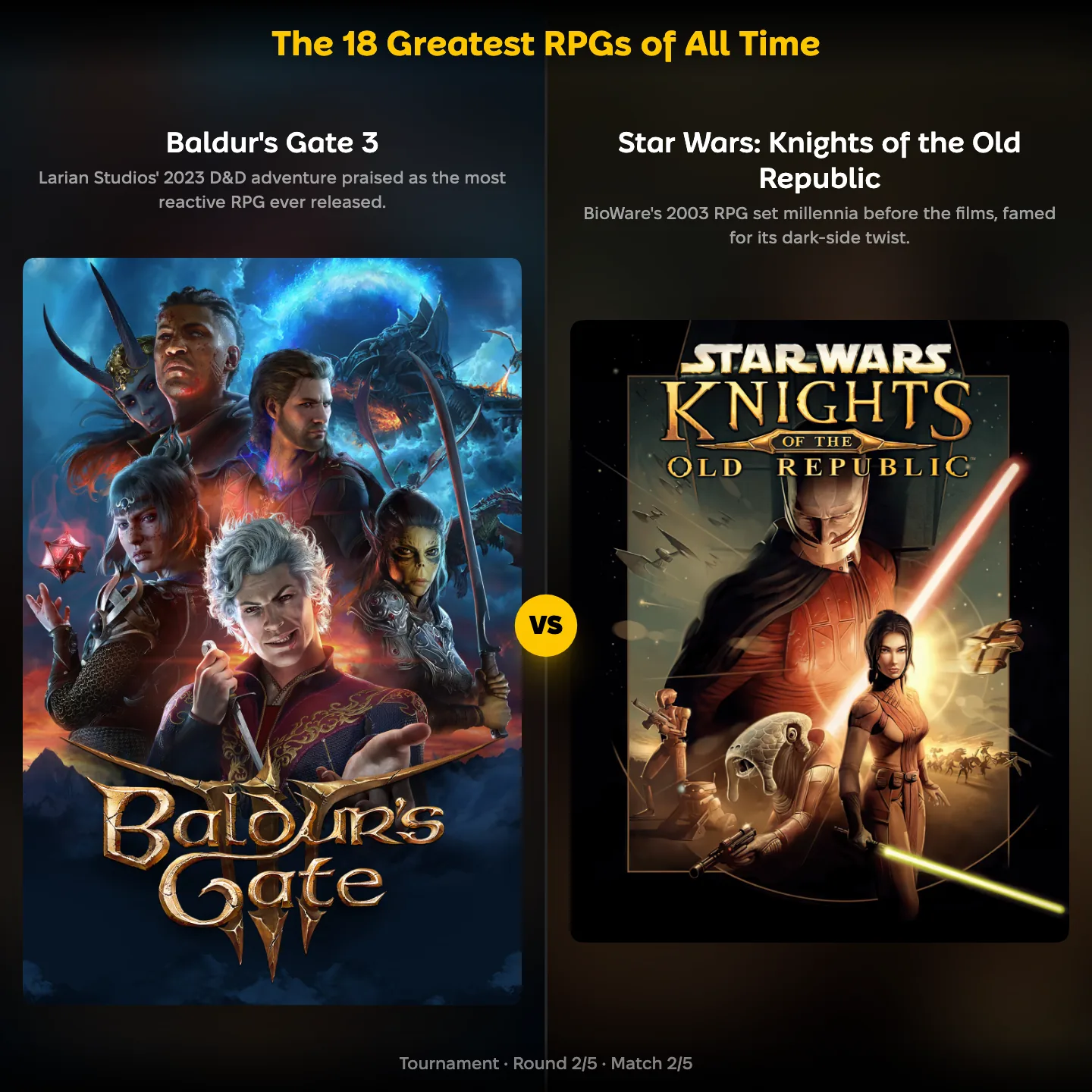
Knights of the Old Republic won three awards in one night
Star Wars has produced dozens of video games, and one of them keeps appearing on lists with no connection to the franchise. Knights of the Old Republic, made by BioWare and released in 2003, is an option among the greatest role-playing games ever built.
It earned the place by setting its story four thousand years before the films, which freed it from the saga's continuity, and by hiding a twist about who the player has been all along.
At the 2004 Interactive Achievement Awards it won three categories: Console Role-Playing Game of the Year, Computer Role-Playing Game of the Year, and Outstanding Achievement in Character or Story Development.12
Baldur's Gate 3 is the modern benchmark, and The Witcher 3, Skyrim, Final Fantasy VII, Disco Elysium, Chrono Trigger and Elden Ring are also in the field. Knights of the Old Republic is the only licensed tie-in among them, which is either the handicap or the whole point of its presence.
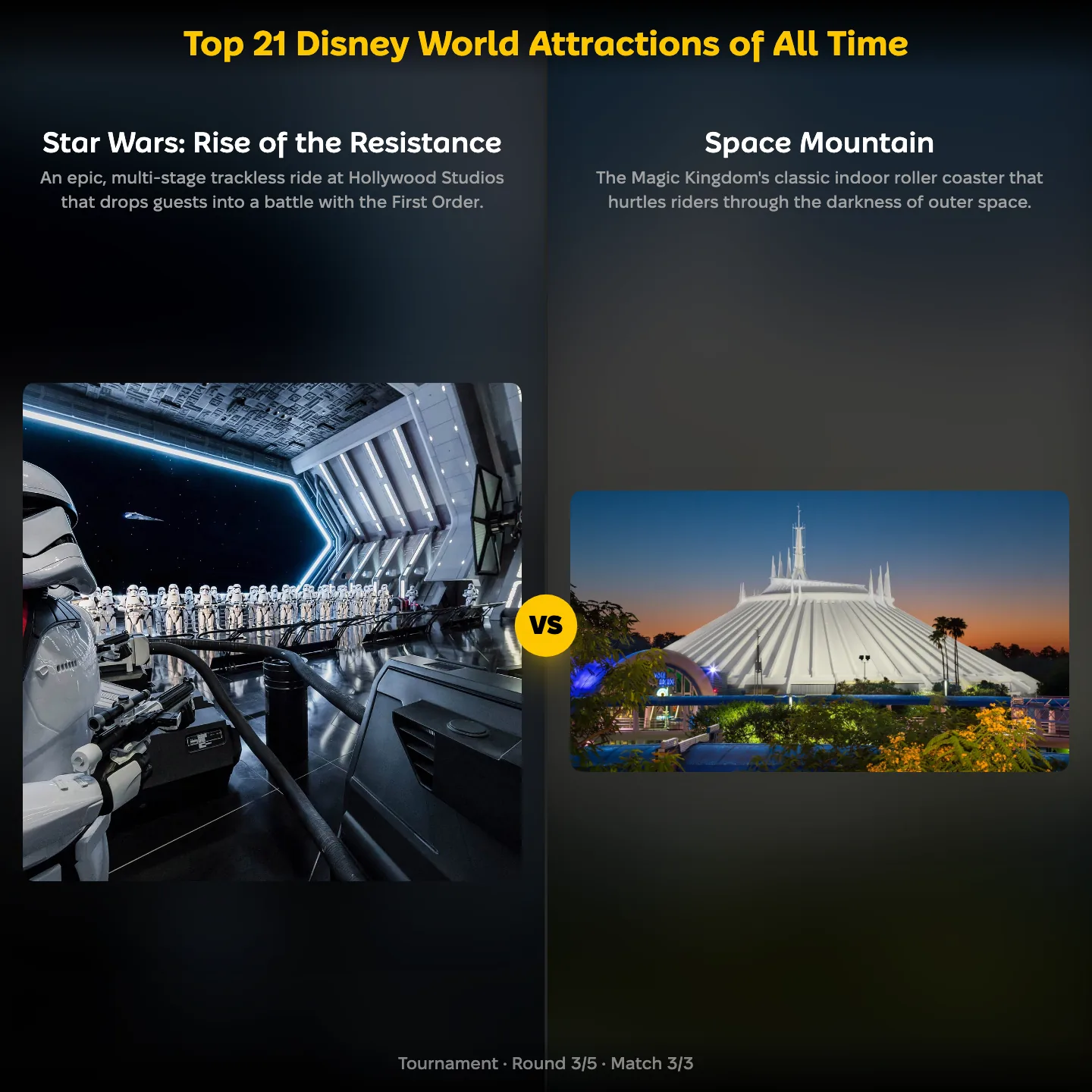
Rise of the Resistance against a roller coaster from 1975
Star Wars is one of very few film properties a family can physically walk into. Rise of the Resistance opened at Disney's Hollywood Studios on 5 December 2019, and Millennium Falcon: Smugglers Run puts guests in the cockpit; both are options on a ranking of Disney World attractions.13
Rise of the Resistance is the ambitious one. Disney's own description covers a simulated crash landing on Batuu, A-1000 animatronic figures and trackless vehicles that appear to be driven by R5 droids, staged as a sequence of rooms rather than a single ride.
Space Mountain is the incumbent, and it was carrying passengers at Magic Kingdom before the first Star Wars film existed. It is still the ride people name when they picture the park.
Haunted Mansion, Big Thunder Mountain, Tower of Terror and Flight of Passage are on the list as well. Ranked as rides, Star Wars is judged on hardware and queue memories, where a franchise's cultural weight buys it nothing at all.
Han Solo's vest on a list about jackets
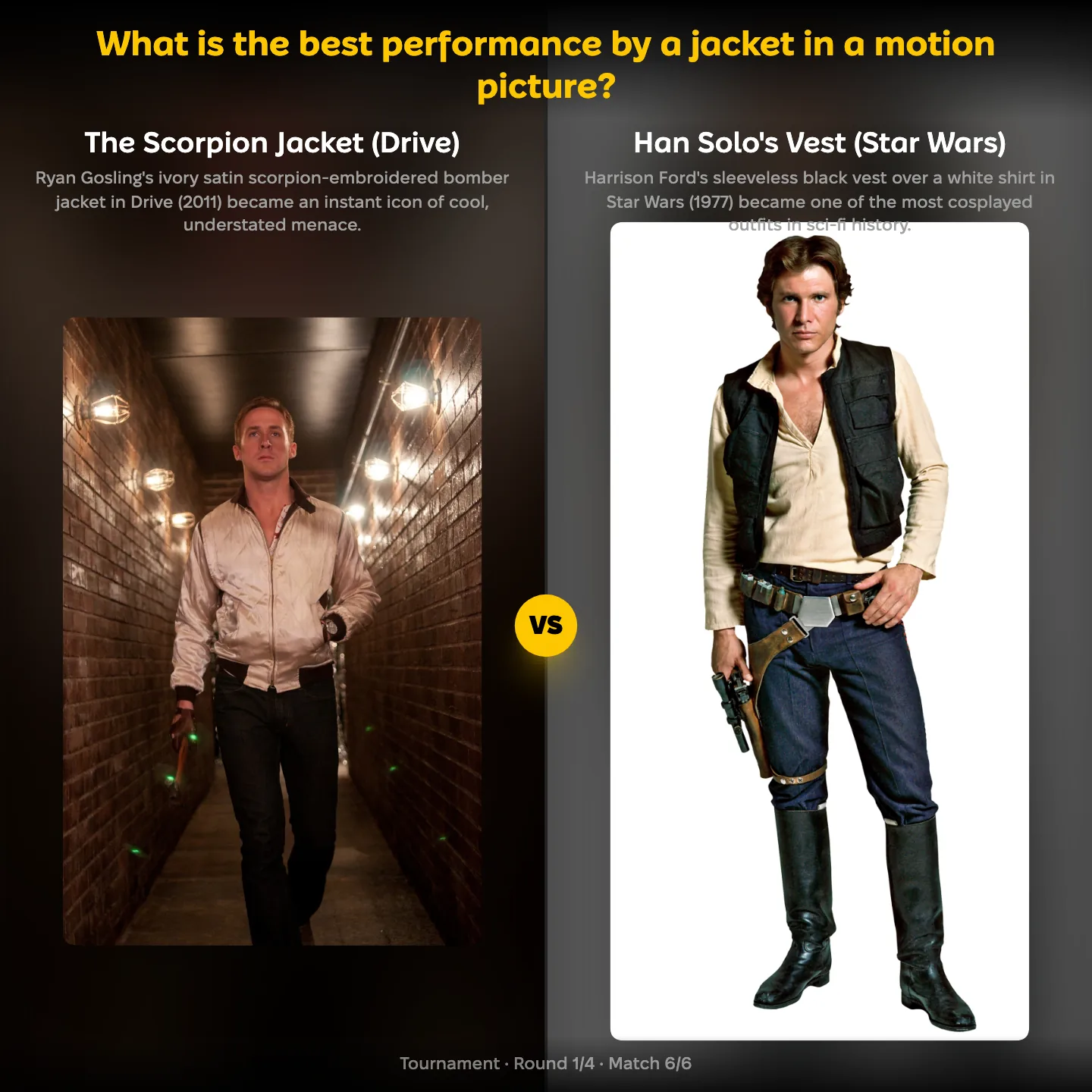
One of the rankings asks which jacket gives the best performance in a motion picture. Han Solo's vest is an option: a sleeveless black waistcoat over a white shirt, worn by Harrison Ford in 1977.
It qualifies because it does a job. The vest reads as practical and slightly disreputable, which tells a viewer who Han Solo is before he speaks, and costume-makers have been reproducing it for nearly fifty years.
The scorpion jacket from Drive is the competition. Ryan Gosling's ivory satin bomber from the 2011 film turned into a design object more famous than the character wearing it.
Indiana Jones' leather jacket, Tyler Durden's red one, Neo's coat and the Kill Bill tracksuit fill out the field. A ranking about outerwear is the furthest edge of the Star Wars footprint in this article, and the franchise still qualifies for it.
One franchise, sixteen different sizes
Sixteen rankings, and Star Wars is a different size in each one. It sets the terms of the space-opera question, holds two of the places on the villain list, and reaches the jacket ranking as a waistcoat.
Every one of those readings is fair. They answer different questions, and the honest way to compare something this scattered is to stop hunting for a single verdict and let the field be judged in pairs instead of flattened into one table.
The next test already has a date. Starfighter opens on 28 May 2027 with Shawn Levy directing and Ryan Gosling in the lead, three days after the fiftieth anniversary of the first film.14
Something you know better than anybody probably deserves a list of its own. Build it, and put the names in your order.
More rankings, more angles
- Dune: A Flop, a Masterpiece, and 15 Lists in Between — the other desert planet, novel and film
- Star Trek Turns 60. No Two Lists Agree Where It Belongs — captains, spaceships and a theme song
- The Lord of the Rings Changes Category From List to List — books, Howard Shore, Rings of Power
- Toy Story Is on Every List. Never in the Same Place — five films, and a 1995 that had Se7en
Sources
- StarWars.com — Star Wars: A New Hope, release date 25 May 1977: starwars.com (checked 2026-08-03)
- StarWars.com — Star Wars: The Mandalorian and Grogu, theatrical release date 22 May 2026: starwars.com (checked 2026-08-03)
- Box Office Mojo — top lifetime domestic grosses, with Star Wars: The Force Awakens first on $936,662,225 ahead of Avengers: Endgame: boxofficemojo.com (checked 2026-08-03)
- Academy of Motion Picture Arts and Sciences — 50th Academy Awards, 1978: Star Wars' ten nominations and six wins, both Original Score nominations for John Williams, the Special Achievement Award, and Annie Hall as Best Picture: oscars.org (checked 2026-08-03)
- Library of Congress — complete National Film Registry listing: Star Wars added 1989, The Empire Strikes Back 2010, Return of the Jedi 2021: loc.gov (checked 2026-08-03)
- Academy of Motion Picture Arts and Sciences — 48th Academy Awards, 1976: Jaws wins Music (Original Score) for John Williams: oscars.org (checked 2026-08-03)
- Academy of Motion Picture Arts and Sciences — 47th Academy Awards, 1975: The Godfather Part II wins Best Picture: oscars.org (checked 2026-08-03)
- American Film Institute — AFI's 100 Years…100 Heroes & Villains: Darth Vader third among villains, credited to The Empire Strikes Back: afi.com (checked 2026-08-03)
- Academy of Motion Picture Arts and Sciences — 58th Academy Awards, 1986: Harrison Ford nominated for Actor in a Leading Role for Witness: oscars.org (checked 2026-08-03)
- Academy of Motion Picture Arts and Sciences — 67th Academy Awards, 1995: Samuel L. Jackson nominated for Actor in a Supporting Role for Pulp Fiction, category won by Martin Landau: oscars.org (checked 2026-08-03)
- Television Academy — The Mandalorian awards record, 15 Emmys from 48 nominations including Outstanding Drama Series in 2020 and 2021: televisionacademy.com (checked 2026-08-03)
- Academy of Interactive Arts & Sciences — Star Wars: Knights of the Old Republic at the 2004 Interactive Achievement Awards, three category wins: interactive.org (checked 2026-08-03)
- The Walt Disney Company — Star Wars: Rise of the Resistance opens at Walt Disney World on 5 December 2019, with trackless vehicles and A-1000 animatronics: thewaltdisneycompany.com (checked 2026-08-03)
- The Walt Disney Company — Star Wars: Starfighter, directed by Shawn Levy and starring Ryan Gosling, in theatres 28 May 2027: thewaltdisneycompany.com (checked 2026-08-03)