
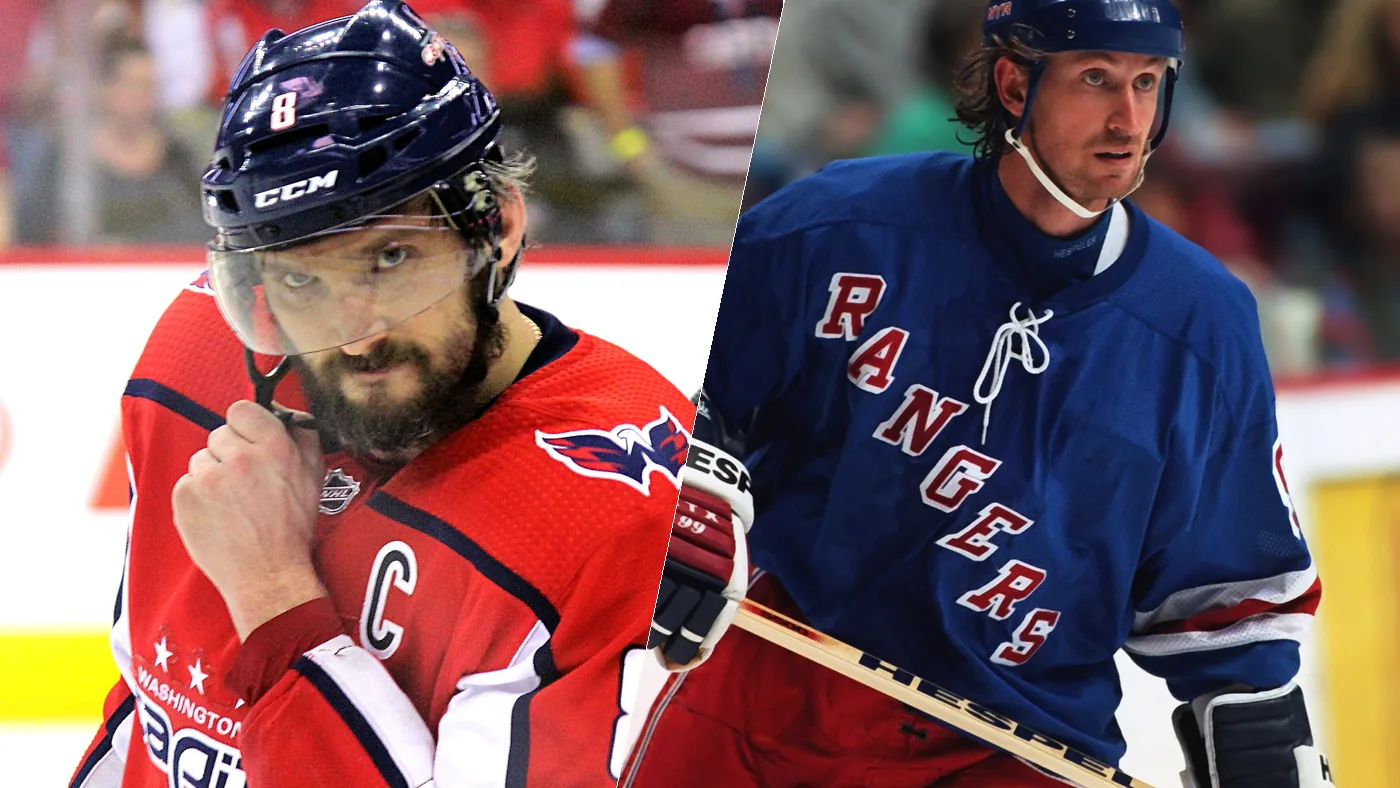
Alex Ovechkin scored his 895th NHL goal on 6 April 2025, against the New York Islanders, and took the one record hockey had filed as permanent: Wayne Gretzky's 894.1 Sixteen months later he chose not to retire. On 2 July 2026 Washington re-signed him for a 22nd season, at 40 years old, with 929 goals already behind him.3
Gretzky's own numbers did not move. He still holds the career points record, the single-season records, and nine MVP awards, and he retired in 1999 with more assists than any player has ever had points.
The comparison is lopsided in both directions: one man took the headline record, the other kept the record book. Thirteen rankings on YouPickBest hold both names, and plenty of them belong to somebody else entirely.
Ovechkin owns the one number hockey called untouchable. Gretzky owns almost every other number in the book, so each of these thirteen lists divides them differently.
Ovechkin vs Gretzky: the best hockey player ever
The widest question in the sport runs 32 names deep here, from Gordie Howe and Maurice Richard to Connor McDavid, with Ovechkin and Gretzky both in the field.
Gretzky's case is the one built for a list like this. Four Stanley Cups in five seasons with Edmonton, a Conn Smythe in the last of them, and a scoring record for every category the NHL keeps.7
Ovechkin's is a one-line résumé that nobody can answer. He is the leading goal scorer in the history of the game, and he did it in the low-scoring era that came after the one Gretzky dominated.
Neither of them is unopposed. Bobby Orr changed what a defenceman was allowed to do and won two scoring titles from the blue line, and Mario Lemieux put up numbers comparable to Gretzky's while missing whole seasons to injury and cancer treatment.
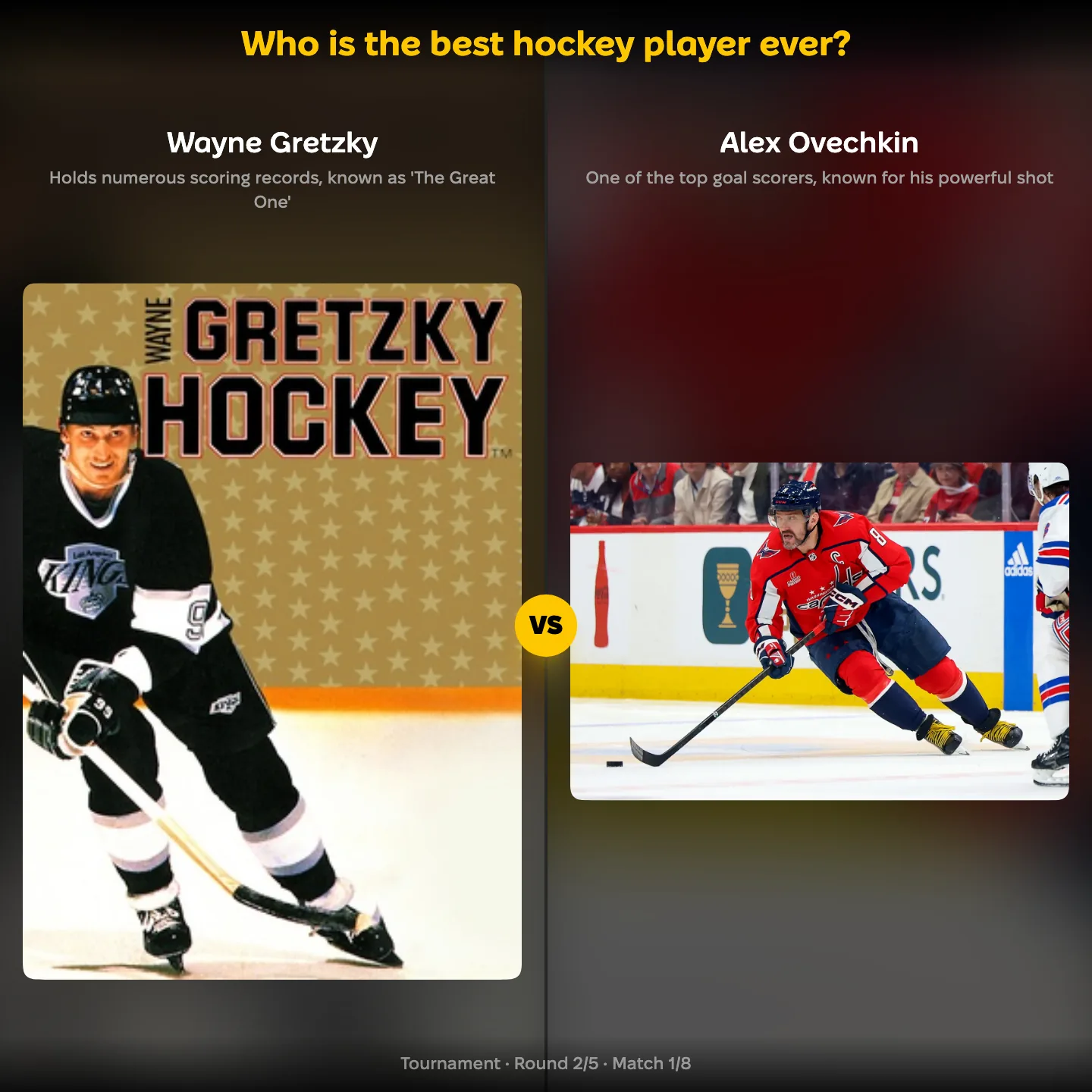
The Hart Trophy, nine times against three
The Hart goes to the player judged most valuable to his team, which is not the same award as best player in the world, and the voting history shows it.
Gretzky won it nine times, eight of them consecutively between 1980 and 1987, and once more in 1989 after the move to Los Angeles.6 Gordie Howe is second on that list with six, spread across eleven years.
Ovechkin has three, in 2008, 2009 and 2013, which is a strong return for a goal scorer: the award tends to reward centres, playmakers and, occasionally, a goaltender having an impossible season.
The goalies are the interesting company here. Dominik Hašek won back-to-back Harts in 1997 and 1998, and Connor Hellebuyck took the 2025 award in Winnipeg, which is the kind of season that beats any forward's case.
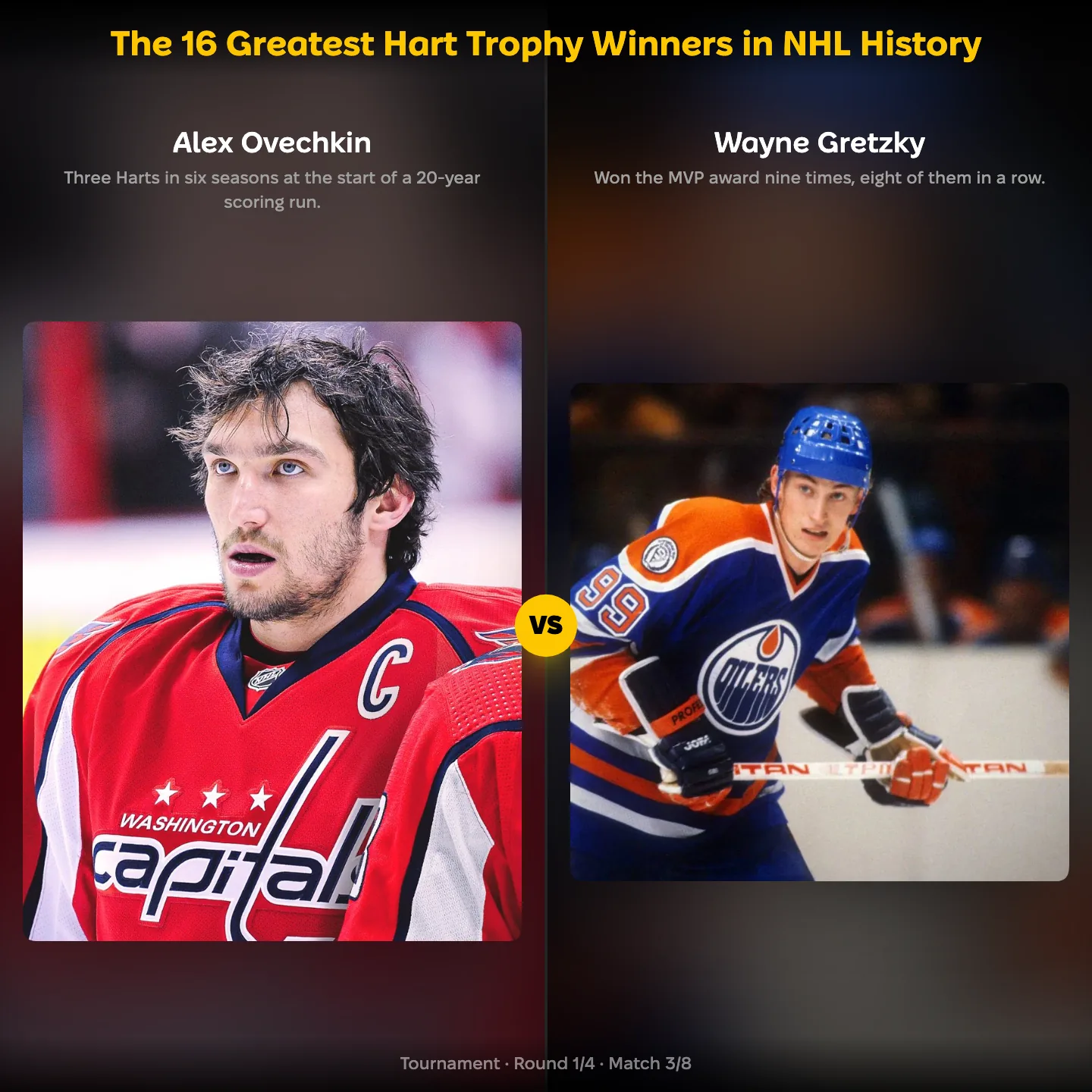
The captaincy: Ovechkin, Messier and the C
Captaincy is the one hockey credential that resists statistics, which makes this ranking a different test for both men.
Ovechkin has worn Washington's C since 2010, longer than anyone in franchise history. Gretzky captained Edmonton through all four Cup wins from 1984 to 1988, then wore the C in Los Angeles and New York as well.
Mark Messier complicates it. He captained two franchises to championships and guaranteed a win in the 1994 conference final before scoring a hat trick in the game.
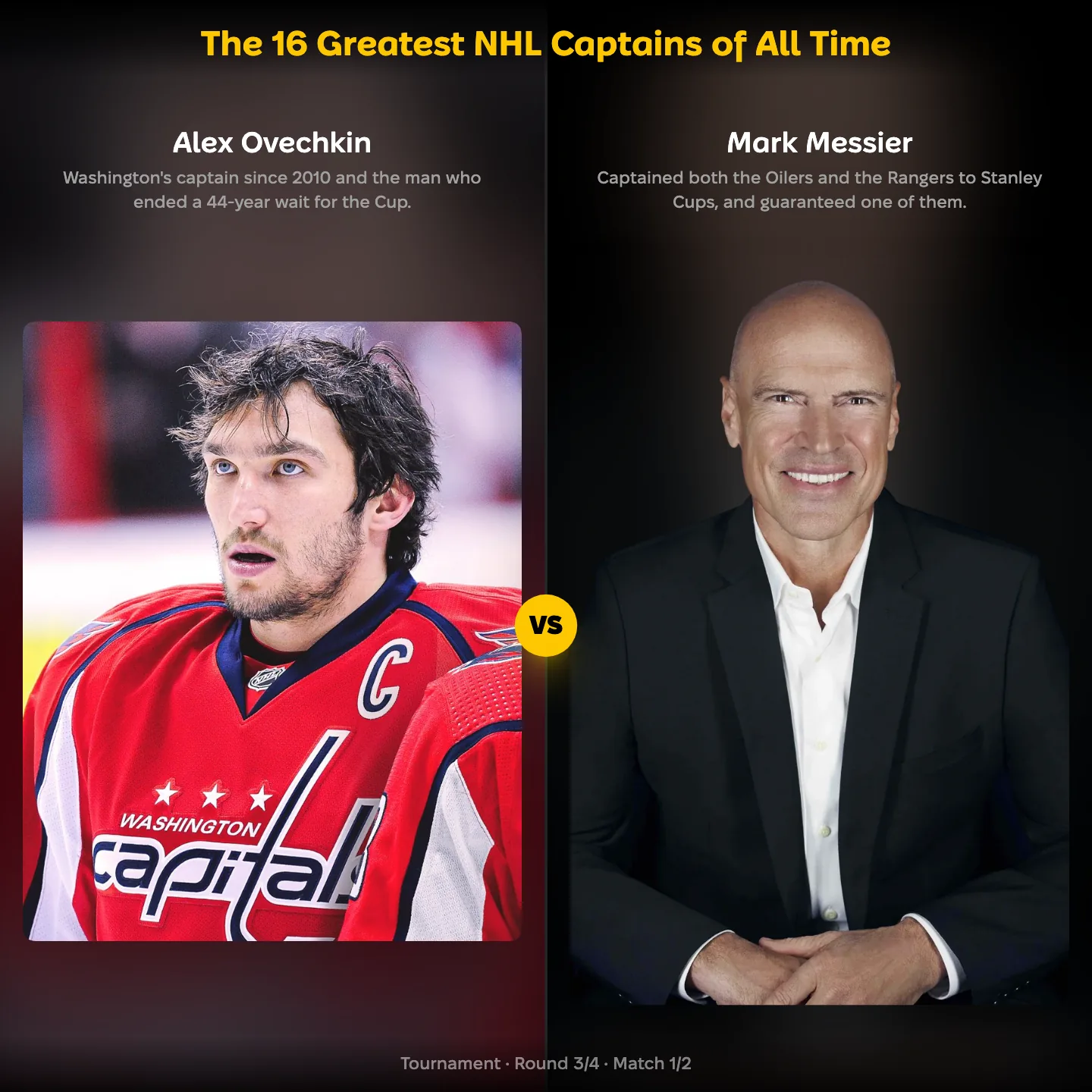
Patrick Roy vs Gretzky: what the playoffs measure
Two months of hockey every spring produce a separate record book, and this ranking is built from that one rather than from regular seasons.
Gretzky holds the postseason records for goals, assists and points, which is the natural extension of what he did in the other 80 games.
Ovechkin's playoff case is one spring. He led the 2018 postseason with 15 goals and finished it with the Stanley Cup and the Conn Smythe Trophy, ending the longest wait in Washington's history.3
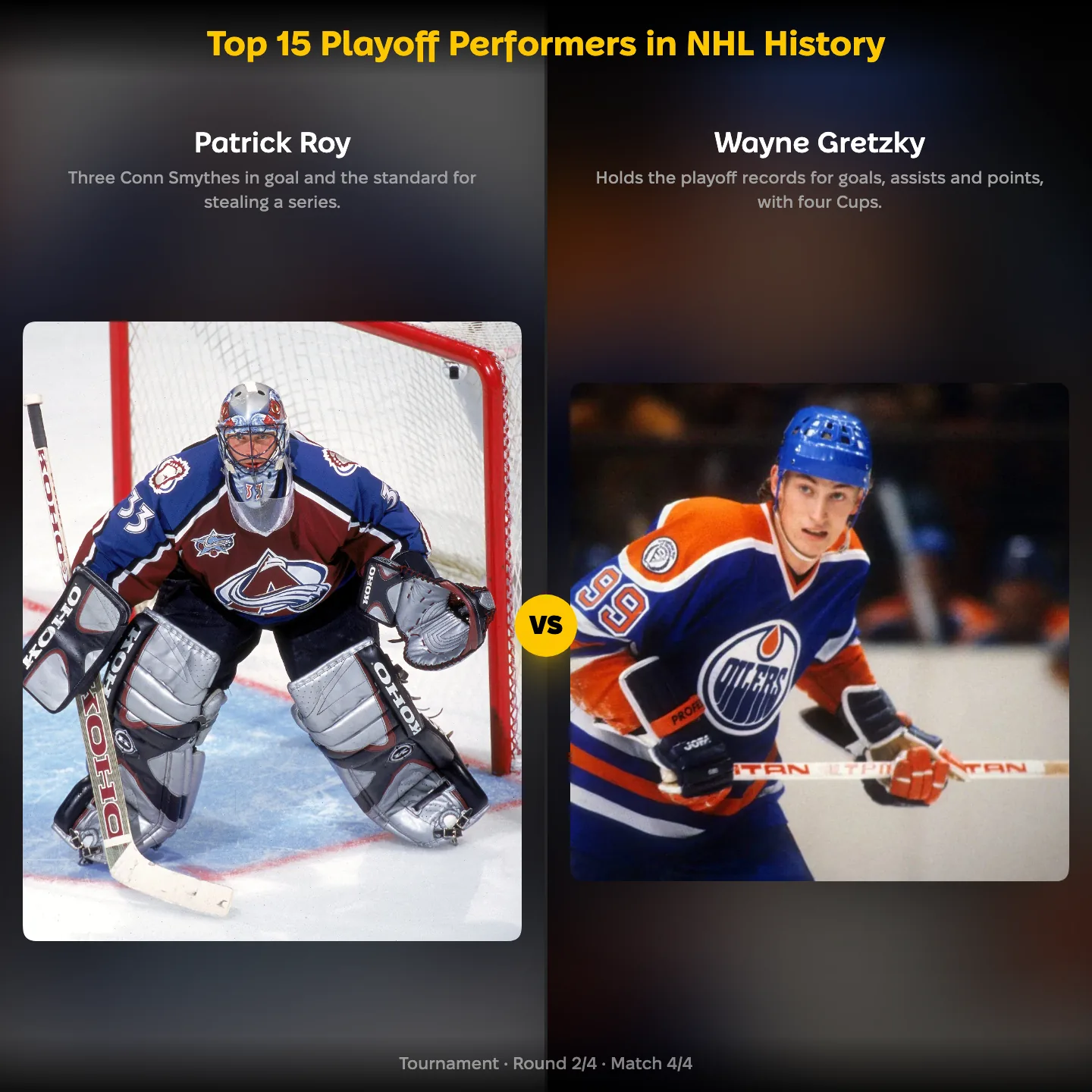
Goaltenders bend a list like this. Patrick Roy won three Conn Smythes and set the standard for a single player stealing a series, and Martin Brodeur has more playoff shutouts than anyone.
Ovechkin's office and Gretzky's passing on the power play
The man advantage is the closest thing hockey has to a controlled experiment, and it is where Ovechkin's case is strongest.
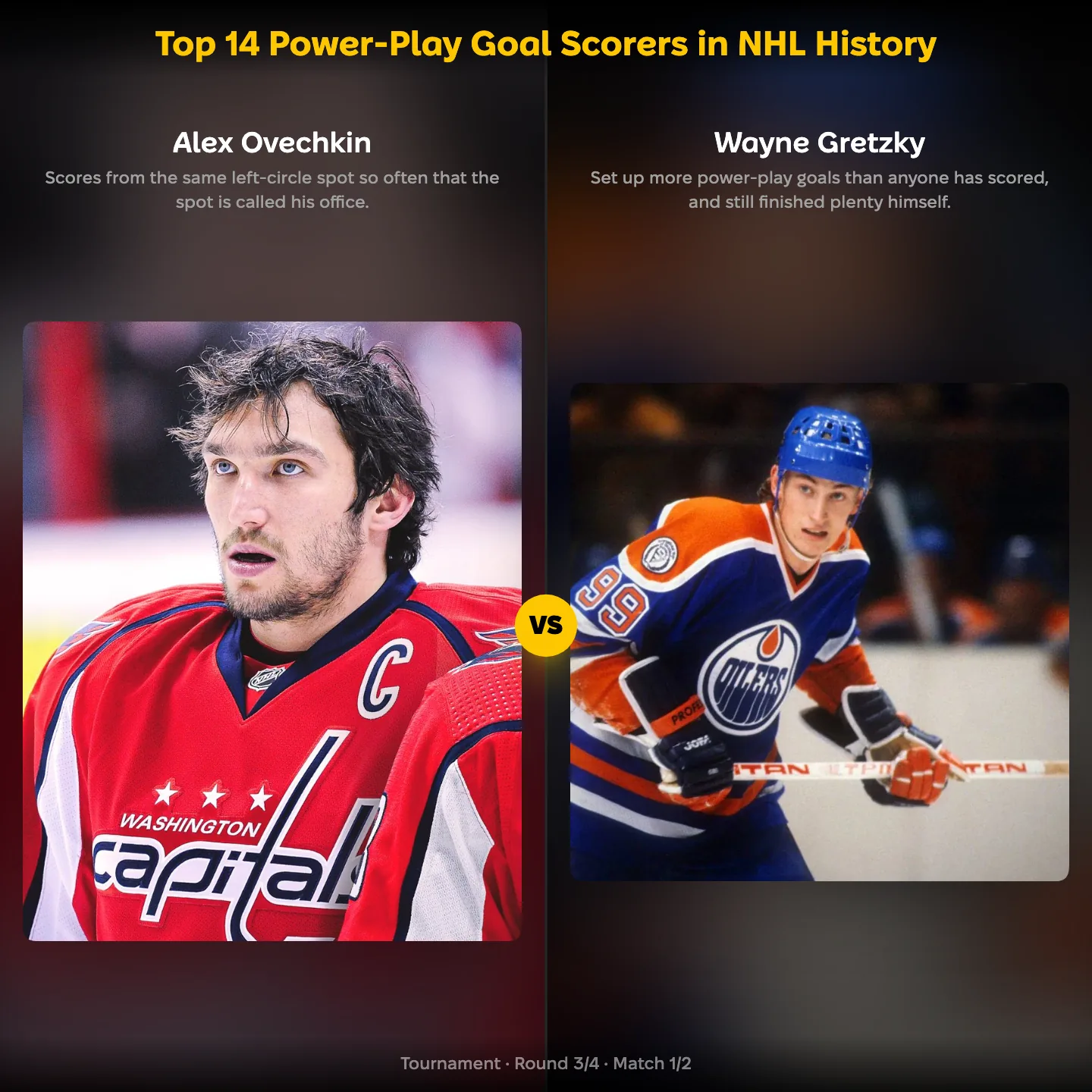
He has spent twenty years shooting from the same spot at the top of the left circle, a location so predictable that broadcasters call it his office and defenders still cannot take it away. Nine Rocket Richard trophies as the league's leading goal scorer came largely from there.3
Gretzky ran a power play from behind the net instead, as the passer rather than the finisher. He could shoot when he chose to: his 92 goals in 1981-82 is still the single-season record, and Brett Hull's 86 in 1990-91 is the best anyone else has managed.5
Everyone else here is a specialist. Dave Andreychuk held the power-play record for two decades on nothing but net-front work, Luc Robitaille and Mike Bossy built their totals on the wing, and Steven Stamkos fires the same one-timer from the opposite circle.
Willie O'Ree, Gretzky and what actually changed hockey
This ranking asks which players changed the sport rather than who was best at it, and the two answers come apart immediately.
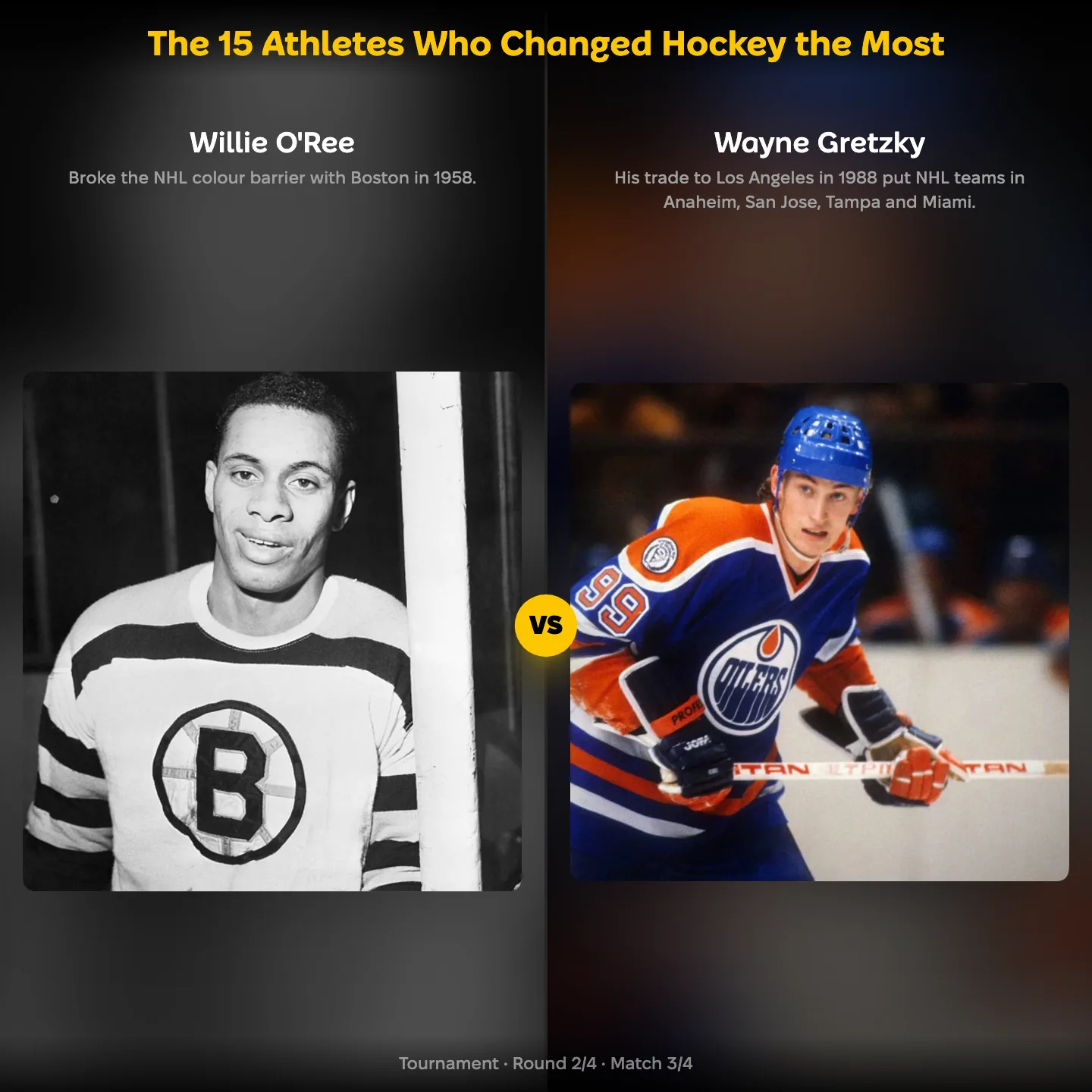
Gretzky's contribution was geographic. Edmonton traded him to the Kings on 9 August 1988, less than three months after a fourth Cup in five seasons, and the sport that followed him south produced NHL teams in Anaheim, San Jose, Tampa and Miami.7
Ovechkin's is tactical and smaller: a generation of teams now design a power play around a left-circle shooter because his worked.
Willie O'Ree is the name that ends the debate. He broke the NHL's colour barrier with Boston in 1958, and Jacques Plante, who put on a mask in 1959 and kept it on, is on the same list.
Hockey usually takes the legs first, so this ranking is a list of players who kept producing after the age at which most of their peers stopped.
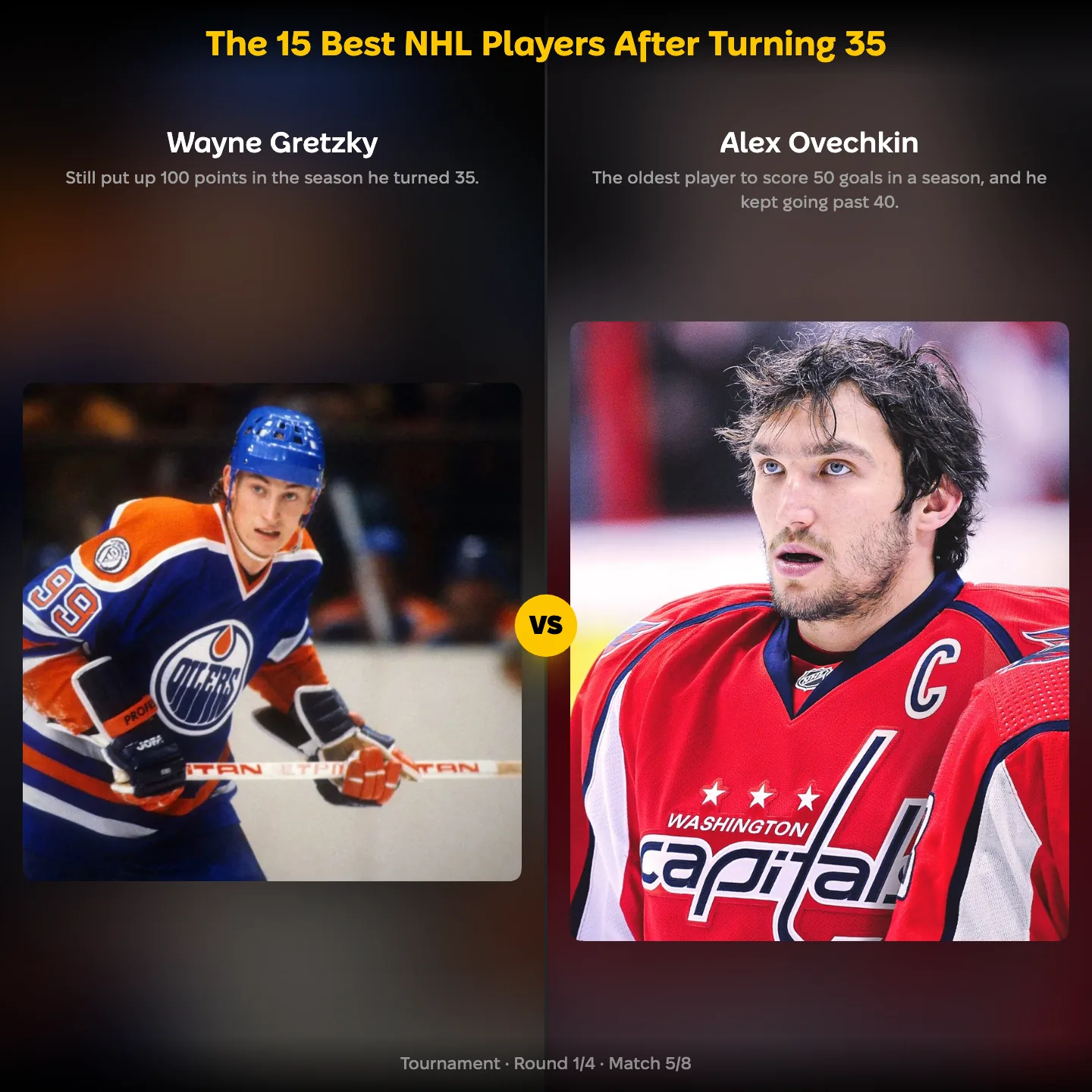
Gretzky belongs on it for the season he turned 35, when he still put up 100 points. He played his last NHL game at 38.
Ovechkin qualifies twice. He is the oldest player to score 50 in a season, and last year, at 40, he scored 32.3
Gordie Howe is the ceiling nobody has reached. He had 103 points at 40 and was still an NHL All-Star at 51, and Chris Chelios played defence in the league at 48.
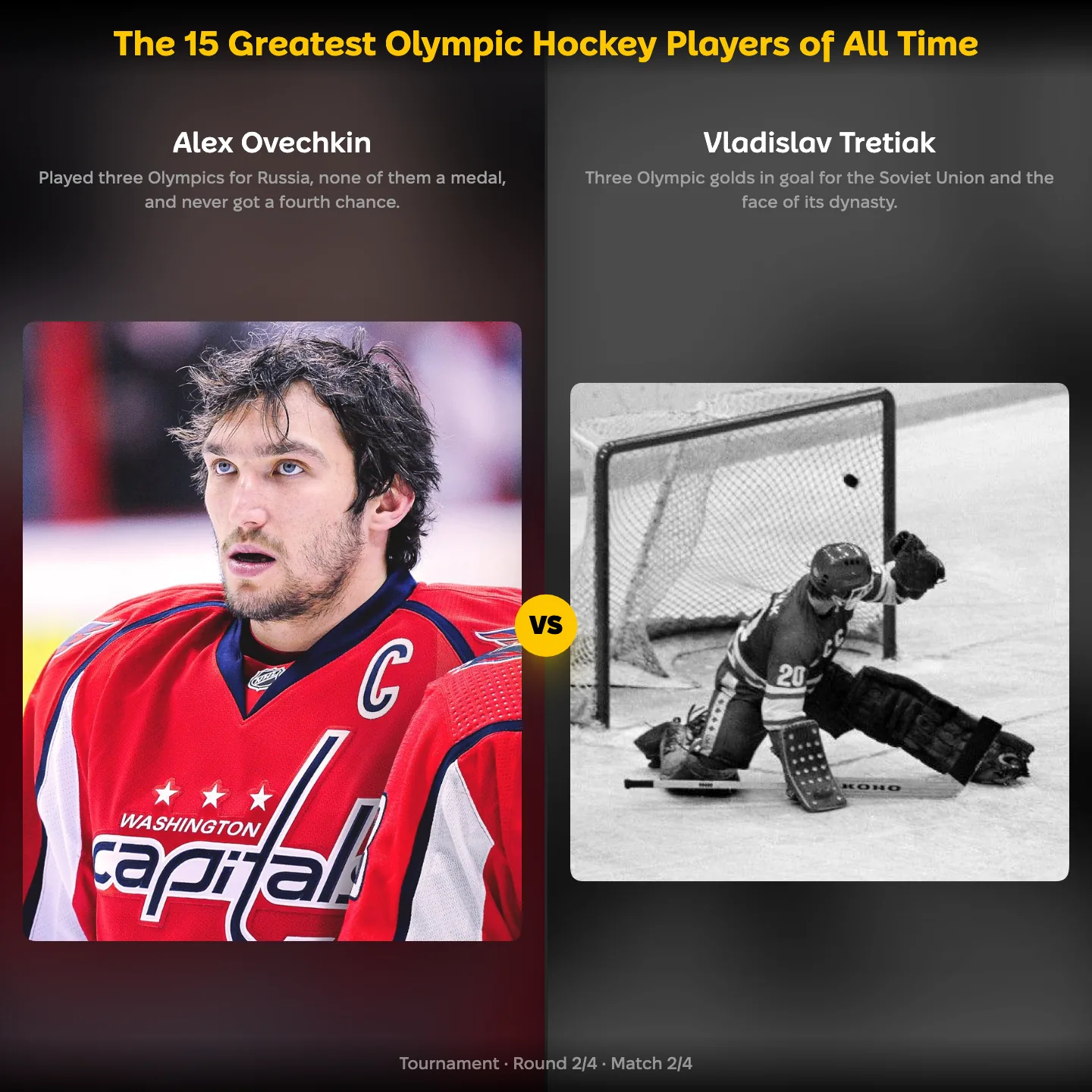
The Olympics: Tretiak's three golds, Ovechkin's none
Two weeks every four years, with no second chances, and it is the one stage where both of these careers came up empty.
Gretzky captained Canada at Nagano in 1998, the first Olympics open to NHL players. Canada finished fourth, and he was left off the shootout that decided the semi-final.
Ovechkin played three Olympic tournaments for Russia and never reached a medal game. The chance of a fourth closed in February 2026: NHL players returned to the Games at Milan-Cortina, and Russian teams remained barred from competing.8
Vladislav Tretiak, three times a gold medallist in goal for the Soviet Union, sets the bar here, and Sidney Crosby's overtime winner in Vancouver in 2010 is the moment most North American fans reach for first.
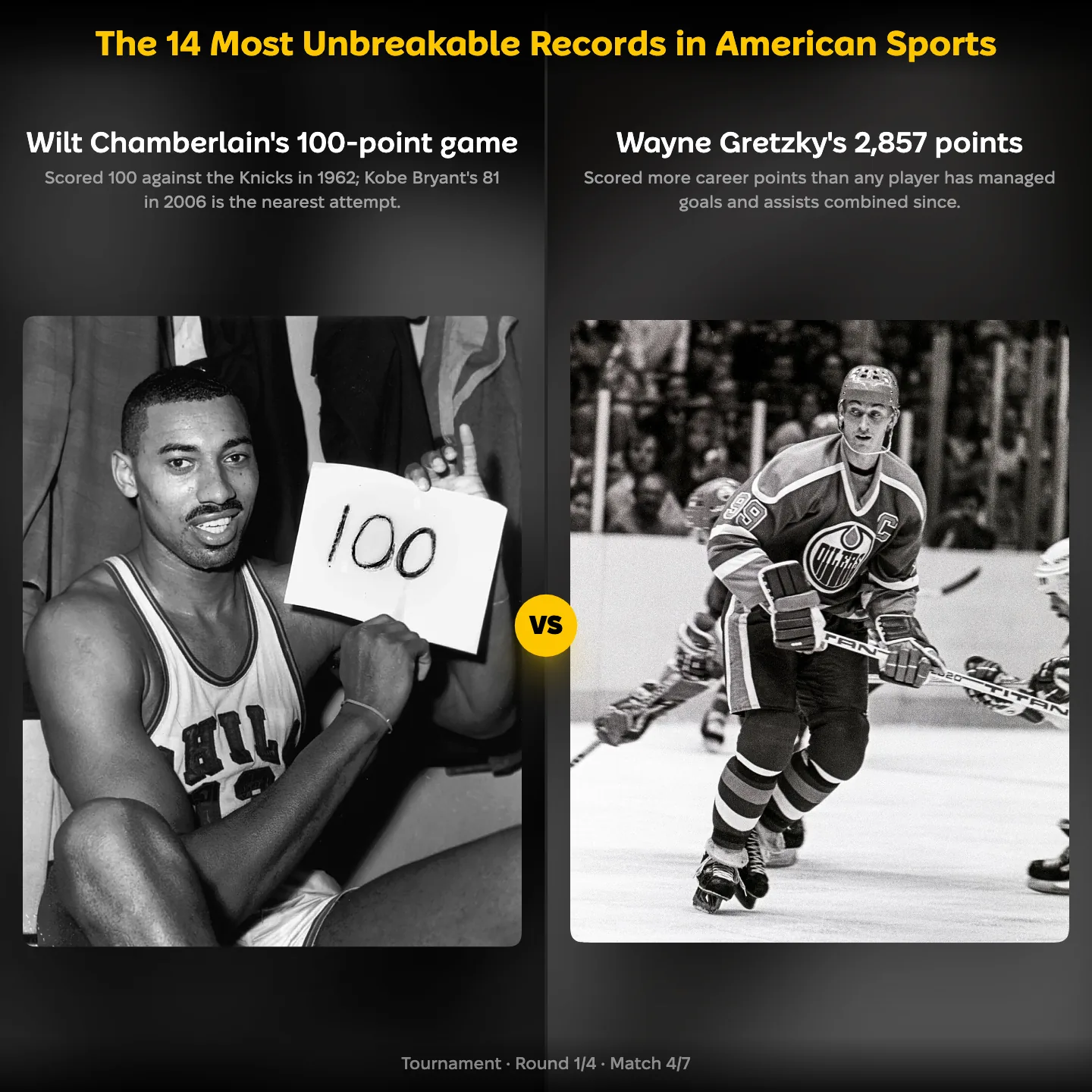
Wilt Chamberlain's 100 points and Gretzky's 2,857
This ranking leaves hockey and asks which record in American sport is least likely to fall, which puts Gretzky next to Joe DiMaggio, Wilt Chamberlain and Secretariat.
His entry is the career points total: 2,857, made up of 894 goals and 1,963 assists. Jaromír Jágr is second on that list, 936 points behind, and the assists alone would still lead the all-time scoring table.4
Ovechkin is not on this list, which is the point of including it. The record everyone assumed was untouchable was the goals record, and it went in April 2025 to a player who scored his 895th at 39.
That is the argument this ranking is really having. Chamberlain's 100-point game and DiMaggio's 56-game hitting streak have stood for over 60 years, and the last decade taught everyone to be careful with the word permanent.
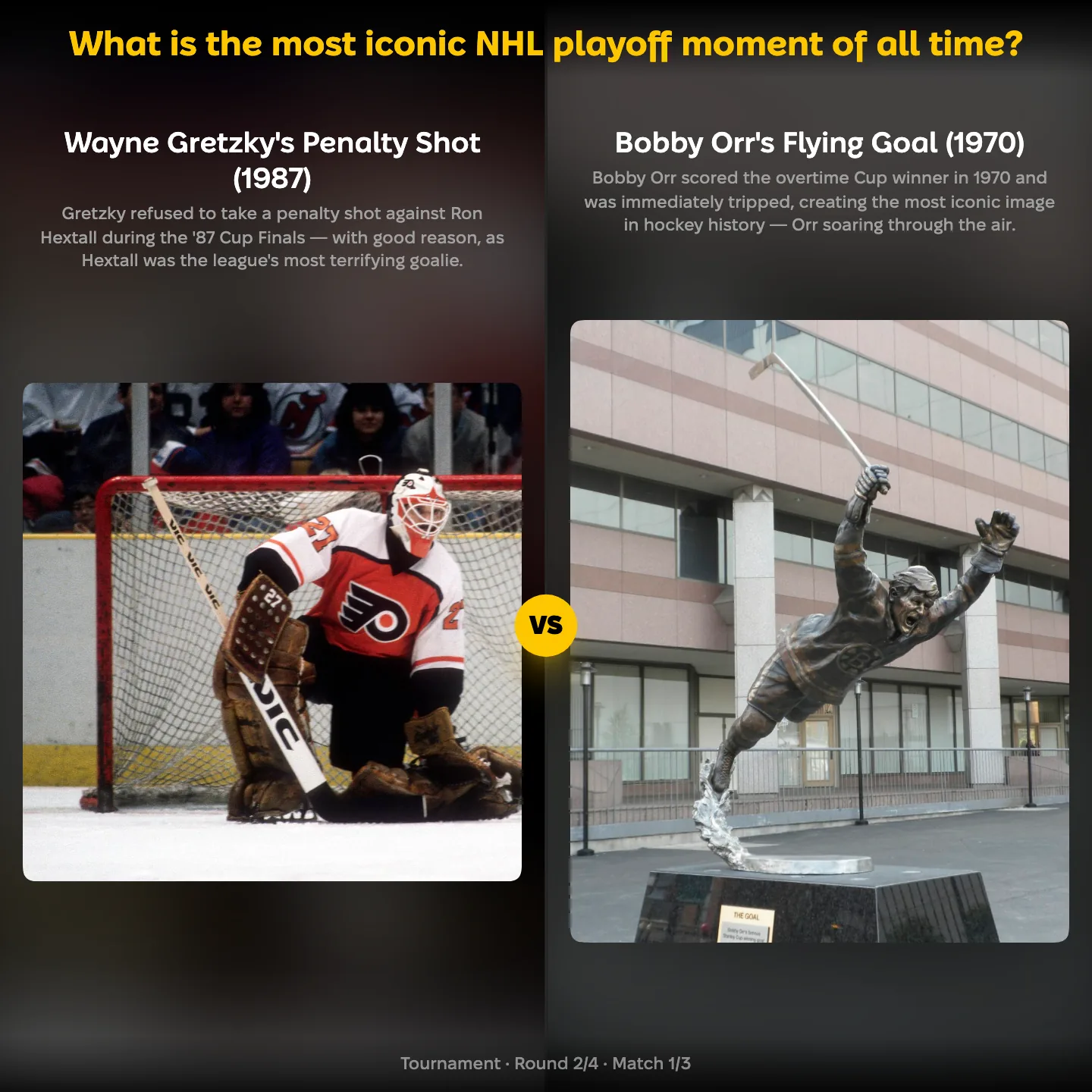
Gretzky's 1987 penalty shot vs Bobby Orr's flying goal
Eleven moments make this list, and the entries are events rather than players, so a career counts for nothing here.
Gretzky appears once, for a moment from the 1987 final against Philadelphia. Ovechkin has no entry at all, which is a fair reading of a career spent mostly in April rather than June.
Bobby Orr's 1970 overtime winner, scored a second before he was tripped into mid-air, is the photograph hockey uses to explain itself to people who do not watch hockey.
Washington: the Capitals list Gretzky can't be on
Every franchise ranking is a list one player owns, and this is the clearest example on the site: Ovechkin has played his entire NHL career for the Washington Capitals.
He became the first player to reach 900 goals there, in a 6-1 win over St. Louis on 5 November 2025.2
Gretzky is absent because he played for four teams and none of them was this one, and the same is true of the New York, Los Angeles and Edmonton lists in reverse.
Peter Bondra, Nicklas Bäckström and Braden Holtby are the rest of the argument, which tells you how much of the franchise's history has one name on it.

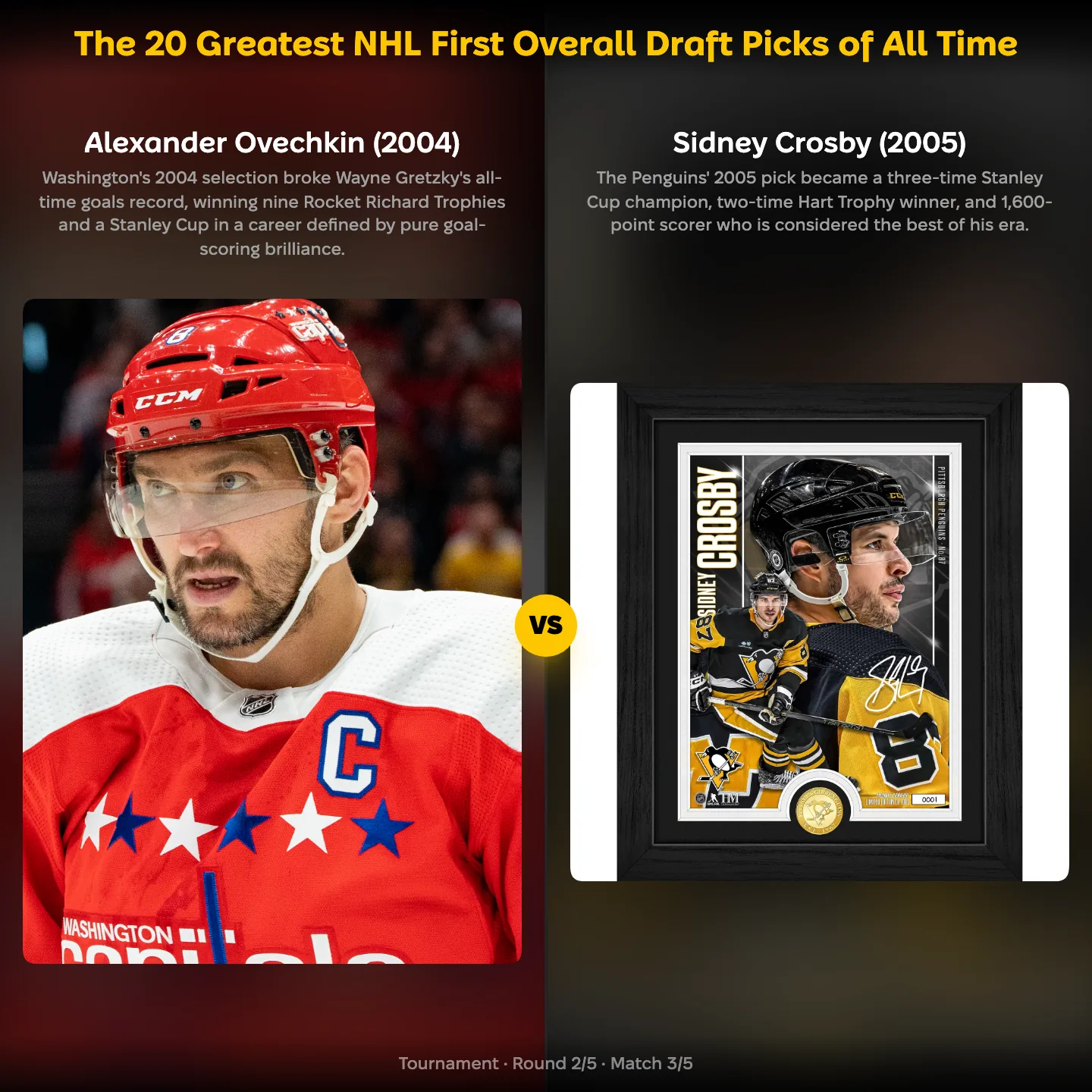
First overall: Ovechkin in 2004, Crosby in 2005, Gretzky never
Draft rankings judge a pick against everything that came after it, and Ovechkin is one of the safest first-overall selections in the league's history.
Washington took him first in 2004, one year before Pittsburgh took Sidney Crosby, and the two of them have been measured against each other ever since.
Gretzky cannot appear here at all. He turned professional at 17 with the WHA's Indianapolis Racers, moved to Edmonton by trade and entered the NHL through the 1979 merger, so no team ever drafted him.9
Connor McDavid, Mario Lemieux and Guy Lafleur crowd the top of it, and the lower half is the more interesting read: the same pick, in other years, bought teams a decade of waiting.
99 and 8: the most iconic number in hockey
The last ranking here drops the players entirely and votes on their numbers, which is a fair way to measure how far a career has travelled into the culture.
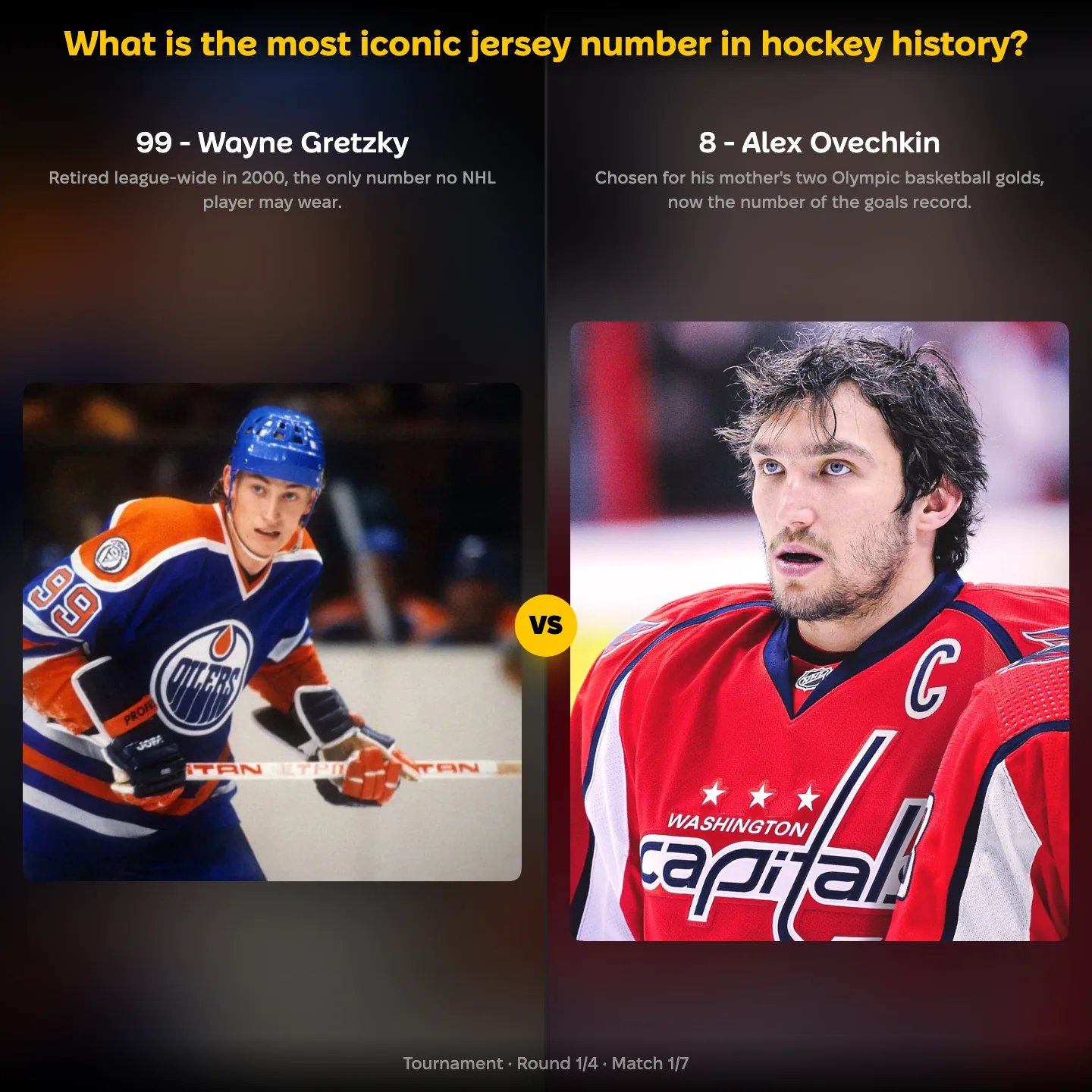
Gretzky's 99 is the only number no NHL player may wear. The league retired it at the 50th All-Star Game on 6 February 2000, and a junior coach had suggested the second nine to a reluctant teenager who wanted 9 like Gordie Howe.9
Ovechkin's 8 comes from his mother. Tatyana Ovechkina won Olympic basketball gold for the Soviet Union in 1976 and 1980 and wore the same number.10
Bobby Orr's 4, Howe's 9 and Lemieux's 66 sit alongside them; 66 exists because Lemieux inverted Gretzky's.
Thirteen questions, two very different careers
Gretzky's case is a record book with his name on almost every line, and Ovechkin's is one line that everybody said would never be crossed. Which of those two things you rate higher is a question about what hockey is for, and every one of these thirteen rankings asks it slightly differently. He turns 41 on 17 September 2026, and the goals keep going up while the record book stays where it is.3
Every list here gets built the same way, two names at a time — the head-to-head method that turns a pile of options into an order. Start with any ranking above, or make your own and find out where the pair lands on a question nobody has asked yet.
More rankings, more angles
- Tiger Woods vs Jack Nicklaus, Major by Major — 15 majors chasing 18
- Tom Brady vs Patrick Mahomes: 7 Rings, 3 Rings, 15 Lists — two eras, one position
- Babe Ruth, Ranked 14 Different Ways — the man who outgrew his sport
Sources
- NHL.com — Ovechkin's 895th goal, 6 April 2025, and Gretzky's previous record of 894: nhl.com (checked 2026-08-21)
- NHL.com — the first player to 900 NHL goals, against St. Louis on 5 November 2025: nhl.com (checked 2026-08-21)
- NHL.com — Ovechkin re-signs on 2 July 2026 for a 22nd season: career total, last season's 32 goals at 40, nine Rocket Richard trophies, three Harts, the 2018 Cup and Conn Smythe, and his 41st birthday: nhl.com (checked 2026-08-21)
- ESPN — career points leaders: Gretzky's 2,857 points and 1,963 assists, with Jaromír Jágr second: espn.com (checked 2026-08-21)
- ESPN — most goals in a single NHL season: Gretzky's 92 in 1981-82 and Brett Hull's 86 in 1990-91: espn.com (checked 2026-08-21)
- NHL.com — complete list of Hart Memorial Trophy winners: Gretzky's nine, Howe's six, Ovechkin's three, Hašek in 1997 and 1998, Hellebuyck in 2025: nhl.com (checked 2026-08-21)
- NHL.com — the 9 August 1988 trade to Los Angeles, three months after a fourth Cup in five seasons: nhl.com (checked 2026-08-21)
- CBS Sports — the IOC decision keeping Russian teams out of the 2026 Winter Olympics: cbssports.com (checked 2026-08-21)
- NHL.com — Gretzky's route into the league through the WHA, and No. 99 retired league-wide on 6 February 2000: nhl.com (checked 2026-08-21)
- NHL.com — Tatyana Ovechkina's Olympic basketball golds in 1976 and 1980, and her No. 8: nhl.com (checked 2026-08-21)