
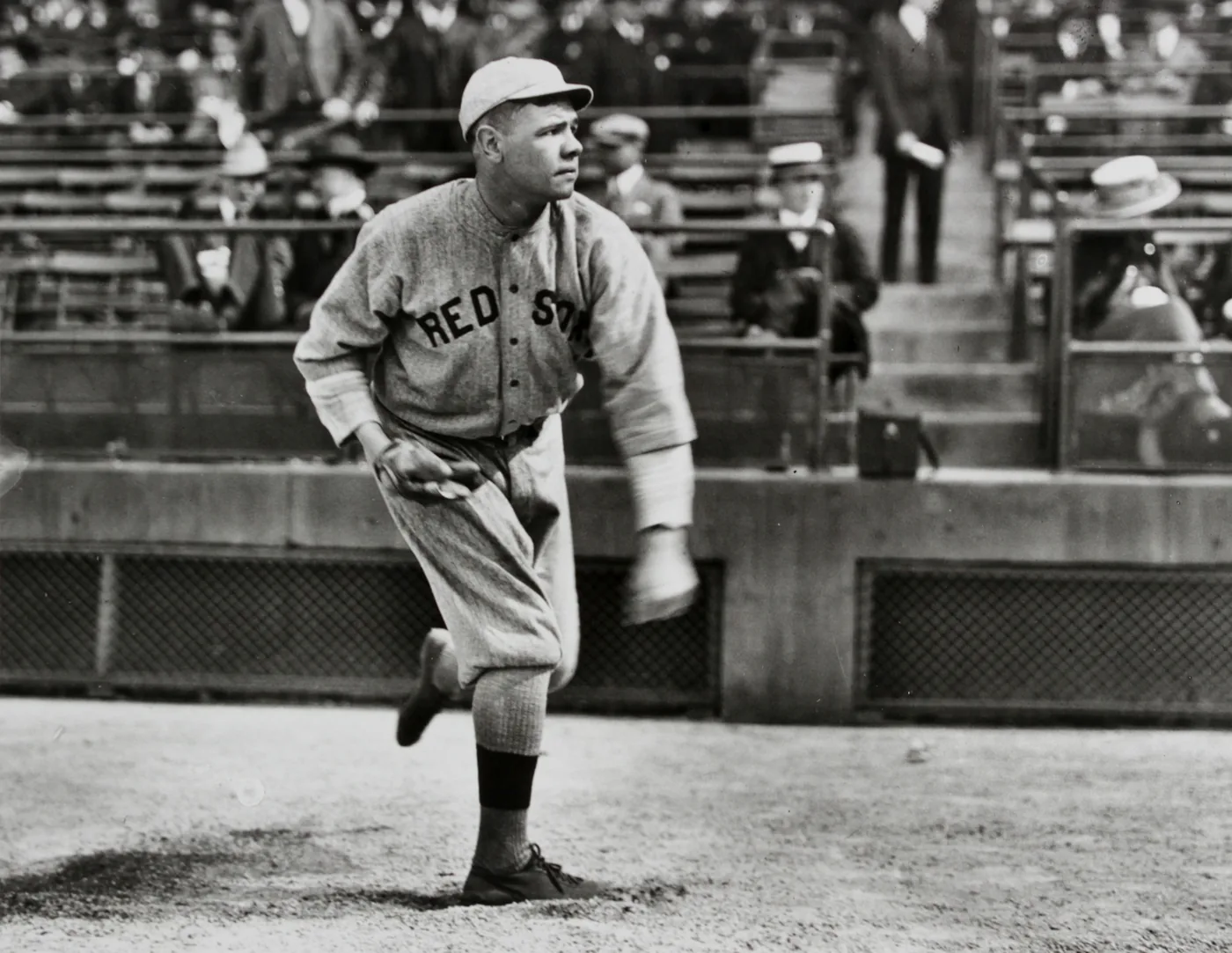
Babe Ruth finished with 714 home runs and a .342 average, and went into Cooperstown with the first class ever elected, in 1936.1 Those are the numbers everyone knows.
Shohei Ohtani is why they are worth reopening in 2026. He came into this season with 280 home runs and 670 strikeouts as a pitcher; Ruth finished on 501 strikeouts of his own, and no third name in the sport's history lives anywhere near either man's pair of columns.2
Below, Ruth is placed on fourteen rankings. Some of them are the ones you would expect. Several file him under something that is not hitting at all.
Every list here has room for Babe Ruth. The interesting ones do not file him under home runs.
Babe Ruth vs Willie Mays: the list that starts the argument
The broadest baseball ranking on the site puts every era in one field, with Honus Wagner and Shohei Ohtani on the same ballot.
Ruth's case is the oldest one there, and the one with the strangest shape. He led the American League in home runs twelve times while also owning a career pitching line, which nobody else on the ballot can say.
Willie Mays is the standard counter. The catch, the arm, the baserunning and 660 home runs make him the answer for voters who think a complete player beats a specialist.
Ty Cobb, Ted Williams and Barry Bonds are all here too, each one a different definition of "best". Cobb hit for the highest average anyone has managed; Bonds has the most home runs. The question quietly decides itself on which of those you think counts.

Once boxing and sprinting join the ballot
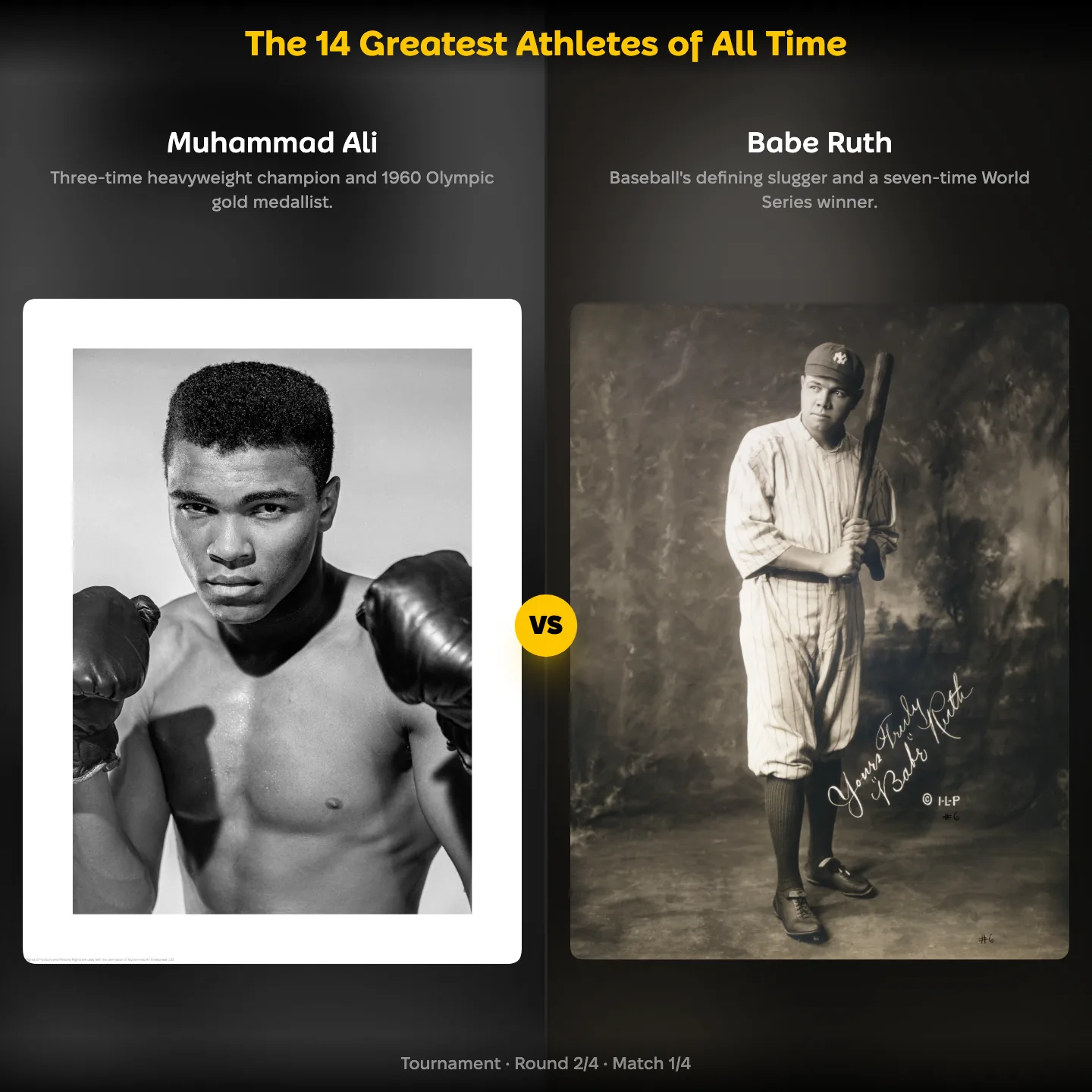
Widen the question past baseball and Ruth stops being the local giant.
This ranking puts him next to Muhammad Ali, Pelé, Michael Phelps and Serena Williams. Ruth's argument here is not the batting average but the audience: he was the first American athlete whose name travelled further than his sport.
The counter is that the others competed against the whole world and Ruth competed against white American professionals in an eight-team league, which is a real limit on any cross-sport claim.
Jesse Owens, Jim Brown and the American shortlist
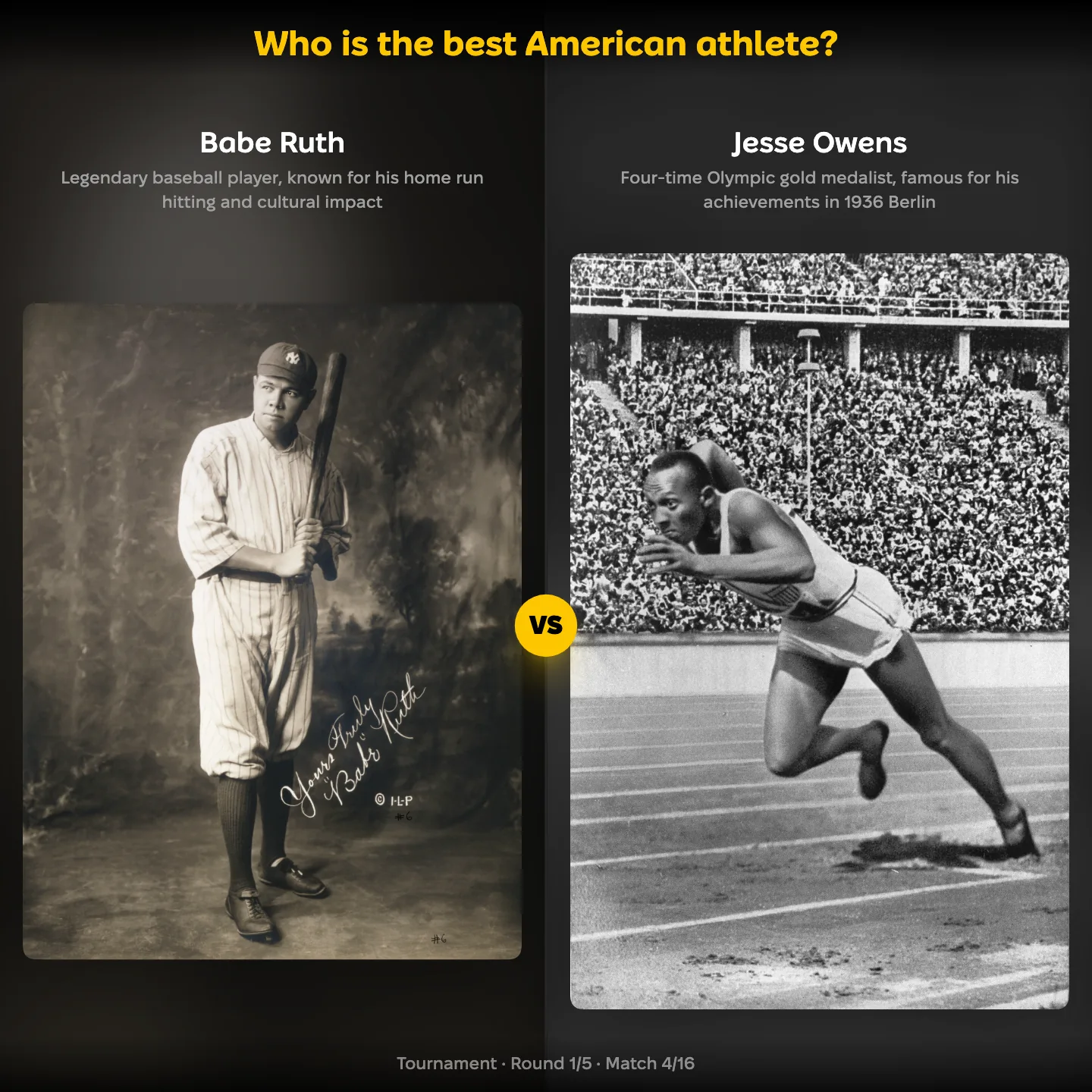
Draw a border around the same idea and half of those names disappear.
This one is American athletes only, so Pelé and Bolt drop out and Jim Brown, Jesse Owens, Jackie Joyner-Kersee and Katie Ledecky come in. Ruth belongs on it twice over: he is one of the two or three names any American over sixty grew up on, and his sport was the national one for most of the century.
Owens is the sharpest rival on it, because 1936 Berlin gave him a moment no home run can match.
659 home runs in pinstripes: Ruth vs Derek Jeter
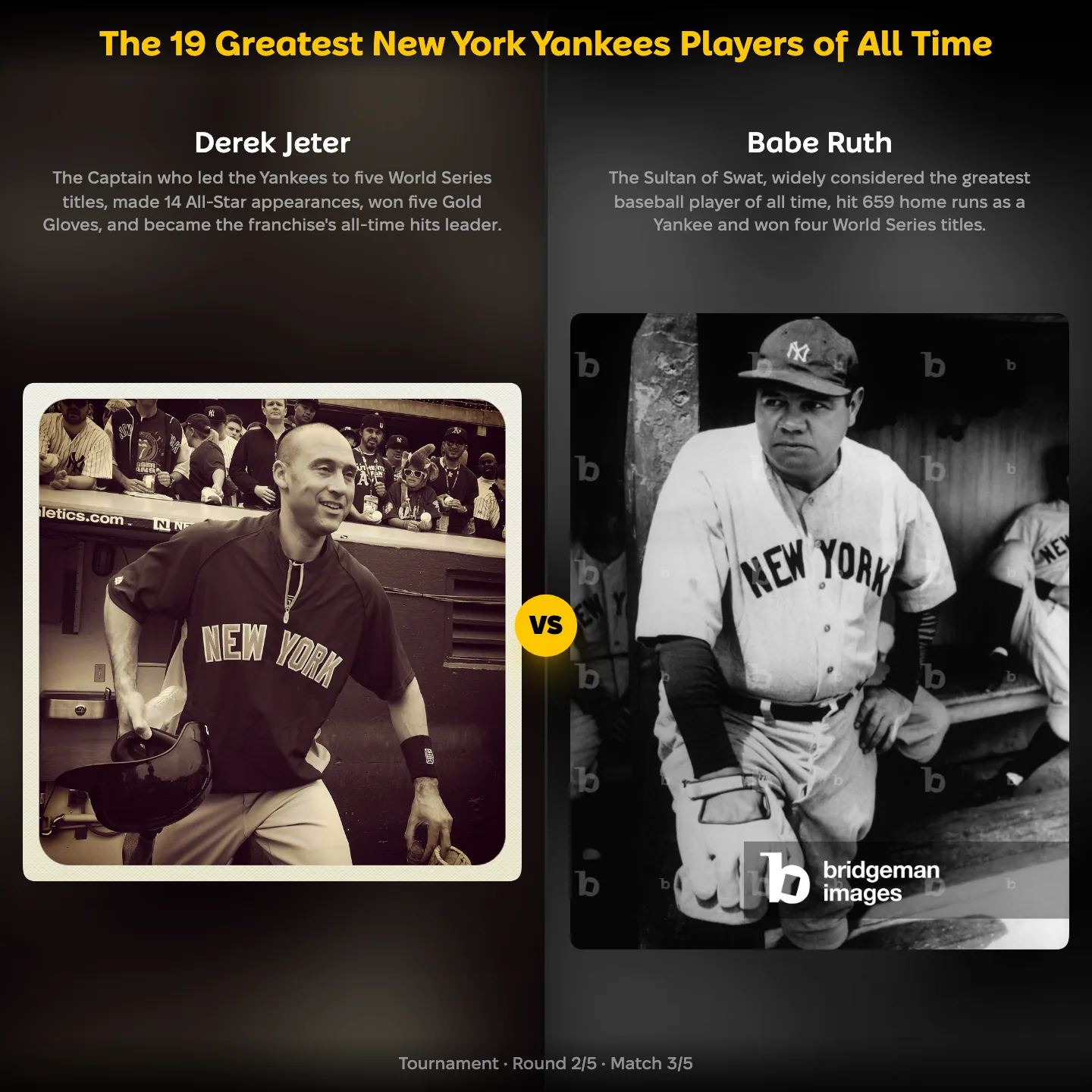
Ruth played fifteen of his twenty-two seasons in New York, from 1920 to 1934, and won four World Series there.1
This is the franchise where the competition is thickest. Lou Gehrig batted directly behind him for a decade. Joe DiMaggio arrived the year after Ruth left and won nine titles. Mariano Rivera, Yogi Berra and Whitey Ford all have cases that do not depend on hitting at all.
Derek Jeter is the modern challenger, and the split is generational rather than statistical: five titles, twenty seasons and the franchise hits record against a man nobody alive watched play.
The oddity is that Ruth is the outsider in this company. Gehrig, DiMaggio, Berra, Ford, Jeter and Rivera were all developed by the Yankees. Ruth was bought from somebody else, which is what the next few sections keep coming back to.
714, 755, 762: Ruth, Aaron and Bonds
Three numbers have held the career home run record since 1921, and all three men are on this ranking.
Ruth's 714 stood for thirty-nine years. His single season of 60, in 1927, stood for thirty-four.1 Neither record is his any more, and the second one has been beaten by four different players.
Hank Aaron passed him in 1974 with a consistency Ruth never had. Barry Bonds passed Aaron in 2007 and brought an era's worth of suspicion with him, and that suspicion is what this ranking cannot resolve.
Josh Gibson is the name that unsettles all of it. His Negro Leagues home run totals were never recorded the way the American League recorded Ruth's, so the comparison people most want to make is the one the record books cannot supply.
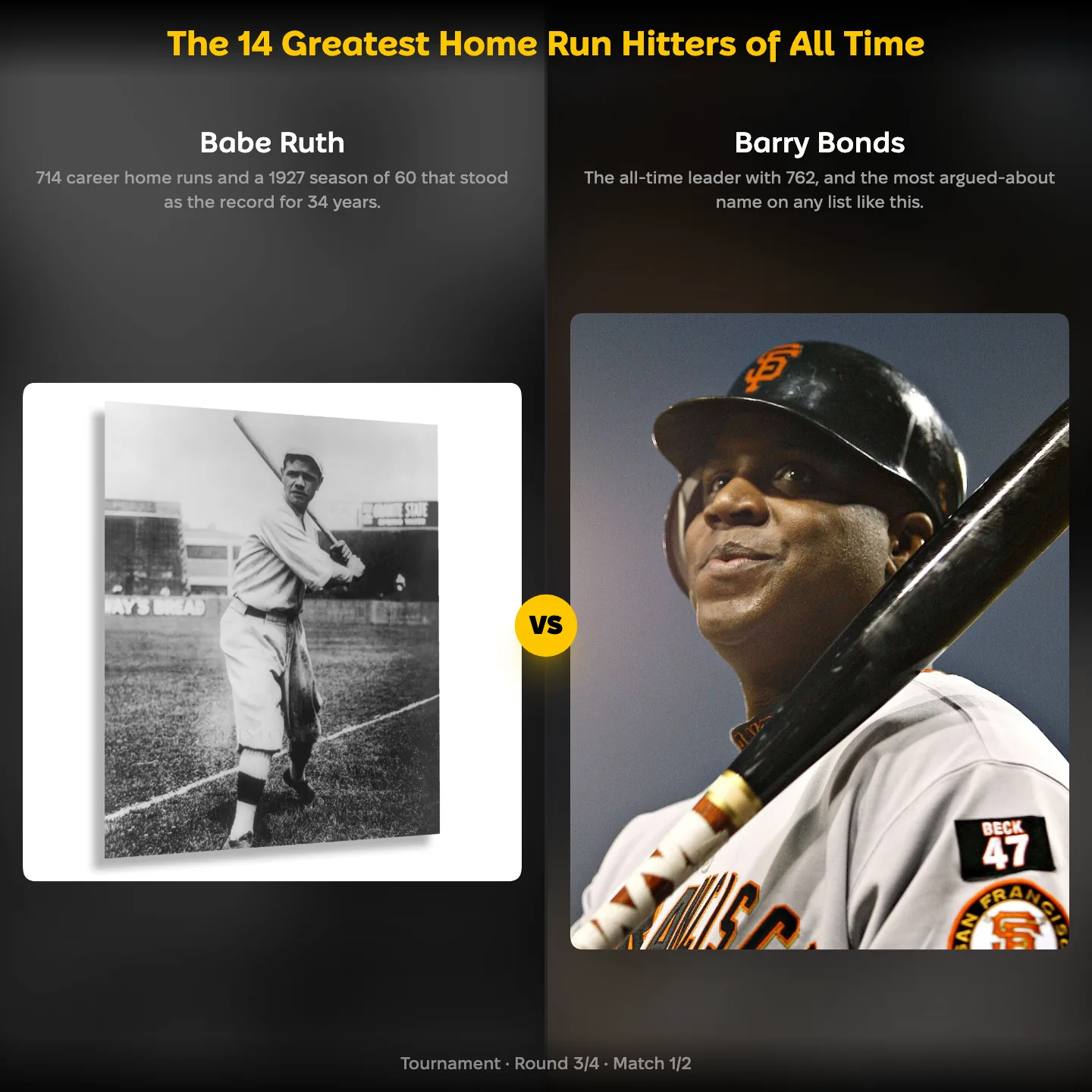
The called shot vs Jackie Robinson's debut
Ruth's entry on this ranking is a gesture nobody has decoded in ninety-four years.
On October 1, 1932, in the fifth inning of Game 3 of the World Series at Wrigley Field, he pointed at something and then hit a home run. Film confirms the gesture and settles nothing about its direction, and Ruth told the story two different ways: first that he was pointing at the Cubs dugout to mark the strike count, later that he had called the spot.3
Jackie Robinson's debut is the moment that makes the called shot look small. April 15, 1947 changed who was allowed on the field; Ruth's changed what a crowd talked about on the way home.
Every other moment on the ranking has hard edges: Don Larsen's perfect game, Bill Mazeroski's walk-off, the Cubs finally winning in 2016. Ruth's is the only entry whose central fact is still disputed.
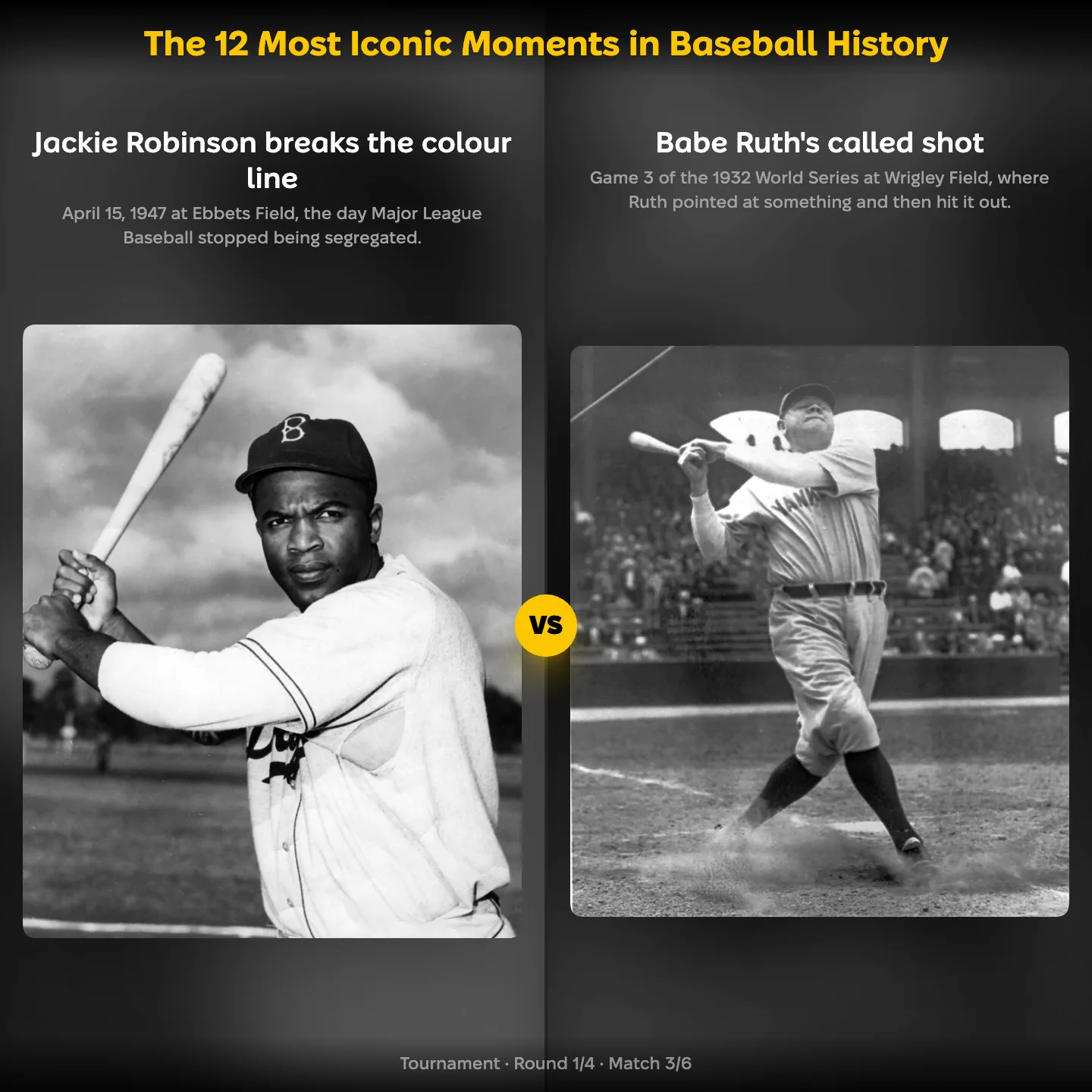
Ruth and Stephen Curry rewrote a rulebook nobody changed
This ranking asks a narrower question than greatness: whose sport was played differently after them.
Ruth's answer is the strongest one baseball has. The game he arrived in was built on bunts, stolen bases and single runs; the game he left was built on waiting for someone to hit the ball out of the park, and it has been that ever since.
Stephen Curry is the closest modern equivalent, and the comparison is exact enough to be uncomfortable: one man made a low-percentage shot the centre of an offence, and every level of the sport followed.
Dick Fosbury, Royce Gracie and Ronda Rousey are on the same ranking for the same reason, each of them having made a technique or a category normal.
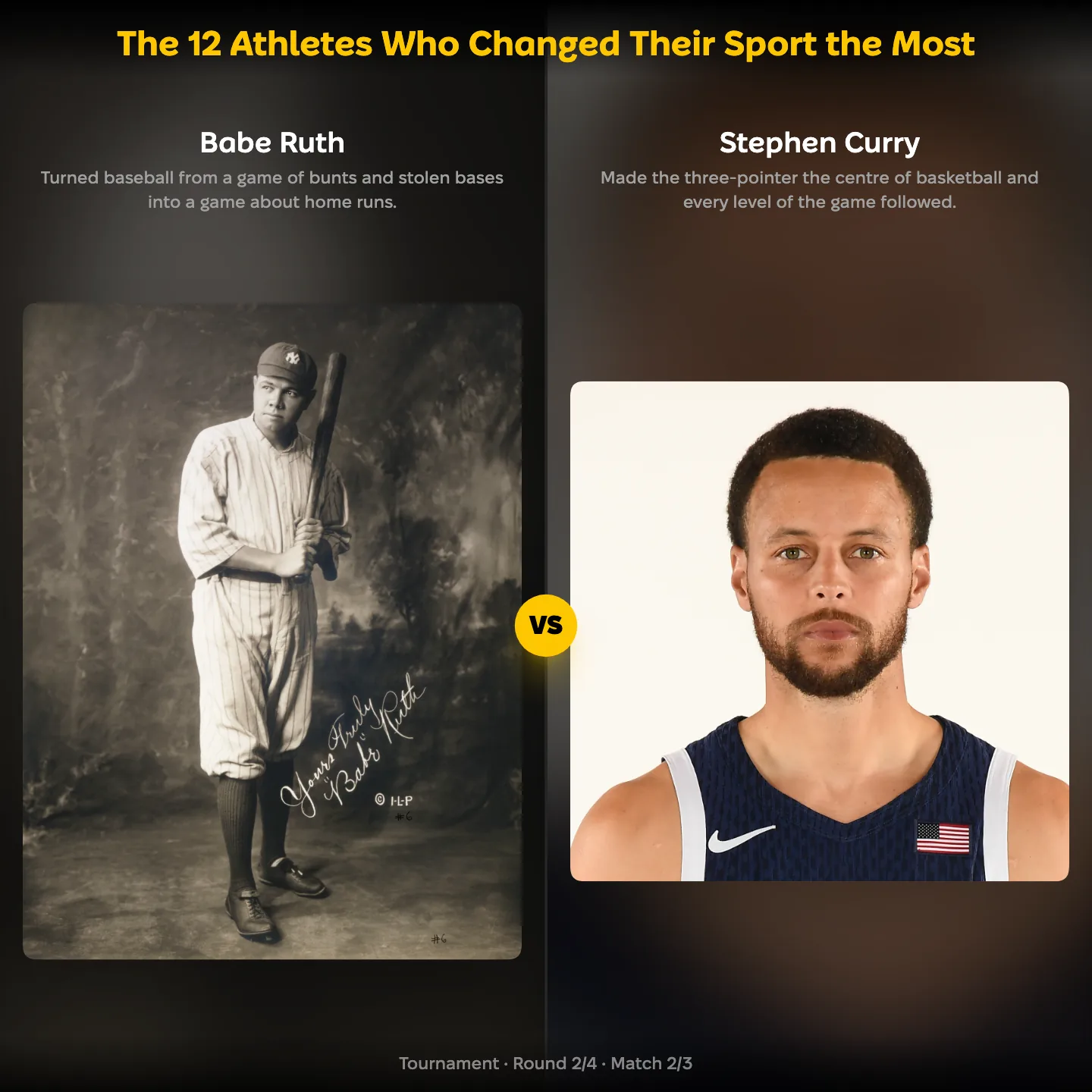
Fame past the box score
Here the measure is reach rather than performance, and the field is mostly people who changed something off the field.
Ruth is on it as the first athlete American mass media was built around. He sold newspapers in the decade radio arrived, and the money he was paid became a public talking point in a way no player's salary had been before.
Jackie Robinson, Billie Jean King, Arthur Ashe and Muhammad Ali are the company. Each of them took a personal risk that Ruth never had to take, which is the honest limit of his claim on this one.
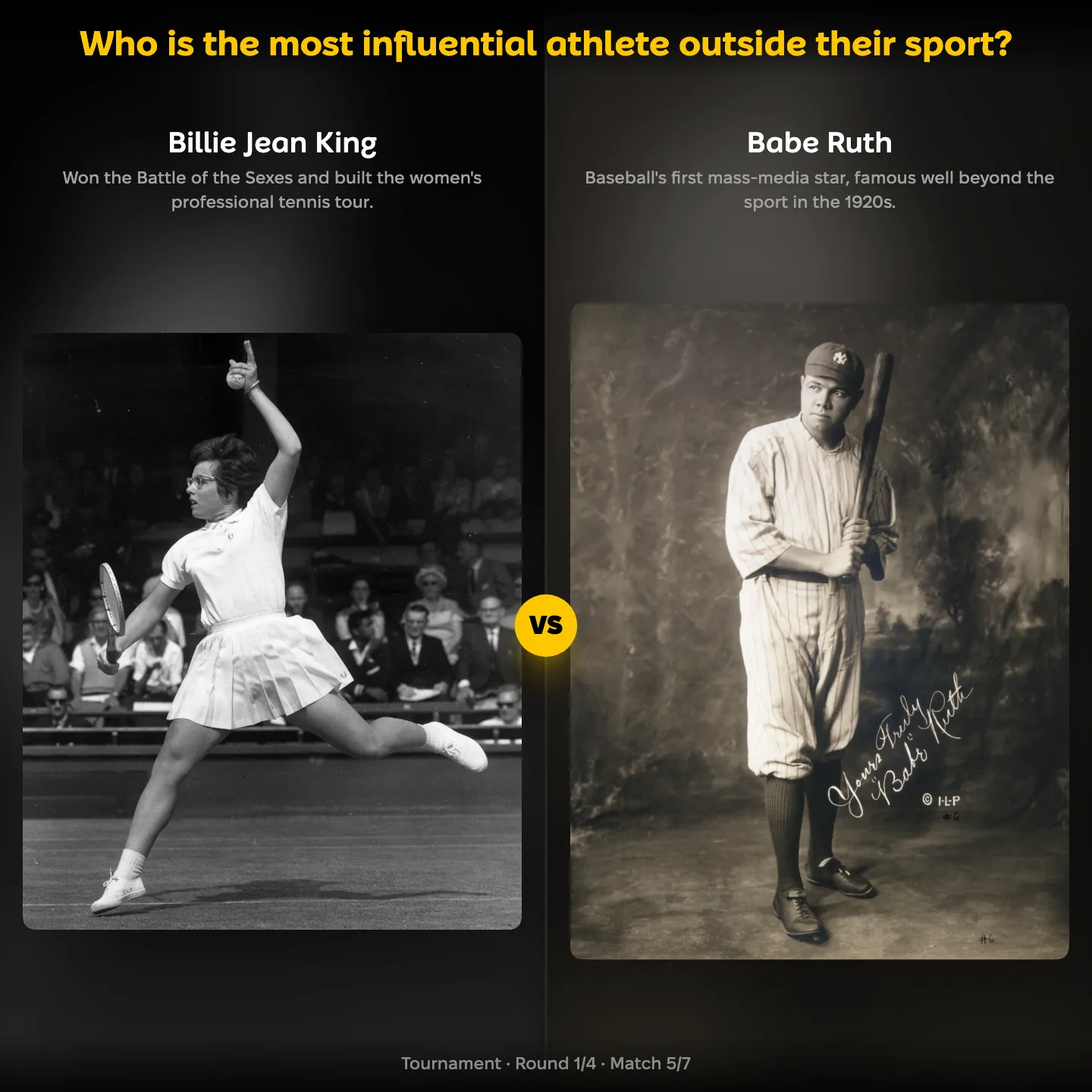
Jack Dempsey, Bobby Jones and the Golden Age of Sport
Shrink the question to a single decade and Ruth is on home ground.
The 1920s are the decade American sport learned to sell itself, and Ruth is the reason as much as the beneficiary: 54 home runs in 1920, 59 in 1921 and 60 in 1927.1
The rivals are the other names that decade minted. Jack Dempsey drew the first million-dollar boxing gates. Red Grange dragged professional football into the mainstream. Bobby Jones won as an amateur against professionals, and Bill Tilden and Suzanne Lenglen made tennis a spectator sport.
The ranking also carries Man o' War, and in the 1920s a racehorse could outdraw most of the humans.

Shohei Ohtani vs Babe Ruth: the two-way argument
This is the ranking the rest of the article has been circling, and the one where Ruth's forgotten half finally counts for something.
His pitching record is 94-46 with a 2.28 ERA across 163 games. In 1916 he won 23 games with a league-leading 1.75 ERA and threw nine shutouts, an American League record for left-handers that Ron Guidry only tied, in 1978.4
Ohtani is the first player in a century to make that combination current, and the numbers have converged: 280 home runs and 670 pitching strikeouts entering this season, against Ruth's career 501 on the mound.2
The rest of the field plays two sports rather than two positions. Bo Jackson was an All-Star outfielder and a Pro Bowl running back. Deion Sanders is the only man to appear in both a Super Bowl and a World Series. Jim Thorpe won Olympic gold and then played professional football and baseball.
Which version of "two-way" you accept decides the whole thing, and Ruth and Ohtani are on the narrow side of that line.

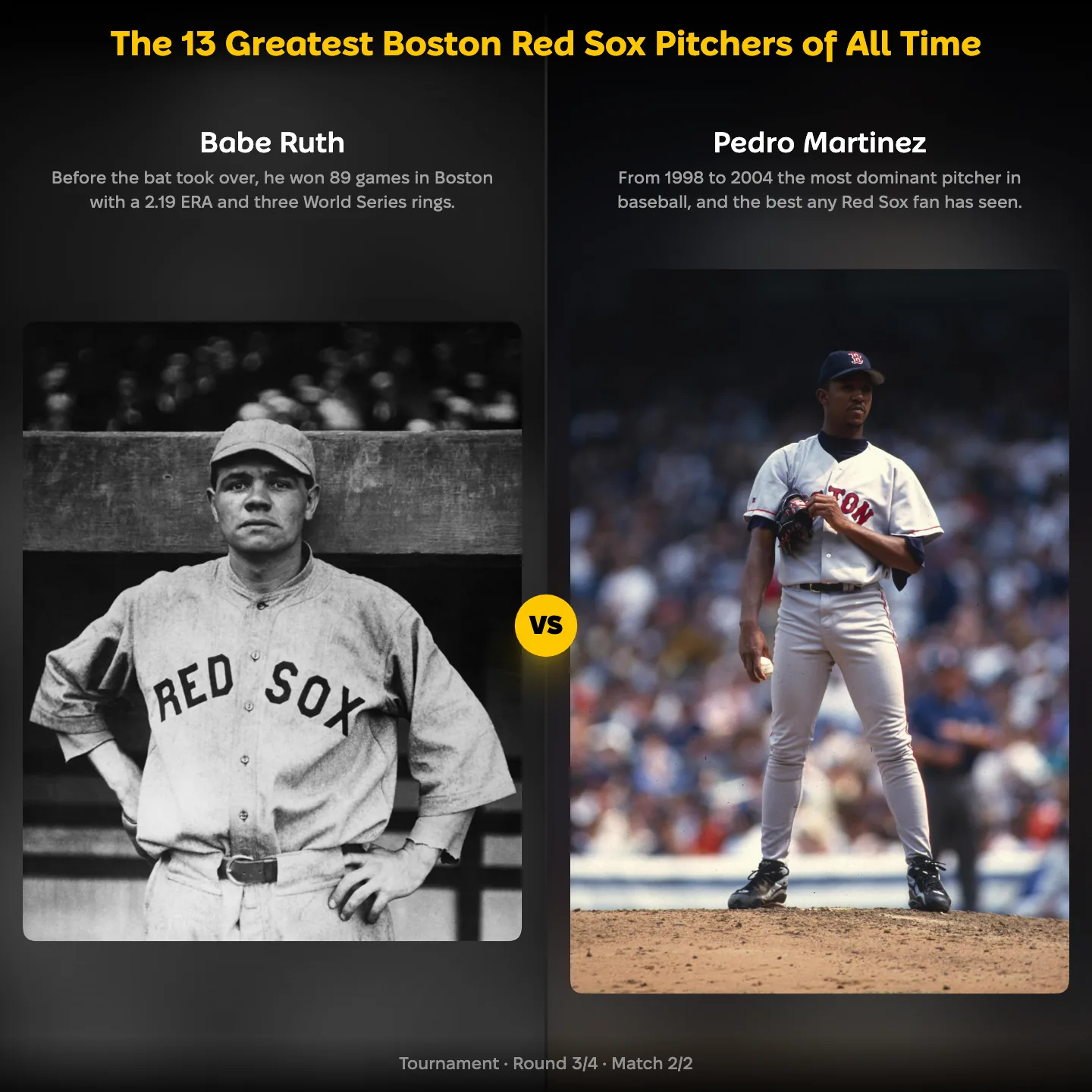
Boston's forgotten left-hander: Ruth vs Pedro Martinez
Boston had Ruth first, for six seasons from 1914, and used him as a pitcher. He won 89 games for them.1
He also holds a piece of World Series history that has nothing to do with hitting. Across the 1916 and 1918 Series he threw 29⅔ consecutive scoreless innings, a record that survived until Whitey Ford broke it in the 1960s.4
Pedro Martínez is the name most Red Sox supporters reach for first, and the case is hard to argue with: from 1998 to 2004 he was the most dominant pitcher in the game.
Behind him the depth is real. Cy Young joined at 34 and went 33-10. Roger Clemens won three Cy Young Awards in Boston. Dutch Leonard's 0.96 ERA in 1914 is still the modern single-season record, and Curt Schilling's bloody sock is the most-replayed pitching image the club owns.
Ruth is the only man on that ranking whose fame was made somewhere else, in another job.
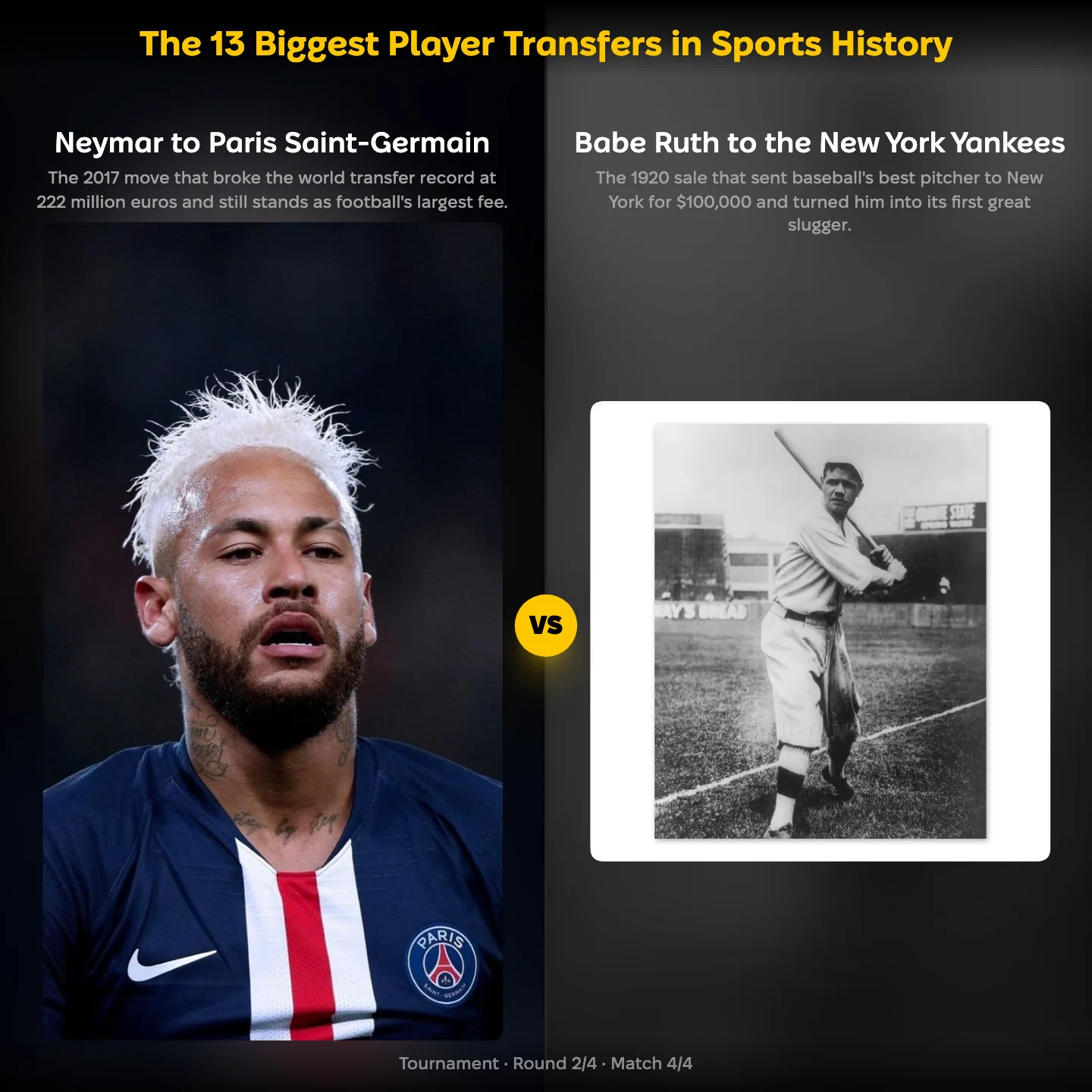
Babe Ruth to the Yankees, Neymar to Paris
On this ranking Ruth appears as a transaction rather than a player.
The sale was announced on January 5, 1920, a week after it was agreed. The price was $100,000, paid in four annual instalments of $25,000 at six percent interest, and five months later Jacob Ruppert lent Harry Frazee a further $300,000 with Fenway Park as collateral.5
What followed is the most expensive consequence in sport. Boston did not win a World Series for eighty-six years, and the drought acquired a name that was simply Ruth's nickname attached to a curse.6
The modern entries are larger in cash and smaller in effect. Neymar's move to Paris Saint-Germain in 2017 broke the world transfer record at 222 million euros and is still football's biggest fee. Cristiano Ronaldo to Real Madrid, Diego Maradona to Napoli and Wayne Gretzky to the Los Angeles Kings each changed a club, a city or a league.
None of them changed two franchises for a century.
The Sultan of Swat vs The Great One
On this ranking Ruth appears without his name.
He is there as the Sultan of Swat, a piece of 1920s newspaper writing so ornate that it has outlived the writer who coined it, and it is up against The Great One, His Airness, The Black Mamba and Iron Mike.
Wayne Gretzky's nickname does a job Ruth's does not: it needs no surname and no sport attached.

The pitcher Boston stopped using
The final ranking asks about a Ruth who never existed.
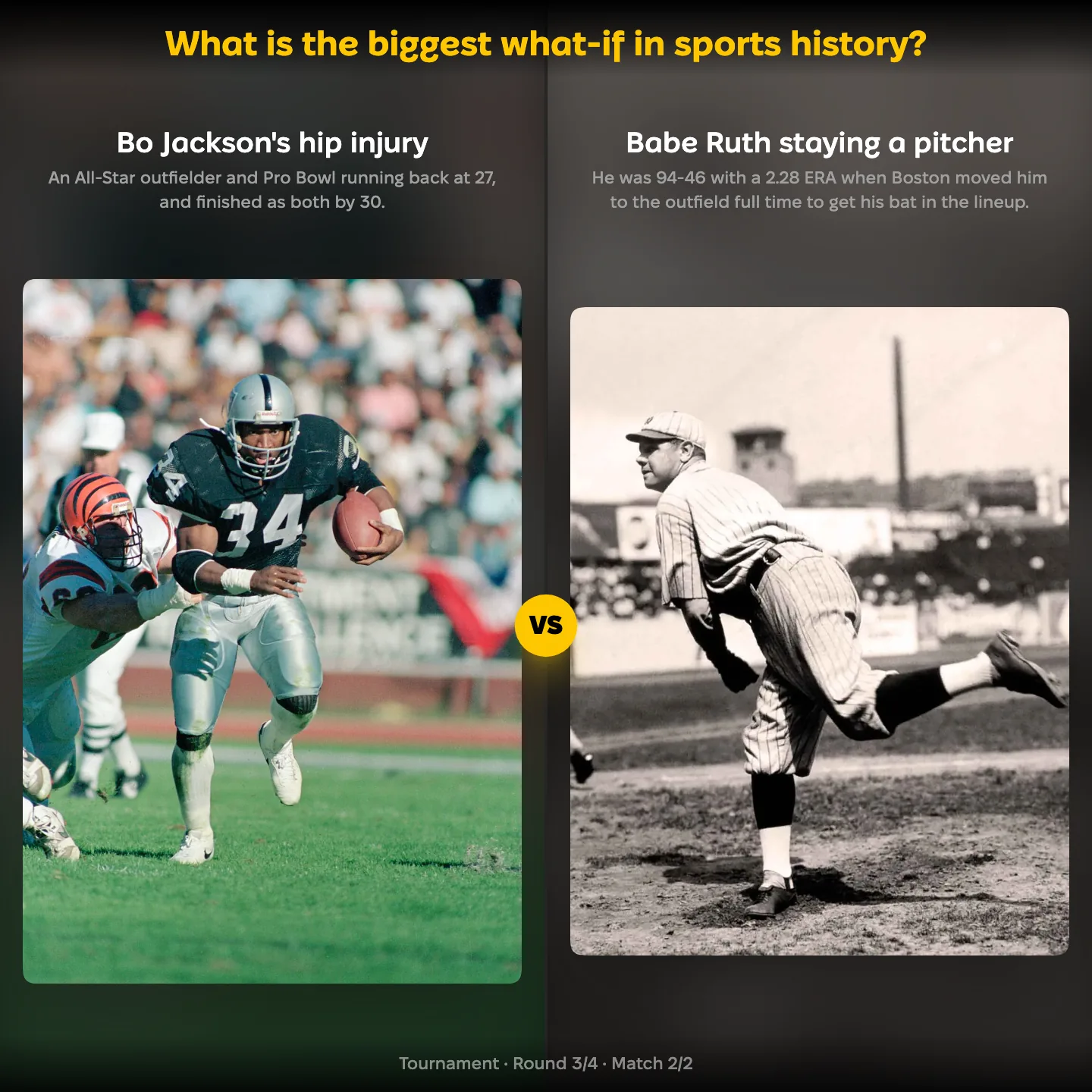
He was 94-46 with a 2.28 ERA when Boston manager Ed Barrow started putting him in the everyday lineup in 1918, during wartime roster shortages, to get his bat into more games. Ruth had already been resisting his pitching duties by then, and within two years he was an outfielder who occasionally pitched.4
The other entries on the ranking are careers taken away. Bo Jackson's hip, Sandy Koufax's elbow at 30, Muhammad Ali's three years out of the ring, Ted Williams' two tours of military service.
Ruth's is different in kind, because nothing was taken from him. A decision was made, it was the right one, and it still removed one of the best left-handed pitchers of his era from the sport at 23.
Fourteen rankings, and only four of them are about hitting
Count the sections back and the pattern is hard to miss: Ruth arrives as a pitcher, a nickname, a price, a gesture at Wrigley Field and a decade's worth of newspaper circulation, and only sometimes as the man with the home run record. Ohtani is doing the two-way thing again a century later, which is exactly why the pitching half of Ruth's career keeps getting dug back up.
Each of these rankings is built the same way underneath, one pick, two candidates, repeated until an order emerges.
Take any name you think you know completely and build four unrelated rankings around them. You will find out quickly how much of what you know came from one list.
More rankings, more angles
- Tom Brady: 199th Pick, 7 Rings, 15 Different Lists — the sixth-round pick who ran out of comparisons
- Tiger Woods vs Jack Nicklaus, Major by Major — 18 majors against 15, and everything else
- 15 Rankings, One Benjamin Franklin — printer, scientist, diplomat, all on separate lists
- Ovechkin vs Gretzky: The Record Fell, the Argument Didn't — 894 goals, then 895
Sources
- National Baseball Hall of Fame — Babe Ruth career record: 714 home runs, .342 average, class of 1936, Boston Red Sox 1914–1919 and New York Yankees 1920–1934, 89 wins in six Boston seasons, and the single-season marks of 54 (1920), 59 (1921) and 60 (1927): baseballhall.org (checked 2026-08-09)
- Yahoo Sports — Shohei Ohtani's career totals entering the 2026 season (280 home runs, 670 pitching strikeouts) against Babe Ruth's 714 and 501: sports.yahoo.com (checked 2026-08-09)
- Wikipedia — Babe Ruth's called shot: Game 3 of the 1932 World Series, October 1 at Wrigley Field, the fifth inning, the film evidence and Ruth's changing accounts: en.wikipedia.org (checked 2026-08-09)
- Society for American Baseball Research, BioProject — Ruth's pitching career: 94-46 with a 2.28 ERA in 163 games, 23 wins and a league-leading 1.75 ERA in 1916, nine shutouts, 29⅔ consecutive scoreless World Series innings broken by Whitey Ford, and Ed Barrow's 1918 decision to bat him every day: sabr.org (checked 2026-08-09)
- National Baseball Hall of Fame — the sale of Ruth to the Yankees: $100,000 in four annual instalments of $25,000 at six percent interest, announced January 5, 1920, plus Jacob Ruppert's $300,000 loan to Harry Frazee secured on Fenway Park: baseballhall.org (checked 2026-08-09)
- Society for American Baseball Research — the 86-year Red Sox championship drought and its attribution to the 1920 sale of Ruth: sabr.org (checked 2026-08-09)