

One Piece, Naruto and Bleach were sold as a set. Weekly Shōnen Jump ran all three at once through the 2000s, readers called them the Big Three, and 2026 is the year the label stops being nostalgia: Bleach's final Thousand-Year Blood War cour premiered in July,4 One Piece began its Elbaph arc in April, and the long-delayed Naruto twentieth-anniversary special is due before the year ends.5
Grouping them was a marketing decision, not a measurement. Rank them on anything specific and the set falls apart.
Shōnen Jump filed One Piece, Naruto and Bleach under one label; fourteen lists show how little the three actually have in common once you stop grouping them.
Weekly Shōnen Jump: all three on the same page
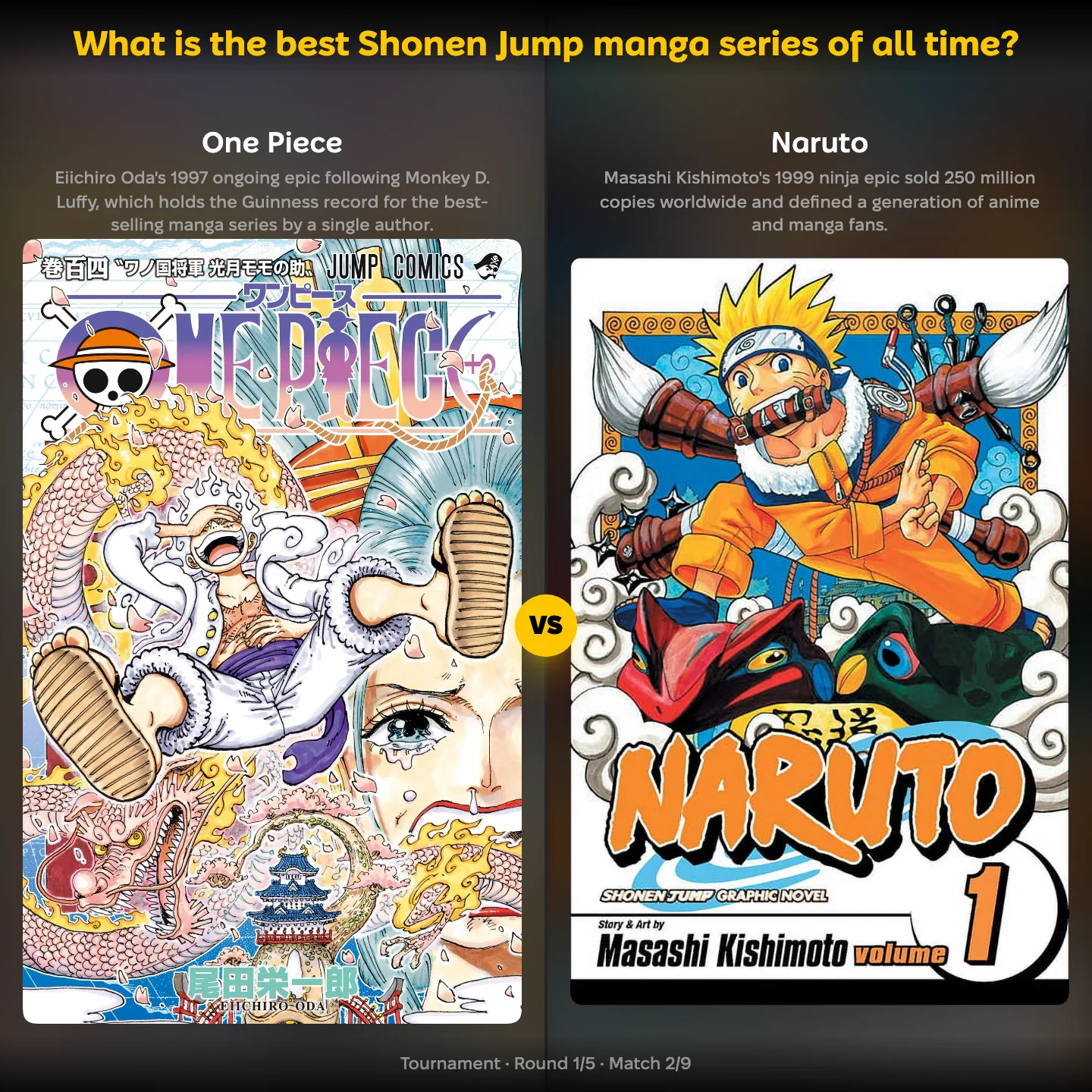
This is the list the Big Three came from. It asks which series the magazine got most right across its whole history, so it holds One Piece, Naruto and Bleach alongside Dragon Ball, Death Note and Demon Slayer.
One Piece has the numbers. Serialized since 22 July 1997, it passed 600 million copies in circulation by March 2026 and holds the Guinness World Record for the most copies published for a comic series by a single author.1
Naruto sold 250 million copies and stopped in November 2014, at a point its author chose.3 Bleach reached 130 million and ran to August 2016.4
Dragon Ball is the complication. It came first, it taught the magazine the format all three inherited, and on a list about Jump itself that lineage counts for as much as any sales figure.
Thousand-Year Blood War: the second attempt nobody else got
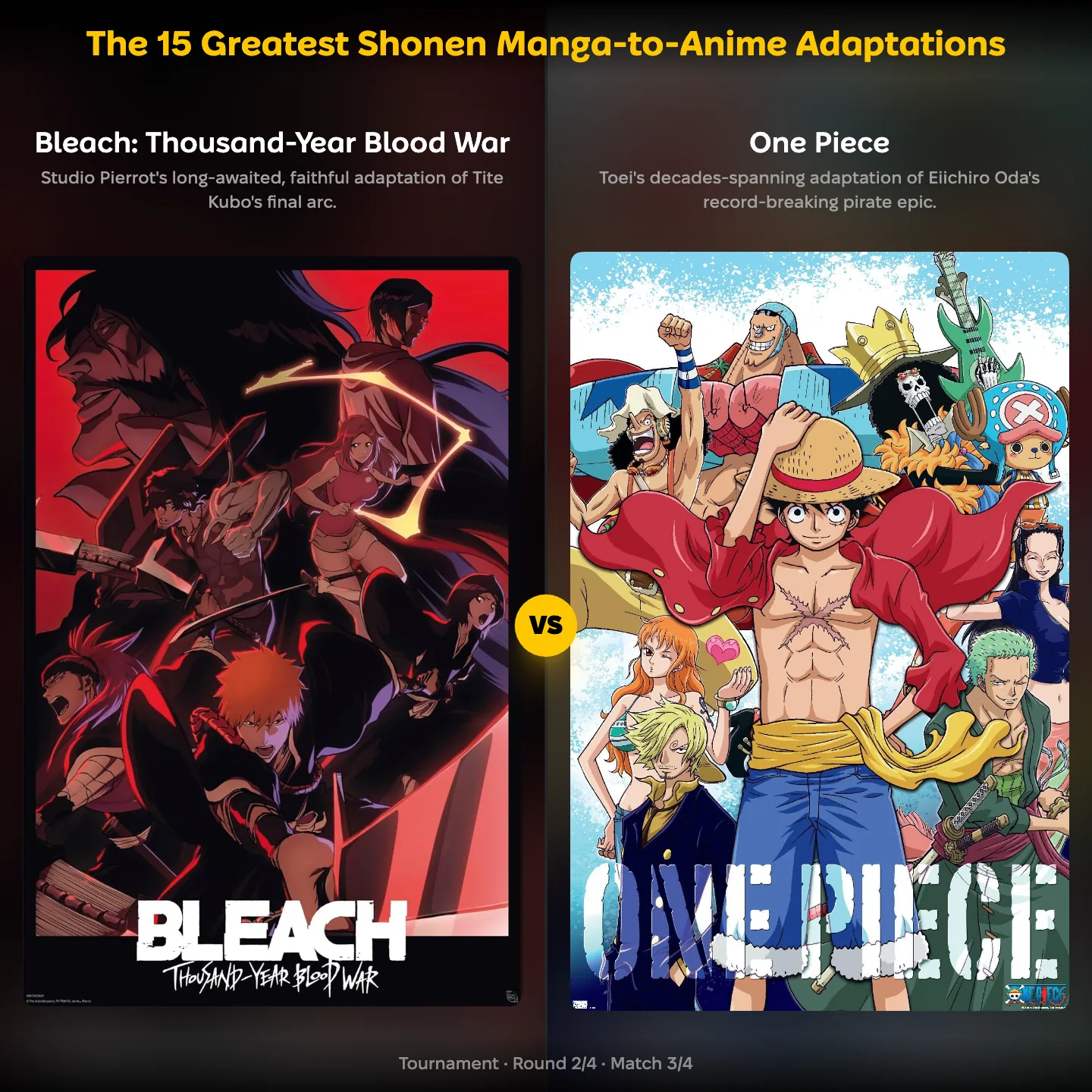
Adaptation quality is a different question from manga quality, and it splits the three immediately.
Bleach alone got a second attempt. Its original anime stopped in March 2012, mid-story, 366 episodes in; a decade later Studio Pierrot came back and animated the final arc as Thousand-Year Blood War, with Tomohisa Taguchi directing the first two cours and Hikaru Murata the last two.4
One Piece and Naruto never needed a rescue and never got a remake either. Both ran continuously alongside their manga, which is why the same production that carried them for 700 and 500 episodes also produced the padding they are known for.
Fullmetal Alchemist: Brotherhood and Demon Slayer qualify on the same logic as Thousand-Year Blood War. In each case somebody decided the source deserved a second, more careful pass.
Aizen, Madara and Doflamingo: three villains, one list
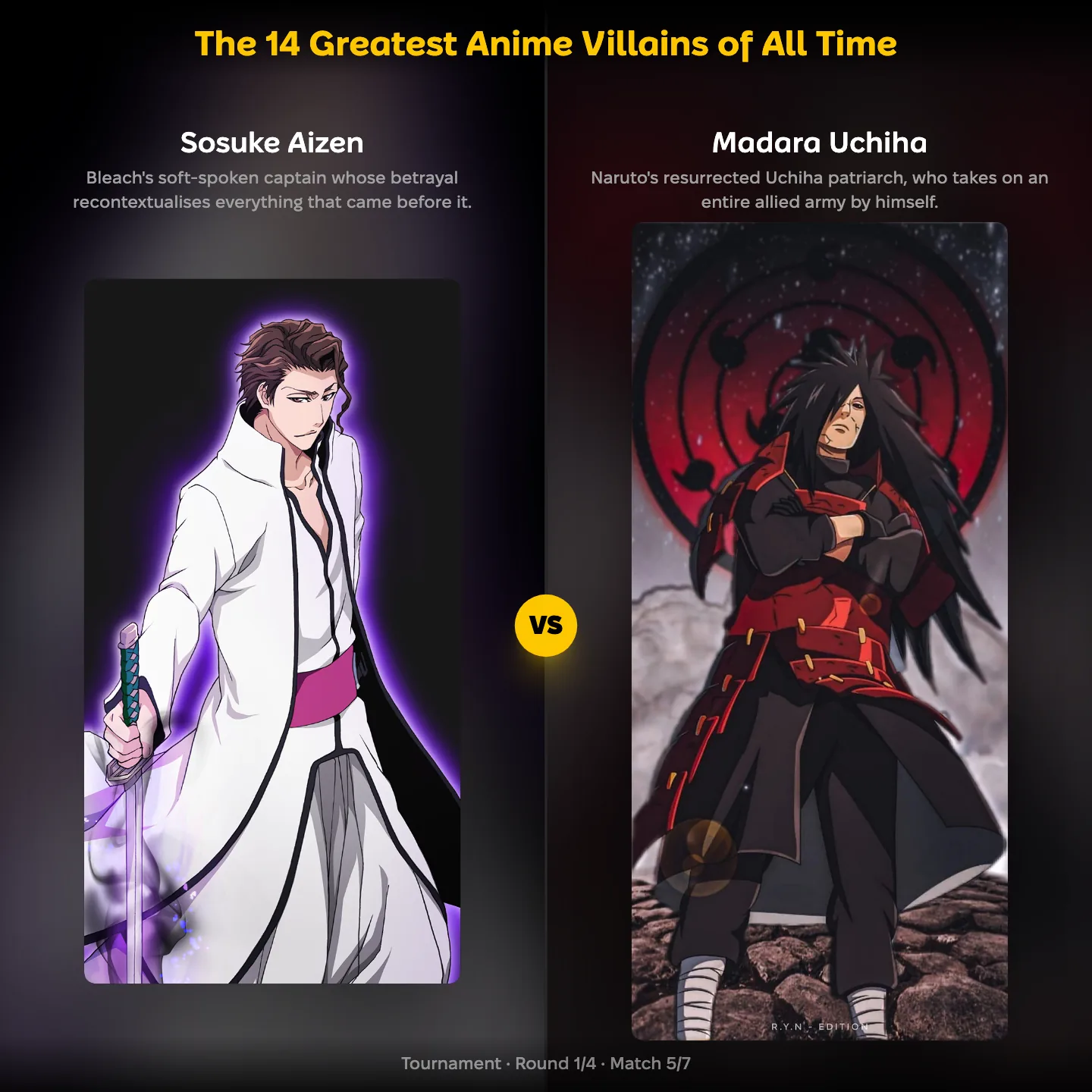
Here the entries are not the series but their antagonists, which makes this the first ranking where all three franchises compete without their protagonists.
Bleach sends Sōsuke Aizen, a captain whose betrayal retroactively rewrites everything the reader thought they understood about the Soul Society. Naruto sends two, Madara Uchiha and Pain, from a war arc built almost entirely around them.
One Piece sends Donquixote Doflamingo, and that is the honest weakness of a thousand-chapter serial: its villains arrive per island, each one enormous inside his own arc and easy to forget two arcs later.
The list is also a reminder that neither Jump nor the Big Three own this category. Light Yagami is a Death Note character, Frieza a Dragon Ball one, and Makima came out of Chainsaw Man twenty years after Bleach started.
Kokoro no Chizu, Blue Bird, Asterisk: the openings
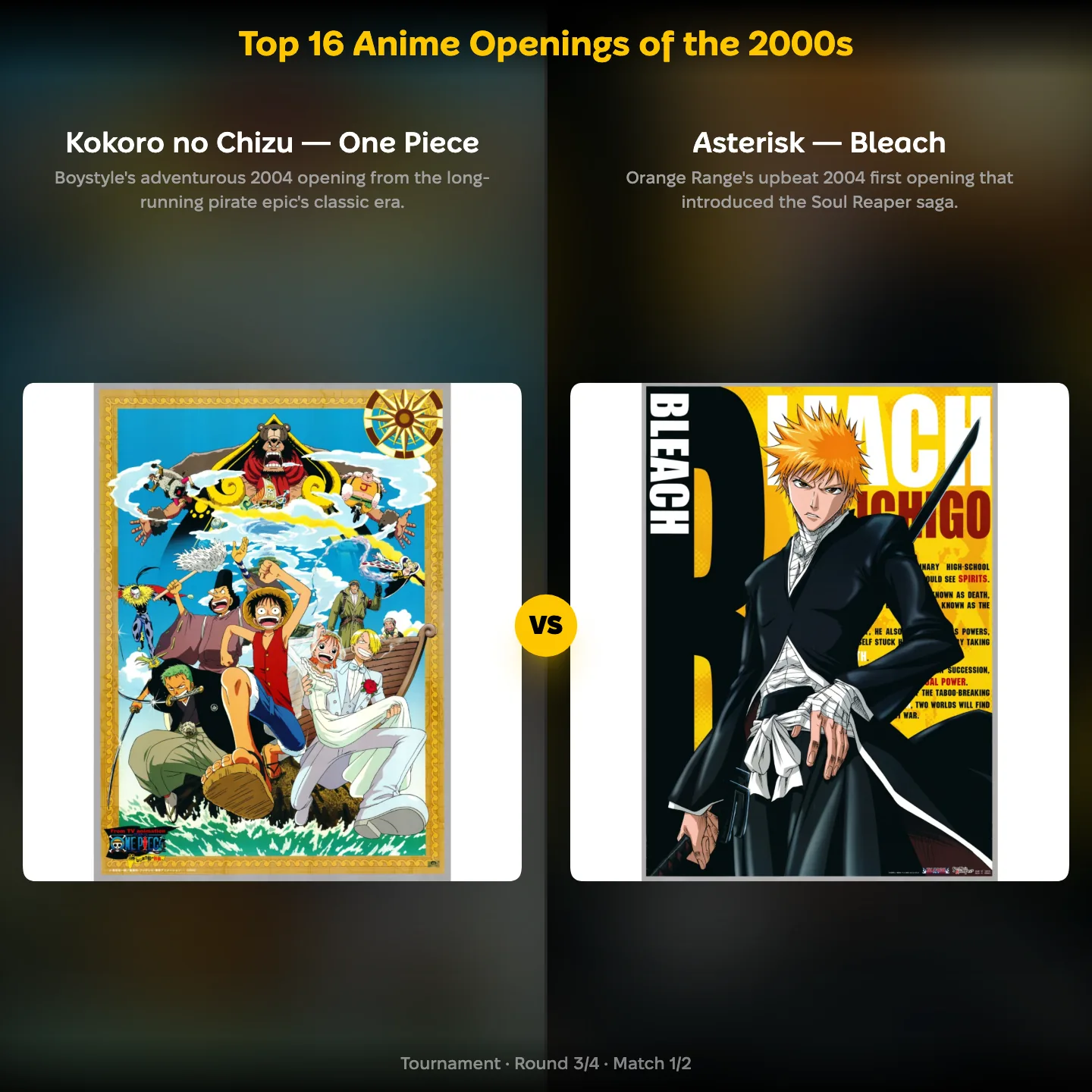
The 2000s are the decade all three shared, and this ranking measures ninety seconds of it at a time.
Naruto is the one franchise here with two entries: Asian Kung-Fu Generation's Haruka Kanata from the original series, and Ikimono-gakari's Blue Bird from Shippuden, which began broadcasting in February 2007. Bleach contributes Orange Range's Asterisk, the song that opened the series in October 2004.
One Piece is represented by Kokoro no Chizu, from the stretch of the anime most viewers over thirty actually watched — before the hiatus, before the 2025 primetime relaunch, when it was a Sunday-morning cartoon about a small crew.
Death Note, Code Geass and Gurren Lagann sit on the same list. The Big Three were the era's biggest shows; that did not make them its best ninety seconds.
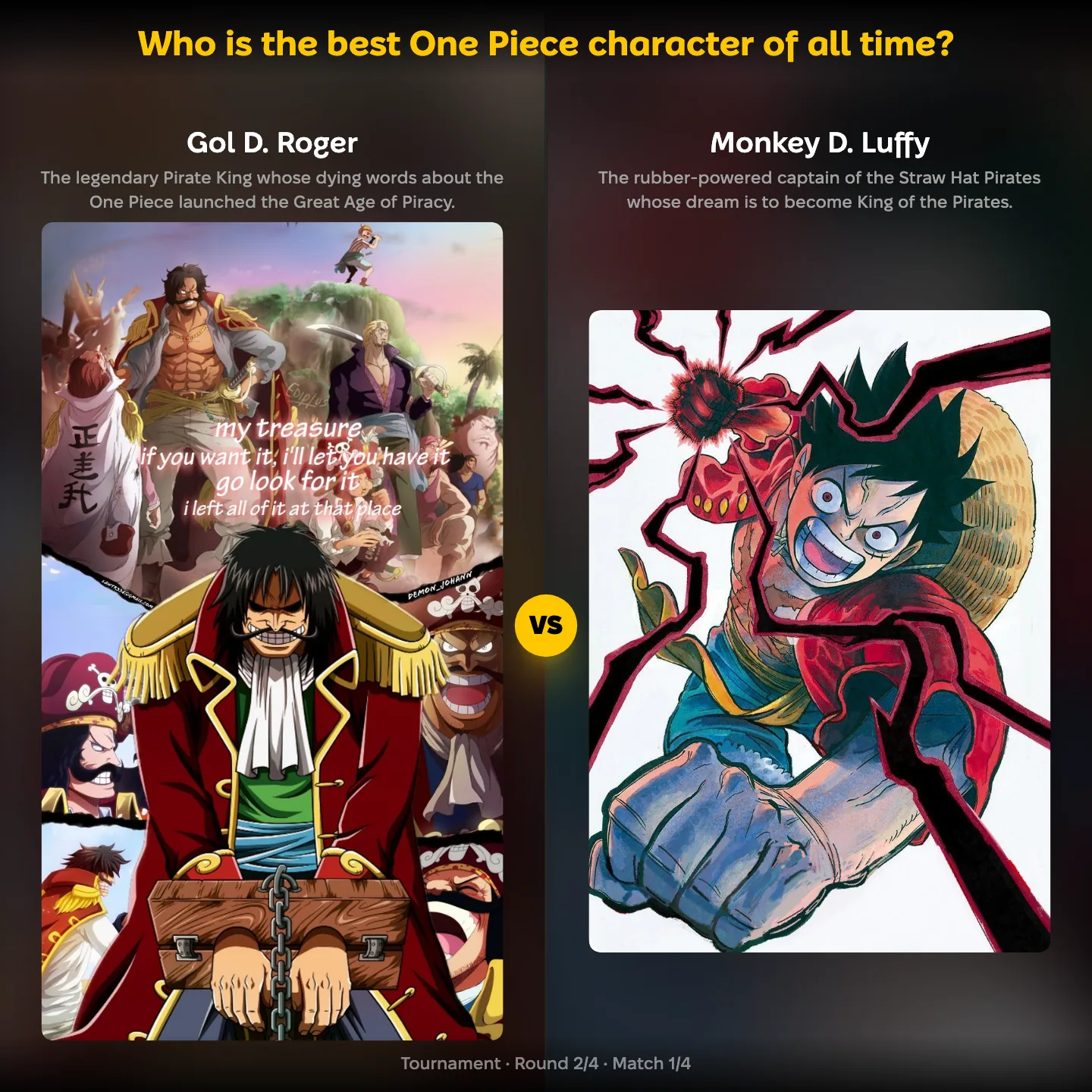
Gol D. Roger vs Monkey D. Luffy, inside One Piece's own cast
Two of the Big Three have a ranking devoted to nothing but their own characters. This is One Piece's.
Luffy is in it, and so is the man whose execution starts the story: Gol D. Roger, the Pirate King whose last words about his treasure launched the Great Age of Piracy. A cast this size is what a serial running since 1997 accumulates: Zoro, Nami, Shanks, Whitebeard, Robin, and a dozen more with their own fandoms.
Bleach has no equivalent ranking on this site at all, and Naruto's is the next section. That asymmetry is not an accident of our catalogue: One Piece and Naruto ran long enough to make their side characters into subjects, and Bleach stopped before most of its Gotei 13 got that treatment.
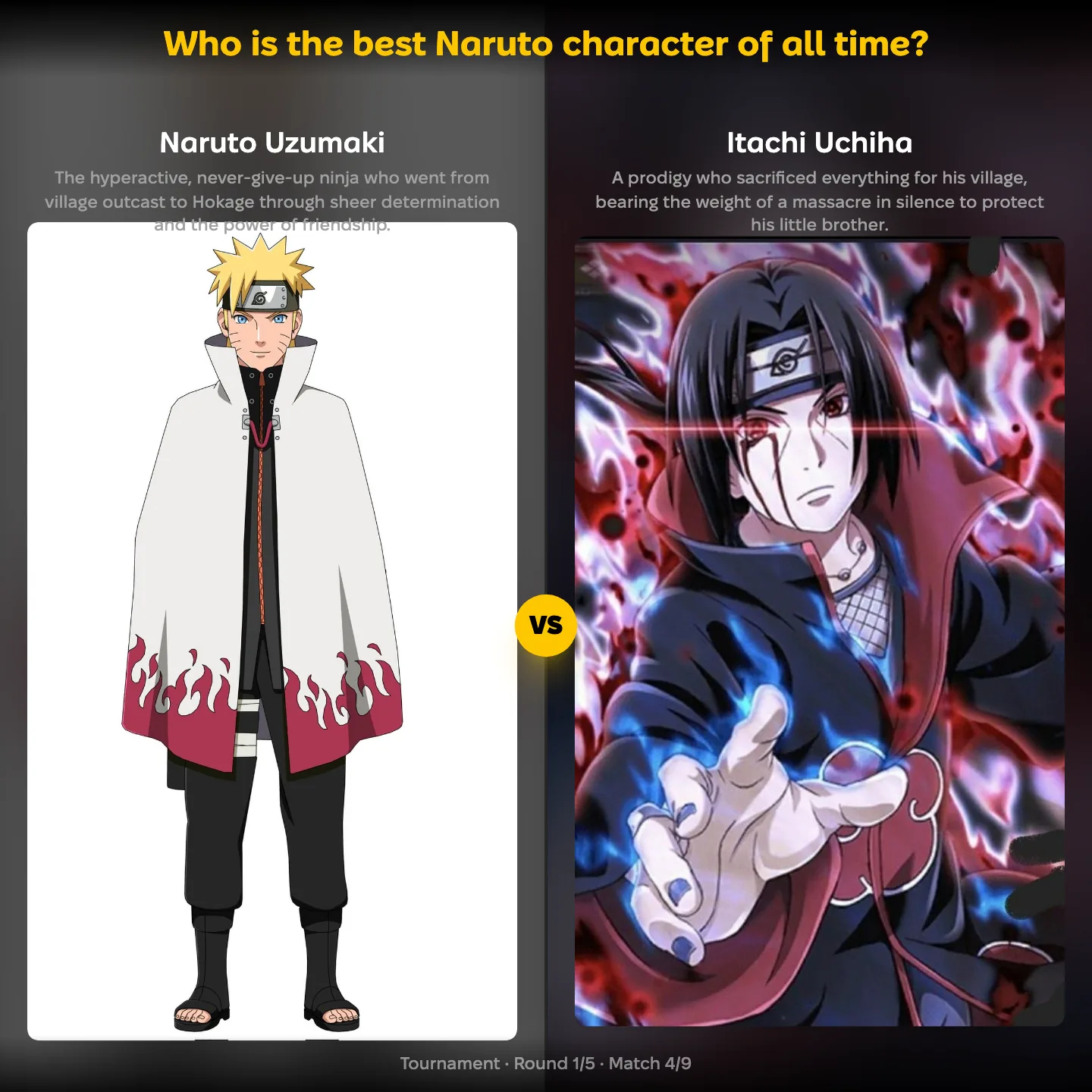
Naruto Uzumaki against Itachi Uchiha and his own supporting cast
Naruto gets the same treatment, against a harder field: Itachi Uchiha, Kakashi Hatake, Minato Namikaze, Jiraiya, Madara and Hashirama Senju, each with a full backstory arc.
One Piece keeps its protagonist central for a thousand chapters. Naruto handed the weight of its second half to the generation above the hero, and this list is where that shows.
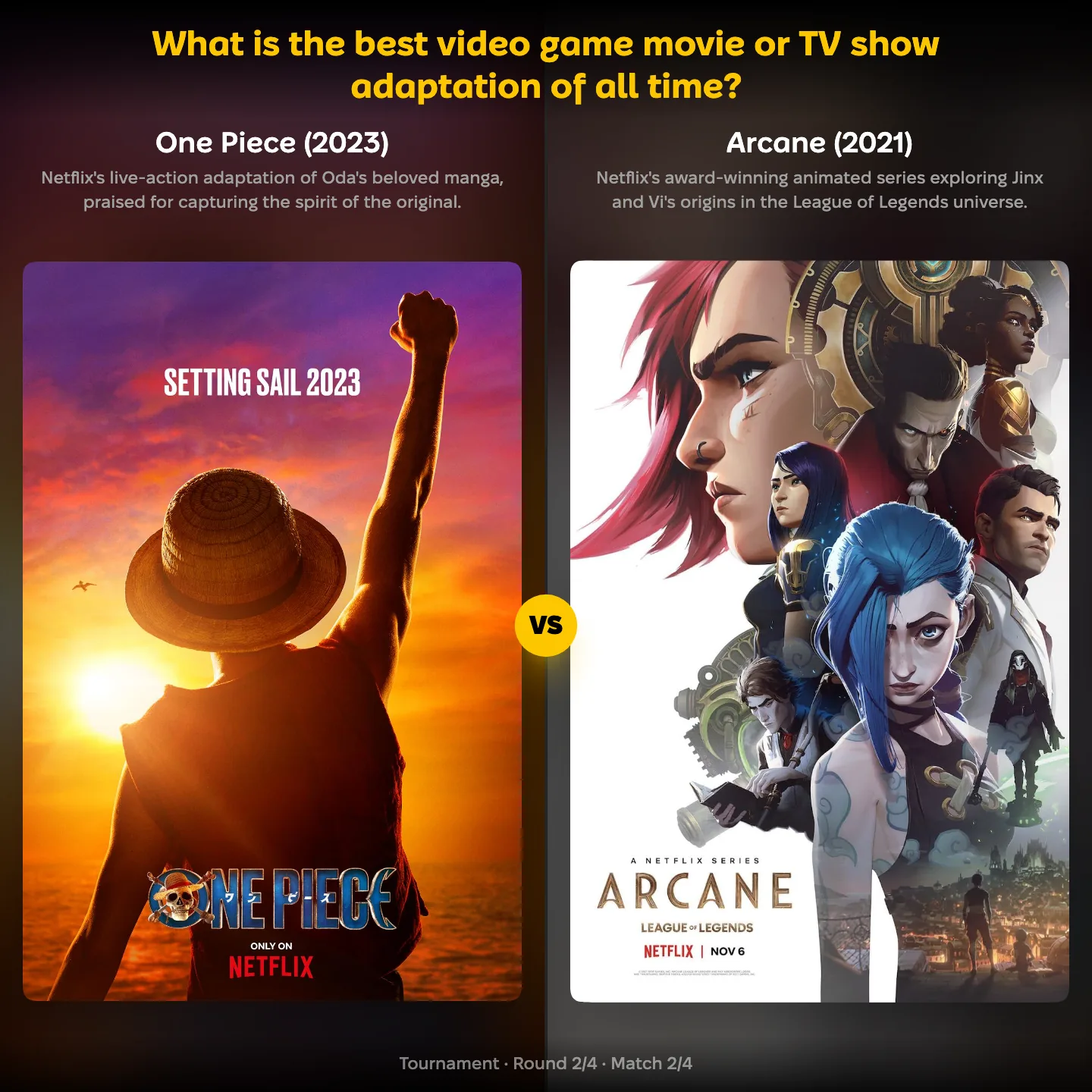
Netflix's One Piece against Arcane and The Last of Us
Live-action adaptation is the category where the three separate hardest, and One Piece is the reason.
Netflix's version is on a list of the best adaptations ever made, next to Arcane, The Last of Us and Fallout. Season two, One Piece: Into the Grand Line, arrived on 10 March 2026 with eight episodes and a limited theatrical run; it holds 100% on Rotten Tomatoes from 29 reviews, against 86% from 63 for season one.6
Naruto has no live-action film or series at all. A Hollywood adaptation has been announced and re-announced for a decade without arriving, so the franchise is absent from both the best and the worst version of this question.
Bleach is in the next section, on the other list.
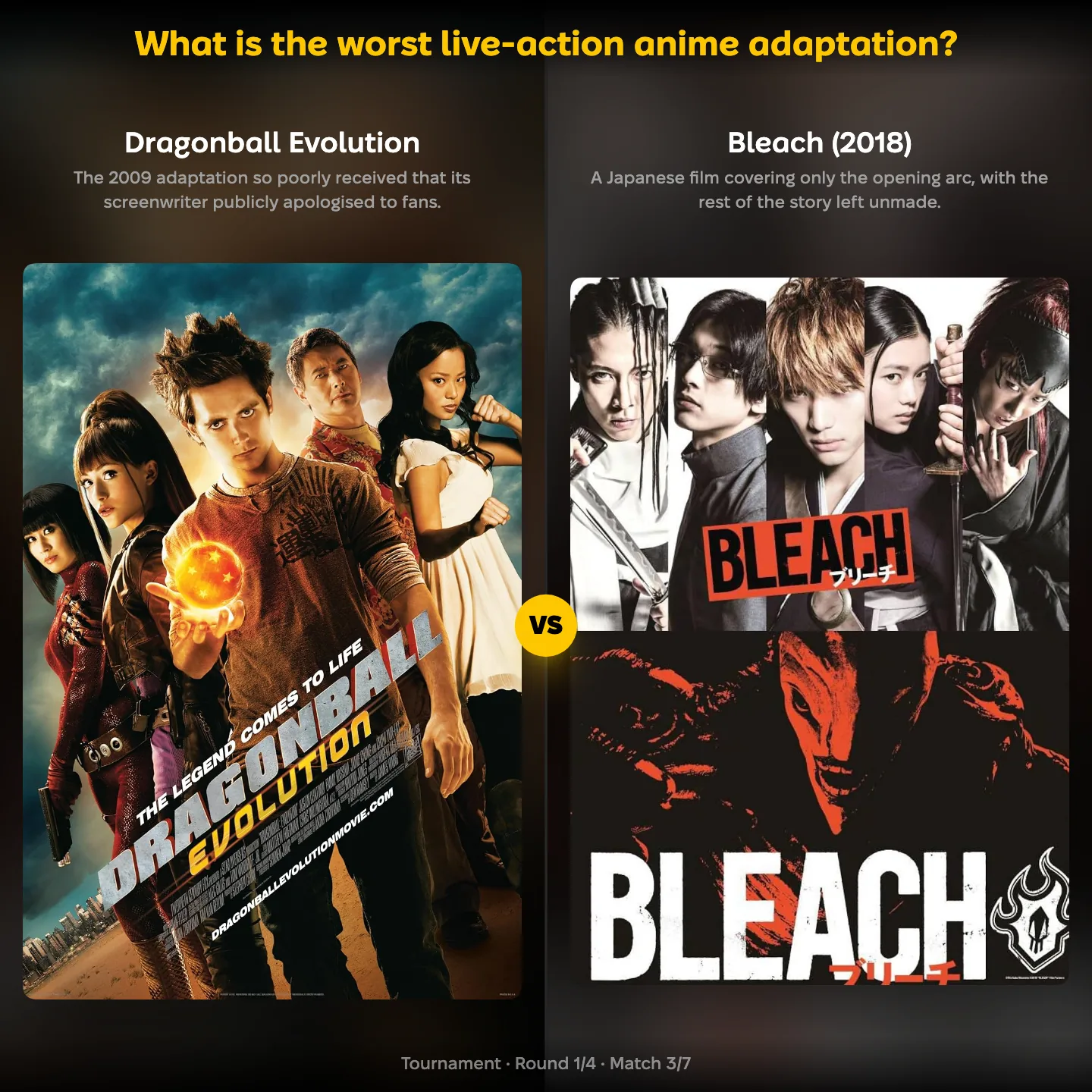
Bleach (2018) and Dragonball Evolution: the list nobody wants
The same question, inverted, and now it is Bleach that qualifies.
Warner Bros. released a live-action Bleach in Japan on 20 July 2018 and Netflix took it worldwide that September. It adapted the opening arc and then stopped; nothing followed. Critics were not brutal — 67% on Rotten Tomatoes, from six reviews7 — so its place here is a fan verdict about an adaptation that covered a fraction of the story and left.
Dragonball Evolution is the anchor of this list, the 2009 film whose screenwriter published an open apology. Death Note (2017), Ghost in the Shell and Attack on Titan are the rest of the company.
One Piece is on the previous list and not on this one, which is the cleanest single contrast the three franchises produce.
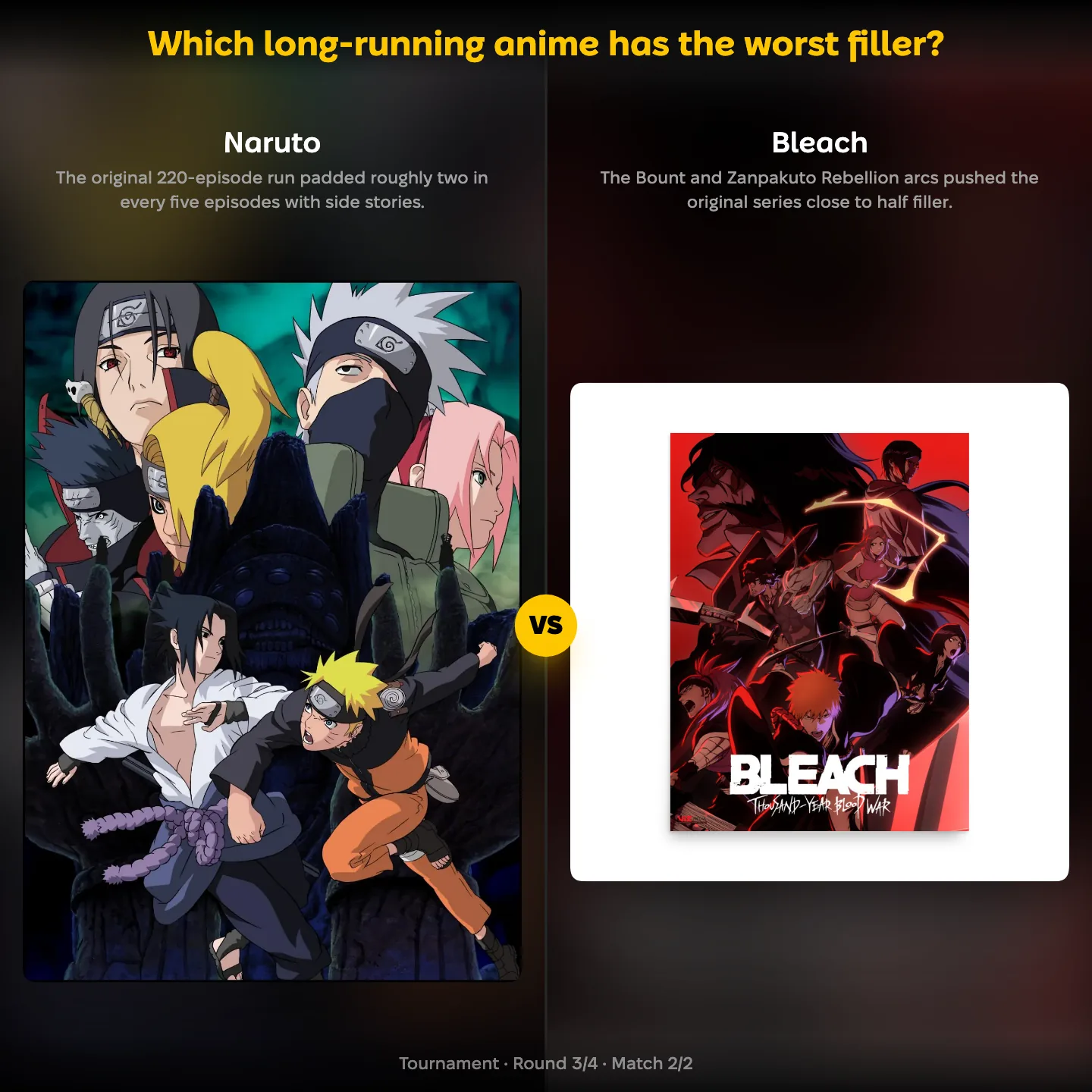
Filler: Bleach's Bount arc against Naruto's long detours
Every long-running adaptation pads. This ranking asks which one made its audience pay the most for it.
Bleach's original run includes the Bount arc and the Zanpakutō Rebellion, both invented for the anime, both dropped in near the middle of the story. Naruto's padding is spread thinner and further: side quests, flashback recaps and whole anime-original stretches across 220 episodes and then 500 more of Shippuden.3
One Piece is the outlier of the three. It has stayed close to its manga for more than a thousand episodes,2 because Toei let the anime run one chapter thinner per week rather than invent a new plot.
Boruto, Fairy Tail, Detective Conan and Pokémon are the wider company here, and one of them has never had a manga to be faithful to in the first place.
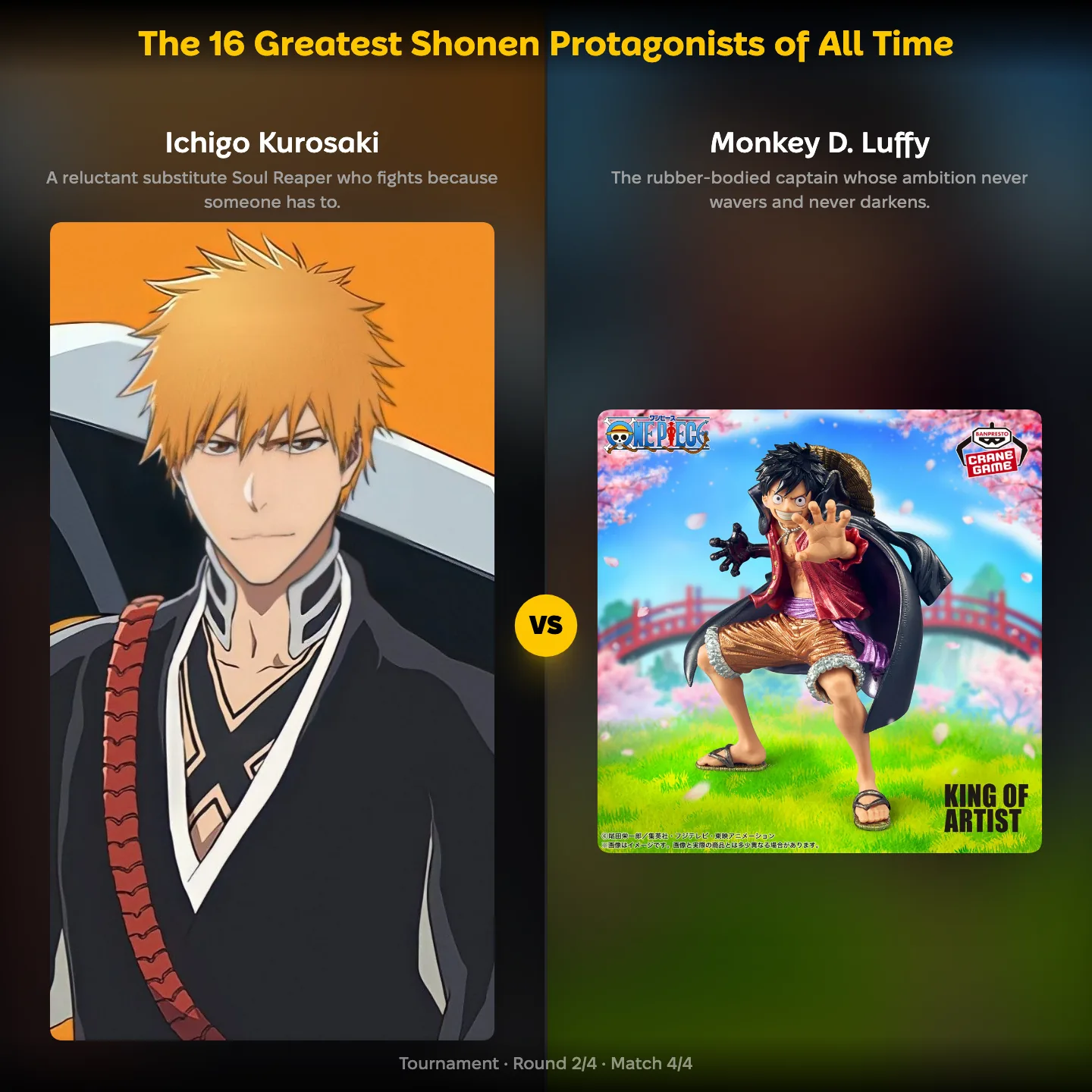
Luffy, Naruto Uzumaki and Ichigo Kurosaki: the job description
Strip the franchises away and rank the heroes as heroes, and the Big Three send three men with almost nothing in common.
Monkey D. Luffy never changes. He wants to be King of the Pirates in chapter one and in chapter eleven hundred, and the story bends around a character who refuses to develop.
Naruto Uzumaki is the opposite design: an orphan nobody wanted, who ends up leading the village that shunned him, winning most of his fights by argument rather than technique.
Ichigo Kurosaki is the reluctant one. He is handed the powers of a Soul Reaper, spends the series resenting the responsibility, and keeps showing up anyway.
Son Goku is also in the field, as the template all three were written against. Edward Elric, Tanjiro Kamado and Eren Yeager are each a deliberate reaction to the same template.
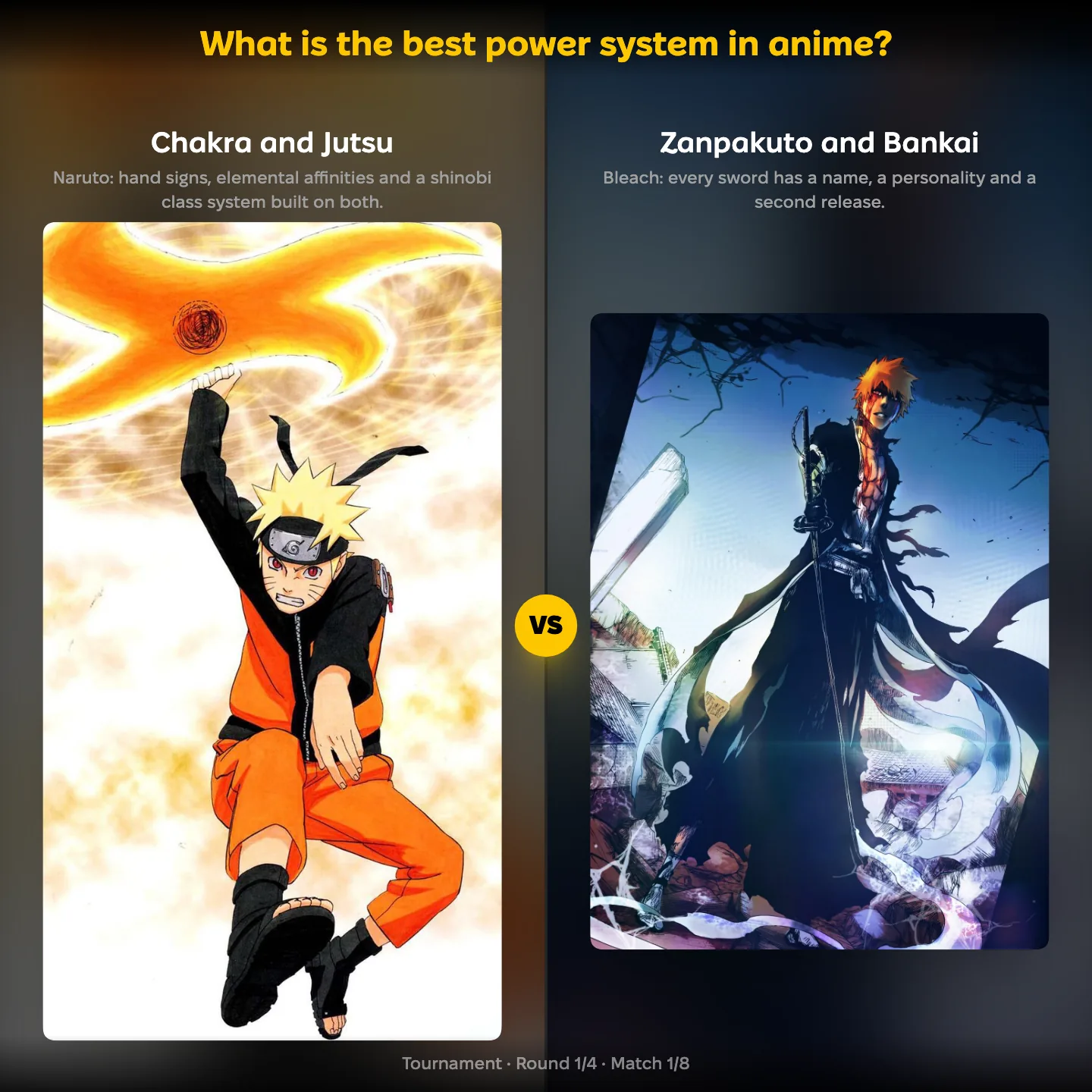
Devil Fruits vs Chakra vs Zanpakutō: rank the rulebooks
Take out the characters and the plots, and what is left of a shonen series is its rulebook. All three wrote one, and they are not the same kind of document.
One Piece's Devil Fruits are the loosest: eat one, gain an arbitrary power, lose the ability to swim in a world made of ocean. The mechanic exists to license invention, and after a thousand chapters it still produces powers nobody could have predicted.
Naruto's chakra is the most systematic. Hand signs, five elemental affinities, clan-inherited techniques and a village school system that teaches all of it. It reads as a curriculum rather than a superpower.
Bleach's zanpakutō sit in between. Every sword has a name and a personality, learning its name unlocks a second release, and the whole hierarchy of the Soul Society runs on who has reached bankai.
The difference shows up in how each series can escalate. Devil Fruits let One Piece invent a new threat per island without breaking anything. Chakra forces Naruto to explain every jump in power, which is why its later arcs keep discovering older, stronger ancestors. Bankai gives Bleach a ceiling it has to keep raising by adding new races above the Soul Reapers.
Nen from Hunter x Hunter is the specialist favourite here, and Death Note's rulebook is on the list too, which shows how far the category stretches: a notebook with terms and conditions counts as a power system.
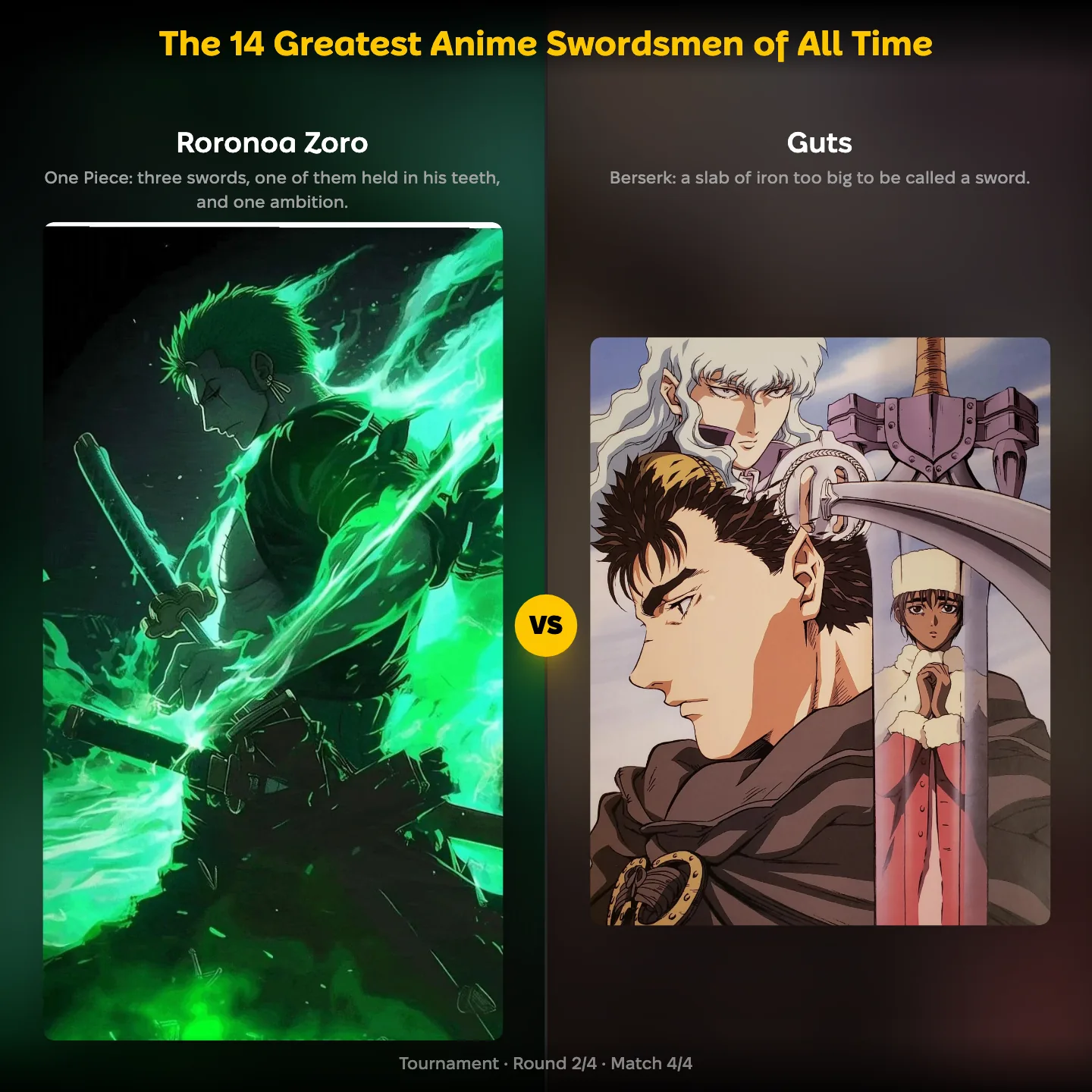
Zoro vs Guts: the swordsman who is not the main character
Swordsmanship is a category where each of the Big Three fields someone, and only one of them fields its hero.
One Piece sends Roronoa Zoro, who fights with three swords and holds the third in his teeth. Bleach sends Ichigo Kurosaki with two captains behind him, Kenpachi Zaraki and Byakuya Kuchiki. Naruto, a series about thrown weapons and hand signs, sends Sasuke Uchiha and Zabuza Momochi.
Guts is why this is not a Big Three list. Berserk gave him a sword too heavy to swing twice, and Kenshin Himura, Levi Ackerman and Mihawk come from series where the sword is the whole point.
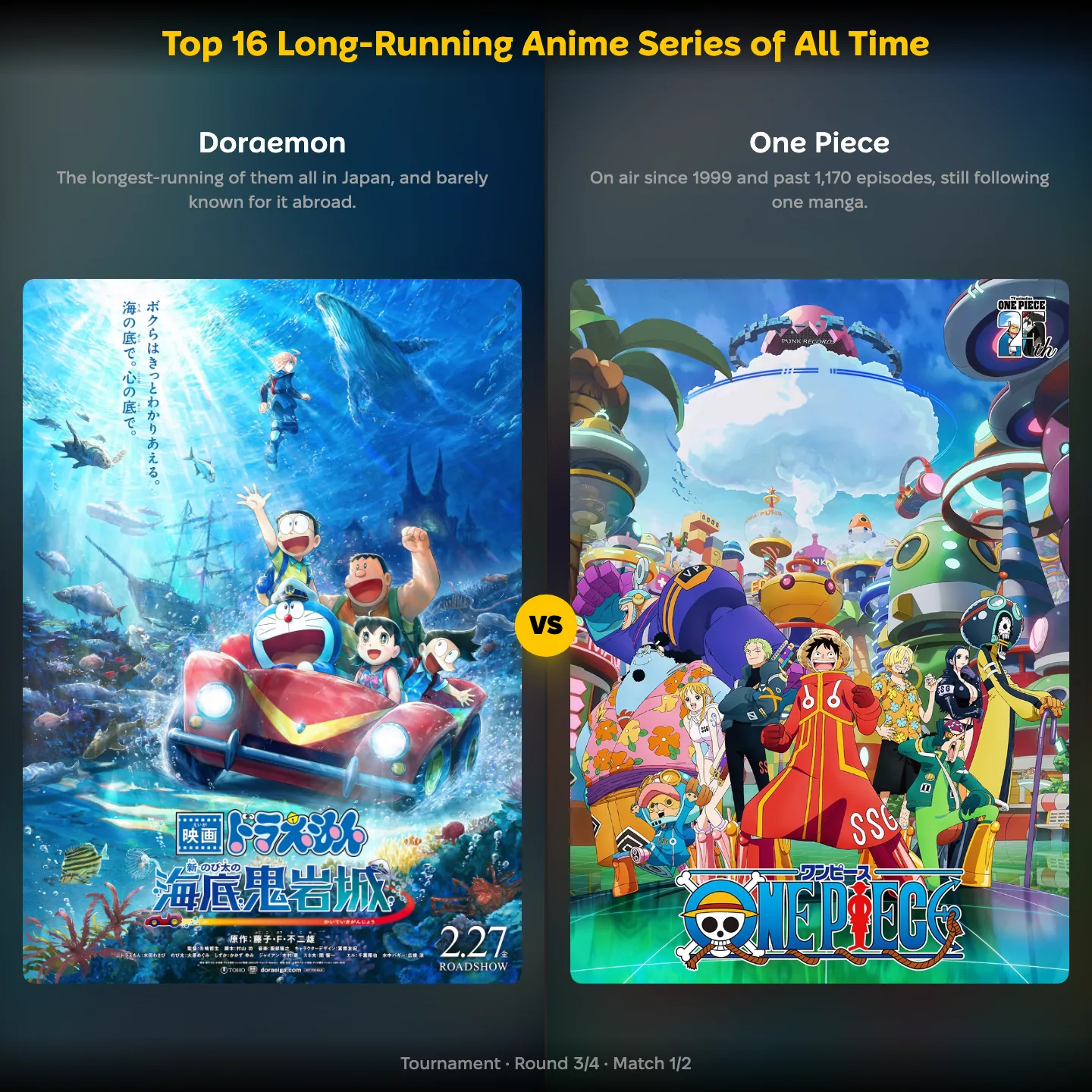
Doraemon has been on air longer than all three
Longevity is the Big Three's proudest claim and the list where it gets put in perspective.
One Piece is the strongest case among them: on air since 1999, past 1,170 episodes, and since April 2026 running two cours a year capped at 26 episodes instead of broadcasting continuously.2 Naruto ran fifteen years across two series; Bleach ran eight, stopped, and came back a decade later.
Doraemon is the correction. It has been running in Japan since 1979, longer than any of the three, and most Western viewers of the Big Three have never seen an episode.
Detective Conan, Crayon Shin-chan, Pokémon and Sailor Moon make the same point in the same list: measured purely on endurance, the Big Three are a Western fandom's canon, not Japanese television's.
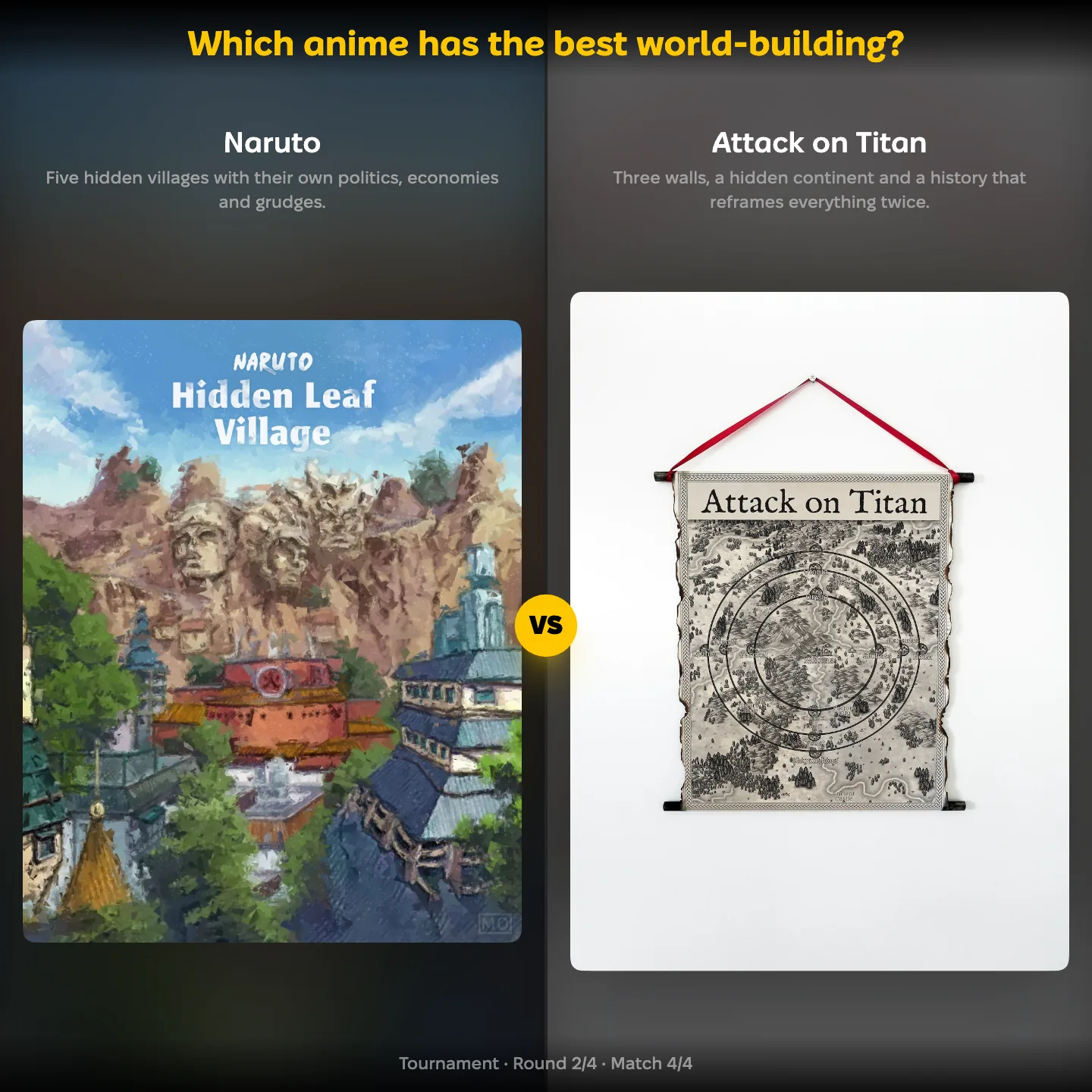
Amestris, the Hidden Leaf and Paradis: whose world holds up
World-building is craft rather than popularity, and it is the question where the Big Three's scale works against them.
One Piece has the largest invented geography in the group: four seas, a Red Line, a world government, a century of deliberately erased history, and a map that keeps paying off decades after it was drawn.
Naruto's Hidden Leaf comes with five rival villages, their economies, their treaties and their grudges, which is why the series can run an entire arc on an exam and have it feel political.
Bleach stacks three realms on top of each other and gives the middle one a bureaucracy of thirteen court guard squads, a noble caste and a central prison.
Fullmetal Alchemist: Brotherhood and Attack on Titan are here on tighter worlds that were finished by design, and Legend of the Galactic Heroes, Mushishi and Made in Abyss are on the list because depth and size are not the same thing.
Three series, one label, fourteen different answers
Sales say One Piece. Adaptation care says Bleach. Cast depth says Naruto. Endurance says Doraemon, and craft says a series none of them are related to. The Big Three was a shelf, and a shelf tells you where a book was kept, not what is in it.
The three are also still moving. Netflix has One Piece season three, The Battle of Alabasta, in production for 2027,6 which means the franchise that already leads the adaptation question is the one adding to its case. Every list here is settled one matchup at a time, so a change of category changes the order, not the method.
Pick the question you would defend in an argument with a friend, and go settle it.
More rankings, more angles
- Death Note: Thriller, Shonen, or Best Cartoon Ever? — one Jump series, filed under five genres
- Super Mario vs The Legend of Zelda: 16 Rankings, One Argument — two Japanese franchises, split by the question
- Dragon Ball vs One Piece: Two Kings of Shonen, 14 Lists — the crew again, this time up against Goku
- Studio Ghibli vs Disney: Two Ways to Draw a Classic — the other Japan-vs-America argument, fought over animated films
Sources
- Wikipedia — One Piece: serialization from 22 July 1997, over 600 million copies in circulation by March 2026, Guinness World Record for most copies published for a comic series by a single author: en.wikipedia.org (checked 2026-08-04)
- Wikipedia — One Piece (1999 TV series): Toei Animation production, 1,172 episodes, October 2024 hiatus, April 2025 primetime return, Elbaph arc from 5 April 2026 on a two-cours-per-year schedule capped at 26 episodes: en.wikipedia.org (checked 2026-08-04)
- Wikipedia — Naruto: serialization September 1999 to November 2014, 250 million copies in circulation, 220 anime episodes (October 2002 – February 2007) and Naruto: Shippuden (15 February 2007 – 23 March 2017), produced by Pierrot: en.wikipedia.org (checked 2026-08-04)
- Wikipedia — Bleach (manga): serialization 7 August 2001 to 22 August 2016, over 130 million copies in circulation, 366 anime episodes (October 2004 – March 2012), and the fourth and final Thousand-Year Blood War cour premiering July 2026 under directors Tomohisa Taguchi and Hikaru Murata: en.wikipedia.org (checked 2026-08-04)
- Outlook Respawn — the Naruto twentieth-anniversary special, four episodes scheduled for late 2026, putting new One Piece, Naruto and Bleach anime in the same year: respawn.outlookindia.com (checked 2026-08-04)
- Wikipedia — One Piece (2023 TV series): season two premiered 10 March 2026 with eight episodes, 100% on Rotten Tomatoes from 29 reviews against 86% from 63 for season one, and season three, The Battle of Alabasta, in production for 2027: en.wikipedia.org (checked 2026-08-04)
- Wikipedia — Bleach (2018 film): released in Japan on 20 July 2018, worldwide on Netflix 14 September 2018, 67% on Rotten Tomatoes from six reviews: en.wikipedia.org (checked 2026-08-04)