
Death Note: Thriller, Shonen, or Best Cartoon Ever?
Death Note is filed as a psychological thriller, a Shonen Jump manga, a 2000s anime and a cartoon. It ranks differently in all 15 lists.
By YPB Team · Published July 30, 2026 · https://youpick.best/articles/death-note-ranked-many-ways
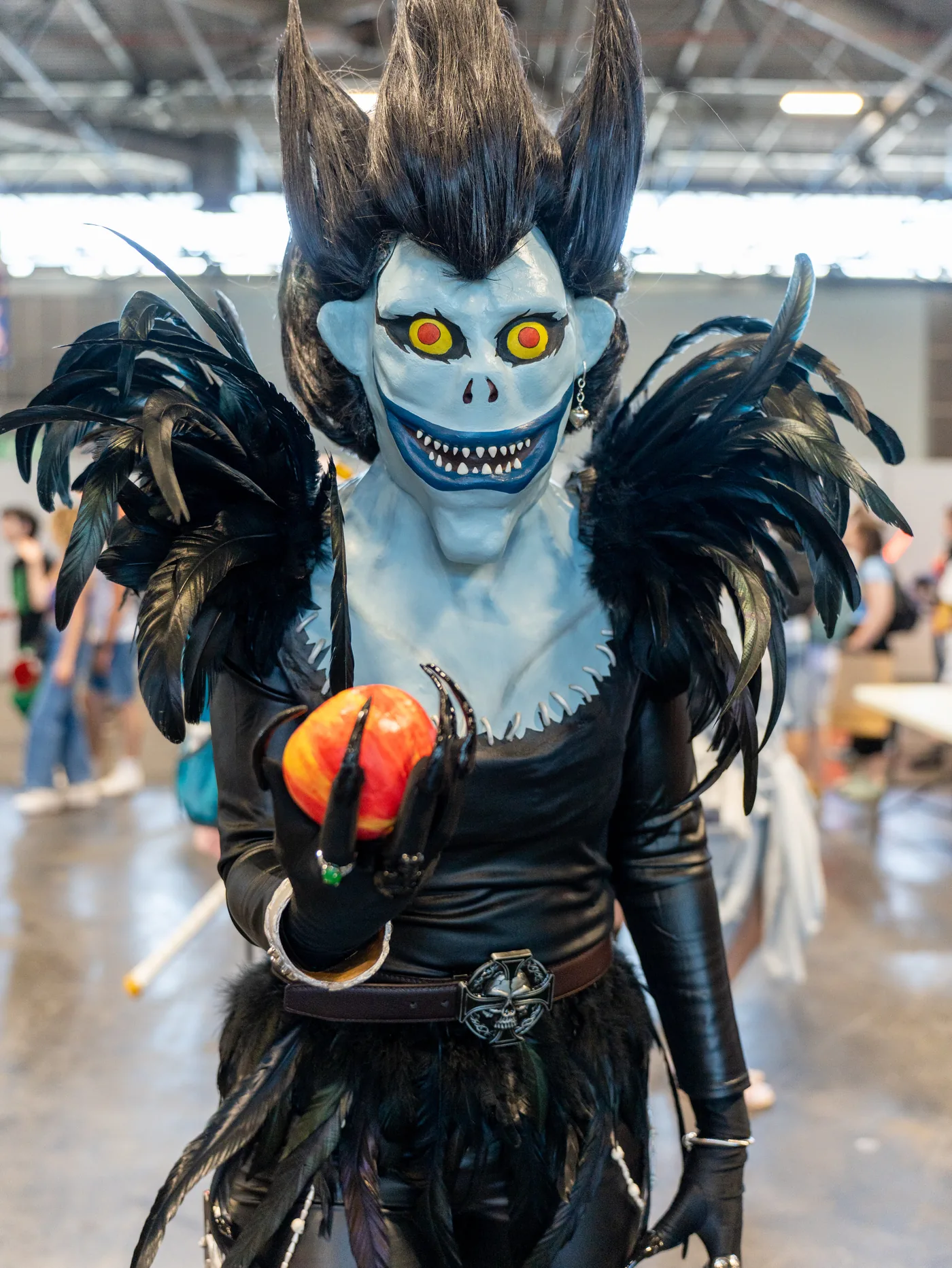
Death Note is 108 chapters of manga, 37 episodes of television, live-action films in two countries, a stage musical and one abandoned Netflix reboot. Tsugumi Ohba and Takeshi Obata finished the story in Weekly Shonen Jump in May 2006; Madhouse put it on television that October, and 30 million collected volumes have gone into circulation since.
It is also, right now, a night out in London. Death Note: The Musical opens at the Barbican Theatre on 30 July 2026 and runs to 12 September, and in October the anime turns 20.
All of which raises an awkward question: what kind of thing is it, exactly? Fifteen rankings below include it, and the category changes in almost every one.
Ask what genre it is and you get one answer. Ask what medium, what decade, or what it does badly, and you get four more. None of them is wrong.
The whole medium, in one question
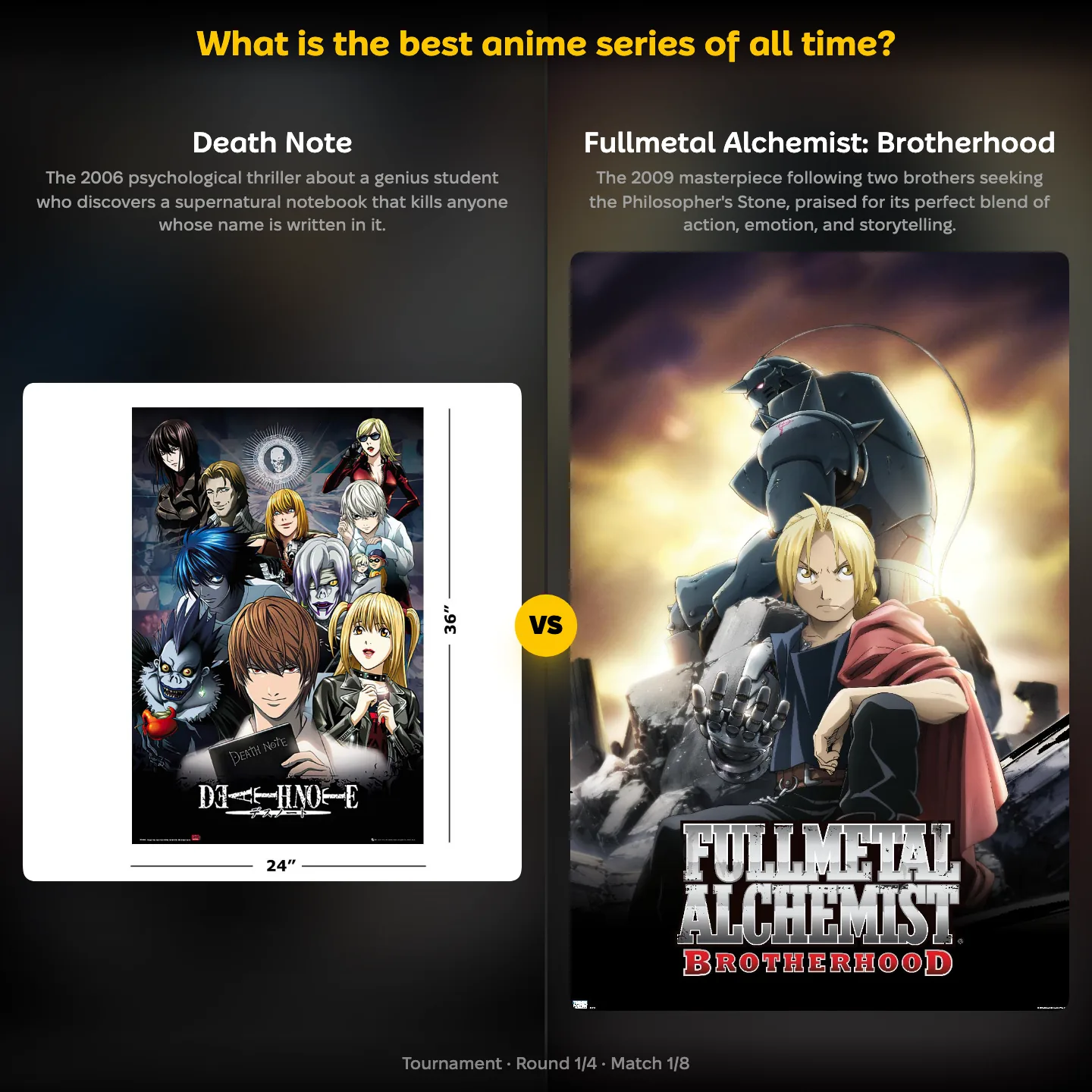
This ranking asks the broadest question anime has, and Death Note is one of fifteen names inside it.
Its case is completeness. Thirty-seven episodes, no filler arcs, a real ending — a finished story at a time when the medium's biggest titles were measured in hundreds of episodes.
The company is the difficulty. Fullmetal Alchemist: Brotherhood, Hunter x Hunter, Cowboy Bebop and Neon Genesis Evangelion are all here, and so is One Piece, which has been running since 1999.
The argument against Death Note on a list this wide is scope. It has no war, no invented world, no cast of dozens. It has two clever people and a notebook.
Widen it to all animation and the rivals change
Move the question from anime to animation and Death Note's competition stops being Japanese.
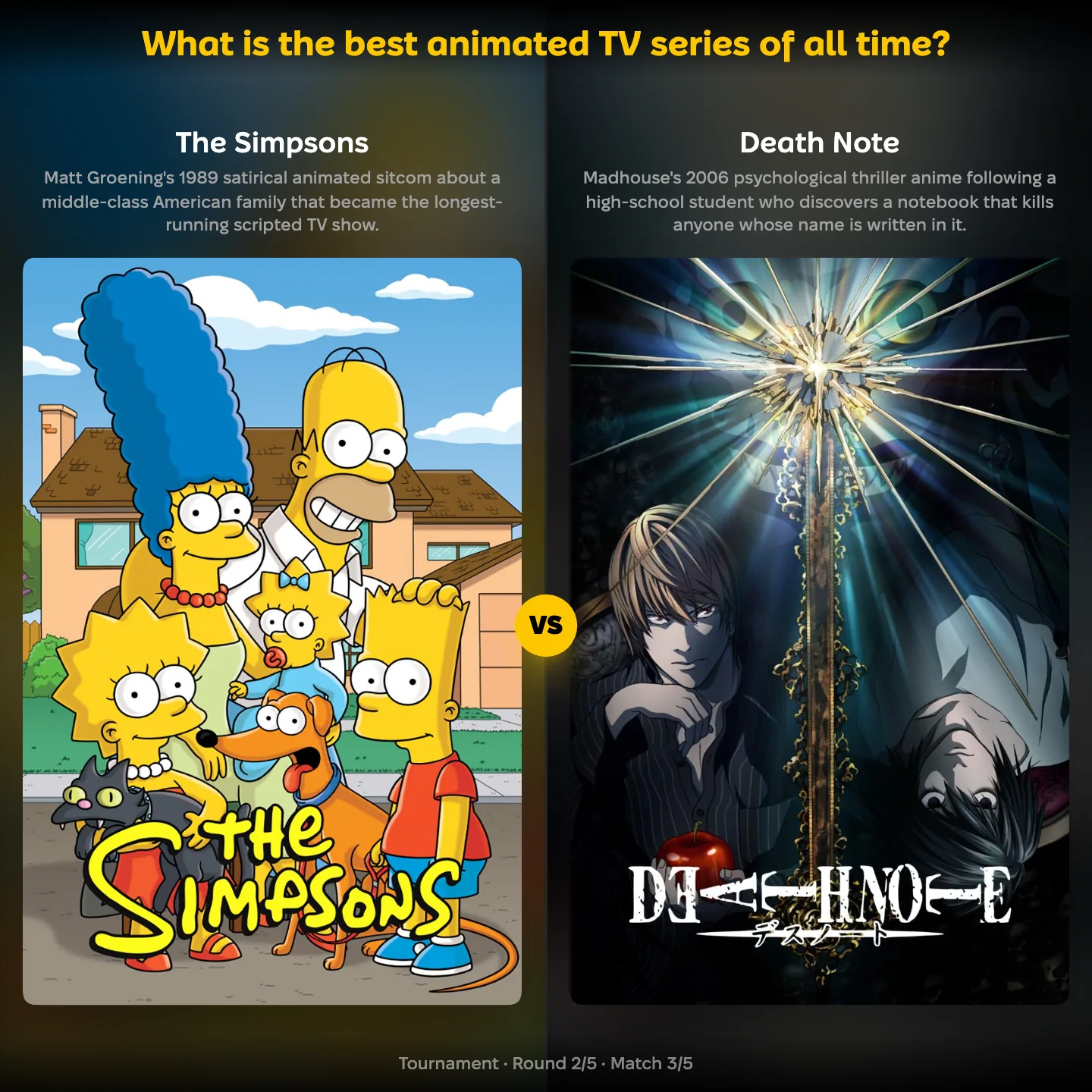
The Simpsons is on this list, on air since 1989 and the longest-running scripted show in American television history. So are Batman: The Animated Series, Avatar: The Last Airbender, Arcane and SpongeBob SquarePants.
Death Note's claim in that company is that it was never made for children. It is a thriller about a student committing mass murder, drawn in the same medium as a cartoon sponge.
A category this wide also works against Death Note. It tends to reward shows that ran for decades and reshaped what came after them, and Death Note ran for nine months.
One decade only, and it is Death Note's decade
Narrow the field to a single decade and Death Note is on home ground. The anime aired from 3 October 2006 to 26 June 2007, squarely in the middle of the 2000s.
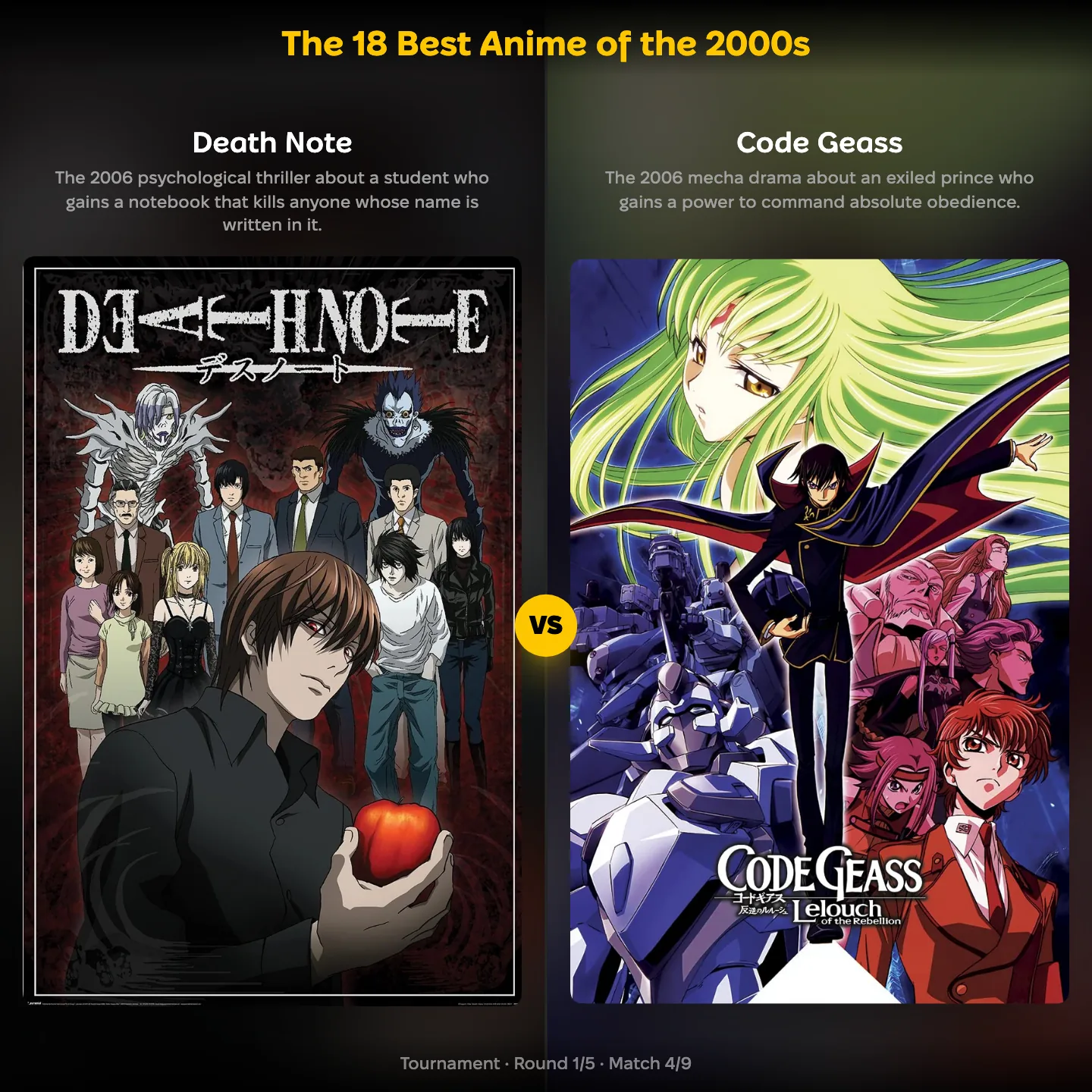
The 2000s were unusually strong. Fullmetal Alchemist, Code Geass, Gurren Lagann, Samurai Champloo, Monster and Clannad: After Story all belong to the same ten years.
Code Geass is the nearest rival, because it runs the same engine: a brilliant student acquires a supernatural power and starts deciding who deserves to die.
Monster is the harder problem. Naoki Urasawa's thriller is the series most often used to argue that Death Note's psychology is the shallower of the two.
The genre it gets used to define
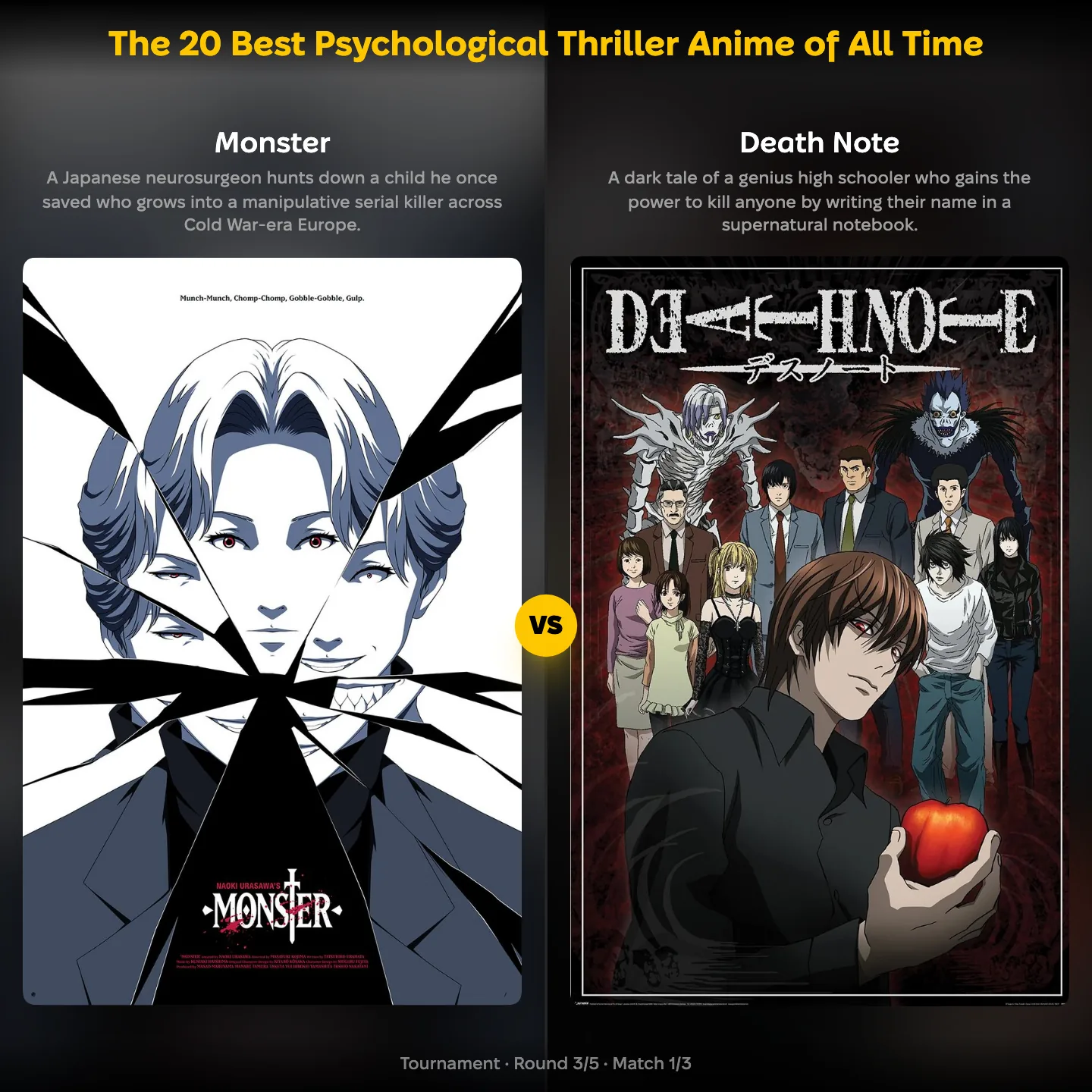
Twenty psychological thrillers, and Death Note is the title people reach for when they need to explain what the genre means.
The premise is why. A notebook that kills anyone whose name is written in it removes every physical obstacle from the story, so what is left is two people reasoning about each other for 37 episodes.
The field is deep. Monster, Perfect Blue, Serial Experiments Lain, Paranoia Agent, Psycho-Pass and Steins;Gate are all here, and Satoshi Kon has more than one entry.
Where Death Note differs from most of them is that it withholds nothing from the viewer. You know who Kira is in the first episode. The suspense is watching a detective work it out.
The narrator happens to be the murderer
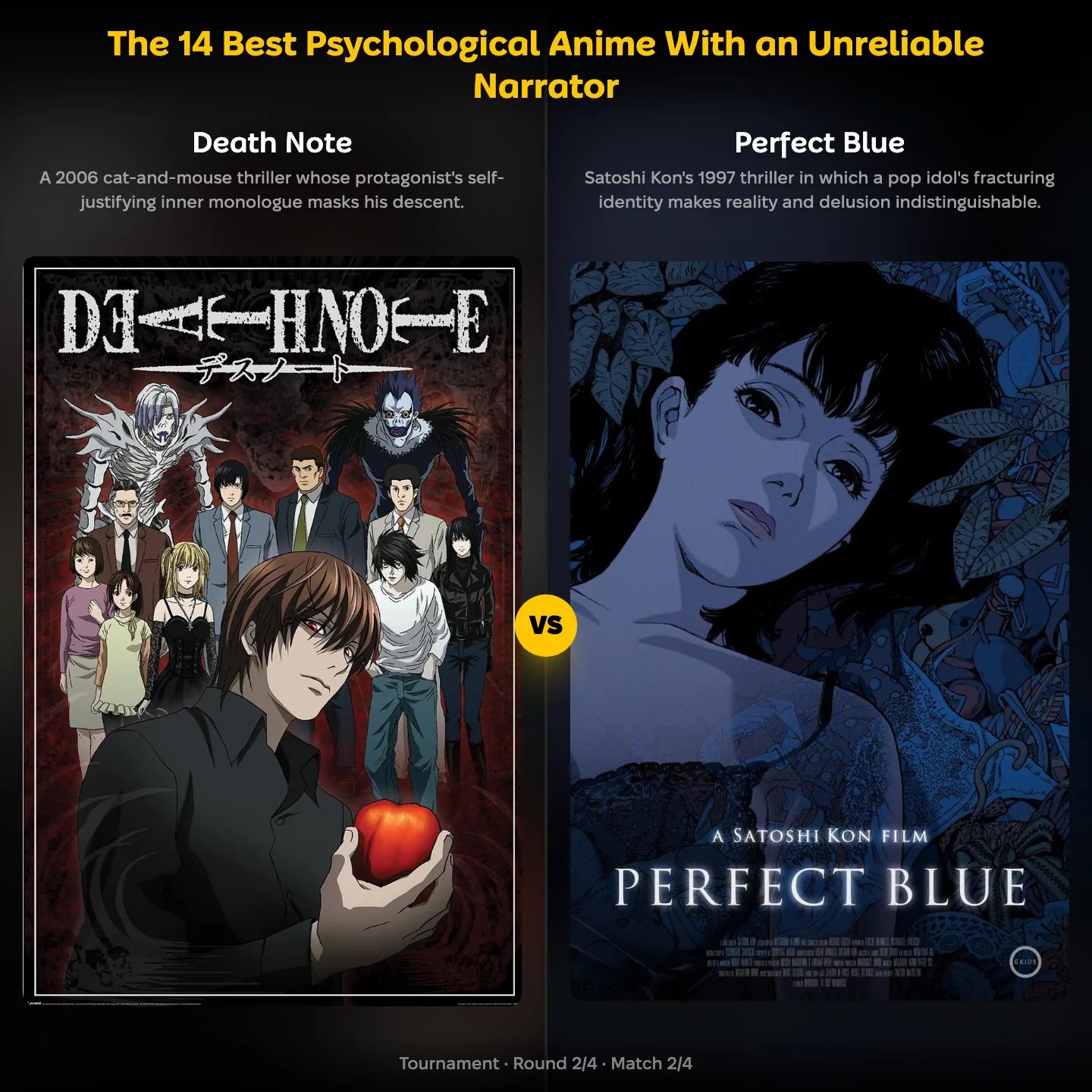
This is a narrower question about craft: which anime cannot be trusted to tell you the truth about itself?
Death Note qualifies through its inner monologue. The voice explaining events for most of the series belongs to Light Yagami, and Light is a person assembling a justification in real time.
The competition is stranger and formally bolder — Serial Experiments Lain, The Tatami Galaxy, the Monogatari Series, Odd Taxi, Boogiepop Phantom.
A reader could reasonably argue Death Note does not belong here at all. It never lies about what happened; it only lets its narrator lie about why. Whether that counts as unreliable narration is the whole argument.
Filed by publisher, next to the giants
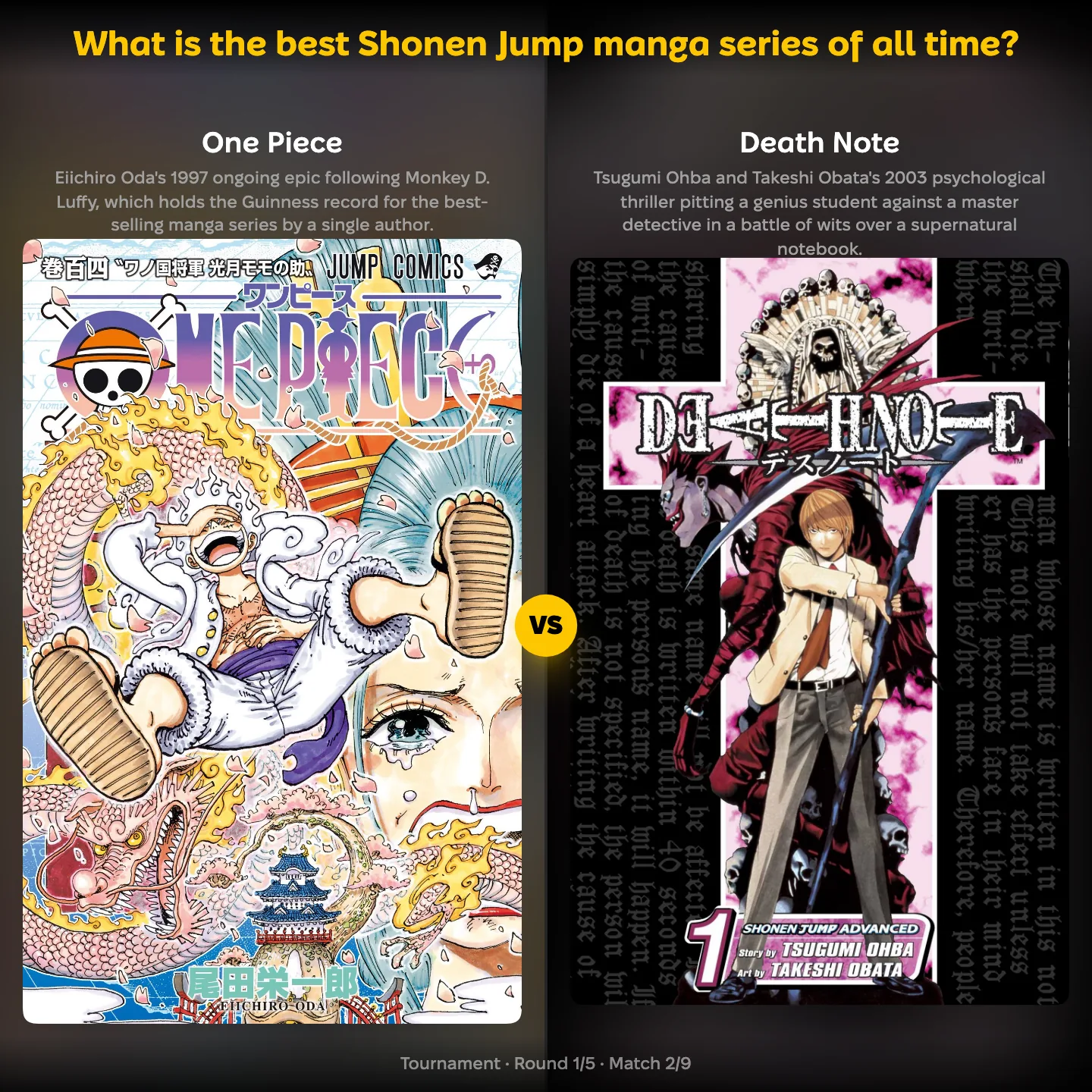
Sorted by publisher, Death Note joins the eighteen biggest series Shueisha's Weekly Shonen Jump has ever printed. It ran there from December 2003 to May 2006.
The scale of the neighbours is the story. One Piece, Dragon Ball, Naruto, Bleach and Demon Slayer have sold in the hundreds of millions of volumes; Death Note's 30 million is a rounding error beside them.
Its counter-claim is that it barely looks like a Jump series at all. No tournament arcs, no power levels, no training montages.
Two people at a desk, and one of them is holding a notebook.
Manga, sorted by era instead
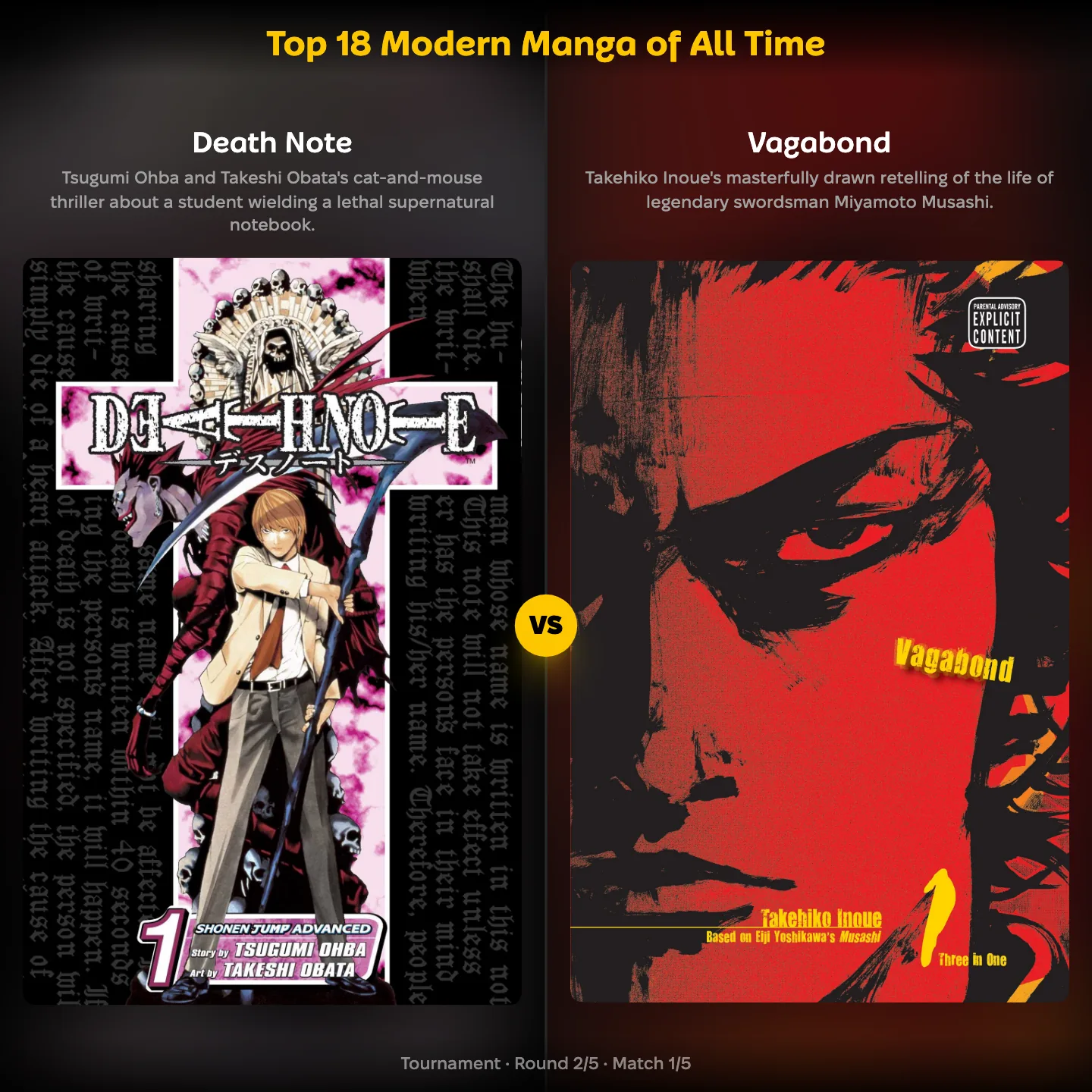
Same medium, a different axis: the best manga of the modern period.
Death Note enters this one as a finished 12-volume series among works that are far longer or still going — One Piece, Vagabond, Vinland Saga, Attack on Titan, Hunter x Hunter.
Takeshi Obata's art is the strongest part of the case. He drew a series with almost no physical action and made two men talking across a table read like a fight scene.
Vagabond is the awkward neighbour. Takehiko Inoue's samurai epic is the usual answer whenever the question is which modern manga is the best-drawn, and it is on this list too.
Short enough to actually finish
This ranking rewards brevity, and 108 chapters across 12 volumes is short for a Jump hit.
The numbers make the point. One Piece passed 1,000 chapters; Naruto ran to 700. Death Note ends before most Jump series have finished their first major arc.
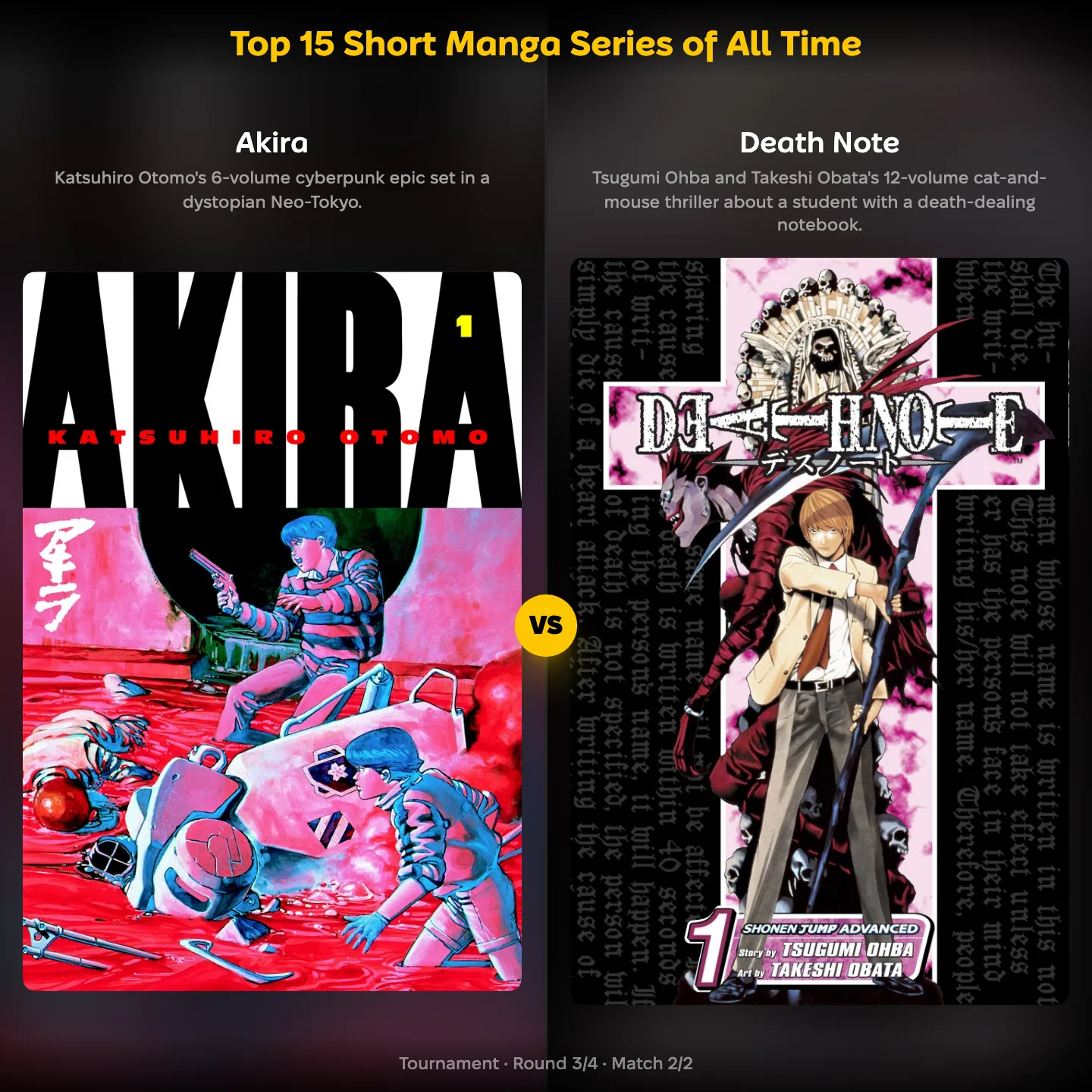
The neighbours here are heavy with prestige — Akira, Pluto, Uzumaki, Monster, 20th Century Boys, Nausicaä of the Valley of the Wind. Naoki Urasawa and Katsuhiro Otomo between them account for a good share of the list.
The complication is that Death Note is only short by Jump standards. Akira is six volumes. Uzumaki is three. On this particular list, twelve is on the long side.
Judged only on the adaptation
Not the story this time. This ranking asks how well somebody else translated it.
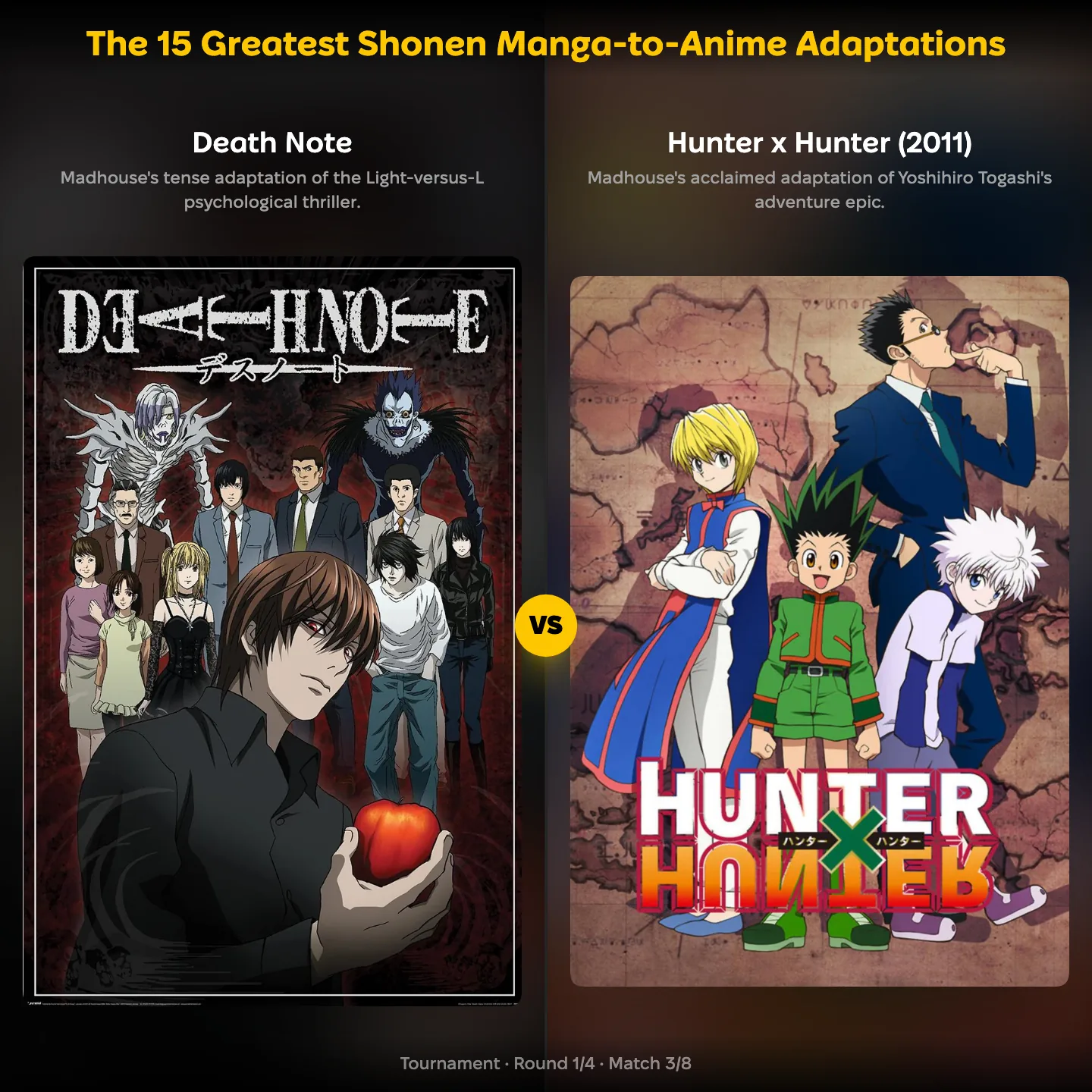
Madhouse's anime, directed by Tetsurō Araki, compressed 108 chapters into 37 episodes and cut very little that mattered. The pacing changes, the substance largely does not.
The bar on this list is high. Fullmetal Alchemist: Brotherhood exists because a studio restarted an entire adaptation from chapter one to follow the manga properly, and Hunter x Hunter (2011) did the same thing.
Faithfulness cuts both ways. Death Note's manga weakens in its back half, and the anime is faithful enough to inherit that too.
Here the entry is not the show at all
On this list Death Note is not a series. It is a song.
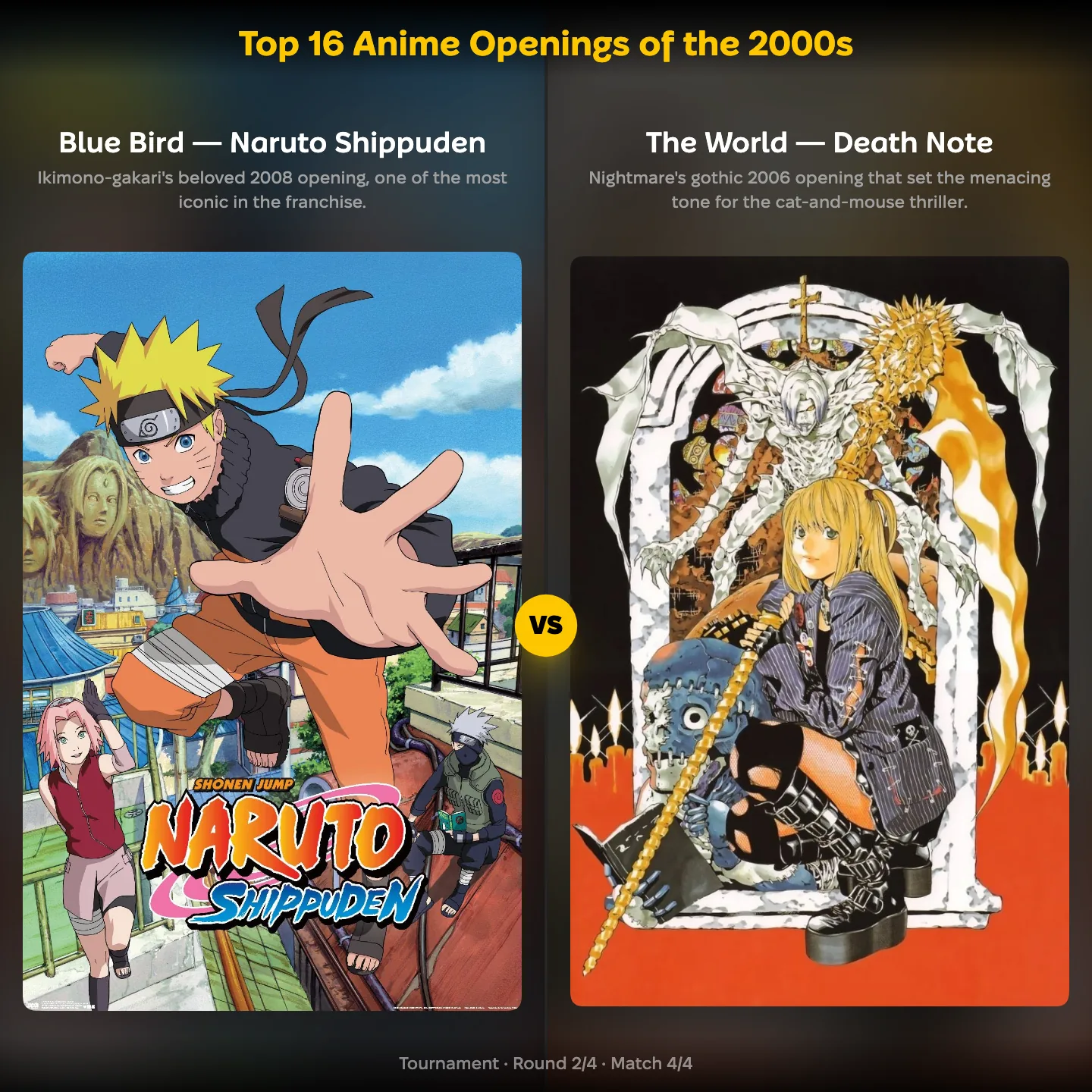
"The World", by the visual-kei band Nightmare, opened the anime in 2006 — a burst of gothic rock that told a first-time viewer exactly what tone to expect before a word of plot arrived.
The rivals are the openings people still hum unprompted: "Blue Bird" from Naruto Shippuden, "Colors" from Code Geass, "Again" from Fullmetal Alchemist: Brotherhood, "Sorairo Days" from Gurren Lagann, "Lilium" from Elfen Lied.
This is the clearest version of the whole problem. Same franchise, entirely different object, judged by what musicians do rather than what storytellers do.
Take the cast out of the show
Break Death Note into its characters and the question becomes who thinks fastest. Three of the fourteen names on this list come from that one series.
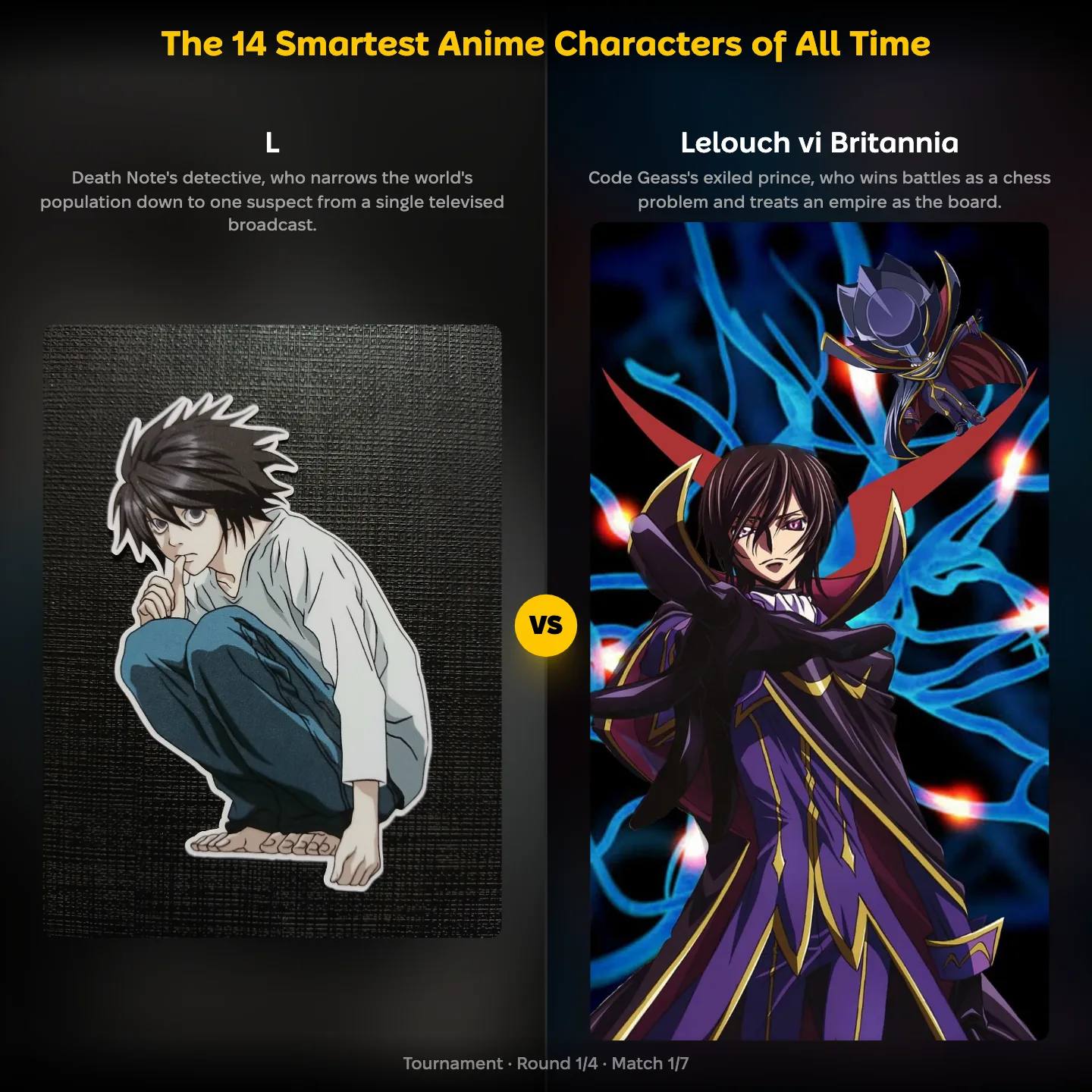
L is the reason. He puts a decoy announcer on air in a single region of Japan, Kira kills the man live, and the suspect pool collapses from the whole world to Kanto.
Light Yagami is here alongside the detective hunting him, and so is Near, L's successor. No other anime supplies three separate entries to a ranking about intelligence.
The rivals are serious people. Lelouch vi Britannia treats an empire as a chessboard, Senku Ishigami rebuilds civilisation from first principles, Kurisu Makise was a published neuroscientist at eighteen, and Johan Liebert dismantles lives without ever touching anyone.
The protagonist, on a list of villains
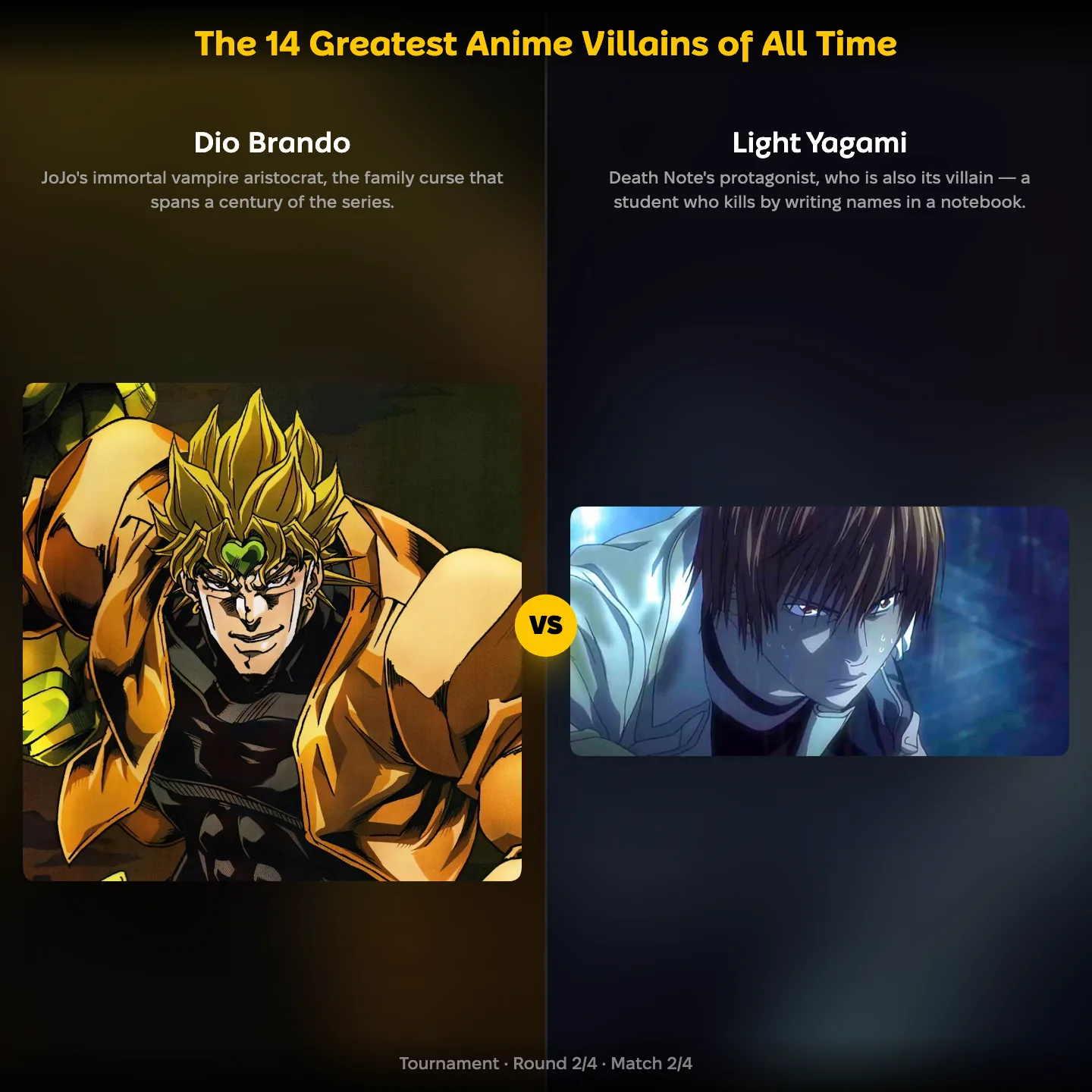
Here is the reframe this whole format exists for. The main character of Death Note is an entry on a ranking of anime villains.
Light Yagami is the point-of-view character for 37 episodes and also a mass murderer who kills thousands of strangers by writing their names down.
The field around him is built from monsters and gods — Frieza, Muzan Kibutsuji, Madara Uchiha, Dio Brando, Sosuke Aizen, Ryomen Sukuna. Light has no powers of his own whatsoever.
Light's real weapon is the audience. Most villains on this list are people you want to see stopped; Light spent a series making viewers hope he would get away with it.
The one list where the show is the whole field
This is the only ranking here in which Death Note is not an option. It is the entire set.
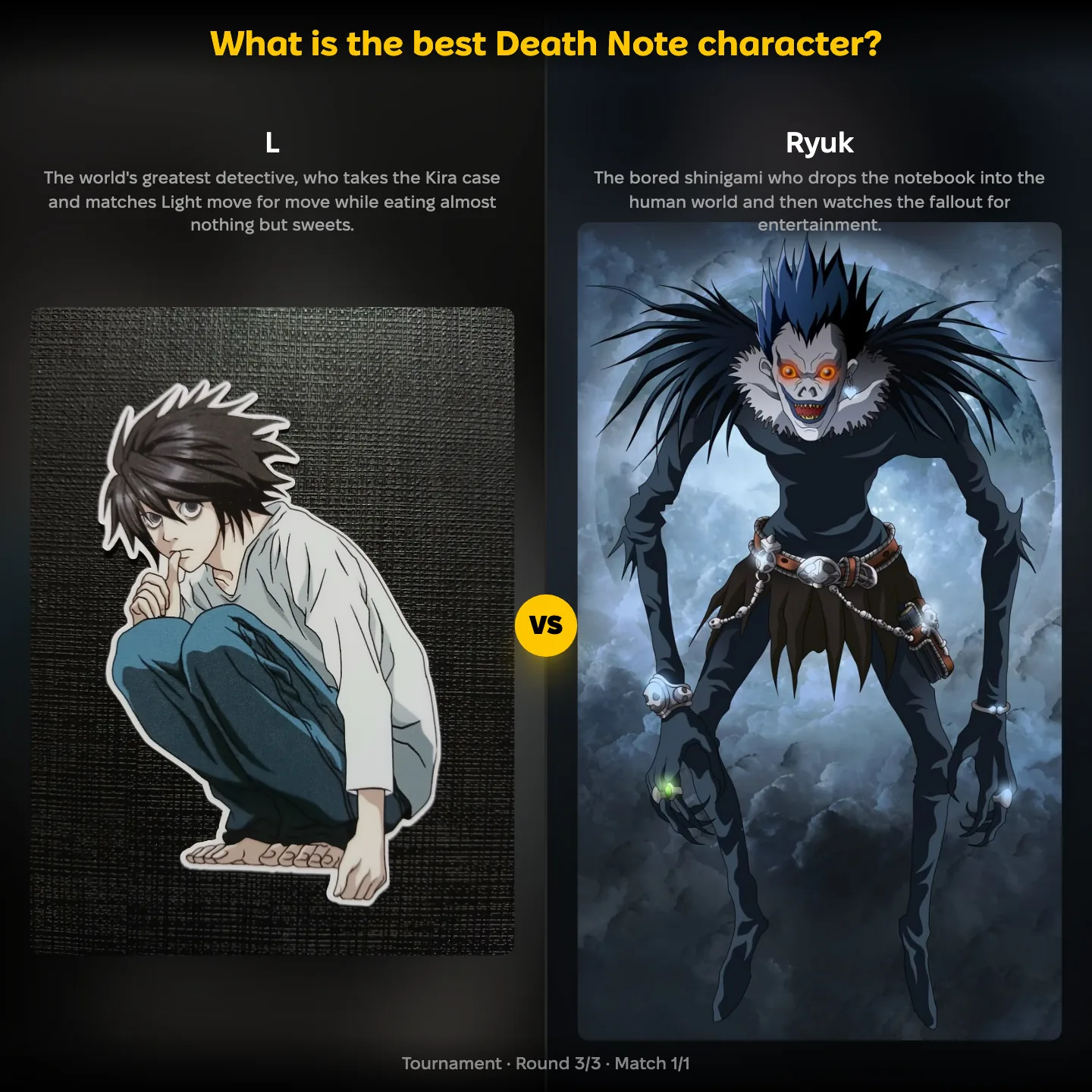
L and Light Yagami are why anyone remembers the series, and they occupy opposite halves of it — one an insomniac detective who sits in a crouch and eats almost nothing but sugar, the other a straight-A student with a god complex.
Ryuk has the oddest case of the lot. He is the shinigami who drops the notebook into the human world out of boredom, refuses to help either side, and asks mainly for apples.
The second tier is where the real argument actually lives: Near, Mello, Misa Amane, and Soichiro Yagami — Light's father, running the police taskforce hunting a killer who lives in his own house.
What happens after the midpoint
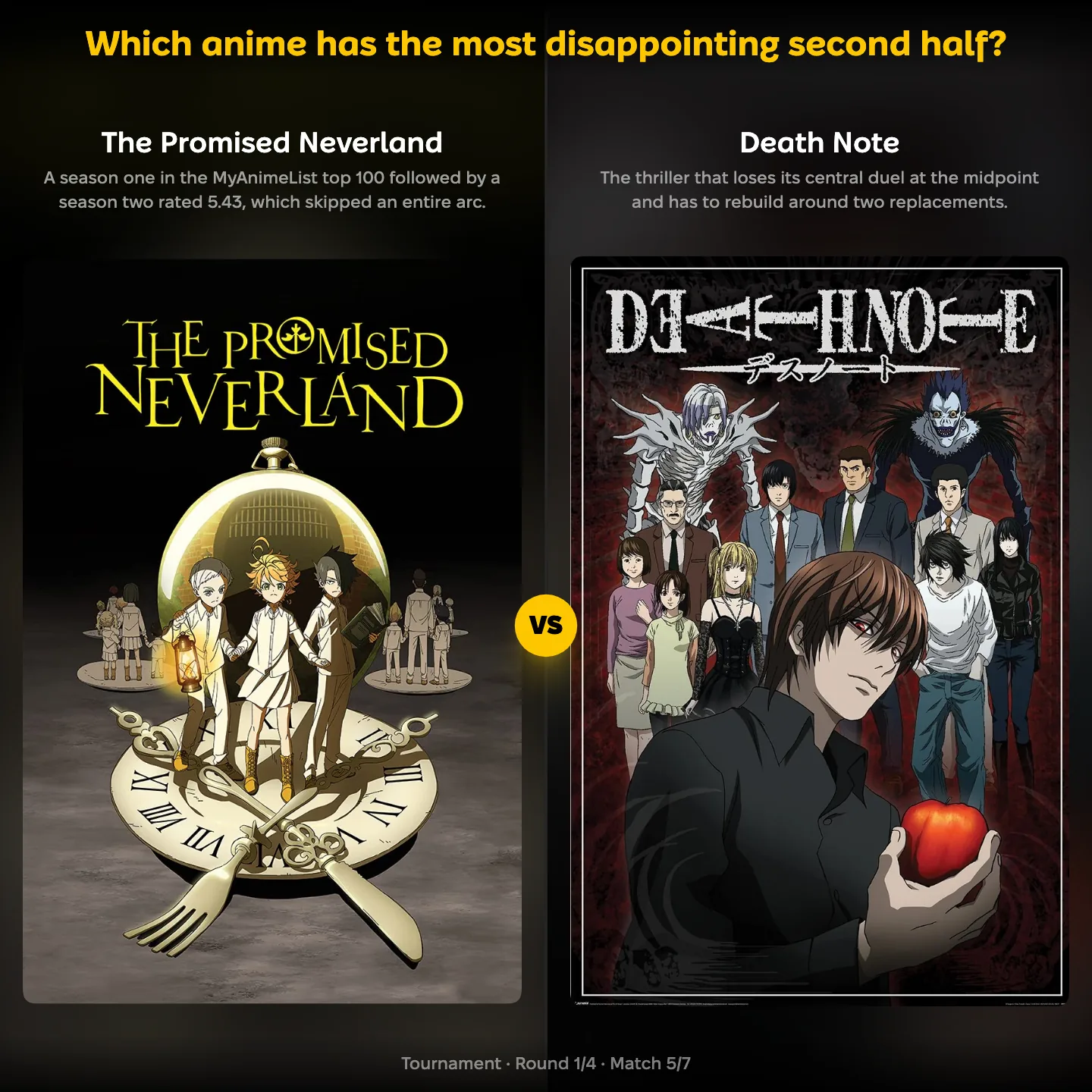
Now the unflattering lens. This ranking asks which anime lost its way in its back half, and Death Note is on it for a specific structural reason.
The series is built on a single duel, and that duel ends halfway through. L leaves. Near and Mello arrive to replace him, splitting one great opponent into two smaller ones, and the show never fully recovers the tension it had.
The competition is fierce. The Promised Neverland's second season skipped an entire arc of its source manga and sits at 5.43 on MyAnimeList against the first season's 8.57 — a collapse steeper than anything Death Note managed.
Sword Art Online, Tokyo Ghoul, Guilty Crown, Darling in the Franxx and Attack on Titan's divisive finale are all here too. Death Note's decline is the gentlest kind: the show stays watchable, it just stops being the thing people fell for.
The list nobody wants to lead
One ranking left, and it is the only one assembled entirely out of failures.
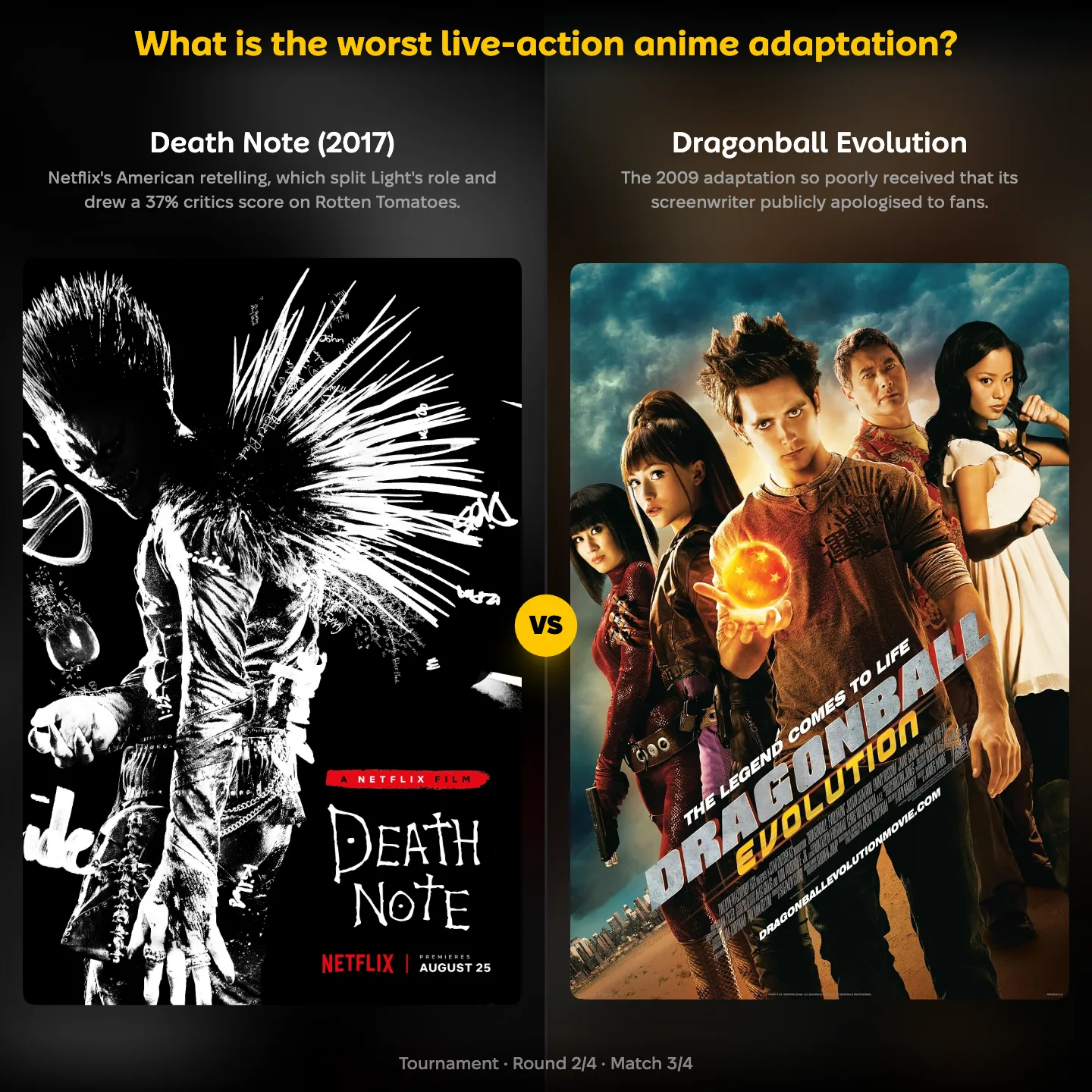
Netflix's 2017 film, directed by Adam Wingard, moved the story to Seattle and split Light's role between two characters. It drew 37% from critics and 23% from audiences on Rotten Tomatoes, and 43 out of 100 on Metacritic; the Rotten Tomatoes critics' consensus called its canvas "fatally overcrowded".
The neighbouring entries are infamous. Dragonball Evolution is here, the 2009 adaptation whose screenwriter later published an open apology to fans. So are Ghost in the Shell, the live-action Fullmetal Alchemist, Netflix's cancelled Cowboy Bebop and Devilman.
The franchise's live-action record is not uniformly bad — the Japanese films that started in 2006 have their defenders, and the Duffer Brothers' announced reboot has gone quiet since they signed an exclusive deal with Paramount. It is the 2017 version people bring up.
So what kind of best is Death Note?
A psychological thriller, a Shonen Jump manga, a 2000s artefact, a cartoon, a rock song, a cast of geniuses, a villain, and a cautionary tale about live-action adaptation. Death Note is all of those at once, and the answer only looks unstable because the question keeps changing underneath it. Every order here is built by comparing two entries and repeating, so the comparison stays honest even when the category does not.
If a series keeps changing genre depending on who is listing it, make the ranking yourself and watch it move again.
More rankings, more angles
- Evangelion at 30: Robot Show, Therapy, Puzzle Box — the show that shares this psychological-thriller shelf
- One Piece vs Naruto vs Bleach: The Big Three, Ranked — the three series Shonen Jump sold as a set
- Studio Ghibli vs Disney: Two Ways to Draw a Classic — hand-drawn Japan against the studio that distributed it
- Attack on Titan Is on Every List. Never in the Same Place — sixteen headings, two of them about things going wrong