
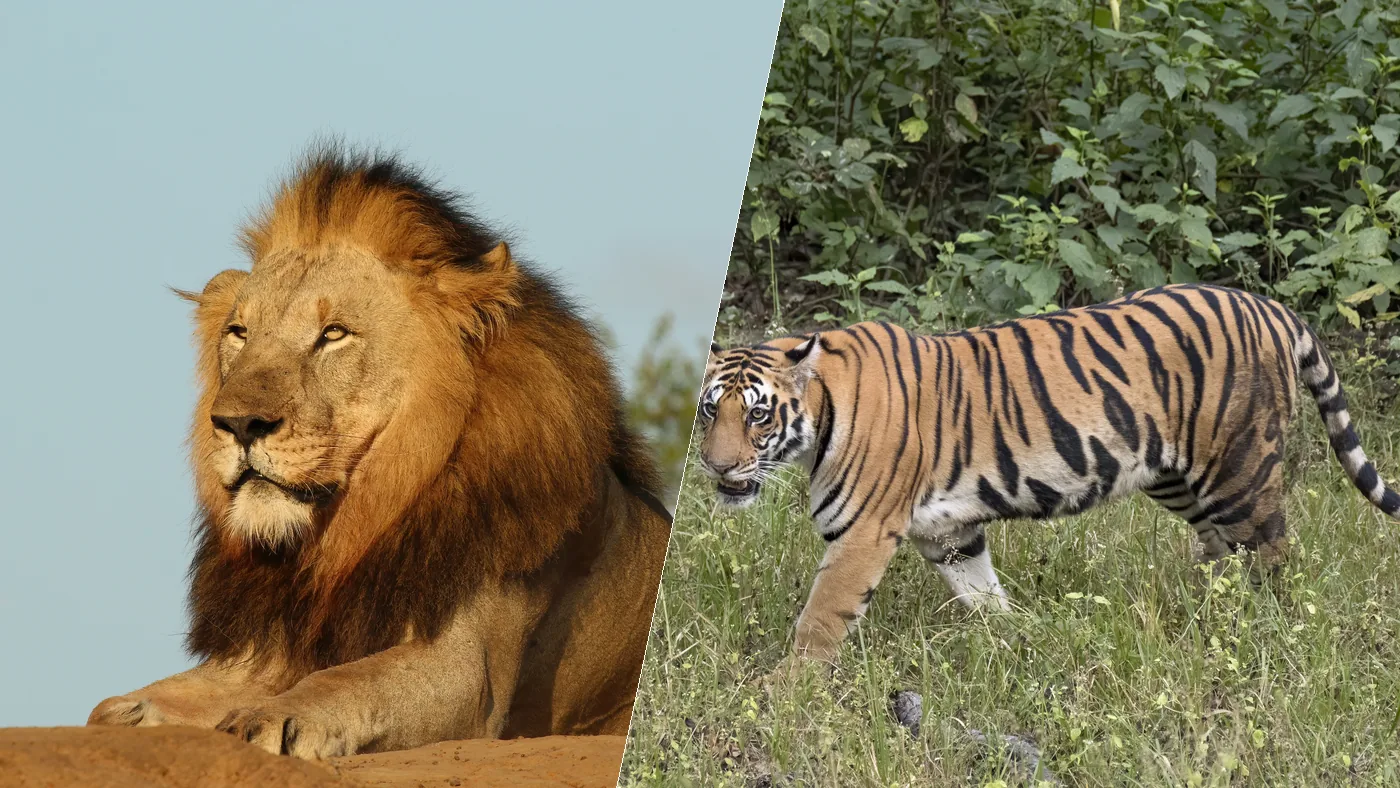
Lion versus tiger is one of the oldest arguments the internet inherited from the schoolyard, and it survives because the two animals almost never meet. The lion is Africa's cat and the tiger is Asia's, and the countries that put one on a flag split along that line: Ethiopia, Kenya, Morocco and the Netherlands took the lion, while India, Bangladesh, Malaysia and North Korea took the tiger.8
World Lion Day falls on 10 August, founded in 2013 by two conservationists working in Zambia.1 It is a good moment to notice how rarely the two cats are measured by the same yardstick. This article puts them on fourteen lists together.
The lion owns the flags, the heraldry and the word king. The tiger owns the size records, and the only population graph of the two that points upward.
Zoo Animals: Both Cats, and an Elephant in the Way
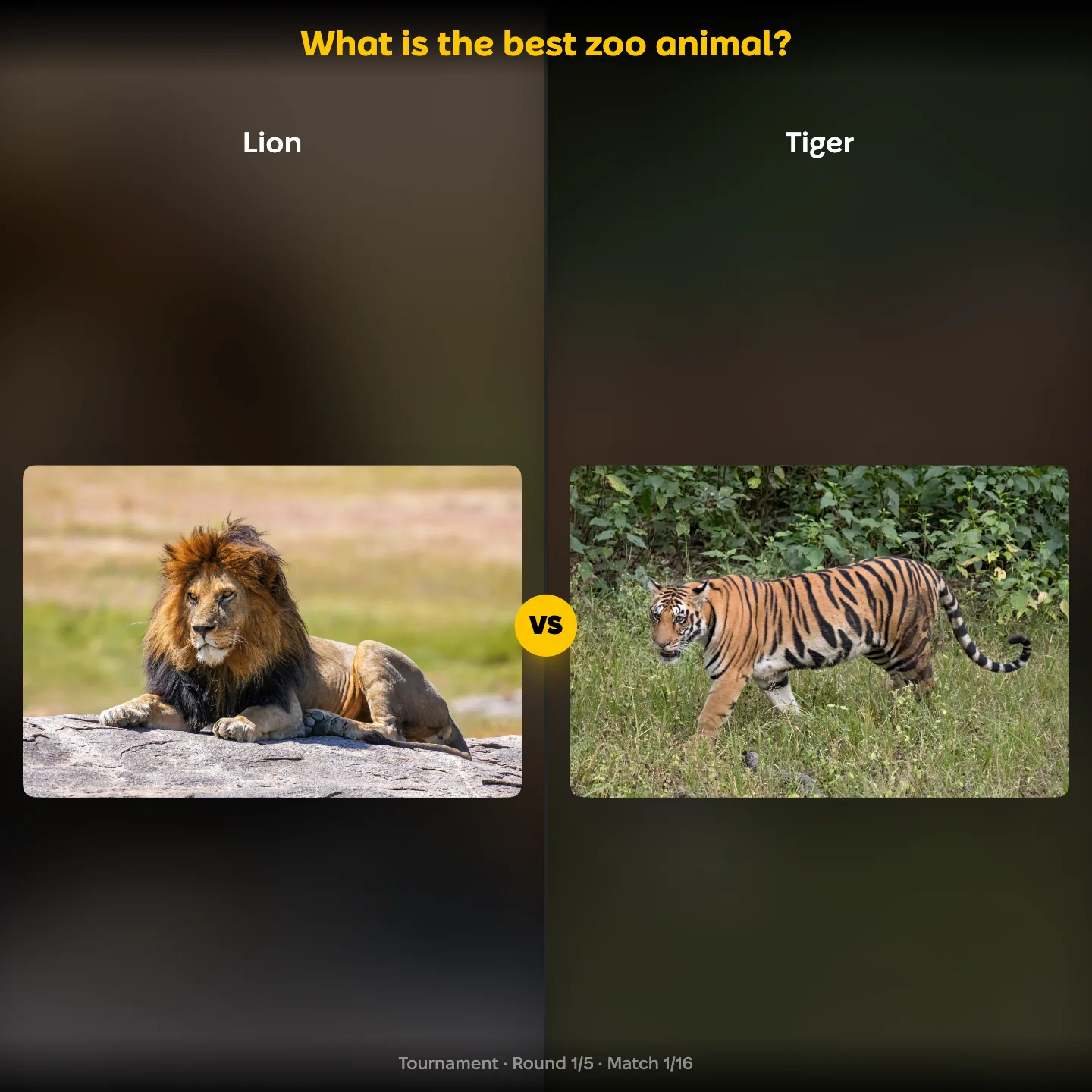
A zoo list is the widest possible version of this question. Thirty-two animals, most of them not predators at all, with the lion and the tiger somewhere among them.
So are the elephant, the panda and the penguin, which is the difficulty. The two cats are competing less with each other here than with everything a family actually stops to look at.
It is the one list on this page where being a big cat carries no automatic advantage.
Lion vs Tiger: The Straight Fight, With Ten Cats Watching
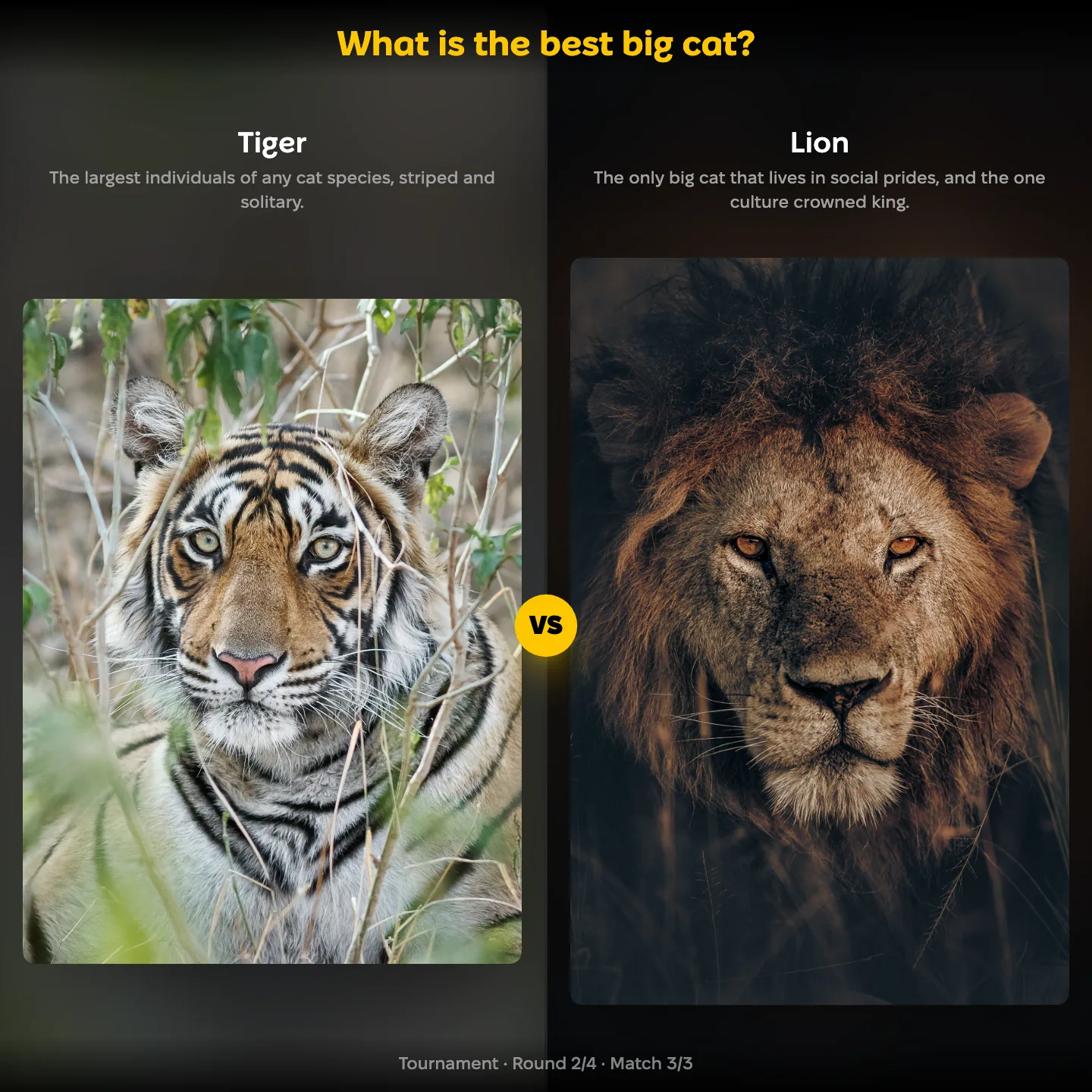
Narrow the field to cats and the comparison finally becomes direct. Twelve species make this list, from the ocelot to the snow leopard, and the two largest are the two under discussion.
The size question is less settled than the schoolyard version suggests. The careful summary of the measurements is that the largest tigers are bigger than the largest lions, while average size across subspecies may favour the lion.5 An Amur tiger reaches 300 kg and three metres.6 A male lion runs 150 to 250 kg.7
The lion's reply is that it does not do anything alone. It is the most social of all wild cats, living in prides that reach forty animals.2
The tiger has no equivalent. Adult tigers live largely solitary lives.5
Snow Leopard, Peacock, and the Two Big Cats
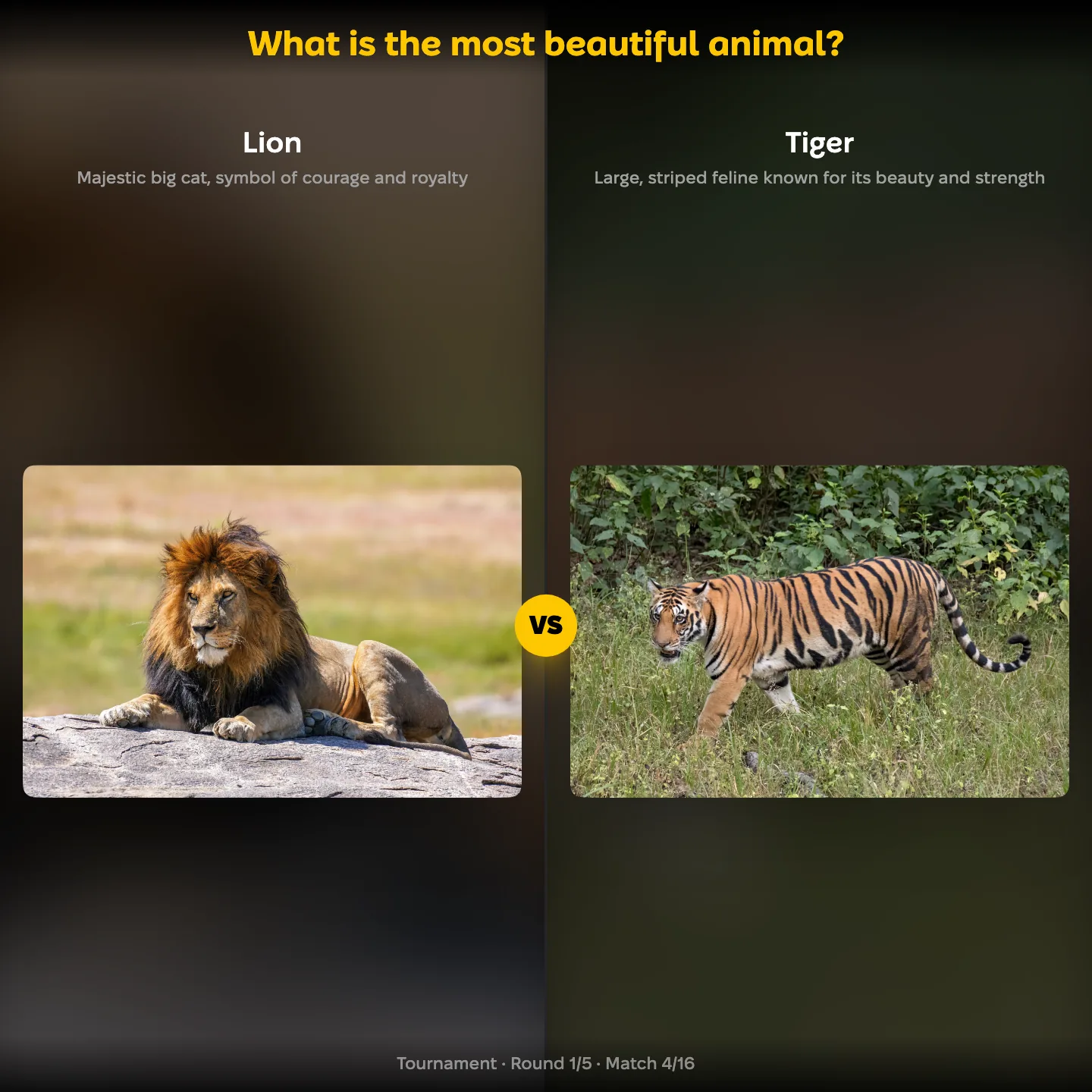
Beauty is the one criterion where neither cat has a technical case to make. Thirty-one animals are on this list and most of them are not predators.
The tiger's claim is the stripe pattern, which no two tigers share. The lion's is the mane, which no other cat grows.
Both are up against a peacock, a snow leopard and an arctic fox, which is a useful reminder that most beautiful and most impressive are different questions.
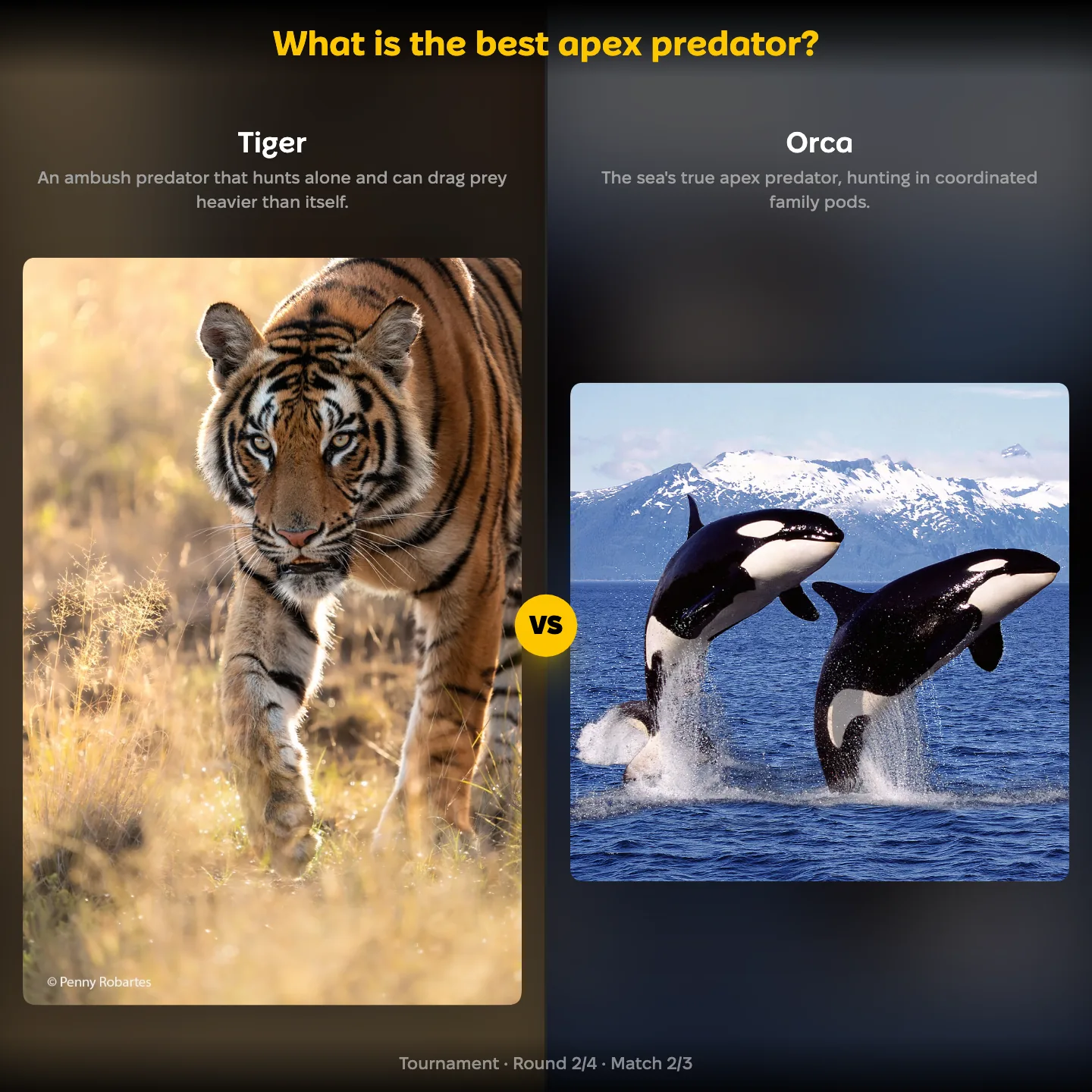
Orca vs Tiger: The Apex Predator Problem
Widen the frame from cats to everything that nothing else hunts, and both animals become mid-sized entries.
The tiger hunts alone and takes prey heavier than itself. The lion hunts cooperatively, which is how a pride brings down a buffalo.
Neither is the largest thing here. The orca hunts in coordinated pods, the saltwater crocodile is the largest living reptile, and the polar bear is the largest land carnivore.
Here the rivalry stops being the whole story. Put the two most famous predators on Earth into a field of apex predators and neither is the obvious answer.
The Mosquito Beats Both of Them
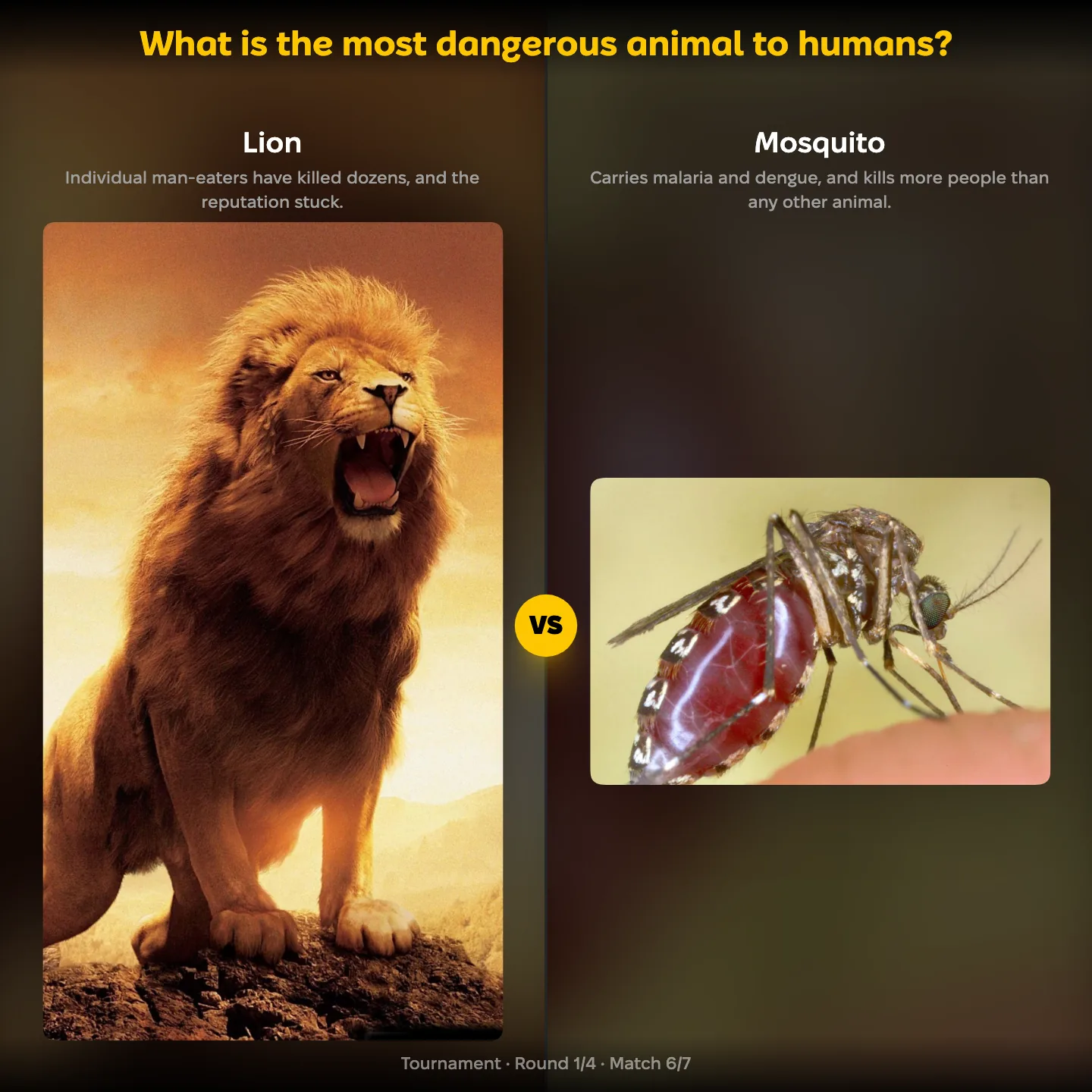
Ask which animal is most dangerous to humans and the honest answer has six legs.
The mosquito is on this list for what it carries rather than what it does: malaria and dengue travel with it. The hippopotamus is Africa's deadliest large animal, and the saltwater crocodile is one of the few that treats a person as prey.
Both big cats qualify for the opposite reason. Each has a documented history of man-eating, and that reputation is most of why anyone names them first.
Measured by deaths rather than by menace, the list puts an insect at the front and the two cats a long way behind it.
The Netherlands, Kenya, India: Who Picked Which Cat
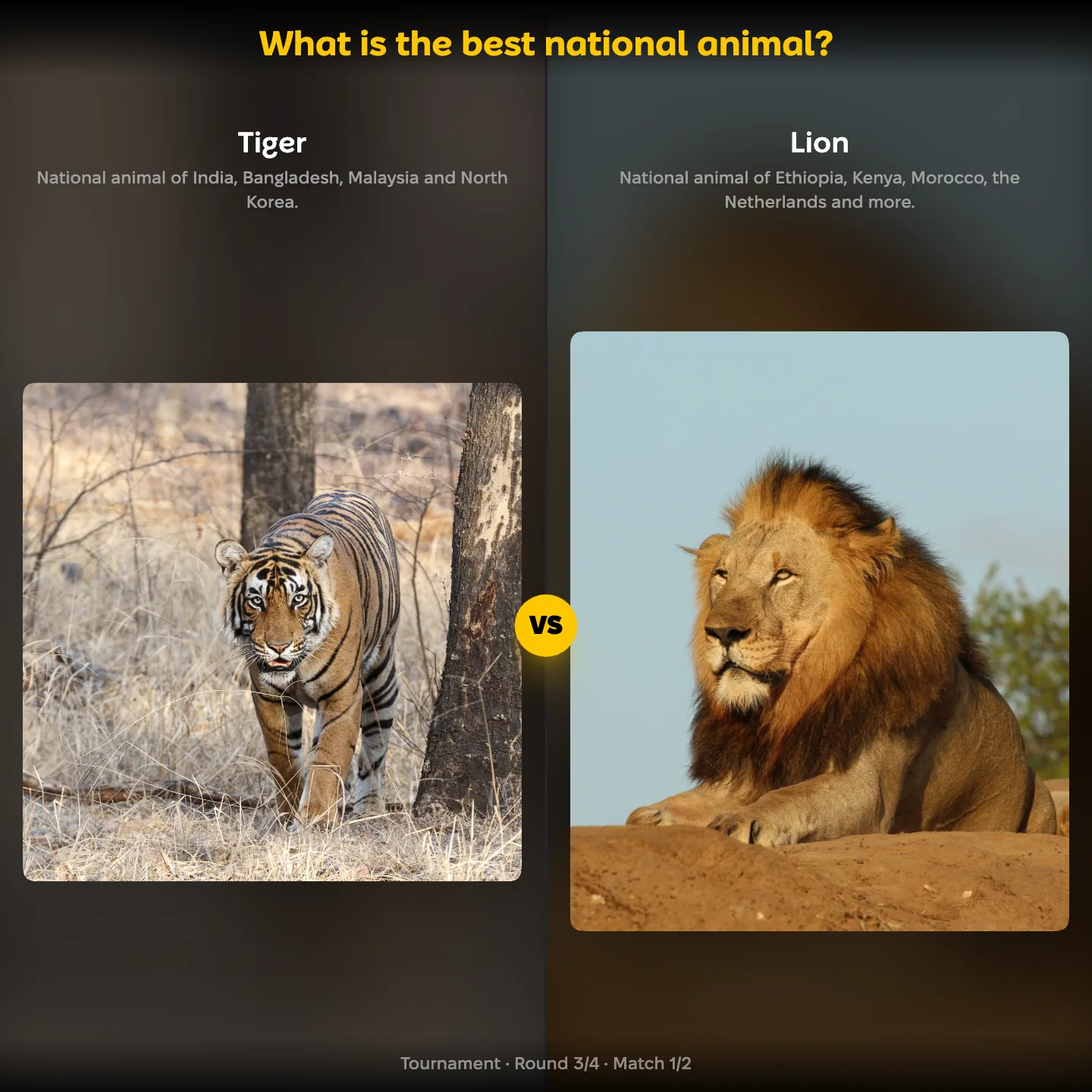
National animals are the clearest map of where these two cats live in people's heads.
The lion is the national animal of Bulgaria, Ethiopia, Israel, Kenya, Morocco, the Netherlands and Norway.8 Ethiopia and Kenya have wild lions. Norway and the Netherlands never did, and inherited the animal through heraldry instead, where the lion has stood for royalty long enough that nobody asks how it got onto a Scandinavian coat of arms.
The tiger is the national animal of Bangladesh, India, Malaysia and North Korea.8 Every one of those countries has, or recently had, wild tigers.
That is the real split. The lion is a symbol that travelled; the tiger is a symbol that stayed where the animal is.
Scotland's entry on this list is a unicorn, which suggests the category was never strictly zoological.
Simba vs Shere Khan: Disney Cast Them Both
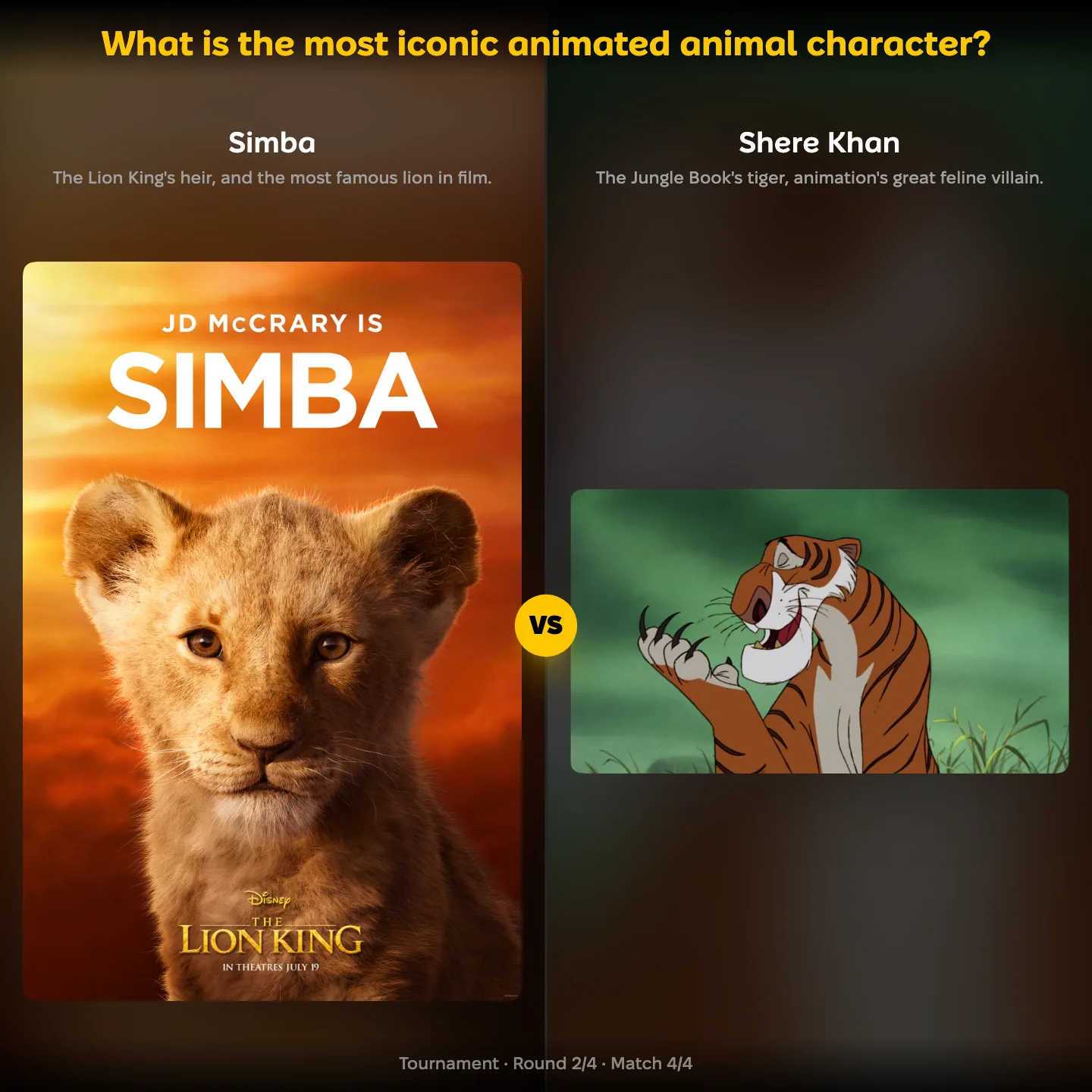
Animation settled this rivalry a long time ago, and not in a way either animal would have chosen.
The lion got the hero. Simba carries The Lion King, the most commercially successful thing either species has been attached to.
The tiger got the villain. Shere Khan has been The Jungle Book's antagonist since Kipling wrote him, and Disney kept him there.
Both sit on a list with Mickey Mouse, Bugs Bunny, Garfield and Snoopy, none of them big cats and all of them with longer careers. Tigger is on it too, so the tiger appears twice and in opposite registers: the menace and the bouncing one.
Detroit Lions vs Detroit Tigers: One City Named Both
American sport is the only place where the lion and the tiger are institutionally connected.
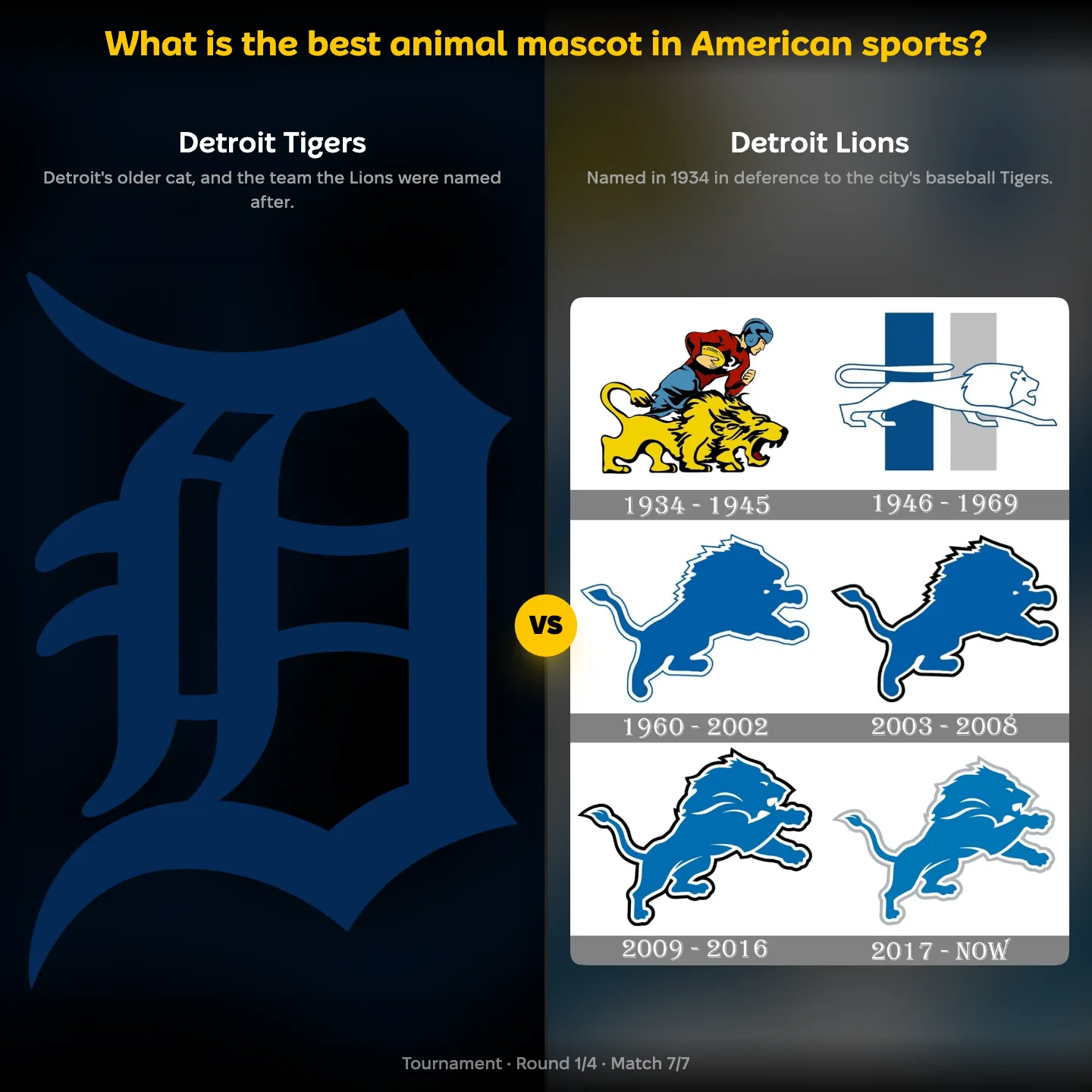
Detroit's baseball club has been the Tigers since 1894. When a football franchise relocated to the city in 1934, it was renamed the Lions in reference to the Tigers.9 One of the two animals in this article is named after the other, in a city where neither has ever lived.
Everything else here is a survey of how American teams choose animals. Clemson and LSU are both Tigers, Penn State fields the Nittany Lions after a local ridge, and the Jacksonville Jaguars are named for a cat that lives thousands of miles from Florida.
The Chicago Bears and the Baltimore Ravens compete for the same slot, so the big cats do not own this category either.
Five Miles of Roar, Against a Rooster
Sound is the lion's strongest single claim in this article.
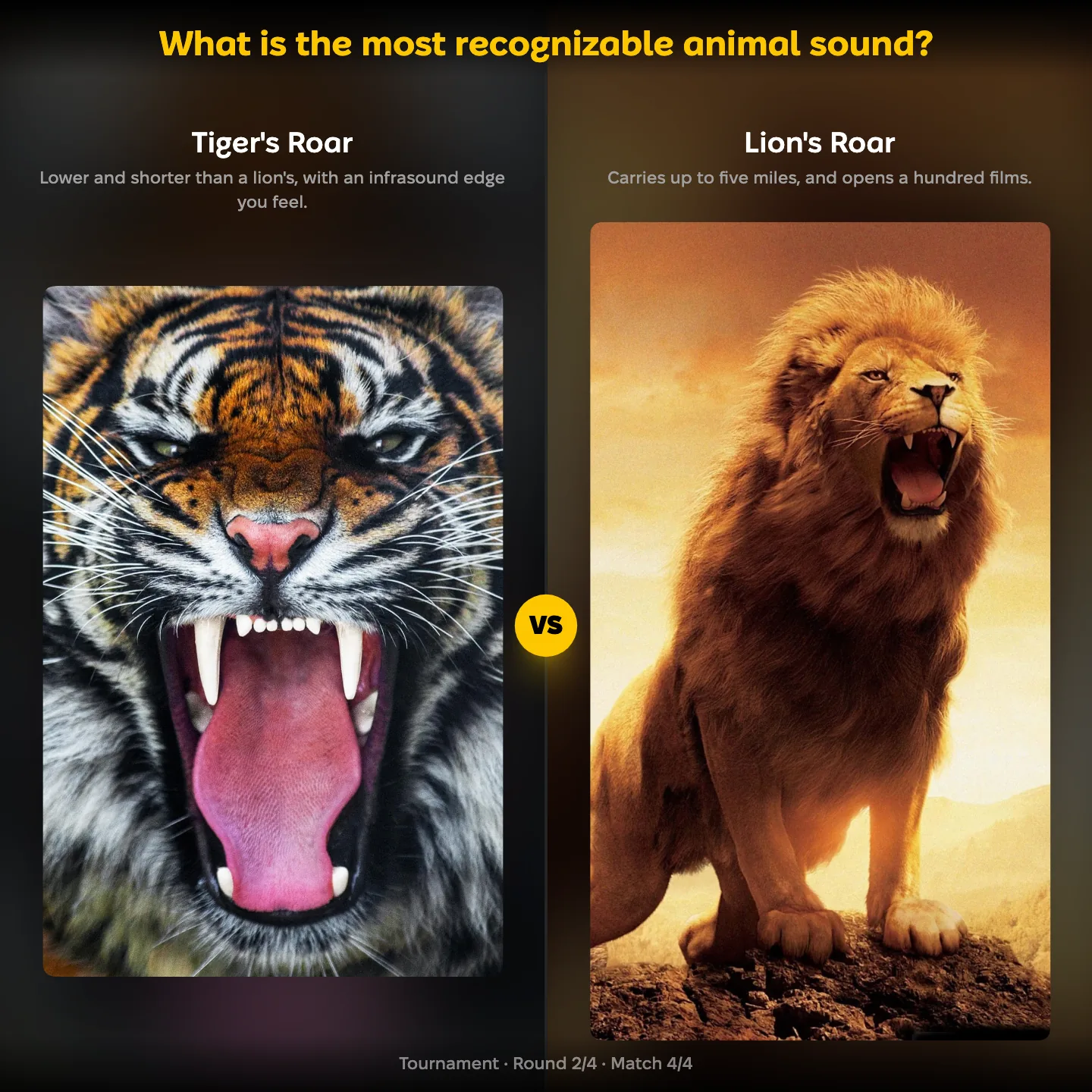
A lion's roar carries up to five miles.7 It is the noise films reach for whenever they need to say wilderness, and the reason a studio put one at the front of every picture it made.
The tiger's roar is lower and shorter, and does not travel in the same way.
Both are on a list with a rooster, a wolf howl, a mosquito and a cicada, where being recognised matters more than being loud.
IUCN Red List: Endangered vs Vulnerable
Conservation is where the two graphs run in opposite directions, and it is the least intuitive thing on this page.
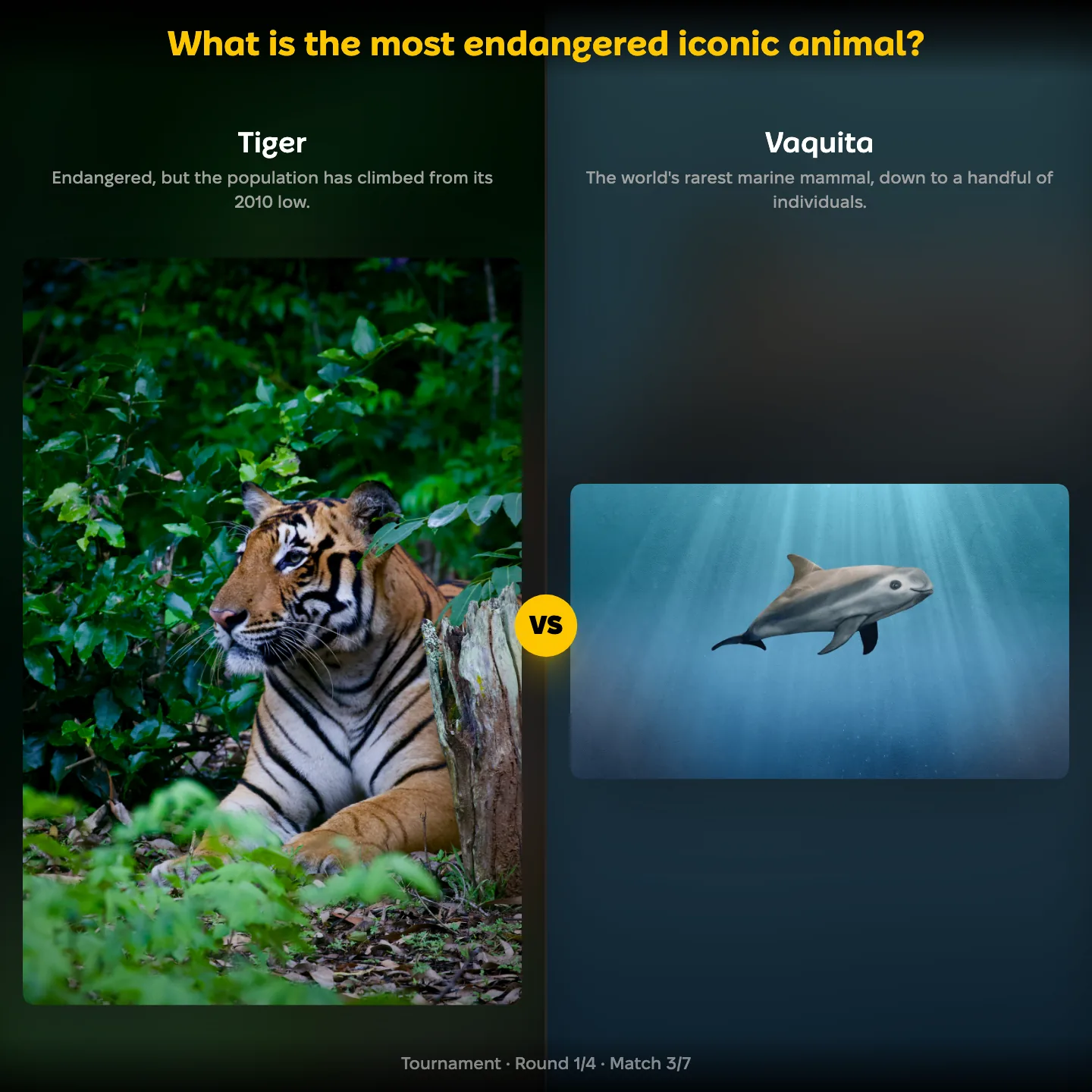
The tiger carries the worse label. It is listed Endangered, and the IUCN's estimate puts the wild population between 3,726 and 5,578.4
That number is climbing. Wild tigers bottomed out around 3,200 in 2010, which triggered the Tx2 programme and a decade of monitoring across the range states.4
The lion is listed Vulnerable, one category below, and has been since 1996.2 Its numbers run the other way. Panthera puts the wild population at about 24,000, down from an estimated 200,000, with a 95 per cent reduction in range.3
So the cat with the worse label is recovering and the cat with the better one is not. Both are also on a list with the vaquita and the Amur leopard, which are in a considerably worse position than either.
The Nemean Lion vs Bai Hu: Two Myths, Two Cats
Both animals were mythologised, in cultures that had never heard of each other.
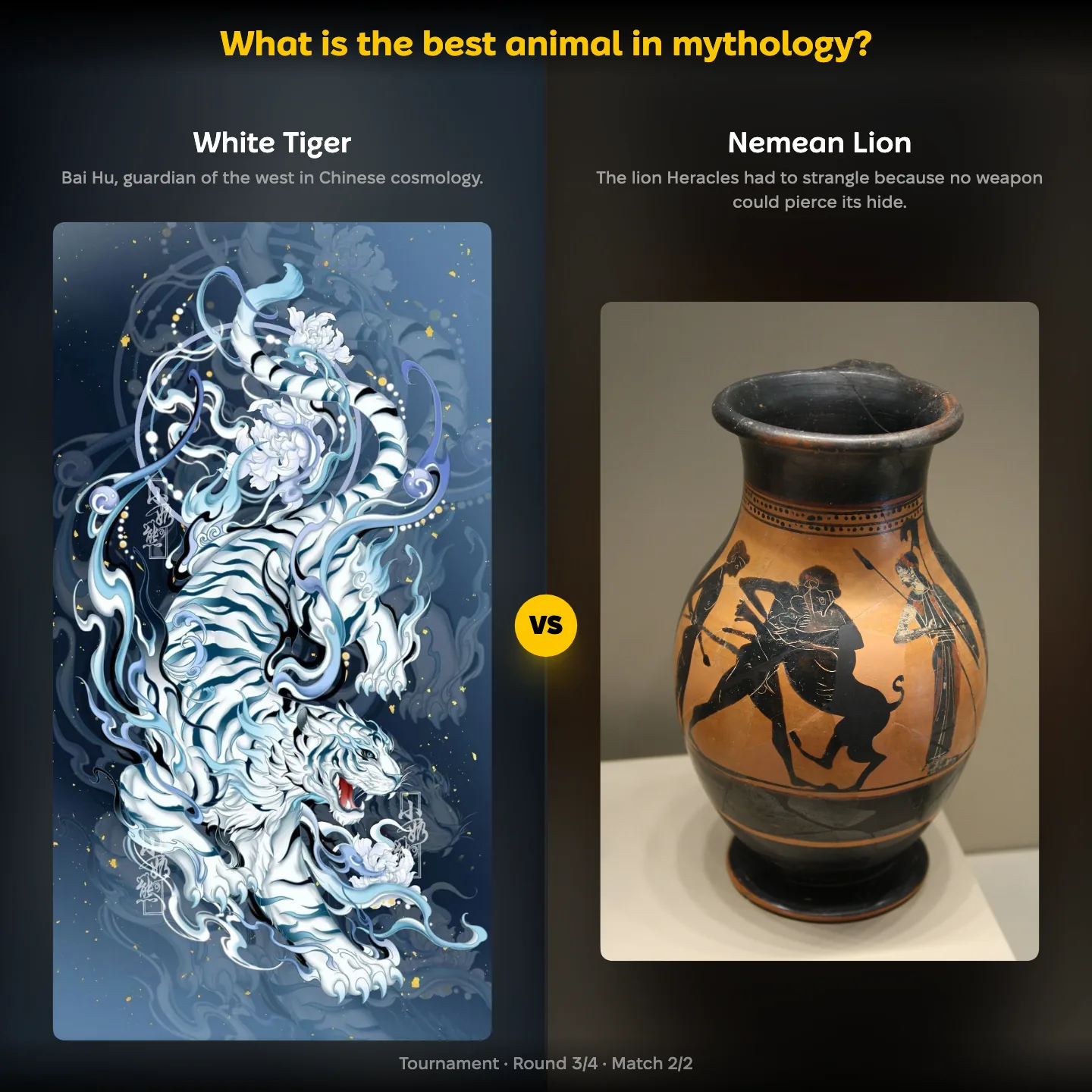
Greece gave the lion a monster. The Nemean Lion had a hide no weapon could pierce, which is why Heracles had to strangle it, and the scene survives on Greek pottery.
China gave the tiger a direction. Bai Hu, the White Tiger, guards the west in a four-symbol cosmology that also assigns a dragon, a bird and a tortoise.
The difference is worth noticing. The lion enters myth as something to be defeated; the tiger enters as something to navigate by.
They share the list with dragons, sphinxes and a kraken, all of them invented, and on the whole better known than the two real animals standing next to them.
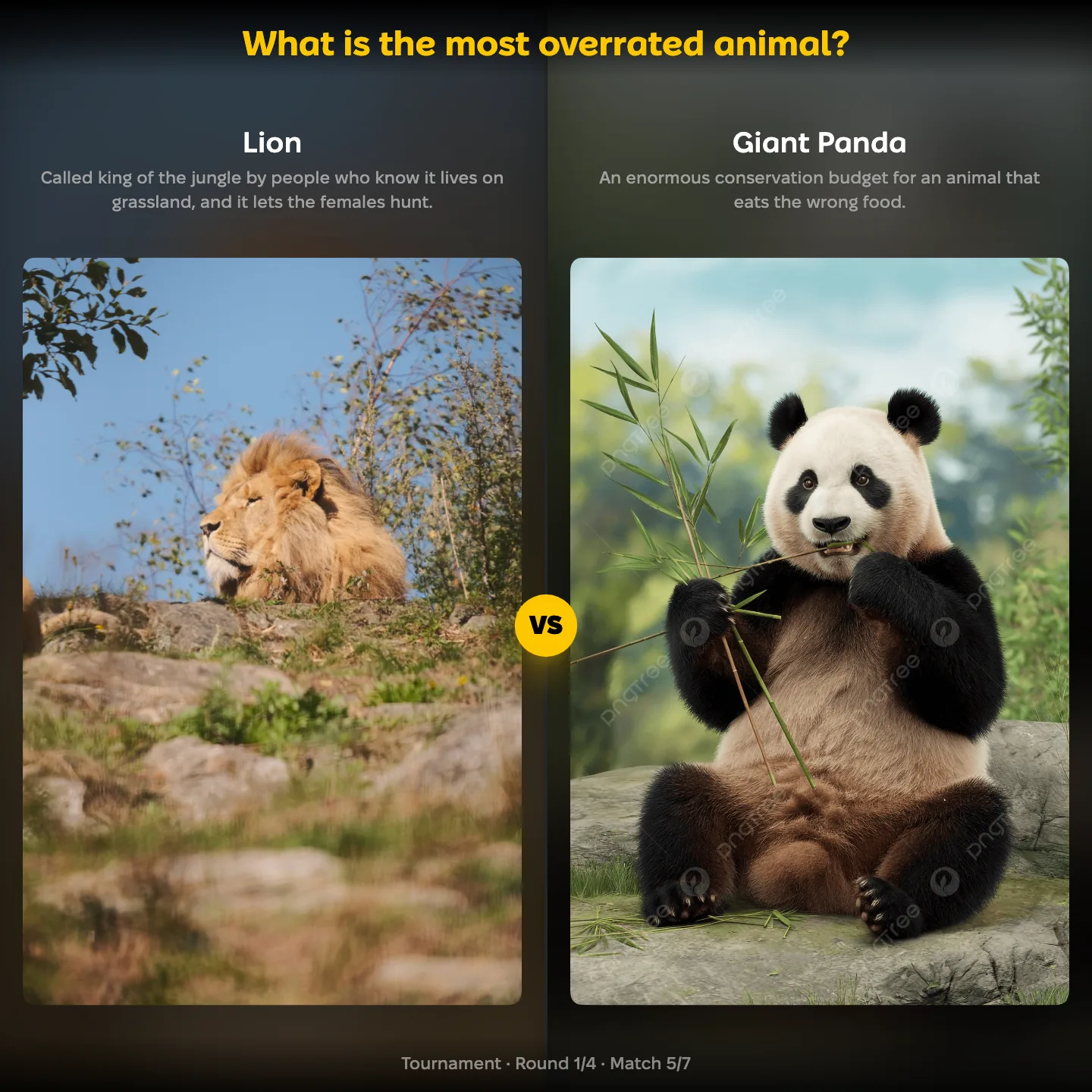
King of the Jungle Lives on Grassland
An inverted list is the fairest test either animal faces here, because fame is the charge.
The lion has the most to answer for. It is called king of the jungle by people who know perfectly well it lives on savanna, the mane is a liability in heat, and the lionesses do a large share of the hunting. Prides of up to forty animals also make it the least solitary predator ever handed a title that implies solitude.2
The tiger's case is quieter. It genuinely does hunt alone, and hunting alone is the harder way to eat.
They share the list with the koala, the panda and the sloth, all famous for doing very little, and with the bald eagle, which steals fish from ospreys.
Nobody comes out of this one well, which is rather the point of it.
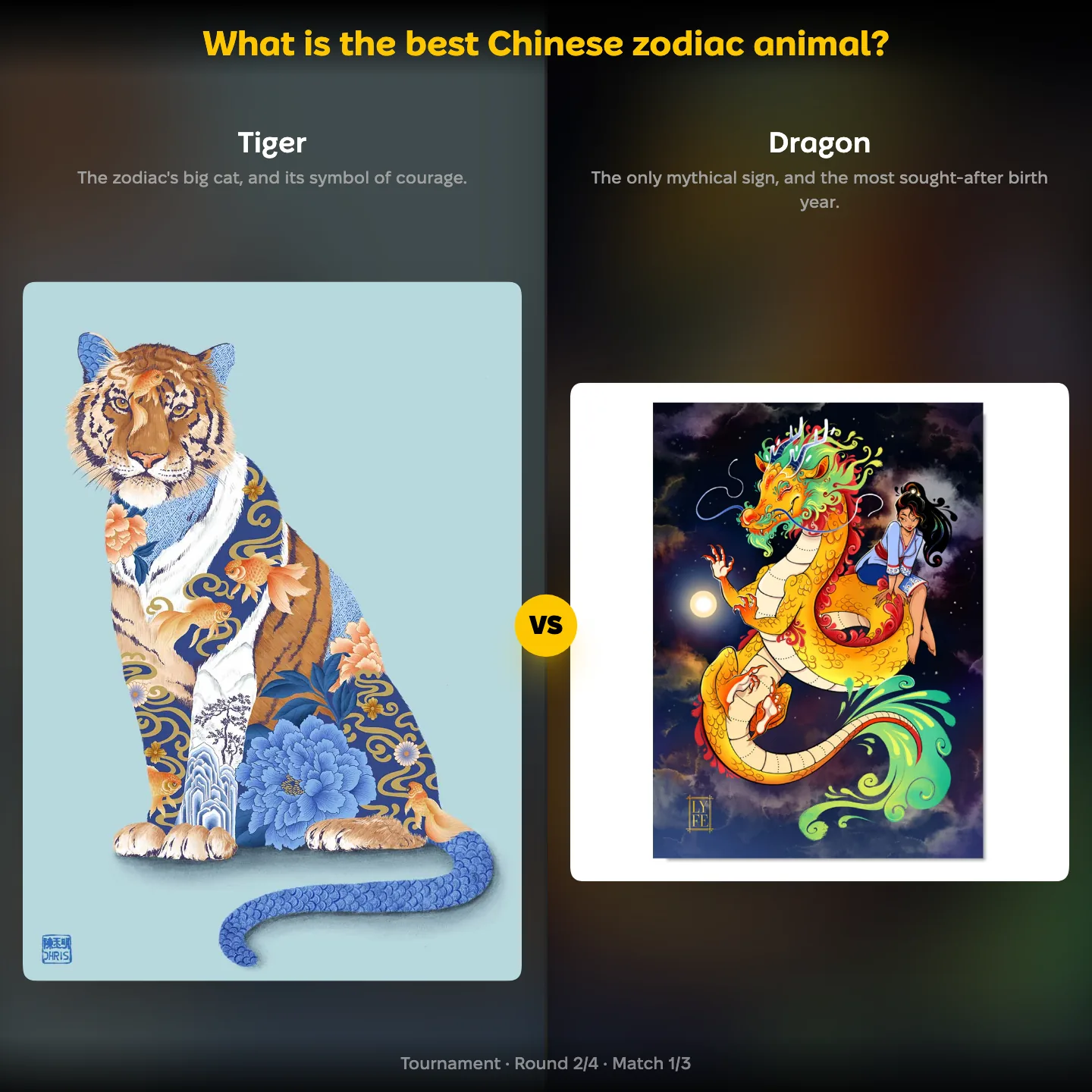
The Chinese Zodiac Has a Tiger and No Lion
Twelve animals, and only one of these two is eligible.
The tiger is the third sign and stands for courage. It sits between the ox and the rabbit, in a cycle that also holds the only mythical entry, the dragon, and the most sought-after birth year of the twelve.
The lion is not in the zodiac at all. It was not native to the region the cycle came from, and the signs that made it are the animals people lived alongside: the ox, the horse, the goat, the rooster, the dog and the pig.
That absence is the same pattern as the flags, running in the other direction. The tiger is Asia's cat, and this is an Asian list.
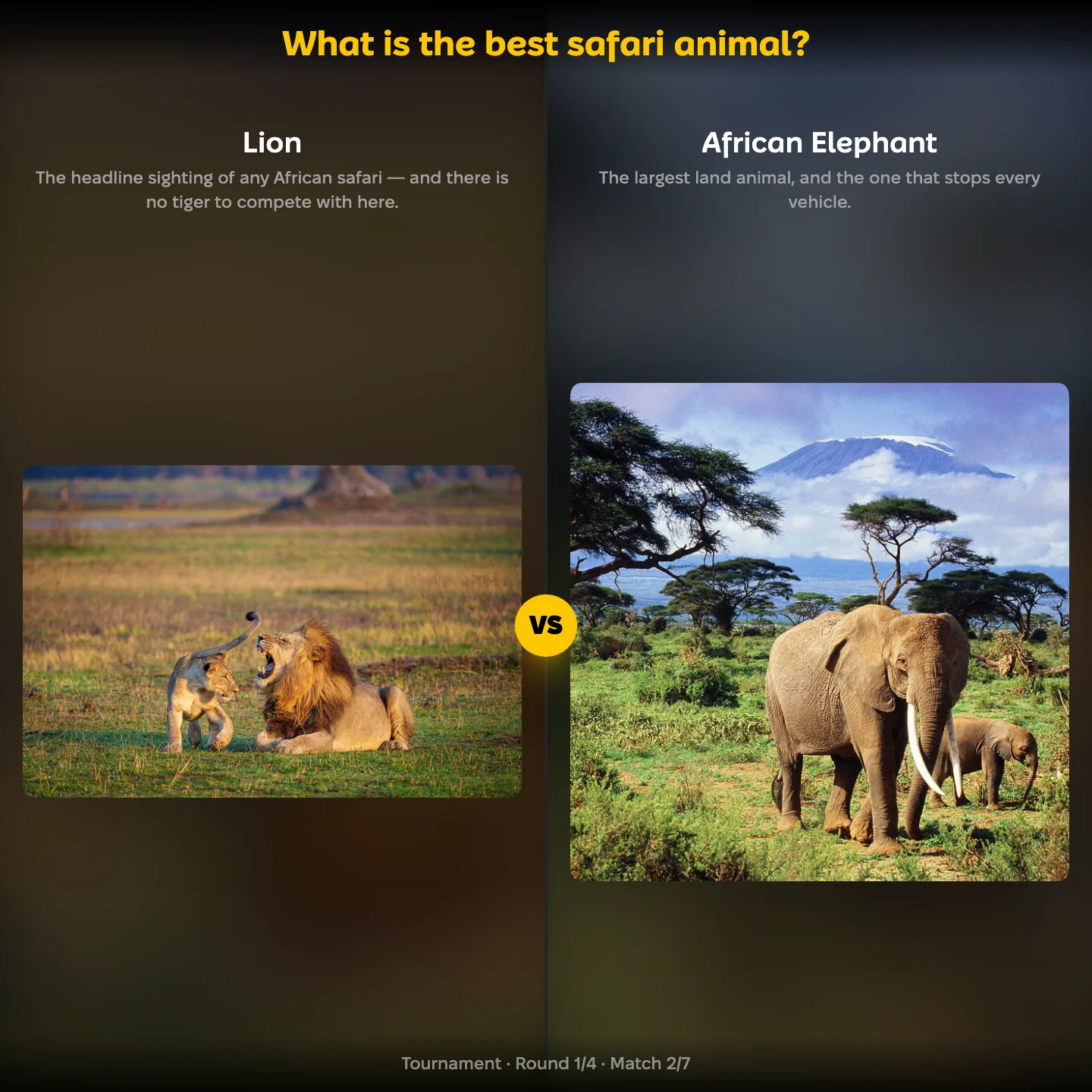
Kruger, Serengeti, Maasai Mara: No Tigers in Africa
The mirror image of the zodiac. There are no tigers in Africa, so the lion has this category to itself.
The lion is the sighting a safari is sold on, and one of the Big Five alongside the elephant, the leopard, the rhino and the Cape buffalo. The leopard is the hardest of the five to actually see.
Behind them comes the supporting cast: giraffe, zebra, cheetah, hippo, wildebeest, wild dog and hyena.
The tiger's absence is not an oversight. These two cats have been separated by geography for as long as anyone has been ranking them, which is why almost every list holding both had to be built around something other than where they live.
The Category Decides the Cat
Fourteen lists, and the two animals change places on almost all of them, because almost none of the lists is measuring the same thing. Symbolism favours the lion, which travelled into the heraldry of countries that never had one. Geography favours whichever continent produced the list. Conservation splits differently again, with the official label and the direction of travel flatly disagreeing.
Each of these gets settled the same way here, by putting two of them side by side and picking one, which is a decent way of finding out what a category actually rewards.
If you reckon some animal is filed wrong, make the list you want and find out what survives it.
More rankings, more angles
- The Bald Eagle Steals Fish, Squeaks, and Represents America — a national symbol with a squeaky voice
- Dogs vs Cats and the 15 Lists That Split Them — the same fight, indoors
- The Wolf, Ranked 16 Different Ways — apex predator, fairy-tale villain, Minecraft pet
- Secretariat Set Three Records in 1973. All Three Still Stand — three 1973 clocks nobody has beaten
Sources
- Wikipedia — World Lion Day, date and 2013 founding by conservationists at ALERT: en.wikipedia.org (checked 2026-08-06)
- Wikipedia — Lion: IUCN Vulnerable listing since 1996, and the lion as the most social of wild felids: en.wikipedia.org (checked 2026-08-06)
- Panthera — wild lion population of about 24,000, down from an estimated 200,000, and a 95% range reduction: panthera.org (checked 2026-08-06)
- Wikipedia — Tiger conservation: the IUCN range of 3,726–5,578 wild tigers, the 2010 low of about 3,200, and the Tx2 programme: en.wikipedia.org (checked 2026-08-06)
- Wikipedia — Tiger: relative size of the largest tigers and lions, and the solitary life of adult tigers: en.wikipedia.org (checked 2026-08-06)
- Smithsonian's National Zoo — Amur tigers reaching 660 pounds (300 kg) and 10 feet (3 m): nationalzoo.si.edu (checked 2026-08-06)
- Smithsonian's National Zoo — male lion weight of 330–550 pounds (150–250 kg), prides of up to 40, and a roar audible up to five miles away: nationalzoo.si.edu (checked 2026-08-06)
- Wikipedia — List of national animals, for the countries that name the lion and the tiger: en.wikipedia.org (checked 2026-08-06)
- Wikipedia — Detroit Lions: the 1934 relocation and the naming in reference to the Detroit Tigers: en.wikipedia.org (checked 2026-08-06)