
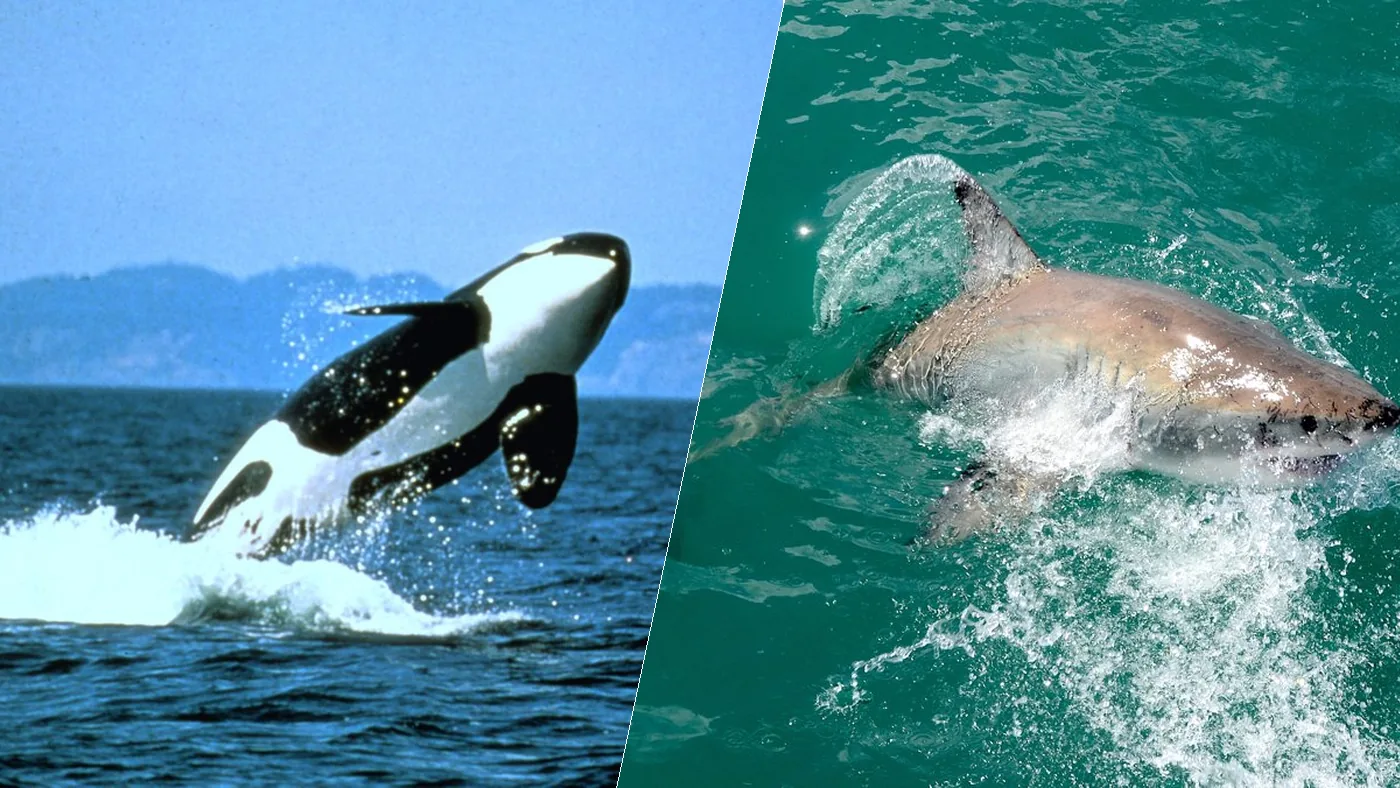
On 4 October 1997, biologists on California's Farallon Islands watched two female orcas attack a white shark and eat it, the first time anyone had documented an orca killing a great white.1 In June 2023 a male orca known as Starboard went further off Mossel Bay, South Africa, killing an eight-foot great white on his own in about two minutes.2
So the orca vs great white shark question has an answer in open water. On land, in films and in people's heads, it does not. This article puts both animals through 14 rankings, from apex predators and fearsome bites to animal movies and wildlife trips.
The orca wins every fight the two have been seen to have; the great white still owns every list built on fear.
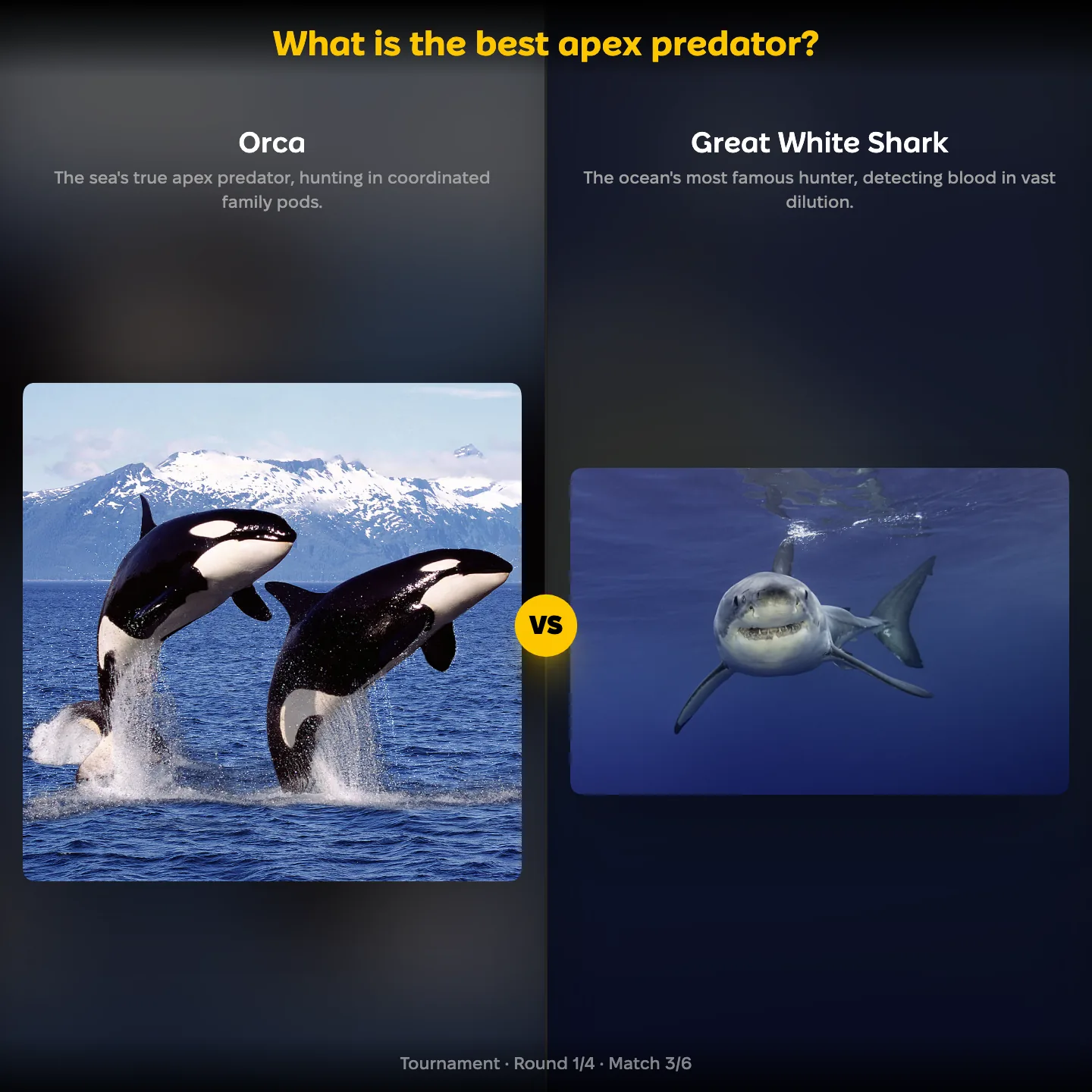
Orca vs Great White Shark: the apex predator question
The best apex predator ranking sets the killer whale and the white shark among twelve animals that top their food chains, from the lion and the polar bear to the harpy eagle and the green anaconda.
The orca's case is reach. NOAA Fisheries estimates around 50,000 killer whales worldwide, and different populations specialise in salmon, seals, whales or sharks.3
The great white's case is the job description. White sharks hunt seals and sea lions at colonies from California to South Africa, and NOAA lists nursery waters off southern California and Long Island.4
Apex means nothing hunts you. On that strict definition the Farallon and Mossel Bay records count against the shark, while the tiger and the polar bear face no comparable threat at all.
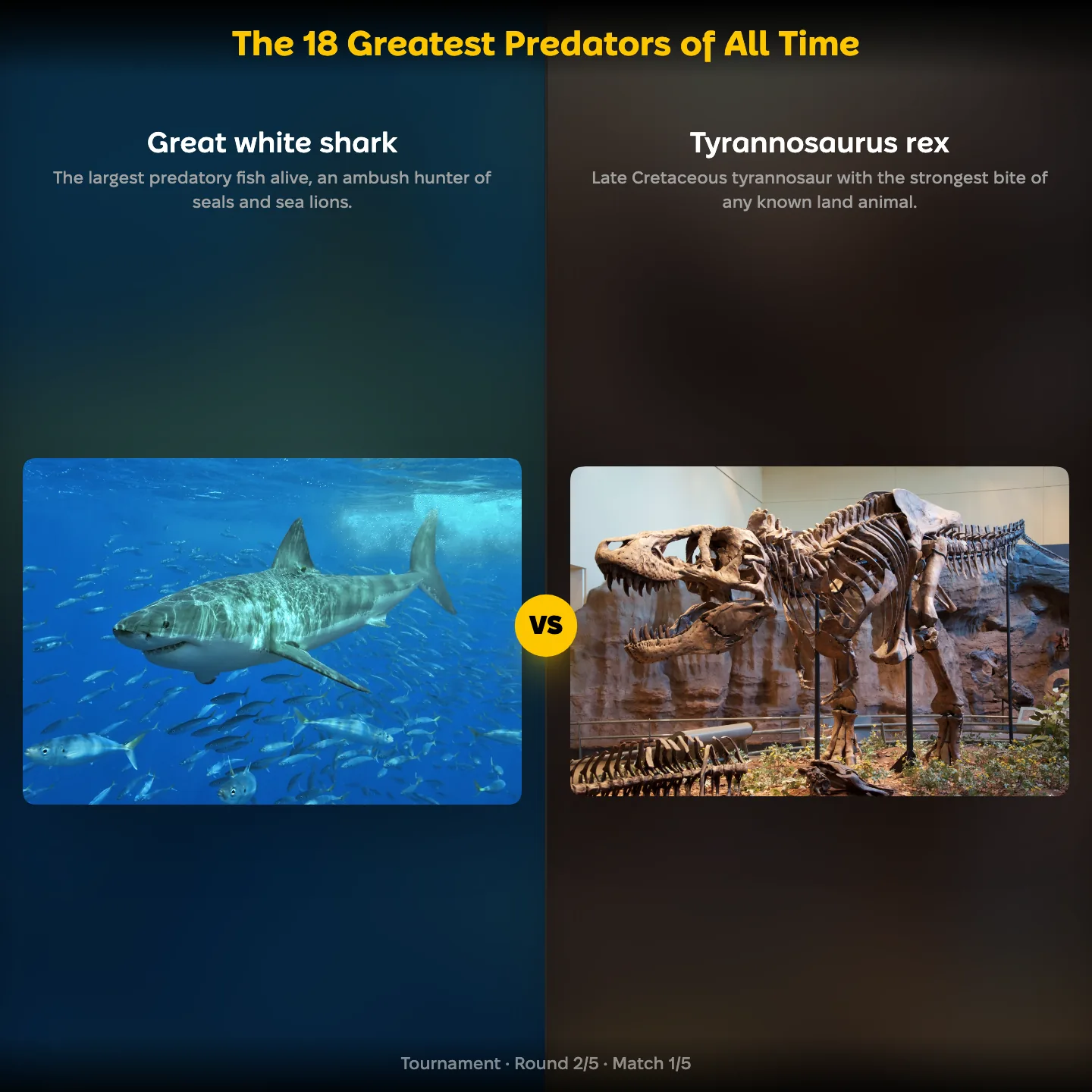
T. rex and the 18 greatest predators of all time
The 18 greatest predators of all time reach deep into the fossil record. Tyrannosaurus rex, Spinosaurus, Smilodon and Megalodon share the list with living hunters, and both sea predators made the cut.
Megalodon is the awkward neighbour for the great white. A far bigger extinct shark with the same body plan makes the living one look like the smaller edition.
The orca's claim is range of prey. Depending on the population, killer whales eat fish, seals, squid, other whales and sharks.
In this company the T. rex is the name most people reach for first, which is why it gets the frame.
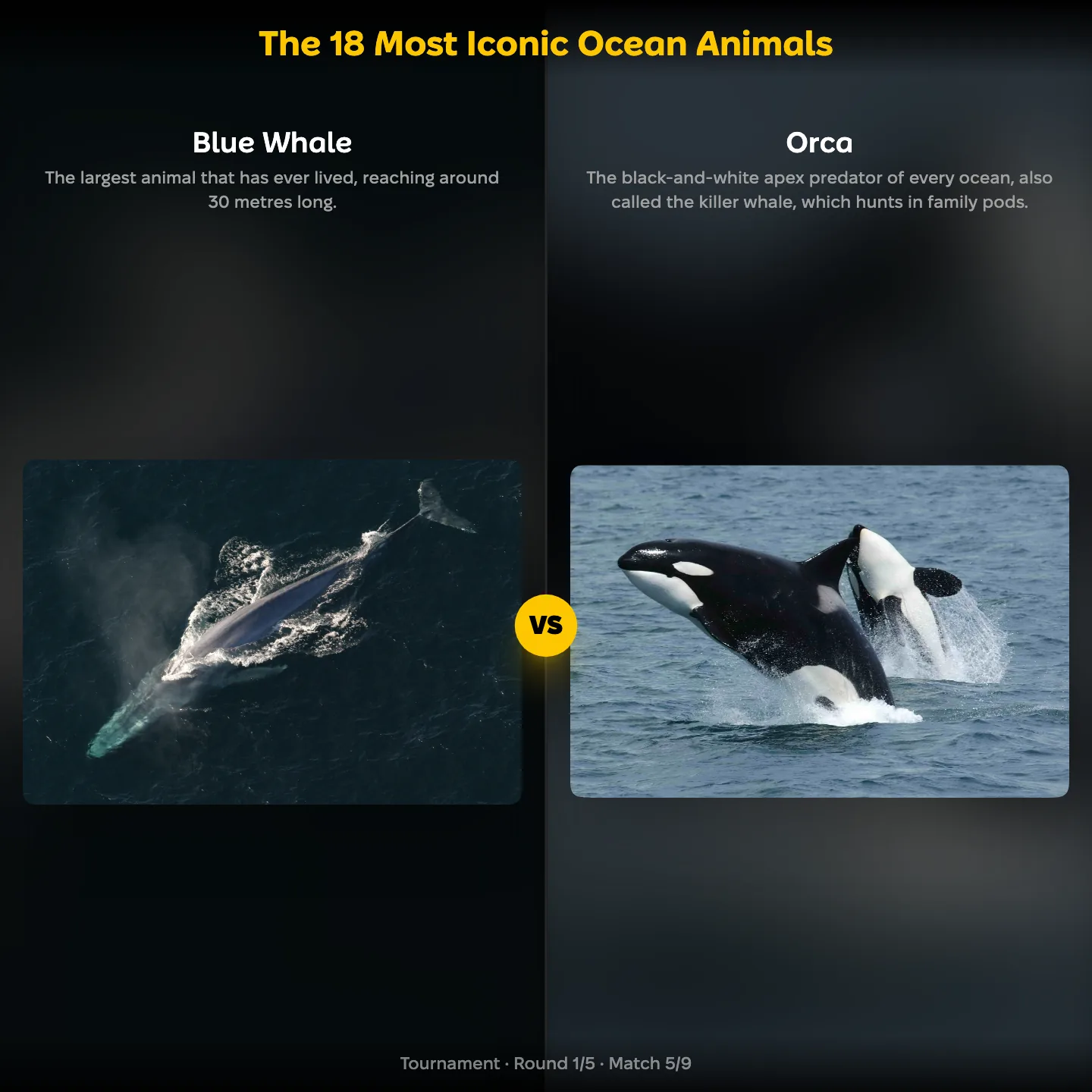
Blue whale vs orca: the most iconic ocean animal
Iconic is a question about recognition, and the 18 most iconic ocean animals reward fame over teeth. The blue whale, the humpback, the clownfish and the sea otter all compete with the two predators here.
The orca's black-and-white pattern is the most recognisable marking in the sea, and Free Willy made it a family animal in 1993.
The great white got its fame from one book and one film: Peter Benchley's Jaws and Steven Spielberg's adaptation of it.
The blue whale needs neither. Being the largest animal that has ever lived is enough, and the clownfish shows the opposite route, carried into every home by Finding Nemo.
The scariest sea creatures: why great whites flee the Farallones
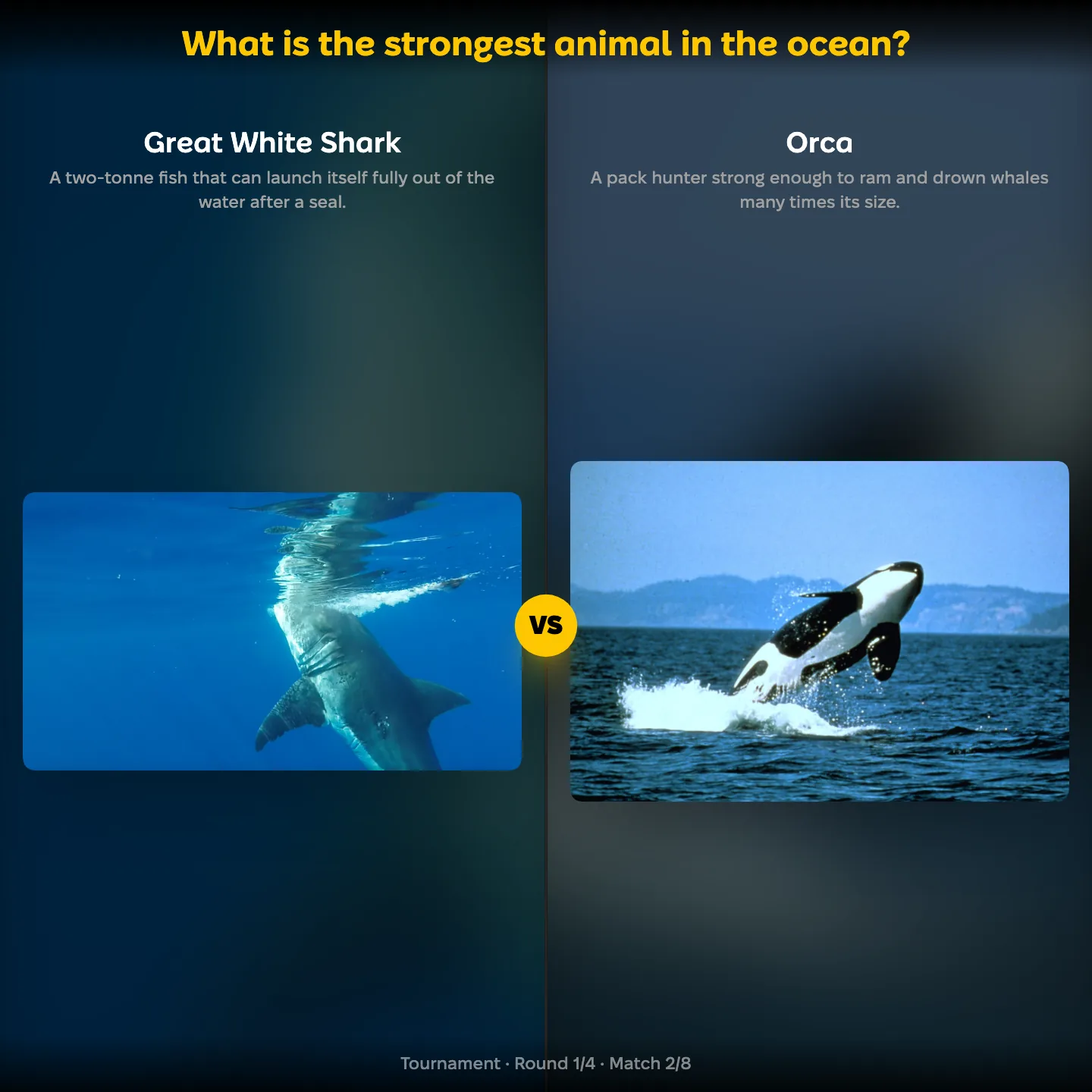
The 18 scariest sea creatures is the great white shark's home ground. Rows of serrated teeth and an attack from below are what most people picture when they think of fear in the water.
The tagging data tells a different story about who scares whom. Scientists tagged 165 white sharks off California between 2006 and 2013, and when orcas came within 3 km of the Farallon Islands, the sharks deserted the area within a day.1 Shark kills of seals there fell by 62% in those years.
The pattern goes back to the first recorded kill. After the October 1997 attack, Point Blue biologists logged only two shark kills of seals for the rest of that season, 95% fewer than in previous years.1
So the orca frightens the great white, and the great white frightens us.
The deep-sea entries play a different game. The goblin shark, the frilled shark and Sloane's viperfish scare by their looks alone, with almost no record of harm to anyone.
Jaws vs Free Willy: the best animal movies of all time
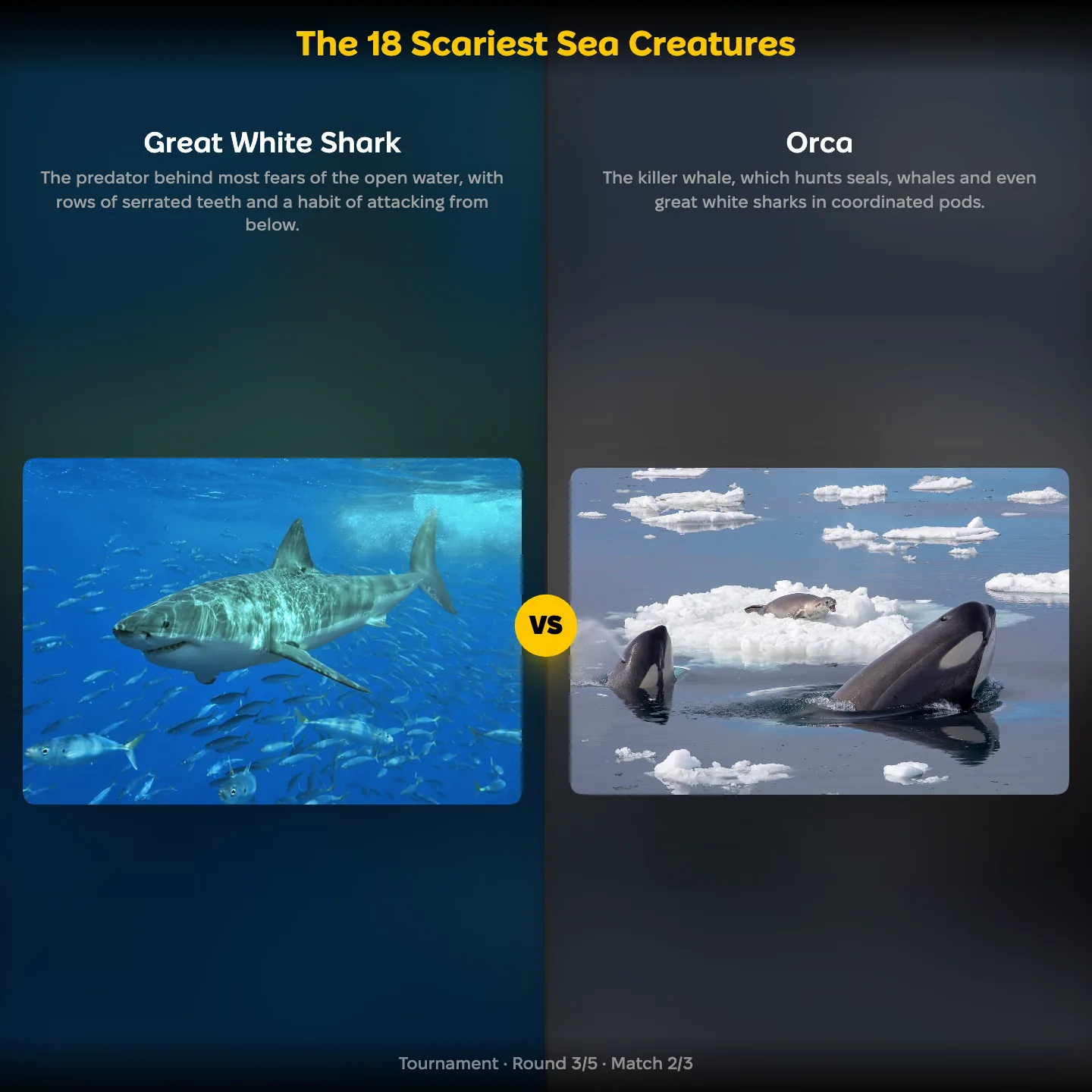
In the 20 best animal movies of all time, the orca and the great white shark compete through their films. Jaws (1975) made the great white cinema's most famous villain, and Free Willy (1993) made a captive orca a child's best friend.
Keiko, the orca who played Willy, outgrew the film. A public campaign moved him from a Mexican amusement park toward release in the wild, and his story became the case most people knew against keeping orcas in tanks.
Dogs and horses own most of this list: Old Yeller, Homeward Bound, Hachi: A Dog's Tale, The Black Stallion and Seabiscuit. Babe, The Lion King and Finding Nemo widen it further.
Spielberg appears twice, with Jaws and War Horse.
Saltwater crocodile vs orca: the most fearsome bite
The most fearsome bite is a contest of jaws. The saltwater crocodile, the hippopotamus, the jaguar and the extinct Megalodon all sit on it next to both sea predators.
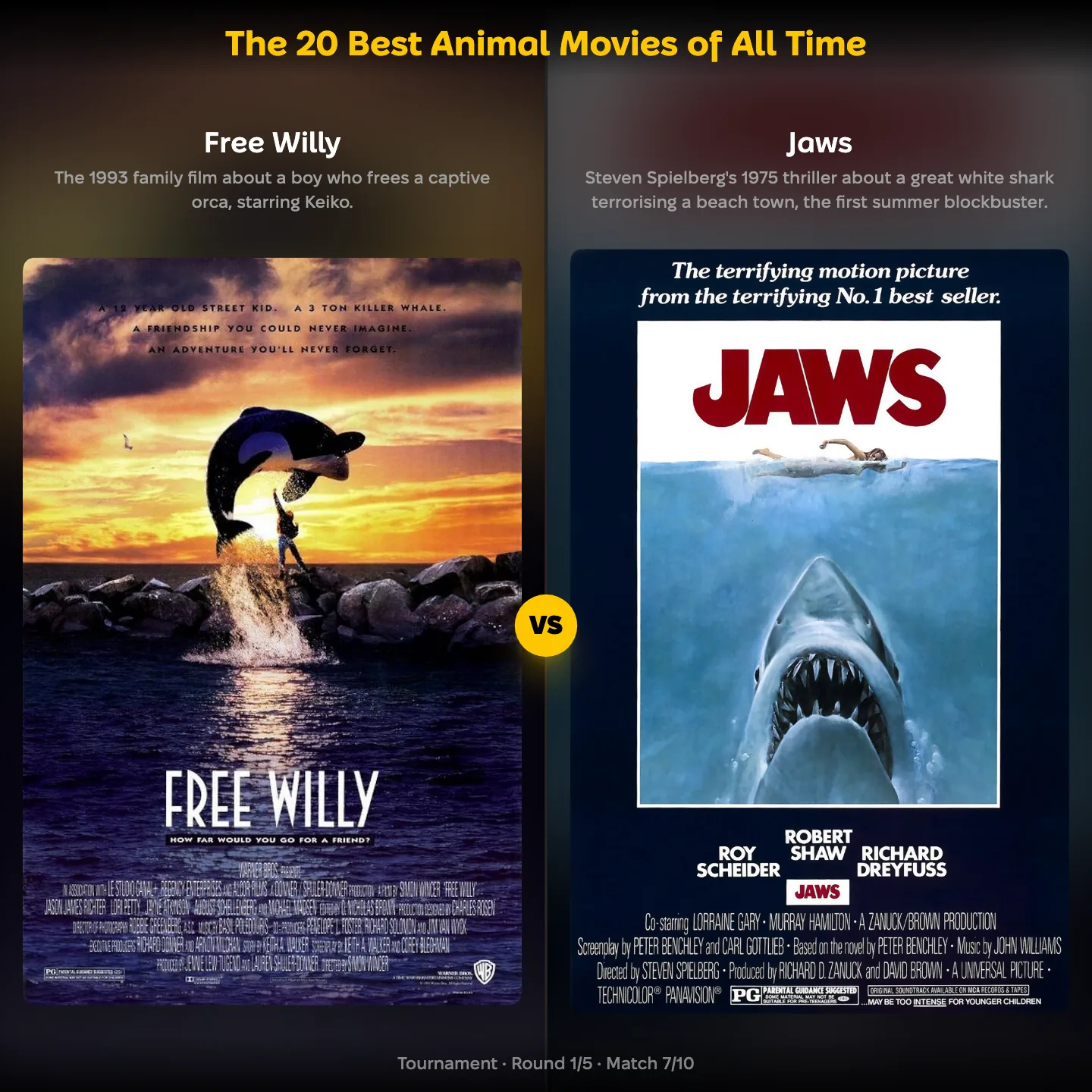
The saltwater crocodile holds the record for measured bite force among living animals, so the crocodile takes the frame opposite the orca.
The great white's bite works by cutting. Its triangular, serrated teeth sit in rows and are replaced throughout its life.
The orca's bite works by holding: conical, interlocking teeth that grip a seal or a shark while the rest of the pod does its work.
Orca vs great white: the strongest animal in the ocean
The strongest animal in the ocean is a question that mixes three kinds of strength: sheer mass, fighting power and force for size. The blue whale, the sperm whale, the walrus and the peacock mantis shrimp each win one of them.
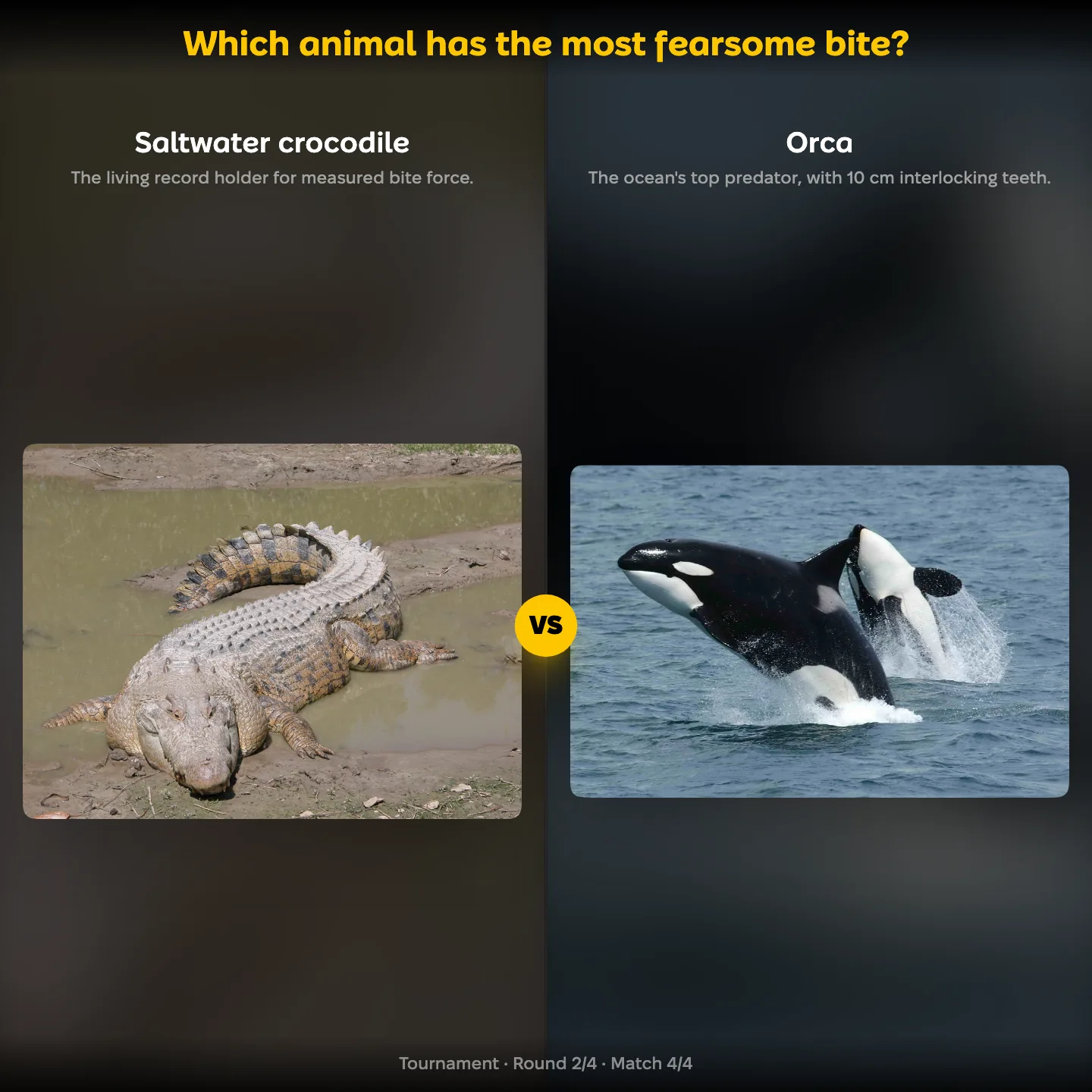
On mass alone the two are not close. NOAA gives the orca up to 32 feet and 11 tons, and the white shark up to 21 feet and 4,500 pounds, so the largest orcas outweigh the largest sharks about five to one.34
The great white's strength shows in acceleration. It can launch its whole body clear of the water after a seal.
Weight for weight, the mantis shrimp beats them both: its club strikes fast enough to crack shells and aquarium glass.
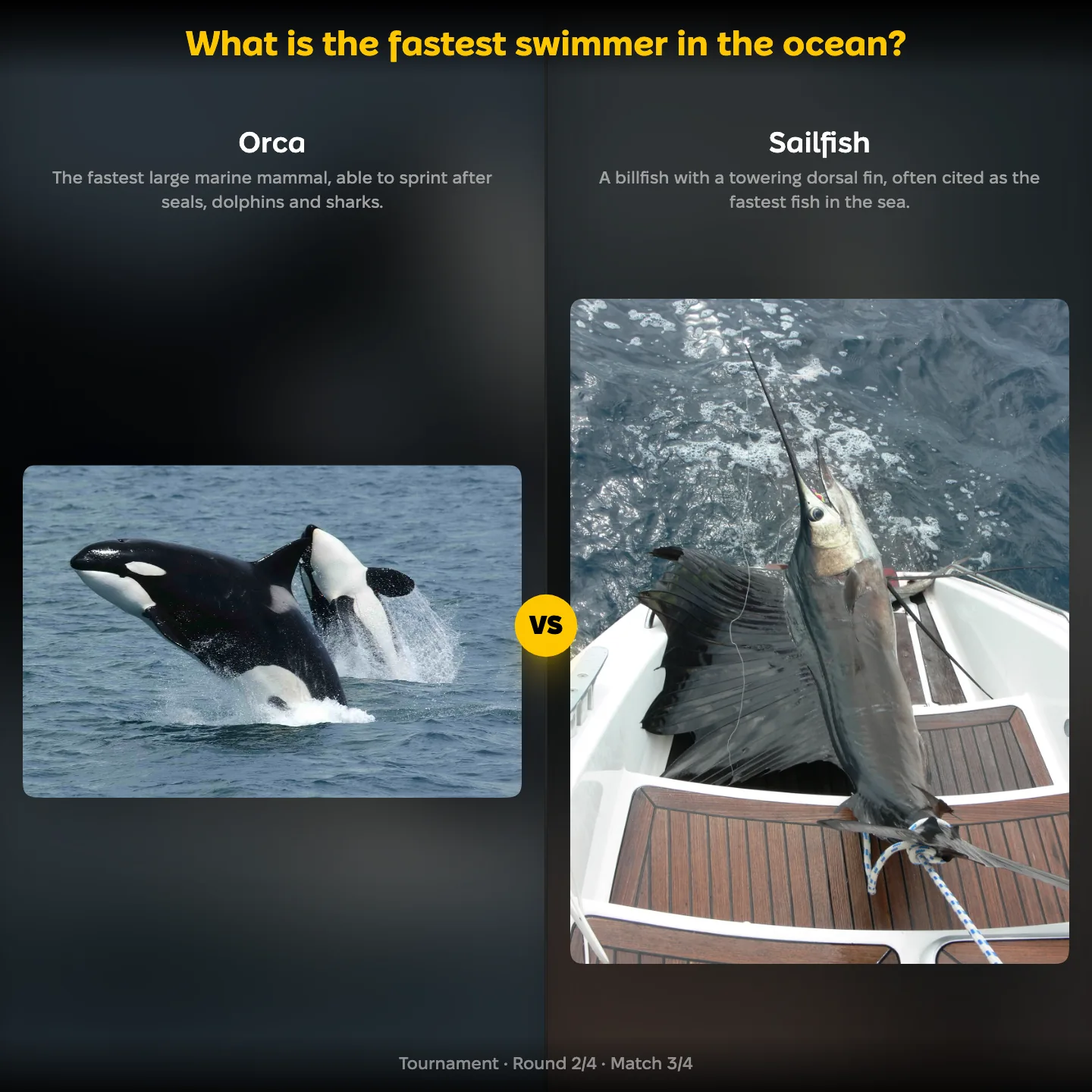
Sailfish vs orca: the fastest swimmer in the ocean
Speed is billfish territory. The sailfish, the black marlin and the swordfish lead the fastest swimmer in the ocean, with the shortfin mako as the quickest shark.
The orca is among the fastest large mammals in the sea, quick enough to run down dolphins. The great white shark is a sprinter rather than a cruiser, built for a short burst from below.
Top speeds for fast fish are hard to measure in the wild, and published figures vary widely.
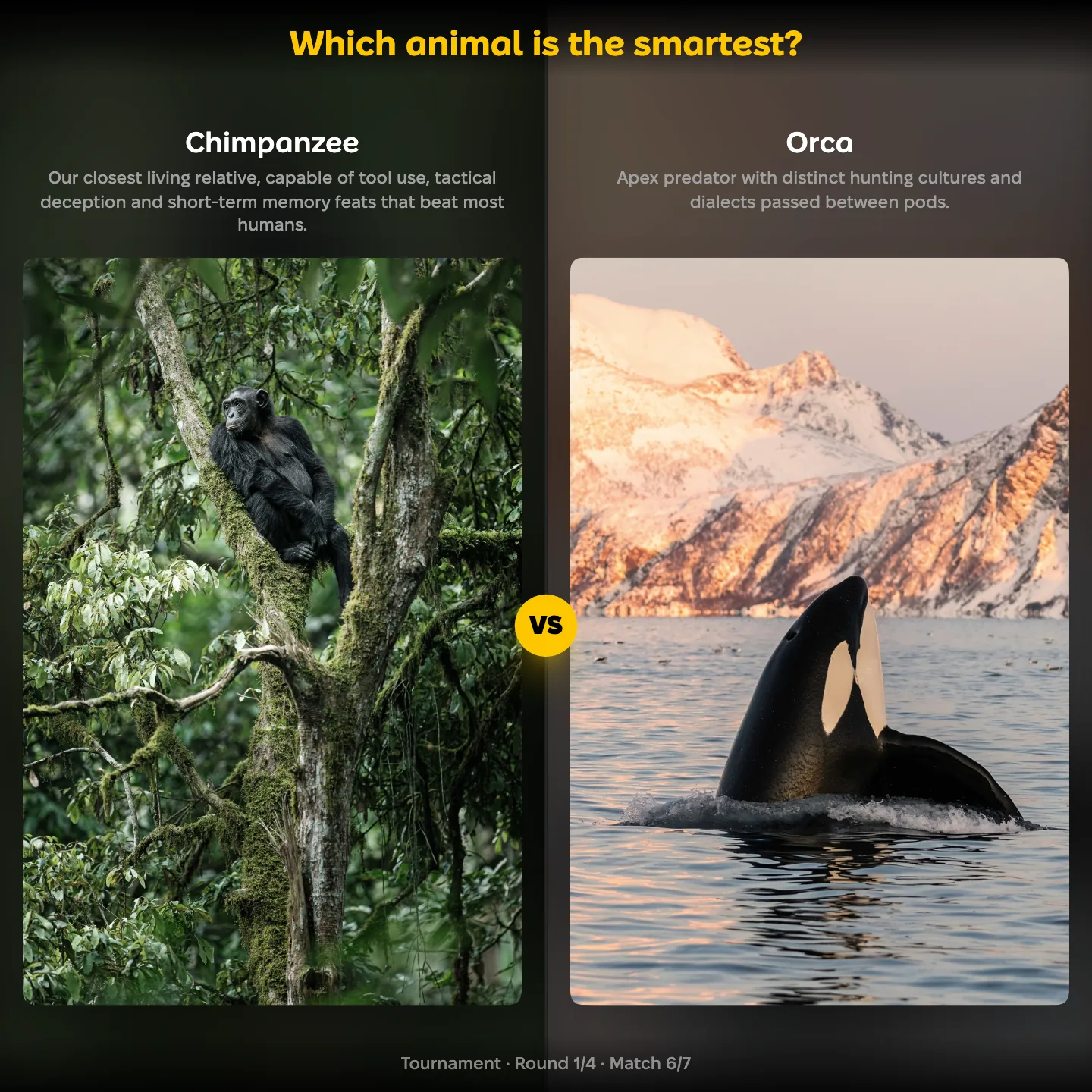
Chimpanzee vs orca: which animal is the smartest
The smartest animal ranking includes the orca and leaves the great white shark off entirely. The chimpanzee, the African grey parrot, the octopus and the crow are the orca's competition.
The orca's case is culture. Pods keep their own calls and their own hunting methods and pass them from mother to calf. Both documented shark kills, in 1997 and 2023, ended with the orcas taking the liver, a learned preference rather than an accident.
The great white's absence is the point of this section. Nobody has built a case for shark intelligence that reaches this company.
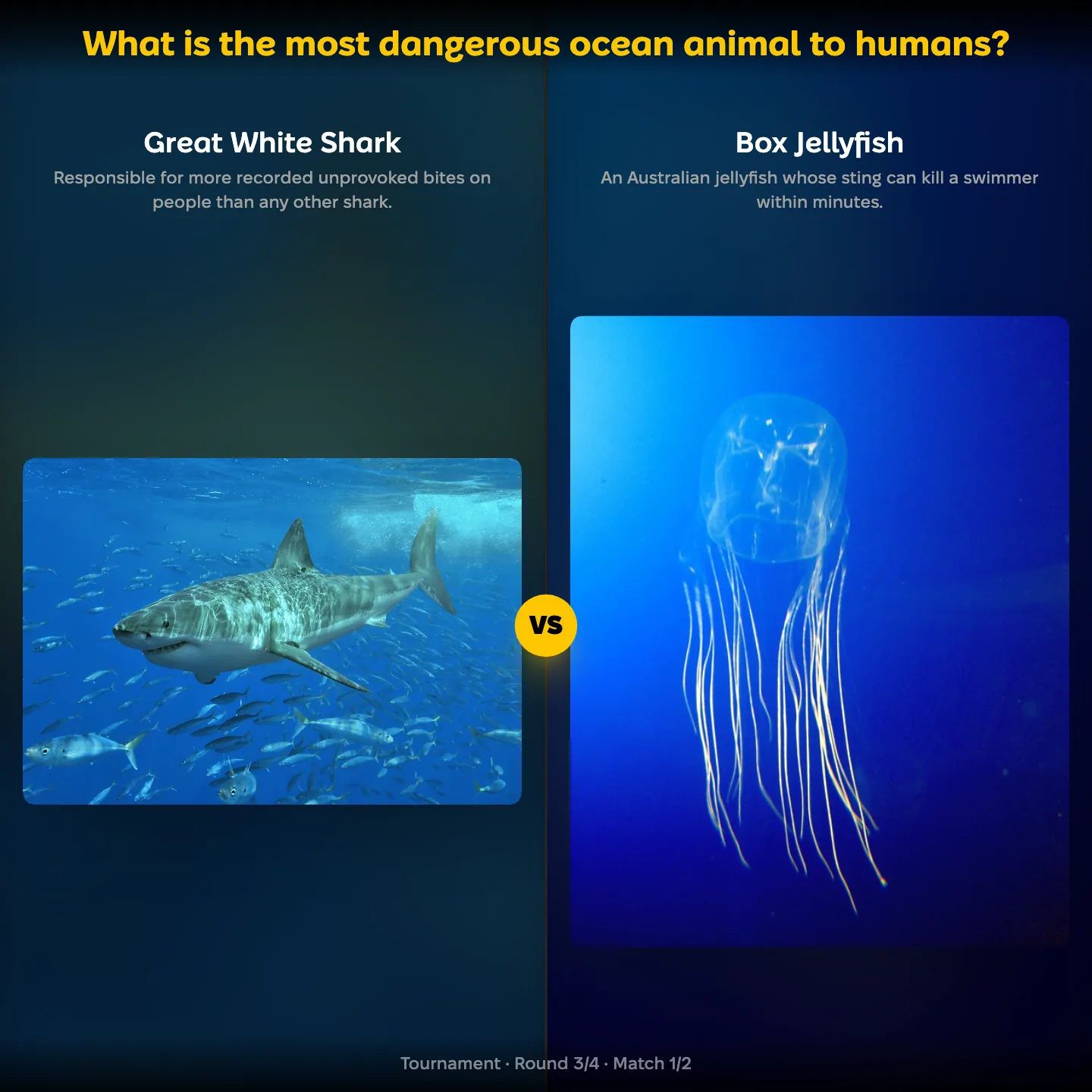
Box jellyfish vs great white: the most dangerous ocean animal to humans
The most dangerous ocean animal to humans is a question about records, not reputations. Great whites and orcas share the list with the box jellyfish, the blue-ringed octopus, the stonefish and the geographic cone snail.
The great white has the worst shark record. The International Shark Attack File counted 65 unprovoked bites worldwide in 2025 and nine unprovoked deaths, four of them caused by white sharks.5
The orca has almost none. A NOAA marine biologist told National Geographic he knew of no report of a killer whale attacking a human; the deaths on record involve captive animals such as Tilikum at SeaWorld Orlando in 2010.6
The box jellyfish faces the shark in the frame because its sting can kill in minutes, and almost nobody sees it coming.
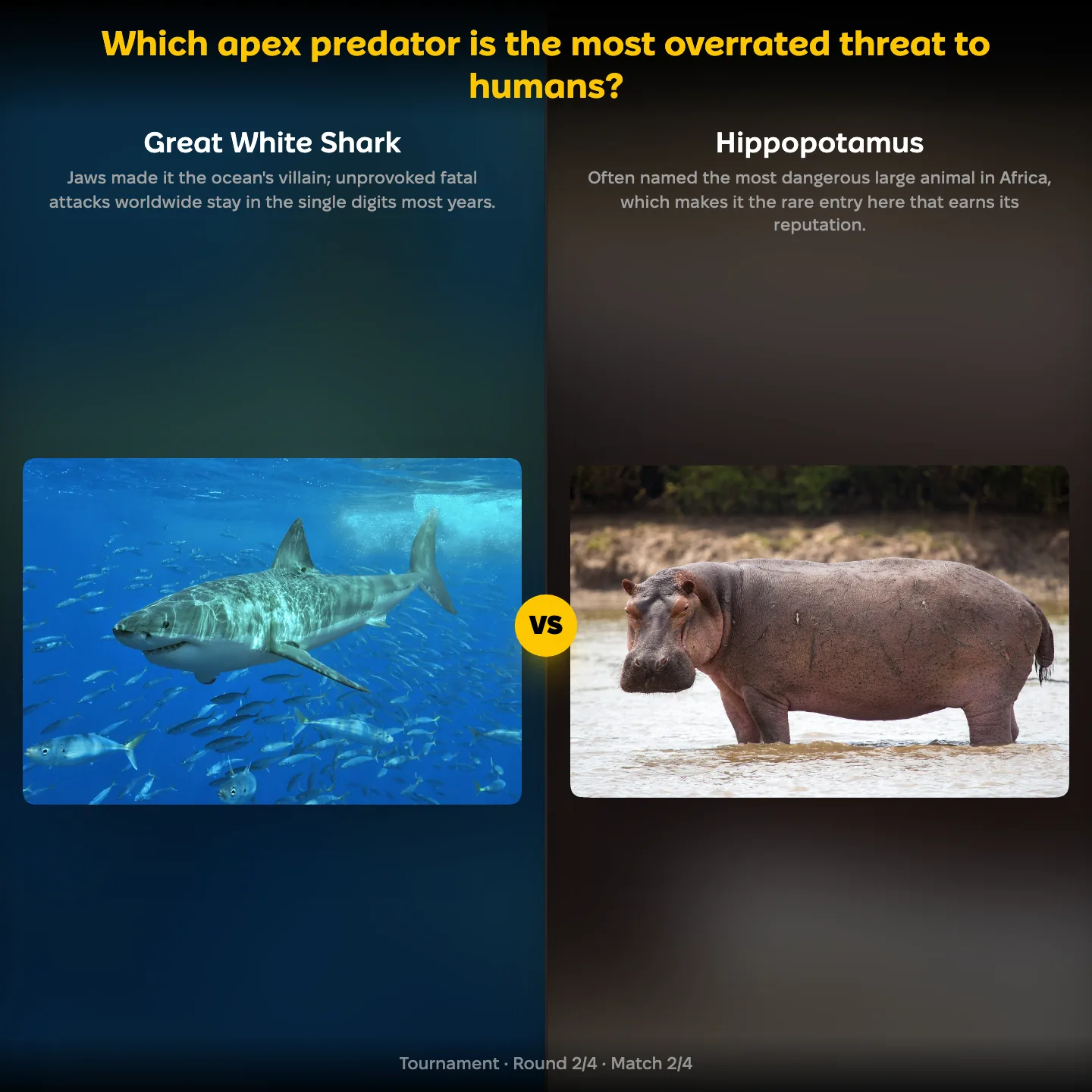
Hippo vs great white: the most overrated threat to humans
This ranking inverts the question. The most overrated threat to humans asks whose fearsome image runs furthest ahead of its real danger, and the great white shark is the obvious nominee.
Jaws gave the shark a reputation that the numbers above never matched. A few deaths a year worldwide, against millions of swimmers and surfers, is a small toll for the most feared animal in the sea.
The orca appears on the list as well, for the opposite reason: a name that promises a killer and a record that shows almost none.
The hippopotamus tests the idea from the other side: a plant-eater whose danger to people is real and often underestimated.
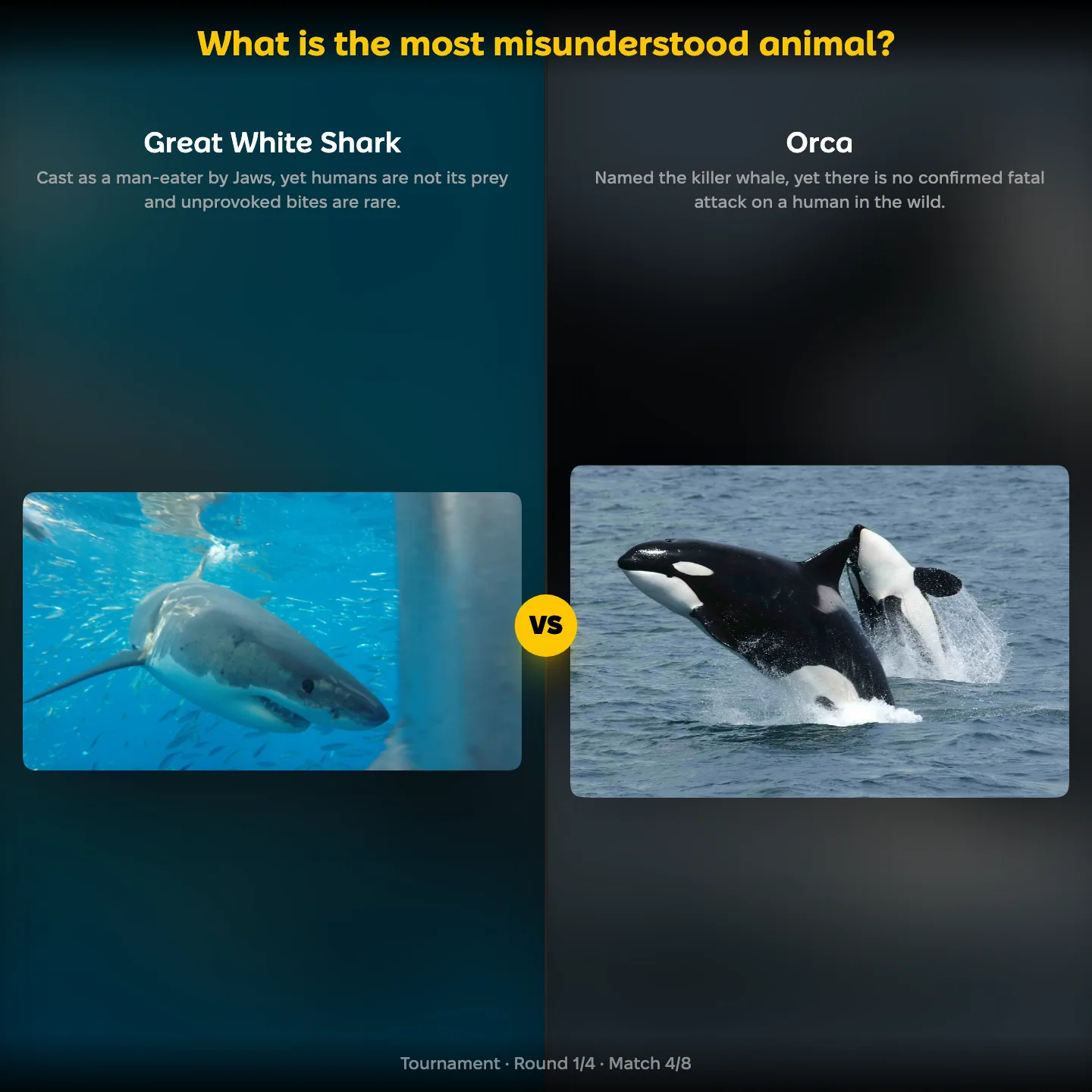
Great white or orca: the most misunderstood animal
The most misunderstood animal collects creatures whose reputation outruns the facts: the bat, the vulture, the spotted hyena, the opossum, the pit bull. Great whites and orcas both qualify.
The great white is misunderstood as a man-eater and as a monster in decline. NOAA describes the northeast Pacific population as increasing and not at risk of becoming endangered, and US rules prohibit keeping a white shark caught in most federal waters.4
The orca is misunderstood through its name. "Killer whale" sounds like a threat to people; for the shark, seals and other whales, it is an accurate job title.
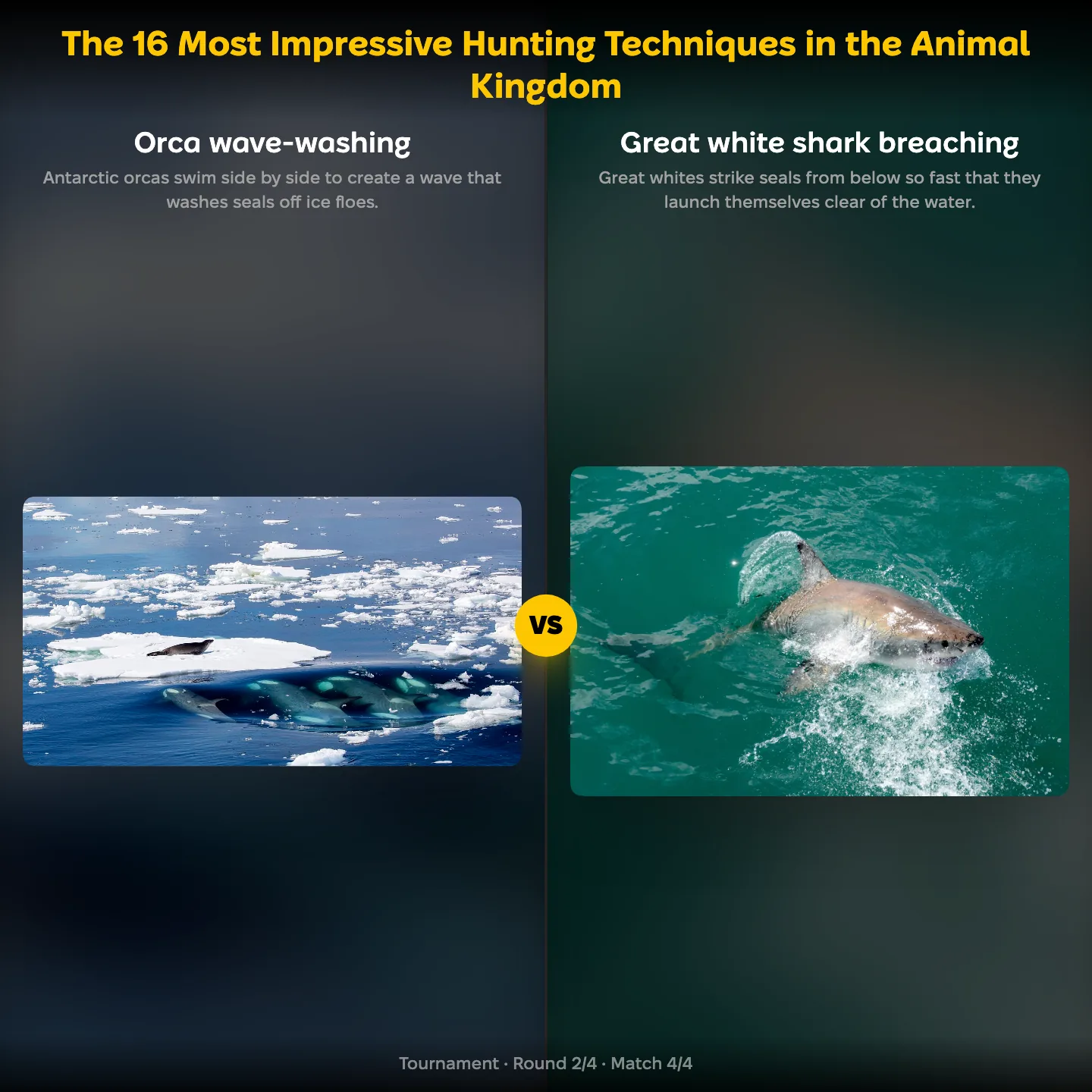
Orca wave-washing vs great white breaching
The 16 most impressive hunting techniques in the animal kingdom set the two predators' signature moves side by side. Humpback bubble-net feeding, the peregrine falcon's dive, the archerfish's water shot and the pistol shrimp's snap fill out the list.
Orca wave-washing belongs to Antarctic pods. Several orcas swim side by side toward an ice floe and raise a wave that washes a resting seal into the water, where the rest of the group waits.
Great white breaching happens off South Africa's seal islands. The shark tracks a seal from the depths and hits it from below at full speed, often carrying itself into the air.
One move needs a team that has rehearsed it, and the other needs a single animal and perfect timing.
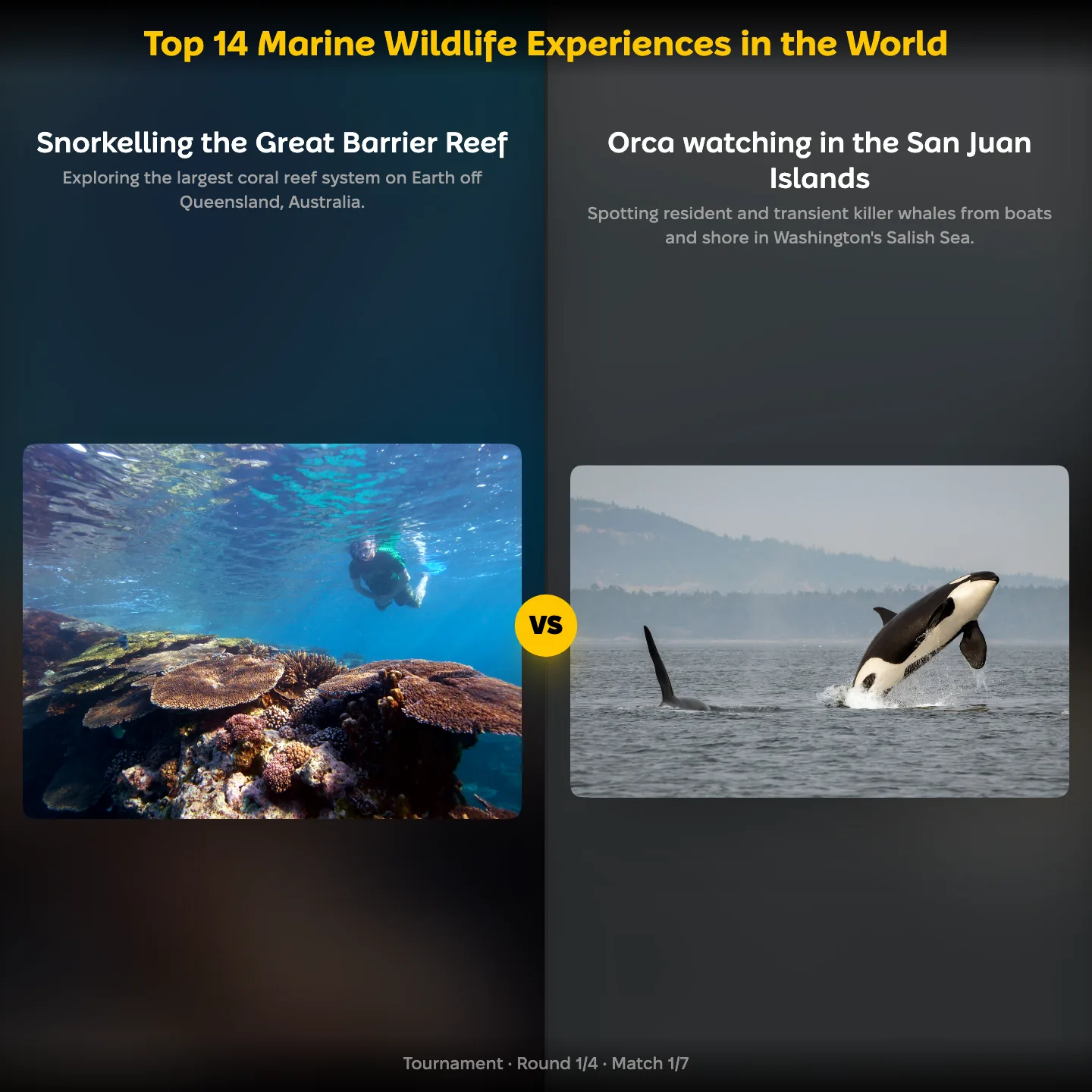
San Juan Islands vs Gansbaai: where to see them
The top 14 marine wildlife experiences in the world turn the matchup into a travel plan. Orca watching in Washington's San Juan Islands and great white shark cage diving in Gansbaai, South Africa, sit beside the Great Barrier Reef, Ningaloo's whale sharks and the gray whale lagoons of Baja California.
The San Juan Islands are home waters for the Southern Resident orcas, a population listed as endangered in 2005. NOAA's July 2025 census counted 74 of them.3
Gansbaai's Shark Alley built a cage-diving industry on great whites, along the same South African coast where Port and Starboard hunt.
The Great Barrier Reef is paired with the orca here because it asks for no luck at all: the reef is always there.
The orca wins the water, the shark wins the screen
Fourteen rankings split the two animals along one line. Every list about power, intelligence or the hunt itself has the orca's evidence behind it, from the Farallones to Mossel Bay. Every list about fear, film and reputation belongs to the great white, a fish that has carried one movie for half a century.
Each of these lists is settled the way the ocean settles it, one head-to-head pick at a time. If a predator you care about is missing, build a ranking around it and see who it has to beat.
More rankings, more angles
- Lion vs Tiger: Who Is the Real King of the Jungle? 14 Lists — the land version of this matchup
- Is T. Rex the Greatest Predator Ever? Where It Lands on 14 Lists — a 97°F hunter and a $31.8 million skeleton
- The Wolf: Greatest Apex Predator or Fairy-Tale Villain? 16 Lists — another pack hunter with a bad name
Sources
- Point Blue Conservation Science, publication brief on Jorgensen et al. (2019), Scientific Reports — the 4 October 1997 orca kill at the Farallon Islands, 165 sharks tagged 2006–2013, sharks leaving within a day, 62% drop in seal kills: pointblue.org (checked 2026-10-04)
- Popular Science — Starboard's solo kill of a white shark at Mossel Bay, June 2023, published in the African Journal of Marine Science: popsci.com (checked 2026-10-04)
- NOAA Fisheries — killer whale size, global population, Southern Resident ESA listing and the July 2025 census: fisheries.noaa.gov (checked 2026-10-04)
- NOAA Fisheries — white shark size, nursery areas, US protection and population trend: fisheries.noaa.gov (checked 2026-10-04)
- Florida Museum of Natural History, International Shark Attack File — 2025 worldwide summary: floridamuseum.ufl.edu (checked 2026-10-04)
- National Geographic — the 2010 SeaWorld Orlando death and a NOAA biologist on wild killer whales: nationalgeographic.com (checked 2026-10-04)