
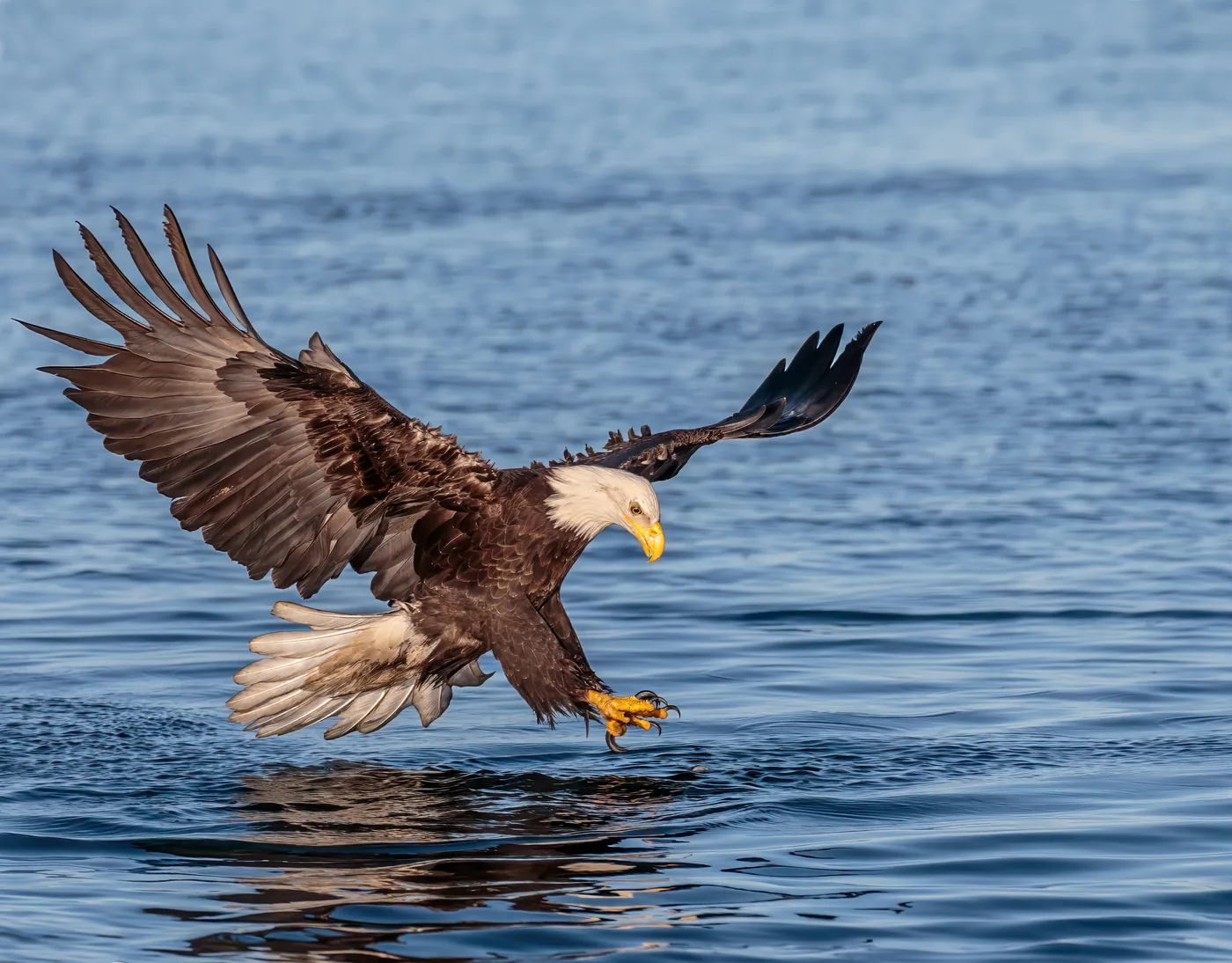
The United States turns 250 in 2026, and its national bird has held the title for barely a year and a half. The bald eagle has been on the Great Seal since 1782, when the secretary of Congress proposed the design, but no law actually named it the national bird until one was signed on Christmas Eve 2024.1 The bird shows up in fourteen rankings here, and several of them are unkind.
The bald eagle wins every list America wrote for it, and loses most of the ones nature wrote.
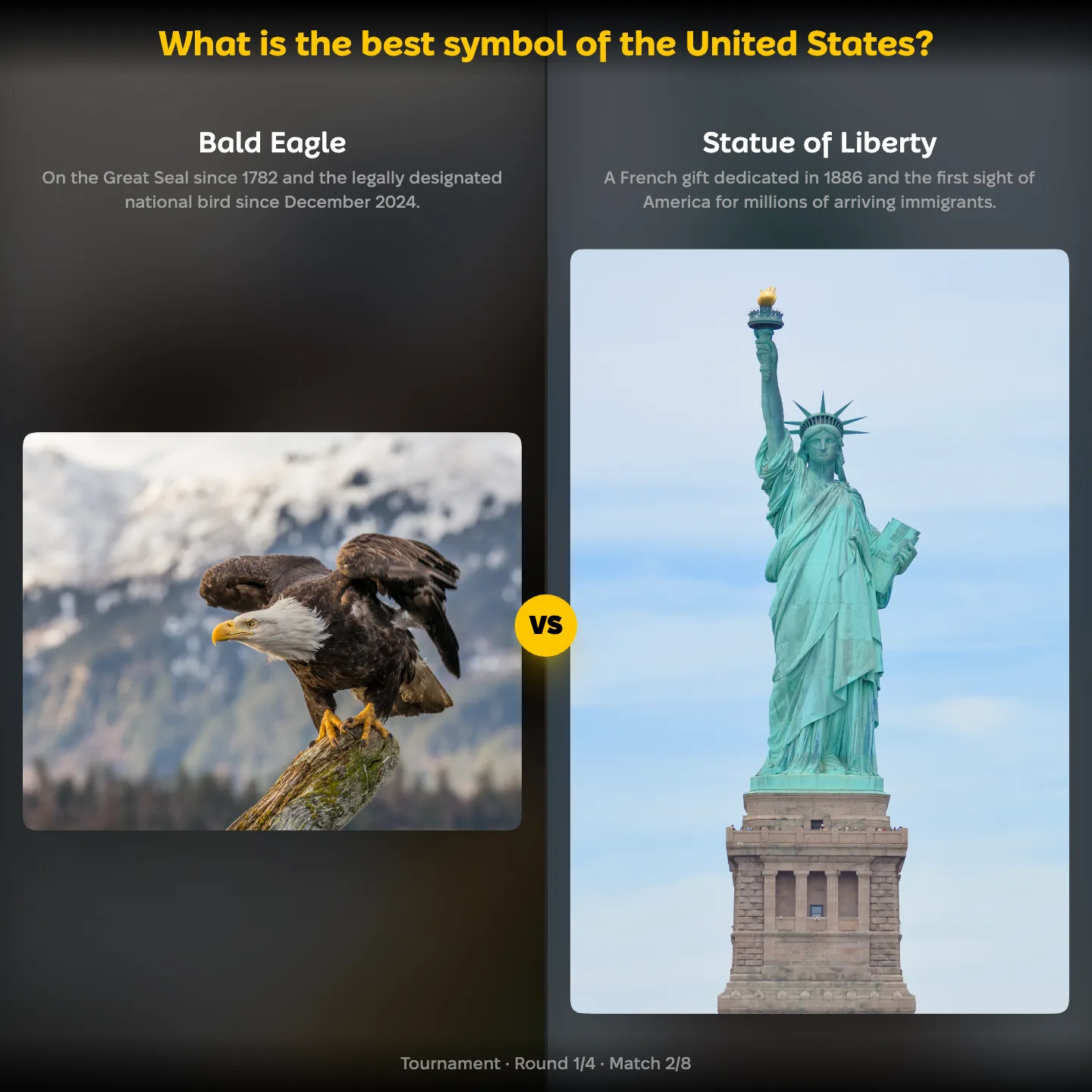
Bald Eagle vs Statue of Liberty: two symbols, one country
This ranking asks which single thing stands for the United States, and it puts the bald eagle up against everything else a classroom poster carries.
The eagle's claim is age plus paperwork. It served as the country's emblem by custom for 242 years before Congress wrote the designation into statute in December 2024.1
The Statue of Liberty makes a different case. It arrived as a gift from France, was dedicated in 1886, and was the first sight of the country for millions of people coming in through New York Harbor.
Everything else here is architecture or an object: Mount Rushmore, the Liberty Bell, Route 66, apple pie, the flag itself. Only the eagle can fly away from the country it stands for.
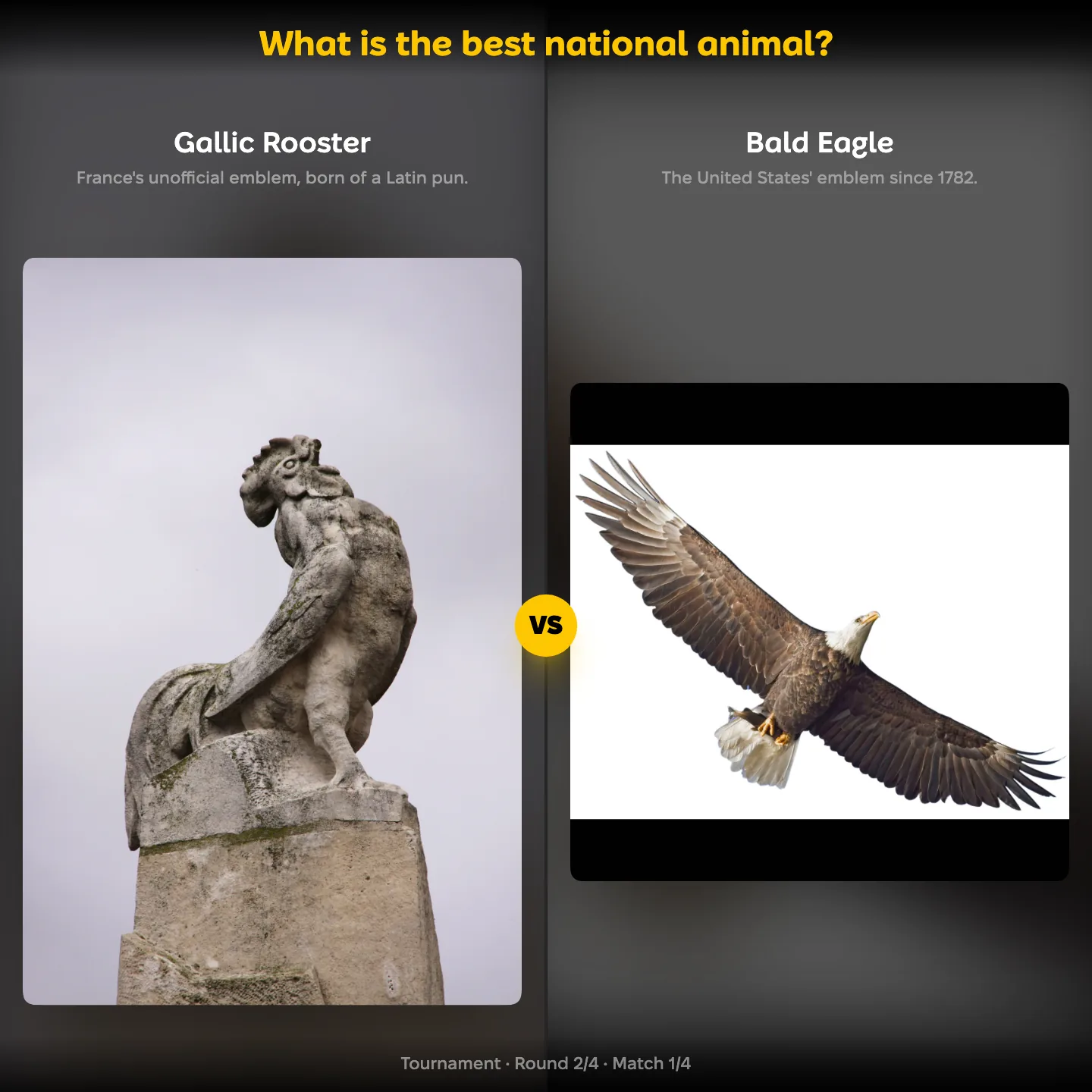
The Gallic Rooster, the Kiwi and the bird America chose
Almost every country keeps an official animal, and this ranking sets those choices against each other.
The American choice is unusually literal about what a country is for. Thirteen arrows in one foot, a peace offering in the opposite talon, and a head turned deliberately away from the weapons.
France went the other way entirely. The Gallic rooster comes from a Latin pun, because gallus meant both a Gaul and a cockerel. New Zealand picked a flightless, nocturnal bird that cannot see well and named its own people after it.
Set against a lion, a tiger or an elephant, the bald eagle is the smallest animal in the room. It is also one of the few that most of its countrymen have watched hunting.
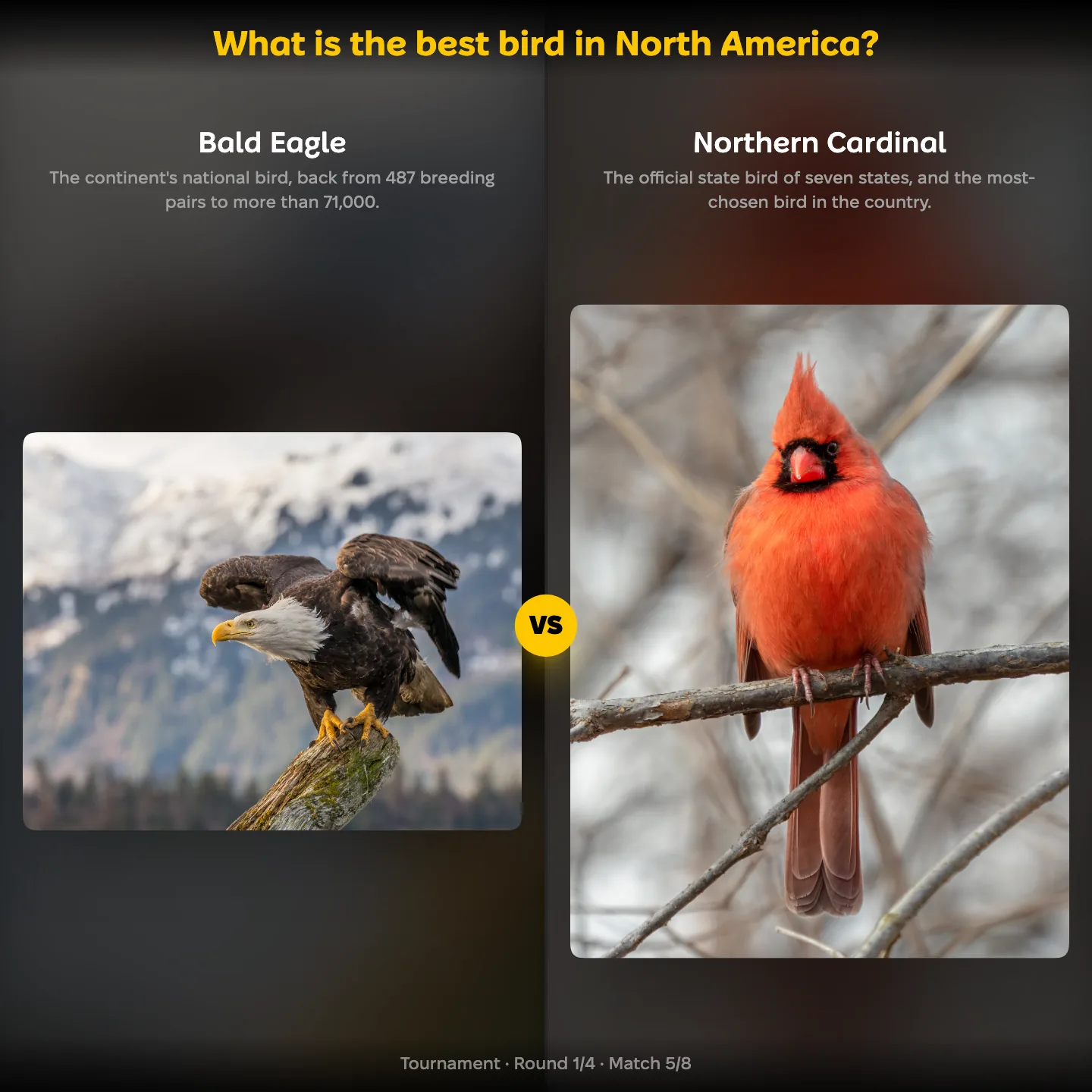
Northern Cardinal vs Bald Eagle: seven states against one country
Narrow the field to one continent and the national bird meets the birds Americans actually have in the garden.
The northern cardinal is the official state bird of seven states — Illinois, Indiana, Kentucky, North Carolina, Ohio, Virginia and West Virginia.2
The bald eagle is the state bird of none of them.2 It stands for the whole country and for no corner of it, and on a ranking of local favourites that absence counts.
Around them sit the garden regulars plus one old grudge: the American robin, the blue jay, the ruby-throated hummingbird that crosses the Gulf of Mexico without landing, and the wild turkey that Benjamin Franklin wanted for the job instead.
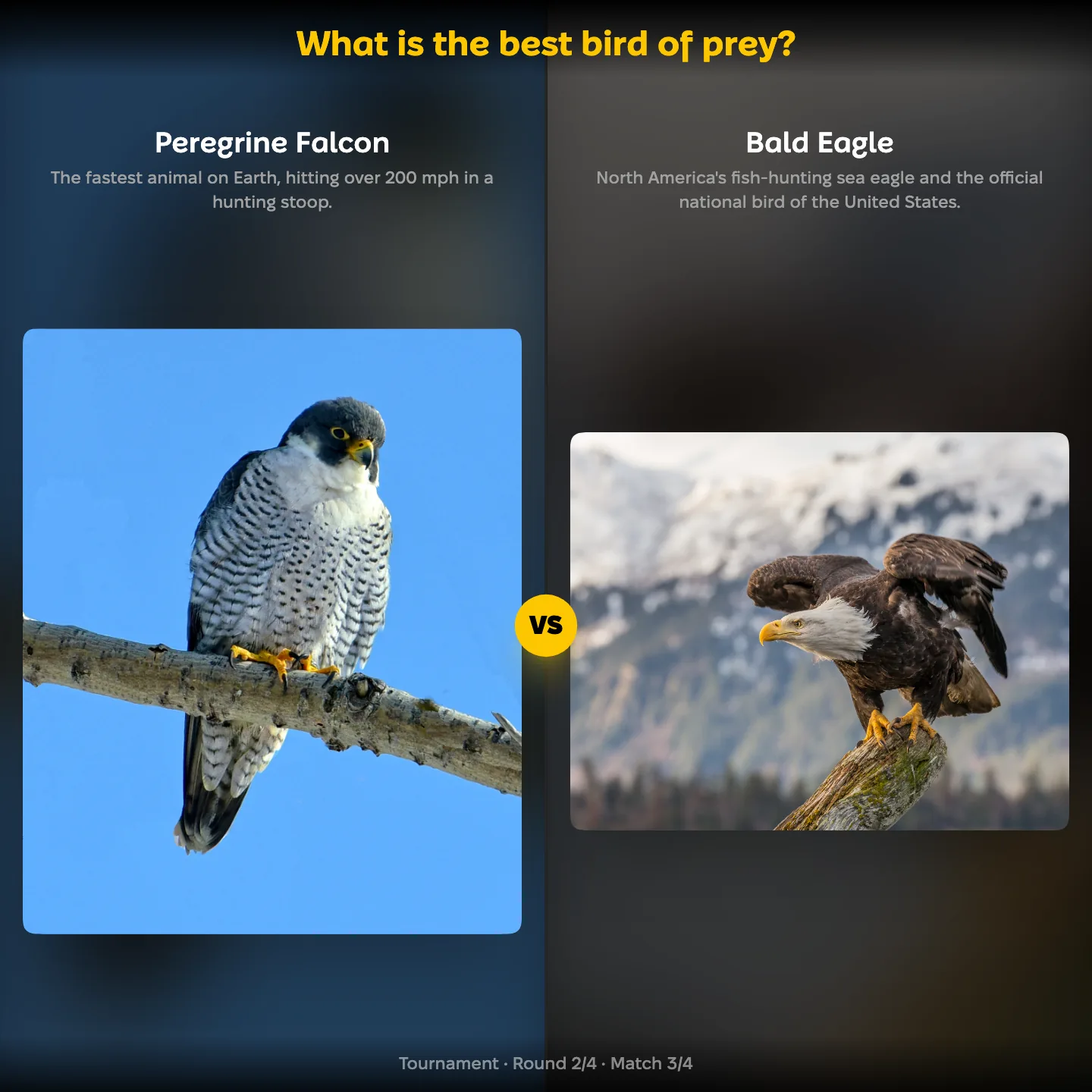
Peregrine Falcon vs Bald Eagle: 200 mph against a wingspan
Judged as a raptor rather than as a symbol, the bald eagle is in a much harder field than it is used to.
Guinness World Records gives the fastest bird dive to the peregrine falcon, at 320 km/h, or 200 mph, in a hunting stoop.3
Size does not rescue the argument either. The harpy eagle has talons the length of a grizzly bear's claws, the Philippine eagle is longer in the body, and Steller's sea eagle is simply heavier.
What the bald eagle has is reach. It is the raptor most people on its continent can name and the one they are most likely to have seen, and familiarity is a real qualification on a list voted on by humans.
417 pairs in 1963: the DDT recovery
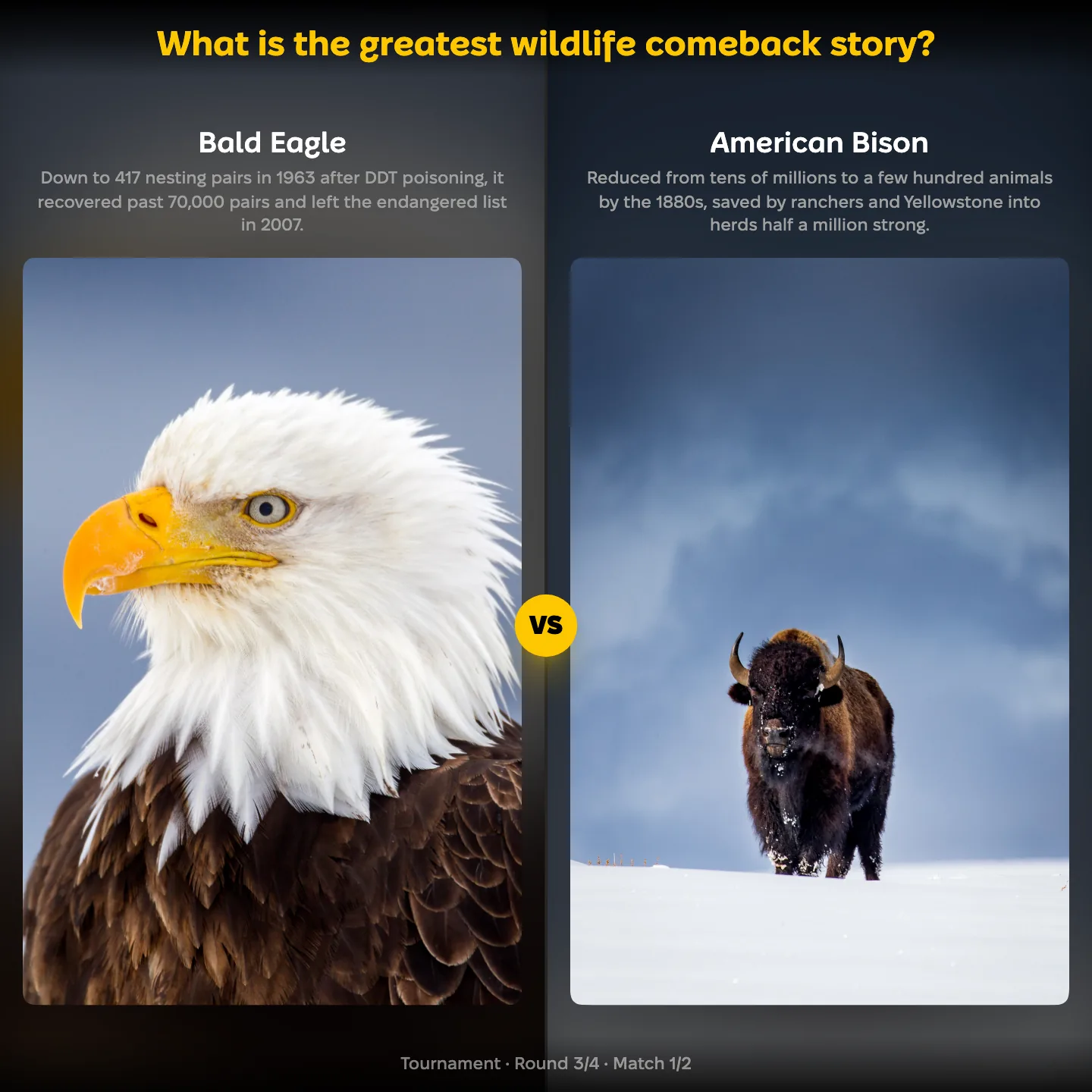
This ranking asks which species came back from the closest call, and the bald eagle's version of the story is the reason the bird is not a museum exhibit.
DDT thinned the shells of its eggs until incubating parents broke them. By 1963 the lower 48 states held an all-time low of 417 breeding pairs.4
The Interior Department took the bird off the endangered species list on 28 June 2007, counting 9,789 breeding pairs.4 The Fish and Wildlife Service's aerial surveys of 2018 and 2019 then put the lower-48 population at 316,700 birds, including 71,400 nesting pairs, more than four times the estimate from a decade earlier.5
That 2021 count was not a headline estimate pulled from nowhere. Fish and Wildlife pilots and observers flew survey transects across the lower 48 over two breeding seasons and combined the results with sightings logged in the eBird app, run with the Cornell Lab of Ornithology.5
It is not competing against easy cases either. The American bison fell to a few hundred animals by the 1880s. The Arabian oryx had gone extinct in the wild altogether before it was put back, and the California condor got down to a number you could fit in a single aviary.
Yellowstone's grizzlies and a bird you can see from a car park
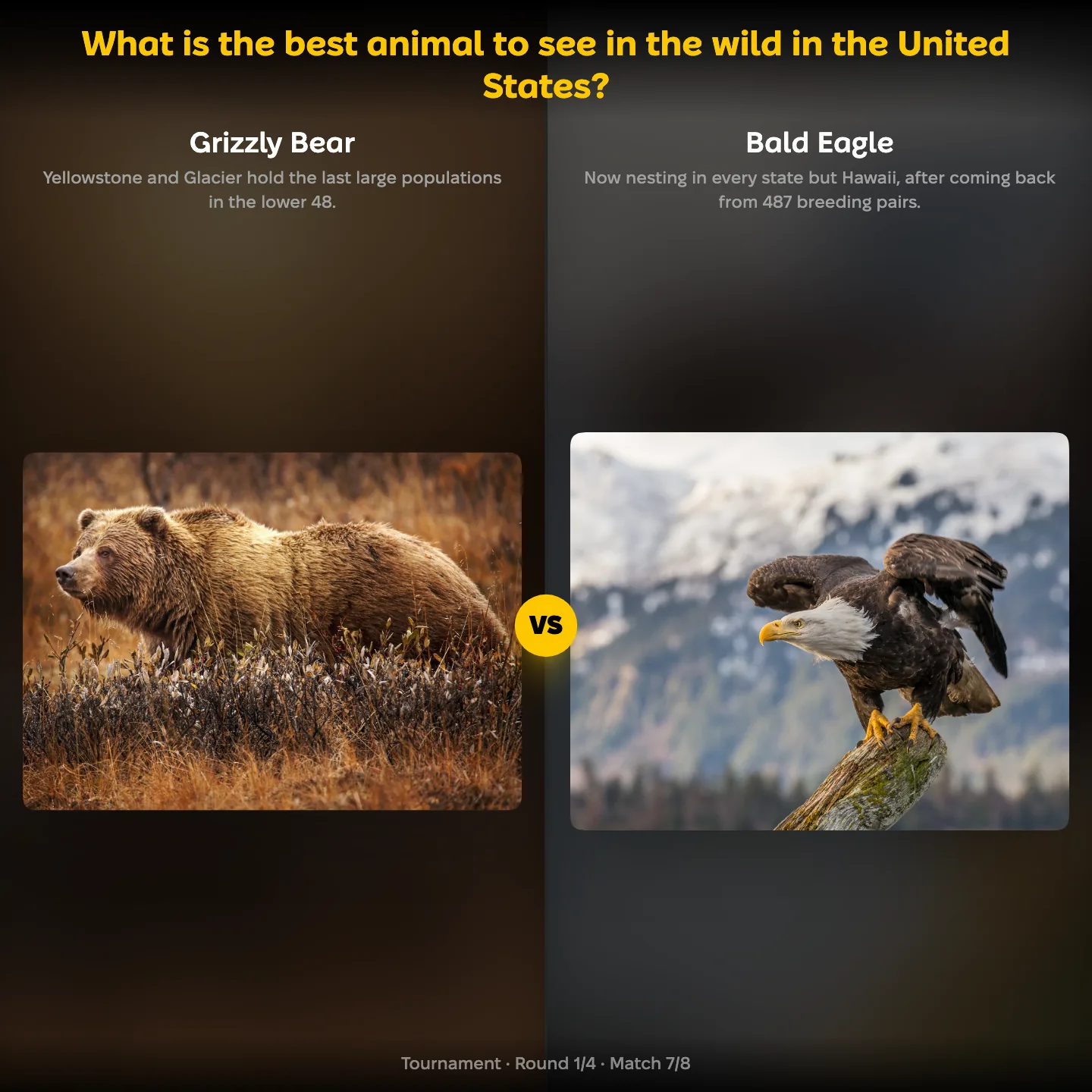
Here the question is what an American animal is worth travelling for, which turns the eagle's greatest asset into a liability.
Its advantage is availability. After the recovery it nests across the lower 48, so finding one takes a river, a bridge and some patience rather than a flight and a guide.
The grizzly bear, the bison and the gray wolf need a particular address, mostly Yellowstone or Glacier, and the trip is the experience.
Against a breaching humpback or a bull elk bugling in the Rockies, a bald eagle on a dead branch is a quieter afternoon.
Great Seal, 1782: arrows in one foot, olive branch in the other
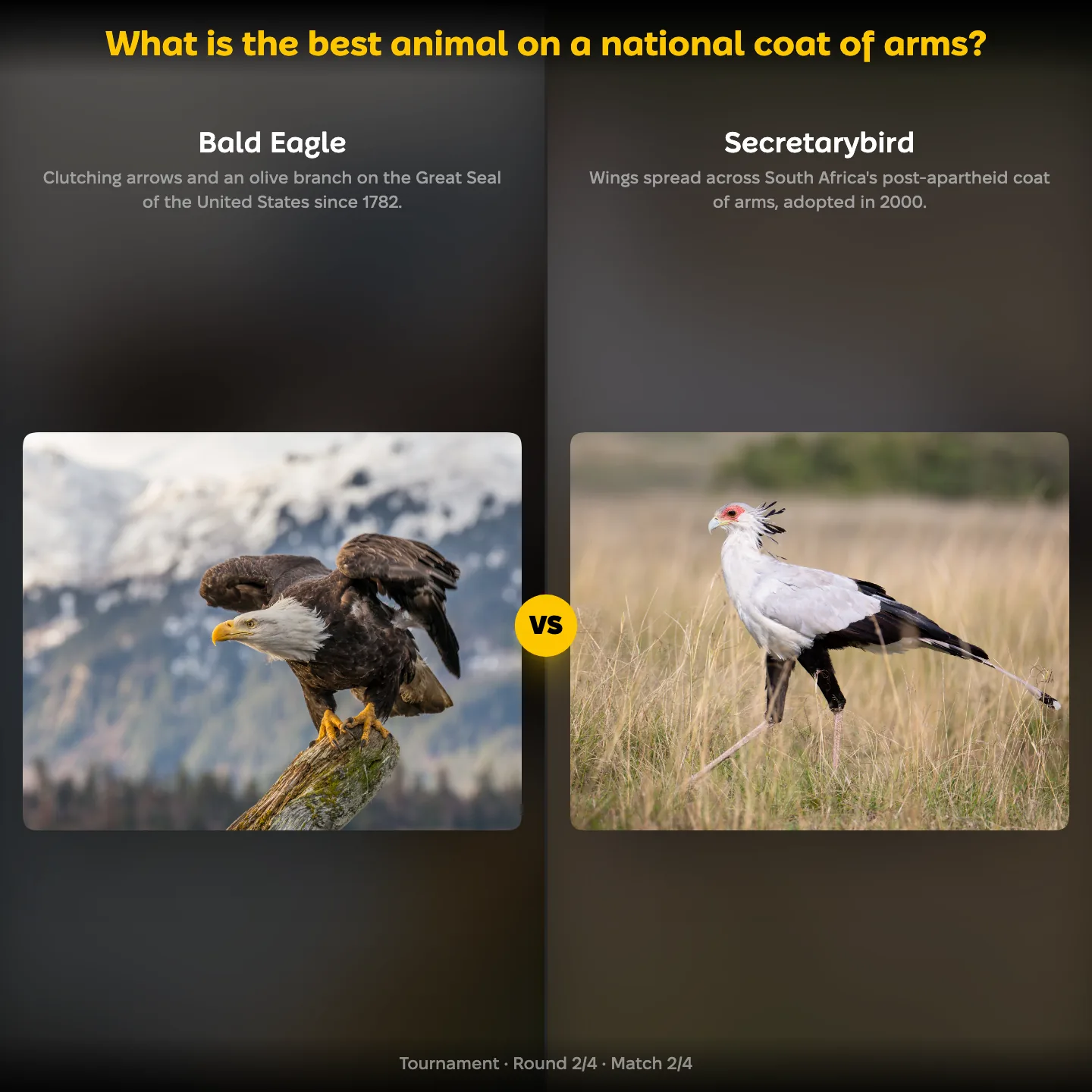
Heraldry is the one field where the bald eagle is competing on its home ground, because the design is the achievement.
Nigeria's arms are held up by two white horses. South Africa put a secretarybird across its post-apartheid emblem. Guatemala uses the quetzal, and Mexico's golden eagle stands on a cactus with a snake in its beak, straight out of the Aztec founding story.
Mexico's bird is the direct comparison, and it has the better narrative. The American eagle has the better silhouette.
The quarter, the loonie and the buffalo nickel
Currency is the most-handled design any country produces, and this ranking is about which animal earned that job.
American coinage has carried the bird for as long as there has been American coinage. The gold piece the mint struck for over a century was called, simply, an eagle.
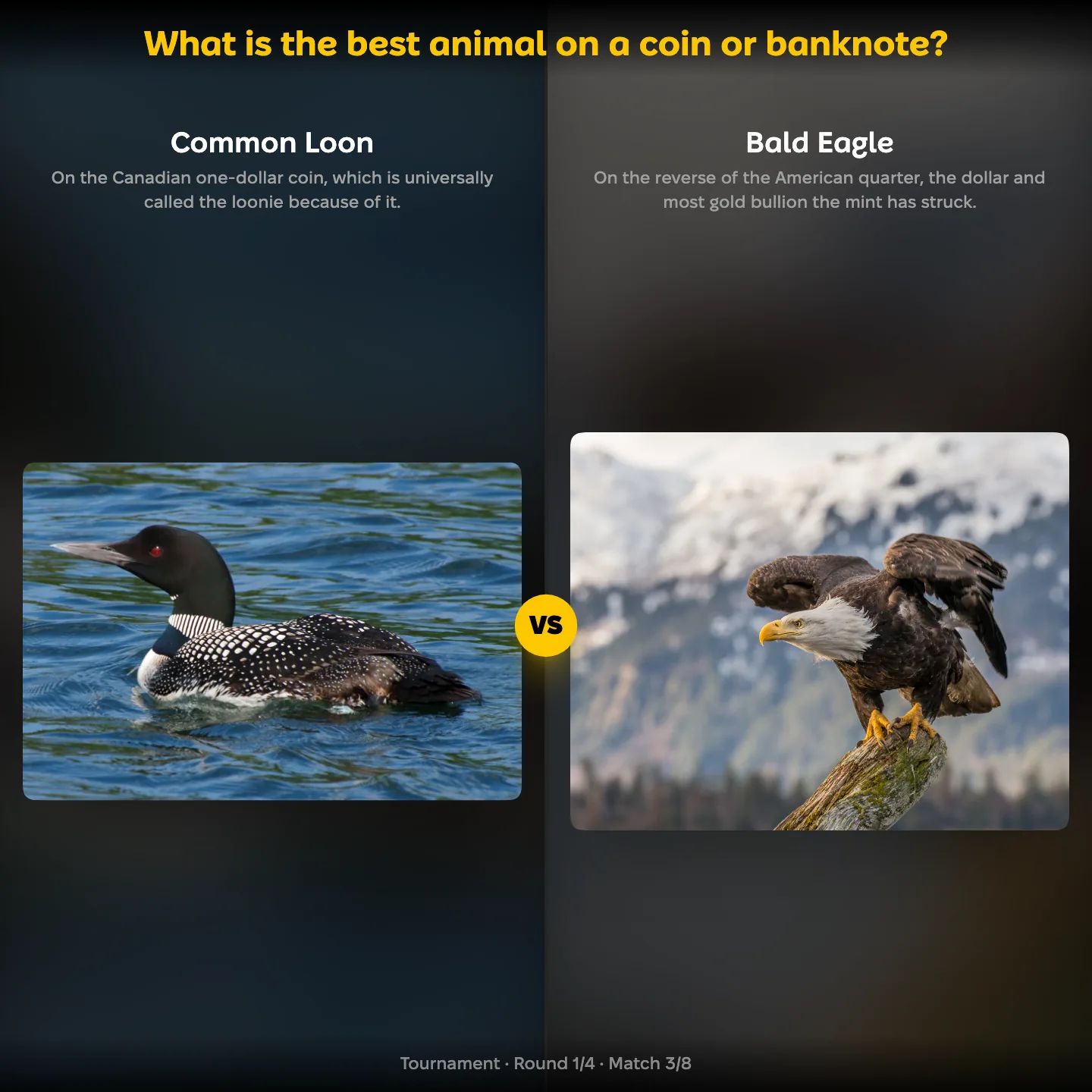
Canada named its dollar coin after the loon printed on it. Australia's twenty-cent piece carries a platypus, an animal European naturalists first assumed was a fake.
One American rival stands out. The Buffalo nickel put a bison on the reverse and a Native American profile on the obverse, and collectors have spent a century calling it the best-looking coin the United States ever struck.
Osprey vs Bald Eagle: who actually catches the fish
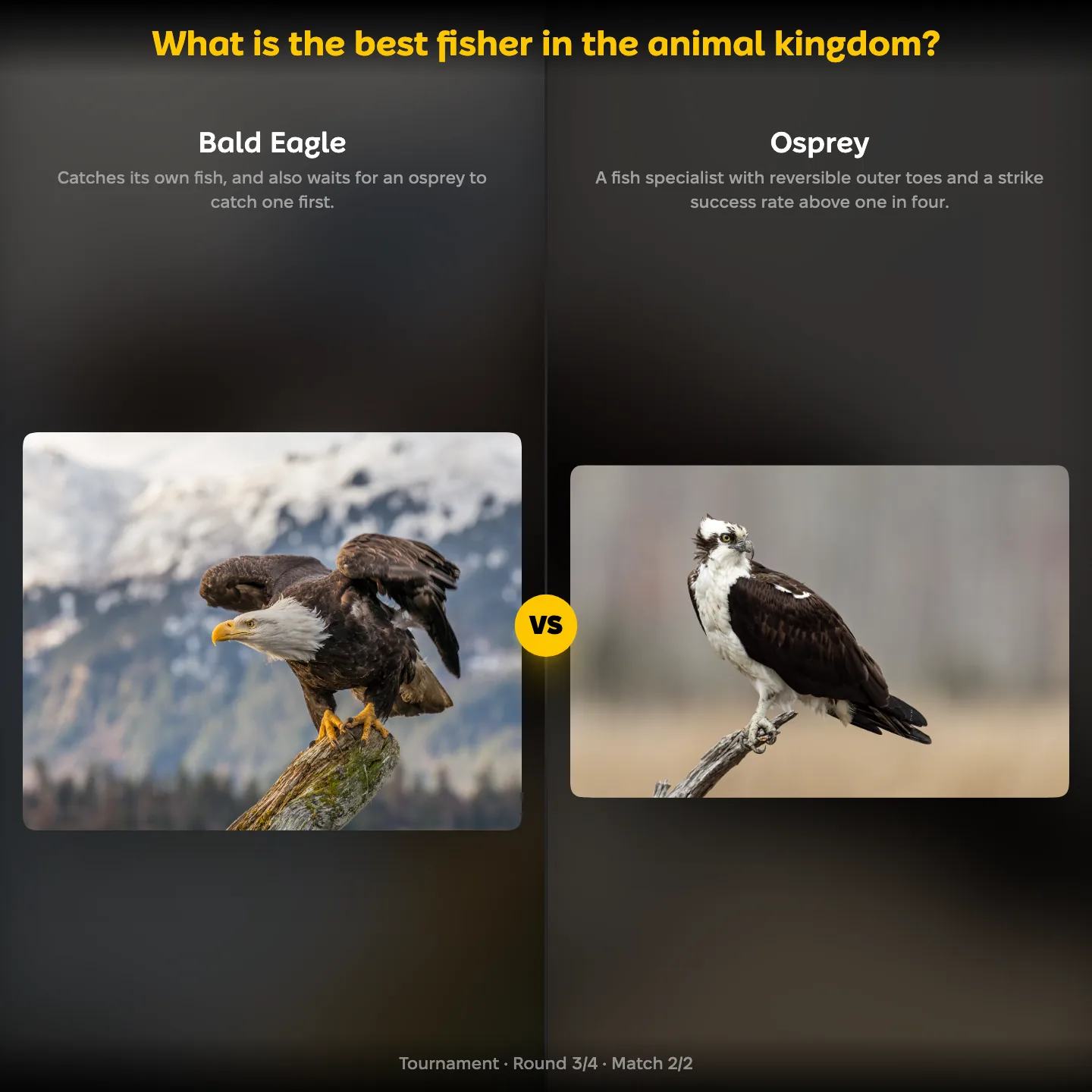
Strip out the symbolism and rank these animals on catching fish, and the national bird has a problem.
The osprey is the specialist. It has reversible outer toes and spined foot pads, it plunges feet-first from height, and it comes up with something a good share of the time.
The bald eagle fishes too. It also waits for an osprey to do the work: the Smithsonian's National Zoo describes it using its size to bully smaller birds of prey, ospreys included, out of their catches.6
Grizzly bears, herons, gannets and orcas fill out the field, and not one of them needs an intermediary.
Franklin's charge: a bird of bad moral character
This ranking collects the animals that make a living from other animals' work, and the bald eagle was nominated for it more than two centuries ago.
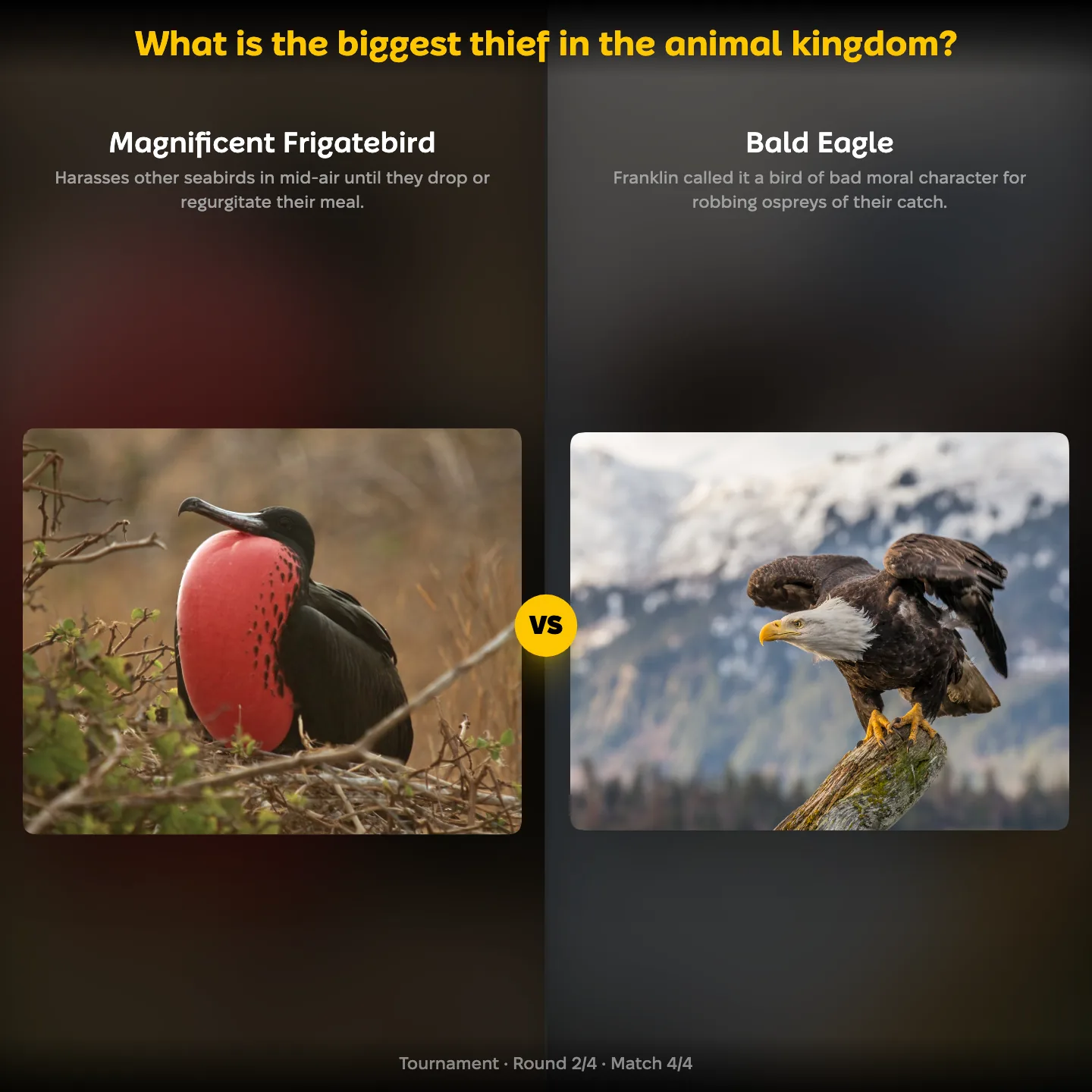
Writing to his daughter Sarah in 1784, Benjamin Franklin called the bald eagle a bird of bad moral character that did not get its living honestly.1
He was describing kleptoparasitism, and on the behaviour he was correct. The bird harasses smaller raptors until they let go of a fish, and it scavenges carrion when it comes across it.6
The competition is more committed. A magnificent frigatebird does almost nothing else for a living. A great skua chases gannets professionally. A raccoon opens the bin.
Franklin lost this one in his own lifetime. The eagle was already on the Seal when he wrote the letter, and it stayed there.
The eagle scream in every film is a Red-tailed Hawk
The most famous sound a bald eagle makes is not a sound a bald eagle makes.
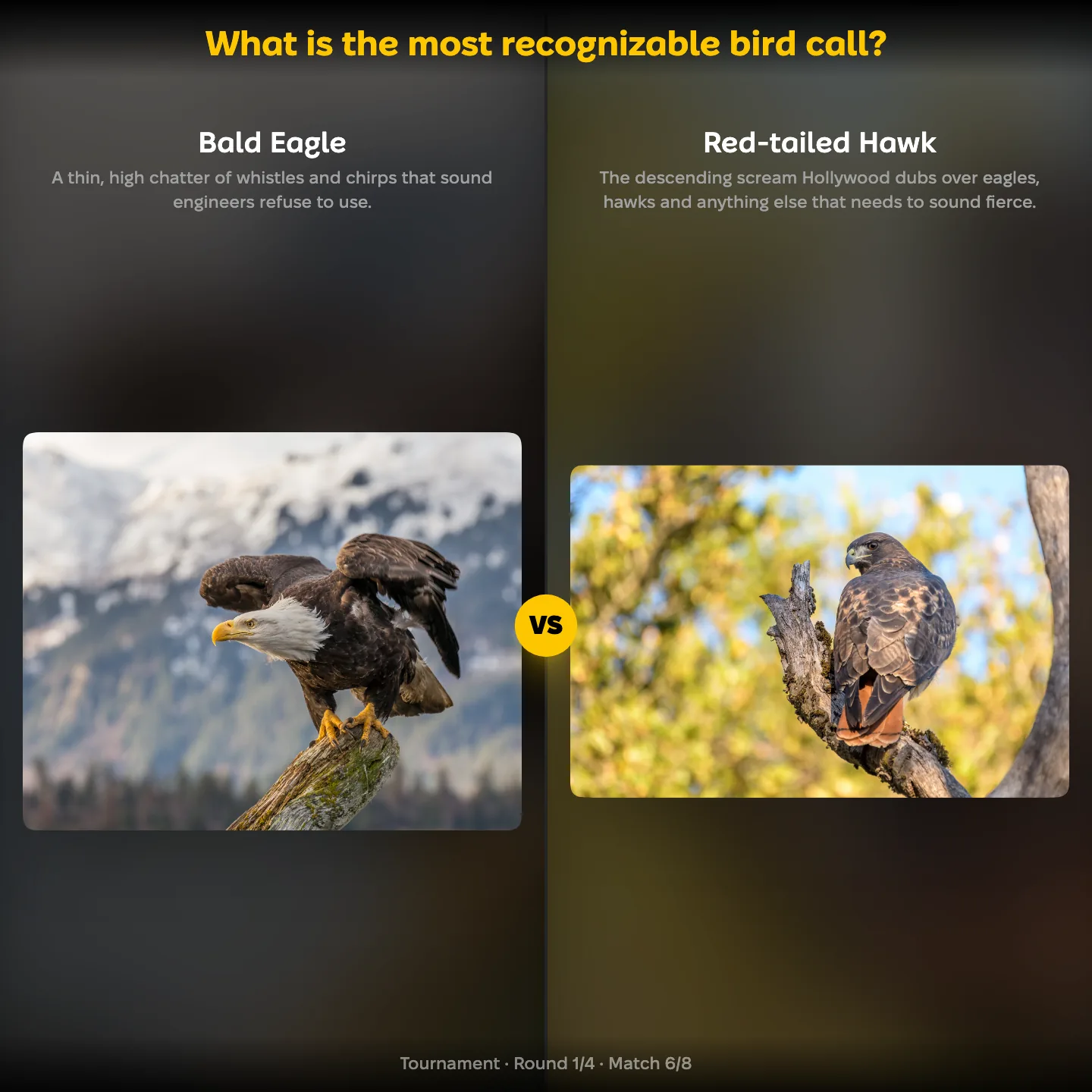
That descending scream over the canyon shot belongs to a red-tailed hawk. Missouri's Department of Conservation puts the reason plainly: eagles have a softer, higher voice, so sound editors reach for the hawk instead.7
What the bird actually produces is a thin chatter of chirps and whistles, which is why audiences reject recordings of the real thing as wrong.
The rest of this ranking earned its places honestly: the rooster, the loon's wail across a northern lake, the kookaburra's cackle, the cuckoo that got a clock named after it.
The substitution has worked so well that the real recording needs a caption. Missouri's conservation department publishes the genuine call with an explanation attached, because the bird does not sound like the bird people think they know.7
The red-tailed hawk sits in this ranking under its own name, credited for once.
Two tonnes in a Florida pine: the biggest nest ever measured
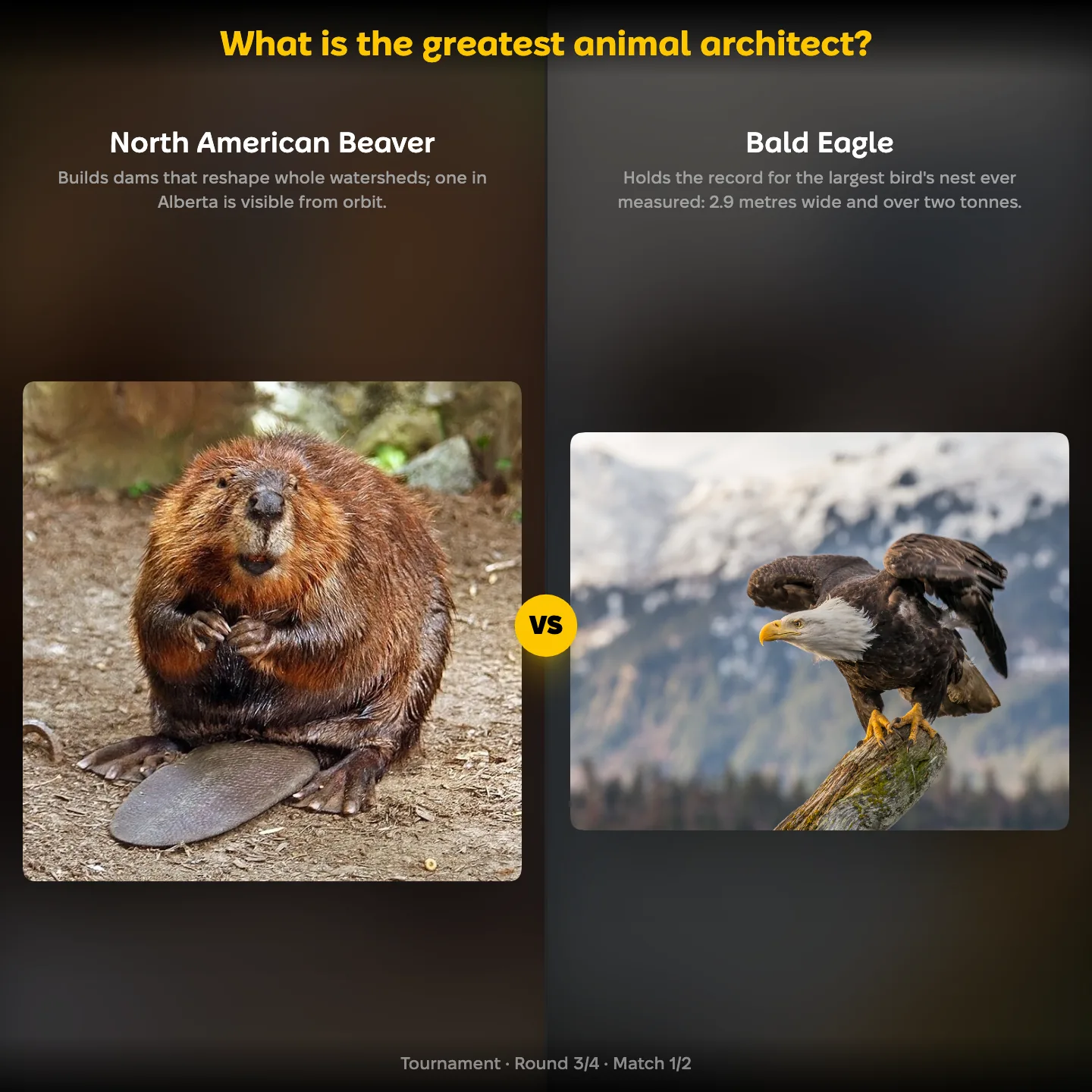
Ranked as builders, the bald eagle owns a world record no rival here approaches.
A pair near St Petersburg, Florida built the largest bird's nest ever recorded: 2.9 metres wide, 6 metres deep, examined in 1963 and estimated to weigh more than two tonnes.8
That was an outlier produced by patience rather than skill. A normal eagle nest runs four to six feet across,6 and it gets big because the pair comes back to the same one year after year and keeps adding sticks.
Beavers redirect entire watersheds. Termites build towers with passive ventilation. A sociable weaver colony puts up thatched apartment blocks that outlast the birds that started them.
Peacocks, quetzals and a bird designed by a committee
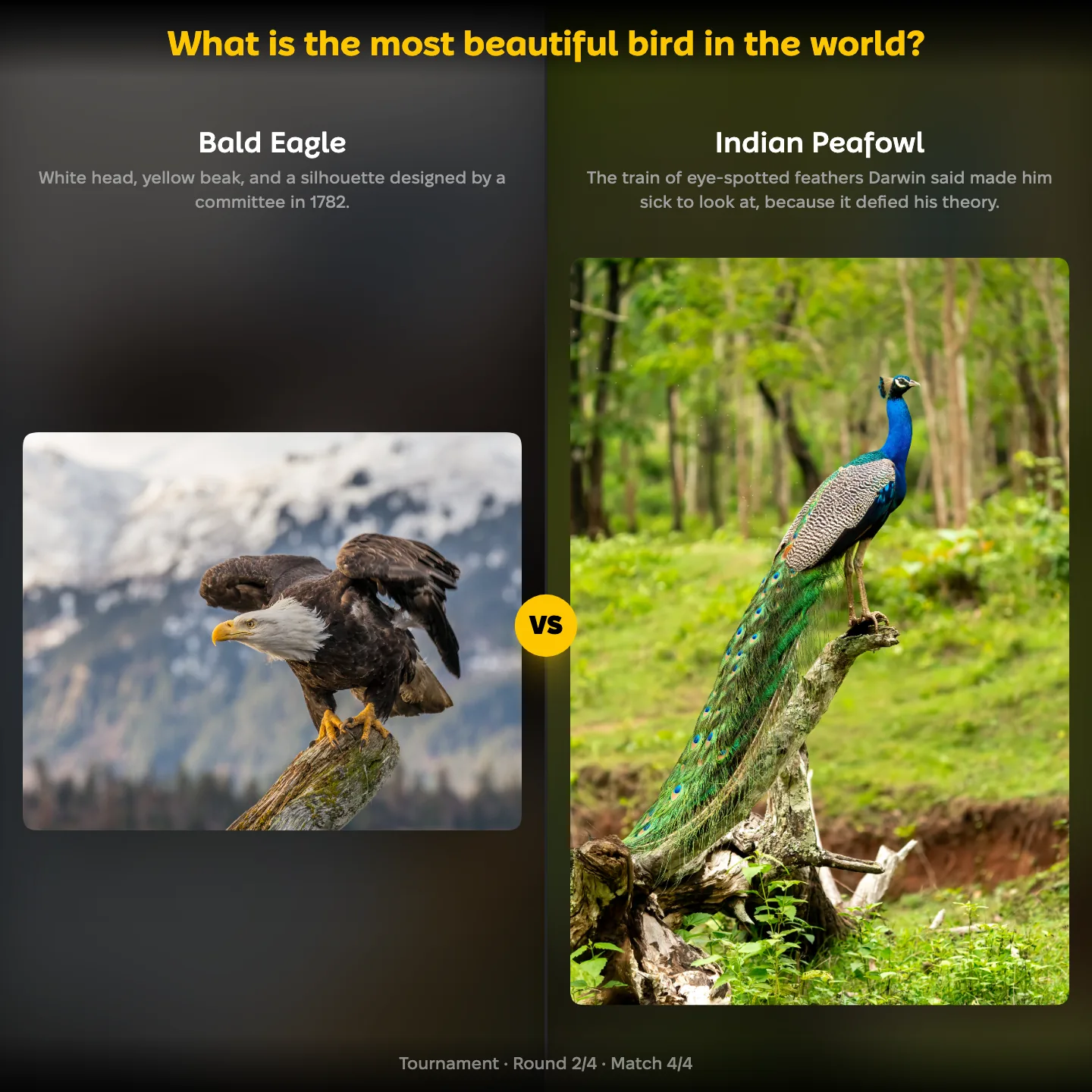
Judged on looks alone, with the symbolism removed, the bald eagle is brown with a white head and a yellow beak. That is the whole palette.
The peacock has a train of eye-spots that Darwin said made him ill to look at, because it defied his own theory. The resplendent quetzal trails tail feathers longer than its body. The scarlet macaw wears three colours at full volume.
The eagle's design does one thing extremely well: it reads at distance and it prints in a single colour. Those are the requirements of a government seal, not of a beauty contest.
The sloth, the panda and the national bird
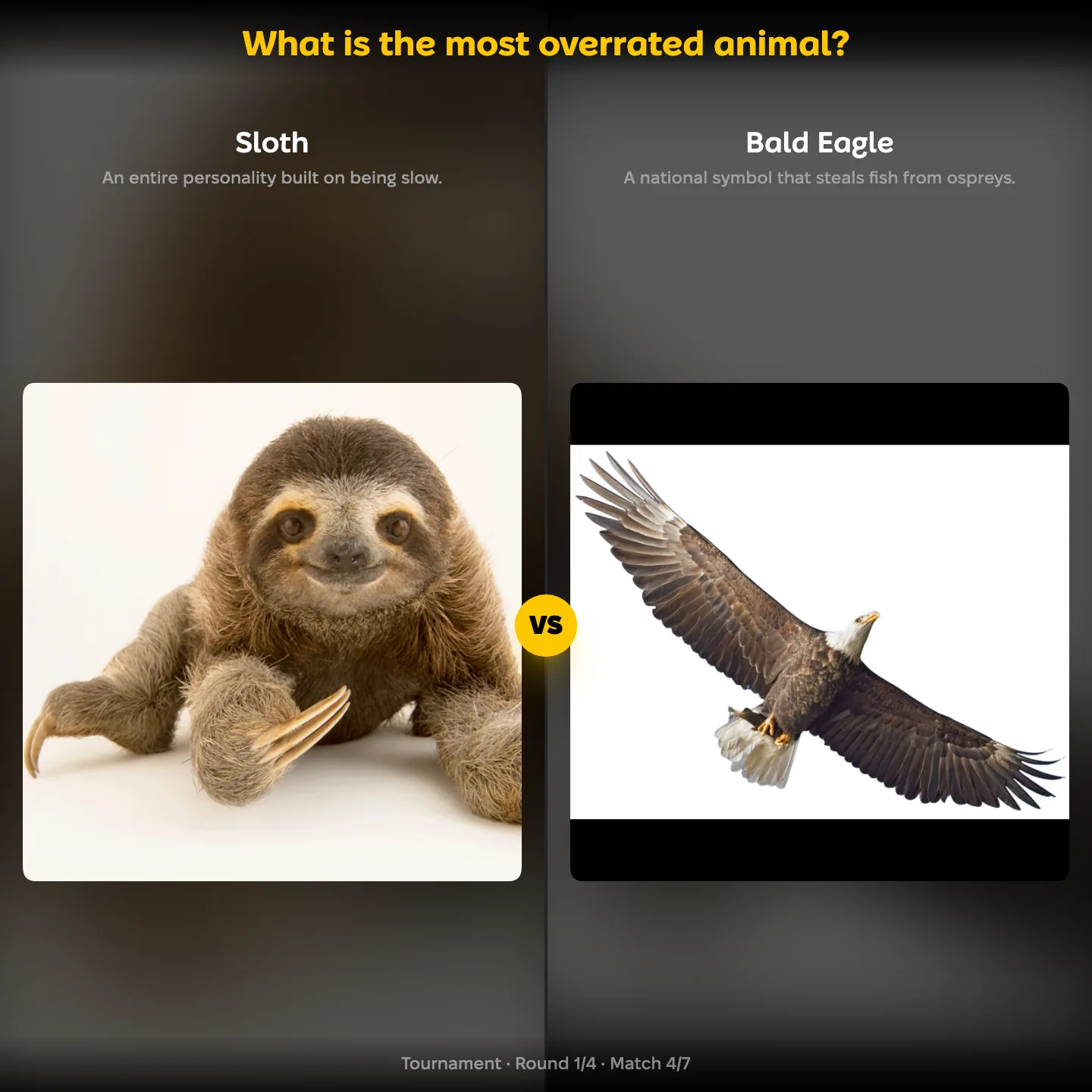
The last ranking asks which animal gets more attention than its record deserves, and most of the case against the bald eagle is already in this article.
It robs ospreys. Its voice has to be replaced in post-production. Not one state has claimed it as a local bird, and the country only got round to the paperwork in 2024.
The defence is that the recovery actually happened, and that policy did it. Banning a pesticide and enforcing a law brought a bird back from a few hundred pairs, which is more than most national symbols can point to.
Its rivals here are formidable. The giant panda absorbs a conservation budget while refusing the diet its own gut is built for. The sloth has built an entire personality on being slow.
One bird, fourteen jobs
Fourteen rankings, and the bald eagle is a different animal in each: a founding document in feathers, an ordinary fish hawk with a bad habit, a bird that cannot make its own noise, and the holder of a two-tonne world record. The lists America wrote for it were always going to flatter it. The ones about hunting, singing and looking good were never going to.
All fourteen get decided in pairs, two options on screen and one click. Comparing things two at a time is what produces the order here. Pick whichever question strikes you as least fair to the eagle and go argue with it.
More rankings, more angles
- The Wolf, Ranked 16 Different Ways — the other American predator that came back
- Lion vs Tiger, Ranked Side by Side — two national animals that never meet in the wild
- Secretariat Ranked Many Ways — three records from 1973 that still stand
- Bears Turn Up on Lists About Oscars, Art Auctions and the NFL — Paddington, Fozzie and the 1985 Bears
Sources
- Smithsonian Magazine — the bald eagle's designation as national bird (signed 24 December 2024), the 1782 Great Seal design, and Benjamin Franklin's "bird of bad moral character" letter: smithsonianmag.com (checked 2026-08-27)
- State Symbols USA — official state birds by state, including the northern cardinal's seven states and the bald eagle's status as a national rather than state bird: statesymbolsusa.org (checked 2026-08-27)
- Guinness World Records — fastest diving bird, peregrine falcon at 320 km/h: guinnessworldrecords.com (checked 2026-08-27)
- U.S. Department of the Interior — news release announcing the bald eagle's removal from the endangered species list on 28 June 2007, with the 1963 low of 417 breeding pairs and 9,789 pairs at delisting: doi.gov (checked 2026-08-27)
- Smithsonian Magazine, reporting the U.S. Fish and Wildlife Service 2018–19 aerial survey — 316,700 bald eagles and 71,400 nesting pairs in the lower 48 states: smithsonianmag.com (checked 2026-08-27)
- Smithsonian's National Zoo and Conservation Biology Institute — bald eagles bullying ospreys and other smaller raptors for their catches, scavenging, and typical nest dimensions: nationalzoo.si.edu (checked 2026-08-27)
- Missouri Department of Conservation — why film and television dub the red-tailed hawk's call over eagles: mdc.mo.gov (checked 2026-08-27)
- Guinness World Records — largest bird's nest, built by bald eagles near St Petersburg, Florida: 2.9 m wide, 6 m deep, examined 1963, estimated over two tonnes: guinnessworldrecords.com (checked 2026-08-27)