
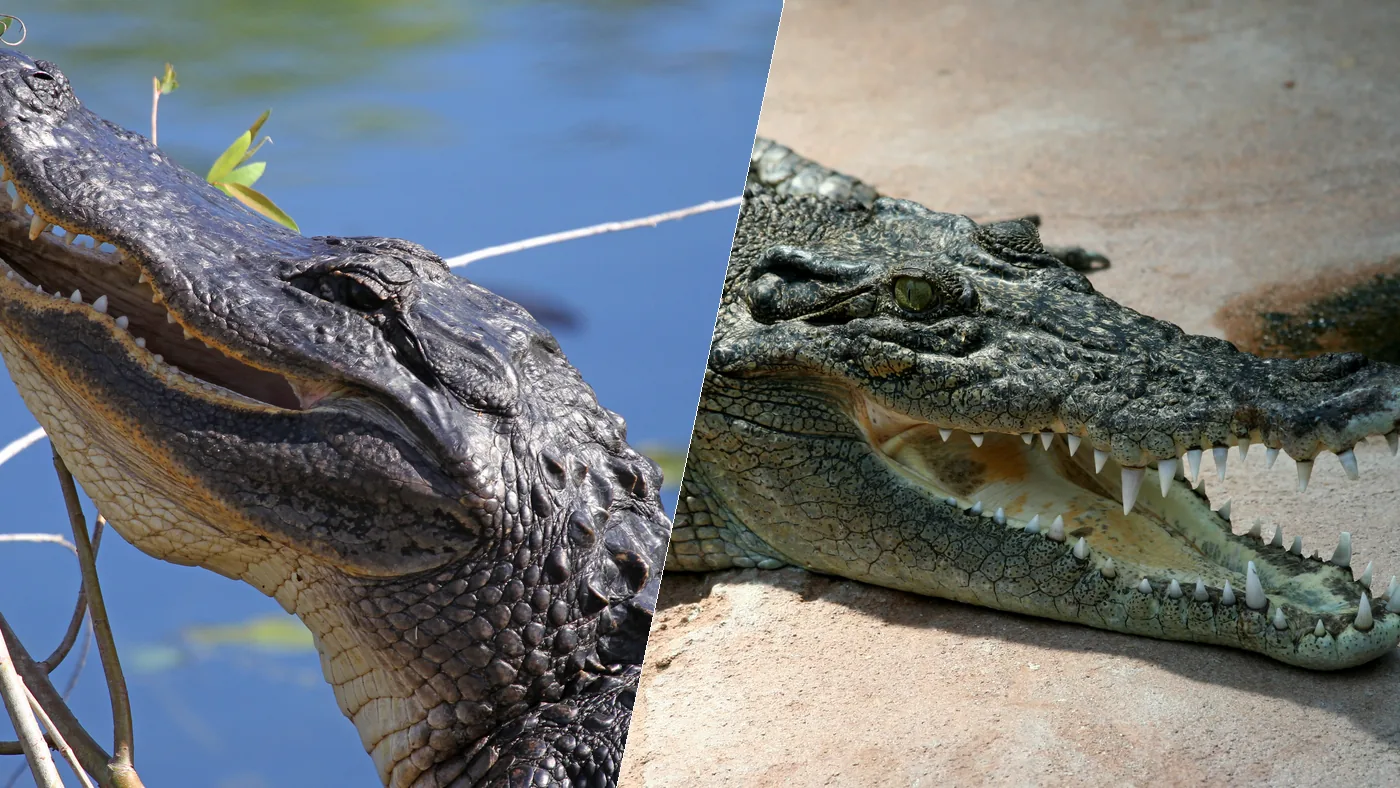
Alligator or crocodile is the question people type when they cannot tell the two apart, and the question they type when they want a fight. Louisiana is answering a third version this month: a new recreational alligator season opens 1 to 31 October 2026, with 5,000 hunters drawn by lottery and two hide tags each.1 Nobody holds a crocodile lottery in the United States, because the American crocodile is a threatened species that lives wild only in South Florida, the one place on Earth where it shares the water with the alligator.2
The rest of the planet keeps them apart. Alligators are American and Chinese; crocodiles run from the Nile to northern Australia. That geography decides most of the fifteen rankings below.
Measure in newtons and metres and the crocodile collects the list. Measure in Florida and the alligator does.
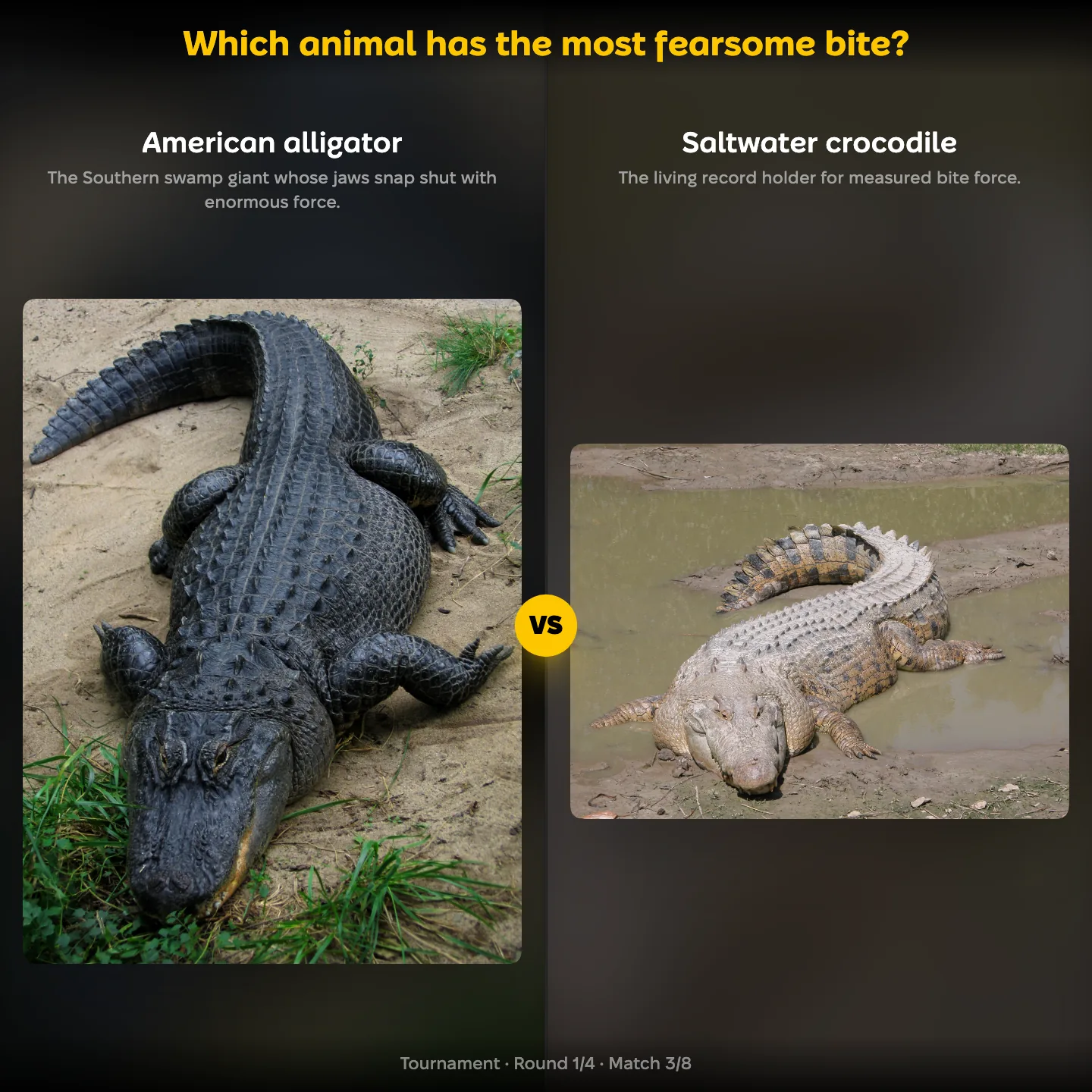
Saltwater Crocodile vs American Alligator: The Bite Nobody Has Beaten
Bite force is the single comparison between alligator and crocodile that an instrument can settle. Both are on this list, along with the hippopotamus, the great white shark and a Tyrannosaurus rex that was never measured by anyone.
The measurement exists for the living ones. In 2012 Gregory Erickson's team put a force meter between the back teeth of 83 adult crocodilians covering all 23 species then recognised, and a saltwater crocodile produced 16,414 newtons, the highest bite force recorded in any living animal.3
The American alligator was in the same study and bit hard enough to embarrass most mammals. What separated it from the crocodile was weight. Erickson's conclusion was that body size, not the shape of the snout, explains almost all of the difference between species.
The broad alligator snout and the narrow crocodile snout turn out to be a way of telling them apart, not a way of predicting who bites harder.
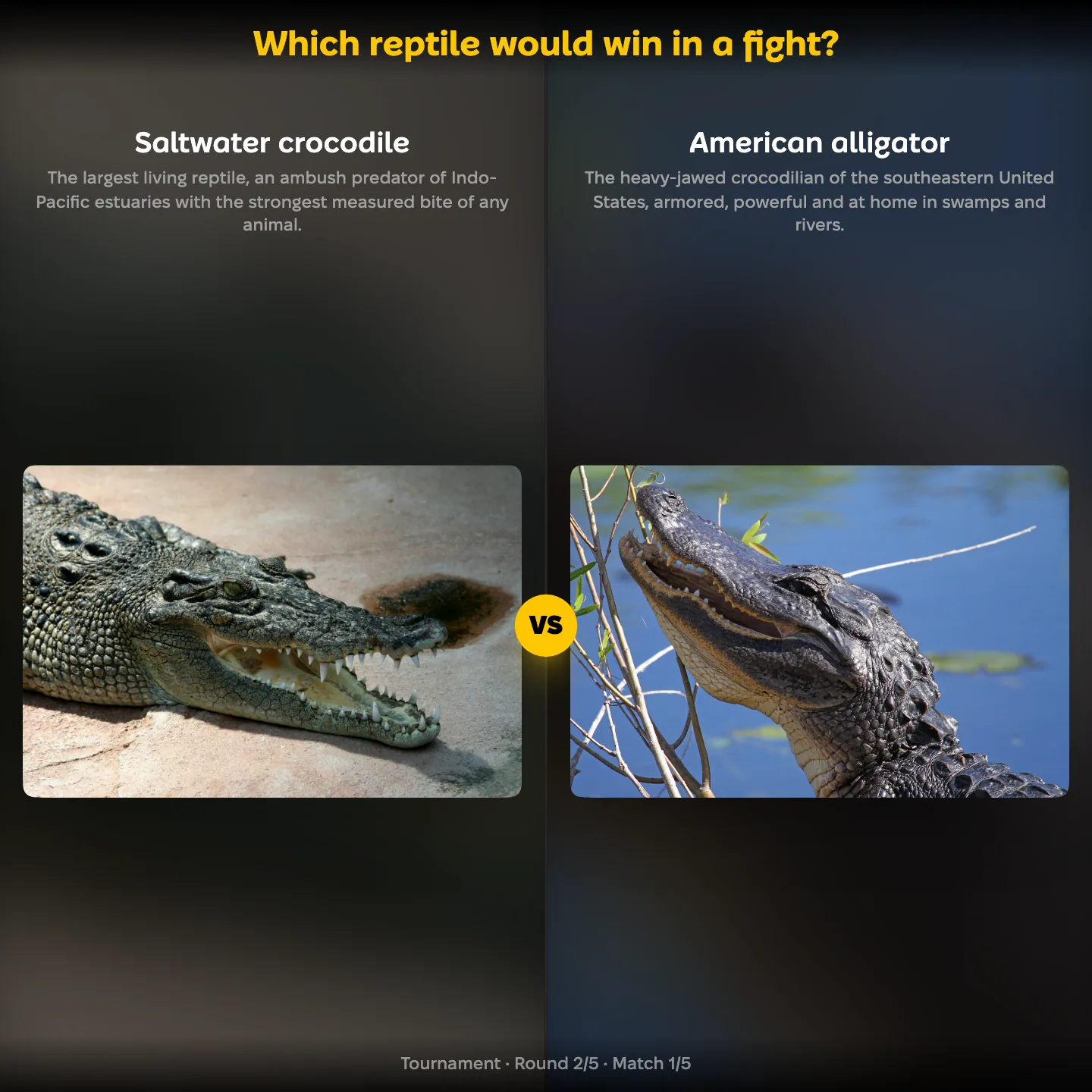
Crocodile vs Alligator vs Komodo Dragon: The Fight Everyone Googles
"Who would win, alligator or crocodile" is the version of this matchup that search engines see most. This ranking makes it a reptile tournament, with the Komodo dragon, the green anaconda, the reticulated python and the king cobra entered alongside the two headliners.
The crocodile's case starts with the tape measure. The Australian Museum calls the saltwater crocodile the largest of all living reptiles, and the largest reliably measured one, caught in the Northern Territory's Mary River in 1974, was at least 615 centimetres long.4
An adult male American alligator occasionally reaches 13 to 15 feet, according to Everglades National Park.5 That is a big animal, and still a size class below the biggest crocodiles.
The alligator's defence is that the fight never happens. The two species overlap only in South Florida, and the crocodile there is the shy, pale American crocodile, not the Australian giant the hypothetical is built around.
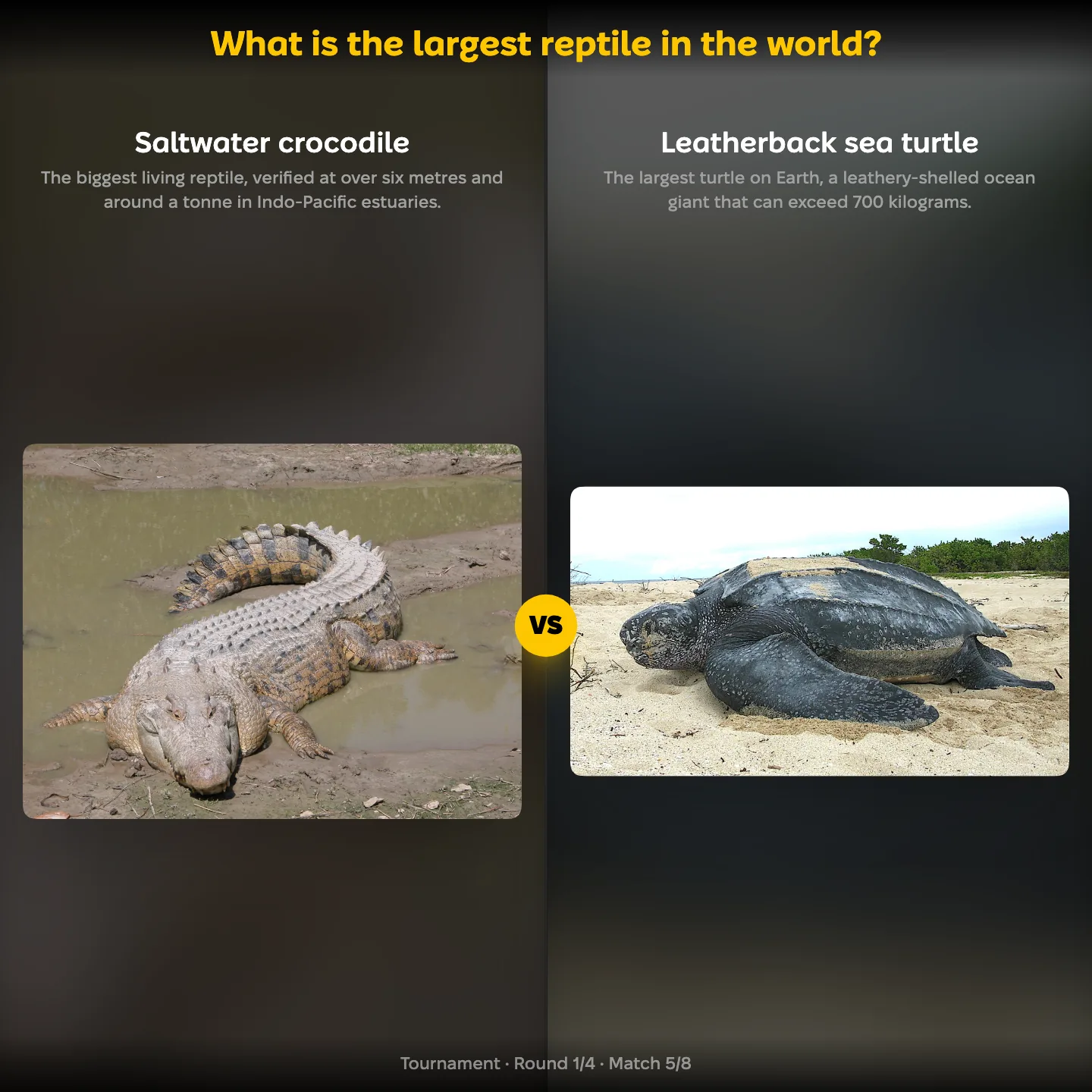
Saltwater Crocodile vs Leatherback Turtle: The Largest Reptile Alive
Size is the ranking the crocodile was built for. The saltwater crocodile, the Nile crocodile, the gharial and the black caiman all appear here, and so does the American alligator, which has to make its case against a leatherback sea turtle and a green anaconda as well as its cousins.
The alligator belongs on the list because few reptiles outside its own family come close to its length. The crocodile belongs because the species record is its own: the 1974 Mary River animal is the one the Australian Museum still cites, and a 100-centimetre skull the museum records hints at something bigger.
The names that complicate the ranking are the ones that are long rather than heavy. A reticulated python can outstretch any alligator, and a leatherback can outweigh most crocodiles.
Which measurement counts is the whole question, and the ranking does not say.
Nile Crocodile vs Inland Taipan: Where the Alligator Looks Tame
Danger is the ranking that splits the family. The saltwater and Nile crocodiles are on it with the American alligator, but so are the inland taipan, the black mamba and the king cobra, animals that kill with a dose instead of a jaw.
The crocodile's reputation is earned on two continents. The Nile crocodile shares rivers with people across much of Africa, and the saltwater crocodile patrols coastlines from India to northern Australia.
The alligator's reputation is milder for a reason that is geographic rather than temperamental. Its only wild range is the American South, where Everglades National Park reports that even its crocodile cousin "rarely exceeds 14 feet in the wild", and the alligator is smaller still.2
The snakes are the counter-argument to both. A reptile that fits in a boot can do more damage per year than one that needs a river.
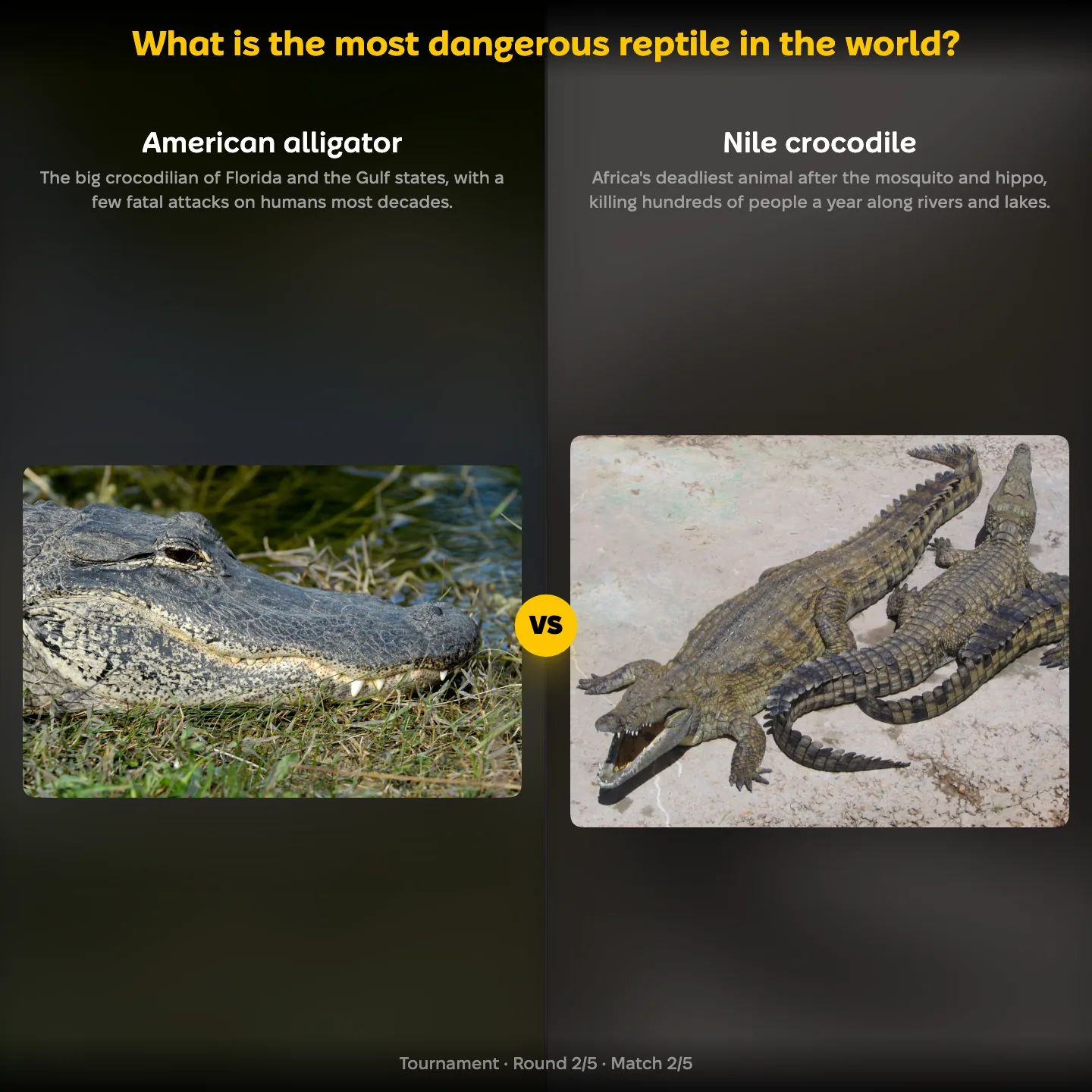
Grizzly Bear vs American Alligator: North America's List Has No Crocodile
Narrow the map to North America and the crocodile disappears. The continent's danger list holds the grizzly, the moose, the bull shark, the white-tailed deer and the American alligator, and not one crocodile.
The absence is accurate: the American crocodile lives at the southern tip of Florida and nowhere else in the country, and it is shy enough to be left off without anyone noticing.
The alligator is everywhere the crocodile is not, from Texas to the Carolinas.
The deer is the reminder that a reptile is rarely the most dangerous thing on an American road.
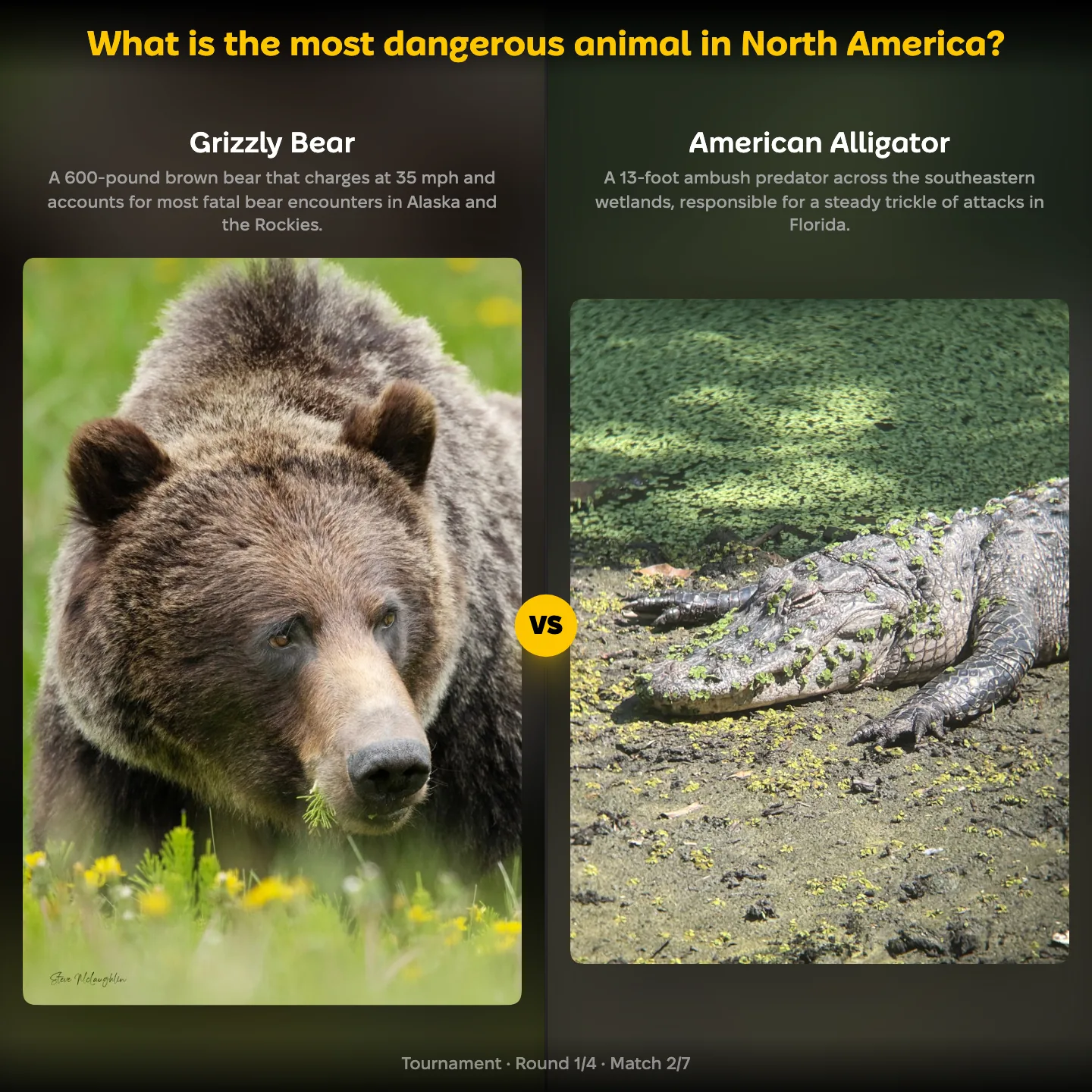
Hippo vs Crocodile vs Alligator: The Freshwater Fear List
Fresh water is where both animals actually hunt, so this ranking asks the practical question: which animal would you least like to find in a river. The American alligator and the saltwater crocodile are joined by the hippopotamus, the bull shark, the piranha, the electric eel and the green anaconda.
The crocodile is the obvious entry. The saltwater crocodile is named for the sea but spends much of its life in rivers and estuaries, which is where most people meet it.
The alligator is the American answer, and the animal most readers of this page have actually seen in the wild, usually from a boardwalk in Florida or a bayou in Louisiana.
The hippo is the name that outranks both in the folklore of African rivers, and the piranha the one that outranks both in films. Neither has been measured against the crocodile's jaw.
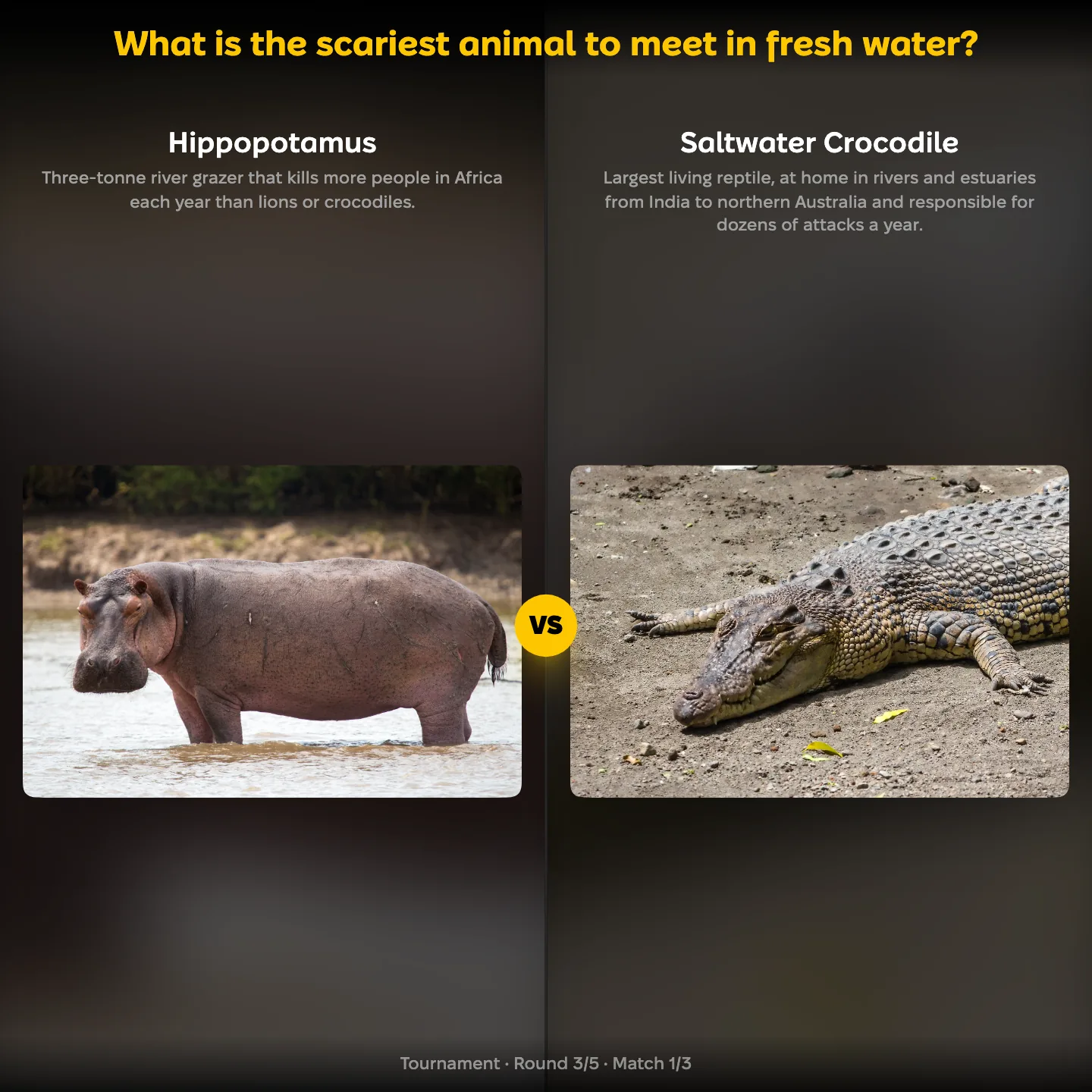
Bald Eagle vs American Alligator: The Comeback Lists
The alligator's best story is not about teeth. It is about recovery. This ranking of wildlife comebacks holds the bald eagle, the gray wolf, the American bison, the humpback whale the American alligator and the American crocodile.
The alligator was listed as an endangered species in 1967, under the law that preceded the Endangered Species Act, and removed from the list in 1987, when the Fish and Wildlife Service pronounced it fully recovered.6 Twenty years from endangered to recovered.
The crocodile's comeback is quieter and still in progress. Everglades National Park reports that the nesting population "continues to slowly increase", enough for the Florida population's status to be changed from endangered to threatened, while the species worldwide stays endangered.
The eagle is the one both reptiles have to beat, because it recovered on a flag.
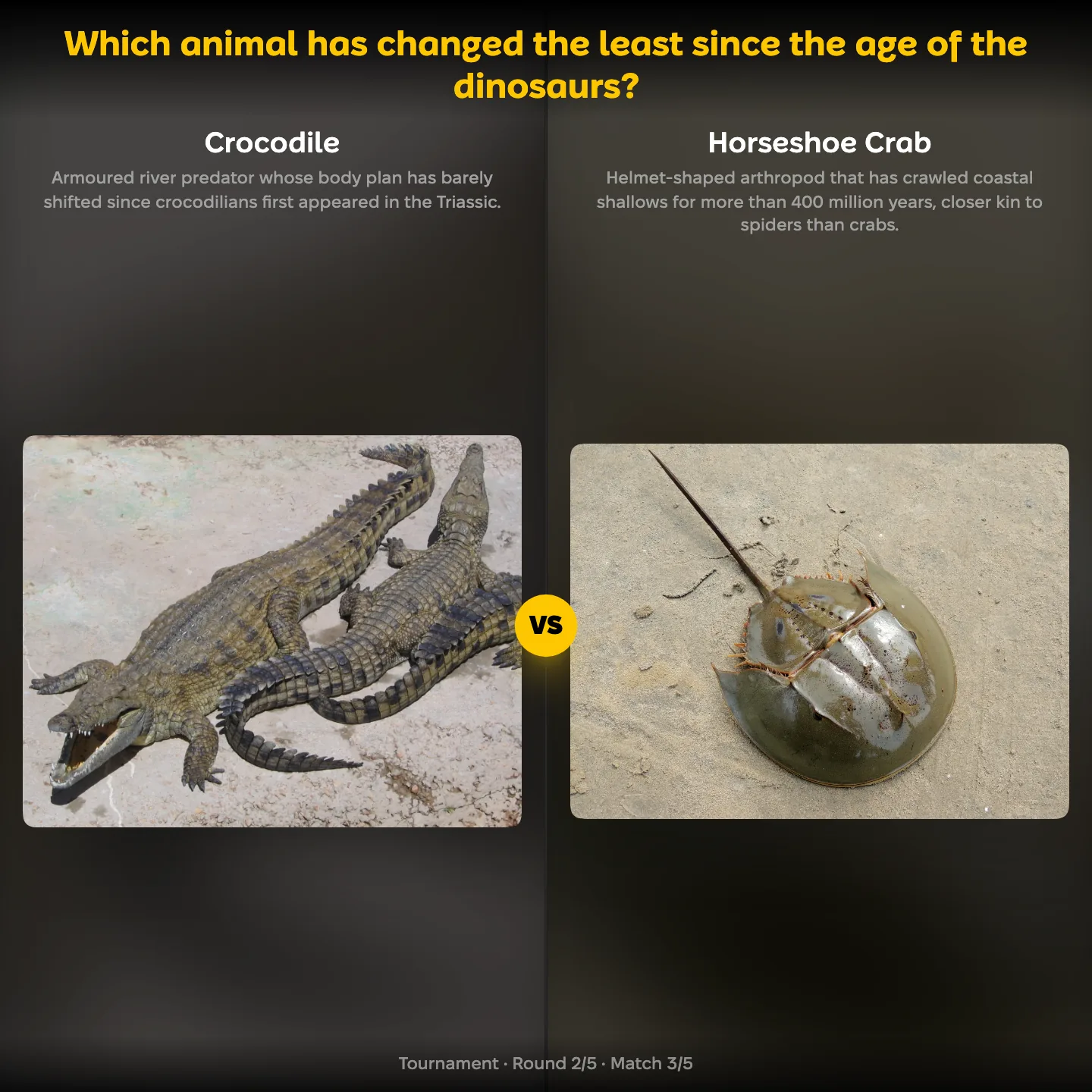
Horseshoe Crab vs Crocodile: 230 Million Years of Not Changing
Living fossils turn the alligator and the crocodile from rivals into relatives. The two share this list of animals that have changed the least since the dinosaurs with the horseshoe crab, the coelacanth, the tuatara and the nautilus.
The crocodilian claim is a long one. Palaeontologists at the University of Utah and the University of Central Oklahoma traced today's crocodylians to a 230-million-year lineage that lived through two mass extinctions, the end-Triassic and the end-Cretaceous, and found that nearly all 26 surviving species are semiaquatic generalists.7
Generalist is the word that matters. The specialised crocodile relatives, the fast runners and the sea-going forms, are the ones that died.
The alligator and the crocodile are the same answer to this question, separated by a snout. The horseshoe crab has them both on age.
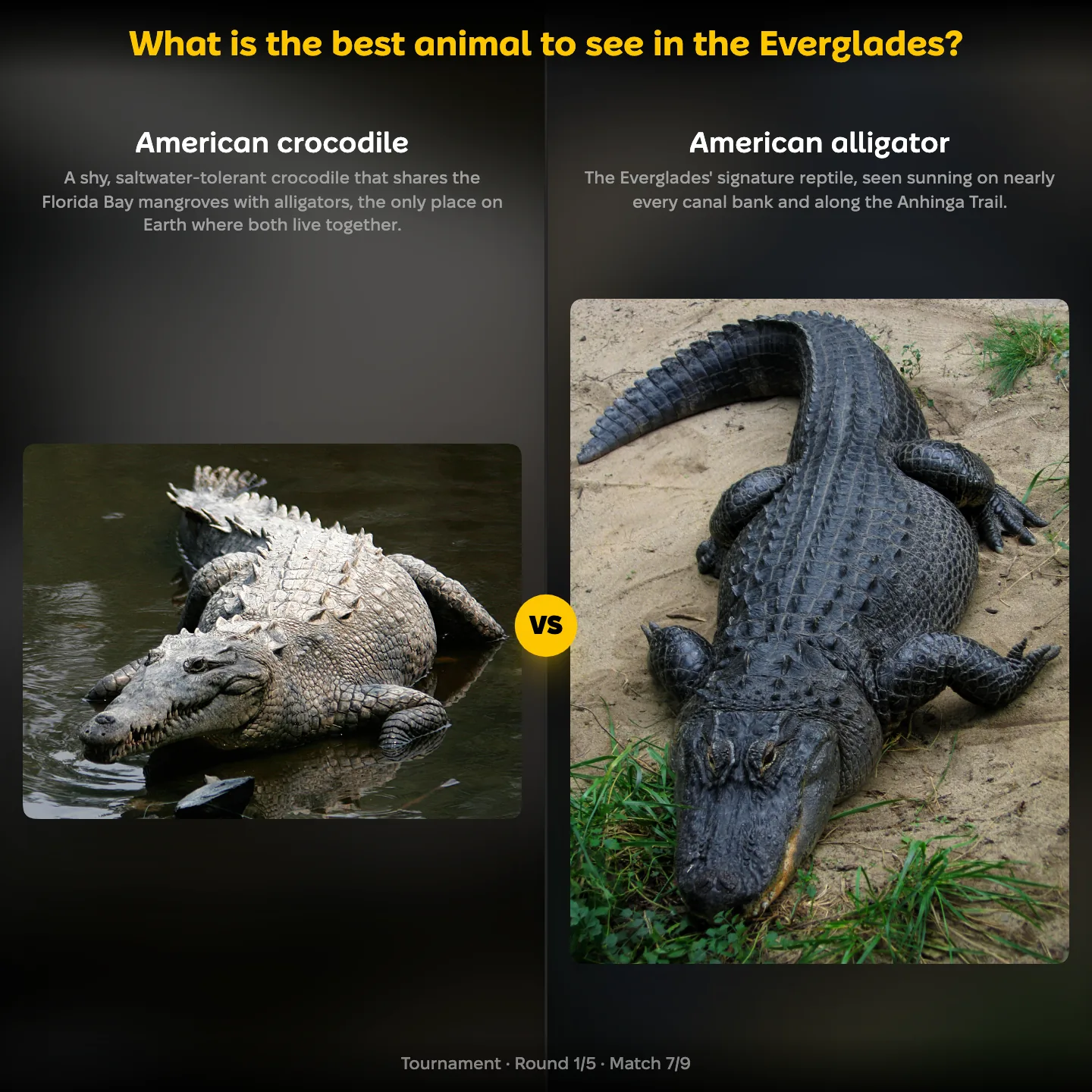
Everglades: Alligator, Crocodile, Manatee, and the Only Overlap on Earth
Everglades National Park is the one address where this whole comparison can be made in person. Its own best-animal ranking holds the American alligator, the American crocodile, the West Indian manatee, the Florida panther, the roseate spoonbill and the Burmese python that should not be there at all.
The alligator is the park's signature. The National Park Service calls it a keystone species: the holes it digs hold water through the winter dry season and shelter fish, turtles and birds until the rains return.5
The crocodile is the rarer sighting. It keeps to the coastal mangroves and brackish creeks at the park's southern edge, and the easy way to confirm one is the fourth tooth on the lower jaw, visible when the mouth is closed, which an alligator never shows.
The manatee and the panther are the names a first-time visitor actually hopes for, which is the complication for both reptiles.
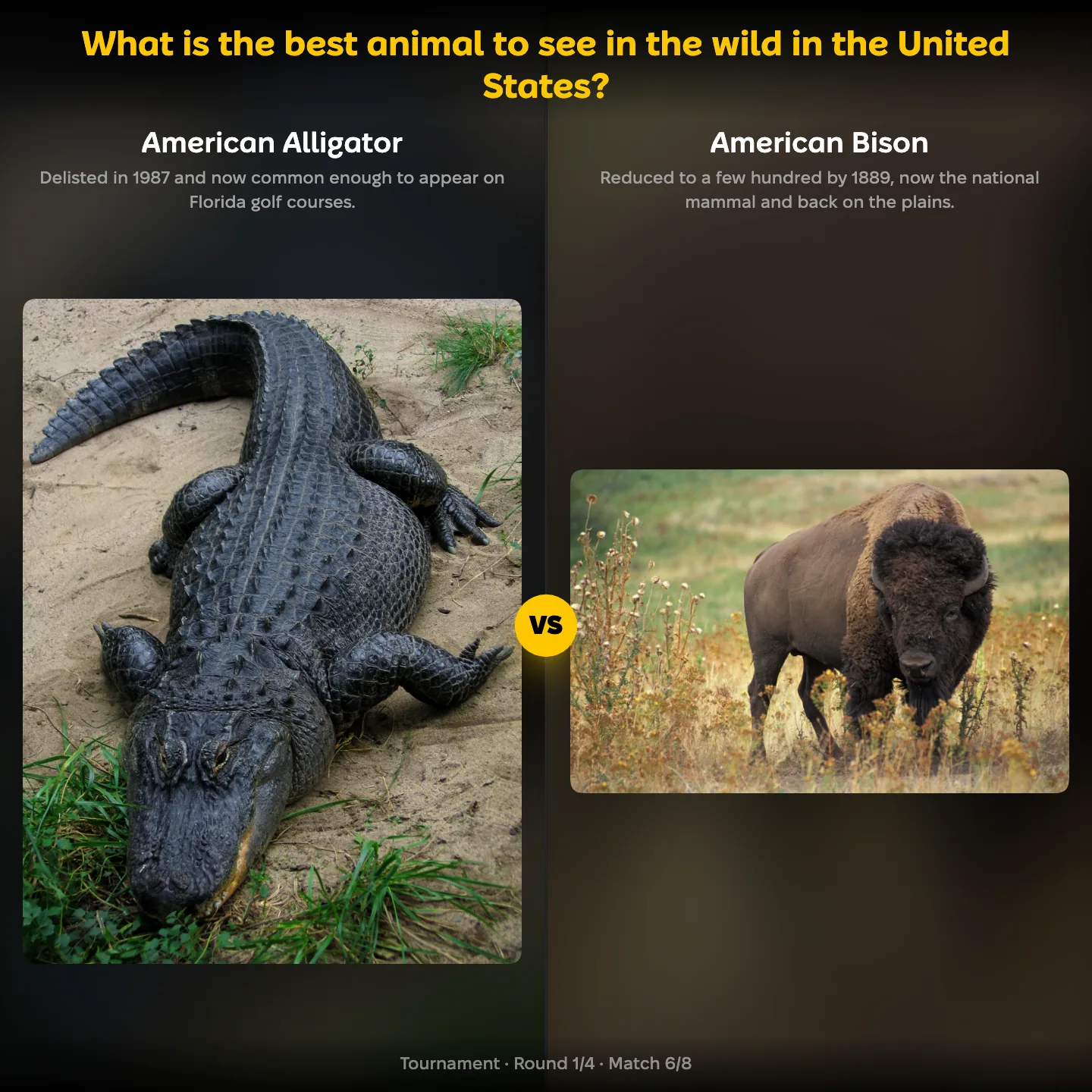
Bison vs Alligator: America's Must-See Wildlife
Widen the map from one park to the whole country and the alligator keeps its place. The national must-see list holds the bald eagle, the grizzly bear, the American bison, the moose, the humpback whale and the American alligator, with the American crocodile added as the Florida footnote.
The alligator's case is availability. It is the only one of these animals a visitor can reliably see from a city park, a golf course or a highway verge across the American South.
The crocodile's case is the opposite. Seeing one in the wild in the United States means one corner of one state, which makes it a trophy sighting rather than a routine one.
The bison and the grizzly carry the romance of the West, and the eagle carries the flag. The two reptiles are competing with the national imagination, not with each other.
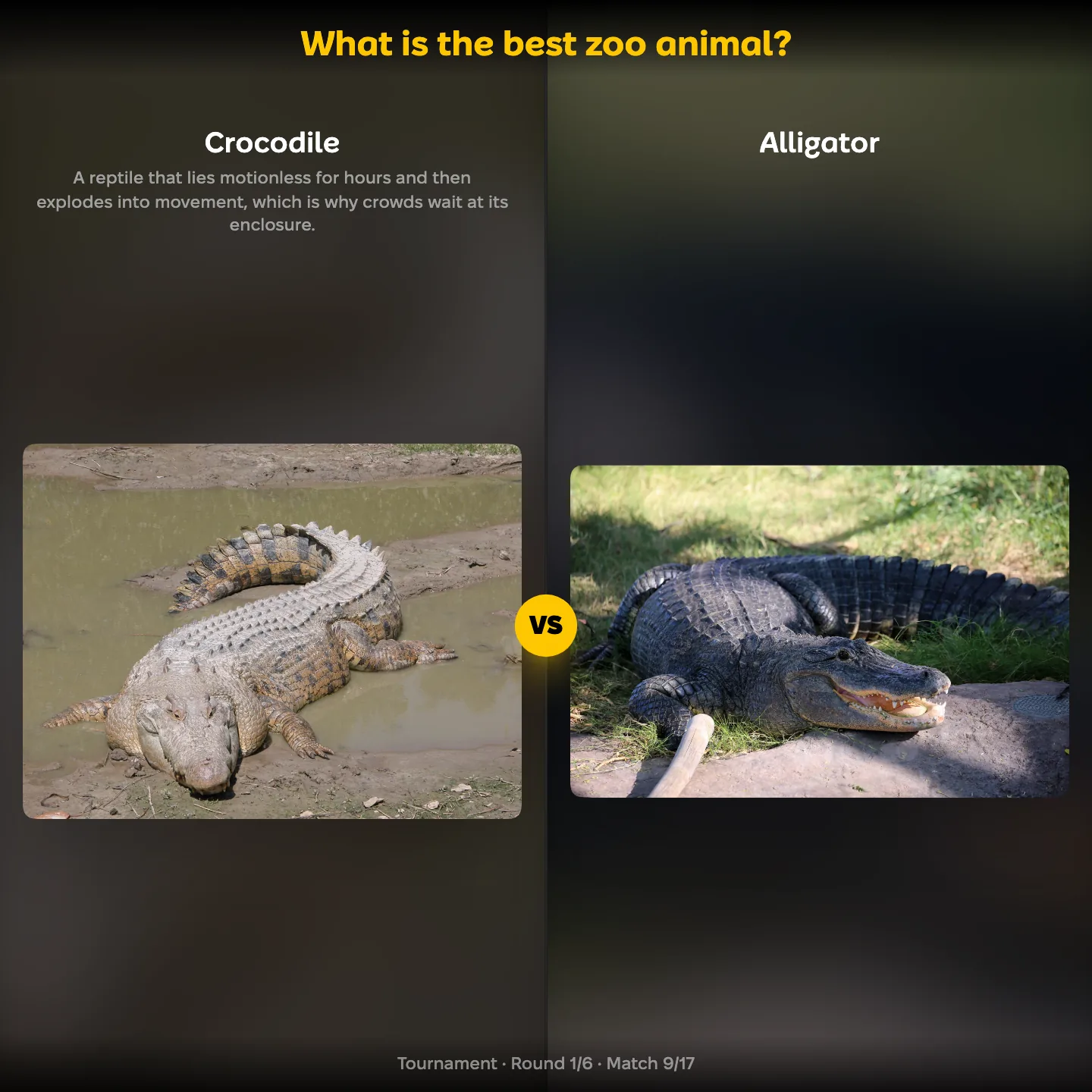
Zoo Day: Crocodile vs Alligator Among Thirty-Three Animals
Thirty-three zoo animals, most of them mammals, and the alligator and the crocodile have to hold a crowd against the panda, the lion and the penguin.
The crocodile's act is stillness followed by one sudden move. The alligator's is being the reptile most American zoos actually keep.
Neither does anything a sloth cannot undo by hanging in a tree.
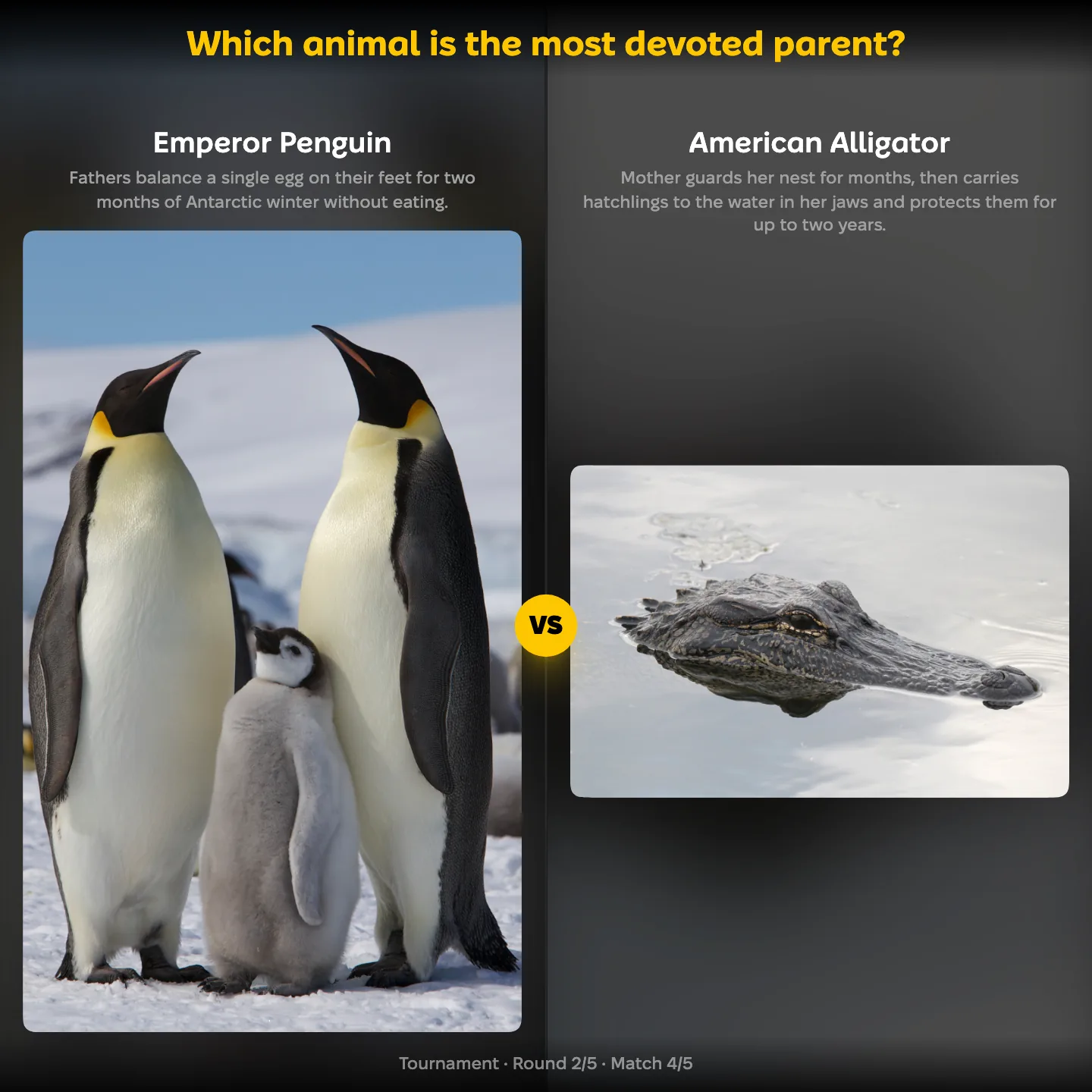
Emperor Penguin vs Alligator: The Parenting List
Devoted parents is the ranking that surprises people who know these animals only from the bite list. The emperor penguin, the orangutan, the elephant, the giant Pacific octopus and the seahorse are on it, and so are the American alligator and the Nile crocodile.
The alligator earns the place with a nest, not a jaw. Everglades National Park describes mound nests about 3.5 feet high and twice as wide, an incubation of 58 to 63 days, and a mother that carries eight to ten hatchlings at a time in her mouth to the water.5
The Nile crocodile does the same job on another continent, guarding the nest for weeks and ferrying its young in the same way.
The penguin's case is a winter spent standing on an egg. Against that, the reptiles are devoted for a season.
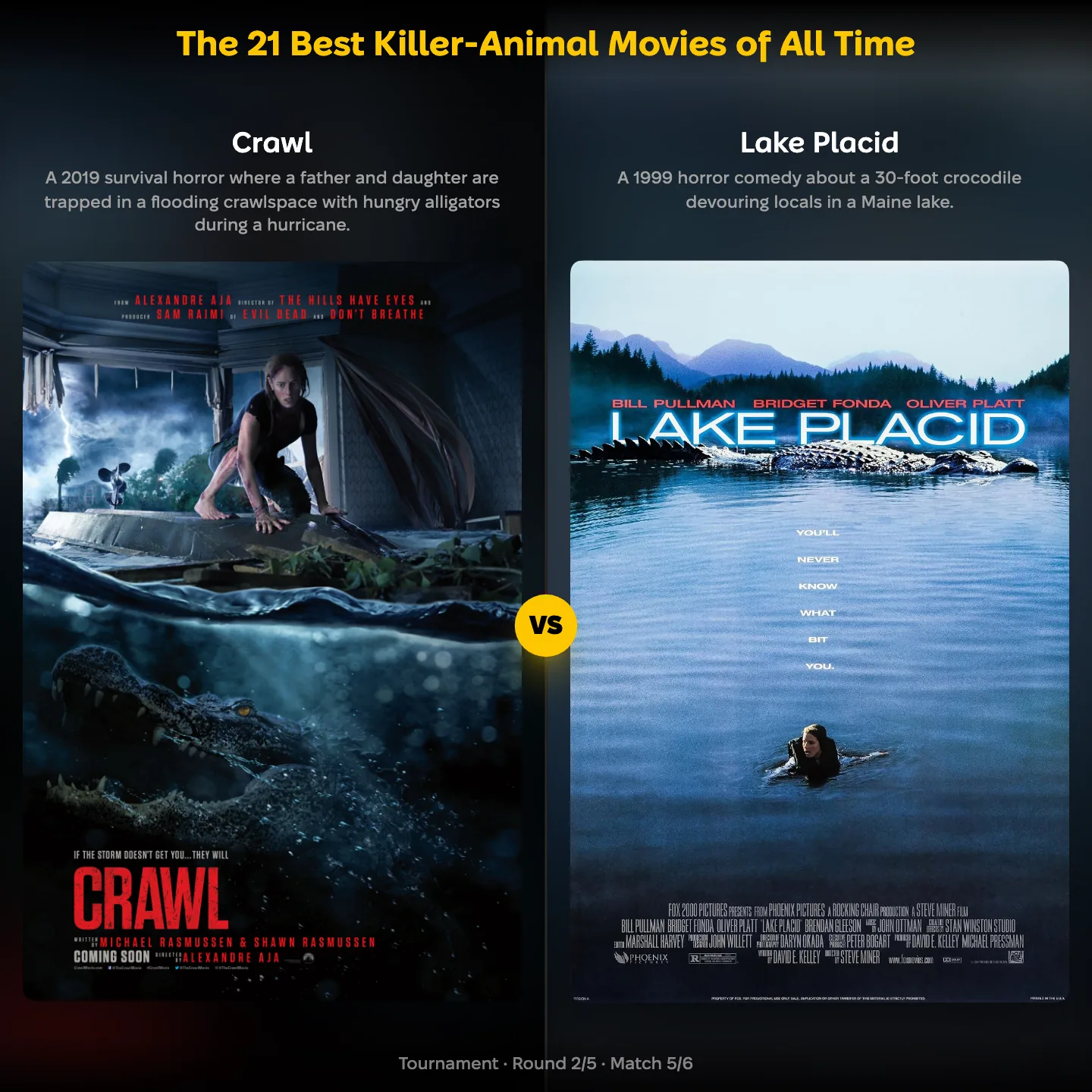
Crawl vs Lake Placid: The Killer-Animal Movies
Cinema has cast both animals as the monster, and this ranking of killer-animal films puts them on the same bill as Jaws, Anaconda, Cujo and The Birds. The alligator's film is Crawl, in which a hurricane floods a Florida house. The crocodile's is Lake Placid, which puts a giant one in a lake in Maine.
Crawl, a Paramount release, took $91.5 million worldwide in 2019.8 Lake Placid took $56.9 million in 1999.9
The crocodile has the bigger box office in its name, and it is not a horror film: Crocodile Dundee grossed $328.2 million worldwide in 1986, with the animal as a punchline rather than a threat.10 The alligator has the friendlier screen record, as Louis the trumpet-playing alligator in The Princess and the Frog, a $267.1 million Disney release.11
Jaws is the name that makes every other killer animal a supporting act, and it is a shark.
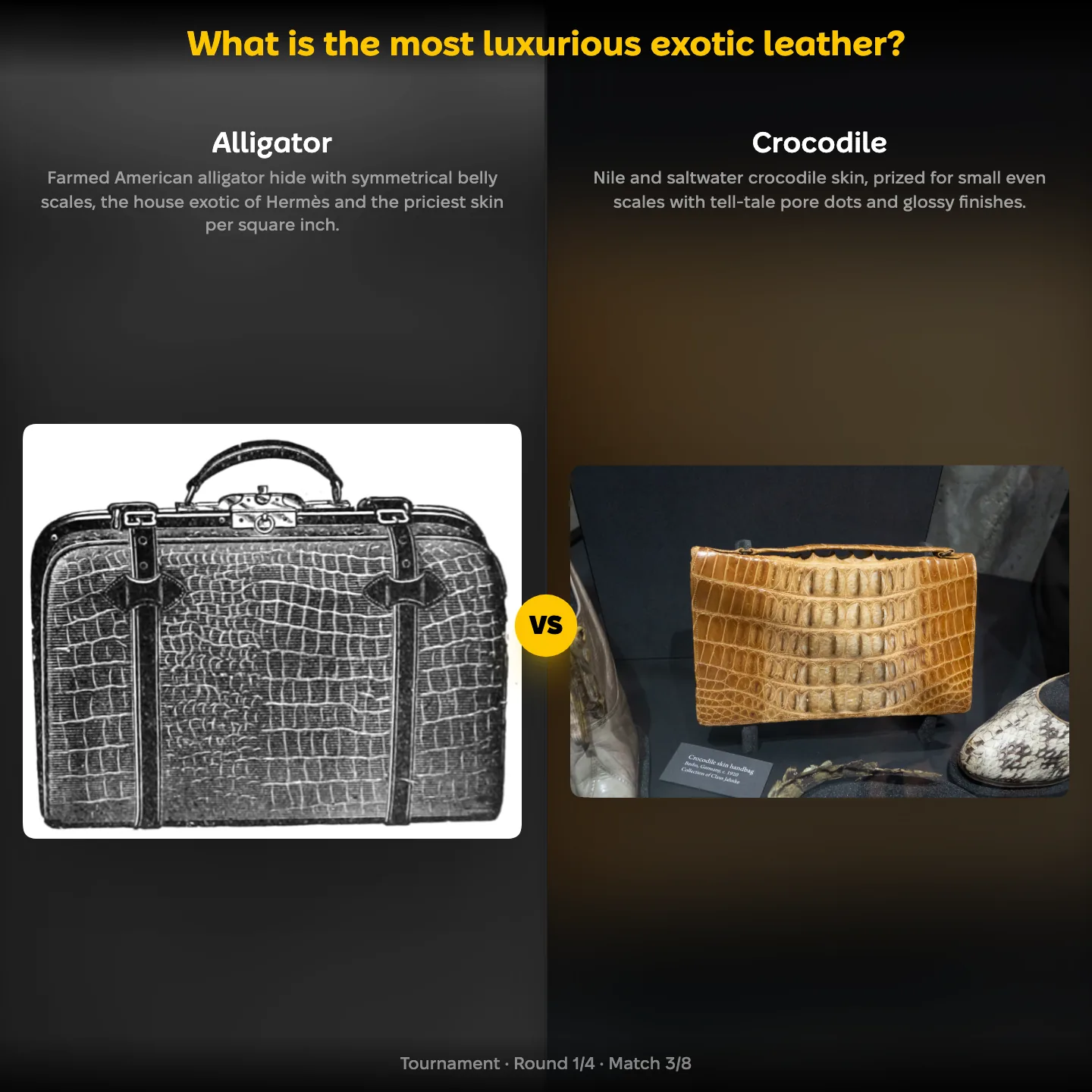
Alligator vs Crocodile Leather: The List Where the Buyer Cannot Tell
Leather is the ranking where both animals are a material rather than a threat. Alligator and crocodile are on this list of exotic leathers with ostrich, python, lizard and stingray, and the two reptile skins are close enough that the trade regulates them together.
The alligator's skin is the reason it was hunted to the endangered list in the first place, and the reason the Fish and Wildlife Service still regulates the legal trade in alligator hides, so that endangered crocodilians with similar skins cannot be passed off as alligator.6
The crocodile's skin carries the luxury name. Saltwater crocodile is the hide the big fashion houses price highest, and the skin the word exotic brings to mind first.
Louisiana's new recreational season draws the line the other way: hides taken under a recreational tag may not be sold, bartered or mixed with commercial-tag alligators, so this month's 10,000 tags add nothing to the handbag supply.1
Lacoste vs Nike: The Crocodile That Became a Logo
The last list has a crocodile and no alligator at all. This ranking of the most iconic logos in fashion holds Nike, Chanel, Adidas, Ralph Lauren and Lacoste, whose crocodile is the only animal on it that is also a reptile on every list above.
The crocodile got there by accident. In Boston in 1923, René Lacoste's team captain promised him a crocodile-skin suitcase if he won his next match; he lost, the American press called him "the crocodile" for his tenacity, and he had one embroidered on his jackets. When the company was founded in 1933 it put the animal on a cotton polo shirt and, by its own account, became the first brand to wear a logo on the outside of its clothing.12
The alligator never made it onto a shirt. Its commercial afterlife is in the hides of the previous section and in the name of a Florida football team.
Nike's swoosh is the name both reptiles have to beat here, and it is not an animal.
The Snout Decides Less Than the Map
Fifteen lists, and the two reptiles swap places on most of them, since hardly any two lists measure the same thing. Force, size and fear go to the crocodile, which has the measurements. Florida, the comeback and the road-side sighting go to the alligator, which has the country. The fossil record and the leather trade cannot tell them apart.
Each of those gets settled here by showing two animals at a time and asking which one belongs higher, a method explained in how a ranking is built from pairs.
If your own swamp has a different monster in it, start a ranking and see which reptile the rest of the internet picks.
More rankings, more angles
- Lion vs Tiger: Who Is the Real King of the Jungle? 14 Lists — the other schoolyard fight, with flags and a Red List
- Where Does the Bald Eagle Rank Among Birds? 14 Lists — the bird that shares the alligator's comeback list
- Famous Bears in Pop Culture: 14 Lists, From Paddington to the NFL — the grizzly from the North America list, fourteen ways
Sources
- Louisiana Department of Wildlife and Fisheries — 2026 recreational alligator season, 1–31 October, 5,000 participants, two hide tags each, no sale of recreational hides: wlf.louisiana.gov (checked 2026-10-12)
- National Park Service, Everglades — American crocodile: South Florida as the only place both species coexist, the threatened status of the Florida population, size, and the visible fourth tooth: nps.gov (checked 2026-10-12)
- Erickson et al., PLoS ONE (2012) — bite-force experiments on 83 adult crocodilians of all 23 species, the 16,414 N saltwater crocodile record, and body size over snout shape: journals.plos.org (checked 2026-10-12)
- Australian Museum — estuarine crocodile as the largest living reptile and the 1974 Mary River specimen of at least 615 cm: australian.museum (checked 2026-10-12)
- National Park Service, Everglades — American alligator: adult size, keystone role and alligator holes, nest dimensions, incubation and hatchlings carried by the mother: nps.gov (checked 2026-10-12)
- Texas Parks and Wildlife — alligator listed as endangered in 1967, pronounced fully recovered in 1987, and the continued federal regulation of the skin trade: tpwd.texas.gov (checked 2026-10-12)
- University of Utah — the 2025 Palaeontology study on crocodylomorphs: a 230-million-year lineage, two mass extinctions survived, 26 living species: attheu.utah.edu (checked 2026-10-12)
- Box Office Mojo — Crawl (2019) worldwide gross: boxofficemojo.com (checked 2026-10-12)
- Box Office Mojo — Lake Placid (1999) worldwide gross: boxofficemojo.com (checked 2026-10-12)
- Box Office Mojo — Crocodile Dundee (1986) worldwide gross: boxofficemojo.com (checked 2026-10-12)
- Box Office Mojo — The Princess and the Frog (2009) worldwide gross: boxofficemojo.com (checked 2026-10-12)
- Lacoste — corporate history: the 1923 Boston nickname, the 1933 founding and the first logo on clothing: corporate.lacoste.com (checked 2026-10-12)