
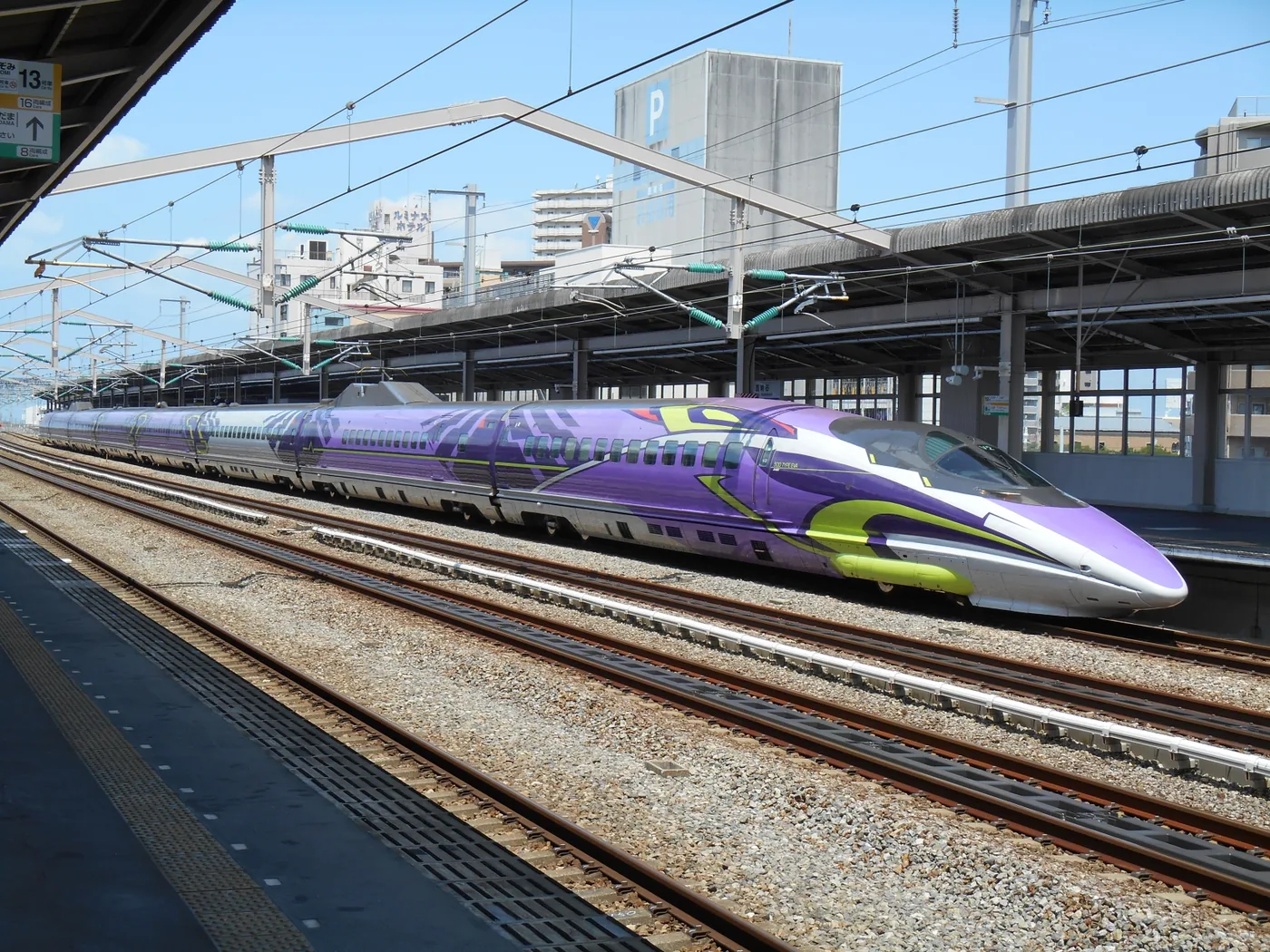
Neon Genesis Evangelion is a twenty-six-episode television show about teenagers in giant robots, and thirty years later people are still arguing about what it actually is. In February 2026 a three-day anniversary festival at Yokohama Arena ended with a surprise announcement: a brand-new Evangelion series, scripted by Nier creator Yoko Taro, animated by Studio Khara with CloverWorks.2
So the show is back on the release schedule. It is also still filed, at the same time, under categories that barely overlap.
Fourteen rankings put Evangelion somewhere: giant robots, clinical depression, puzzle-box plotting, best-ever, most overrated. It has a real claim on all of them.
Astro Boy started it, Evangelion bent it
Influence rankings measure a different thing from quality. They ask what the medium looked like before a show and what it looked like after.
Evangelion aired on TV Tokyo from 4 October 1995 to 27 March 1996.1 Animage readers gave it their Anime Grand Prix in 1995 and again in 1996, then handed the 1997 award to its film sequel. Three years running for one story.5
Astro Boy has the earlier and larger claim. Osamu Tezuka's 1963 series was the first weekly animated show made in Japan; without it there is no industry for Evangelion to bend.
Akira, Sailor Moon, Mobile Suit Gundam and Dragon Ball make up the remainder of the ballot, founders and reinventors both. Evangelion belongs among them for one narrow reason. It took the most commercial genre on television and made it about a boy who does not want to get in the robot.
The 1990s: Cowboy Bebop, Princess Mononoke and a robot show
Shrink the window to ten years and the company gets tougher, not kinder. The 1990s gave anime Cowboy Bebop, Ghost in the Shell, Princess Mononoke, Perfect Blue, Berserk and Serial Experiments Lain, most of them inside four years of each other.
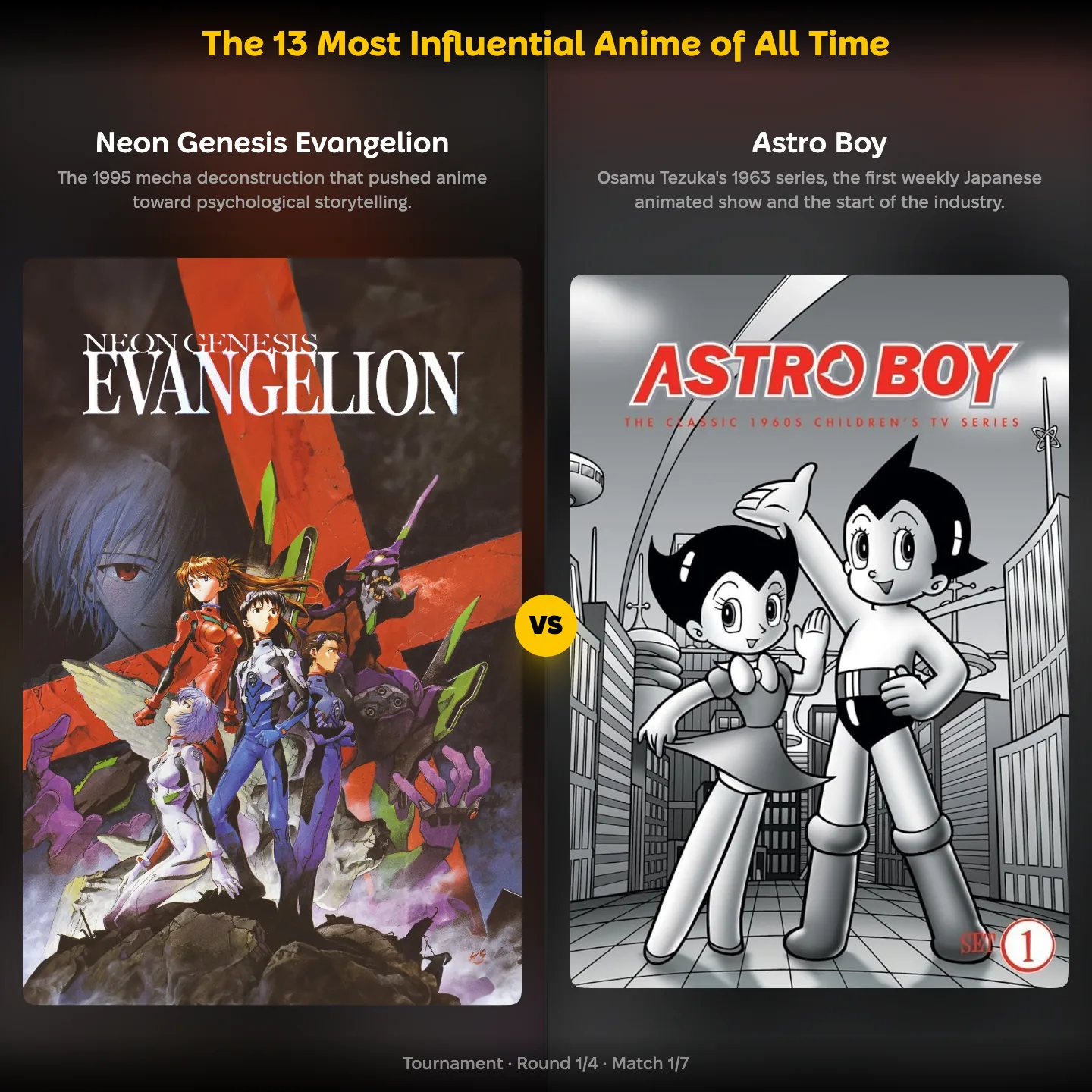
Evangelion sits in the middle of that run. Its case rests on reach rather than craft: Cowboy Bebop is the better-made show almost frame for frame, and Evangelion changed what the following decade's television looked like.
Cowboy Bebop is also the opponent most likely to beat it, which is why the two are paired below.
Evangelion vs Mobile Suit Gundam: the robot show that argued with robots
Mecha is the genre Evangelion is officially filed under, and the one it spent twenty-six episodes disagreeing with.
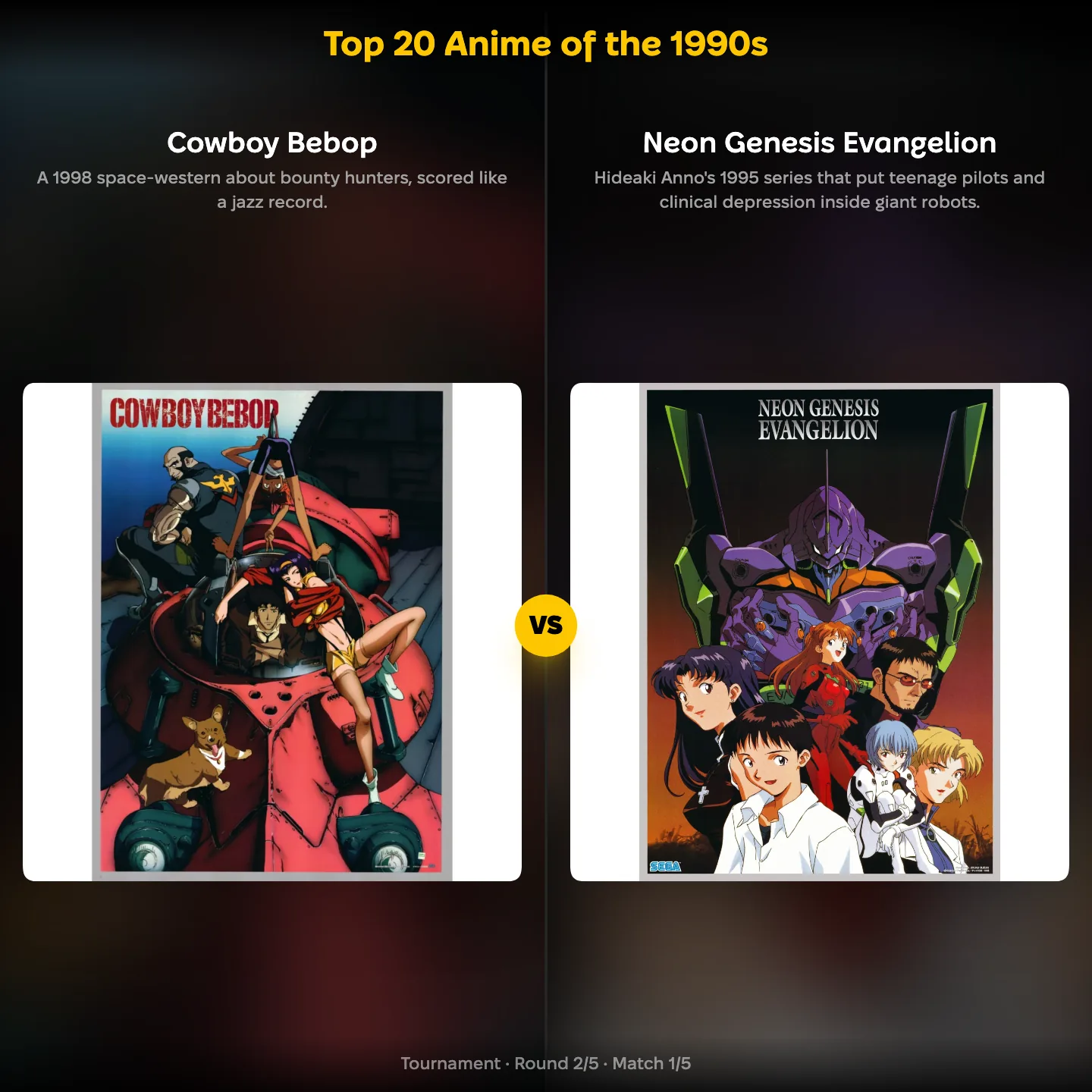
Mobile Suit Gundam set the terms in 1979. Yoshiyuki Tomino replaced the invincible super robot with a military machine, a supply chain and a teenage pilot who is frightened; every serious mecha series since has worked inside that frame.
Evangelion took the next step and made the machine itself the problem. The Evas are not vehicles. They are restrained things in armour, they run on a battery, and piloting one hurts. A genre built to sell model kits produced a show in which the cockpit is the worst place to be.
Gurren Lagann, Code Geass, Macross and Gunbuster fill out the ballot, and Gundam holds five separate entries on it. Against a franchise that has been running for forty-six years, one series from 1995 is working with a much smaller catalogue.
Filed beside Perfect Blue and Monster
The same twenty-six episodes turn up on a ballot with no robots on it at all.
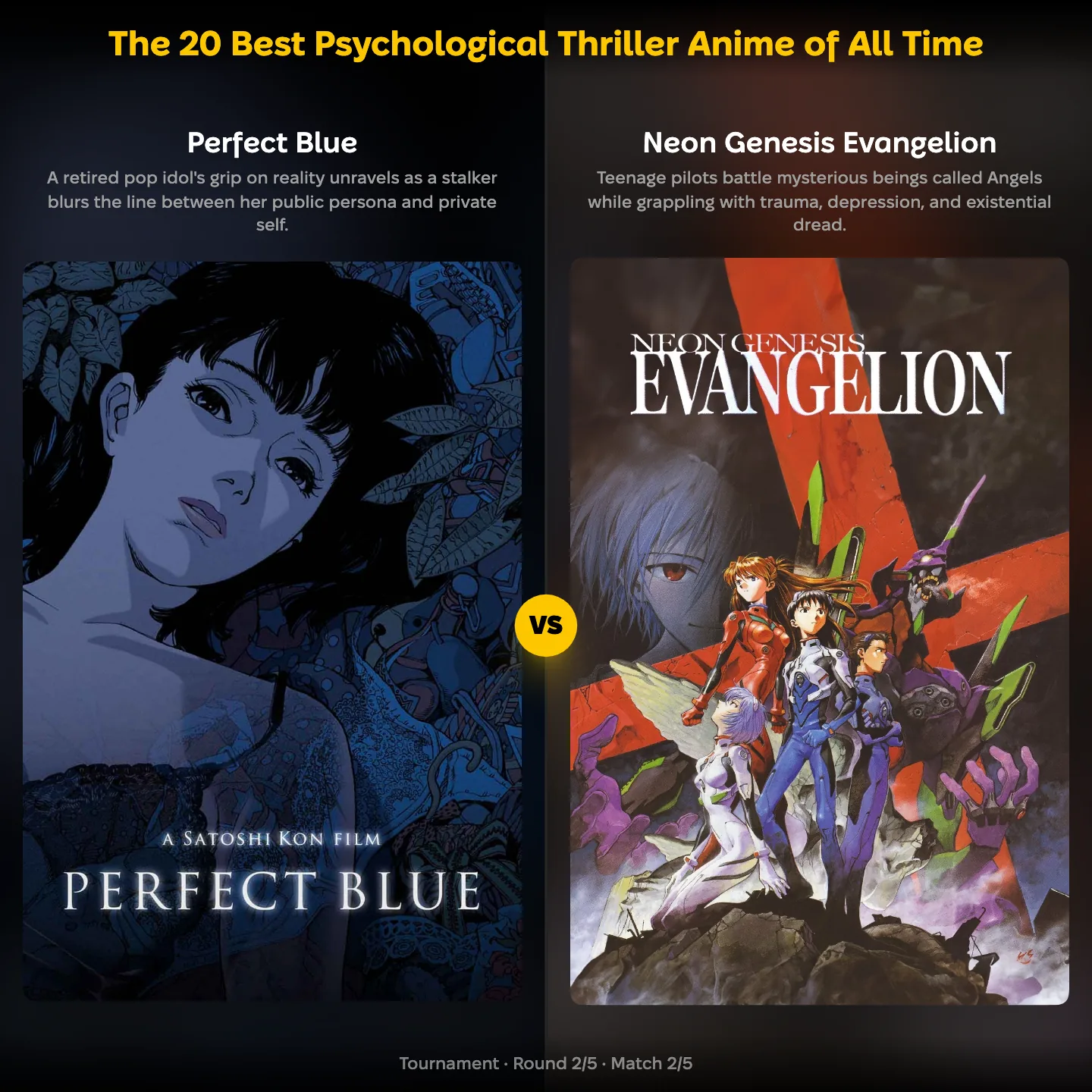
Psychological-thriller rankings are built around Death Note, Monster, Perfect Blue and Paranoia Agent, shows about people coming apart under observation. Evangelion qualifies because its last act abandons the war and becomes a hundred minutes inside one fourteen-year-old's head.
Satoshi Kon's Perfect Blue, released two years later, does the same trick in ninety minutes and does it more precisely. That is the strongest case against Evangelion here: it earns the shelf, and it is not the tidiest thing on it.
The puzzle-box shelf, with Lain and Steins;Gate
There is a third shelf, and Evangelion fits that one too.
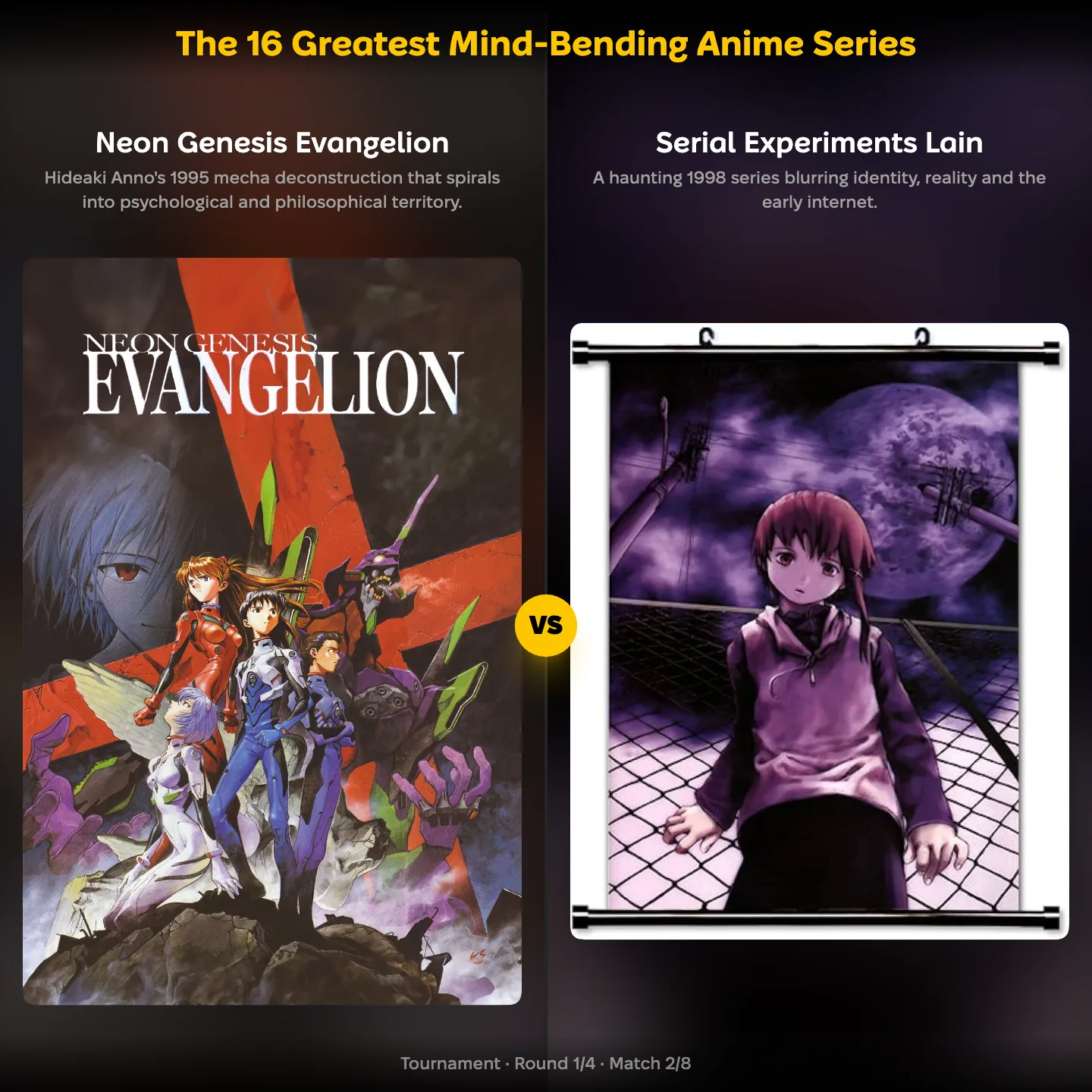
Mind-bending rankings collect shows that withhold their own plot: Serial Experiments Lain, Steins;Gate, Texhnolyze, Paranoia Agent. Evangelion belongs because of the Human Instrumentality Project, which is explained almost entirely in fragments, across scrolls and boardrooms and one monologue, and never in a single place.
Lain, from 1998, is the purer case. It is barely interested in having a plot to withhold.
The End of Evangelion is a film, and films are judged differently
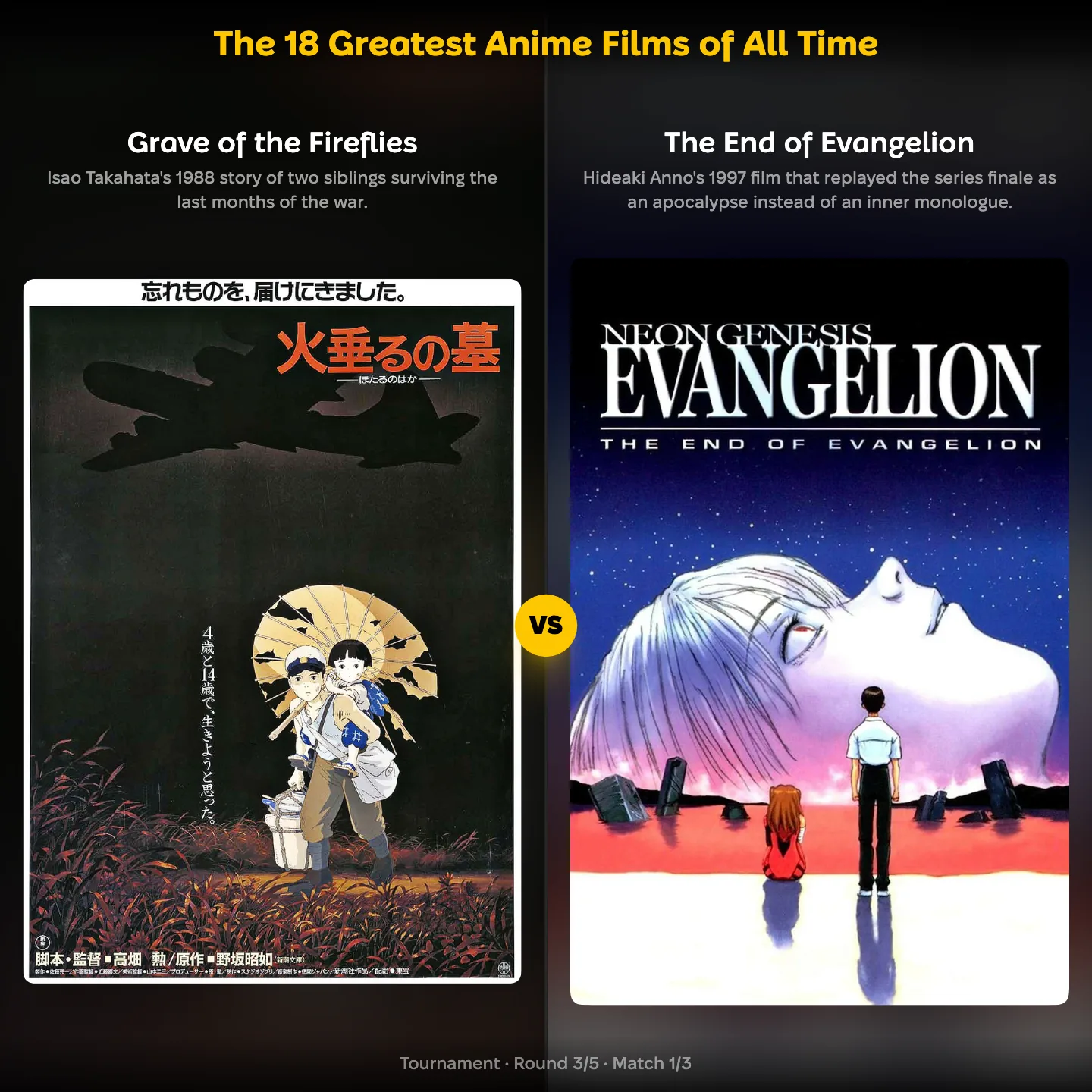
Film rankings do not take the series. They take The End of Evangelion, released on 19 July 1997 as a theatrical retelling of the television finale.1
The company here is the heaviest anime has: Spirited Away, Akira, Grave of the Fireflies, Princess Mononoke, Your Name. Several of those get handed to newcomers as a first anime. The End of Evangelion is the opposite. It assumes twenty-six episodes of homework and then spends its running time dismantling them.
Isao Takahata's Grave of the Fireflies shows what that is up against. A 1988 film about two children starving in the last months of the war needs no context at all.
Money tells the same story from the other side. The franchise's highest-grossing film is the 2021 finale, Evangelion: 3.0+1.0 Thrice Upon a Time, which took ¥10.28 billion and was the second-biggest Japanese release of its year.7
A Cruel Angel's Thesis: 1,000 weeks on a karaoke chart
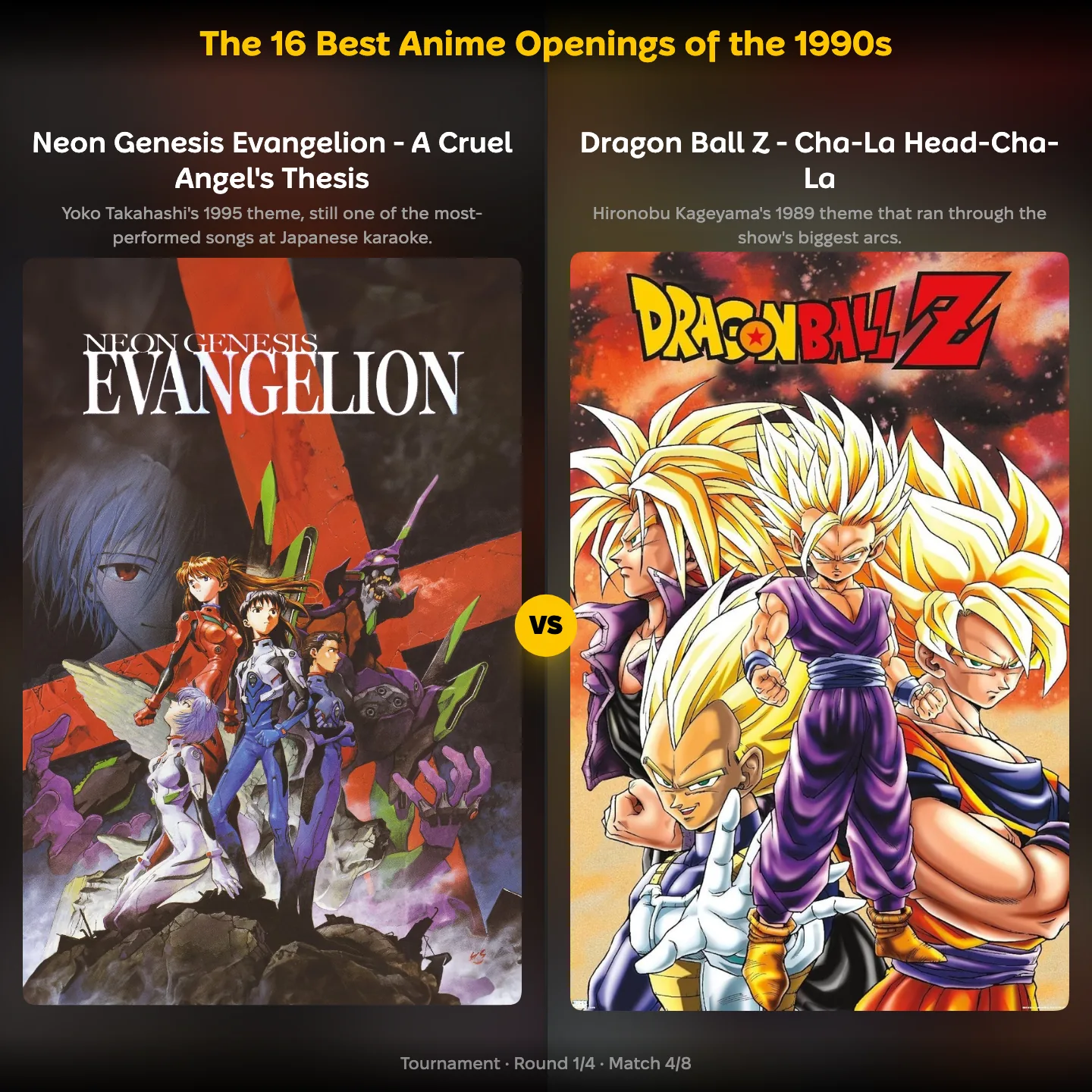
Yoko Takahashi released the opening theme on 25 October 1995, and it has comfortably outlived the show that carried it.
It was the most-played karaoke song of the entire Heisei era, and on 4 May 2026 it logged its thousandth week on the Oricon karaoke chart, only the fourth song ever to get there. Two months earlier it passed 100 million streams in Japan.4
The 1990s openings ballot is where that record meets its own generation: Cha-La Head-Cha-La, Tank!, Moonlight Densetsu, Butter-Fly. Dragon Ball Z's theme reached far more children at the time.
The soundtrack shelf, where the opening theme counts for nothing
Score rankings judge the other ninety minutes of music, and the famous theme is not part of the job.
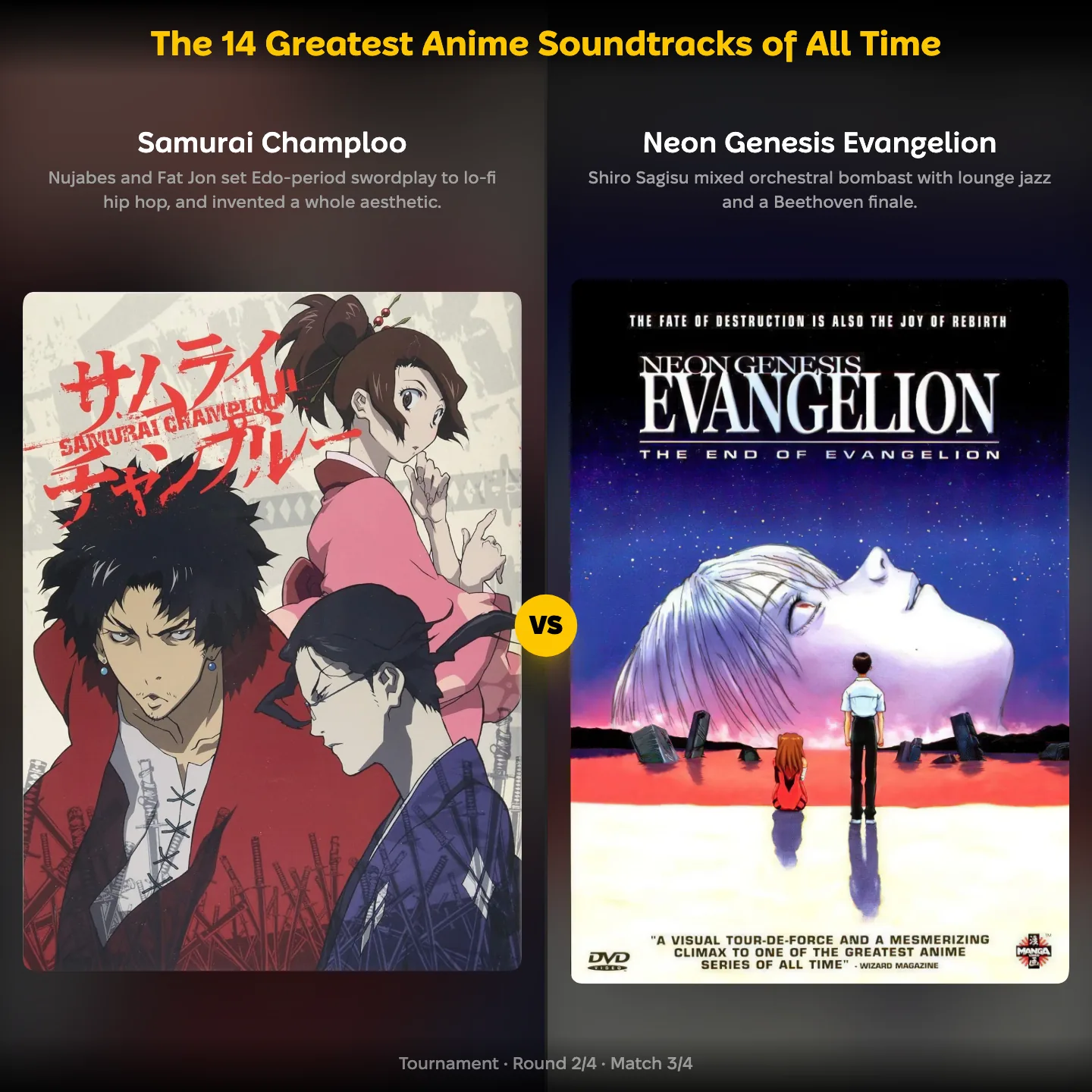
Shiro Sagisu's Evangelion score is built from choral pieces and orchestral cues that reappear under everything, including a Bach movement used at moments where the show has stopped explaining itself. Samurai Champloo answers with a hip-hop soundtrack assembled by Nujabes.
The field also holds Yoko Kanno's Cowboy Bebop and Joe Hisaishi's Princess Mononoke. The standard here is very high, and Evangelion's theme song buys it nothing.
Shinji Ikari vs Heero Yuy: the pilot who does not want the job
Rank the shows and Evangelion does well. Rank the pilots and it runs into a problem of its own making.
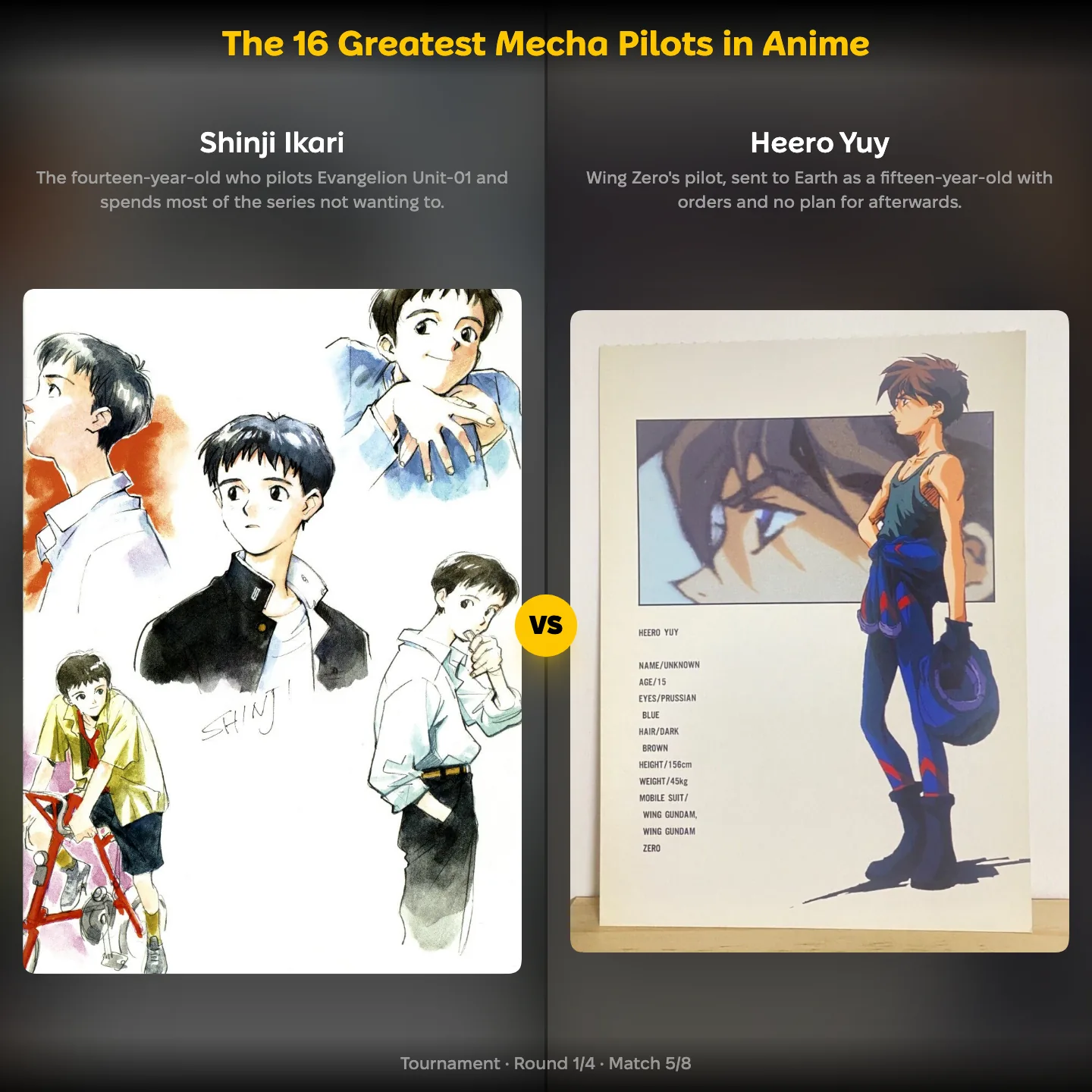
Shinji Ikari is fourteen, he is conscripted by his father, and his defining scenes are the ones where he refuses to get in. Evangelion exists because of him, and he is a poor fit for a ballot that rewards aces.
Heero Yuy is what the genre normally hands you: fifteen years old, sent to Earth with a mission and no plan for afterwards, and entirely willing. Char Aznable, Amuro Ray and Domon Kasshu are further along the same ballot.
Asuka Langley Soryu is the Evangelion entry that fits the brief, trained for the cockpit since childhood and the best pilot in the show. She is on this ballot too, which makes Shinji's placement the honest one.
Gendo Ikari vs Ging Freecss: absent fathers, ranked
Then there is the ballot Evangelion has a genuinely strong case on, and it is not a compliment.
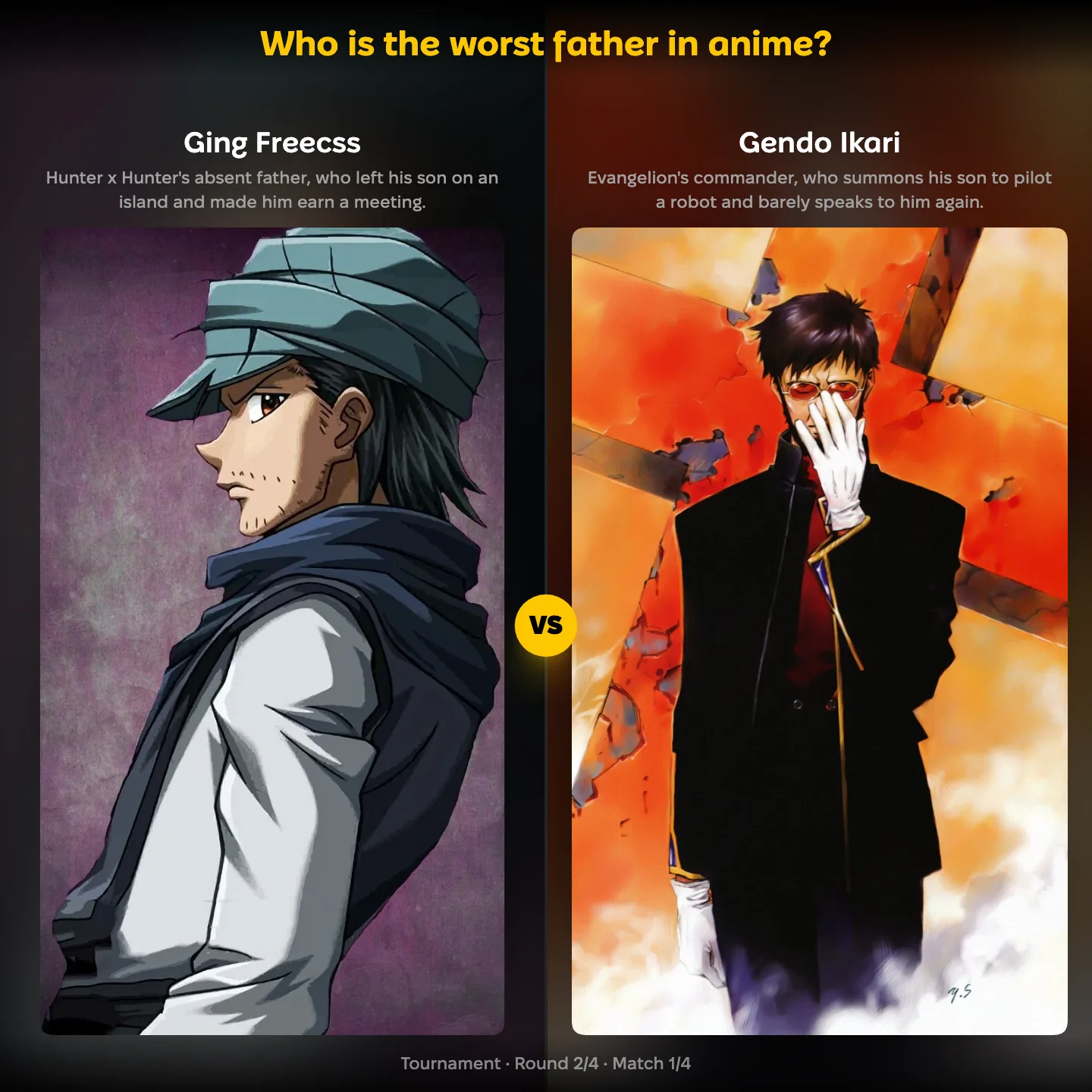
Gendo Ikari abandons his son after his wife's death, summons him back years later to pilot a machine, and speaks to him roughly as often as the plot requires. The show's central relationship is a man declining to have a conversation.
Ging Freecss is the other famous absentee: he left his son on an island and made him cross a continent to earn a meeting. Endeavor, Shou Tucker and Judge Vinsmoke bring worse crimes and less screen time.
Gendo's advantage is that the whole series is about him doing it. Most anime fathers are bad in a subplot.
Megumi Hayashibara voiced Rei, Lina Inverse and Jessie
Some rankings file Evangelion under a person rather than a show.
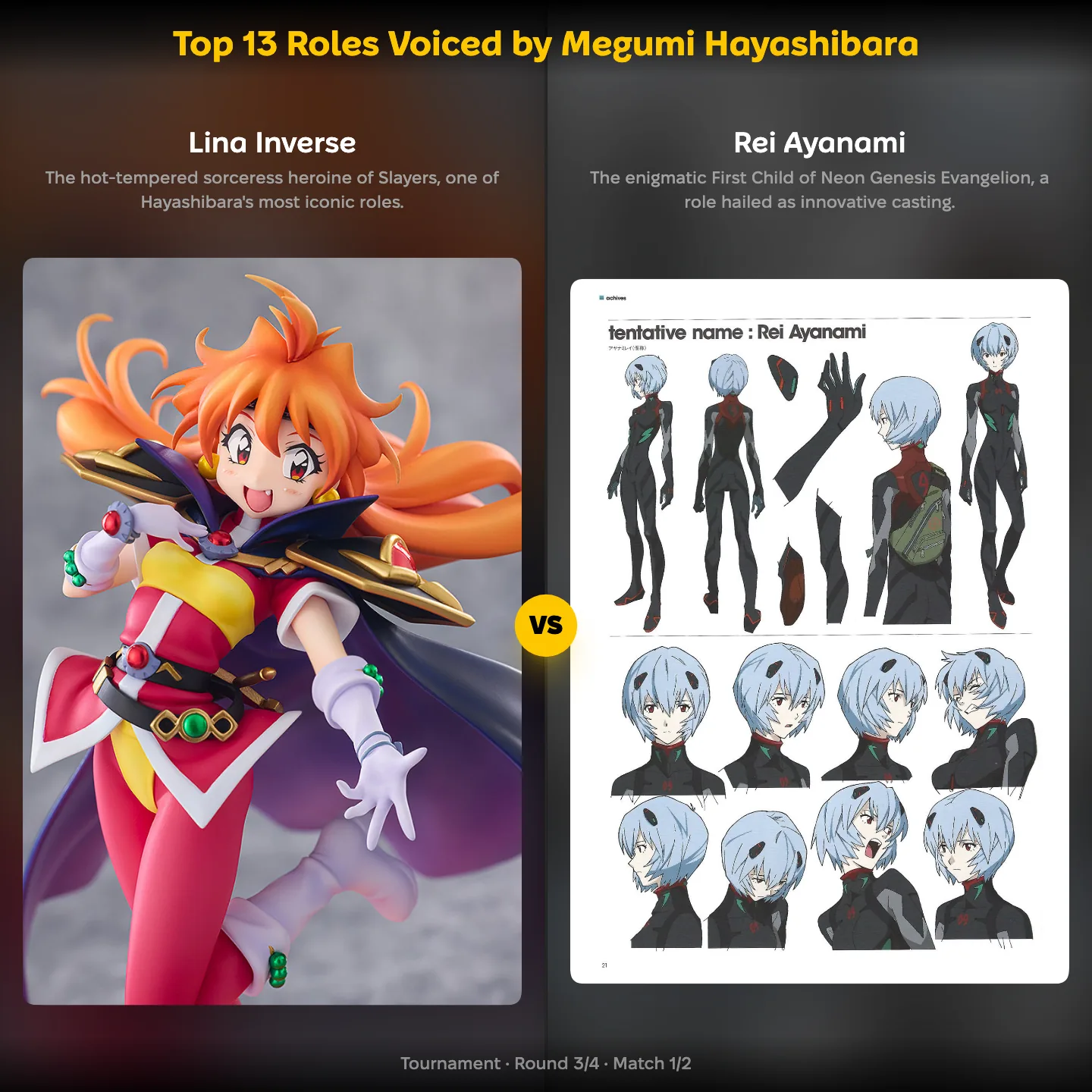
Megumi Hayashibara voiced Rei Ayanami, and the same career also holds Lina Inverse in Slayers, Faye Valentine in Cowboy Bebop, Ai Haibara in Detective Conan, Jessie in Pokémon and the female Ranma.10
Rei is the quietest role in that set by a distance, which cuts both ways. The performance is nearly flat on purpose, and Lina Inverse is the one people do impressions of.
Attack on Titan has a rival for the most argued-about ending
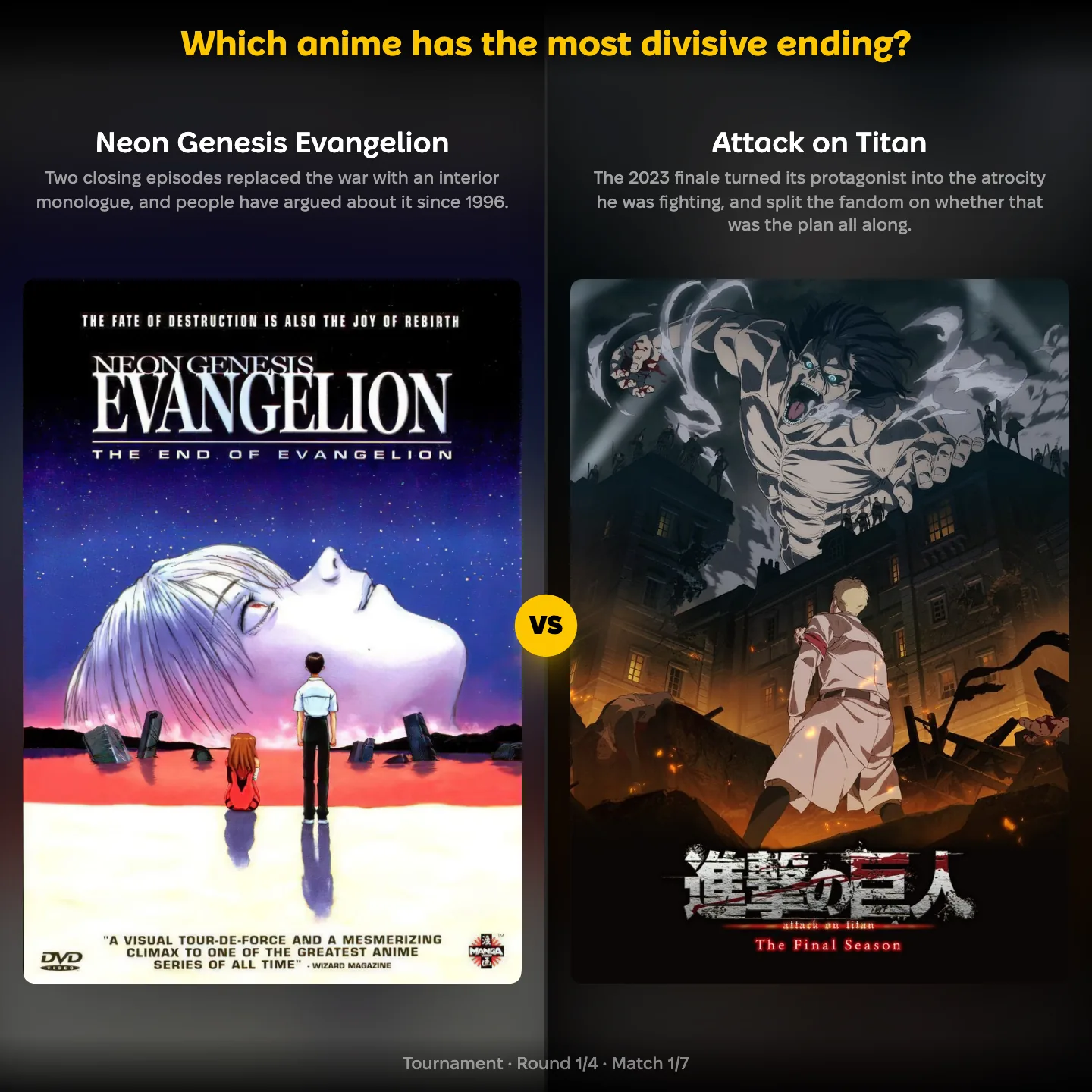
Evangelion's final two episodes drop the war entirely. They are built from abstract animation, still frames, line drawings and voice-over, and the criticism aimed at them was specifically that the story never resolves.1
Hideaki Anno's response was to make The End of Evangelion, which stages the same conclusion as an apocalypse instead of an inner monologue. Thirty years on, people still disagree about whether that was a correction, a second draft or a rebuttal.
Attack on Titan is the modern rival: an ending that arrived in 2023 and split its audience within a week. Code Geass, Death Note and the 1997 Berserk sit on the same ballot, Berserk for stopping mid-story.
Evangelion's claim here is simple. Its ending has been fought over for three decades and nobody has won yet.
The overrated list, where thirty years of praise costs you
A show has to be praised at length before anyone bothers calling it overrated. That makes this ranking a backhanded index of reputation.
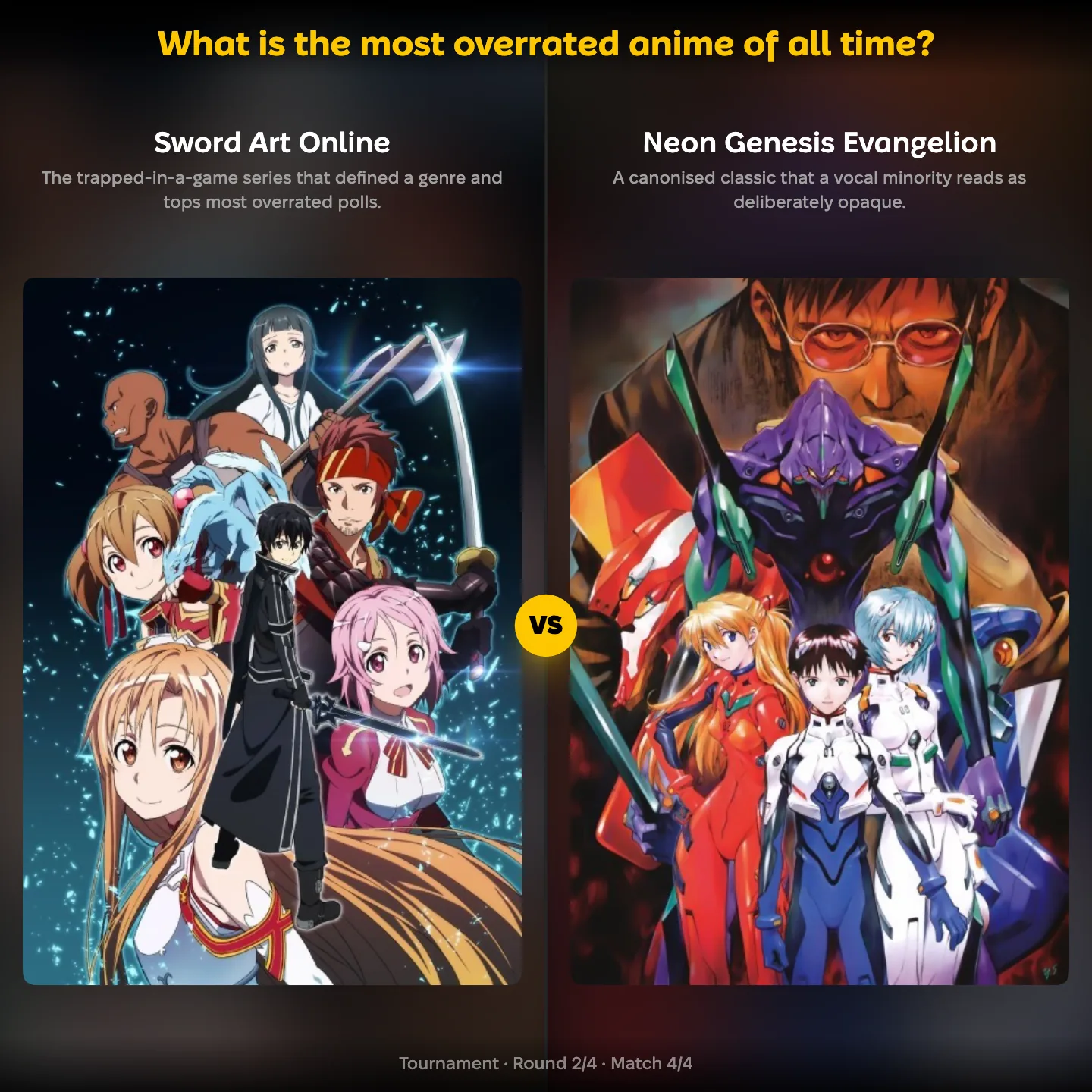
The case against Evangelion is that it gets recommended as a masterpiece to people who then meet twelve episodes of monster-of-the-week television before anything unusual happens, and that decades of interpretation have loaded the show with more meaning than it was built to carry.
Sword Art Online is a different kind of entry, a series nobody claims is deep, resented mostly for how big it got. Naruto, Death Note, Demon Slayer and Attack on Titan share the ballot with it, which tells you this is a popularity list wearing a complaint.
Hideaki Anno also made a Godzilla film
The narrowest ballot here is the director's own shelf, and Evangelion's competition on it is the strangest in the article.
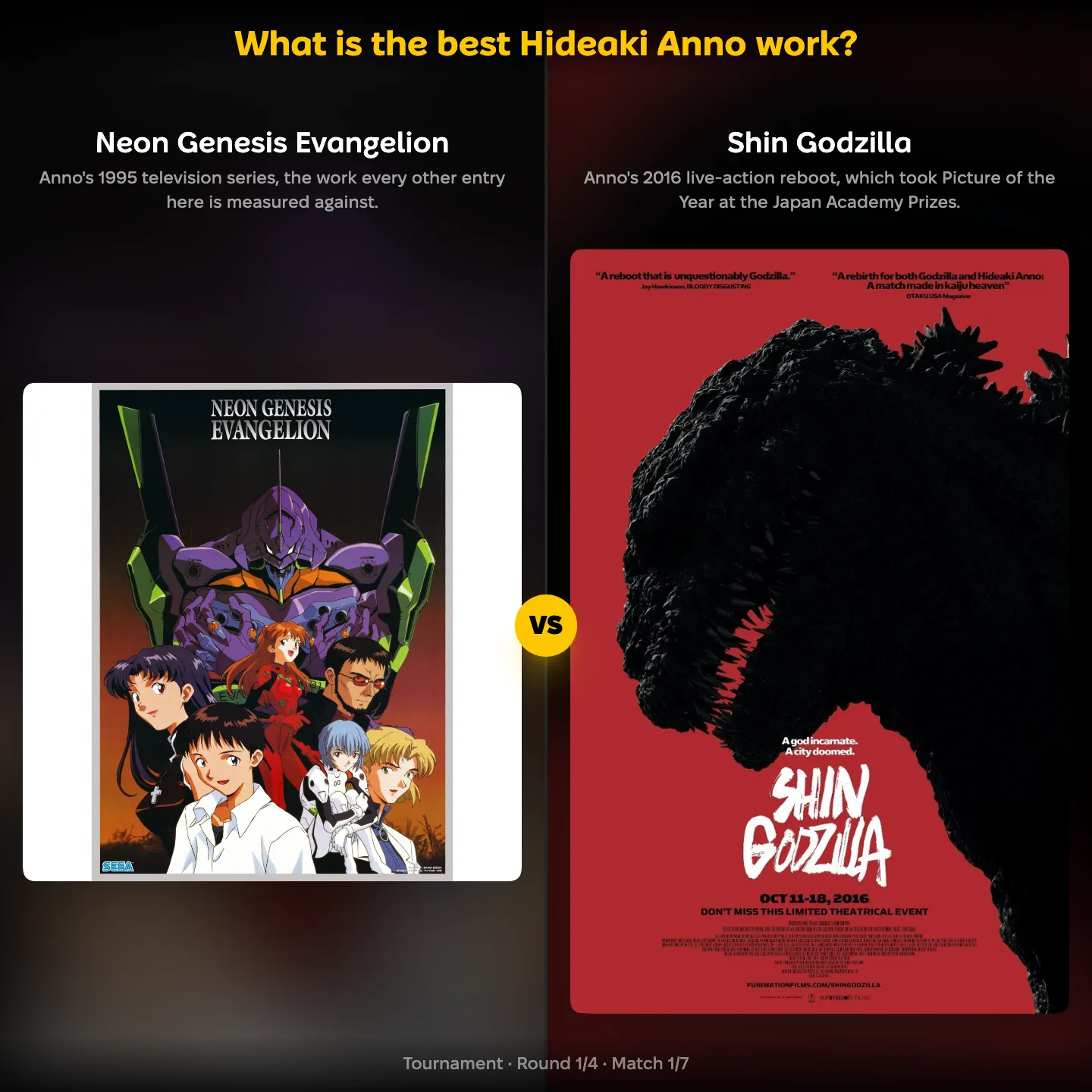
Anno's Shin Godzilla took Picture of the Year and Director of the Year at the 40th Japan Academy Prizes in March 2017, seven awards in total, the biggest haul of that ceremony.8 He followed it with Shin Ultraman and Shin Kamen Rider, and before any of it he made Gunbuster, a six-part 1988 OVA that opens as a sports comedy and closes with a pilot returning to an Earth twelve thousand years older than the one she left.
The Rebuild films are on the shelf too, and they are the awkward part. The third arrived in November 2012 and the fourth in March 2021: eight years and four months, across announced dates in 2013, winter 2015 and June 2020, with Anno's own account being that the third film left him depressed.6
Fourteen entries, seven of them Evangelion in one form or another. The interesting question is whether the live-action work beats any of them.
Thirty years and still unfiled
Most shows settle into one category within a few years of ending. Evangelion has spent three decades being claimed by the mecha shelf, the thriller shelf, the puzzle-box shelf and the complaints pile at once, and every one of those claims survives contact with the episodes.
The new series will not settle it either. Its first English trailer screened at Anime Expo in July 2026 and it still has no release date.3
You get through every ranking above by choosing between two entries, then two more. Why head-to-head beats star ratings covers the rest.
Know a show that keeps turning up on lists it has no business being near? Build that ranking yourself.
More rankings, more angles
- Attack on Titan Is on Every List. Never in the Same Place — the other ending nobody agreed on
- Death Note: Thriller, Shonen, or Best Cartoon Ever? — the psychological shelf they share
- Studio Ghibli vs Disney: Two Ways to Draw a Classic — the other side of 1990s Japanese animation
Sources
- Wikipedia — Neon Genesis Evangelion: broadcast dates on TV Tokyo, episode count, the criticism of the final two episodes, and the release of The End of Evangelion: en.wikipedia.org (checked 2026-09-13)
- Anime News Network — the new Evangelion series announced on 23 February 2026 at the Yokohama Arena anniversary festival, with staff and studios: animenewsnetwork.com (checked 2026-09-13)
- Kotaku, 5 July 2026 — the first English-language trailer for the new series, shown at CloverWorks' Anime Expo panel, with no release date announced: kotaku.com (checked 2026-09-13)
- Wikipedia — "A Cruel Angel's Thesis": release date, the Heisei-era karaoke record, 1,000 weeks on the Oricon karaoke chart in May 2026, and 100 million streams in Japan: en.wikipedia.org (checked 2026-09-13)
- Wikipedia — Anime Grand Prix: Animage readers' Best Anime winners for 1995, 1996 and 1997: en.wikipedia.org (checked 2026-09-13)
- Wikipedia — Rebuild of Evangelion: release dates of the four films and the delays between the third and the fourth: en.wikipedia.org (checked 2026-09-13)
- Wikipedia — Evangelion: 3.0+1.0 Thrice Upon a Time: the ¥10.28 billion Japanese gross and its place in the 2021 box office: en.wikipedia.org (checked 2026-09-13)
- Variety, 3 March 2017 — Shin Godzilla's seven wins at the 40th Japan Academy Prizes, including Picture of the Year and Director of the Year: variety.com (checked 2026-09-13)
- Wikipedia — 500 Series Shinkansen: the 500 TYPE EVA livery in service on the Sanyo Shinkansen from 7 November 2015 to 13 May 2018: en.wikipedia.org (checked 2026-09-13)
- Wikipedia — Megumi Hayashibara: her roles as Rei Ayanami, Lina Inverse, Faye Valentine, Ai Haibara, Jessie and the female Ranma: en.wikipedia.org (checked 2026-09-13)