
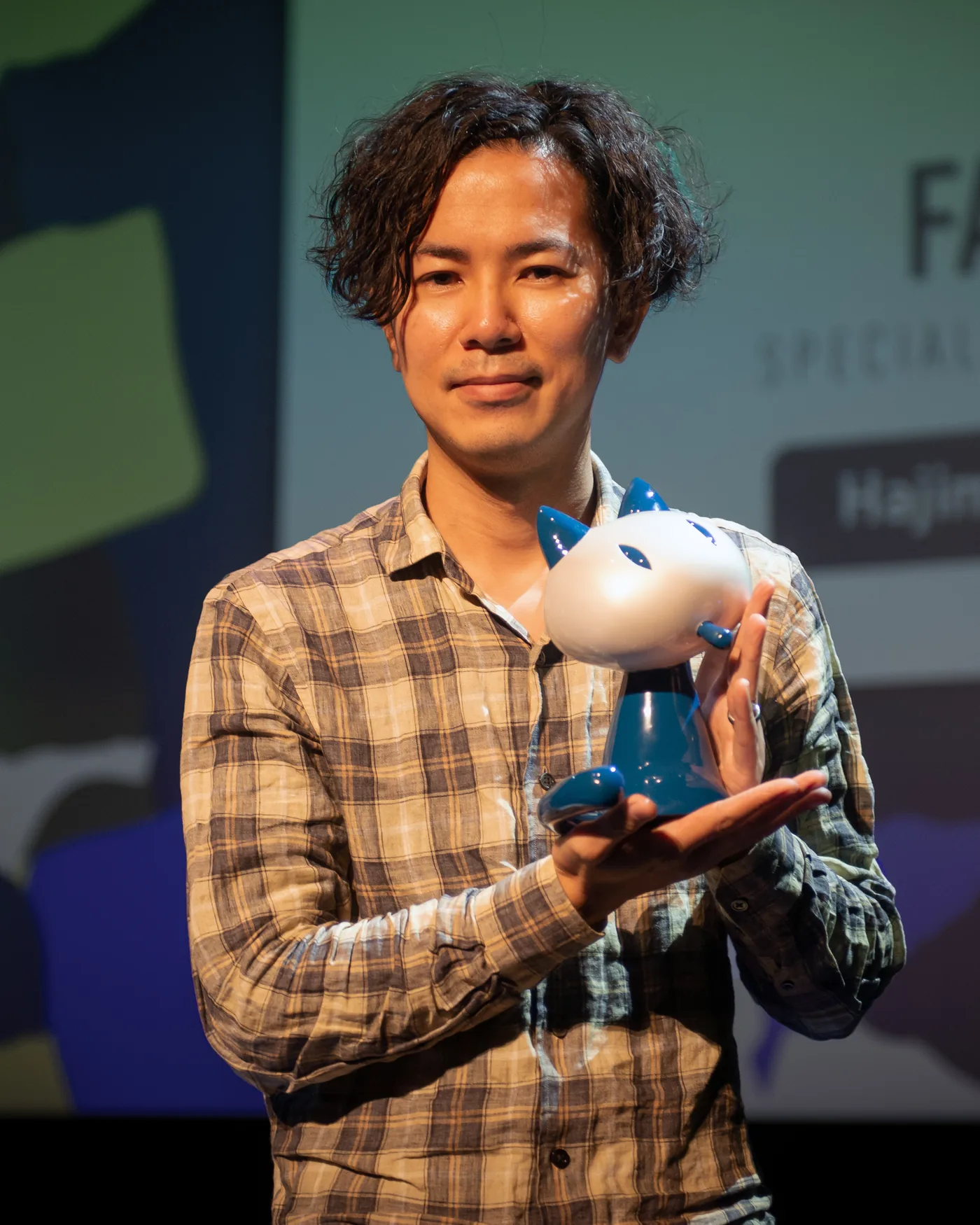
Hajime Isayama finished Attack on Titan on 9 April 2021, after eleven and a half years and 139 chapters in Kodansha's Bessatsu Shōnen Magazine, with more than 140 million copies in circulation.1 The anime needed two studios and a decade to catch up with him.
Koei Tecmo releases Attack on Titan 3 on 10 December 2026, the first game in the series to adapt the story from beginning to conclusion.3 Which raises a question the game has to answer and the rankings never do: what kind of story is it adapting?
Attack on Titan appears in sixteen rankings here. No two of them are asking the same thing.
Attack on Titan reaches "greatest ever" lists and "most disappointing" lists on the same evidence: it changed shape halfway through.
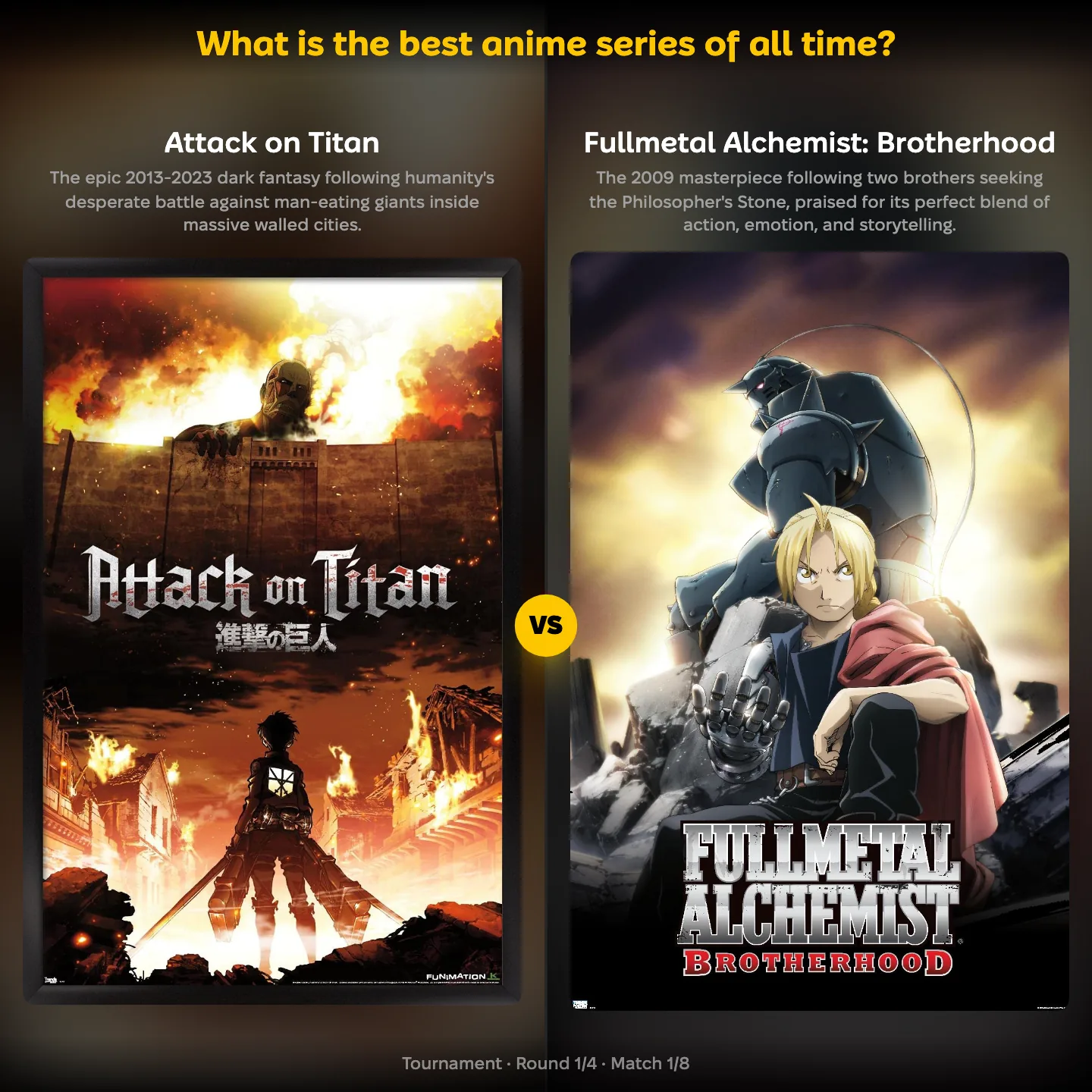
Attack on Titan vs Fullmetal Alchemist: the argument that never ends
The broadest question in the medium is also the least useful one, because everybody answering it means something different by "best". Fifteen series are on this list and each has a constituency that considers the matter closed.
Attack on Titan belongs here on scale. It ran ten years, crossed from a niche seinen-adjacent magazine into a global release schedule, and finished with a viewership event rather than a quiet finale.
Fullmetal Alchemist: Brotherhood belongs here on execution. It adapted a completed manga, so it never had to invent an ending or pad a season, and that structural luck is most of why it appears near the top of lists like this one.
Elsewhere on the list the same fault line runs through everything. One Piece and Naruto arrive with decades of accumulated audience behind them. Cowboy Bebop and Steins;Gate arrive with a short run and nothing wasted in it.
Anime in an open field, next to SpongeBob
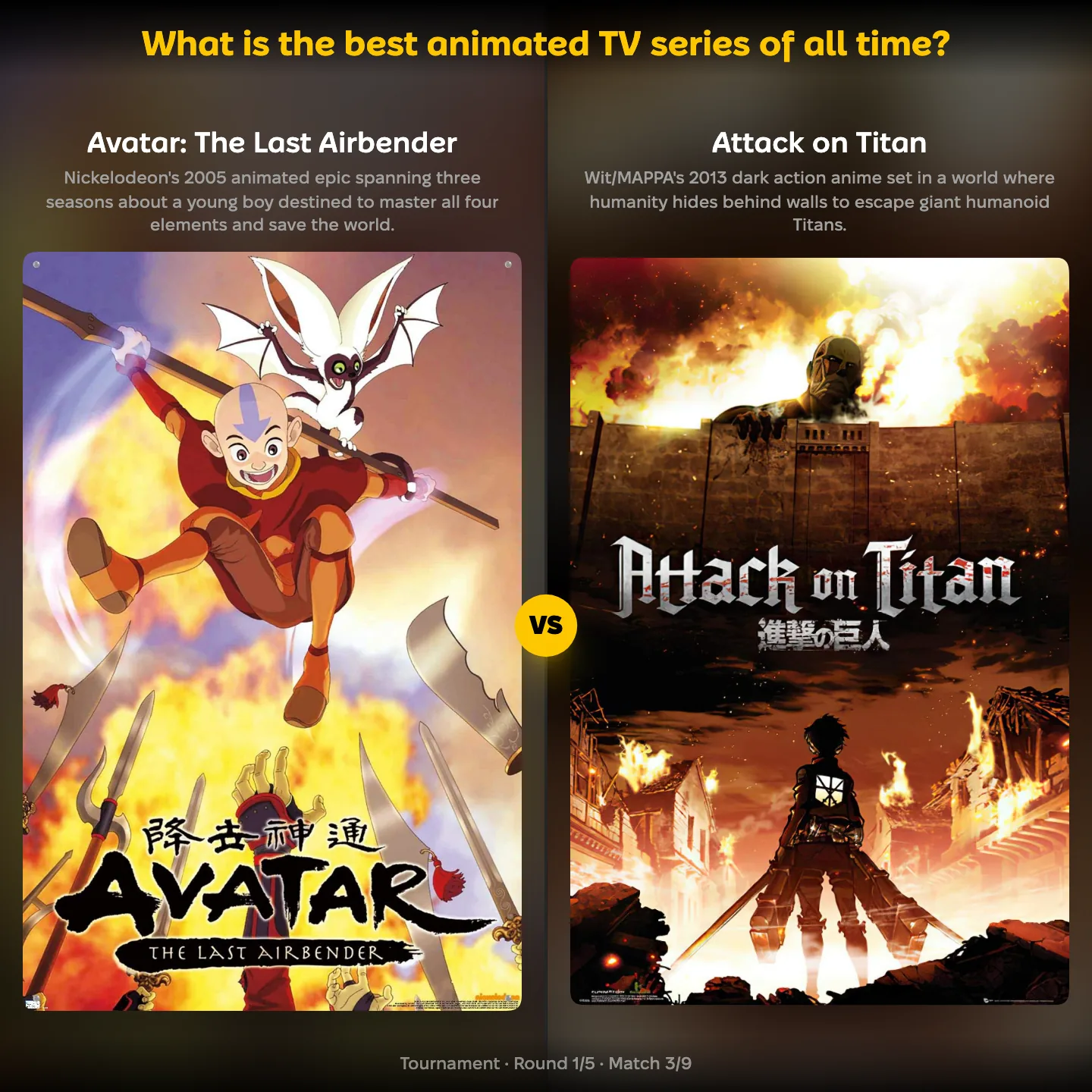
Widen the category from anime to animated television and the comparison stops being domestic. Attack on Titan is now measured against The Simpsons, SpongeBob SquarePants, Batman: The Animated Series and Avatar: The Last Airbender.
This is the list where the series' register works against it. A show built on siege warfare and genocide has no answer to thirty-five years of Springfield, because they are not trying to do the same job.
The comparison worth making is with Avatar: The Last Airbender, the American show that borrowed anime's serialisation and long-arc plotting outright. Put those two together and the question becomes who used the borrowed structure better.
The decade it defined
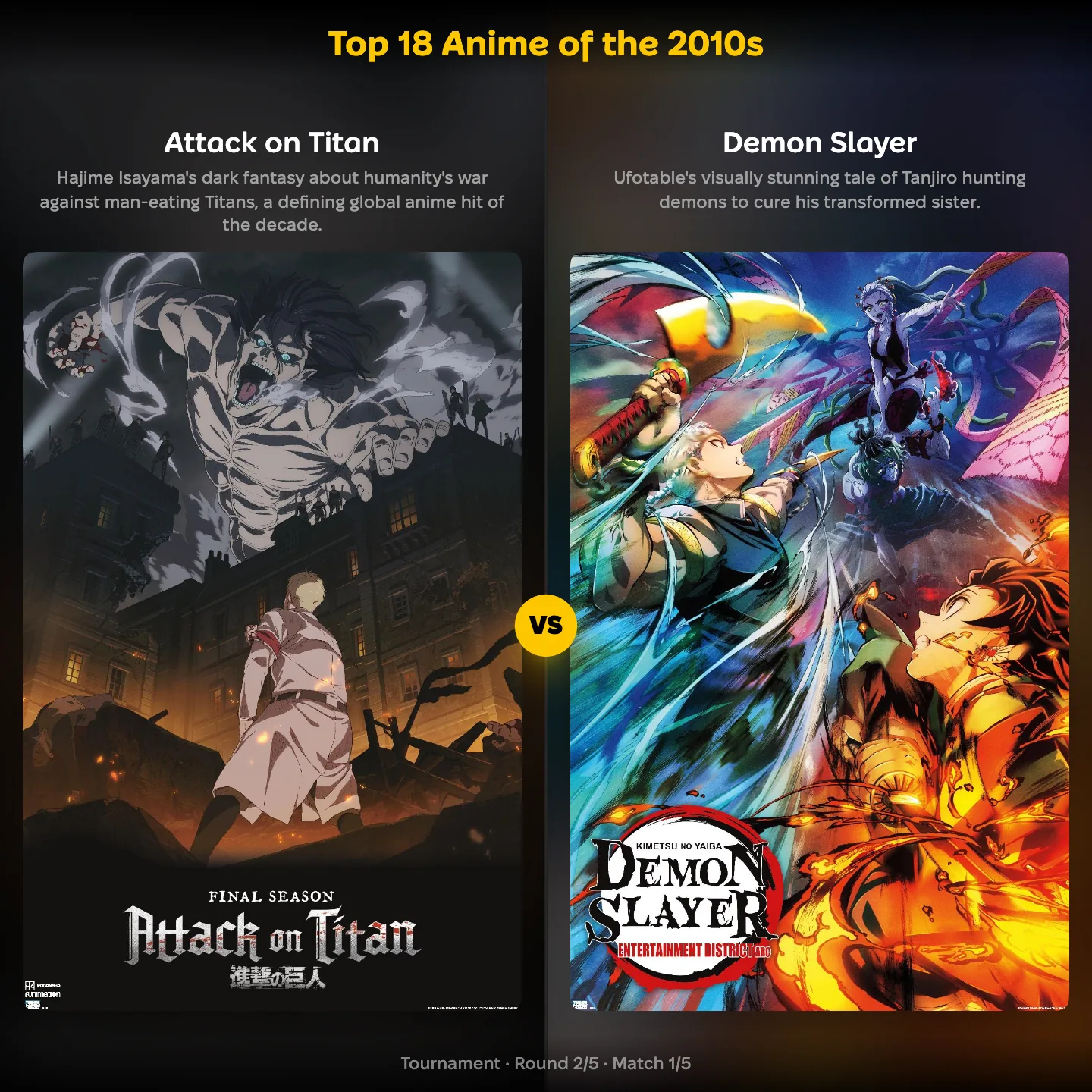
Attack on Titan opened in 2013 and the 2010s reorganised themselves around it. The list of that decade's anime is largely a list of shows that either followed its template or deliberately refused it.
Demon Slayer is the counter-example, arriving in 2019 with the opposite proposition: clean hero, clear villain, spectacular fight animation, no moral trapdoor.
Between them are Hunter x Hunter, Mob Psycho 100, Made in Abyss and Vinland Saga, each of which took the serious-fantasy register somewhere different.
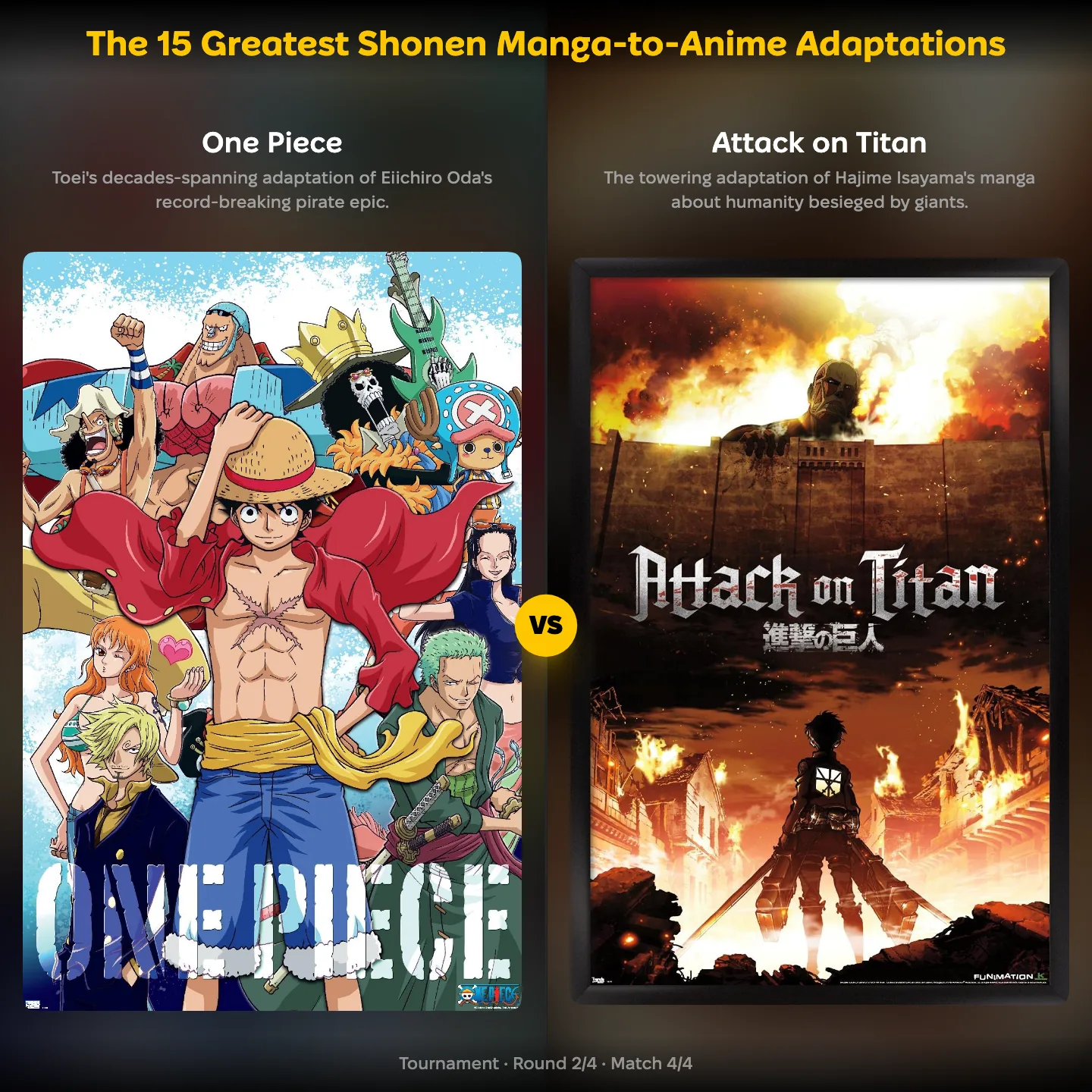
One Piece vs Attack on Titan: judged as an adaptation
Adaptation rankings measure something specific: how much of the manga survived the move to screen.
Attack on Titan has an unusual answer, because it was adapted twice under different conditions. Wit Studio worked ahead of a manga that was still running. MAPPA adapted a finished text and could see the ending from the start.
One Piece is the opposite case, and the reason adaptation lists exist. A manga of that length produces an anime with years of filler and pacing that regularly stalls, no matter how well loved the source is.
Fullmetal Alchemist: Brotherhood keeps winning this category for the structural reason above, and Bleach: Thousand-Year Blood War is the recent entrant built specifically to correct an earlier adaptation's mistakes.
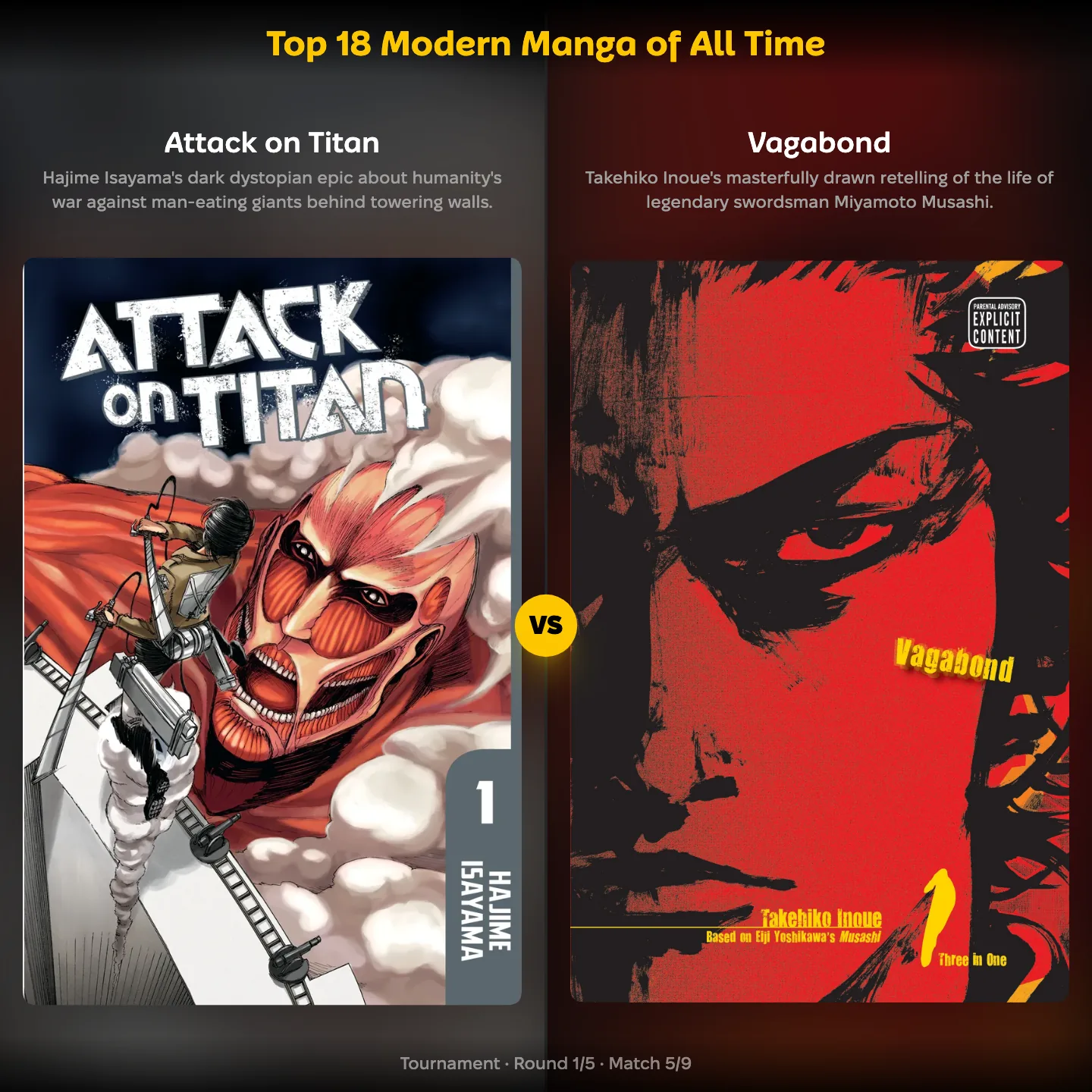
On the page, where Vagabond is waiting
Move to the manga list and Attack on Titan meets its most awkward comparison. Isayama's draughtsmanship was famously rough early on, and readers who came from the anime often find the first volumes hard going.
Vagabond is the reason that matters here. Takehiko Inoue's brushwork is the standard this category is judged against, and it is a standard Attack on Titan never tried to meet.
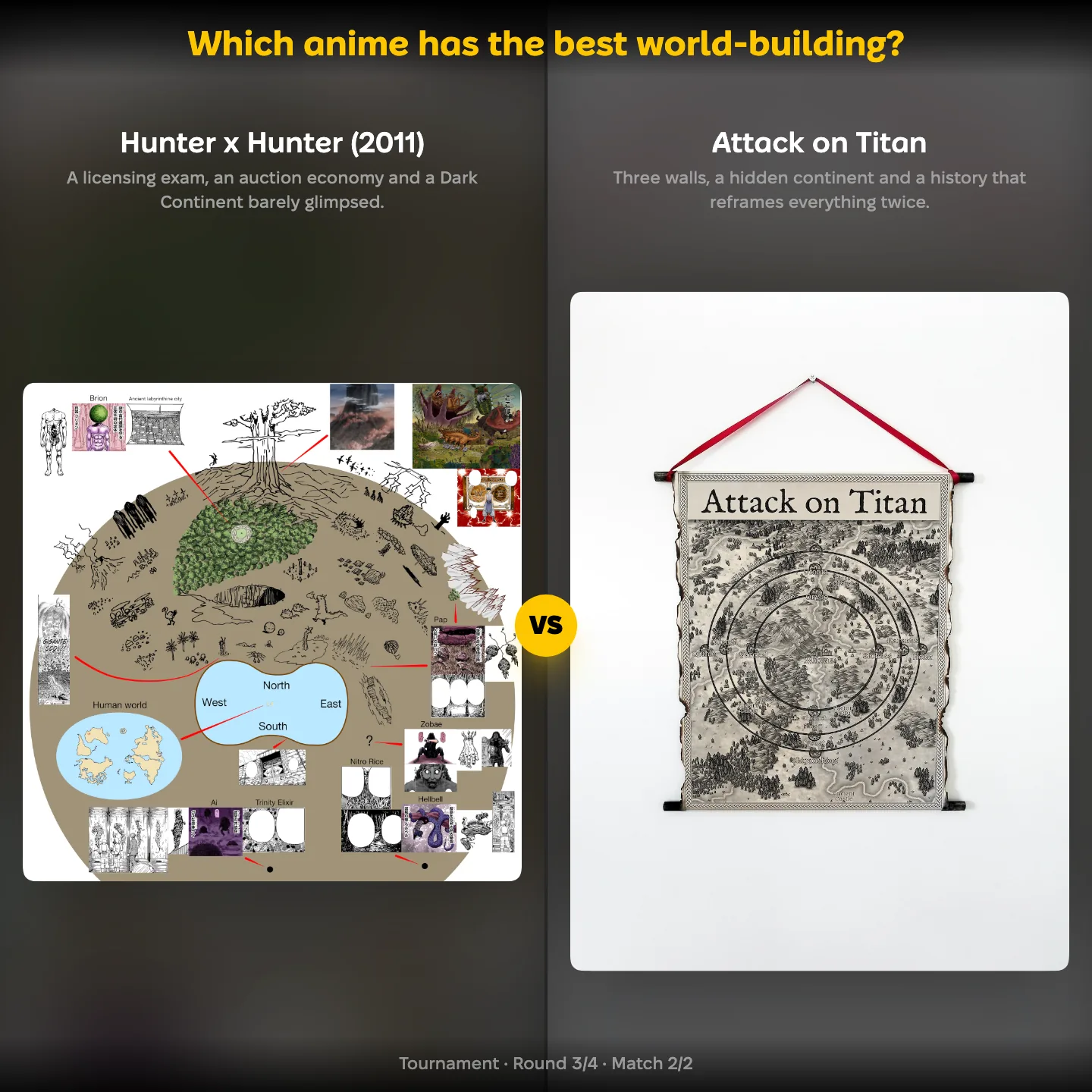
Hunter x Hunter and the world-building question
World-building lists reward internal consistency rather than spectacle, which is where Attack on Titan makes its strongest case. The walls, the Titan hierarchy, the political geography beyond the sea and the mechanics of inheritance were all load-bearing long before they were explained.
Hunter x Hunter is the standing champion of this category because its Nen system behaves like a set of rules a reader can reason with, and Togashi keeps honouring them.
The deep cuts here are Mushishi, Legend of the Galactic Heroes and Spice and Wolf, championed by readers who think spectacle is the enemy of world-building.
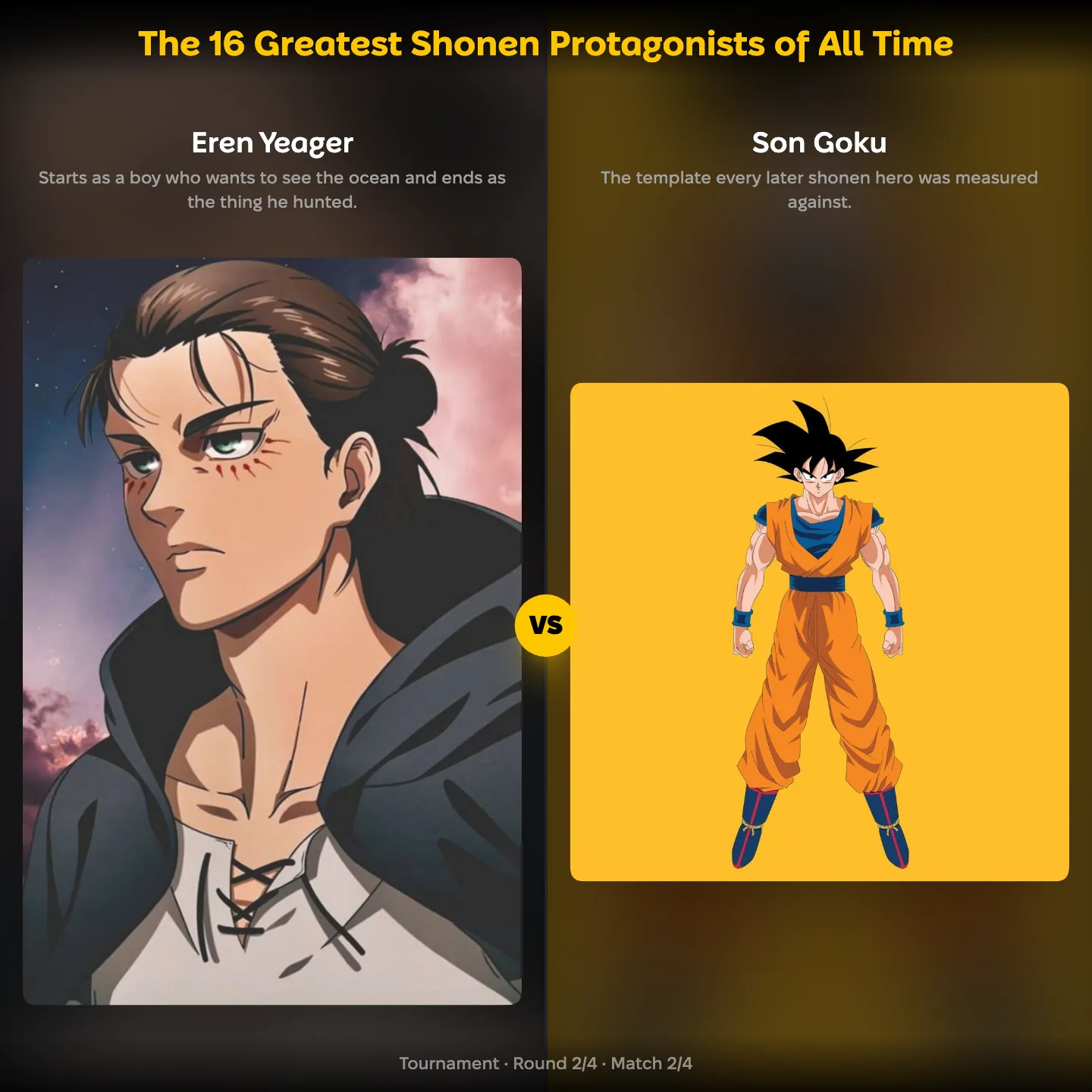
Eren Yeager vs Son Goku
Shonen protagonist lists have a shape: the hero gets stronger, protects people, and stays recognisably himself. Eren Yeager breaks the third condition on purpose.
He starts as a boy who wants to see the ocean and ends as the reason most of the world is dead. No other name on this list travels that distance, and it is the single hardest thing to reconcile when people rank him.
Son Goku is the template the category was built from, which makes the pairing useful. Goku's appeal is that he does not change; Eren's is that he does.
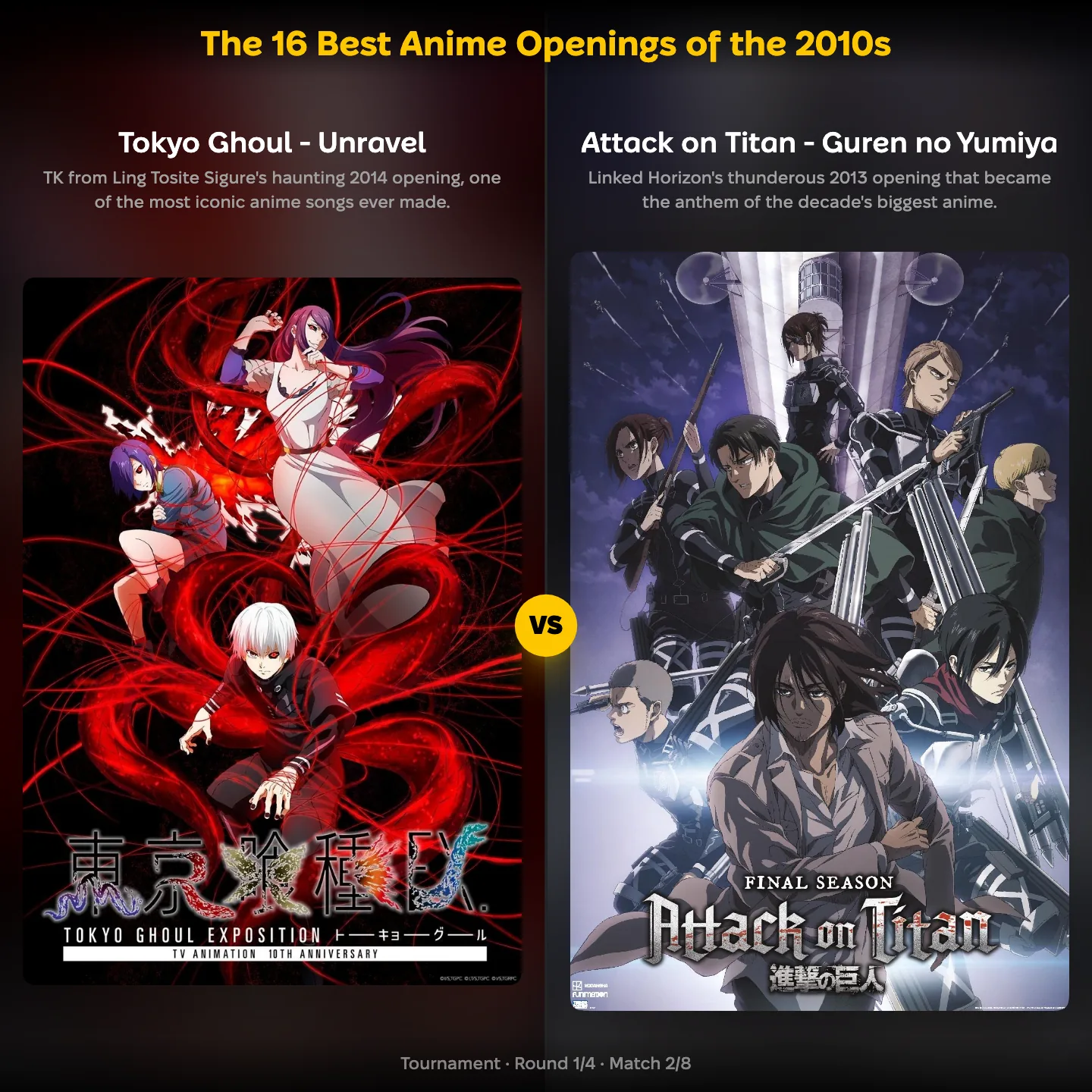
Guren no Yumiya: Linked Horizon against Ling Tosite Sigure
Linked Horizon released "Guren no Yumiya" as a single on 10 July 2013, and it sold more than 100,000 copies in its first week.2 The German-titled chorus and the cavalry-charge tempo became shorthand for the whole series.
Tokyo Ghoul's "Unravel" is the other 2010s opening people can hum unprompted. It does the reverse: TK's vocal is thin and cracked where Linked Horizon fields a choir.
Here Attack on Titan competes on a single ninety-second artefact rather than a decade of story.
Wit Studio: the show that made the studio
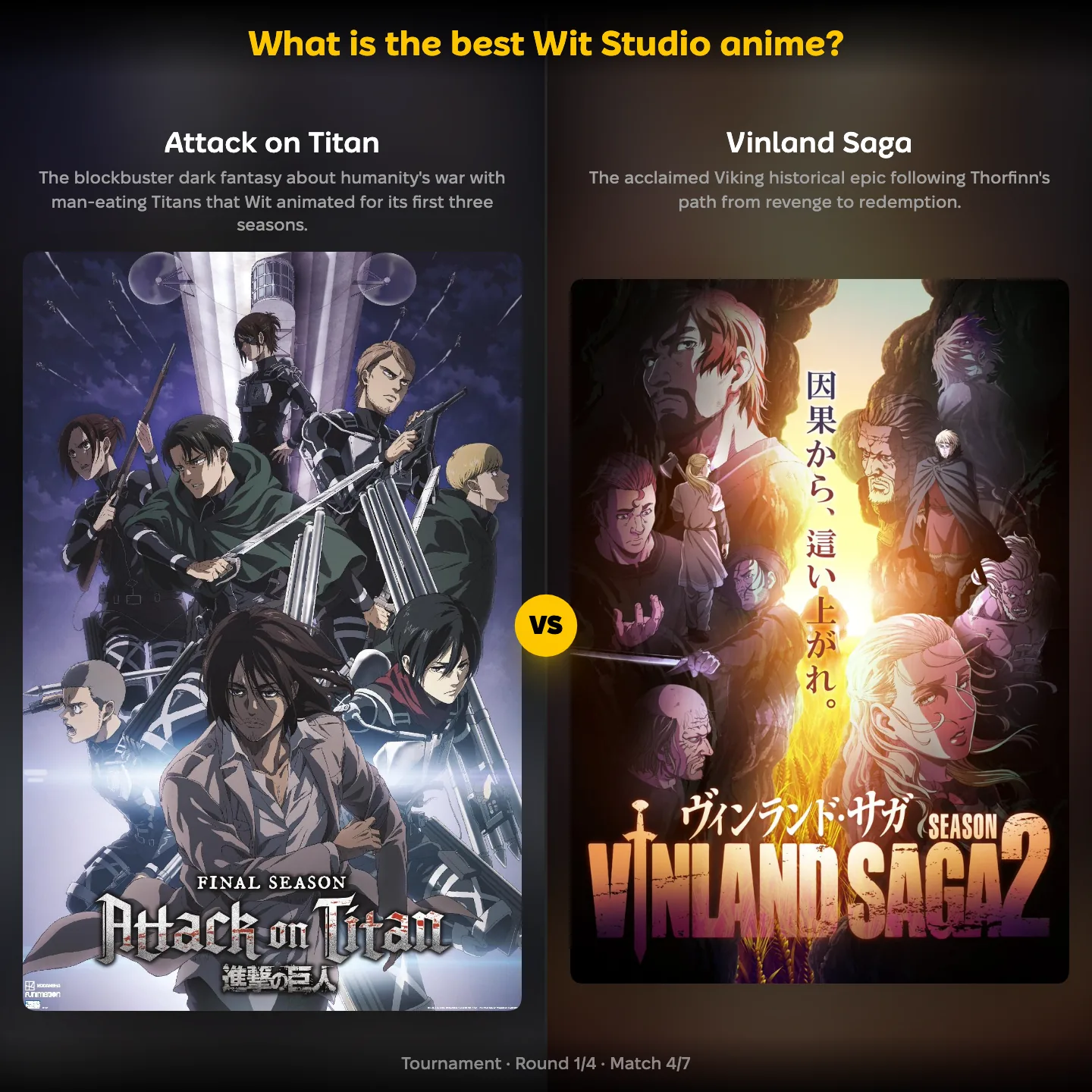
Wit Studio was founded on 1 June 2012 by George Wada and Tetsuya Nakatake, both former Production I.G producers.4 Attack on Titan went to air the following April. The studio was barely a year old.
That timing turns the whole category into a question about a debut. Wit had no back catalogue to be judged against, and the omnidirectional-gear sequences it built for season one became the thing every later studio was measured on.
The catalogue it assembled afterwards is the competition: Vinland Saga, Ranking of Kings, Great Pretender, and Spy × Family co-produced with CloverWorks.4
Vinland Saga is the strongest counter-argument, and the neatest one, because Wit also lost that show to MAPPA after a single season. Twice the studio built something and handed it over.
MAPPA: the studio that had to finish it
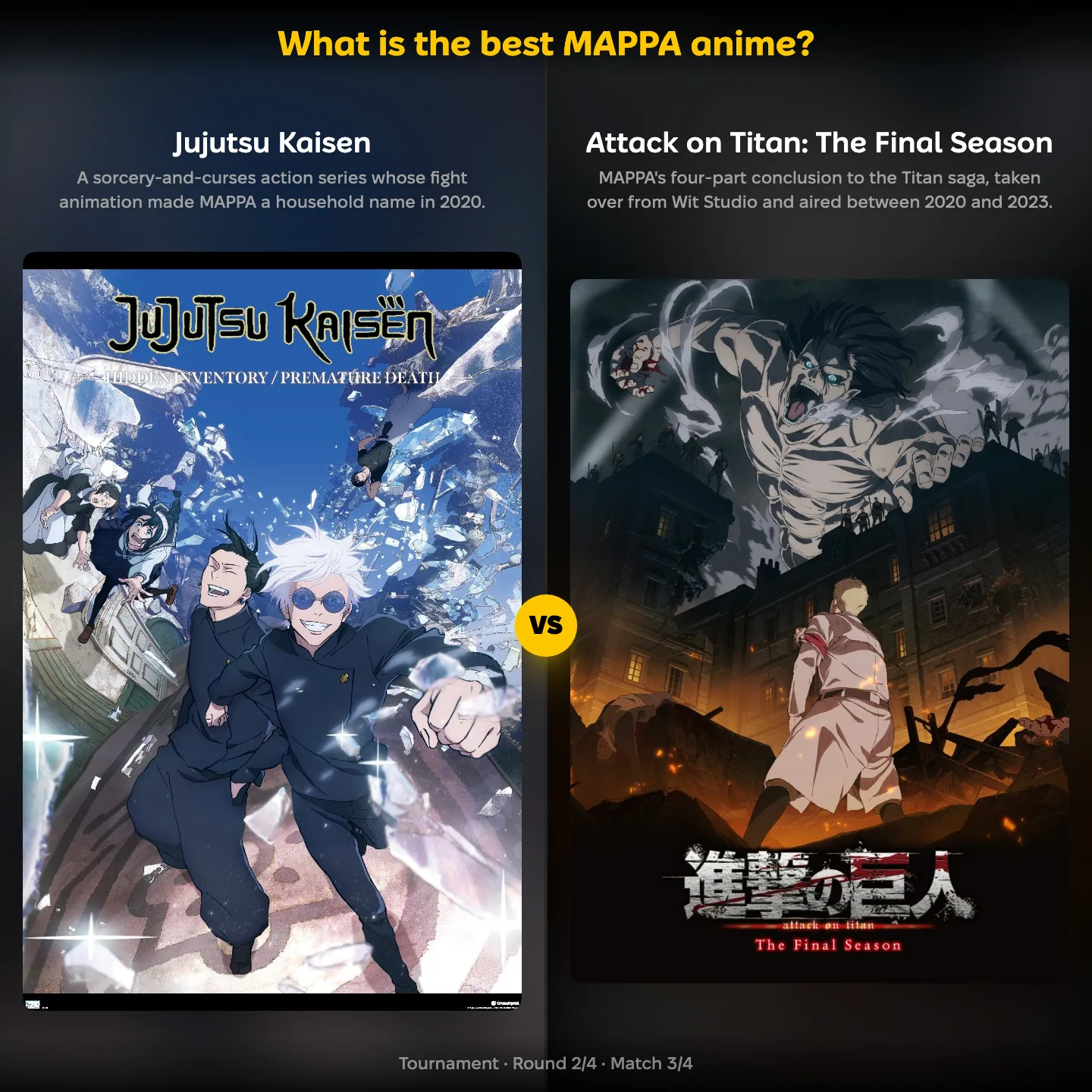
MAPPA took over for the Final Season, which ran from 2020 to 2023.2 Inheriting a series at its most demanding point is a thankless job, and the visual handover was argued about from the first episode.
MAPPA was founded on 14 June 2011 and marked its fifteenth anniversary with a presentation on 19 June 2026, using an Attack on Titan Final Season visual among the anniversary art.5 The studio still puts the show front of house.
The rest of its catalogue is unusually wide for a company known mainly for two or three titles. Yuri!!! on Ice is a figure-skating drama, Kids on the Slope is about 1960s jazz, In This Corner of the World is a Hiroshima film, and Zombie Land Saga is an idol comedy with undead idols.
Jujutsu Kaisen and Chainsaw Man are the direct competition, and both have a claim Attack on Titan cannot make here: MAPPA built them from the first frame.
Berserk set the bar for dark fantasy
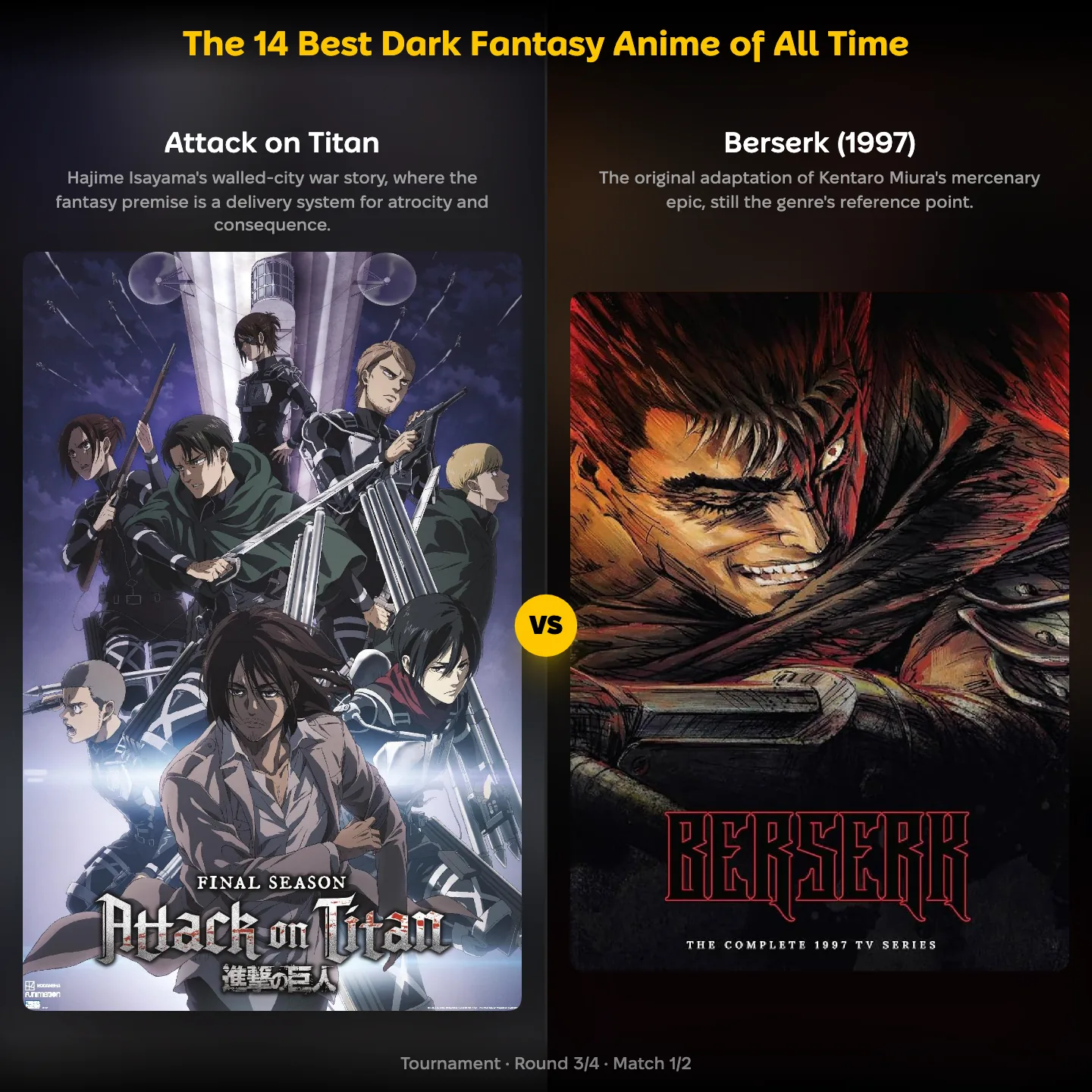
Filed by genre, Attack on Titan lands in a category whose rules predate it by two decades. Dark fantasy asks whether the cruelty in a story is doing work or decorating it.
Berserk is the reference point, and the 1997 series is why. Kentaro Miura's mercenary epic established that the genre could be brutal and still be about something, which is the test every entry here is graded against.
Attack on Titan qualifies because its horror is structural. The Titans turn out to be people, and that reveal reframes every earlier fight as something worse.
Made in Abyss, Devilman Crybaby and Claymore round out the harder end of the list, and Puella Magi Madoka Magica is the one that gets in by disguising itself as something gentler.
Hiroyuki Sawano vs Yoko Kanno
Hiroyuki Sawano scored Attack on Titan, joined by Kohta Yamamoto for the Final Season. His signature is a full choir singing invented German over strings and percussion, and it is loud enough that people who have never watched the show recognise it.
Yoko Kanno and the Seatbelts are the counter-case. The Cowboy Bebop score is jazz, blues and bebop played by a working band, and it earns its place by being music that survives without the pictures.
Those two positions are the whole category. Joe Hisaishi's Princess Mononoke and Nujabes' work on Samurai Champloo sit closer to Kanno; Shiro Sagisu's Evangelion sits closer to Sawano.
Evangelion, Attack on Titan, and two endings nobody settled
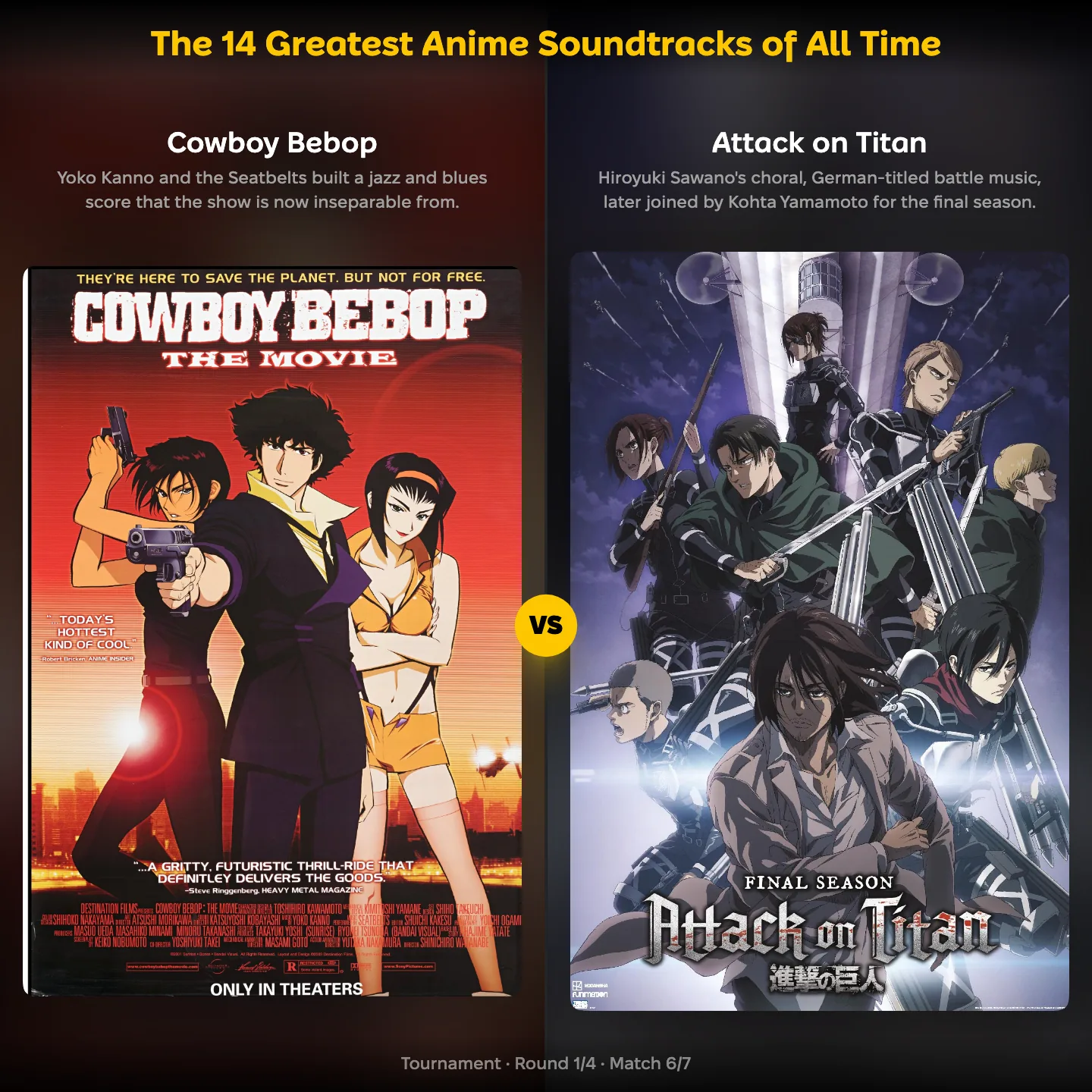
The Attack on Titan finale aired on 5 November 2023 and the fandom has not recovered its composure since.2 The complaint concerns what the story asks of its readers: accepting Eren's choice as the point the whole series had been building toward.
Neon Genesis Evangelion is the other name people reach for, and the comparison is exact. Both series spent their run promising a resolution about the world and delivered one about a single character's interior.
The difference is what came afterwards. Evangelion got The End of Evangelion, a film that re-answered the question in the other register; Attack on Titan has only the chapter it published.
The Promised Neverland's second season, School Days and Devilman Crybaby are on this list for cruder reasons. That is what separates them from the two headline entries, because nobody accuses Isayama or Anno of carelessness.
The second-half problem
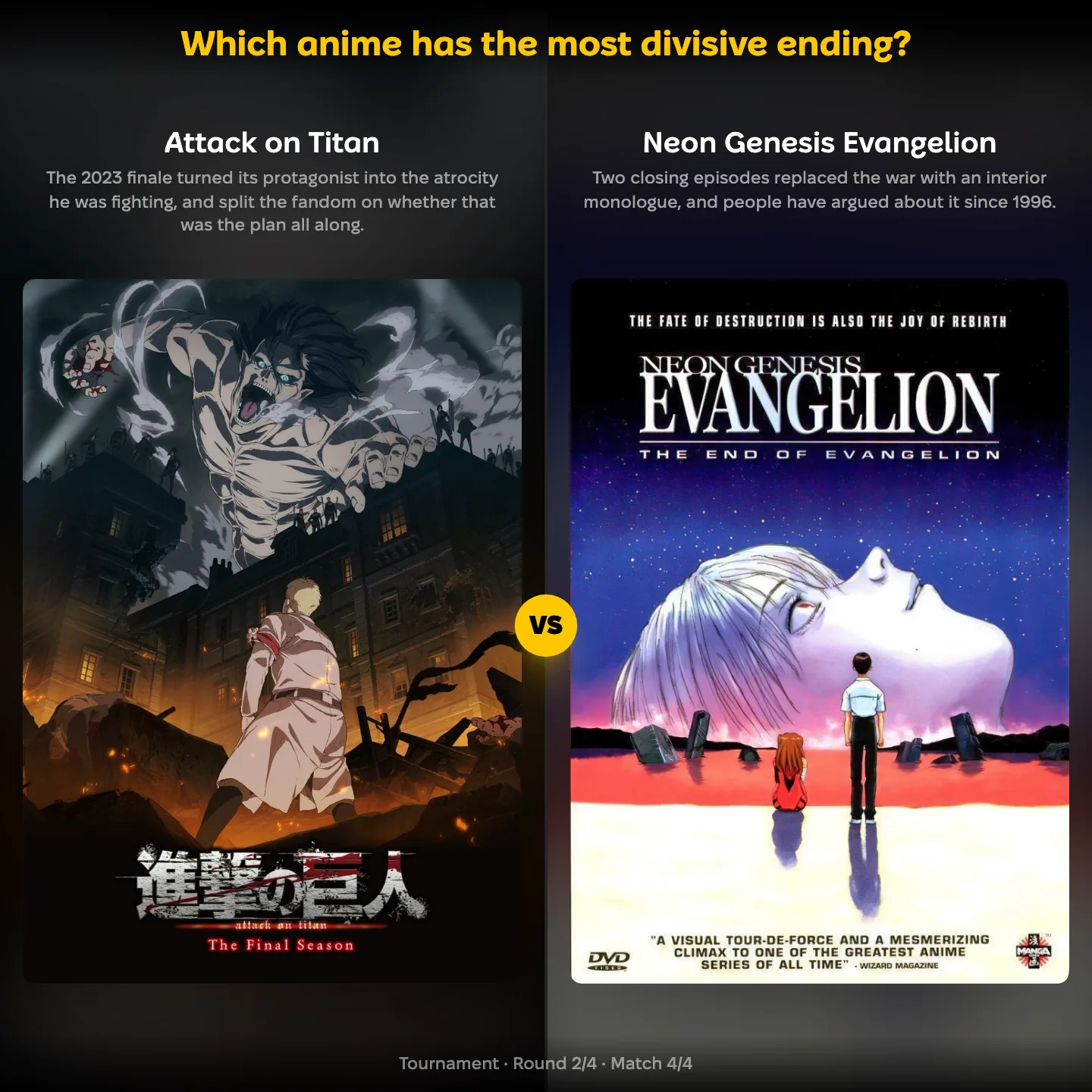
Here is the unflattering entry, and Attack on Titan qualifies for it honestly. The timeskip into the Marley arc swaps the cast, the setting and the genre at once, trading siege horror for political thriller.
Plenty of readers consider that swap the best thing the series did. Plenty stopped watching, which is exactly the condition this ranking is describing.
Sword Art Online is the comparison the list invites, though the two failures are unrelated. One is accused of losing its nerve; the other of losing its premise on purpose.
The 2015 live-action film, and a list nobody wants to win
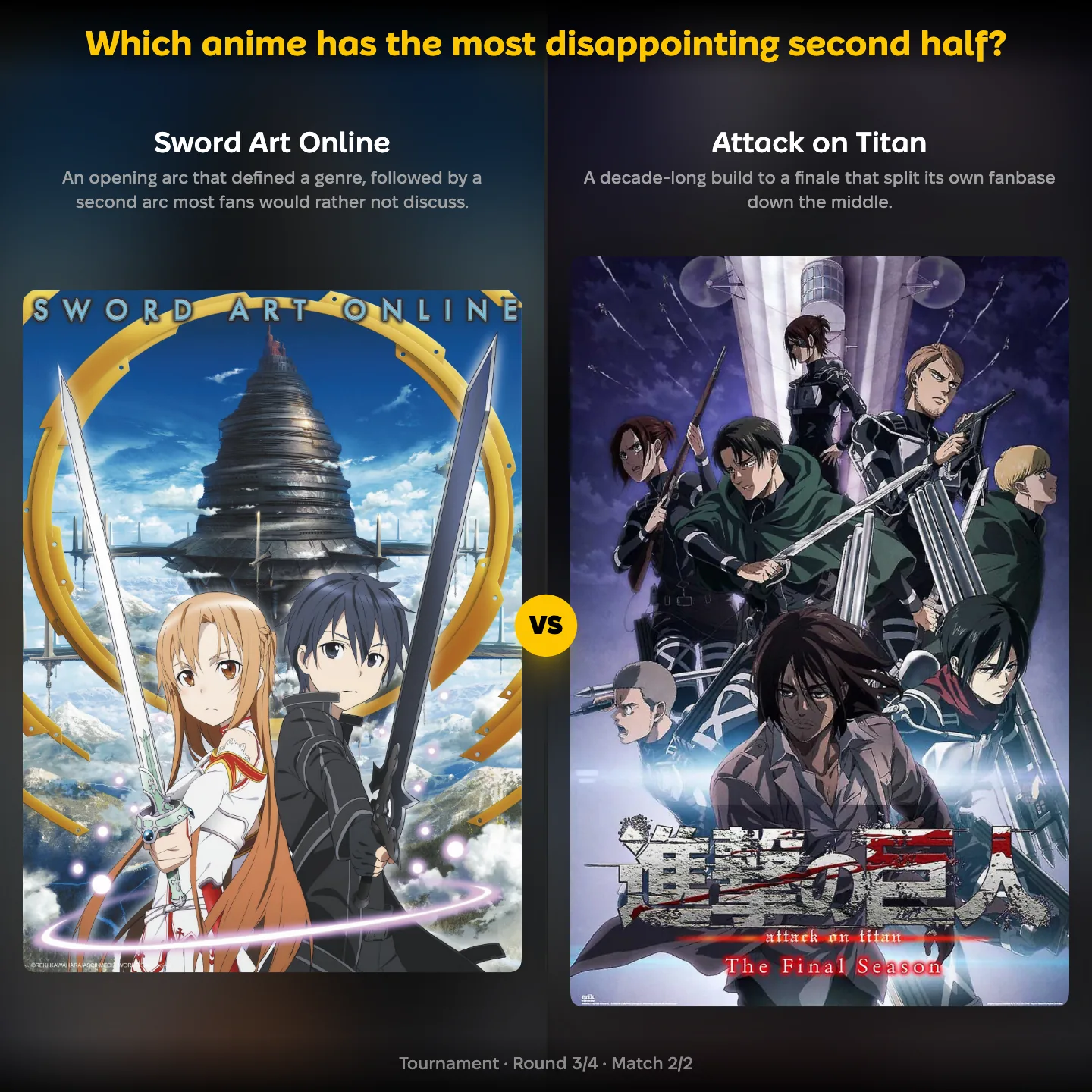
Shinji Higuchi's two-part live-action adaptation arrived in 2015 and holds a 47% critics score on Rotten Tomatoes against a 35% audience score.6 It cut fan-favourite characters, invented replacements, and relocated the story away from its European visual setting.
Dragonball Evolution is the benchmark for this category, and the reason the category feels settled before it starts.
The animated side of the franchise has the opposite record in cinemas. Attack on Titan: The Last Attack, the compilation film of the finale, took $25,956,985 worldwide.7
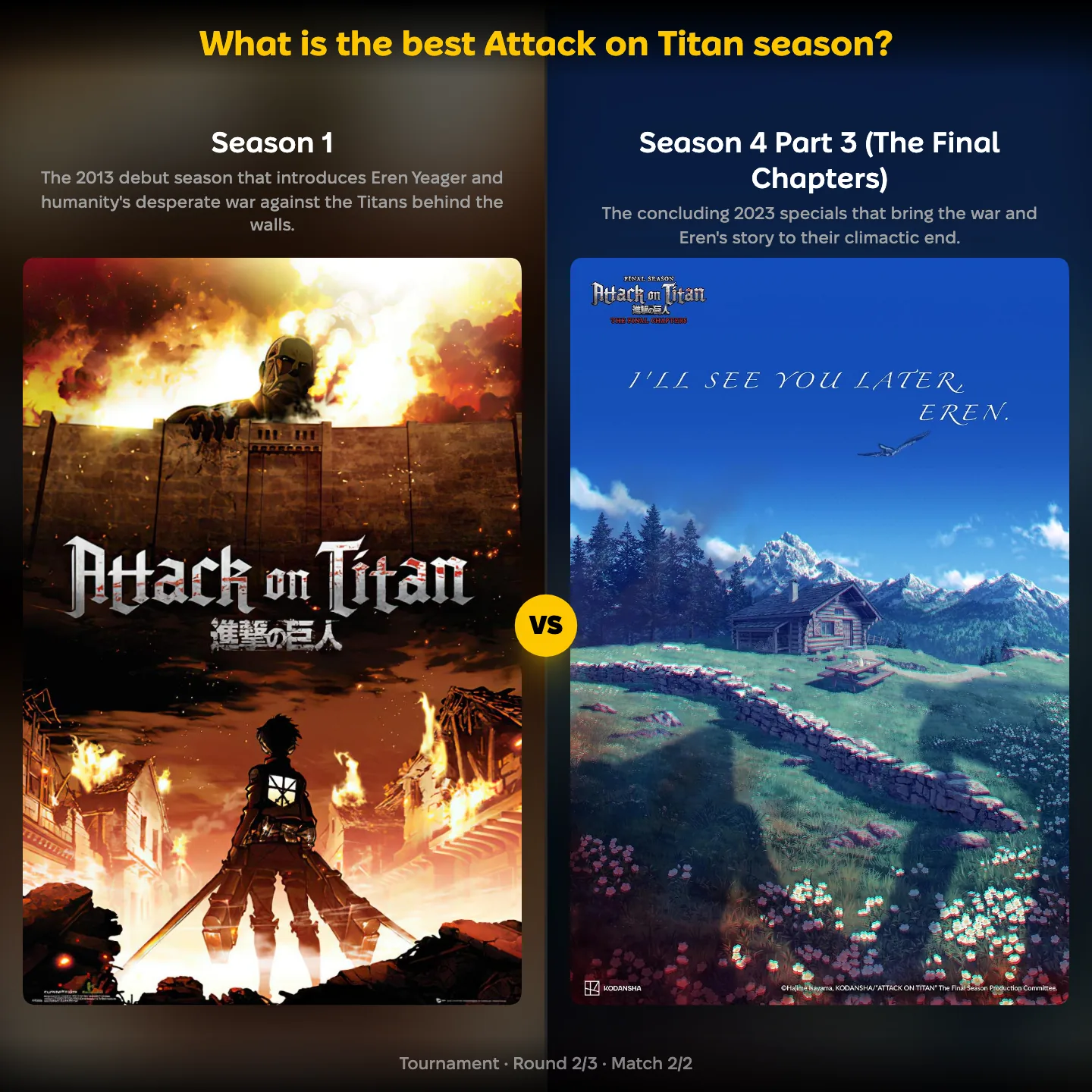
Season 1 vs The Final Chapters
The last ranking removes every other series and asks the show to compete with itself across seven seasons and parts.
Season 1 has the advantage of being unrepeatable. Nobody watching in 2013 knew what the Titans were, and the Colossal Titan appearing over the wall worked once, on an audience with no information.
The Final Chapters has the opposite advantage. It is the only part that can pay off ten years of setup, and it is the part MAPPA was hired to deliver.
Between them are the seasons fans quietly rate highest: Season 3 Part 2, which contains the Shiganshina arc and the basement, is the usual answer from people who have watched the whole thing twice.
Sixteen categories, one show that fits all of them badly
A series that can be filed under shonen adaptation, dark fantasy, animated television, world-building and disappointing second half is not being described by any of those headings. It is being approximated by them, and the gaps between the approximations are where the interesting reading happens.
Each list above resolves through head-to-head voting, which is how one series ends up looking like a different show in every one of them.
Take the one that annoys you most and go and disagree with it.
More rankings, more angles
- Death Note: Thriller, Shonen, or Best Cartoon Ever? — a 37-episode series measured against 500-episode ones
- Studio Ghibli vs Disney: Two Ways to Draw a Classic — hand-drawn houses with opposite instincts
- Demon Slayer Passed Spirited Away, Not Mugen Train — a box-office record and fifteen lists
- Evangelion at 30: Robot Show, Therapy, Puzzle Box — the other ending nobody stopped arguing about
Sources
- Wikipedia — Attack on Titan (manga): serialisation in Kodansha's Bessatsu Shōnen Magazine from 9 September 2009 to 9 April 2021, 139 chapters, and over 140 million copies in circulation: en.wikipedia.org (checked 2026-08-16)
- Wikipedia — Attack on Titan (TV series): Wit Studio on seasons 1–3 and MAPPA on season 4 (2020–2023), the 5 November 2023 conclusion, and the "Guren no Yumiya" single released 10 July 2013 selling over 100,000 copies in its first week: en.wikipedia.org (checked 2026-08-16)
- Gematsu — Attack on Titan 3 (Omega Force / Koei Tecmo) releases 10 December 2026 and adapts the story from its beginning to its conclusion: gematsu.com (checked 2026-08-16)
- Wikipedia — Wit Studio: founded 1 June 2012 by George Wada and Tetsuya Nakatake, formerly of Production I.G, with Vinland Saga, Ranking of Kings, Great Pretender and Spy × Family among its works: en.wikipedia.org (checked 2026-08-16)
- Anitrendz — MAPPA's fifteenth-anniversary presentation on 19 June 2026 included an Attack on Titan Final Season anniversary visual: anitrendz.net (checked 2026-08-16)
- Rotten Tomatoes — Attack on Titan (2015): 47% Tomatometer and 35% audience score: rottentomatoes.com (checked 2026-08-16)
- Box Office Mojo — Attack on Titan: The Last Attack worldwide gross of $25,956,985: boxofficemojo.com (checked 2026-08-16)