
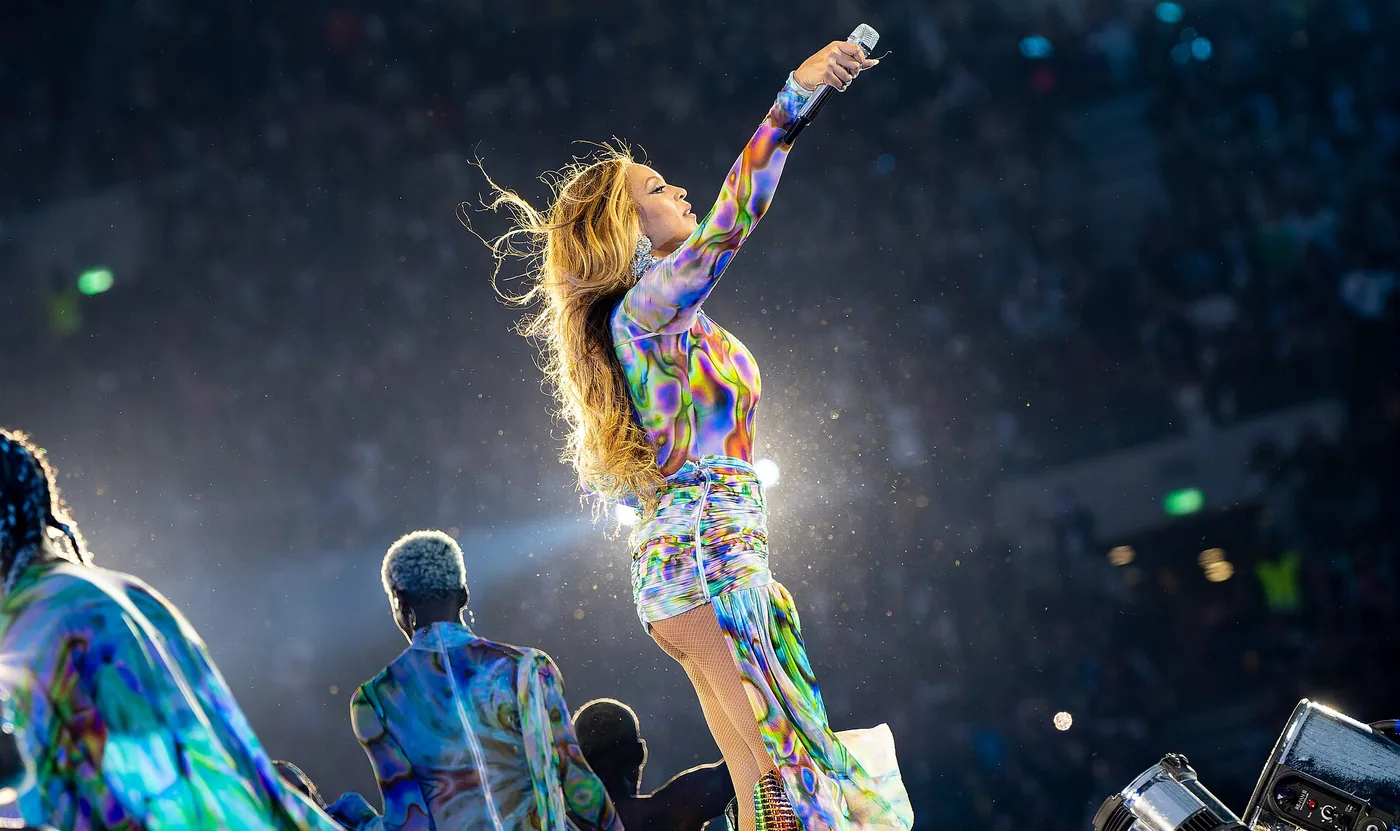
Beyoncé has won 35 Grammys from 99 nominations, more than any other artist since the Grammys began, and the 2025 ceremony handed her Album of the Year on her sixth nomination in that category.1
Around that record sit a country album, a house album, a Netflix concert film, a Met Gala she co-chaired and eight years in a girl group before any of it.
On 4 July 2026 she put out "MORNING DEW (DONK)", her first new song in two years, and Parkwood Entertainment framed it as the opening of a 60-day countdown to a 20th-anniversary reissue of B’Day.2 A reissue is as good a reason as any to work out where she belongs. She is among the options in sixteen of the rankings here, and the size of her claim changes on every one.
Every list here wants a different Beyoncé: the country one, the disco one, the couture one, the teenager in Destiny’s Child.
Beyoncé vs Madonna, and thirty other pop stars
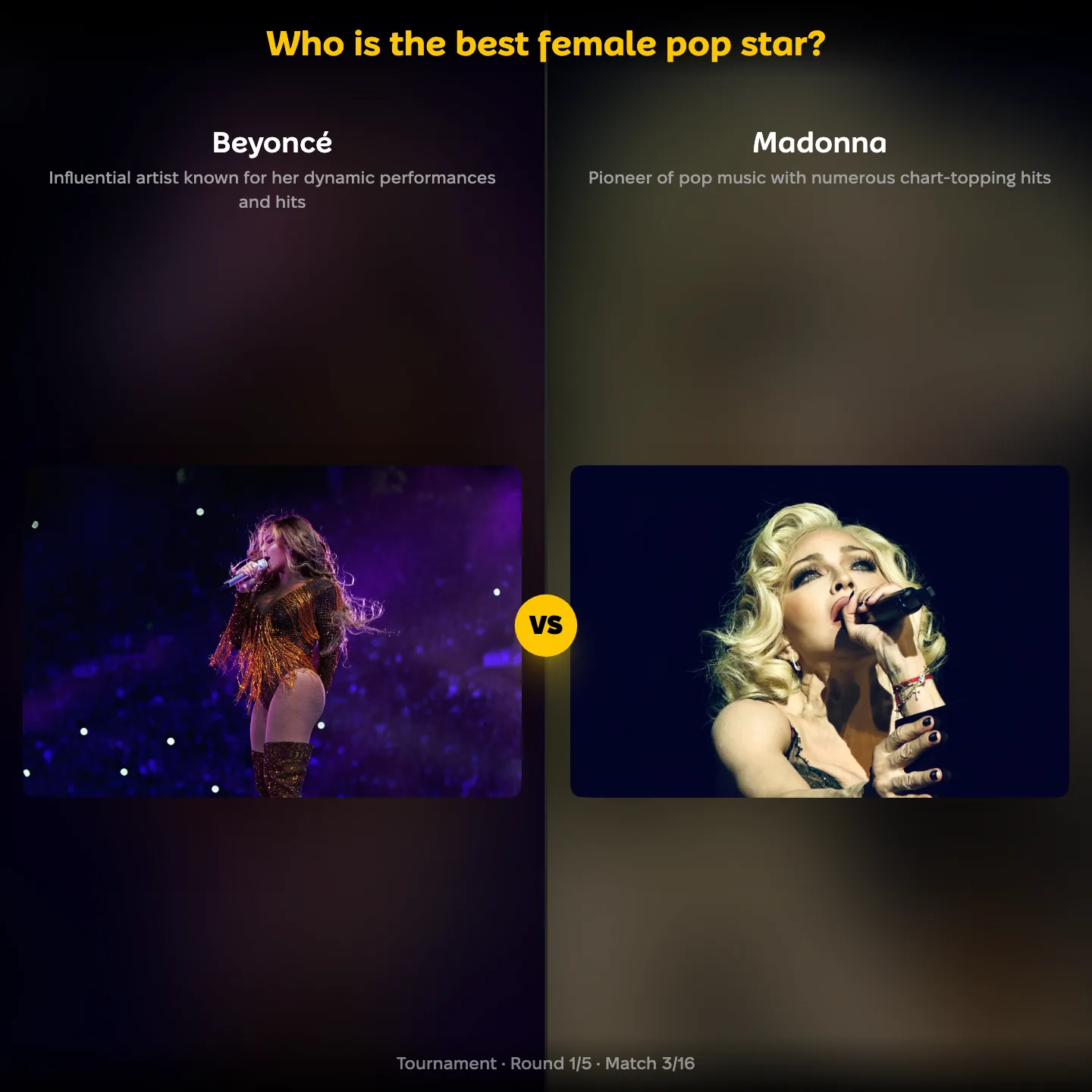
"Who is the best female pop star?" is about as broad as a Beyoncé question gets, and it is the one where her case needs the least explaining. Each of her last four solo albums arrived as an event rather than a release.
The trouble with a broad question is a broad field. This ranking holds 32 names, from Whitney Houston and Mariah Carey to Sabrina Carpenter and Olivia Rodrigo.
Madonna is the comparison worth having. She built the template: serial reinvention, the tour as spectacle, provocation on a schedule. Beyoncé has spent two decades running it at a larger scale.
Sharing a list with 31 other names is a different test from sharing one with seven.
Sinatra, Aretha Franklin, Ella Fitzgerald: no genre, no decade
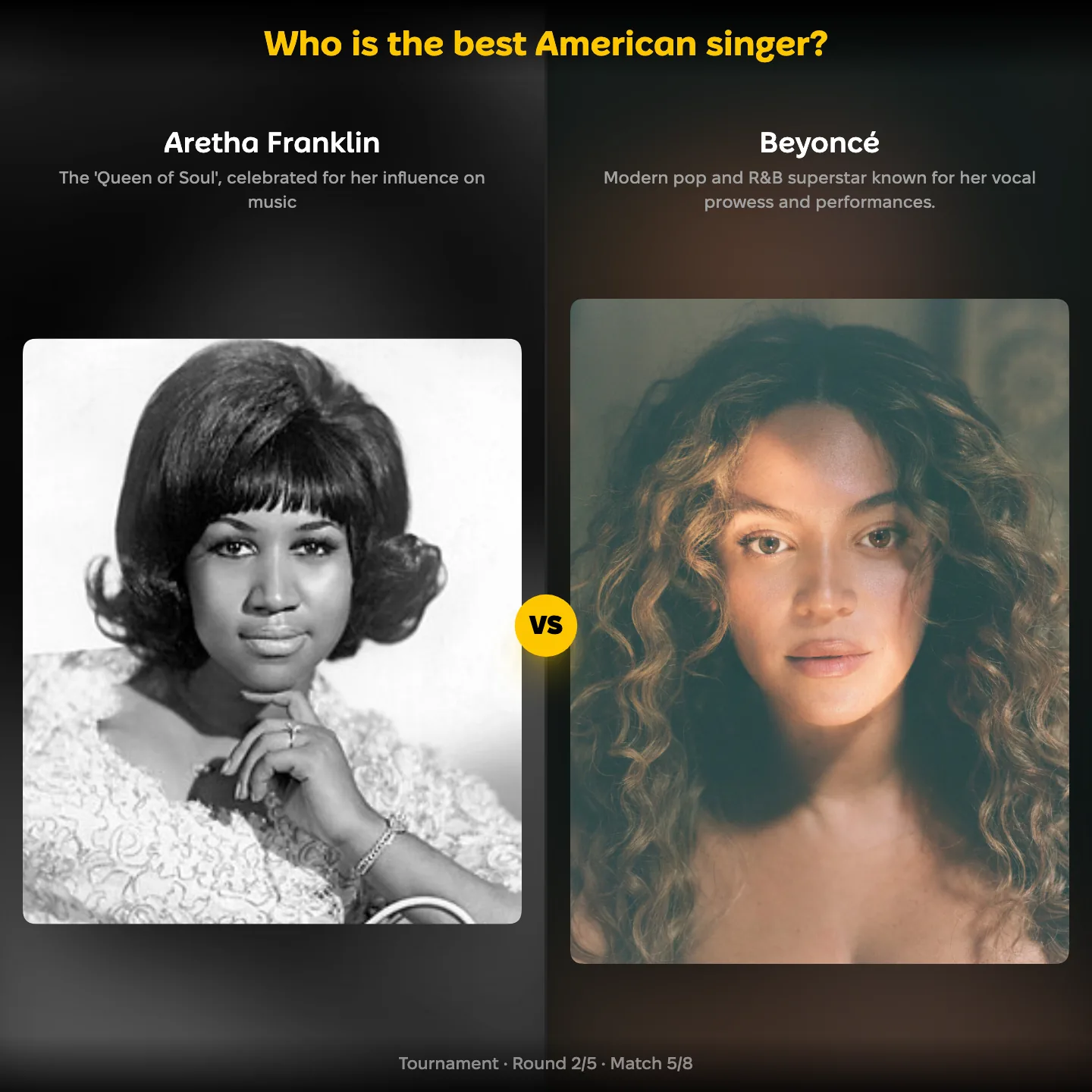
Drop "pop" from the question and Beyoncé is competing across a century. "Who is the best American singer?" puts her in a field of 32 that includes Frank Sinatra, Aretha Franklin, Ella Fitzgerald, Billie Holiday, Nina Simone, Ray Charles and Michael Jackson.
Her qualification here is range. Renaissance is a house record, Cowboy Carter is a country record, and Lemonade moves through rock, alternative R&B and country in one sitting.
Aretha Franklin is the hardest name on the list to get past. "Respect" settled what a soul vocal could do, and Beyoncé has covered her repeatedly and in public.
Her case here is real, and so is everyone else’s: Ella Fitzgerald, Nina Simone and Ray Charles are not filler names.
Lemonade next to Sgt. Pepper’s and The Wall
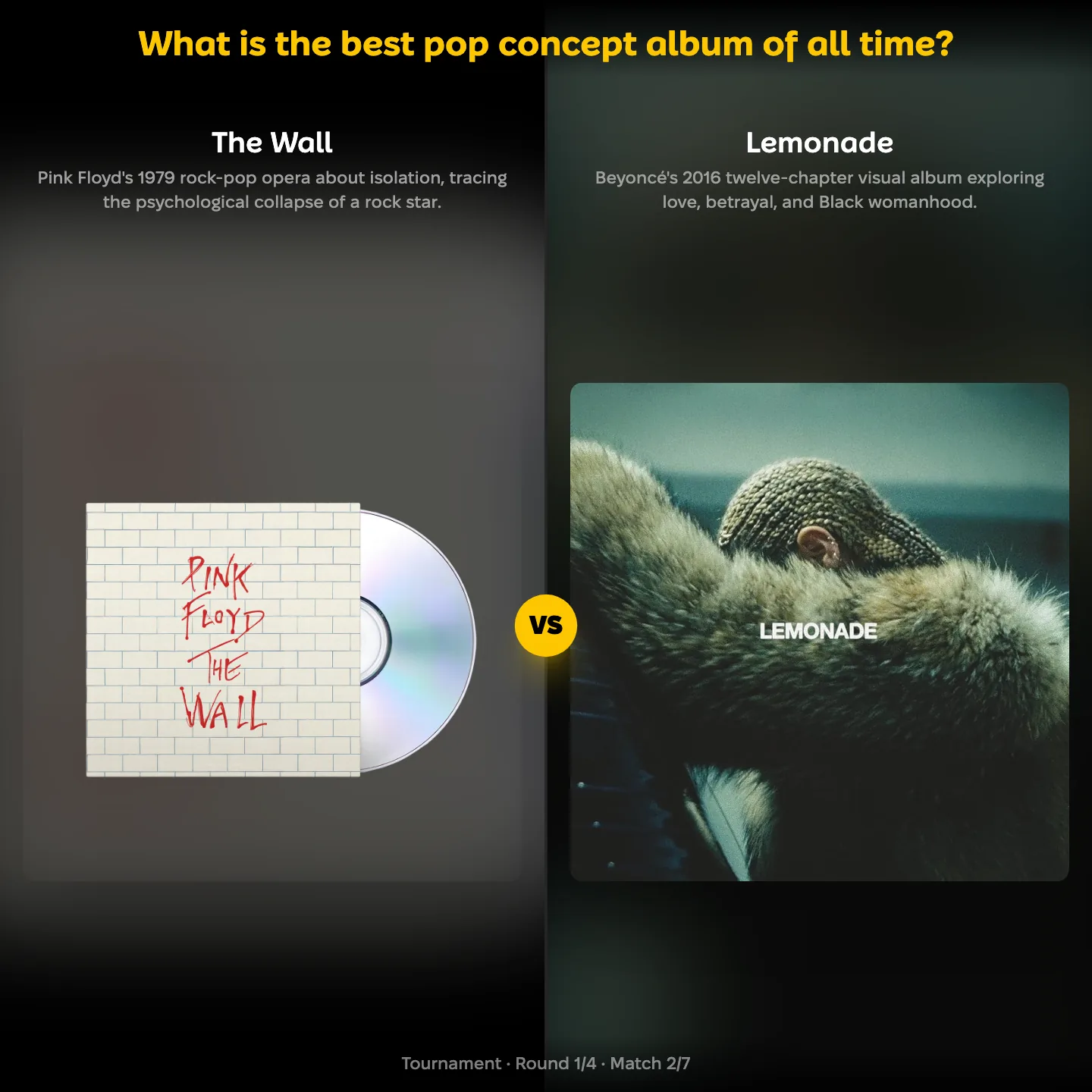
grammy.com’s guide to her catalogue calls Lemonade, her sixth album, a genre-crossing record carried by a visual component that several filmmakers directed, and records that it took two Grammys from nine nominations at the 59th ceremony.3
That construction is why it belongs among concept albums rather than merely good ones — and why this is the hardest room in the article.
The competition here comes from outside pop: Sgt. Pepper’s Lonely Hearts Club Band, Pink Floyd’s The Wall, David Bowie’s Ziggy Stardust, The Who’s Tommy and Green Day’s American Idiot, four of them released before Beyoncé was born.
A 2016 album in that company is the newcomer by four decades. The counter-argument is that Lemonade had to work as a film and a record at once.
Album of the Year 2017: Lemonade and Adele’s 25
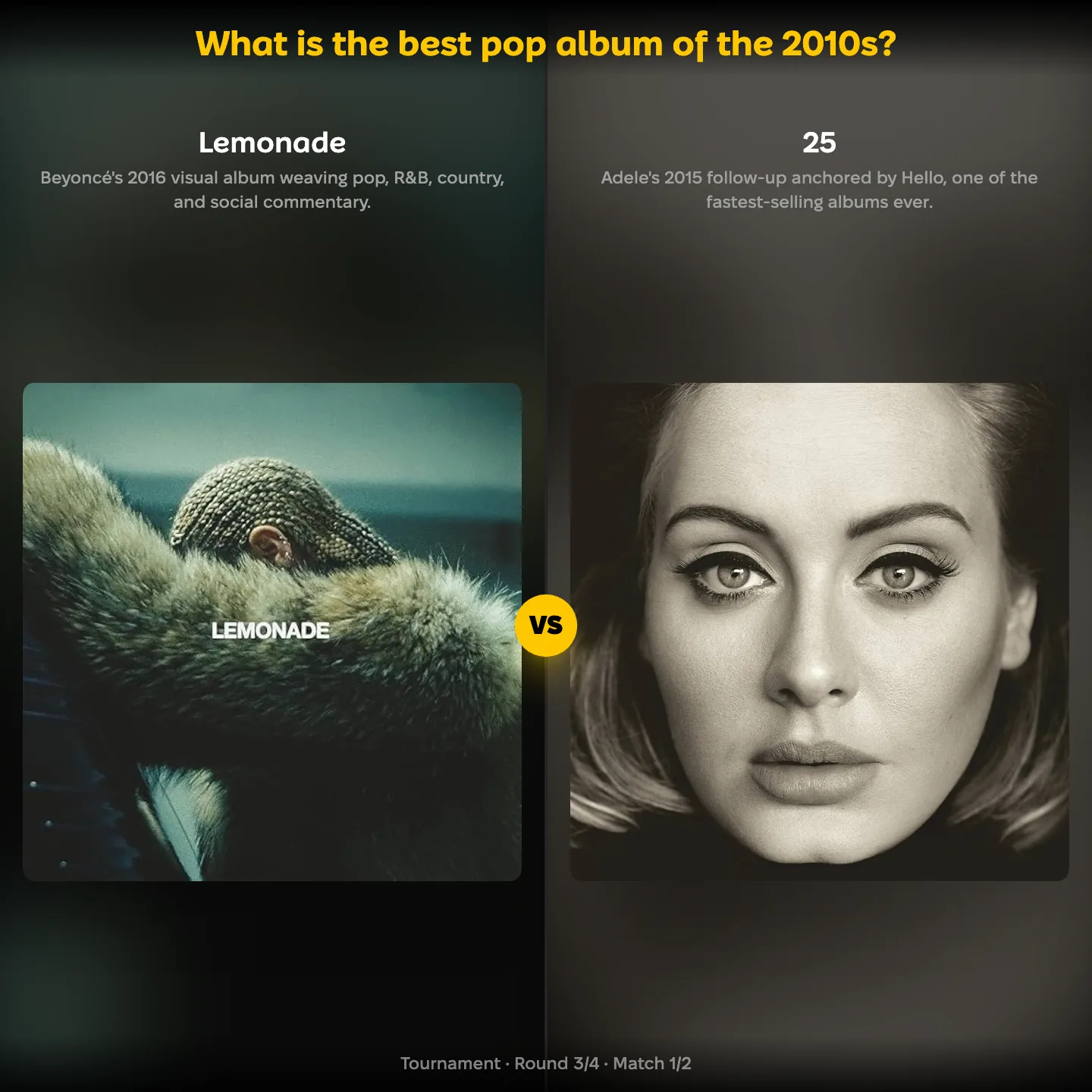
Narrow the question to one decade and Beyoncé appears twice. Lemonade (2016) and the surprise-released BEYONCÉ (2013) are both in the field for the best pop album of the 2010s, so the strongest case against either record is the other one.
Adele owns the other big claim on those years. Album of the Year went to her 25 at the 59th Grammys in 2017, and from the stage she called Lemonade monumental and told Beyoncé, "you are our light".4
That speech is why people still bring the pairing up. The winner spent her time on stage arguing for the record she had just beaten.
Nine years later this is still the matchup the section rests on, and the artist who did not win it now holds the Grammy record.
Renaissance and Cowboy Carter: two acts of a trilogy
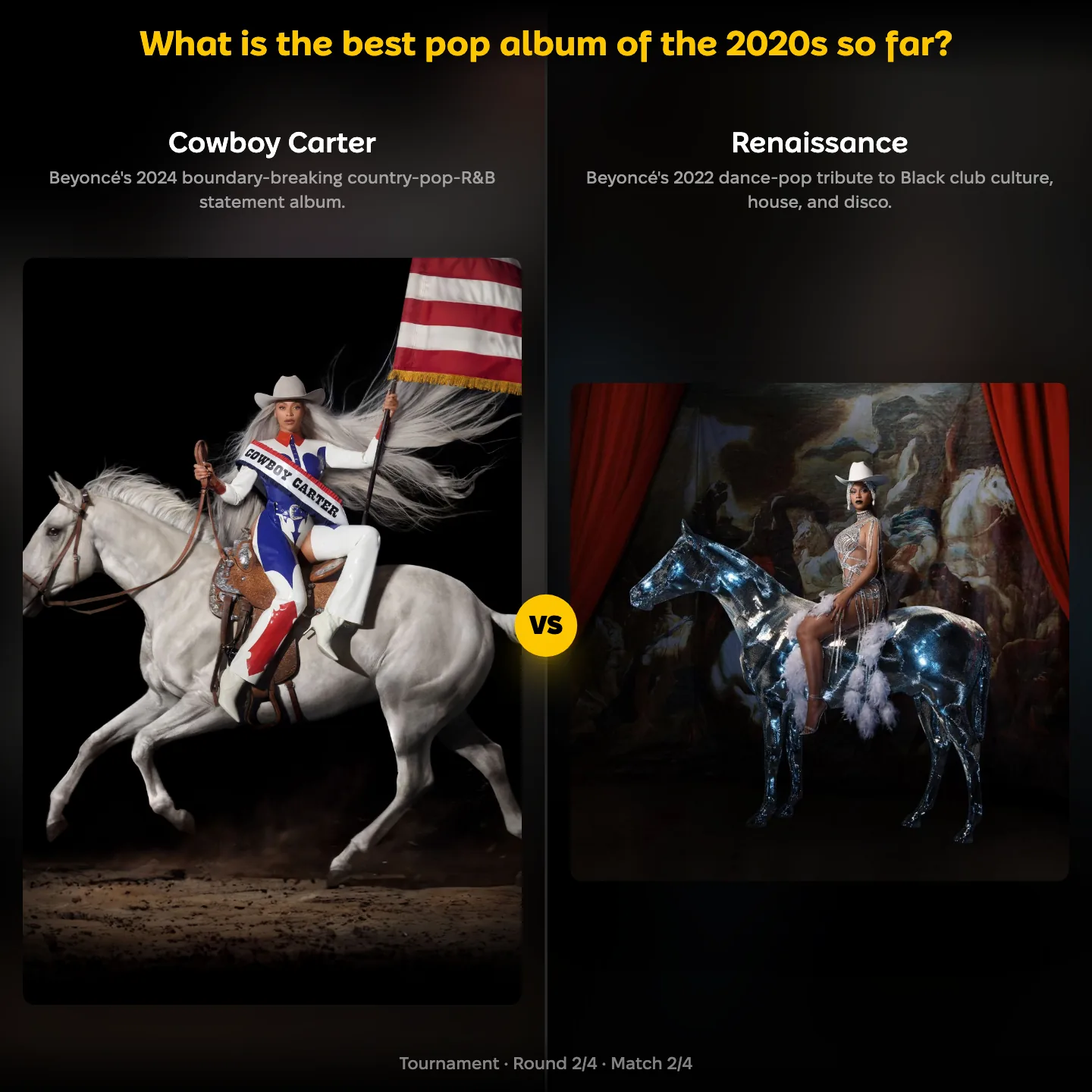
Beyoncé’s 2020s are two albums that share a project and little else. grammy.com’s catalogue guide calls Renaissance (2022) the first of a reported trilogy and the 27-track Cowboy Carter (2024) its second act.3
The ranking for this decade so far has room for both, which makes for odd self-competition: one record is for dancing at four in the morning, the other has a banjo on it.
The country half of that pair also broke a Grammy category open. Cowboy Carter won Best Country Album at the 2025 ceremony, and grammy.com notes that no Black artist had taken the category before.1
The third act has never been announced — Renaissance landed in 2022, Cowboy Carter in 2024, and the gap between them is the only evidence anyone has. Dua Lipa’s Future Nostalgia, Taylor Swift’s Midnights, Billie Eilish’s Hit Me Hard and Soft and Harry Styles’ Harry’s House fill out the field.
Four records, one list
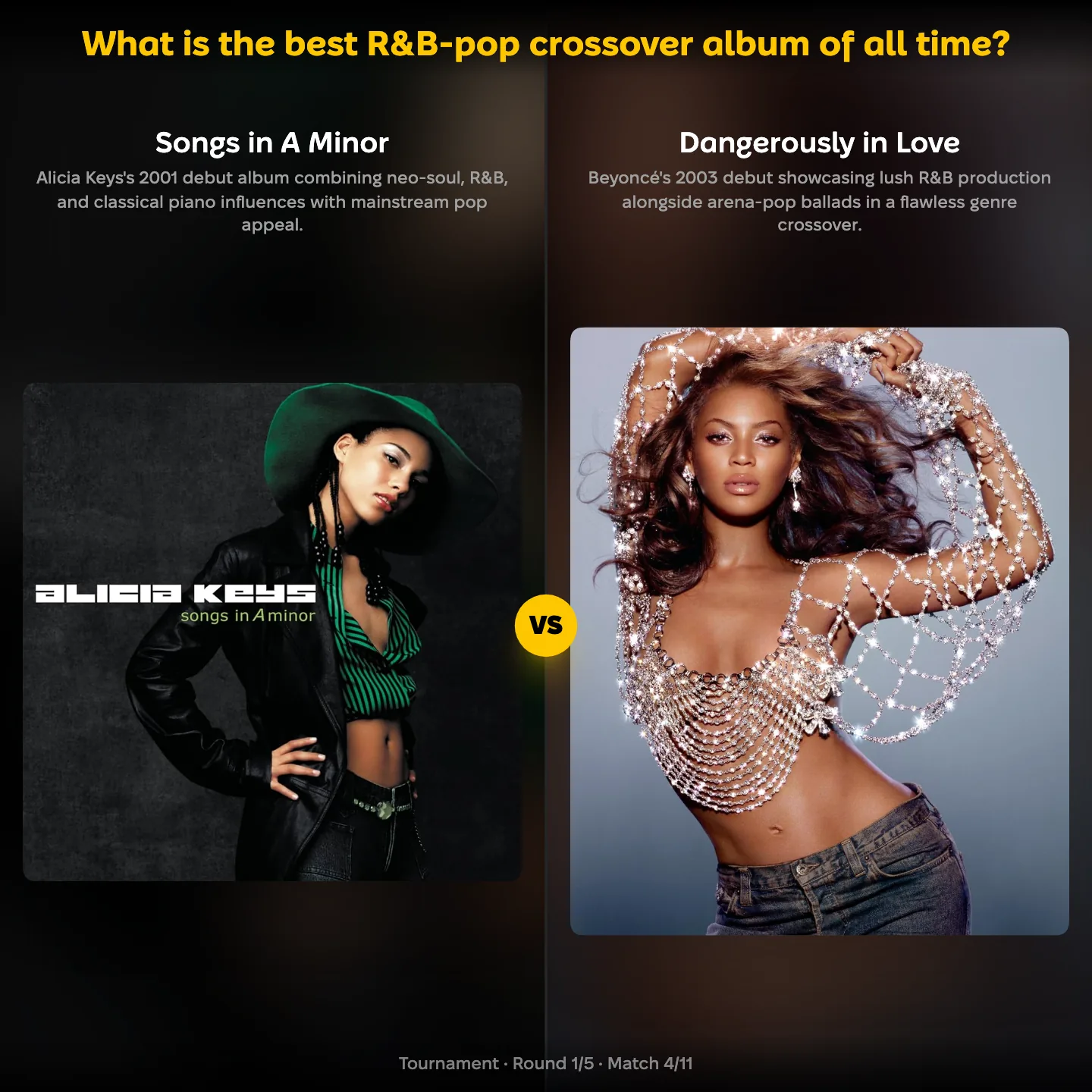
The best R&B-pop crossover album is where Beyoncé’s footprint is widest: Dangerously in Love, B’Day, Lemonade and Destiny’s Child’s Survivor are all options in the same field of 21.
Dangerously in Love is the one that started it. It arrived in 2003 while Destiny’s Child were still officially together, and "Crazy in Love" and "Baby Boy" both came off it.
Songs in A Minor, the Alicia Keys debut, comes closest to a direct rival. It came two years earlier, sold on classical piano and neo-soul rather than on production, and set the terms her debut had to beat.
Thriller is on this list too — the record every crossover album since 1982 has been measured against.
Super Bowl XLVII: the halftime show in New Orleans
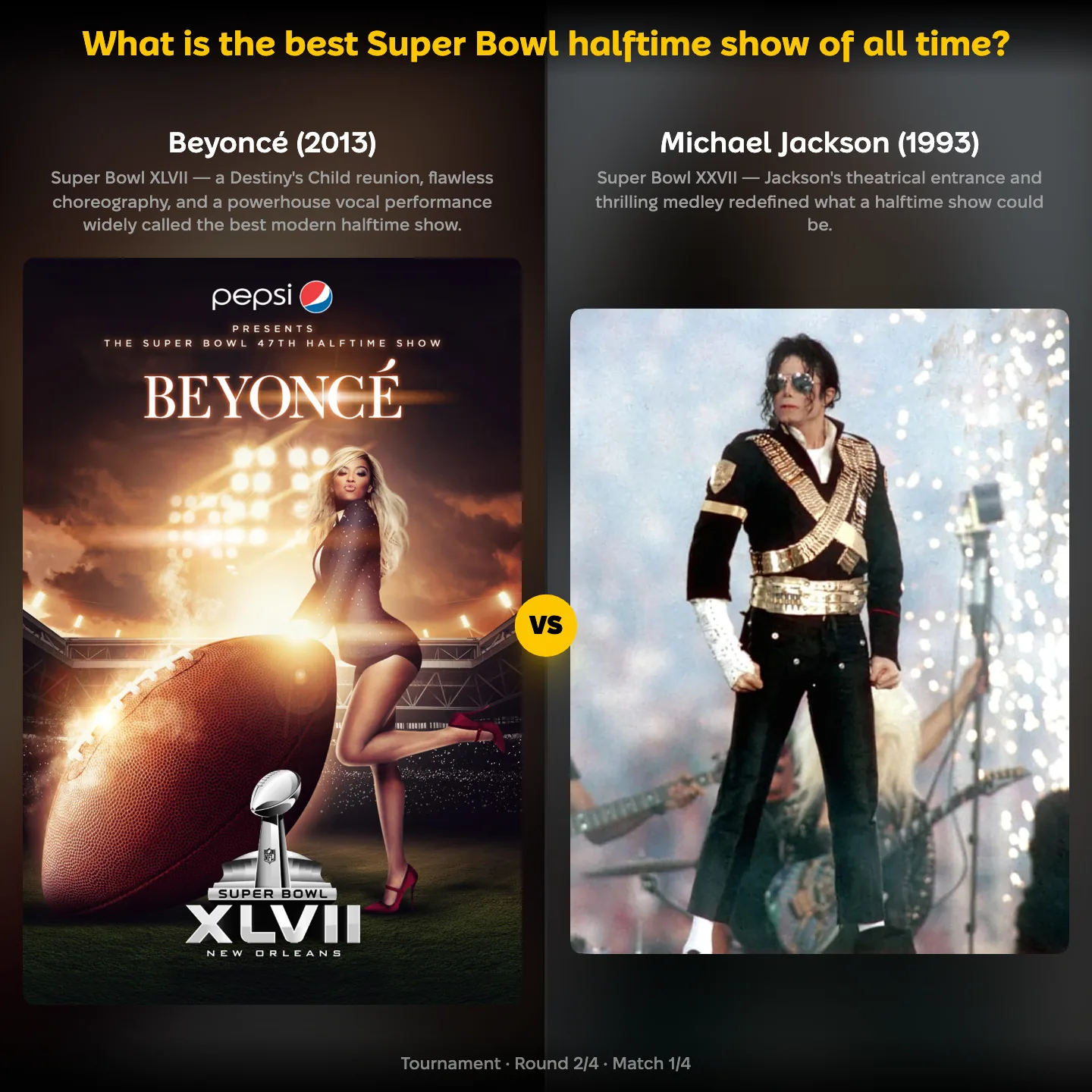
The Super Bowl halftime slot is short and it comes with the largest live audience on American television. In February 2013 Beyoncé took it in New Orleans and brought Destiny’s Child back on stage for part of it, which is what the NFL’s own report of the night led with.5
It is the performance people reach for when they argue that the modern halftime show is a production rather than a concert.
Michael Jackson’s 1993 show is the reason the slot matters at all. Before it, halftime meant marching bands and novelty acts; after it, the NFL started booking the biggest artist available.
Prince playing "Purple Rain" in actual rain in 2007 is the other set nobody has got past. Madonna 2012, Lady Gaga 2017, Rihanna 2023 and Bad Bunny 2026 are here as well.
Coachella 2018: the set that got the festival renamed
In April 2018 Beyoncé became the first Black woman to headline Coachella. Her set ran close to two hours with a marching band, 100 dancers and 26 songs in a row, and the livestream drew 458,000 simultaneous viewers, more than any live music festival had pulled on YouTube.6
People started calling the weekend Beychella, and the name stuck well enough that it is how the set gets referred to now.
Her case is at its most straightforward here. Coachella has a specific problem — enormous crowds, short sets, artists playing the same show they played the night before. Two hours of staged choreography is not what the format usually produces.
Daft Punk’s 2006 set inside the illuminated pyramid is the other performance that gets cited as festival history rather than a good night out.
BET Awards: five of the sixteen nights are hers
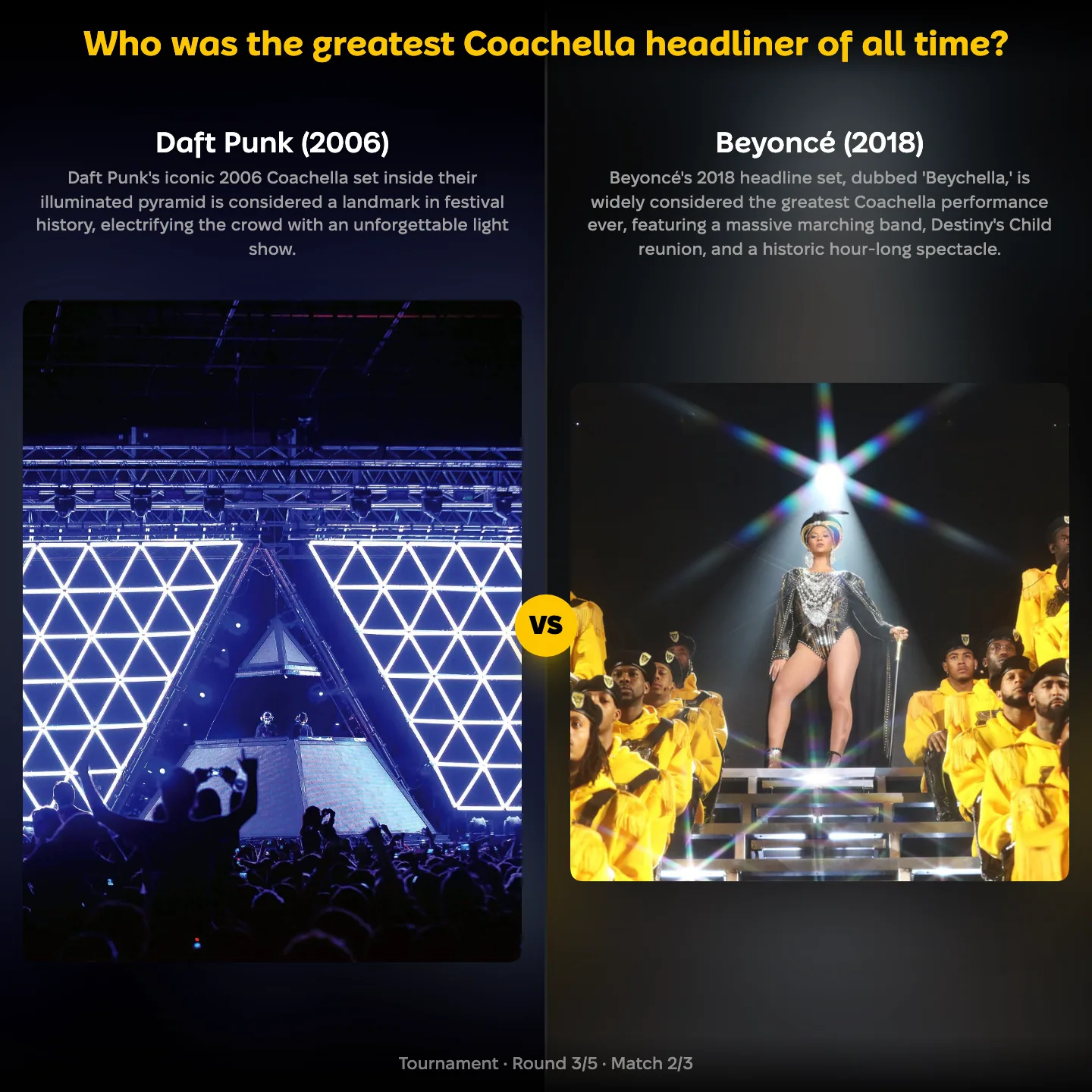
The BET Awards ranking is where Beyoncé’s problem is Beyoncé. Five of its sixteen options involve her: the 2003 solo debut performing "Crazy in Love", the 2004 duet with Usher, the 2006 set with Jay-Z, a 2007 performance, and Destiny’s Child in 2005.
The 2003 appearance reads as a turning point. Dangerously in Love was weeks old, the group had not formally split, and she went out alone.
Destiny’s Child in 2005 was the opposite kind of night. They performed "Cater 2 U" a few months before announcing the end of the group, which makes it a farewell in retrospect rather than at the time.
Whitney Houston in 2001, James Brown in 2003, The Fugees, Mary J. Blige, Kendrick Lamar and the 2016 Prince tribute fill the other eleven slots.
Taylor Swift vs Beyoncé: the whole tour, night after night
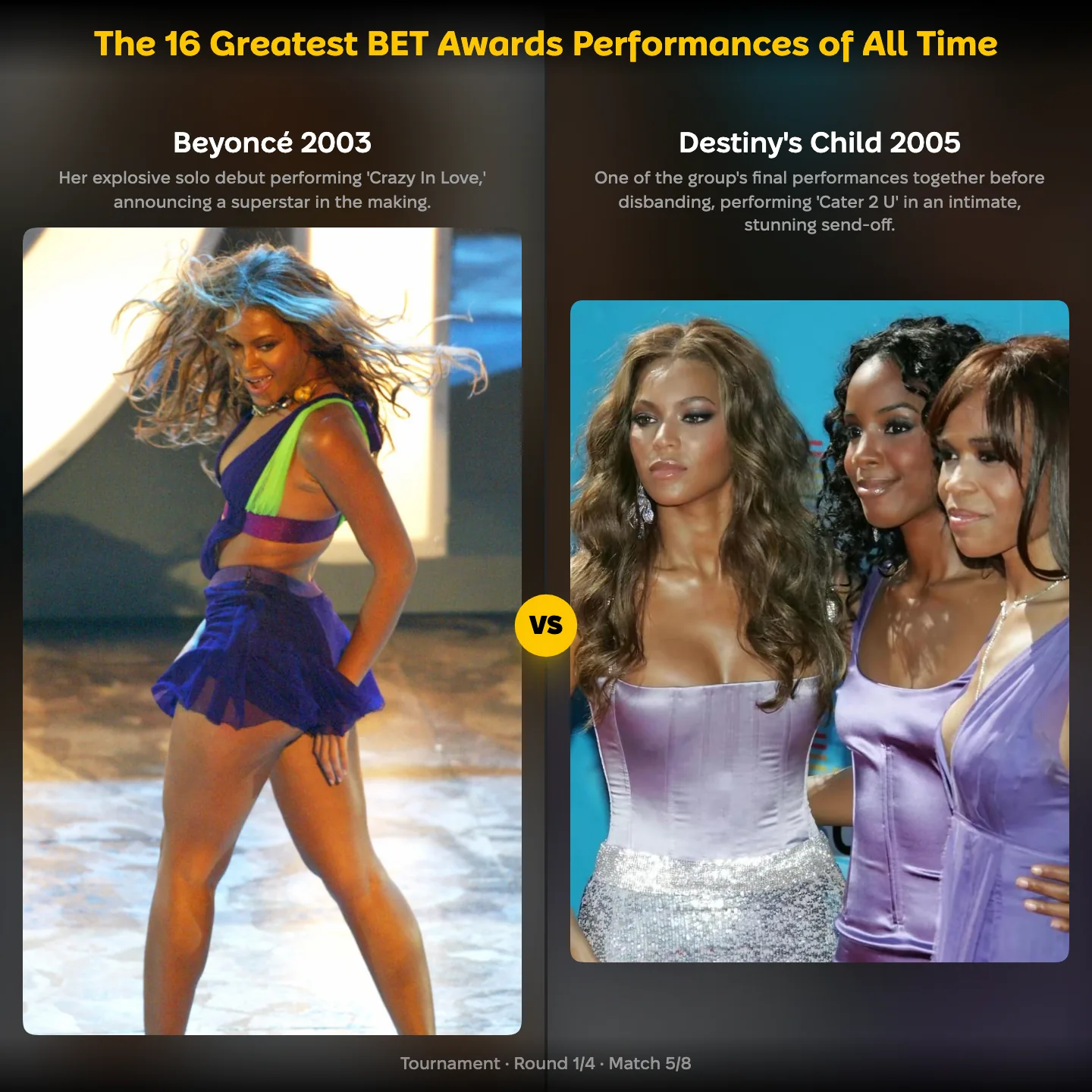
A single performance is one question. "Which pop star has the best concert experience?" is a different one, about the product night after night across a whole tour.
Beyoncé has the numbers for it. Billboard Boxscore put the Renaissance World Tour at $579.8 million from 56 shows in 2023 and the Cowboy Carter Tour at $407.6 million from 32 shows in nine markets in 2025, which made her the first woman and the first American act to finish two tours above $400 million.7
Taylor Swift is the obvious counter-argument and a genuinely different proposition: three and a half hours, a set list drawn from ten albums, and an audience that treats attendance as participation.
Bruce Springsteen and Paul McCartney also sit in this field. Both were filling stadiums before either of the others had a record out.
Rihanna’s papal look and the Met’s most-visited show
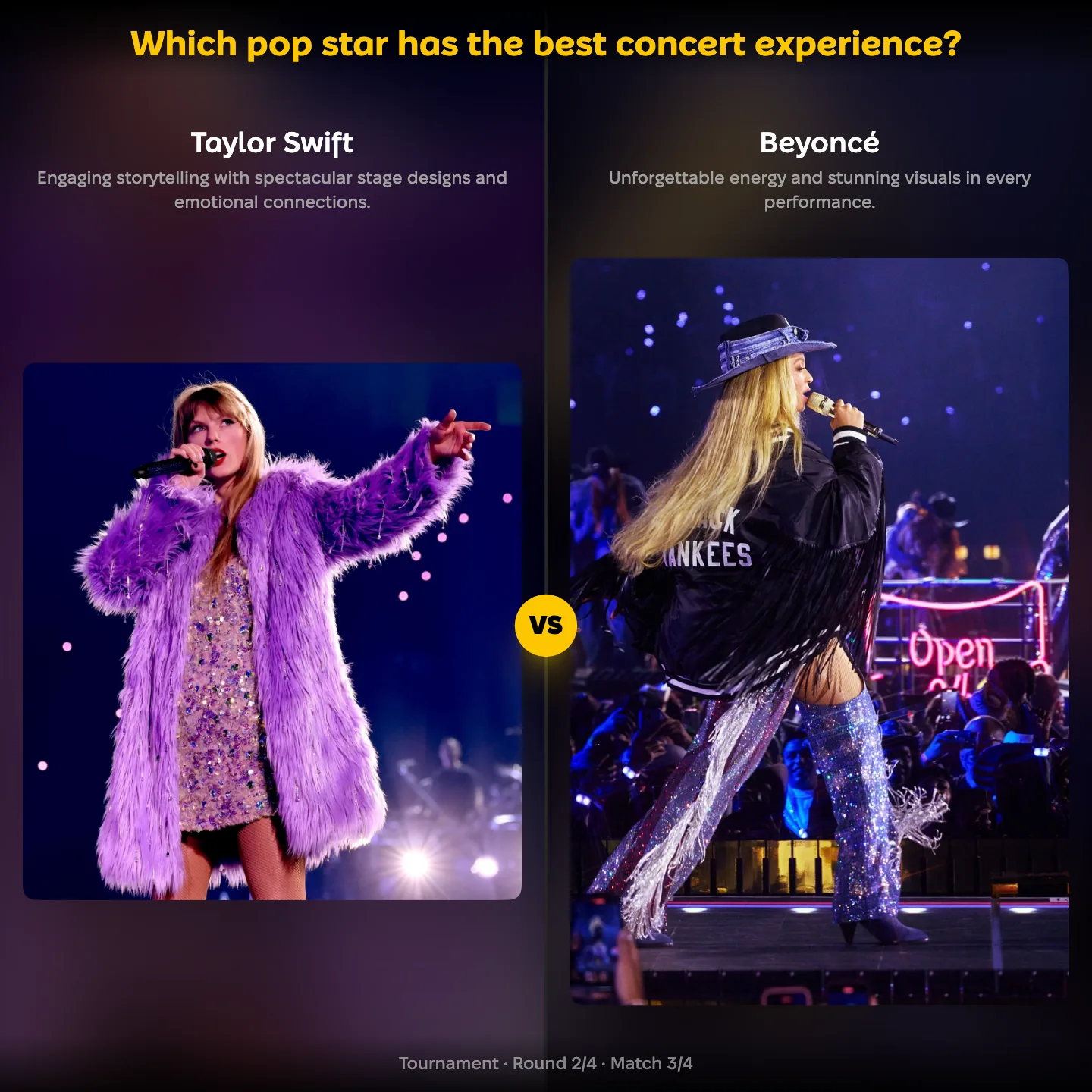
The most iconic Met Gala look of all time is a ranking about clothes, photographers and one flight of steps. Beyoncé’s entry is the sheer, crystal-embroidered gown she wore to the 2015 gala, the one held for China: Through the Looking Glass.
She earns a place on volume as much as on any single dress. She has been going since the mid-2000s, and her 2016 look is an option on the site’s other Met Gala list.
Rihanna’s 2018 Maison Margiela papal look is the hardest one to get past. It came out of Heavenly Bodies: Fashion and the Catholic Imagination, which drew 1,659,647 visitors and became the most-visited exhibition in the Met’s history, well clear of the 815,992 who saw the show Beyoncé’s 2015 dress belonged to.8
Lady Gaga’s four-part 2019 entrance and Billy Porter arriving carried by six men are options here as well, which tells you what kind of list this is.
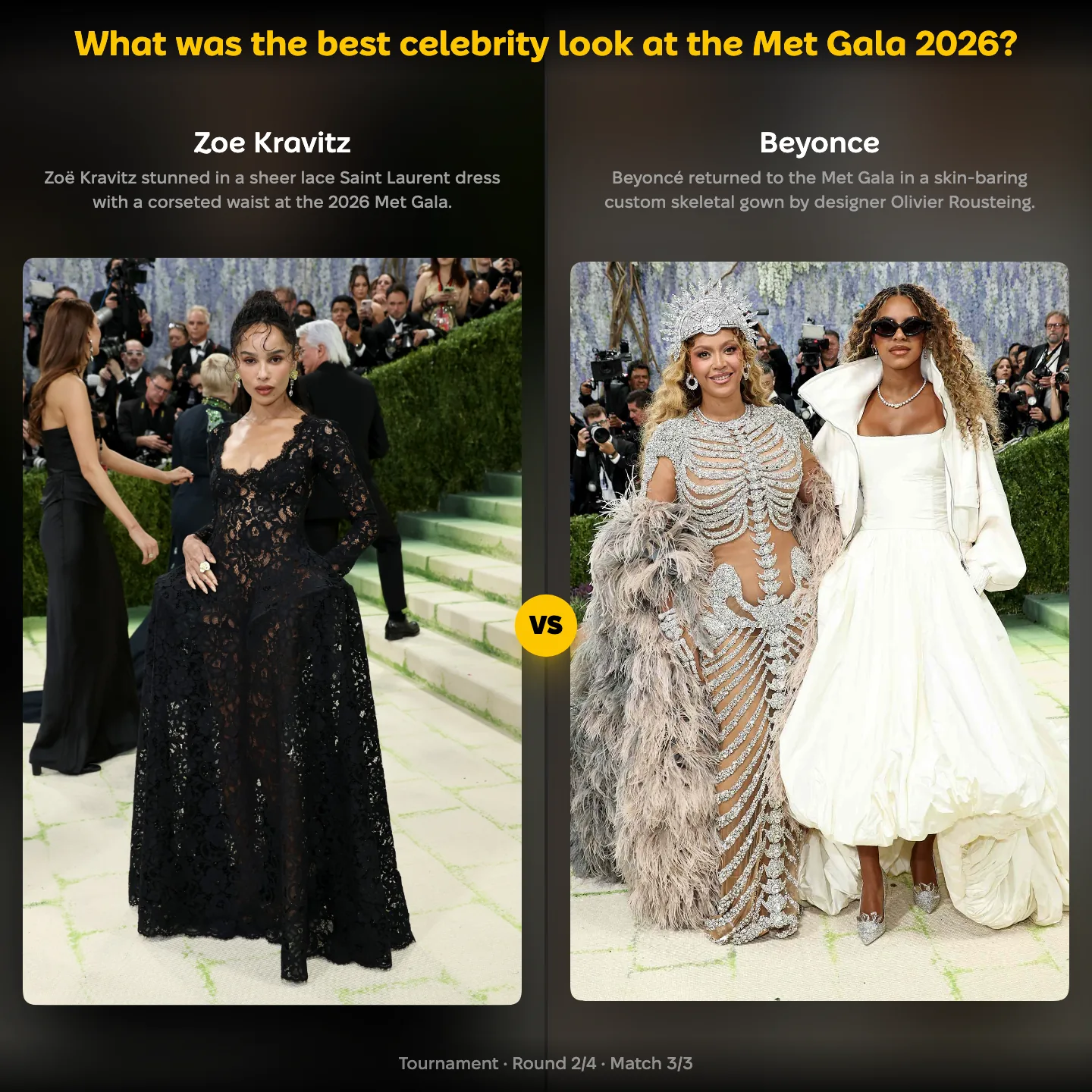
Met Gala 2026: Beyoncé co-chaired the evening
The all-time Met Gala list rewards twenty years of appearances. Narrow it to one evening and that advantage disappears: the 2026 ranking holds eleven names from a single night, and nobody in it had an archive of red carpets to draw on.
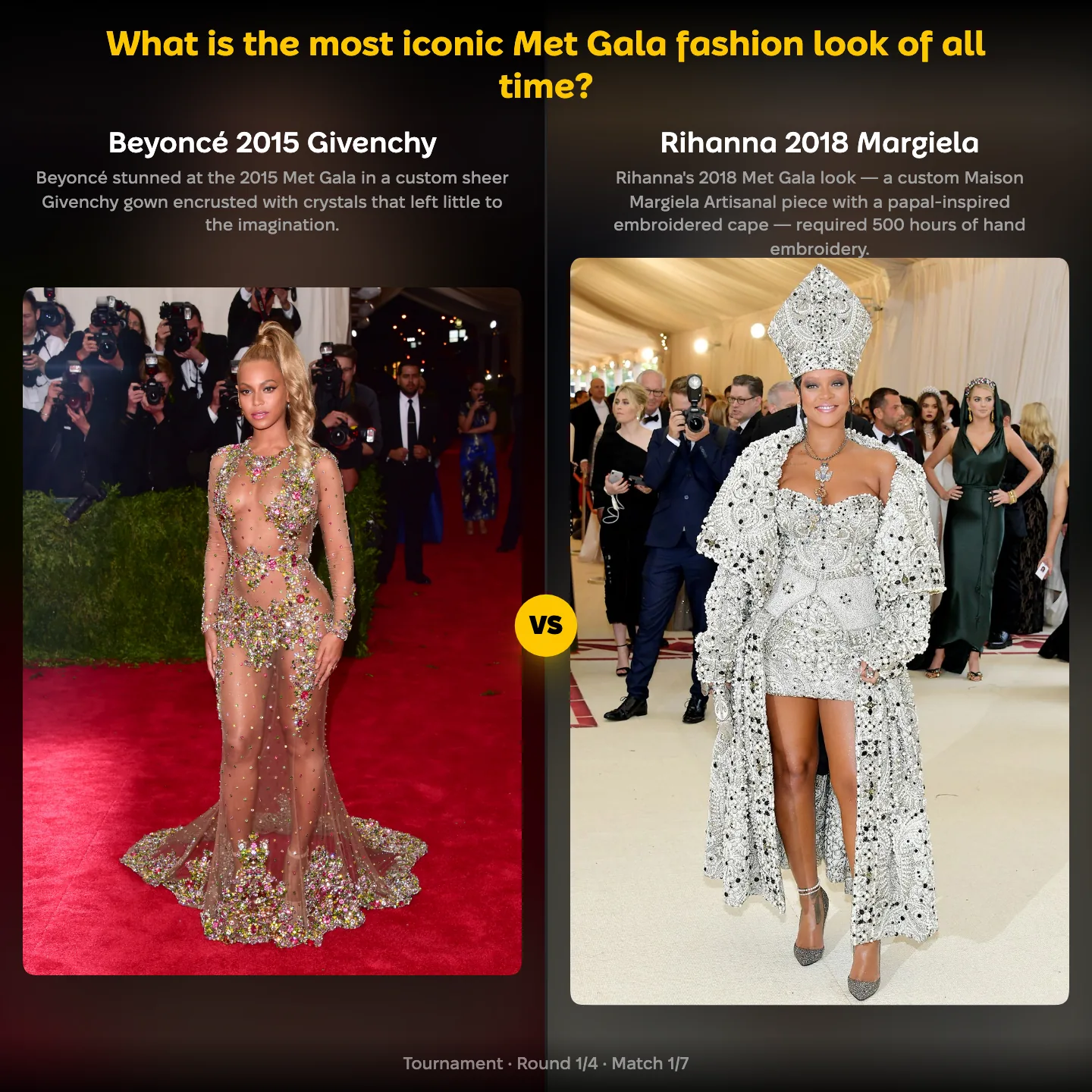
Beyoncé was not simply a guest at that one. The Met announced her as a co-chair of the 4 May 2026 benefit alongside Nicole Kidman, Venus Williams and Anna Wintour, with a dress code of "Fashion is Art" set for the Costume Art exhibition.9
Zoë Kravitz is the kind of option a one-night list favours, and she was no bystander either: she co-chaired the gala’s host committee.
Rihanna, Kylie Jenner, Heidi Klum, Blake Lively and Adut Akech were all on the same steps, Akech as another member of that committee.
Homecoming vs Stop Making Sense
Homecoming is Beyoncé’s film about building the Coachella set, and grammy.com’s account of it counts four months of band rehearsals, four more with the dancers and over 200 people on stage by the night itself; Netflix released it on 17 April 2019.10
Among the best music documentaries it is a long way from home. The field is Woodstock, Gimme Shelter, The Last Waltz, Don’t Look Back, Amy and Summer of Soul, most of them made by directors whose reputations rest on this one genre.
Jonathan Demme’s Stop Making Sense is the specific problem. His 1984 Talking Heads film is what people reach for whenever concert films come up at all.
Homecoming has one advantage none of them do: the artist in front of the camera built the show the camera is pointed at.

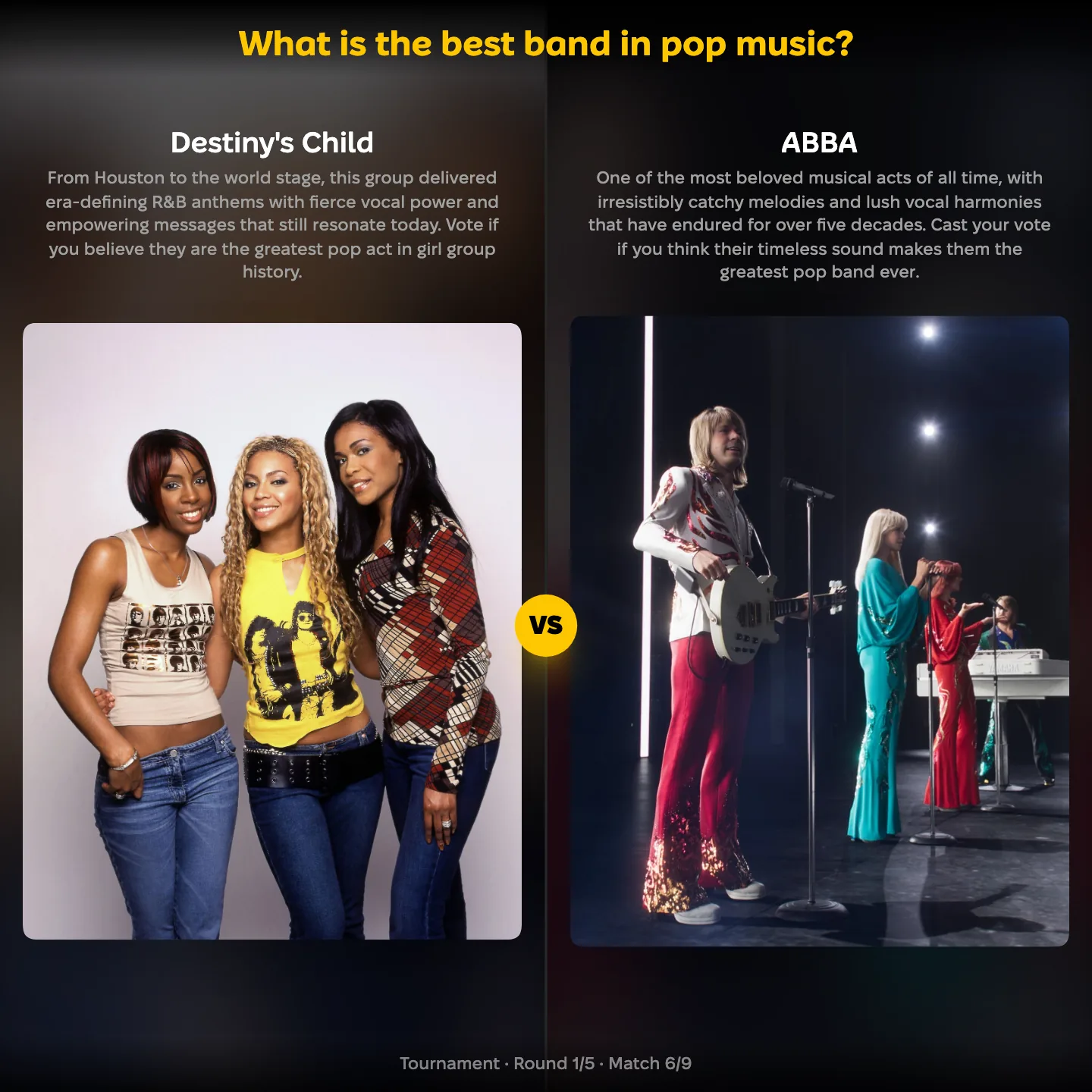
Destiny’s Child against The Beatles and ABBA
Destiny’s Child packed their hits into three years, and for this ranking that is nowhere near enough. The field is ABBA, The Beatles, the Bee Gees, Fleetwood Mac and The Jackson 5, plus every boy band and girl group of the last thirty years.
ABBA are the tidiest problem. "Dancing Queen", a catalogue that turned into two films and a stage show still running, and a hologram residency selling tickets in London decades after Eurovision.
The Beatles are a different order of problem entirely.
Destiny’s Child’s own case is the run of "Bills, Bills, Bills", "Say My Name", "Independent Women Part I" and "Bootylicious", and the fact that one of the three went on to the career this article is about.
"Say My Name" vs "Independent Women Part I"
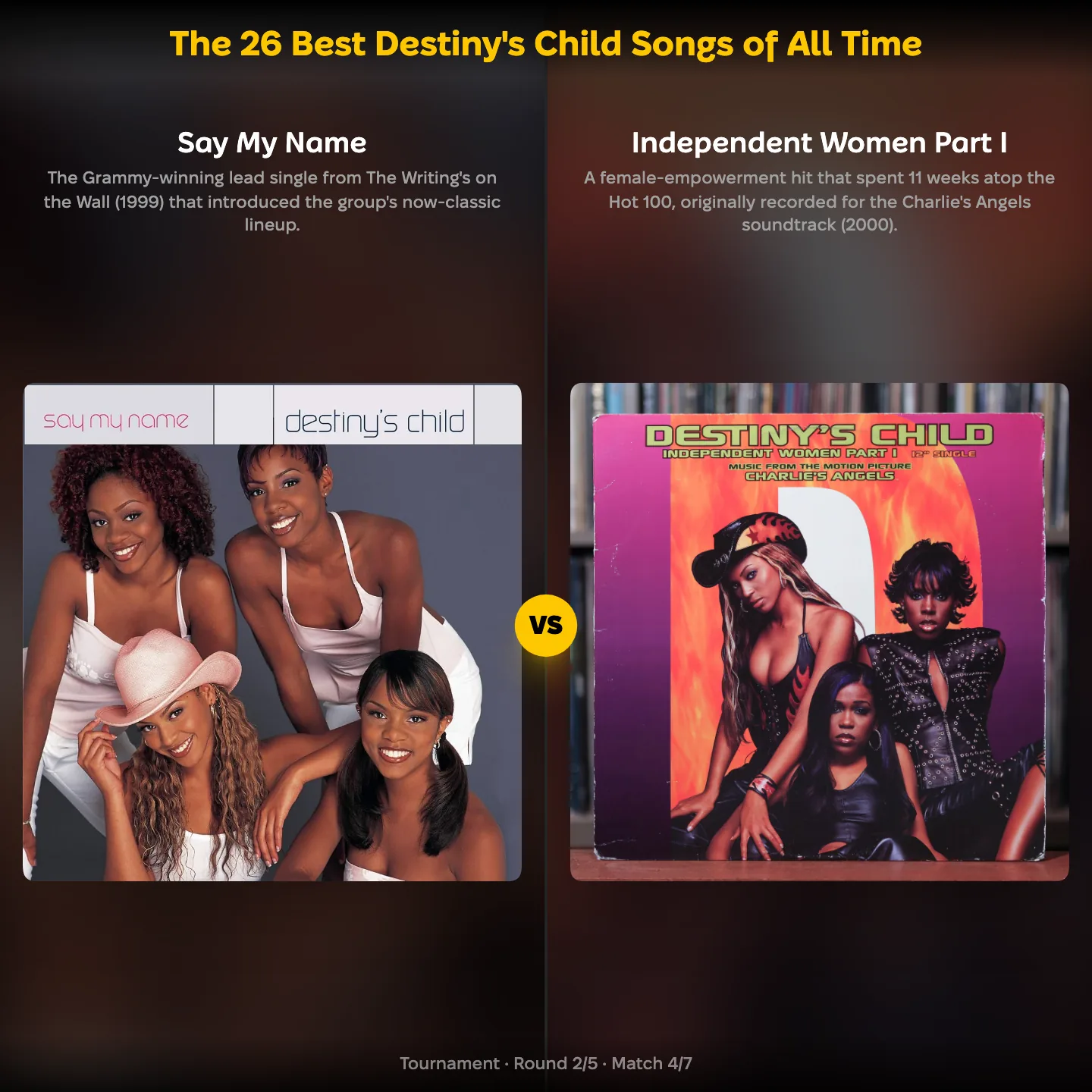
Remove the other bands and Destiny’s Child gets 26 options of its own. This is the ranking that covers Beyoncé’s first eight years, from "No, No, No" in 1997 through to Destiny Fulfilled in 2004.
"Say My Name" is the song people name first. It came off The Writing’s on the Wall in 1999, and its video introduced the three-member line-up that people picture when they picture the group.
"Independent Women Part I" is the commercial answer. Written for the Charlie’s Angels soundtrack in 2000, it held No. 1 on the Hot 100 for eleven weeks, longer than anything else the group released, and Billboard’s chart history for them shows four singles reaching the top.11
"Jumpin’, Jumpin’", "Cater 2 U" and "Lose My Breath" are options here as well, a reminder of how much ground those eight years cover.
Eight albums, no outside help
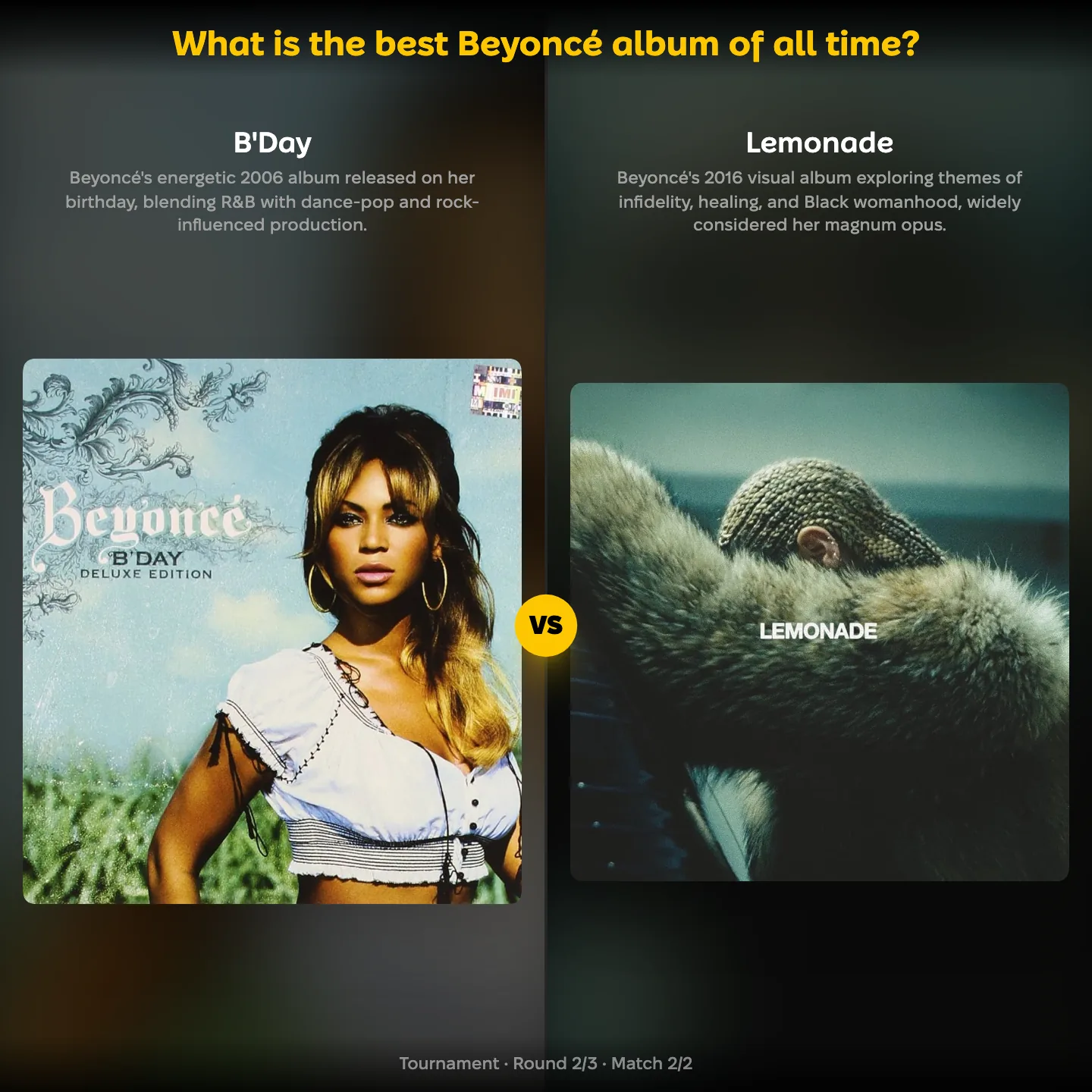
The last question is the narrowest and the hardest to duck. Eight solo albums, no other artist to compare against and no era to hide behind: Dangerously in Love, B’Day, I Am… Sasha Fierce, 4, BEYONCÉ, Lemonade, Renaissance and Cowboy Carter.
Lemonade is the critical answer and Cowboy Carter is the one the Recording Academy eventually agreed with.
B’Day is the interesting outsider — and the reason this article exists this summer. Parkwood’s release calls it her second No. 1 album, out worldwide on 4 September 2006 with a first week of 541,196 copies, and it is the record "MORNING DEW (DONK)" counts down to.2
Twenty years on, those eight records still split the room.
From Destiny’s Child to Cowboy Carter
The concept-album ranking sets Lemonade against records made before she was born. The pop-band ranking puts her first group next to The Beatles. The documentary ranking makes Homecoming share a field with Woodstock, and the country category she won in 2025 held nothing of hers until 2024.
Sixteen questions, sixteen different fields — and she is a plausible entry in every one. Each order comes out of single duels between two options, repeated until the field runs out.
Name the Beyoncé record you would defend against every other name in its field, then make the list that tests it.
More rankings, more angles
- How Many Ways Can You Rank Madonna? — the pop star whose template this one inherited
- Eminem Is on Every Rap List. Never in the Same Place — an Oscar, a Lollapalooza slot and Revival
- The Beatles vs The Rolling Stones: 16 Lists That Can’t Agree — rock’s oldest rivalry, sixteen ways
- What Kind of Best Is Michael Jackson? — pop, Motown, the moonwalk and a billion-dollar biopic
Sources
- Recording Academy (grammy.com) — Beyoncé’s 35 Grammy wins from 99 nominations, the most of any artist, her first Album of the Year at the 2025 ceremony on her sixth nomination in the category, and *Cowboy Carter* as the first Best Country Album win by a Black artist: grammy.com (checked 2026-08-03)
- Parkwood Entertainment press release, 4 July 2026 — "MORNING DEW (DONK)" as her first new song in two years, the 60-day countdown to the 20th-anniversary reissue of B’Day, and B’Day’s 4 September 2006 release with first-week sales of 541,196: prnewswire.com (checked 2026-08-03)
- Recording Academy (grammy.com) — Songbook guide to her catalogue: Lemonade as her sixth album with a visual component by several directors, its two wins from nine nominations at the 59th Grammys, Renaissance as the first of a reported trilogy, and the 27-track Cowboy Carter as its second act: grammy.com (checked 2026-08-03)
- Recording Academy (grammy.com) — 59th Grammy Awards: Adele’s 25 as Album of the Year, and her acceptance speech about Lemonade: grammy.com (checked 2026-08-03)
- NFL — report of the Super Bowl XLVII halftime show in New Orleans, February 2013, and the Destiny’s Child reunion in it: nfl.com (checked 2026-08-03)
- Recording Academy (grammy.com) — Beyoncé as the first Black woman to headline Coachella, the near-two-hour 2018 set with 100 dancers and 26 songs in a row, and its record 458,000 simultaneous YouTube viewers: grammy.com (checked 2026-08-03)
- Billboard Boxscore — the Cowboy Carter Tour at $407.6 million from 32 shows in nine markets, the Renaissance World Tour at $579.8 million from 56 shows, and Beyoncé as the first woman and first American act to wrap two tours above $400 million: billboard.com (checked 2026-08-03)
- The Metropolitan Museum of Art — Heavenly Bodies at 1,659,647 visitors, the most-visited exhibition in the Museum’s history, and China: Through the Looking Glass (2015) at 815,992: metmuseum.org (checked 2026-08-03)
- The Metropolitan Museum of Art — the 2026 Met Gala on Monday 4 May with Beyoncé, Nicole Kidman, Venus Williams and Anna Wintour as co-chairs, Zoë Kravitz co-chairing the host committee with Adut Akech among its members, and the “Fashion is Art” dress code for Costume Art: metmuseum.org (checked 2026-08-03)
- Recording Academy (grammy.com) — Homecoming on Netflix from 17 April 2019, four months of band rehearsals followed by four months of dance rehearsals, and the 200-plus people on stage: grammy.com (checked 2026-08-03)
- Billboard — Destiny’s Child chart history: “Independent Women Part I” at No. 1 on the Hot 100 for eleven weeks, and the group’s four Hot 100 chart-toppers: billboard.com (checked 2026-08-03)