
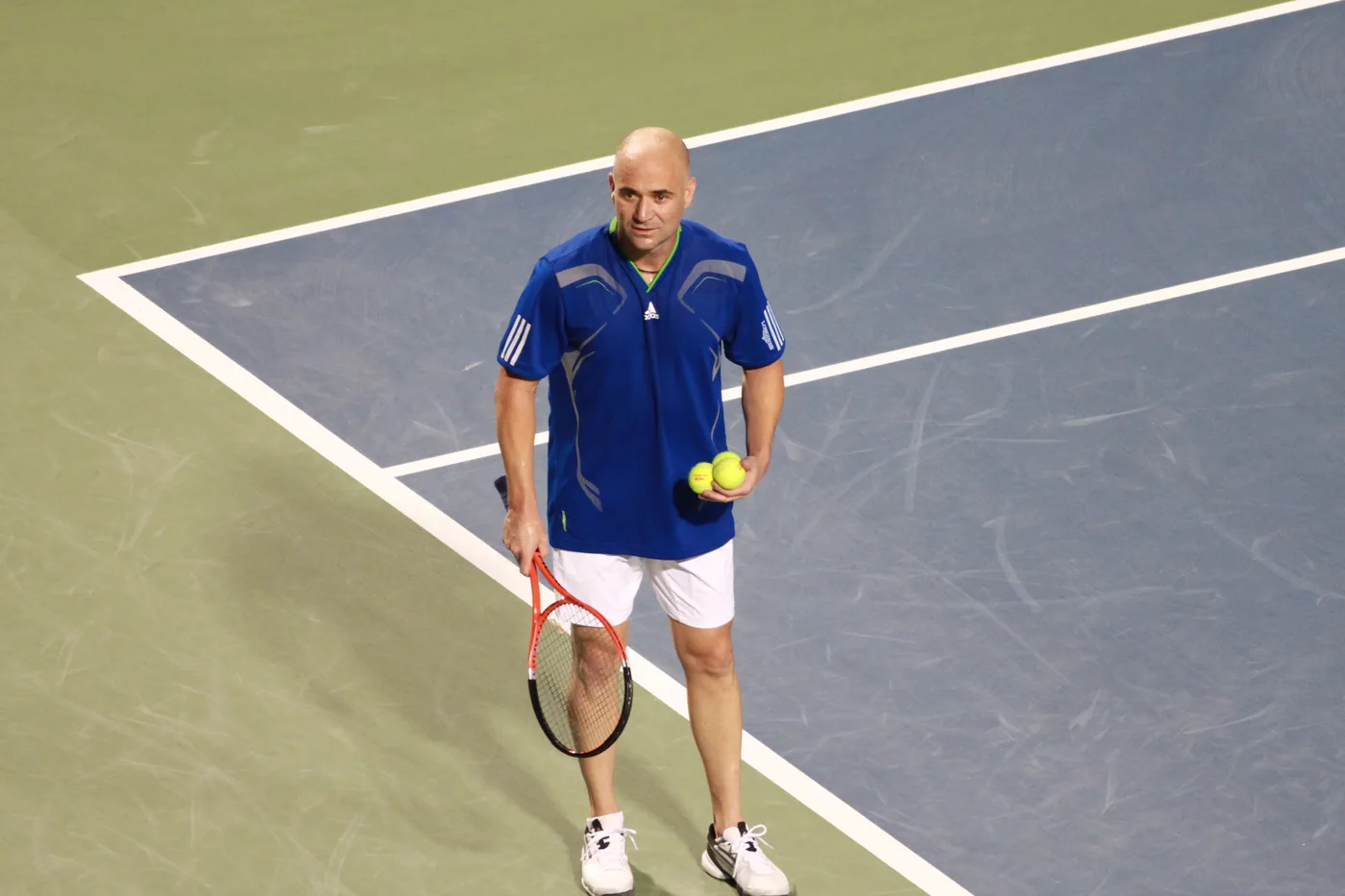
Andre Agassi played his last professional match on 3 September 2006, a US Open third round he lost to Benjamin Becker.1 The 2026 US Open main draw opens on 30 August, which puts the twentieth anniversary of that afternoon inside this year's tournament.2
Twenty years is usually long enough for a career to compress into one sentence. His has not. He boycotted Wimbledon for three years and then won it, fell out of the world's top hundred at 27, and finished 1999 ranked first.
Twelve rankings hold Agassi, and between them they file one career as a technician, a showman, a comeback and a warning.
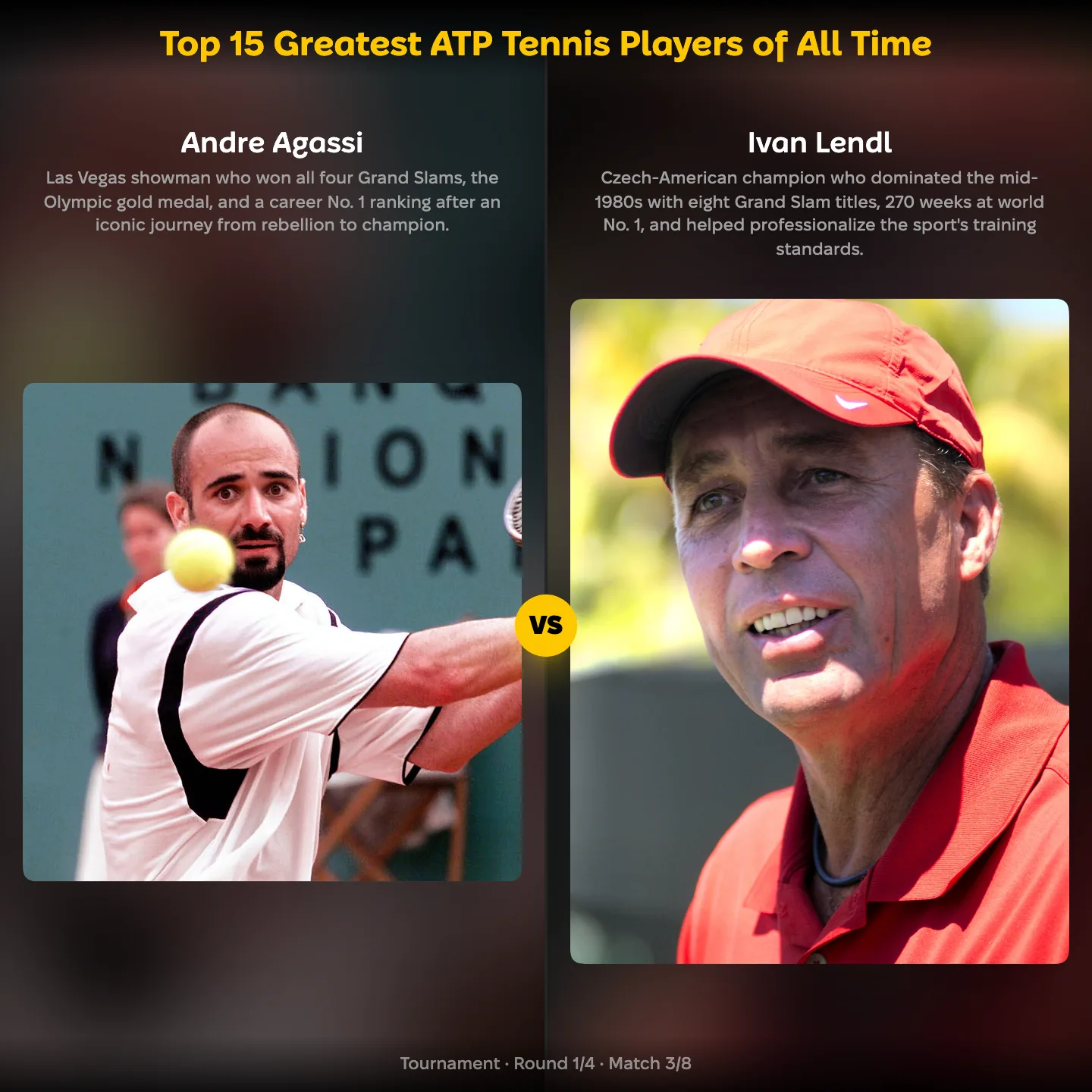
Agassi vs Ivan Lendl, on the widest list in tennis
Start with the broadest question the sport asks and Agassi is one of fifteen names on the ballot.
His case is eight major titles, 60 tour titles and 101 weeks at world No. 1.1
Ivan Lendl brings eight majors of his own and 270 weeks at the top. Behind both of them stand Novak Djokovic, Rafael Nadal and Roger Federer, whose totals moved this conversation somewhere Agassi's generation never reached.
What Agassi has that most of the fifteen do not is range across time. He won majors eleven years apart, on grass, on clay and on hard courts.
The 15 greatest American men: Agassi, Sampras, Connors
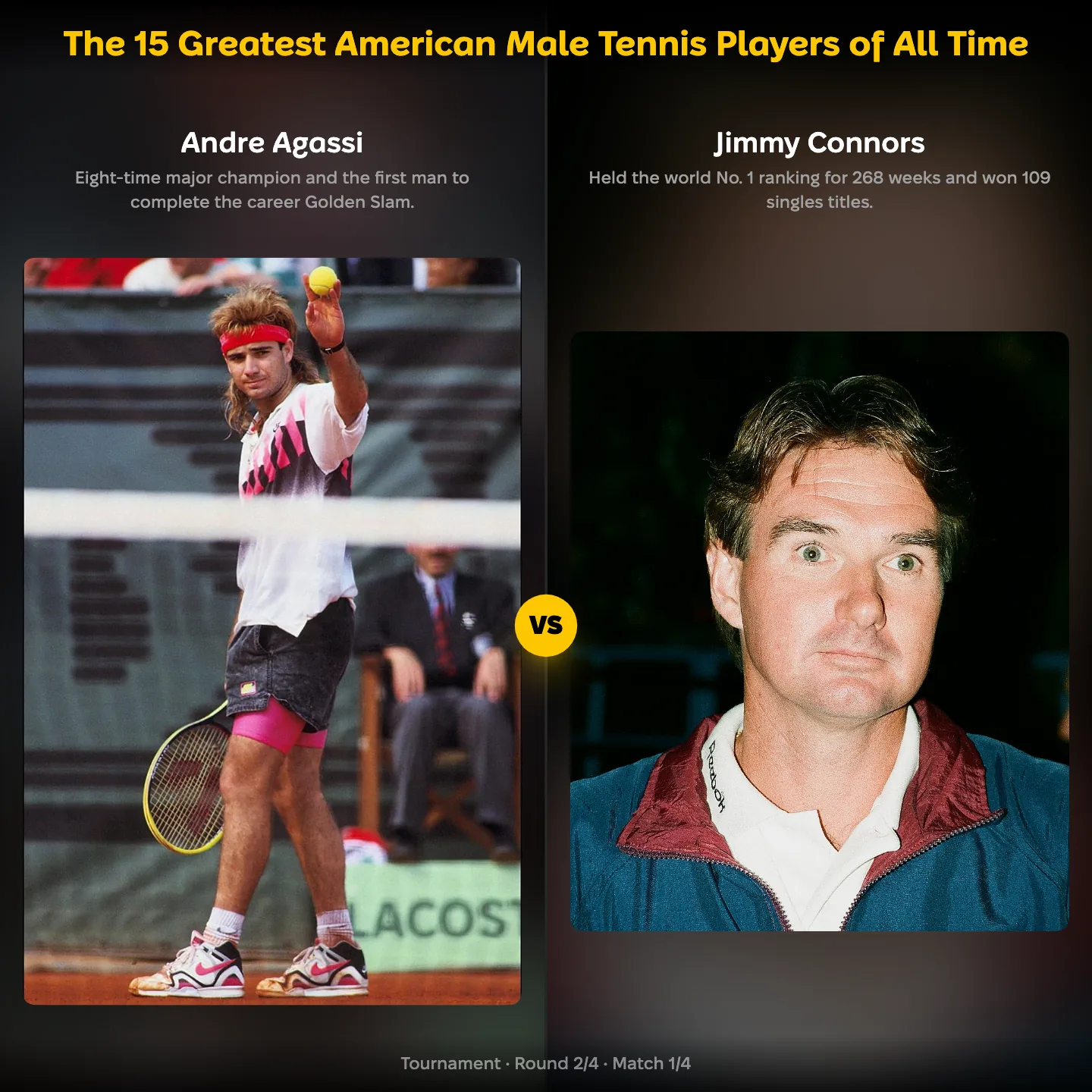
Narrow the field to one country and the company around Agassi changes completely.
He was born in Las Vegas in 1970 and spent his teens at the Bollettieri academy in Florida, which is where the serve-return game that defined him was built.
Jimmy Connors held No. 1 for 268 weeks and won 109 singles titles, a total no man has approached since. Pete Sampras, the other American of Agassi's exact generation, finished six consecutive years as the world's top player.
The deeper the list goes the older it gets. Bill Tilden dominated the 1920s, Don Budge won all four majors in 1938, and Pancho Gonzales spent the 1950s on a professional circuit the record books barely tracked.
The 1990s, where Agassi met Stefan Edberg's volleys
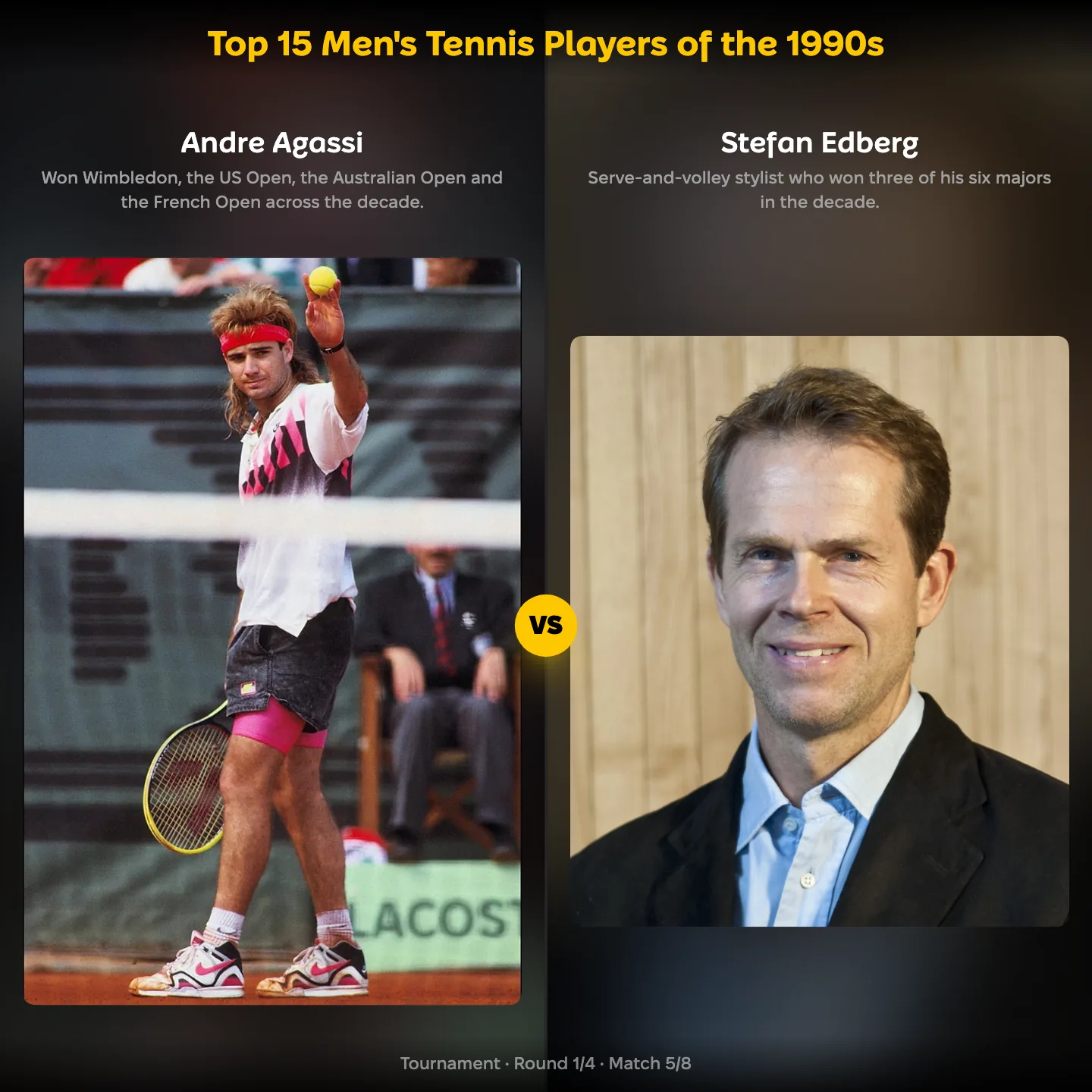
The decade is the frame that flatters Agassi most, because he won all four majors inside it.
Stefan Edberg is the stylistic opposite on the same list. He served and volleyed his way to three majors in the 1990s, against a man who stood on the baseline and took the ball out of the air away from him.
Sampras is the problem with this ranking, as he was the problem with the decade. Six straight years finishing No. 1 leaves everyone else competing for second.
Specialists fill out the ballot. Thomas Muster and Sergi Bruguera were close to unplayable on clay, Goran Ivanišević had the heaviest serve on tour, and Gustavo Kuerten arrived from outside the top 60 to win Roland Garros at 20.
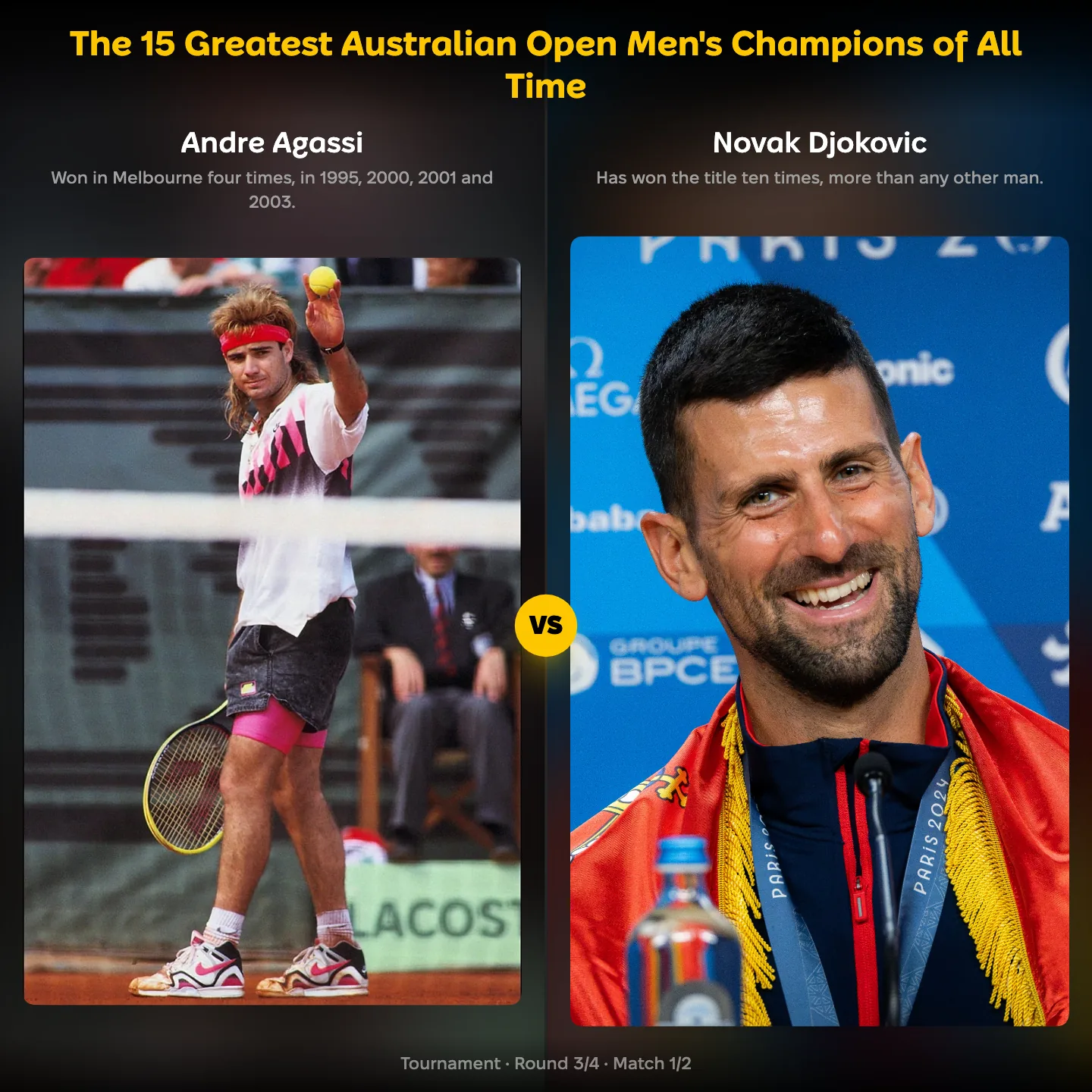
Melbourne: Agassi's four titles, Djokovic's ten
The Australian Open is the tournament that liked Agassi best. He won it in 1995, 2000, 2001 and 2003.1
Three of those four came after he turned 29, which is the statistic that makes this list different from the ones about the 1990s.
Novak Djokovic has won the title ten times, more than any other man, and Roy Emerson and Roger Federer have six each. On a list built purely on Melbourne, that trio sets the bar.
Rod Laver and Ken Rosewall are on the ballot from a time when the tournament sat awkwardly in the calendar and many of the best players skipped it, which is the sort of asterisk this kind of ranking cannot show.
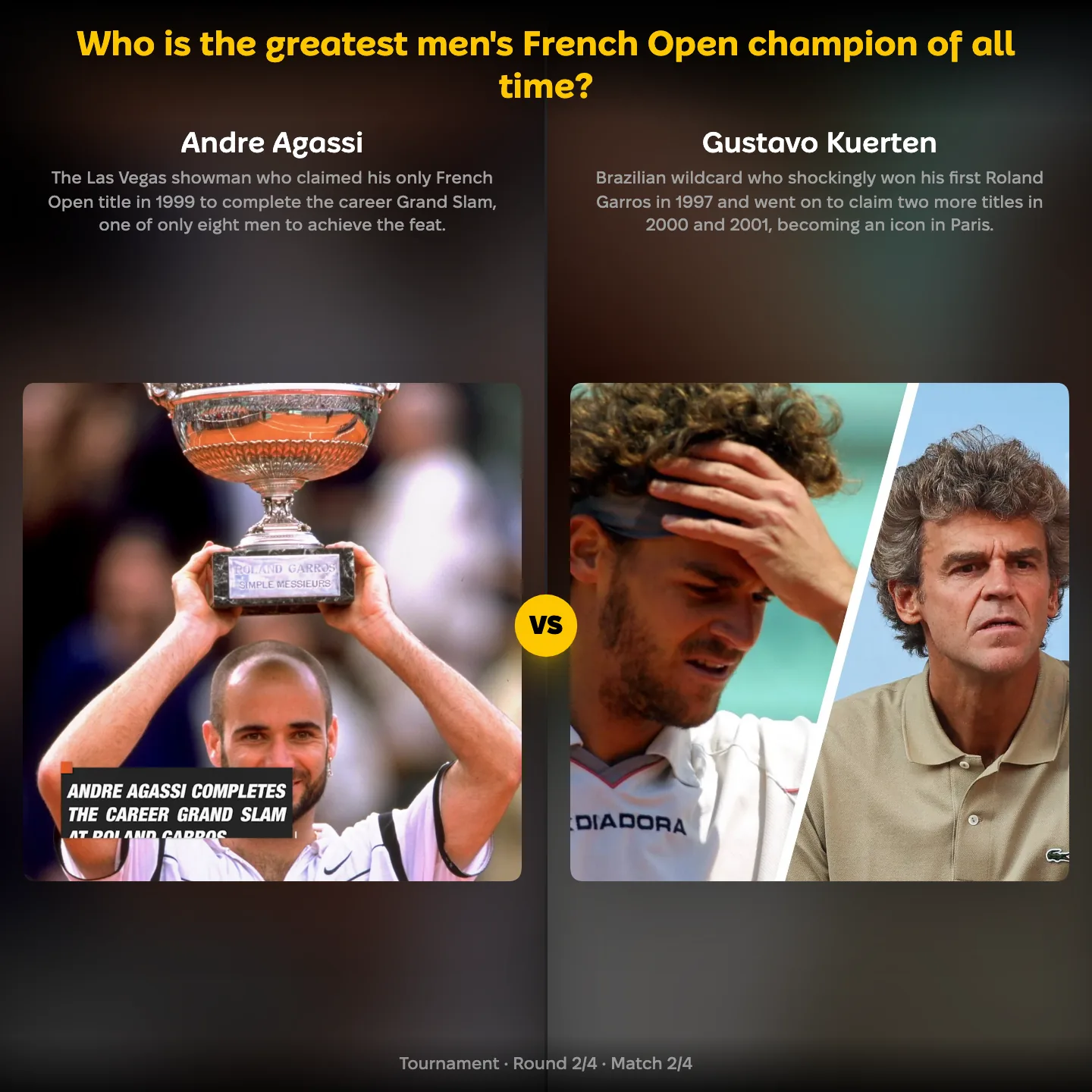
Roland Garros 1999: the title that completed the set
Clay was Agassi's worst surface and Paris gave him his most important title, which is the contradiction this ranking sits on.
He had already lost two French Open finals, to Andrés Gómez in 1990 and to Jim Courier in 1991. When he came back in 1999 he was 29 and two years removed from the bottom of the rankings.
Winning it made him the first man to hold all four majors and an Olympic singles gold at once.1 Only Nadal and Djokovic have matched that since.
Against the specialists on this list he has one title where they have many. Gustavo Kuerten won three, Ivan Lendl and Mats Wilander three each, and Nadal's record in Paris is the reason most of these ballots are decided before they start.
The case for Agassi here is not volume. It is that his single title is the one that changed what his whole career meant.
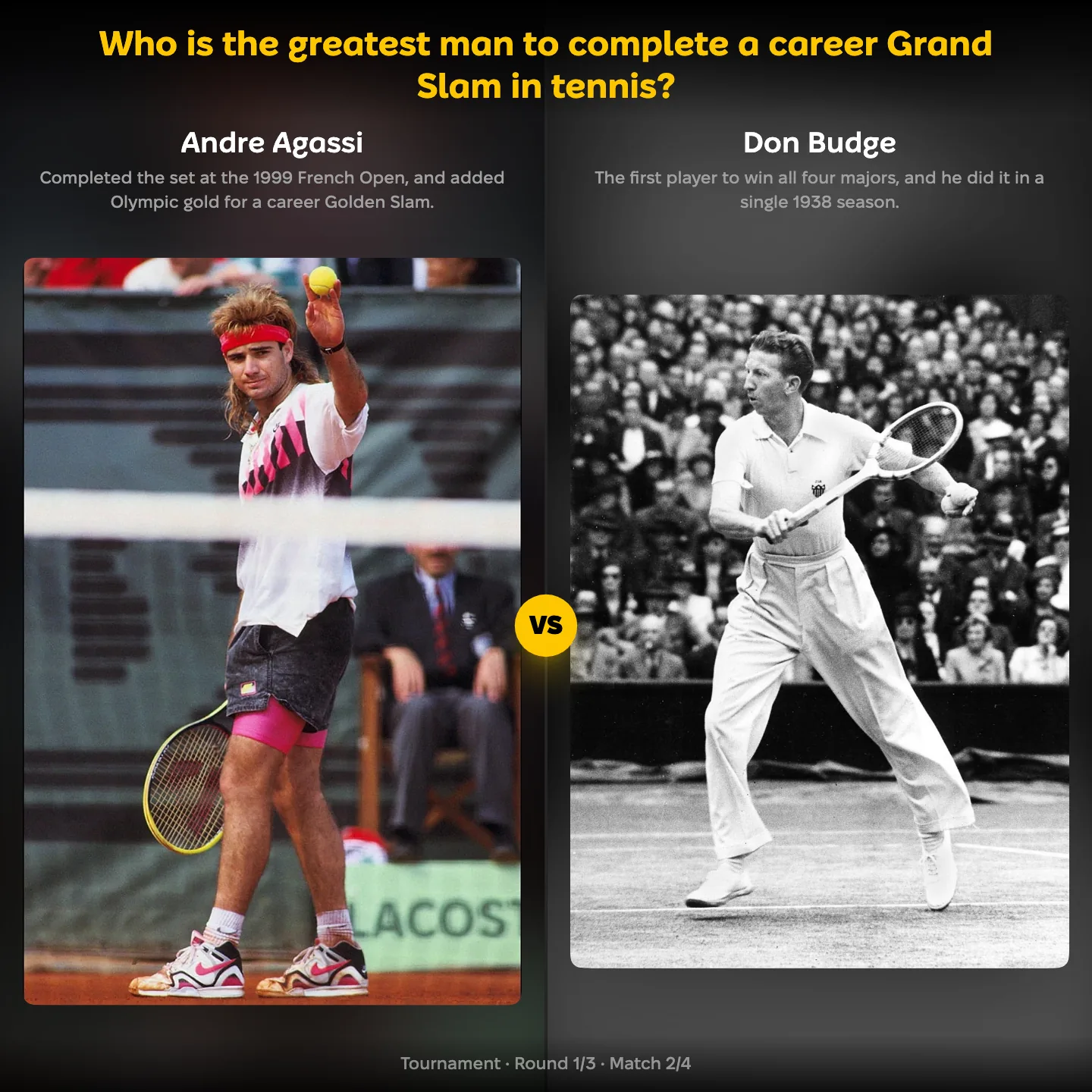
Eight men have won all four majors. Agassi and Don Budge are two
This is the smallest ranking in the article, because the entire membership is eight players.
Don Budge got there first and did it inside one 1938 season. Fred Perry, Rod Laver, Roy Emerson, Agassi, Federer, Nadal and Djokovic complete the set.
Agassi joined last among the amateurs-era names and first among the moderns, in 1999.
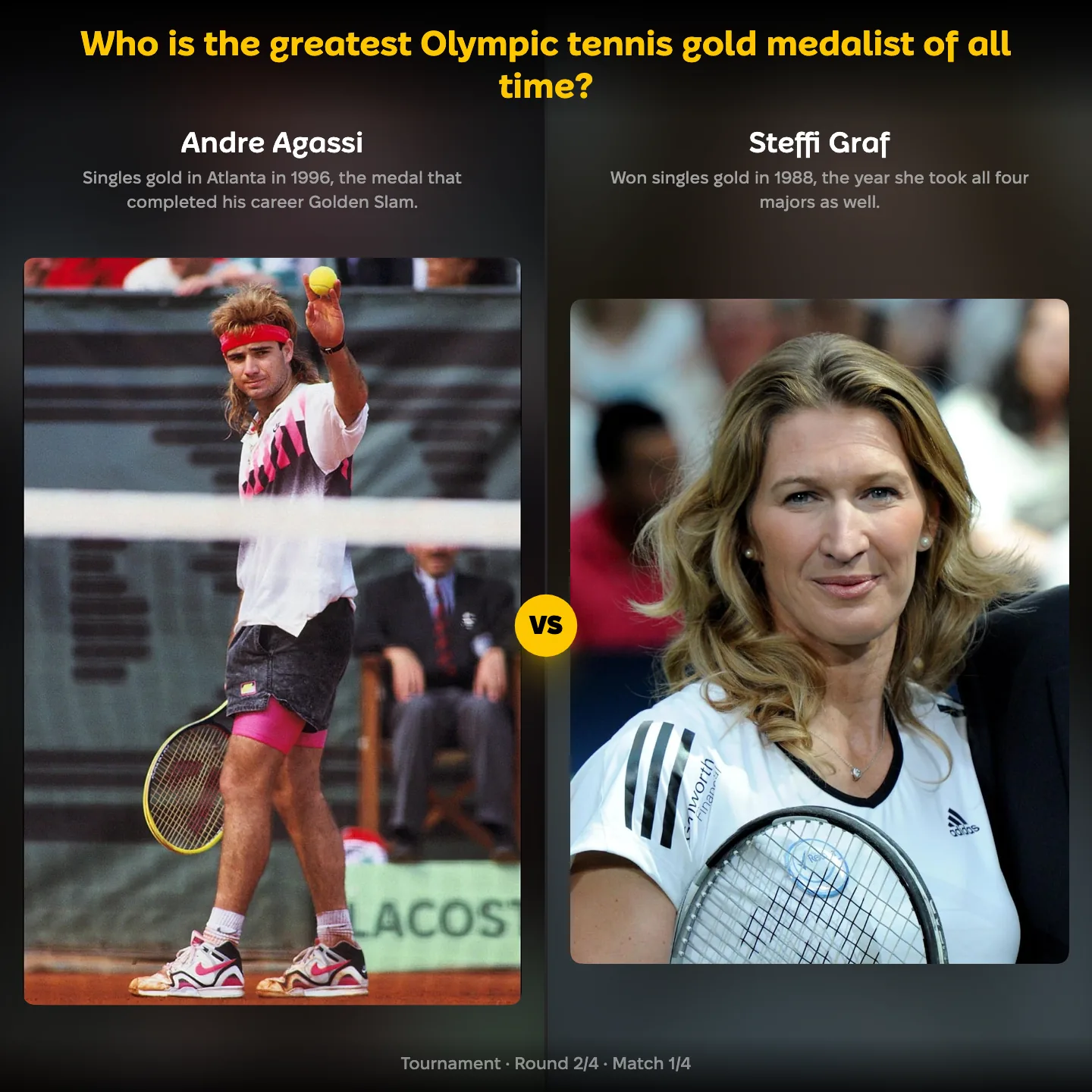
Atlanta 1996 and Seoul 1988: two golds in one household
Agassi won Olympic singles gold in Atlanta in 1996, beating Sergi Bruguera in the final.1
Steffi Graf is on the same ballot for Seoul 1988, the year she won all four majors and the Olympic title in one season, the first tennis player to do it.3 She and Agassi married in 2001.
Serena and Venus Williams arrive here with four golds each across singles and doubles, a different shape of Olympic career entirely.
No. 141, then No. 1: Agassi next to Niki Lauda
This is the ranking where Agassi stops being a tennis player and becomes a story about returning.
On 10 November 1997 he was the 141st-ranked man in the world, playing Challenger events in front of a few hundred people.1 The International Tennis Hall of Fame records what happened next as the biggest single-year climb into the top ten in the history of the ATP rankings: 122nd at the end of 1997, sixth at the end of 1998, and first at the end of 1999.4
Niki Lauda is the standard this ranking is measured against. He was burned in a crash at the Nürburgring in 1976 that nearly killed him, and he was racing again six weeks later.
The rest of the ballot is built from harder material than a slump. Monica Seles came back from being stabbed on court, Mario Lemieux returned from Hodgkin's lymphoma, Ben Hogan won a US Open the year after a head-on collision, and Muhammad Ali got his title back after three years of exile.
Set against those, Agassi's fall was self-inflicted, which he has never disputed.

Denim shorts, a mullet, and Dennis Rodman's hair
On this list the eight majors count for nothing and the clothes count for everything.
Agassi arrived in the late 1980s in denim shorts over neon lycra, with a mullet and a pirate bandana, on a tour that still expected white. In 1989, aged 19, he filmed a Canon Rebel commercial whose three-word line, "image is everything", followed him around for the rest of his career.5
Dennis Rodman is the competition, and his claim is simple: the hair colour changed more often than the fixture list.
The ballot is otherwise a 1990s time capsule. Deion Sanders played two professional sports and dressed for both, David Beckham had made his haircut into news by 1998, and Allen Iverson brought cornrows and streetwear into the NBA at the end of the decade.

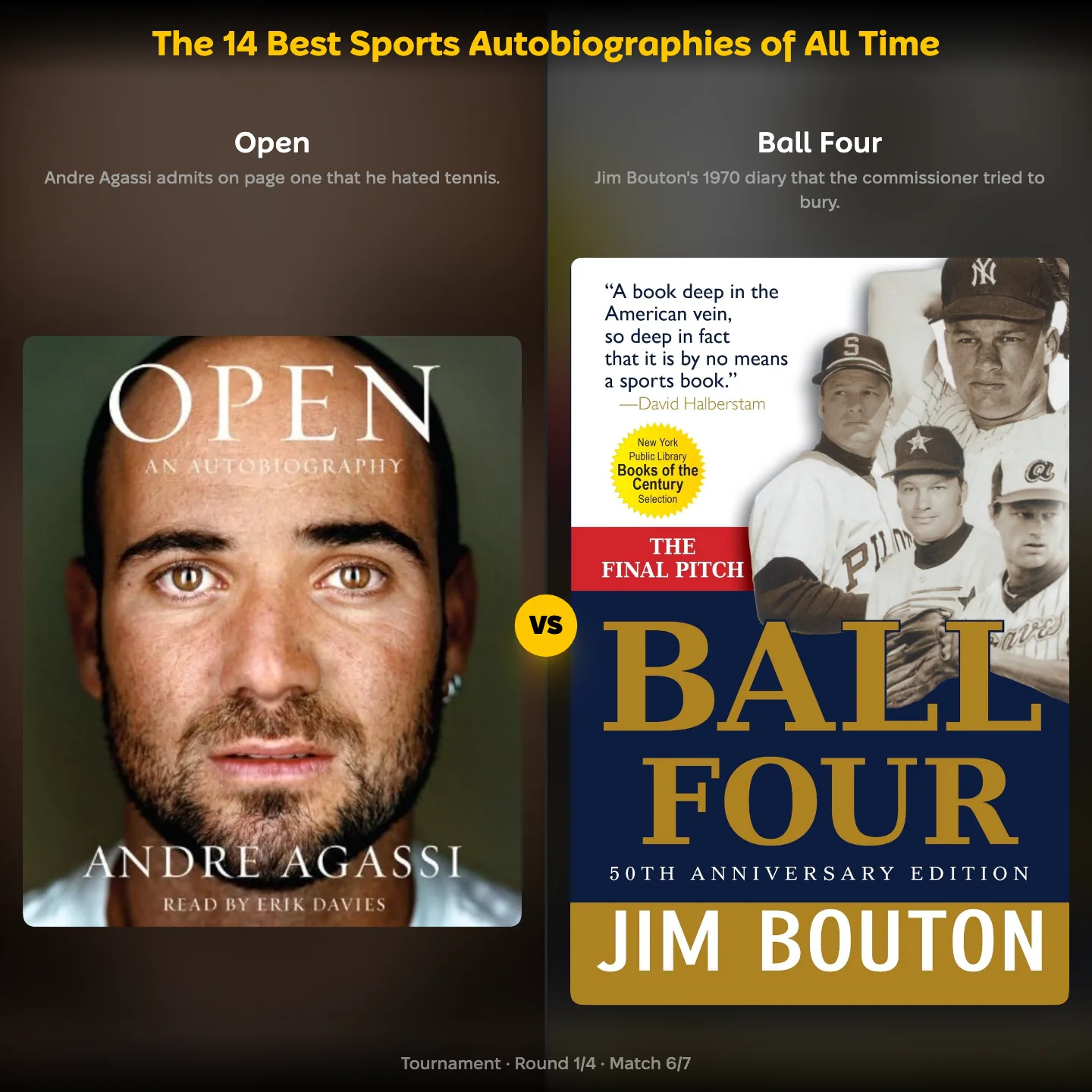
Open: the book in which Agassi says he hated tennis
On one ranking in this article Agassi is not a person at all. He is a book.
"Open" was published on 9 November 2009, written with the Pulitzer-winning journalist J. R. Moehringer, and it topped the New York Times bestseller chart.6 Two things in it made news: he had hated the sport for most of his life, and he had used crystal methamphetamine in 1997, the year his ranking collapsed.
That disclosure is why the book sits so oddly next to the comeback ranking. The same twelve months produce his lowest ranking and his most quoted confession.
The competition here is a genre with real depth. Jim Bouton's "Ball Four" was a 1970 diary that baseball's commissioner tried to bury, Mike Tyson's "Undisputed Truth" is as unguarded as its title, and Kobe Bryant's "The Mamba Mentality" sells on a different promise entirely.
The what-if list Agassi wrote himself onto
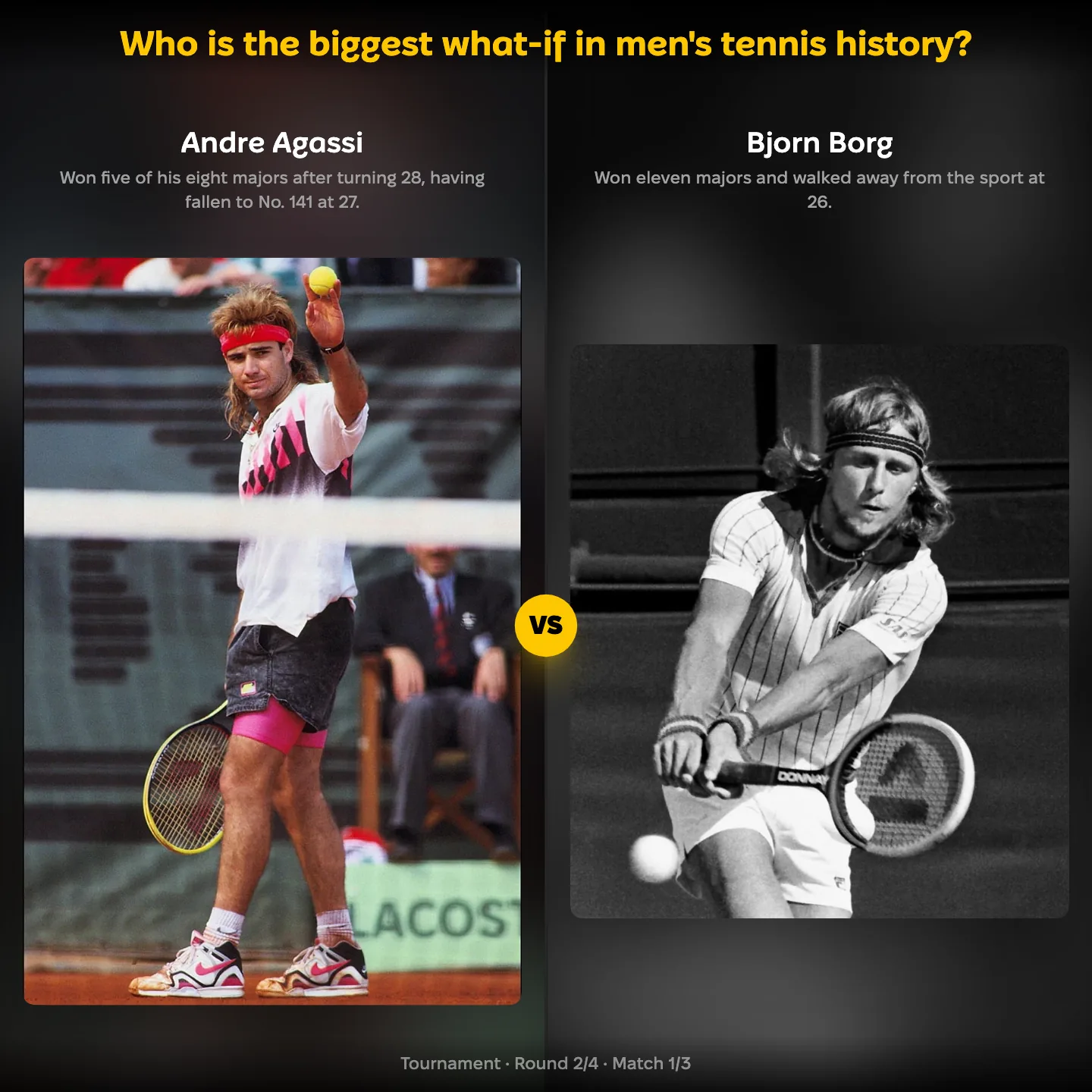
Every subject deserves one unflattering ranking, and Agassi supplied the evidence for his.
Five of his eight majors came after he turned 28. Read forwards that is a late peak; read backwards it is a decade in which the most talented player of his generation collected three.
Björn Borg is the purest version of the same question. He won eleven majors and left the sport at 26, and nobody has ever settled what the next five years would have held.
The rest of the ballot lost time to their bodies rather than their choices. Juan Martín del Potro won the US Open at 20 and then spent years in wrist surgery, Gustavo Kuerten's hip ended a career at its peak, and Marat Safin beat both Sampras and Federer in major finals and finished with two titles.
Sampras, Becker, Federer: nineteen years of opponents
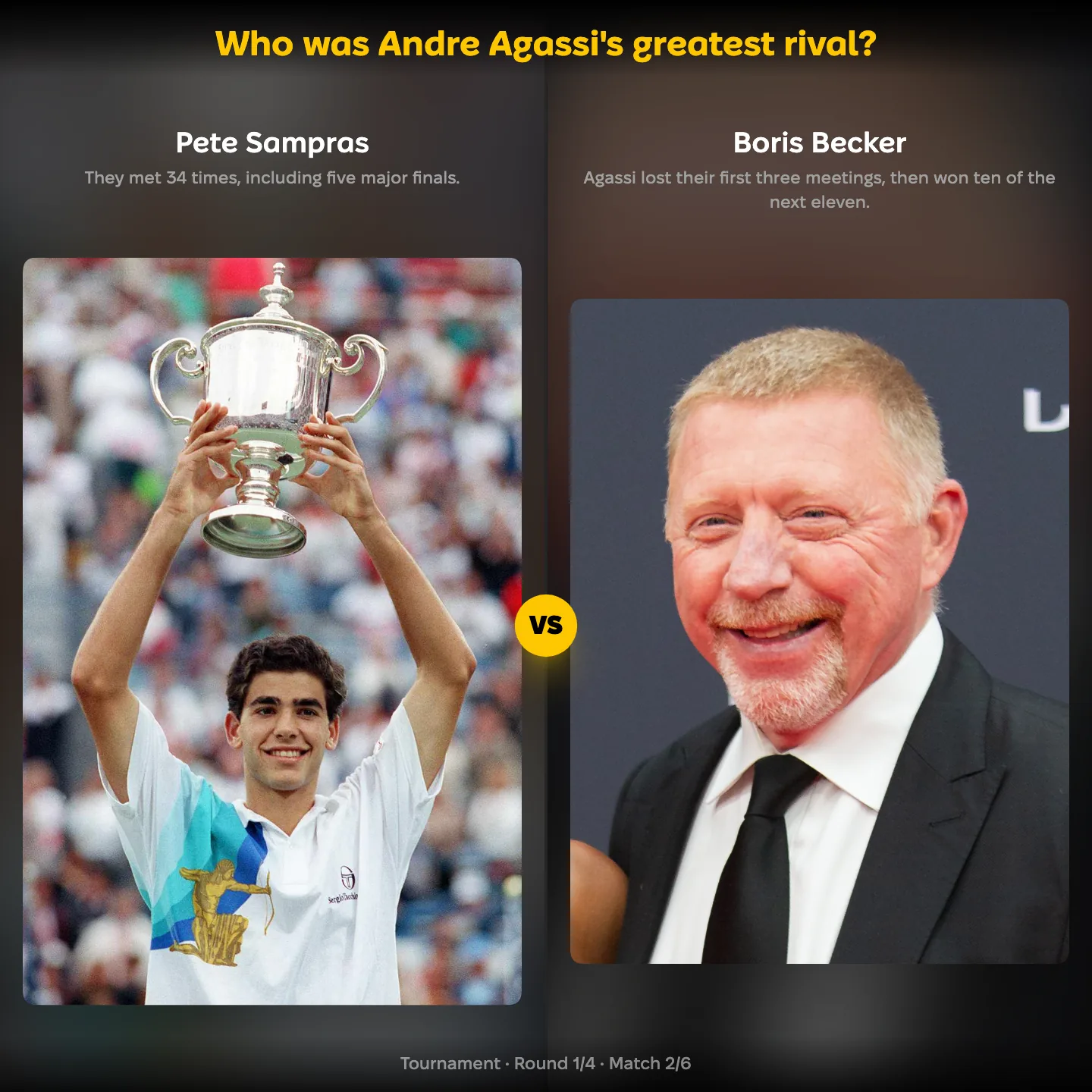
The last ranking inverts the article. Agassi is not one of the options here. He is the question, and the options are the men who kept appearing across the net from him.
Pete Sampras is the obvious answer. They met 34 times, five of those in major finals. Their rivalry is the one that defined American tennis for a decade, and it ran on a genuine contrast: the biggest serve in the game against the best return.
Boris Becker is the more interesting candidate. Agassi lost their first three meetings and then won ten of the next eleven, the arithmetic of a returner solving a server.
Roger Federer belongs on the list for a different reason. He beat Agassi in the 2005 US Open final, when Agassi was 35, and the two of them are the hinge between two eras of the sport.
Two names on the ballot are there for single afternoons. Andrei Medvedev led the 1999 French Open final by two sets, and Todd Martin took the 1999 US Open final to five.7
Twenty years on, the file still will not close
A career that produces a Golden Slam, a ranking collapse and a bestselling confession is not going to resolve into a single position on a single list, and twelve rankings later it has not.
What holds them together is that Agassi is legible in all of them. He is a plausible entry on a list of American greats, on a list of 1990s style, on a list of comebacks and on a list of regrets, and each of those is a real claim rather than a stretch.
Every one of these rankings is decided the same way, by putting two names side by side and repeating until the order settles.
If someone you follow shows up in a dozen unrelated lists, build the ranking that puts them there and see how the room votes.
More rankings, more angles
- Federer vs Nadal vs Djokovic — 16 Lists That Split Them — 66 majors, still no agreed order
- Serena Williams Won 23 Majors. The Lists Still Can't Place Her — the record she never broke
- Sinner vs Alcaraz: Two No. 1s, 14 Different Lists — the rivalry that replaced the Big Three
- Billie Jean King Won 39 Majors. One Exhibition Made Her Famous — 39 majors, and one exhibition match
Sources
- Wikipedia — Andre Agassi: final match on 3 September 2006 against Benjamin Becker, the eight major titles and their years, 60 tour titles, 101 weeks at No. 1, the Wimbledon absence of 1988–1990, the No. 141 ranking of 10 November 1997, and the 1996 Olympic final against Sergi Bruguera: en.wikipedia.org (checked 2026-08-23)
- Wikipedia — 2026 US Open: tournament dates of 30 August to 13 September 2026 at the USTA Billie Jean King National Tennis Center: en.wikipedia.org (checked 2026-08-23)
- Wikipedia — Steffi Graf: the 1988 Golden Slam, all four majors plus Olympic gold in one season, and her 22 major singles titles: en.wikipedia.org (checked 2026-08-23)
- International Tennis Hall of Fame — Andre Agassi: the largest one-year climb into the top ten in ATP ranking history, from 122nd at the end of 1997 to sixth in 1998, and the first year-end No. 1 in 1999: tennisfame.com (checked 2026-08-23)
- Tennis.com — the 1989 Canon Rebel commercial and the "image is everything" line: tennis.com (checked 2026-08-23)
- Wikipedia — Open: An Autobiography: publication on 9 November 2009, written with J. R. Moehringer, No. 1 on the New York Times bestseller list, and the disclosures about hating the sport and using crystal methamphetamine in 1997: en.wikipedia.org (checked 2026-08-23)
- Wikipedia — 1999 US Open men's singles: the five-set final against Todd Martin: en.wikipedia.org (checked 2026-08-23)