
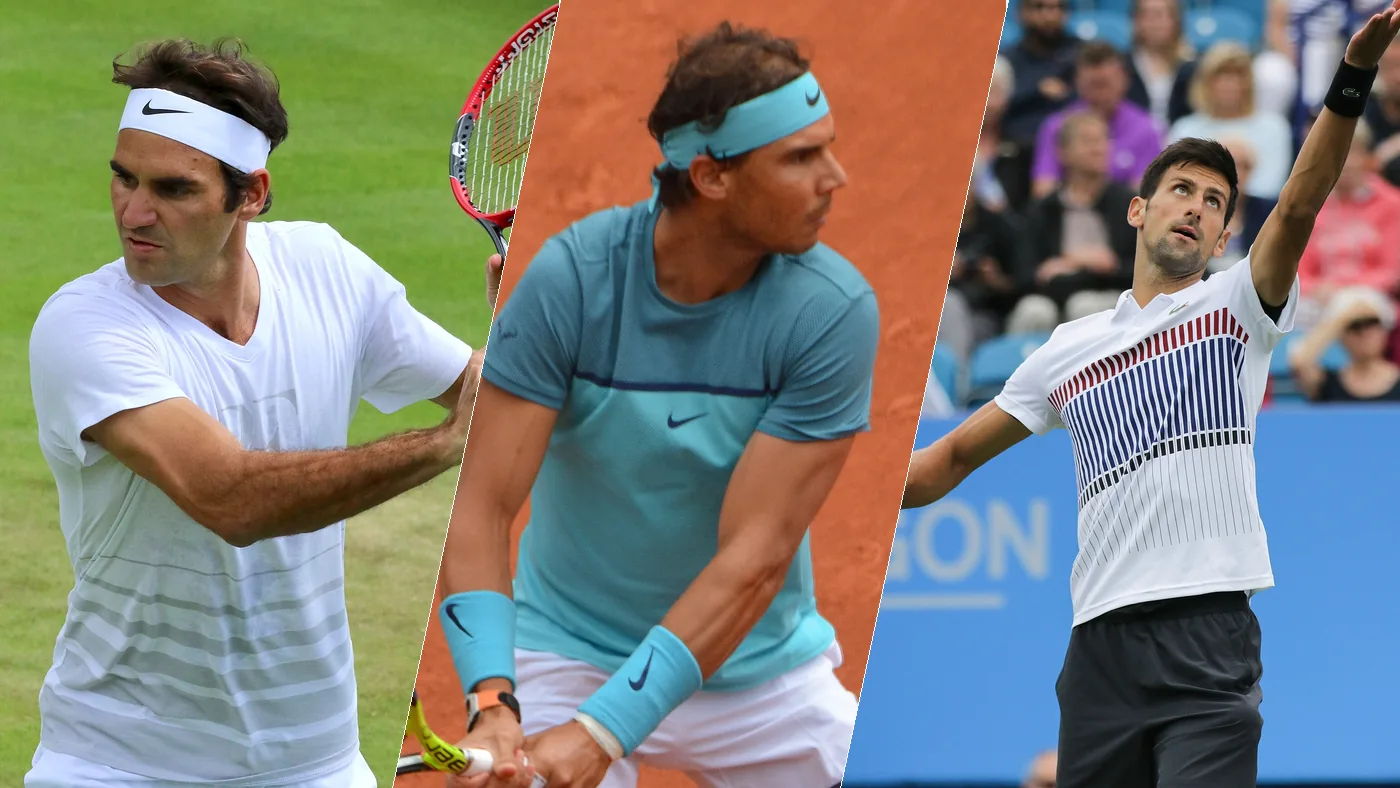
Roger Federer, Rafael Nadal and Novak Djokovic met 150 times on a tennis court, and the longest of those rivalries ran to 60 matches and finished 31–29 to Djokovic.1 On 1 February 2026, at 38, Djokovic reached an eleventh Australian Open final and lost it 2–6, 6–2, 6–3, 7–5 to Carlos Alcaraz, who completed the career Grand Slam and left Djokovic a beaten finalist in Melbourne for the first time.2 Sixteen rankings on this site hold at least one of the three, and they drop them into company none of them chose: Swiss ski jumpers, Serbian swimmers, an eleven-hour match on Court 18.
Fourteen French Opens, eight Wimbledons and 428 weeks at No. 1 are the three records this rivalry produced, and each one belongs to a different man.
Laver, Sampras and Borg got there first
Best male tennis player of all time is the ranking that made these three famous outside tennis. All of them are on it, next to Rod Laver, Pete Sampras and Björn Borg.
Djokovic has the record book. His 24 major titles are the men's record, made up of 10 Australian Opens, seven Wimbledons, four US Opens and three at Roland-Garros, which makes him the only man with three or more of each.3
Federer has the volume. He won 103 tour titles and 1,251 tour-level matches against Djokovic's 101 and 1,177, and lost 27 of their 50 meetings.5
Nadal has the head-to-head that refuses to age. He beat Federer 24 times in 40 meetings, the widest margin anywhere inside the trio, and did it with the smallest career totals of the three: 92 titles and 1,080 wins.6
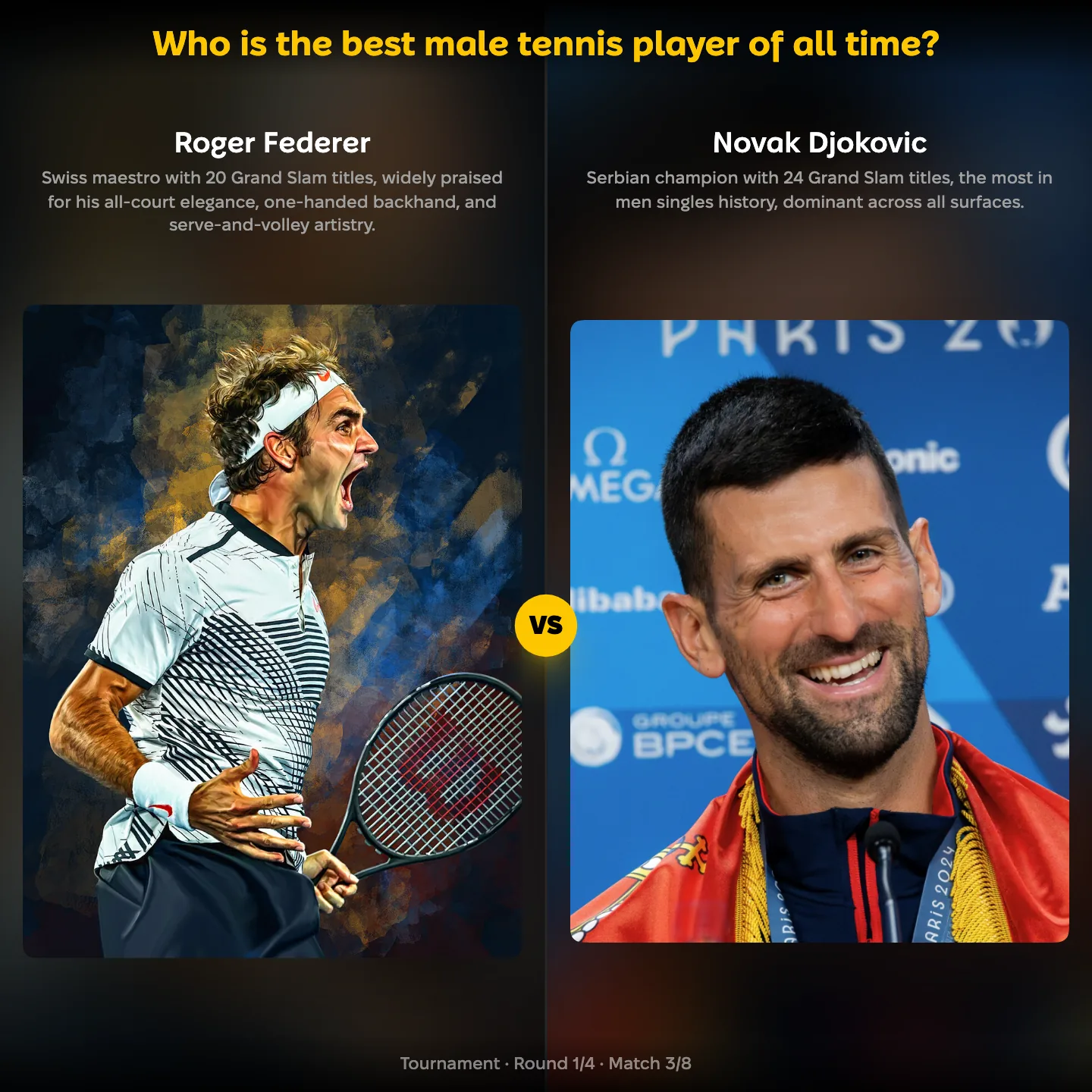
Grand Slam titles: 24, 22 and 20, with Sampras on 14
Count Grand Slam titles alone and the field drops to eleven men. Sampras is the closest outsider on 14.7
Nadal's 22 is the most lopsided total in the sport. Fourteen came at Roland-Garros, five of them in consecutive years from 2010 to 2014, and no other man has won any single major more than 10 times.8
Federer's 20 spread more evenly: six Australian Opens, five US Opens in a row from 2004 to 2008, one Roland-Garros.9 Those five September titles in New York are the only stretch in the trio's careers when one of them held a hard-court major outright for half a decade.
Djokovic's 24 has the flattest distribution of the three, and double figures in one place only: Melbourne. Take the Australian Open out of all three careers and Nadal leads on 20 majors to 14 each for Federer and Djokovic, which is a different sentence entirely.
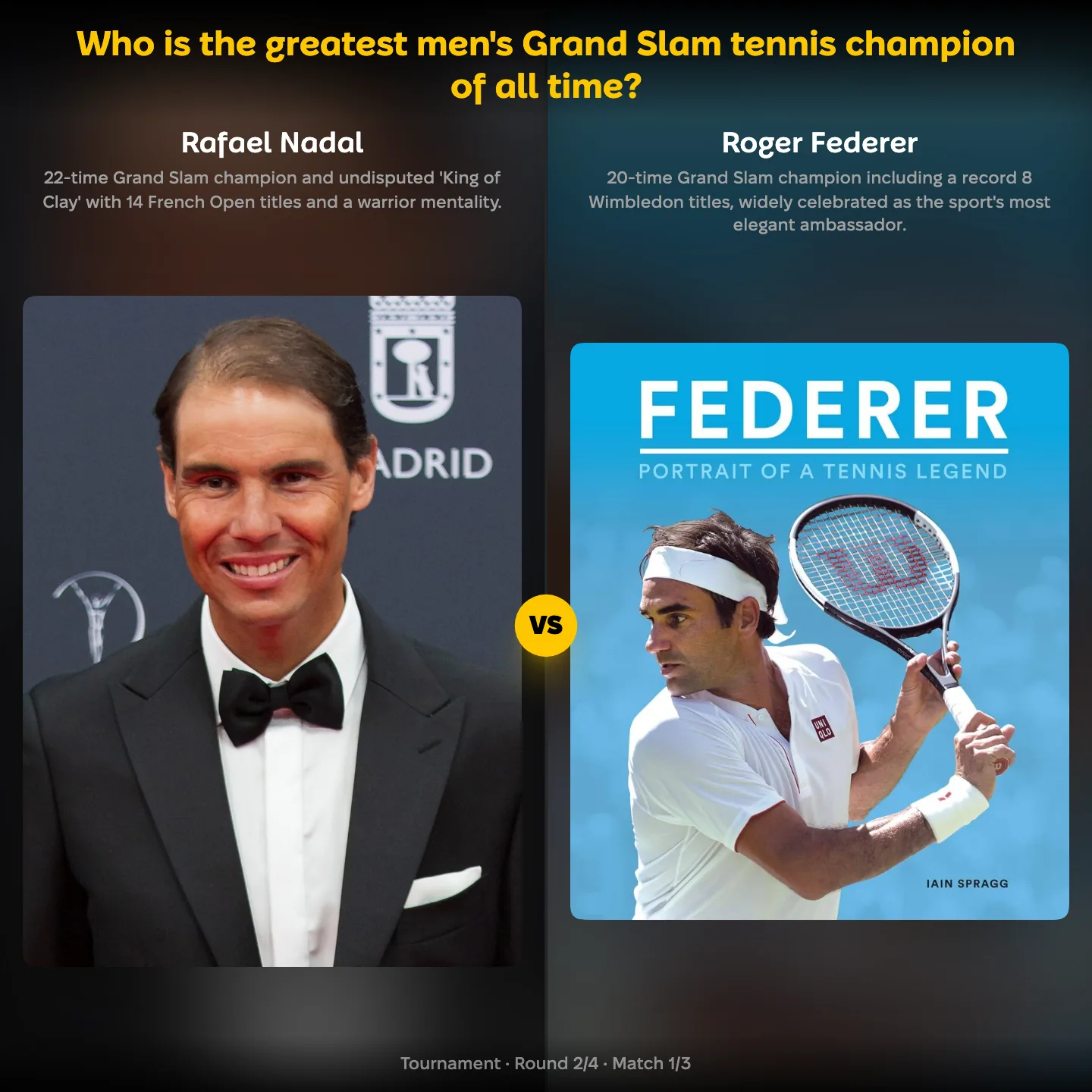
428 weeks at No. 1, and the three men between Federer and Nadal
Weeks at world No. 1 measures something titles do not: the months when nobody in the draw was getting past you at all. All three are here, with seven other men who held the ranking.
Djokovic has 428 weeks at the top and eight seasons that ended with him there. Federer's 310 weeks are second. Nadal is sixth on 209, behind Sampras on 286, Ivan Lendl on 270 and Jimmy Connors on 268.4
Those three names in the middle are the reason this ranking is not a Big Three podium: two of the men ahead of Nadal never met him, and the third retired before he was born.
Federer's run started on 2 February 2004,9 and Nadal did not reach No. 1 until 18 August 2008, six weeks after he had beaten Federer at Wimbledon.8 Djokovic got there in July 2011 and stayed long enough to double Nadal's total.
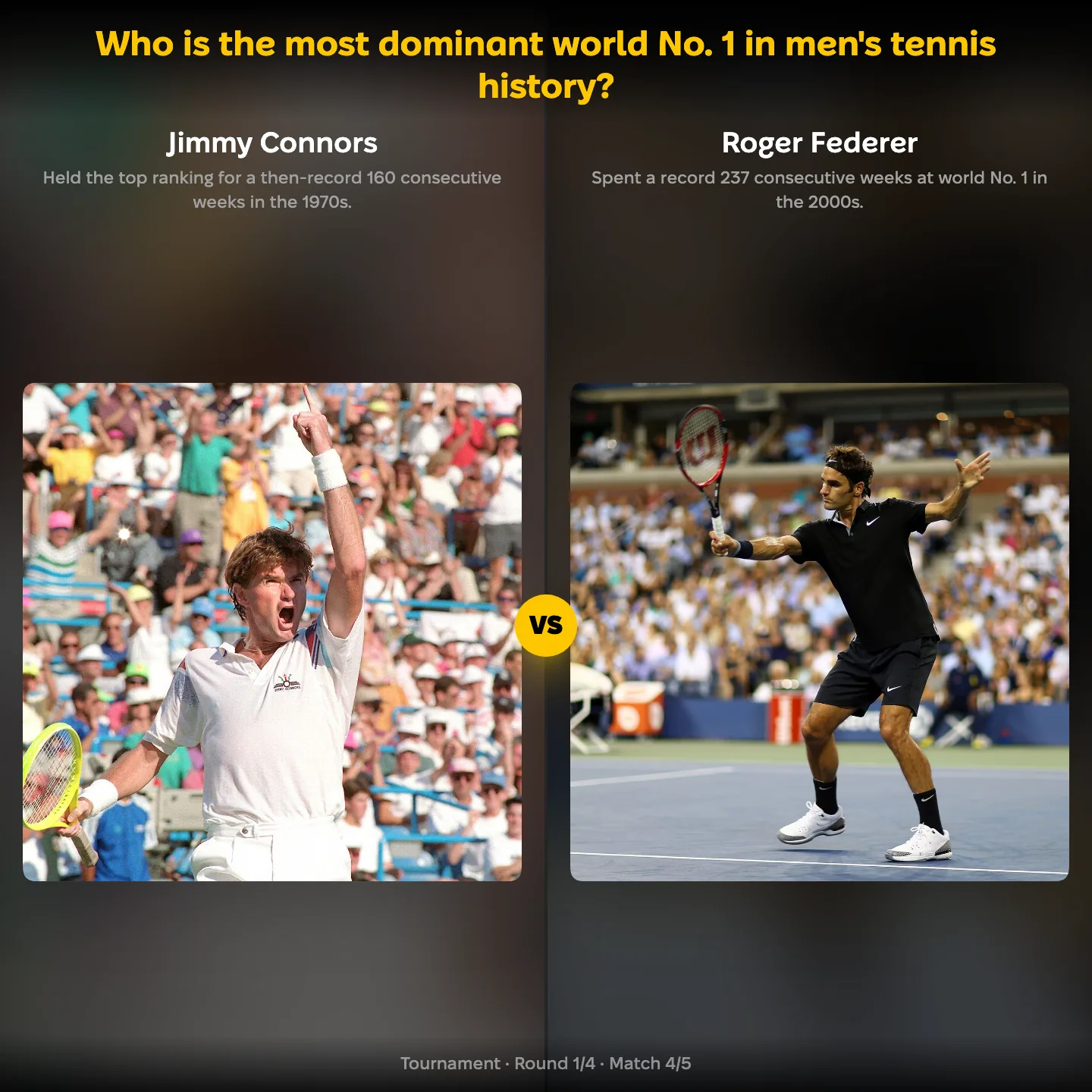
Roland-Garros: 112 wins, four defeats, nineteen years
The French Open ranking is where the order inside the trio is least contested. Fifteen champions are on it, men and women.
Nadal went 112–4 at Roland-Garros, never lost a final there across nineteen editions from 2005 to 2022, won 39 matches in a row on the court between 2010 and 2015, and dropped 37 sets in his whole career in Paris while winning 333.10
Djokovic is on this list for two of those four defeats as much as for his own titles in Paris. Robin Söderling caused the first in 2009 and Alexander Zverev the last in 2024 — the middle two belong to Djokovic, in 2015 and 2021, and no other man beat Nadal there twice.
Federer's single Roland-Garros title, in 2009, arrived in the one year Nadal lost before the final. On the same court Nadal beat Djokovic eight times and Federer six, which is the fullest answer available to why the clay rankings and the grass rankings never agree.
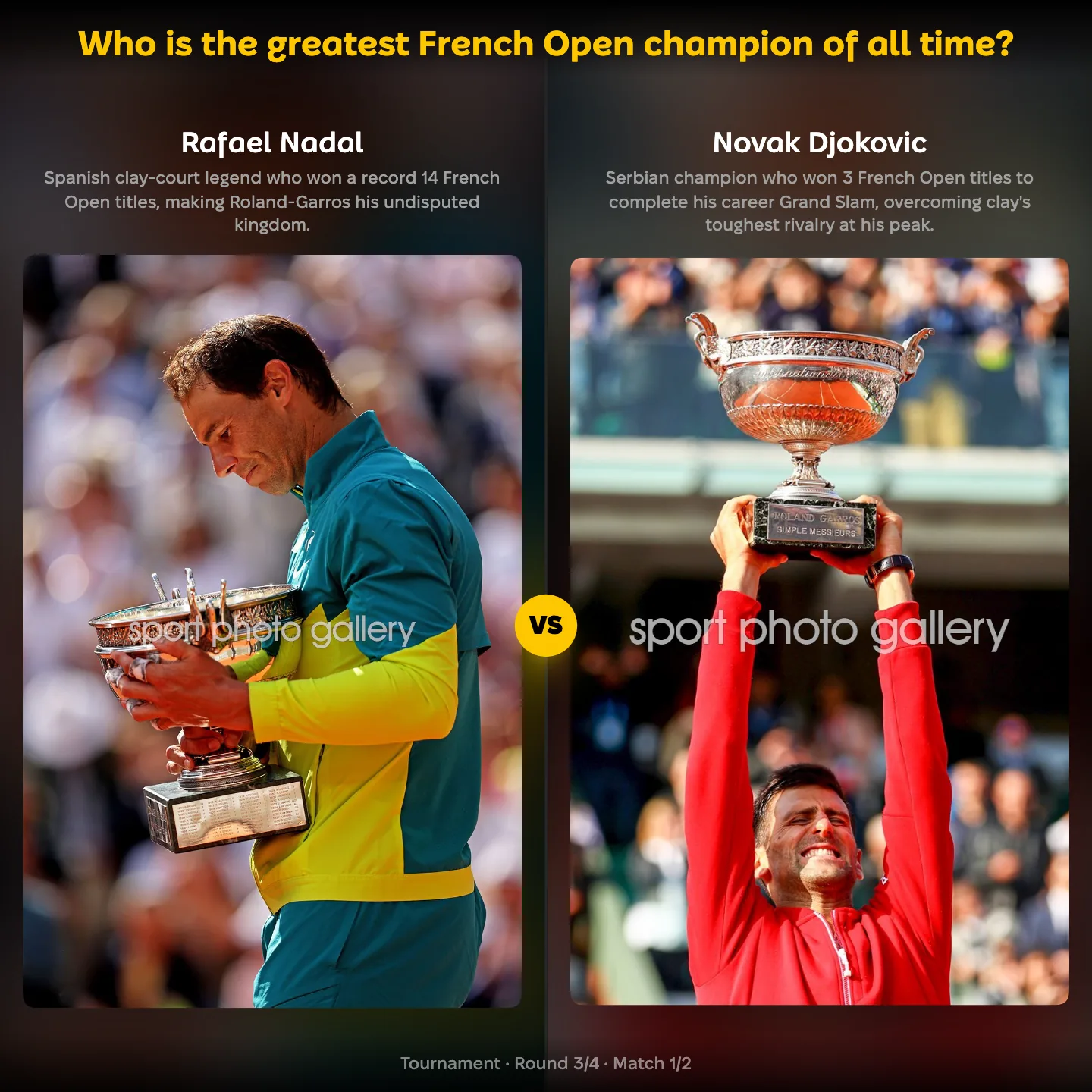
Clay courts: the list without Federer on it
Greatest clay-court player is the first ranking here that leaves one of the three out entirely. Nadal and Djokovic are both on it. Federer is not.
Nadal's clay record reads like a misprint before Roland-Garros is even counted: 12 titles at Barcelona, 11 at Monte-Carlo, 10 in Rome.8
Federer won one clay major in a twenty-year career. On grass or hard courts his absence from a top ten would be strange; on clay it is arithmetic, and Djokovic makes the list on the strength of beating the man who owned the surface.
Steffi Graf, Chris Evert and Justine Henin take three of the other places, all of them French Open champions from the decades before Nadal's first trip to Paris.
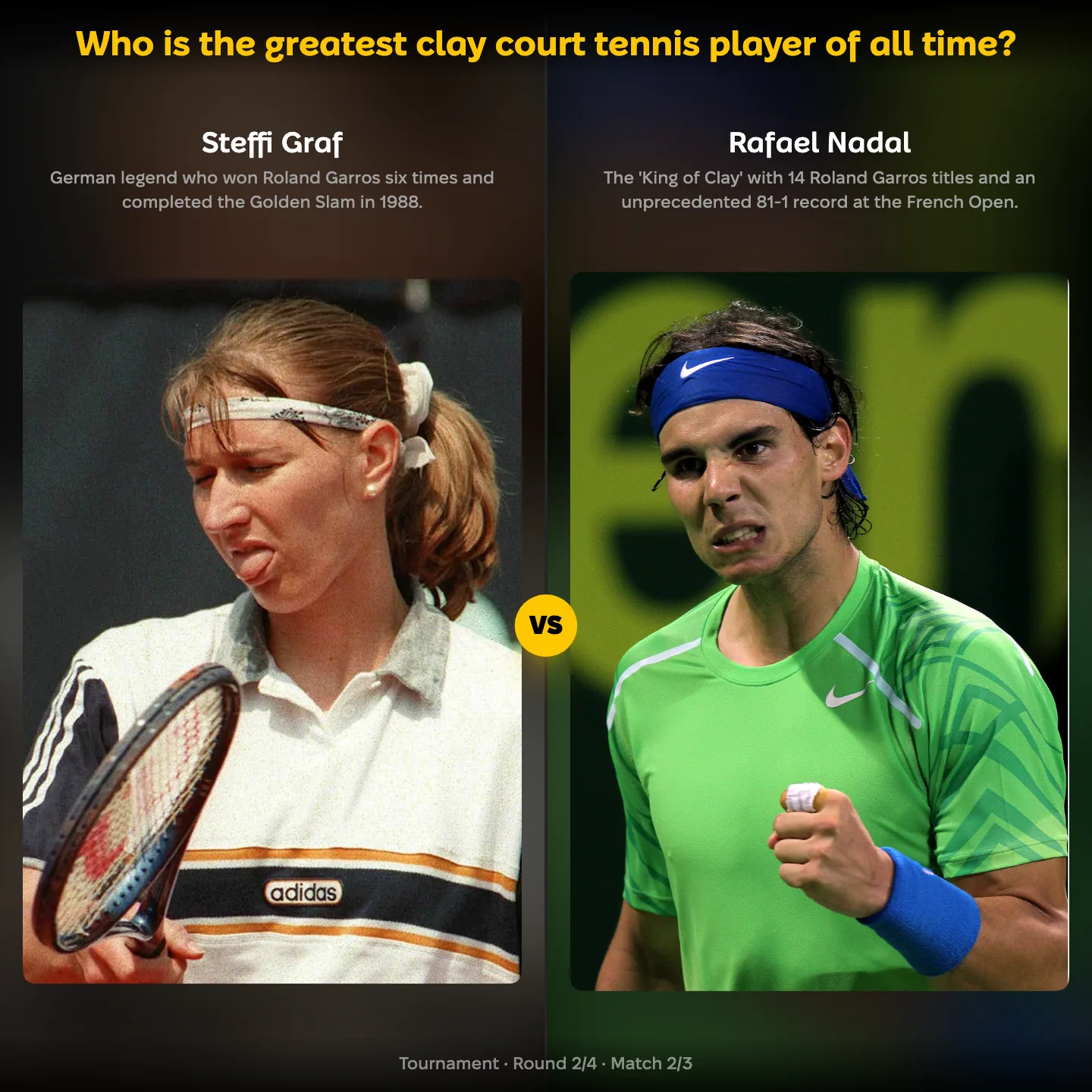
Grass: Federer's eight, Sampras's seven, Nadal's two
Grass turns the clay order upside down, and this time all three are in the ranking.
Federer won eight Wimbledon titles, the first in 2003 and the last in 2017 at 35.9
Sampras won seven of his 14 majors at Wimbledon between 1993 and 2000,7 and Borg is on the list from the decade before that. Neither man ever faced any of the three, which is the case anyone arguing for the older grass makes.
Djokovic matches Sampras at Wimbledon, four of his titles coming in consecutive editions from 2018 to 2022. Nadal won it twice, in 2008 and 2010, which for a player filed under clay is a correction to the filing.
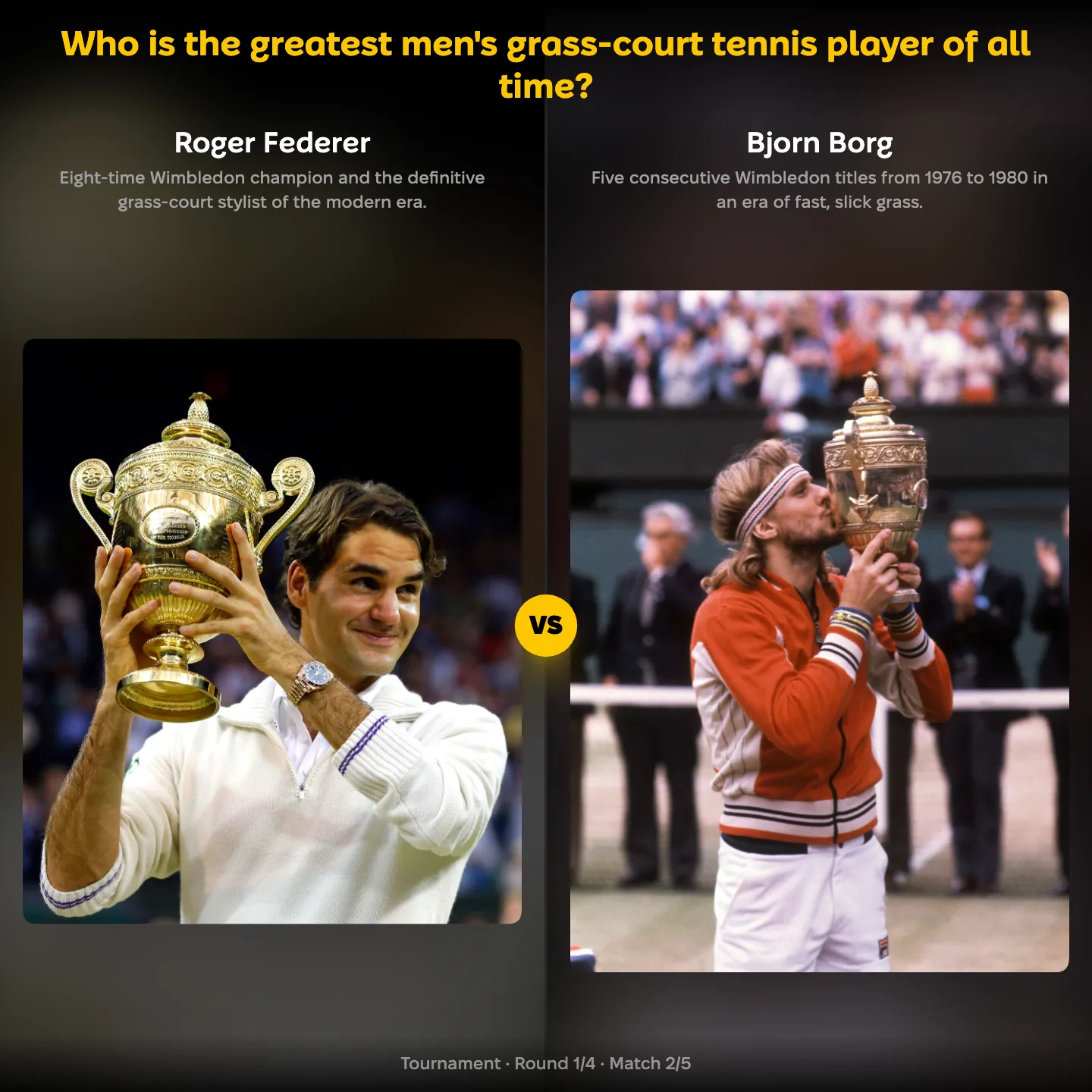
Nineteen Wimbledon champions, and Nadal is not one of them
This ranking narrows grass to one fortnight and stretches it across the tournament's whole history: nineteen champions, men and women, from Althea Gibson and Margaret Court to Carlos Alcaraz. Federer and Djokovic are on it. Nadal is not.
Federer is there on the raw count, and his last Wimbledon final came in 2019 at 37.
Djokovic is there on the era. He won his titles while Federer, Nadal and Andy Murray were all still in the draw, and he beat Federer in that 2019 final.
Jannik Sinner is the newest name, after a second Wimbledon in 2026 that finished 6–7, 7–6, 6–3, 6–4 against Alexander Zverev.11
Nadal's absence is the informative part. Two Wimbledon titles is a career for most players — it is not enough to make a list of nineteen at this tournament, which is a fair summary of what the standard on that lawn looks like.
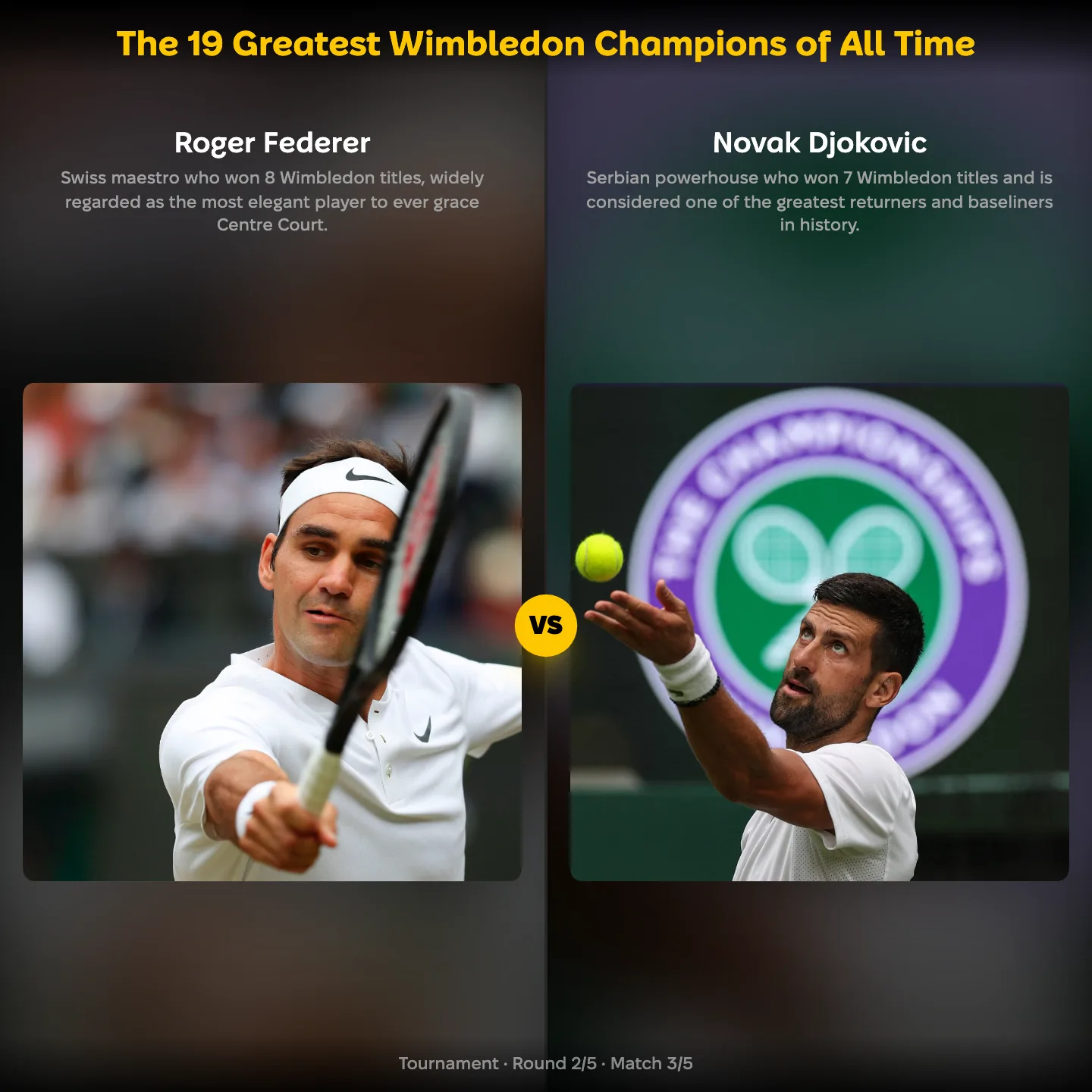
Hard courts: Djokovic's 14, Federer's 11, Nadal's six
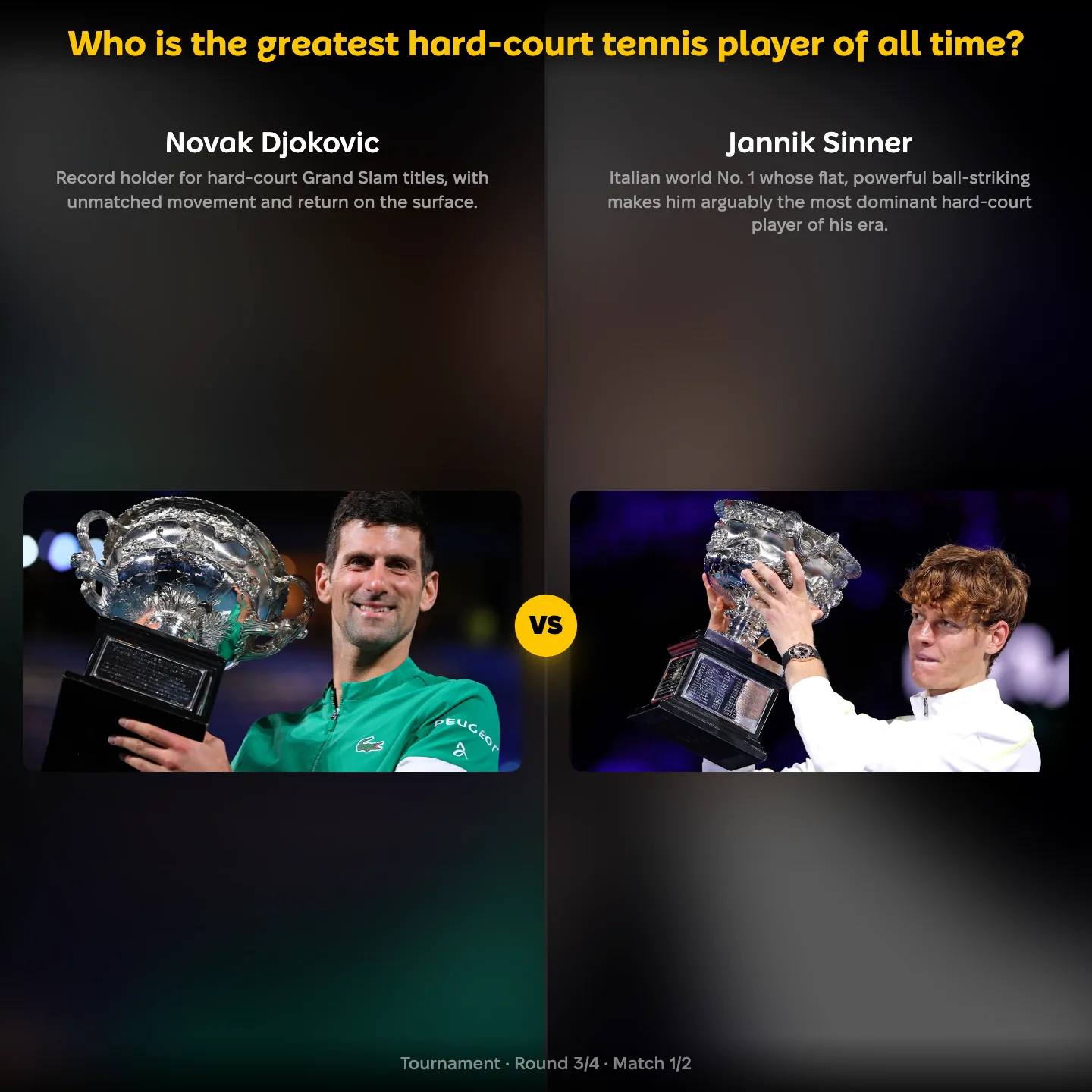
Most professional tennis is played on hard courts, so this surface ranking covers the most ground, and the current generation gets a say in it. Federer, Nadal and Djokovic are all on it, with Jannik Sinner, Carlos Alcaraz and Daniil Medvedev.
Djokovic won 14 of his 24 majors on hard courts, 10 of them in Melbourne and four in New York.3
Federer took 11 of his 20 there and Nadal six of his 22, including two Australian Opens thirteen years apart.8
Sinner and Alcaraz are the reason this list will not sit still. On 3 August 2026 they held the top two places with 13,450 and 8,160 ranking points, and the highest-placed member of the older three was Djokovic in fifth.12
Federer vs Nadal, 2008: the match that outranks the players
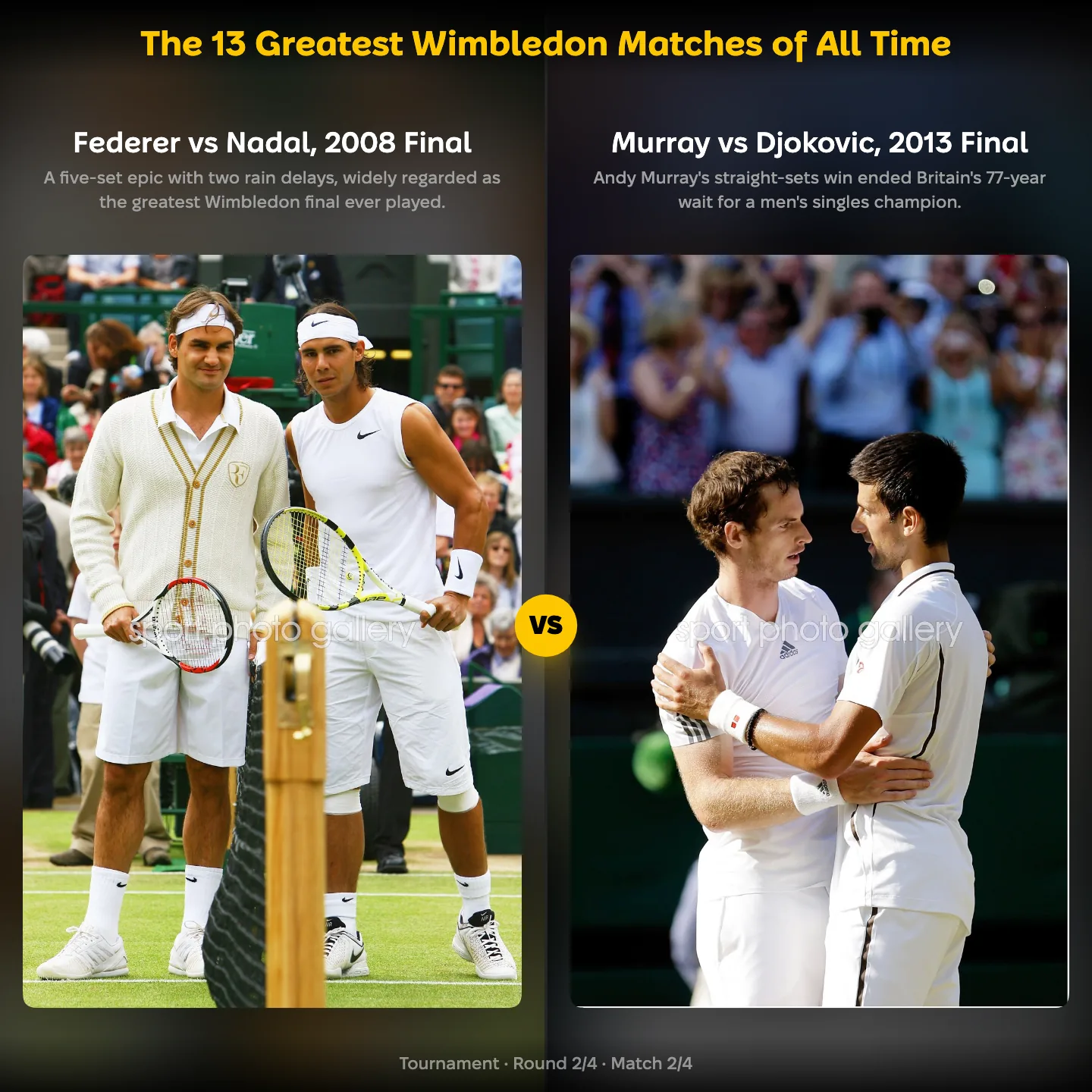
Rank single matches instead of careers and the three of them stop being candidates. Thirteen Wimbledon matches are on this ranking, and they play in four of them.
Federer vs Nadal, 2008 is the match most often nominated as the best ever played. Nadal won it 6–4, 6–4, 6–7, 6–7, 9–7 as the light went, ending Federer's run of five straight Wimbledon titles and taking his own first.13
Djokovic vs Federer, 2019 is the rival nomination. Djokovic won 7–6, 1–6, 7–6, 4–6, 13–12, the fifth set going to a tie-break at twelve games each.14
The rest of the list needs neither of them. John Isner beat Nicolas Mahut 70–68 in the fifth over 11 hours and five minutes in 2010, and Murray's win over Djokovic in 2013 ended a 77-year wait for a British men's champion, which is a kind of significance no rally count reaches.15
Roland-Garros finals: Lendl in 1984, Nadal in 2012
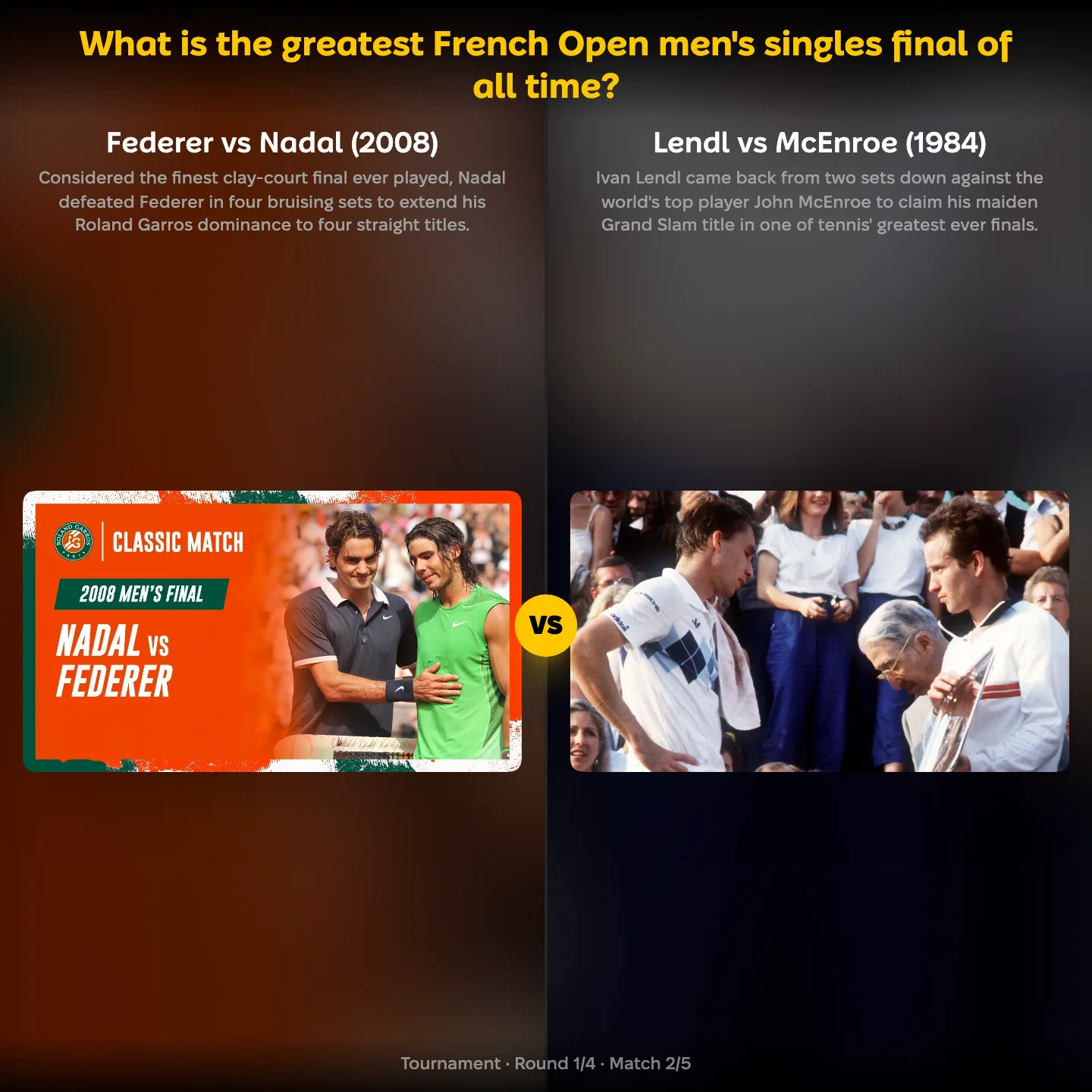
Ten French Open finals get a ranking of their own, and the trio fills half of it as matches rather than as names.
Federer vs Nadal is there twice, from 2006 and 2008. Nadal won the 2008 final inside a fortnight in which he never lost a set.10
Nadal vs Djokovic, 2012 is the four-set final that gave Nadal a seventh title in Paris and pushed him past every man who had won the tournament before him.
Two entries have nothing to do with any of the three. Lendl beat John McEnroe in the 1984 final for the first major title of his career, and Stan Wawrinka beat Djokovic in 2015, a year before Djokovic finally won the tournament. Both matches hold their place on a list where five of the ten involve Federer, Nadal or Djokovic, which is what a ranking of finals rather than of players looks like.
Messi, Jordan and Bolt: the room where tennis is one sport of many
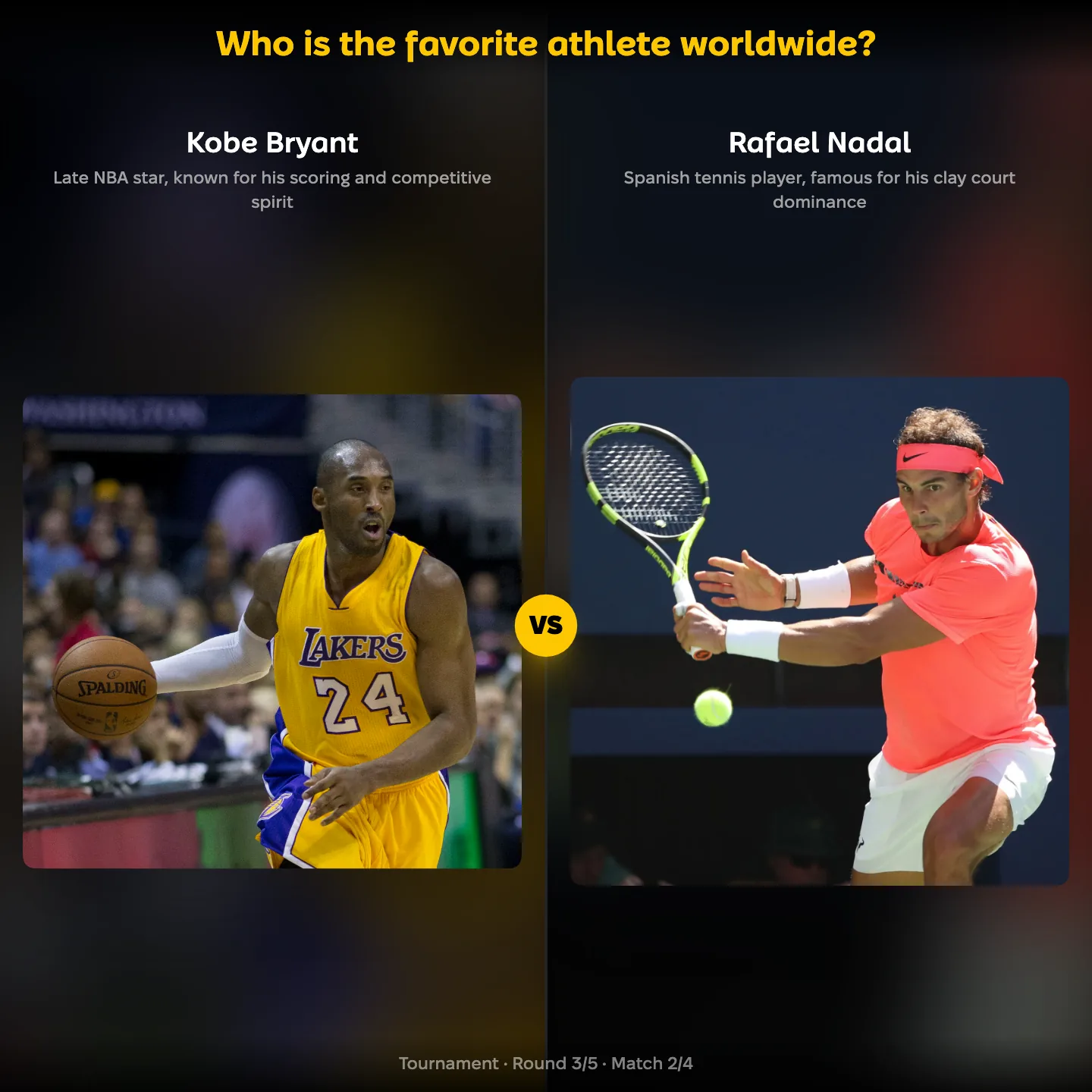
Widen the question to every sport and the trio's advantage thins. Thirty-two athletes are on this list, and Federer, Nadal and Djokovic are three tennis players among Cristiano Ronaldo, Lionel Messi, Michael Jordan, Usain Bolt, Muhammad Ali, Serena Williams, Kobe Bryant, Virat Kohli and Sachin Tendulkar.
In a room full of Olympians the Olympic record is what separates the three of them. Nadal won the singles gold in Beijing in 2008, at 22.8
Djokovic needed sixteen more years and got his in Paris in 2024, at 37, which made him the oldest of the three to win anything at all.3
Federer never won one. His closest attempt was the 2012 final on Wimbledon's grass, and Murray took it in front of the crowd that had watched Federer win the same title seven times.15
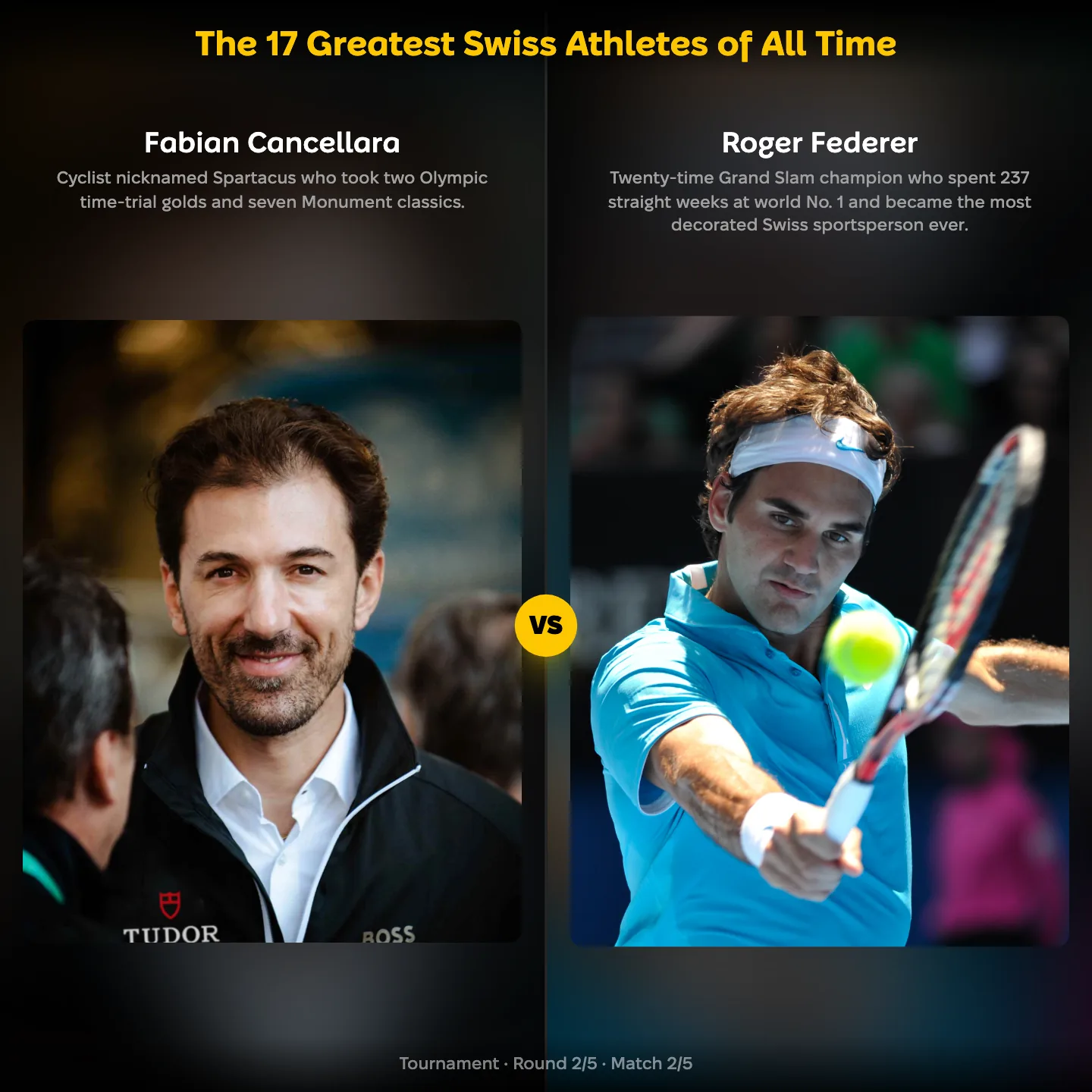
Seventeen Swiss athletes, and Federer is the one who plays in summer
Nationality is the sorting rule that splits the trio automatically, because all three carry different passports. This ranking holds seventeen Swiss athletes, so Nadal and Djokovic have nothing to enter.
Federer finished five seasons as the world's top-ranked player,4 and no other Swiss athlete has spent five years as the best in the world at anything.
The company is mostly winter sport. Simon Ammann came off a ski jump, Vreni Schneider and Dario Cologna came down mountains, and Fabian Cancellara rode a bicycle against the clock — all of them Olympic champions, all of them in sports Switzerland treats as its own.
Martina Hingis makes it two tennis players on a list where tennis is not the national game, and Stan Wawrinka, Federer's doubles partner at the Beijing Olympics, is on it as well.
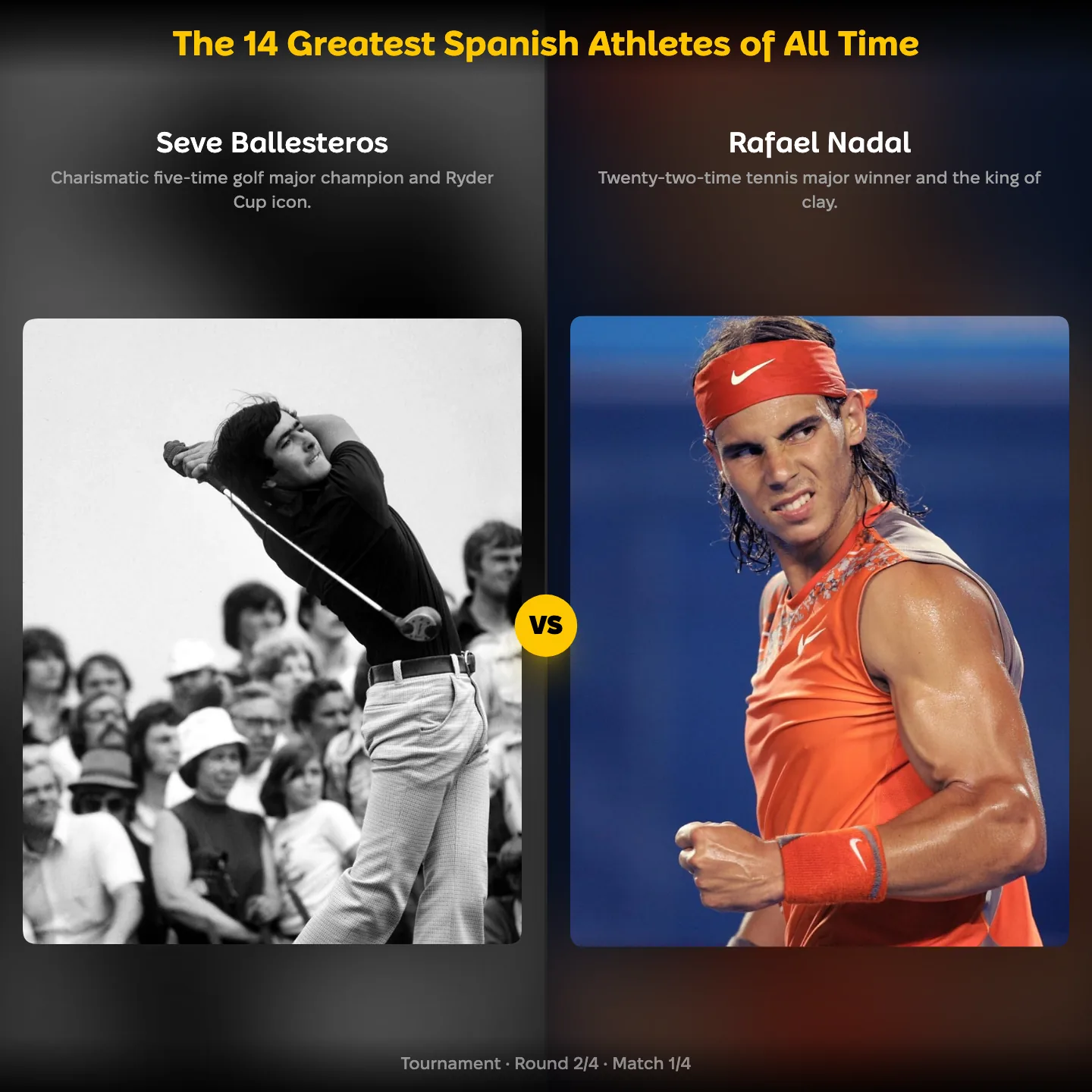
Fourteen Spanish athletes: Nadal, Ballesteros, Indurain
Spain's list works the same way from the other side. Fourteen athletes are on it, which leaves Federer and Djokovic with nothing to enter.
Nadal answers for tennis on his own. His Olympic gold from Beijing is the credential that reads the same in every sport on the list, and it arrived in the same August he first reached No. 1.
The rest of the company is serious. Seve Ballesteros turned the Ryder Cup into a European event, Miguel Indurain won the Tour de France five years running, Pau Gasol won NBA titles, Fernando Alonso won Formula 1 titles, and Andrés Iniesta scored the goal that won the 2010 World Cup.
Carlos Alcaraz is on the list as the player carrying Spanish tennis after Nadal, and in February 2026 he became the youngest man to win all four majors, at 22 years and 272 days, with two titles at each of the French Open, Wimbledon and the US Open behind him.2
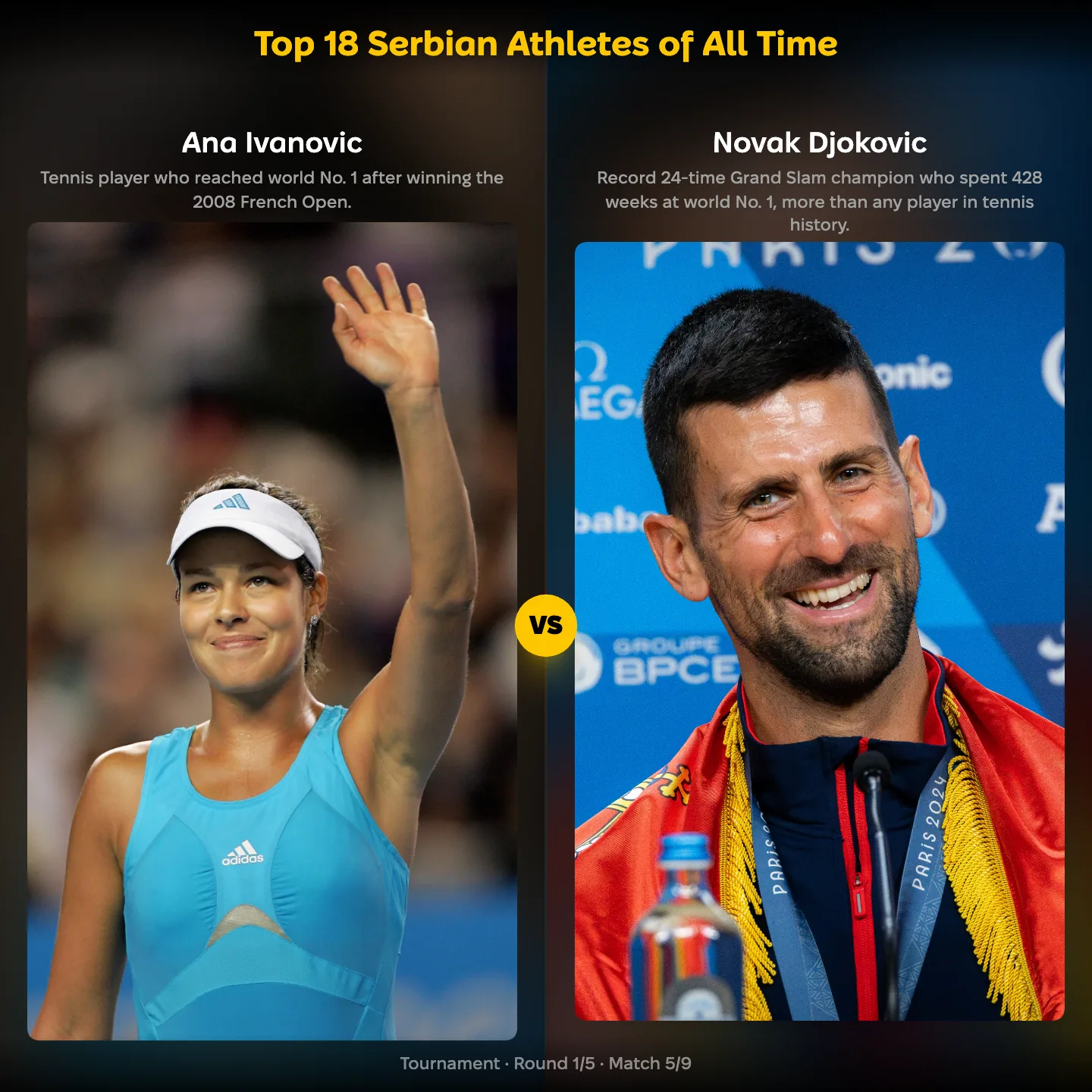
Eighteen Serbian athletes: Djokovic, Jokić and a swimmer
Serbia's ranking is the third of the national lists, and it runs the same way again. Federer and Nadal are not eligible, and Djokovic carries tennis by himself.
Djokovic's 24 majors and his Olympic gold make the largest haul any Serbian athlete has assembled in an individual sport, and he first reached No. 1 on 4 July 2011.3
Nikola Jokić is what makes this a contest rather than a coronation: an NBA champion and Finals MVP with the Denver Nuggets.
Ana Ivanović and Jelena Janković are the other two tennis players, both former world No. 1s from the same twelve months. And Milorad Čavić is on the list for a silver: he finished behind Michael Phelps in the 100m butterfly at Beijing 2008, one of the eight finals Phelps won at those Games.16
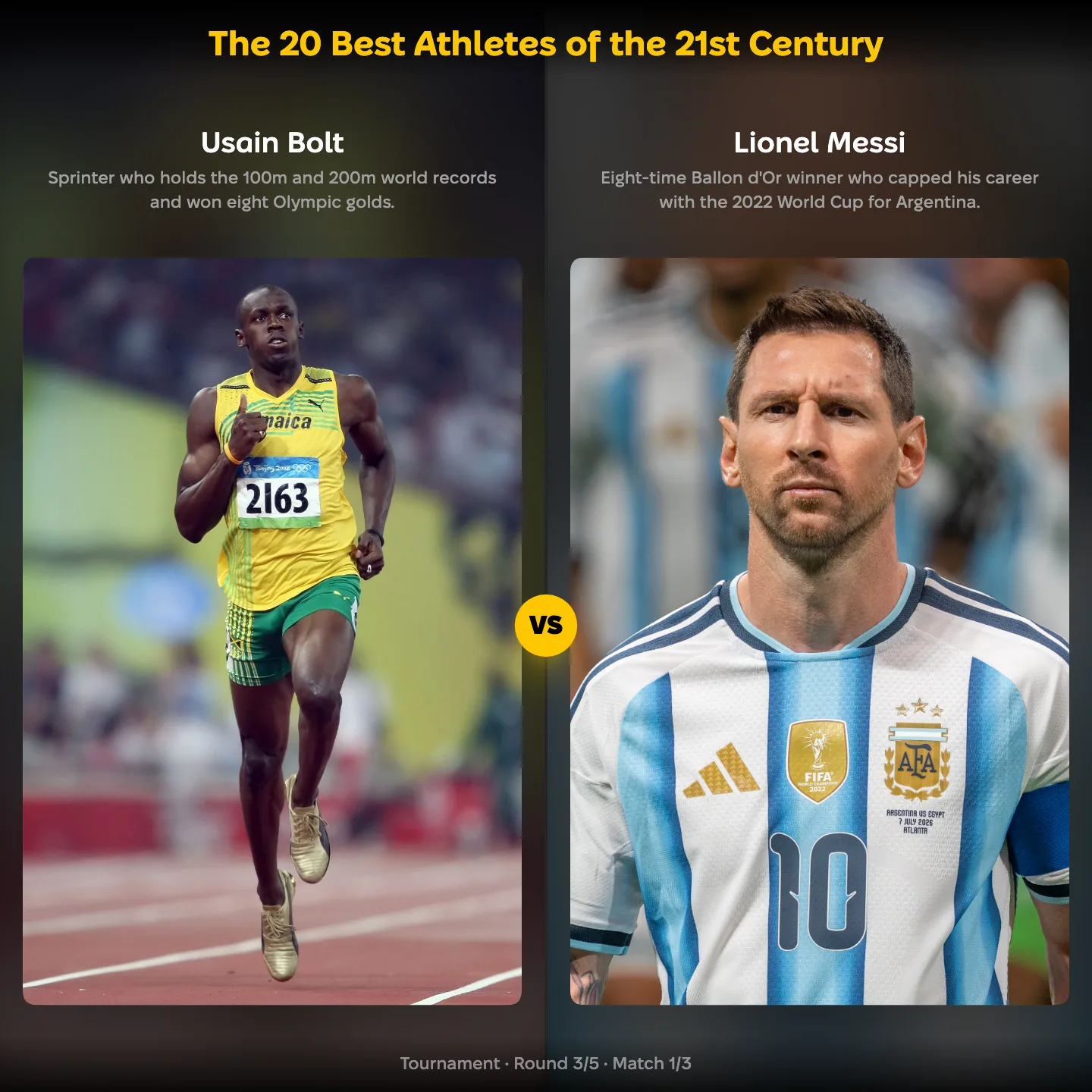
Phelps, Bolt and Serena: twenty athletes of the 21st century
Narrow the field to athletes of the 21st century and the period being judged is exactly the period the three of them owned. All of them are here, with seventeen others.
Between them Federer, Nadal and Djokovic held the No. 1 ranking for 947 weeks, more than eighteen of the twenty-five years under review.4
They are also the only three from one sport on the list, which says something no individual record does: no other discipline produced three all-time greats at the same time who kept taking titles off each other.
Michael Phelps, Usain Bolt, Serena Williams, Simone Biles, Katie Ledecky, Allyson Felix, LeBron James, Tiger Woods, Lewis Hamilton, Tom Brady and Eliud Kipchoge fill out the rest. This is the ranking where being one of the three best tennis players ever stops being unusual.
Sinner and Alcaraz: the ranking only Djokovic can join
Every list above is about what has already happened. This one asks who is best right now, which is why two of the three cannot be on it at all.
Federer's last professional match was a doubles at the 2022 Laver Cup in London, played alongside Nadal.17 Nadal followed him out in November 2024, at the Davis Cup finals in Málaga.10
Djokovic is still on the entry lists. At 39 he has played 19 matches in 2026 for a 14–5 record and no titles,1 a thin season by his standards and still enough for fifth in the world.
Sinner ended his Wimbledon in July, 6–4, 6–4, 6–4 in the semi-finals, one win short of the eighth title that would have drawn him level with Federer.11 Alcaraz, Medvedev and Alexander Zverev fill out the rest of the ranking, and Djokovic has not won a major since the 2023 US Open.3
What 150 matches never settled
Twenty years of playing each other left three ledgers that disagree: Djokovic ahead of both, Nadal ahead of Federer, Federer ahead of the other two on titles won. The sixteen rankings above do the same thing at a larger scale, because clay gives the order to Nadal, grass gives it to Federer, and a count of weeks and majors gives it to Djokovic. Nobody has to pick one of the three, and the three of them never managed to settle it between themselves, which is why lists like these get compared two by two.
If you would rather set the terms yourself, build the ranking you think decides it and find out whether the surface still does the deciding.
More rankings, more angles
- Jannik Sinner: Best in One List, Last in Another — beat Djokovic in the 2026 Wimbledon semi-final
- Serena Williams Won 23 Majors. The Lists Still Can't Place Her — 23 majors, sixteen questions
- Sinner vs Alcaraz: Two No. 1s, 14 Different Lists — the pair who took the era from them
- Martina Navratilova vs Chris Evert: 80 Matches, 60 of Them Finals — the women's version, eighty matches long
Sources
- ATP Tour — Djokovic v Nadal ATP Head2Head (31–29 in 60 meetings) and both career panels (Djokovic at 39: 14–5 in 2026 with no titles; Nadal 92 titles, 1,080 wins): atptour.com (checked 2026-08-03)
- International Olympic Committee — 2026 Australian Open men's final report: Alcaraz d. Djokovic 2–6, 6–2, 6–3, 7–5 on 1 February 2026, the youngest man to complete the career Grand Slam at 22 years 272 days, with two titles at each of the other three majors, and Djokovic a Melbourne runner-up for the first time: olympics.com (checked 2026-08-03)
- ATP Tour — Djokovic's title list: 10 Australian Opens, 7 Wimbledons, 4 US Opens, 3 Roland-Garros, the Paris 2024 Olympic title, 101 titles in all, and a first week at No. 1 on 4 July 2011: atptour.com (checked 2026-08-03)
- ATP Tour — PIF ATP Rankings former No. 1s, total weeks and year-end finishes: Djokovic 428 weeks and 8 year-end No. 1s, Federer 310 and 5, Sampras 286, Lendl 270, Connors 268, Nadal 209: atptour.com (checked 2026-08-03)
- ATP Tour — Djokovic v Federer ATP Head2Head (27–23 in 50 meetings) and Federer's career panel: 103 titles, 1,251 tour-level wins: atptour.com (checked 2026-08-03)
- ATP Tour — Nadal v Federer ATP Head2Head, 24–16 in 40 meetings, with both career panels: atptour.com (checked 2026-08-03)
- ATP Tour — Sampras's title list: 14 majors, seven of them at Wimbledon between 1993 and 2000: atptour.com (checked 2026-08-03)
- ATP Tour — Nadal's title list: 22 majors (14 Roland-Garros including 2010 to 2014, 4 US Opens, 2 Australian Opens in 2009 and 2022, 2 Wimbledons), the Beijing 2008 Olympic title, 12 Barcelona, 11 Monte-Carlo and 10 Rome titles, and a first week at No. 1 on 18 August 2008: atptour.com (checked 2026-08-03)
- ATP Tour — Federer's title list: 20 majors (8 Wimbledons from 2003 to 2017, 6 Australian Opens, 5 consecutive US Opens from 2004 to 2008, 1 Roland-Garros in 2009) and a first week at No. 1 on 2 February 2004: atptour.com (checked 2026-08-03)
- Roland-Garros (FFT) — Nadal's tournament record: 14 titles from 2005 to 2022, a 112–4 match record, the only four men to beat him there, 39 consecutive wins between 2010 and 2015, 37 sets lost against 333 won, four title runs without dropping a set, 8 wins over Djokovic and 6 over Federer on that court, and his farewell at the Davis Cup in November 2024: rolandgarros.com (checked 2026-08-03)
- The Championships, Wimbledon — official 2026 gentlemen's singles draw: Sinner champion 6–7(7), 7–6(2), 6–3, 6–4, after a 6–4, 6–4, 6–4 semi-final win over Djokovic: wimbledon.com (checked 2026-08-03)
- ATP Tour — PIF ATP Rankings (singles), 3 August 2026: Sinner 13,450 points, Alcaraz 8,160, Djokovic fifth on 3,760: atptour.com (checked 2026-08-03)
- The Championships, Wimbledon — official 2008 gentlemen's singles draw: Nadal d. Federer 6–4, 6–4, 6–7(5), 6–7(8), 9–7, ending Federer's five straight titles: assets.wimbledon.com (checked 2026-08-03)
- The Championships, Wimbledon — official 2019 gentlemen's singles draw: Djokovic d. Federer 7–6(5), 1–6, 7–6(4), 4–6, 13–12(3): assets.wimbledon.com (checked 2026-08-03)
- The Championships, Wimbledon — official history: Isner d. Mahut 70–68 in the fifth over 11 hours 5 minutes in 2010, Murray's 2013 win over Djokovic ending 77 years without a British men's champion, and Murray's 2012 Olympic final win over Federer at Wimbledon: wimbledon.com (checked 2026-08-03)
- International Olympic Committee — Beijing 2008 men's 100m butterfly result, Phelps gold and Čavić silver: olympics.com (checked 2026-08-03)
- Laver Cup — official tournament history: Federer's final professional match at London 2022, a doubles played alongside Nadal: lavercup.com (checked 2026-08-03)