
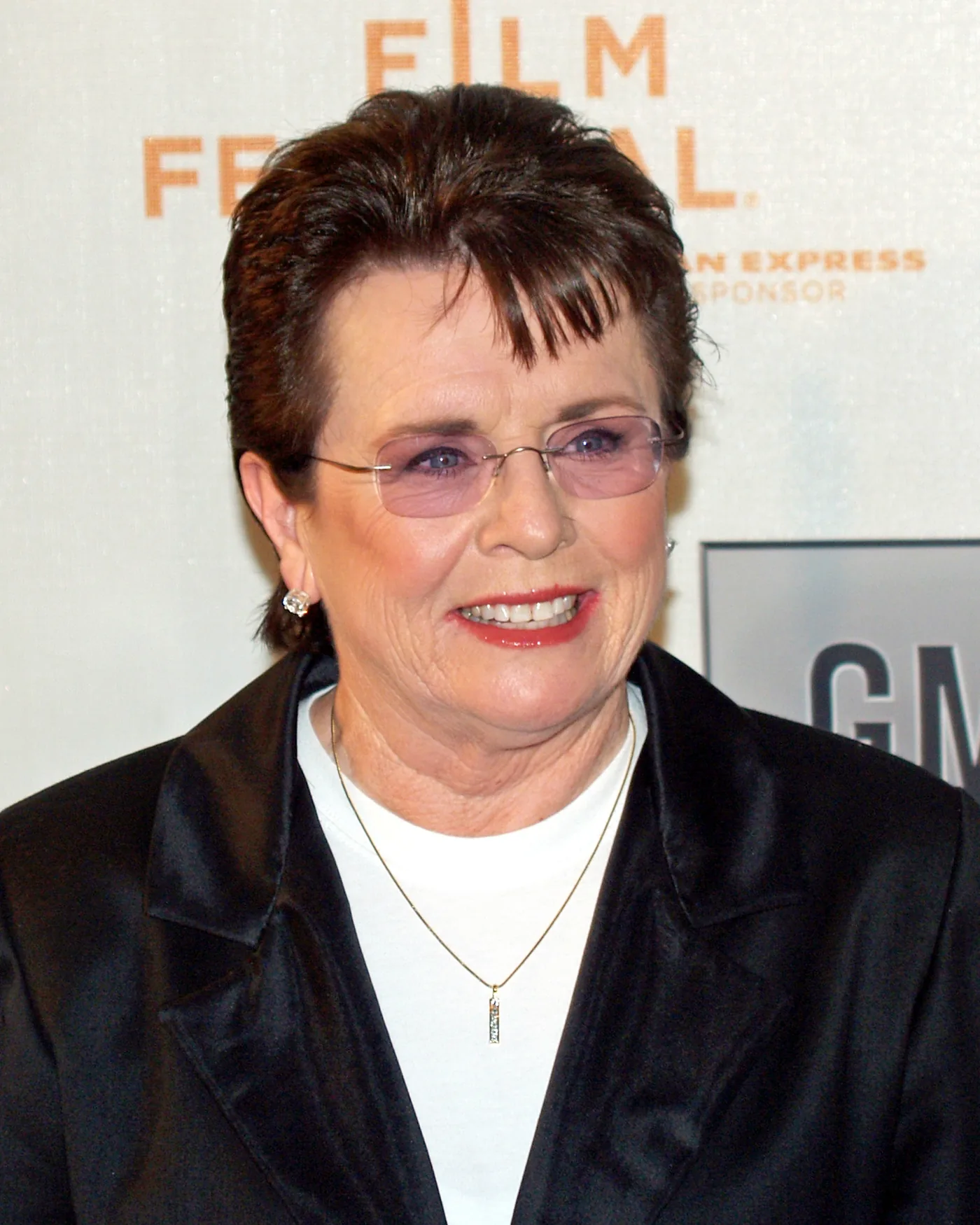
The US Open opened its Fan Week today at the USTA Billie Jean King National Tennis Center in Flushing Meadows, with the main draw starting on 30 August.4 It is the only tennis venue on earth named after a woman, and the woman is still alive to walk into it.
King won 39 Grand Slam titles: twelve in singles, sixteen in women's doubles, eleven in mixed. That is a career worth arguing about. It is also the smaller half of her record.
She appears in fourteen rankings here. Tennis accounts for barely half of them.
The rankings where Billie Jean King is unarguable are the ones that never mention a trophy.
Billie Jean King vs Steffi Graf: twelve majors against twenty-two
Start with the widest question inside her own sport, where the entry requirement is a trophy count and nothing else.
King's singles record is 129 tournament titles and world No. 1 in six of the ten years from 1966 to 1975.2 On the specific measure this ranking rewards, twelve singles majors is a modest number.
Steffi Graf has 22, and the only Golden Slam anybody has completed. Margaret Court has 24. Serena Williams has 23, Martina Navratilova 18, Chris Evert 18. Five women in the field cleared King's total, and two of them nearly doubled it.
The case for her here is the shape of the era rather than the size of the pile. Three of the four majors were played on grass when she started, the Australian Open was skipped by most of the field, and there was no professional tour to build a career on until she built one.
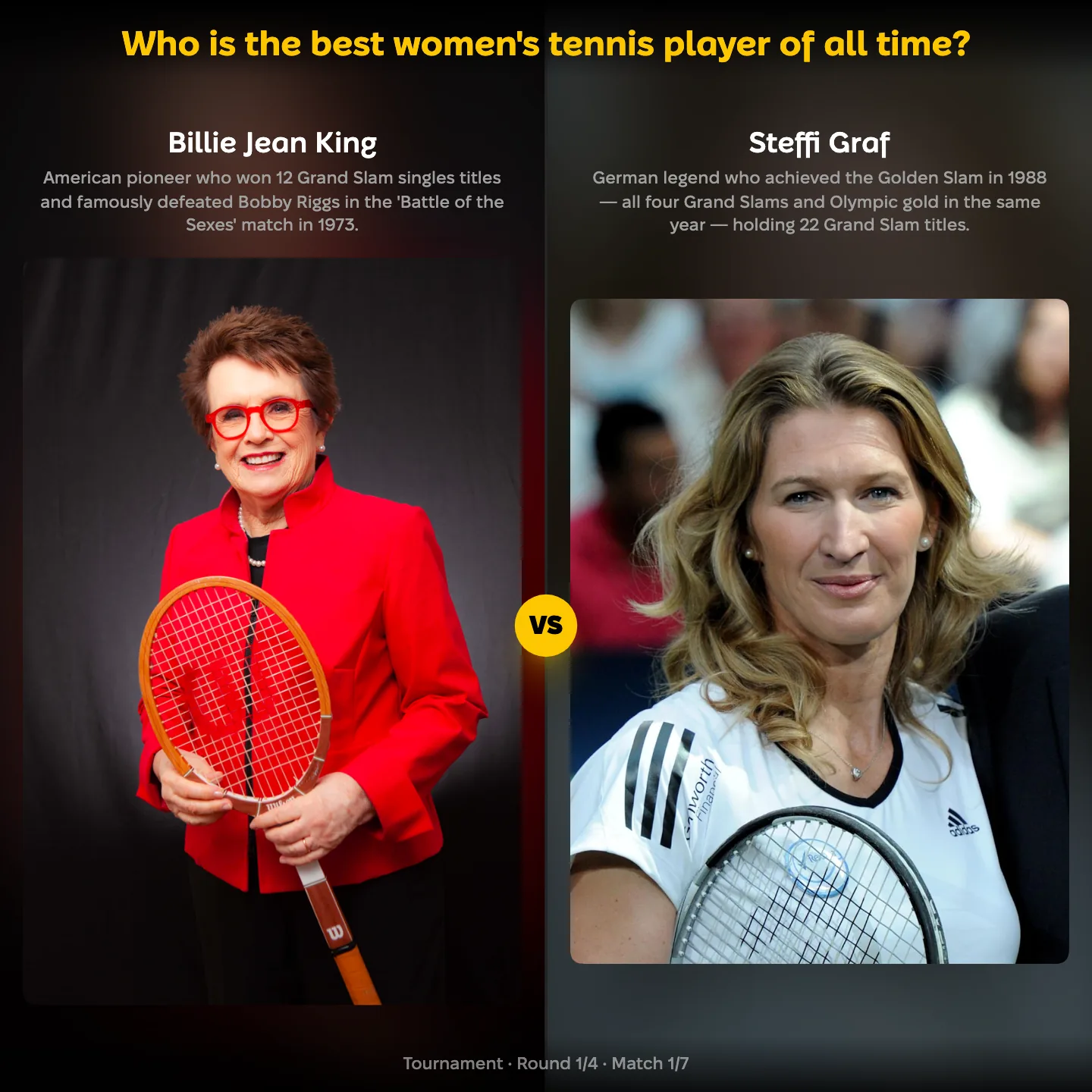
Jackie Joyner-Kersee, Nadia Comaneci, and a tennis player
Widen the field to every sport and the comparison stops being about majors, because nobody else in it plays for majors.
Jackie Joyner-Kersee holds the heptathlon world record and six Olympic medals across four Games. Nadia Comăneci was fourteen when a judge in Montreal awarded Olympic gymnastics its first perfect 10. Wilma Rudolph won three golds in Rome in 1960 after childhood polio.
King has no Olympic medal, because tennis was not an Olympic sport during her career. What she has instead is the tour those women's successors compete on for money.
Babe Didrikson Zaharias runs closest on that particular ground: Olympic track golds, ten major golf titles, and a co-founder of the LPGA in 1950. Two women in this field built a professional circuit for the ones who came after them, which is a different achievement from winning on one.
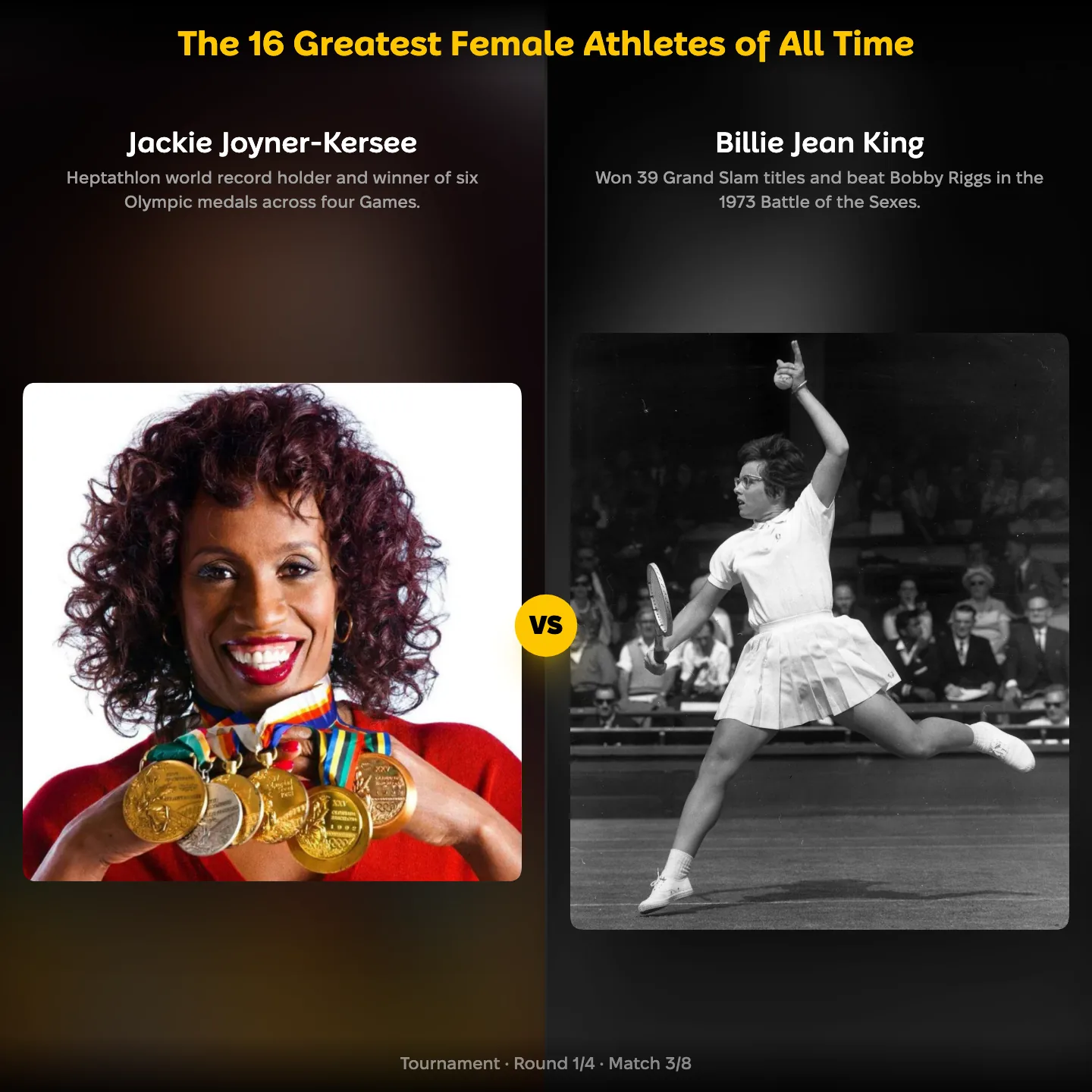
Twenty Wimbledon titles, a record she shares with Navratilova
Narrow the question to one tournament and King climbs to the top of the page.
She won twenty Wimbledon championships: six in singles, ten in women's doubles, four in mixed. Nobody has more. Martina Navratilova matched the twenty and nobody else has come close.1
Roger Federer holds the men's singles record with eight, which is the number this ranking's voters usually reach for first. Across all three events he stops at eight; the doubles half of a career is where the totals get large.
Serena Williams, Steffi Graf, Björn Borg, Pete Sampras and Venus Williams fill out a field of seventeen. On grass, in this specific building, King's case needs no era-adjustment at all.
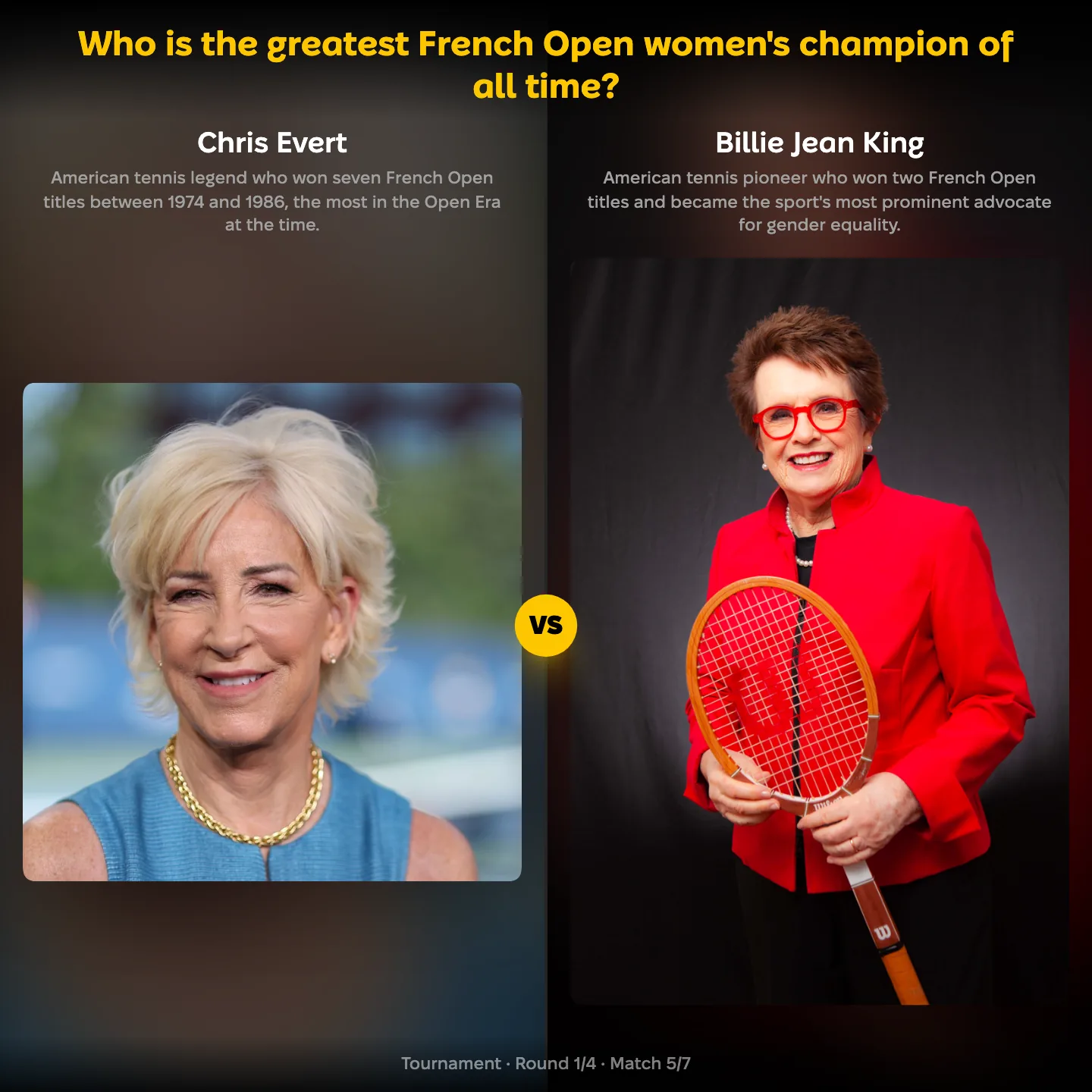
Chris Evert won seven French Opens. King won one
Move the same career to clay and it collapses.
King took the French Open singles title once, in 1972. Clay suited her attacking game least, and Roland-Garros is the only major where she has no depth of record to point at.
Chris Evert won seven, and built a 125-match clay-court winning streak while she was at it. Steffi Graf has six, Justine Henin four.
On a fourteen-name ballot of Roland-Garros champions, one title is the entry fee.
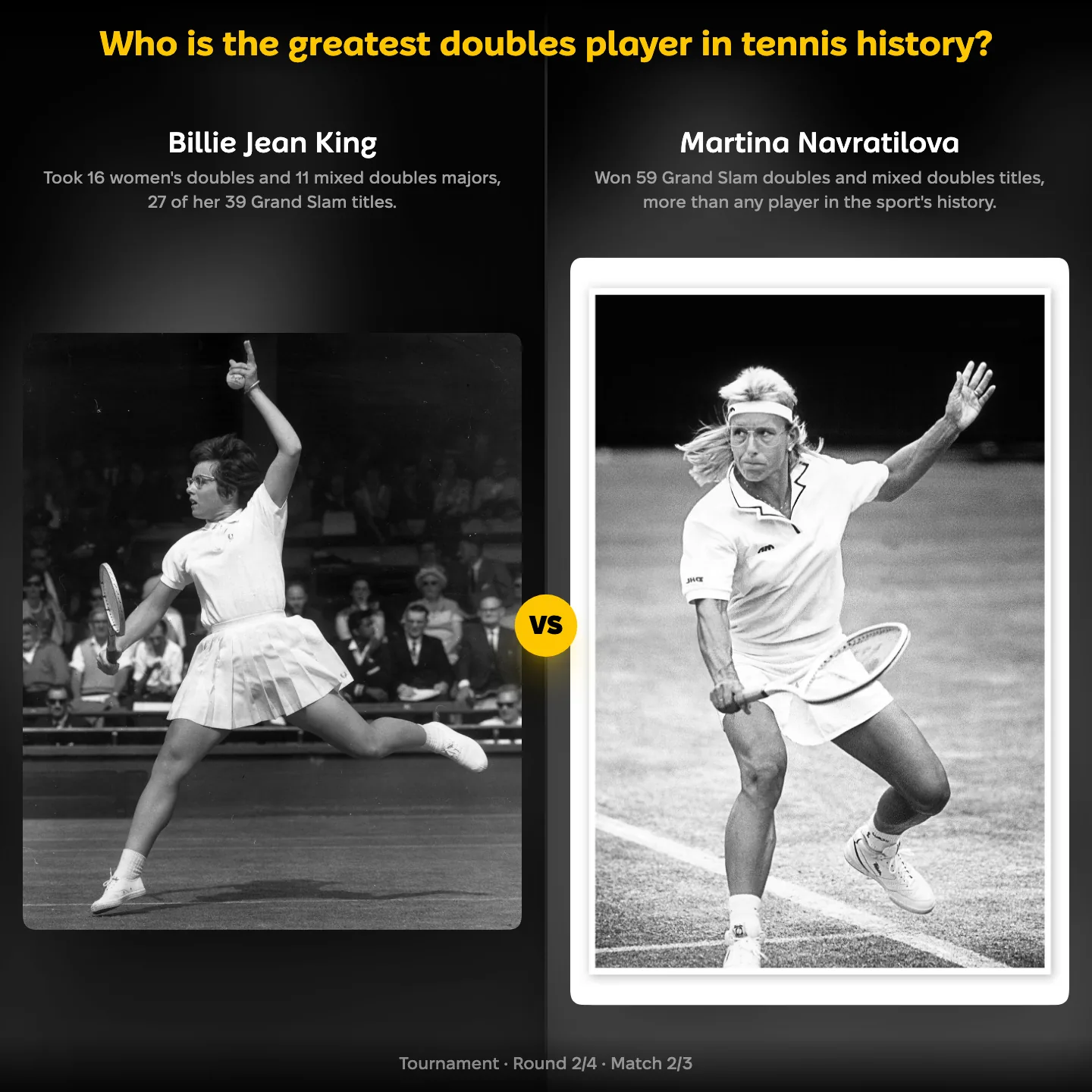
Martina Navratilova's 59 doubles majors, and King's 27
Twenty-seven of King's thirty-nine Grand Slam titles came with a partner on court.1 Every singles-only list in this article throws two-thirds of her record away.
Navratilova is the reason this is not simply King's ranking. She won 59 doubles and mixed doubles majors, more than any player in the sport's history, and took 20 of her women's doubles titles alongside Pam Shriver.
Shriver is on the ballot too, with 21, which is the detail that shows how the discipline works: a great doubles record is half a great partnership.
Margaret Court's 21 mixed doubles majors are the largest haul in that event. The Bryan brothers won 16 as a pair. Serena and Venus Williams went unbeaten in Grand Slam doubles finals together and won 14.
Pete Sampras and the death of serve-and-volley
Judge her on technique instead of trophies and the field changes again.
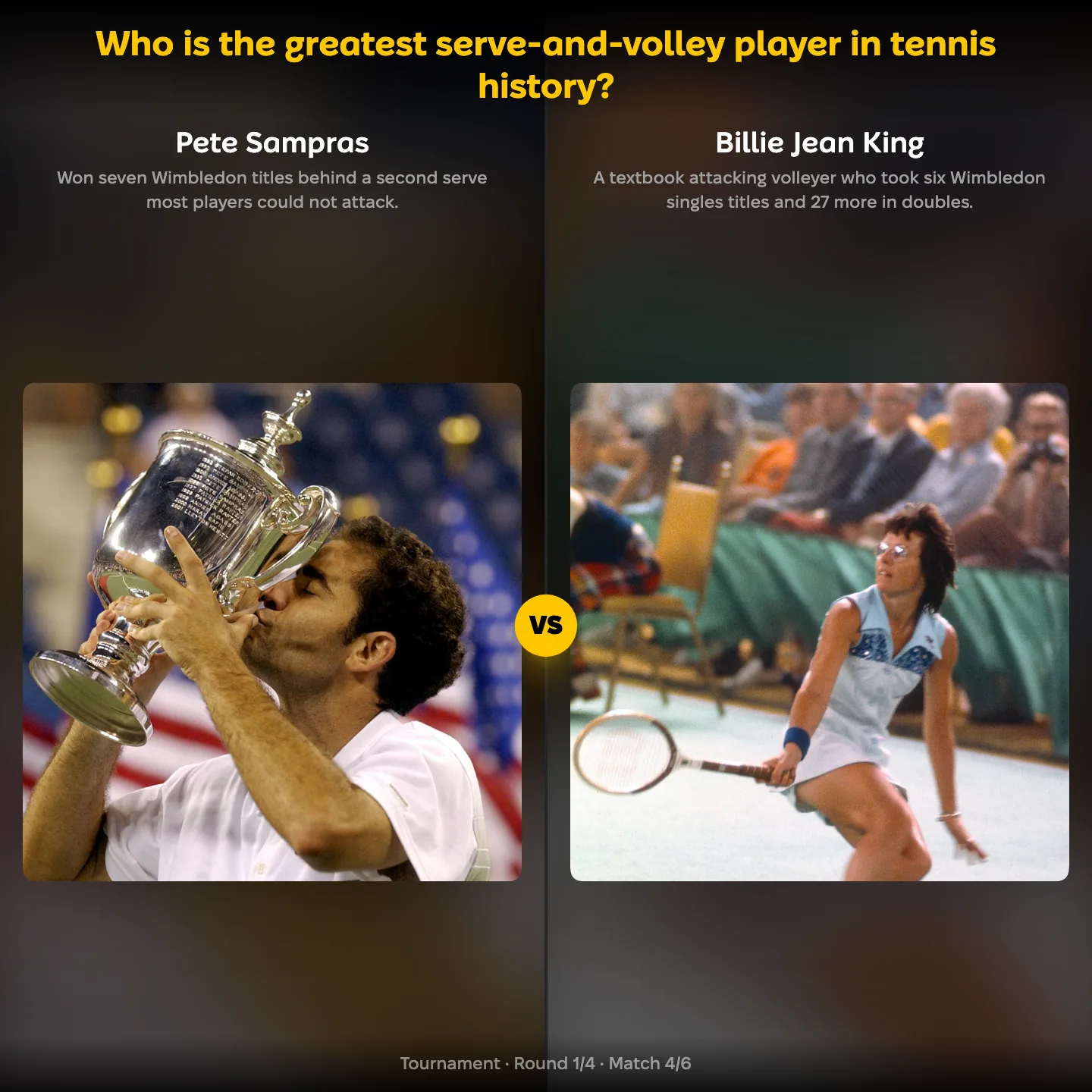
King played classic attacking tennis: serve, two steps forward, finish at the net. It is the style that built her six Wimbledon singles titles and it has almost disappeared from professional tennis, killed off by polyester strings and slower courts.
Pete Sampras is the name most voters reach for, with seven Wimbledon titles won behind a second serve nobody could attack. Stefan Edberg's volley technique is still the one coaches demonstrate.
John McEnroe had the softest hands of the era. Goran Ivanišević was the last man to win Wimbledon as an outright serve-and-volleyer, on a wild card in 2001, and nobody has done it since.
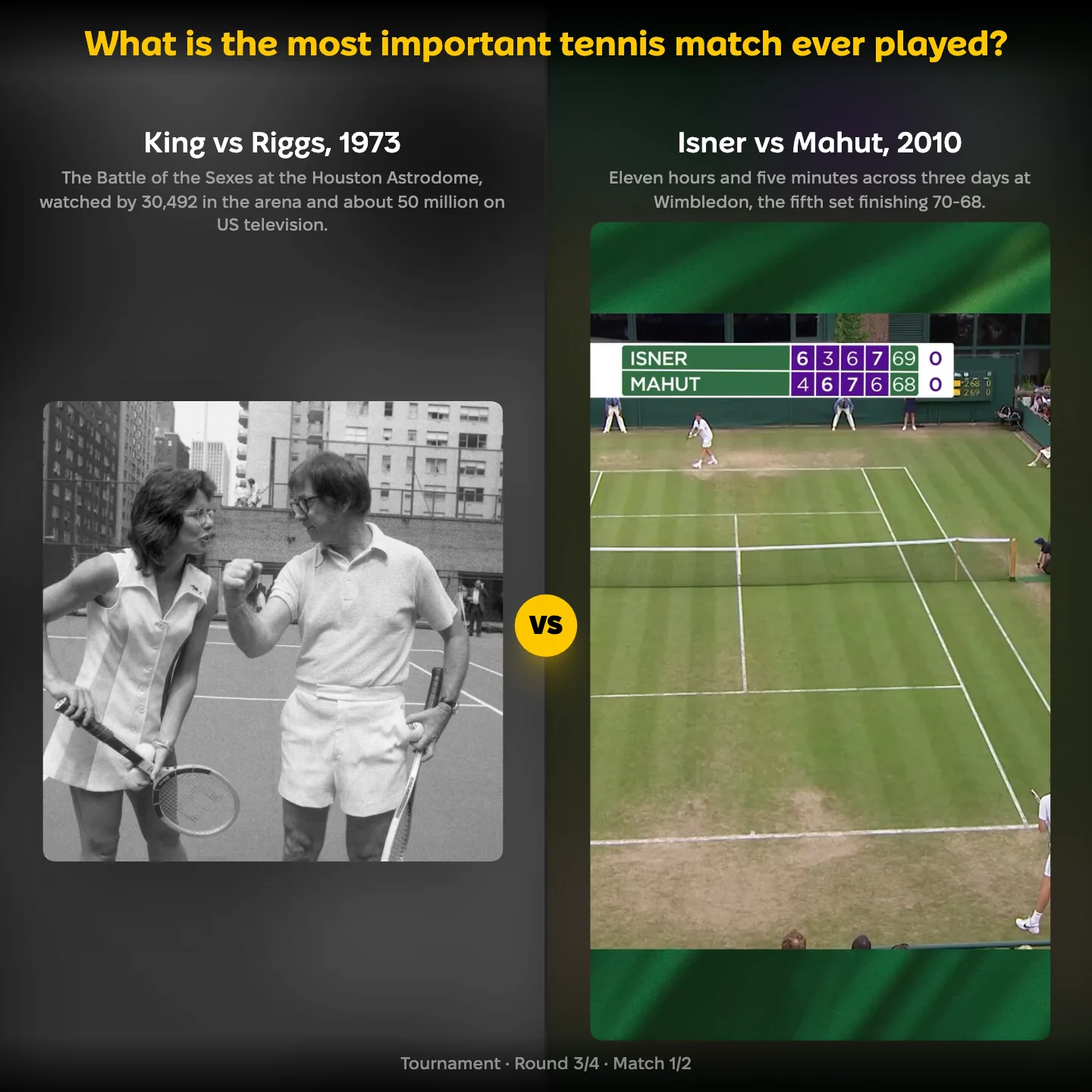
The Houston Astrodome, 20 September 1973
Everything she is famous for outside tennis hangs on this one afternoon, and the ranking asks about importance rather than quality.
King beat Bobby Riggs in straight sets, 6–4, 6–3, 6–3, for a $100,000 winner-take-all purse. There were 30,492 people in the Astrodome and about 50 million watching on American television.1 No tennis match before or since has had that audience.
The competition on this ballot is all sport and no spectacle. Isner against Mahut ran eleven hours and five minutes across three days at Wimbledon, the fifth set finishing 70–68. Borg and McEnroe played a fourth-set tie-break to 18–16 in the 1980 final. Federer and Nadal finished the 2008 final in near-darkness at 9–7.
Arthur Ashe's 1975 Wimbledon win is the one entry that competes on King's own ground: the tactical dismantling of Jimmy Connors was also the first Wimbledon singles title won by a Black man.
The counter-argument is that an exhibition should not outrank a final. It is a fair objection, and it is why the ranking says "important" instead of "best".
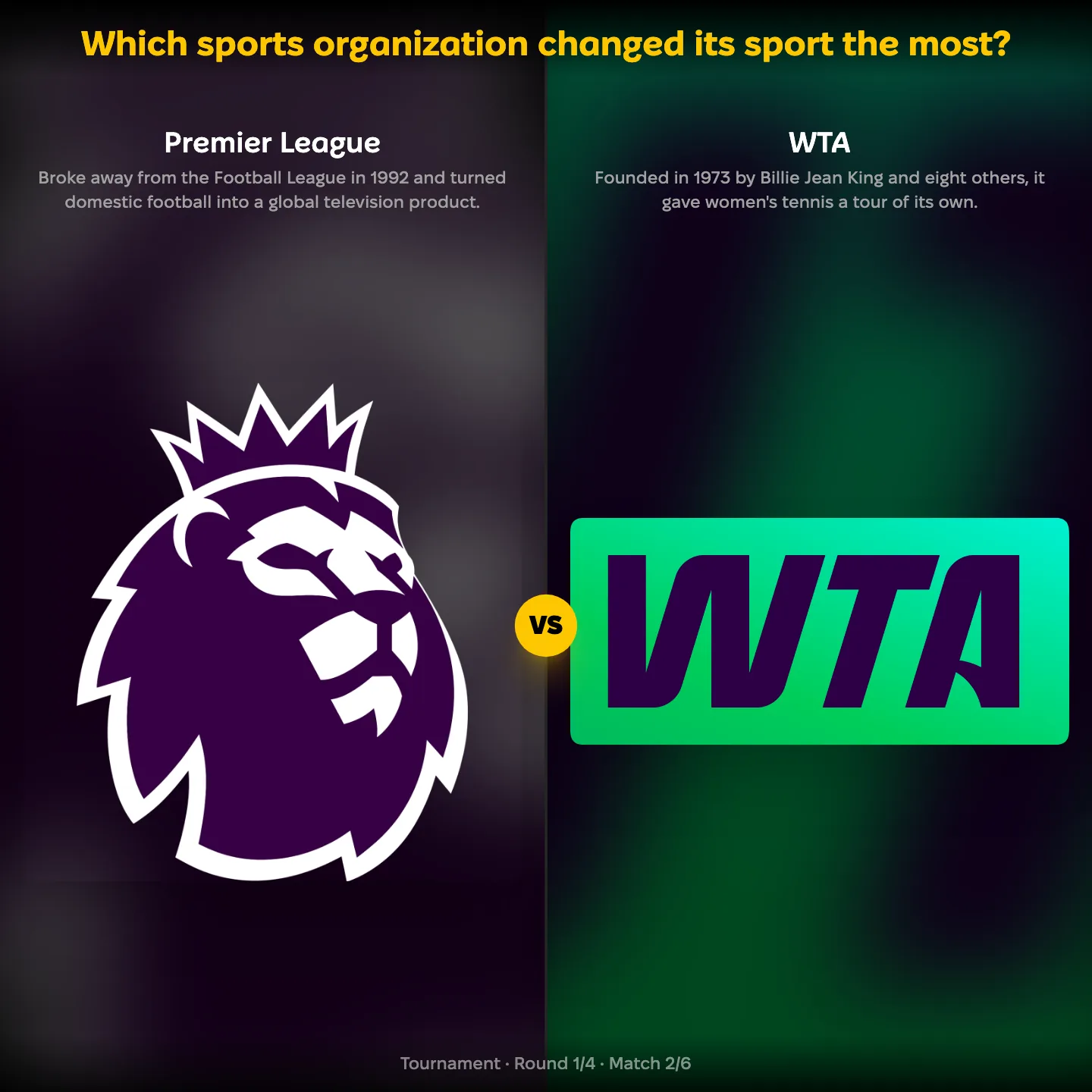
The WTA against the Premier League
Here King is not on the ballot. The thing she built is.
At the 1970 Pacific Southwest Open the men's purse was $12,500 and the women's was $1,500. King and eight other players refused to enter, signed $1 contracts with the publisher Gladys Heldman, and played a breakaway tournament in Houston instead. The Women's Tennis Association followed in 1973.2
The Original 9 are a separate option on the same ballot, which makes this the one ranking where King competes against herself twice over.
The field is otherwise enormous. The Premier League broke away from the Football League in 1992 and turned domestic football into a global television product. The UFC wrote unified rules for a sport that had none. The MLBPA won free agency and reset what every athlete in America could earn.
Against organisations with a hundred times the revenue, the WTA has a smaller claim and a stubborner one: half of tennis has a professional career because it exists.
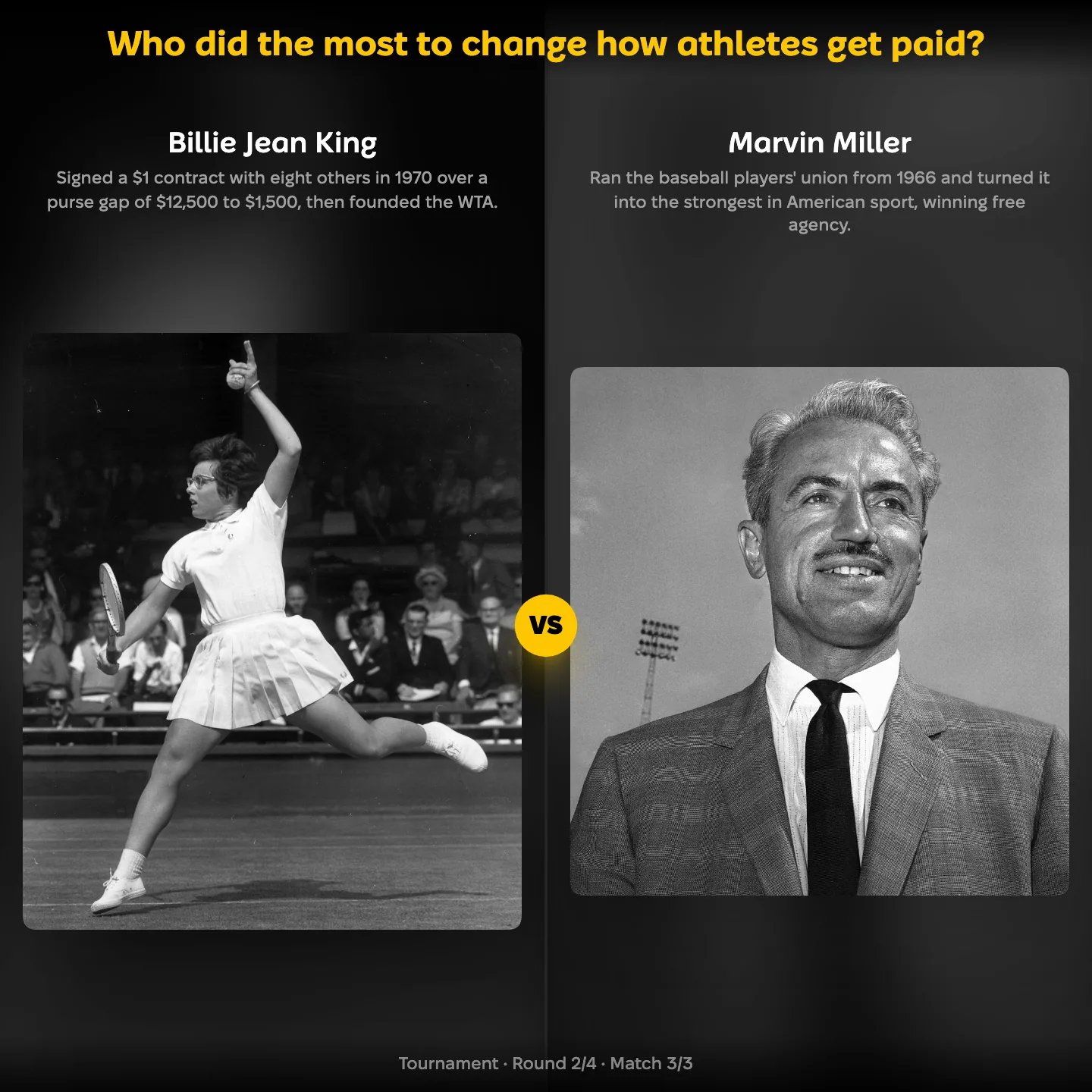
Marvin Miller, Curt Flood, and a contract worth one dollar
Sport's pay history is mostly lawyers, and King is the rare entry who was also the athlete.
Her contribution has a date attached. In 1973 the US Open handed its women's champion the same cheque as its men's, the first major to do it, after she said she would not enter otherwise.1 Wimbledon took until 2007 to follow.
Marvin Miller is the field's heaviest name. He ran the baseball players' union from 1966, won salary arbitration and free agency, and turned the weakest labour position in American sport into the strongest.
Curt Flood paid the higher price. He refused a trade in 1969, took baseball's reserve clause to the Supreme Court, lost, and never played again. Andy Messersmith played a season without a contract in 1975 and won the arbitration that finished the clause for good.
Jean-Marc Bosman's 1995 case let footballers leave for nothing at contract's end, and Ed O'Bannon's suit over his own likeness began the chain that ended NCAA amateurism.
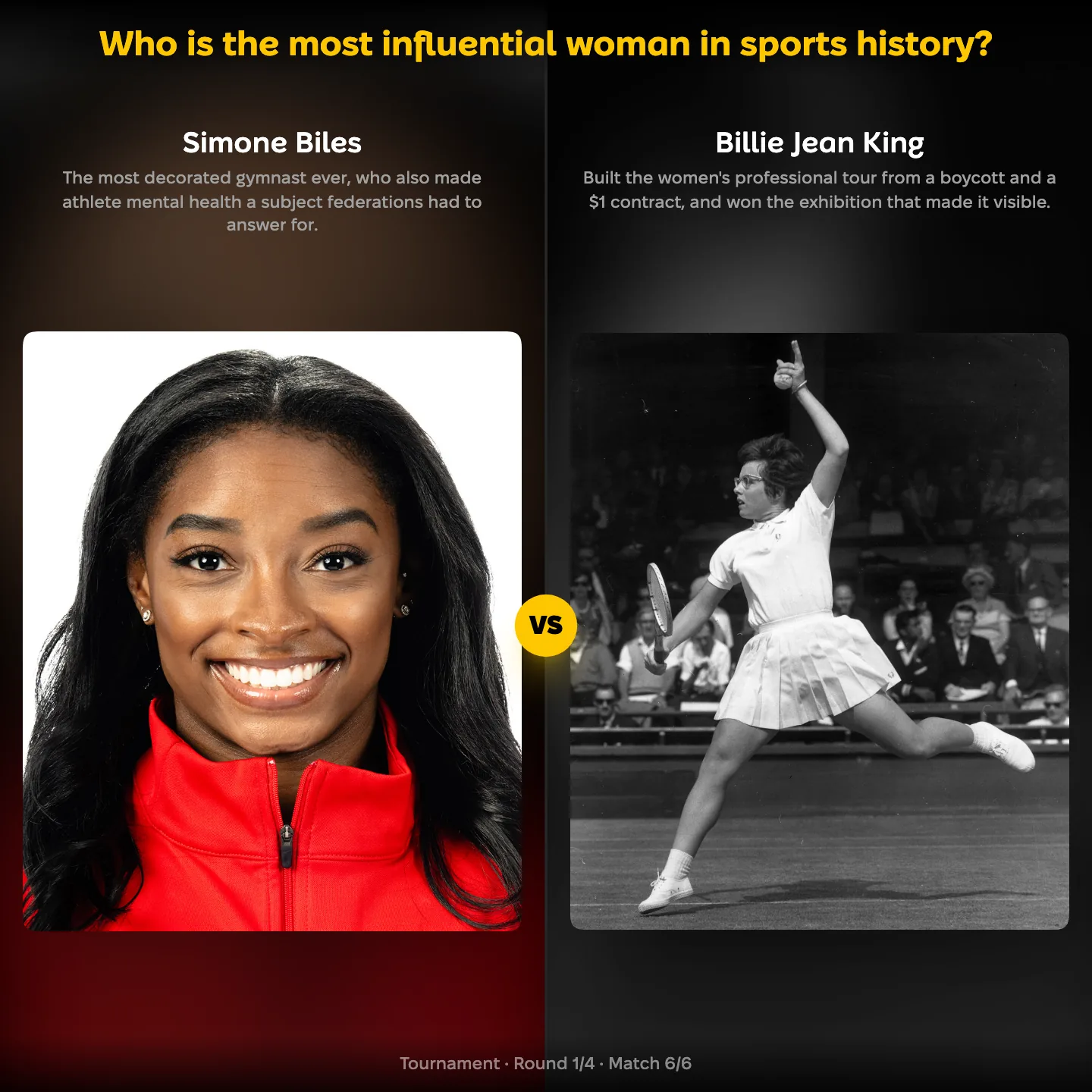
Simone Biles, Wilma Rudolph, and the first $100,000 season
Restrict the question to influence and King's case sharpens.
In 1971 she became the first woman in any sport to earn six figures in a season, and in 1972 the first woman named Sports Illustrated's Sportsperson of the Year.1 Both firsts were arguments about money disguised as awards.
Simone Biles is the strongest modern claim. The most decorated gymnast in history also made athlete mental health something federations had to answer for, and testified to the US Senate about the abuse she and her teammates suffered.
Megan Rapinoe led the US women's team's equal-pay case against its own federation to a $24m settlement in 2022, which is the same fight King started fifty years earlier and did not finish.
Venus Williams argued the case that finally moved Wimbledon and Roland-Garros to equal prize money in 2007. Kathrine Switzer ran Boston in 1967 while an official tried to drag her off the course.
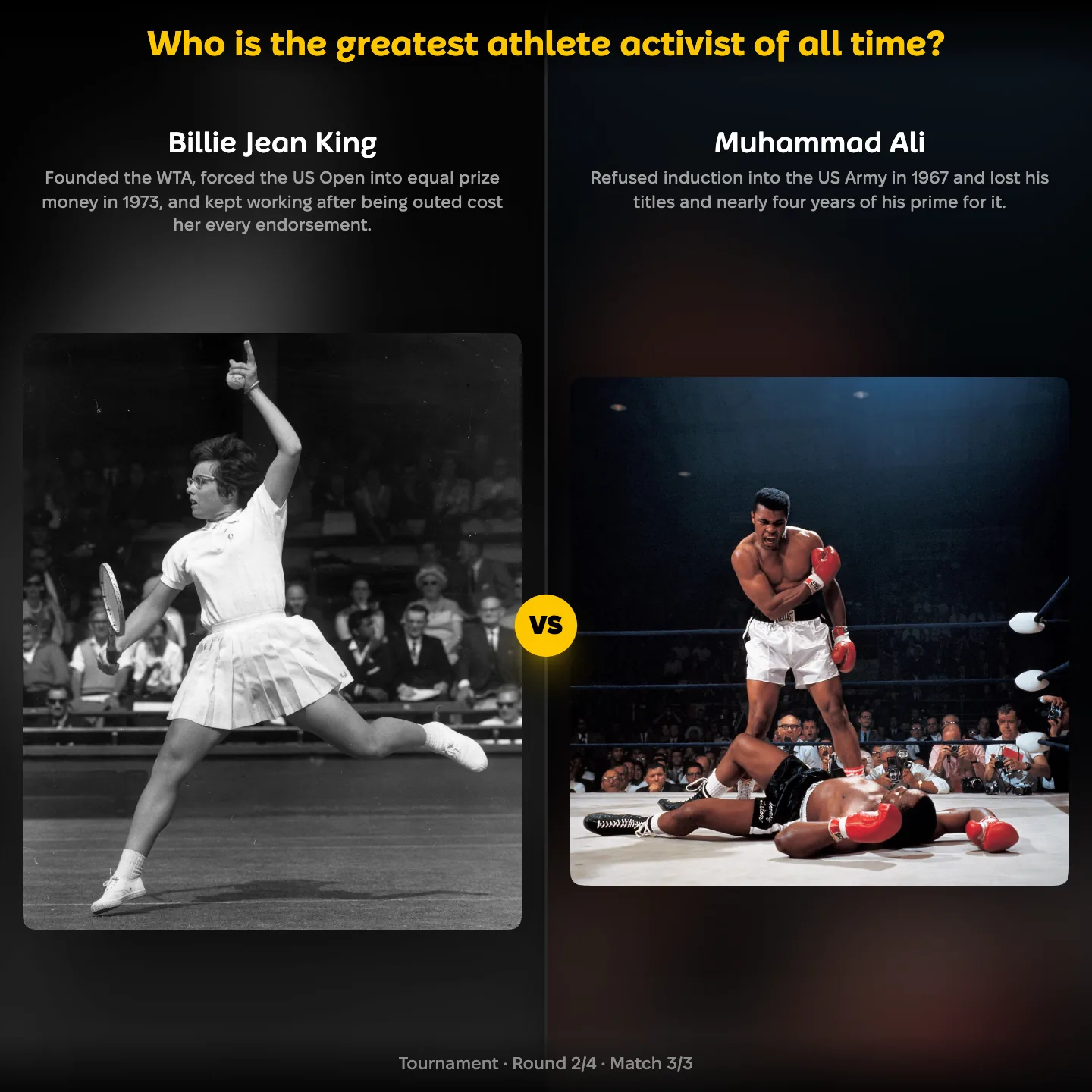
Muhammad Ali gave up four years. King lost her endorsements in a day
Open the field to every athlete who took a public position and the price becomes the measure.
Muhammad Ali would not be drafted in 1967, and it cost him his titles and nearly four years of his prime. Colin Kaepernick knelt during the anthem in 2016 and has not played an NFL game since. Tommie Smith raised a gloved fist in Mexico City in 1968 and was expelled from the Games.
King's cost arrived in 1981, and she did not choose the timing. A palimony suit filed by a former assistant made her the first prominent active sportswoman publicly identified as gay, and she lost every endorsement contract she had inside 24 hours, an estimated $2m.3 She was 37, and postponed retiring because she needed the prize money.
Martina Navratilova came out by choice the same year and campaigned on it for four decades. Jackie Robinson broke baseball's colour line in 1947 and spent the rest of his life on civil rights.
Arthur Ashe belongs in the same paragraph as King for a different reason: he was arrested protesting apartheid, and spent his last year on AIDS awareness after a transfusion infected him.
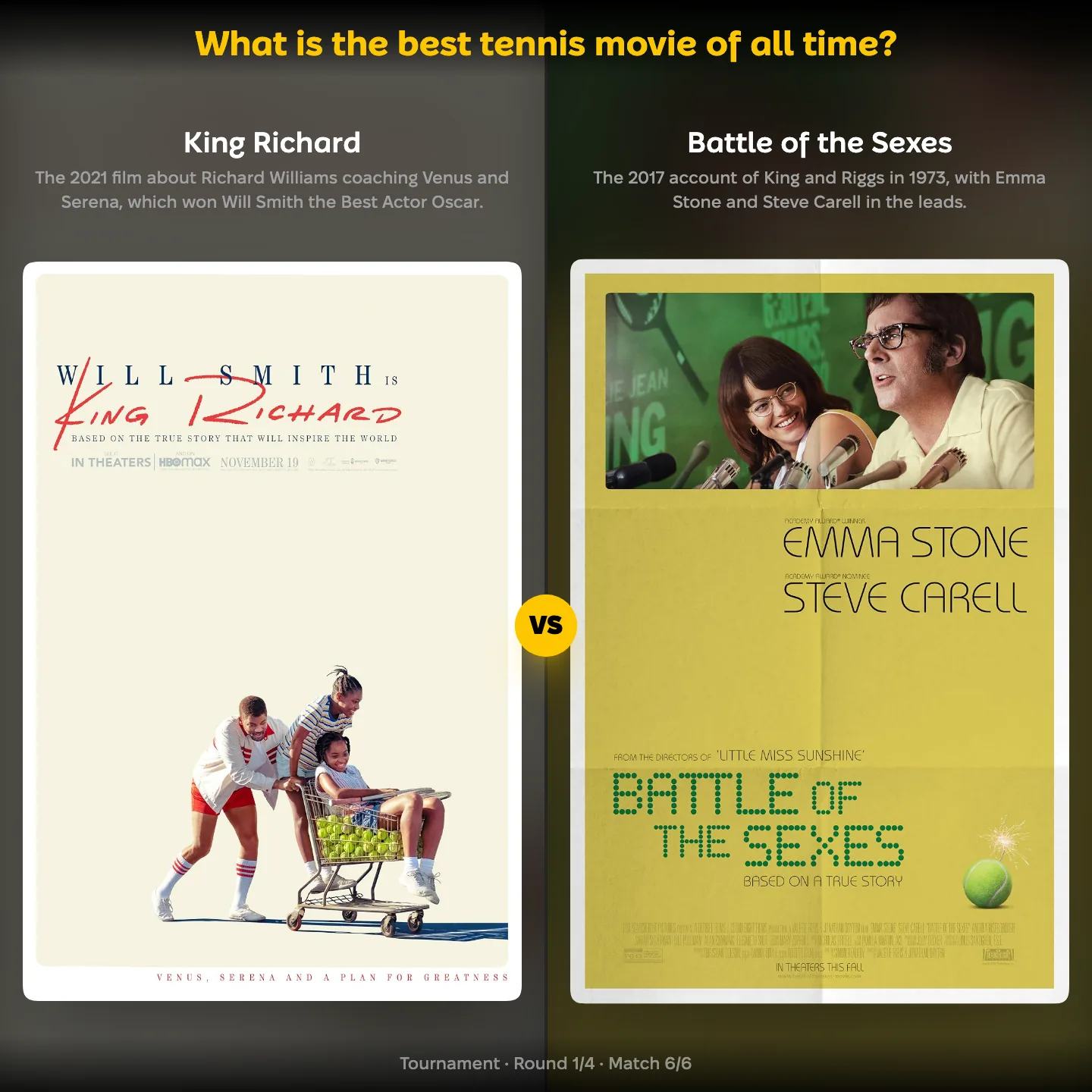
Battle of the Sexes vs King Richard: the same sport on screen
On this ballot King is not a player. She is a 2017 film with Emma Stone in the lead and Steve Carell as Riggs.
The film has the harder job of the two front-runners, because everyone already knows the score. It plays the Astrodome as farce and King's private life as the real plot, which is a defensible reading of 1973 and a strange one to sell as a sports movie.
King Richard is the competition, and it won Will Smith the Best Actor Oscar for playing Richard Williams rather than either of his daughters. Both films solve the same problem the same way: put the tennis in the background.
The other entries are odder than the leaders. Hitchcock's Strangers on a Train has a tennis player for a protagonist. Challengers scored a love triangle with Reznor and Ross. Pat and Mike put Katharine Hepburn on court in 1952 with Gussie Moran playing herself.
Bobby Riggs was 55. That is the case against the match
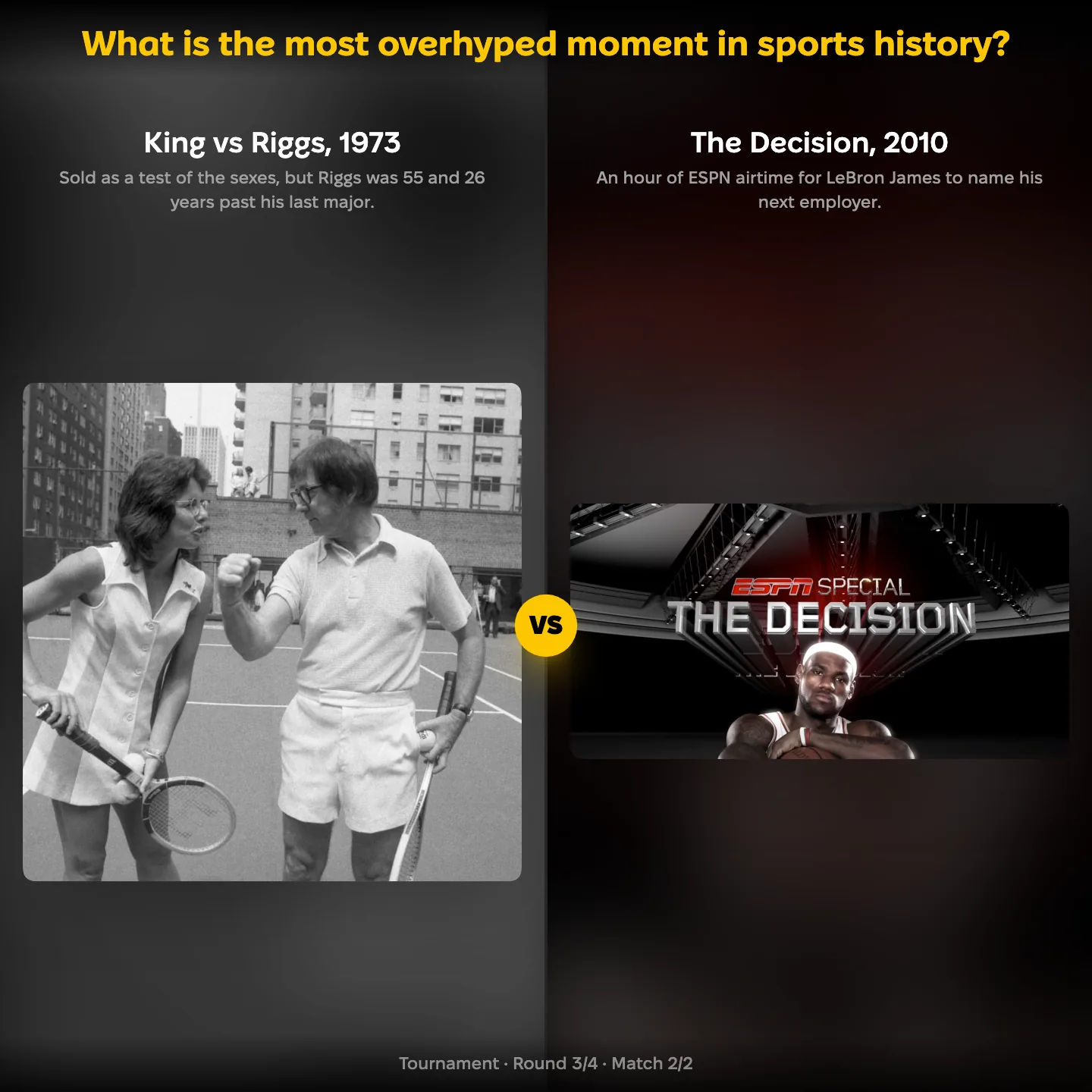
The unflattering ranking is the one that takes her most famous afternoon and treats it as a sales job.
The facts support the charge. Riggs was 55 years old and 26 years past his last major title; King was 29 and the best woman in the world.2 A hustler who had spent months talking his way onto television got the match he wanted, and the winner-take-all purse went to the favourite.
Margaret Court's defeat four months earlier is the reason it happened. Riggs beat her 6–2, 6–1 in May 1973, and that scoreline is what made a second match a national event.
The field around it is generous company for a bad idea. Ali fought a professional wrestler to a draw in Tokyo in 1976. Mayweather sold 4.3 million pay-per-views to box a mixed martial artist. Jake Paul fought a 58-year-old Mike Tyson on Netflix.
The defence is that nobody watching in 1973 was measuring athletic quality, and 50 million people did not tune in for a well-struck backhand. The match was a referendum with rackets, and it worked because she won it.
The WTA or the Astrodome: her own list, ranked
The last ranking turns the question inward and makes her chapters compete with each other.
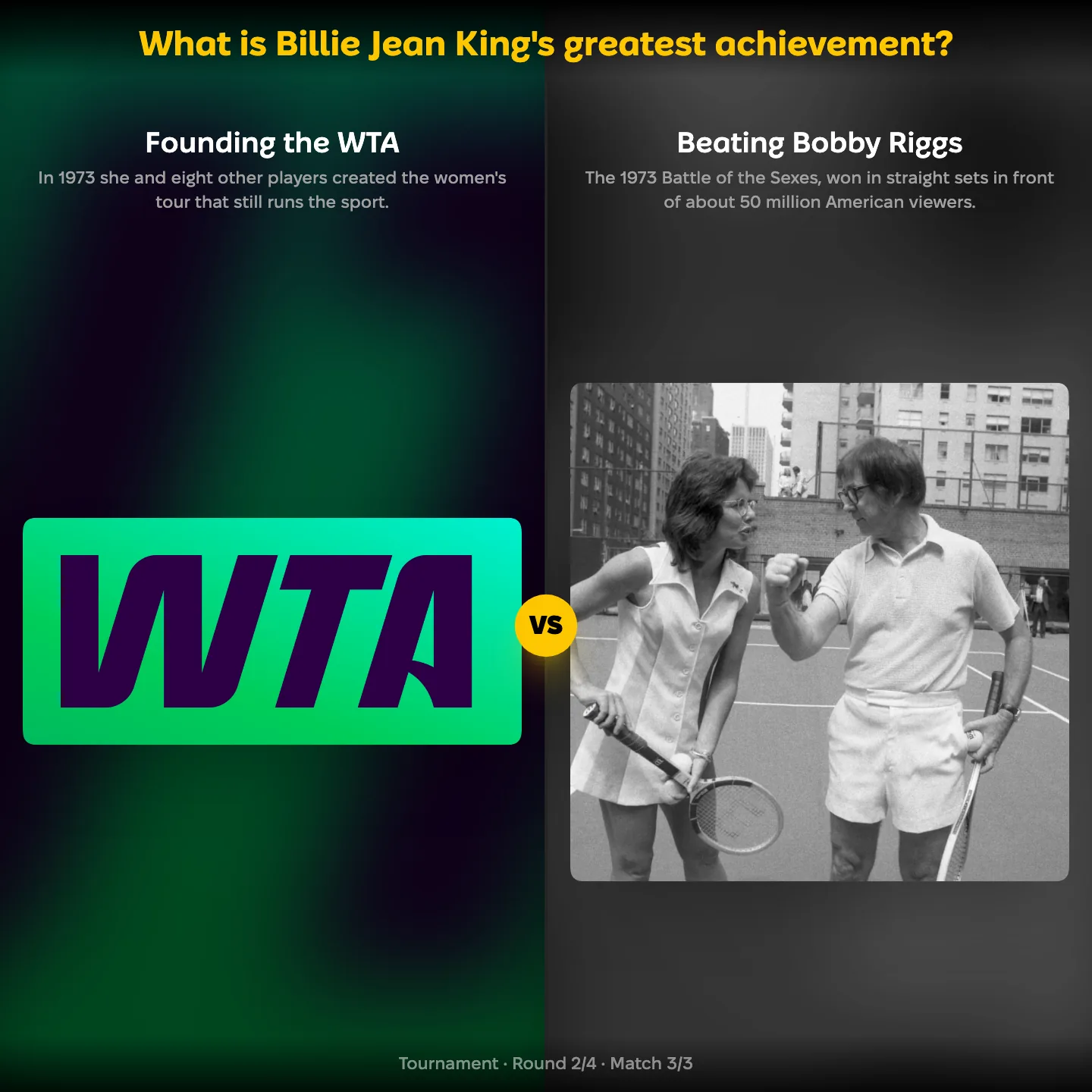
The tour is the answer she gives herself, and the paperwork backs her up. The Fed Cup became the Billie Jean King Cup in 2020, and the national tennis centre in Flushing Meadows took her name in 2006, the first major American sports venue named after a woman.2
The decorations are on the ballot too. She received the Presidential Medal of Freedom in 2009, the first female athlete to be given it, and a Congressional Gold Medal in 2024.1
Twenty Wimbledon titles and thirty-nine majors are the entries a pure tennis reading would put first, and they are the ones her own answer keeps pushing down the page.
Then there is 1981, which is on the list as an achievement rather than a misfortune: she lost everything commercial she had and kept organising anyway.
Fourteen rankings, and the tennis is the easy part
Twelve singles majors put her mid-field among the great champions and nowhere near the top of clay. Twenty Wimbledon titles and a tour built out of a boycott put her somewhere else entirely. The gap between those two readings is the whole of her career, and no single list holds both.
Each of these questions gets decided by comparing two names at once, and that is how you find out which version of a person you believe in.
Take the question that interests you and see whether she survives it. Or write the one nobody here thought to ask.
More rankings, more angles
- Serena Williams Won 23 Majors. The Lists Still Can't Place Her — 23 majors and no agreement on where they rank
- Martina Navratilova vs Chris Evert: 80 Matches, 60 of Them Finals — eighteen majors each, and no tiebreaker
- Federer vs Nadal vs Djokovic — 16 Lists That Split Them — three men, twenty majors each, no consensus
- Andre Agassi Skipped Wimbledon Three Years, Then Won It — skipped Wimbledon three years, then won it
Sources
- International Tennis Hall of Fame — King's 39 major titles and their breakdown, her 20 Wimbledon championships, the 1973 Battle of the Sexes scoreline, purse, attendance and television audience, the 1973 US Open's move to equal prize money, her 1971 $100,000 season, the 1972 Sports Illustrated award, the 2009 Presidential Medal of Freedom and the 1999 Arthur Ashe Courage Award: tennisfame.com (checked 2026-08-23)
- Wikipedia — King's 129 career singles titles and six years at world No. 1, the 1970 Pacific Southwest Open purse gap and the $1 contracts that followed, Margaret Court's 6–2, 6–1 loss to Riggs in May 1973, the ages of both players in September 1973, the 2006 naming of the USTA National Tennis Center, the 2020 renaming of the Fed Cup and the 2024 Congressional Gold Medal: en.wikipedia.org (checked 2026-08-23)
- Tennis Majors — the April 1981 palimony suit, King being publicly identified as gay, and the loss of every endorsement within 24 hours: tennismajors.com (checked 2026-08-23)
- Tennis Majors — the 2026 US Open calendar: Fan Week from 23 August, qualifying 24–28 August, main draw from 30 August, finals on 12 and 13 September at the USTA Billie Jean King National Tennis Center: tennismajors.com (checked 2026-08-23)
- Wikimedia Commons — the hero photograph, "Billie Jean King TFF 2007" by David Shankbone, licensed CC BY 3.0: commons.wikimedia.org (checked 2026-08-23)
