
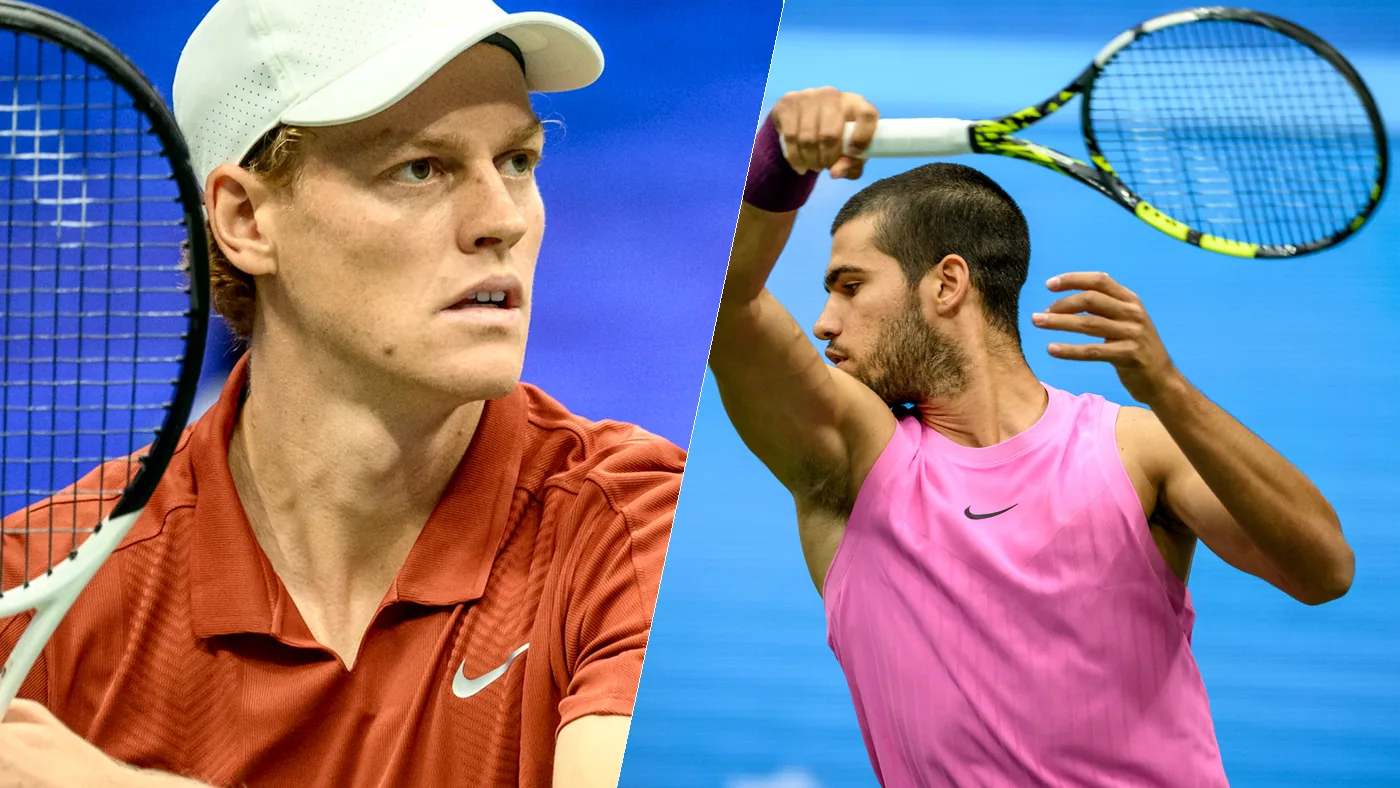
Jannik Sinner and Carlos Alcaraz have played each other seventeen times, and Alcaraz leads 10–7.1 Alcaraz has not hit a competitive ball since he hurt his right wrist in Barcelona on 15 April, and he withdrew from Roland Garros and Wimbledon.3 Sinner won a second Wimbledon title in his absence. The US Open, which Alcaraz took off Sinner last September, begins in New York at the end of this month.
So the New York fortnight is the first time since April that both men will be in the same draw. Fourteen rankings on this site contain one or both of them.
Put Sinner and Alcaraz on grass and one name holds up; move them to clay and the other does. The court under the question decides more than the ranking does.
Sixteen names, and they are the newest two
The all-time list is the one place in this article where both men are the newcomers.
Alcaraz has seven major titles. Sinner has five.1
Novak Djokovic has twenty-four. Bjorn Borg stopped playing at twenty-six and still turns up in this company four decades on, which is a kind of standing neither of these two has had the years to build.
That distance is the honest starting point for everything below, and it is the only section here where the two of them are the small names.
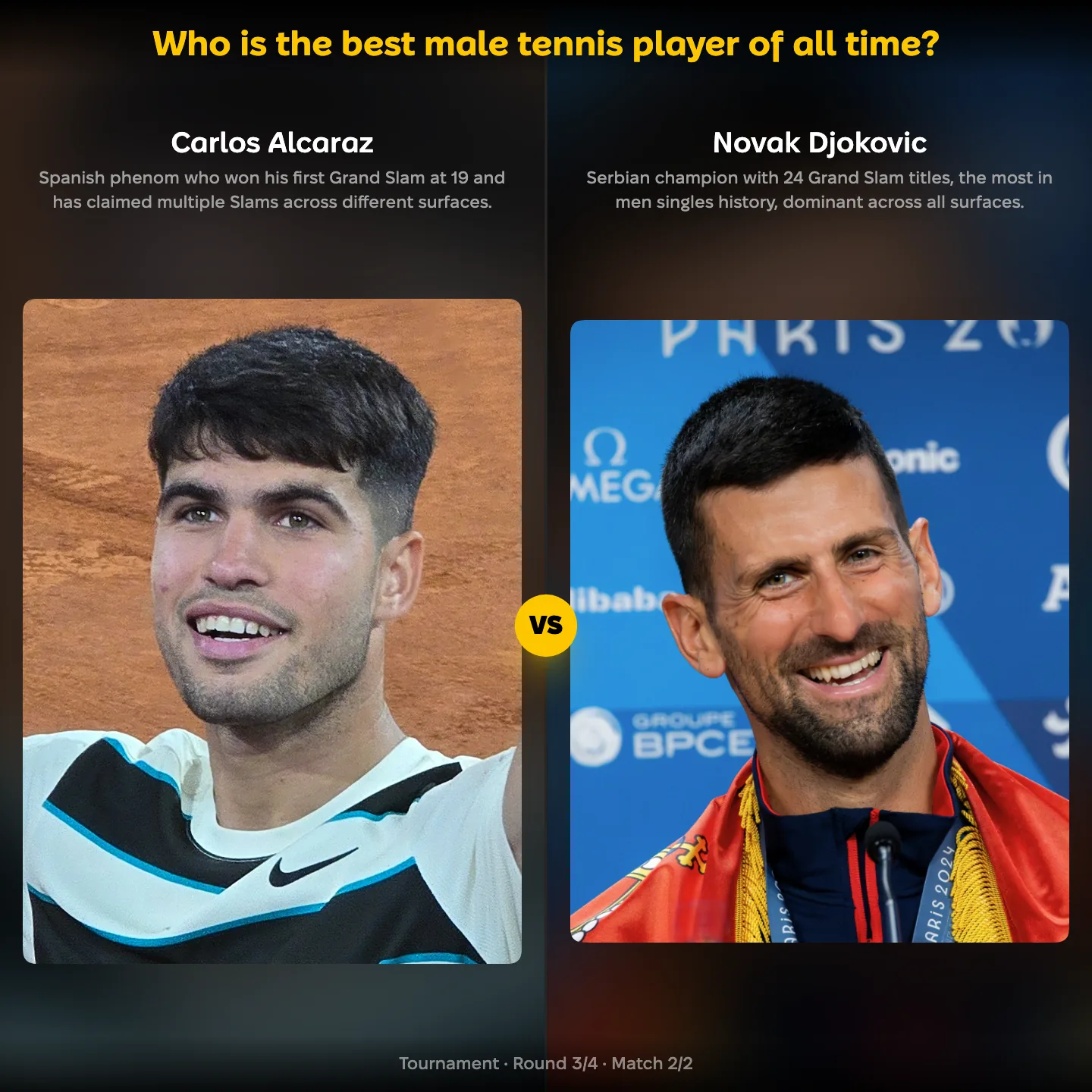
Sinner vs Alcaraz: the ranking and the eye test
Narrow the question to today and the field empties out fast. This one is really about two players.
The ATP computer is not ambiguous. Sinner has held the No. 1 ranking since 13 April,2 and he leads the list with 13,450 points to Alcaraz's 8,160.4 Across their careers that is 81 weeks at the top against Alcaraz's 66.
The gap is not a verdict on anyone's tennis. Ranking points come from tournaments played, and Alcaraz has spent a third of the season in a wrist brace.
Djokovic, Alexander Zverev and Daniil Medvedev are all on this list. None of them has been a serious answer to the question since 2023.

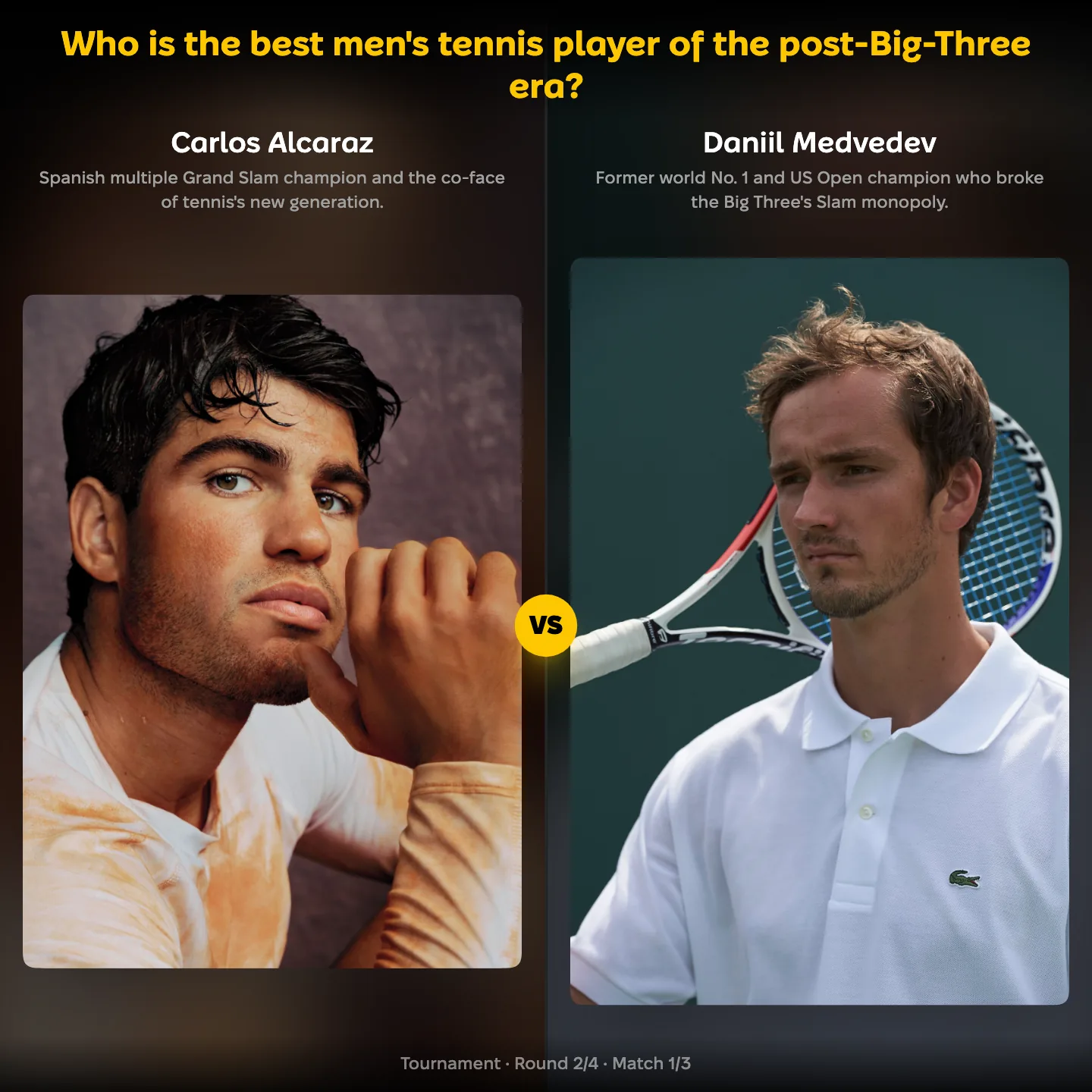
The era Daniil Medvedev was supposed to get
Every generation of men's tennis after Federer, Nadal and Djokovic was described as the next one for about five years before anyone actually took the game. This ranking asks who finally did.
Medvedev arrived first. He beat Djokovic in a US Open final, reached the top of the rankings, and then watched two younger players close the door behind them.
Sinner's path in was strange. He was a national giant-slalom champion at seven and skied competitively until he was thirteen, which is late to start a tennis career.2 Alcaraz took the conventional Spanish path and was in a major final at nineteen.
Dominic Thiem and Zverev also appear here. Each was the designated heir at some point, and neither answer aged well.
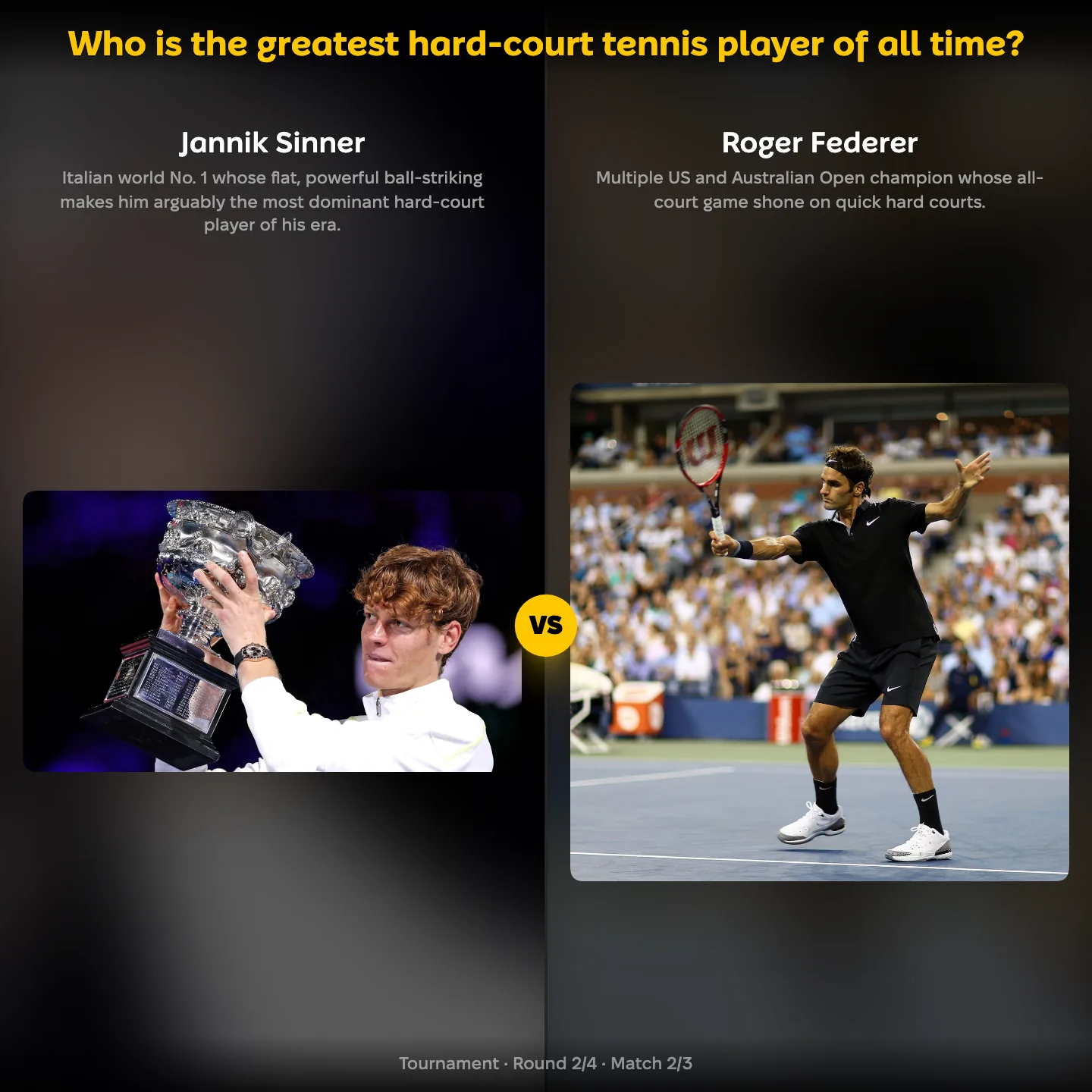
Hard courts still belong to Roger Federer
Hard courts host two of the four majors, which makes this the surface that decides most careers. It is also the surface where Sinner and Alcaraz have met most often.
Alcaraz leads that particular sub-total 7–3.1 Sinner's flat, early ball-striking is built for exactly these courts, and he has still lost the majority of their hard-court meetings.
Federer, Djokovic, Pete Sampras, Andre Agassi and Ivan Lendl are all here, and between them they hold most of the hard-court majors ever played.
The case for either of the current two is a case about the next decade. Nothing on this surface gets settled by a player still in his twenties.
Flushing Meadows has crowned both of them
The US Open is the tournament this article walks into, and it is the one major where both men already have their names on the trophy.
Alcaraz won it first, at nineteen, and again last September against Sinner. Sinner won it in between, becoming the first Italian man to do so.
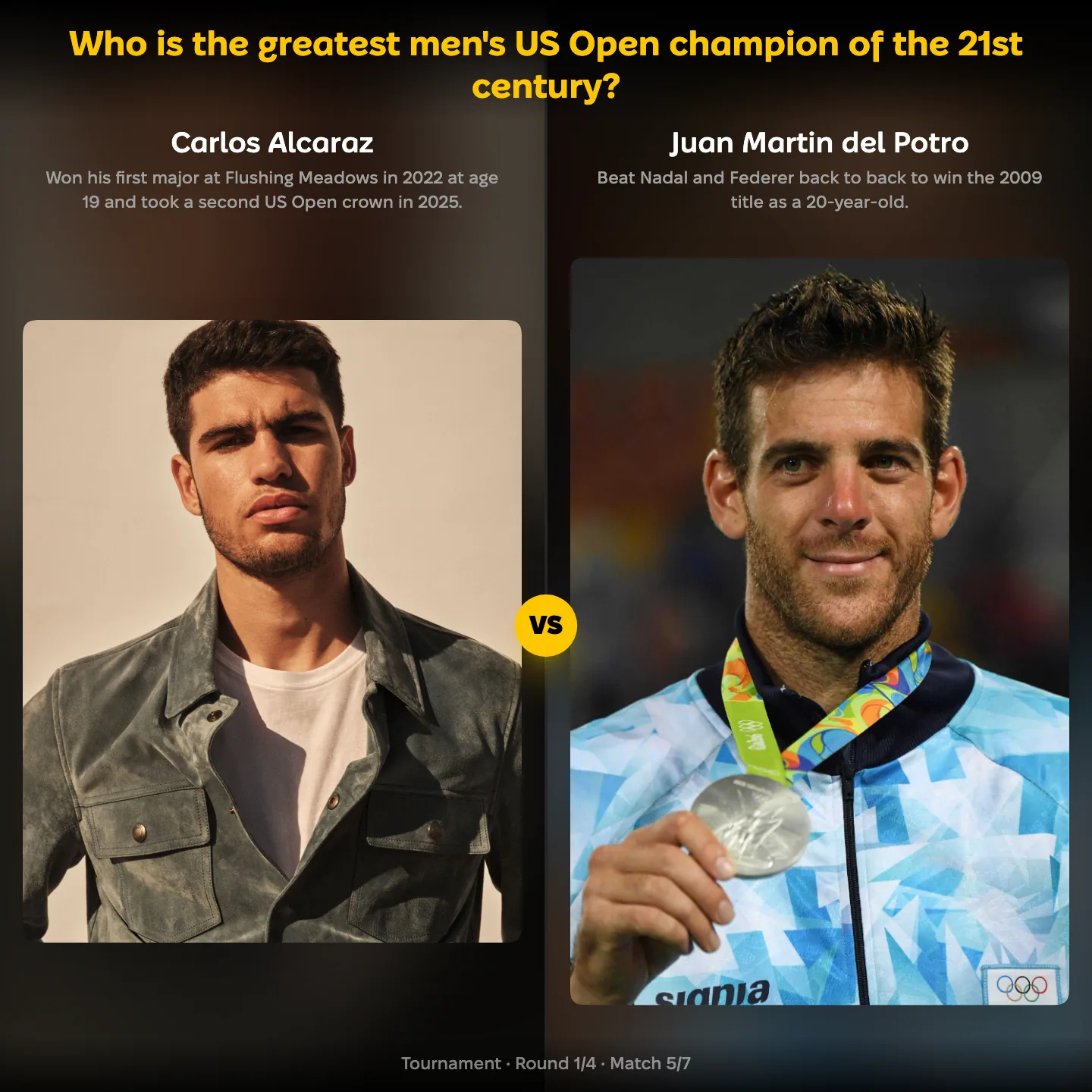
Juan Martín del Potro keeps this ranking from being a list of the same four names. He won in New York once, beat the two best players in the world back to back to do it, and injuries took the rest.
Federer and Djokovic still dominate the century here, and Andy Murray, Marat Safin and Lleyton Hewitt all have a claim. Three titles between Sinner and Alcaraz is a good start and not much more than that.
Roland Garros and Wimbledon, five weeks apart
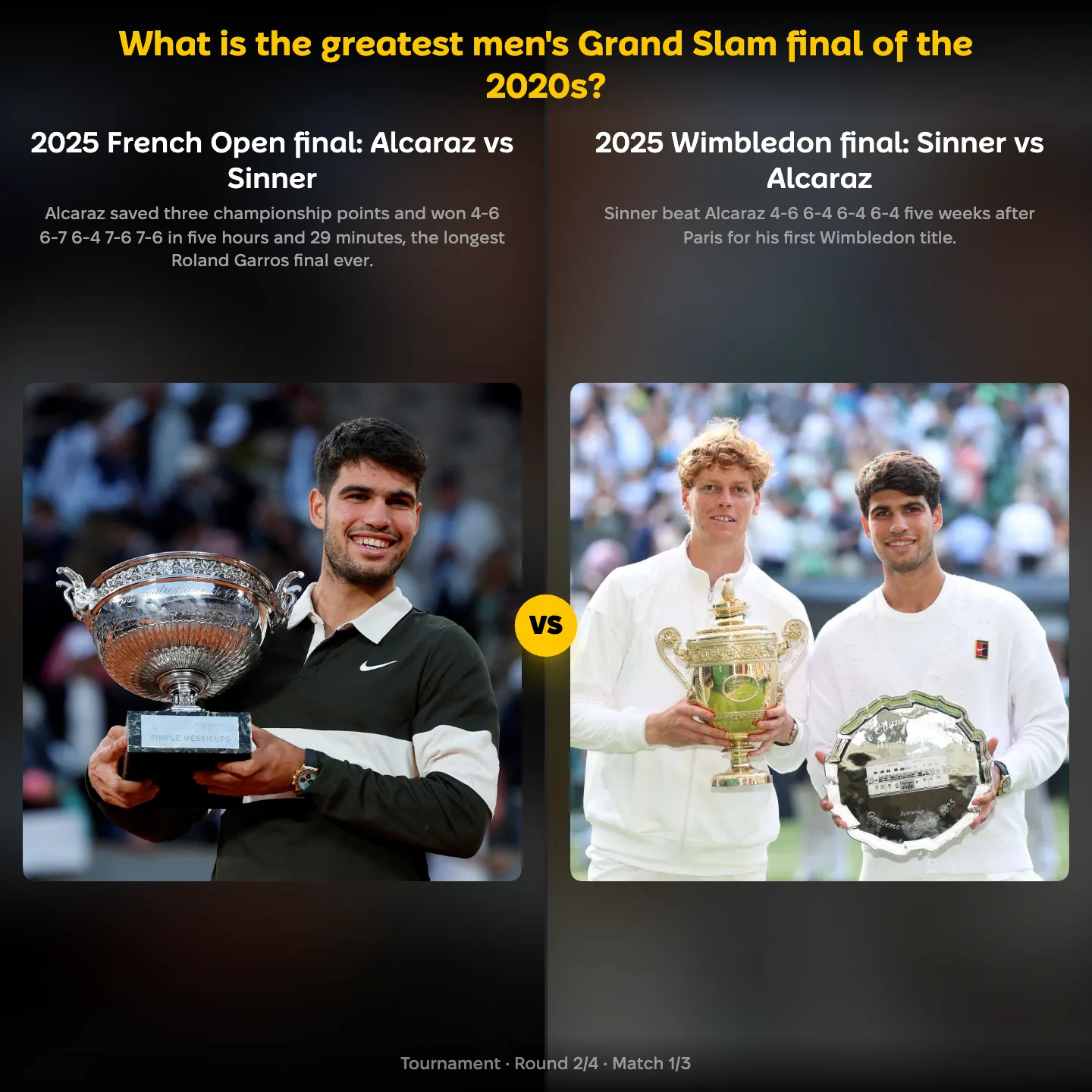
In the summer of 2025 Sinner and Alcaraz played two major finals against each other inside five weeks, and won one each. Both are in this ranking of the decade's best finals.
Paris came first. Sinner served for the title and lost it: Alcaraz saved three consecutive championship points and won in five hours and twenty-nine minutes, the longest final Roland Garros has ever staged.5
Wimbledon came next, and Sinner won it in four sets. Grass is the one surface where their head-to-head runs entirely his way.1
The two results are hard to reconcile because almost nothing separated them. Clay slows the ball and lengthens rallies, which suits the player who defends and improvises; grass does the opposite and pays the man who takes time away. Five weeks was enough to flip which of those was worth more.
The other finals here belong mostly to Djokovic, including the one where Medvedev denied him a calendar Grand Slam. Only two of the twelve were contested by the same pair in the same summer, and both of those are in this rivalry.
Federer vs Nadal set the bar for this
Rivalries are judged on length as much as quality, which is the one category where Sinner and Alcaraz are plainly short.
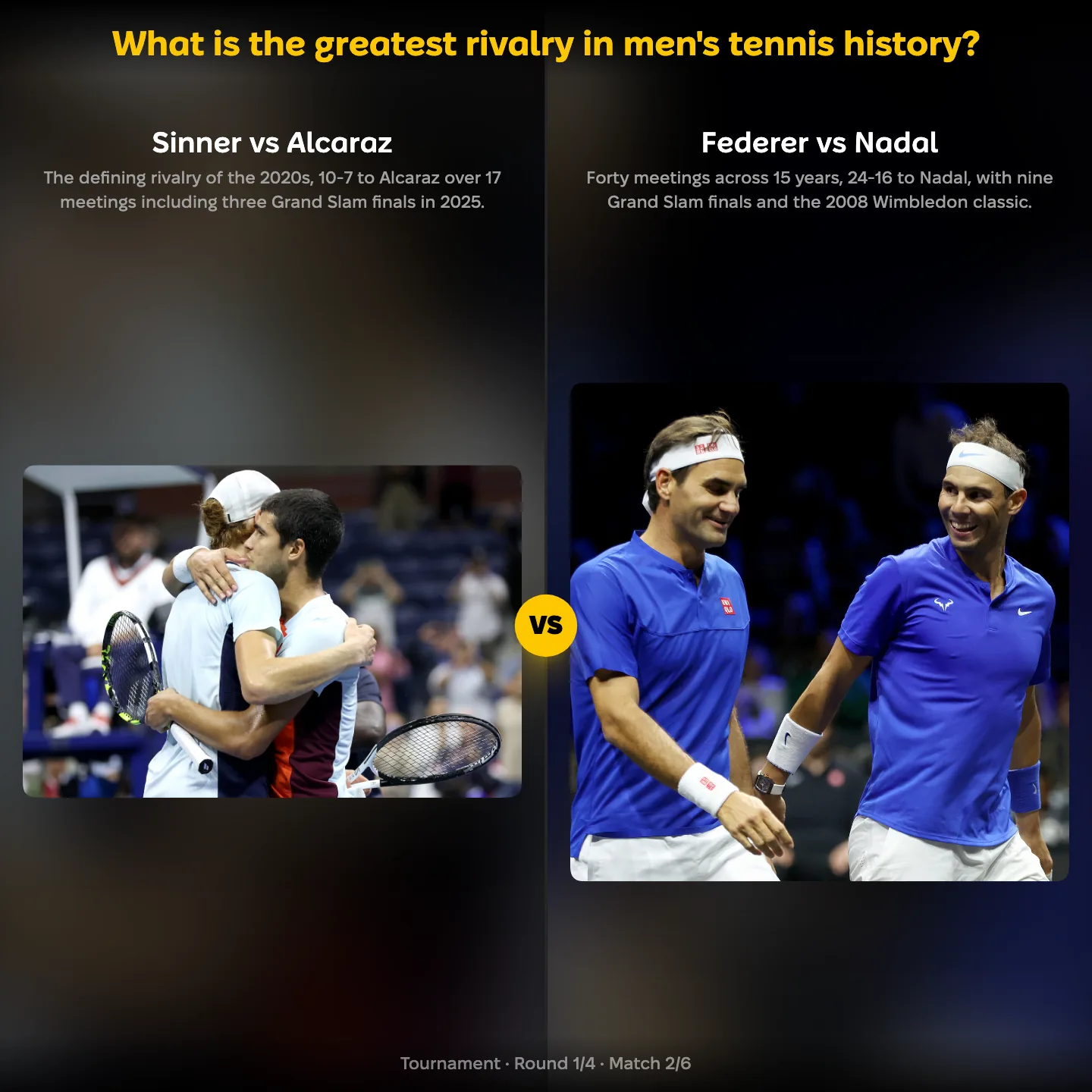
Federer and Nadal played for fifteen years across four surfaces and two distinct eras of racket technology. Borg and McEnroe barely overlapped and are still the shorthand for tennis as a personality clash.
Sinner and Alcaraz have the density instead. Three major finals in a single season is something none of the older pairs managed, and the styles are genuinely opposed: Sinner takes time away, Alcaraz gives it back and then invents something.
What they have not had yet is a decade, or a match that people who do not follow tennis can name.
Indoors, where Sinner has not been beaten
Indoor hard courts remove wind, sun and bad bounces, which rewards the player who hits the ball flattest and earliest. That description fits one of these two much better than the other.
Sinner has won the season-ending ATP Finals twice, in 2024 and 2025.2 Alcaraz's game is built on spin, height and improvisation, and none of those pay as well under a roof.
Lendl, Boris Becker, Sampras and John McEnroe all made careers on fast indoor courts in an era when the tour played far more of them.
This is the clearest example in the article of a question written, almost by accident, in Sinner's favour. Change one word to "clay" and the section inverts.

One backhand each, built differently
Both men hit two-handed backhands. The two shots have almost nothing in common.
Sinner's is flat and taken early, hit down the line to change direction. Alcaraz's carries more spin and margin, and hides the best backhand drop shot on tour.
Stan Wawrinka, Richard Gasquet and David Nalbandian are the names this ranking exists for, and all three hit one-handers that people still describe in aesthetic terms.
A technique ranking rarely agrees with a trophy ranking, and this is why.

The half of the game nobody films
Serving gets the highlight reels and the speed guns. Returning decides matches, and it is the skill that separates a top-ten player from a champion.
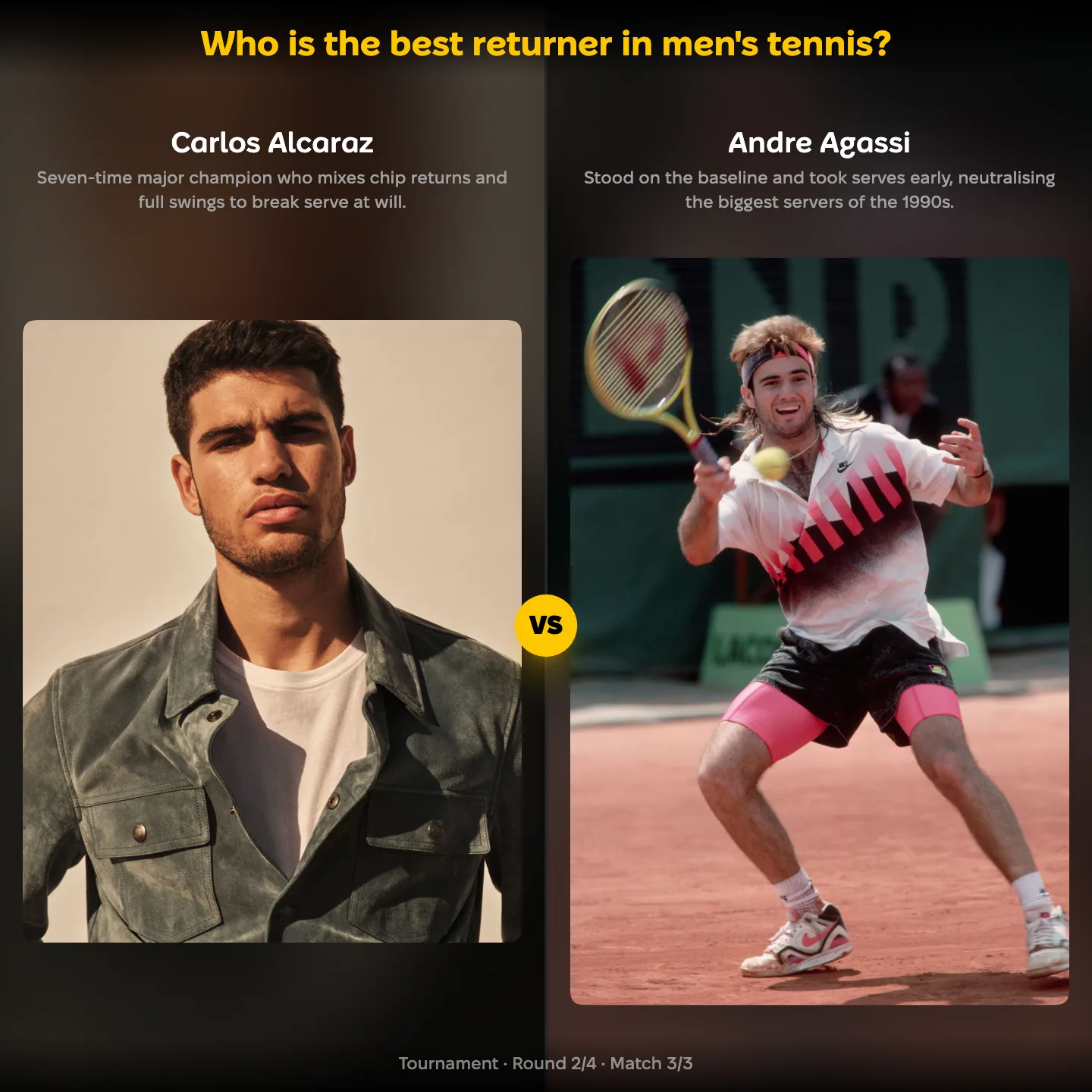
Agassi is the reference point here. He stood on the baseline against the biggest servers of the 1990s and took the ball early enough to turn their weapon into a rally.
Djokovic did the same thing for longer. Sinner and Alcaraz both return well by any normal standard and neither has yet made it the thing they are known for.
That is a real hole in both of their cases, and it only becomes visible when a ranking asks about a single skill and ignores the career around it.
What happens after four hours
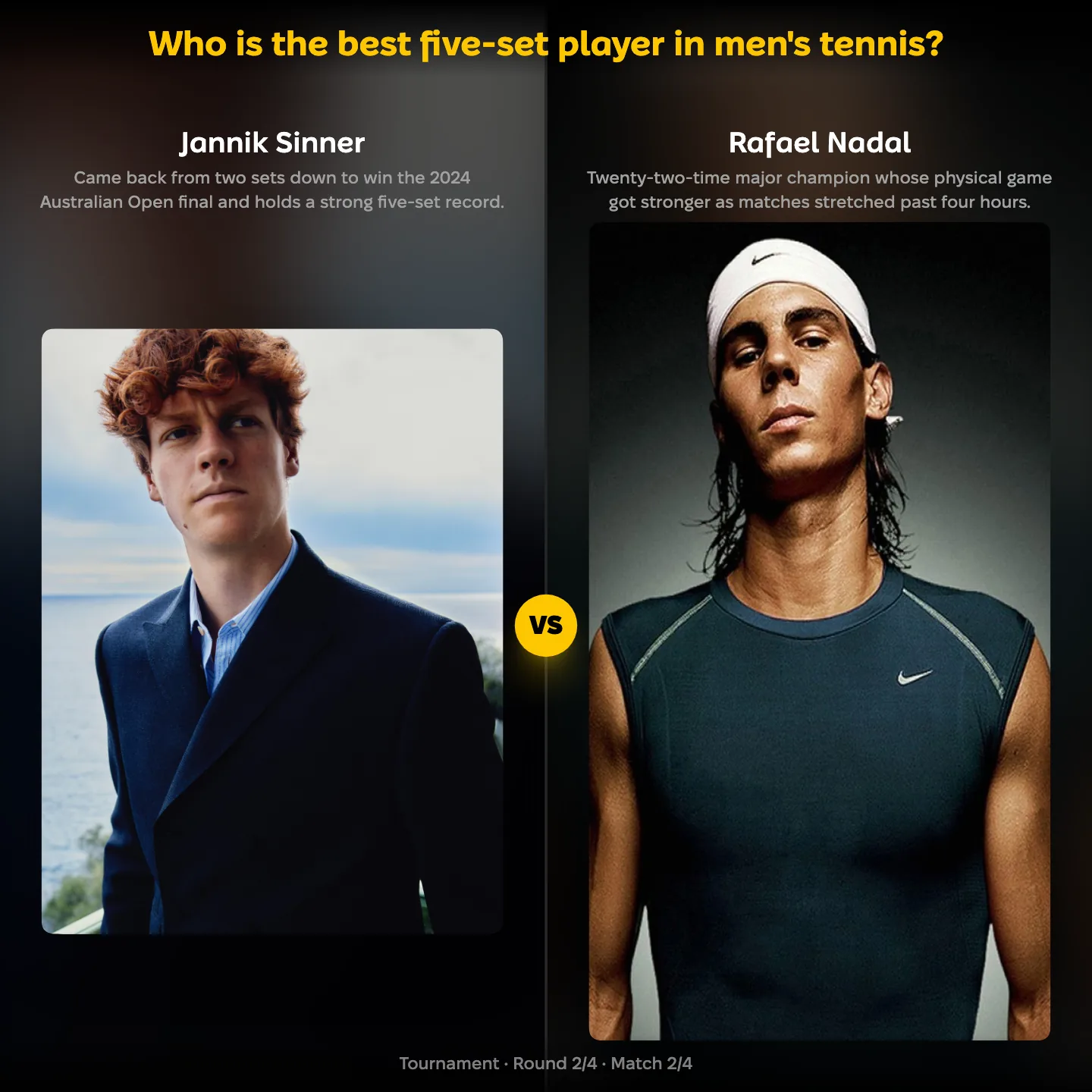
Only the men's majors go to five sets, so this ranking is about a format almost nobody else plays. It rewards fitness, patience and a tolerance for being behind.
Sinner and Alcaraz have met in three five-set matches. Alcaraz has won all three.1
Nadal is the standing answer to the question, and Djokovic has the record of coming back from two sets down more often than anyone at this level.
Sinner's counter is the 2024 Australian Open final, where he lost the first two sets and won the title anyway. One match makes a thin pattern. It is also precisely the evidence this ranking asks for.
Twenty majors is a long way from twelve
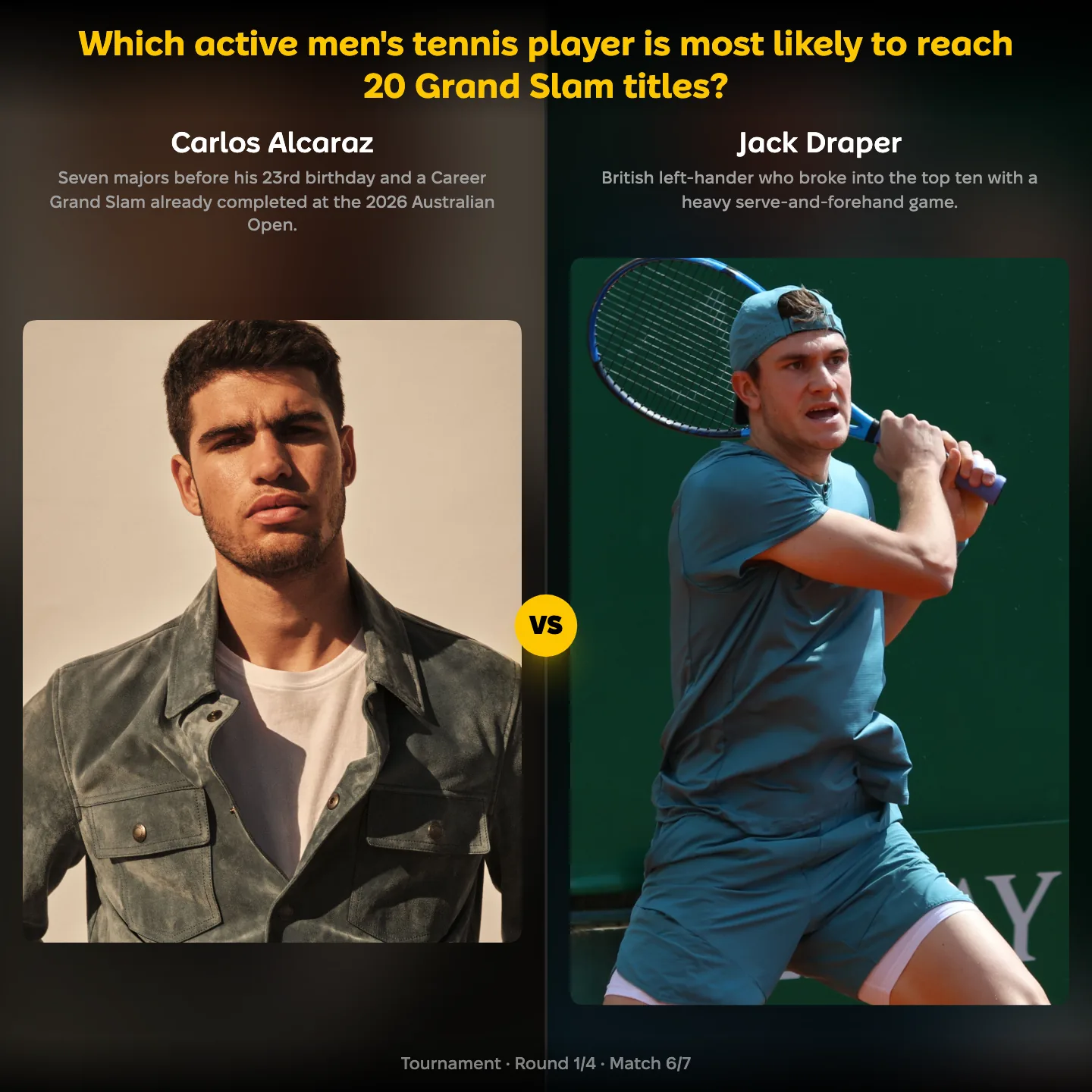
Only one ranking in this article asks about the future, which makes it the only place where being twenty-two counts as an asset.
Alcaraz completed the career Grand Slam at the 2026 Australian Open, beating Djokovic in the final, and he did it before his twenty-third birthday.6 Sinner's five are more concentrated: hard courts and grass, nothing in Paris yet.
Jack Draper, Ben Shelton and Holger Rune are also on this list, a useful reminder of how many players have appeared on a projection like this one and finished with none.
Twenty is a number three men have ever reached. Both of these two would need to roughly double what they have, without a serious injury, in a sport that has just taken four months off one of them.
Seventeen French Open champions, and Sinner is not one
Every other section in this article has both men in it. This one has Alcaraz and a gap where Sinner should be.
Alcaraz has won Roland Garros twice, and he leads their clay-court meetings 3–2.1 Clay is the surface his game was built on and the one where he has never really been the underdog against anyone.
Sinner's best result in Paris is a final he led by two sets. He then lost in the second round in 2026, and the tournament has become the obvious hole in an otherwise complete record.
Alexander Zverev, who spent years being described as a player who could not win a major, won this one in 2026 at the fourth attempt.7 Absence from a list is its own kind of information.

The list neither of them wants
Overrated is a word about the gap between reputation and record, so a world No. 1 is always eligible for it.
The case against Sinner is that his majors are concentrated on the surfaces that suit him, and that he served a three-month suspension from 9 February to 4 May 2025 after a WADA settlement over clostebol traced to a physiotherapist's treatment.2 The original tribunal had found no fault or negligence, and the ban still shapes how a section of the sport talks about him.
The case against Alcaraz is inconsistency: early losses to players ranked far below him, and now a body that has cost him half a season.
Alexander Zverev, Stefanos Tsitsipas and Grigor Dimitrov are on this list for the older version of the charge: years near the top of the game, a reputation built on potential, and a trophy cabinet that never caught up.
Nick Kyrgios is the name the ranking was really written for. He reached one major final and has been talked about more than most players who won several, which is close to a working definition of the word.
Both of the current two are here because the word attaches itself to whoever is winning. Being at the top is the qualification, which is true of no other ranking on this page.

Fourteen questions, no verdict
Across these fourteen rankings the two of them swap places roughly with the surface, the era and the skill being measured, and almost never with anything as tidy as merit. Sinner owns the roof and the grass; Alcaraz owns the clay and the long ones; the all-time lists still belong to men who finished playing years ago.
That is what makes New York worth watching this month. On a court the two of them answer the question themselves. Here everybody else answers it, a pair at a time.
Build the version of the question you actually care about, and see which name survives it.
More rankings, more angles
- Jannik Sinner: Best in One List, Last in Another — the same player, seen alone
- Federer vs Nadal vs Djokovic — 16 Lists That Split Them — the three men these two are chasing
- Serena Williams, Ranked 15 Different Ways — twenty-three majors, measured from every side
- Andre Agassi Skipped Wimbledon Three Years, Then Won It — skipped Wimbledon three years, then won it
Sources
- Wikipedia — Alcaraz–Sinner rivalry: head-to-head record, meeting list, surface and five-set splits, weeks at No. 1, and each player's Grand Slam titles: en.wikipedia.org (checked 2026-08-14)
- Wikipedia — Jannik Sinner: return to No. 1 in April 2026, 2026 Wimbledon title, ATP Finals titles, junior skiing career, and the 2025 clostebol suspension: en.wikipedia.org (checked 2026-08-14)
- Wikipedia — 2026 Carlos Alcaraz tennis season: the right-wrist injury of 15 April and the withdrawals that followed, including Roland Garros and Wimbledon: en.wikipedia.org (checked 2026-08-14)
- LiveTennis — ATP singles rankings for 14 August 2026: livetennis.io (checked 2026-08-14)
- Wikipedia — 2025 French Open men's singles final: duration, championship points saved, and the tournament record: en.wikipedia.org (checked 2026-08-14)
- Wikipedia — 2026 Australian Open: the men's singles final and Alcaraz's completed career Grand Slam: en.wikipedia.org (checked 2026-08-14)
- Wikipedia — 2026 French Open: Alexander Zverev's first major title, won in his fourth final: en.wikipedia.org (checked 2026-08-14)