
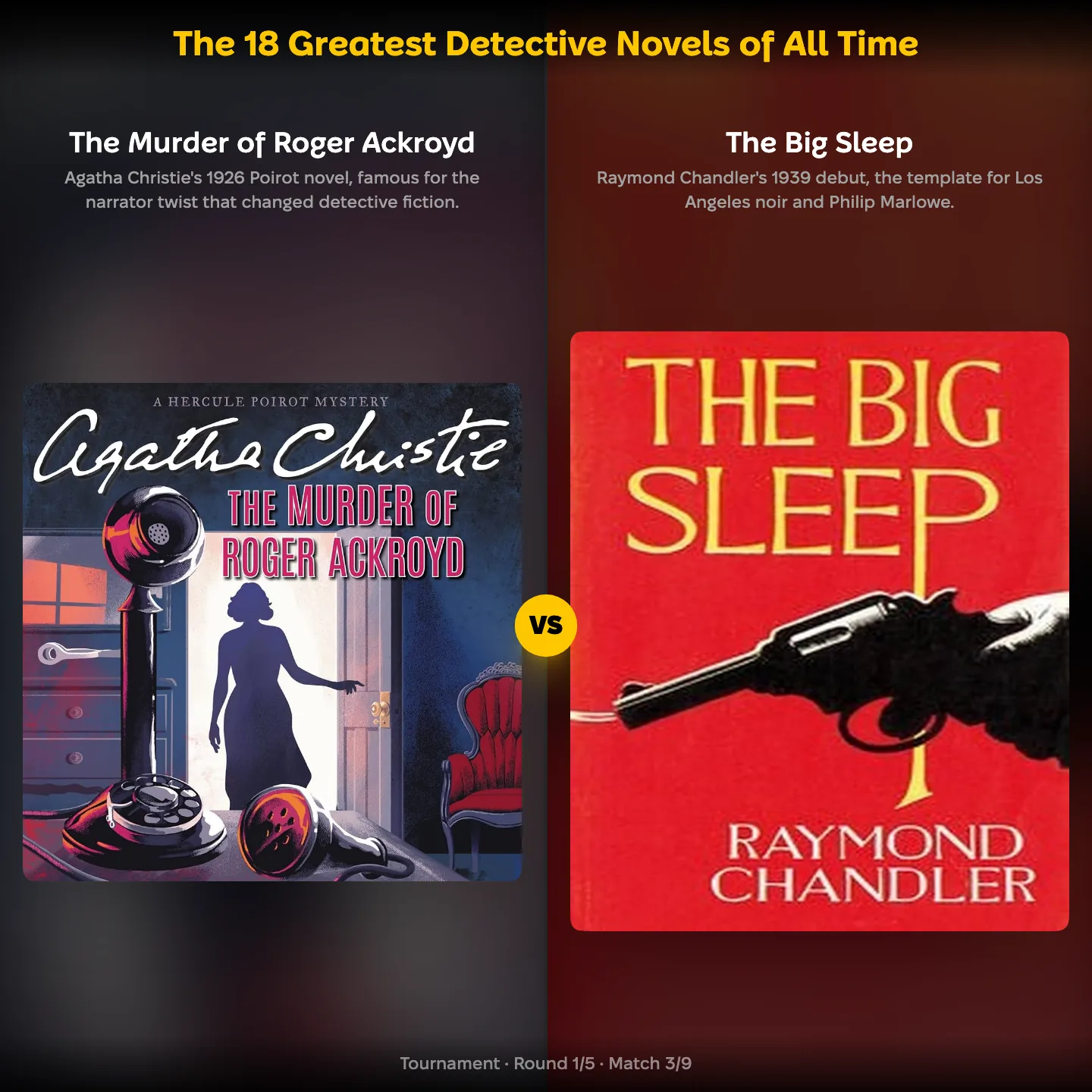
The Murder of Roger Ackroyd was published in June 1926, and its official publisher still calls the ending one of the most iconic twists in crime fiction.1 A hundred years later Christie is not filed as a novelist so much as loaned out to other people's categories. Netflix put a new adaptation of hers, Seven Dials, on air in January 2026.2
Fifteen rankings here hold her name, her books, her detectives or the actors who played them. Almost none of those fifteen is a crime-fiction category.
Christie's footprint is bigger outside novels than in them: she competes on lists about actors, stage runs, film adaptations and plot twists at least as often as on lists about books.
The Murder of Roger Ackroyd broke the genre's only rule
Detective fiction had one contract with the reader, and in 1926 Christie tore it up. The narrator of Roger Ackroyd is Dr Sheppard, the country doctor who assists Poirot, writes the account, and turns out to have done it.
Critics of the day called it cheating. The Detection Club later wrote rules partly to forbid what she had done, and every unreliable narrator since owes the book something.
The competition on this ranking is the hard-boiled tradition that grew up in reaction to her. Raymond Chandler's The Big Sleep arrived in 1939 with a private eye, a Los Angeles heat wave and a plot nobody could fully explain, and Chandler spent a famous essay attacking exactly the English drawing-room mystery Christie perfected.
Both books are on the list. So is And Then There Were None, which means a third of the top of the genre came out of one Devon house.
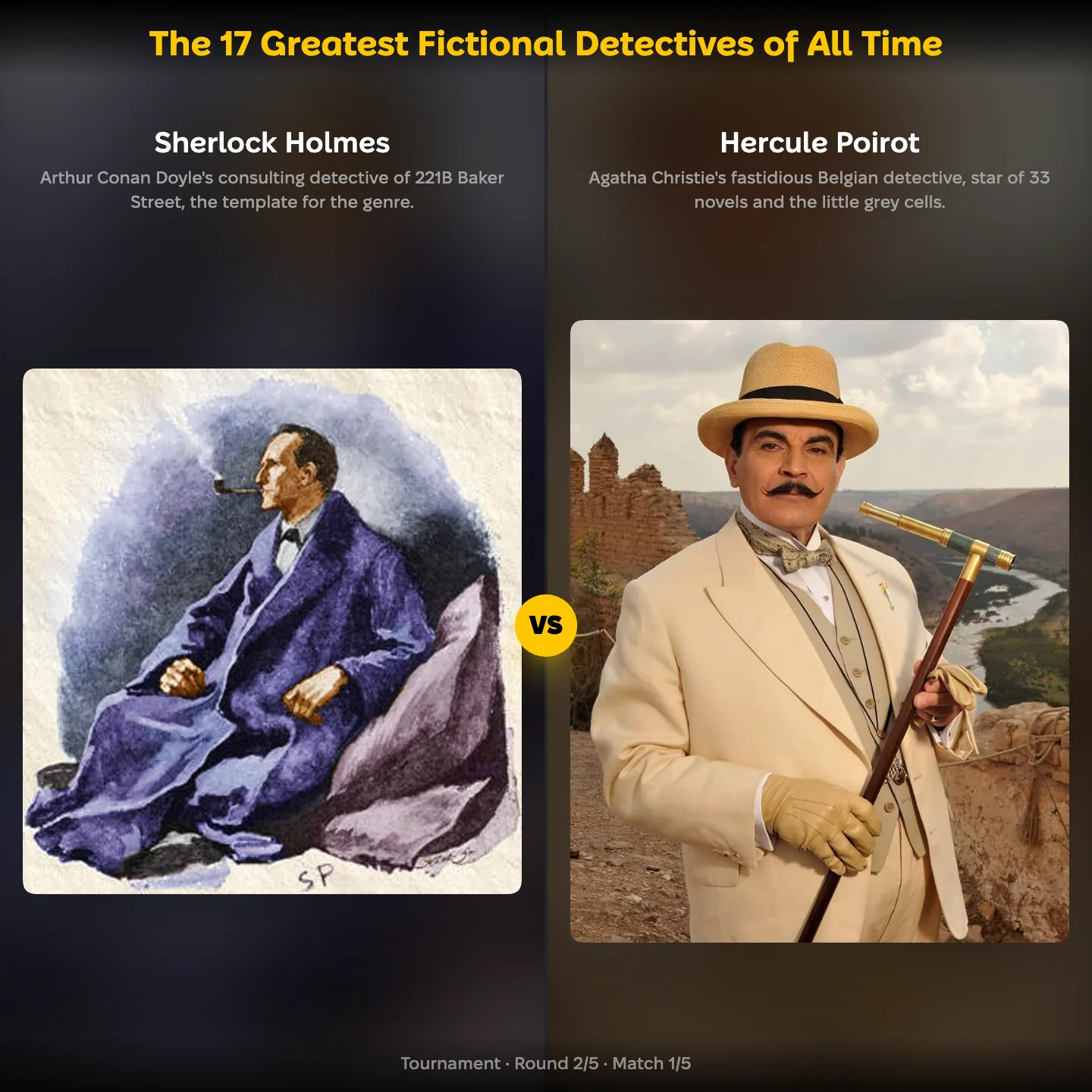
Poirot vs Sherlock Holmes: the comparison she never escaped
Christie is the only writer on this ranking with two entries. Hercule Poirot, the retired Belgian policeman with the waxed moustache, arrived in 1920; Miss Marple, the St Mary Mead spinster who solves murders by village analogy, followed a decade later.
Sherlock Holmes is the name everything in the category is measured against, and Christie knew it. She gave Poirot a plodding companion, Captain Hastings, because Conan Doyle had given Holmes a Watson.
Around them stands the century that followed: Philip Marlowe, Sam Spade, Columbo, Lisbeth Salander. Poirot outlasted almost all of them in print, and Christie grew to dislike him intensely — she called him insufferable in her own notebooks and killed him off in a manuscript she then locked in a vault for thirty years.
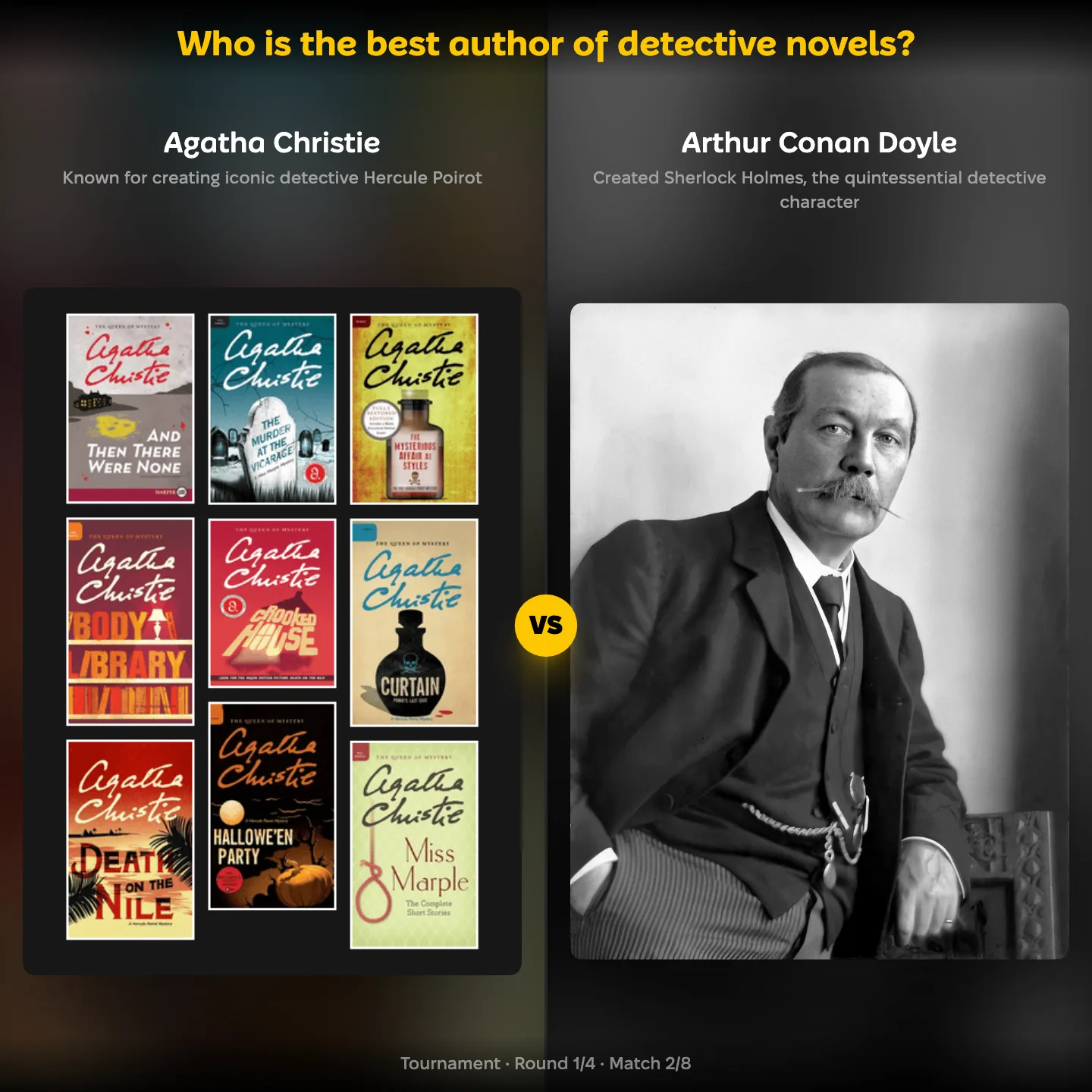
The one list built for Agatha Christie
Every other ranking on this page borrows her. This one is the category she owns outright: writers of detective novels, judged as writers of detective novels.
Arthur Conan Doyle is the obvious rival, and the case for him is priority. He got there first, and the shape of the thing — the brilliant amateur, the slower friend, the closing explanation — is his invention before it is hers.
The case for Christie is volume and range. Poirot, Marple, Tommy and Tuppence, Superintendent Battle and Harley Quin all came out of the same typewriter, alongside plays, radio work and six romantic novels published as Mary Westmacott.
Behind those two sit Dashiell Hammett, Dorothy L. Sayers, Georges Simenon and the Nordic writers who sell in her volumes today. Whichever way it falls, this is the only list on the page where she is the subject rather than the exhibit.
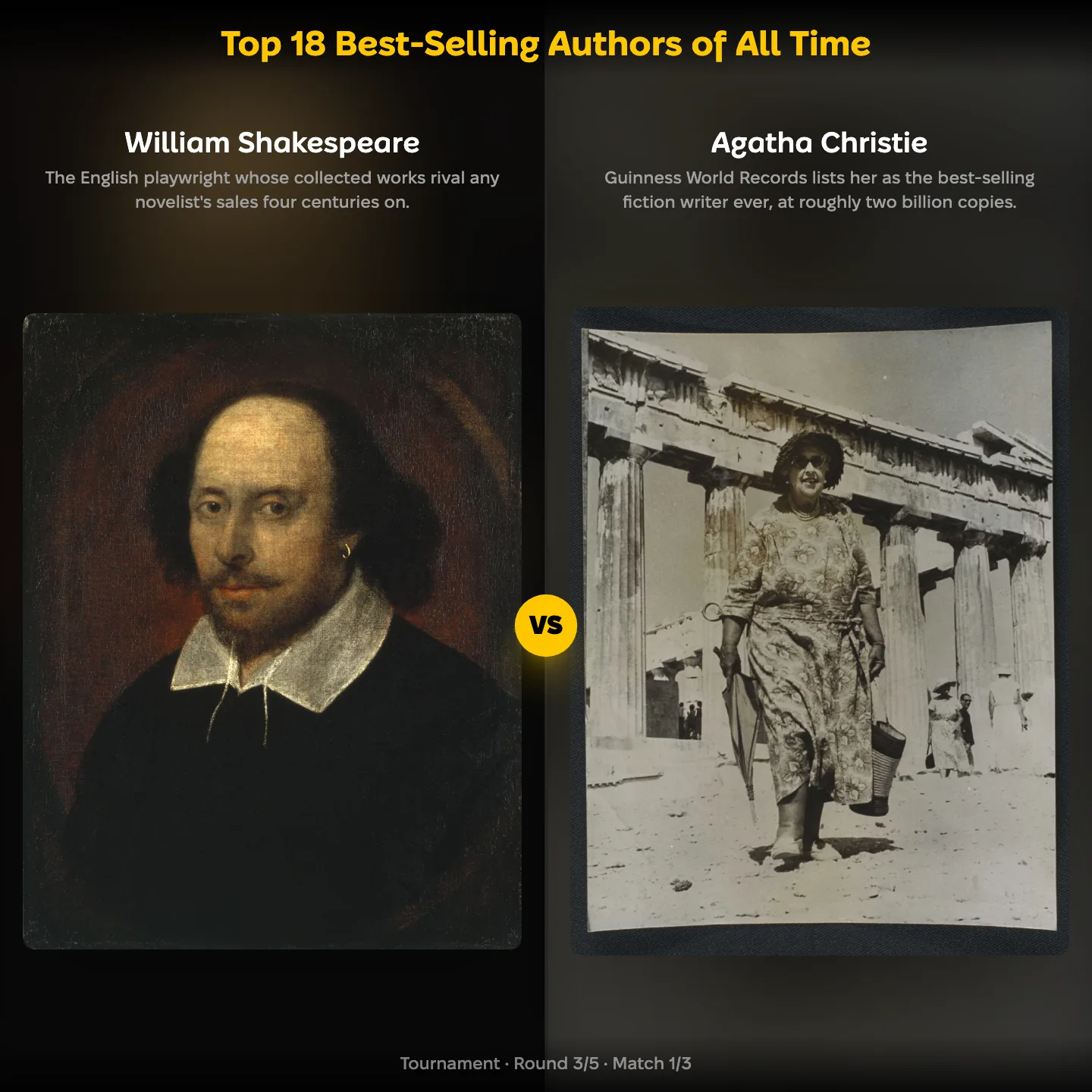
Two billion copies, and Shakespeare for company
Guinness World Records lists Christie as the world's best-selling fiction writer, at roughly two billion copies in 44 languages.3 That is the number that puts her on a list with nobody else's job description.
Shakespeare is the only name that seriously disputes it, across four centuries and a different medium.
Everyone else makes it a strange room: Barbara Cartland's romances, Enid Blyton's children's books, Jin Yong's martial-arts epics. Nobody here writes the same kind of book as anybody else.
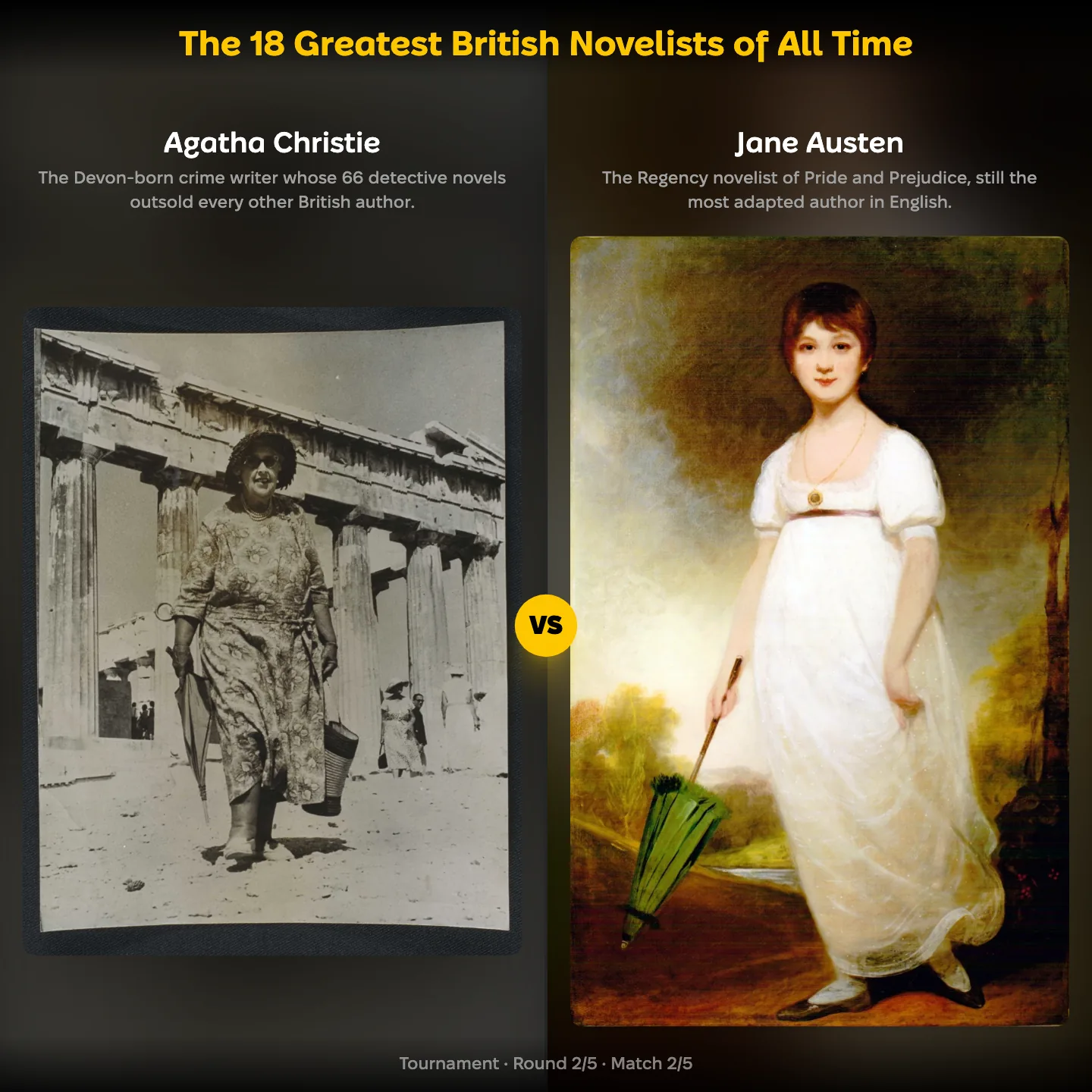
Christie vs Austen: outselling the canon she is judged against
This is where the sales stop helping. A ranking of British novelists is a ranking about prose, influence and the literature syllabus, and on those terms Christie has always been treated as a craftswoman rather than an artist.
Jane Austen is the counter-case in the frame. Six novels against sixty-six, and Austen is the one taught, adapted and quoted.
Dickens, Orwell, Woolf, both Brontës, Tolkien and Kazuo Ishiguro fill out the field. Christie outsold every one of them and is the least likely of the group to appear on a university reading list.
Her defenders point at the plotting, which is the one thing nobody else here attempted at her scale: sixty-six puzzles that hold together on a second reading, built by a writer who trained as an apothecary's dispenser and used the poisons she knew.
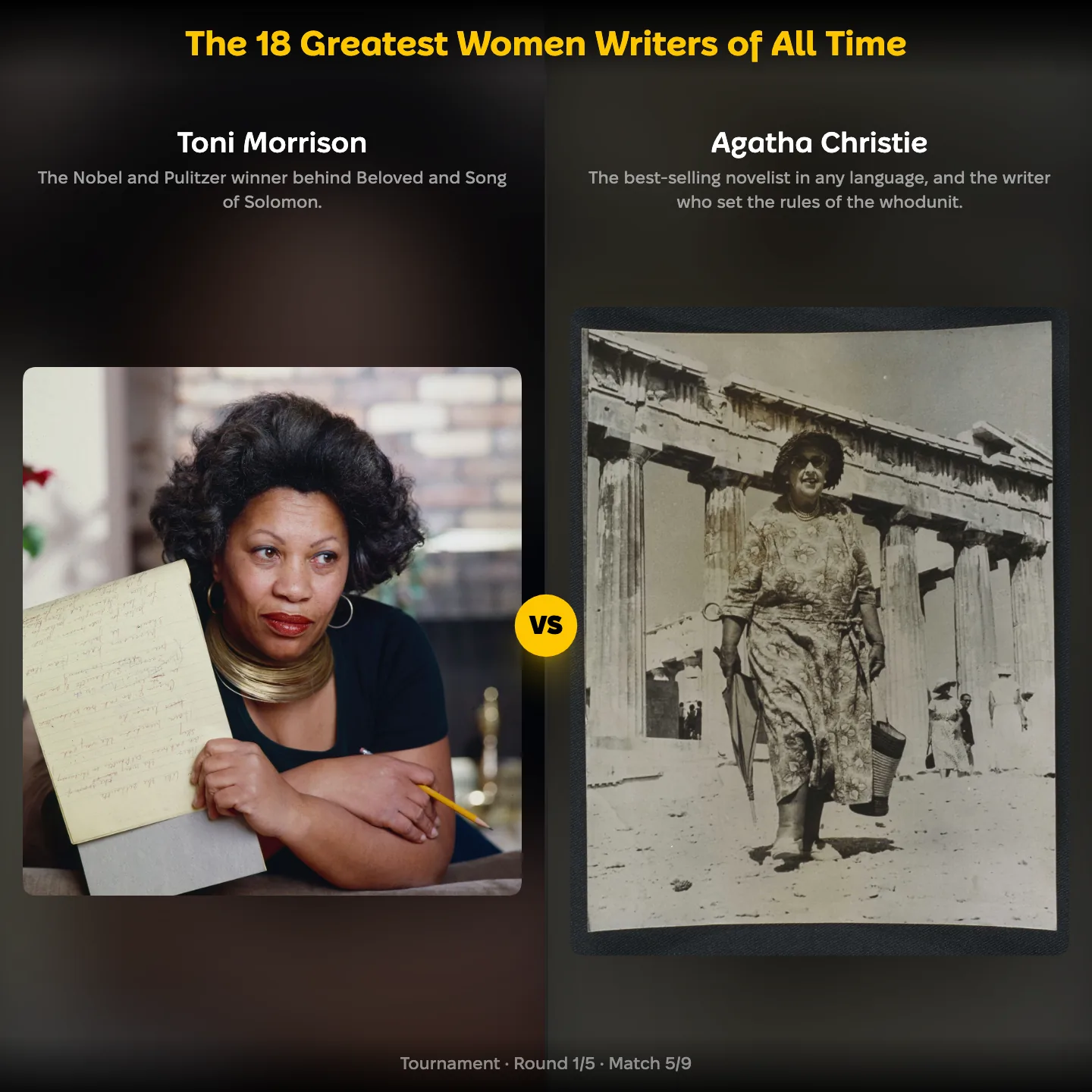
Sappho, Murasaki Shikibu and the woman who outsold them
Widen the category from Britain to the world and the company changes completely. Christie is here with Sappho, whose poems survive in fragments, and Murasaki Shikibu, whose Tale of Genji was written around 1010 and is often called the first novel.
Toni Morrison supplies the contrast: a Nobel and a Pulitzer against the best-selling shelf in publishing history.
Christie belongs here for a reason no prize committee recorded. She built a working career in a genre that barely admitted women as authors, kept it for fifty-five years, and did it while the industry filed her as light reading.
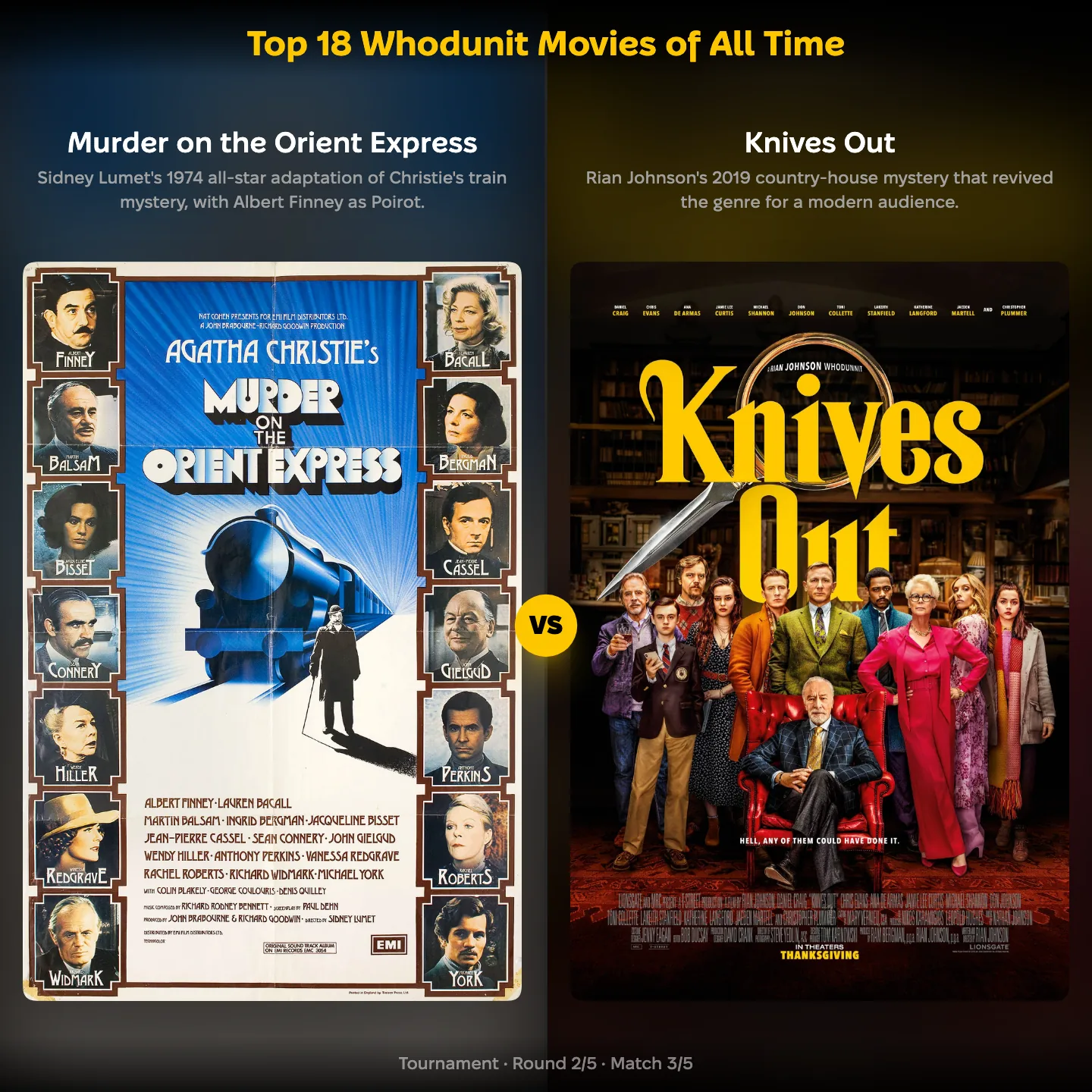
Murder on the Orient Express vs Knives Out: the shape she left behind
Four films on this ranking began as Christie books. No other writer supplies as many. Evil Under the Sun, Witness for the Prosecution, Death on the Nile and the train are all hers.
Knives Out is the modern one, and Rian Johnson has never hidden the debt. A wealthy family, a house full of motives, a foreign-accented detective who talks too much: the machinery is Christie's, running on 2019 politics.
The rest of the field shows how far the form travels. Chinatown takes the detective and refuses him the solution; Memories of Murder follows Korean police who never catch anyone; Clue was released with three different endings in different cinemas.
Seventy episodes of Poirot against Columbo's raincoat
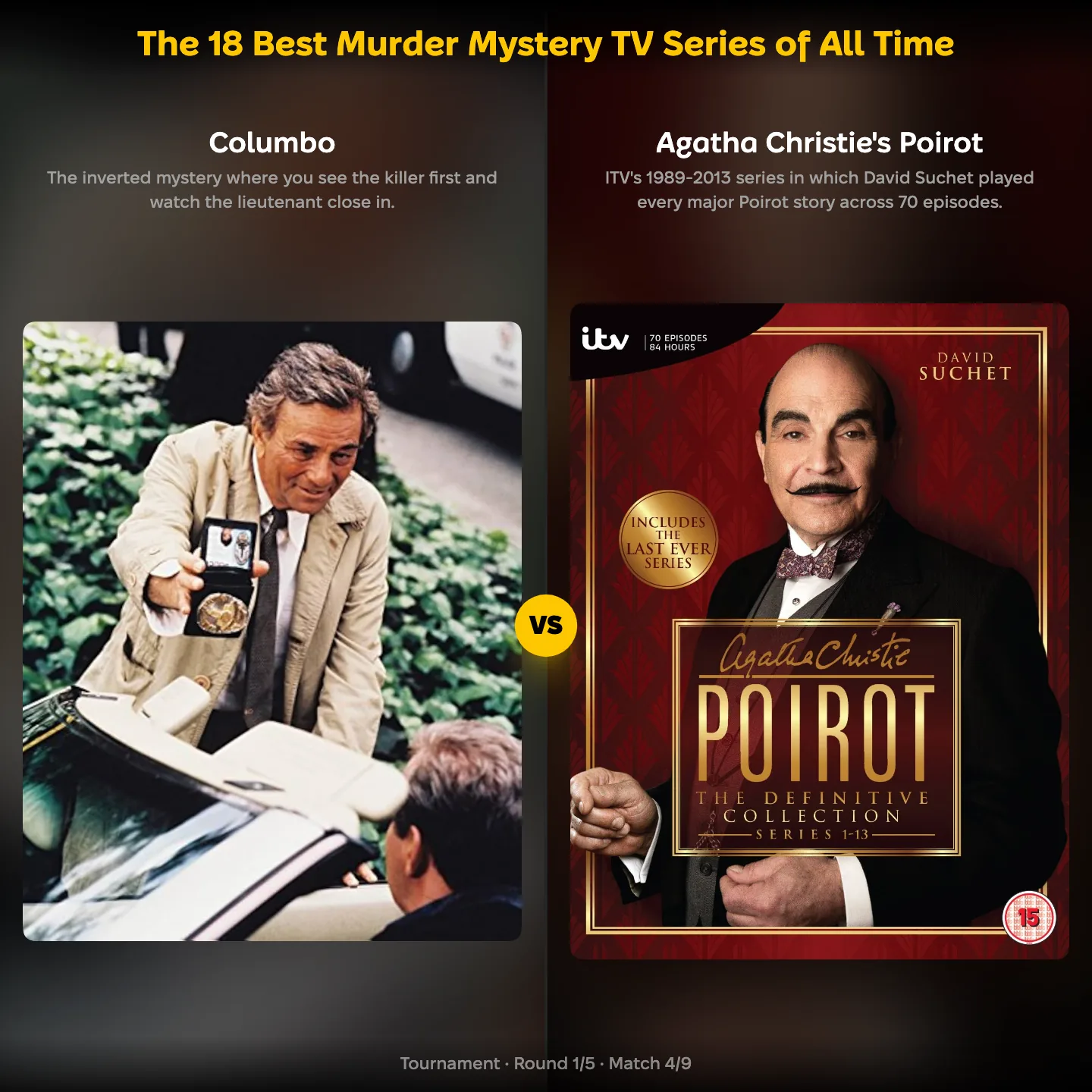
Agatha Christie's Poirot ran on ITV from January 1989 to November 2013: thirteen series, seventy episodes, and by the final one, Curtain, David Suchet had filmed every major Poirot story Christie wrote.4 No other adaptation project in television has that shape.
Columbo is the opposite idea. You watch the murder first and spend the hour waiting for the lieutenant to close the trap, which is the inverted mystery Christie herself tried in Endless Night.
The BBC's Miss Marple with Joan Hickson is also on this ranking, so Christie supplies two of the eighteen shows.
Against them sit True Detective, Twin Peaks, Broadchurch and Line of Duty — prestige television that treats a single death as a season-long excavation. Christie's own adaptations solve it in ninety minutes and hand you tea.
David Suchet vs Kenneth Branagh: the moustache question
Nine actors have played Hercule Poirot on screen. Here Christie is the category itself, not an entry inside somebody else's.
David Suchet is the completist's answer. He kept a list of Poirot's characteristics from the books and refused to break it, down to the walk, and he stayed with the part for twenty-four years.
Kenneth Branagh is the box-office answer, and the most visible disagreement about the character in fifty years is his moustache — a two-tier grey construction that Christie readers argued about for weeks in 2017.
Behind them: Peter Ustinov's six warm, unhurried outings from 1978, Albert Finney's single Oscar-nominated turn in 1974, John Malkovich's bleak beardless version for the BBC, and Austin Trevor, who played him clean-shaven in 1931 because nobody had decided the moustache mattered yet.

Henry V, Thor and a Christie adaptation: Branagh's range
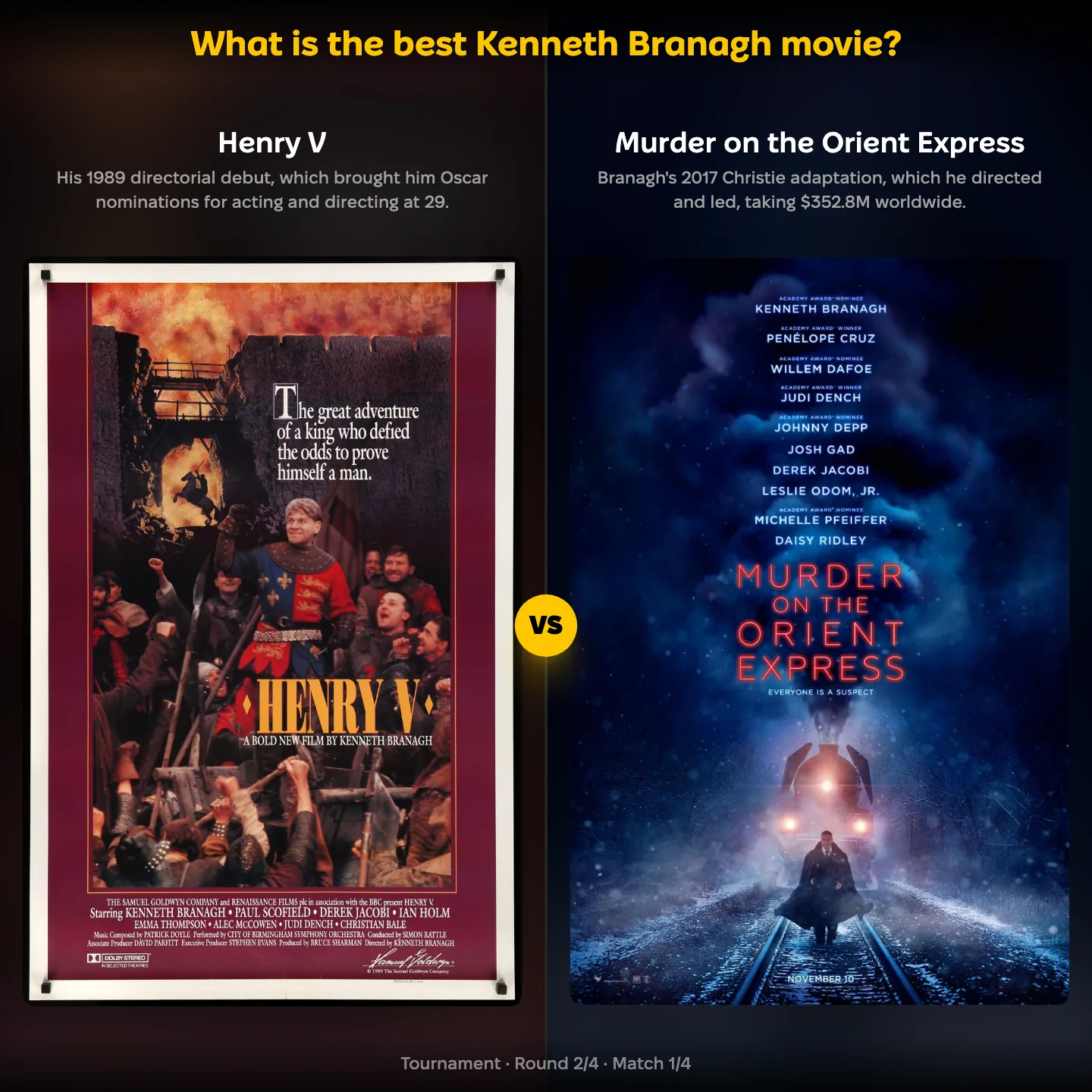
Christie appears on this ranking three times, and not as a writer. Murder on the Orient Express, Death on the Nile and A Haunting in Venice are the three films Kenneth Branagh directed and starred in as Poirot.
The first of them took $352.8 million worldwide on a $55 million budget, which is why the other two exist.5
Henry V is the reason anyone gave Branagh a Poirot budget in the first place. He directed it at twenty-eight and was nominated for both acting and directing.
The full list runs from Belfast, which won him a screenwriting Oscar, through Thor and Cinderella to Artemis Fowl, which went straight to streaming and was panned. A Christie adaptation anchors the commercial end of a very strange career.
Ingrid Bergman won an Oscar for five minutes on that train
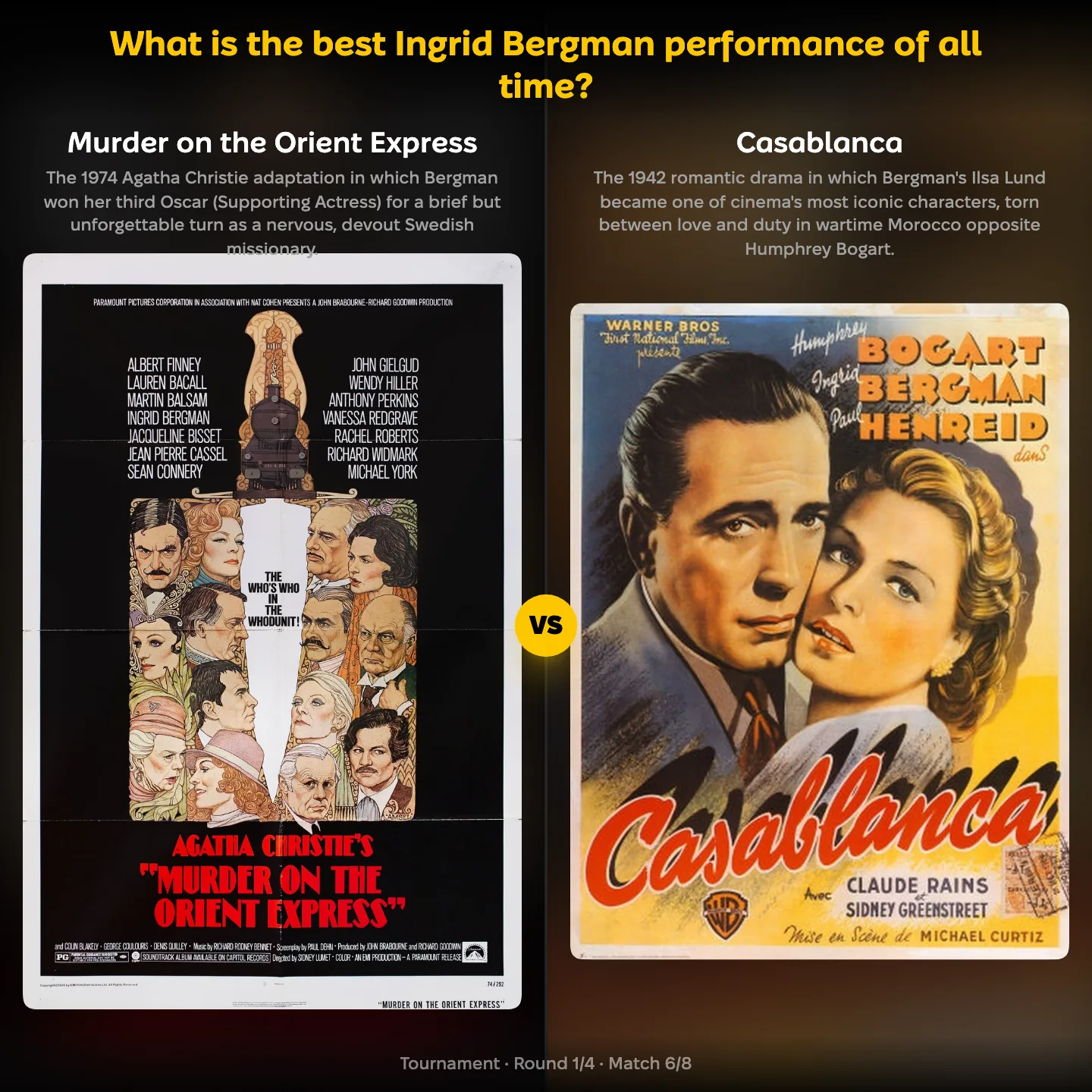
Christie's presence on this ranking is a single supporting role. Ingrid Bergman played Greta Ohlsson, a nervous Swedish missionary, in the 1974 Murder on the Orient Express, and took Best Supporting Actress at the Academy's April 1975 ceremony.6
It was her third Oscar, and she did not think she had earned it. Bergman said publicly that Valentina Cortese deserved the award more, and put her own win down to Hollywood's guilt over having frozen her out two decades earlier.
Casablanca stands beside it, and the gap between the two performances is the whole story here: an actress with one of cinema's permanent roles, honoured for a cameo in a detective film.
The Mousetrap has outlasted Phantom, Cats and everything else
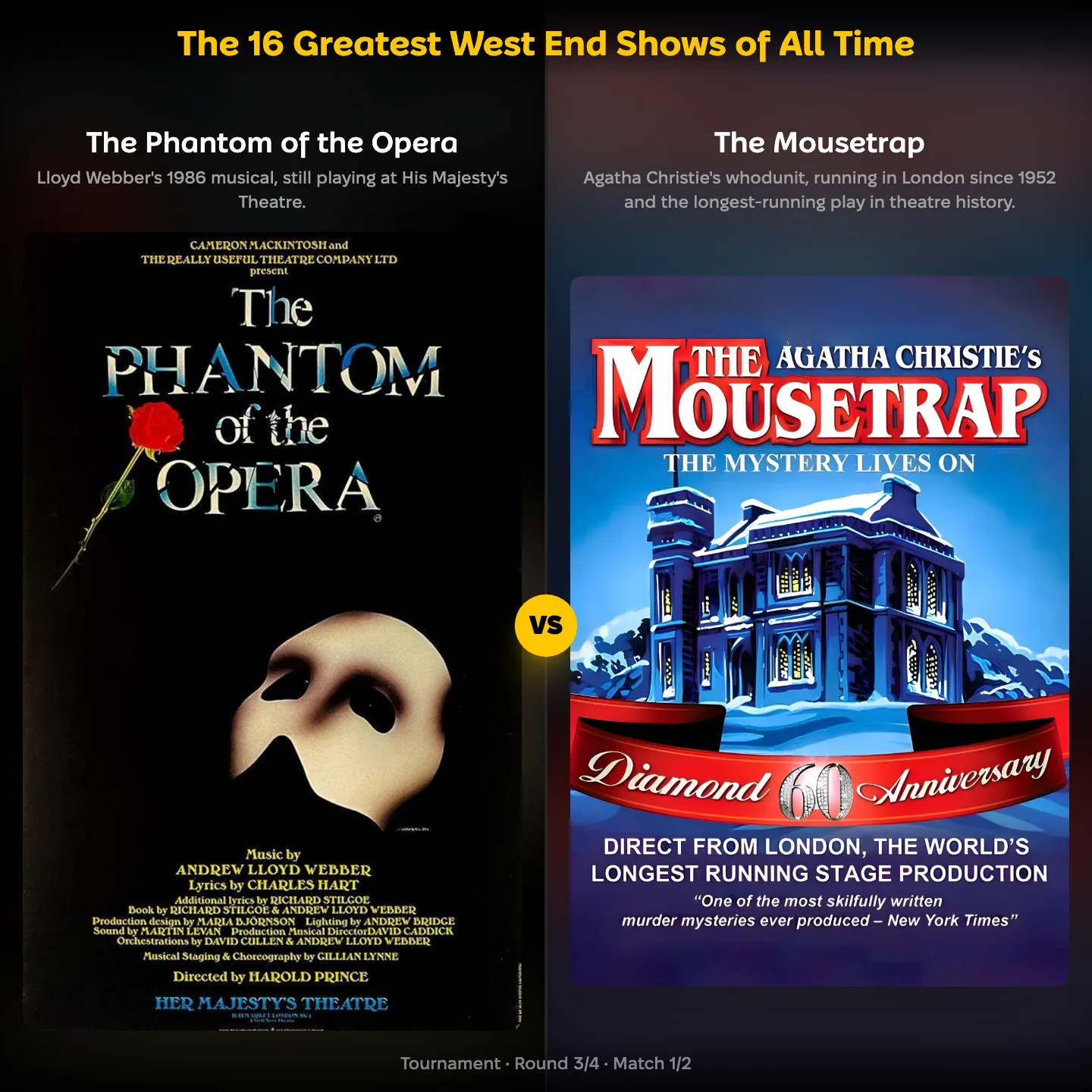
The Mousetrap opened in Nottingham in October 1952, moved to London that November, and has been running there ever since — the longest run in theatre history, now in its seventy-fifth year.7 Audiences are still asked at the curtain not to give the ending away.
No other novelist competes in this category at all. Christie also has a second entry, Witness for the Prosecution, staged since 2017 inside London County Hall with the audience seated in a real debating chamber.
The competition is the modern West End machine: Les Misérables, The Phantom of the Opera, Hamilton, Wicked, The Lion King. Every one of them is a musical with an orchestra, a merchandise line and a marketing budget.
The Mousetrap is eight actors in a guest house, and it has outlived most of the theatres that opened around it.
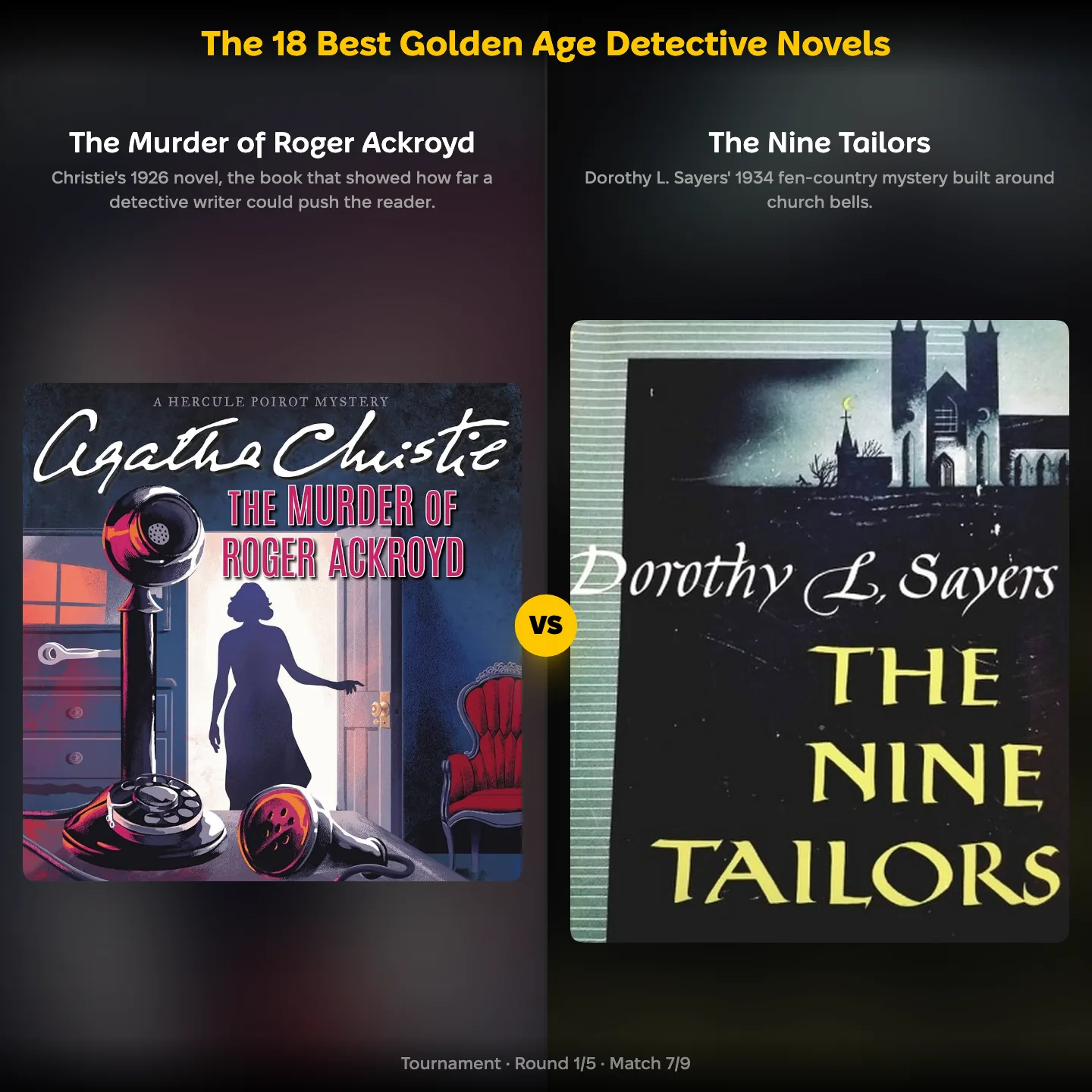
The golden age: Sayers, Carr and the rules Christie kept breaking
Between the wars, detective fiction ran on fair play. The clues were on the page, the reader could in principle solve it, and a generation of British writers competed inside that constraint.
Christie supplies four of the eighteen books here, which is more than anyone else. She also supplies most of the era's famous violations of its own etiquette.
Dorothy L. Sayers is the name critics cite to argue that the era produced literature. The Nine Tailors spends chapters on English change-ringing before it gets to the corpse, and Gaudy Night is an Oxford novel with a mystery attached.
John Dickson Carr, Anthony Berkeley, Josephine Tey, Margery Allingham and Christianna Brand round out a list that most readers today know as a shelf of green Penguin spines. Only Christie is still stocked in every airport.
Her own shortlist: seventeen novels out of sixty-six
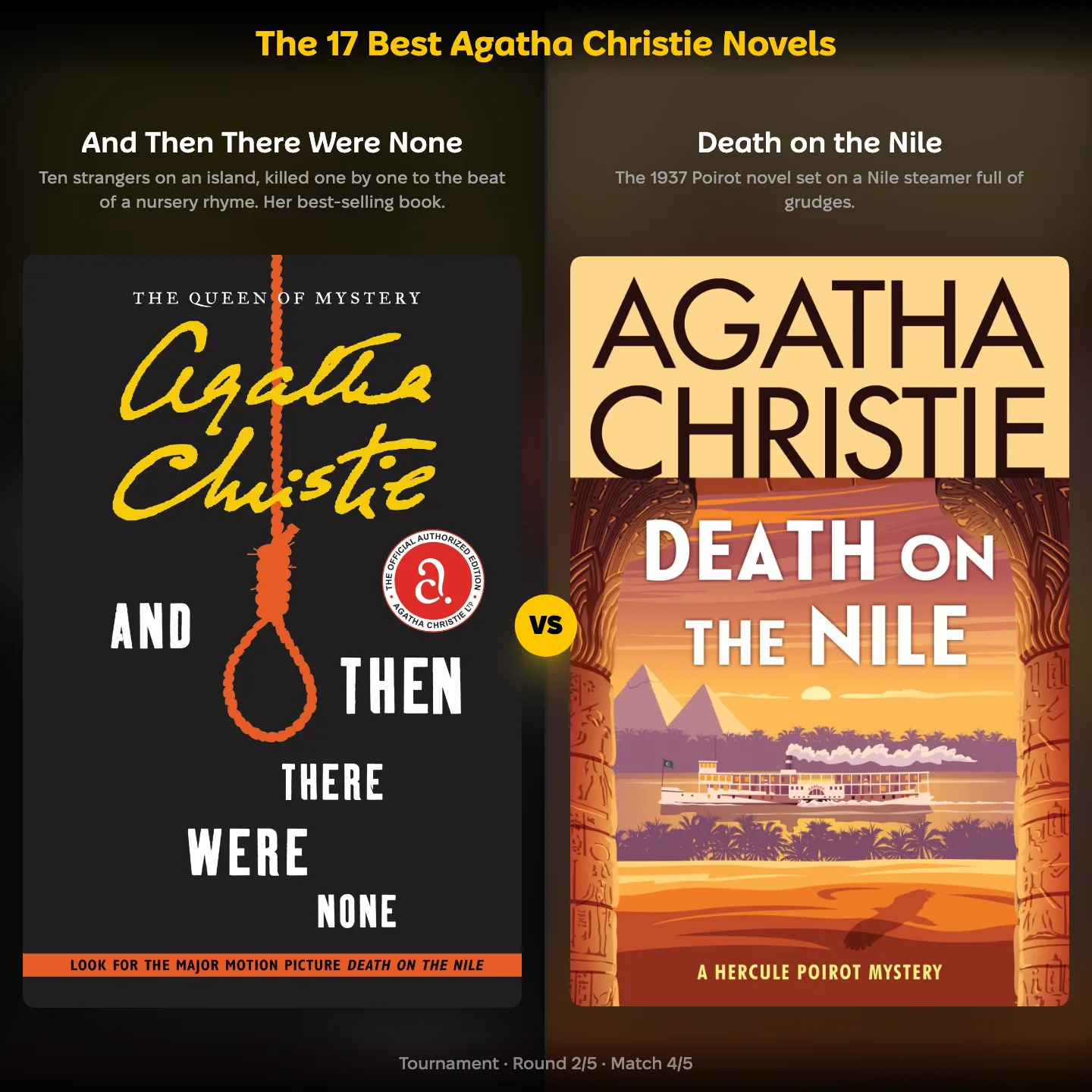
Take the outside world away and the disagreement gets worse, not better. Christie readers cannot agree on which of her own books is the best, and the two obvious candidates split the vote every time it is asked seriously.
And Then There Were None, published in 1939, is the one that sold. Her official publisher calls it the best-selling crime novel of all time, and in 2015 readers picked it as the World's Favourite Christie in a global poll for her 125th anniversary.8
Death on the Nile is the one people picture: a paddle steamer, a honeymoon, a cast of passengers with debts.
Then there are the ones her readers push instead. Crooked House and Endless Night were Christie's own favourites, Five Little Pigs reconstructs a murder sixteen years afterwards, and Curtain was written during the Blitz and locked away until 1975 so that Poirot would have an ending whatever happened to her.
The list nobody wants to win, with Ulysses and Moby-Dick
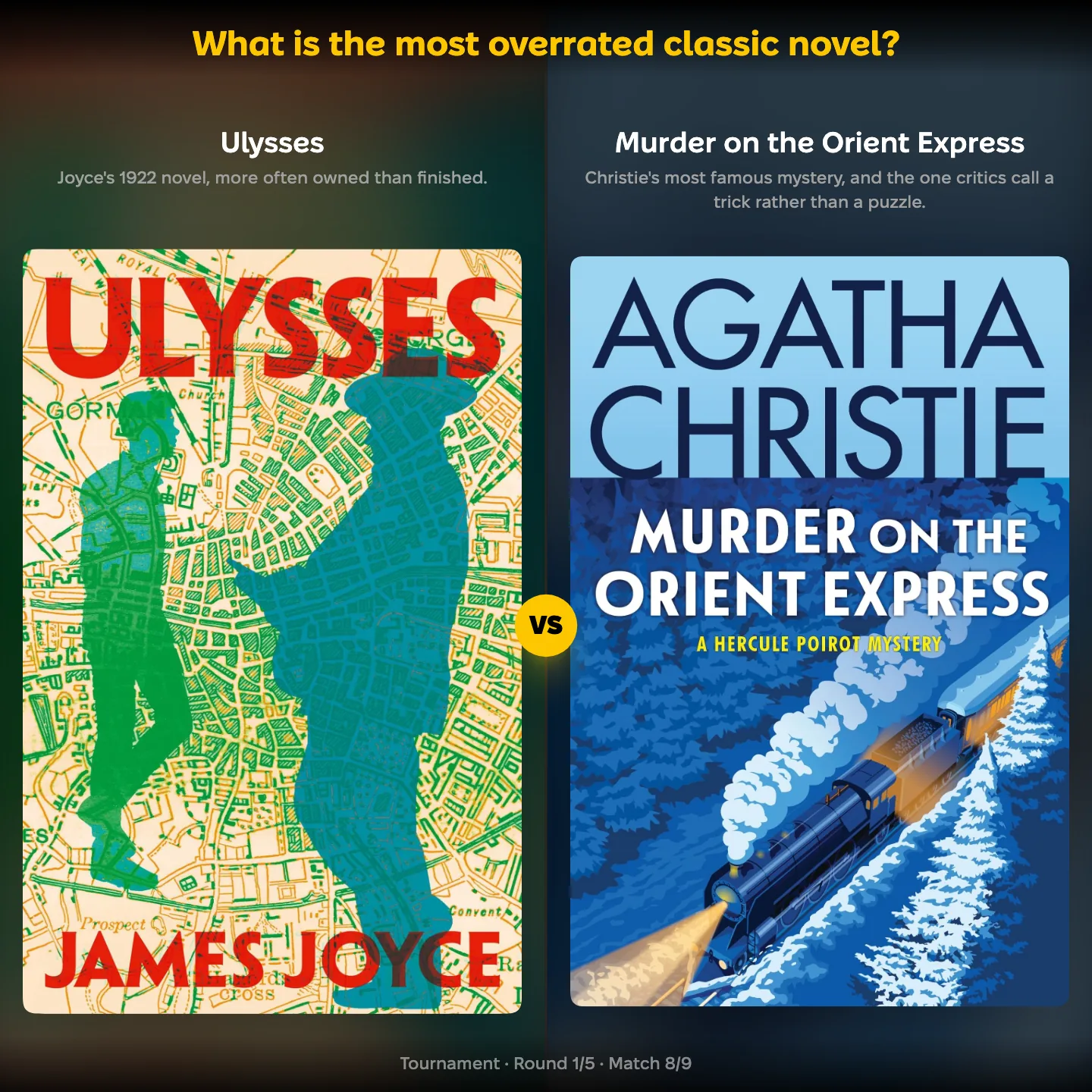
Christie is on this ranking too, and it is the least flattering room in the article. Murder on the Orient Express is the book her critics reach for: a solution so audacious that it reads to them as a trick rather than a puzzle, and one that no reader could have deduced.
Ulysses carries the opposite complaint. Joyce is accused of being unreadable; Christie is accused of being too easy to read.
Everything else here is an English-literature syllabus with the safety catch off: Moby-Dick and its whaling chapters, On the Road, Atlas Shrugged, The Catcher in the Rye, The Alchemist.
Being here at all is a kind of status. Nobody calls a forgotten book overrated.
Fifteen categories, and only one of them is hers
Christie is the rare writer whose reach is measured in other people's fields: an actors' ranking, a theatre ranking, two film rankings, a syllabus of classics she is accused of not belonging to. Only one of the fifteen is about detective novelists, and that is the one where Conan Doyle is waiting.
There is a second centenary still to come this year. She disappeared on the evening of 3 December 1926 and was found eleven days later at a hotel in Harrogate, with no account of where she had been, and the case remains the one Christie mystery without a published solution.9
All fifteen are built by the head-to-head method, which keeps the disagreement on the surface rather than dissolving it into an average.
Know a writer who keeps showing up in categories that are not theirs? Build the ranking and see how far it stretches.
More rankings, more angles
- Stephen King Wrote Horror. The Lists Keep Filing Him Elsewhere — the other novelist the categories can't hold
- Hemingway vs Fitzgerald: One Won the Nobel, One Wrote Gatsby — two novelists who keep landing on the same ballots
- The Lord of the Rings Changes Category From List to List — Tolkien measured as book, film and franchise
- Dracula: 538 Films, and Stoker Never Saw Transylvania — the most-filmed character, rarely the point of the list
Sources
- Agatha Christie Ltd — 100 years of The Murder of Roger Ackroyd (publication June 1926, "one of the most iconic twists in crime fiction"): agathachristie.com (checked 2026-08-14)
- Agatha Christie's Seven Dials — Netflix miniseries, premiered 15 January 2026: wikipedia.org (checked 2026-08-14)
- Guinness World Records — best-selling author for fiction: ~2 billion copies in 44 languages: guinnessworldrecords.com (checked 2026-08-14)
- Agatha Christie's Poirot — ITV, 8 January 1989 to 13 November 2013, 13 series and 70 episodes, ending with Curtain: wikipedia.org (checked 2026-08-14)
- Box Office Mojo — Murder on the Orient Express (2017): $352,794,081 worldwide on a $55m budget: boxofficemojo.com (checked 2026-08-14)
- 47th Academy Awards, 8 April 1975 — Ingrid Bergman, Best Supporting Actress for Murder on the Orient Express: wikipedia.org (checked 2026-08-14)
- The Mousetrap (official) — world premiere Nottingham 6 October 1952, London 25 November 1952, longest-running play in theatre history: the-mousetrap.co.uk (checked 2026-08-14)
- Agatha Christie Ltd — And Then There Were None: best-selling crime novel of all time and the 2015 World's Favourite Christie: agathachristie.com (checked 2026-08-14)
- The National Archives — police report on the disappearance of Agatha Christie, 3–14 December 1926: nationalarchives.gov.uk (checked 2026-08-14)