
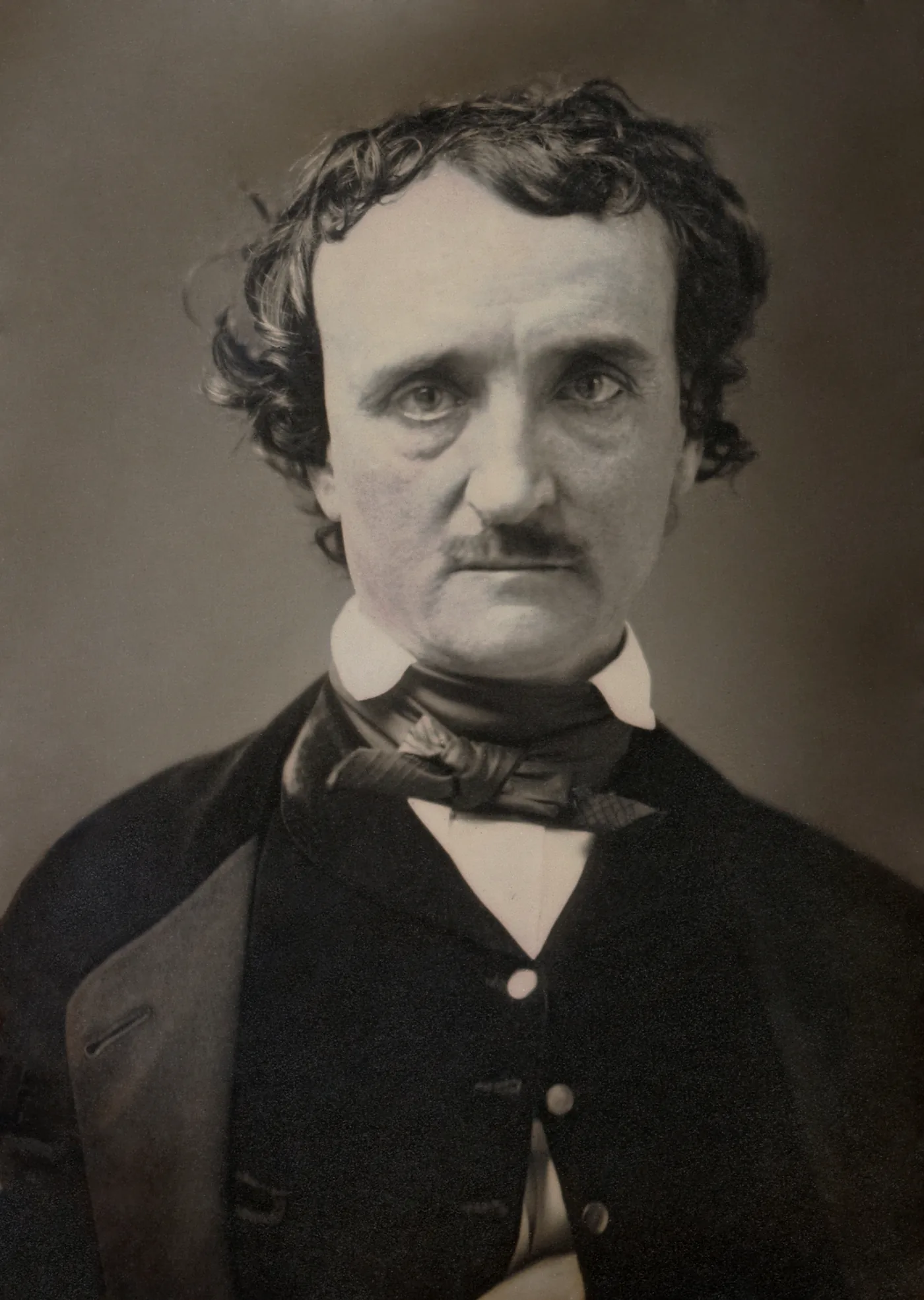
Edgar Allan Poe was found delirious in a Baltimore tavern on 3 October 1849 and died four days later at Washington College Hospital. No death certificate survives, and the cause is still listed as undetermined.1 Baltimore marked the 177th anniversary of that death with its Poe festival on 2–4 October 2026, and Halloween falls at the end of the same month.2
He was forty when he died. In that time he wrote a poem schoolchildren still recite, invented the fictional detective and left enough tales of buried bodies to keep Hollywood and Netflix busy ever since. Those are three separate careers, and they put him on fifteen very different rankings, among them American poets, fictional detectives and sports mascots.
Poe started two genres and gave an NFL team its name, and almost every list remembers only one of the three.
Poe vs Mark Twain: the greatest American writer of all time
This ranking asks the biggest question in American letters, and Edgar Allan Poe belongs on it for range alone: poet, critic, short-story writer and inventor of the detective tale.
Mark Twain is the obvious rival. Huckleberry Finn gave American prose its own voice, and Hemingway famously traced all modern American literature back to it.
Poe's case is influence. His only novel, The Narrative of Arthur Gordon Pym, is rarely read, yet Baudelaire translated him into French, Conan Doyle borrowed his detective, and Lovecraft built a career on his atmosphere.
Faulkner, Morrison, Melville and Whitman fill out a field where every name has a claim to the title.

Stephen King vs Poe: the greatest horror writers
Poe appears on the greatest horror writers list next to Mary Shelley, Bram Stoker, H. P. Lovecraft and Shirley Jackson.
Stephen King is the natural opponent, with dozens of novels and a shelf of film and TV adaptations. Poe left no horror novel at all. His claim rests on short tales such as The Tell-Tale Heart, The Black Cat and The Pit and the Pendulum, most of them shorter than a single King chapter.
What Poe supplied was the method. He argued in The Philosophy of Composition that a story should be built backwards from a single effect, and the unreliable murderer narrating his own crime is still a horror staple.

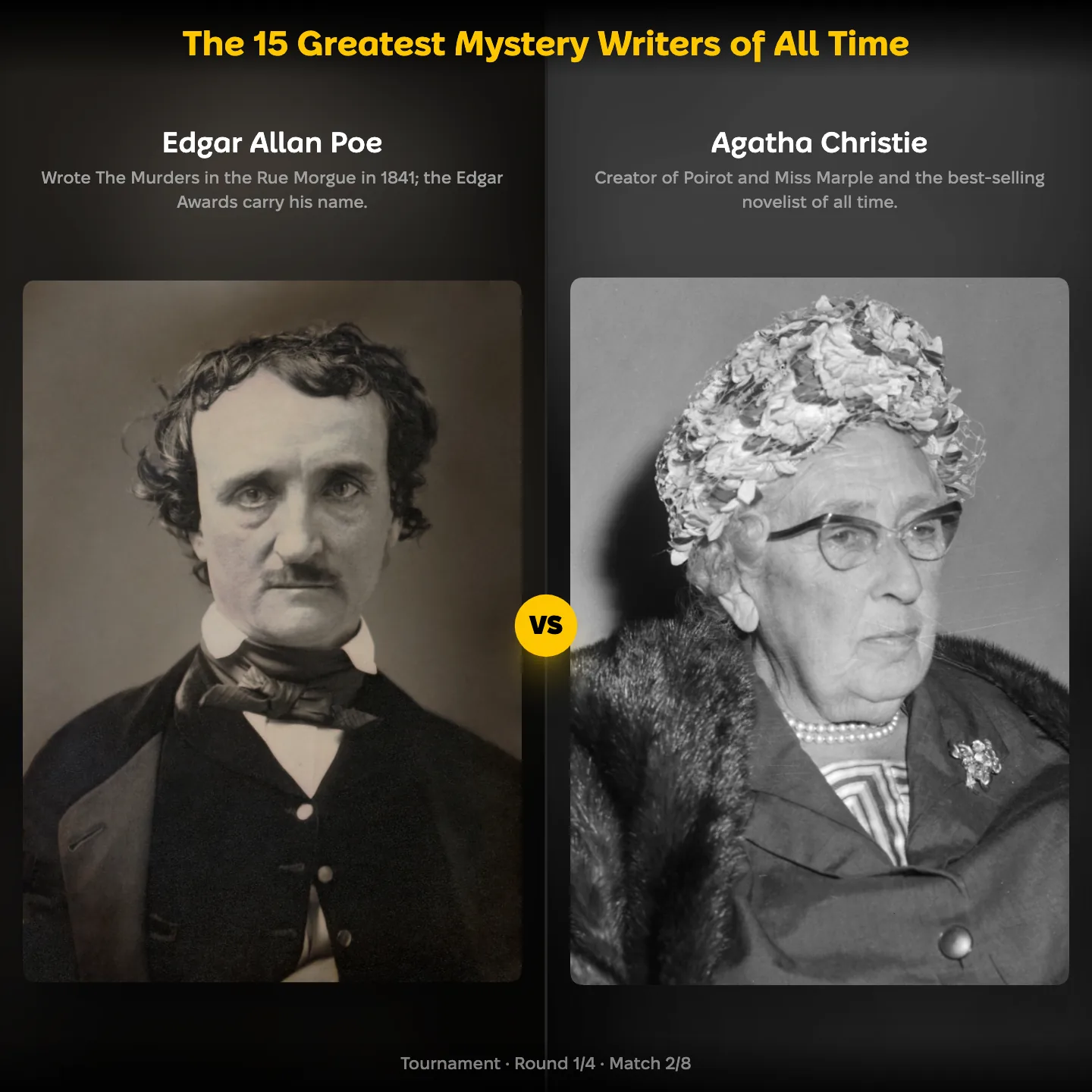
Poe vs Agatha Christie: the man the Edgar Awards are named for
The greatest mystery writers ranking is the one where Poe has the best paper claim. The Murders in the Rue Morgue appeared in Graham's Magazine in April 1841 and is usually described as the first modern detective story.3
Its rules survived intact: an eccentric amateur genius, a loyal friend narrating, a locked room and a solution revealed before the reasoning behind it. Arthur Conan Doyle and Agatha Christie both built on that frame.
The genre's own trade body acknowledges the debt. Since 1946 the Mystery Writers of America have handed out the Edgar Awards, named after Poe as a pioneer of the form.4
Christie's counter-case is volume and craft. Poe wrote three Dupin stories, Christie wrote dozens of novels, and Raymond Chandler, Dorothy L. Sayers and Georges Simenon each turned the template into something Poe never imagined.
Emily Dickinson vs Poe: the top American poets
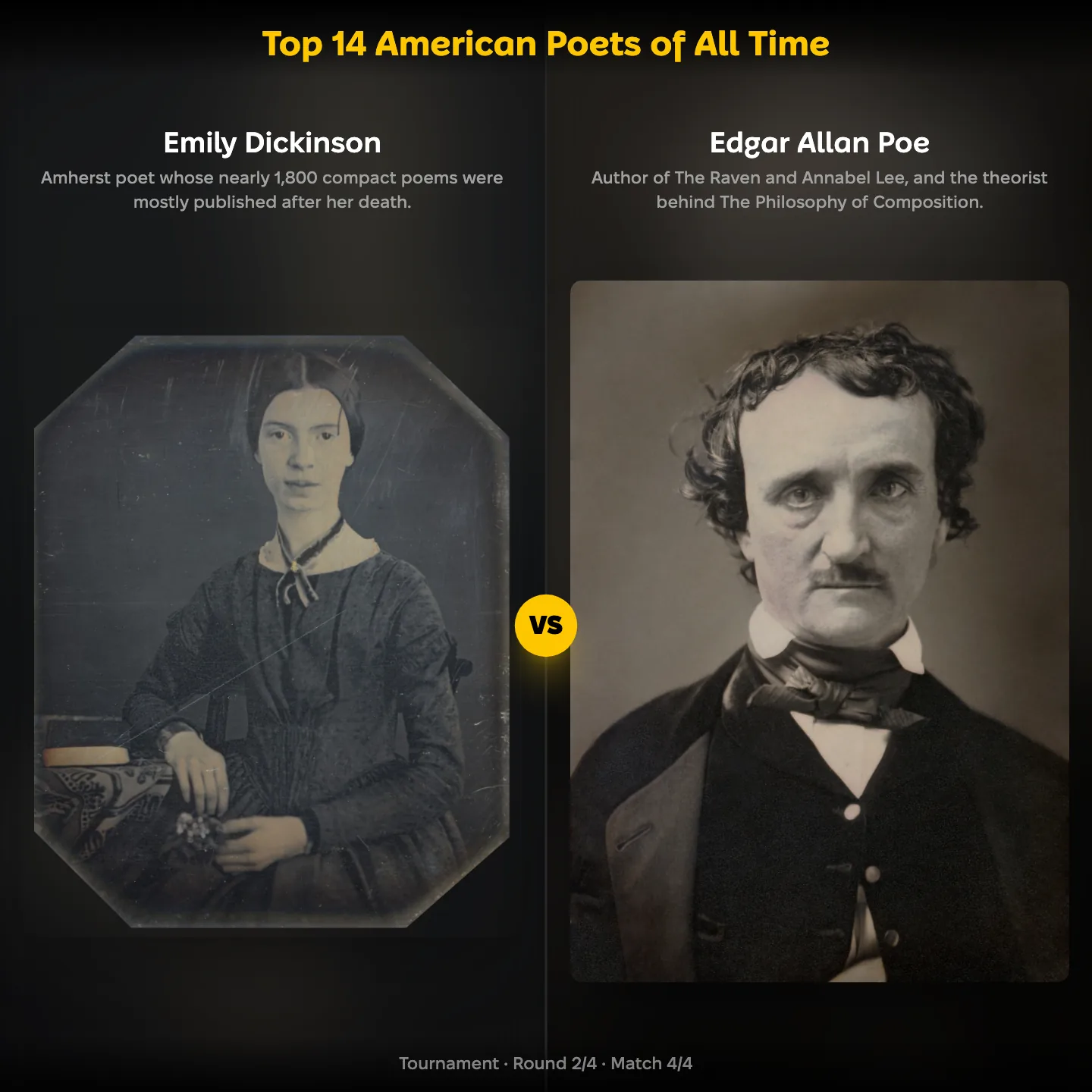
Poe thought of himself as a poet first, and the top American poets ranking takes him at his word.
Emily Dickinson is a sharp contrast. She published almost nothing in her lifetime, while Poe chased magazine fame and got it with one poem.
His competition here includes Walt Whitman, Robert Frost, Langston Hughes and Henry Wadsworth Longfellow, a rival Poe publicly accused of plagiarism in 1845.
Critics have never settled on Poe's verse. The musical repetition that makes Annabel Lee easy to memorise is the same quality later readers dismissed as mechanical.
The Raven vs Sonnet 18: the most famous poems ever written
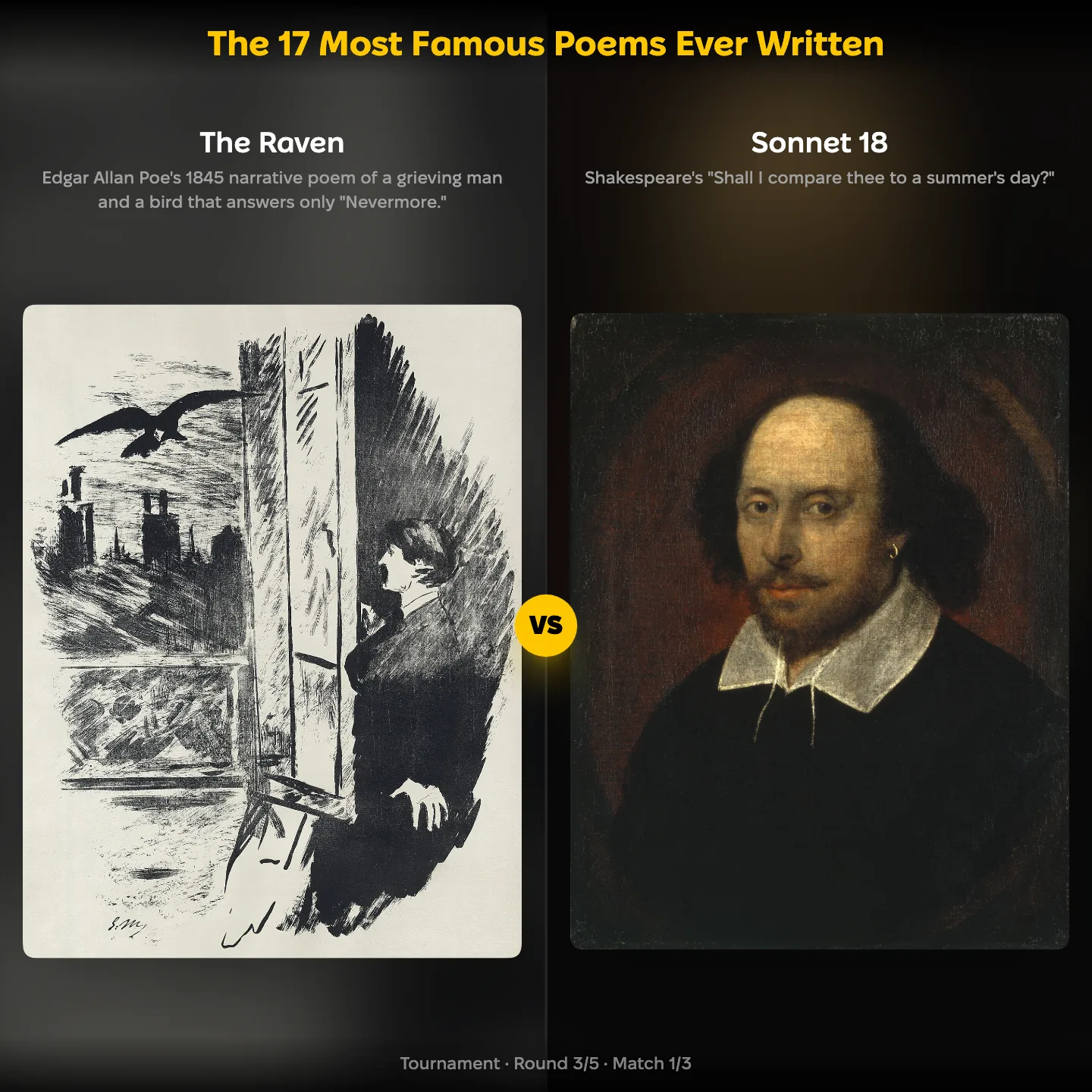
The most famous poems ranking does not list Poe himself; it lists The Raven, and that may be the more accurate measure of his fame.
The poem was printed in the New York Evening Mirror on 29 January 1845, ahead of its official appearance in the American Review. The Edgar Allan Poe Society records that the Review's editor paid $10 or $15 for it.5
It made Poe a celebrity almost overnight, and parodies appeared within weeks. "Nevermore" became a catchphrase that outlived everyone who first laughed at it.
Shakespeare's Sonnet 18, Frost's The Road Not Taken and Shelley's Ozymandias make this one of the hardest fields in the article.
Maya Angelou and Poe: the most quotable American writer
Maya Angelou, Mark Twain, Ralph Waldo Emerson and Dorothy Parker are the specialists on the most quotable American writer ranking, writers whose sentences were built to be repeated.
Edgar Allan Poe earns his place with fewer words. "All that we see or seem is but a dream within a dream" turns up on tattoos and posters, and "Quoth the Raven" needs no second half.

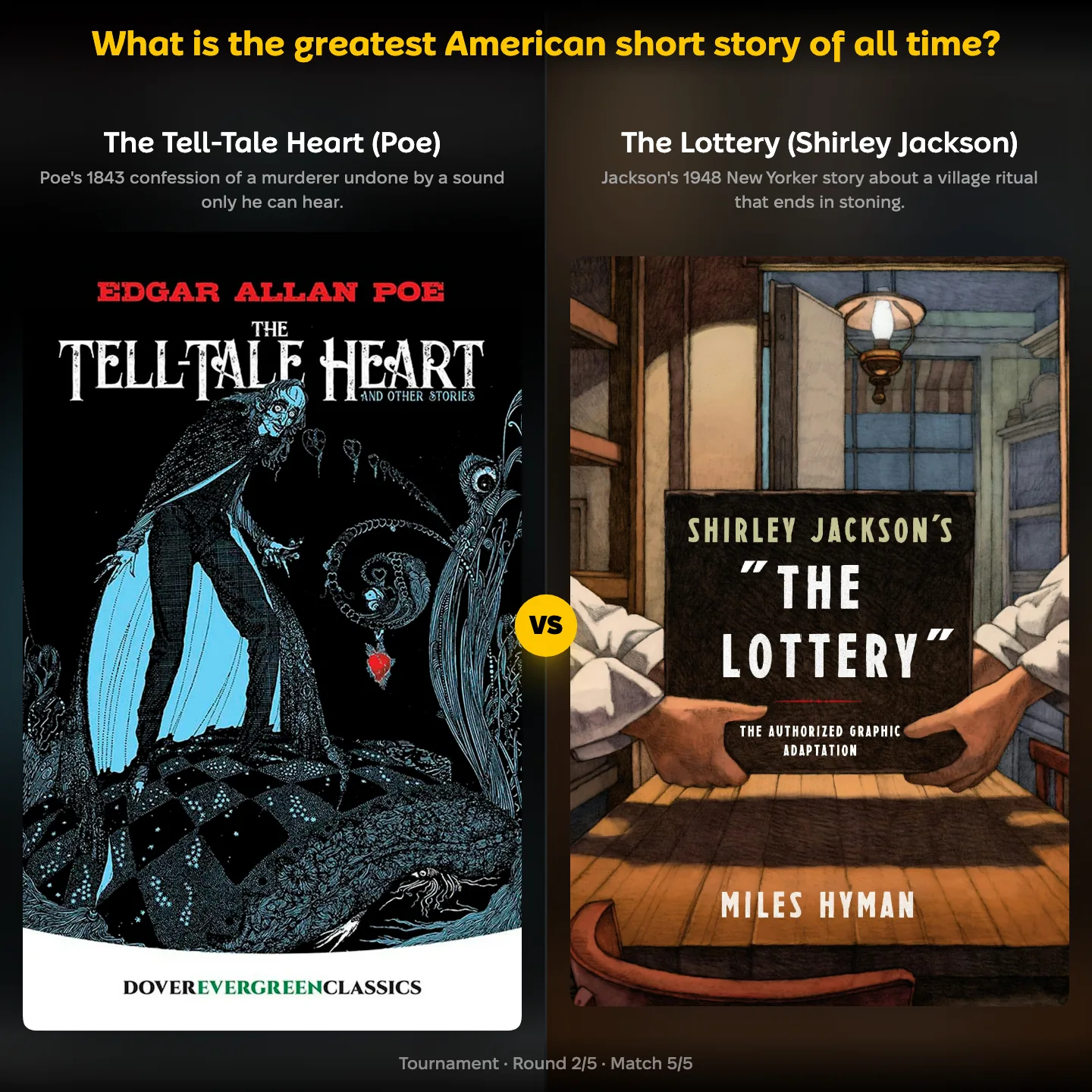
The Tell-Tale Heart vs The Lottery: the greatest American short story
Edgar Allan Poe wrote the theory of the short story as well as the stories, so this ranking sits close to the centre of his work.
The Tell-Tale Heart first ran in January 1843 in the debut issue of The Pioneer, a short-lived Boston magazine edited by James Russell Lowell, and Poe was likely paid $10.6
Shirley Jackson's The Lottery, published by The New Yorker in 1948, is the closest relative on the list: another short, flat-voiced story that ends in a killing. Hemingway, Fitzgerald, Flannery O'Connor and Raymond Carver fill the rest of the field.
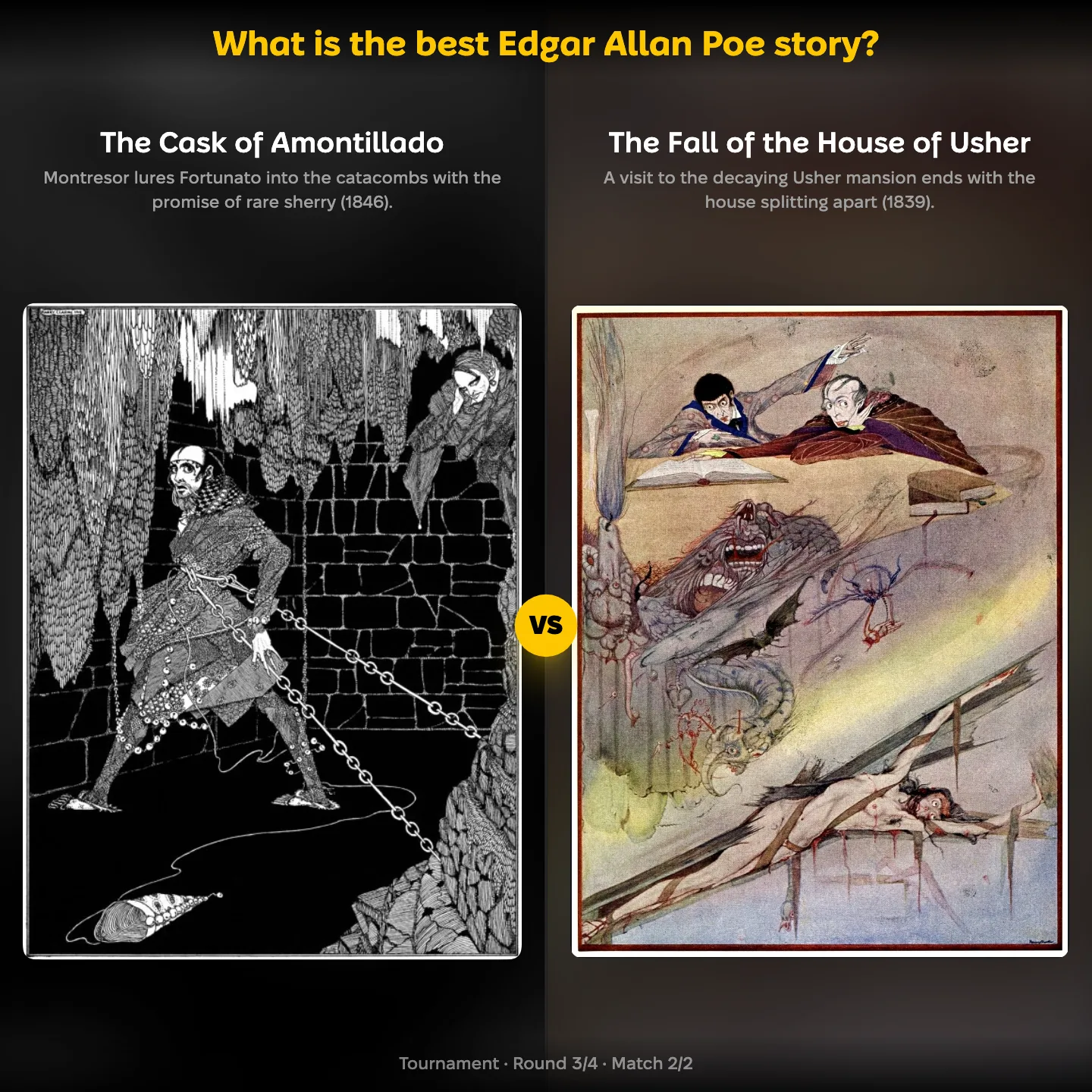
The Fall of the House of Usher vs The Cask of Amontillado
The best Edgar Allan Poe story ranking sets Poe against himself: fifteen of his tales and no other author.
The Fall of the House of Usher, from 1839, is the purest atmosphere piece: a decaying mansion, a sister buried too early and a crack running down the wall. The Cask of Amontillado, from 1846, is the opposite, a revenge story told in clipped dialogue with almost no description at all.
The detective tales, The Gold-Bug and the sea story A Descent into the Maelström show how far his range went beyond horror.
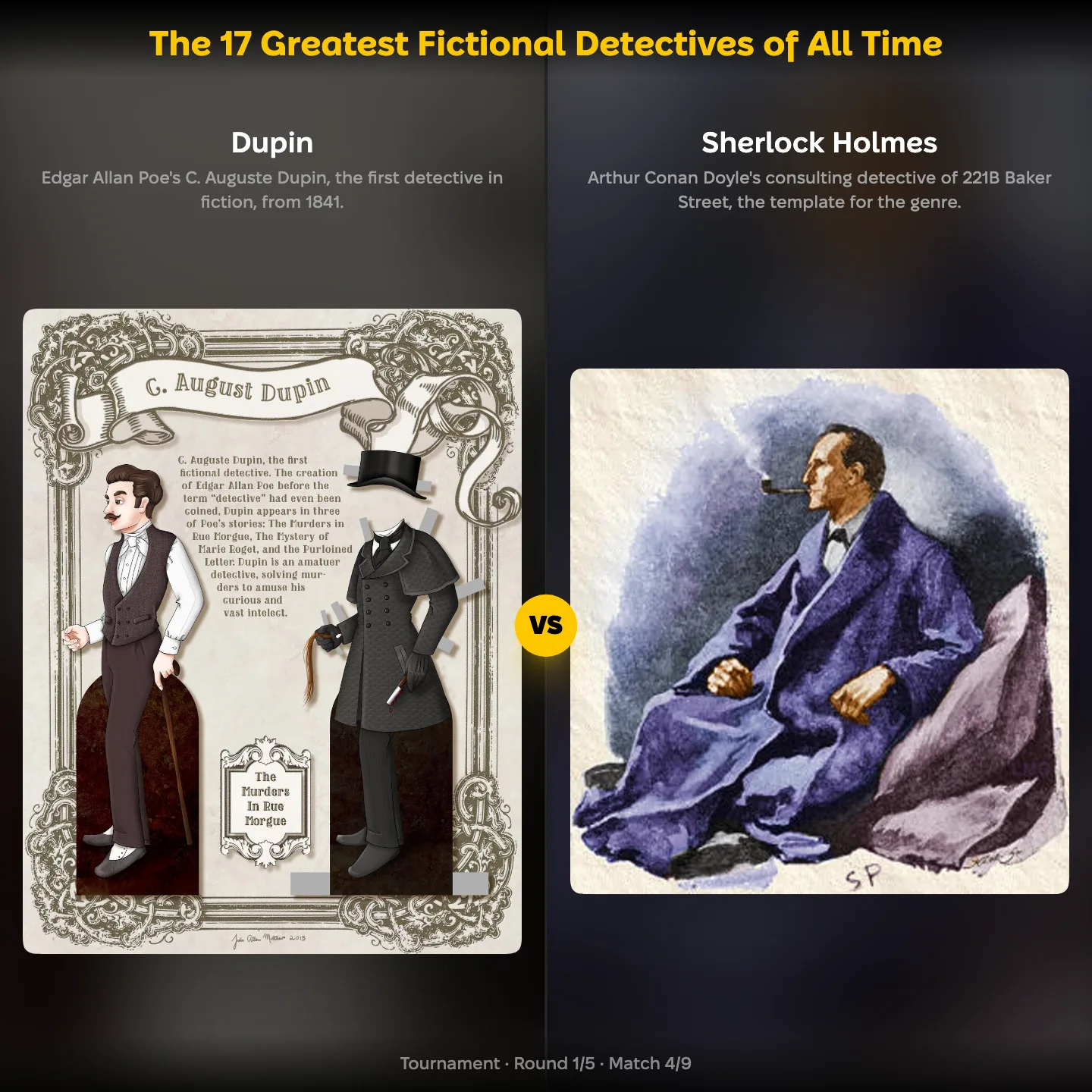
Sherlock Holmes vs Dupin: "a very inferior fellow"
The greatest fictional detectives ranking holds C. Auguste Dupin, the Paris amateur Poe created for The Murders in the Rue Morgue, and here Poe's invention looks small.
Sherlock Holmes himself delivered the verdict. In A Study in Scarlet, the 1887 novel that introduced him, Holmes calls Dupin "a very inferior fellow" with "some analytical genius" who was no phenomenon.7
Dupin appears in three stories. Holmes got four novels and 56 short stories, and Hercule Poirot and Columbo each ran for decades.
The prototype rarely survives contact with the models built on it. Every detective on this list inherited a habit from Dupin, and most readers have never heard his name.
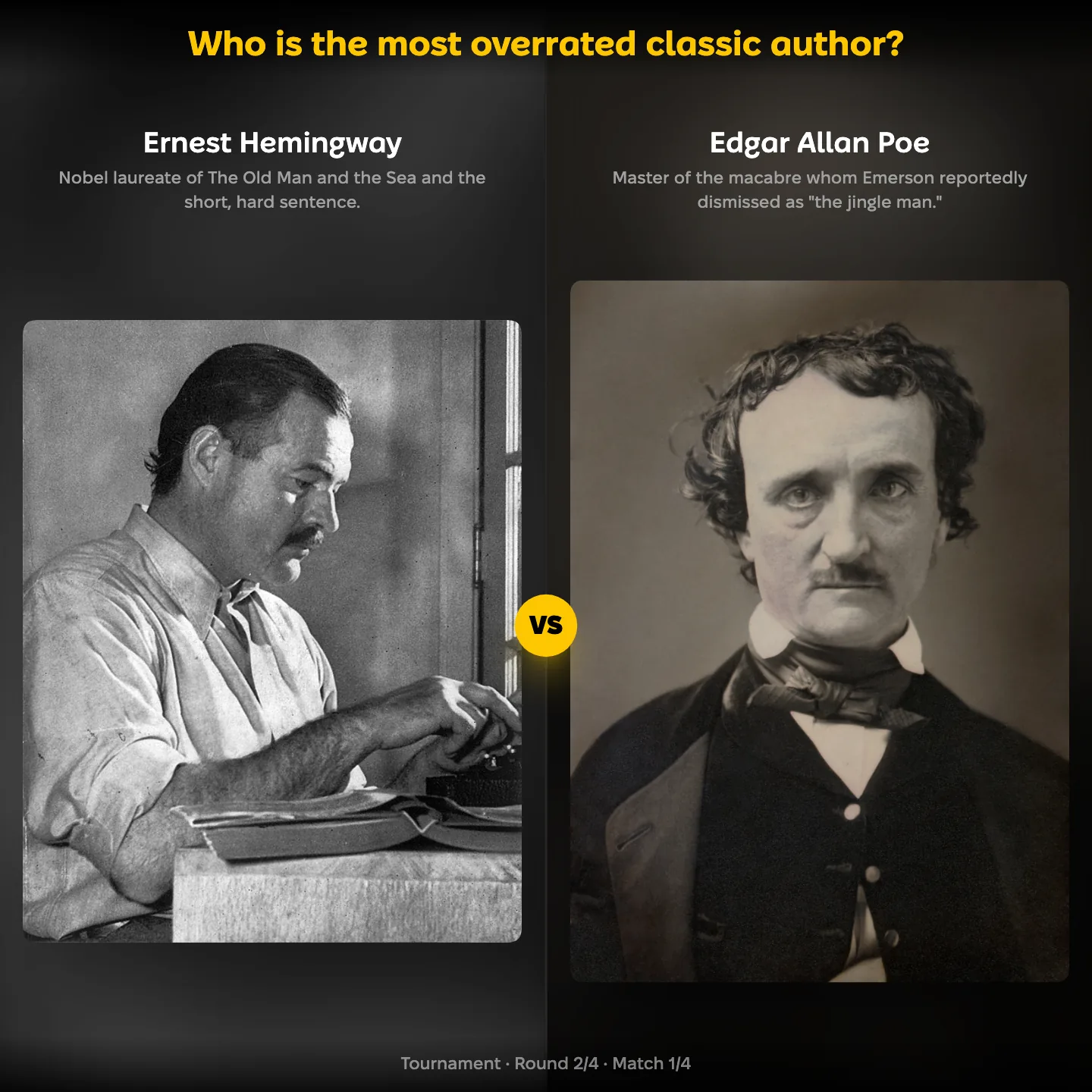
Hemingway vs Poe: the most overrated classic author
Poe has had detractors since the 1840s, which is why he belongs on the most overrated classic author list.
Ralph Waldo Emerson dismissed him as "the jingle man", a remark William Dean Howells recorded from a conversation with Emerson in his memoir.8 Henry James wrote that enthusiasm for Poe marked a primitive stage of reflection.
The case against him is that the rhythm is too obvious, the gothic furniture repetitive, and the reputation inflated by his dramatic death.
Ernest Hemingway, James Joyce and Ayn Rand face the same charge from other directions: too much reputation for too little range. Poe's defenders answer with the French. Baudelaire and Mallarmé took him more seriously than his own country did.
Born in Boston, buried in Baltimore: Poe vs Benjamin Franklin
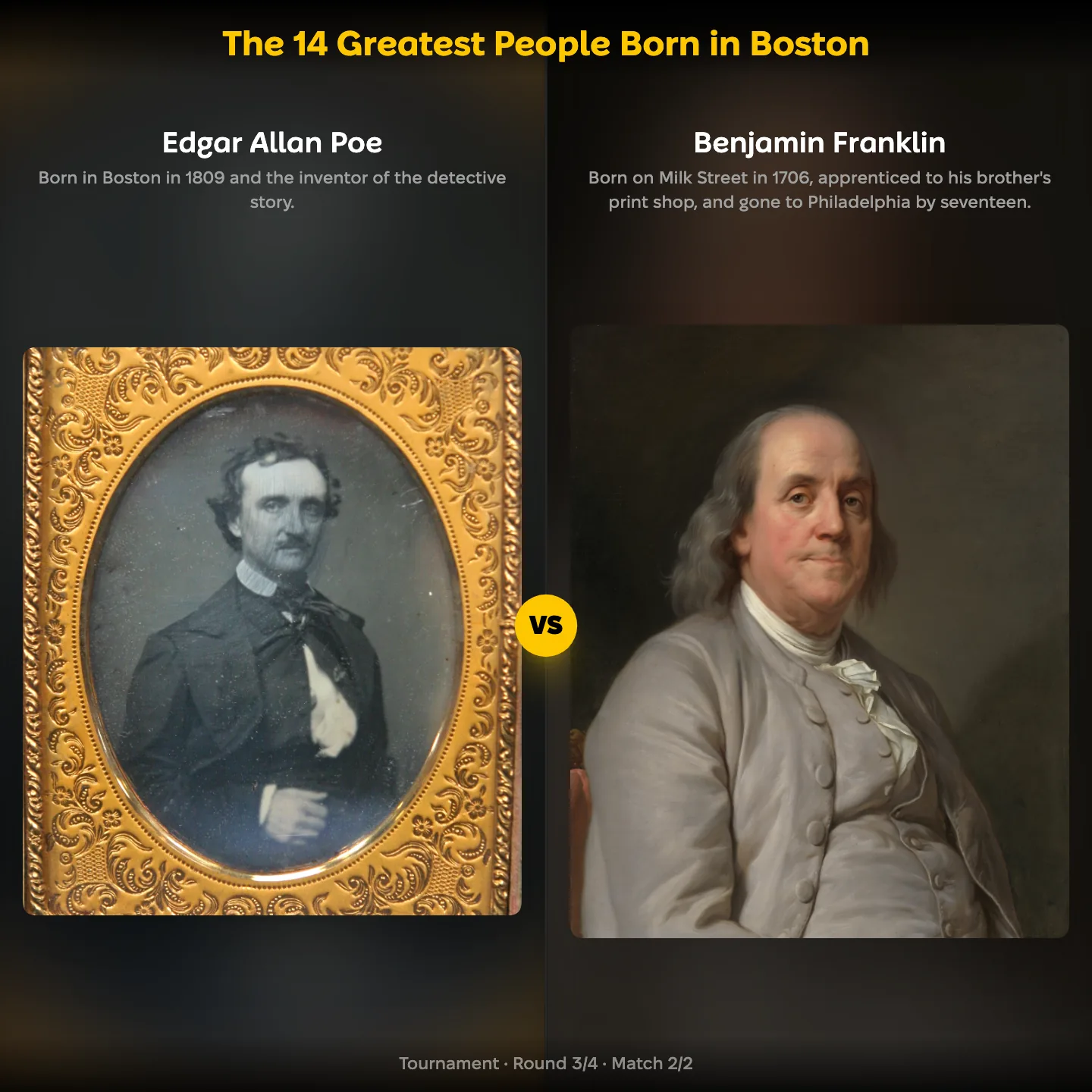
Edgar Allan Poe was born in Boston on 19 January 1809, to two touring actors, and that birthplace puts him on the greatest people born in Boston ranking.
He never claimed the city. Poe called Boston's literary establishment "Frogpondians" and spent his adult life in Richmond, Philadelphia, New York and Baltimore, where he is buried.
Benjamin Franklin, born on Milk Street in 1706, shares the list with John F. Kennedy, Samuel Adams and Ralph Waldo Emerson.
Baltimore Ravens vs Chicago Bears: an NFL mascot from a poem
The best animal mascot in American sports ranking holds no writer at all. It holds the Baltimore Ravens, the only NFL team named after a poem.
When the Cleveland franchise moved to Baltimore, The Baltimore Sun ran a phone vote. A record 33,748 callers took part, 22,463 of them chose Ravens, and the name was announced on 29 March 1996.9 The club's own history page credits the "mythical bird in a famous poem".
The Chicago Bears, the Detroit Lions and the Philadelphia Eagles chose real animals. The Ravens chose literature.

Treehouse of Horror, 1990: James Earl Jones reads The Raven
The best Halloween TV special ranking includes The Simpsons' Treehouse of Horror, and Edgar Allan Poe helped launch it.
The first episode aired on Fox on 25 October 1990 and closed with an adaptation of The Raven, narrated by James Earl Jones, with Homer as the narrator and Bart as the bird.10 The anthology became an annual tradition.
Its main rival is It's the Great Pumpkin, Charlie Brown, from 1966. Disney, Garfield and Toy Story specials complete the list.

Boris Karloff's The Raven: Corman, Price and a young Jack Nicholson
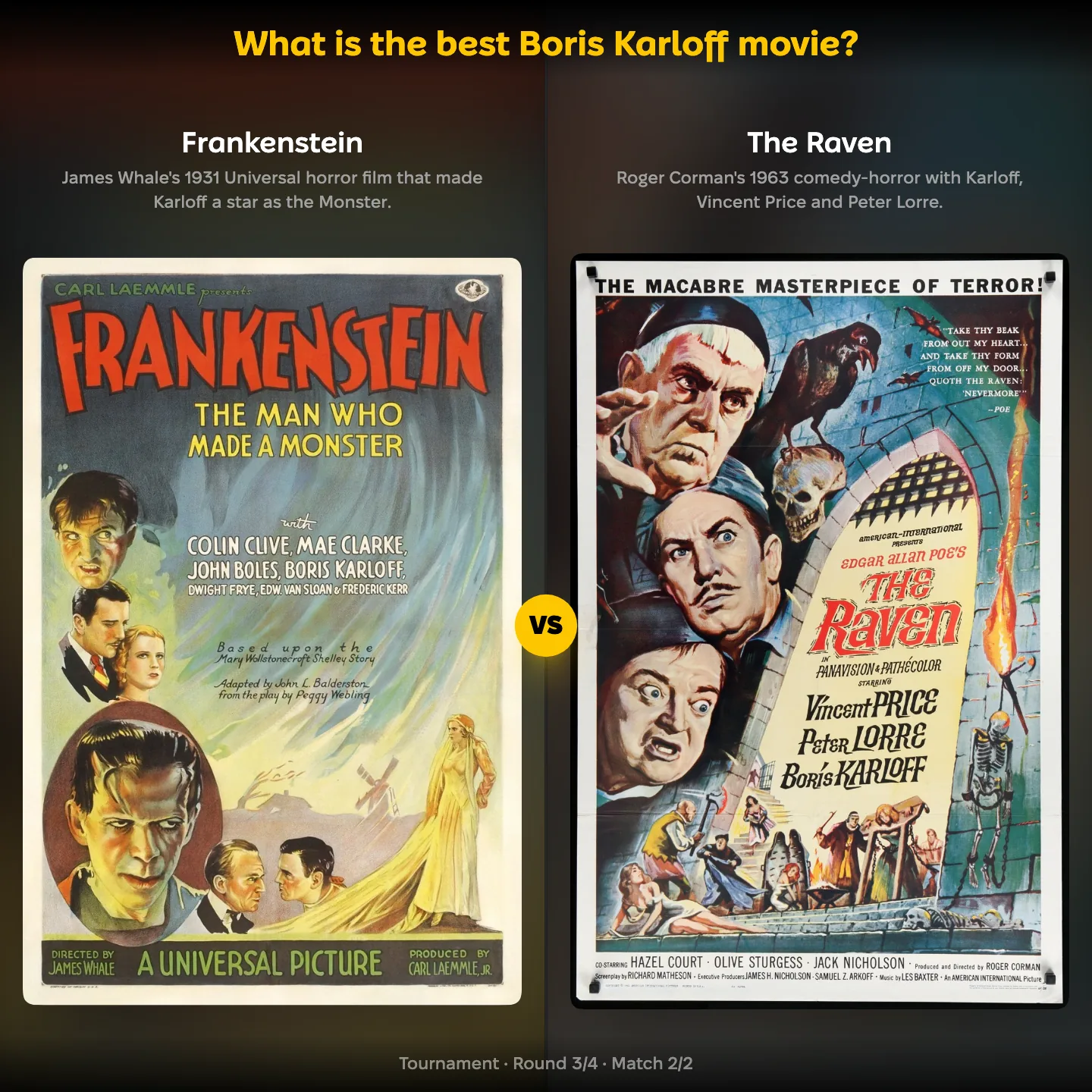
The best Boris Karloff movie ranking is dominated by Frankenstein, Bride of Frankenstein and The Mummy. The 1963 film The Raven is there too.
Roger Corman directed it as the fifth of eight Poe films he made in the early 1960s. Vincent Price, Peter Lorre and Karloff play rival sorcerers, and Jack Nicholson has a supporting role.11
The plot owes Poe little beyond the title and a talking bird. It plays as a comedy.
Netflix's Usher vs Hill House: Mike Flanagan's two houses
The best Netflix horror series ranking puts Poe's newest adaptation against the show that made its director famous.
Mike Flanagan's The Fall of the House of Usher arrived on Netflix on 12 October 2023 in eight episodes. Each takes its title from a Poe work, from The Masque of the Red Death to The Gold-Bug, and the finale is named after The Raven.12 The series turns the Ushers into a pharmaceutical dynasty.
Flanagan's own The Haunting of Hill House, from 2018, is the strongest competitor. Stranger Things, Midnight Mass and the Korean zombie drama Kingdom complete the shortlist.

Three careers, one man
Poe spent his working life underpaid and in debt. The fifteen rankings show what that work produced: a genre with its own awards, a poem that named a football team, and a horror tradition that Lovecraft and Netflix both drew on. Most of these lists claim one Poe and ignore the other two. The full picture only appears when you put them side by side and decide one pair at a time.
If another writer sprawls across this many shelves, start a ranking of your own and see where they land.
More rankings, more angles
- Stephen King: King of Horror? Only 3 of His 16 Lists Are Horror — Kubrick, Morgan Freeman and epic fantasy
- Best Mystery Writer of All Time? Agatha Christie on 15 Lists — Roger Ackroyd at one hundred
- Hemingway vs Fitzgerald: One Won the Nobel, One Wrote Gatsby — Paris, 1925, and a cut manuscript
Sources
- Wikipedia — Death of Edgar Allan Poe (found 3 October 1849, died 7 October, cause undetermined, no death certificate): en.wikipedia.org (checked 2026-10-13)
- Baltimore Fishbowl — 2026 International Edgar Allan Poe Festival, 2–4 October, Lexington Market: baltimorefishbowl.com (checked 2026-10-13)
- Wikipedia — The Murders in the Rue Morgue (Graham's Magazine, April 1841; first modern detective story): en.wikipedia.org (checked 2026-10-13)
- Wikipedia — Edgar Awards (Mystery Writers of America, named after Poe, established 1946): en.wikipedia.org (checked 2026-10-13)
- Edgar Allan Poe Society of Baltimore — "The Raven" publication history and payment: eapoe.org (checked 2026-10-13)
- Wikipedia — The Tell-Tale Heart (The Pioneer, January 1843; likely paid $10): en.wikipedia.org (checked 2026-10-13)
- Project Gutenberg — Arthur Conan Doyle, A Study in Scarlet, chapter II: gutenberg.org (checked 2026-10-13)
- Knowing Poe (Maryland Public Television) — Emerson's "jingle-man", quoted by W. D. Howells: knowingpoe.thinkport.org (checked 2026-10-13)
- Baltimore Ravens — Naming the team (33,748 callers, 22,463 votes, 29 March 1996): baltimoreravens.com (checked 2026-10-13)
- Wikipedia — Treehouse of Horror (25 October 1990, The Raven narrated by James Earl Jones): en.wikipedia.org (checked 2026-10-13)
- Wikipedia — The Raven (1963 film), fifth of eight films in the Corman–Poe cycle: en.wikipedia.org (checked 2026-10-13)
- Wikipedia — The Fall of the House of Usher (miniseries), released 12 October 2023, eight episodes: en.wikipedia.org (checked 2026-10-13)