
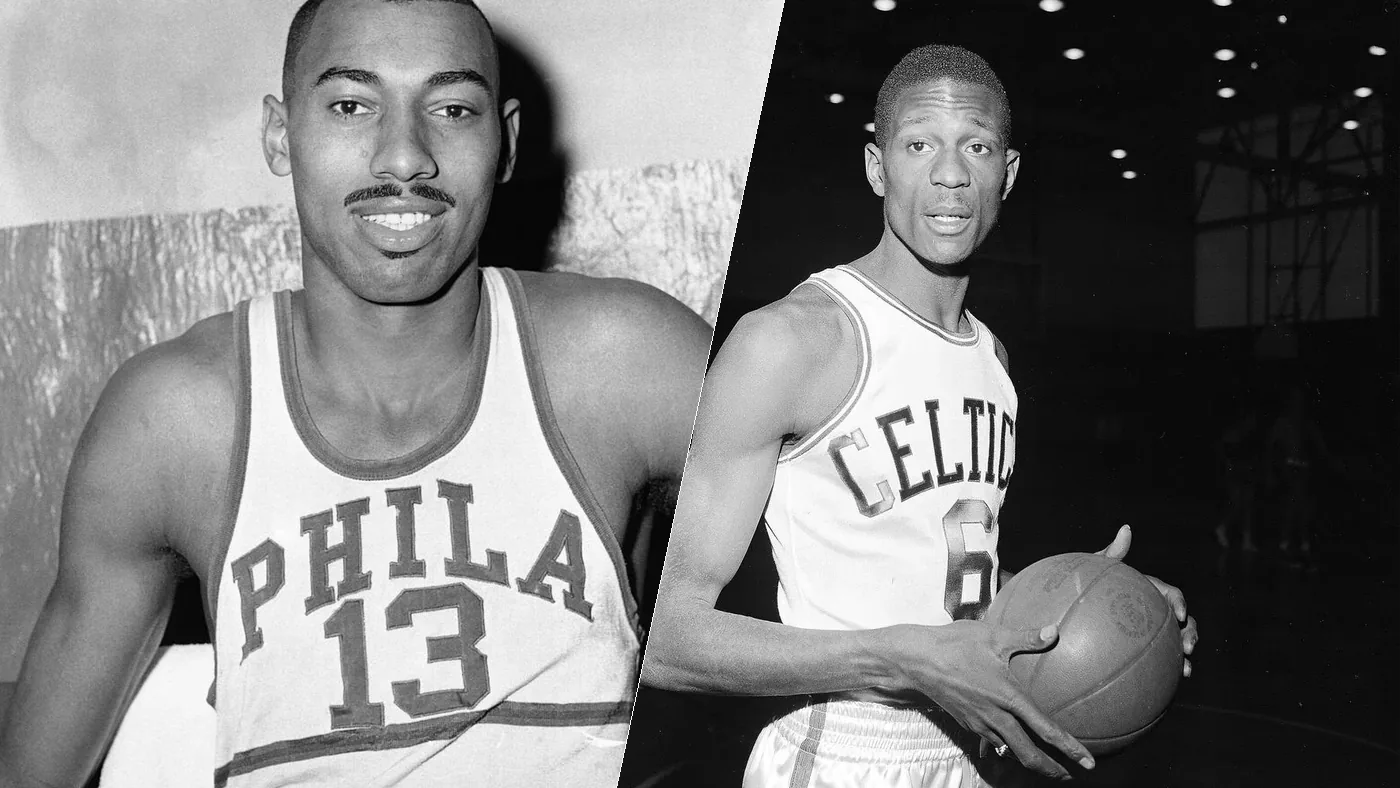
Wilt Chamberlain and Bill Russell faced each other 143 times: 94 games in the regular season, 49 in the playoffs. Chamberlain averaged 30.0 points a game in those meetings and Russell 14.2. Russell's teams won 86 of them.1
The 2026–27 season tips off on 20 October, sixty years after the one season that came out the other way. In 1966–67 Chamberlain's Philadelphia 76ers went 68–13 and put Boston out 4–1.2
Fifteen questions on this site contain one of them. Most contain both.
Measure a career one night at a time and Chamberlain is untouchable. Measure it one season at a time and Russell is. Sixty years on, basketball still has not agreed which clock to read.
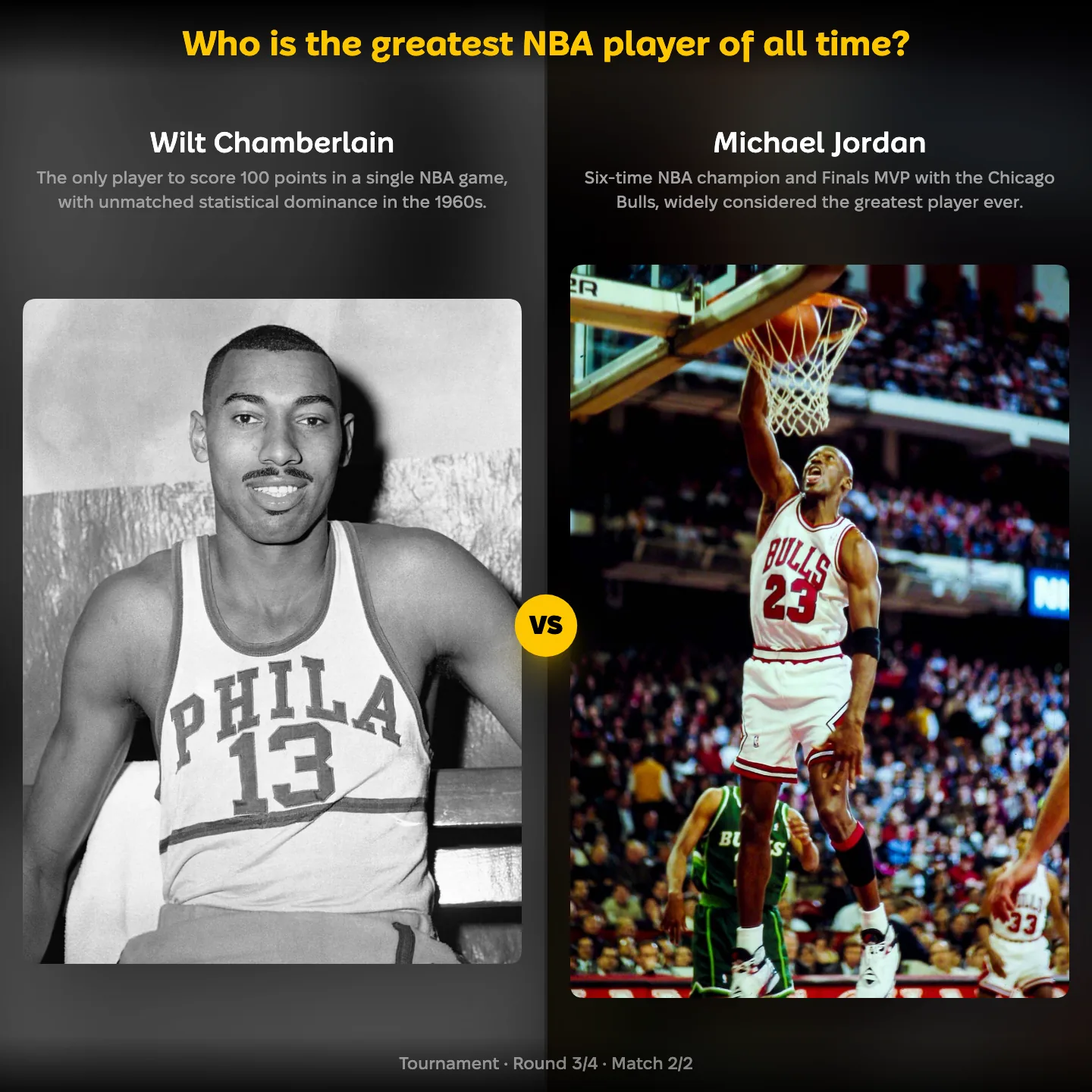
Wilt Chamberlain vs Michael Jordan: the all-time list neither of them owns
The broadest basketball question here opens with fourteen names, Chamberlain and Russell among them.
Chamberlain brings the numbers nobody has matched: 30.1 points a game across fourteen seasons, seven straight scoring titles and eleven rebounding titles.3
Russell brings the trophy case: five MVP awards, and eleven titles in the thirteen years he played, while averaging 15.1 points.4
Neither profile is what this question usually turns on. Michael Jordan, LeBron James, Kareem Abdul-Jabbar and Magic Johnson sit in the same fourteen, and all four played to a national television audience with the footage to prove it. The two 1960s centres spent most of their careers in front of nobody but the people in the arena.
Best NBA centre: the position they both defined
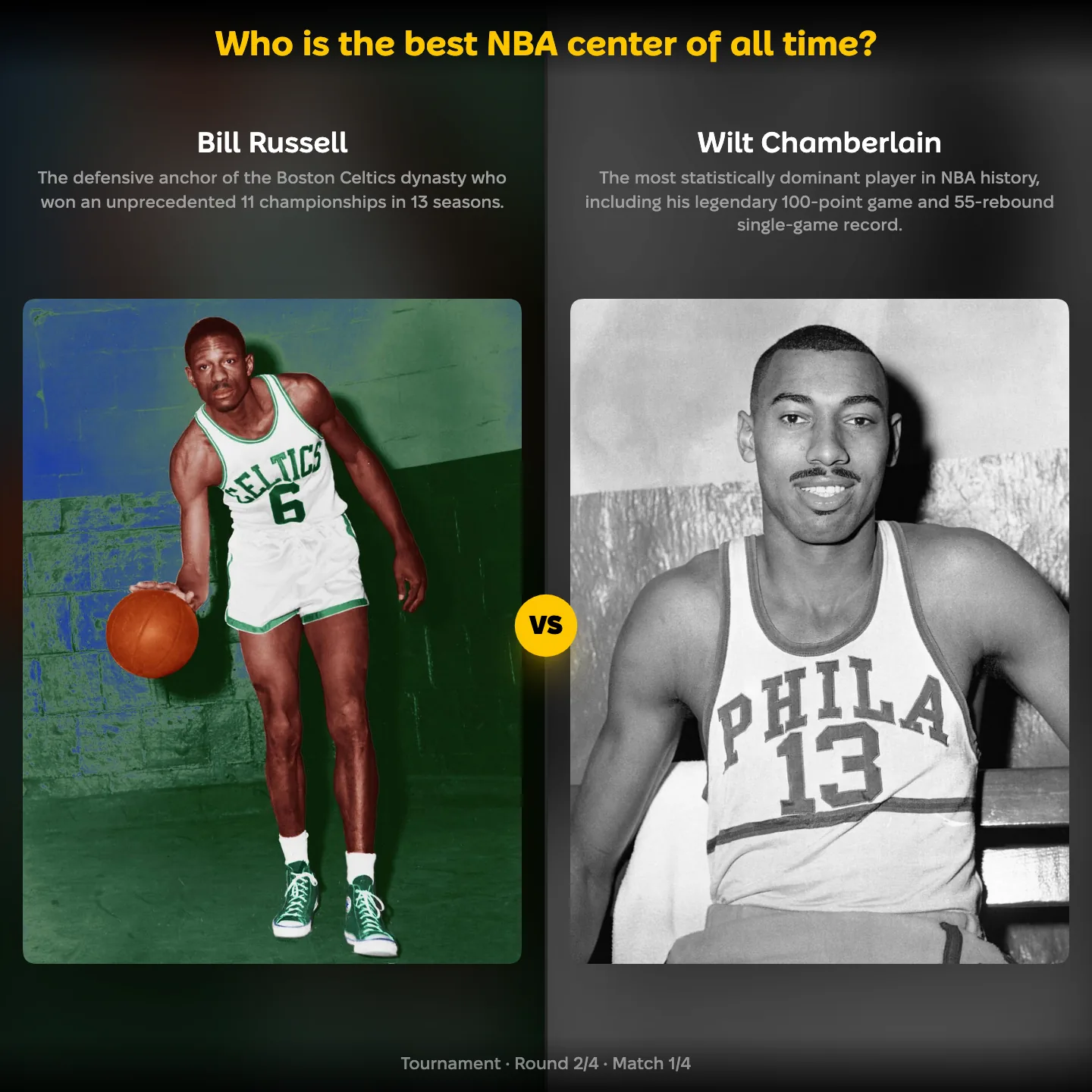
Narrow the same question to the position both men played and the field halves.
This is where Chamberlain and Russell stop being two names among many. They played the same position in the same league at the same time, and between them they made the centre spot the axis of the sport for two decades.
Kareem Abdul-Jabbar answers with longevity, Hakeem Olajuwon with footwork, Shaquille O'Neal with an era people actually watched. Each of the three has something the 1960s pair cannot produce.
The 1960s: Russell, Chamberlain and Oscar Robertson
Restrict the question to their own decade and a third name walks in.
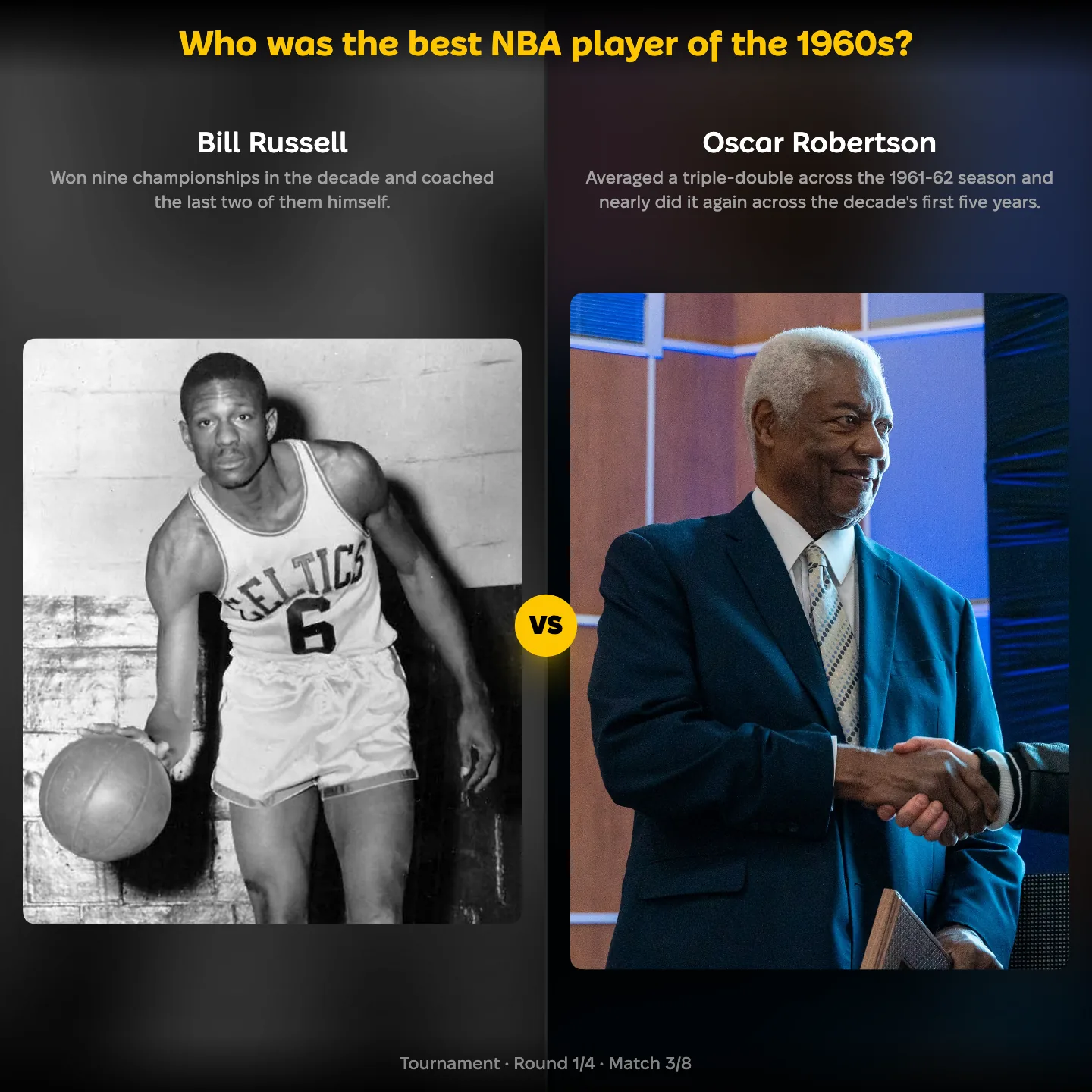
Russell won nine championships inside those ten years and coached the last two of them himself, having taken the Celtics job in April 1966 without giving up his place on the floor.4
Chamberlain spent the same decade rewriting the record book. The 50.4 points a game he averaged in 1961–62 is the only fifty-point season anyone has had, and in 1968 he led the league in assists, which no centre has done since.3
Oscar Robertson averaged a triple-double across 1961–62 and something close to one over the decade's first five years. Whichever centre a reader prefers, Robertson makes the decade harder than it looks.
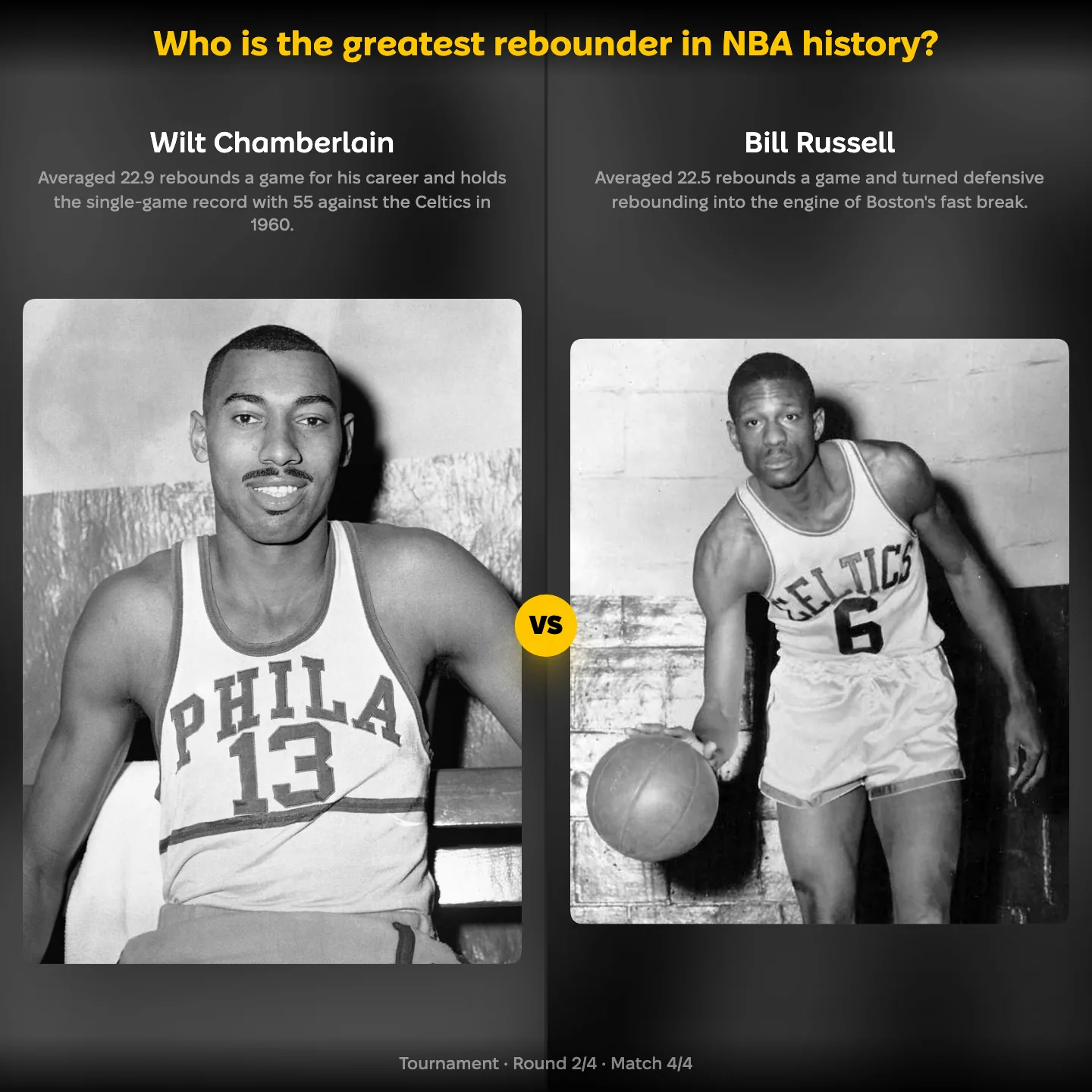
Rebounding: 22.9 against 22.5
The closest comparison in the article. Chamberlain's career average is 22.9 rebounds a game and Russell's is 22.5, first and second on the all-time list.3 Chamberlain is also the only player to average 30 points and 20 rebounds in a season, which he managed seven times.
The single-game record belongs to Chamberlain: 55 rebounds on 24 November 1960, in a home defeat to Russell's Celtics.3 Russell's own best is 51, against Syracuse nine months earlier.4
Russell's defenders point at what the rebound was for. Boston's offence started with him clearing the defensive glass and throwing the outlet pass, so his totals were the first move of a fast break rather than a total in themselves.
Dennis Rodman and Moses Malone keep this from being a two-man question. Both led the league repeatedly in eras that produced far fewer missed shots to collect.
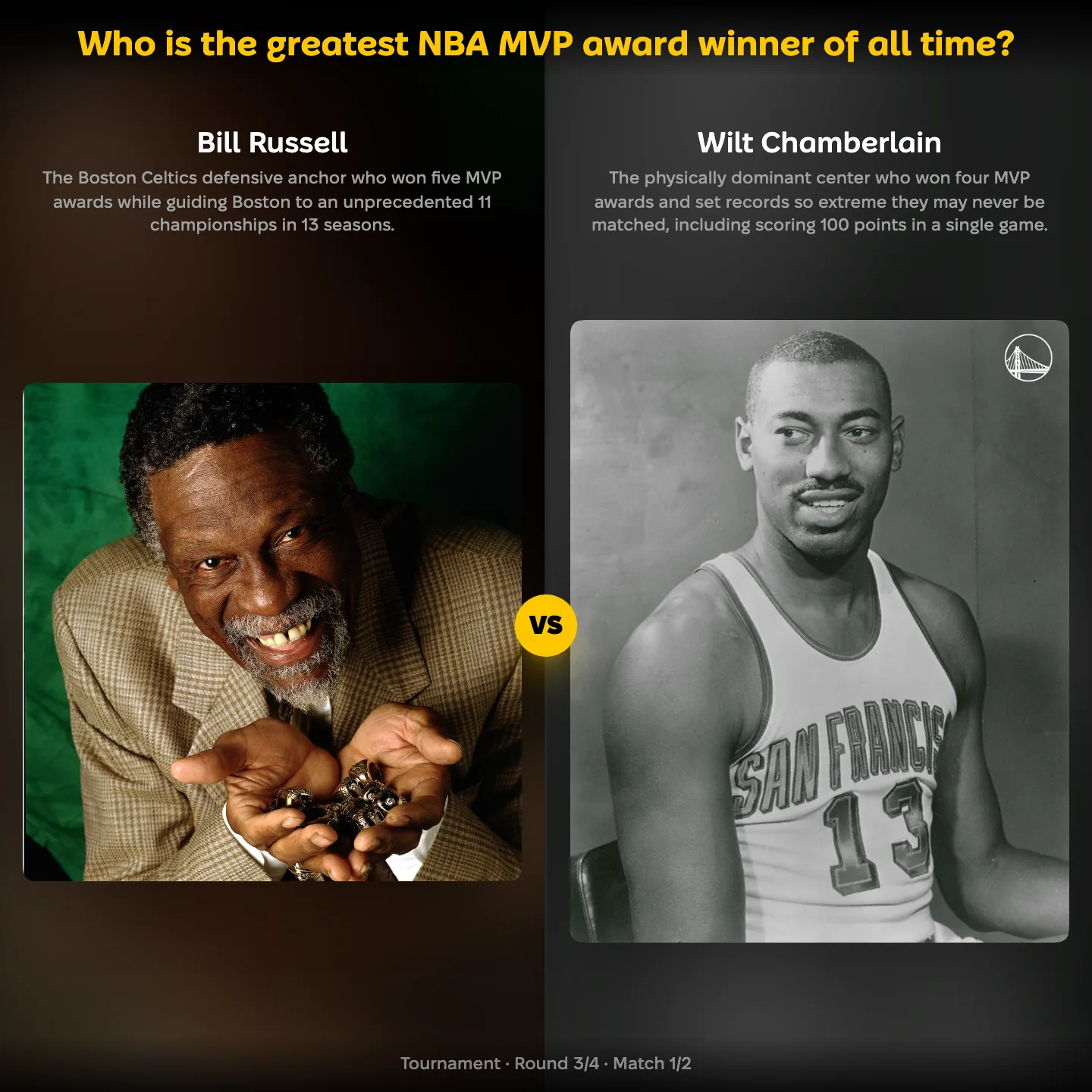
Five MVPs against four, decided by the same voters
Between 1958 and 1968 these two took nine of the eleven MVP awards, five for Russell and four for Chamberlain.
That split is the oddest fact in the rivalry, because one electorate produced both halves of it. Russell's five arrived while he was scoring fifteen a game. Chamberlain's four arrived in seasons when he was outscoring everyone who had ever played.
The award has since gone to players built on neither profile. Kareem Abdul-Jabbar has six, Michael Jordan five, LeBron James four, and the modern MVP reads as a scoring-and-efficiency prize rather than a vote on who is hardest to play against.
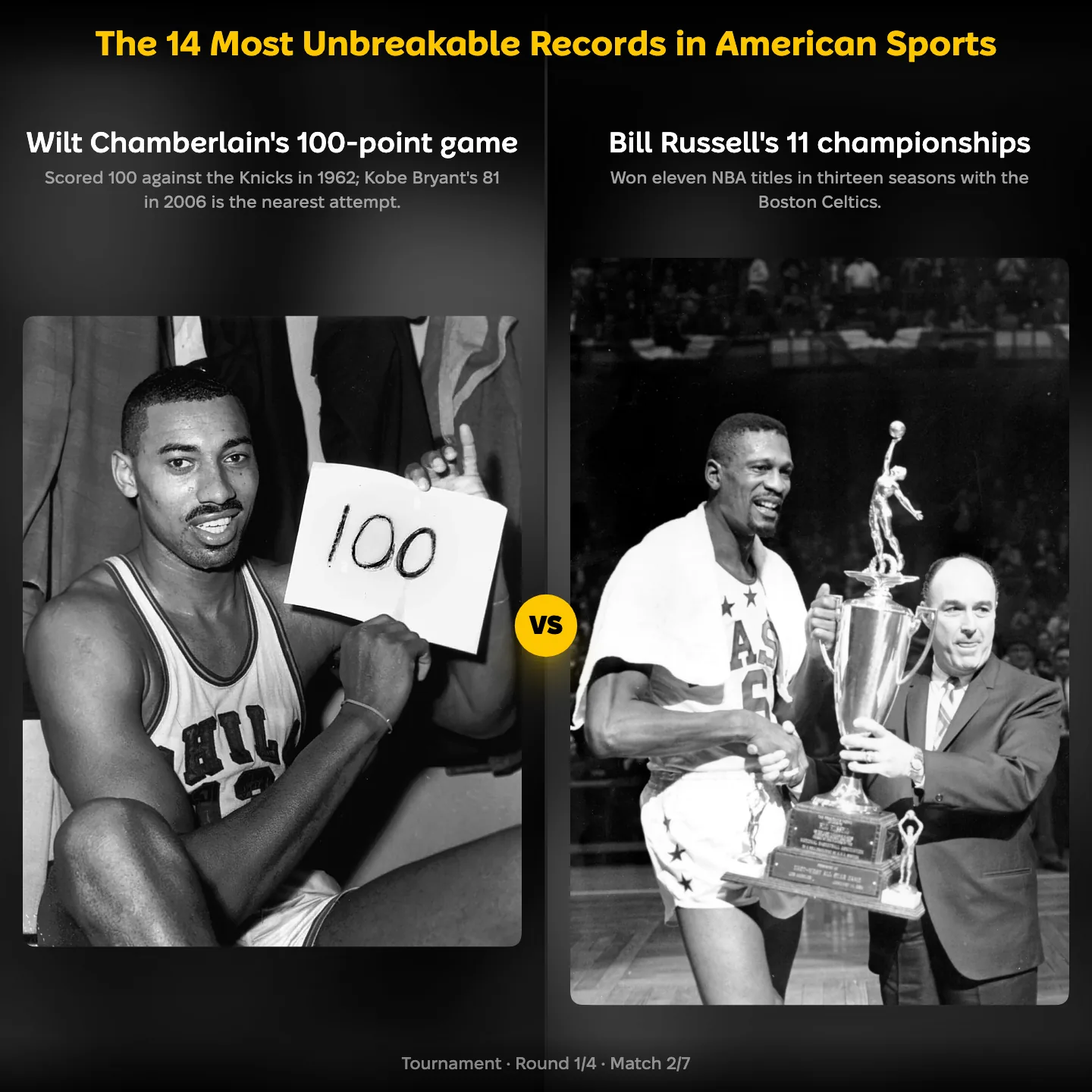
Unbreakable records: Chamberlain and Russell as two list entries
Leave basketball's own lists and the pair turn up on a wider American sports ranking as records rather than as players. One entry is Chamberlain's hundred-point night. The other is Russell's eleven championships.
Sixty years of debate, compressed into two lines of a fourteen-item list. Neither man ever quite settles it, because the two entries are not being measured on the same axis.
The company makes the point again. Joe DiMaggio's 56-game hitting streak, Cal Ripken's 2,632 consecutive games and Wayne Gretzky's 2,857 career points are all things one career did. Russell's entry took a whole roster.
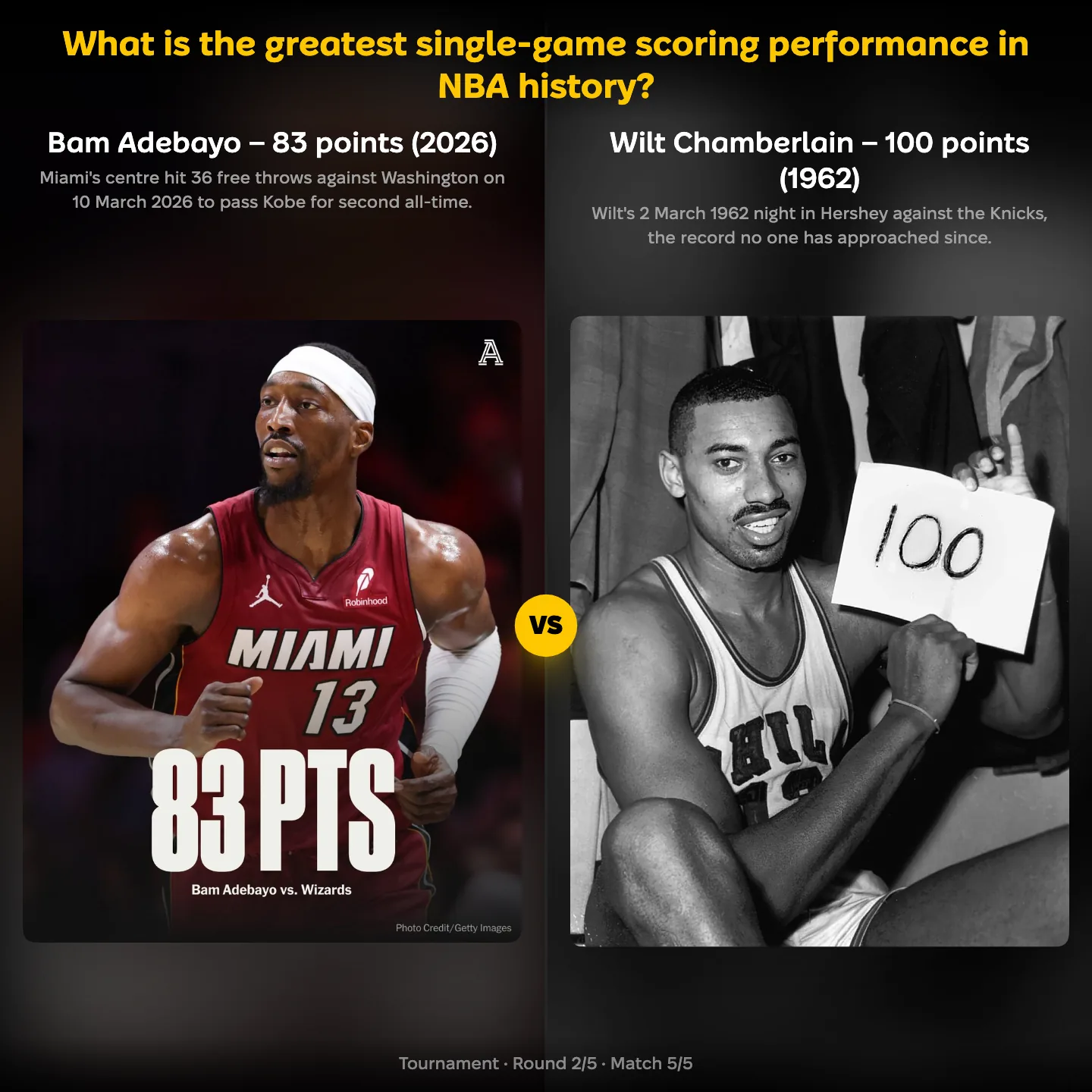
Hershey, 2 March 1962: the list Bill Russell cannot enter
Chamberlain scored 100 points against the New York Knicks in Hershey, Pennsylvania, on 2 March 1962.3 No film of it survives and 4,124 people were in the building.5
It has been the outer limit of the sport for sixty-four years, and it survived its closest examination six months ago. Bam Adebayo put up 83 for Miami on 10 March 2026, passing Kobe Bryant's 81 from 2006 and setting a free-throw record of his own with 36 made from 43. He still stopped seventeen short.6
Russell has no entry on this list. In thirteen seasons he never once led the league in scoring.4
That absence states the difference between them more cleanly than any comparison could. The question asks for the best single night anyone has had, and one of the two most decorated centres in the sport never had one.
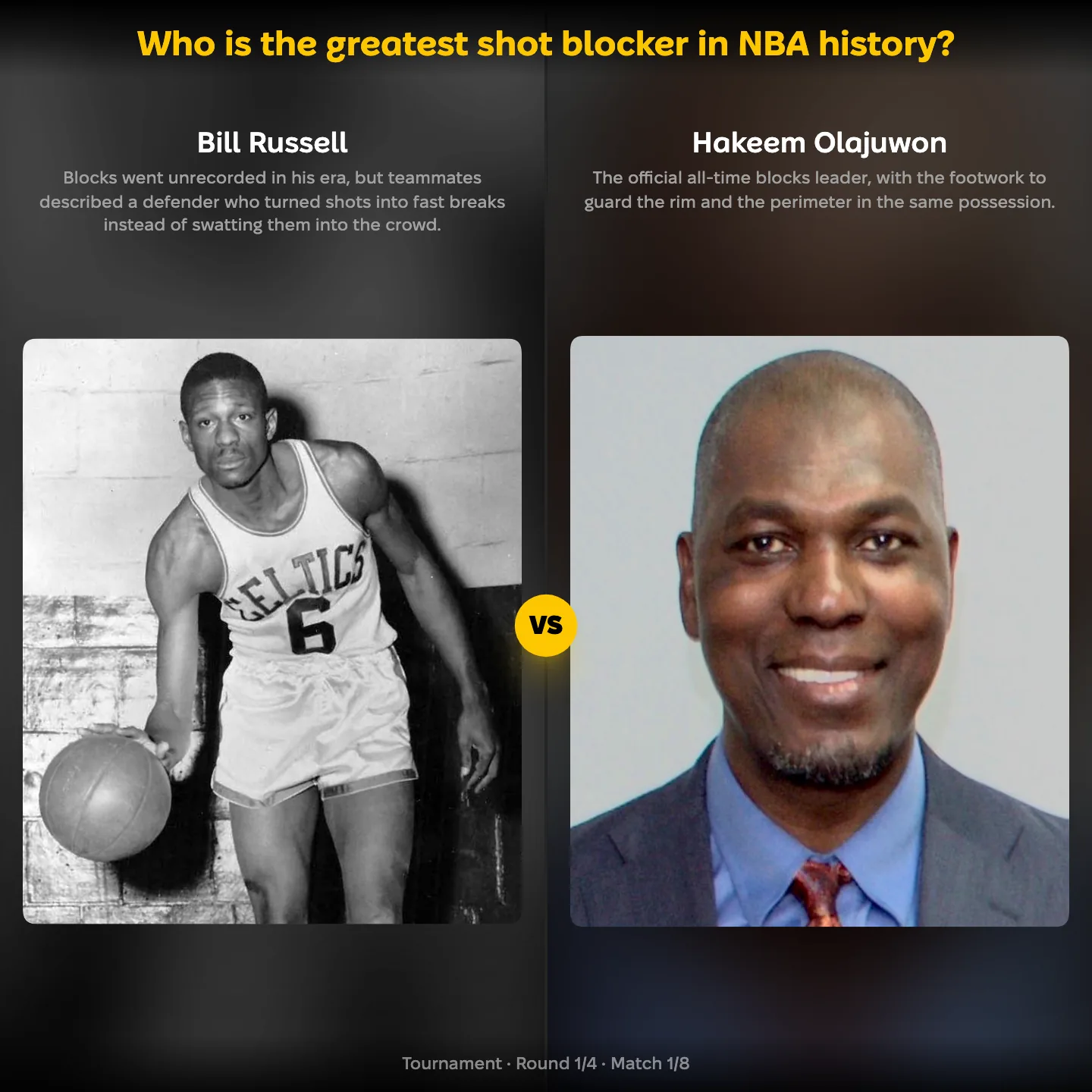
Shot blocking: Bill Russell against Hakeem Olajuwon and the missing box score
Blocked shots were not a recorded NBA statistic until 1973–74, four years after Russell retired and one after Chamberlain did. Neither man has an official career total.4
What survives for Russell is a private tally. Boston writers counted his blocks by hand across 135 games and came out at 8.1 a night, a figure no player has averaged in any season since the league started keeping count.4
Hakeem Olajuwon holds the official record with 3,830 blocks,7 and Dikembe Mutombo and Mark Eaton own the biggest seasons. Those three carry numbers. Russell and Chamberlain are on the list on the word of people who were in the gym.
Bill Russell vs Scottie Pippen: defence as the entire case
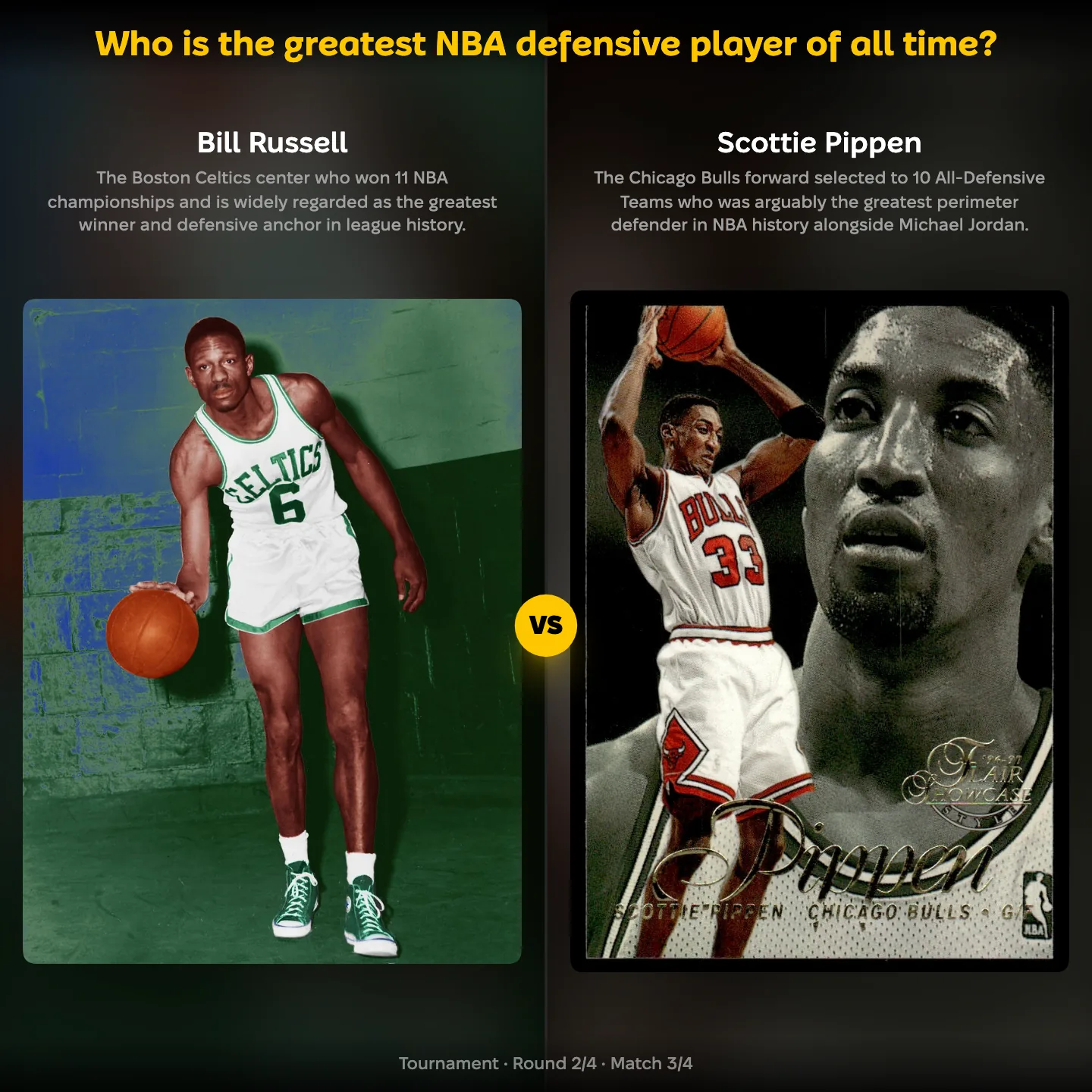
Chamberlain is missing here, and Russell is close to the premise of the question.
Defence is what Russell's eleven titles are usually credited to, and it is the one area where his contemporaries never proposed Chamberlain instead. He remains first all time in defensive win shares, comfortably clear of second.4
Scottie Pippen, Gary Payton and Dennis Rodman make the modern case that a perimeter defender changes more games than a centre does. All three have the All-Defensive selections to prove it. That honour was first awarded in 1968–69, Russell's final season.9
Boston: Bill Russell against Larry Bird
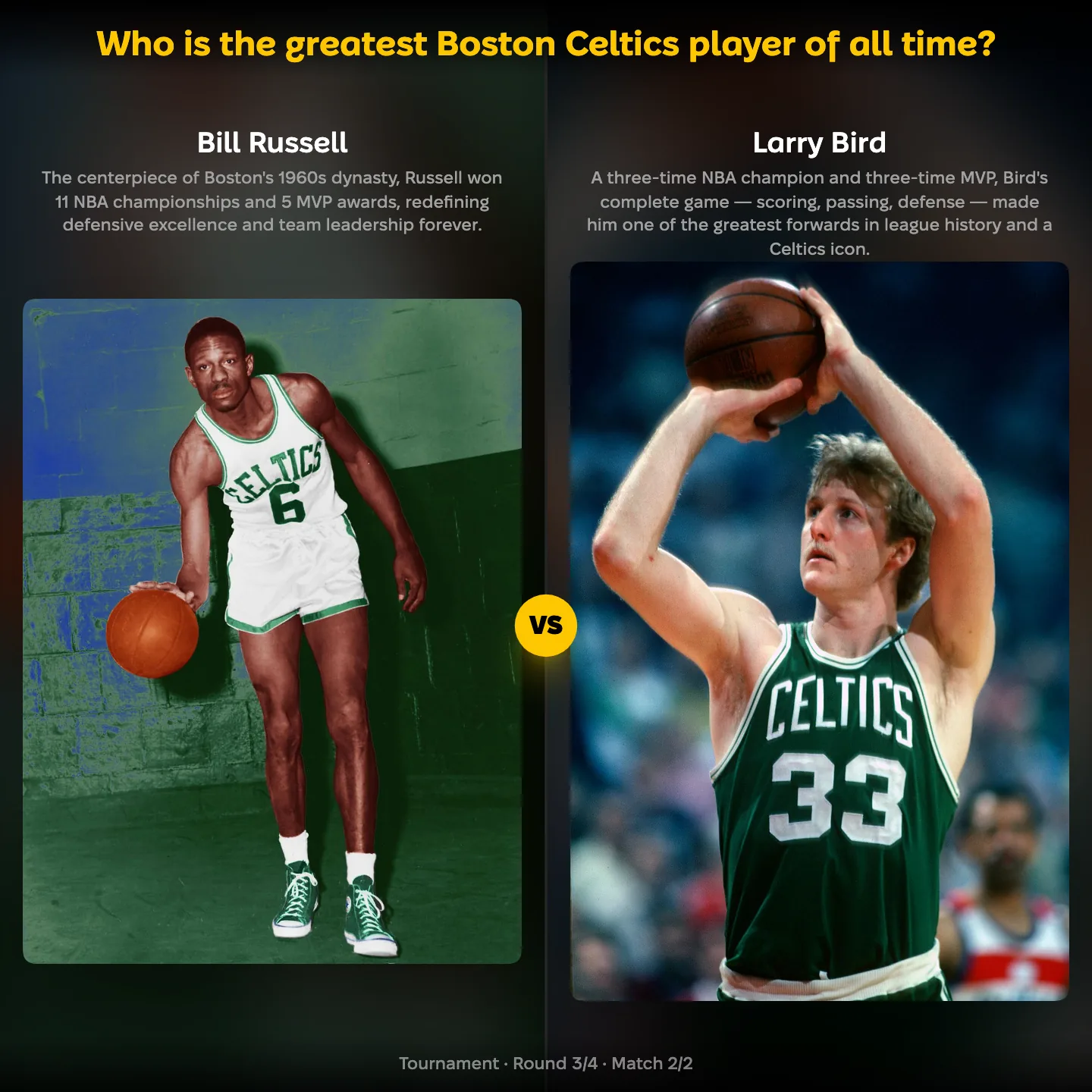
Chamberlain played for three franchises and appears on none of their club lists here. Russell played for one, for thirteen seasons, and this is it.
Larry Bird is the complication. Three championships, three consecutive MVP awards and a decade of highlights people actually saw make him the Celtic most Boston supporters under sixty grew up on.
John Havlicek and Paul Pierce are on the same list. Between the four of them, the club has more genuine candidates than it has room for.
Philadelphia: Wilt Chamberlain against Allen Iverson
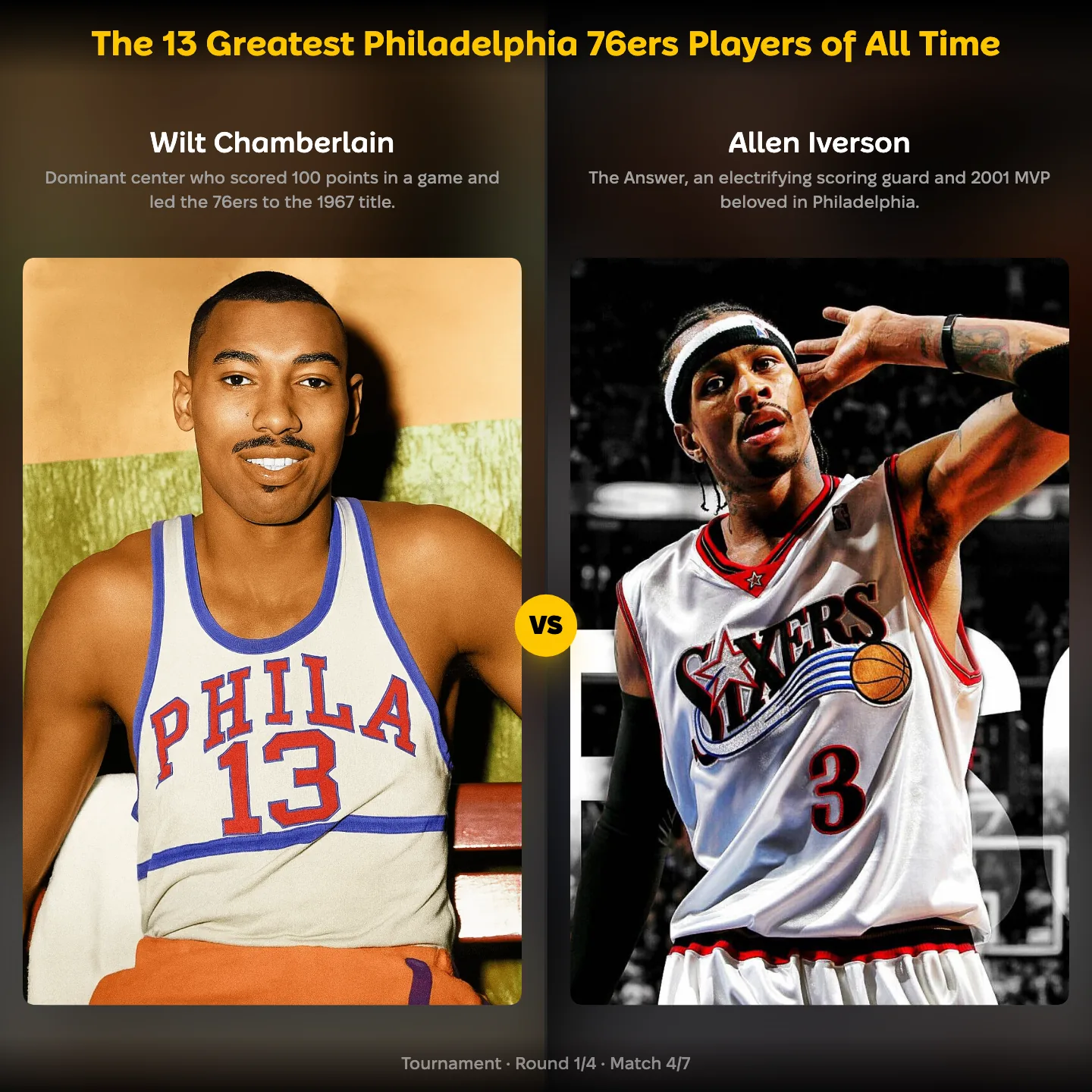
The reverse case. Russell is absent, and Chamberlain is on the list of the city he was born in. He grew up in West Philadelphia and played at Overbrook High before Kansas and a season with the Harlem Globetrotters.3
Allen Iverson is the obstacle, and no statistic explains why. Iverson gave Philadelphia the 2001 run and a decade of being the smallest man on the floor, which is a specific kind of local memory.
Julius Erving and Charles Barkley are there as well, making this the most crowded club question in the article.
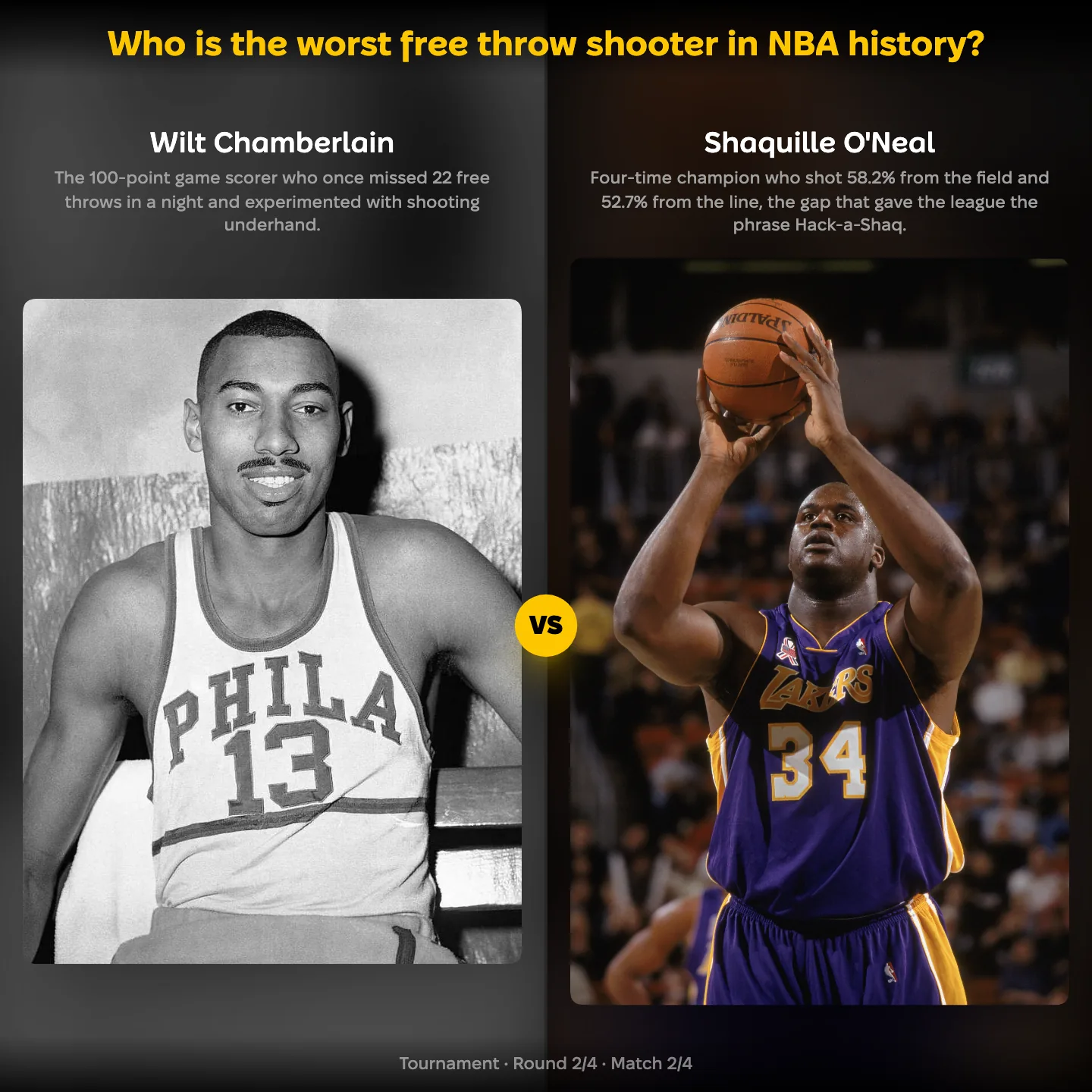
Wilt Chamberlain vs Shaquille O'Neal: 51.1 per cent at the line
The unflattering list, and Chamberlain has little competition on it.
He shot 51.1 per cent from the free-throw line across his career and missed 5,805 of them, a total no one in the league's history has approached.8 In the hundred-point game itself he made 28 of 32, a rate nothing else in his career resembles.3 He also tried the shot underhanded, one-handed, two-handed, from the side of the circle and from well behind the line, and none of it took.3
Shaquille O'Neal is the modern equivalent at 52.7 per cent, and the deliberate-fouling tactic named after him is why most people know the statistic exists.8
Russell was not much better, at 56.1 per cent for his career, but he took a fraction of the attempts, so the misses never piled into a record.4
The two-clock problem inverts here. Judge Chamberlain by any per-game measure and he is the most productive player who ever lived. Judge him by the one shot nobody defends and he is the worst of the greats.
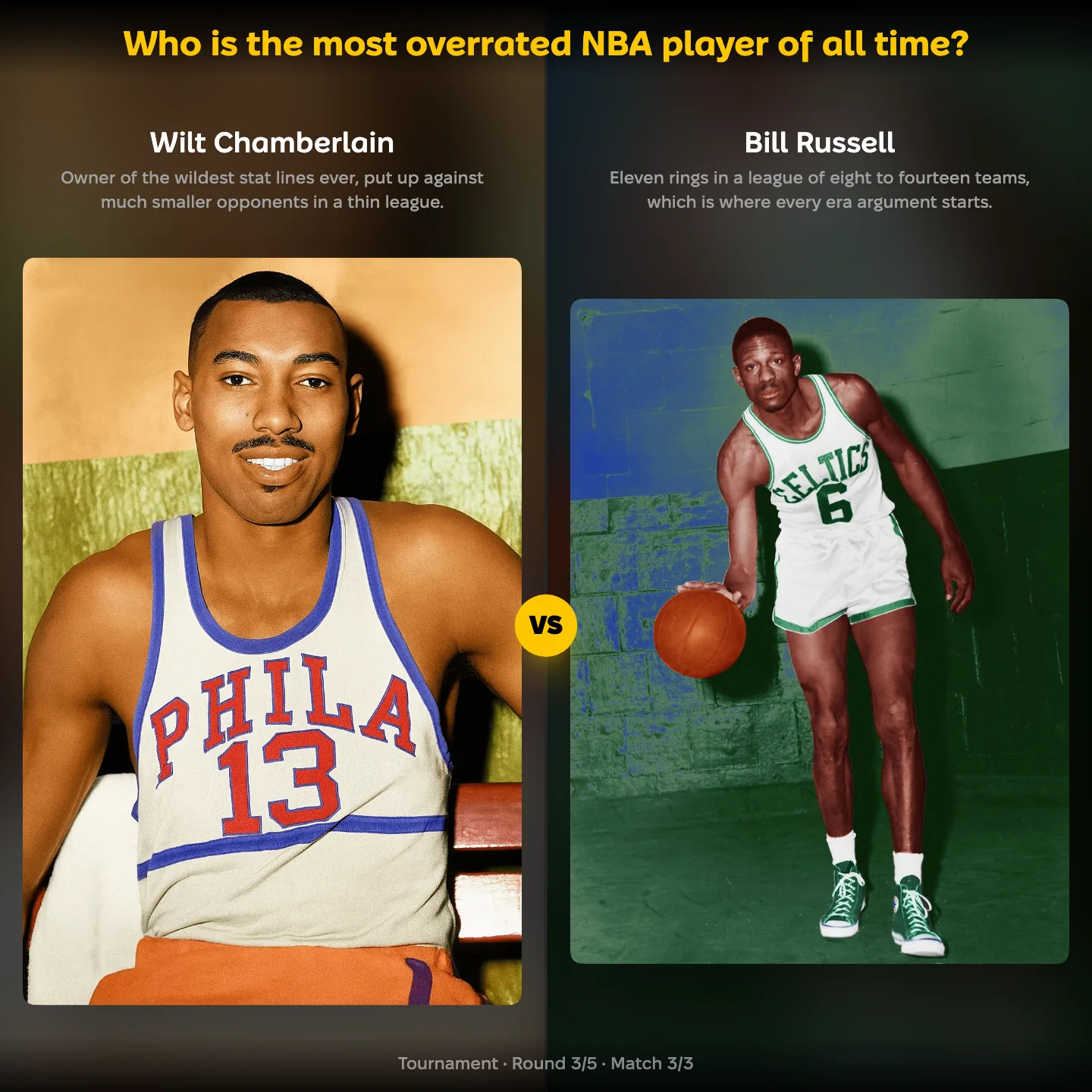
The overrated list that somehow holds both of them
Chamberlain and Russell are both on this one, for opposite reasons, which summarises the last sixty years fairly well.
The charge against Chamberlain is the trophy count: fourteen seasons, two titles, and enormous numbers put up against opponents who were often several inches shorter in an eight-team league.
The charge against Russell is the box score: fifteen points a game, no scoring title, and a career spent on the deepest roster of the era.
Neither charge survives much contact with the head-to-head record, which is presumably how the two of them ended up sharing a list neither would have chosen.
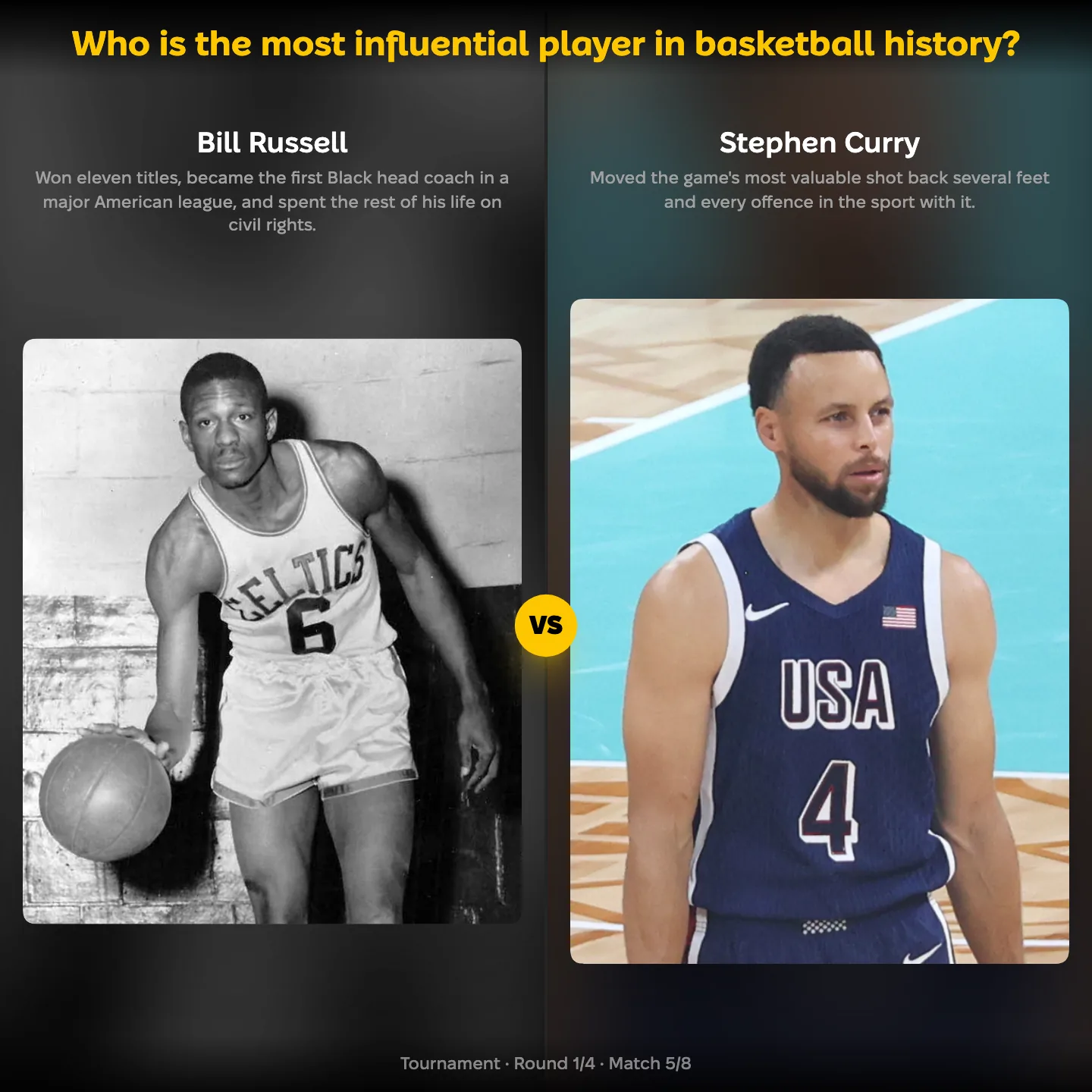
Influence: Bill Russell, Stephen Curry and what the sport copied
Influence and dominance are different questions, and this ranking separates them.
Russell's case runs past the court. He was the first Black head coach in any major American professional league, he marched in Washington in 1963, and the NBA Finals MVP award has carried his name since 2009.4
Chamberlain's case is that the rulebook was rewritten around him. The lane was widened, offensive goaltending was banned, inbounding over the backboard was outlawed, and free-throw shooters were required to keep their feet behind the line because he could dunk from it.3
Stephen Curry has the strongest modern claim. Every level of the sport now takes the shot he made central, a change visible in any gym in the world.
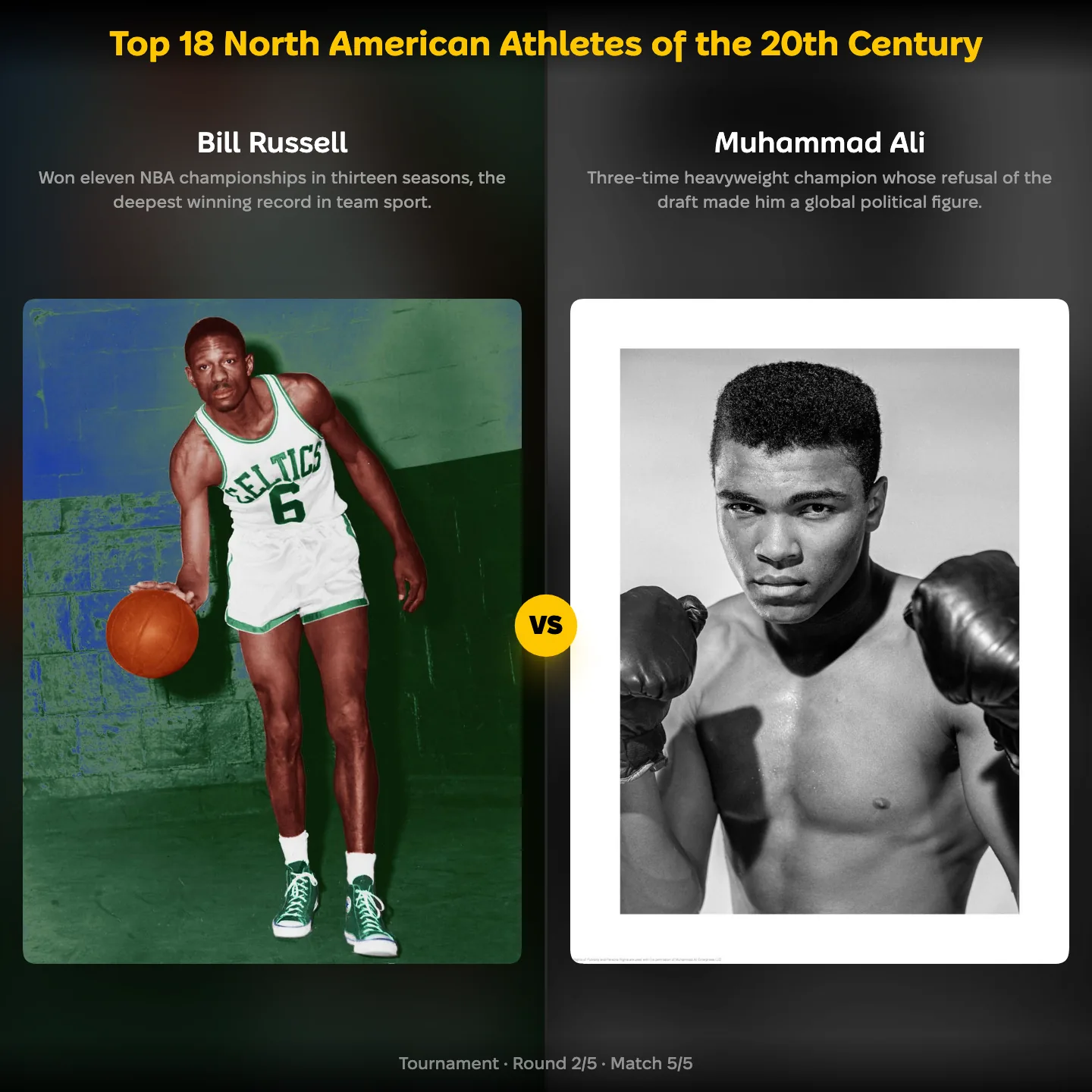
Outside basketball: Bill Russell next to Muhammad Ali
The last ranking takes both men out of their sport and drops them into a century of American athletes.
Russell brings things no basketball list measures: two NCAA titles at San Francisco, an Olympic gold in Melbourne in 1956, and a Presidential Medal of Freedom.4 Chamberlain brings a body that would have been famous in three other sports. As a Kansas track athlete he high-jumped 6ft 6in and put the shot 53ft 4in.3
Against Muhammad Ali, Jim Brown, Jesse Owens and Babe Ruth, both of them become specialists again. Being the best centre of your decade is a smaller claim here than it sounded fourteen sections ago.
Two clocks, still running
Fifteen questions, and the pattern holds all the way down. Every list built on a single night belongs to Chamberlain. Every list built on a season or a career belongs to Russell. The two of them were never being measured against each other, but against two different definitions of the job.
A rivalry taken apart one head-to-head at a time behaves like that. The question you choose decides the answer before you start.
So choose the one you actually believe in, and find out whether your answer holds up fifteen times.
More rankings, more angles
- Magic Johnson vs Larry Bird: 47 Years of the Same Argument — the rivalry that saved the league twenty years later
- LeBron James vs Michael Jordan: Who Wins Which List? — two men who never shared a court
- Shaquille O'Neal: Six Teams, Four Rings, 16 Lists — the centre who inherited the free-throw problem
- Lakers vs Celtics: 12 Finals, 35 Titles — the clubs those two played for, ranked fifteen ways
Sources
- Yahoo Sports — Russell and Chamberlain head-to-head record and per-game averages in their meetings: sports.yahoo.com (checked 2026-09-05)
- Wikipedia — 1967 NBA Finals: Philadelphia's 68–13 season and the 4–1 series win over Boston: en.wikipedia.org (checked 2026-09-05). Season opening date from the 2026–27 NBA season page (checked 2026-09-05)
- Wikipedia — Wilt Chamberlain: career averages, scoring and rebounding titles, the 1968 assists title, the 100-point game, the 55-rebound game, the free-throw experiments, Overbrook and Kansas, the track marks, and the rule changes made in response to him: en.wikipedia.org (checked 2026-09-05)
- Wikipedia — Bill Russell: championships, MVP awards, career averages and free-throw percentage, the 51-rebound game, the 1966 coaching appointment, defensive win shares, the unrecorded blocks tally, the NCAA and Olympic titles, and the Presidential Medal of Freedom: en.wikipedia.org (checked 2026-09-05)
- Wikipedia — Wilt Chamberlain's 100-point game: date, venue, attendance and shooting line: en.wikipedia.org (checked 2026-09-05)
- Wikipedia — Bam Adebayo's 83-point game, 10 March 2026: en.wikipedia.org (checked 2026-09-05)
- Wikipedia — Hakeem Olajuwon's career blocks total: en.wikipedia.org (checked 2026-09-05)
- Noah Basketball — career free-throw percentages and missed free throws for Wilt Chamberlain and Shaquille O'Neal: noahbasketball.com (checked 2026-09-05)
- Wikipedia — NBA All-Defensive Team, awarded since the 1968–69 season: en.wikipedia.org (checked 2026-09-05)