
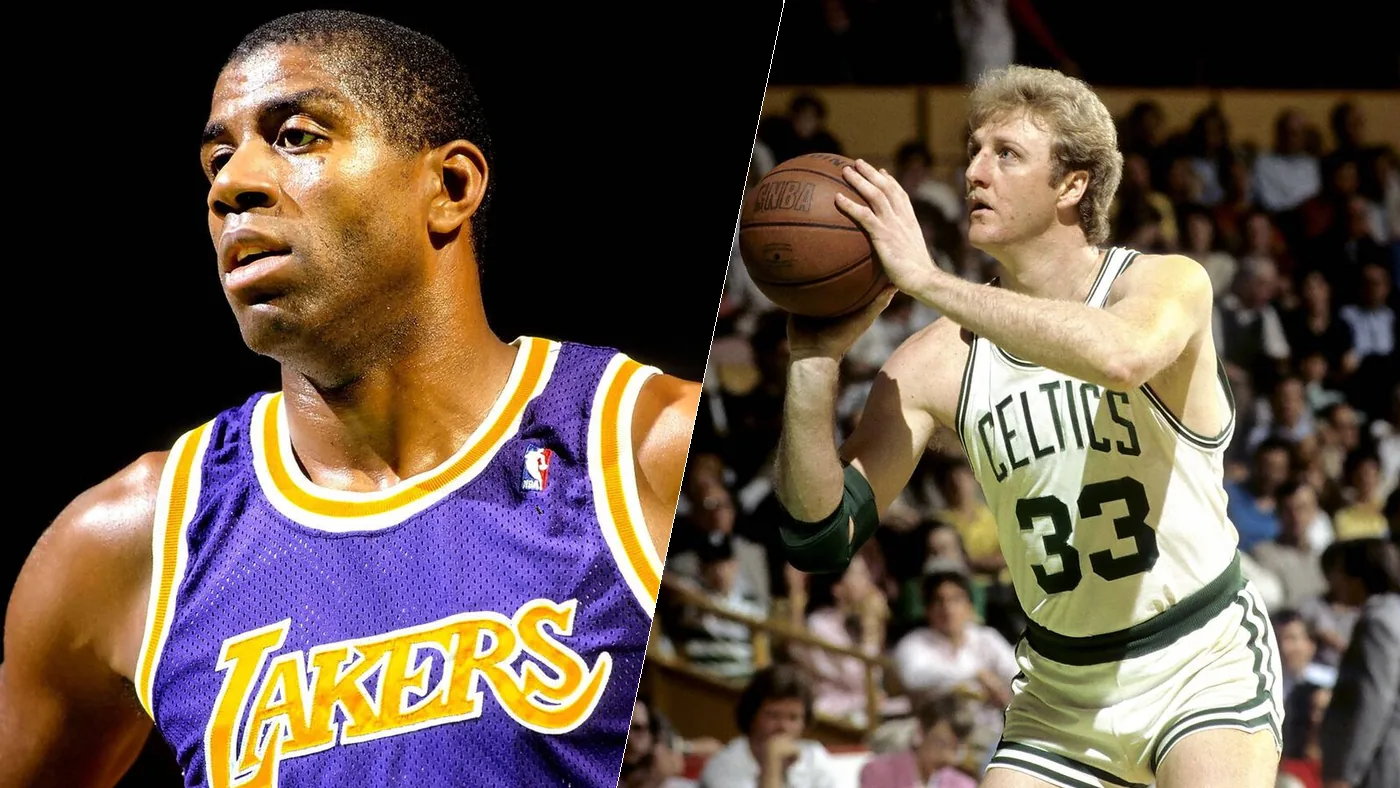
Magic Johnson and Larry Bird arrived in the NBA for the same season, 1979–80, and spent the following decade dividing the league between them. They met three times in the Finals: Boston took 1984 in seven games, Los Angeles took 1985 and 1987.1 They had already played each other once, in the 1979 NCAA final, which still holds the highest Nielsen rating any basketball game has drawn in the United States.2 Forty years ago this summer Bird's Celtics finished 67–15 and won the title, his third.3
Fifteen rankings on this site hold one or both of them.
The general basketball lists hold both of them. The specific ones, sorted by position or by shot or by city, hold exactly one.
Michael Jordan, and then everyone else
The broadest basketball question on the site puts fourteen names in one field, Magic Johnson and Larry Bird among them.
Johnson brings five championships and three MVP awards from twelve full seasons.4 Bird brings three championships and three MVPs, all three of his in consecutive years.3
Neither total is what this question is usually decided on. Michael Jordan, Kareem Abdul-Jabbar, LeBron James, Bill Russell and Wilt Chamberlain sit in the same fourteen. Each of those five was built for exactly this question.
One screen, and the whole problem is visible. Both men belong here. Neither is the answer.
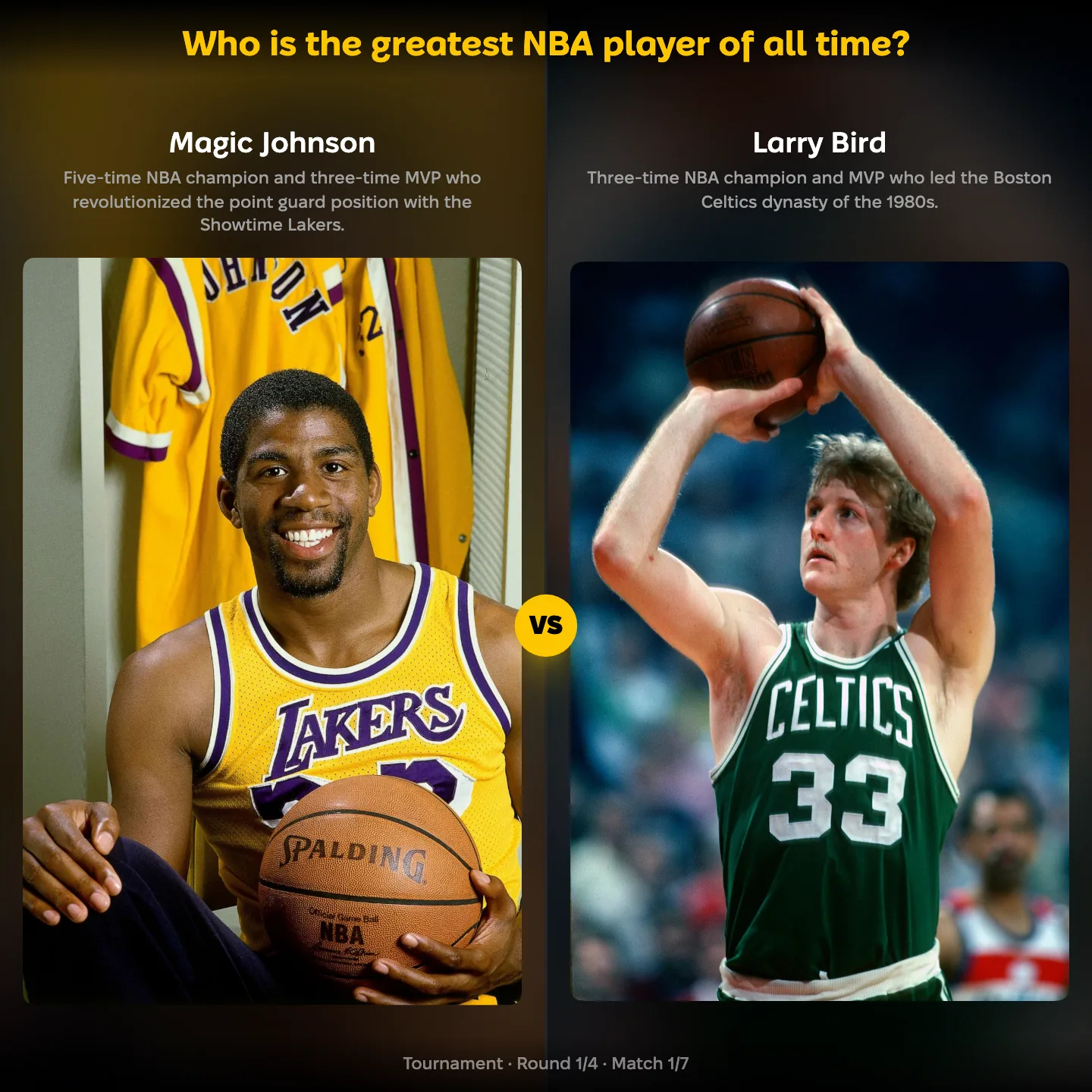
Six MVPs for Kareem, three each for Magic and Bird
Narrow the field to MVP winners and the arithmetic gets brutal for both of them.
Kareem Abdul-Jabbar won the award six times, in 1971, 1972, 1974, 1976, 1977 and 1980. Jordan and Russell won five each, LeBron James four. Johnson and Bird have three apiece.5
Bird's three came in a row, 1984 through 1986, which only Russell, Chamberlain and Jordan had managed before him. Johnson's arrived across four seasons at the other end of the decade, in 1987, 1989 and 1990.
Counting trophies flattens that difference into a tie. It is the first of these fifteen rankings that treats them as equals.
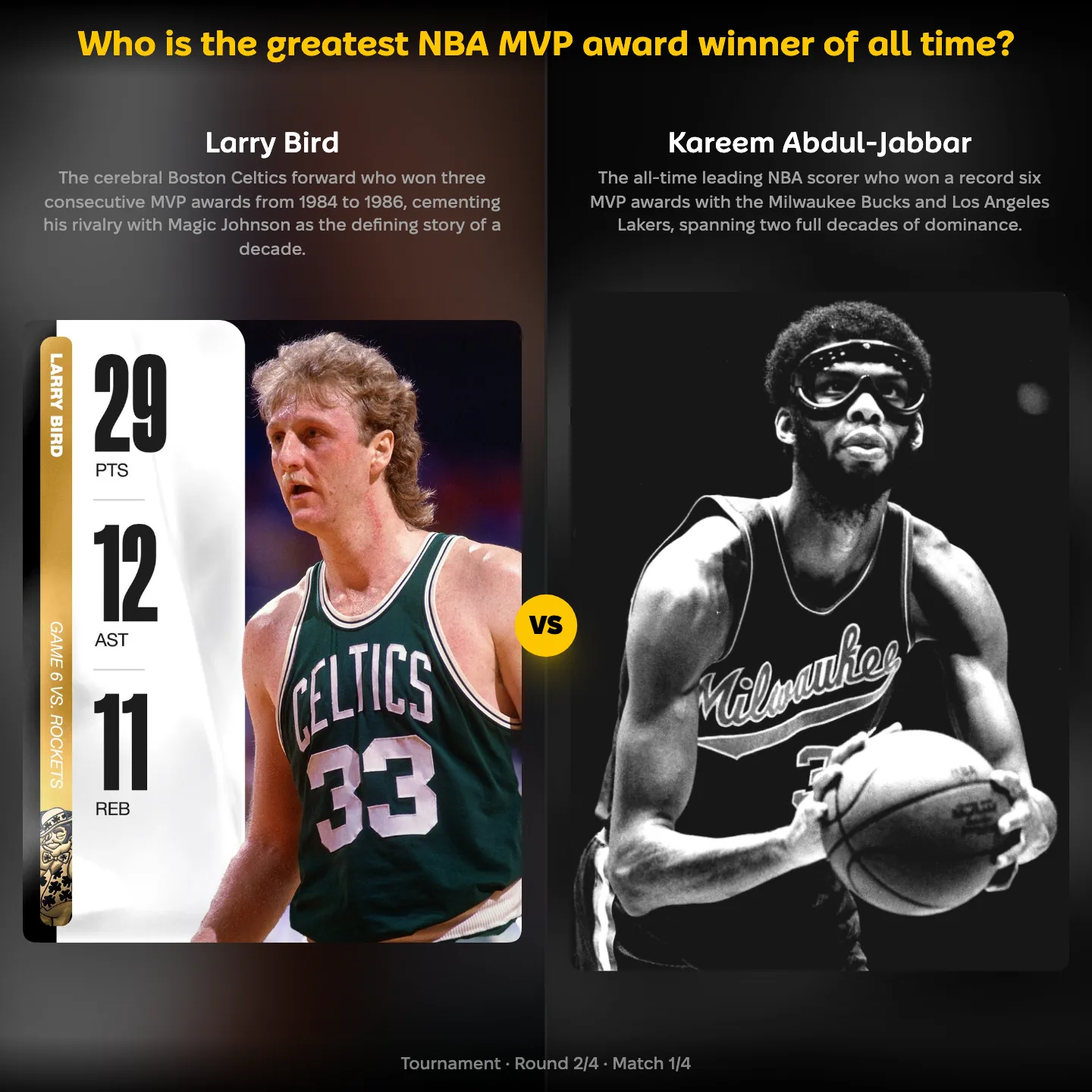
Finals MVP: three for Magic Johnson, two for Larry Bird
Switch the award to the Finals and the tie breaks.
Johnson won the Finals MVP award in 1980, 1982 and 1987. The first of those came as a rookie, when an injured Abdul-Jabbar left him starting at centre in Game 6 and he finished with 42 points, 15 rebounds and 7 assists. No other rookie has won it.4
Bird won it twice, in 1984 and 1986, both against opponents his Celtics had to beat in six games or more.3
Twenty names sit on this list, Jordan's six among them. Three against two is the cleanest separation the two men have anywhere in this article, and it is worth one award.
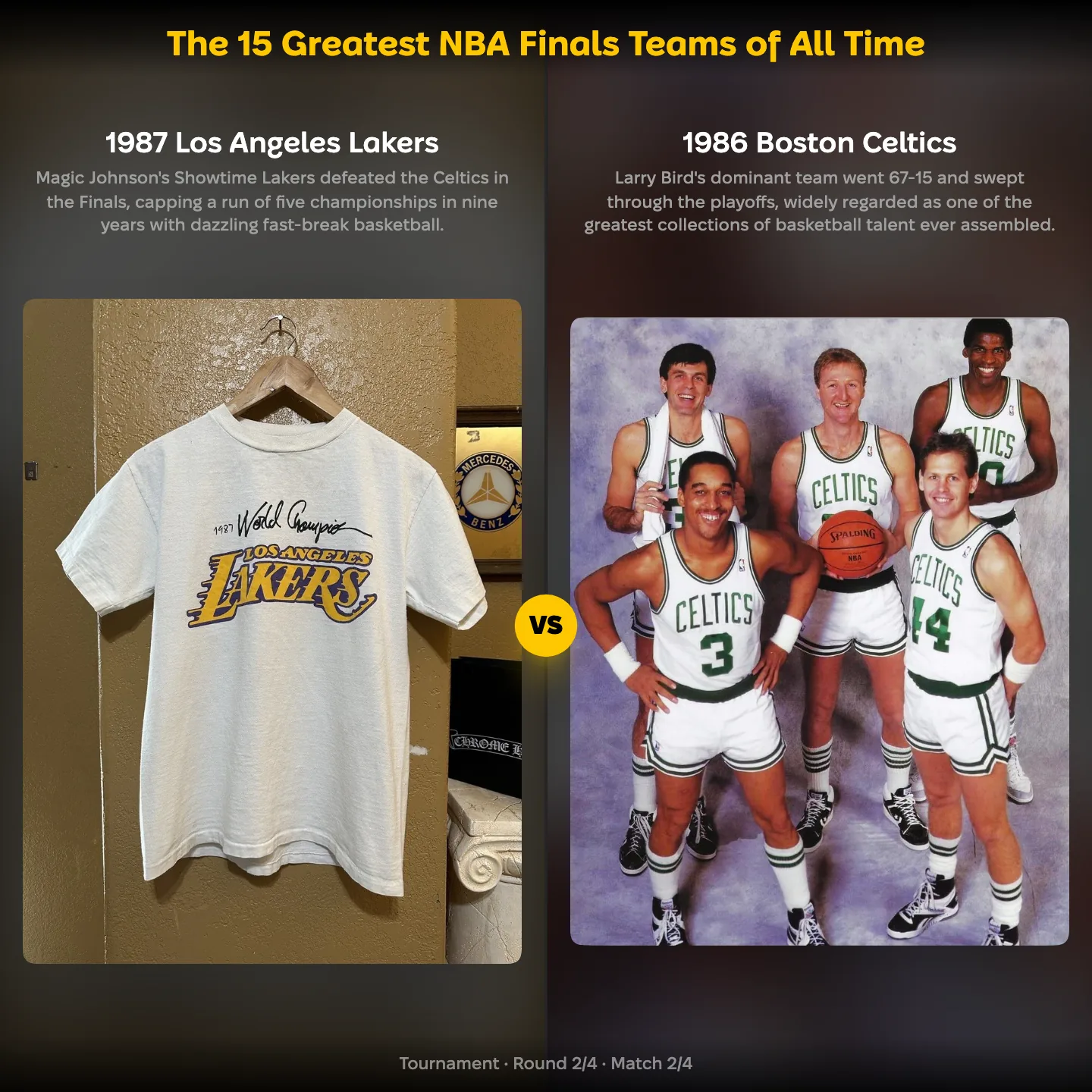
The 1986 Celtics vs the 1987 Lakers
This ranking is about teams, so Johnson and Bird appear in it the way a driver appears in a ranking of cars.
Bird's entry is the 1985–86 Celtics, 67–15 in the regular season, his third championship and the last of his three straight MVP seasons.3 Boston lost one home game all year.
Johnson's is the 1987 Lakers, the season he won his first MVP and his third Finals MVP, and the year Los Angeles beat Boston in six.1
Fifteen teams are on the list, including the 1995–96 Bulls at 72–10. Putting the 1986 Celtics and the 1987 Lakers next to each other reproduces the fight Boston and Los Angeles were having at the time, with the two rosters standing in for the two men.
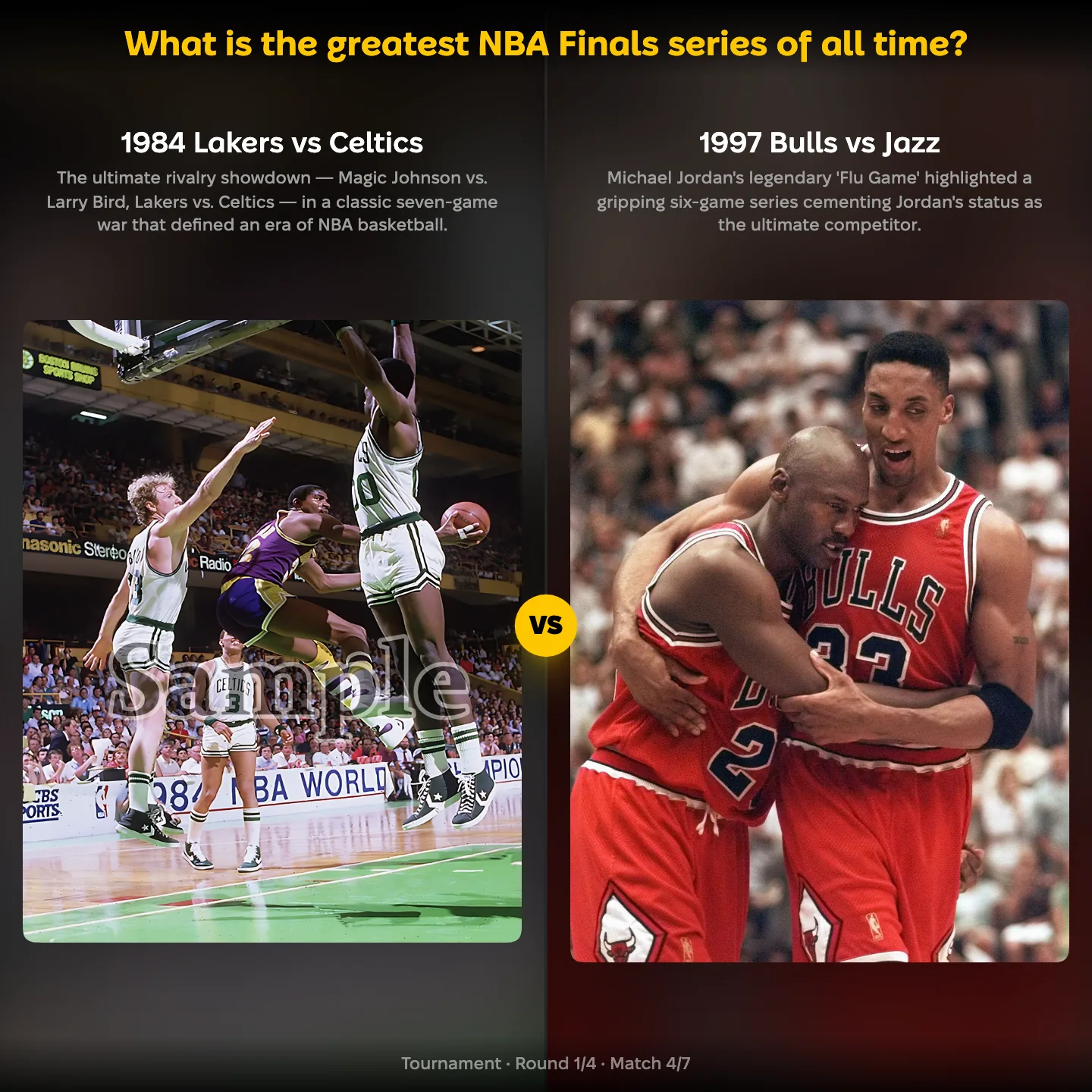
The 1984 Finals went seven games
Five years after the NCAA final, Johnson and Bird finally met as professionals, and the series that followed is the reason the rest of this article exists.
Boston won it 4–3. Bird averaged 27.4 points and 14.0 rebounds and took the Finals MVP award.6
Johnson had the worst week of his career inside it. In Game 2 he dribbled out the clock in a tied game with 18 seconds left. In Game 4 he threw a bad pass to Robert Parish late in the fourth and then missed two free throws in overtime. Boston fans spent the rest of the series calling him Tragic Johnson.6
Thirteen series are on this ranking, from 1969 to 2019. The counter-argument for Los Angeles is that they answered immediately: 1985 and 1987 both went their way, and Johnson finished the decade with more rings than Bird.1
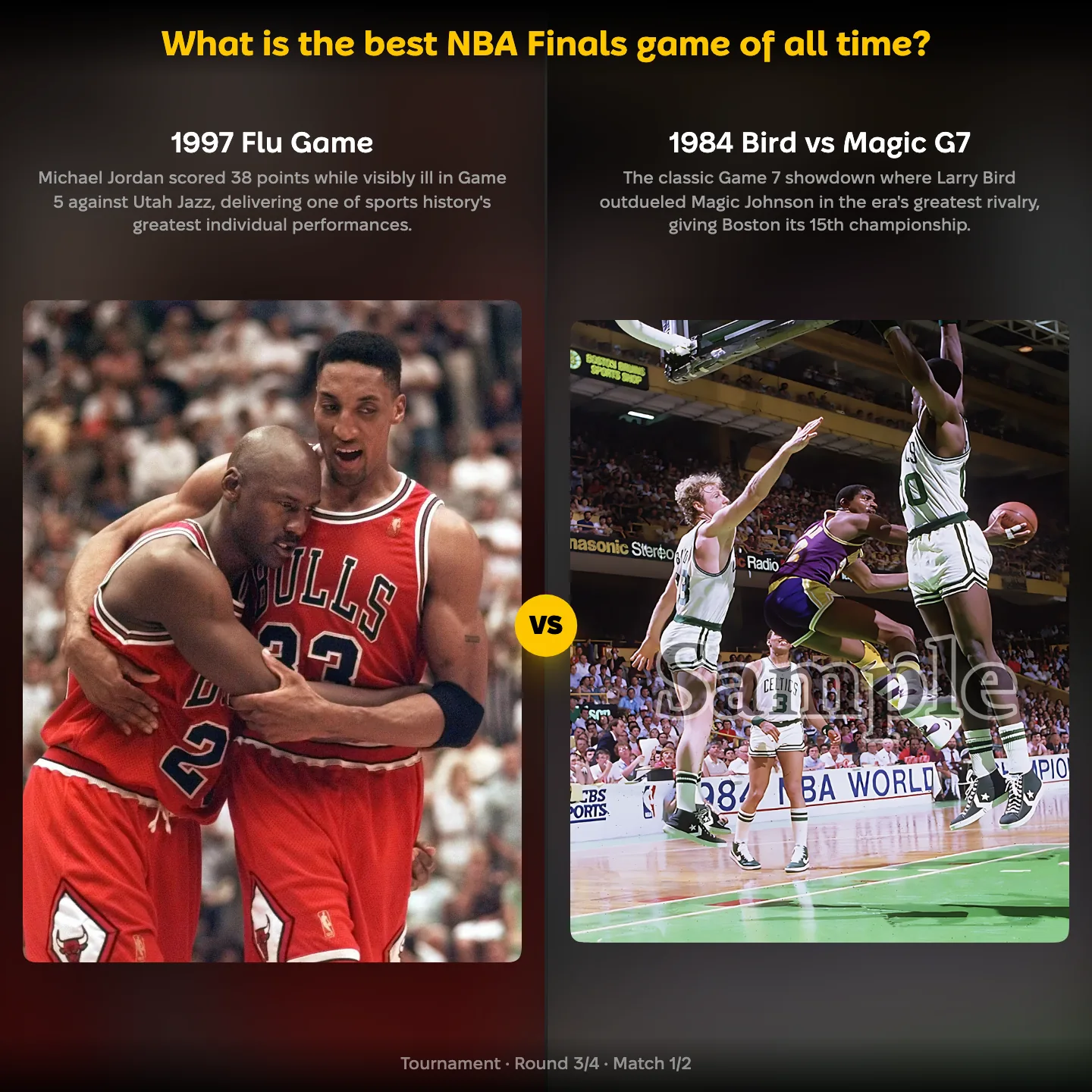
Game 7, 1984: an option named after both of them
One option in this ranking of single games is called "1984 Bird vs Magic G7". The rivalry is one of the contenders.
Boston won that game 111–102 in front of 14,890 at the Garden, the club's first title clinched at home since 1966.6 Two nights earlier, Game 5 had been played at about 97°F with no air conditioning in the building. Abdul-Jabbar used an oxygen tank on the bench and one of the referees fainted from dehydration in the first half.6
Johnson's own signature game is on the same list: the 1987 junior sky hook that beat Boston in Game 4.
Fourteen games are in the field. Most belong to one man: Jordan's flu game, Jordan's last shot, LeBron's block, Ray Allen's corner three. The Bird and Johnson entry is the oldest thing on the list by more than a decade.
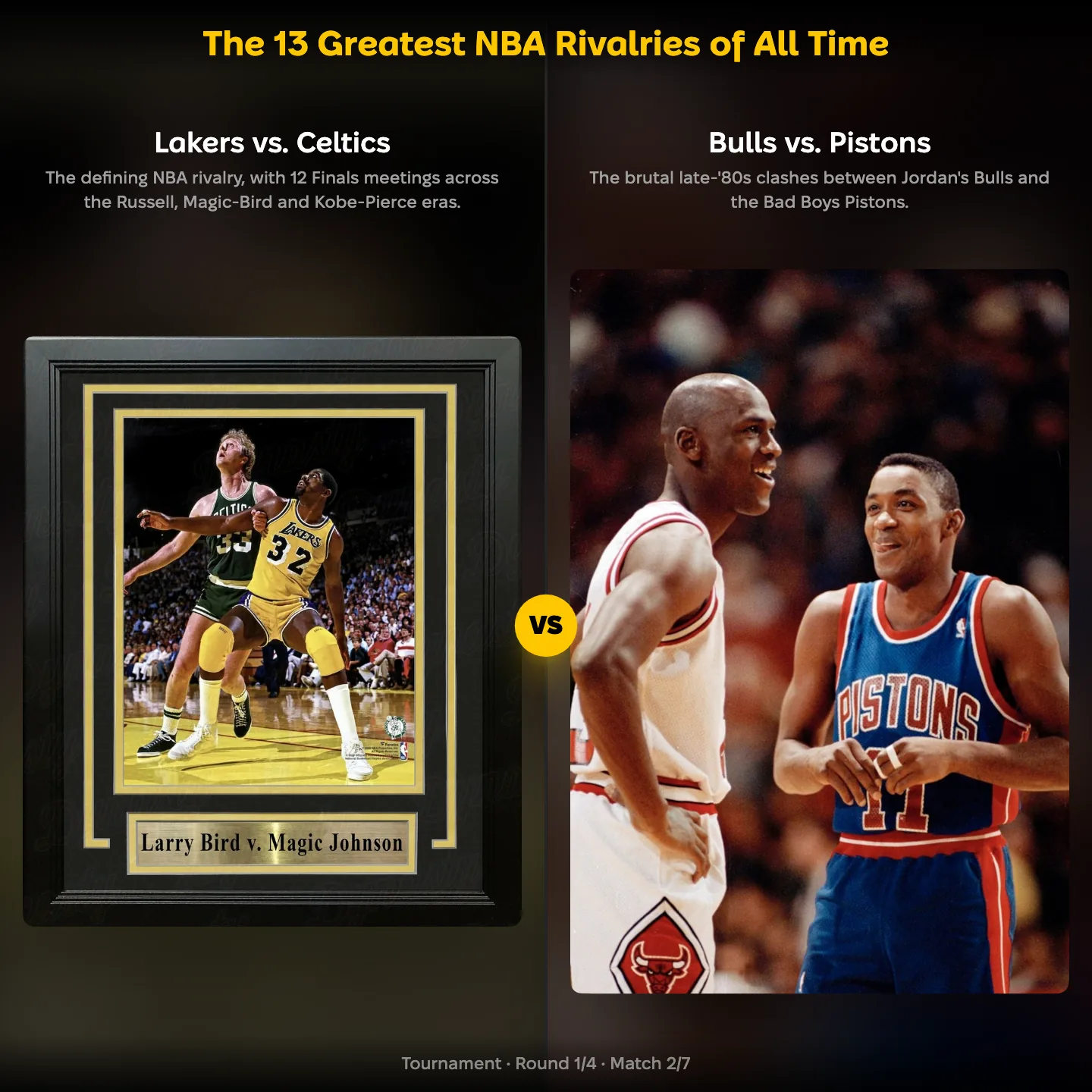
Lakers vs Celtics: twelve Finals meetings, three of them theirs
Here the two men disappear into their employers.
Los Angeles and Boston have met in the Finals twelve times, a record for any pairing in the league, starting in 1959.1 Johnson and Bird are responsible for three of those twelve.
The ranking's own description of the matchup names three eras: Russell, Magic and Bird, then Kobe and Pierce. Two of those had happened before either man was born.
Twelve other rivalries are in the field, including Bulls against Pistons and every modern grudge the league has produced. This is the one section where the honest reading is that Johnson and Bird inherited something rather than built it.
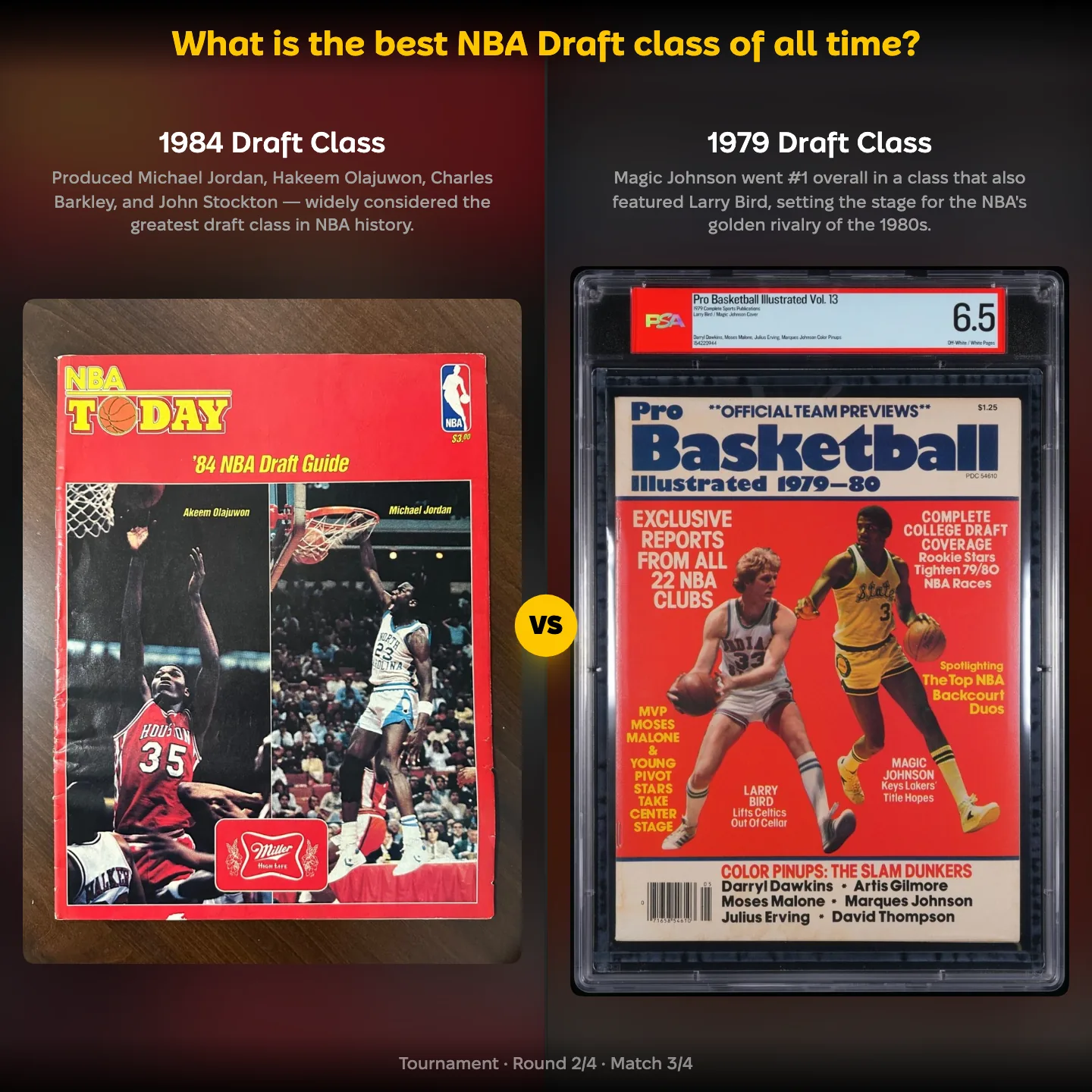
The 1979 draft class, against 1984 and 1996
Filing these two by draft class is harder than it looks, because only one of them belongs to the class named here.
Johnson went first overall in the 1979 draft, to the Lakers, straight out of a national championship at Michigan State. Bird had been taken sixth the year before, in 1978, by Boston, using a pick on a junior-eligible player who had already said he would go back to Indiana State for his senior season. He signed with the Celtics in April 1979, and their rookie years ran together anyway.7
So the 1979 class gets credit for a player the 1978 draft actually produced.
Thirteen classes are on the list. The 1984 class holds Jordan, Hakeem Olajuwon, Charles Barkley and John Stockton, and 1996 holds Kobe Bryant, Allen Iverson and Steve Nash. Against those two, 1979 is carried by a single first pick and an accounting quirk.
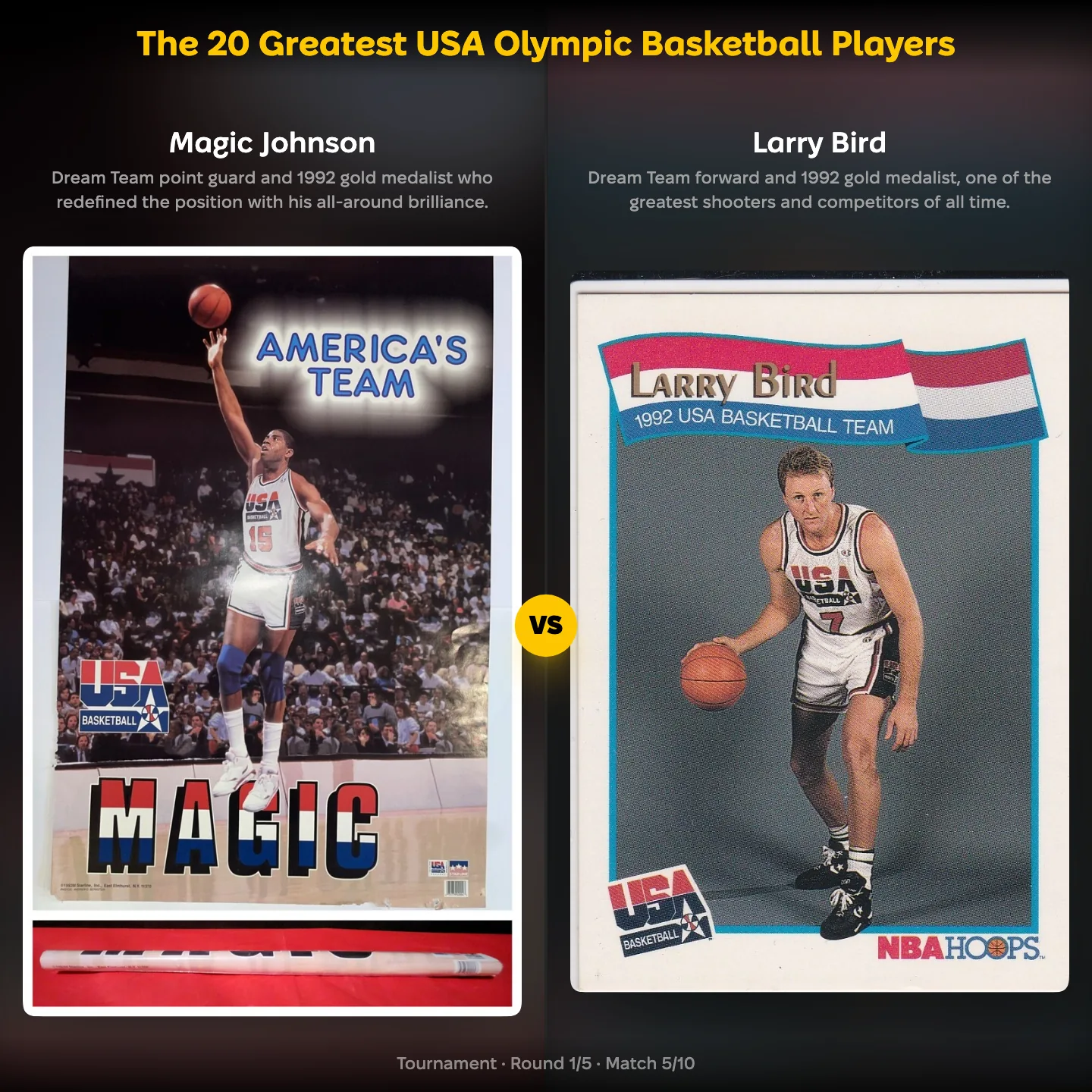
Barcelona 1992: the one team that put them on the same side
Every other ranking here has Johnson and Bird on opposite sides. The Olympic list has them in the same jersey.
Johnson went to Barcelona as co-captain of the 1992 US team having already retired. He announced he was HIV-positive on 7 November 1991 and stopped playing at 32.4 Bird played the tournament through chronic back trouble and retired immediately afterwards, aged 35.3
Both careers, in other words, ended at the same tournament, on the same team, on a court neither of them had to fight the other for.
The list runs to twenty players and Jordan is on it too, alongside Kevin Durant, Kobe Bryant and LeBron James from later teams. The strongest case for the two of them rests on timing: the gold medal was the last thing either one won.
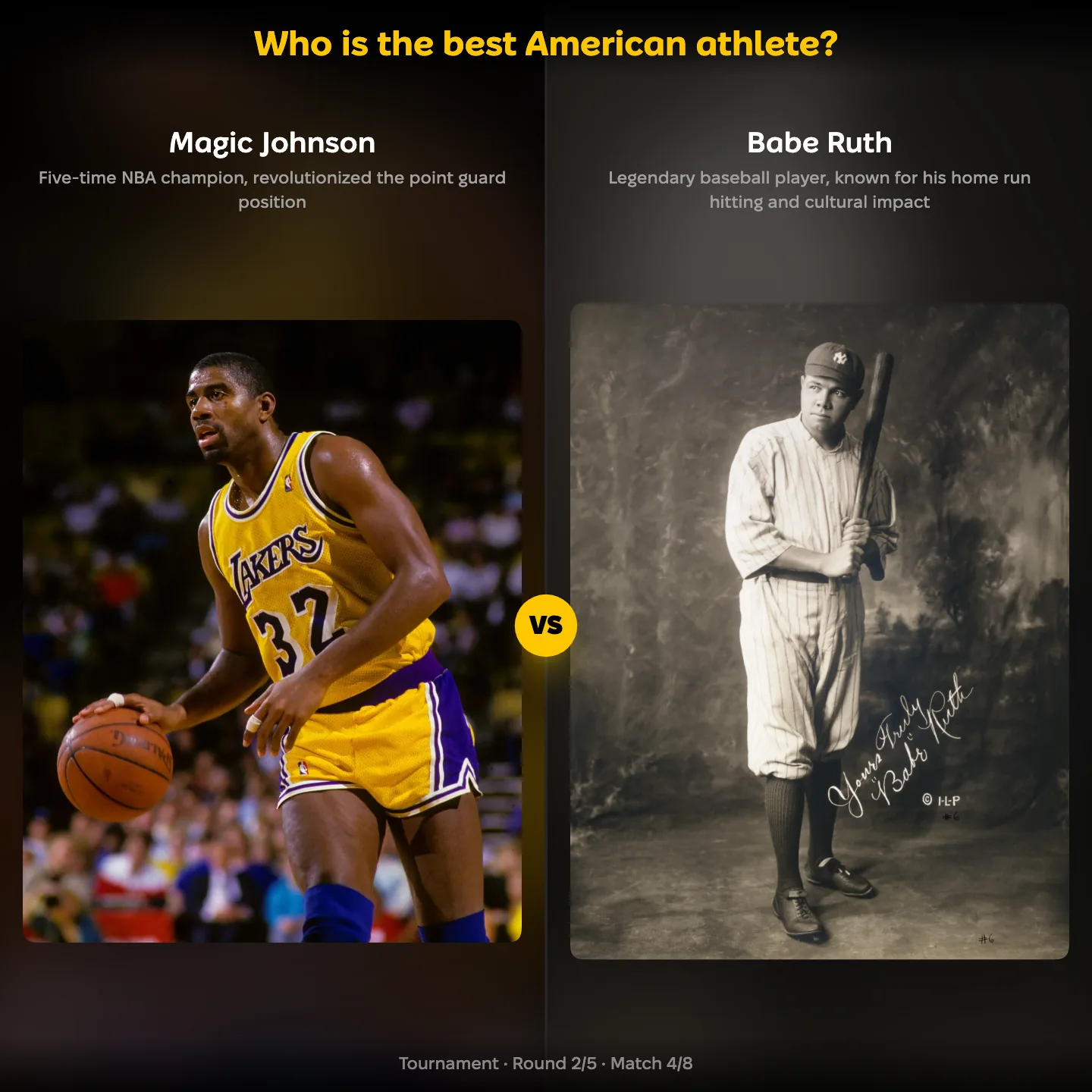
Babe Ruth, Muhammad Ali and two basketball players
Thirty-one names from every American sport are in this one, and Johnson and Bird are two of six basketball players in it.
Babe Ruth, Muhammad Ali, Jesse Owens, Jackie Robinson, Serena Williams and Michael Phelps are the sort of company the question puts them in.
Rings stop counting for much once baseball and boxing are in the field.
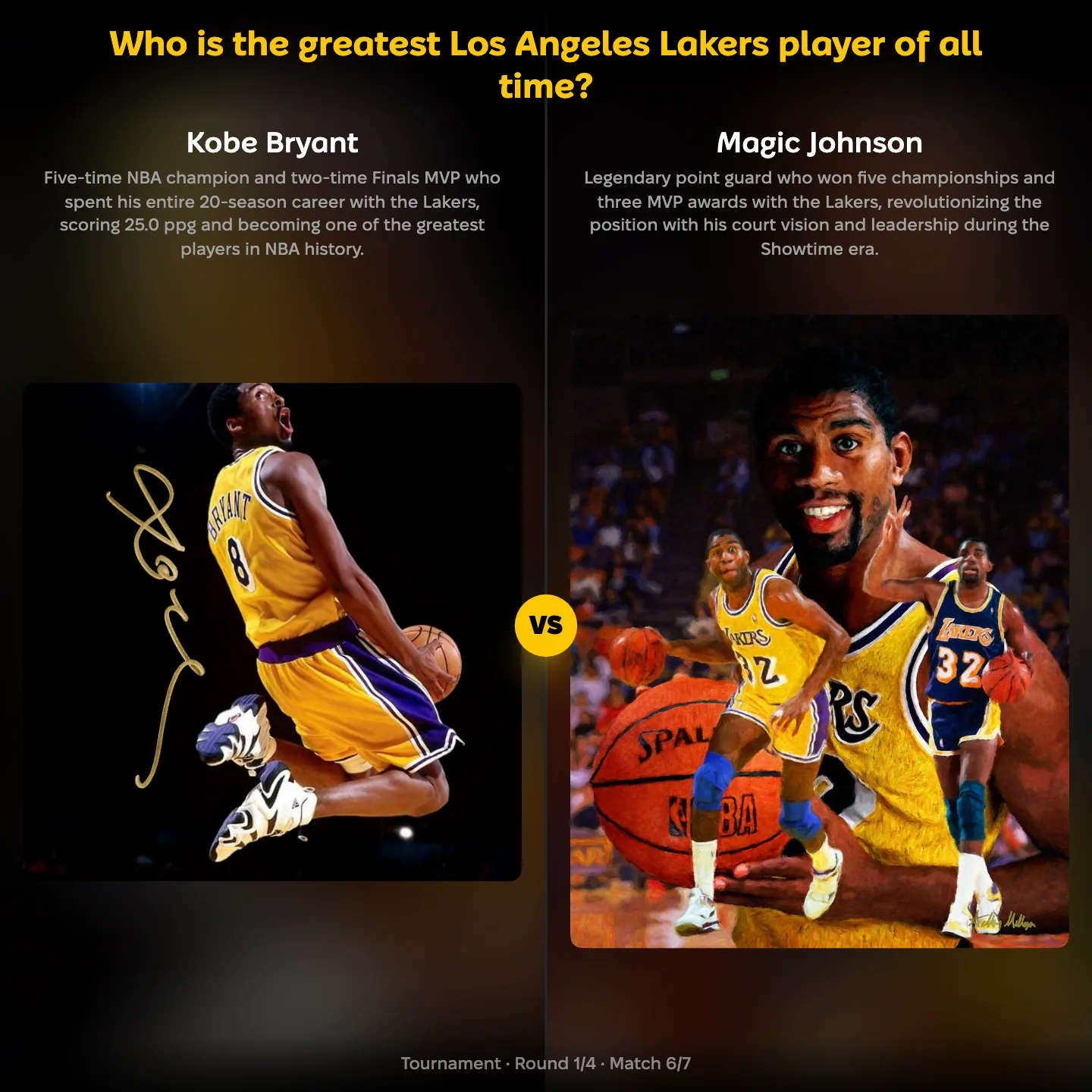
Kobe Bryant, Kareem Abdul-Jabbar and the Lakers question
Ask the question by franchise and Bird is not eligible to answer it.
Johnson won all five of his championships with Los Angeles and led the league in assists four times while doing it, finishing with 11.2 a game across 905 appearances.4
Fourteen names are on the Lakers list, and the franchise has collected too many great players for that to settle anything. Kobe Bryant, Kareem Abdul-Jabbar, Shaquille O'Neal, Jerry West, Elgin Baylor and LeBron James all wore the same jersey.
The Bird equivalent is one section down, and it has the same problem in green.
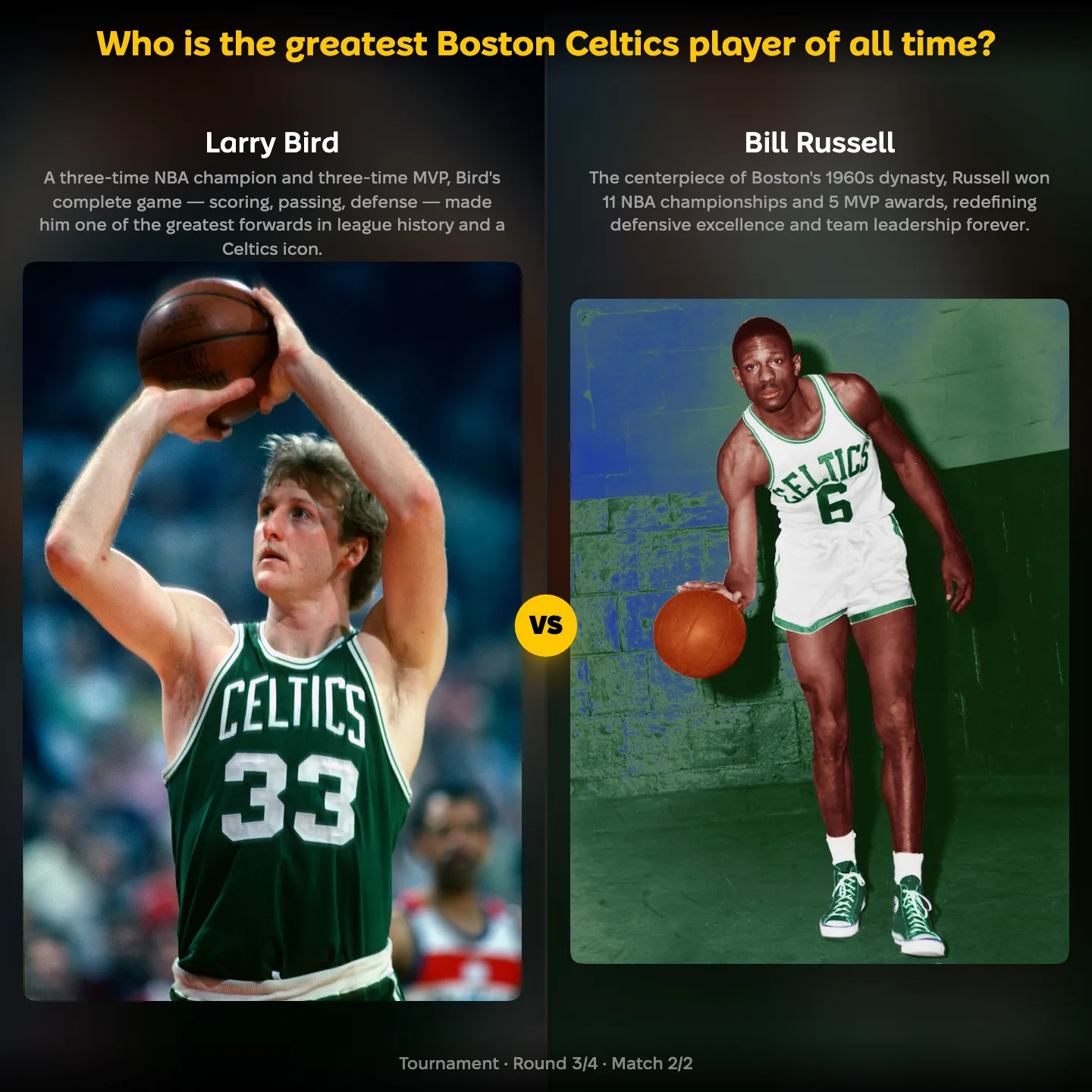
Bill Russell vs Larry Bird: eleven rings against three
Boston's version of the same question is harder than the Lakers' one, for a single reason.
Bill Russell took eleven titles out of thirteen Celtics seasons. Bird took three.3
Bird's case has to be built on what the franchise looked like when he arrived rather than on the count. Boston had gone 29–53 the season before he got there and went 61–21 in his rookie year, the largest single-season improvement the league had seen at that point.8
Sixteen names are on the list, including Kevin McHale and Robert Parish from Bird's own front line. Johnson has no entry here at all, and that absence is why both franchise questions belong in one article.
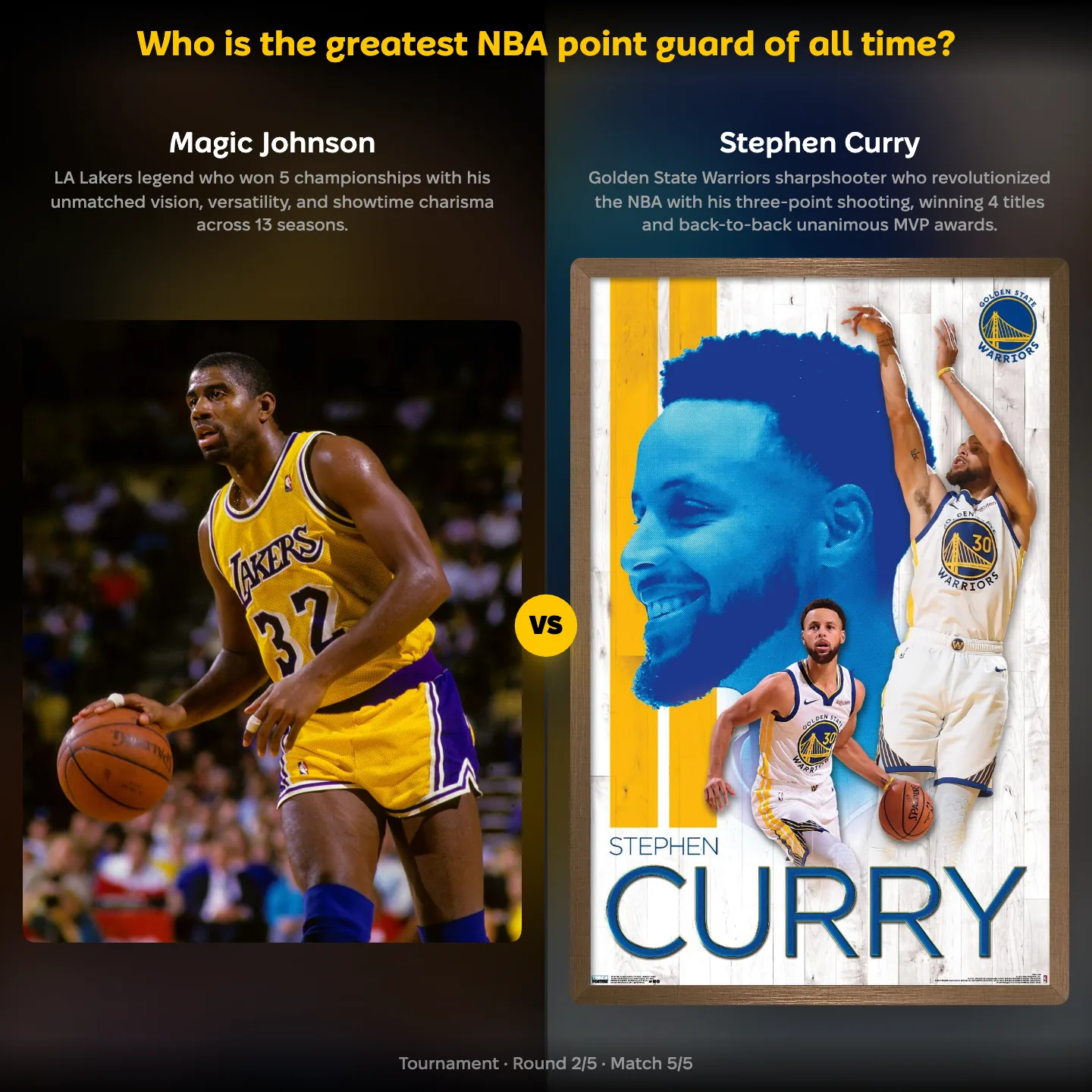
Magic Johnson vs Stephen Curry: the point-guard list
Sort basketball by position and Johnson gets a list of his own.
He was 6ft 9in and played point guard, which had not been done before and has rarely been done since. The four assist titles and the 11.2 career average come from that.4
Eighteen names are in the field: Stephen Curry, Oscar Robertson, John Stockton, Isiah Thomas, Bob Cousy, Jason Kidd.
Bird played small forward and is not among them. Position is the cleanest way to get these two onto different pages.
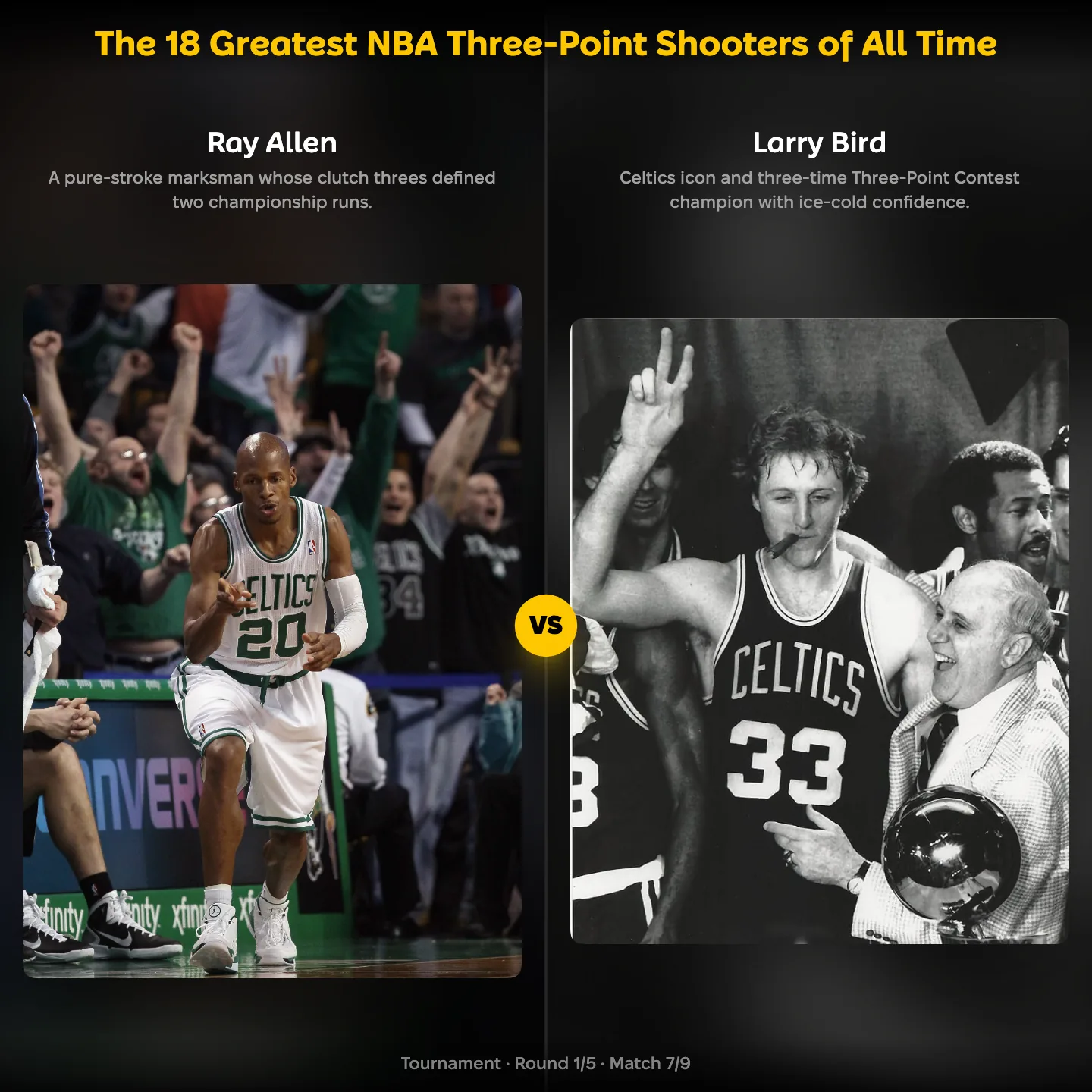
Ray Allen vs Larry Bird: shooting before the three-point era
Sort basketball by a single skill and the sides swap over.
Bird won the first three Three-Point Contests, in 1986, 1987 and 1988.3 Johnson is absent, and nothing in his game would have put him there.
Eighteen shooters are on the list, nearly all from after the line stopped being a novelty: Stephen Curry, Ray Allen, Reggie Miller, Klay Thompson, Damian Lillard.
Bird's case is that he shot from a distance his own league barely used. The case against him is volume, and Curry alone has taken more threes than Bird attempted shots of any kind.
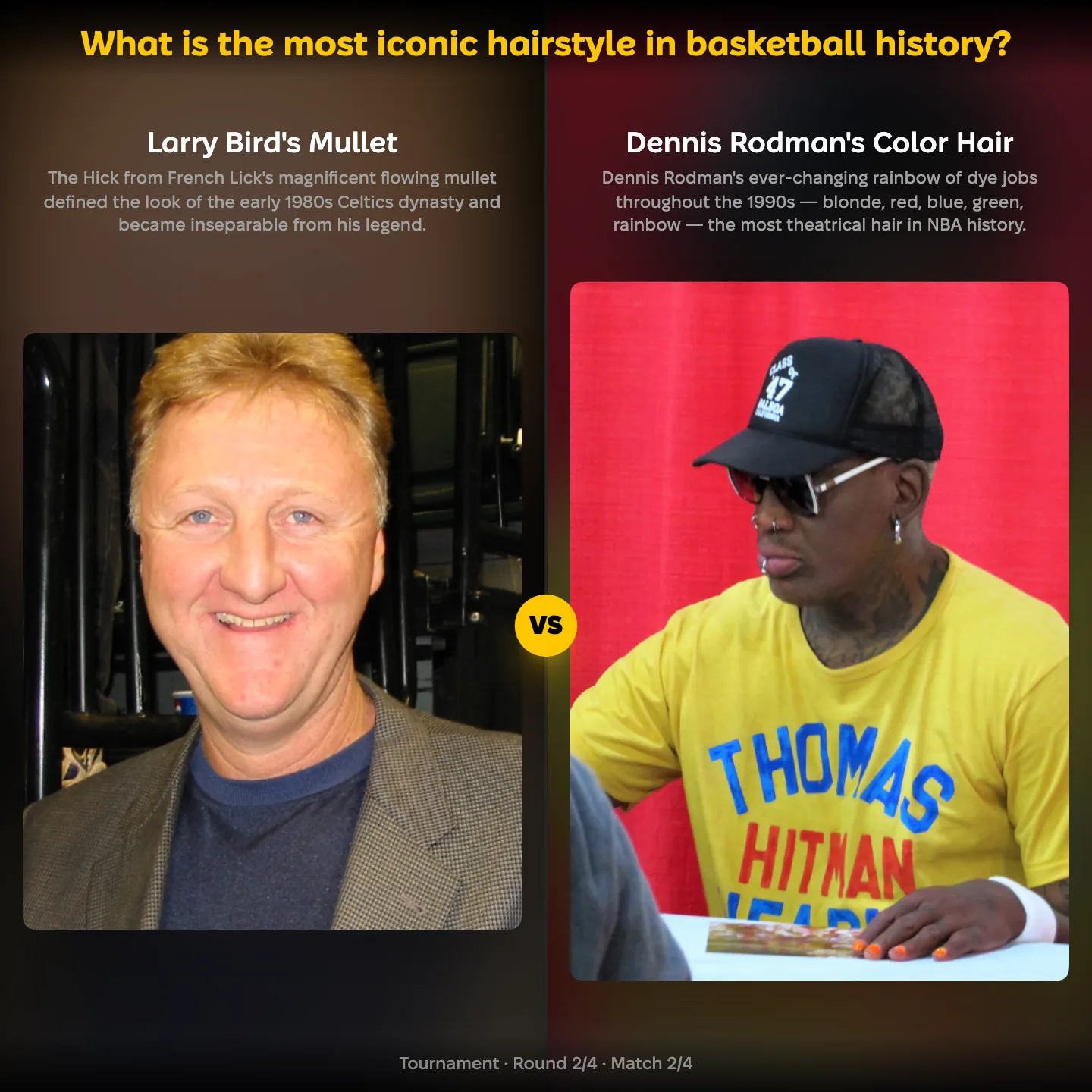
Larry Bird's mullet against Dennis Rodman's dye job
Fourteen rankings in, the basketball has run out and the hair is still going.
Bird's mullet is an option here. Johnson is not, though Dennis Rodman, Allen Iverson, Julius Erving and Walt Frazier's hat all are.
Fifteen questions, and ten of them fit both men
Ten of these fifteen rankings contain both men. The other five are the interesting ones: by position, by franchise, by the three-point shot, by hair, one of them qualifies and the other has nothing to enter. Johnson and Bird spent a decade being treated as a single subject with two halves, and the moment a question gets specific the halves come apart.
If you want the mechanics behind these results, building a ranking two options at a time explains how the order is produced.
All 15 rankings, in one place:
- Who is the greatest NBA player of all time?
- Who is the greatest NBA MVP award winner of all time?
- Top 20 NBA Finals MVPs of All Time
- The 15 Greatest NBA Finals Teams of All Time
- What is the greatest NBA Finals series of all time?
- What is the best NBA Finals game of all time?
- The 13 Greatest NBA Rivalries of All Time
- What is the best NBA Draft class of all time?
- The 20 Greatest USA Olympic Basketball Players
- Who is the best American athlete?
- Who is the greatest Los Angeles Lakers player of all time?
- Who is the greatest Boston Celtics player of all time?
- Who is the greatest NBA point guard of all time?
- The 18 Greatest NBA Three-Point Shooters of All Time
- What is the most iconic hairstyle in basketball history?
Take the question you would actually argue about at a bar, and go settle it.
More rankings, more angles
- LeBron James vs Michael Jordan: Who Wins Which List? — the argument the NBA had next
- Kobe Bryant's Records Keep Falling. The Lists Keep Him. — 81 points, and what happened to the record
- Lakers vs Celtics: 12 Finals, 35 Titles — the same rivalry, franchise against franchise
- Wilt Chamberlain vs Bill Russell: 100 Points, 11 Rings — the two-man argument the 1960s had
Sources
- Celtics–Lakers rivalry — Finals meetings and results, including 1984, 1985 and 1987: wikipedia.org (checked 2026-08-03)
- 1979 NCAA Division I men's basketball championship game — date, score and Nielsen rating: wikipedia.org (checked 2026-08-03)
- Larry Bird — championships, MVP awards, Three-Point Contest wins, the 1985–86 Celtics and his retirement: wikipedia.org (checked 2026-08-03)
- Magic Johnson — championships, MVP and Finals MVP awards, assist titles, the 1980 Game 6 line and the November 1991 announcement: wikipedia.org (checked 2026-08-03)
- NBA Most Valuable Player Award — winners by count, Abdul-Jabbar's six and the years for each: wikipedia.org (checked 2026-08-03)
- 1984 NBA Finals — series result, Bird's averages, the Game 5 heat, Johnson's Game 2 and Game 4 errors and the Game 7 score: wikipedia.org (checked 2026-08-03)
- 1978 NBA draft — Bird taken sixth by Boston as a junior-eligible pick and signed in April 1979: wikipedia.org (checked 2026-08-03)
- 1979–80 Boston Celtics season — the 29–53 to 61–21 turnaround in Bird's rookie year: wikipedia.org (checked 2026-08-03)