
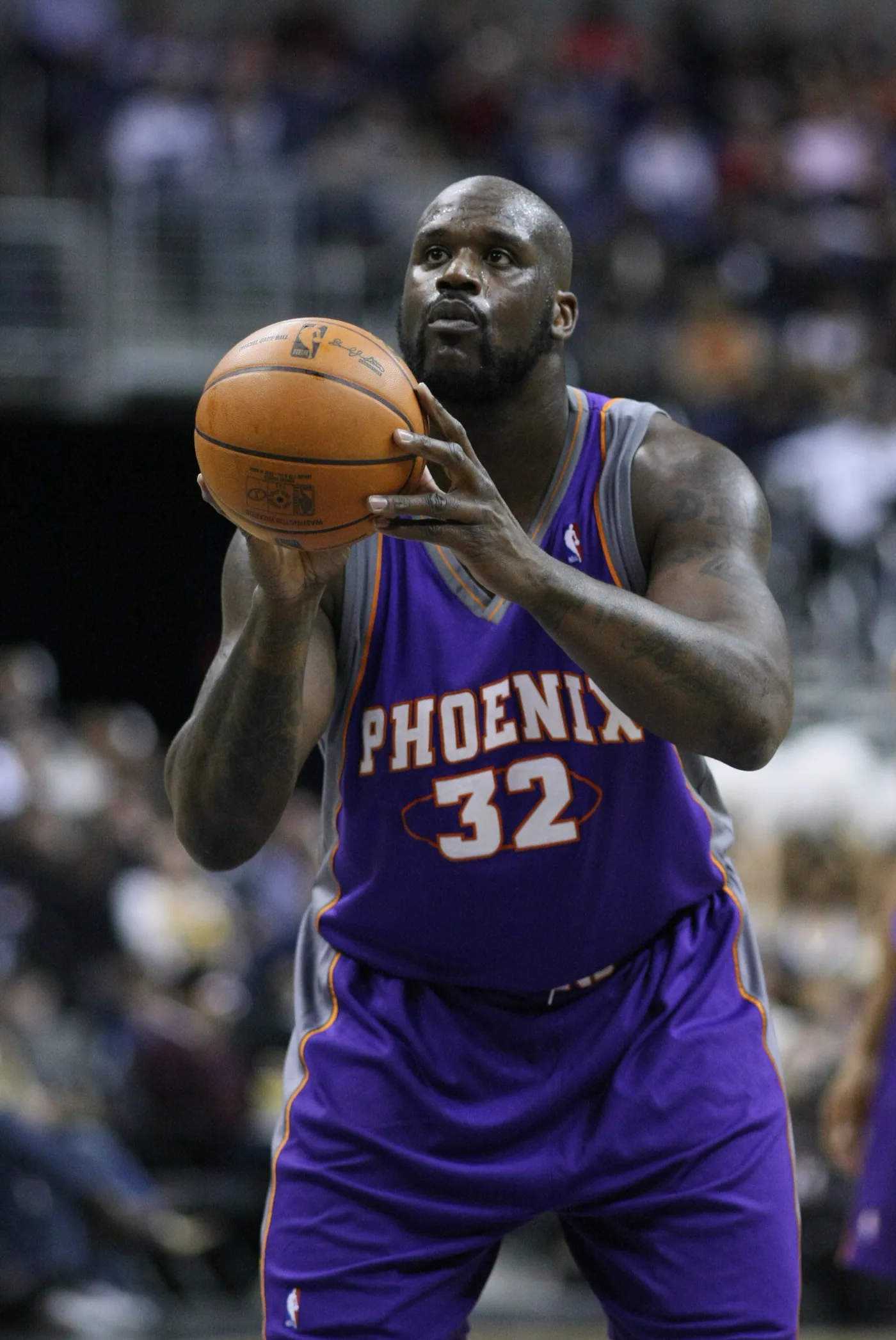
Shaquille O'Neal left the Orlando Magic for the Los Angeles Lakers on 18 July 1996.2 Thirty years later, that signature is still the hinge his whole career swings on: three championships in Los Angeles, a fourth in Miami, and a place in the Hall of Fame.
Alongside all of it he built a second CV, none of it basketball. A platinum-selling rap album.7 A fighting game. A film about a genie who lives in a boombox. Six NBA teams, and a second career touring as a DJ.
Sixteen of the rankings here carry his name. They agree on very little.
Every list that flatters Shaq is about what happened between the free-throw line and the rim. Every list that exists to catalogue failures found room for him too.
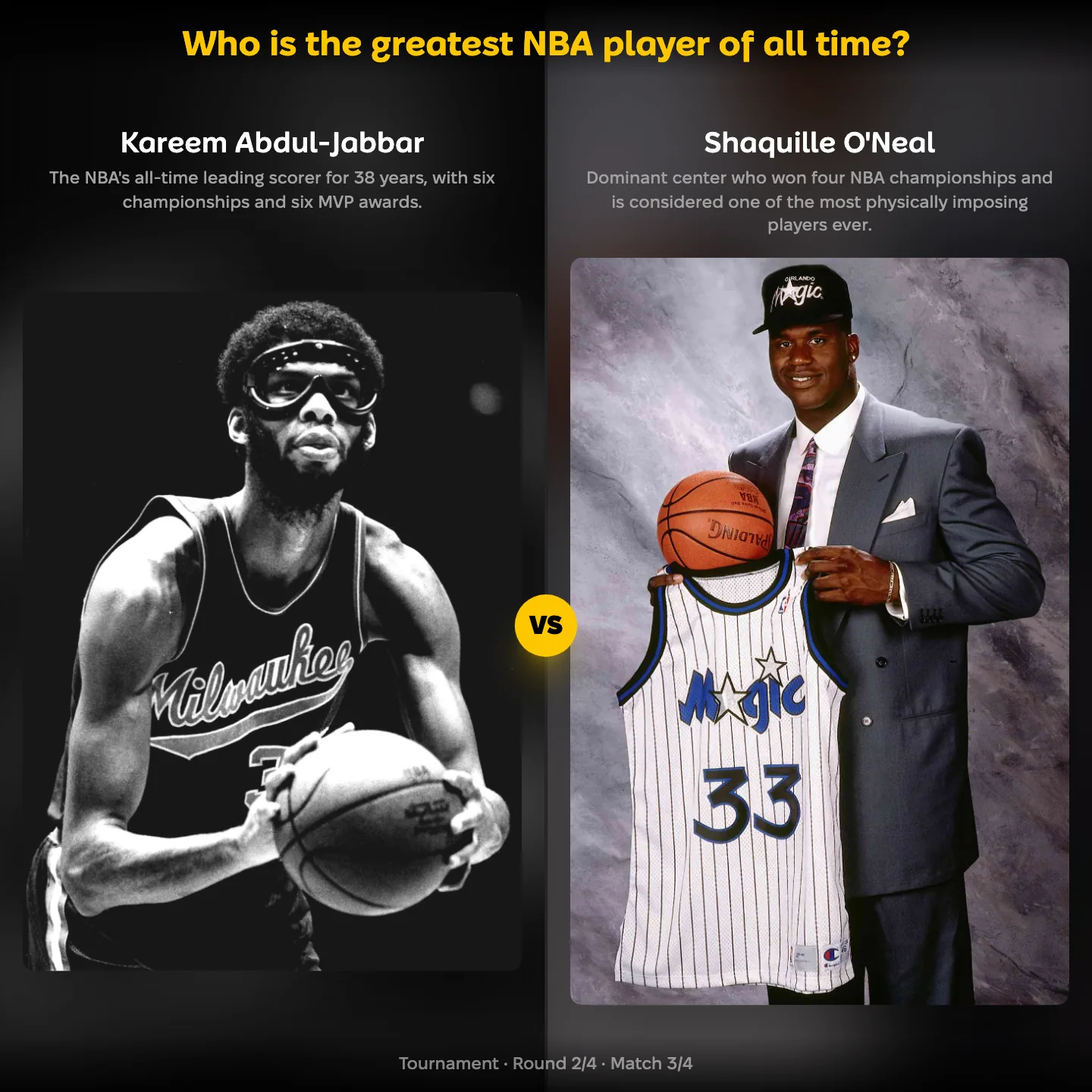
Kareem, Wilt and Jordan: the fourteen names on basketball's biggest list
This ranking asks the oldest question the sport has, and fourteen players are in the running.
His case is 28,596 career points, four championships, the 1999–2000 MVP award, fifteen All-Star selections and a place on the NBA's 75th Anniversary Team.1
The company is the problem. Kareem Abdul-Jabbar held the all-time scoring record for 38 years. Bill Russell won eleven titles. Michael Jordan never lost a Finals.
What a list like this cannot record is the thing every opponent describes first. At 7 ft 1 and 325 pounds, O'Neal was the player of his era whom teams redesigned their defence around, and usually failed anyway.
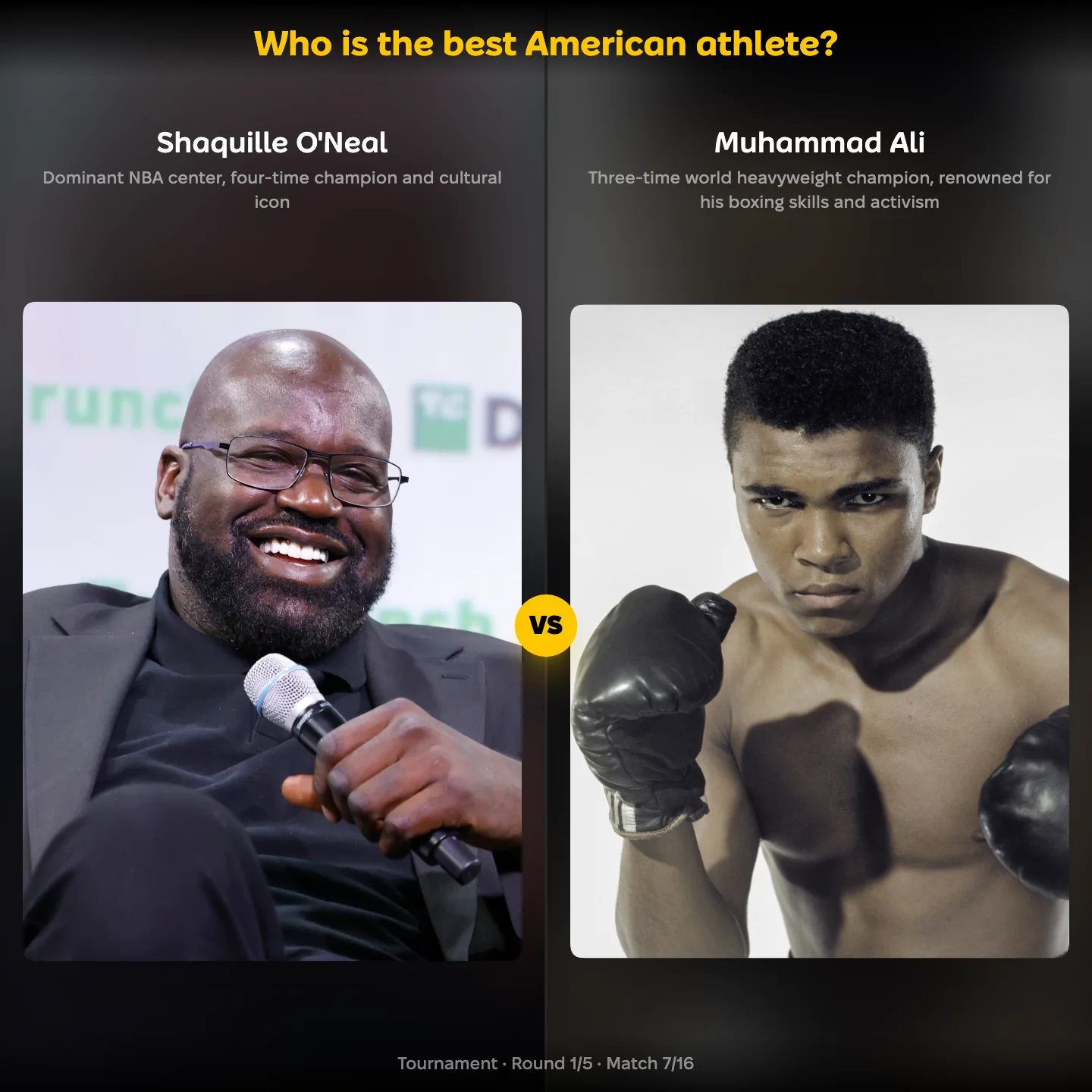
Muhammad Ali to Simone Biles: basketball is one door into American sport
Thirty-one American athletes make this ranking, drawn from every sport the country cares about, and O'Neal is the only true centre among them.
Boxing brings Muhammad Ali. Track brings Jesse Owens and Jackie Joyner-Kersee. Baseball brings Jackie Robinson, whose case has nothing to do with statistics at all.
O'Neal's claim here is cultural. Through the late 1990s he was the most recognisable American athlete who was not Michael Jordan, and he converted that into films, records and a sneaker line while still playing.
Set against a field this wide, four rings in one sport is a narrow argument. Putting him on the list is a way of finding that out.
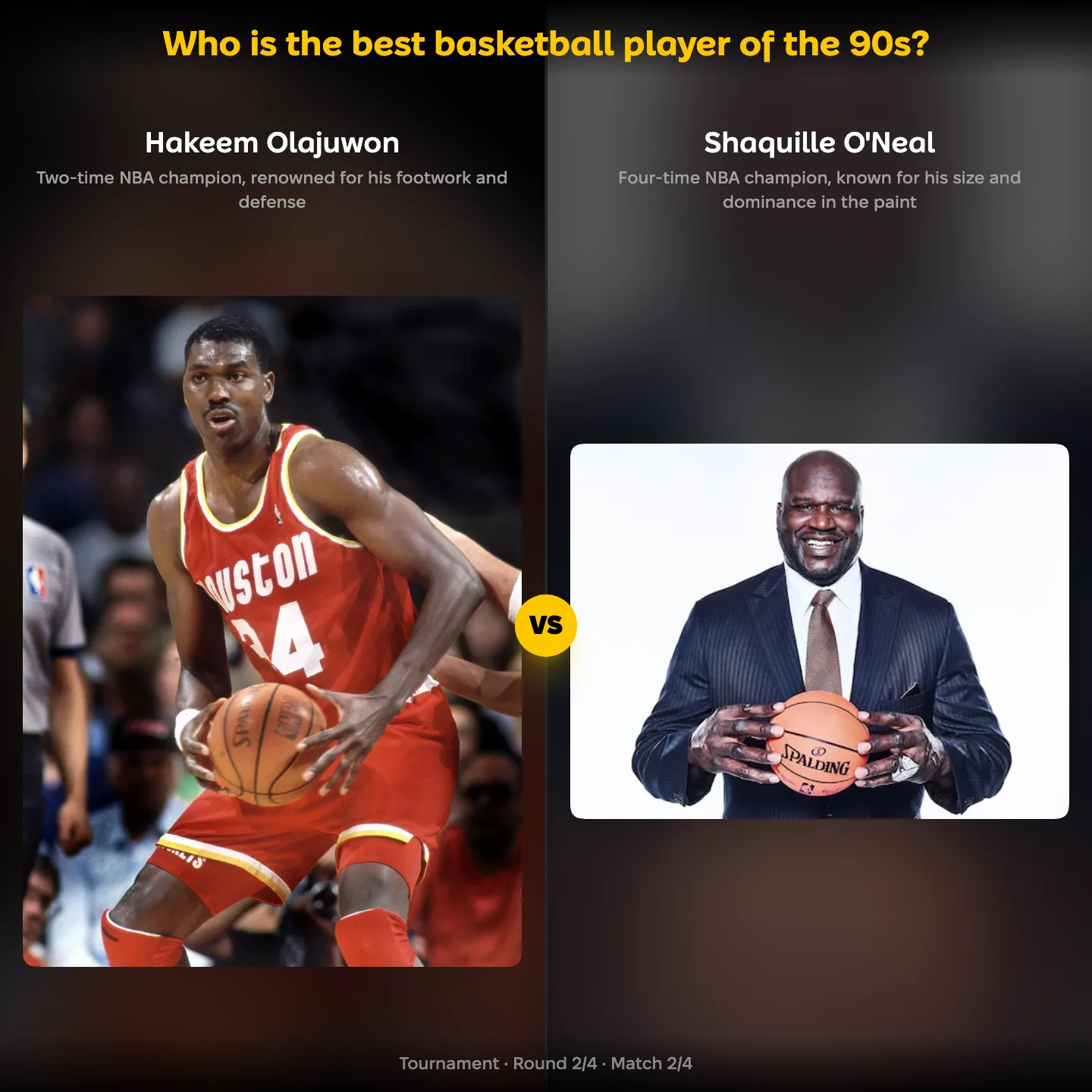
Hakeem Olajuwon and the centre who defined the 1990s
The 1990s belonged to Michael Jordan, and this ranking is about everyone who had to play in that decade anyway.
Shaquille O'Neal arrived in 1992 as the first overall pick and won Rookie of the Year in his first season.1 By 1995 he had taken Orlando to the Finals, at twenty-three.
Hakeem Olajuwon collected the two championships Jordan's retirement left available, in 1994 and 1995, and swept O'Neal's Magic to win the second of them.
David Robinson, Patrick Ewing, Karl Malone and Charles Barkley all share the same fate on this list: a decade of excellence, and the trophies going somewhere else.
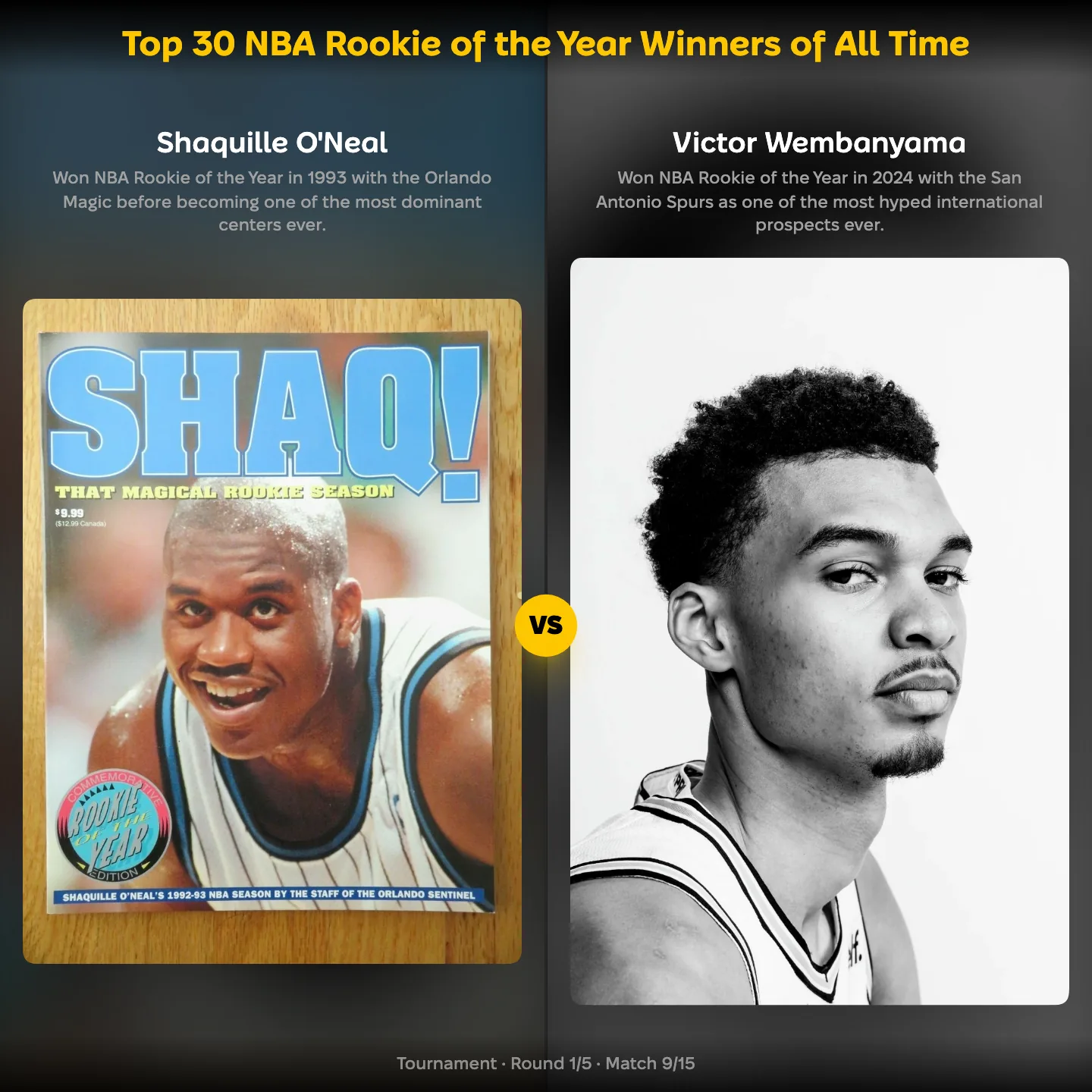
Rookie of the Year, 1993: from Shaq to Wembanyama
Thirty winners of the same award, stretching from Elgin Baylor in 1959 to Victor Wembanyama.
O'Neal took it in 1992–93, the season Orlando drafted him first overall.1
LeBron James, Michael Jordan, Wilt Chamberlain and Kareem Abdul-Jabbar share the award with him. So do several players who never made an All-Star team afterwards, which tells you how little a first season settles.
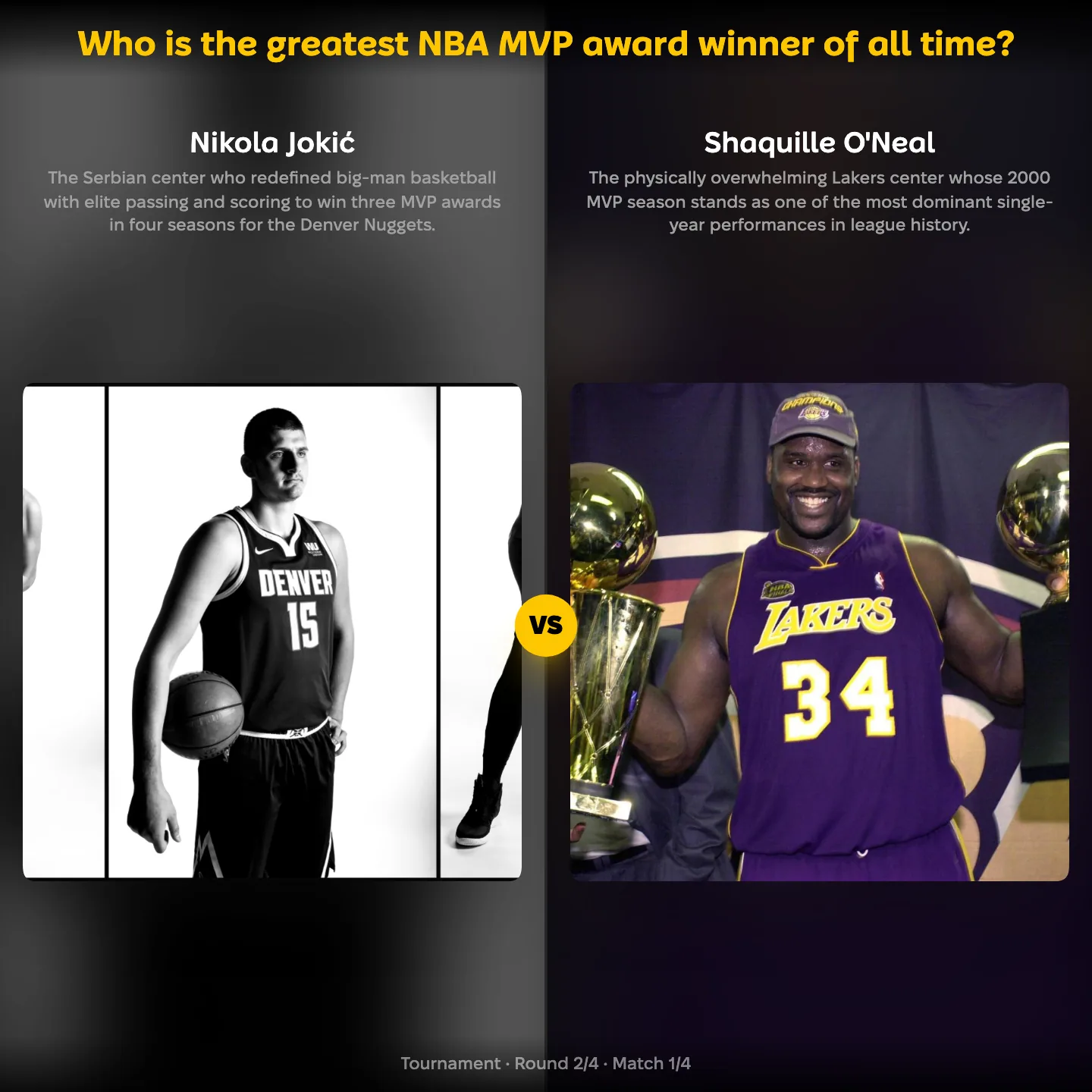
One MVP, and the award Kareem won six times
Fifteen MVP winners are ranked here, and O'Neal's single trophy arrived in 1999–2000, the first season of the Lakers' three-peat.1
Kareem Abdul-Jabbar won six of them. Michael Jordan and Bill Russell won five each. Wilt Chamberlain won four.
Voters spent the rest of O'Neal's prime handing the award elsewhere while opposing coaches were building game plans around the assumption that he could not be stopped. That gap between reputation and hardware is what this ranking exposes.
Nikola Jokić and Giannis Antetokounmpo have both collected more MVP awards than he ever did.
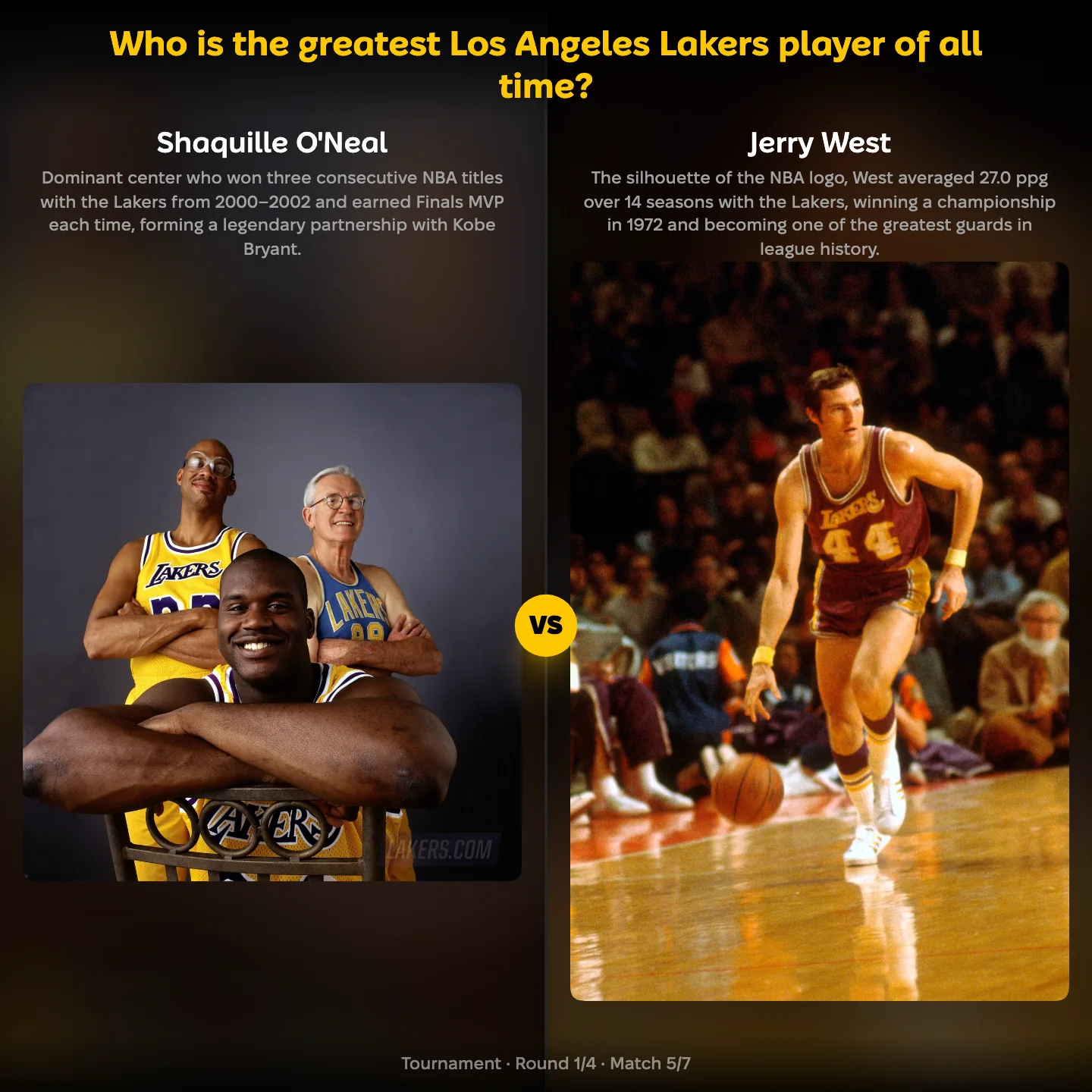
Shaq vs Jerry West: the greatest Laker of all time
The Lakers list is the deepest single-franchise question in American sport, and it runs fourteen names deep.
His eight seasons in Los Angeles produced three consecutive championships from 2000 to 2002 and three consecutive Finals MVP awards, a run only Michael Jordan has also managed.1
Jerry West gave the franchise fourteen seasons and became the silhouette in the league's logo. Kareem Abdul-Jabbar and Magic Johnson won five titles each in purple and gold. Kobe Bryant won five and stayed twenty years.
Length of service is the case against O'Neal here, and it is a fair one. He left in 2004 after a falling-out with Bryant that split the club, and no other Laker on this list departed on worse terms.
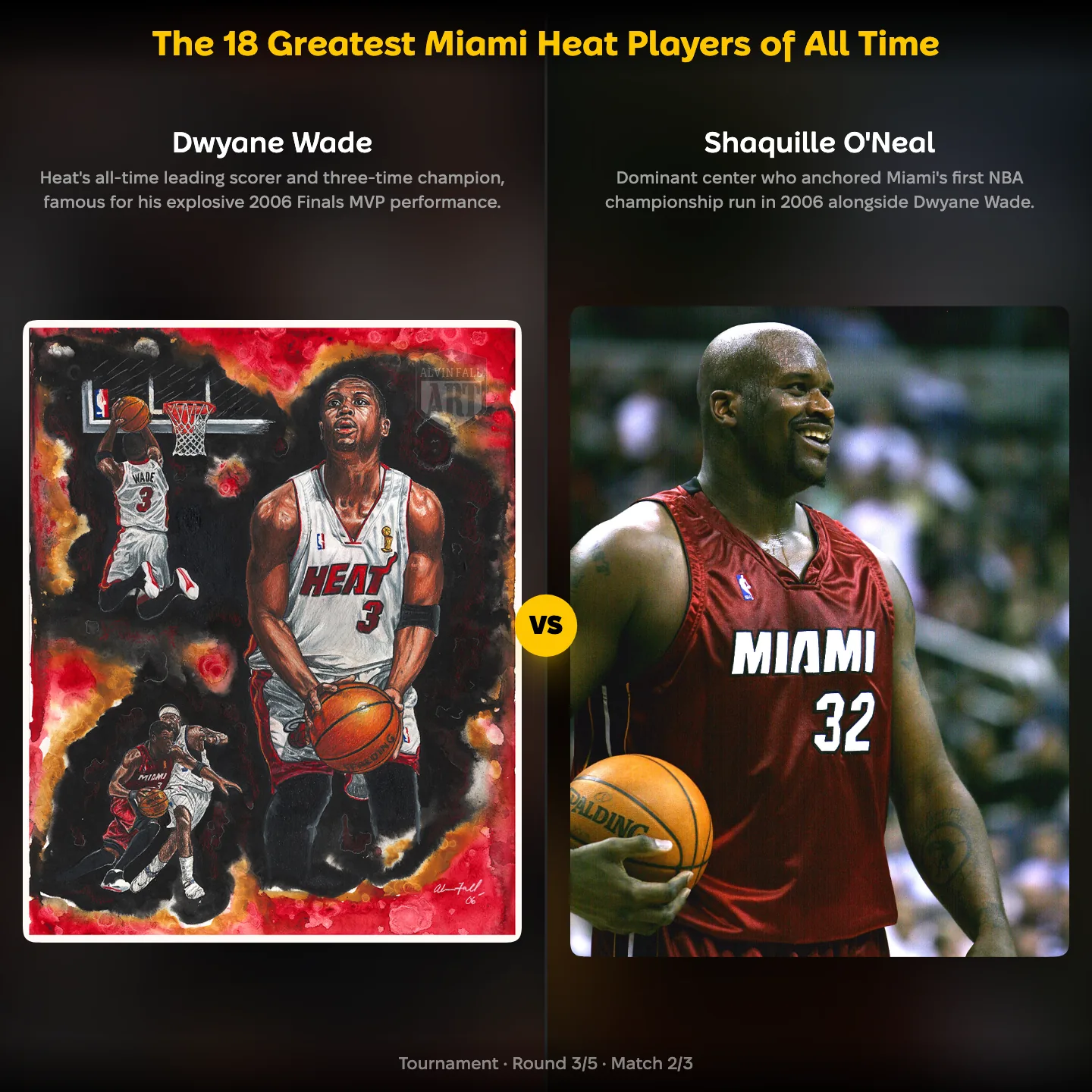
Miami Heat: one ring in four seasons, eighteen names
O'Neal's Miami spell ran from 2004 to 2008, and eighteen players are ranked on the franchise's all-time list.
The 2006 championship carries his case. That was the club's first title, and the only ring O'Neal won outside Los Angeles.
Dwyane Wade won three championships with Miami across thirteen years. LeBron James won two in four. Alonzo Mourning gave the franchise a decade and its first identity.
A short stay that ends in a trophy outweighs a long one that does not. That is what makes this list harder than the length of anyone's contract suggests.
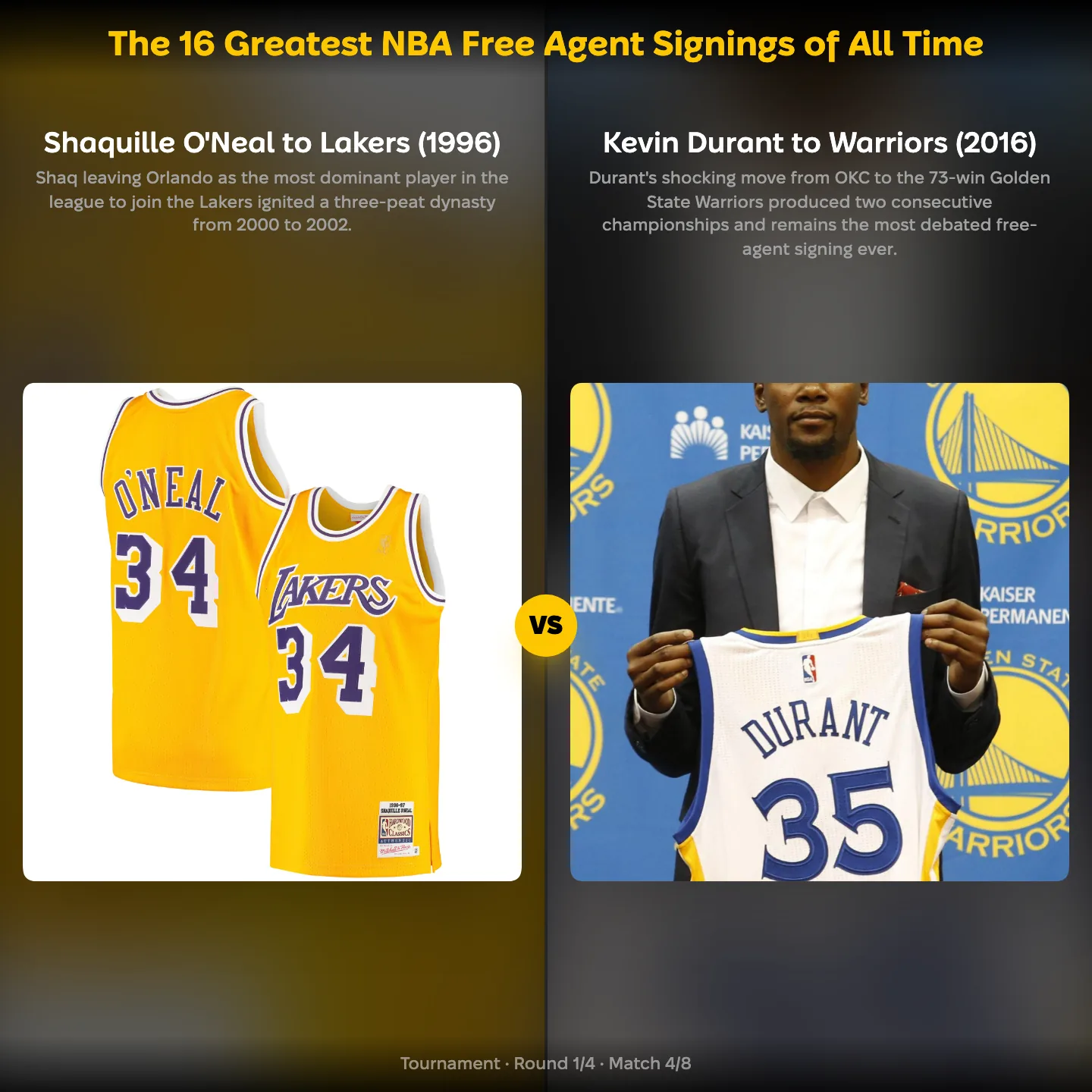
Orlando to Los Angeles, 18 July 1996
Thirty years ago this summer, Shaquille O'Neal signed with the Lakers on a seven-year deal reported at $120 million, the largest contract in team sports at the time.2
Orlando had reached the Finals with him the season before. Los Angeles had drafted a seventeen-year-old Kobe Bryant three weeks earlier. Three championships followed within four years.
LeBron James's move to Miami in 2010 is the modern benchmark on this ranking, and Kevin Durant joining a 73-win Golden State team in 2016 is the most argued-over entry in it.
What separates O'Neal's is the era. There was no televised decision and no announcement video, just a contract in July and a dynasty by the spring of 2000.
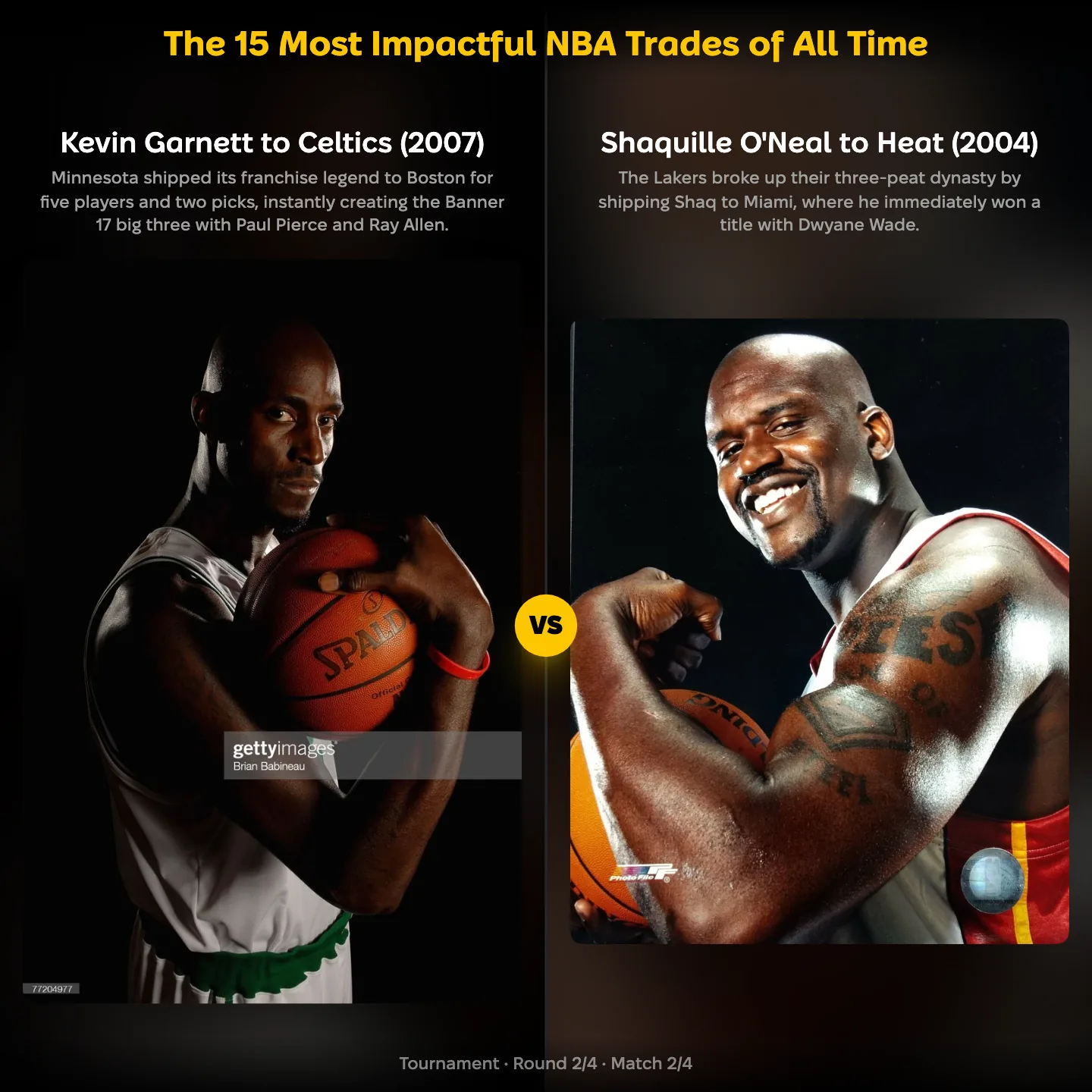
The 2004 trade to Miami, next to Kareem's and Garnett's
This ranking collects the deals that redrew a title race, and O'Neal's exit from Los Angeles in 2004 is one of them.
The Lakers sent him to Miami for Lamar Odom, Caron Butler and Brian Grant. He won a championship two years later; Los Angeles did not win another until 2009.
Kareem Abdul-Jabbar's move to the Lakers in 1975 and Kevin Garnett's to Boston in 2007 are the two entries that changed a franchise's decade the same way.
Wilt Chamberlain to the Lakers in 1968 is the closer parallel. A dominant centre, already a champion, traded in his thirties into a team that then rebuilt itself around him.
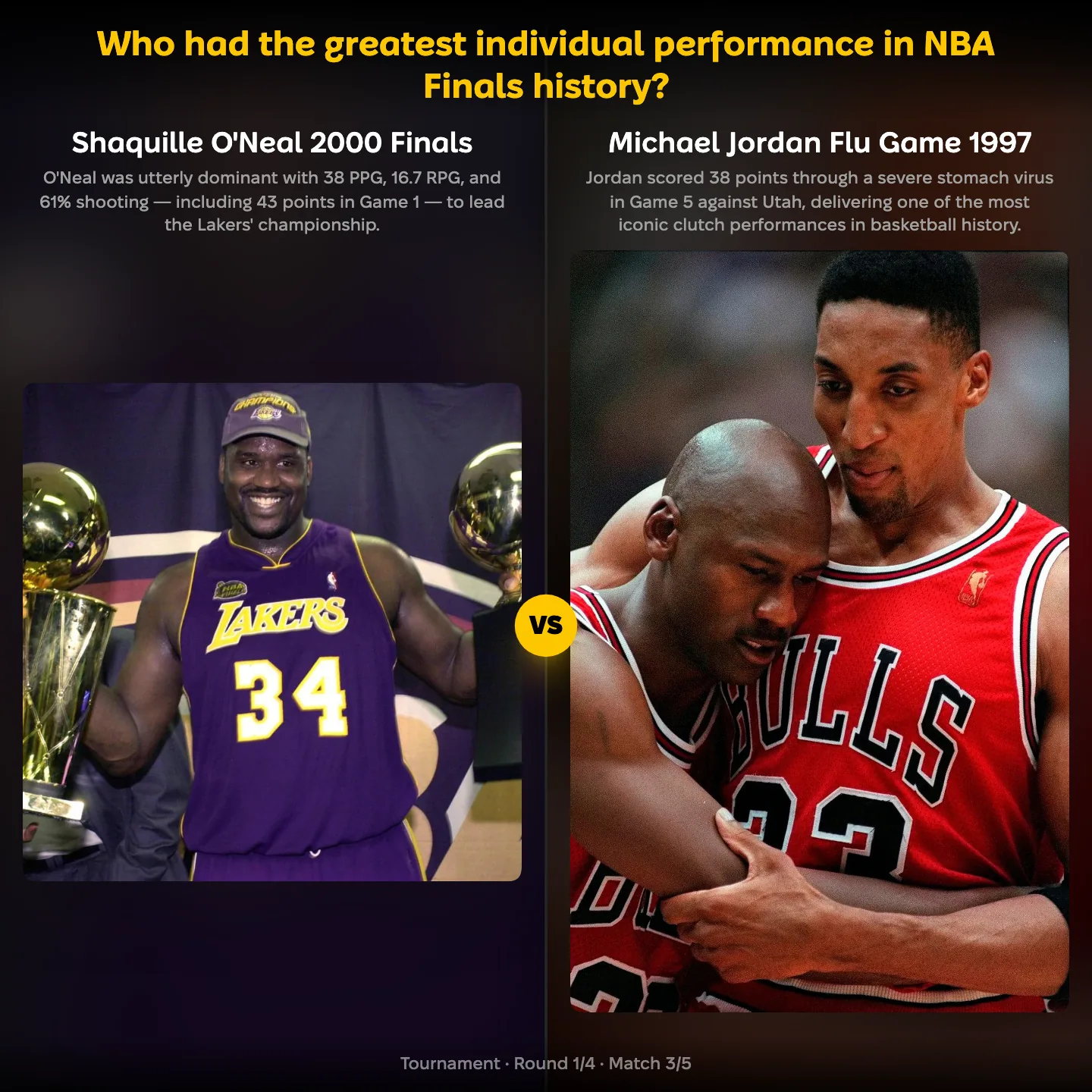
38 points a game: the 2000 Finals against the Indiana Pacers
Ten performances make this ranking, and O'Neal's 2000 Finals is the entry that stretches across a whole series.
He averaged 38.0 points and 16.7 rebounds over six games against Indiana, and took the first of his three Finals MVP awards.3
Michael Jordan's flu game in 1997 and LeBron James's Game 7 in 2016 get replayed far more often, and both of them are single nights.
That is the comparison the ranking keeps running into: a six-game average against one unforgettable evening. Magic Johnson's Game 6 in 1980, played at centre as a rookie, belongs in the same awkward space.
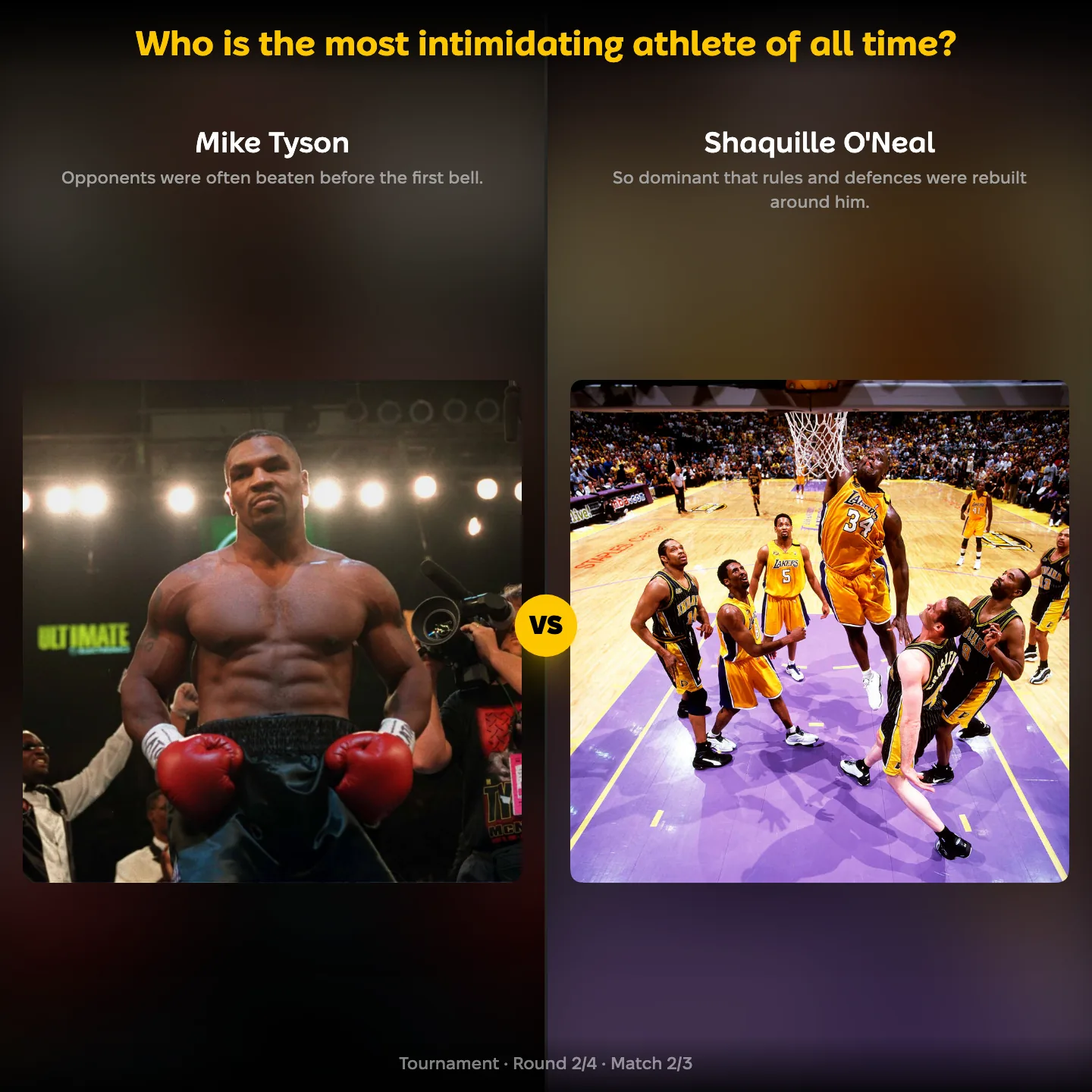
Mike Tyson, Lawrence Taylor and the most intimidating athlete alive
Twelve athletes are ranked here on fear rather than achievement, and Shaquille O'Neal is the tallest and heaviest name among them.1
Teams eventually stopped defending Shaquille O'Neal conventionally and started fouling him on purpose. Nobody invents a tactic like that for a player they believe they can guard.
Mike Tyson and Sonny Liston bring boxing to the list. Lawrence Taylor and Dick Butkus bring American football, where intimidation is part of the job description rather than a side effect.
The case against him is temperament. O'Neal was famously cheerful about all of it, which is a strange quality to carry into a ranking about menace.
Reebok, the Shaq Attaq and Allen Iverson's Question
Eighteen endorsement deals are ranked here, and O'Neal's is one of the few from the 1990s that did not have a Nike swoosh on it.
He signed with Reebok as a rookie in 1992, and the Shaq Attaq became one of the decade's rare signature basketball shoes built outside Nike's orbit.
Michael Jordan's Nike contract went on to generate a business larger than several leagues. Allen Iverson's Reebok deal, from the same brand four years after O'Neal's, produced the Question, a shoe still in production.
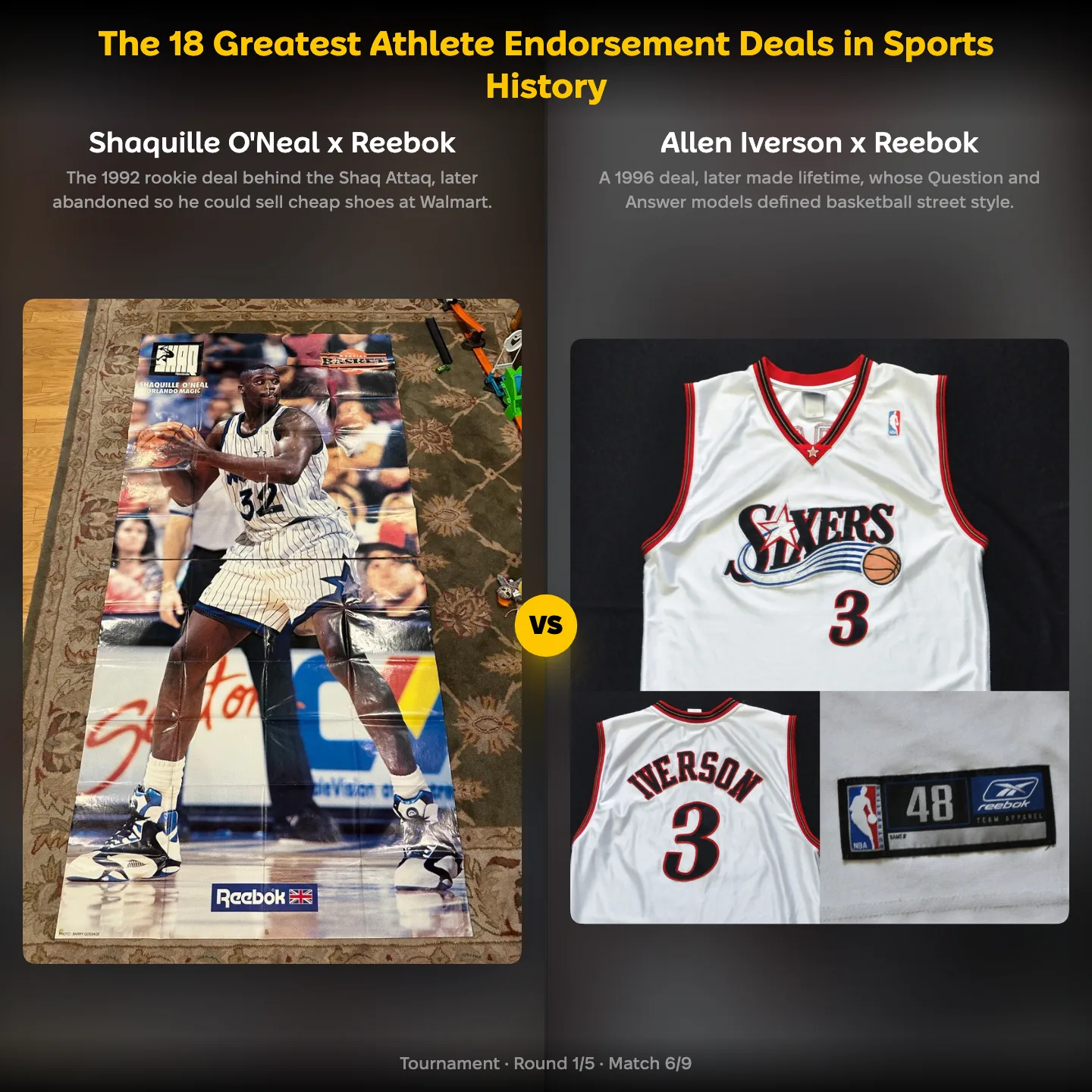
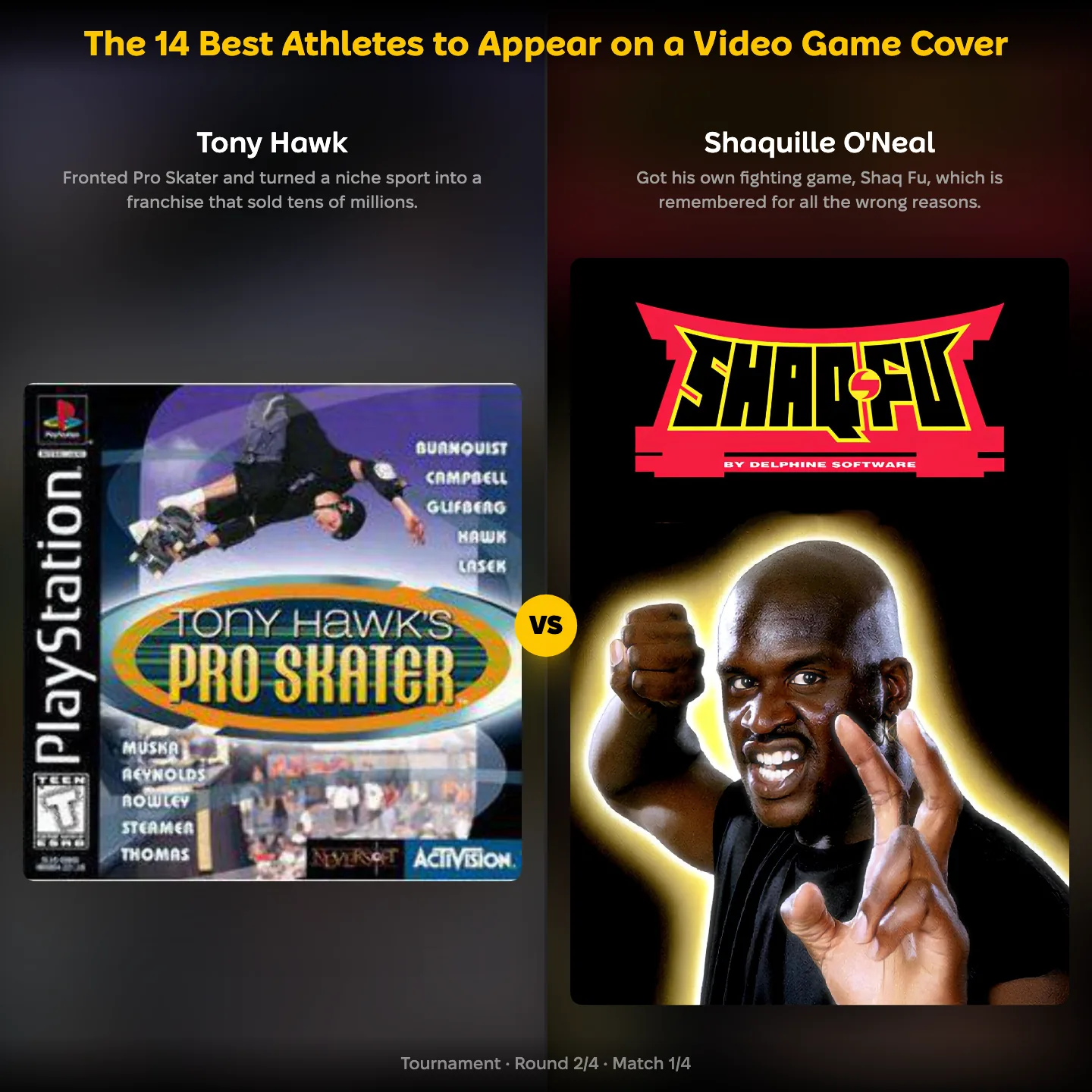
Tony Hawk, Bo Jackson and the athletes who sold a box
Fourteen athletes have carried a video game cover, and Shaquille O'Neal is on this list for a game people bought and then complained about.
Tony Hawk's Pro Skater built a franchise on a name most buyers could not have identified before 1999. Bo Jackson and Ken Griffey Jr. did the same for American football and baseball a decade earlier.
Lionel Messi and Cristiano Ronaldo appear here as well, attached to football games that sell tens of millions of copies a year without needing a face on the front.
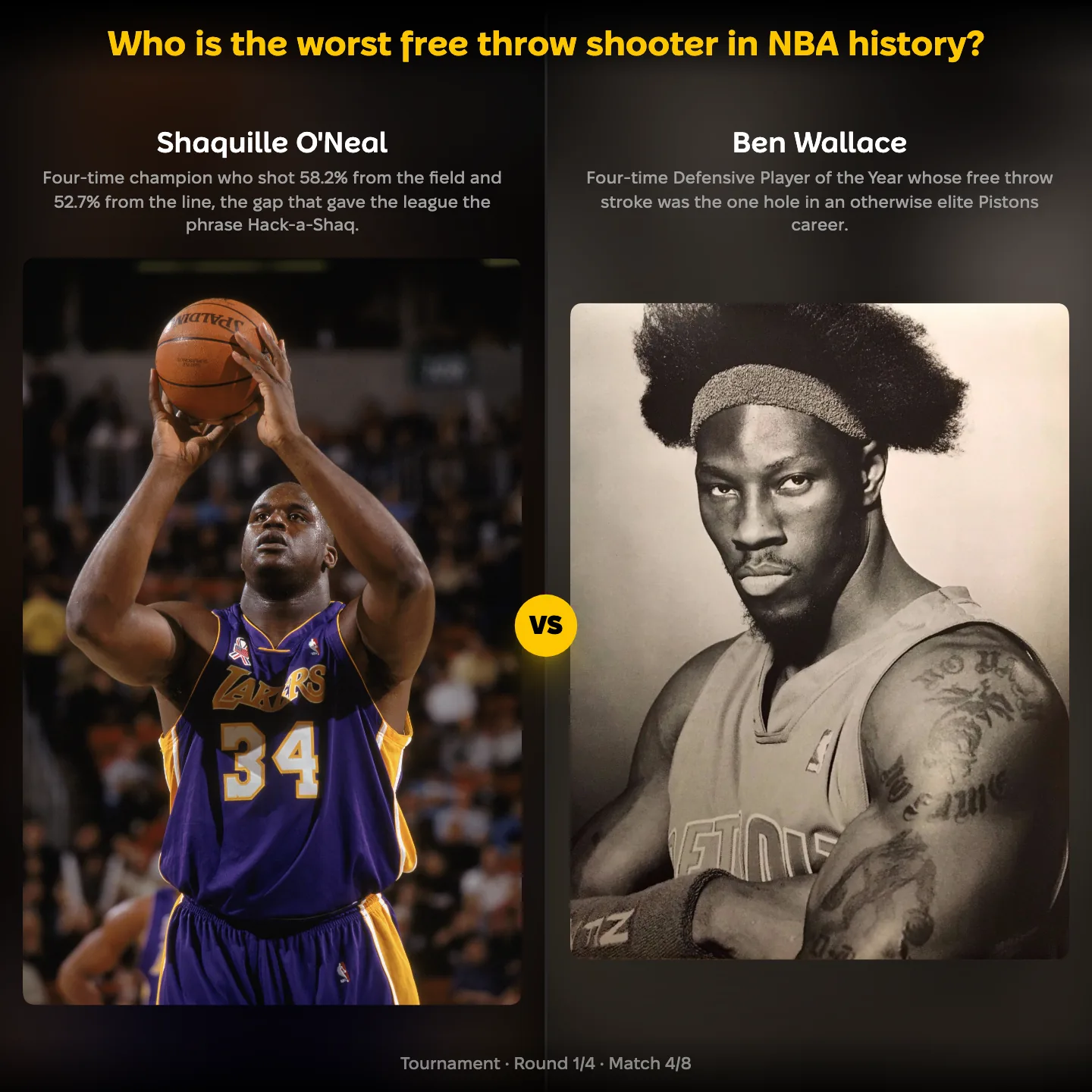
Hack-a-Shaq: 58.2% from the field, 52.7% from the line
This is the ranking built on the one thing Shaquille O'Neal could not do.
Across 1,207 regular-season games he shot 58.2% from the field and 52.7% from the free-throw line.1 Dallas coach Don Nelson turned that gap into a strategy of deliberate fouling, and although he first used it on Dennis Rodman, the tactic took O'Neal's name.8
The league eventually legislated against it. From the 2016–17 season, off-the-ball fouls in the last two minutes of any quarter give the fouled team a free throw and the ball.8
Wilt Chamberlain had the same weakness a generation earlier. Ben Wallace, Dwight Howard and DeAndre Jordan all built careers on defence and rebounding with the same hole in them, and each of them got the same treatment.
Being on a list like this is backhanded evidence of value. Nobody wastes a foul on a player who cannot hurt them.
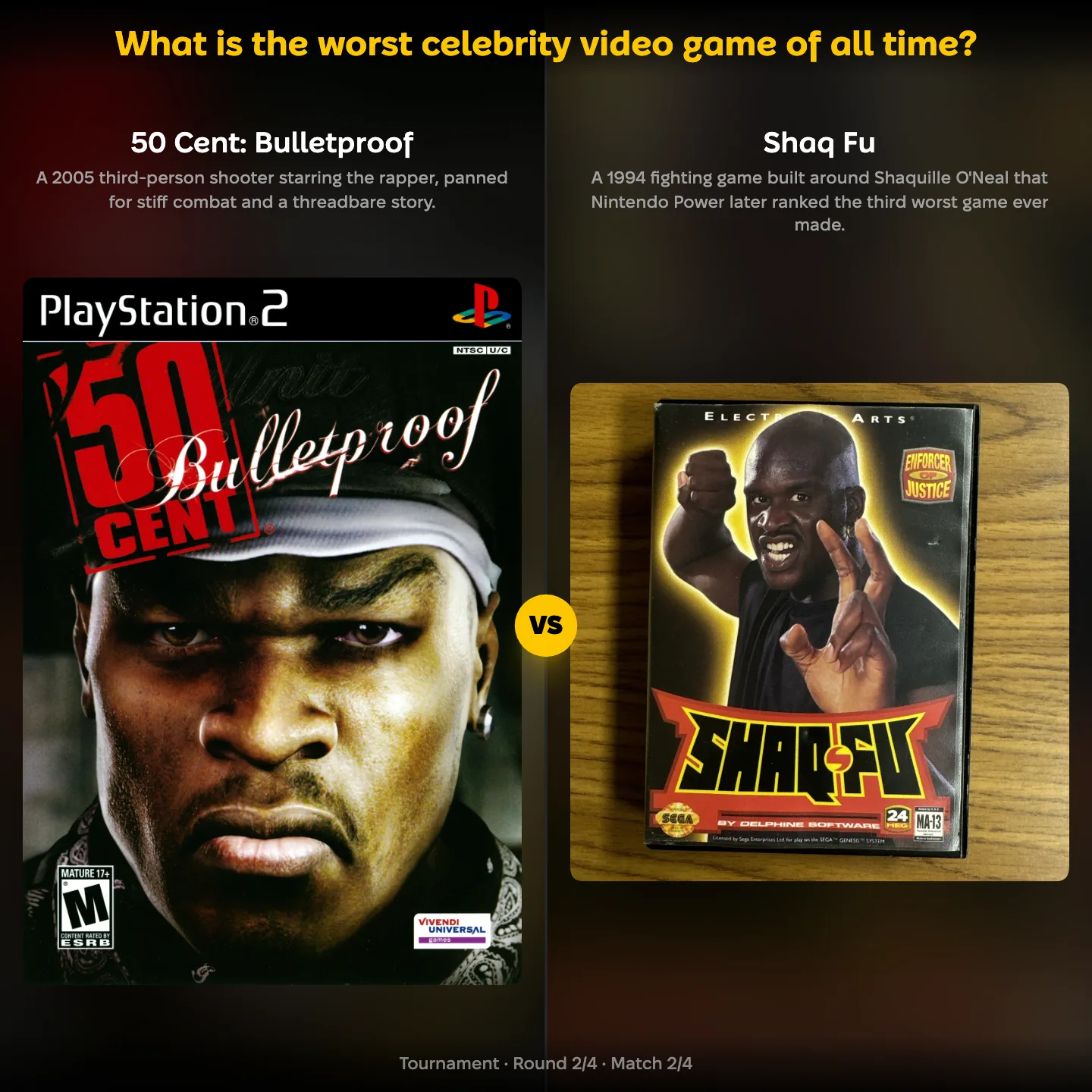
Shaq Fu, 1994: the game Nintendo Power called the third worst ever made
Fifteen celebrity video games are ranked here, and O'Neal's has a reputation that long outlived the console it shipped on.
Shaq Fu dropped him into a side-scrolling fighting game against a cast nobody remembers. Nintendo Power later placed it third on its list of the ten worst games ever made, with the verdict that a worse idea was not available.6
The competition is real. Three separate Sega CD releases asked players to edit a pop music video. Journey Escape, from 1982, is a game about getting a rock band safely to its tour bus.
A fan campaign to buy and destroy every surviving copy ran for years, and a crowdfunded sequel arrived in 2018 to reviews as poor as the original's.6
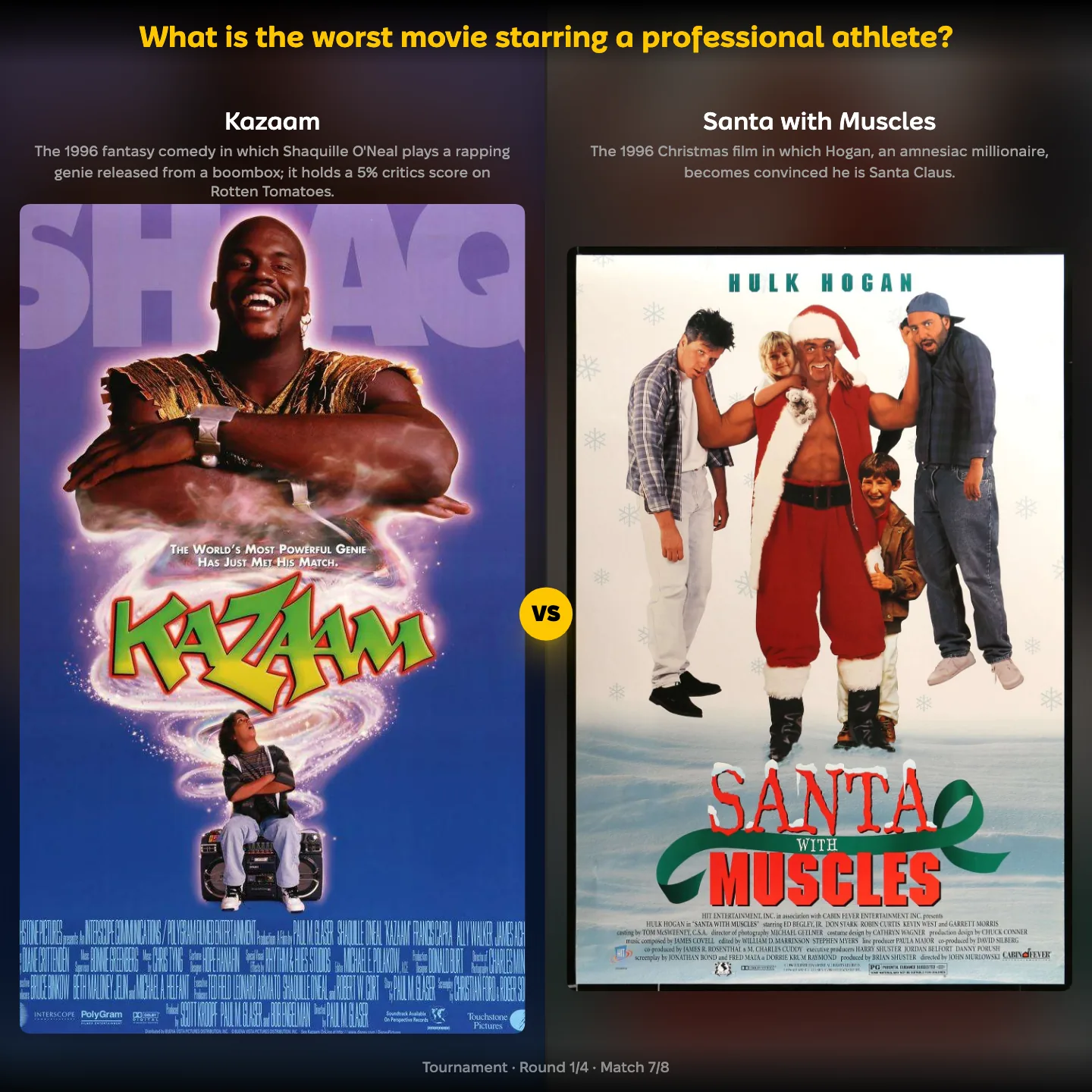
Kazaam and Santa with Muscles: the athlete-movie hall of shame
Fifteen films starring an athlete are ranked here. Shaquille O'Neal accounts for two.
Kazaam, from 1996, cast him as a rapping genie released from a boombox. Rotten Tomatoes puts its critics score at 5% across 38 reviews.4
Steel, his 1997 turn as a DC superhero who welds his own armour, does worse: 4% from 24 reviews.5 Blue Chips, the 1994 college basketball drama that put him opposite Nick Nolte, is the one film here critics treated kindly.
Hulk Hogan supplies four entries by himself, one of them a Christmas story in which an amnesiac millionaire becomes convinced he is Santa Claus.
Michael Jordan's Space Jam is on the same list, which is the useful reminder that a film reviewed this badly can still be loved by everyone who saw it at nine years old.
The paint is the only place the lists agree
Sixteen rankings, and the pattern in them is not random. Everything Shaquille O'Neal did within fifteen feet of the basket got him ranked among the greats. Everything he attempted beyond that radius earned him a place in somebody's catalogue of disasters, and he kept attempting it anyway.
He is still going. North Carolina has him booked as DJ Diesel for its Chapel Thrill concert series on 12 September 2026, playing outside Wilson Library before the Tar Heels host East Tennessee State.9
Our explainer on voting things down two at a time covers the mechanics behind every list above. Or build one, and choose which Shaq the question is about.
More rankings, more angles
- Kobe Bryant's Records Keep Falling. The Lists Keep Him. — the other half of the three-peat, measured separately
- Magic Johnson vs Larry Bird: 47 Years of the Same Argument — the Lakers rivalry that came two decades earlier
- What Is Pairwise Comparison? — why every ranking here is built two options at a time
- Chicago Bulls: 72 Wins in 1996, 31 in 2026 — 72 wins, six banners, one bad decade
Sources
- Basketball-Reference — Shaquille O'Neal career page: games, scoring, field-goal and free-throw percentages, draft position, honours, Hall of Fame year: basketball-reference.com (checked 2026-08-13)
- Deseret News, 18 July 1996 — contemporaneous report of the Lakers signing and its terms: deseret.com (checked 2026-08-13)
- Basketball-Reference — 2000 NBA Finals, Pacers vs Lakers: Finals MVP and the 38.0 / 16.7 series averages: basketball-reference.com (checked 2026-08-13)
- Rotten Tomatoes — Kazaam (1996) critics score: rottentomatoes.com (checked 2026-08-13)
- Rotten Tomatoes — Steel (1997) critics score: rottentomatoes.com (checked 2026-08-13)
- Wikipedia, citing Nintendo Power — Shaq Fu, its ranking among the worst games ever, the destruction campaign and the 2018 sequel: en.wikipedia.org (checked 2026-08-13)
- Wikipedia — Shaq Diesel, released October 1993 and certified platinum by the RIAA in March 1994: en.wikipedia.org (checked 2026-08-13)
- Wikipedia — Hack-a-Shaq: Don Nelson's use of deliberate fouling, its naming, and the 2016–17 off-the-ball foul rule: en.wikipedia.org (checked 2026-08-13)
- University of North Carolina Athletics — 2026 Chapel Thrill concert schedule, listing DJ Diesel (Shaquille O'Neal) for 12 September against East Tennessee State: goheels.com (checked 2026-08-13)