
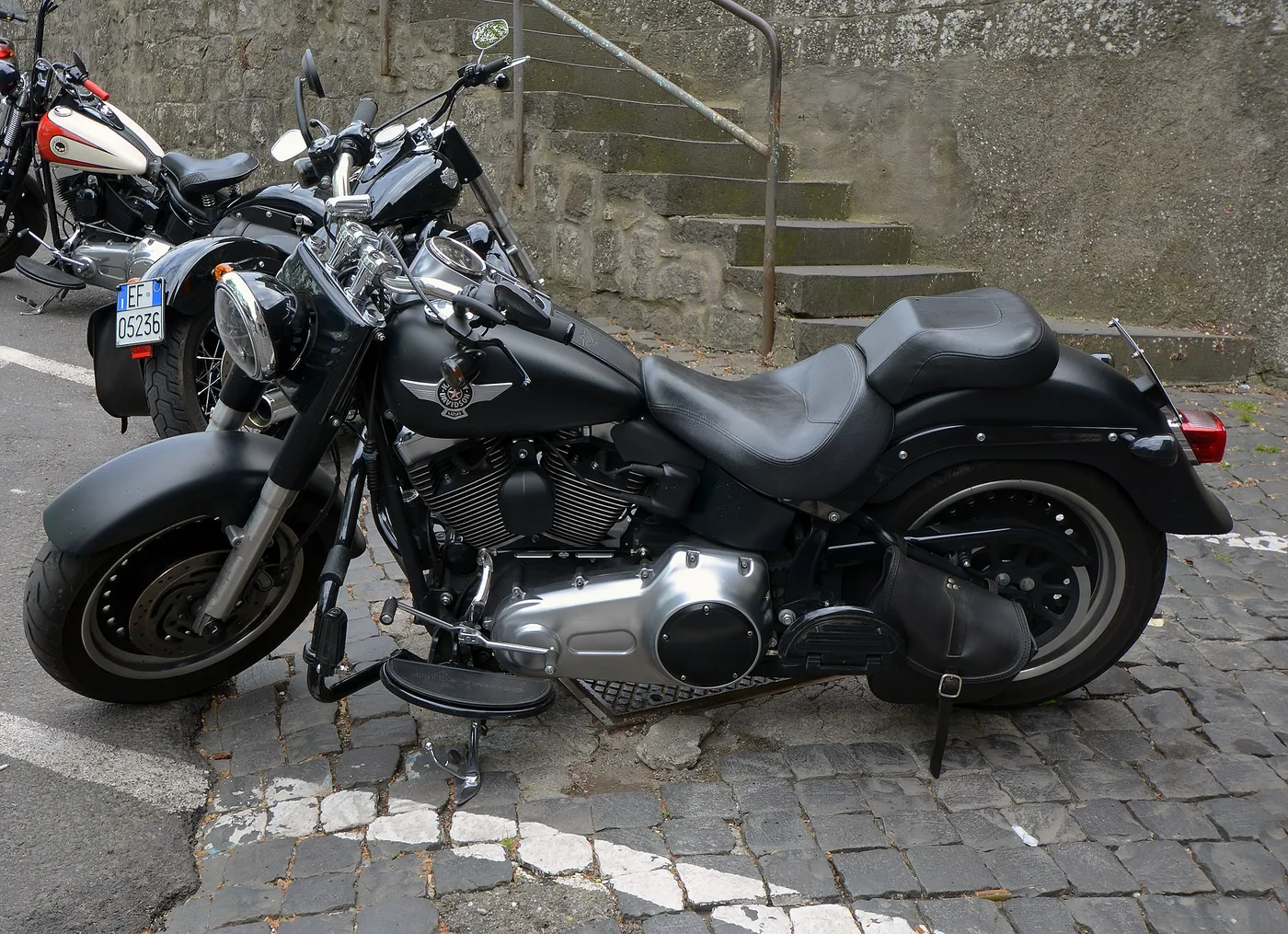
Harley-Davidson started in a ten-by-fifteen-foot shed in Milwaukee in 1903 and spent the next century becoming shorthand for something bigger than motorcycles.1 In 2026 the company is in what its own chief executive calls a reset year: retail sales fell 12% in 2025 to 132,535 motorcycles worldwide, the year closed with a $29 million operating loss, and in April the brand relaunched around the returning bar-and-shield logo.2
So there are two Harleys to keep track of. One is an American icon that turns up on lists about logos, road trips, engine noise and the things the country exports as itself. The other is a manufacturer trying to sell bikes to people who currently buy Hondas.
Ask what America built and Harley-Davidson is near the front of the queue. Ask what to actually ride and the queue rearranges itself completely.
Harley-Davidson vs Honda: the brand question, asked plainly
Start with the version of the question nobody has to interpret. Fourteen manufacturers, one list, no qualifiers.
Harley makes heavyweight cruisers and very little else, and it has done so since 1903. That focus is the case for it and the case against it in the same sentence.
Honda is the largest motorcycle manufacturer on earth and builds everything from 125cc commuters to MotoGP machinery. So do Yamaha, Suzuki and Kawasaki, and each of them will sell you a bike that does more things competently than a Road King does.
Harley's advantage over all of them is a customer who tattoos the logo on. BMW, Ducati and Triumph all sit here too, and each has a different idea of what "best" is supposed to measure.
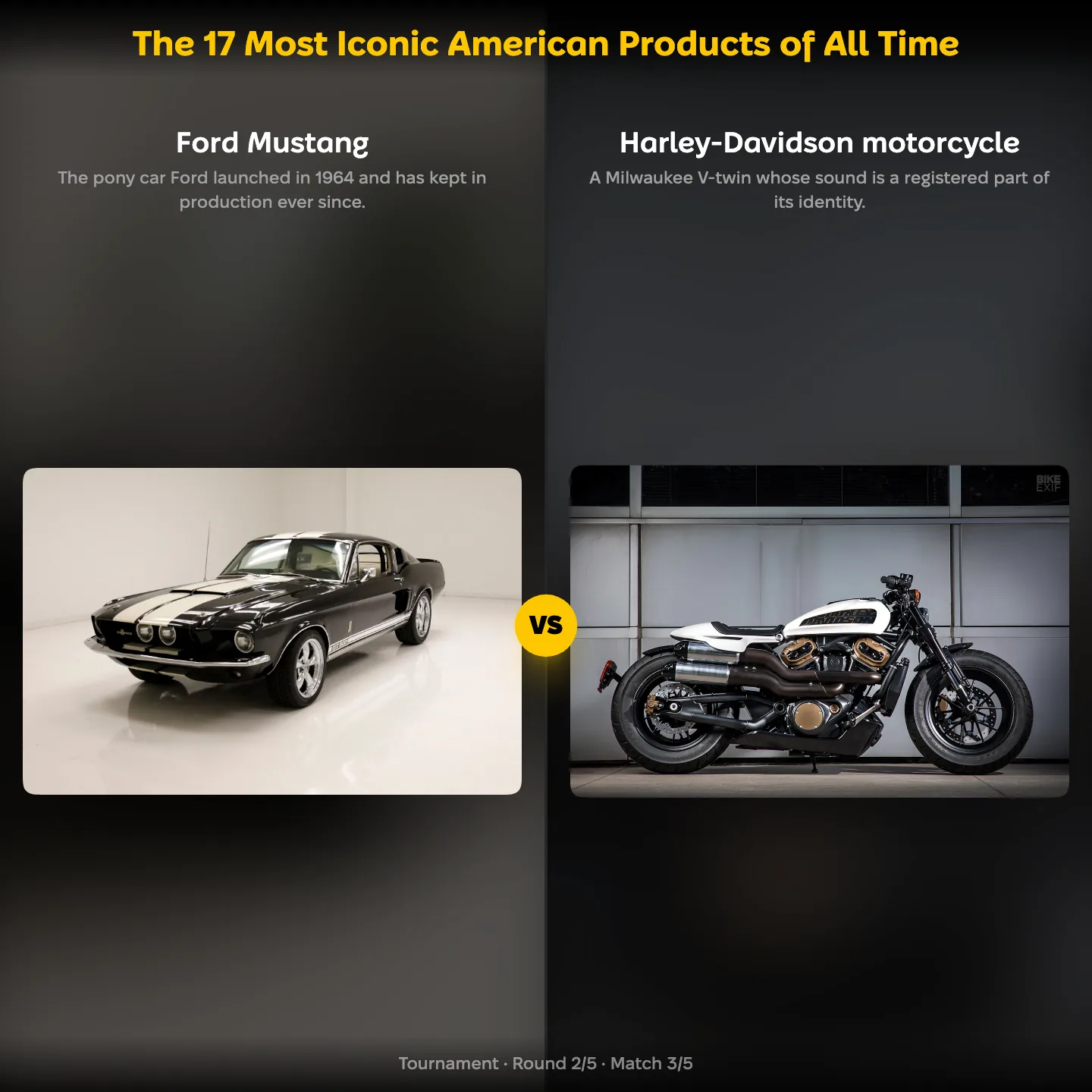
The Harley and the Mustang: two objects America exports as itself
This list drops the motorcycles and asks a broader question: which manufactured objects read as American anywhere in the world?
Harley-Davidson belongs here on cultural grounds, not commercial ones. It has never been large by industrial standards.
The Ford Mustang is its nearest rival on the list, and the comparison is uncomfortable: two 20th-century machines carrying a badge into a market that moved on, both now sold partly on the memory of what they used to mean.
The company Harley keeps is the real point. The Coca-Cola contour bottle, Levi's 501s, the Zippo, the Fender Stratocaster: objects whose shape is the product.
The Bar and Shield against the Swoosh
The bar-and-shield is the piece of Harley-Davidson the company was most confident about in 2026. When Artie Starrs launched the RIDE brand platform on 9 April, the historic mark went back to the centre of the identity.3
It is also the only logo on this list that people pay to have permanently applied to their own skin, which is a form of brand equity no agency can bill for.
The Nike Swoosh was bought for $35 in 1971 and has since dropped the wordmark entirely. It is the benchmark for what a logo can become when the company behind it keeps growing.
Eighteen marks compete here. McDonald's, Coca-Cola and Apple are all identifiable to people who have never bought the product. Harley's is recognisable to people who will never buy a motorcycle. That is a narrower claim, and a stranger one.
Fat Boy, Knucklehead, WLA: Harley judged only against Harley
Remove every other manufacturer and the question turns inward. Sixteen Harleys, ninety years apart at the extremes, and no outside benchmark to hide behind.
The 1936 EL Knucklehead is the engineering answer. Its overhead-valve V-twin set the architecture every big Harley has used since, and the rocker covers that named it are still the shape people draw when they draw a Harley engine.
The WLA Liberator is the historical one. Harley built the olive-drab flathead in volume for despatch riders in Europe and North Africa, and it is the only bike here that was issued rather than bought.
The Fat Boy is the one civilians recognise. Solid disc wheels, a fat front tyre, and a silhouette so specific that it became the brand's default profile in advertising and film.
Then the models that argue with the brand's own idea of itself. The V-Rod was liquid-cooled and developed with Porsche, and the people who buy Softails never fully accepted it. The Pan America 1250 went further, taking Harley into adventure-bike territory BMW had held for forty years. The Nightster does the same job at the other end, replacing the air-cooled Sportster with a liquid-cooled Revolution Max engine aimed at riders who have not bought a motorcycle yet.
The interesting thing about all three is that they exist at all. A company whose asset is a fixed idea of what a motorcycle should be keeps building the ones that contradict it.
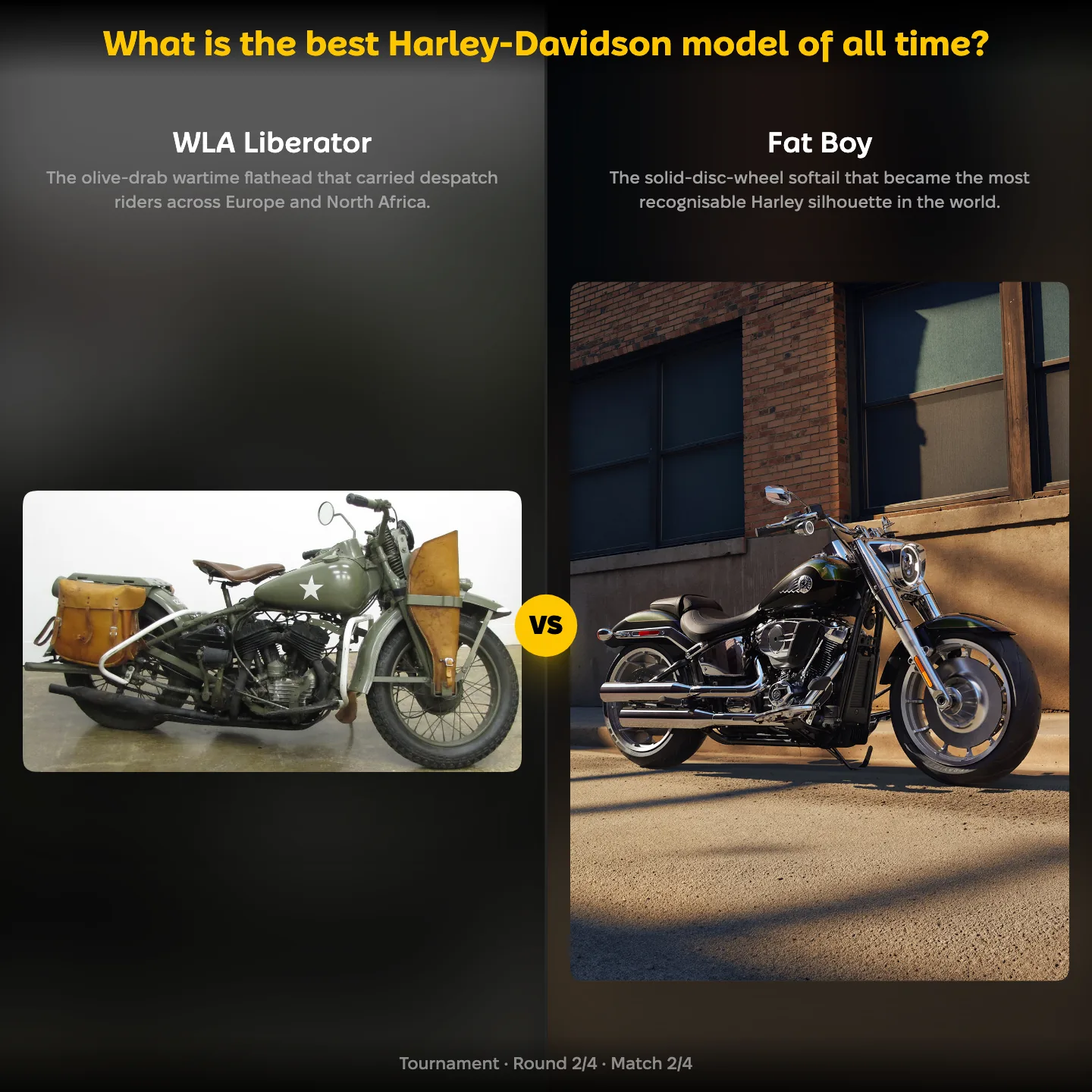
Easy Rider's chopper against Akira's Kaneda bike
Sixteen motorcycles that carried a scene, and three of them are Harleys.
The Captain America chopper from Easy Rider is the most copied motorcycle ever built for a film. A stretched panhead in stars and stripes, it is the reason a generation of American bikes got their forks extended.
Kaneda's red machine from Akira has the opposite claim. It was drawn, not built, and it has outlived its film in poster and model form more completely than any physical prop on this list.
Everything else here is a fair fight: McQueen's disguised Triumph from The Great Escape, the Batpod, Trinity's Ducati 996, the Tron light cycle. Harley's third entry here is the Fat Boy from Terminator 2, which is the same model as the section above and a good illustration of how a product becomes a shorthand.
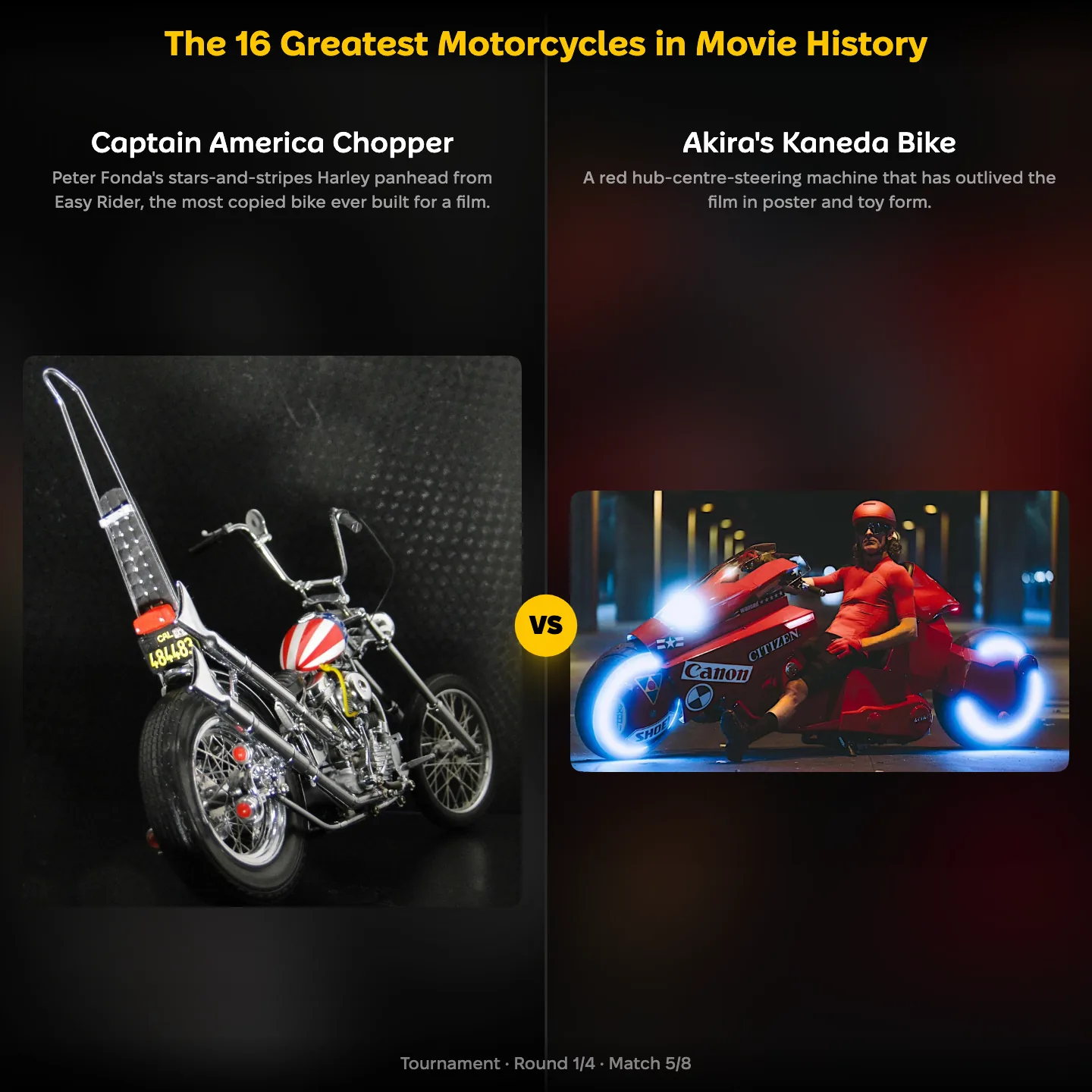
The Merlin, the Ferrari V12 and the potato-potato
Harley-Davidson once tried to own this category in law. In 1994 the company applied to trademark the uneven idle of its 45-degree V-twin — the potato-potato-potato — and withdrew the application in 2000 after six years of opposition from Honda, Yamaha and Kawasaki.4
The legal argument failed because the sound is a consequence of the engine's architecture rather than a decision anyone made. That is also why it is on this list.
The Rolls-Royce Merlin is the hardest competition here. A supercharged V12 that powered the Spitfire, it still stops airshow crowds mid-sentence sixty years after the last one left service.
Ferrari's naturally aspirated V12 and the 18,000rpm scream of the early-2000s Formula 1 grid make the same claim from the other direction: sounds engineered to be thrilling rather than sounds that happened.
Most of this list is like that. The Concorde-era turbojet, the two-stroke rasp carrying across a motocross valley, a Cummins diesel clattering at a set of lights — all of them are noises made at work, at speed, under load.
A Harley at idle is famous for what it does standing still. That is the difference, and it is why the sound became a marketing asset before anyone thought to defend it in court.
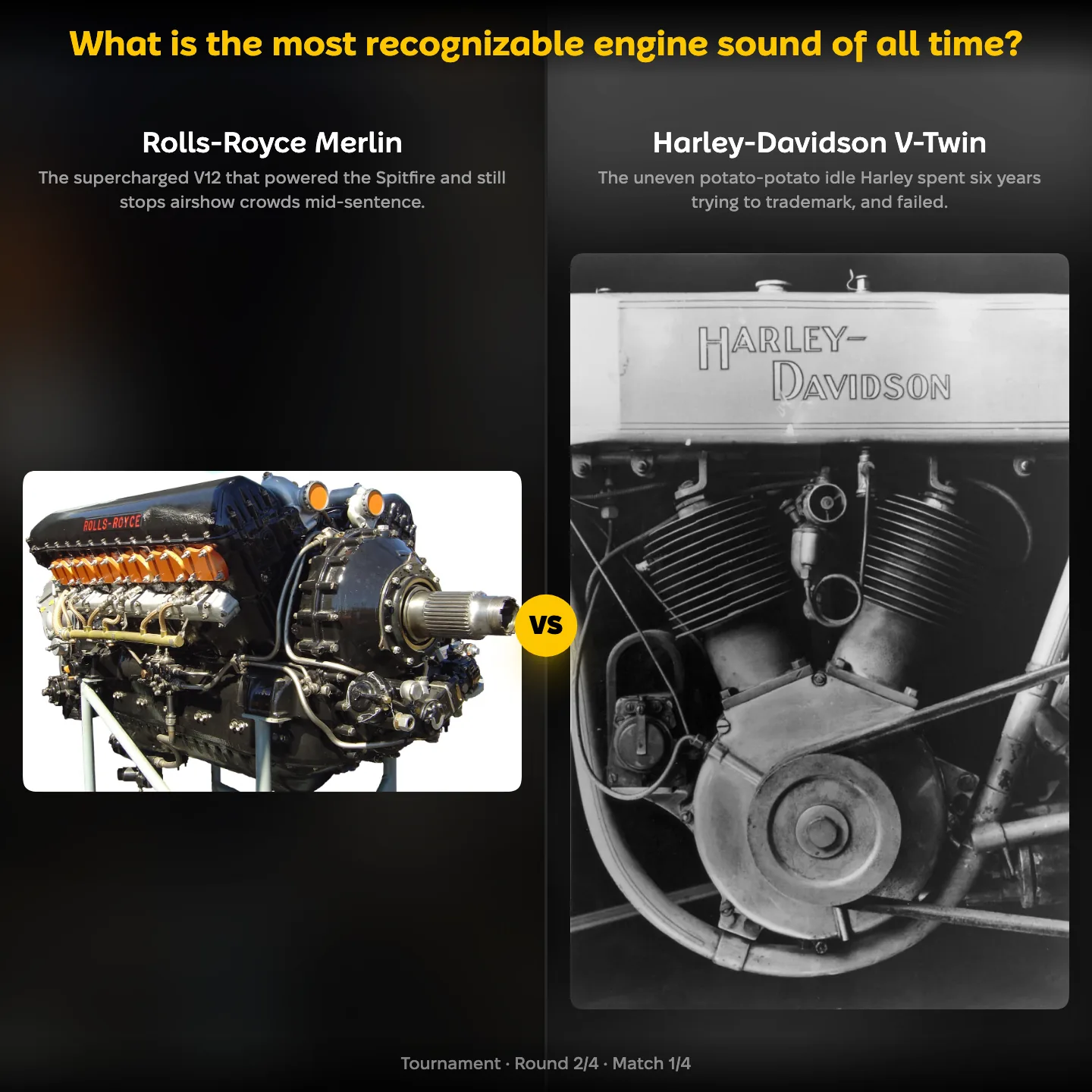
Road Glide vs R 1300 GS: two answers to the same continent
Three Harleys are on this list. No other manufacturer has as many.
The Road Glide is the strongest of them. Its shark-nose fairing is frame-mounted rather than bar-mounted, so crosswinds push the bike instead of the steering, and the Milwaukee-Eight underneath would rather cruise at 70 than rev.
The BMW R 1300 GS is the case against. It will do the same continent on tarmac and keep going when the tarmac stops, which a bagger cannot.
Honda's Gold Wing splits the difference: six cylinders, and quiet enough to hold a conversation at highway speed.
The Knucklehead and the CB750, thirty-three years apart
Judged as engineering rather than as culture, Harley-Davidson has two entries here and a much harder audience.
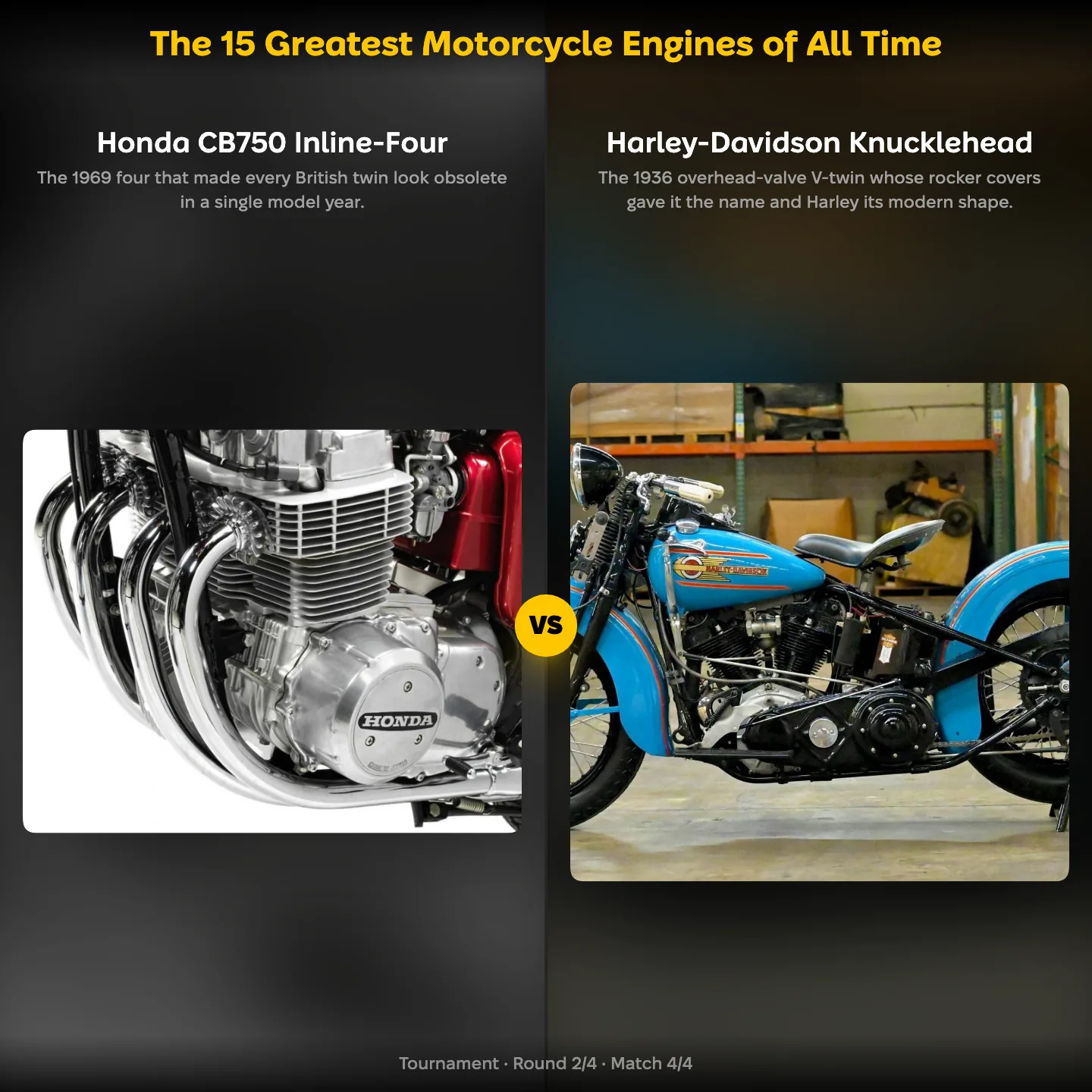
The Knucklehead earns its place by longevity of influence. Introduced in 1936, its overhead-valve layout is still legible in the Milwaukee-Eight that Harley sells today, which is a lineage almost nothing else on this list can claim.
Honda's CB750 inline-four is the counter-example that hurts. It arrived in 1969 with an overhead cam, a disc brake and four cylinders, and it made most of what came before look like a previous era overnight.
Then the specialists: Ducati's desmodromic valves, closed mechanically rather than by springs; the 250cc Honda RC166 six that revved to 20,000rpm in 1966; the Vincent Series C, whose engine was the frame. Against that company, a V-twin's virtue is character rather than cleverness.
AMF, 1981: the buyback that kept the Motor Company alive
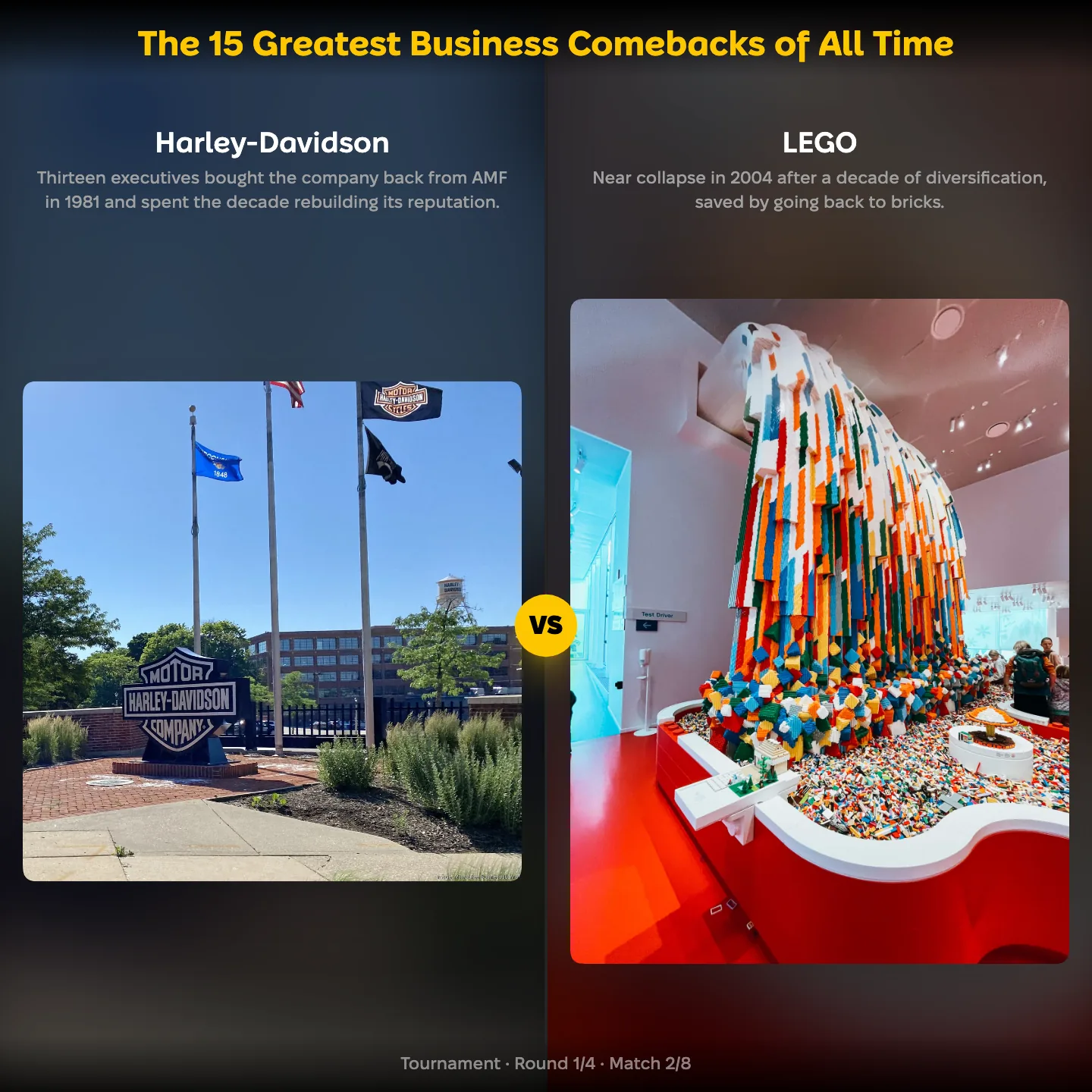
AMF bought Harley-Davidson in 1969. The bowling-and-tennis-equipment conglomerate cut costs, changed production methods, and spent a decade damaging the reputation it had paid for.
In February 1981 a group of thirteen executives led by Vaughn Beals and Willie G. Davidson bought the company back for roughly $80 million, funded by three bank loans.5 The rebuild took the rest of the decade.
Apple is the obvious competition. Weeks from insolvency in 1997 and later the most valuable company on earth, it is the story every rescue since gets measured against.
LEGO and Marvel make quieter versions of the same claim: one near collapse in 2004 after a decade of diversification, the other filing for bankruptcy in 1996 and selling its characters cheap. Nintendo, Ducati and Fiat each have a version too.
What separates Harley's story is who did the buying. Apple brought back a founder; Harley was bought by the people already inside the building, one of them a grandson of a founder. The rescue was not a strategy imported from outside, it was a refusal to let someone else finish the job badly.
The uncomfortable part is that a company on this list has, by definition, been in trouble before. Harley's 2026 reset is happening to an organisation that already knows what the bottom looks like.
Milwaukee: the Calatrava museum and the one with Serial Number One
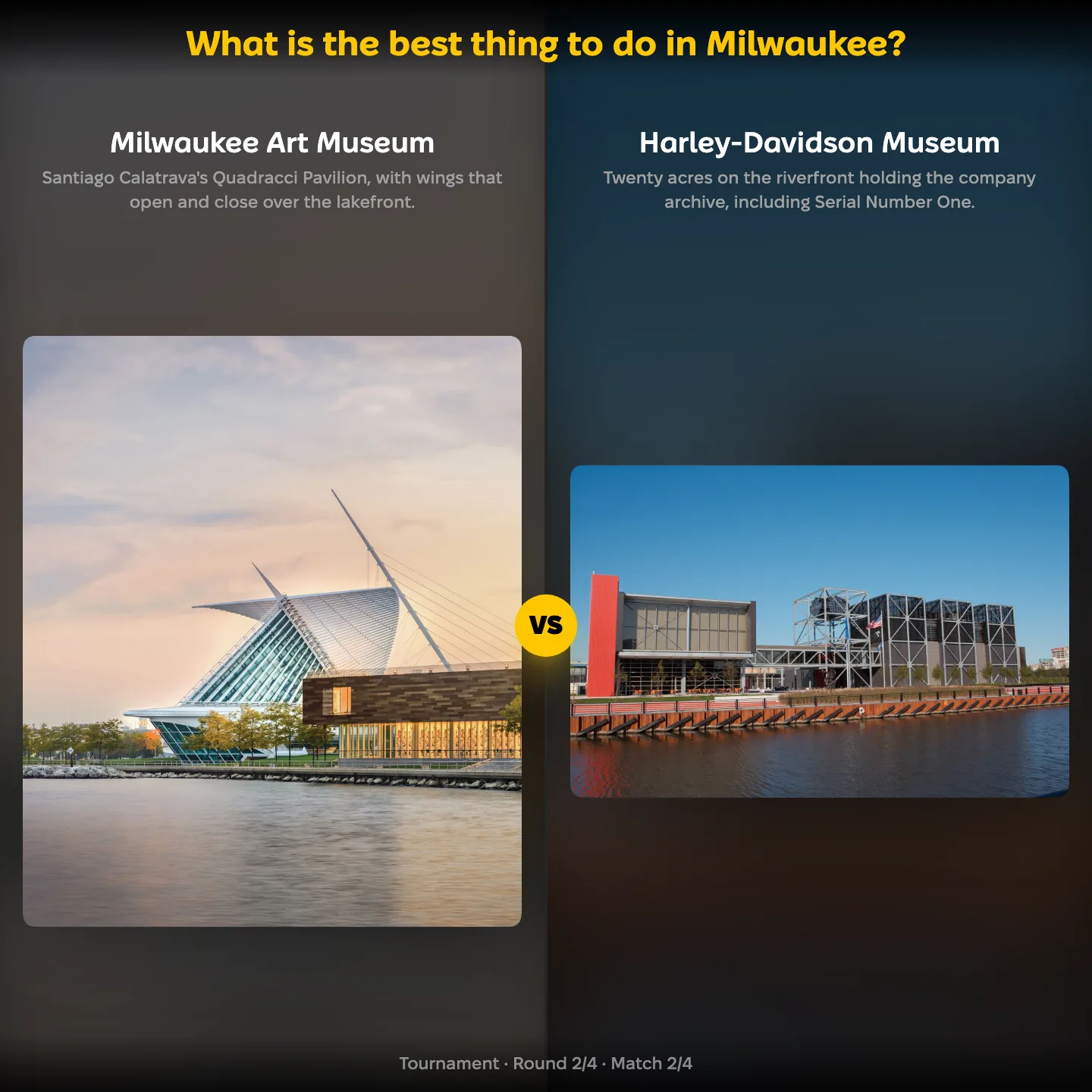
Harley-Davidson has been in Milwaukee since the shed, and its museum now occupies twenty acres of reclaimed industrial riverfront. Serial Number One, the oldest known Harley, is inside.
The Milwaukee Art Museum is the city's other answer. Santiago Calatrava's Quadracci Pavilion has a brise-soleil that opens and closes over the lakefront twice a day.
Beyond those two the list is a proper city: Summerfest, the Historic Third Ward, the Mitchell Park Domes, Bradford Beach, the Pabst Mansion. Before Milwaukee was a motorcycle town it was a beer town.
The Nightster against the Honda Rebel 500
This is the list Harley-Davidson most needs to be on and is least suited to.
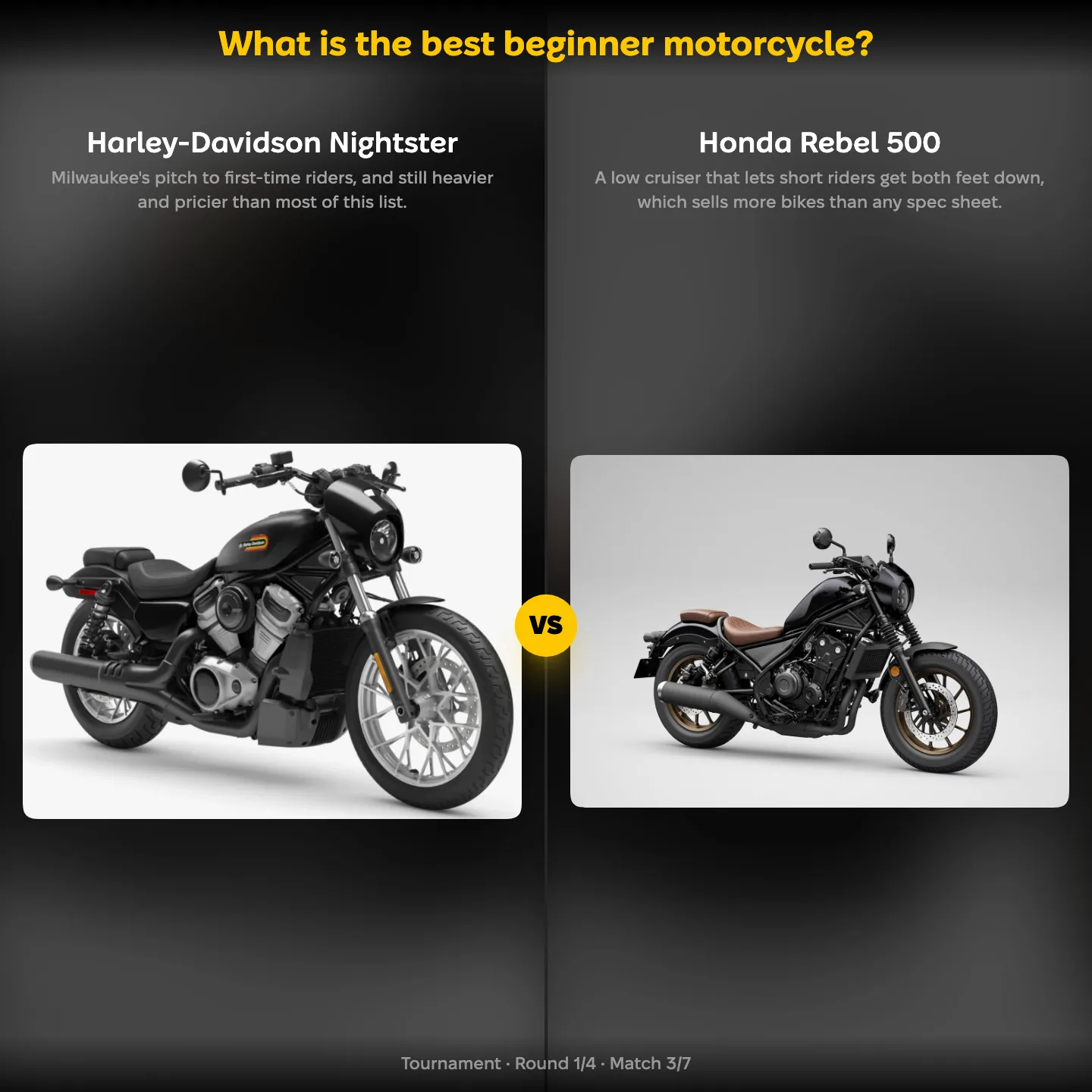
The Nightster is Milwaukee's pitch to first-time riders: a liquid-cooled Revolution Max engine in a Sportster shape, built to bring people into the brand before they are 50. It is still heavier and more expensive than almost everything around it.
The Honda Rebel 500 answers the question that actually decides these purchases. It is low enough for short riders to get both feet flat on the ground, which sells more motorcycles than any specification sheet.
Kawasaki's Ninja 400 and Suzuki's SV650 are the enthusiast picks, forgiving enough for a beginner and quick enough to keep. Harley's problem here is structural rather than reputational: the buyers on this list are choosing on seat height, weight and insurance, and none of those is what the company is good at.
LiveWire sold 653 motorcycles in 2025
Harley-Davidson's electric project is now a separate public company, and its numbers are small enough to be quoted in full: 653 motorcycles sold worldwide in 2025, up from 612 the year before.6
LiveWire holds roughly 70% of the market for on-road electric motorcycles above 50 horsepower, which sounds impressive until you learn that the whole segment moved about 933 machines.6
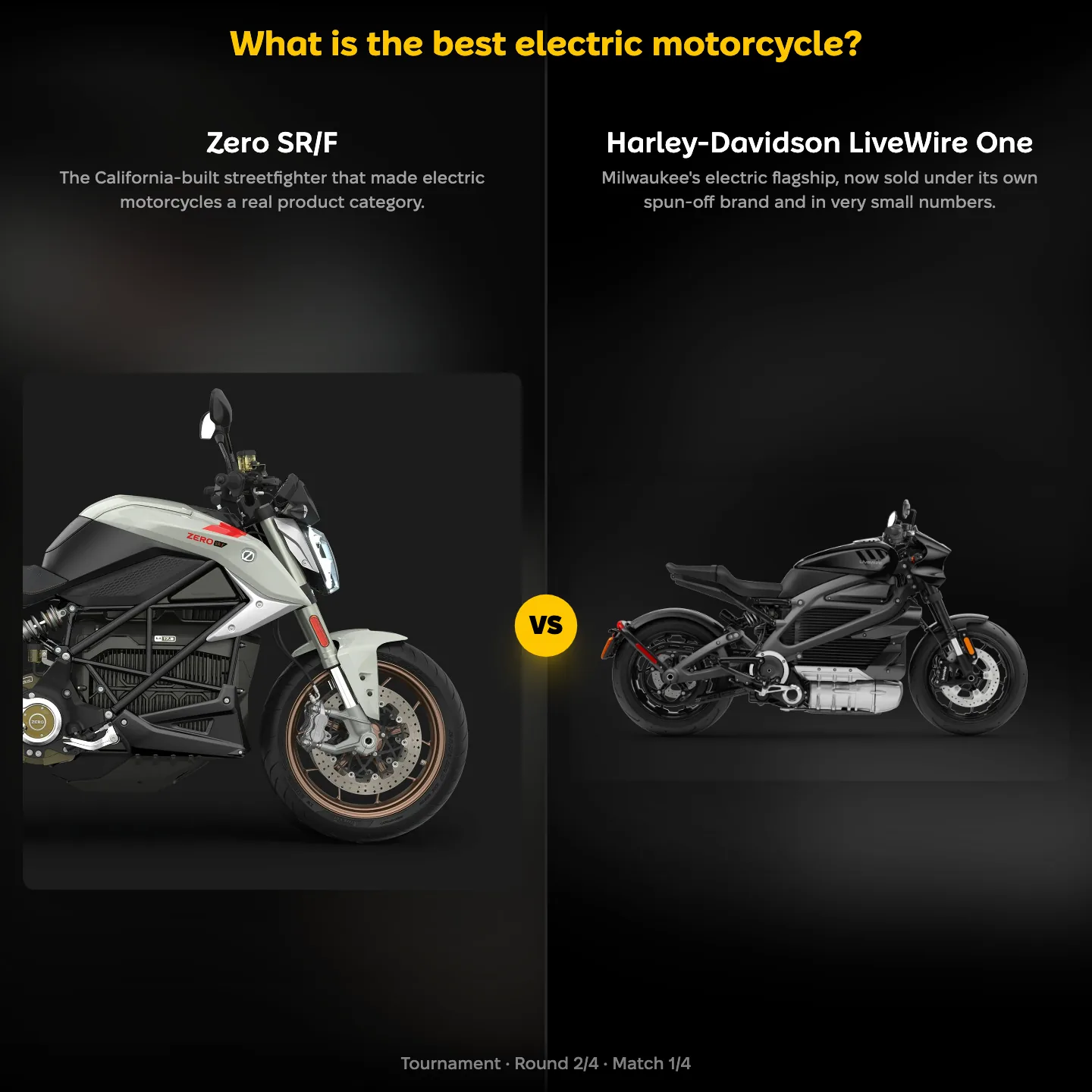
Zero Motorcycles is the American brand that got there first and made the category real. The SR/F is the bike most people who have ridden an electric motorcycle have ridden.
The category's actual volume is somewhere else entirely. The Sur-Ron Light Bee, a cheap electric dirt bike, outsells the premium brands many times over. That is either the future of the segment or evidence that it isn't a segment yet.
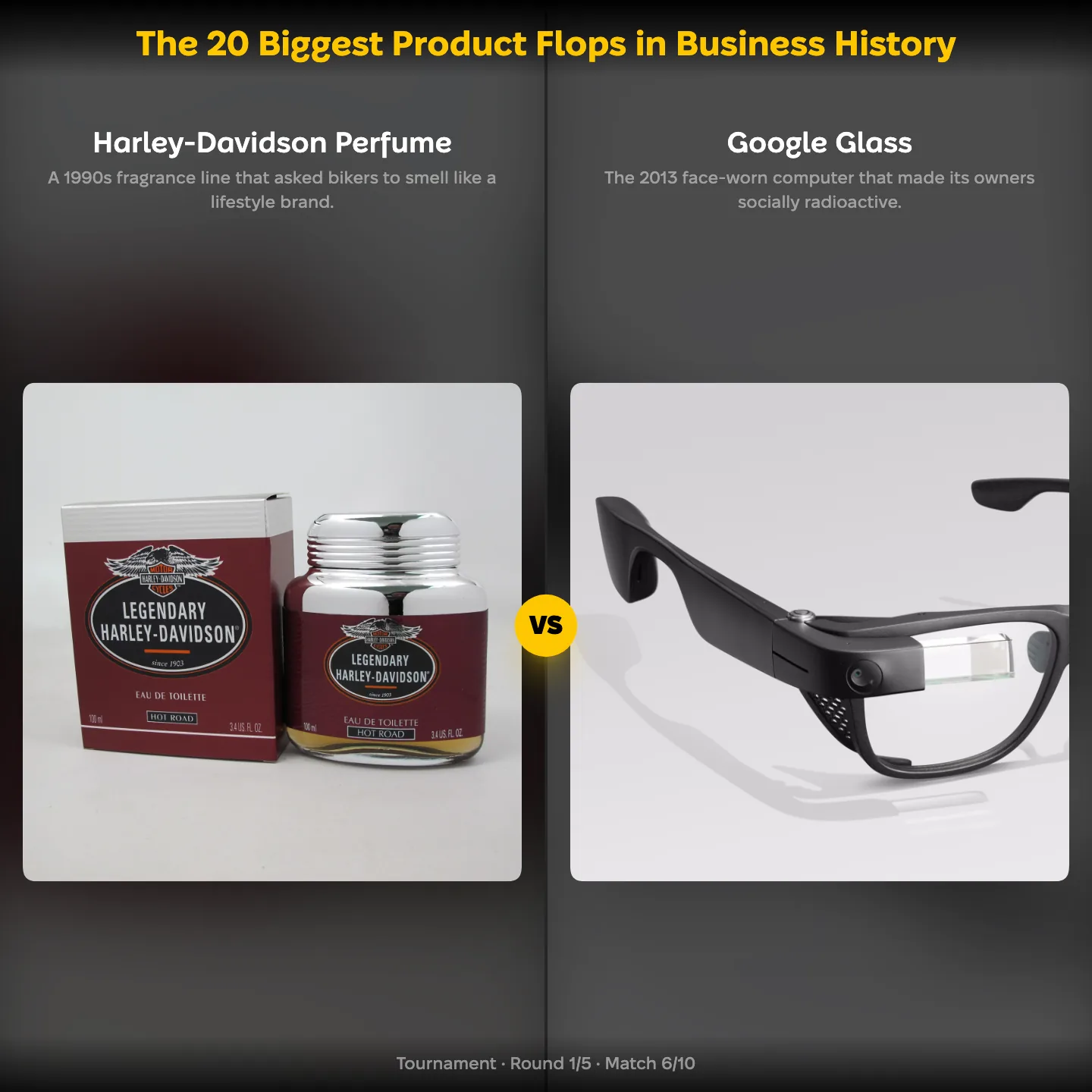
Harley-Davidson Perfume, 1996
In the mid-1990s Harley-Davidson licensed its name onto a fragrance line, and business schools have been using the result as a teaching example ever since.
The logic was not stupid. The brand sells identity more than it sells transport, and a licensing programme that already covered jackets, boots and lighters had no obvious edge.
The perfume found the edge. Buyers who would pay for the bar-and-shield on a leather jacket did not want it on a bottle of eau de toilette, and the range was withdrawn.
The company it keeps on this list is expensive: New Coke, the Ford Edsel, Google Glass, the Segway, the Samsung Galaxy Note 7. Every one of them came from an organisation that had good reason to believe it understood its customer.
Thirteen questions, two different companies
Every list above is asking one of two things. What did America make, or what should you ride? Harley-Davidson gives a completely different account of itself depending on which one it is answering.
That gap is the whole of the 2026 problem. A logo people tattoo on themselves and a showroom that first-time riders walk past are the same company, and one of those assets does not convert into the other. Starrs has said he wants dealer profitability and younger riders; the lists suggest the second is the harder half.
The rankings above reach their order the way two friends reach a decision: one head-to-head at a time, with each small choice narrowing the field.
Disagree with any of it? Every ranking above is open, and the shed-to-showroom question is more fun when someone who owns a Road King is voting against someone who owns a Rebel.
More rankings, more angles
- Ford Mustang: Same Badge, a V8, an EV and a Subcompact — the other American vehicle sold on its own past
- Ferrari Means Something Different on Every List — a badge that is a race team, a road car and a colour
- Coca-Cola vs Pepsi: The Cola Wars, Ranked 15 Ways — New Coke and Harley's perfume on the same flops list
Sources
- HowStuffWorks — Harley-Davidson history, production beginning in a 10-by-15-foot Milwaukee shed in 1903: auto.howstuffworks.com (checked 2026-09-10)
- Harley-Davidson — Q4 and full-year 2025 results, 10 February 2026: 132,535 global retail motorcycles sold, down 12%, and a $29 million operating loss: investor.harley-davidson.com (checked 2026-09-10)
- Harley-Davidson — RIDE brand platform launch, 9 April 2026, returning the historic bar-and-shield logo to the centre of the identity: prnewswire.com (checked 2026-09-10)
- SlashGear — Harley-Davidson's 1994 application to trademark its V-twin exhaust sound and the 2000 withdrawal after opposition from Honda, Yamaha and Kawasaki: slashgear.com (checked 2026-09-10)
- Lowbrow Customs — the AMF years and the February 1981 leveraged buyout for about $80 million led by Vaughn Beals and Willie G. Davidson: lowbrowcustoms.com (checked 2026-09-10)
- New Atlas — LiveWire's 2025 sales of 653 electric motorcycles, up from 612, and its share of a roughly 933-unit segment: newatlas.com (checked 2026-09-10)