
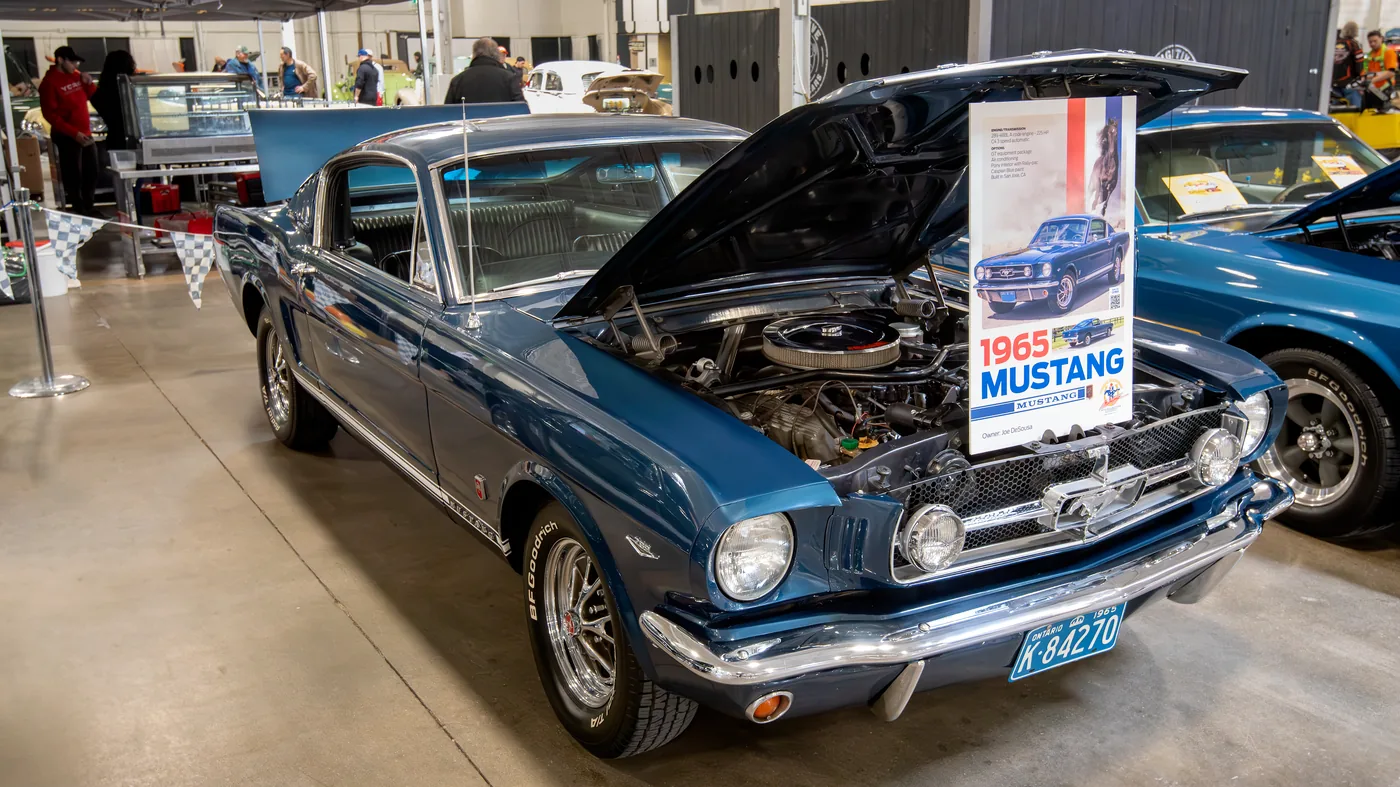
In August 2026 Ford drove a four-door Mustang prototype into a private dealer meeting in Las Vegas. It is petrol, not electric, it carries the trademarked Mach 4 name, Ford is aiming at a starting price under $40,000, and dealers who saw it compared its proportions to a Porsche Panamera.1
The badge on its bootlid has already been worn by a 1965 coupe that outsold its own first-year forecast four times over, a mid-seventies subcompact, a supercharged V8 coupe and a battery-powered crossover.2 That is why the same nameplate keeps turning up on rankings that share no other options.
We put a Mustang into fourteen of them.
A Mustang qualifies for fourteen different rankings, and the badge means a different car in every one.
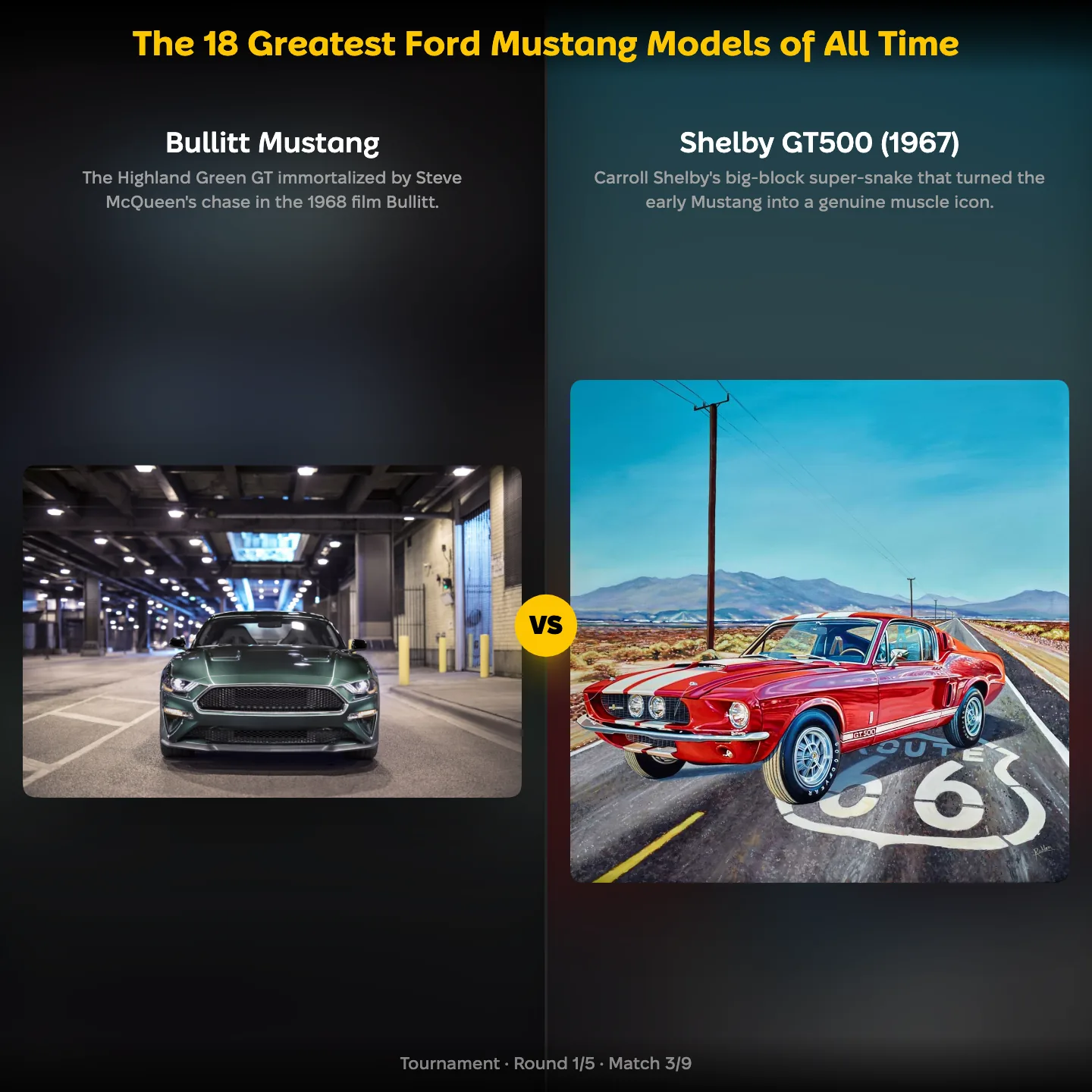
Every option is a Mustang: Bullitt against the 1967 Shelby GT500
Every option on this list is a Mustang, all eighteen of them. The question stops being whether the nameplate belongs anywhere and becomes which six decades of it deserve the name most.
The Bullitt car's case is partly cinema and partly money. Sean Kiernan's Highland Green 1968 fastback, the actual hero car from the film, sold for $3.74 million at Mecum's Kissimmee auction on 10 January 2020, the most anyone has paid for a Mustang at public auction, beating a 1967 Shelby GT500 Super Snake at $2.2 million.3
The 1967 Shelby GT500 argues from engineering rather than film. Carroll Shelby's big-block cars are what turned a stylish secretary's coupe into something drag strips took seriously, and five separate Shelbys made this list.
Then there is everything else: the Boss 302, the Fox Body GT 5.0 that a generation learned to drive sideways, the supercharged Terminator Cobra, and the 2024 Dark Horse. Six decades of cars sharing a name and almost no parts.
Boss 429 vs 1968 Dodge Charger R/T
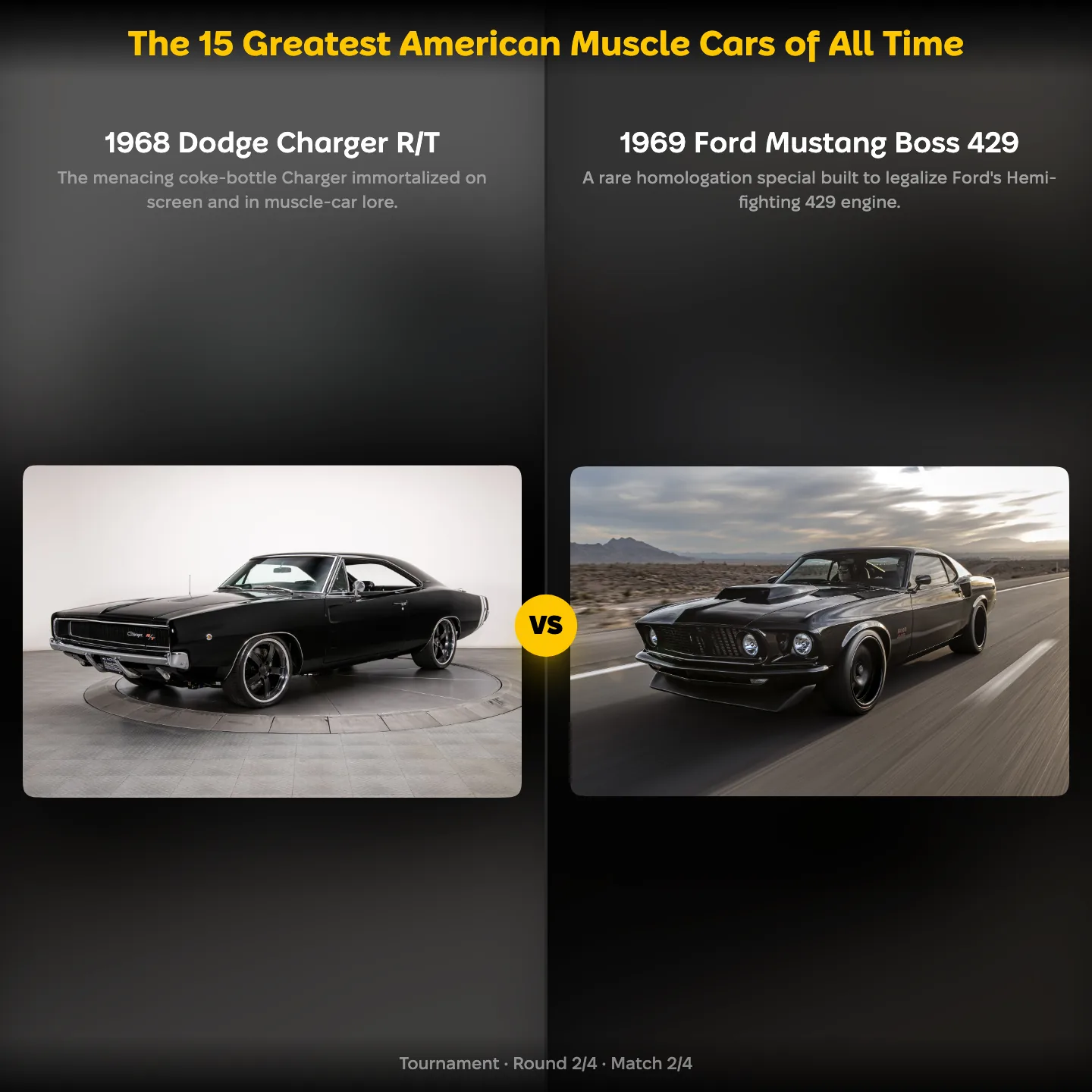
American muscle is the category the Mustang usually gets filed under. The two cars that made this list are the 1969 Boss 429 and the 1970 Mach 1, not the everyday GT anyone pictures.
The Boss 429 exists because of a rulebook. Ford needed its Hemi-fighting 429 engine homologated for NASCAR, so it squeezed the motor into a Mustang shell in small numbers and sold the result to the public.
The 1968 Charger R/T brings its own film history to the fight — it is the black car being chased through San Francisco in Bullitt, which means these two share a scene as well as a category.
The counter-case belongs to the Pontiac GTO, which invented the class in 1964 by dropping a large engine into a mid-size body, and to the Hemi Cuda, which most collectors would take over either Mustang.
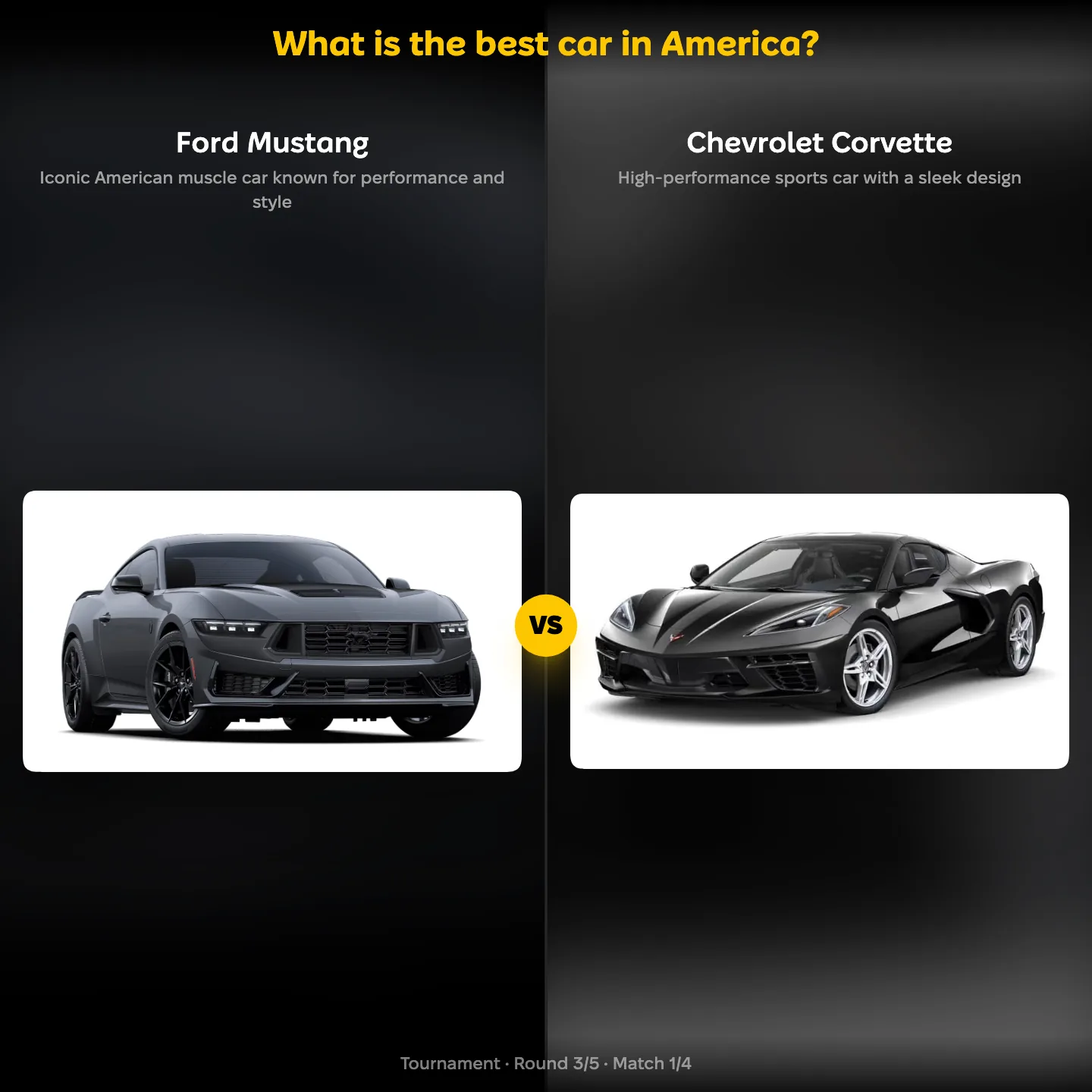
Ford Mustang vs Chevrolet Corvette: the American question
Ask which car best represents America and the field stops being sports cars. This ranking puts the Mustang next to the F-150, the Silverado, three Teslas, the Escalade and the Jeep Wrangler.
The Mustang's strongest claim here is survival. Of the three original pony cars it is the only one still in production: Chevrolet ended sixth-generation Camaro production in December 2023, and the Challenger's V8 era closed with it.4
The Corvette answers with the harder-edged version of the same idea. It has been America's sports car since 1953, and the current mid-engined car competes with European machinery costing twice as much.
Neither of them is what America actually buys. The F-150 has been the country's best-selling vehicle for decades, and a list about the best car in America that ignores the pickup is a list about taste rather than roads.
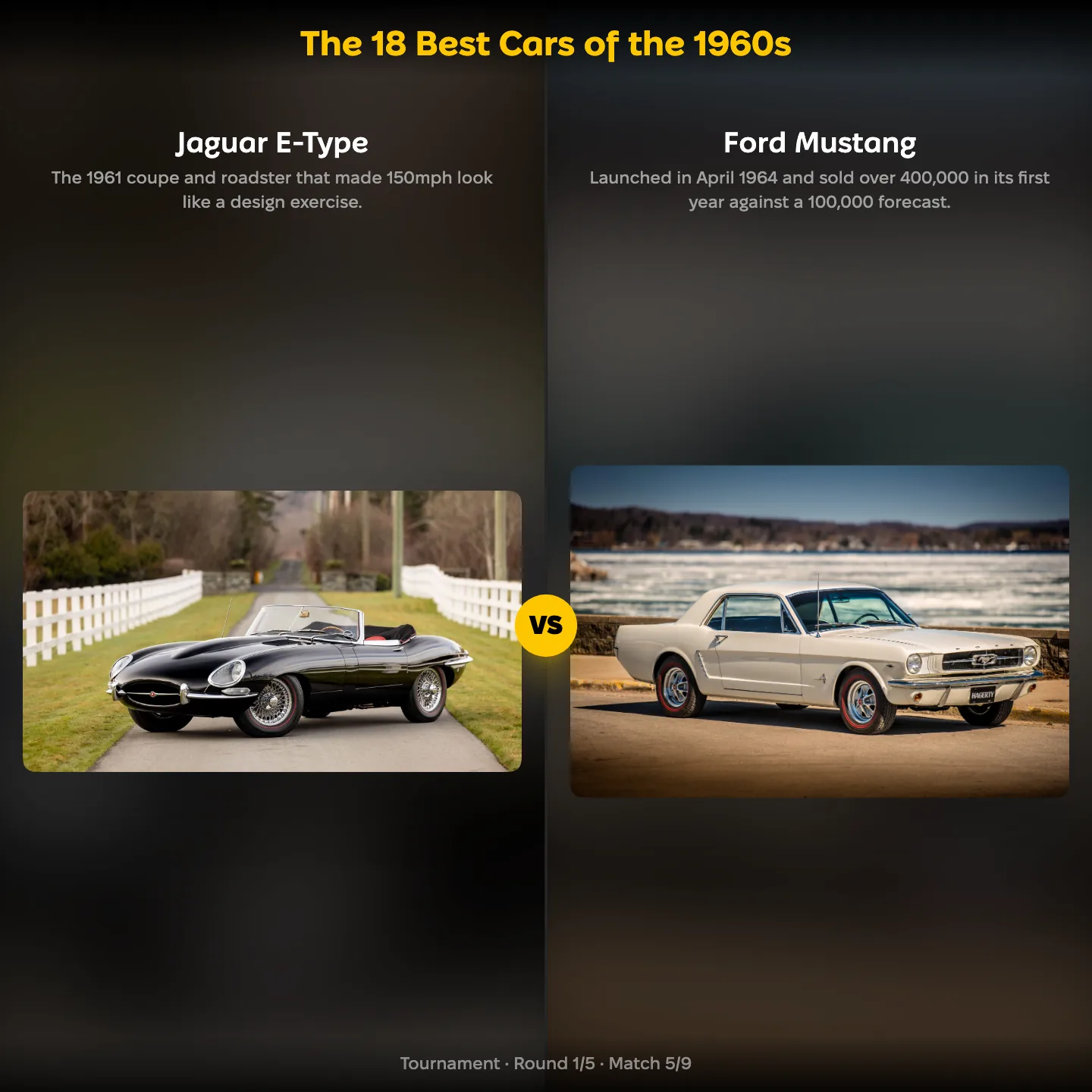
The Mustang and the Jaguar E-Type: two answers to the same decade
The 1960s produced the pony car and the mid-engined supercar within two years of each other, so this ranking is where the Mustang meets the cars it was never designed to fight.
Its case is scale. Ford introduced the Mustang on 17 April 1964 and sold over 400,000 in the first year against an internal forecast of 100,000 — the most successful launch the company had managed since the Model A.2
The E-Type's case is that it looks like nothing else on the list, and Enzo Ferrari is supposed to have called it the most beautiful car ever made. Nobody has ever said that about a Mustang.
The rest of the decade is unkind in a different way: the Miura, the 250 GTO, the GT40 that beat Ferrari at Le Mans and the Mini Cooper S that won Monte Carlo. The Mustang is the cheap one in that company, which was always the point.
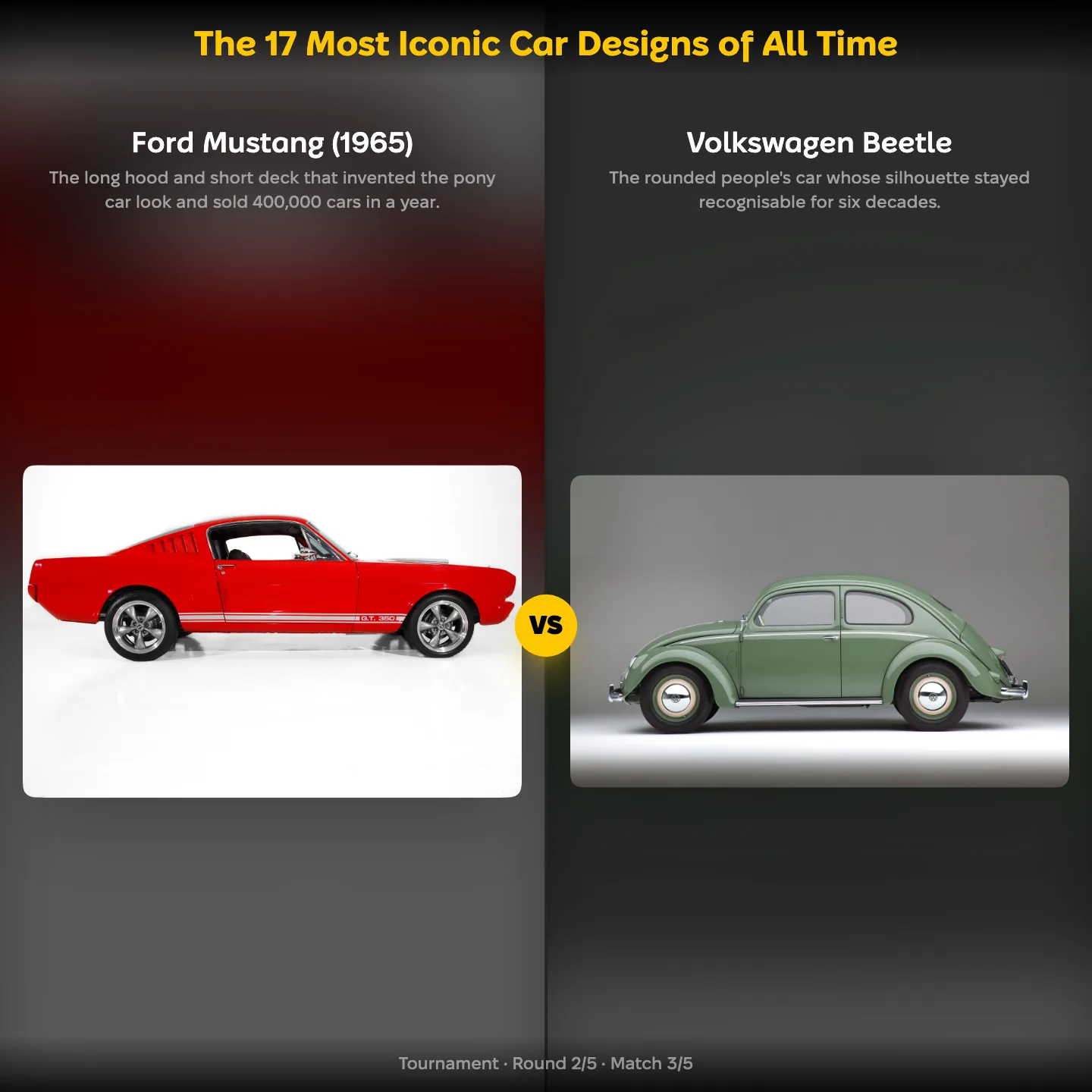
Long hood, short deck: the proportion the Beetle ignored
Design rankings usually reward cars that look expensive. The Mustang is here for the opposite reason: it made a cheap car look like a costly one, using proportion alone.
The long-hood, short-deck silhouette was copied almost immediately by the Camaro, the Firebird, the Barracuda and the AMC Javelin, and it is still what the current car is drawn around sixty years later.
The Beetle got onto the same list by ignoring every one of those rules. Its shape had no proportional drama at all and stayed recognisable from the 1930s to the end of the century.
Against the E-Type, the 300 SL and the Citroën DS, the Mustang is the only entry whose design brief was a price target rather than a form.
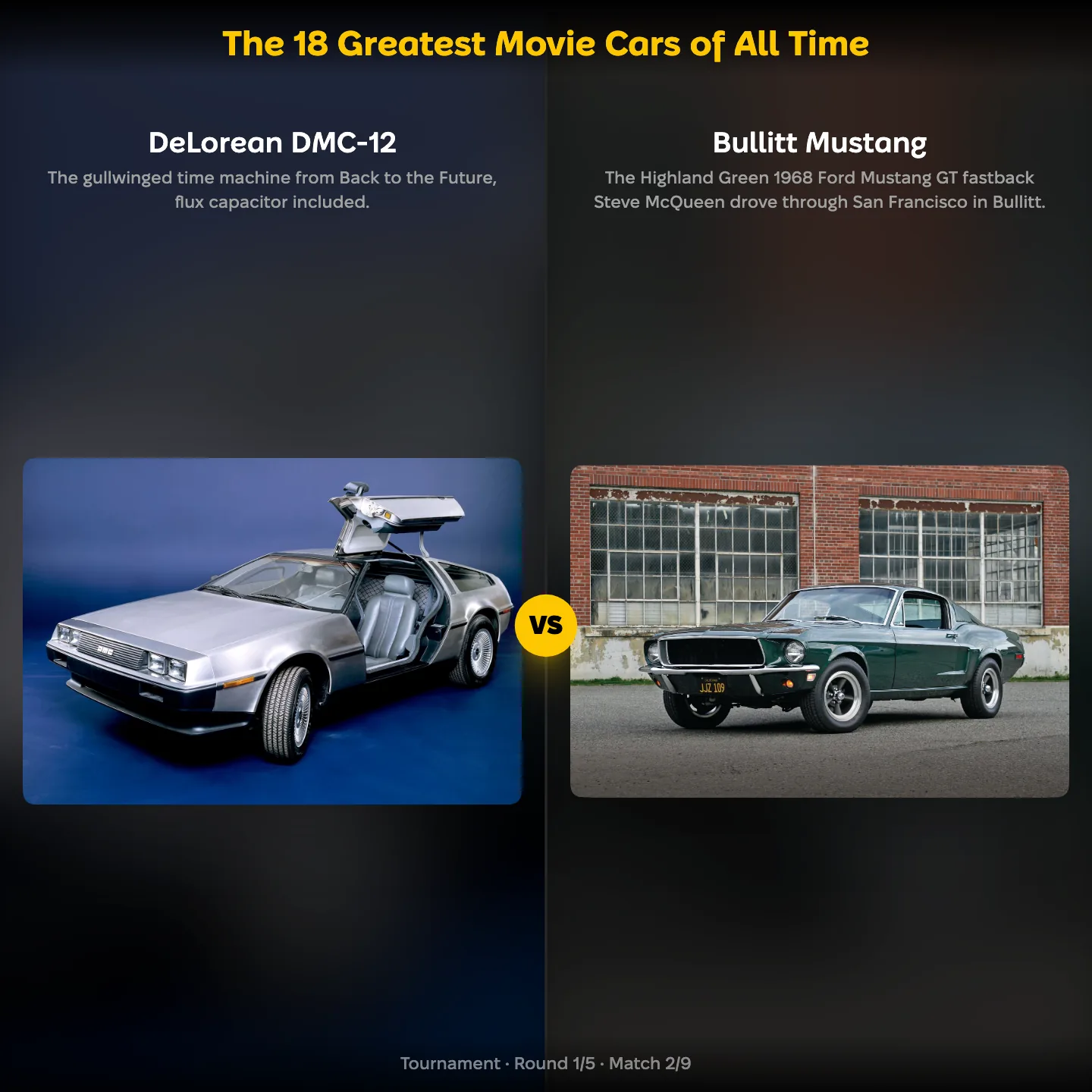
The Bullitt Mustang vs the DeLorean DMC-12
Movie cars are the one category where a car's engineering barely matters. What matters is whether you can name the film from the silhouette, and two Mustangs clear that bar on this list.
The Bullitt fastback earns its place through a chase that runs with no music under it, only engines and tyres, and through the fact that Steve McQueen did a fair share of the driving himself. The car's later sale price says the same thing in dollars.3
The DeLorean has an easier argument. It is a time machine, and no other option on the list has ever been anything but a car.
The second Mustang on the list is Eleanor, the 1967 Shelby GT500 from Gone in 60 Seconds — a different film, a different generation of the same nameplate. Around them sit the Ecto-1, the General Lee, Herbie and two Batmobiles, which is the strangest company any car in this article keeps.
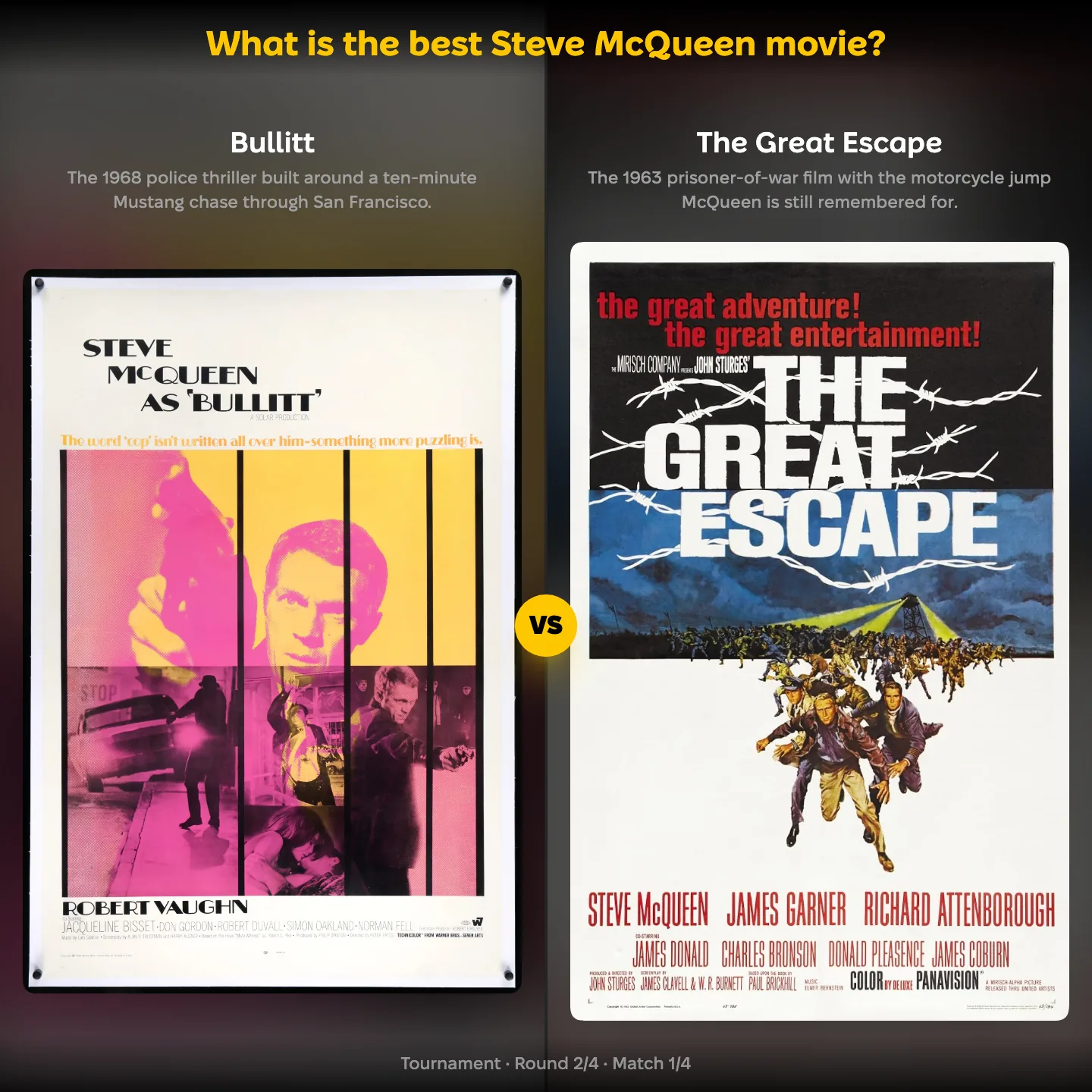
Bullitt or The Great Escape: McQueen's best film
Here the Mustang is a supporting actor. The ranking is Steve McQueen's filmography, and Bullitt is on it because of what happens in the middle of it.
The film's reputation rests almost entirely on ten minutes of San Francisco, which is a thin argument for a police thriller and a very strong one for a car.
The Great Escape has the opposite shape. It is remembered for an ensemble, a tunnel and a motorcycle jump, and it is the McQueen film most people have actually seen twice.
Papillon gave him his most demanding performance, and The Sand Pebbles produced his only Academy Award nomination. Judged as films rather than as car footage, Bullitt has real competition.
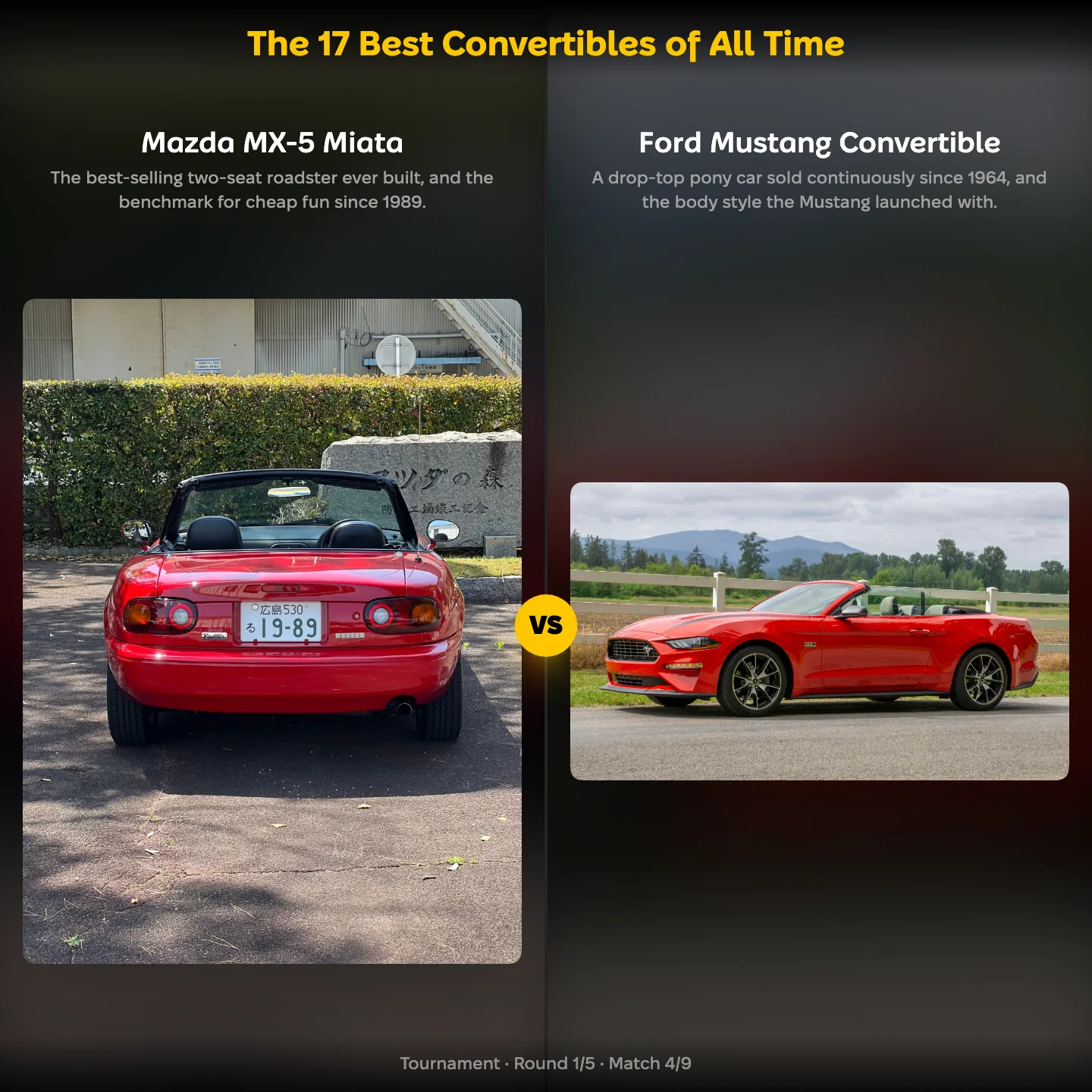
Mustang Convertible vs Mazda MX-5 Miata
A convertible ranking should suit the Mustang. It has been sold with a folding roof since the launch in April 1964, and the convertible was one of the two body styles the car arrived with.2
The problem is the company. The MX-5 is the purpose-built version of the same idea: two seats, light, cheap, and designed around the roof rather than adapted to it.
The E-Type roadster, the Pagoda SL and the 300 SL sit on the same list, every one of them engineered as an open car first.
The Mustang's answer is that none of those is a family car with four seats and a V8, which is the trade every drop-top Mustang buyer has actually made.
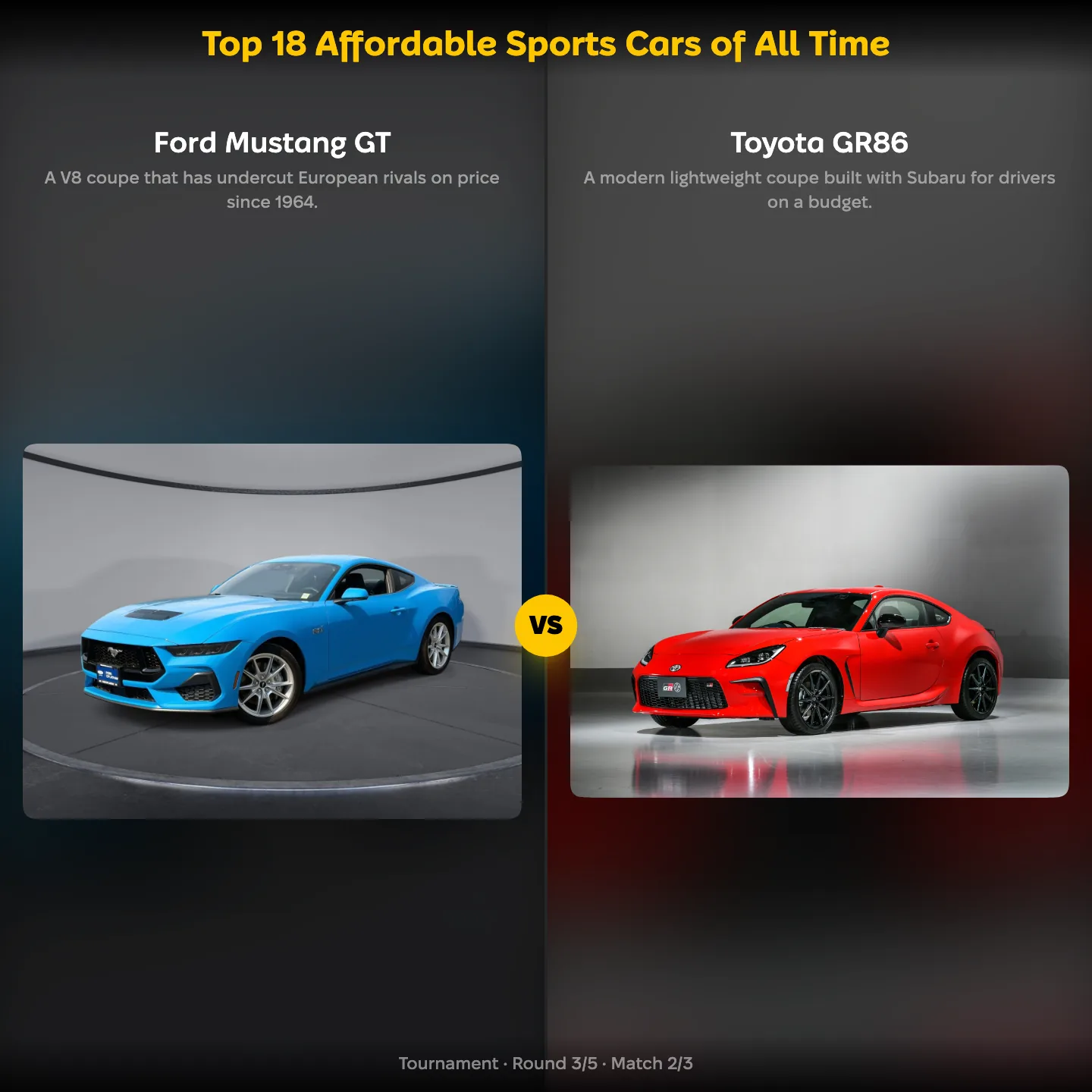
A V8 for GR86 money
Affordable performance is the Mustang's original pitch and the one it has never abandoned: eight cylinders and rear-wheel drive at a price the German coupes do not reach.
The GR86 and the MX-5 make the opposite case. They are slower in a straight line and better on a narrow road, because they weigh several hundred kilos less.
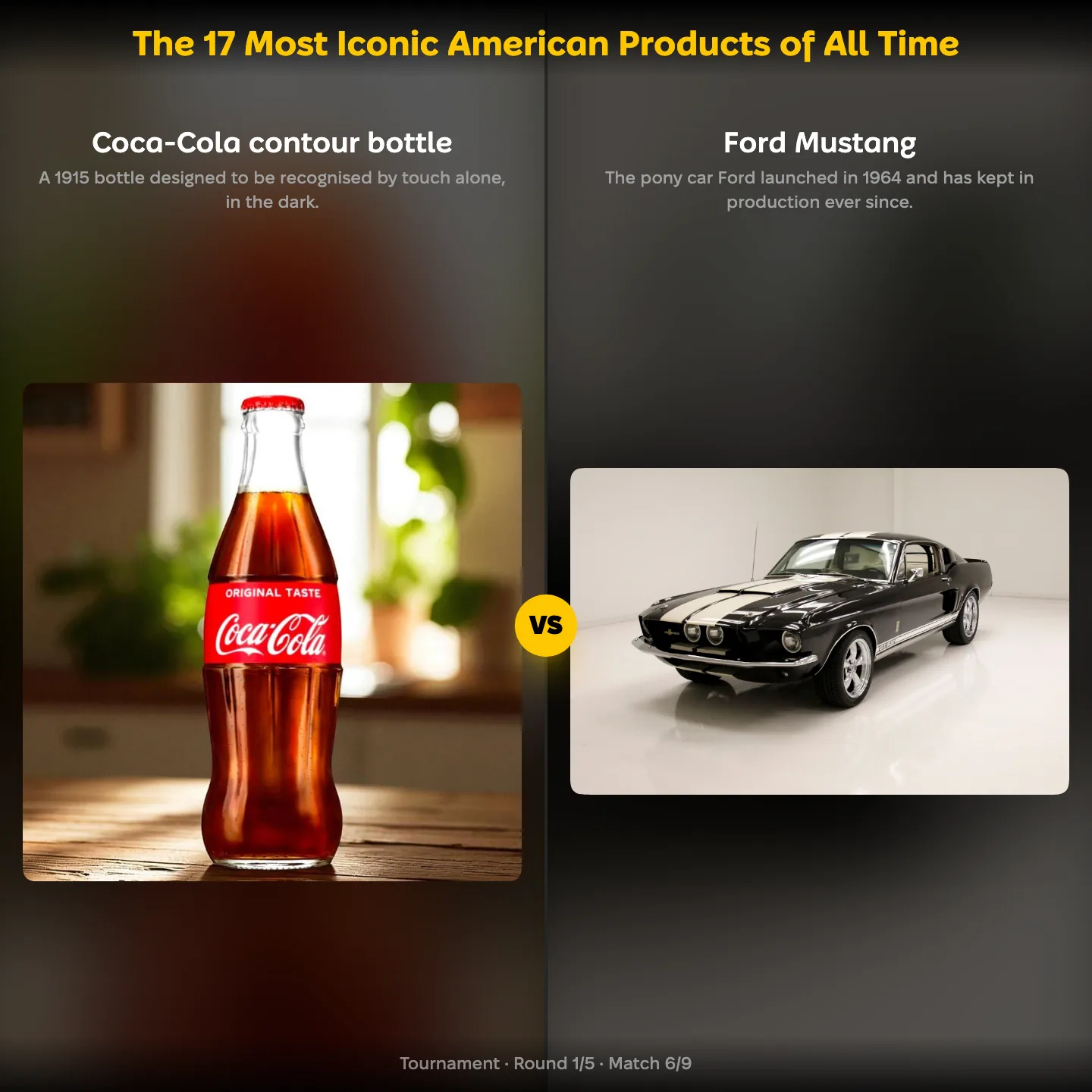
A coupe, a Coca-Cola bottle and a pair of Levi's
This ranking leaves the car park. It asks which objects an American household would recognise in silhouette, and the Mustang qualifies as an object rather than as transport.
Its qualification is the launch itself. A car that outsold its own forecast four times over in twelve months, and that has stayed in production ever since, belongs in the same conversation as things people buy without comparing specifications.
The company it keeps is instructive: the contour Coke bottle designed to be identified by touch, Chuck Taylor All Stars, the Stratocaster, the Zippo, the Big Mac.
The Model T has the better claim. It changed how things are manufactured; the Mustang changed how they are sold.
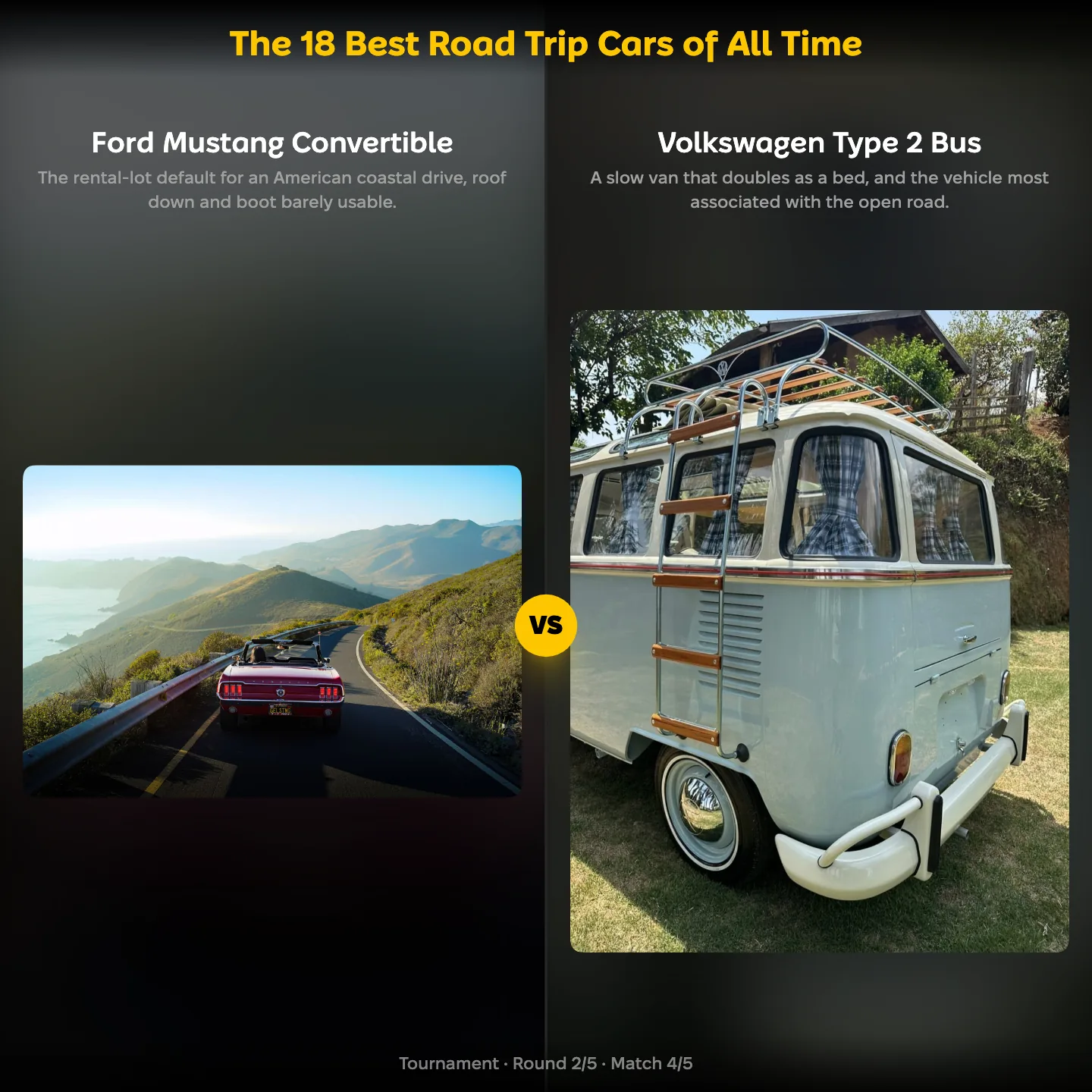
Mustang Convertible vs the Volkswagen Type 2 bus
The Mustang convertible is the rental-counter default for an American coastal drive, and it is genuinely good at the first two hours of one.
Then the luggage arrives. The Type 2 bus, the Land Cruiser and the Airstream all solve the part of a road trip that happens after dark, and a Mustang solves none of it.
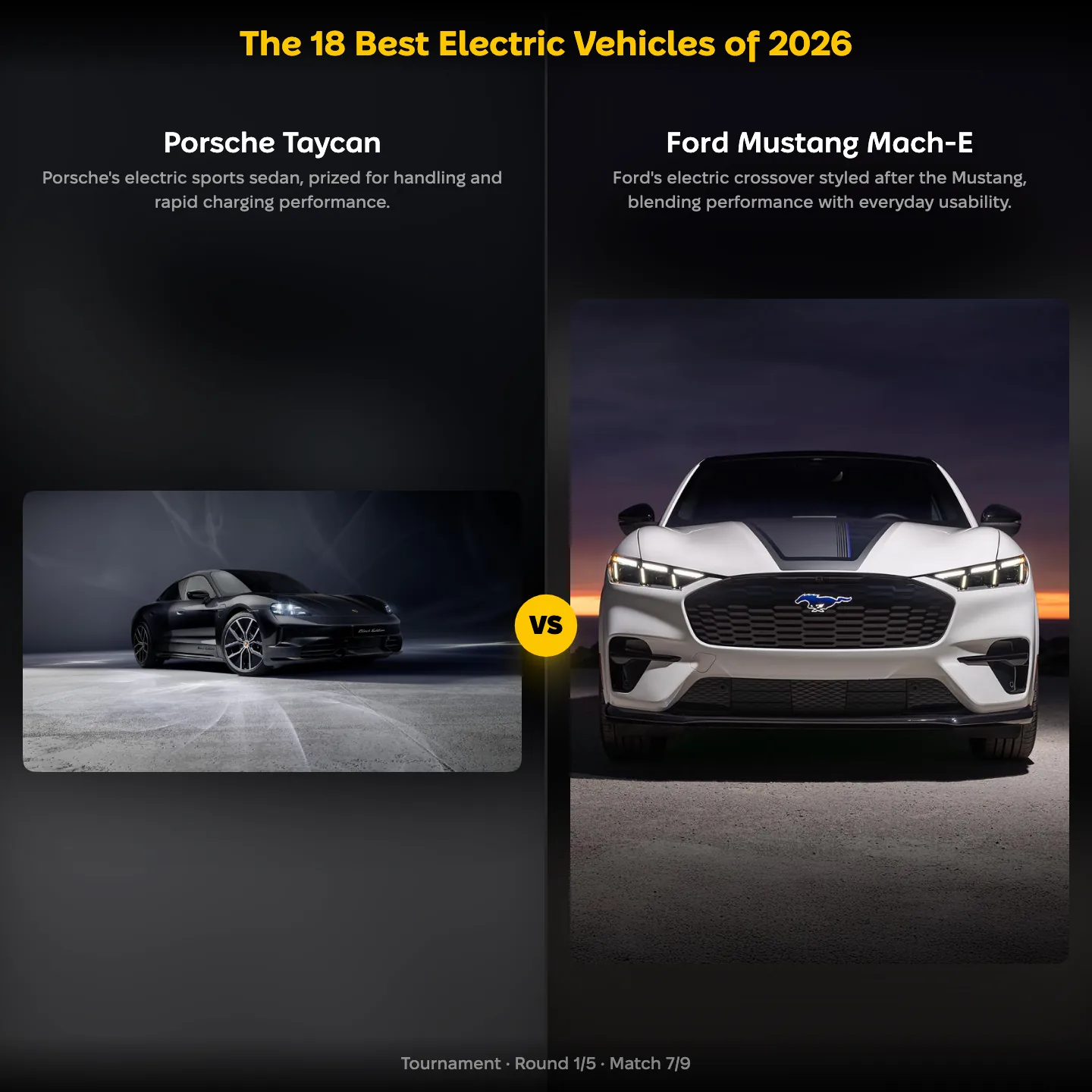
Mustang Mach-E vs Porsche Taycan: the badge on a crossover
The Mustang on this list has five doors, a battery and a raised ride height. Ford revealed the Mach-E on 17 November 2019 as a battery-electric compact crossover SUV, and gave it the running-horse badge and the three-bar tail lights.5
Judged as an electric crossover it holds its own. It is Ford's volume EV, and this list weighs it on the same terms as the Ioniq 5 and the Kia EV6.
Porsche built an electric car that drives like the rest of its range. That is precisely the complaint Mustang owners make about the Mach-E.
The name is doing work here that the engineering did not ask for. Nobody would have questioned this car if the badge on it had said Edge.
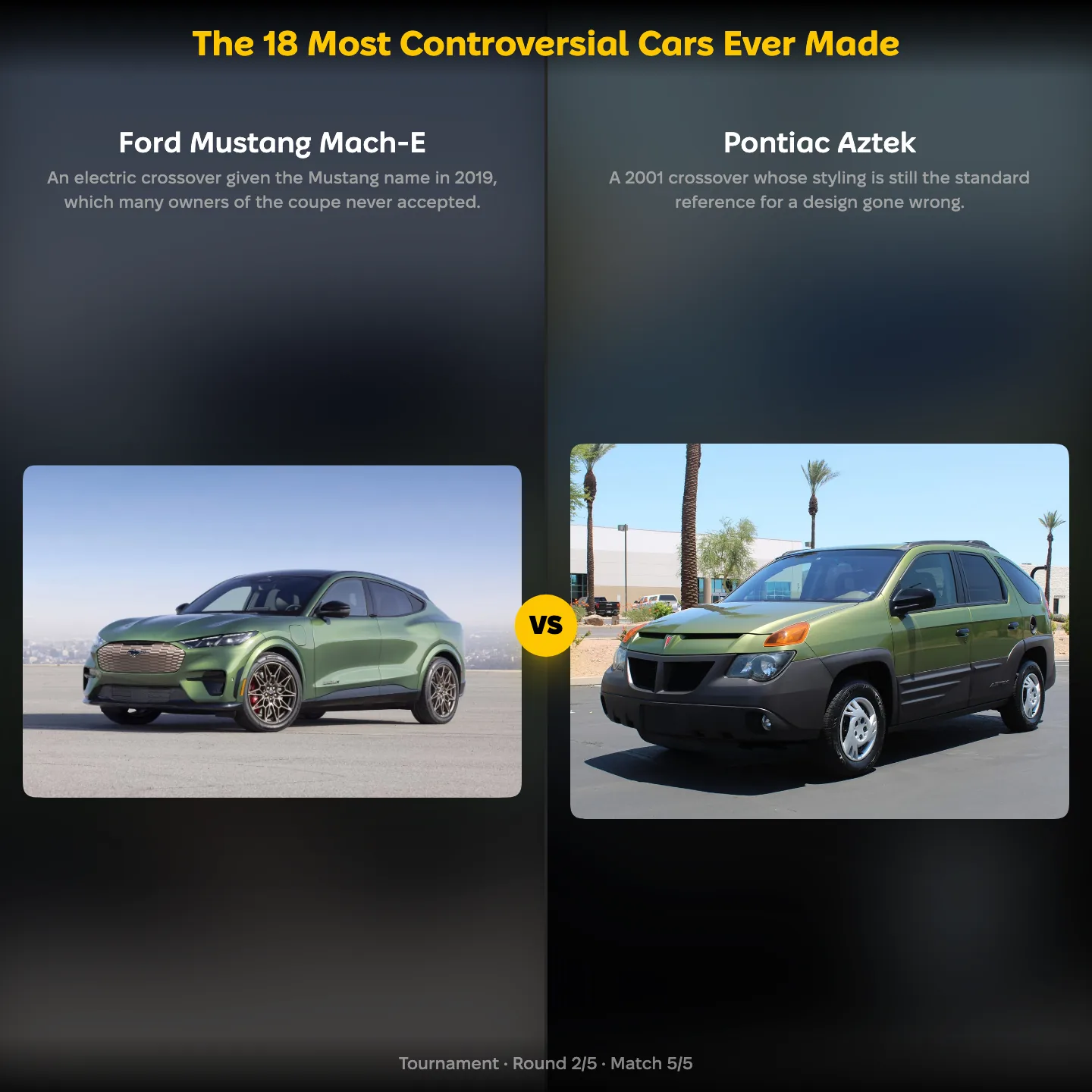
Mustang II and Mach-E: the two times the badge broke
The nameplate appears twice on this list, which no other car in the article manages, and neither entry is there for something the car did well.
The Mustang II came first. Built from 1973 for the 1974 model year, it was a subcompact pony car on small-car underpinnings, launched into an oil crisis with a four-cylinder engine available and a V8 that arrived a year late.6 It sold in enormous numbers and enthusiasts have been apologising for it ever since.
The Mach-E repeats the offence in current form: a badge applied to a body style the nameplate had never worn, for commercial reasons that were entirely rational.
The rest of the list says something about the word controversial. The Aztek was ugly, the Corvair was the subject of a famous safety campaign, the Cayenne was the SUV that funded a sports-car maker. Only the two Mustangs qualify purely for what they were called.
That question is not settled either. The four-door prototype Ford showed its dealers this month is the next entry in exactly this category.
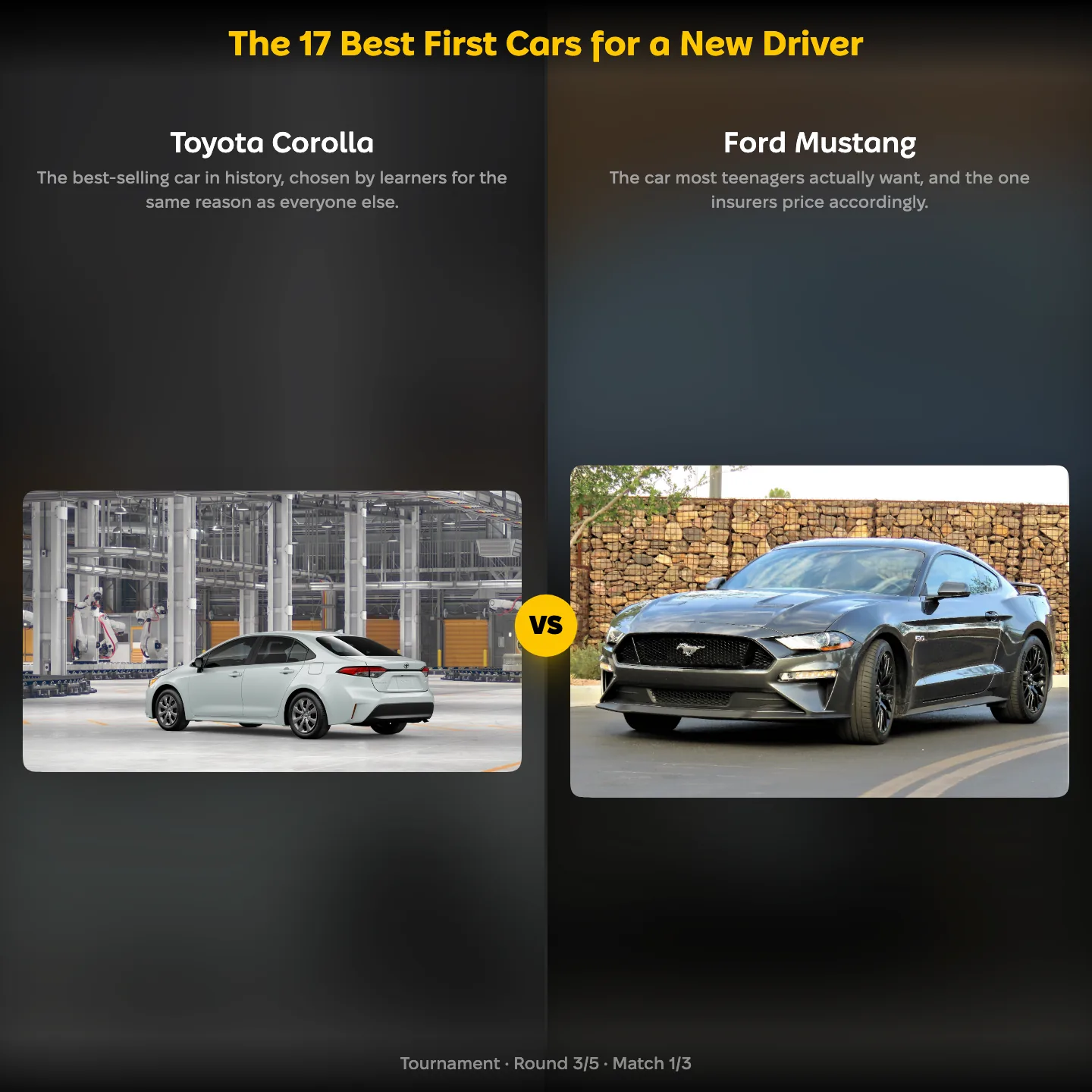
Ford Mustang vs Toyota Corolla: the first car nobody recommends
A first car is judged on insurance, repair bills and how much trouble it lets a new driver find. Every one of those tests reads the Mustang's character as a defect.
A rear-wheel-drive coupe with a V8 fails all three tests, which has never stopped it being the car a seventeen-year-old asks for. American insurers price it accordingly.
The Corolla and the Civic answer honestly, for the least romantic reasons available: parts on every shelf in the country, and nothing under the bonnet that rewards showing off.
There is a version the Mustang wins. The four-cylinder EcoBoost car is a different proposition from the GT, and a used one is not obviously worse than a hot hatch — which is how a lot of teenagers end up in one anyway.
Sixty years of a name that keeps moving
Sort the same badge by design, by film, by price or by insurance premium and a different Mustang answers each time: a 1965 coupe, a 1968 fastback, a 2024 supercharged V8, a crossover with a battery. A name outliving the car it was drawn for does that, which is how Ford can put four doors on one and still call it a Mustang.
Each of those questions resolves through head-to-head voting: two options on screen, one pick, repeat until an order exists.
Own a nameplate that means five different cars to five different people? Build the ranking and let the matchups sort them out.
More rankings, more angles
- Ferrari Means Something Different on Every List — a badge that is a race team, a road car and a colour
- Mario Andretti Won Indy, Daytona and F1 — Once Each — the only driver on three American podiums that matter
- Is Cadillac the Best American Car Brand? Where It Lands on 13 Lists — Ecto-1, the Cimarron and the presidential Beast
- Where Does Harley-Davidson Actually Rank? — the other Milwaukee-to-Detroit export sold on memory
Sources
- Motor Illustrated — four-door Mustang prototype shown to dealers, Mach 4 name, sub-$40,000 target: motorillustrated.com (checked 2026-08-24)
- Wikipedia — Ford Mustang: 17 April 1964 introduction, over 400,000 first-year sales against a 100,000 forecast, continuous production since 1964: en.wikipedia.org (checked 2026-08-24)
- Hagerty — the original Bullitt Mustang sold for $3.74M at Mecum Kissimmee on 10 January 2020, beating a 1967 Shelby GT500 Super Snake at $2.2M: hagerty.com (checked 2026-08-24)
- Wikipedia — Chevrolet Camaro (sixth generation): production ran to December 2023: en.wikipedia.org (checked 2026-08-24)
- Wikipedia — Ford Mustang Mach-E: revealed 17 November 2019 as a battery-electric compact crossover SUV: en.wikipedia.org (checked 2026-08-24)
- Wikipedia — Ford Mustang (second generation): produced 1973–1978 for model years 1974–1978 as a subcompact pony car: en.wikipedia.org (checked 2026-08-24)