
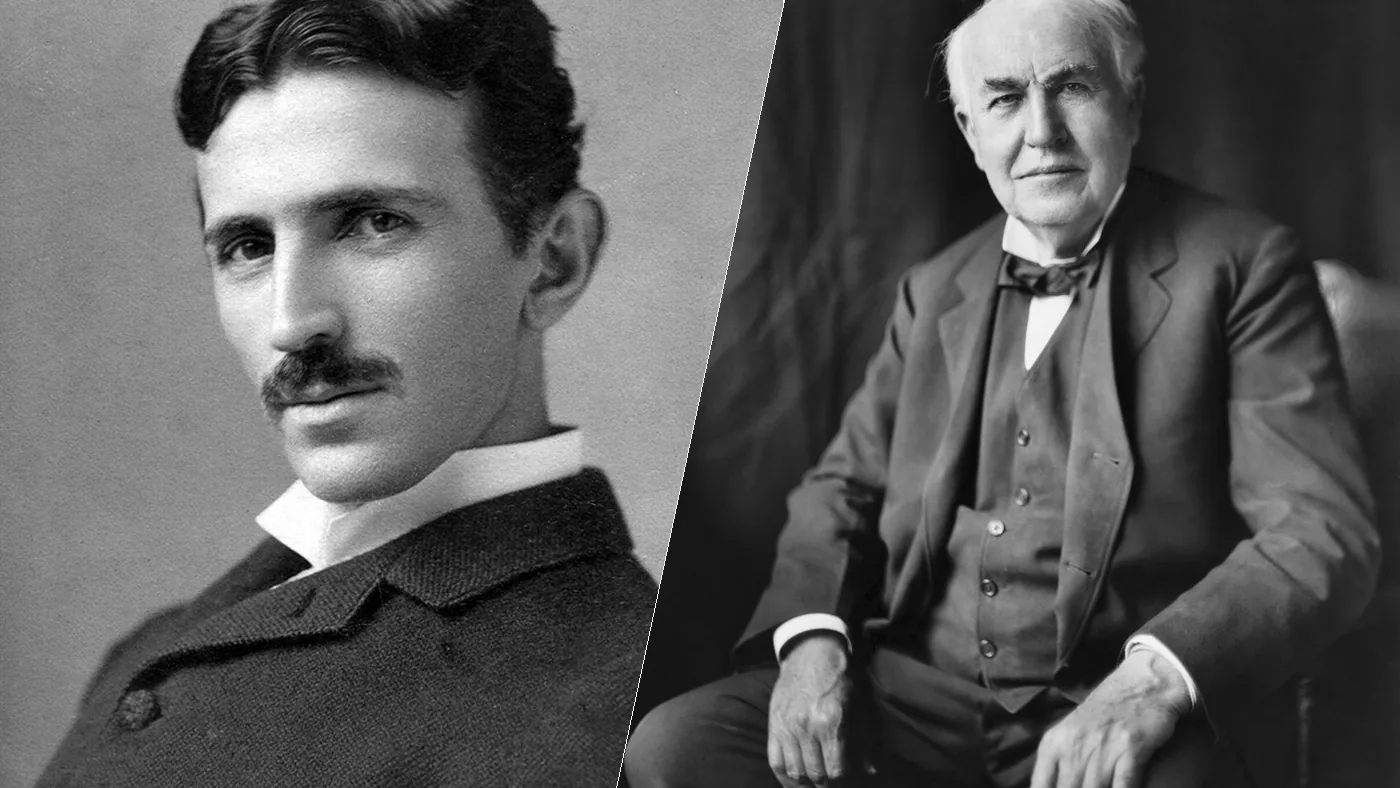
Nikola Tesla and Thomas Edison worked for the same company before they became opposites. Tesla reached New York in 1884 and took a job improving Edison's direct-current generators; four years later he was presenting alternating-current work to America's electrical engineers, and the system he described made Edison's obsolete.
Edison fought back in public, running a campaign to discredit alternating current that included electrocuting animals to show what it did. He lost anyway. Westinghouse undercut General Electric to light the 1893 Chicago World's Columbian Exposition with Tesla's system — $399,000 against $554,000, and Buffalo was drawing power from Niagara Falls by 16 November 1896.2
Then, 130 years later, the losing side came back. NVIDIA's roadmap for AI data centres moves the whole facility to 800-volt direct current, and Texas Instruments announced a complete power architecture built to that reference design in March 2026.3 The grid outside is still Tesla's. The racks inside are turning back into Edison's.
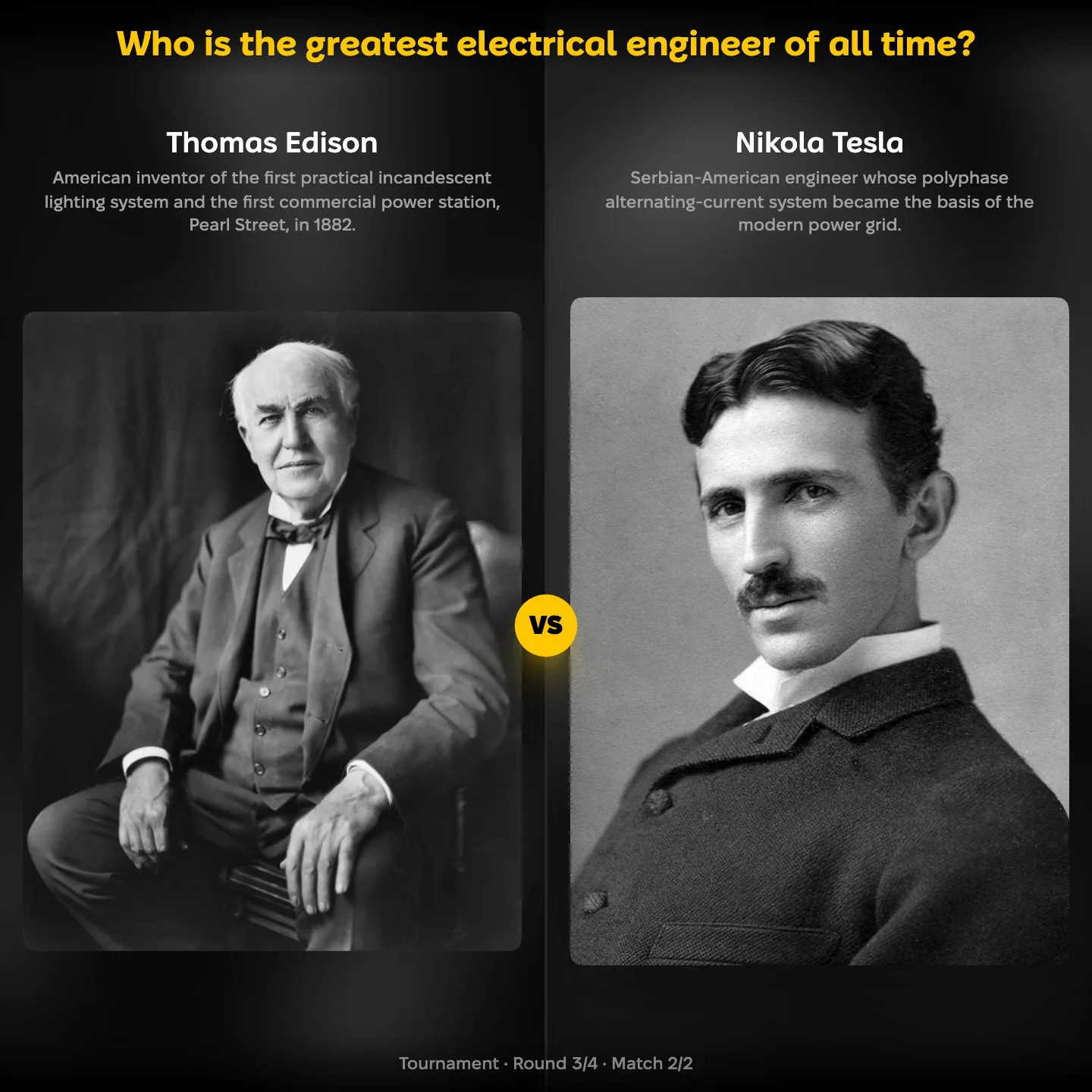
Tesla and Edison split every list along the same seam: one is scored for having the idea, the other for shipping it.
Einstein, Newton and the company they keep
Start with the widest question on the site and both men become small. The field runs from Archimedes to Tim Berners-Lee, and the names in front of any scientist question — Einstein, Newton, Darwin, Curie — did work of a kind neither Tesla nor Edison attempted.
Tesla has the better claim of the two on strict scientific grounds: he presented papers to the American Institute of Electrical Engineers in 1888 and 1891 and served as its vice-president in 1892.1
Edison is on the list for industrialising discovery rather than adding to it.
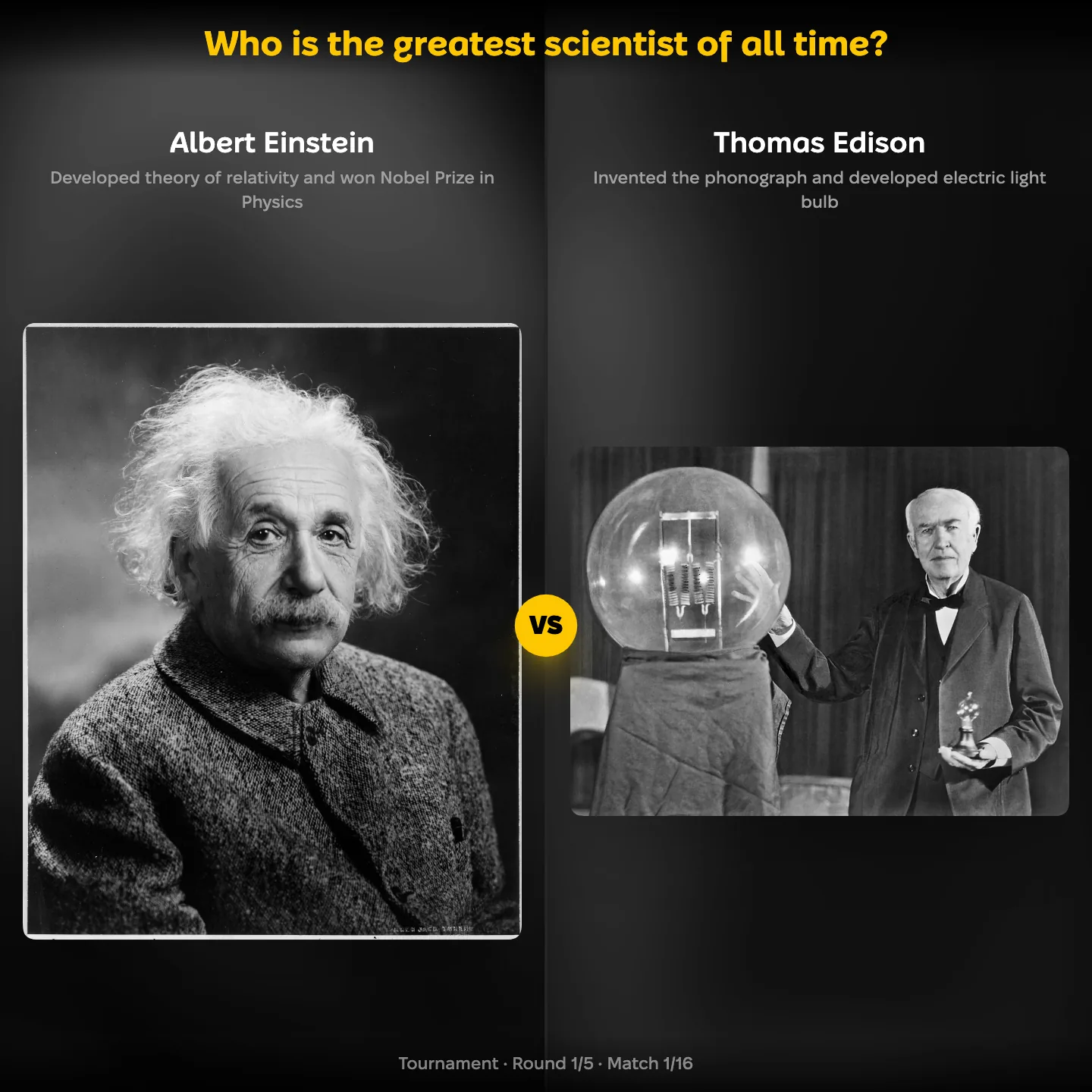
Edison vs Tesla on the inventors' list
Narrow the question from science to invention and both men move to the front.
Edison holds 1,093 United States patents, a record for one person that has never been broken, plus several hundred foreign ones.4 On a list that counts output, nobody in history comes close.
Tesla's case is the opposite shape. He was granted a little over a hundred US patents, and one of them, the polyphase induction motor, is inside almost every industrial machine built since.1
Around them sit Gutenberg, Watt, Bell, the Wright brothers and Hedy Lamarr, which is where the list gets interesting: printing and the steam engine changed more lives than either electrical system did, and they arrived first.
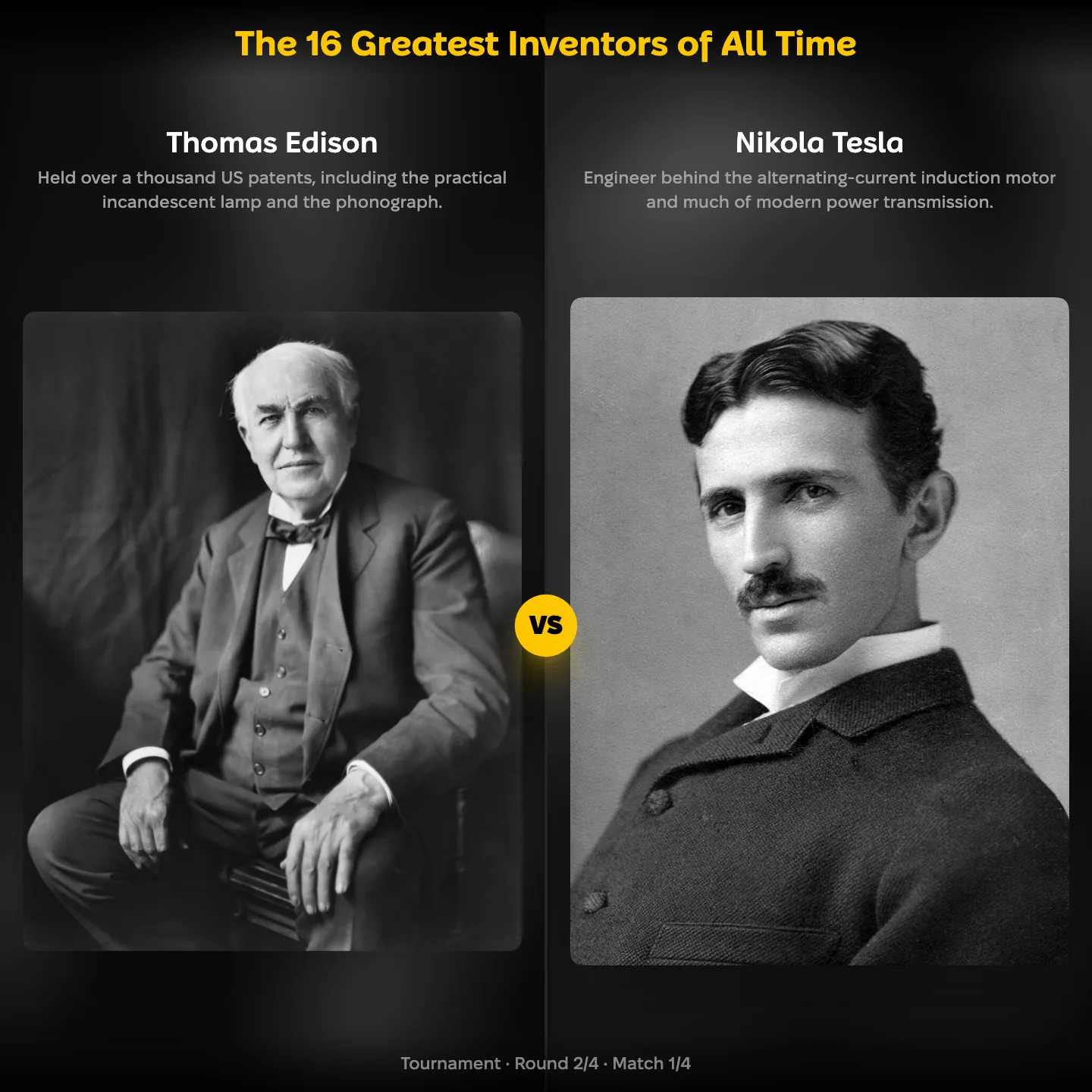
Overrated is a word both men have been called
This is the list where fame counts against you, and Tesla and Edison are on it for opposite offences.
The charge against Edison is credit-taking: a manager of other people's work who put his name on the patent. The charge against Tesla is inflation: a genuinely great engineer turned by the internet into a martyr who supposedly invented everything, including things he only sketched.
Their neighbours here are Columbus, Napoleon, Cleopatra and Julius Caesar, which sets the bar for what "overrated" has to mean. Being wrongly credited with a light bulb is a smaller sin than being wrongly credited with a continent.
One fact complicates both sides at once. In 1917 Tesla accepted the Edison Medal, the highest honour the American electrical profession had, from the same body he had addressed as a young man.1 He had initially refused it.
The engineers of the 1890s saw none of this. To them Edison was the manager who paid the wages and Tesla was the theorist Westinghouse bet a company on. The saint and the fraud are both later inventions.
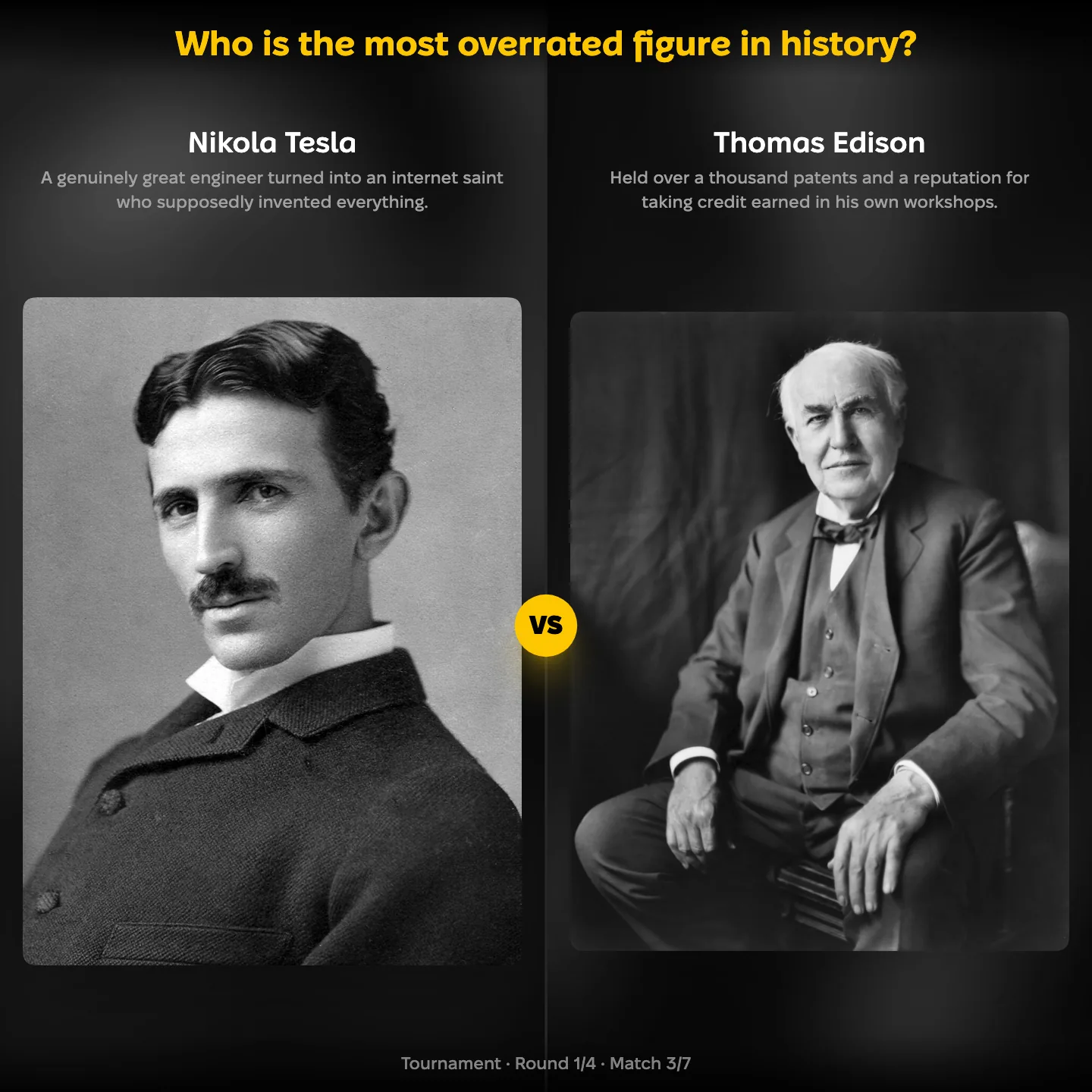
The light bulb vs the induction motor
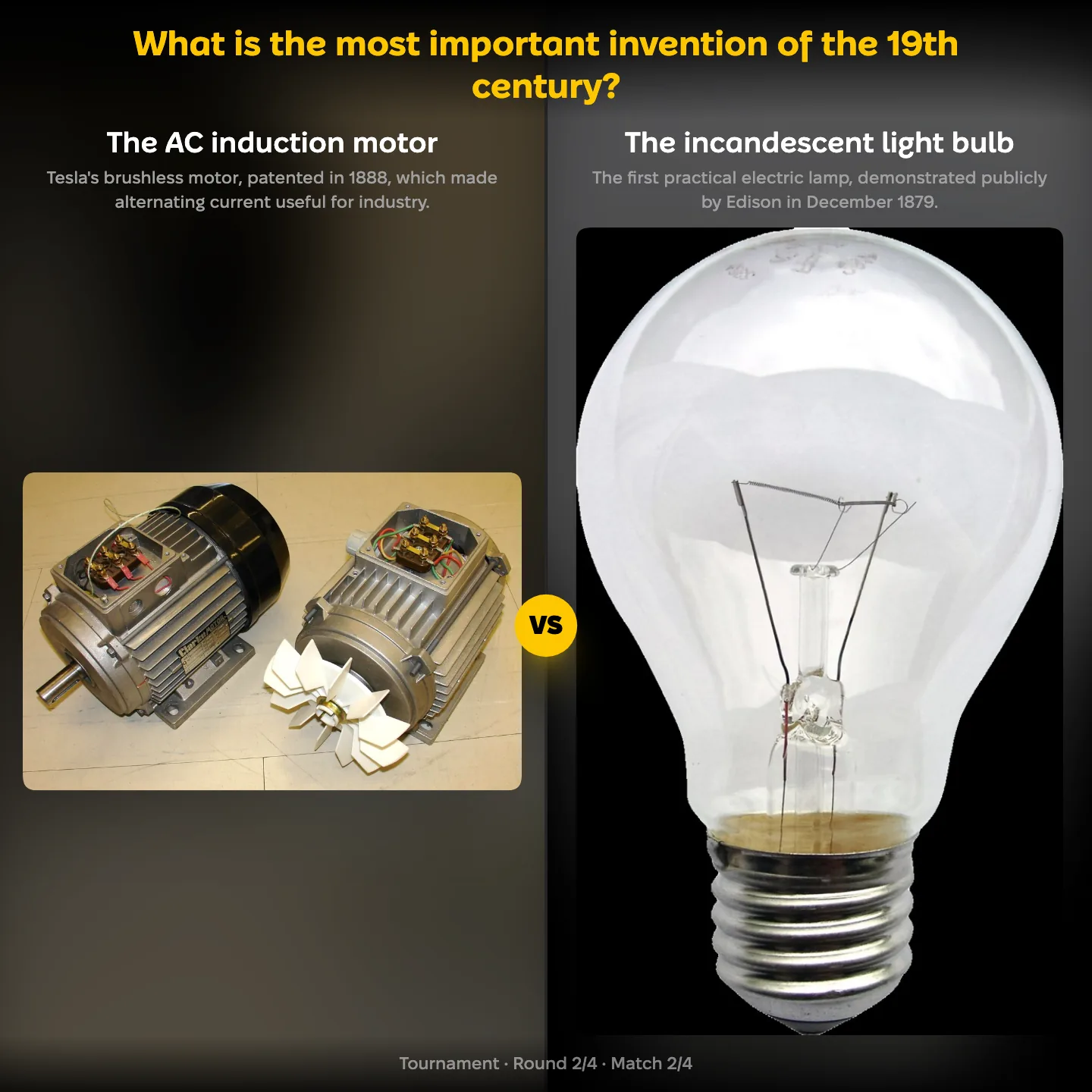
Here Tesla and Edison appear as their work rather than their faces.
Edison's entry is the incandescent lamp, demonstrated publicly in December 1879 and running as a commercial system at Pearl Street three years later.5 Tesla's is the alternating-current induction motor, patented in 1888: the invention nobody can picture and almost every factory contains.
Cheap steel rebuilt more of the world than either of them. No Bessemer converter, no skyscraper to wire.
A national holiday, and two men who never got one
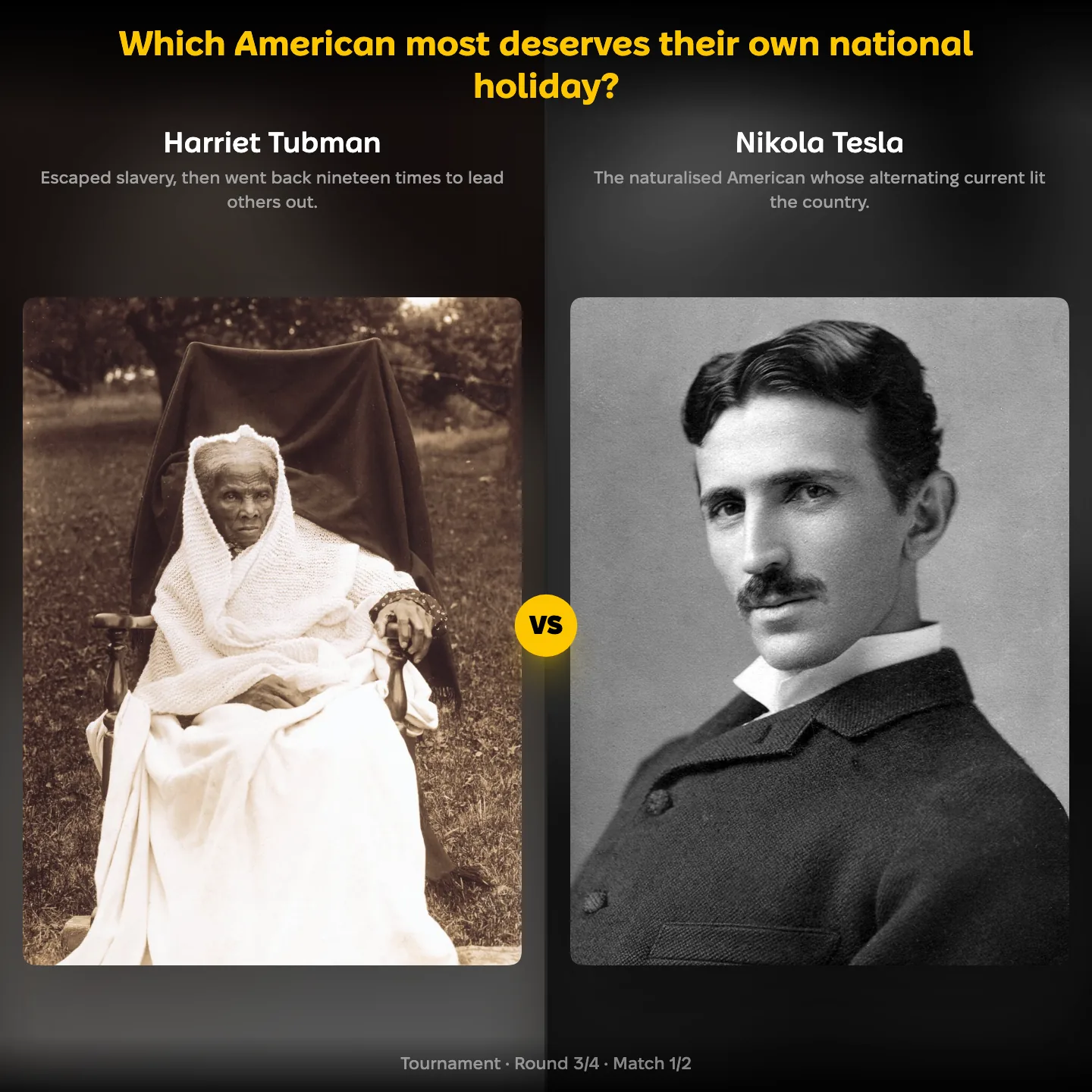
Both Tesla and Edison turn up on a list of Americans who deserve a day named after them, which takes a moment to parse in Tesla's case.
He became a United States citizen on 30 July 1891 and reportedly valued it above any scientific honour.1 Edison was born in Milan, Ohio, in 1847 and died in West Orange, New Jersey, in 1931, having spent 44 years in the same laboratory.5
The competition is where this one gets hard. Harriet Tubman, Frederick Douglass, Rosa Parks, Susan B. Anthony and Neil Armstrong are all on the list, and a holiday is a moral claim as much as a technical one.
Against people who freed other people, two men who electrified a country are making the weaker case, and both of them know it.
Edison had three months of school
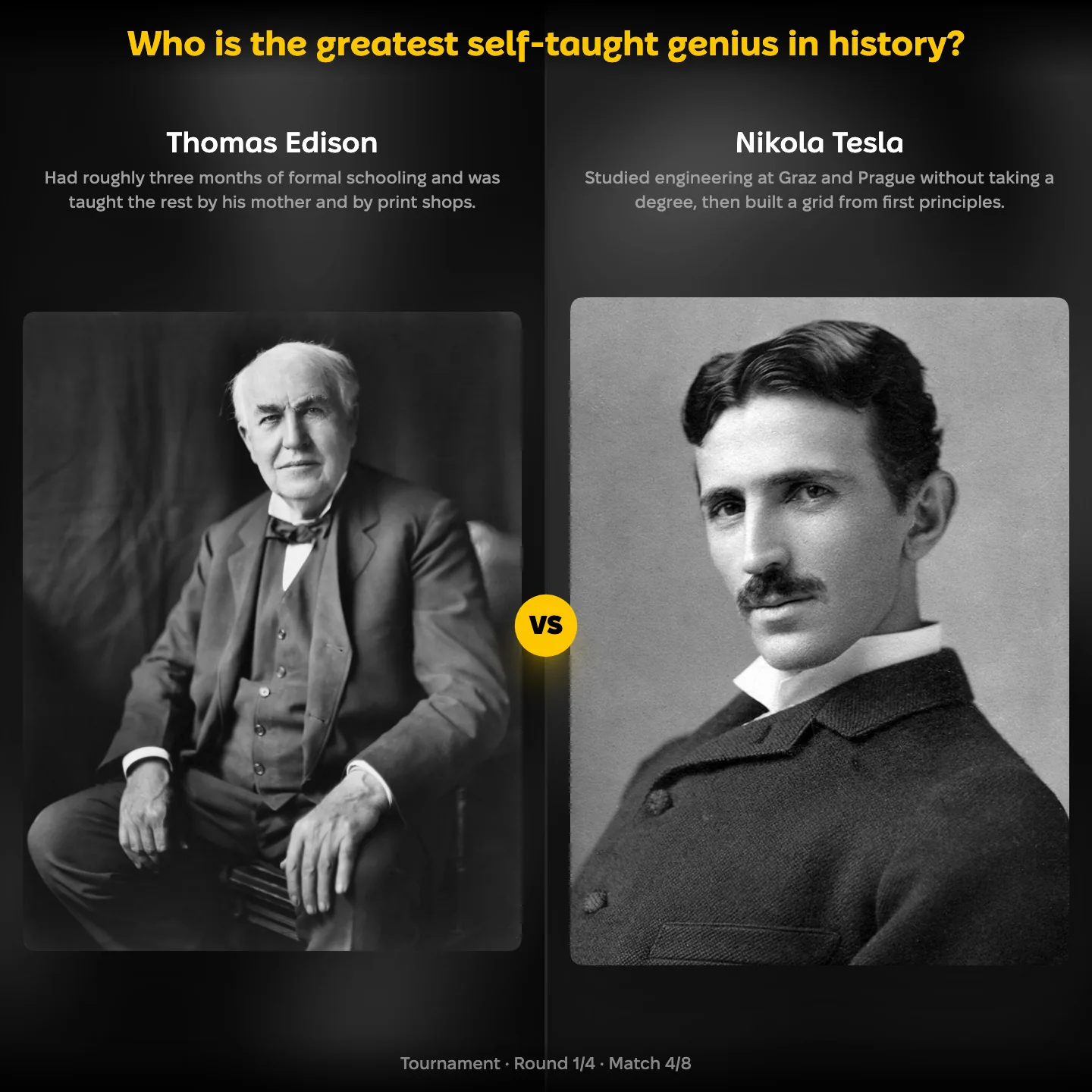
On schooling, Tesla and Edison sit at opposite ends of this list, and not in the order people assume.
Edison had roughly three months of formal schooling. His mother taught him at home and the rest came from print shops and telegraph offices.5
Tesla is the credentialled one. He studied engineering at Graz and in Prague, left without a degree, and built the alternating-current system from theory rather than from tinkering — which is exactly why Edison's people could not argue him out of it.
The list around them is stacked with people who had no schooling at all: Faraday bound books before he did physics, Ramanujan worked from one borrowed textbook, Frederick Douglass taught himself to read while enslaved, and Lincoln had about a year in a classroom.
Westinghouse, Gillette, Eastman: the ones who could sell
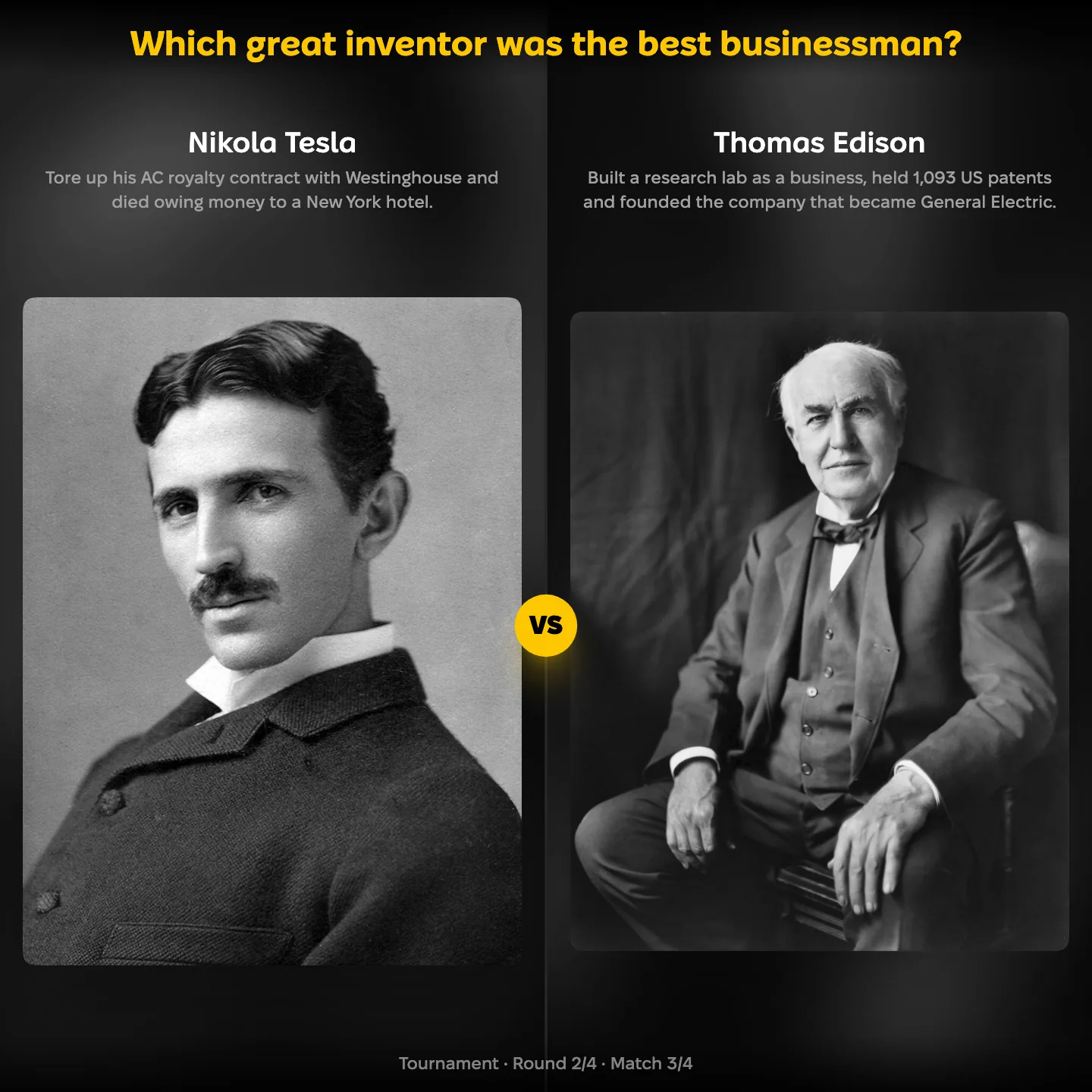
If the question is commercial judgement rather than invention, the two men are not close.
Edison built a research laboratory as a business and founded the firm that became General Electric. Tesla tore up his alternating-current royalty agreement with George Westinghouse when the company was in trouble, and died in a New York hotel owing money.
The field here is full of people who understood the second half of the job. King C. Gillette worked out that the money was in the blades. Isaac Singer did not invent the sewing machine and invented hire purchase to sell it. George Eastman sold cameras cheap and film dear.
Charles Goodyear discovered vulcanised rubber and died roughly $200,000 in debt, which is the other outcome available to an inventor with no head for contracts.
The Tesla counter-argument is that the royalty he gave away was on a system the whole world now runs on. That makes him the worst businessman on this list and the one with the largest footprint on it, and the two facts are the same fact.
Faraday, Maxwell and the engineers' own list
Narrow the field to the discipline Tesla and Edison actually shared and the argument changes shape again.
Tesla belongs near the front of any electrical engineering list on the strength of one system: generation, transmission and the motor at the end of the wire, designed as a whole.
Edison's contribution is the demonstration that the whole chain could be sold: the station, the meter, the wiring and the lamp, delivered as a service in 1882 rather than as a laboratory result.
Above both of them sit the people whose work made either system thinkable. Michael Faraday found induction, James Clerk Maxwell wrote the equations, and Heinrich Hertz proved the waves existed. Further down, Shannon, Kilby and Noyce built the century that followed.
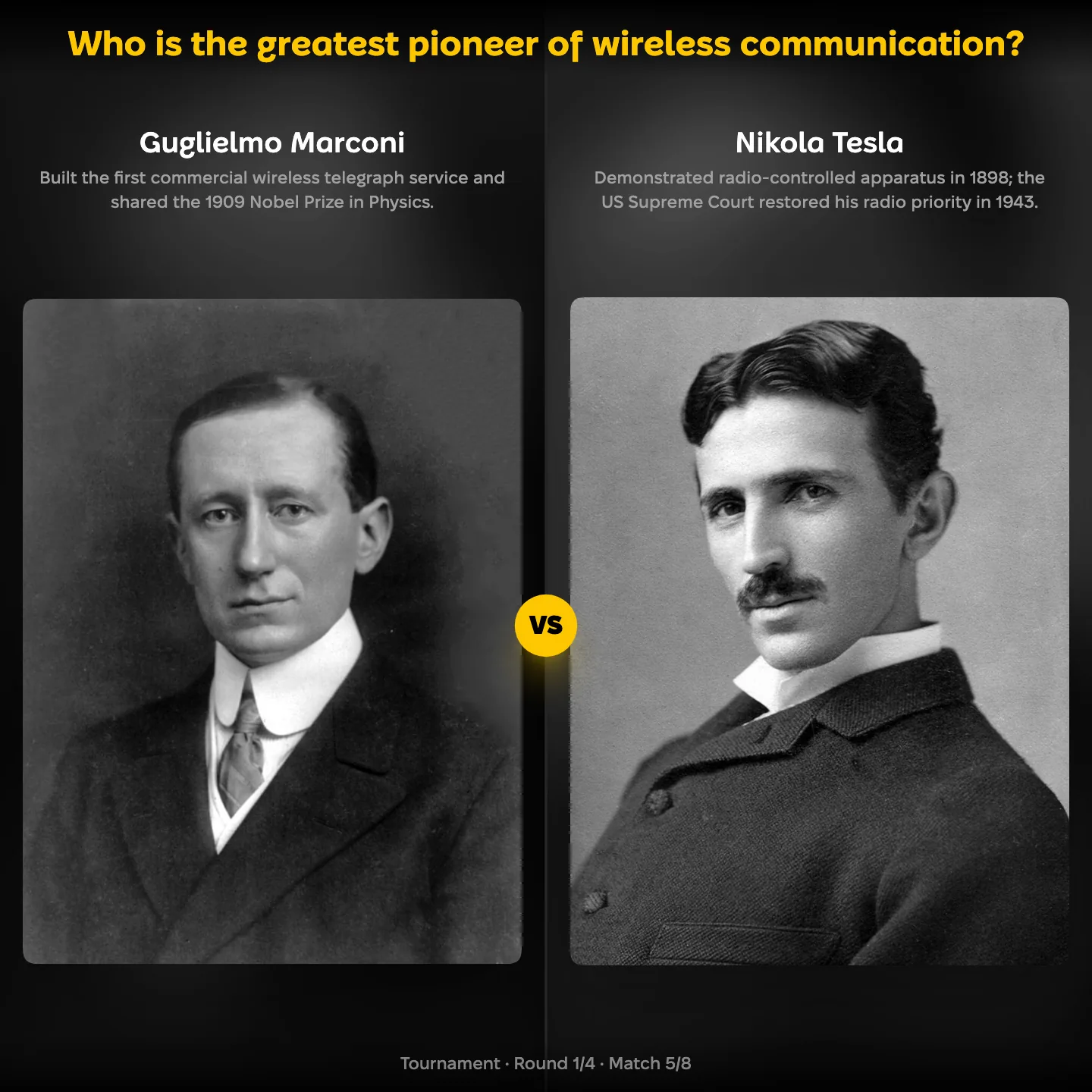
Marconi vs Tesla: who invented radio
The radio question has a courtroom answer and it went Tesla's way, decades too late.
Marconi built the first commercial wireless telegraph service and shared the 1909 Nobel Prize in Physics for it. In 1943 the United States Supreme Court restored Tesla's radio patent priority, the same year he died.1
Edison is on this list too, which surprises people. He patented an induction-based wireless telegraph in 1885 and sold the rights to Marconi, a rare case of Edison correctly valuing something and then handing it to the competition.
Around them the list holds Hertz, Lodge, Popov, Fessenden and Armstrong, and Hedy Lamarr's 1942 frequency-hopping patent, which is closer to Wi-Fi than anything else here.
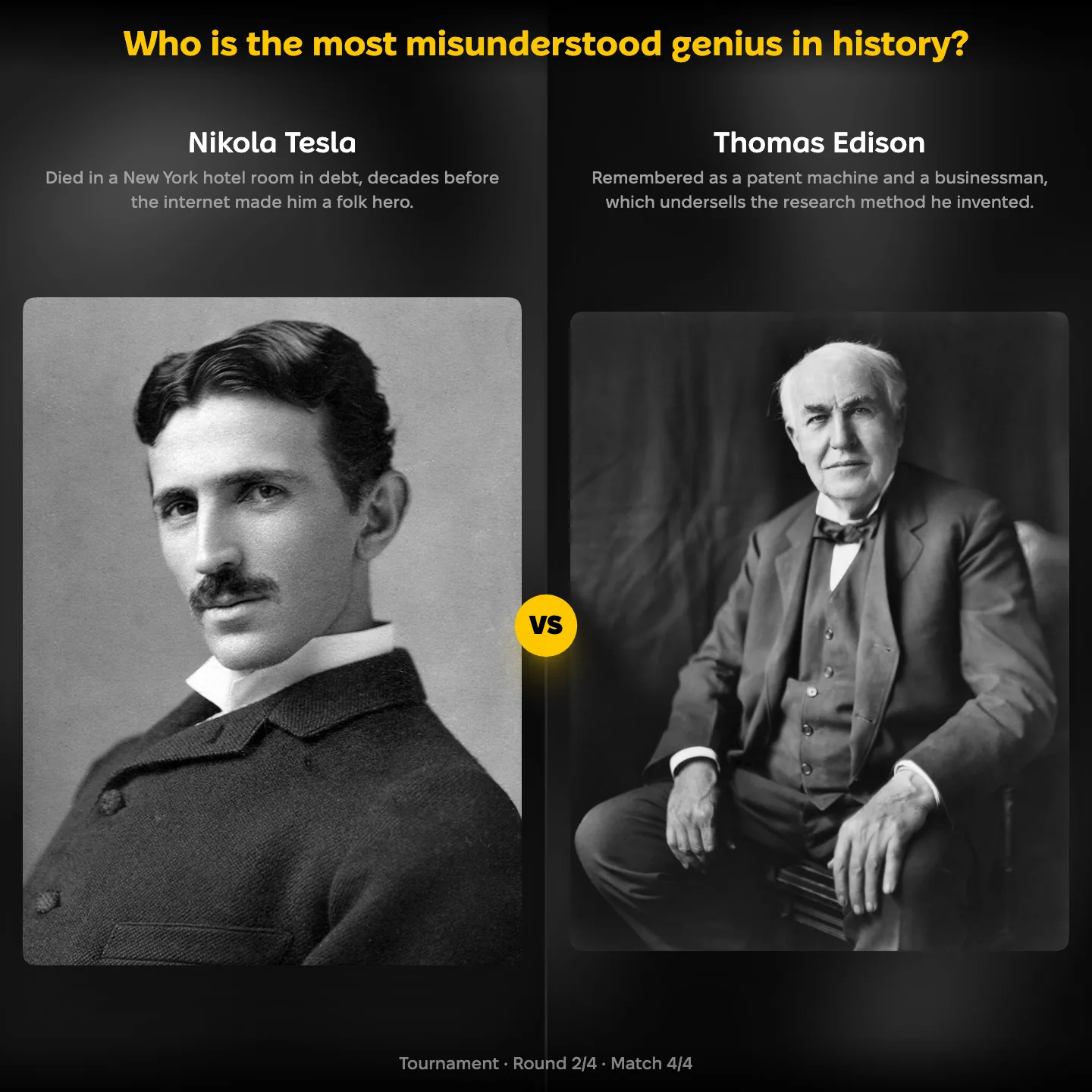
Semmelweis, Turing and the room that laughed
Tesla is the internet's favourite misunderstood genius and Edison is its favourite villain, which makes this list a test of how much either reputation deserves.
Tesla's case is real. He died in a hotel room in 1943, in debt, long before the AC grid he designed was recognised as his.
Edison's case is subtler and rarely made: the man remembered as a patent machine invented the industrial research laboratory, and that method produced more of the twentieth century than any single device in it.
The competition is brutal. Ignaz Semmelweis proved handwashing saved mothers and died in an asylum. Alan Turing was prosecuted and pardoned 61 years after his death. Gregor Mendel's genetics sat unread for 35 years, and Alfred Wegener was mocked for continental drift until the seafloor proved him right.
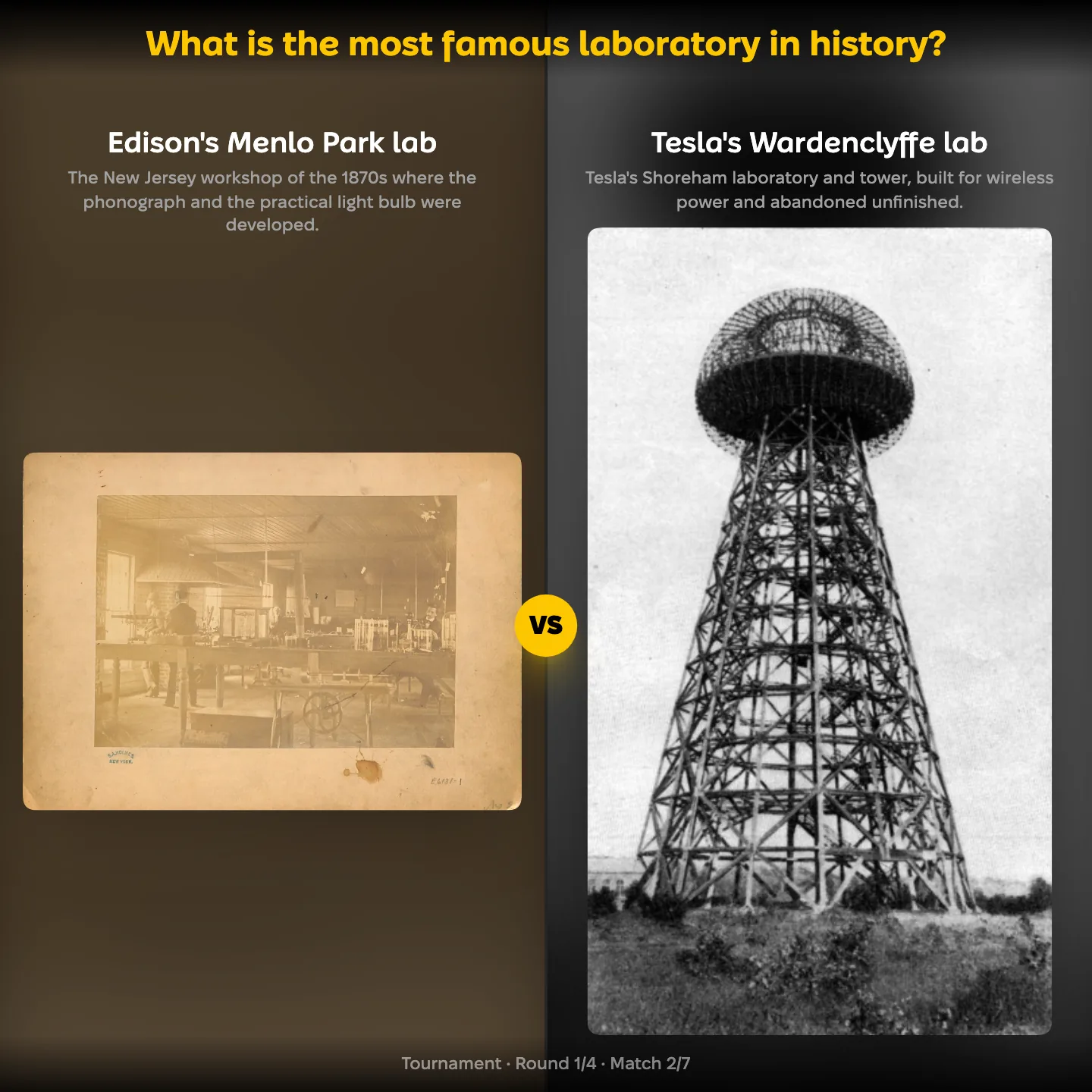
Menlo Park vs Wardenclyffe
Both men are on this list as buildings, and the buildings tell the story faster than the biographies.
Menlo Park, New Jersey, was the first laboratory built to invent on schedule. The phonograph and the practical incandescent lamp came out of it in the 1870s, and the model — salaried staff, a machine shop, a library — is what every corporate lab since has copied.
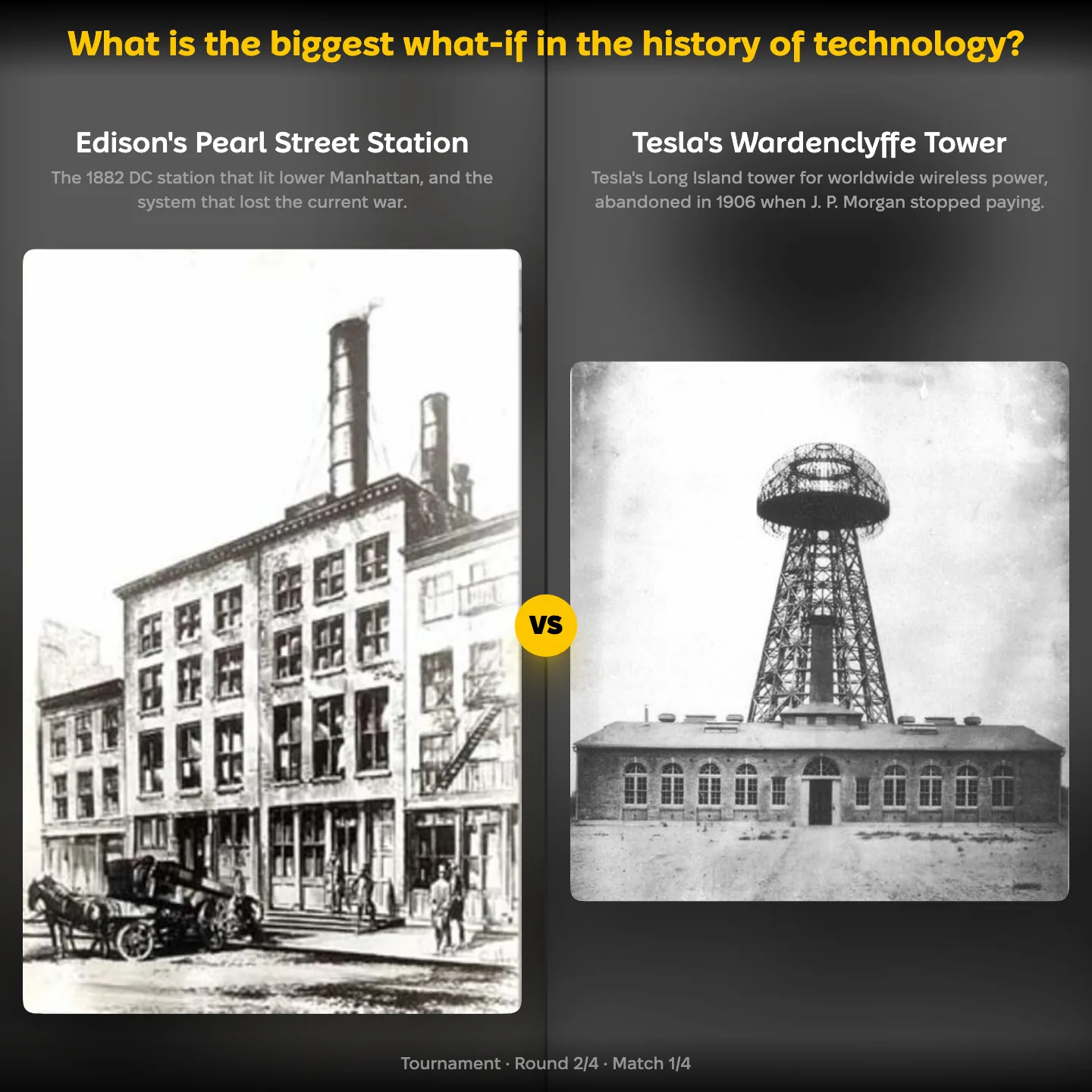
Wardenclyffe was Tesla's attempt at the same thing at ten times the ambition: a Long Island laboratory and a 187-foot tower meant to broadcast power without wires. It never worked, and it never finished.
The company here is Bell Labs, Los Alamos, CERN, Bletchley Park and the Cavendish, all of which produced results Wardenclyffe only promised, and none of which are as famous a ruin.
The tower, the station and the machines nobody finished
The what-if list is the only one where Tesla and Edison appear as failures, and it is the most flattering thing on this page for both of them.
Wardenclyffe is here because J. P. Morgan stopped paying in 1906, leaving the tower standing and useless. Whether worldwide wireless power was ever physically possible is a separate question, and the reason the entry is a what-if rather than a theft.
Pearl Street qualifies by the opposite route. It worked. Edison's direct-current station lit lower Manhattan in September 1882 and then lost the war to alternating current, which is why the AI data centre story of 2026 reads as a reversal rather than a coincidence.
Everything else here belongs to the museum of the almost: Babbage's Analytical Engine, the Xerox Alto, Concorde, the Antikythera mechanism, the Soviet N1 and a Saturn V that never lost a crew and stopped flying in 1973.
The list Edison cannot join
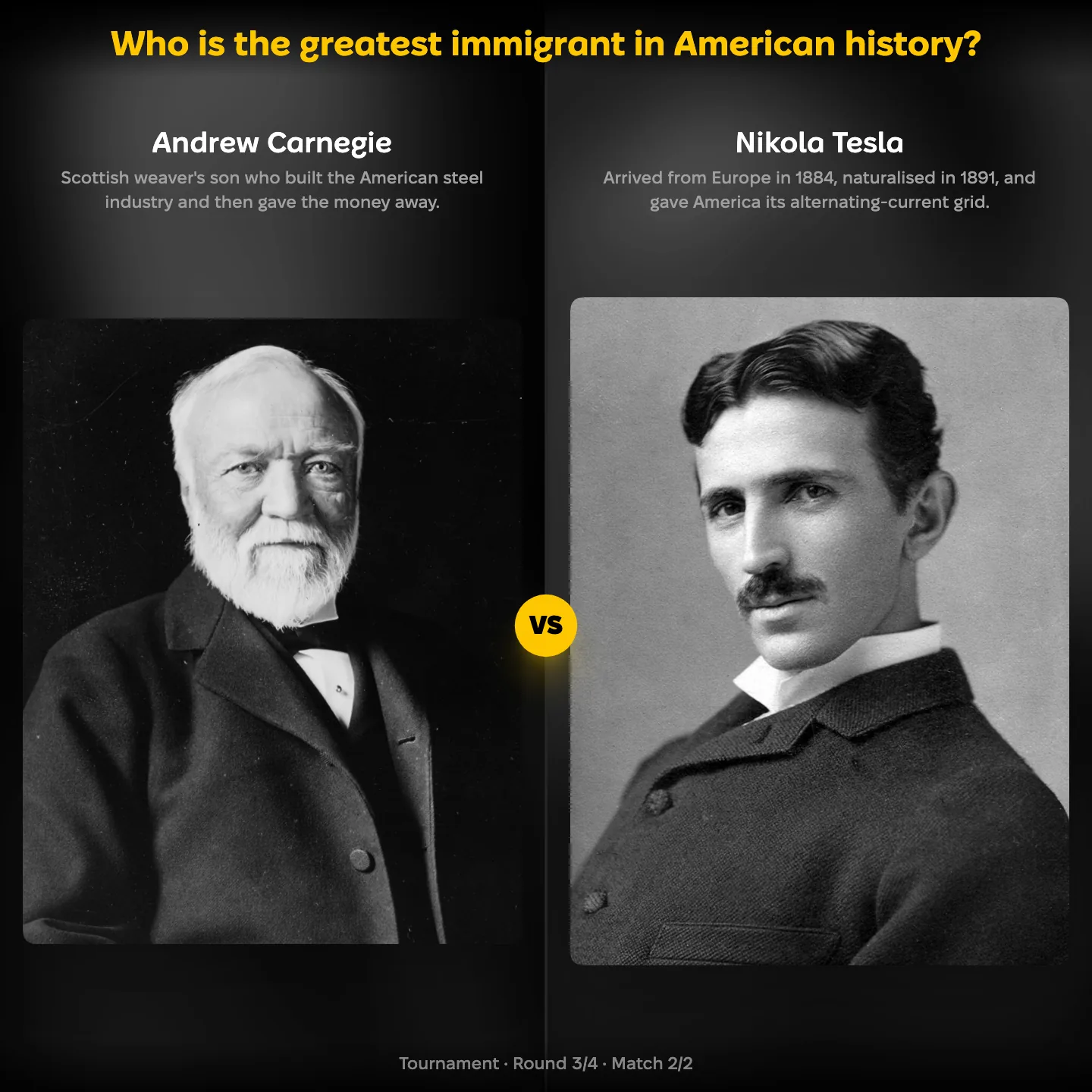
Thirteen questions in, here is the one that excludes him. Edison was born in Ohio; Tesla arrived from Europe in 1884 with no money and a letter of introduction.
That letter, according to the story, was addressed to Edison.
Tesla's competition is the strongest field in this article. Andrew Carnegie built the American steel industry and gave the fortune away. Albert Einstein moved the centre of theoretical physics to Princeton in 1933. Enrico Fermi built the first nuclear reactor under a Chicago stadium, Wernher von Braun built the Saturn V, and Alexander Hamilton designed the country's financial system before any of them were born.
Edison's absence is the point of including the list at all: the man who defines American invention is the one who did not have to arrive.
Thirteen questions, two men, no stable answer
Change the question from "who invented more" to "who understood more" and these two swap places; change it again to "who sold more" and they swap back. That is not indecision, it is the shape of a partnership neither of them wanted: Tesla supplied the idea the century needed and Edison supplied the machinery for turning ideas into products, and the argument only stays alive because both halves were necessary.
All thirteen were sorted the slow way, two contenders at a time, so a name that carries one question can vanish from the next.
If you think a third name belongs in the middle of this, and Westinghouse has a case, build the ranking and put it to a vote.
More rankings, more angles
- Leonardo da Vinci Is on Every List. Never in the Same Place: the flying machine that stayed a sketch
- 15 Rankings, One Benjamin Franklin: printer, diplomat, and the man on the $100
- Washington vs Lincoln: Who Wins Which List?: two presidents on the same fifteen lists
Sources
- IEEE. Nikola Tesla: AIEE papers of 1888 and 1891, vice-presidency in 1892, US citizenship on 30 July 1891, the 1917 Edison Medal, over 100 US patents, and the 1943 restoration of his radio priority: transmitter.ieee.org (checked 2026-09-02)
- US Department of Energy. The War of the Currents: Edison's campaign against AC, Westinghouse's $399,000 bid against General Electric's $554,000 for the 1893 Chicago World's Columbian Exposition, the Niagara Falls contract, and Buffalo lit on 16 November 1896: energy.gov (checked 2026-09-02)
- Texas Instruments. Complete 800 VDC power architecture for next-generation AI data centres, built with NVIDIA, announced 16 March 2026: ti.com (checked 2026-09-02)
- US National Park Service. Thomas Edison National Historical Park FAQ: 1,093 US patents, a record for one person, plus several hundred foreign patents: nps.gov (checked 2026-09-02)
- US National Park Service. Edison biography: born 11 February 1847 in Milan, Ohio, died 18 October 1931, the December 1879 public demonstration of the incandescent lamp, the Pearl Street station of September 1882, and 44 years at West Orange: nps.gov (checked 2026-09-02)