
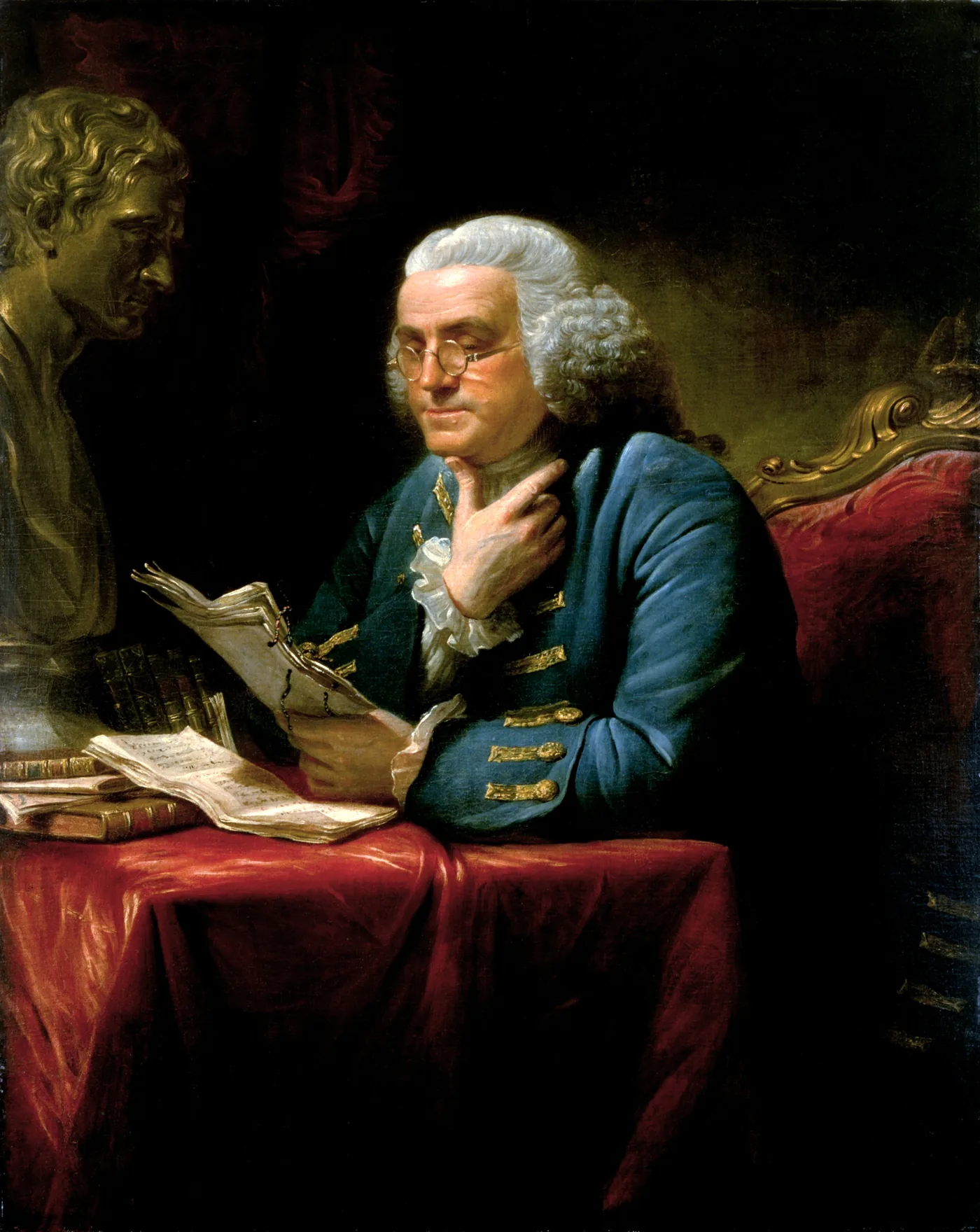
Benjamin Franklin was seventy when he signed the Declaration of Independence, the oldest of the fifty-six men who put their names to it.1 By then he had already been a printer, a physicist, a postmaster, a newspaper proprietor and an ambassador, and he still had the Constitution ahead of him.
The United States turns 250 this year, and the National Park Service has anniversary programming running at Revolutionary sites through 2026.2 Which makes it a decent moment for a narrower question than the parades ask: what, exactly, is Franklin the greatest at?
We built fifteen rankings to find out. Barely any of them overlap.
Fifteen rankings, and no two of them are about the same subject. That is what a man with six careers does to a filing system.
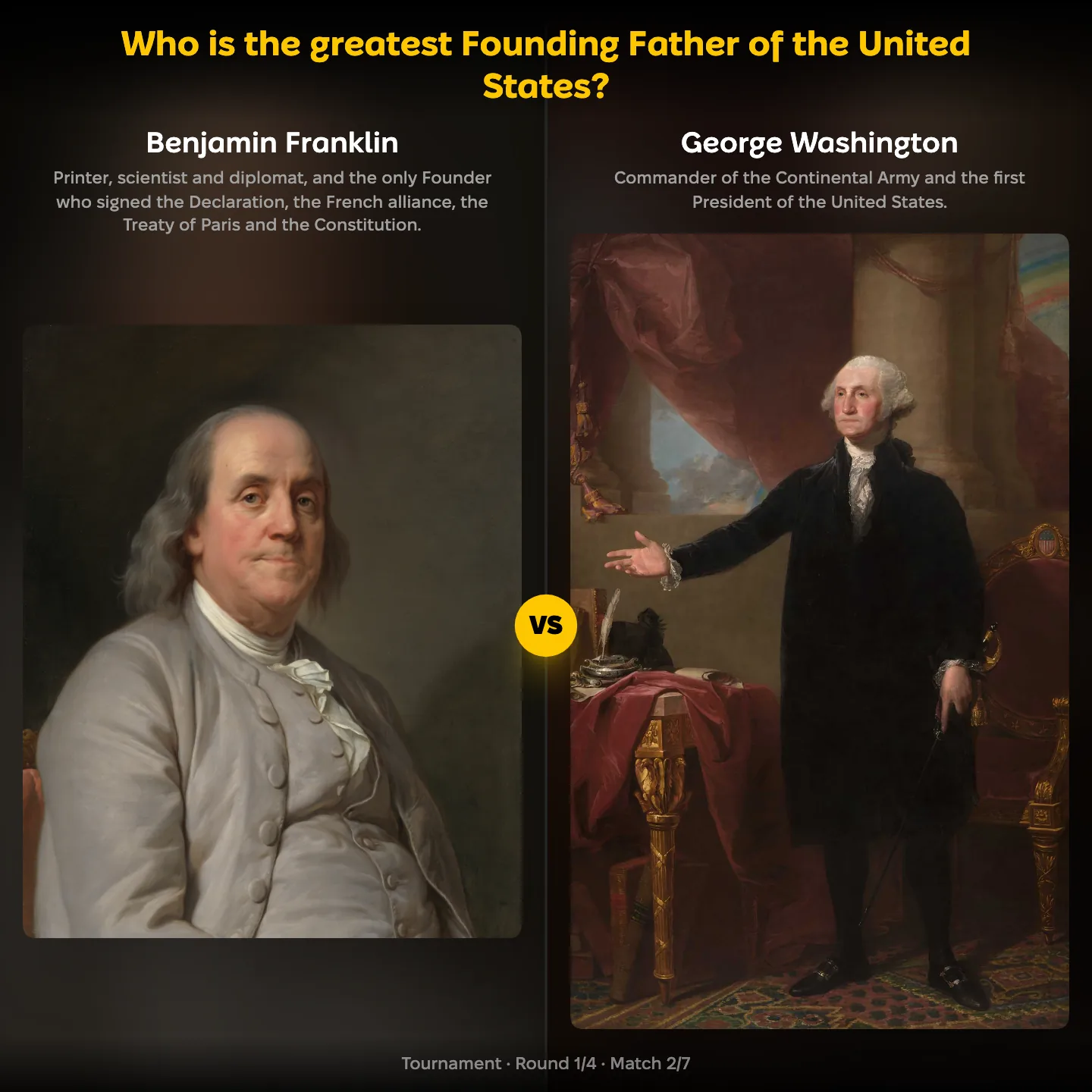
Franklin vs Washington: the Founding Father question
The obvious list first. Fourteen founders, including Roger Sherman, whose Great Compromise built the two-chamber Congress and whose face almost nobody could pick out of a line-up.
Franklin's claim rests on range. He signed the Declaration in 1776, the military alliance with France in 1778 and the Constitution in 1787, which is a longer stretch of the founding than anyone else was present for.
Washington's claim is simpler and heavier. He commanded the army that won, then gave the power back, twice, which is the part of the story that had no precedent at the time.
Then there is Thomas Paine, who wrote none of the documents and arguably supplied the reason for all of them. Fourteen names, three genuinely different definitions of the word "founder", and a reader has to pick one.
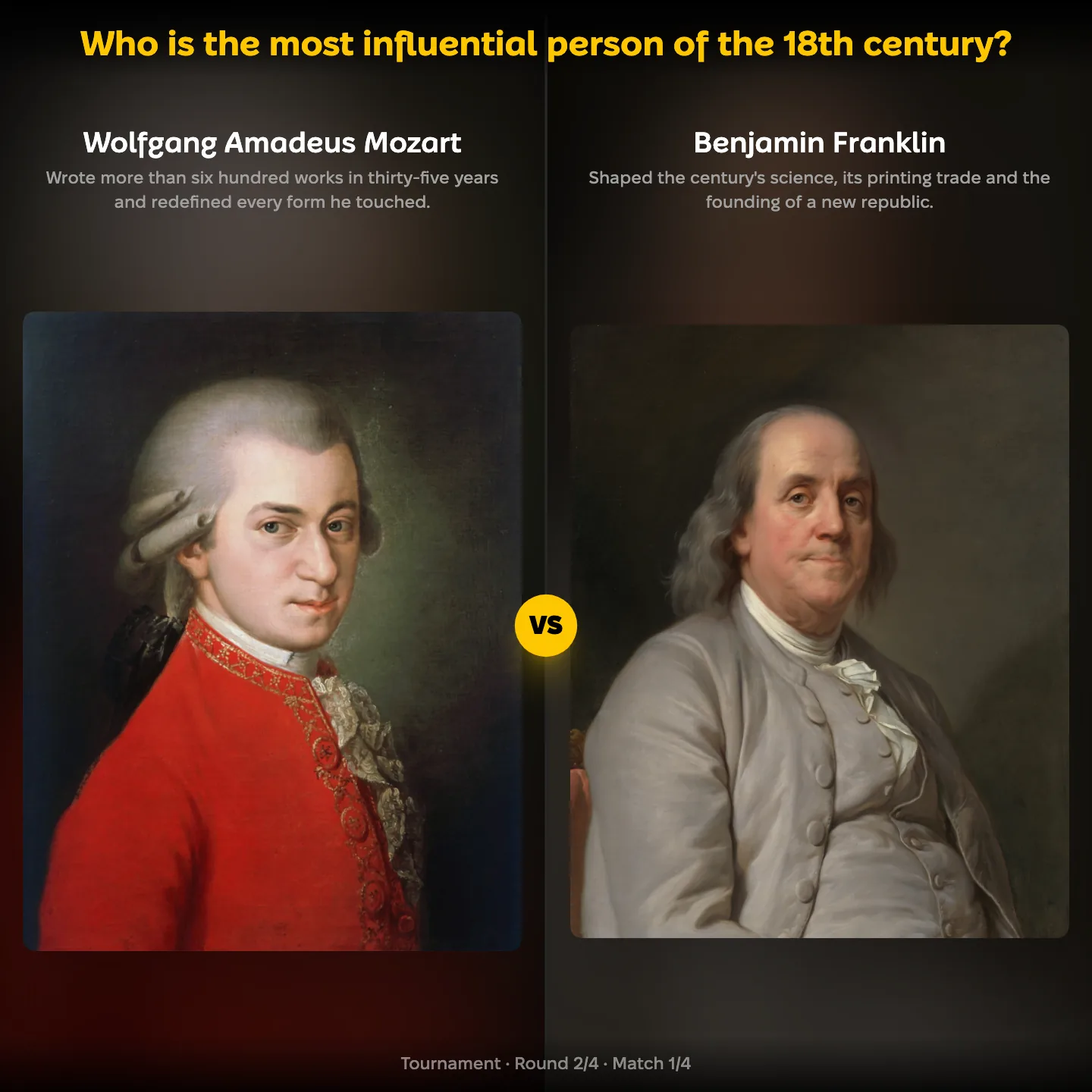
Mozart, Kant, and a man with a kite
Widen the frame to the whole eighteenth century and Franklin stops being a founder and becomes one entry in a very strange field.
Mozart wrote more than six hundred works and died at thirty-five. Immanuel Kant split philosophy into before and after. James Watt's condenser set the pace of industry for a century.
Franklin belongs in that company on the strength of the electricity work alone. Whether he belongs above any of them is a question about what the century was actually for.
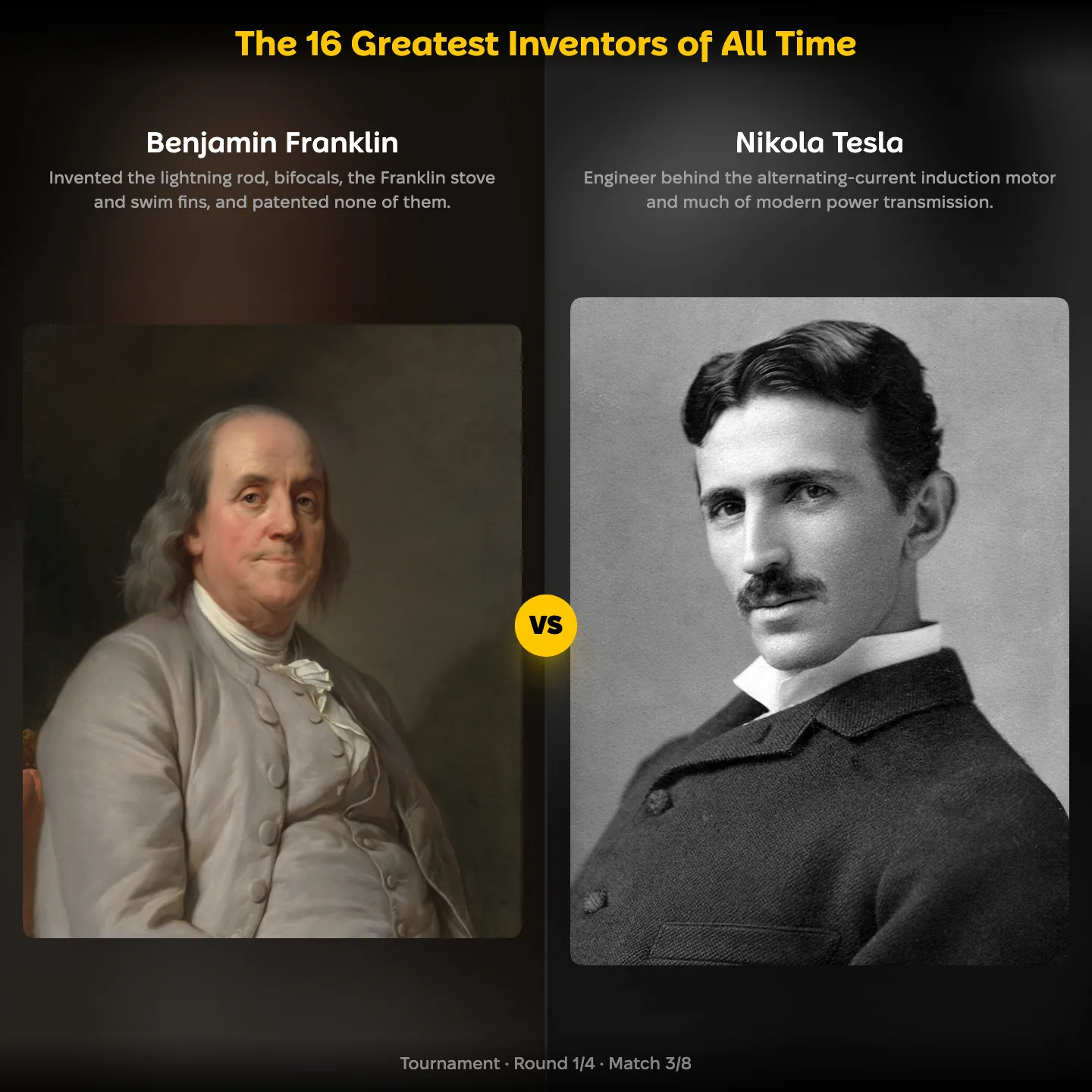
Edison, Tesla, and the inventor who never filed a patent
Franklin's inventions are all still recognisable: the lightning rod by 1749, the Franklin stove in 1742, bifocals, swim fins he made at about eleven, a flexible urinary catheter for his brother in 1752, and the glass armonica in 1761.3
He patented none of them. The Franklin Institute records his reasoning: since we all benefit from other people's inventions, we should be glad to serve others by our own, freely and generously.3
That is the problem with this list. Thomas Edison held over a thousand US patents and built the first industrial research laboratory to produce more of them. Nikola Tesla's induction motor is inside a large fraction of the machines now running.
By volume of output, Franklin is nowhere near Edison's bracket. By what he did with the output, he has the field almost to himself: Jonas Salk is the only other name here who refused to profit from the thing he made.
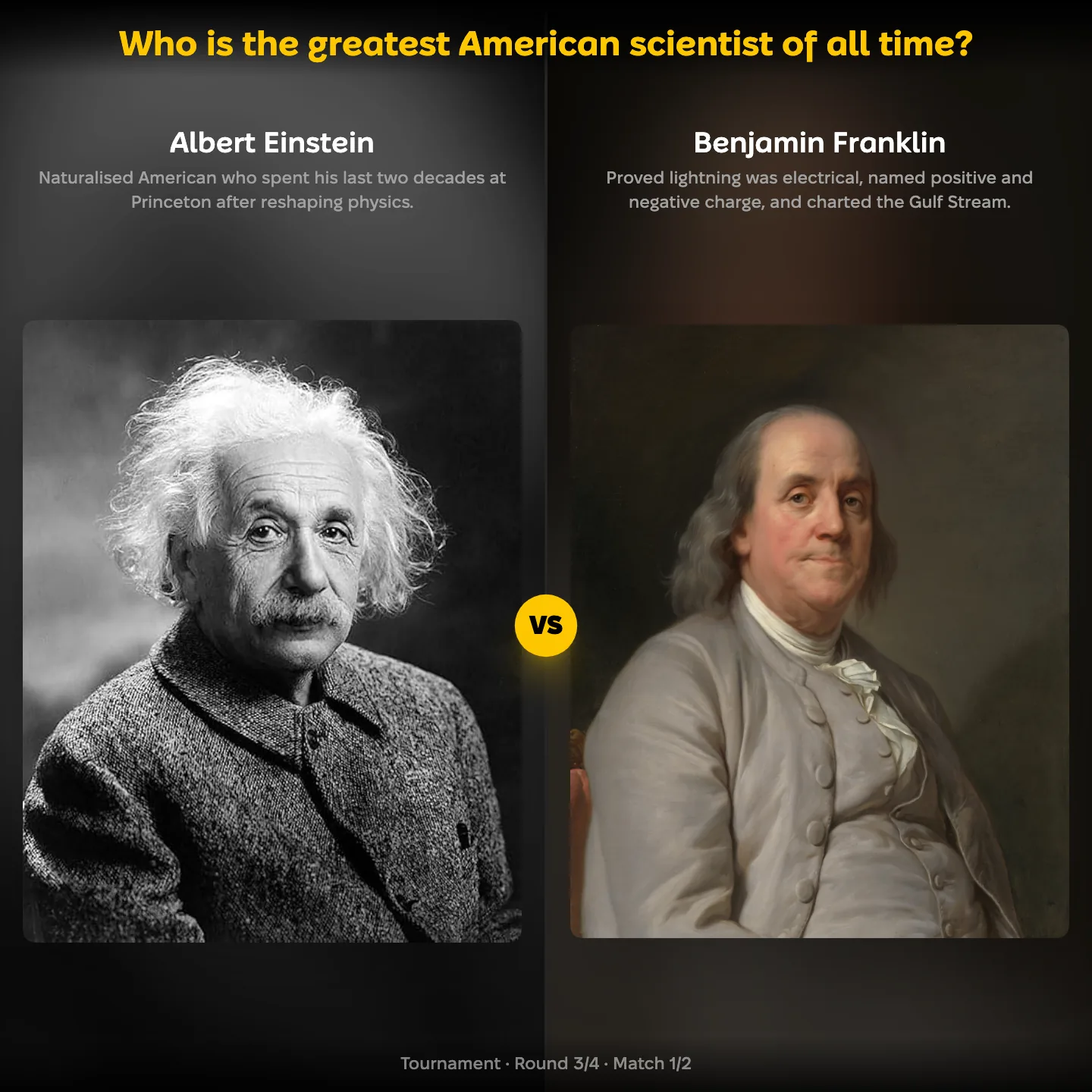
Franklin vs Einstein: the greatest American scientist
Narrow the field to Americans and the eighteenth century suddenly has to compete with the twentieth.
Franklin proved lightning was electrical, gave us the vocabulary of positive and negative charge, and charted the Gulf Stream well enough to shorten Atlantic crossings.
Albert Einstein spent his last two decades at Princeton. Richard Feynman rebuilt quantum electrodynamics. Katherine Johnson's orbital mathematics put Americans into space and brought them back.
Franklin did his work before the country he is being ranked for existed, which is true of nobody else on the list.
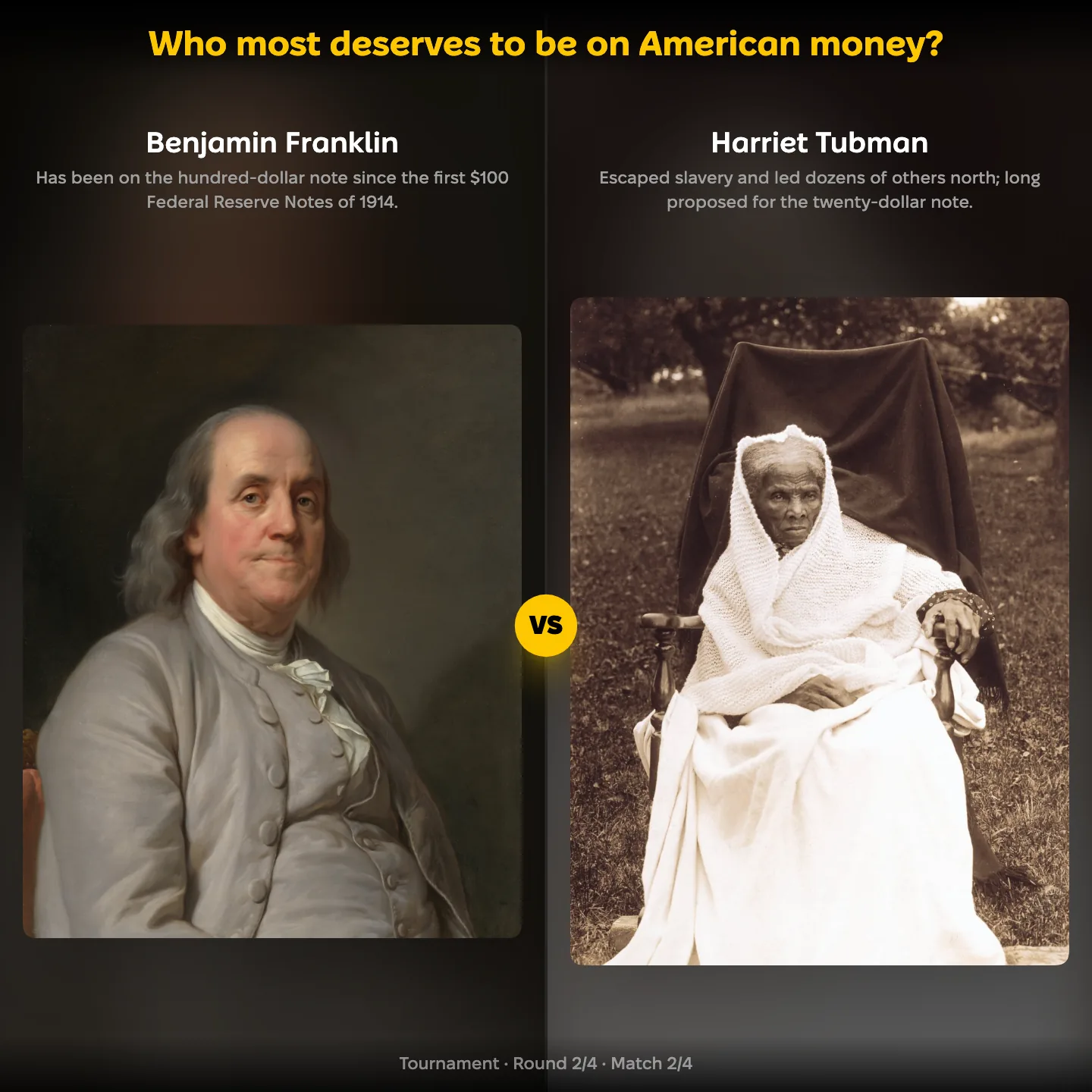
Philadelphia's colonial notes and the hundred-dollar bill
Most people meet Franklin as a face on money. Fewer know he printed it: in 1739 his Philadelphia firm produced colonial notes using nature prints, raised impressions cast from real leaves, as a counterfeit deterrent no forger could copy by hand.4
Two and a half centuries later his portrait is the one on the hundred, with Independence Hall on the reverse. He is also the only person on a circulating US note who was never president, which is either an accident of history or the point of it.
Everyone else here is a live proposal rather than a museum piece. Harriet Tubman has been put forward for the twenty for years. Martin Luther King Jr has a federal holiday and a memorial and no banknote at all.
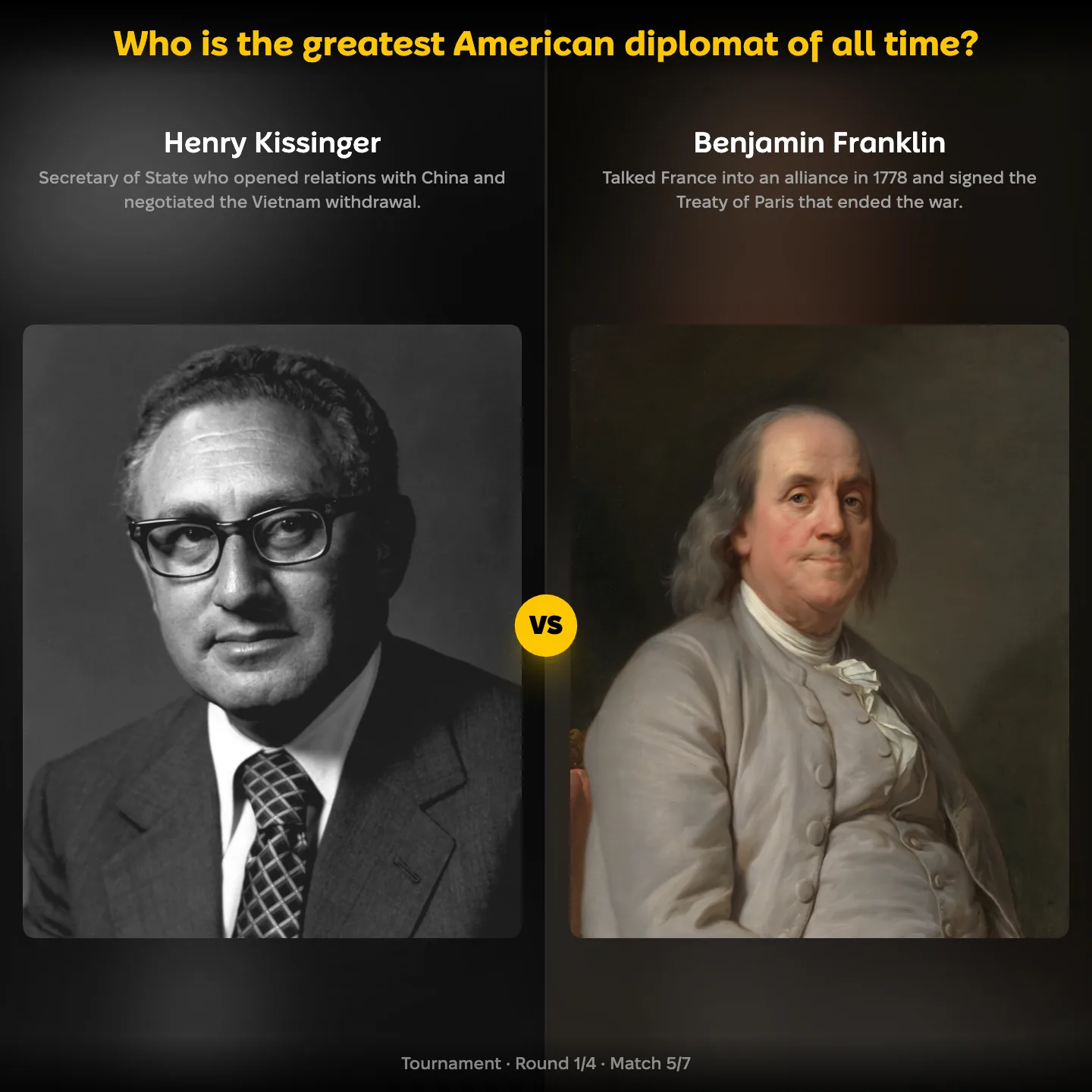
Paris, February 1778: the signature that won the war
Franklin's least-remembered job is the one with the strongest claim on any list. He went to France in 1776 as the American commission's senior figure and came back with a war-winning alliance.
On 6 February 1778 Franklin, Arthur Lee and Silas Deane signed the Treaty of Alliance and the Treaty of Amity and Commerce with France.5 Without French money, ships and troops there is no Yorktown.
The competition is serious. George Marshall rebuilt post-war Europe and won a Nobel for it. Ralph Bunche mediated the 1949 Arab-Israeli armistice and became the first Black Nobel Peace laureate. Henry Kissinger opened relations with China.
What separates Franklin is that he was negotiating on behalf of a country that did not yet exist, from a court that had every reason to let it fail.
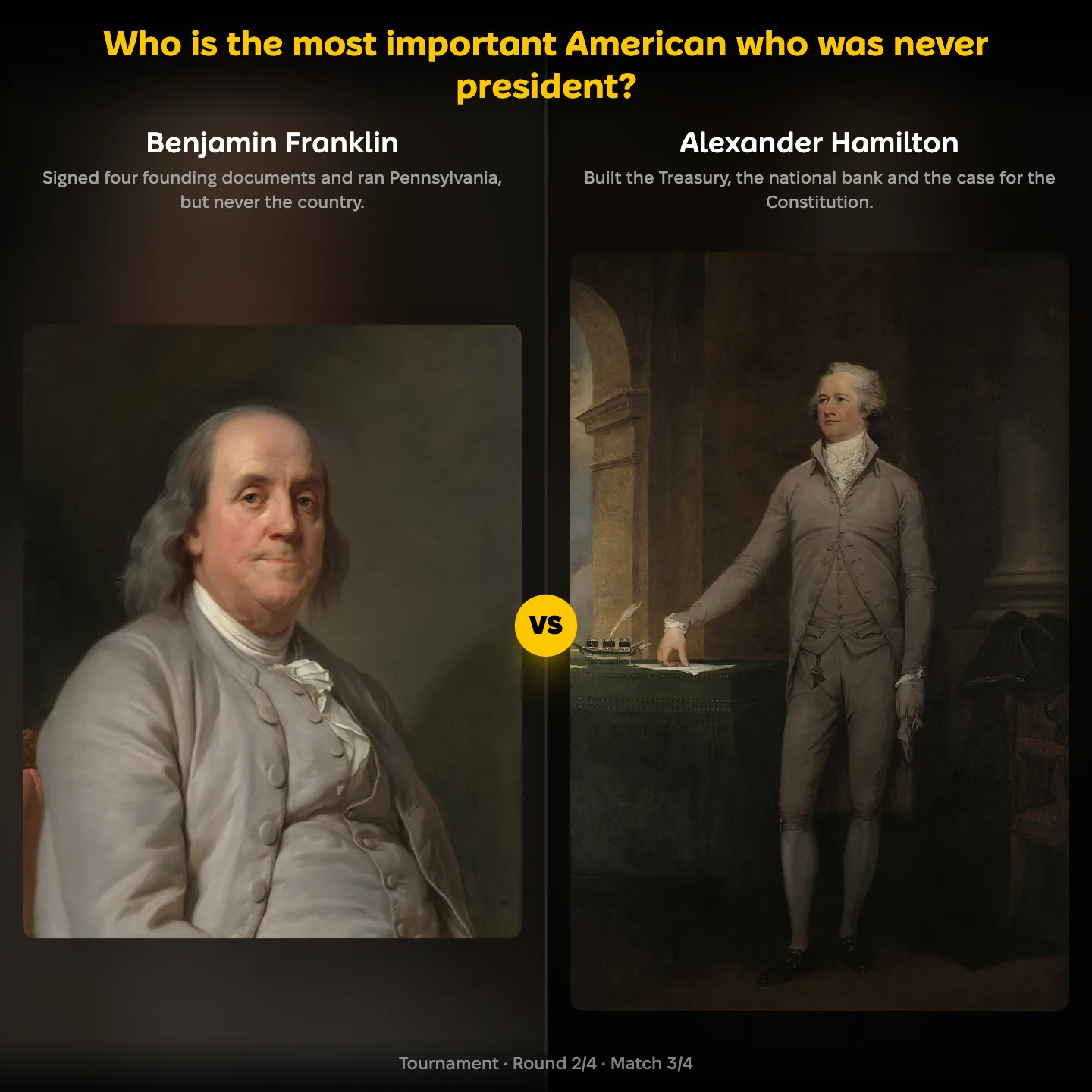
Franklin vs Hamilton: the best American who never got the job
This is the one ranking Franklin qualifies for because of something he did not do.
He never became President of the United States. His highest executive office was President of Pennsylvania's Supreme Executive Council, the state's equivalent of governor, which he took at the age of eighty and held from 18 October 1785 to 1 October 1788.6 He was also the first Postmaster General.6
Alexander Hamilton has the strongest rival case. He built the Treasury, the national bank and the argument for the Constitution itself, and the financial machinery he designed is still running.
Then the list widens past the founding generation and gets harder. Martin Luther King Jr, Frederick Douglass, Harriet Tubman, Susan B. Anthony and Rosa Parks changed the country from outside government entirely, a qualification of a wholly different sort from Franklin's near-miss.
Fifteen people, and the only thing they share is a job none of them had.
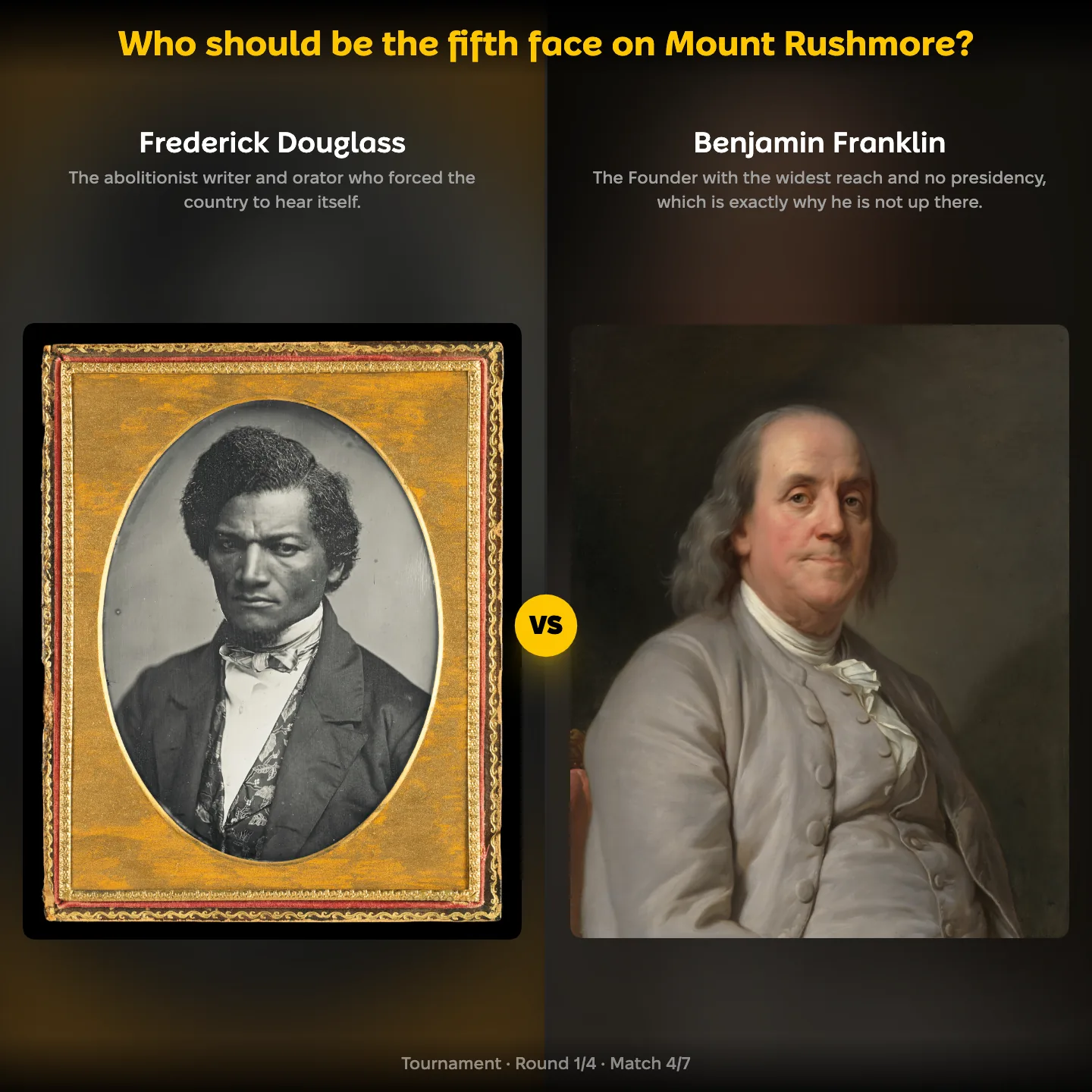
Mount Rushmore has four faces and a waiting list
Four presidents are carved into that mountain and Franklin is not one of them, which is why he is a candidate here rather than an answer.
His case is the same as everywhere else: the widest footprint of the founding generation. Against him: Rushmore is a monument to the presidency, and he never held it.
The honest complication is closer to home. Franklin's son William was the royal governor of New Jersey and stayed loyal to the King; the two men never reconciled, and their last meeting in 1785 was about money.7 A monument flattens things like that, which is part of what makes fourteen alternative faces worth arguing over.
Leonardo da Vinci is standing in the way
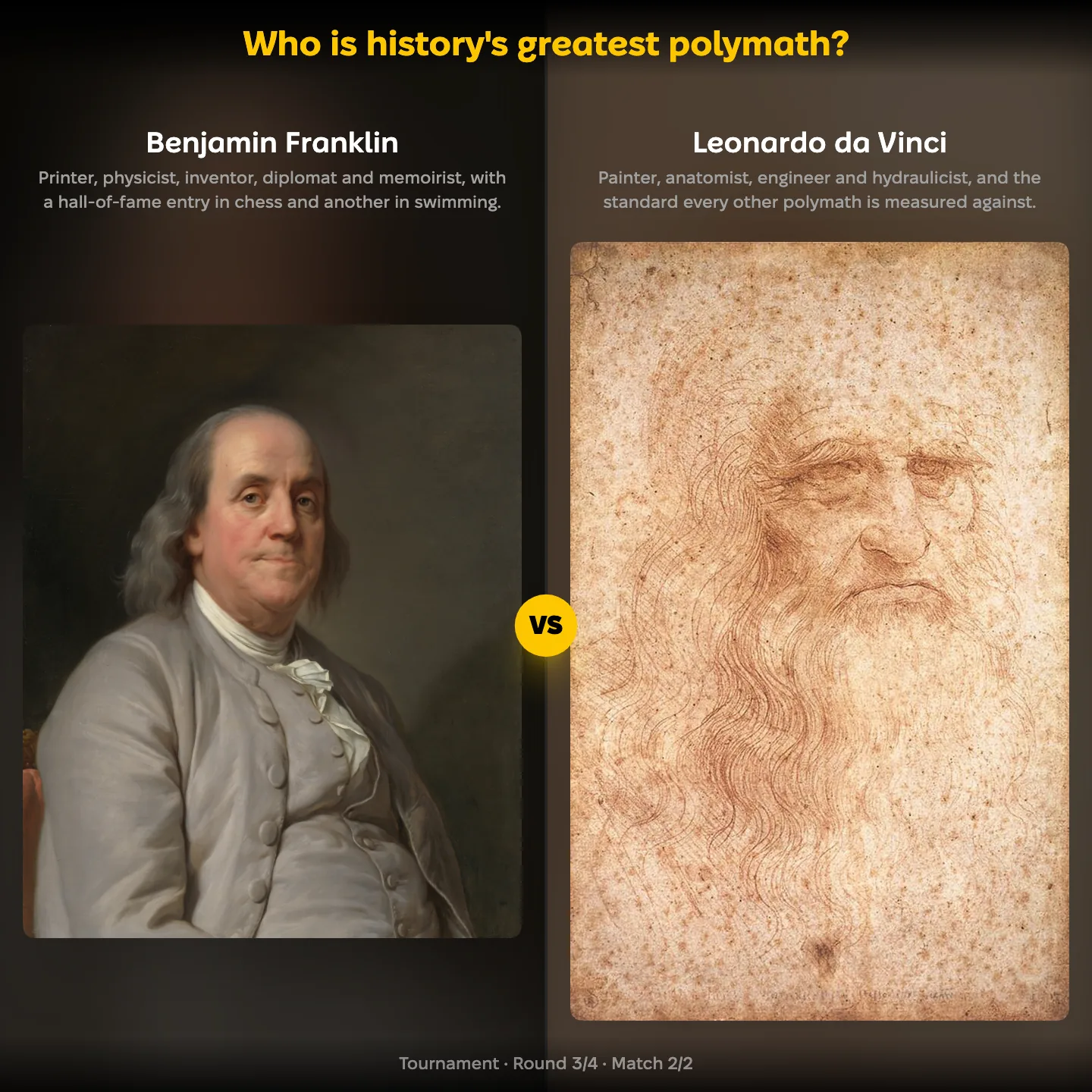
History's greatest polymath is the one category built for a man like Franklin, and the one he cannot win.
His range holds up under inspection. He wrote The Morals of Chess in 1779, arguing that the game trains foresight, circumspection, caution and perseverance, and the US Chess Hall of Fame inducted him in 1999 as one of the continent's first chess writers.8 The International Swimming Hall of Fame has him too, as a Contributor: he swam three and a half miles down the Thames in 1726, made oval hand paddles to move faster, and campaigned for teaching every child to swim.9
Leonardo da Vinci is the ceiling. Painter, anatomist, military engineer and hydraulicist, and the name every subsequent polymath gets measured against.
Isaac Newton is the other obstacle, and a stranger one. He built classical mechanics, then ran the Royal Mint and spent years on alchemy. Franklin's fourteen-name field includes Aristotle, Ibn Sina and Hildegard of Bingen, and being third or fourth in that room is not a demotion.
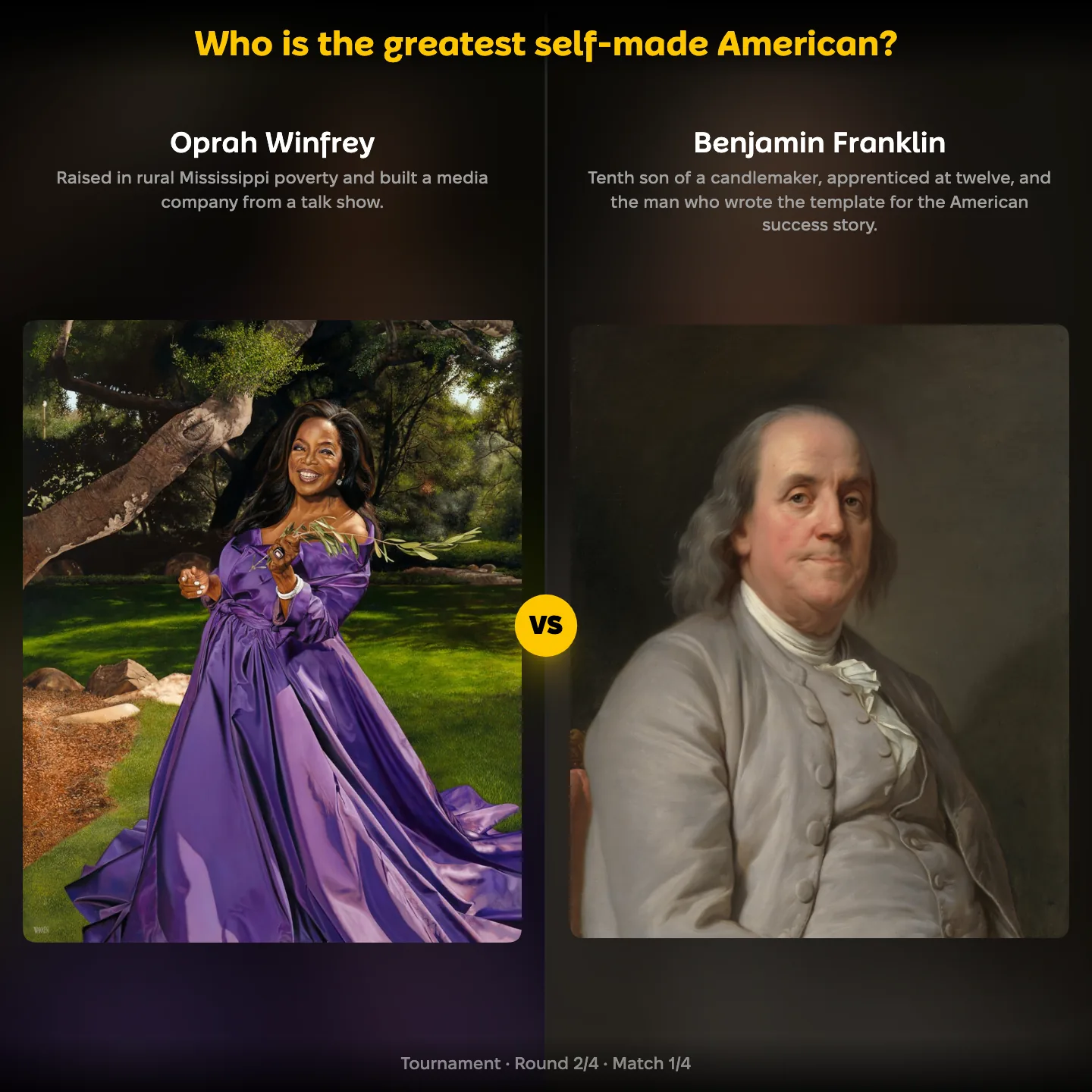
Oprah Winfrey vs Benjamin Franklin: two definitions of self-made
The greatest self-made American is a category Franklin partly invented. He was the tenth son of a Boston candlemaker, apprenticed to his brother's print shop at twelve, and his Autobiography is where the whole American self-improvement genre starts.
Oprah Winfrey grew up in rural Mississippi poverty and built a media company out of a daytime talk show. Andrew Carnegie arrived from Scotland at thirteen and worked in a cotton mill. Madam C.J. Walker was the daughter of enslaved parents.
The interesting tension is that the later names on this list built fortunes, and Franklin built institutions and then gave the profitable parts away. Fourteen people, two completely different definitions of "made".
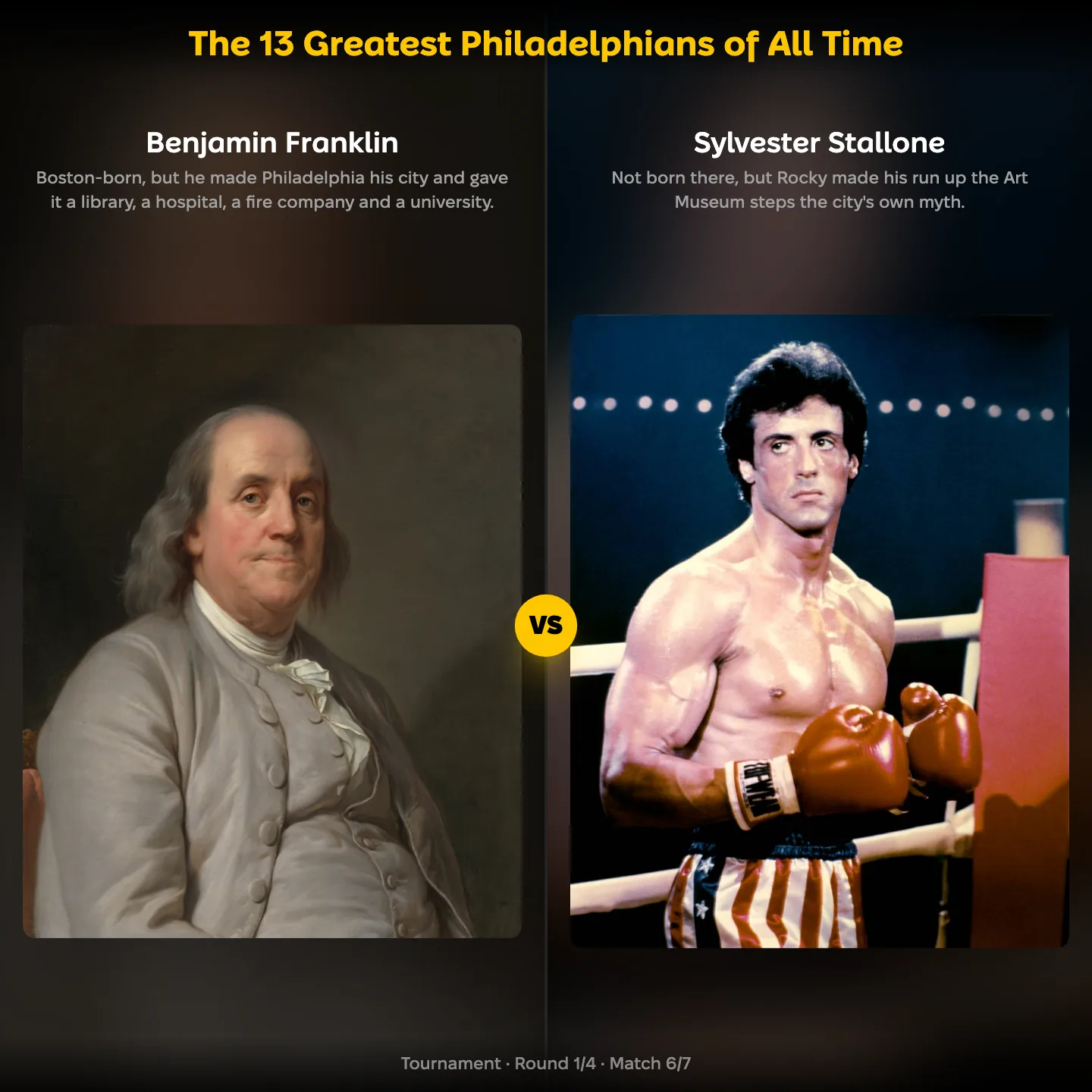
Philadelphia: the city he chose, and Rocky
Franklin was born in Boston, but Philadelphia is the city he built. He organised the trustees who founded the University of Pennsylvania in 1749 and served as its president until 1755, and he helped start the country's first subscription library in 1731 and its first hospital in 1751.10
Then the ranking hands him thirteen rivals who mostly arrived two centuries later.
Wilt Chamberlain scored 100 points in a game. Kobe Bryant learned the sport on Lower Merion's courts. Will Smith, Kevin Hart, Patti LaBelle and Questlove between them cover most of what people outside the city now know about it.
Sylvester Stallone was not even born there, and Rocky Balboa's run up the Art Museum steps is arguably the city's most recognisable image worldwide. Civic ranking is rarely about who did the most.
Boston: the city he left at seventeen
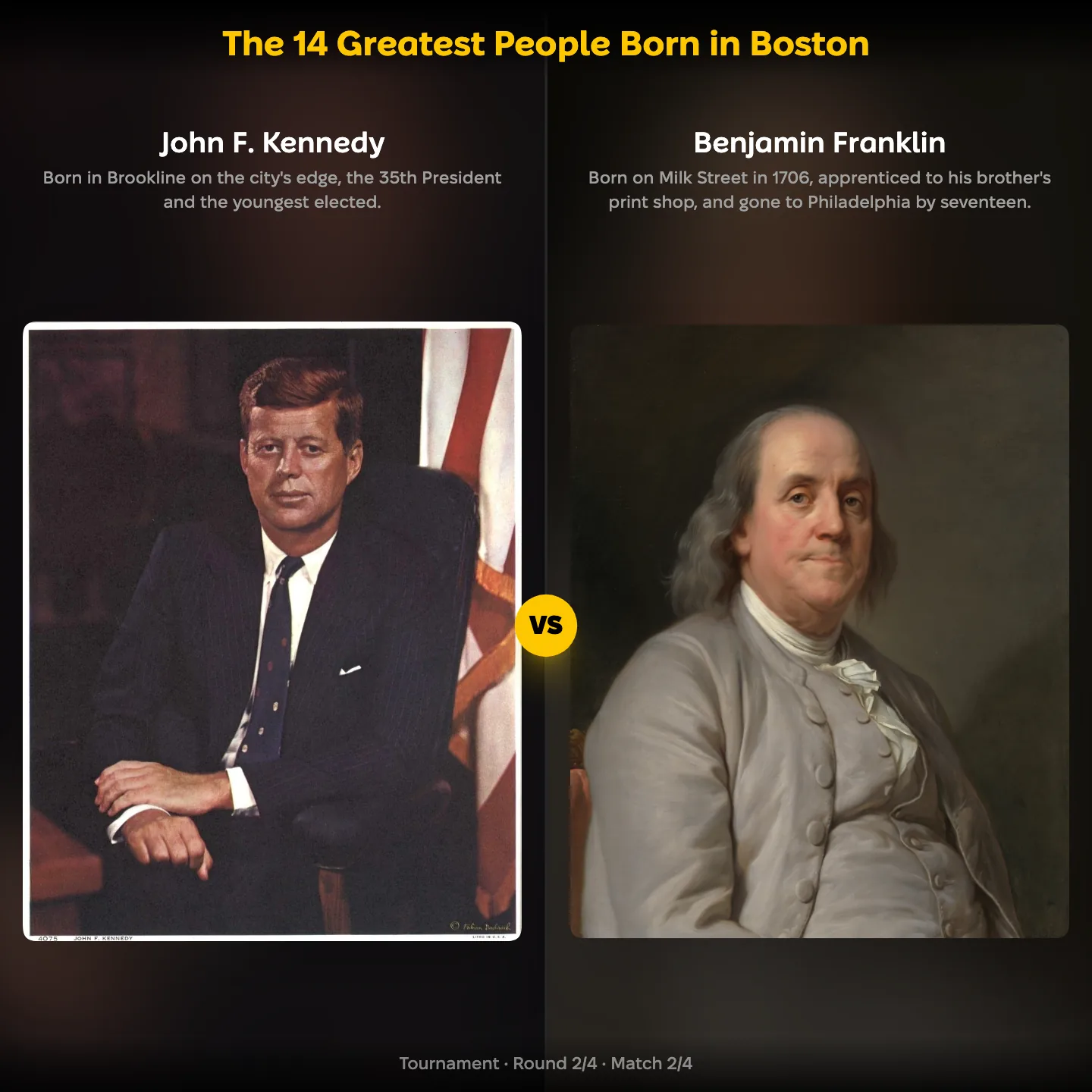
Franklin was born on Milk Street in 1706 and gone by seventeen, which is enough to put him on Boston's list and not obviously enough to top it.
John F. Kennedy was born in Brookline on the city's edge. Edgar Allan Poe was born in Boston in 1809 and invented the detective story. Samuel Adams organised the resistance that became the Revolution from a few streets away.
Then the list runs forward to Matt Damon, Chris Evans, Donna Summer and Conan O'Brien. Boston's exports have skewed heavily towards actors ever since.
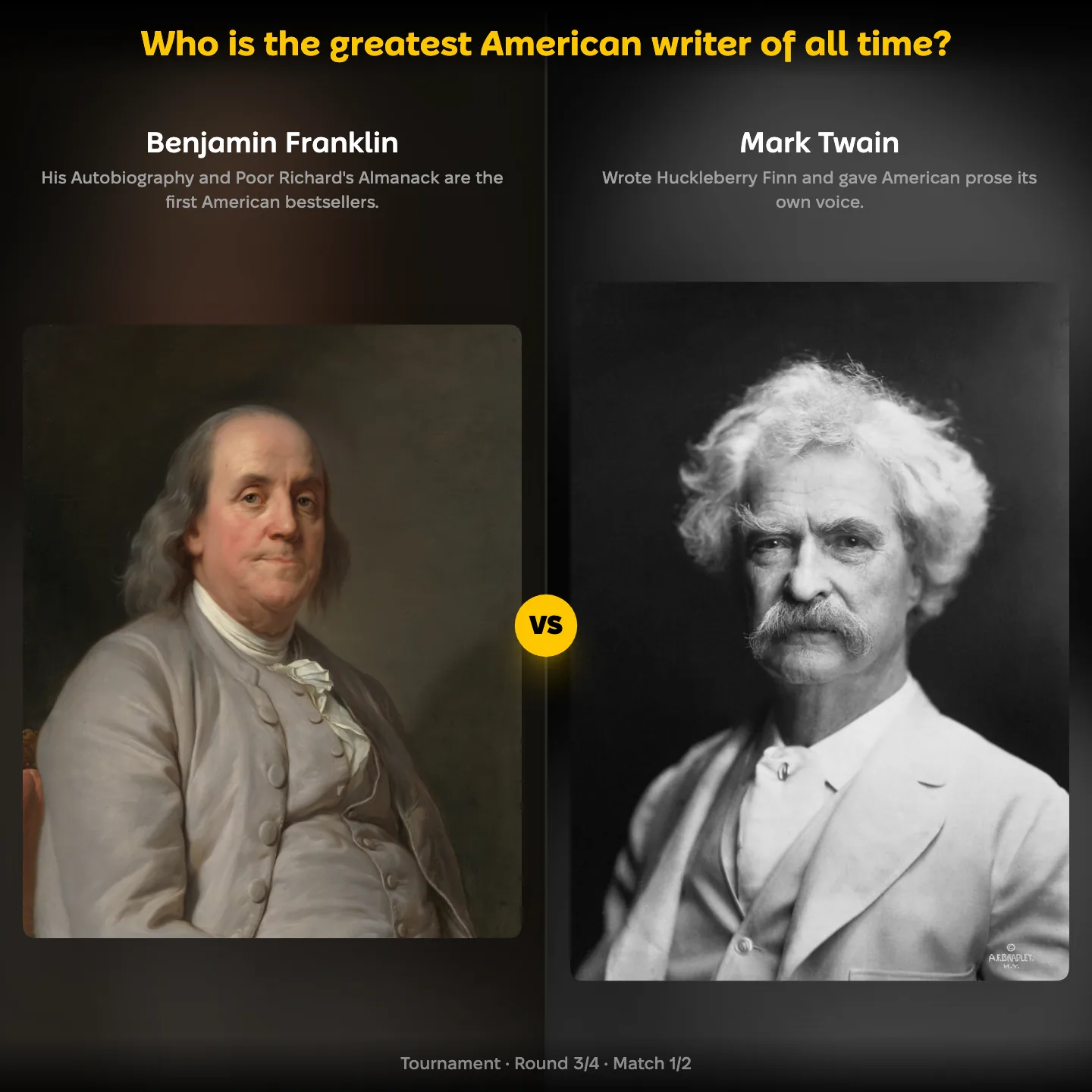
Mark Twain vs Benjamin Franklin: the printer among the novelists
Here is the list where Franklin's range finally runs out, and it is the most useful section in the article.
His literary credentials are real. Poor Richard's Almanack ran for twenty-five years and supplied English with a shelf of proverbs, and the Autobiography has never been out of print. He was, by trade, a writer who owned the press.
He is also up against Mark Twain, Toni Morrison, William Faulkner, Herman Melville and James Baldwin. Four Nobel laureates sit on this list. Franklin wrote no novels, no plays and no poetry that anyone reads for pleasure.
A memoir and a book of proverbs against Huckleberry Finn and Beloved is not a close contest, and pretending otherwise would be the sort of flattery that makes a ranking useless. The honest version of Franklin's case is narrower and still worth making: nobody else on the list shaped how Americans write about themselves.
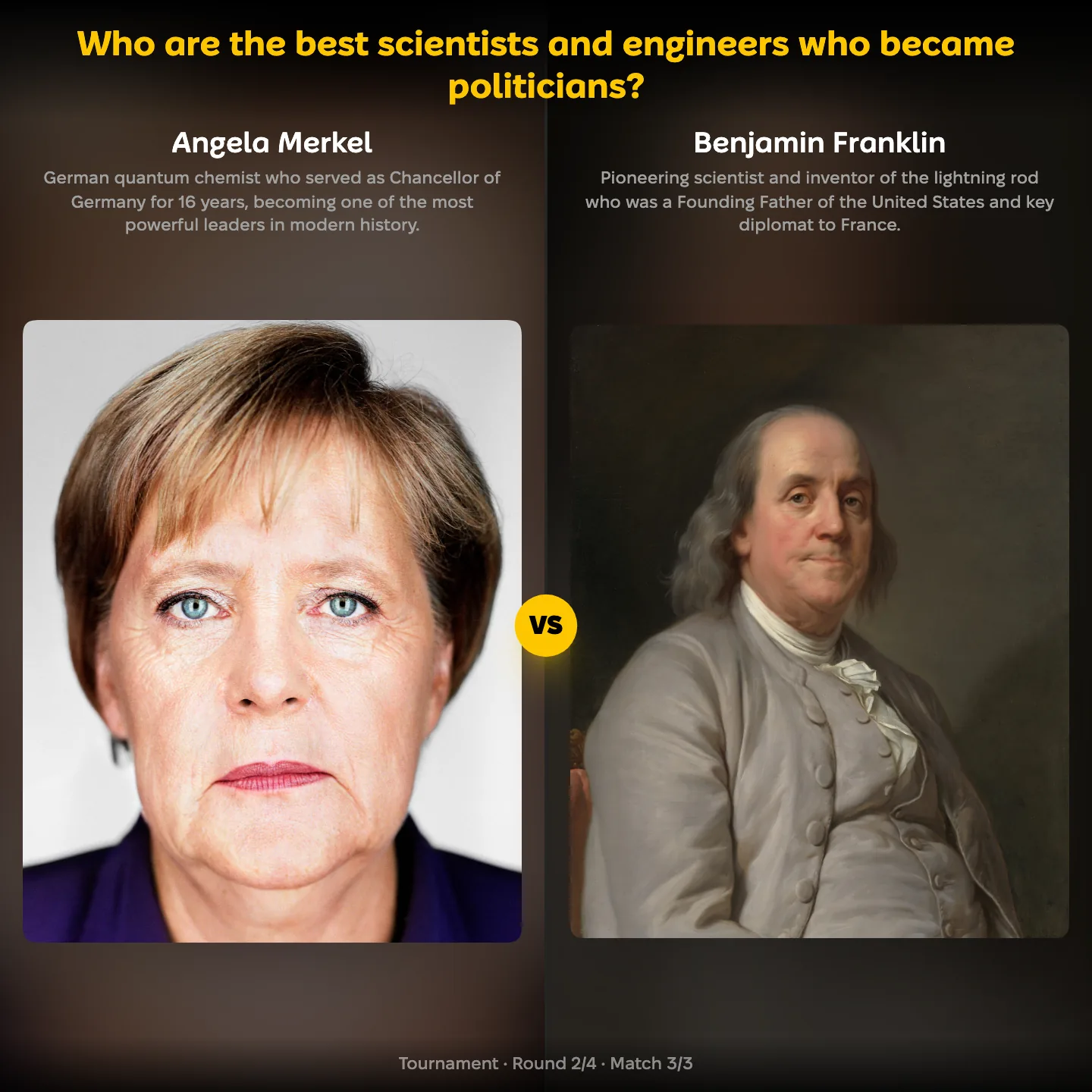
Angela Merkel, Jimmy Carter, and the scientists who went into government
A ranking of scientists and engineers who went into politics already existed on the site before we started this article, and Franklin was already in it, which says something about how naturally he files.
Angela Merkel took a doctorate in quantum chemistry and then ran Germany for sixteen years. Jimmy Carter trained as a nuclear engineer on the Navy's submarine programme. Wernher von Braun designed rockets and then spent years on the politics of getting Apollo funded.
Franklin got there first by two centuries, without the modern route of a science degree into public office, because in 1776 there was no such route to take.
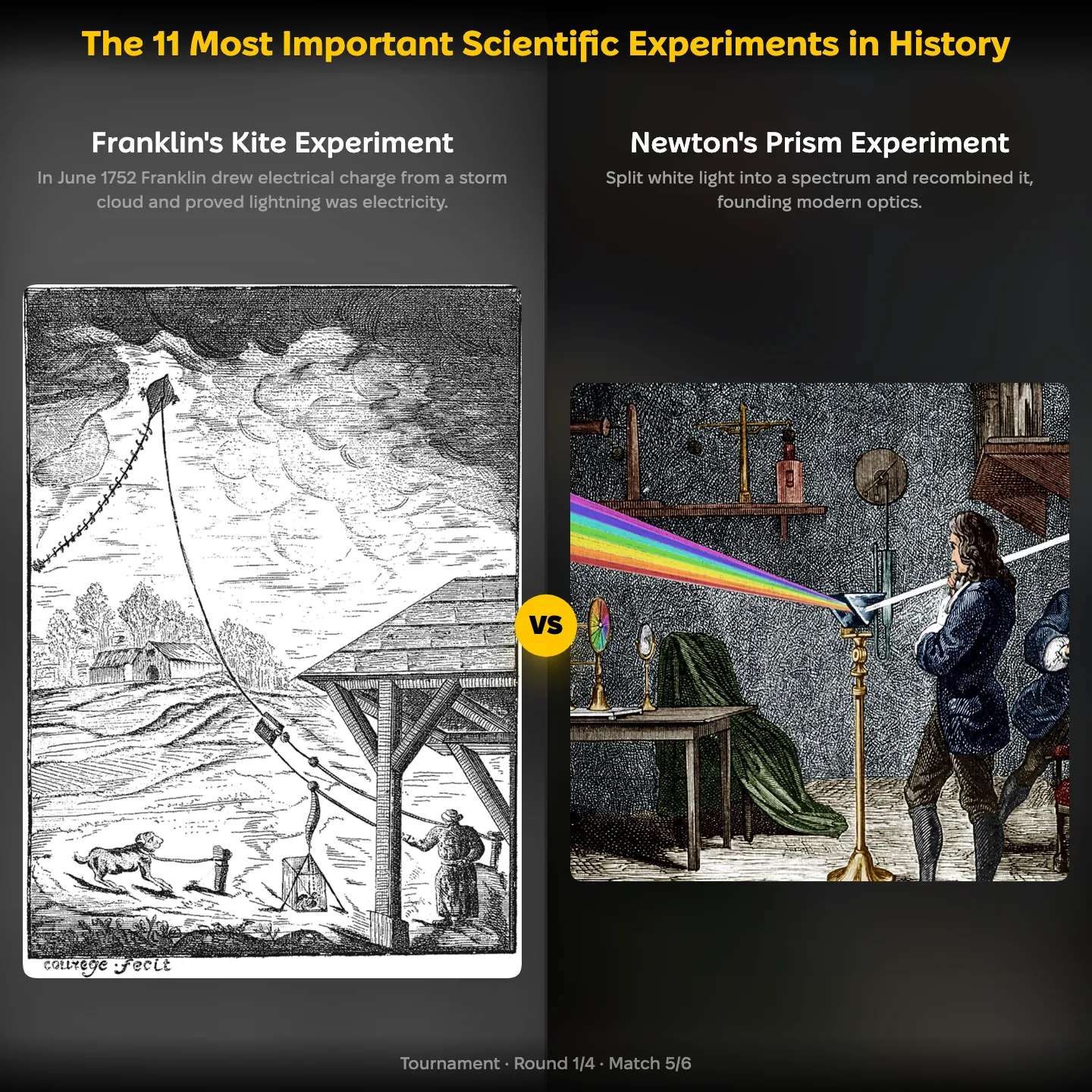
Newton's prism vs Franklin's kite
The last ranking does not contain Franklin at all. It contains one afternoon of his work.
On 10 June 1752 he flew a kite into a storm cloud and drew off electrical charge, which established that lightning is electricity and gave him the lightning rod.3 It is probably the most famous experiment ever performed by an amateur, and it was performed in a field, with a kite, by a printer.
The competition is laboratory work of a different order. Rutherford's gold foil found the nucleus. Rosalind Franklin's Photo 51 gave away the double helix. Cavendish weighed the Earth with lead spheres and a torsion balance in 1798.
Newton's prism split white light and founded optics, and Newton is the useful comparison here: same century-defining result, radically different working conditions. Eleven experiments, and only one of them could have been done by somebody's neighbour.
Fifteen filing cabinets, one printer
Franklin is easy to admire and almost impossible to file, and these fifteen rankings are really fifteen attempts at the same filing problem. Boston claims him by birth and Philadelphia by everything else; the inventors want him for the lightning rod and the writers cannot find room for a book of proverbs; the diplomats have the best claim of all and use it least.
Every one of those lists gets decided by the same head-to-head method, which is more honest than asking anybody to rank a man against himself.
Somewhere in your own field there is a name that shows up in categories sharing no border. Build the list and see what the matchups do with them.
More rankings, more angles
- Tesla vs Edison: AC Won the Grid, DC Won the Devices — the electricity men who came after him
- Washington vs Lincoln: Who Wins Which List? — the two presidents every American list starts with
- Theodore Roosevelt: Rough Rider, Nobel Laureate, Teddy Bear — one president, twelve incompatible jobs
- Leonardo da Vinci Is on Every List. Never in the Same Place — the polymath who finished almost nothing
Sources
- National Archives — Signers of the Declaration of Independence gallery, on Franklin as the oldest signer at 70 and his birth on 17 January 1706 in Boston: archives.gov (checked 2026-08-11)
- National Park Service — 250th anniversary of American independence programming through 2026: nps.gov (checked 2026-08-11)
- The Franklin Institute — Franklin's inventions with dates, his refusal to patent them in his own words, and the 10 June 1752 kite experiment: fi.edu (checked 2026-08-11)
- Bureau of Engraving and Printing — 1739 entry on Franklin's Philadelphia firm printing colonial notes with nature prints as a counterfeit deterrent: bep.gov (checked 2026-08-11)
- US Department of State, Office of the Historian — Franklin, Arthur Lee and Silas Deane signing the Treaty of Alliance and the Treaty of Amity and Commerce with France on 6 February 1778: history.state.gov (checked 2026-08-11)
- National Governors Association — Franklin as President of Pennsylvania's Supreme Executive Council from 18 October 1785 to 1 October 1788, taken at eighty, and as Postmaster General: nga.org (checked 2026-08-11)
- American Battlefield Trust — William Franklin as Benjamin's son and royal governor of New Jersey, his loyalism, and the unreconciled final meeting in 1785: battlefields.org (checked 2026-08-11)
- World Chess Hall of Fame — Franklin's 1999 induction into the US Chess Hall of Fame and The Morals of Chess (1779): worldchesshof.org (checked 2026-08-11)
- International Swimming Hall of Fame — Franklin's induction as a Contributor, the 1726 Thames swim, his hand paddles and his case for universal swim instruction: ishof.org (checked 2026-08-11)
- University of Pennsylvania — Franklin organising Penn's trustees in 1749 and serving as president to 1755, and the first subscription library (1731) and first hospital (1751): upenn.edu (checked 2026-08-11)