
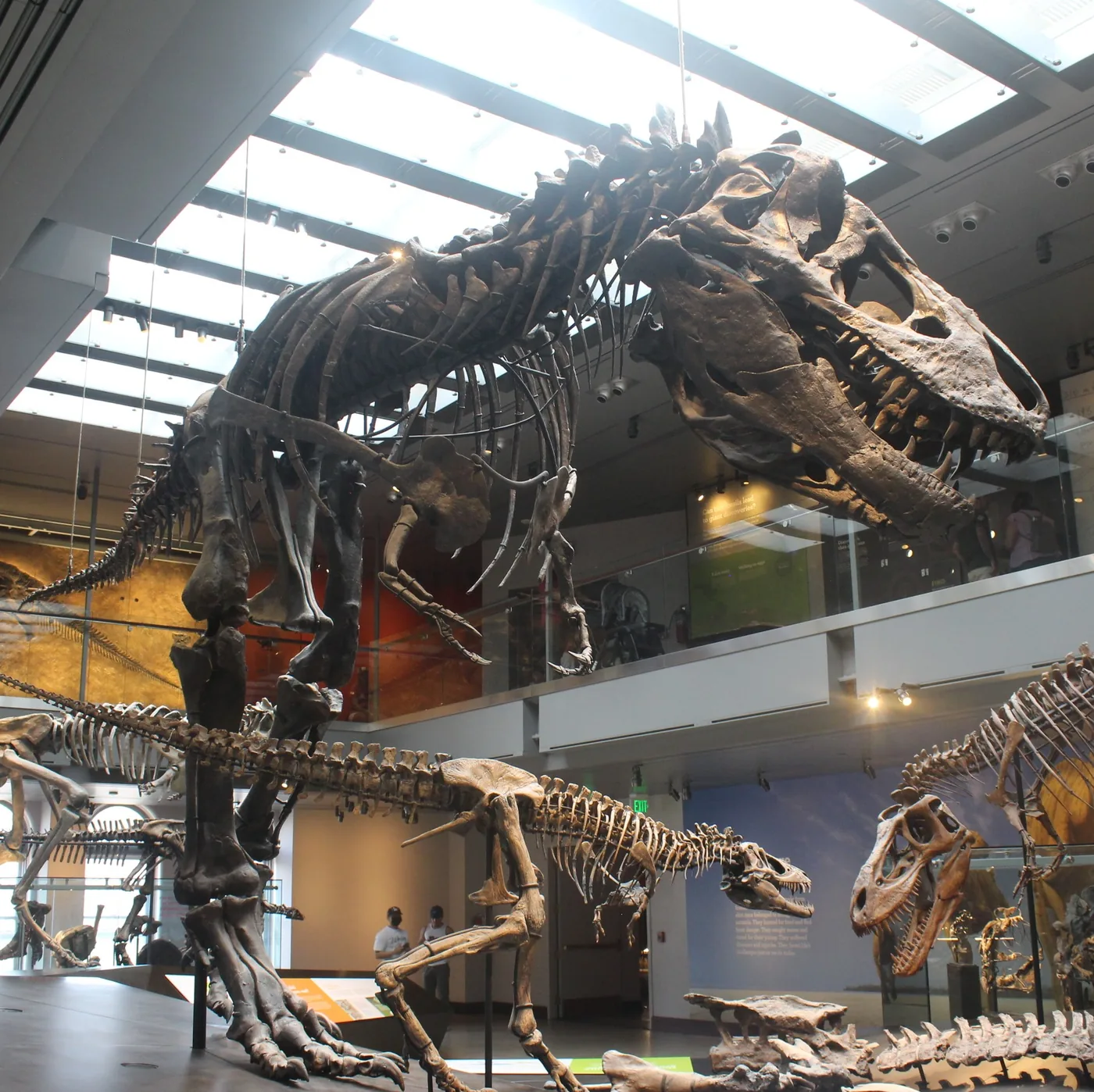
Tyrannosaurus rex ran at 36 °C, or 97 °F, about the temperature of a human. A UCLA team read that figure from the enamel of two teeth belonging to Thomas, a young adult T. rex at the Natural History Museum of Los Angeles County, and published it in Science Advances on 16 September 2026.1 Cold-blooded reptiles run at 28 to 30 °C, so the result places the most famous dinosaur with the warm-blooded animals.
The science keeps adding to the animal. The rest of the world has spent a century doing something else with it: casting it in films, selling it as a toy, naming a band after it and putting it up for auction.
Science keeps upgrading T. rex into a warmer, stronger animal; popular culture keeps shrinking it into a nervous toy, a purple TV host and a glam-rock band.
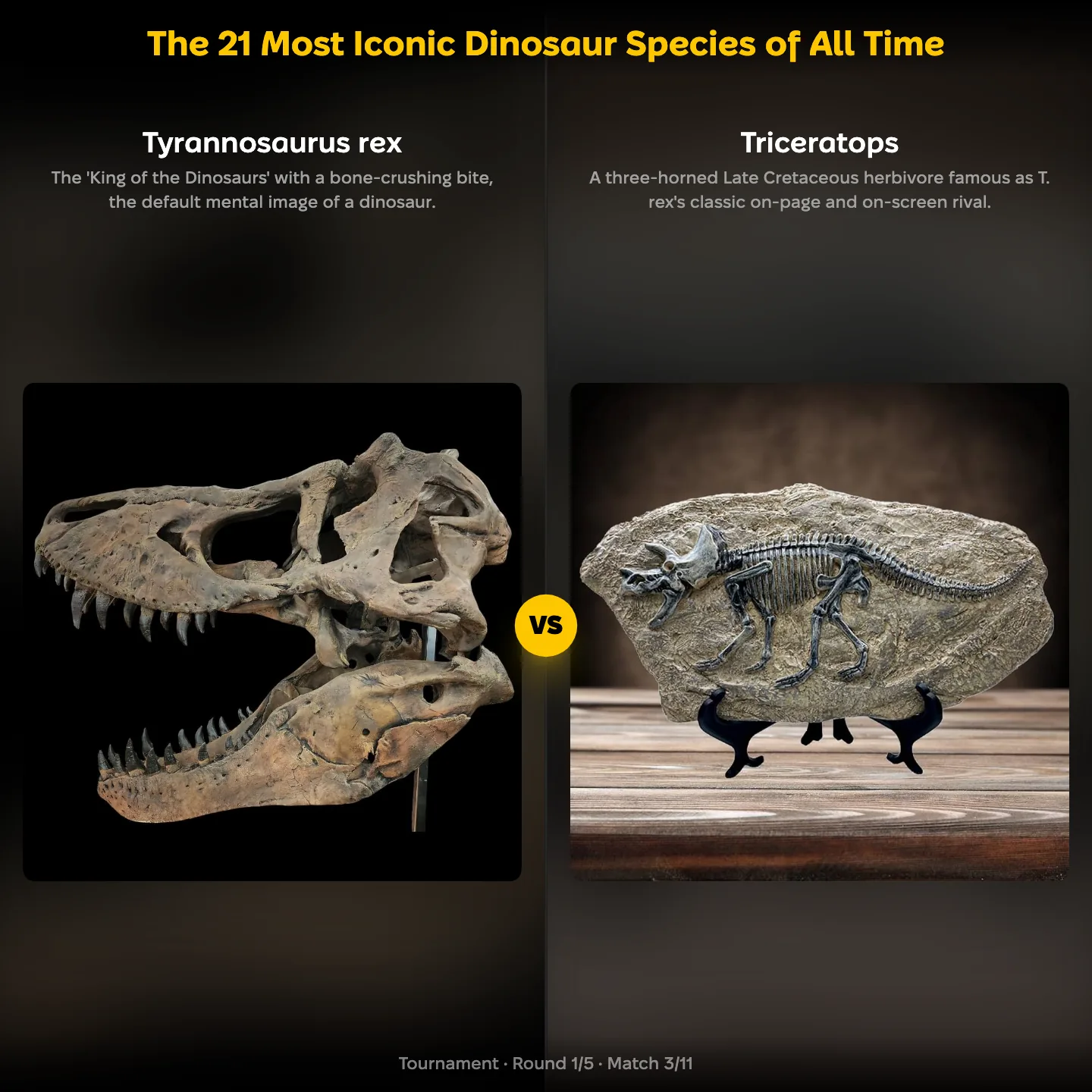
Tyrannosaurus vs Triceratops: the Hell Creek pair
The first ranking asks which dinosaur species is the most iconic, and it holds 21 of them: Stegosaurus, Brachiosaurus, Velociraptor, Spinosaurus and the rest of the museum-hall regulars.
Tyrannosaurus rex lived in what is now the western United States and Canada between 68 and 66 million years ago, right up to the asteroid.2 That makes it one of the last non-bird dinosaurs, and one of the best documented.
Triceratops shared the same rivers and floodplains in Montana and the Dakotas. Its bones have been found with tyrannosaur tooth marks, so the pairing on toy shelves and book covers has a basis in the fossil record.
The case against T. rex here is familiarity itself. Stegosaurus has the plates, Brachiosaurus the neck, and a newer name like Utahraptor has never been overexposed.
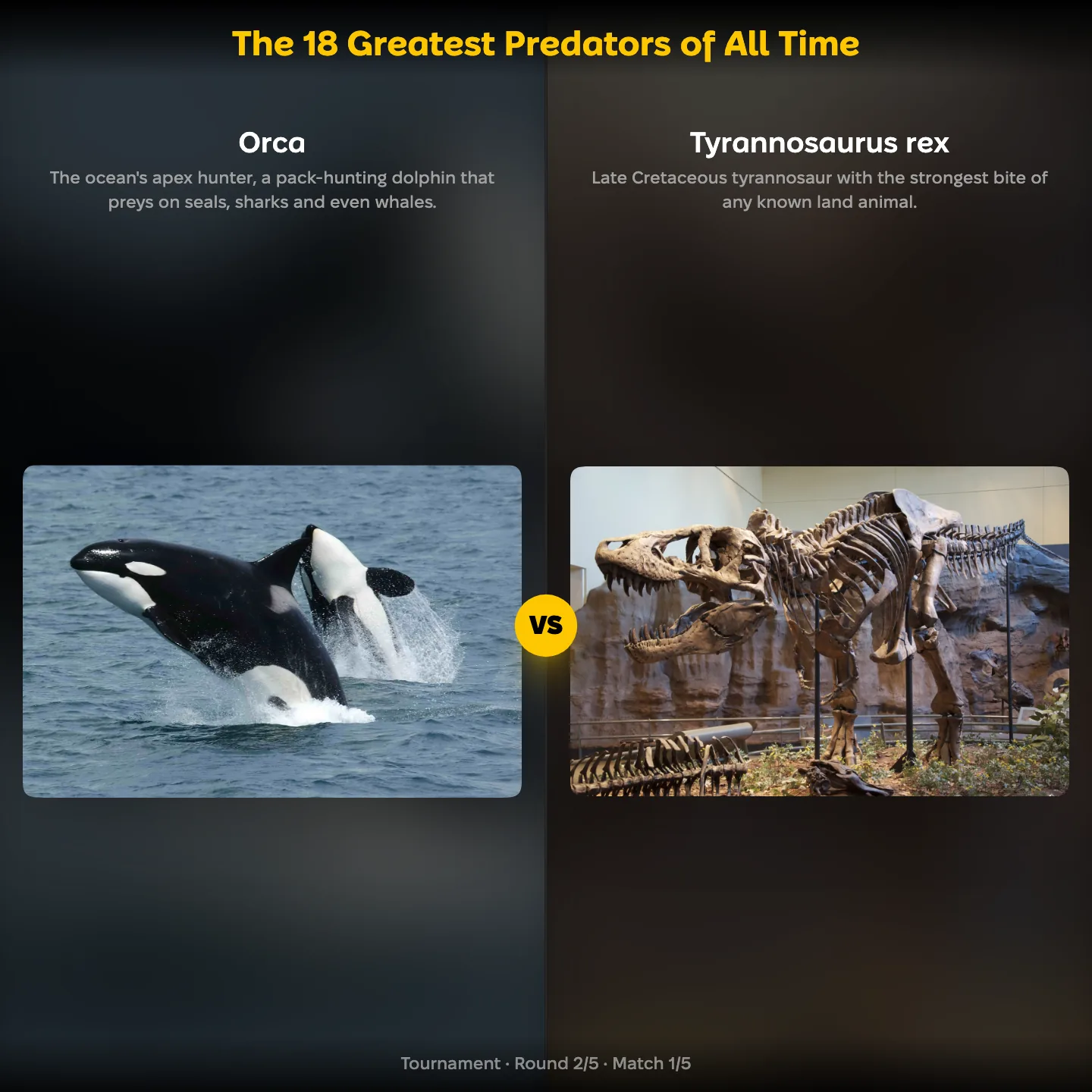
Orca vs T. rex: predators across 66 million years
This ranking puts 18 predators on one list, living and extinct: the orca, the great white shark, the lion, the tiger, the saltwater crocodile, the peregrine falcon, Megalodon and Smilodon among them.
Tyrannosaurus rex is here because it was the largest land predator of its ecosystem. The Natural History Museum in London counts 60 teeth in its jaws, the biggest about 20 centimetres long.2
The orca has a different claim. It hunts seals, sharks and whales in coordinated groups, in every ocean, and nothing hunts it in return.
A voter who values success rate over size has other options. The African wild dog and the peregrine falcon succeed in a larger share of their hunts than the big cats do.
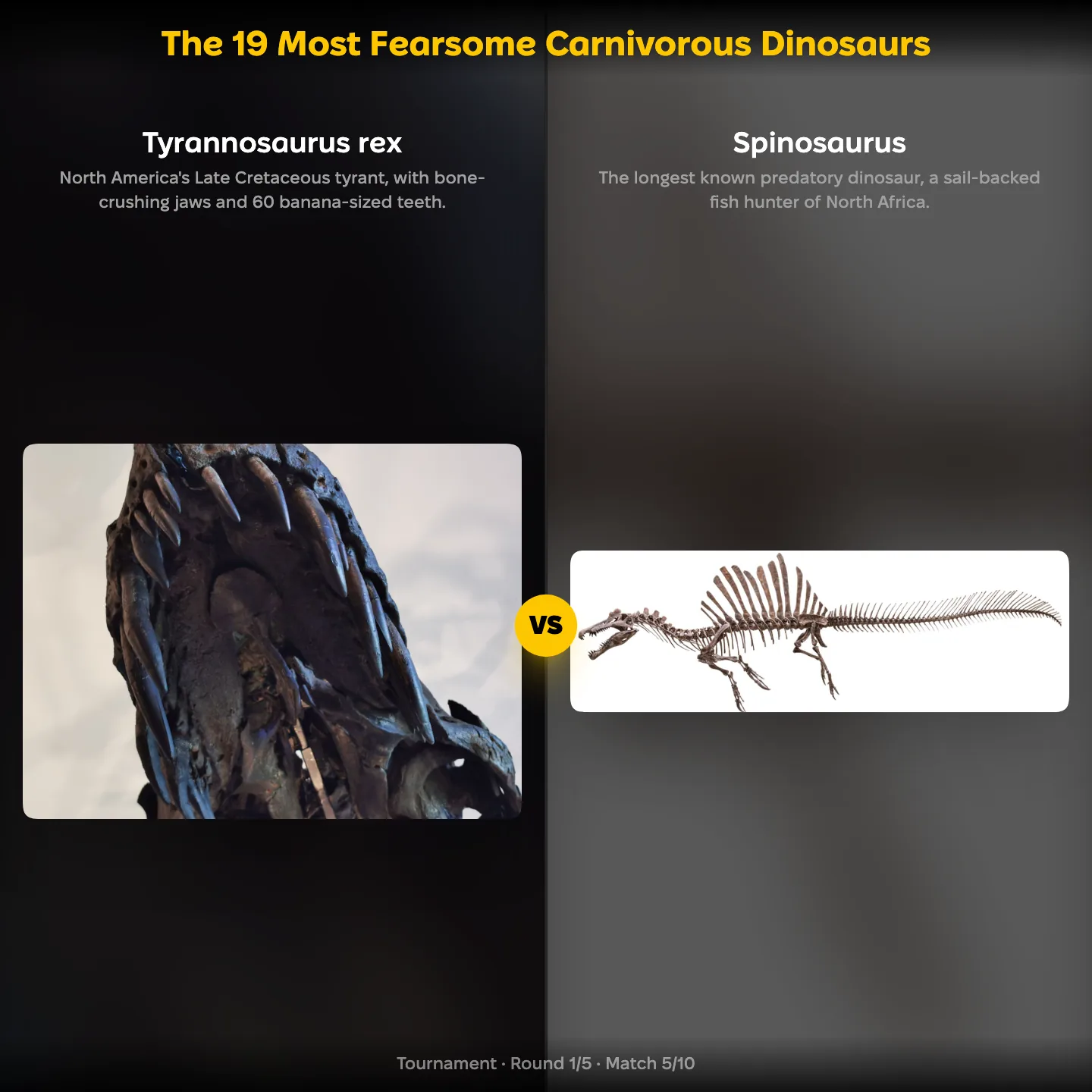
T. rex vs Spinosaurus: length against bite
Nineteen meat-eating dinosaurs make up this ranking, among them Allosaurus, Giganotosaurus, Utahraptor and the feathered Chinese tyrannosaur Yutyrannus.
The obvious challenger is Spinosaurus. The Natural History Museum lists it at 14 metres, longer than any other meat-eating dinosaur, and it lived in North Africa some 30 million years before T. rex.3 Jurassic Park III staged a fight between the two in 2001, and the film let Spinosaurus win.
Tyrannosaurus rex answers with build. Its skull was wide and deep, made for crushing, while Spinosaurus had a narrow, crocodile-like snout suited to catching fish in rivers.
Carcharodontosaurus and Giganotosaurus complicate the picture. Both matched T. rex for length, and both had blade-like teeth for slicing rather than breaking bone.
35,000 newtons: the Tyrannosaurus bite
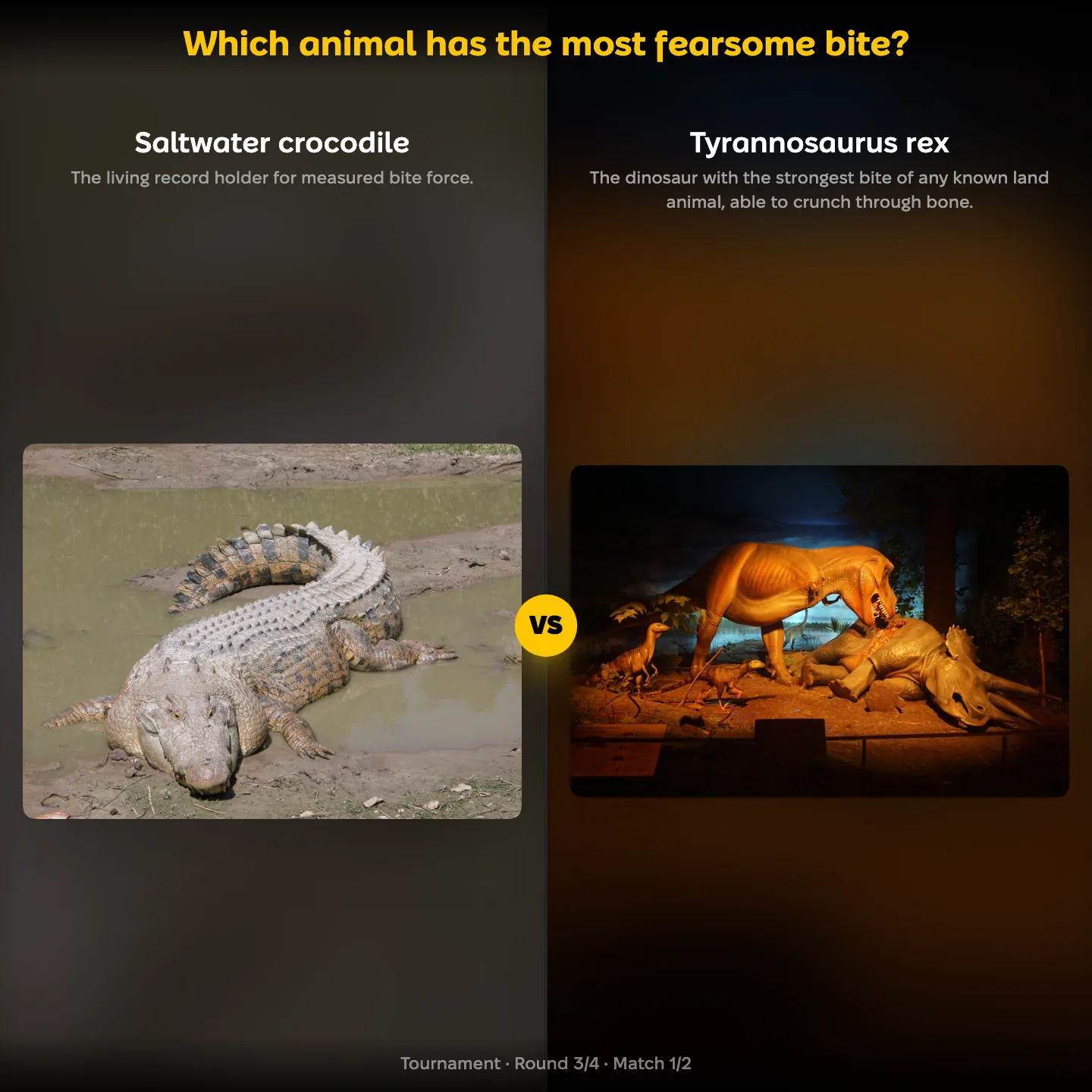
The ranking of fearsome bites mixes living record holders with extinct ones: the saltwater and Nile crocodiles, the American alligator, the hippopotamus, the jaguar, the spotted hyena, the Tasmanian devil and Deinosuchus.
In 2012 Karl Bates and Peter Falkingham modelled the jaw muscles of an adult Tyrannosaurus rex for the journal Biology Letters. They estimated a bite of 35,000 to 57,000 newtons at a single rear tooth, the highest figure calculated for any land animal.4 A human bite, in the same paper, comes to between 700 and 1,020 newtons.
The saltwater crocodile has the strongest bite ever measured in a living animal. The difference is that its number came from a force meter, while the dinosaur's came from a computer model.
The jaguar has a narrower claim of its own. It kills by biting through the skull, so its bite is judged by what it does rather than by the newtons.
Velociraptor and the tiny-arms problem
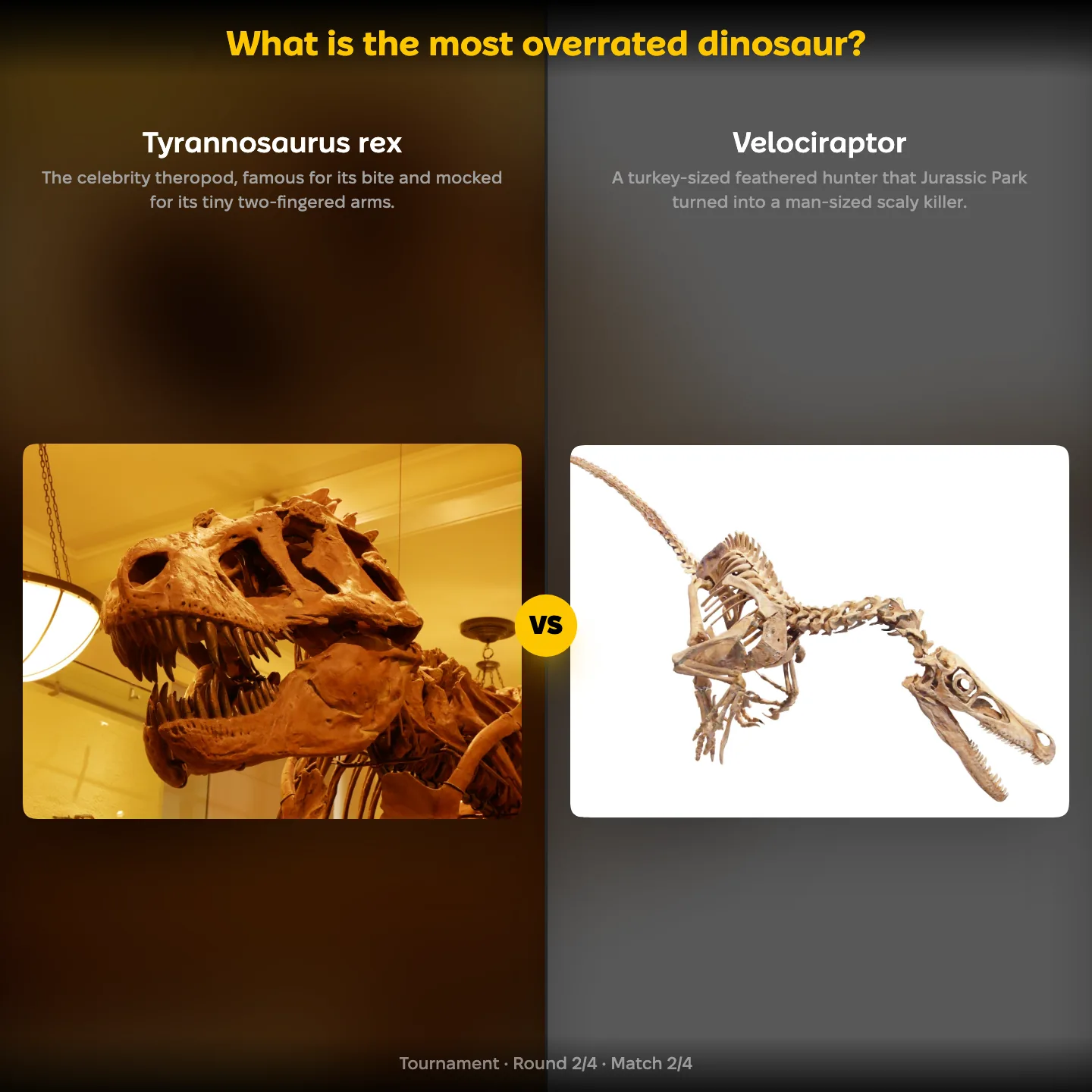
Here the question flips. The ranking asks which dinosaur is the most overrated, and the options are the famous ones: Brontosaurus, Stegosaurus, Triceratops, Spinosaurus, Dilophosaurus and Tyrannosaurus rex itself.
The case against T. rex writes itself. Its arms were short enough to be a running joke, two-fingered and too small to reach its own mouth, and a century of films has made it the default answer to every dinosaur question.
Velociraptor is the other strong candidate, and the fossils back the charge. The Natural History Museum describes a feathered animal about 1.8 metres long and 7 kilograms in weight, and notes that the films doubled its size, modelling it on the larger Deinonychus.5
Brontosaurus has its own history of overexposure. Scientists folded it into Apatosaurus for most of the 20th century, and museums kept the name on their signs anyway.
Jurassic Park's Rexy vs Brachiosaurus
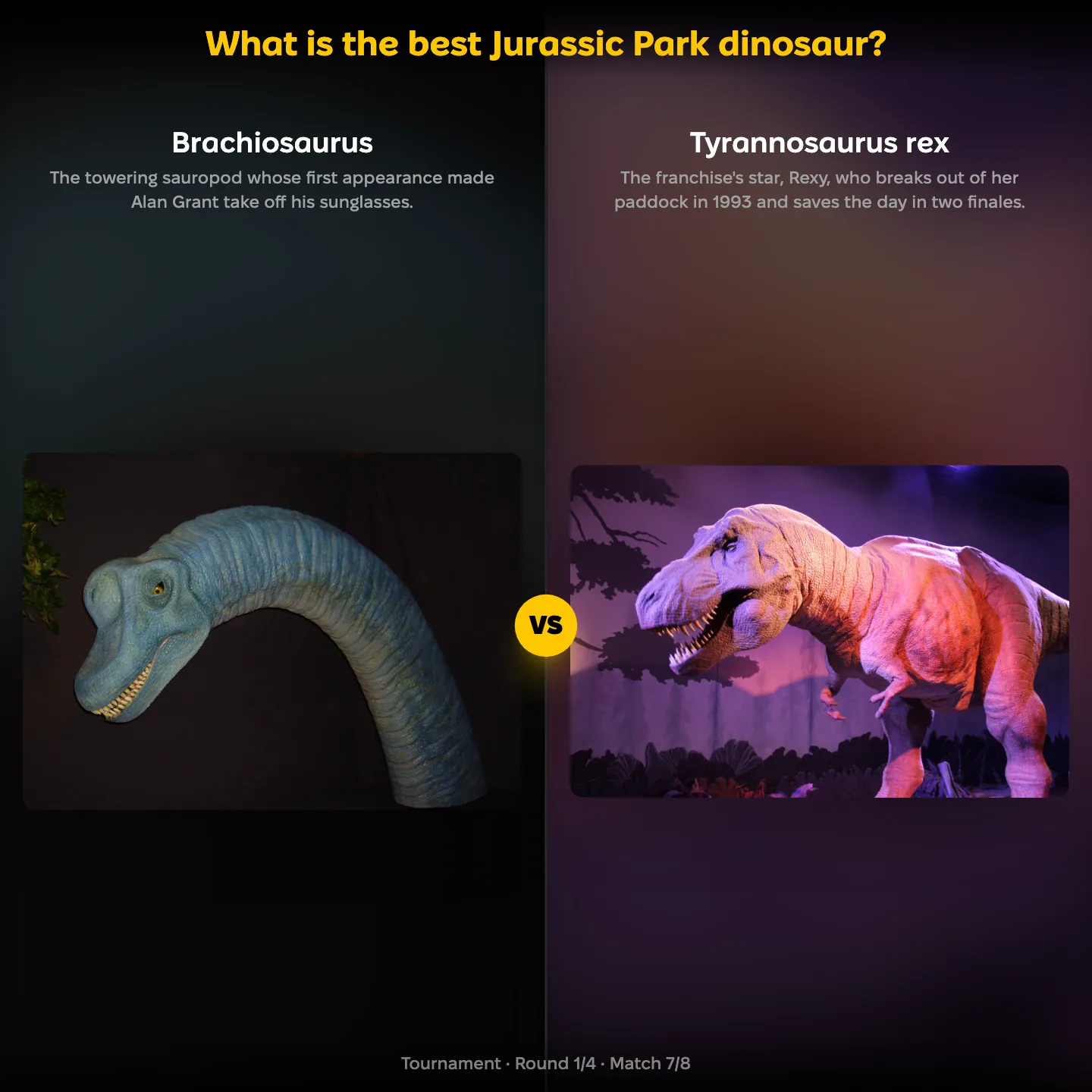
This ranking covers six films, from Steven Spielberg's Jurassic Park in 1993 to Jurassic World Dominion. The field includes Brachiosaurus, Dilophosaurus, the raptors, Mosasaurus, Giganotosaurus and Therizinosaurus.
The Tyrannosaurus rex of the series, called Rexy by fans, breaks out of her paddock in the rain in the first film and returns for the finales of Jurassic World and Dominion. Stan Winston's studio built her as a full-size animatronic for the original.
Brachiosaurus had the scene that sold the premise. It is the first dinosaur the characters see, and the one that makes Alan Grant stand up in the jeep.
The raptors have the strongest counter-claim. They hunt the characters through the kitchen in the first film, and Jurassic World gave one of them, Blue, a story arc of her own.
Gary Rydstrom's T. rex roar among the great film sounds
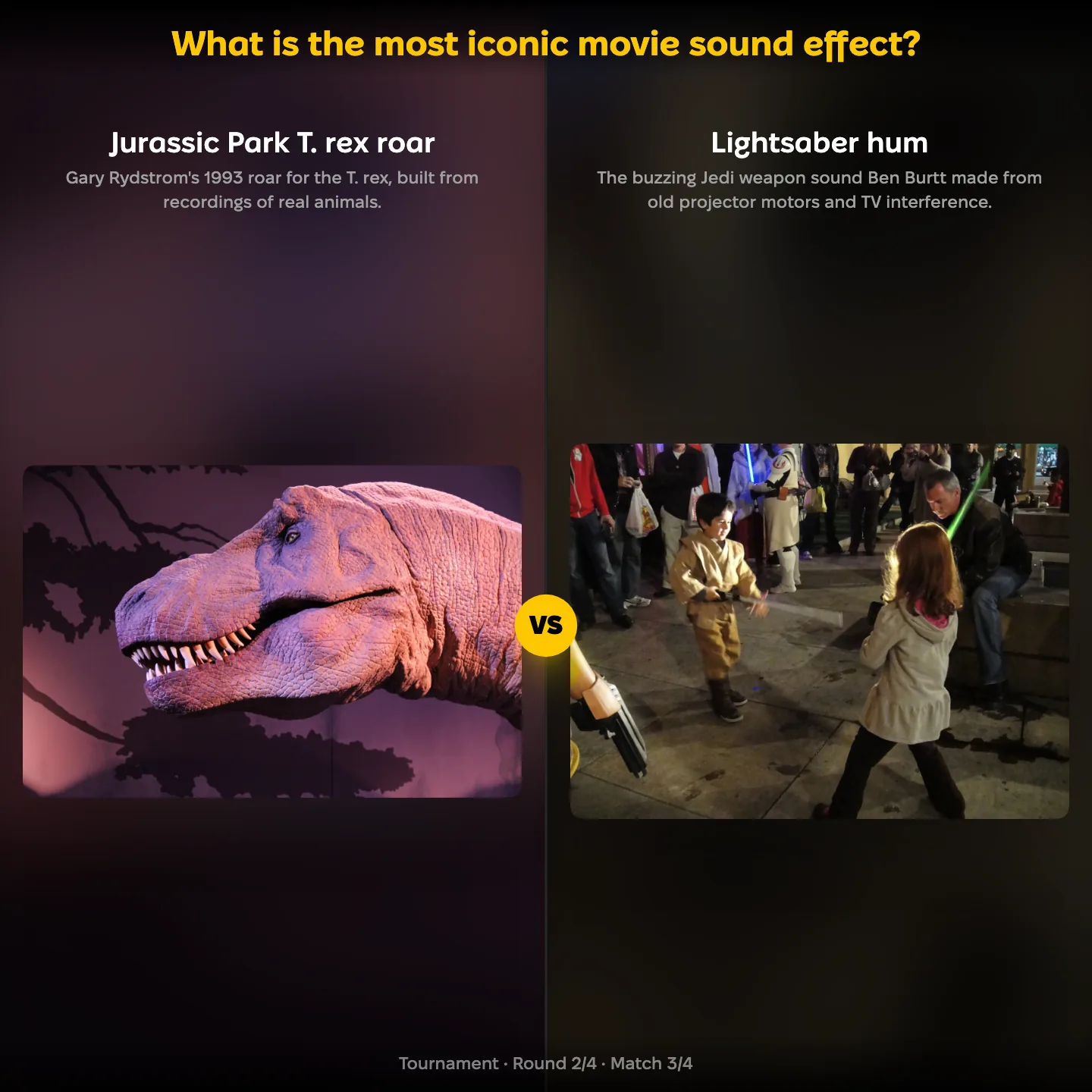
Gary Rydstrom mixed the Tyrannosaurus rex roar for Jurassic Park from the calls of real animals. This ranking of film sounds puts it with the lightsaber hum, Chewbacca's growl, Darth Vader's breathing, Godzilla's roar, the THX Deep Note and the Psycho strings.
Star Wars has more entries than any other film series here, and Godzilla's 1954 roar is older than both.
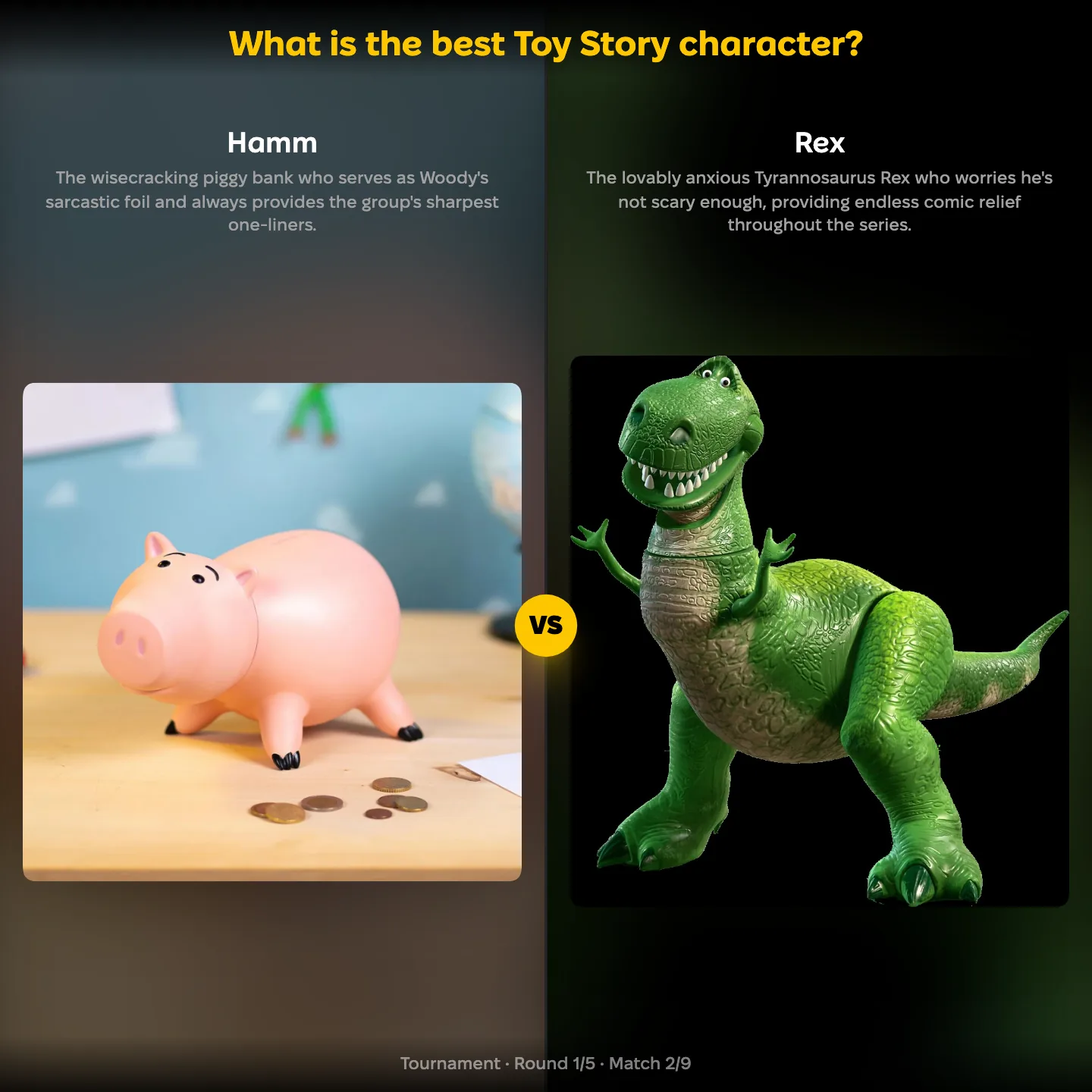
Rex in Toy Story: a tyrannosaur with nerves
Pixar's Toy Story gave the species its most un-tyrannical role. Rex, voiced by Wallace Shawn, is a green plastic Tyrannosaurus who worries that he is not scary enough.
The ranking of Toy Story characters holds Woody, Buzz Lightyear, Jessie, Hamm, Mr. Potato Head, Forky and Lotso. Rex is the only dinosaur in the field, and one of the 1995 originals who appears in all four films.
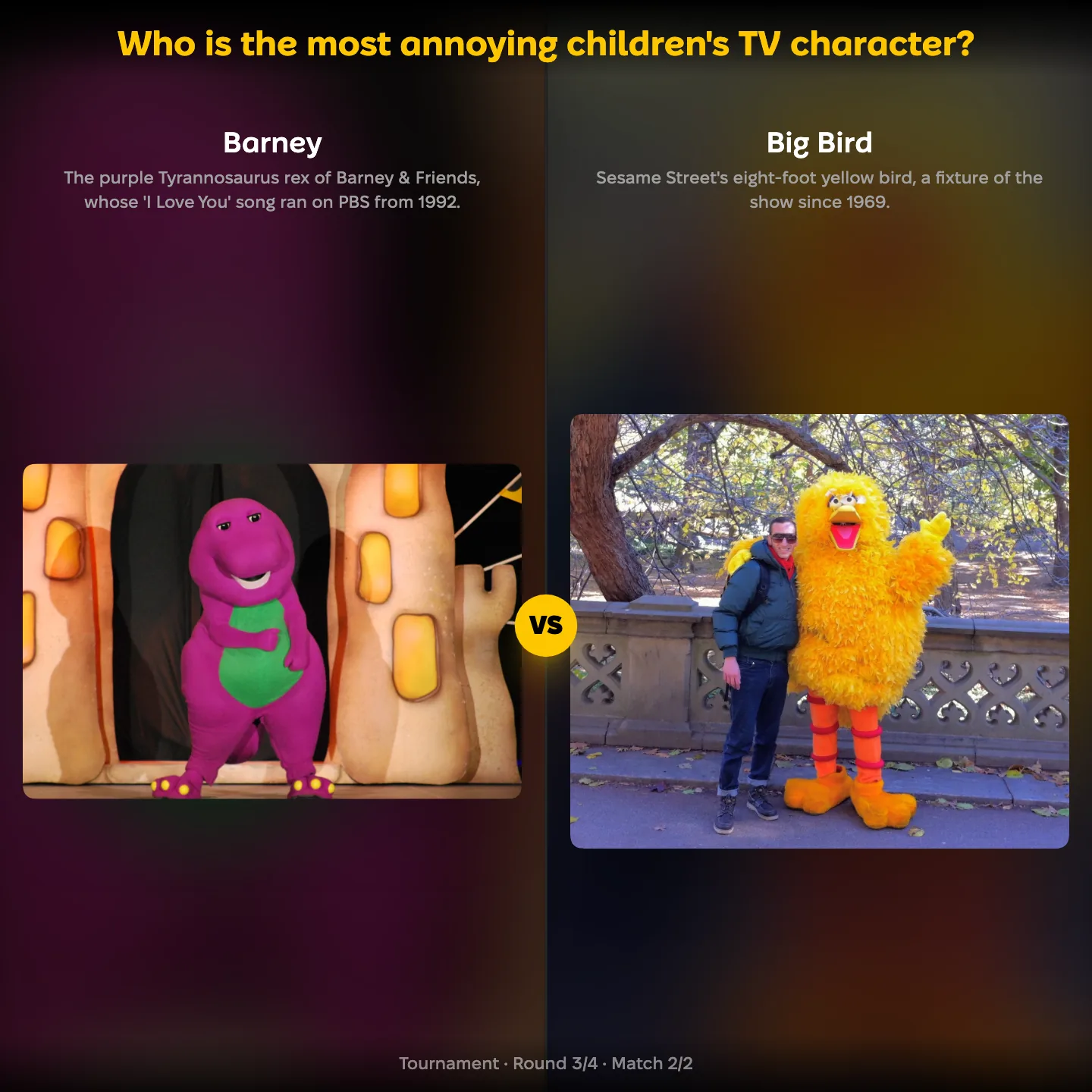
Barney vs Big Bird: the purple T. rex of PBS
Barney is a Tyrannosaurus rex. The purple dinosaur of Barney & Friends, which PBS began airing in 1992, closes every episode with "I Love You" and became a favourite target of parody.
This ranking asks which children's TV character is the most annoying, and it holds Elmo, Big Bird, Oscar the Grouch, the Teletubbies, Dora the Explorer, Thomas the Tank Engine and SpongeBob SquarePants.
Big Bird is the gentler case. He has been on Sesame Street since 1969, and his fans are mostly adults who grew up with him.
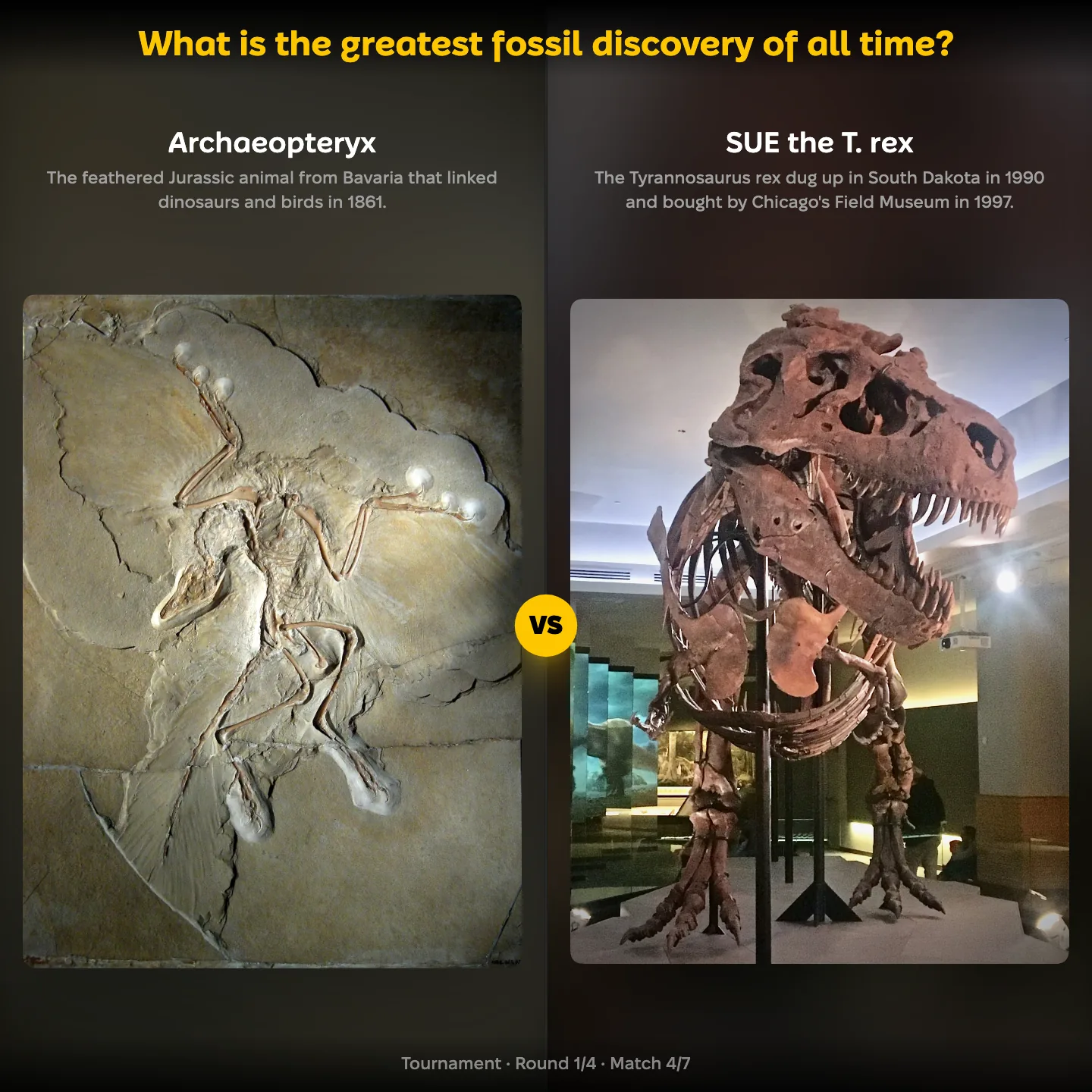
SUE at the Field Museum: 250 bones from South Dakota
The greatest fossil discoveries include Lucy, the Taung Child, the Burgess Shale, Tiktaalik, Sinosauropteryx and the first Archaeopteryx. Most of them changed a textbook. SUE, the Tyrannosaurus rex, changed how people buy fossils.
Sue Hendrickson found the skeleton in 1990 near Faith, South Dakota, and the dig took six people 17 days. The Field Museum in Chicago bought it at auction in 1997 for $8.4 million, at the time the most ever paid for a fossil. SUE is about 90 percent complete, with 250 of an estimated 380 bones, and went on show on 17 May 2000.6
Archaeopteryx has the scientific claim. The first skeleton came out of a Bavarian quarry in 1861, two years after Darwin's On the Origin of Species, and showed feathers on an animal with teeth and a bony tail.
Lucy has the human one. Her 3.2-million-year-old skeleton showed an ancestor walking upright long before brains grew large.
Stan at Christie's: $31.8 million for a skeleton
SUE's record lasted 23 years. In October 2020 Christie's in New York sold Stan, a Tyrannosaurus rex found in South Dakota, for $31.8 million after 20 minutes of telephone bidding. The pre-sale estimate had been $6 million to $8 million.7
The ranking of jaw-dropping auction sales puts both dinosaurs next to Leonardo's Salvator Mundi, van Gogh's Portrait of Dr. Gachet, the Codex Leicester, a 1933 Double Eagle coin, the British Guiana 1c magenta stamp and Dorothy's ruby slippers.
Salvator Mundi has the biggest number on the list. It sold at Christie's in 2017 and remains the most expensive painting ever auctioned.
Palaeontologists had a different reaction to Stan. A skeleton in private hands is out of reach for researchers, so for them the sale was a loss rather than a spectacle.

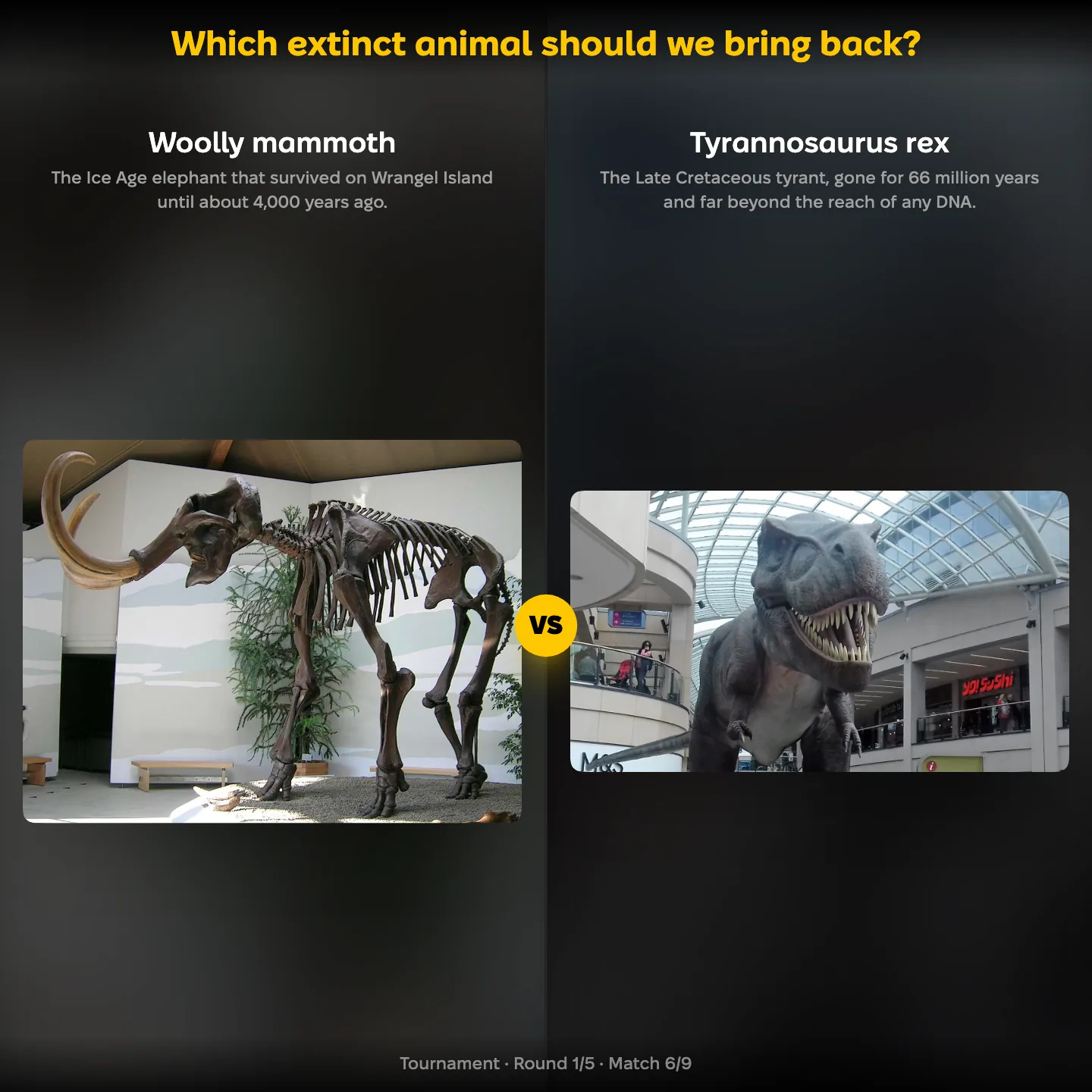
Dire wolves, mammoths and T. rex: the de-extinction wish list
Which extinct animal should come back? The ranking holds 17 candidates: the woolly mammoth, the dodo, the thylacine, the passenger pigeon, the dire wolf, the great auk, Steller's sea cow and the Irish elk among them.
The question stopped being purely hypothetical in April 2025. Colossal Biosciences presented three pups named Romulus, Remus and Khaleesi as dire wolves: gray wolves carrying 20 edits to 14 genes. The company named the woolly mammoth, the dodo and the thylacine as its next projects, with a mammoth calf planned for 2028.8
Tyrannosaurus rex is the wish no laboratory can grant. Its DNA has not survived 66 million years, so it stays on the list as the choice of the heart rather than the lab.
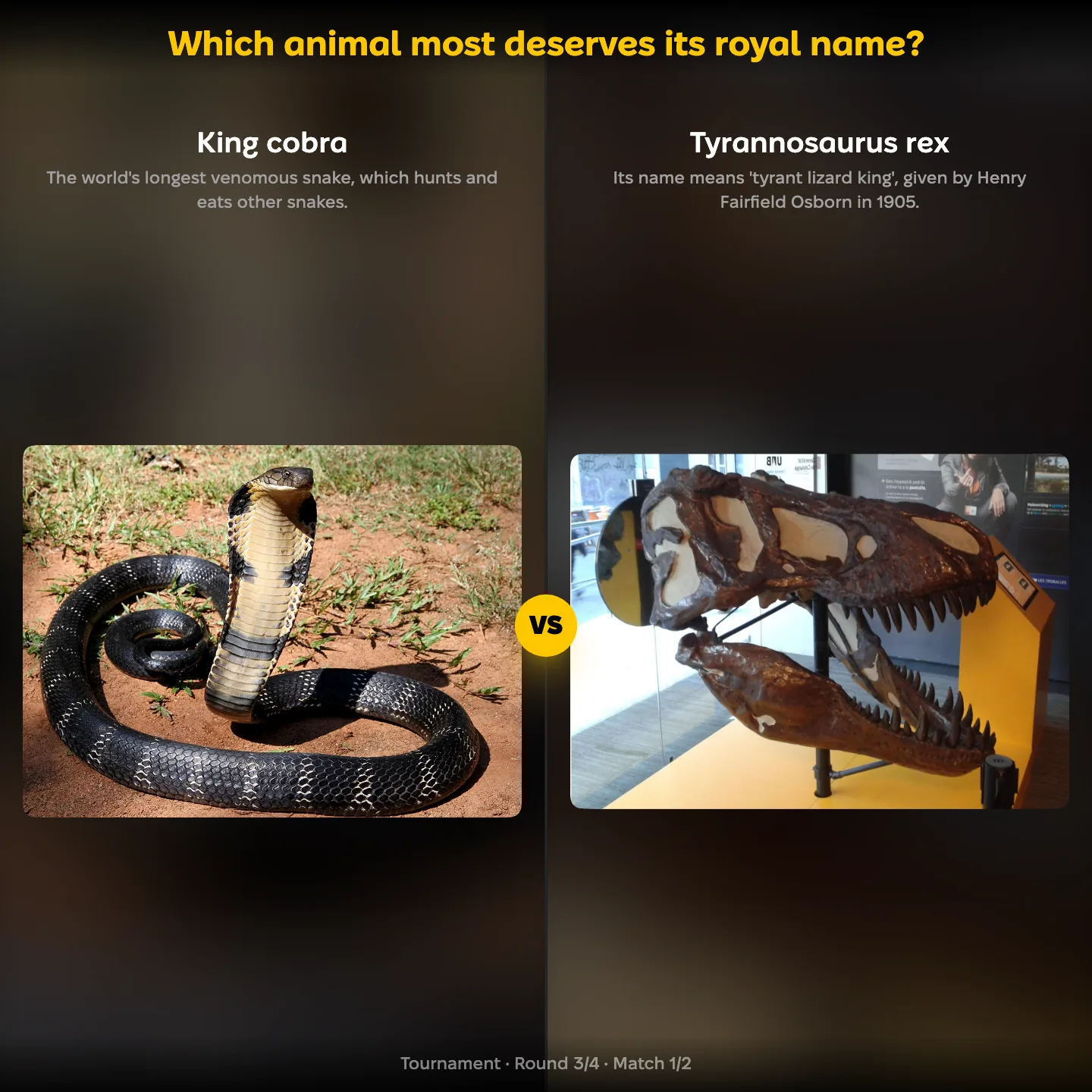
"Tyrant lizard king" against the king cobra
Henry Fairfield Osborn named the species in 1905, and Tyrannosaurus rex means "tyrant lizard king".2 This ranking weighs it against every other animal with a royal title: the king cobra, the emperor and king penguins, the monarch butterfly, the emperor tamarin and Queen Alexandra's birdwing.
The king cobra has the best claim among the living. It is the longest venomous snake in the world, and it eats other snakes.
Marc Bolan's T. Rex vs Roxy Music
The last ranking has no dinosaur in it. T. Rex was Marc Bolan's band, named after the animal, and between 1971 and 1972 it scored four UK number ones: Hot Love, Get It On, Telegram Sam and Metal Guru, 16 weeks at the top in all.9
The ranking of glam rock bands puts it against Roxy Music, Slade, Sweet, the New York Dolls, Mott the Hoople, Sparks, Queen and Kiss.
Roxy Music is the critics' case. Bryan Ferry's band, with Brian Eno in the first line-up, took glam into art school. The chart case belongs to T. Rex and Slade.

A warm-blooded king in a purple suit
The same animal that bit harder than anything else on land is a plush toy, a PBS host and a record-breaking lot at Christie's. Each of those versions competes against a different field, and each ranking here was decided the same way, one pair of options at a time.
If you have a subject that lives this many lives, build a ranking for it and see which one people pick.
More rankings, more angles
- Famous Bears in Pop Culture: 14 Lists, From Paddington to the NFL — Fat Bear Week, Paddington and a Leonardo drawing
- The Wolf: Greatest Apex Predator or Fairy-Tale Villain? 16 Lists — Yellowstone hunter, Norse god-killer, Minecraft pet
- Lion vs Tiger: Who Is the Real King of the Jungle? 14 Lists — two big cats and Detroit's two teams
Sources
- UCLA Newsroom — T. rex body temperature of 36 °C (97 °F) from two teeth of Thomas, Natural History Museum of Los Angeles County; Science Advances, 16 September 2026; reptiles at 28–30 °C: newsroom.ucla.edu (checked 2026-09-28)
- Natural History Museum, London — Tyrannosaurus: named by Henry Fairfield Osborn in 1905, "tyrant lizard", 68–66 million years ago, USA and Canada, 60 teeth up to 20 cm: nhm.ac.uk (checked 2026-09-28)
- Natural History Museum, London — Spinosaurus: 14 metres, 99–94 million years ago, Egypt and Morocco: nhm.ac.uk (checked 2026-09-28)
- Bates, K. T. and Falkingham, P. L., "Estimating maximum bite performance in Tyrannosaurus rex using multi-body dynamics", Biology Letters, 2012 — 35,000–57,000 N at a posterior tooth; human 700–1,020 N: pmc.ncbi.nlm.nih.gov (checked 2026-09-28)
- Natural History Museum, London — Velociraptor: 1.8 metres, 7 kg, feather-like covering, shown at double size in the films: nhm.ac.uk (checked 2026-09-28)
- Field Museum — SUE the T. rex: found 1990 near Faith, South Dakota, by Sue Hendrickson; bought at auction in 1997 for $8.4 million; about 90% complete, 250 of about 380 bones; unveiled 17 May 2000: fieldmuseum.org (checked 2026-09-28)
- NBC News — Stan sold at Christie's New York for $31.8 million after 20 minutes of telephone bidding; estimate $6–8 million: nbcnews.com (checked 2026-09-28)
- TIME, 7 April 2025 — Colossal Biosciences' pups Romulus, Remus and Khaleesi, 20 edits to 14 gray wolf genes; woolly mammoth (2028 target), dodo and thylacine next: time.com (checked 2026-09-28)
- Official Charts Company — T. Rex: 4 UK number ones (Hot Love, Get It On, Telegram Sam, Metal Guru), 16 weeks at number one: officialcharts.com (checked 2026-09-28)