
A bracket, or single-elimination tournament, pairs the options off, sends each winner to the next round and stops when one option is left. Pairwise voting collects many two-way choices, usually from many people, and turns the whole record of wins and losses into an ordered list. Every matchup asks the same question in both. The difference is what happens to the answers: a bracket throws the loser away, and a pairwise model keeps every result.
That difference was first argued over in 1882, by the author of Alice's Adventures in Wonderland, about lawn tennis.
The arithmetic of 16, 32 and 64 options
A knockout with N entrants plays N − 1 matches, because each match eliminates exactly one entrant. It needs a power of two (16, 32, 64) for everyone to start in the same round; with any other number, some entrants get a bye and skip the first round.1 A round robin, where everyone meets everyone once, plays N(N − 1)/2 games.2
| Options | Bracket matches | Bracket rounds | Round-robin games |
|---|---|---|---|
| 16 | 15 | 4 | 120 |
| 32 | 31 | 5 | 496 |
| 64 | 63 | 6 | 2,016 |
Putting all the options in order sits between those two figures. Any method that sorts by comparison needs at least log₂(N!) comparisons in the worst case, which grows like N × log₂ N.1 For 16 options the formula gives 45, and in 2022 Florian Stober and Armin Weiß proved by exhaustive computer search that the true worst-case minimum is 46.3 A bracket spends 15 picks on the same 16 options and learns one thing for certain: which of them won.
Lewis Carroll's complaint about the second prize
On 12 August 1882 the St James's Gazette printed a letter signed Charles L. Dodgson, the Oxford mathematician who wrote as Lewis Carroll. His target was the lawn tennis knockout. With 32 players drawn at random, he calculated, the second-best player has only a 16 in 31 chance of taking second prize, because 15 times in 31 the draw puts him in the best player's half and he goes out before the final. The chance that the best four players all receive their proper prizes came out at "almost exactly 19-250ths", more than 12 to 1 against.4
A year later Dodgson published a pamphlet, "Lawn Tennis Tournaments: The True Method of Assigning Prizes with a Proof of the Fallacy of the Present Method". It argued that any player from the 3rd-best to the 17th-best could take second prize through an accident of the draw. His remedy kept a record, for every player, of everyone proved superior to them, either by beating them directly or by beating someone who had. A player was struck out once three superiors were on record.5
The objection still holds. A bracket ranks its champion and nobody else, and every place below the winner depends on the draw.
What research says about finding the best entrant
Dmitry Ryvkin and Andreas Ortmann compared three tournament formats in Management Science in 2008 by measuring how often each one lets the strongest contestant win. Their working paper found the round robin the most accurate format when games are cheap, and a knockout at least as accurate as a round robin with four players and a moderate amount of luck.6 The published abstract adds that accuracy does not always improve with more players or less noise.
Tim McGarry and Robert Schutz reached a similar split in 1997. The plain knockout was weak at ranking all the players but needed fewer games than a round robin, and a double-elimination format with reasonably accurate seeding could match or beat the round robin.7
Wimbledon's fix: seeding the draw
Seeding is the knockout's answer to Carroll. The strongest entrants are placed in different parts of the draw so that they can meet only in the late rounds. Wimbledon first seeded in 1924, by nationality, placing up to four players from one country in different quarters. In 1927 it began seeding by ability, with eight seeds in each singles event, and René Lacoste and Helen Wills were the first No. 1 seeds.8 Wills, later Helen Wills Moody, is one of 18 contenders in the greatest Wimbledon women's singles champions ranking.
Seeding needs a ranking before the tournament starts. A new ranking on YouPickBest has none, so its brackets are drawn at random, and the byes go to whichever options the shuffle puts first.
March Madness and the ideal type world cup
Brackets are also a mass game. ESPN's men's Tournament Challenge collected 26.6 million completed brackets for the 2026 NCAA tournament, up from 24.4 million a year earlier.9 A 63-game bracket has 2⁶³ possible outcomes, so if every game were a coin flip the odds of a perfect bracket would be 1 in 9.2 quintillion. Using its players' actual picks, NCAA.com puts the odds nearer 1 in 120.2 billion.10 The longest verified perfect start belongs to Gregg Nigl, whose 2019 bracket survived 49 games and broke on the 50th.11 The programs those brackets are built around, Kentucky, North Carolina and Gonzaga among them, meet one on one in the greatest college basketball program ranking.
South Korea turned the bracket into a way of picking favourites. The "ideal type world cup" (이상형 월드컵) shows two candidates at a time and advances the preferred one until a single winner remains; a segment of the same name ran on the KBS variety show Shin Dong-yup and Shin Bong-sun's Champagne.12
From Zermelo to Elo: turning pairs into a full order
Statistics took the other route and kept every result. In 1927 the psychologist L. L. Thurstone published "A law of comparative judgment", a model of how people choose between two stimuli.13 In 1929 the mathematician Ernst Zermelo published a model for ranking players from tournament results.14 Ralph Bradley and Milton Terry arrived at the same model in Biometrika in 1952, and it now carries their names.15
The Bradley–Terry model gives every option a strength and treats each matchup as a contest whose odds depend on the two strengths. Fitting it to all the results places every option on one scale, including options that never met. Arpad Elo's rating for chess works on the same principle and was adopted by FIDE, the international chess federation, in 1970.16 Other fields that rank by pairs, such as preference research and search ranking, are covered in what is pairwise comparison.
Crowds voting in pairs, from Facemash to PlaNYC
The web made it possible to collect pairwise choices from strangers. In the autumn of 2003 Facemash, a Harvard student site, showed two ID photos at a time and asked visitors to pick one. The Harvard Crimson counted 450 visitors and at least 22,000 votes before it was shut down.17 Kittenwar, online by April 2005, set kitten photos against each other and asked visitors to click the cutest; Salganik and Levy's paper on wiki surveys names it as a forerunner.18
The pairwise method has also been used for public policy. For the PlaNYC 2030 plan, the New York City Mayor's Office ran a "wiki survey" on All Our Ideas from October 2010 to January 2011. It started from 25 ideas; 1,436 respondents gave 31,893 responses and added 464 ideas of their own, and 8 of the final top 10 came from those additions. Matthew Salganik and Karen Levy described the project in PLOS ONE in 2015.19
How YouPickBest combines the two
Each play on YouPickBest is a bracket or a run of King of the Hill. Either way it takes N − 1 picks and ends with one winner for that player. The draw is reshuffled for every play, so the same two options can meet in the first round of one play and in the final of another.
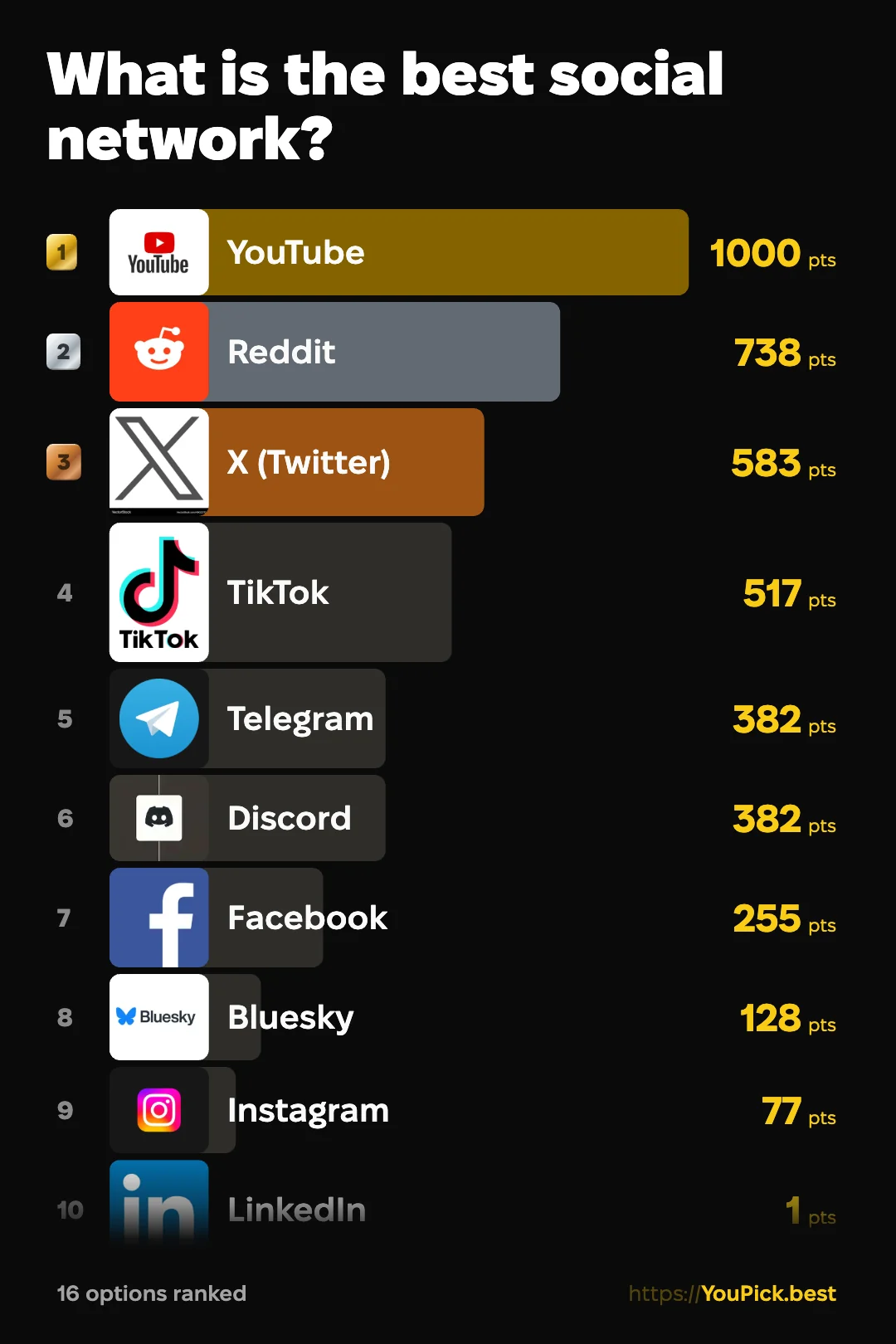
The results page does not count championships. Every matchup from every play goes into one pool, and the score of each option rests mainly on the share of those matchups it won. Each player runs a knockout of their own, and the crowd produces a pairwise record, so the luck of any single draw is averaged away over many plays. The win rate counts every win the same, whoever it came against; Bradley–Terry and Elo weigh the strength of the opponent. The weights are set out in how rankings are scored.
Bracket, round robin and sampled pairs compared
| Bracket | Round robin | Sampled pairwise voting | |
|---|---|---|---|
| Matchups for 16 options | 15 | 120 | any number, spread over many voters |
| What one run tells you for certain | the winner | the full record of every pair | nothing alone; the order forms across voters |
| Effect of the draw | decides who meets whom and when | none | averages out over many draws |
| Where it is used | tennis, March Madness, the ideal type world cup | football leagues | Elo ratings, All Our Ideas, YouPickBest results |
Common questions
Does a bracket always find the best option?
Only if the best option wins every matchup it plays. With one consistent voter it does, since the favourite beats everything it meets. With luck or disagreement in the mix it can miss: Ryvkin and Ortmann found the round robin more accurate when games are cheap, though a knockout held its own in a four-player field.
Why not compare every pair?
Because the count grows with the square of the field: 120 matchups for 16 options, 2,016 for 64. Pairs sampled across many voters give a statistical model enough to place every option.
What is the difference between a bracket and a round robin?
A bracket eliminates each loser and plays N − 1 matches. A round robin keeps everyone in and plays every pair once, N(N − 1)/2 matches in total.
What is the Bradley–Terry model?
A statistical model for paired comparisons, published by Ralph Bradley and Milton Terry in 1952. It estimates a strength for each option from all the results at once, and the gap between two strengths sets the odds of one beating the other.
More on how voting works
- King of the Hill Voting: How Winner-Stays Ranking Works — amendment votes, arcade queues and the Condorcet paradox
- What Is Pairwise Comparison? The Simple Way to Rank Anything — where ranking by pairs is used outside voting
- How Rankings Are Scored: The 1000-Point System — three virtual wins, three virtual losses and a ceiling of 1000
- What Is an Ideal Type World Cup? Korea's Bracket for Picking a Favourite — the Korean TV game built on the same knockout
Sources
- Carnegie Mellon University, 15-451 lecture notes "Concrete models and lower bounds" — knockout finds the maximum in N − 1 comparisons; the log₂(N!) lower bound for comparison sorting: cs.cmu.edu (checked 2026-09-23)
- Andreas Ortmann and Dmitry Ryvkin, working paper on tournament formats — round robin with N players plays N(N − 1)/2 games: ssrn.com (checked 2026-09-23)
- Florian Stober and Armin Weiß, "Lower Bounds for Sorting 16, 17, and 18 Elements", ALENEX 2023, doi:10.1137/1.9781611977561.ch17: arxiv.org (checked 2026-09-23)
- Charles L. Dodgson, "The Fallacies of Lawn Tennis Tournaments", St James's Gazette, 12 August 1882 (transcription): schnark.github.io (checked 2026-09-23)
- Charles L. Dodgson, "Lawn Tennis Tournaments: The True Method of Assigning Prizes with a Proof of the Fallacy of the Present Method", 1883 (transcription): schnark.github.io (checked 2026-09-23)
- Dmitry Ryvkin and Andreas Ortmann, "The Predictive Power of Three Prominent Tournament Formats", Management Science 54(3), 2008, doi:10.1287/mnsc.1070.0856; findings from CERGE-EI working paper 303: cerge-ei.cz (checked 2026-09-23)
- Tim McGarry and Robert W. Schutz, "Efficacy of traditional sport tournament structures", Journal of the Operational Research Society 48, 1997: doi.org (checked 2026-09-23)
- Lawn Tennis Association, "How do Wimbledon seedings work?" — purpose of seeding, 1924 seeding by nationality, 1927 seeding by ability: lta.org.uk (checked 2026-09-23)
- ESPN Press Room, 19 March 2026 — 26.6 million completed Tournament Challenge brackets: espnpressroom.com (checked 2026-09-23)
- Daniel Wilco, NCAA.com — the 2⁶³ outcomes and the 1 in 120.2 billion estimate: ncaa.com (checked 2026-09-23)
- Mike Benzie, NCAA.com, 22 March 2026 — Gregg Nigl's 49-game perfect start in 2019: ncaa.com (checked 2026-09-23)
- Korean Wikipedia, "신동엽, 신봉선의 샴페인" — the ideal type world cup segment on KBS: ko.wikipedia.org (checked 2026-09-23)
- L. L. Thurstone, "A law of comparative judgment", Psychological Review 34(4), 1927: doi.org (checked 2026-09-23)
- Ernst Zermelo, Mathematische Zeitschrift 29, 1929, pp. 436–460: doi.org (checked 2026-09-23)
- Ralph A. Bradley and Milton E. Terry, "Rank Analysis of Incomplete Block Designs: I. The Method of Paired Comparisons", Biometrika 39(3/4), 1952: doi.org (checked 2026-09-23)
- US Chess Federation, "About US Chess" (archived 2008) — Elo's system and its adoption by FIDE in 1970: web.archive.org (checked 2026-09-23)
- Bari M. Schwartz, "Hot or Not? Website Briefly Judges Looks", The Harvard Crimson, 4 November 2003: thecrimson.com (checked 2026-09-23)
- Kittenwar home page, archived 30 April 2005: web.archive.org (checked 2026-09-23)
- Matthew J. Salganik and Karen E. C. Levy, "Wiki Surveys: Open and Quantifiable Social Data Collection", PLOS ONE 10(5):e0123483, 2015: doi.org (checked 2026-09-23)