
Frank Herbert published Dune in 1965. Sixty-one years later it is a book, a notorious flop, an Oscar-sweeping blockbuster, a strategy game that founded a genre, and a prestige TV series. Denis Villeneuve's third film, adapting Dune Messiah, opens on 18 December 2026 with Robert Pattinson joining as Scytale.1 Warner Bros. released the first trailer and character posters in July 2026, and the date it landed on is already a fan nickname: Dunesday, because Avengers: Doomsday opens the same day.2
So a single story has been rebuilt six times by six sets of people, and each version is judged by a different crowd.
Dune has been both a legendary disaster and an Oscar sweep, so its rankings split on which Dune you mean.
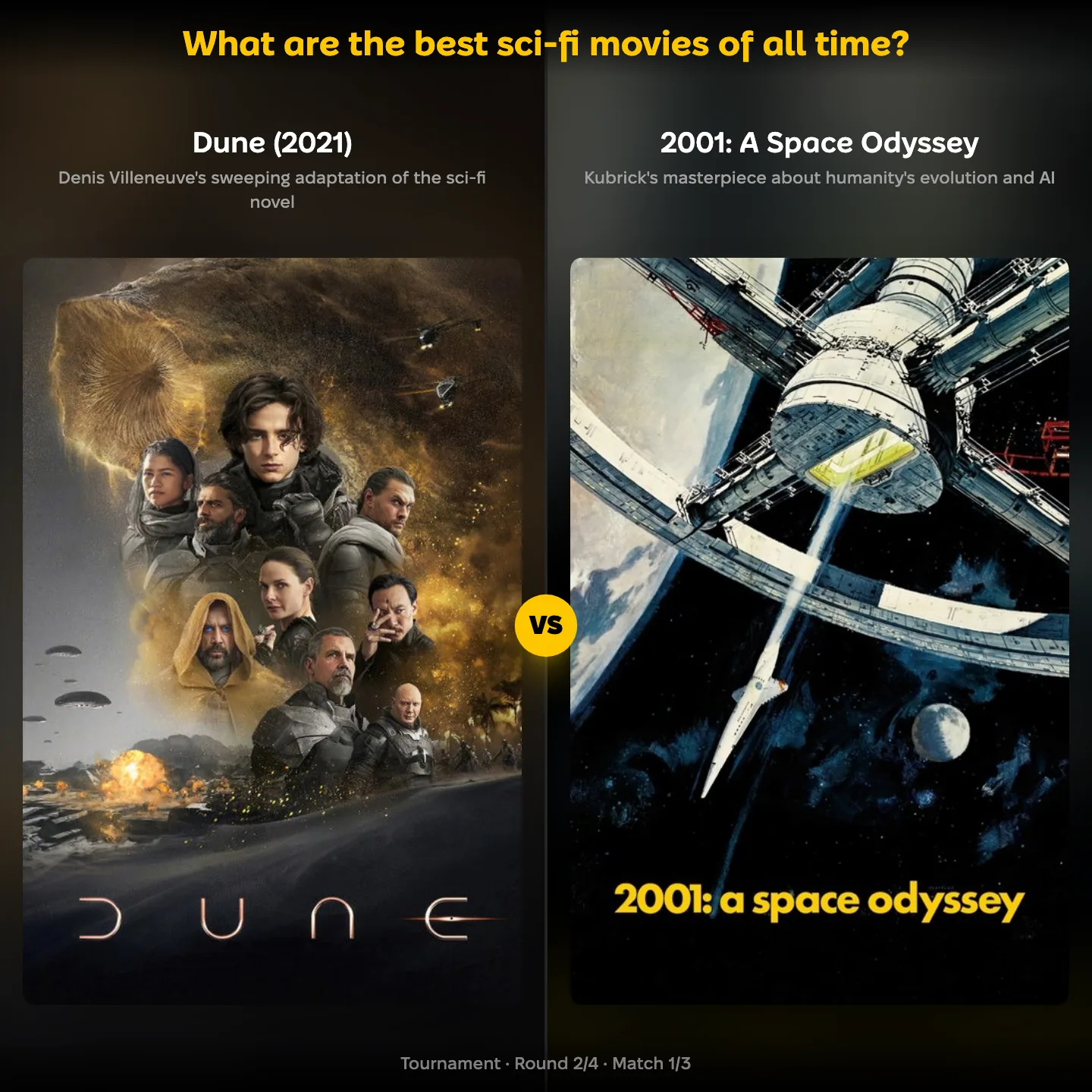
Dune vs 2001: A Space Odyssey — the whole genre in one room
The broadest sci-fi film list on the site is the least forgiving place for anything made this decade. It holds Blade Runner 2049, The Matrix, Alien, Terminator 2, Stalker and the original Star Wars.
Villeneuve's 2021 Dune arrives with unusually strong paperwork. It went into the 94th Academy Awards with ten nominations and won six — cinematography, editing, original score, visual effects, production design and sound.3
Kubrick's 2001: A Space Odyssey needs no paperwork at all. It is fifty-eight years old and still the film most often placed at the top of this category.
The awkward fact for Dune is that half this list predates it by decades, and voters in a category this wide tend to reward the film that changed what came after rather than the one that executed best.
Six Dunes: Lynch, Villeneuve and two television attempts
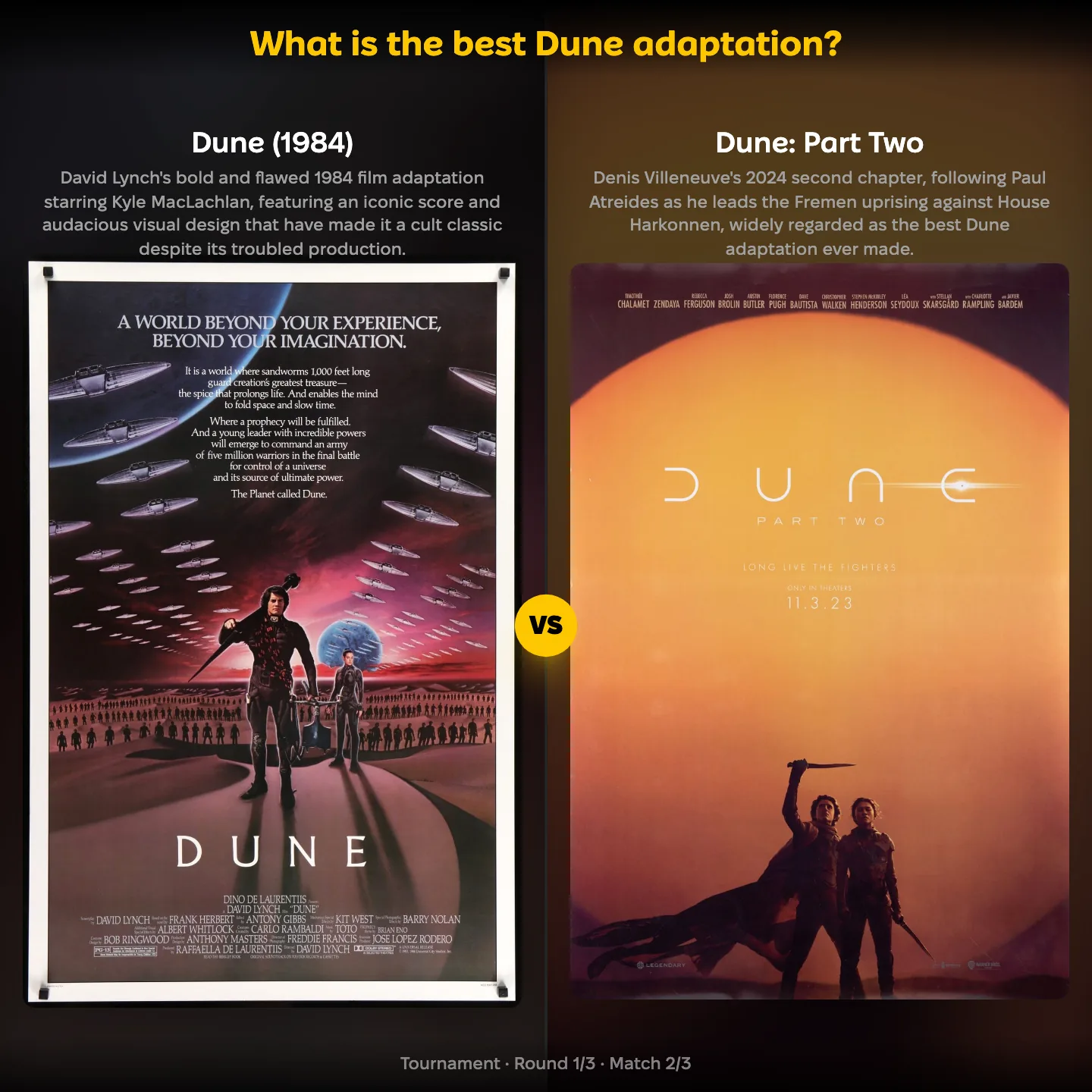
One ranking on this site contains nothing but Dune. Six adaptations sit in it: David Lynch's 1984 film, the two Villeneuve features, the Sci-Fi Channel's Frank Herbert's Dune from 2000, its 2003 sequel Children of Dune, and HBO's Dune: Prophecy.
The 1984 film is the outlier by a wide margin. It grossed about $30.9 million against a budget of $40–42 million and was pulled from cinemas after roughly five weeks.4
The two miniseries are the versions almost nobody defends and almost nobody has rewatched. They also came closest to the book, which is the whole problem with judging adaptations by fidelity.
Reading the six together is the clearest picture of what actually happened to this story: two decades of people failing to film it, then one director doing it twice in three years.
Denis Villeneuve: Arrival, Blade Runner 2049 and two trips to Arrakis
Villeneuve has made eight features that people argue about, and two of them are Dune. That double entry is unusual — most directors get one shot at a book this size.
Arrival is the film his admirers reach for first. It is small, it is about linguistics, and it earned eight Oscar nominations in 2017 without a battle scene in it.
Blade Runner 2049 is the other contender, and it shares Dune's problem in reverse: enormous craft, disappointing box office.
Dune's case here rests on scale rather than surprise. It is the one Villeneuve project where the budget, the cast and the source material all matched the ambition, and Prisoners, Sicario and Incendies are the ones a voter picks to reward something tighter.

Frank Herbert against Orwell, Le Guin and Asimov
Strip away every film and Dune is a novel competing with twenty-one other novels, and this is the room where its credentials are strongest.
Dune tied the Hugo Award for Best Novel with Roger Zelazny's This Immortal, and won the very first Nebula Award for Best Novel, presented by the Science Fiction and Fantasy Writers of America in 1966.5 It is routinely described as the best-selling science fiction novel ever published.6
The company is serious. Nineteen Eighty-Four gave English three words it still uses daily. Ursula K. Le Guin's The Left Hand of Darkness and The Dispossessed both won the Hugo and the Nebula outright. Asimov's Foundation invented the galactic-empire template Herbert then complicated.
Andy Weir's The Martian is here as the modern outlier — a self-published survival story from 2011 sitting beside books that are on university syllabuses.
The counter-argument to Dune is length. It is the novel most often abandoned at page 150, and a list voted on by readers is a list voted on by people who finished it.

Timothée Chalamet: Call Me By Your Name made him, Dune made him a franchise
Chalamet's filmography splits neatly into the years before Paul Atreides and the years after. Call Me By Your Name earned him a Best Actor nomination at 22, the third-youngest in the category's history.
Both Dune films sit on his list, which is a structural advantage nothing else in his career has.
Lady Bird, Little Women and Wonka pull in three different directions, and A Complete Unknown gave him a second nomination playing Bob Dylan.
Dune gave him something his other films could not: the lead of a series big enough to schedule a decade around.

Zendaya has three Spider-Man films and one Chani
Chani is a supporting part that grows. In the 2021 film Zendaya is on screen for roughly seven minutes, most of them as a vision; in Dune: Part Two she carries the emotional spine of the story and the closing shot.
The three Spider-Man films are the obstacle. They made billions, they ran for five years, and MJ is the role a general audience knows her for.
Challengers is the third force here, and the film critics cite to argue she is a serious lead.

Arrakis vs Tatooine: which desert planet came first
Arrakis appeared in 1965. Tatooine appeared in 1977, twelve years later, also a desert world, also home to a young man with a destiny and a mysterious mentor.
The debt is not disputed by anyone who has read both, and it is the reason this ranking is more interesting than it looks.
Recognition runs the other way. Tatooine has two suns, a cantina, a podrace and forty years of merchandising; Arrakis has sand, worms and a spice economy that takes a glossary to explain.
Eighteen worlds sit in this ranking, and the range is the point: Trantor covered by a single city, Le Guin's frozen Gethen, Solaris as a thinking ocean, and Miller's planet from Interstellar, where an hour costs seven years.

Dune: Part Two against The Empire Strikes Back
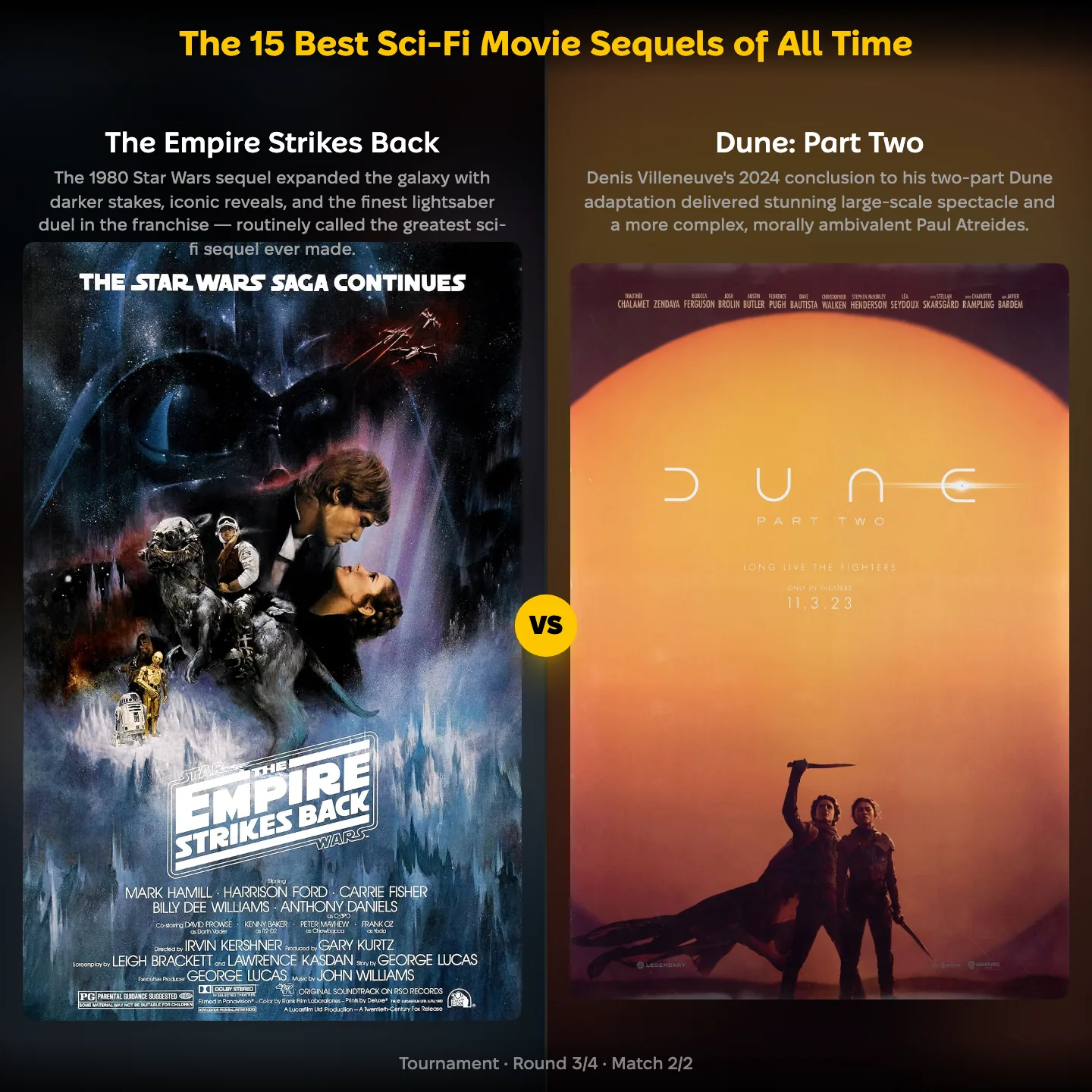
Sequels are the one category where Dune's second film has an unusually clean case. Dune: Part Two took $715 million worldwide on a $190 million budget, the seventh-highest-grossing release of 2024, and won two of its five Oscar nominations.7
It is also the rare sequel that is not really a sequel. Villeneuve shot one novel in two parts, so Part Two is the second half of a film that was always going to be released in halves.
Every category needs a benchmark, and here it is The Empire Strikes Back. Star Trek II: The Wrath of Khan, Aliens and Terminator 2 are in the room too.
Every one of those took an existing world and darkened it. Part Two simply finished a story that had been cut in half, which is a different achievement and a harder one to vote for.
Hans Zimmer scored Dune instead of Tenet
Zimmer has been attached to Dune since he read the novel as a teenager, and in 2019 he turned down Christopher Nolan's Tenet to take it — after scoring The Dark Knight, Inception, Interstellar and Dunkirk for him.
The score he wrote is the least Zimmer-sounding thing on his own list: wordless female vocals, invented instruments, almost no melody a listener could hum back. It won him the Academy Award for Best Original Score.3
Gladiator, The Lion King and Interstellar are the three that people actually hum, and Pirates of the Caribbean is the one that colonised every trailer for a decade.
That is the tension in this ranking: the Oscar went to the score that sounds least like him.

The Lord of the Rings and the unfilmable-book club
Some books arrive with a reputation for defeating directors, and Dune spent forty years as the headline example.
Alejandro Jodorowsky tried first. Between roughly 1974 and 1976 he assembled Salvador Dalí to play the Emperor, Orson Welles, Mick Jagger, H.R. Giger and Chris Foss on design, Jean Giraud on 3,000 storyboards, and Pink Floyd on the soundtrack — then ran about $5 million short of a $15 million budget and never shot a frame.8
Peter Jackson's The Fellowship of the Ring is the other landmark in this category, and it got there first, in 2001, with a trilogy studios had spent decades calling impossible.
Stranger entries fill out the ranking: Cronenberg turning Naked Lunch into a film about writing Naked Lunch, Ang Lee putting a tiger in a lifeboat, Tom Tykwer filming a novel built entirely on smell, and Joseph Strick attempting Ulysses in 1967.

Javier Bardem: Stilgar against Anton Chigurh
Stilgar is the best comic performance in either Dune film, and Bardem plays a fanatic who is also the audience's way into Fremen belief.
No Country for Old Men is an impossible act to follow. Bardem took the 2008 Oscar for Best Supporting Actor as Anton Chigurh, and the haircut has been on best-villain lists ever since.
The Sea Inside, Biutiful and Before Night Falls are the Spanish-language performances his own admirers rate highest, and Skyfall is the one the largest audience saw.

Jason Momoa: twenty minutes as Duncan Idaho
Duncan Idaho dies in the first film, having been on screen for about twenty minutes, and he is the character most people leave the cinema talking about.
Momoa's alternative is a franchise lead. Aquaman took over a billion dollars in 2018 and made him a headline name, which is more than a supporting swordsman usually manages.
The gap is what the parts ask for. Aquaman asks for charisma; Duncan Idaho asks for a man who is loved by everyone he meets and dies protecting a boy, in a film where nothing else is warm.

Wadi Rum against Monument Valley
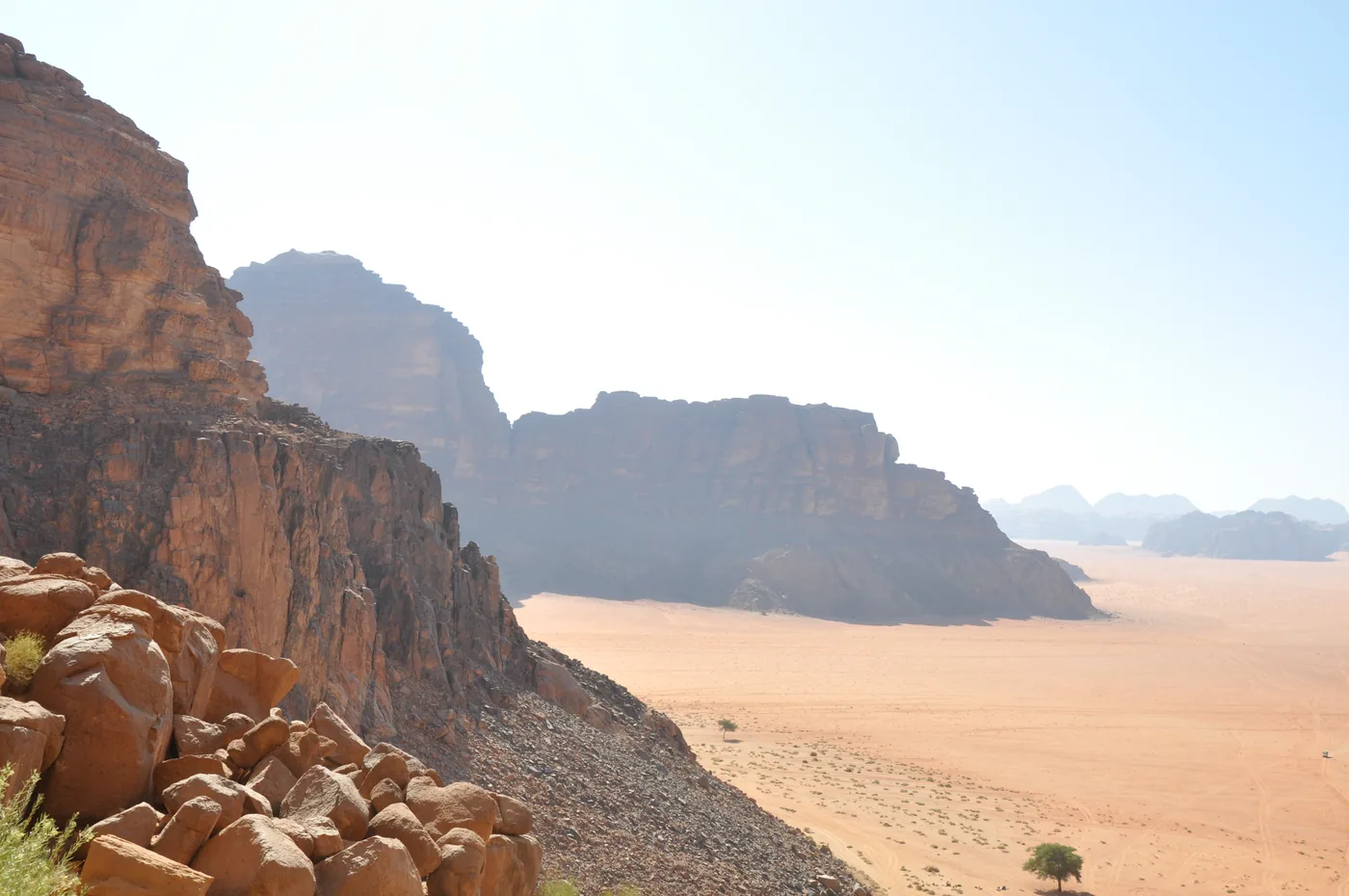
Villeneuve shot Arrakis in Wadi Rum in Jordan and in the Liwa Oasis in Abu Dhabi, and the same locations were used again for the third film between July and November 2025.1
Dune's claim in this category rests on how much work the desert does. Sand hides the worms, the spice is in the sand, and the plot is a fight over who gets to stand on it.
David Lean got to Wadi Rum first, in 1962, and Lawrence of Arabia is why any of this looks the way it does. John Ford's Monument Valley did the same job for the Western, and The Searchers is the film that fixed it.
Against them the list runs from George Miller's Namib chase in Mad Max: Fury Road to Antonioni blowing up a house in Death Valley in Zabriskie Point, and to Wim Wenders opening Paris, Texas with a man walking out of the Big Bend with no memory of who he is.

Dune II: the game that made Command & Conquer possible
This is the strangest place Dune turns up, and the one where its case is strongest.
Westwood Studios released Dune II: The Building of a Dynasty in December 1992. Earlier games had experimented with real-time command. Dune II fixed the template every one after it copied: mouse-driven base building, fog of war, resource harvesting, unit micromanagement. Command & Conquer, Warcraft, Age of Empires and StarCraft all descend from it.9
StarCraft is the counter-case, and a strong one. Blizzard's 1998 game became a televised professional sport in South Korea and is still played competitively.
Influence and quality are different questions, though, and this ranking asks the first one. Westwood's own Command & Conquer is in the list too, three years younger and built by the same people from the same blueprint.

David Lynch took his name off Dune
Lynch had made Eraserhead and The Elephant Man, and Dino De Laurentiis handed him $40 million and no final cut. Lynch spent years afterwards distancing himself from the result, and had his name replaced with a pseudonym on some television versions.10
The film he did release runs 137 minutes, explains its universe in voiceover, and contains a scene in which the villain drinks a man's blood. It has a genuine cult following, an Italian pop-rock score by Toto and one by Brian Eno, and production design nobody has matched since.
Mulholland Drive, Blue Velvet and Eraserhead are what the rest of his list is made of, and they are the reason he is on the list at all.
The honest reading of this one is uncomfortable. A story that produced a six-Oscar film in 2021 also produced the picture its own director walked away from in 1984.

One book, fifteen different juries
A story that has been filmed six times has been judged by six audiences, and they do not agree with each other about anything except that it is worth attempting again. Novel readers, film critics, Zimmer completists and people who played a DOS game in 1992 are all ranking something they call Dune, and none of them mean quite the same object.
The mechanics are simple enough to explain in a page: the head-to-head method behind every list here.
Or take something you know too well — a book, a band, a city — and build the list that would put it somewhere unexpected.
More rankings, more angles
- Stephen King Wrote Horror. The Lists Keep Filing Him Elsewhere — the other author whose adaptations keep outnumbering his books
- The Lord of the Rings Changes Category From List to List — the trilogy that beat the unfilmable label first
- Star Wars: 16 Lists, 16 Different Answers — the desert planet that arrived twelve years after Arrakis
- Christopher Nolan: $6,000 Debut, $250M Odyssey, 16 Lists — the director who shot a feature for the price of a car
Sources
- Wikipedia — Dune: Part Three, release date, cast and 2025 filming in Budapest, Wadi Rum and Abu Dhabi: en.wikipedia.org (checked 2026-08-17)
- Deadline — Dune: Part Three trailer and character posters, July 2026, and the shared 18 December date: deadline.com (checked 2026-08-17)
- Wikipedia — List of accolades received by Dune (2021), ten nominations and six wins at the 94th Academy Awards, including Best Original Score: en.wikipedia.org (checked 2026-08-17)
- Wikipedia — Dune (1984 film), box office and theatrical run: en.wikipedia.org (checked 2026-08-17)
- Science Fiction and Fantasy Writers of America — Nebula Awards, Dune, Best Novel: nebulas.sfwa.org (checked 2026-08-17)
- Wikipedia — Dune (novel), Hugo tie with This Immortal and best-selling status: en.wikipedia.org (checked 2026-08-17)
- Wikipedia — Dune: Part Two, worldwide gross, budget and Academy Award results: en.wikipedia.org (checked 2026-08-17)
- Wikipedia — Jodorowsky's Dune, the 1974–1976 attempt, its collaborators and its collapse: en.wikipedia.org (checked 2026-08-17)
- Wikipedia — Dune II, Westwood Studios, December 1992, and its influence on the real-time strategy genre: en.wikipedia.org (checked 2026-08-17)
- SlashFilm — David Lynch's Dune as a box-office bomb and his distance from it: slashfilm.com (checked 2026-08-17)