
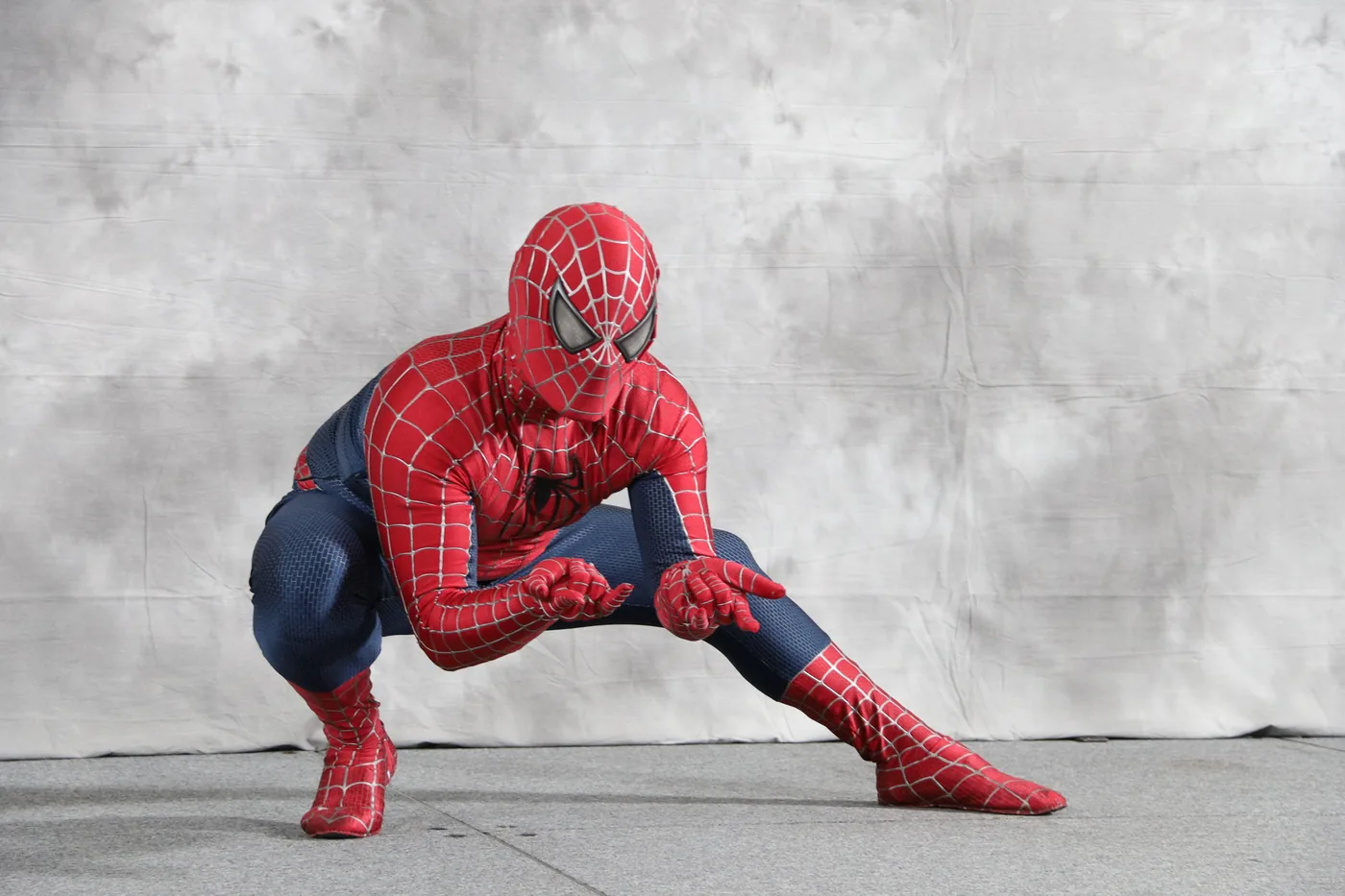
Spider-Man's films belong to Sony, and Marvel Studios has to borrow him back. Spider-Man: Brand New Day opened on 31 July 2026 with Tom Holland in the suit for a fourth time, directed by Destin Daniel Cretton and produced by Kevin Feige alongside Sony's Amy Pascal and Avi Arad.1
That arrangement is why he keeps appearing on lists nobody built for him. Fifteen are below: the Academy's animated-feature winners, a console's all-time library, the open-world genre, and the filmographies of four actors who made their names somewhere else.
Sony finances the films, PlayStation publishes the games, Marvel Studios borrows the character, and the fifteen lists below have inherited three different Spider-Men.
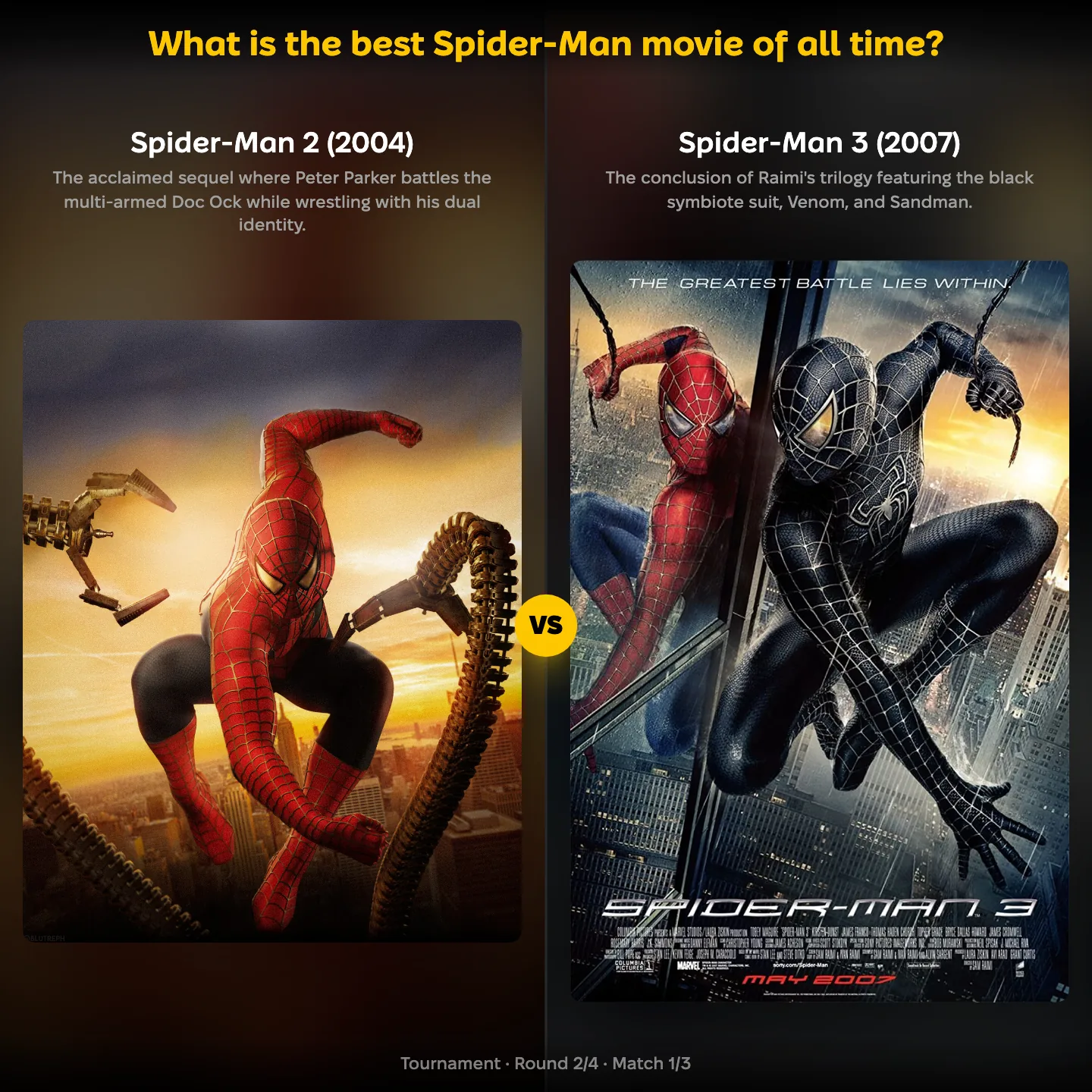
Spider-Man 2 vs Spider-Man 3: the one list built only from his films
Ten films, all of them his, and the ranking has to compare things that were never meant to be compared. Three of the ten star a different Peter Parker; one stars Miles Morales.
Sam Raimi's second film, Spider-Man 2 (2004), is the usual live-action answer, built on Alfred Molina's Doctor Octopus and an elevated-train fight that later superhero films kept copying. It took Best Visual Effects at the 77th Academy Awards, credited to John Dykstra, Scott Stokdyk, Anthony LaMolinara and John Frazier.2
Spider-Man 3 (2007) put the symbiote suit, Venom and Sandman into one film, and the trilogy stopped there. Sony restarted the series five years later with Andrew Garfield.
So the ten options are not ten attempts at one film. They are four separate relaunches of the same teenager, and choosing between them mostly means choosing which relaunch you grew up with.
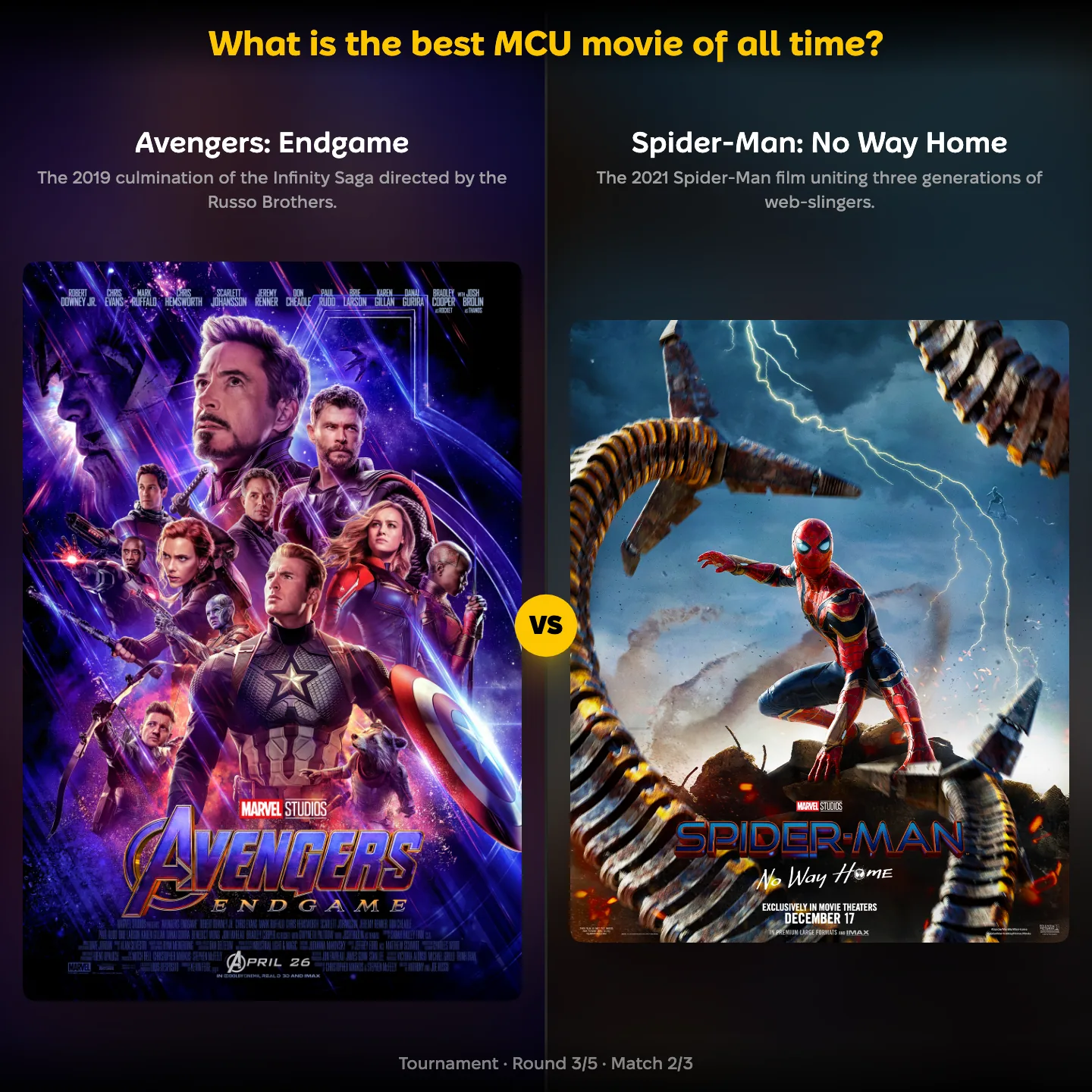
No Way Home and Homecoming inside the MCU's eighteen
The MCU ranking holds eighteen films, and two of them are Spider-Man's: No Way Home and Homecoming.
Box Office Mojo puts No Way Home at $1,921,426,073 worldwide from its December 2021 release.3 Sony released it; Marvel Studios made it; both logos are on the front of it.
Avengers: Endgame and Avengers: Infinity War are the difficulty. Both close a story that ran across a decade and more than twenty films, and both were built as events in a way a solo sequel structurally cannot be.
Spider-Man's case is that his two entries are the only ones here that had to be negotiated. Every other film on the list was made by a company that already owned its lead.
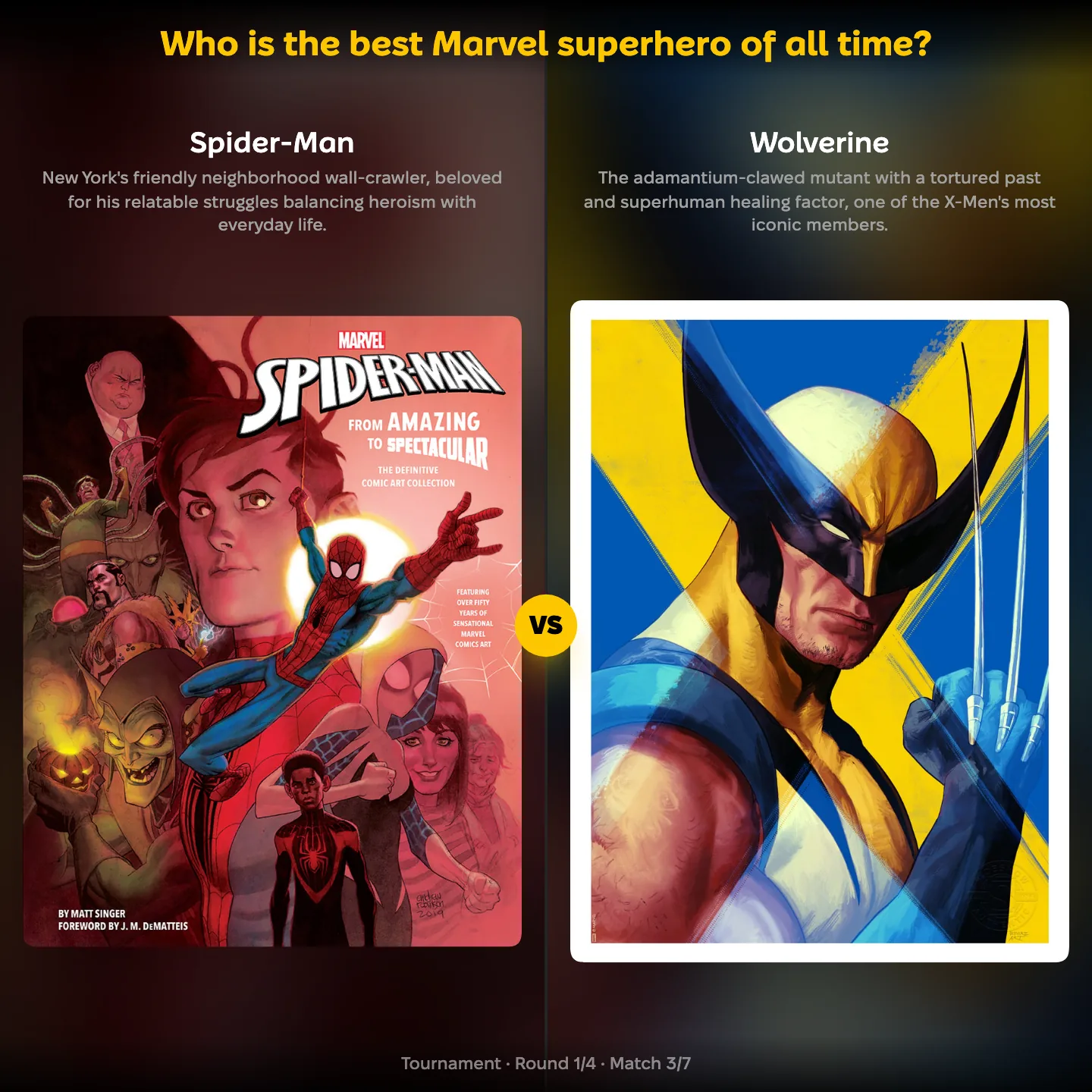
Spider-Man against Wolverine, twelve years apart
This ranking drops films entirely. It asks who the best Marvel superhero is, and the options are characters: Spider-Man, Iron Man, Captain America, Thor, Wolverine, Black Panther and eight more.
Marvel dates Amazing Fantasy #15, Peter Parker's first appearance, to 1 August 1962, written by Stan Lee and drawn by Steve Ditko.4 He was the company's commercial flagship for decades before Marvel Studios existed.
Wolverine, the other Marvel character who anchored a studio's whole decade, first appeared in Incredible Hulk #181 on 1 November 1974.5 He spent the 2000s fronting Fox's X-Men films while Spider-Man carried Sony's half of the same business.
Nobody in this ranking is defending a weak third act, which is what separates it from every film list here. The question is which of them Marvel would print on a single cover if it had to pick one.
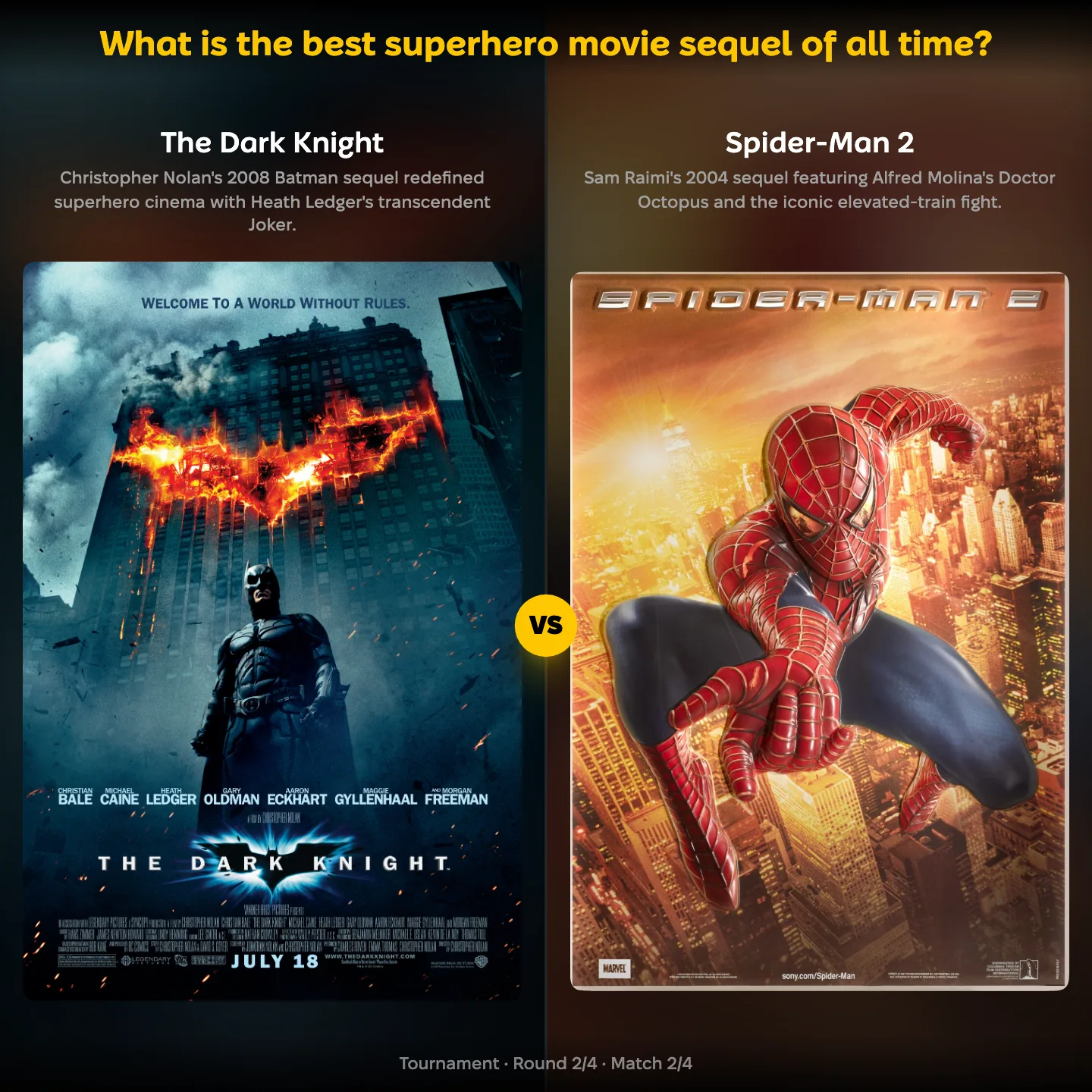
Spider-Man 2 and No Way Home among thirteen superhero sequels
Thirteen superhero sequels are on this list, and two belong to Spider-Man: Spider-Man 2 and No Way Home.
Spider-Man 2 reached cinemas in 2004, four years ahead of The Dark Knight, and made "the sequel is the good one" a standard claim about comic-book cinema. It skipped the origin story and spent the running time on a villain with a reason.
No Way Home works the other way round, by importing two earlier franchises. That is either the most generous thing a Spider-Man film has done or an admission that the character's own history had become the attraction.
The field around them is mostly Marvel Studios: Endgame, Infinity War, The Winter Soldier, Thor: Ragnarok, Civil War. Logan, X2, Superman II and Batman Returns keep it from being a single studio's room.
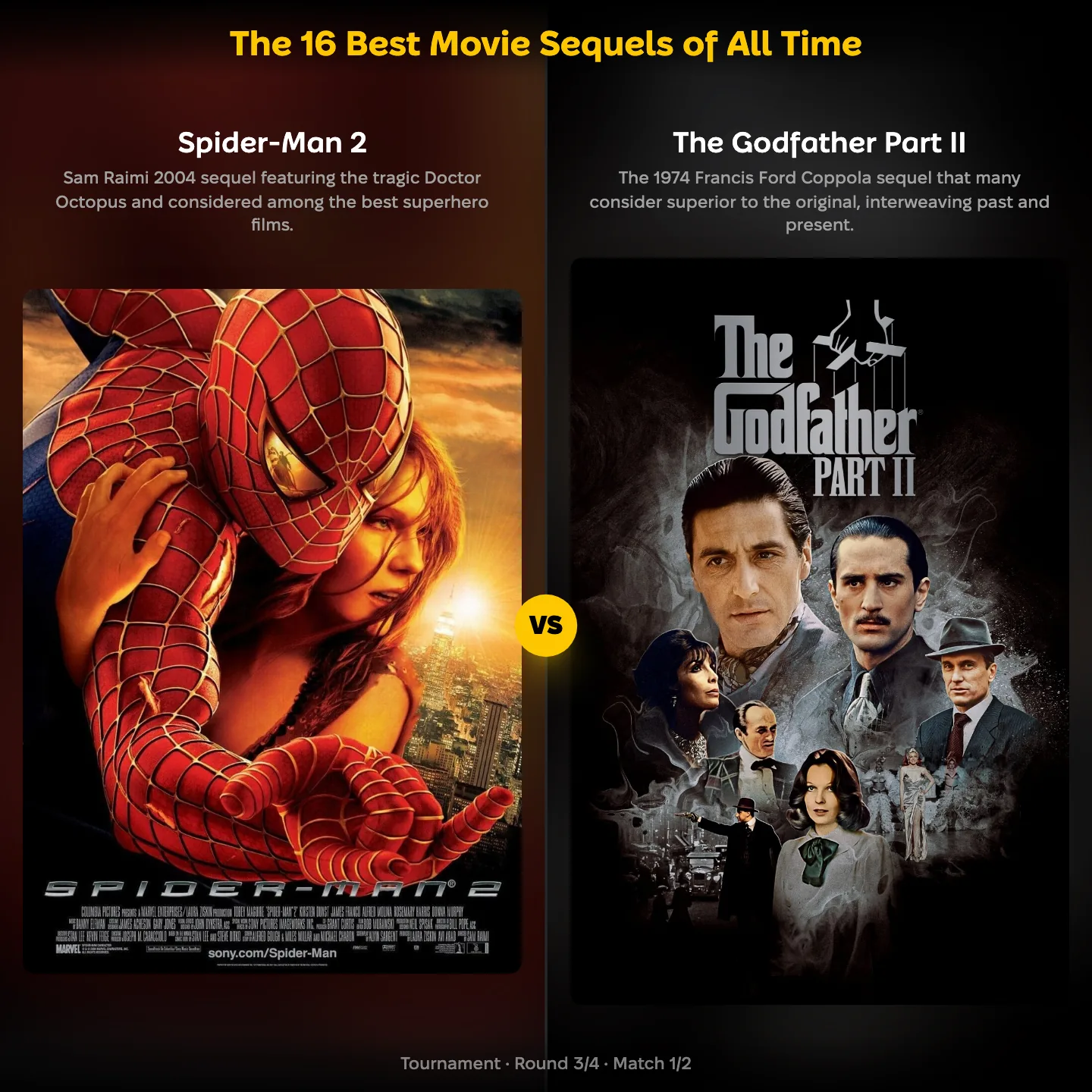
The Godfather Part II is on the same list as Spider-Man 2
Spider-Man 2 sits in a second sequel ranking too, sixteen options wide, with the genre filter switched off.
Its neighbours there are The Godfather Part II, The Empire Strikes Back, Aliens, Terminator 2, The Silence of the Lambs and Mad Max: Fury Road. The Godfather Part II took six awards at the 47th Academy Awards, Best Picture and Best Director among them.6
The film did not change. The room did — a comic-book sequel with an obvious case among superhero films has a much harder one standing next to Coppola.
That is not a knock on Raimi. It is what happens when the comparison set stops being drawn around Spider-Man.
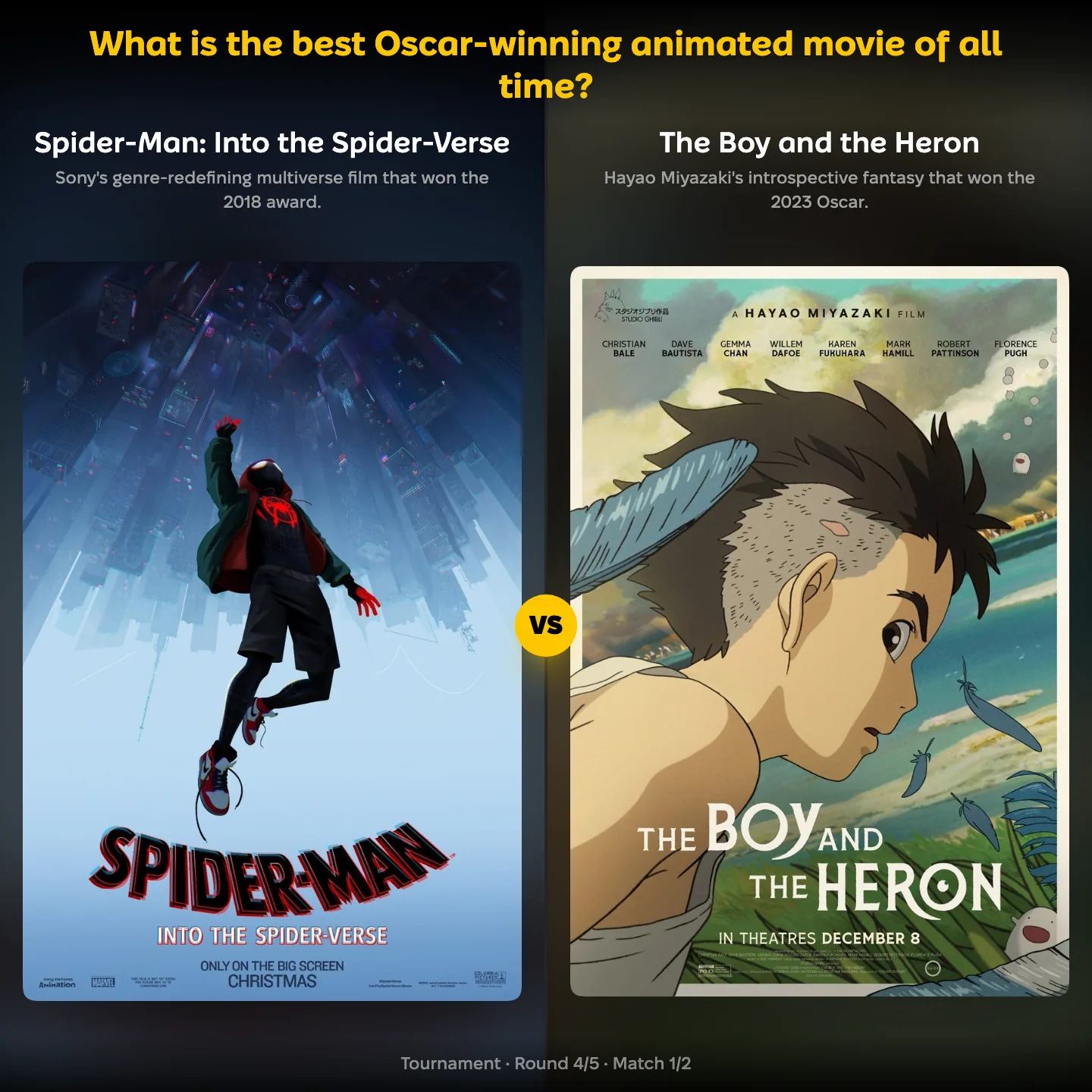
Into the Spider-Verse won the category Across the Spider-Verse lost
Spider-Man: Into the Spider-Verse took Best Animated Feature at the 91st Academy Awards in February 2019, ahead of Incredibles 2, Isle of Dogs, Mirai and Ralph Breaks the Internet.7 This ranking sets every winner of that category against the others.
Twenty-five films are in it, starting with Shrek in 2002 and taking in Spirited Away, WALL-E, Up, Toy Story 3, Coco, Soul, Flow and KPop Demon Hunters. Spider-Man shares the shelf with Pixar's strongest decade and both of Hayao Miyazaki's winners.
The awkward entry sits six along. The Boy and the Heron won the same category in 2024, the year Spider-Man: Across the Spider-Verse was nominated and lost.8
So the Spider-Verse has one film in this ranking and one that was only nominated for it, and the instalment most people call the better of the two is the one that came away empty.
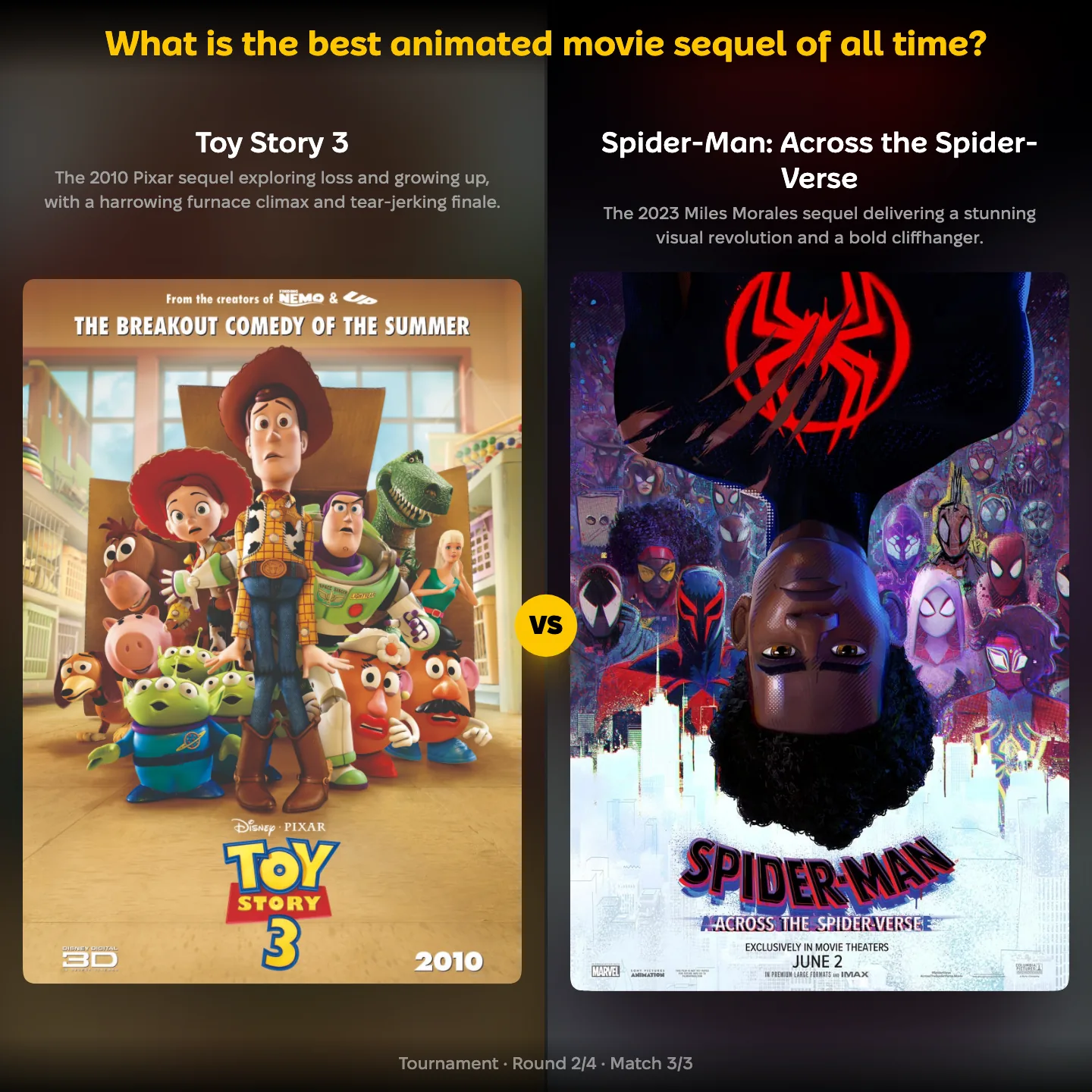
Toy Story 3, Shrek 2 and an unfinished Spider-Verse
Spider-Man: Across the Spider-Verse reached cinemas in 2023 and did something a middle chapter rarely risks: it ended on a cliffhanger with no resolution, because the third film was already in production.
The competition here is Pixar and DreamWorks at full strength — Toy Story 2, Toy Story 3, Shrek 2, How to Train Your Dragon 2, Incredibles 2, Puss in Boots: The Last Wish. Six of the twelve options come from those two studios.
An unfinished story is a real objection on a list like this, and it is the one thing Toy Story 3 cannot be accused of.
Sony's answer is that the trilogy was always one story cut into three parts. That answer holds only once Beyond the Spider-Verse is in cinemas.
Five of the fourteen Marvel games are Spider-Man's
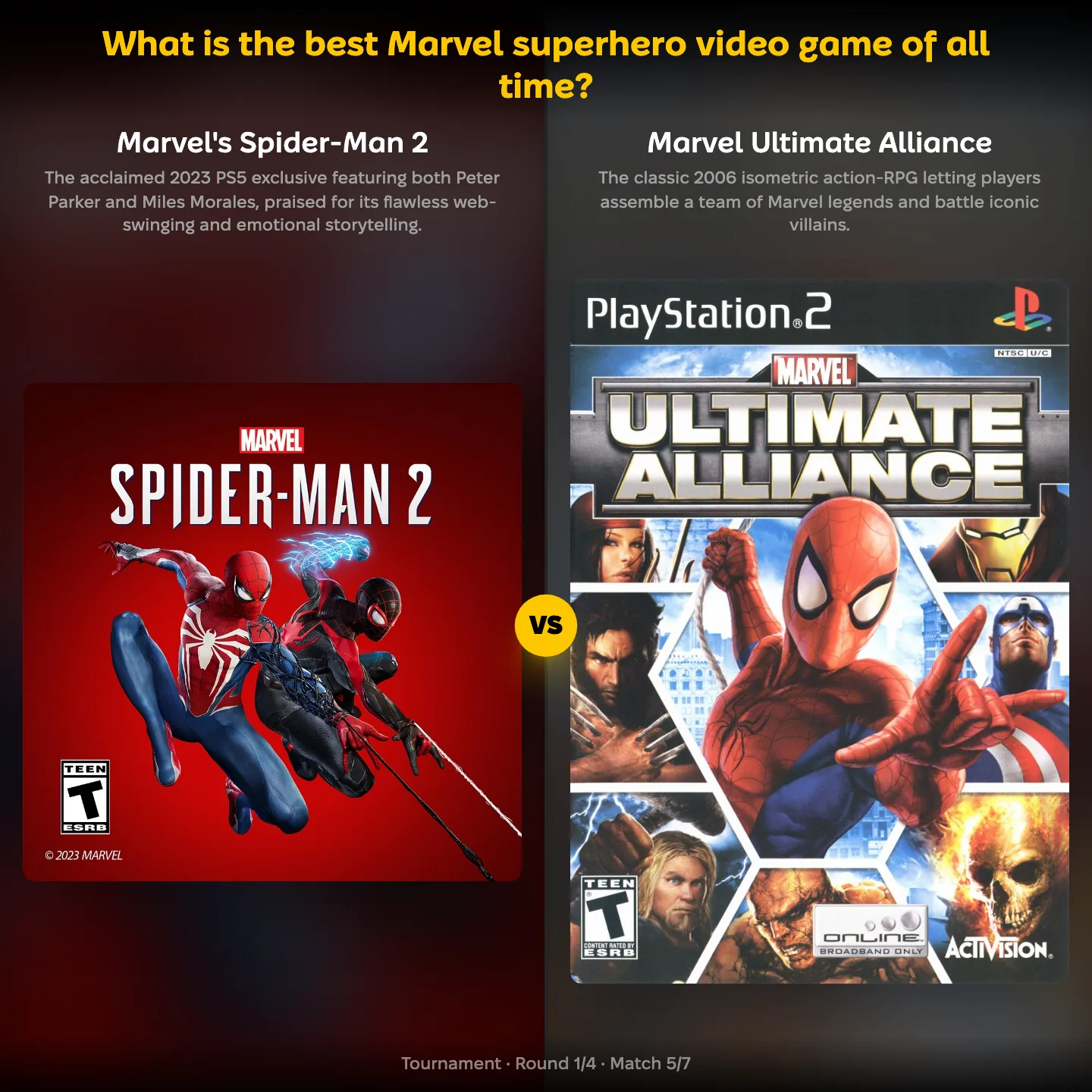
Five of the fourteen options on this ranking of Marvel video games are Spider-Man games. No other Marvel character has more than one.
They are Marvel's Spider-Man, Marvel's Spider-Man 2, Miles Morales, Spider-Man: Web of Shadows and a handheld Amazing Spider-Man 2, up against Marvel Ultimate Alliance, Marvel vs. Capcom 2, Marvel's Midnight Suns, X-Men Legends and Marvel Rivals.
Sony Interactive Entertainment announced in October 2023 that Insomniac Games' Marvel's Spider-Man 2 had sold more than 2.5 million copies in its first 24 hours, the fastest start any PlayStation Studios game has had.9
The older options hold a claim the new ones cannot. Marvel Ultimate Alliance let players field a squad drawn from the whole Marvel roster in 2006. A Spider-Man game gets two playable heroes at most, and Spider-Man 2 used both of them.
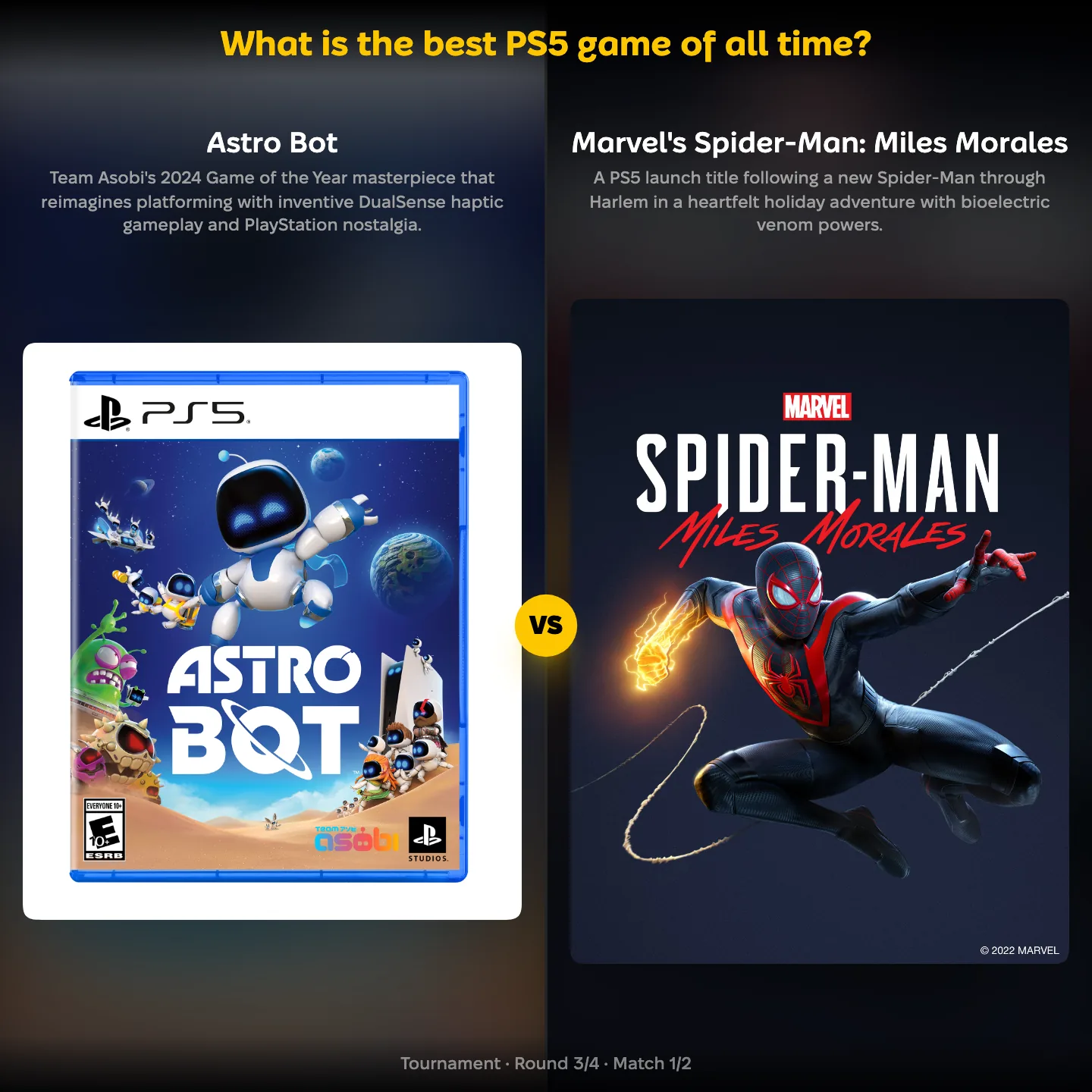
Miles Morales was on the shelf the day PS5 was
The PS5 ranking takes Marvel out of the question and asks which game is the best on the console. Two Spider-Man titles are in it: Marvel's Spider-Man 2 and Miles Morales.
PlayStation named Miles Morales a launch title two months before the hardware shipped, and it went on sale on 12 November 2020, the day PS5 reached its first seven markets.10 Demon's Souls, also on this ranking, arrived the same morning.
Day-one availability is why a spin-off sits on a console's all-time list. For several weeks Miles Morales was one of a handful of things a new PS5 could actually do.
Everything else in the field belongs to Sony: God of War Ragnarok, Returnal, Ghost of Tsushima Director's Cut, Astro Bot, plus Baldur's Gate 3 and Final Fantasy VII Rebirth from outside. Spider-Man is the only entry Sony had to license from another company.
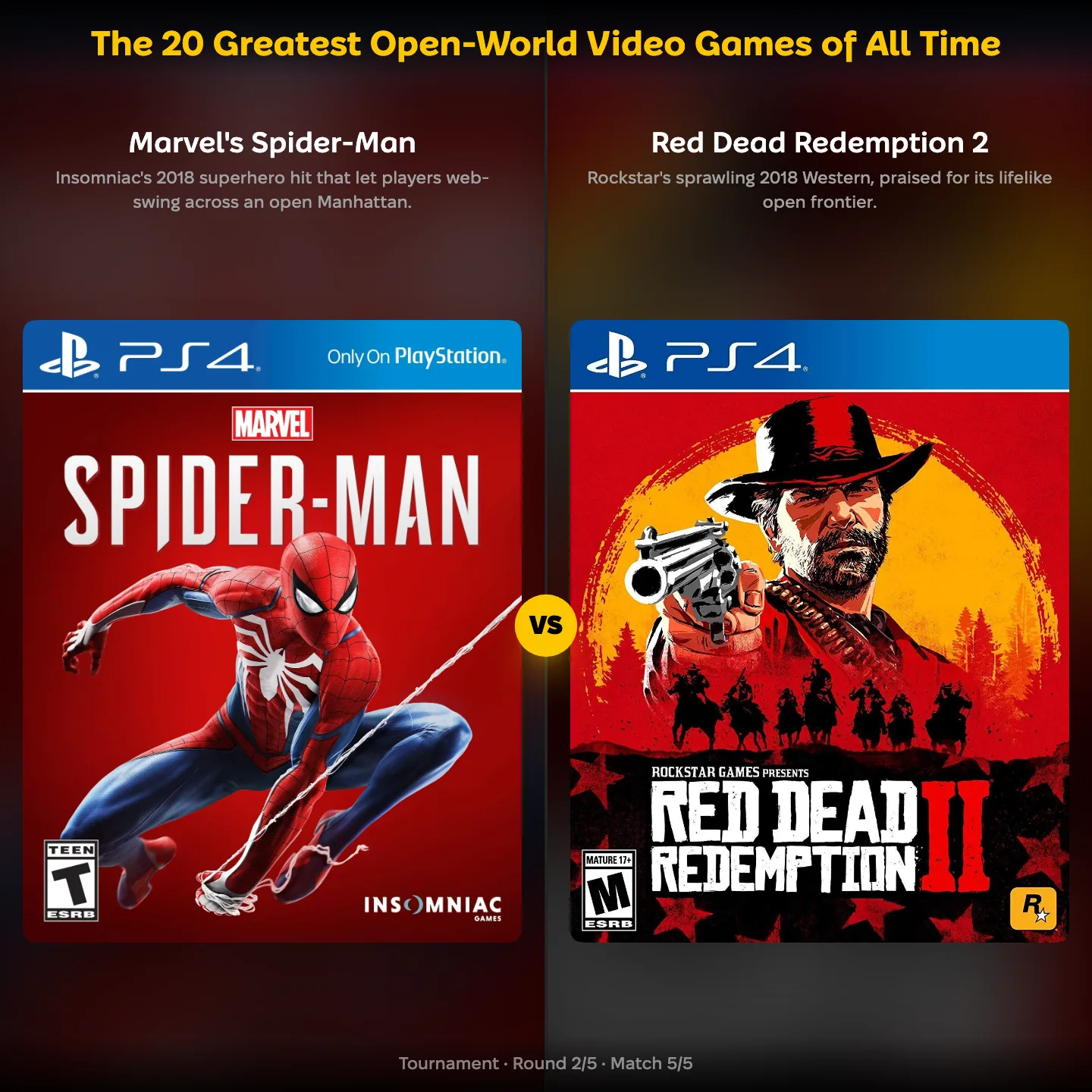
Marvel's Spider-Man vs Red Dead Redemption 2: one borough against a frontier
Marvel's Spider-Man (2018) is one of twenty options on a ranking of the greatest open-world games, and this is where being a superhero game stops helping.
Its map is a compressed Manhattan. One borough, no wilderness, no second city, and web-swinging designed as a movement puzzle rather than as transport between markers.
Everything around it is enormous. Red Dead Redemption 2 laid a frontier across five fictional states, Breath of the Wild dropped players into Hyrule with no directed path, and Skyrim, GTA V, Elden Ring and Minecraft all trade in scale or freedom one island cannot match.
The Spider-Man case is that map size is the genre's laziest measure. Swinging through a dense city is the entire design, and a bigger, emptier New York would make the game worse.
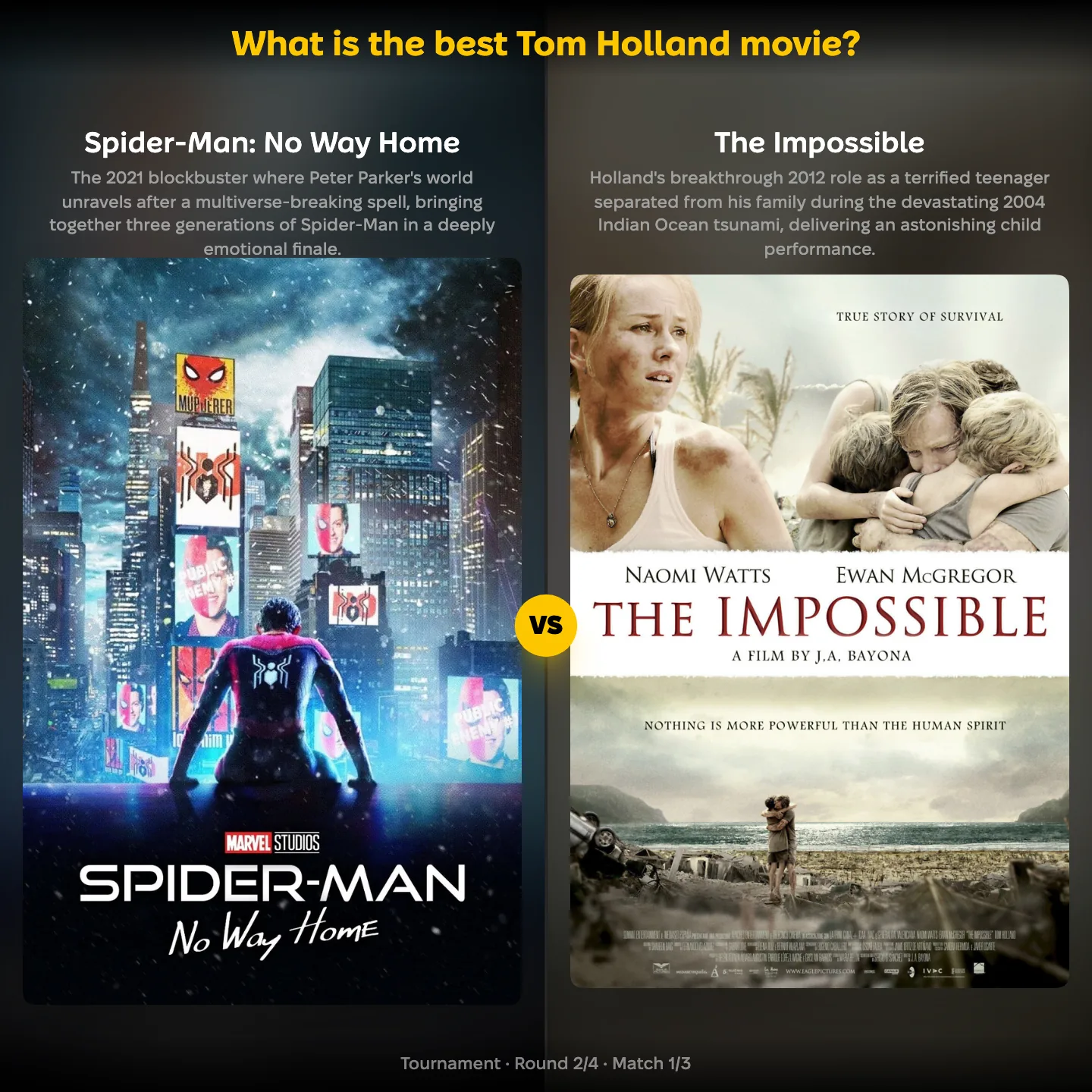
Tom Holland's eleven films, four of them in the suit
Eleven films are on Tom Holland's ranking, and four put him in the suit: Homecoming, Far From Home, No Way Home and Brand New Day, which built its cast around him with Sadie Sink, Jon Bernthal, Tramell Tillman and Mark Ruffalo.1
Add Civil War, Infinity War and Endgame, where he plays the same character inside somebody else's film, and Spider-Man accounts for seven of the eleven entries on his own list.
The four that are not Marvel are the interesting part. The Impossible (2012) cast him as a boy separated from his family in the 2004 Indian Ocean tsunami, and that is the performance sitting on his résumé when Marvel hired him three years later.
Cherry, Uncharted and Chaos Walking are the counter-evidence: three swings at a leading role outside the suit, none of which changed what he is known for.
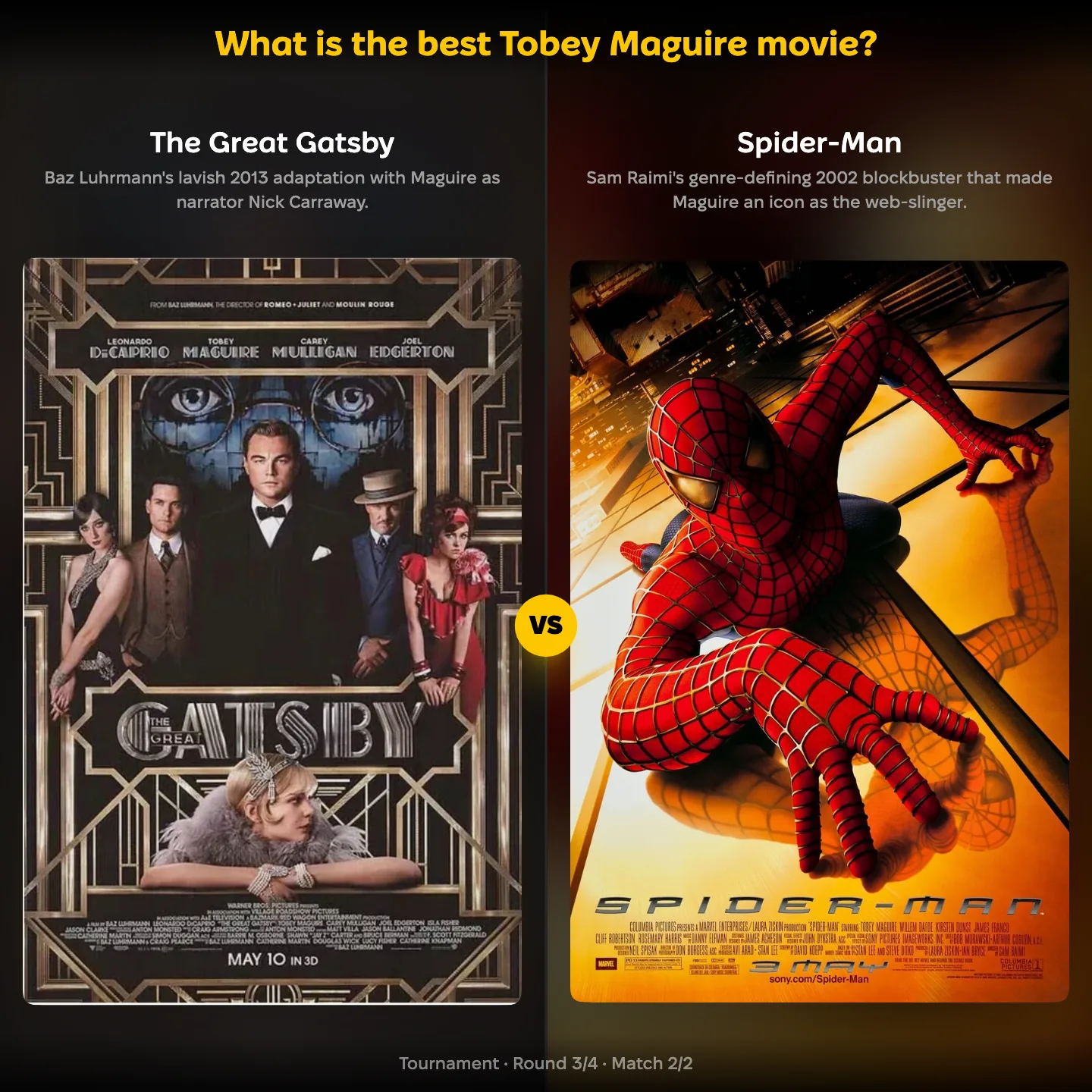
Tobey Maguire opened Spider-Man to $114.8 million in 2002
Tobey Maguire played Spider-Man three times between 2002 and 2007, then came back for No Way Home fourteen years after the last one. All four appearances are among the thirteen films on his ranking.
The 2002 original carries the historical claim. Box Office Mojo records a $114,844,116 opening weekend in North America against a $139 million production budget.11 That weekend was Sony's entire case for a franchise, and it bought three films in five years.
His work outside the suit is a different career: The Cider House Rules, Wonder Boys, The Ice Storm, Pleasantville, Seabiscuit. Mostly 1990s and early-2000s drama, made before and around the trilogy rather than after it.
The Great Gatsby is the nearest thing on the list to a post-Spider-Man lead, and in it he narrates while Leonardo DiCaprio acts.
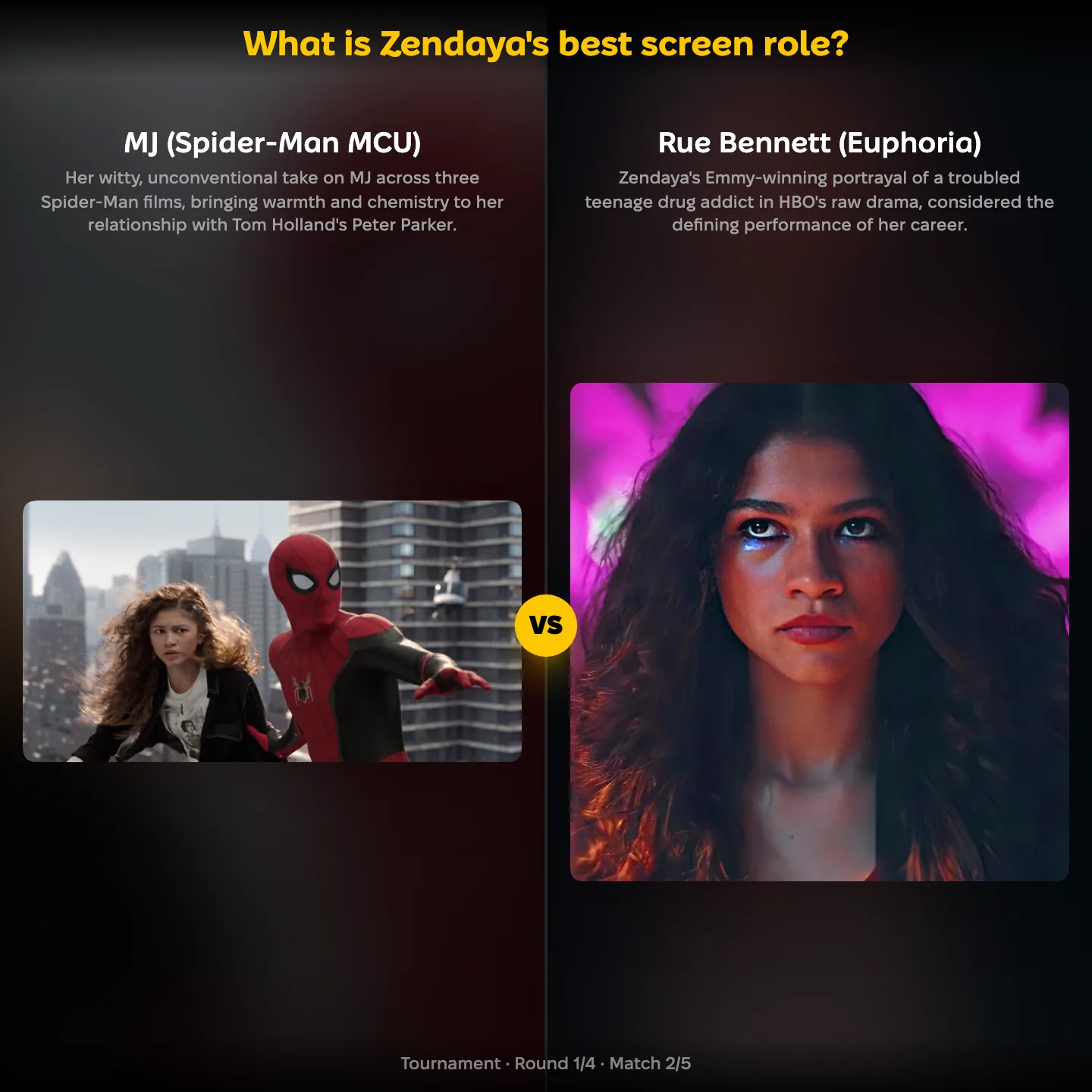
Zendaya has two Emmys; MJ has three films
Zendaya has played MJ in three Spider-Man films and returns in Brand New Day, which makes the role the longest-running thing on her ranking of ten screen performances.
It is also the one with the least written into it. MJ is a supporting character in someone else's origin story, handed dry commentary and a reason for Peter Parker to have something to lose.
Rue Bennett in Euphoria is the counter-example. The Television Academy records Zendaya winning Outstanding Lead Actress in a Drama Series in 2020 and again in 2022, the youngest and first Black actress to take that category twice, with a further nomination in 2026.12
Challengers, Dune and The Greatest Showman fill out the list. Four of the ten options are film leads, and the Spider-Man one is not among them.
Emma Stone: Gwen Stacy and Poor Things on one list
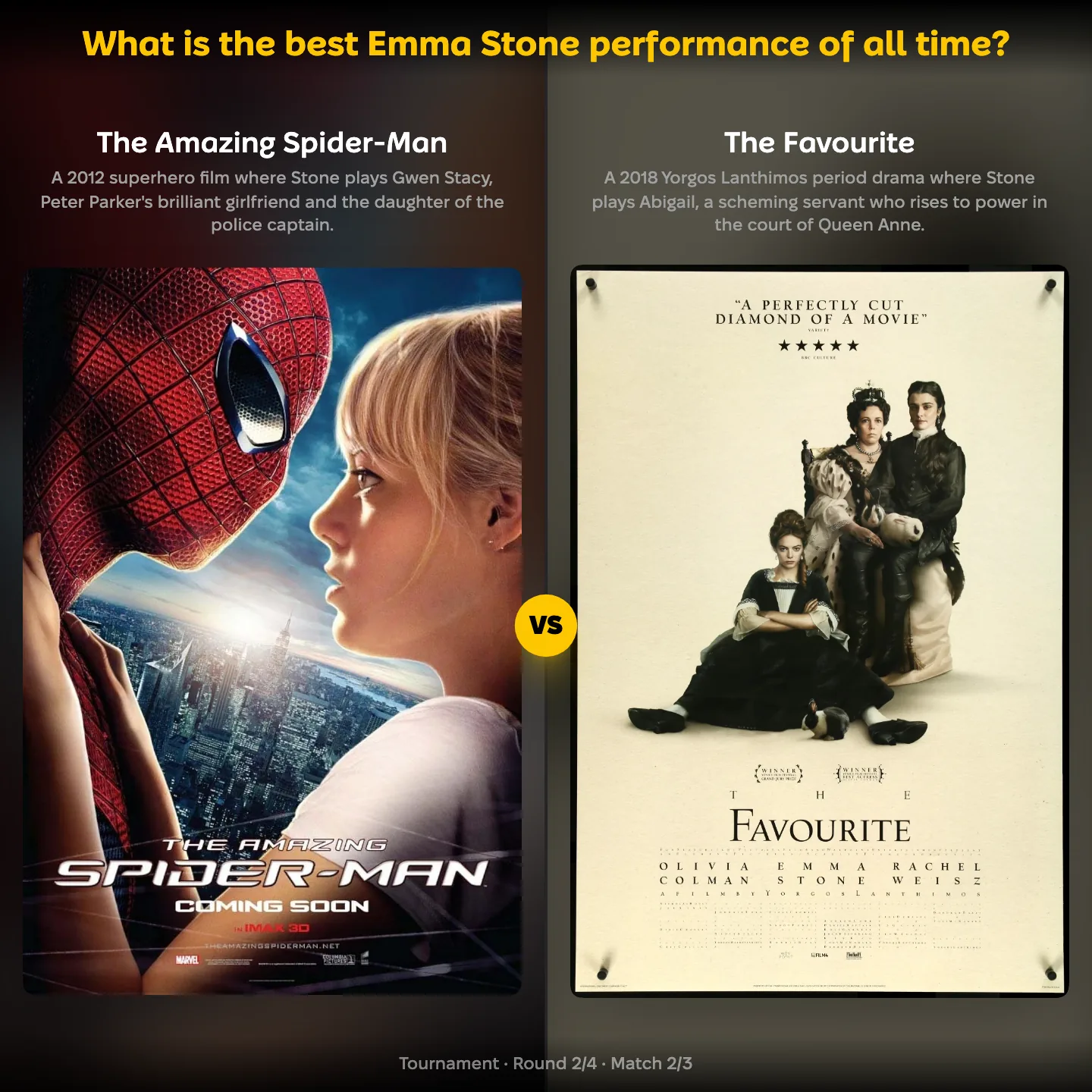
Emma Stone played Gwen Stacy in The Amazing Spider-Man (2012) and its 2014 sequel. On a ranking of her twelve best performances, the Spider-Man film has the least behind it.
She won Best Actress at the 96th Academy Awards for Poor Things.8 Five years before that she was nominated in Supporting Actress for The Favourite, in a year when Best Actress went to her co-star Olivia Colman.7
The Favourite is the useful comparison, because it shows what the surrounding work looks like: a Yorgos Lanthimos period comedy in which Stone plays a servant clawing her way into Queen Anne's court.
The Gwen Stacy case is not really about the performance. The part existed to be Peter Parker's girlfriend and then to die, and no amount of talent turns that into the best thing on a CV like this.
Jake Gyllenhaal played Mysterio and Lou Bloom
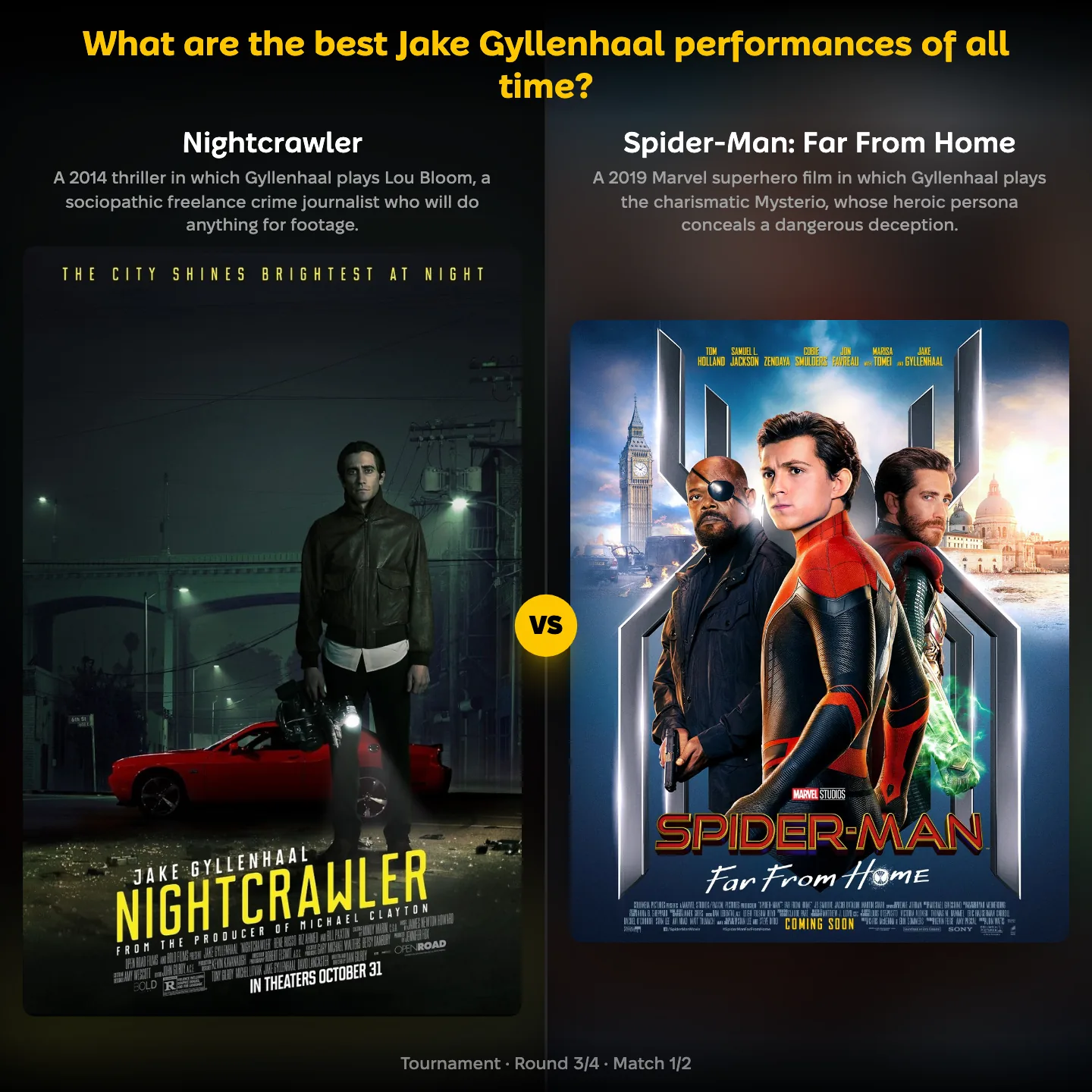
Jake Gyllenhaal played Mysterio in Spider-Man: Far From Home (2019). It is one of fourteen options on his performance ranking, and the hardest of the fourteen to build a case for.
Nightcrawler is why. Gyllenhaal lost a great deal of weight to play Lou Bloom, a freelance crime videographer who films what he causes, and it is the performance the rest of his career gets measured against.
Behind it sit Brokeback Mountain, Zodiac, Donnie Darko, Prisoners and Southpaw. The Academy nominated him in Supporting Actor for Brokeback Mountain at the 78th ceremony, where the award went to George Clooney for Syriana.13
The fair reading of Mysterio is that it is a good performance inside a film built on a twist: an illusionist selling a fake heroic persona, which is close to what Gyllenhaal has always been best at. It is also the only one of the fourteen where he is playing somebody else's villain.
Sony built his best rooms without Marvel Studios
Line the fifteen up and the pattern runs against the marketing. Spider-Man's strongest cases are the animated film and the games, both made on Sony's side of the arrangement with no Marvel Studios in the room. The live-action MCU entries put him among eighteen, and four of the lists here belong to other actors outright.
Spider-Man: Beyond the Spider-Verse is dated 18 June 2027, having lost its original slot to the 2023 writers' and actors' strikes,14 so Miles Morales gets a third film and this page gets a sixteenth framing. Every list here was settled by a straight choice between two names.
The ranking nobody has built yet is fictional New Yorkers: Peter Parker against Holden Caulfield, Carrie Bradshaw and Don Draper. It is available.
More rankings, more angles
- 16 Rankings, One Batman — Detective Comics #27, and seven screen Batmen
- Star Wars: 16 Lists, 16 Different Answers — six Oscars in 1977, then everything after
- Super Mario vs The Legend of Zelda: 16 Rankings, One Argument — 945 million Mario units against Ocarina of Time
Sources
- Marvel — Spider-Man: Brand New Day in theaters 31 July 2026, directed by Destin Daniel Cretton, starring Tom Holland, Zendaya, Sadie Sink, Jacob Batalon, Jon Bernthal, Tramell Tillman, Michael Mando and Mark Ruffalo, produced by Kevin Feige, Amy Pascal, Avi Arad and Rachel O'Connor: marvel.com (checked 2026-08-03)
- Academy of Motion Picture Arts and Sciences — 77th Academy Awards (2005), Visual Effects won by Spider-Man 2 (John Dykstra, Scott Stokdyk, Anthony LaMolinara, John Frazier): oscars.org (checked 2026-08-03)
- Box Office Mojo — Spider-Man: No Way Home: $1,921,426,073 worldwide, released 15 December 2021: boxofficemojo.com (checked 2026-08-03)
- Marvel — Amazing Fantasy (1962) #15, published 1 August 1962, writer Stan Lee, penciller Steve Ditko, first appearance of Spider-Man: marvel.com (checked 2026-08-03)
- Marvel — Incredible Hulk (1962) #181, published 1 November 1974, first appearance of Wolverine: marvel.com (checked 2026-08-03)
- Academy of Motion Picture Arts and Sciences — 47th Academy Awards (1975), The Godfather Part II winner in Best Picture, Directing, Actor in a Supporting Role, Adapted Screenplay, Art Direction and Original Dramatic Score: oscars.org (checked 2026-08-03)
- Academy of Motion Picture Arts and Sciences — 91st Academy Awards (2019), Animated Feature Film won by Spider-Man: Into the Spider-Verse; Emma Stone nominated in Actress in a Supporting Role for The Favourite; Actress in a Leading Role won by Olivia Colman: oscars.org (checked 2026-08-03)
- Academy of Motion Picture Arts and Sciences — 96th Academy Awards (2024), Animated Feature Film won by The Boy and the Heron with Spider-Man: Across the Spider-Verse nominated; Actress in a Leading Role won by Emma Stone for Poor Things: oscars.org (checked 2026-08-03)
- Sony Interactive Entertainment — press release, 23 October 2023: Marvel's Spider-Man 2 by Insomniac Games sold more than 2.5 million copies in 24 hours, the fastest-selling PlayStation Studios game in PlayStation history, with two playable Super Heroes: sonyinteractive.com (checked 2026-08-03)
- PlayStation.Blog — PS5 launches 12 November 2020 in the US, Japan, Canada, Mexico, Australia, New Zealand and South Korea, with Marvel's Spider-Man: Miles Morales and Demon's Souls among the launch titles: blog.playstation.com (checked 2026-08-03)
- Box Office Mojo — Spider-Man (2002): $114,844,116 domestic opening weekend, $139,000,000 budget, Sony Pictures Releasing: boxofficemojo.com (checked 2026-08-03)
- Television Academy — Zendaya's Emmy record: wins for Outstanding Lead Actress in a Drama Series for Euphoria in 2020 and 2022, youngest and first Black actress to win the category twice, nominated again in 2026: televisionacademy.com (checked 2026-08-03)
- Academy of Motion Picture Arts and Sciences — 78th Academy Awards (2006), Actor in a Supporting Role: Jake Gyllenhaal nominated for Brokeback Mountain, award won by George Clooney for Syriana: oscars.org (checked 2026-08-03)
- The Numbers — Spider-Man: Beyond the Spider-Verse: theatrical release 18 June 2027, Sony Pictures, production disrupted by the 2023 WGA and SAG strikes: the-numbers.com (checked 2026-08-03)