
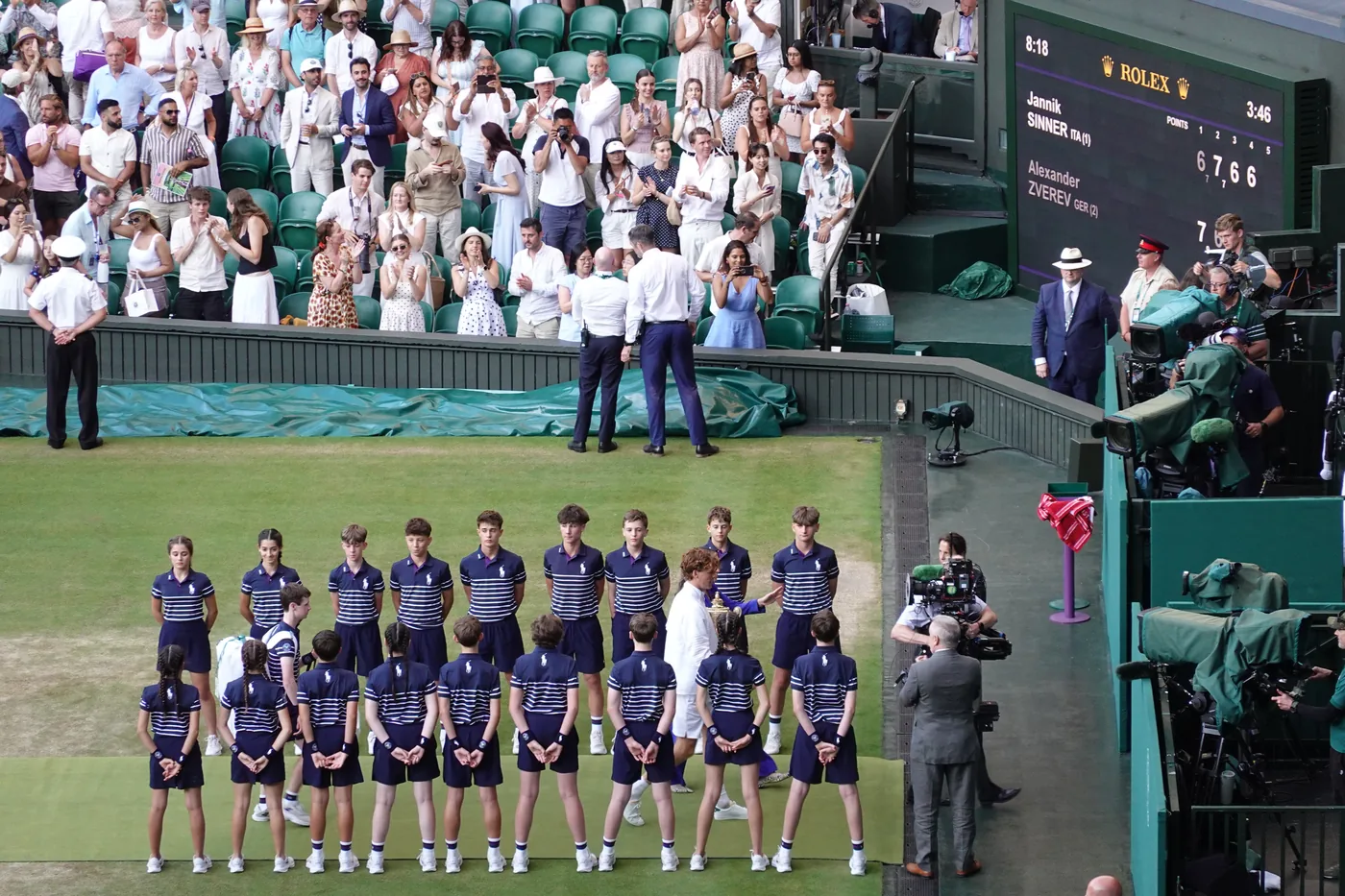
Jannik Sinner won the first five Masters 1000 events of 2026, at Indian Wells, Miami, Monte-Carlo, Madrid and Rome, and the last of them completed his career Golden Masters: every one of the nine biggest titles the tour holds below the majors.1
He retained Wimbledon in July. On 31 July he was still world No. 1, at 24 years old.2
Eleven rankings on this page carry his name, and they read like eleven different careers.
Paris clay is the one room where Sinner is still an underdog, and it quietly decides how most of these lists read.
Sinner vs Alcaraz: the top of the game is two players deep
The first ranking asks the plainest question the sport has: who is the best men's player in the world today. Sinner, Carlos Alcaraz, Alexander Zverev, Novak Djokovic and a long tail of names below them are all in the field.
Sinner brings the body of work. Thirty tour titles and a career record of 365 wins against 89 defeats, all of it since he turned professional in 2018.2
Alcaraz brings the trophies that decide arguments. He owns seven majors to Sinner's five, and at the 2026 Australian Open in January he became the youngest man of the Open era to complete the career Grand Slam, at 22 years and 272 days.3
The distance between those two claims is mostly Alcaraz's summer. He played neither Roland-Garros nor Wimbledon in 2026, and by the end of July he had dropped to No. 3.4 Sinner played all three majors of the year.
Sinner vs Djokovic: the all-time table and its arithmetic
Open the same question to every era and Sinner becomes the youngest name in a field built out of finished careers: Djokovic, Roger Federer, Rafael Nadal, Rod Laver, Bjorn Borg.
Djokovic is the wall at the far end of it. He has 101 tour titles and 1,177 career wins against 238 defeats, and he was still ranked No. 5 at 39 years old at the end of July 20265 — a career that began when Sinner was two.
Sinner is on this list for rate rather than volume, which is the only case an unfinished career can make.
Borg is the precedent that makes it a serious one. He won 11 major titles in seven years and walked away at 26,6 so a career this short has belonged in this company before.
The career Golden Masters, completed at 24
This ranking asks something narrower than quality: which world No. 1 was the hardest to beat while he held the top of the game.
Sinner's 2026 is the exhibit. He went 44-3 through the end of July,2 and the nine Masters 1000 events sit immediately below the majors in prestige, which is why closing the set in Rome in May mattered more than any individual trophy in it.
The men he is held against were all measured across years instead of one summer: Federer, Djokovic, Ivan Lendl, Jimmy Connors. That is the case against Sinner in this frame, and none of it is about how he played.
His own season supplies the other half of it. The Australian Open ended for him in a January semi-final and Paris ended for him in May,1 so a year that looks total on the Masters ledger is one major out of three.
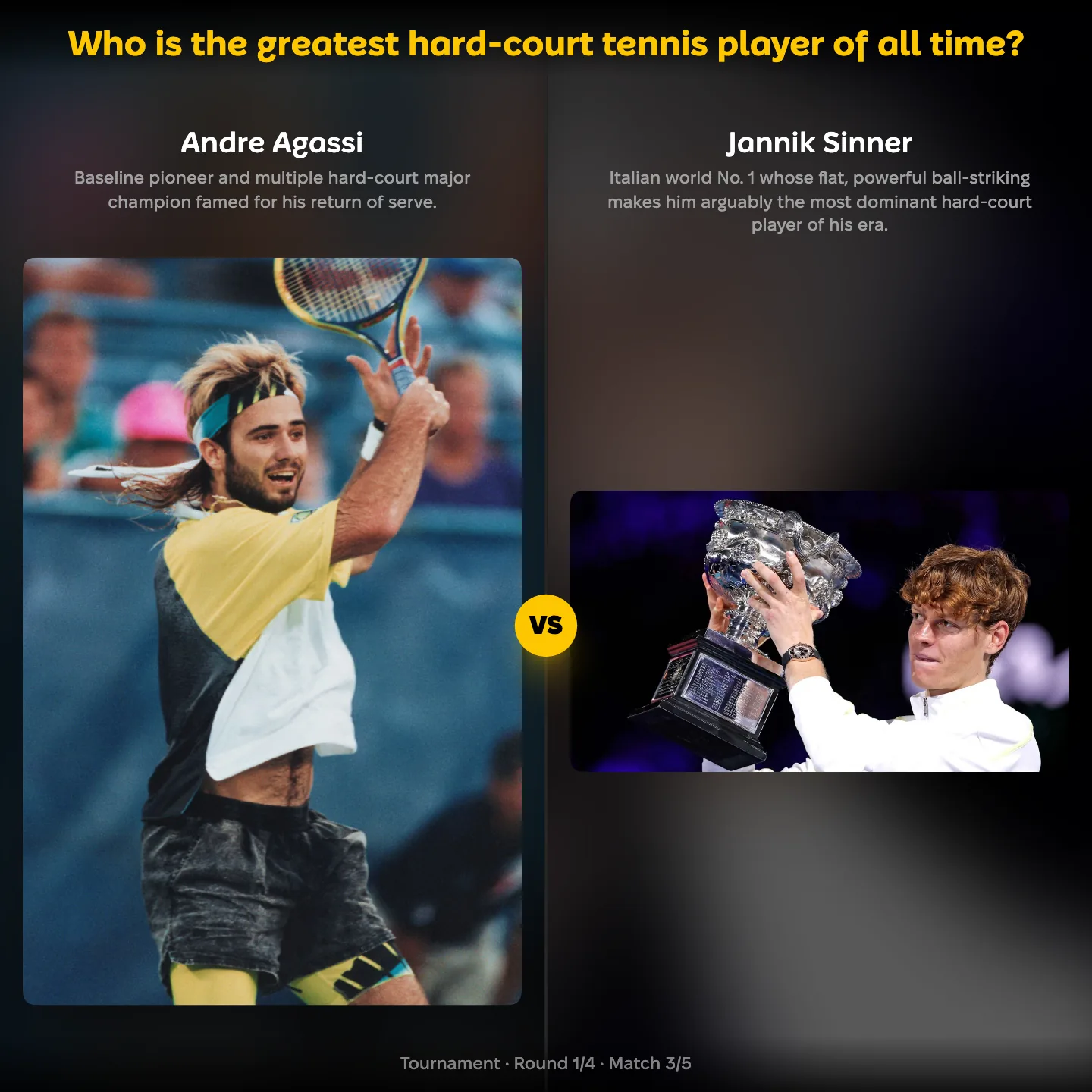
Melbourne and New York: the hard-court case
Restrict the all-time question to hard courts and Sinner's record stops looking short.
He won the Australian Open in 2024 and again in 2025, and the US Open in 2024. Those three are the majority of everything he has won at major level.
Djokovic is the reason this stays difficult. He has won the Australian Open ten times between 2008 and 2023,5 so one tournament on his record outnumbers Sinner's whole collection of majors twice over.
Andre Agassi belongs in the same room, with a game built for concrete and a return of serve nobody has improved on. Sinner's hard-court case is sharper by season and far shorter by decade.
Wimbledon twice, and Borg's five in a row
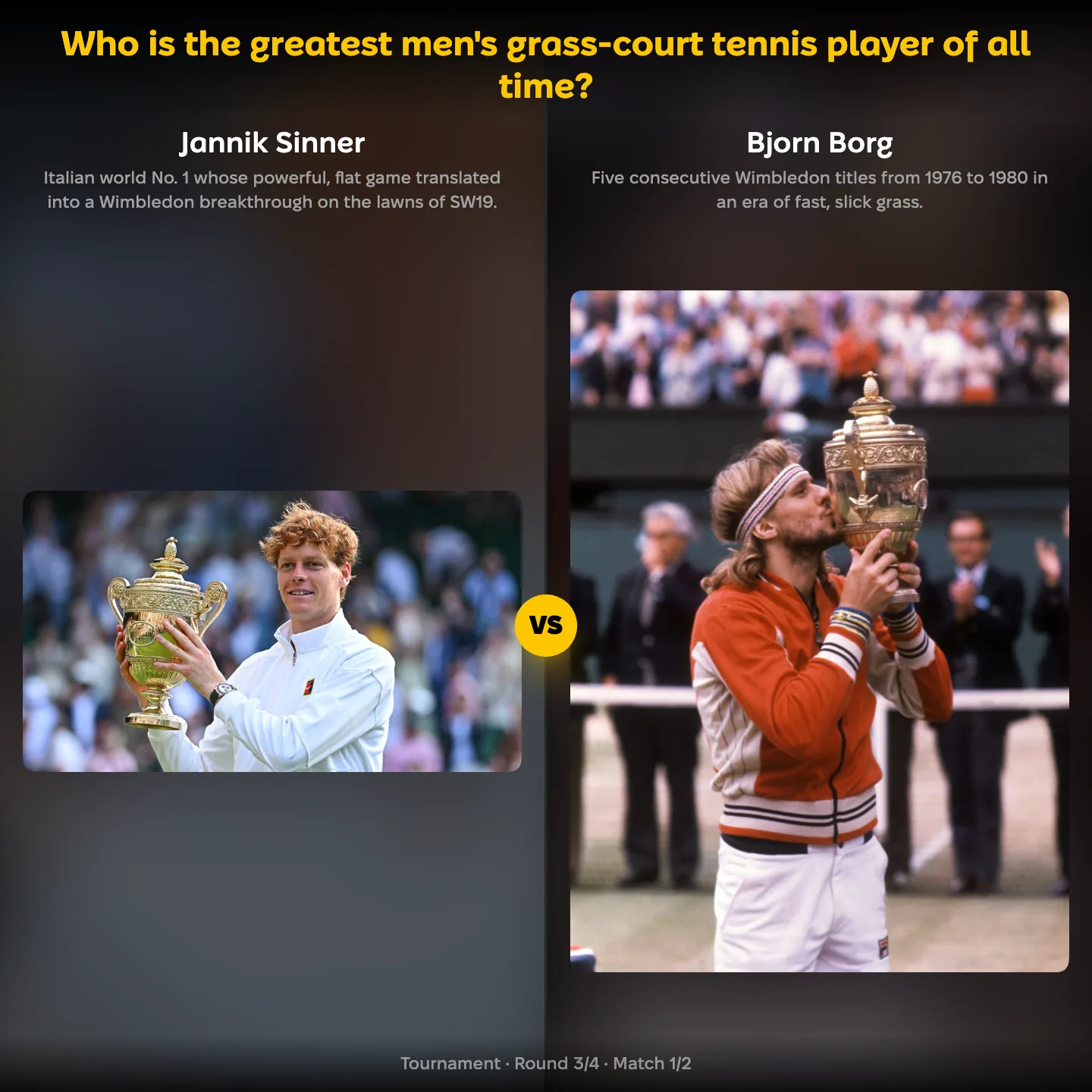
Grass has the shortest season in tennis and the longest memory. Sinner is on this list as a two-time Wimbledon champion, having won the title in 2025 and defended it against Zverev a year later.
Borg is the standard on the surface: five consecutive Wimbledon championships, 1976 through 1980, the last of them the five-set final against John McEnroe.6
Pete Sampras managed seven titles at the All England Club.7
Two is a start, and Sinner's grass career is exactly two summers old. Winning them back to back is the one structural thing he already shares with Borg.
After the Big Three, a Big Two
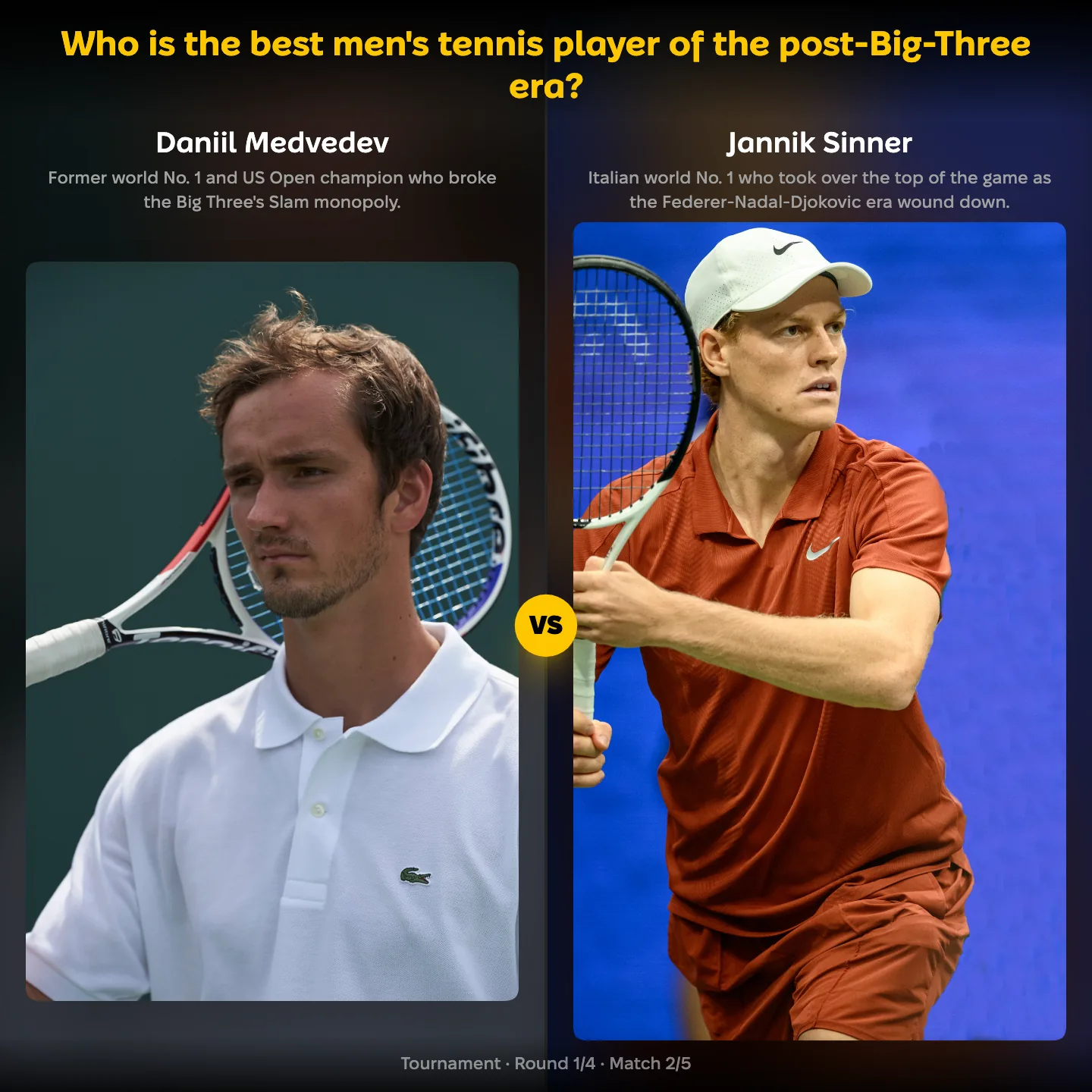
Take Federer, Nadal and Djokovic out of the frame and the era Sinner belongs to gets very small.
Roland-Garros calls it the Big Two in its own profile of Alcaraz, and 2025 is why: Sinner beat him in the Wimbledon final, Alcaraz beat him in the US Open final that September.3
Daniil Medvedev and Zverev are the other names with a claim, and Zverev's arrived at Roland-Garros in June 2026.8
Panatta, Pietrangeli and the shortest great tradition in tennis
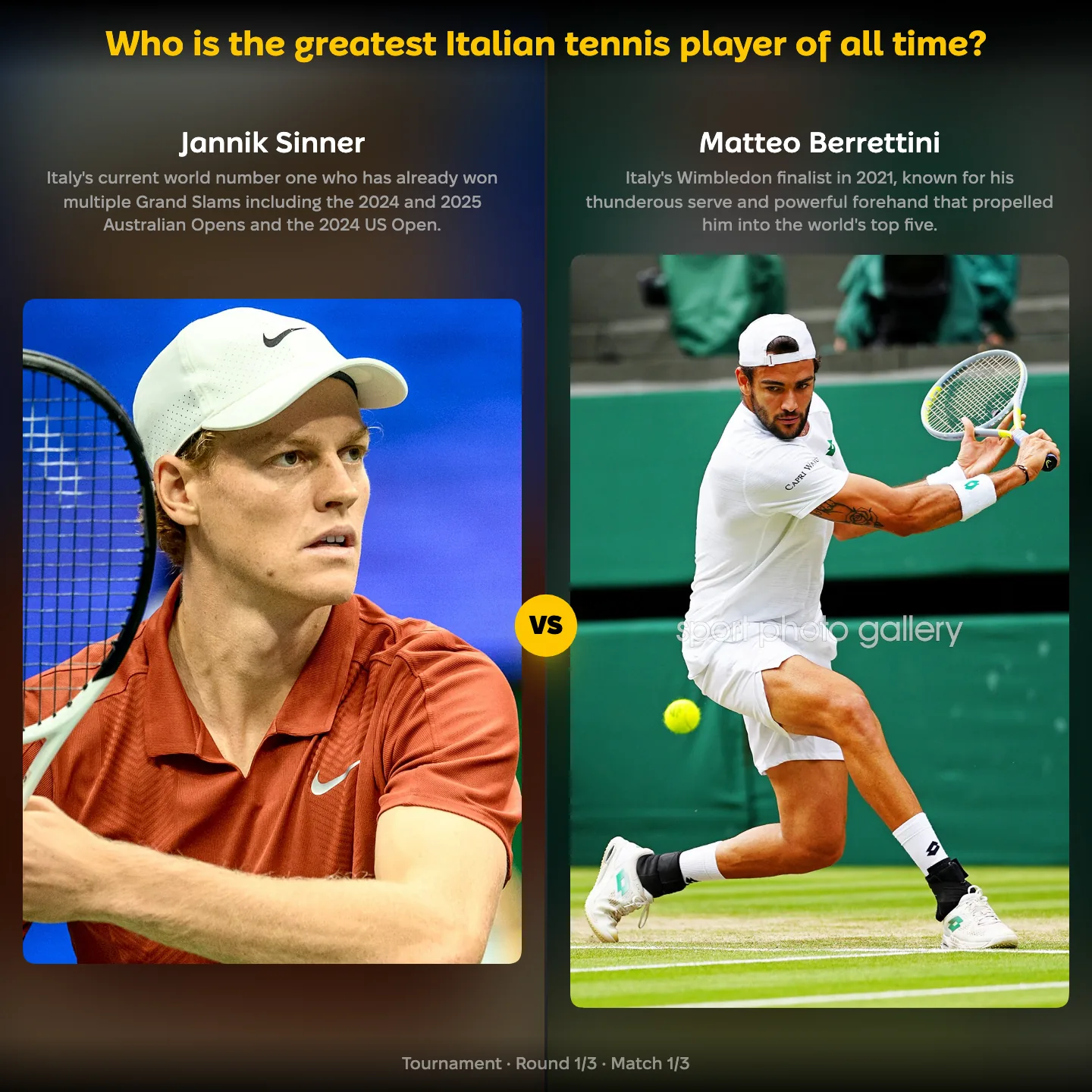
Italy has produced champions since the 1950s and, until Sinner, never a world No. 1 — that gap is the whole shape of this ranking.
Nicola Pietrangeli won Roland-Garros in 1959 and 1960. Adriano Panatta won it in 1976, beating Borg in four sets in the quarter-finals on the way, and the tournament's own history of that fortnight records him as the second Italian man ever to win a major.9
Sinner is the first Italian to reach No. 1, which he did in June 2024 at 22 years old.1 Everything Italian tennis owned before him arrived in single fortnights.
Flavio Cobolli is the awkward footnote in the Italian story. Seeded 10 in 2026, he reached the Roland-Garros final and lost it to Zverev in five sets across four hours and 16 minutes,8 in the same fortnight Sinner went out in round two.
Sinner among Rossi, Tomba and Pantani
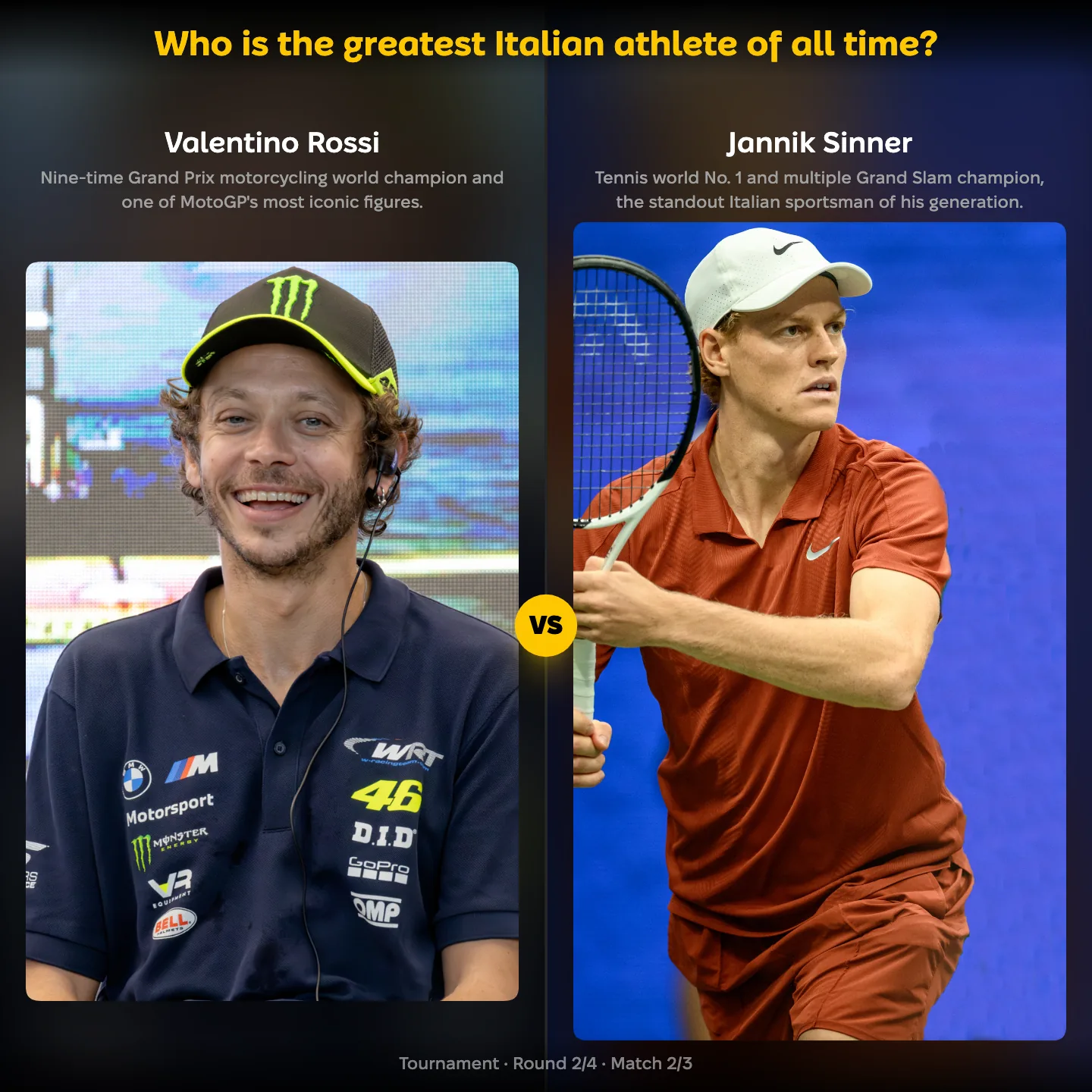
Widen the frame to every sport Italy has ever cared about and Sinner is standing beside Valentino Rossi, Alberto Tomba and Marco Pantani. What he brought into that company is a team trophy: Italy won the Davis Cup in 2023, 2024 and 2025, after one previous title in 1976 against Chile in Santiago.10
Roland-Garros, the trophy that is missing
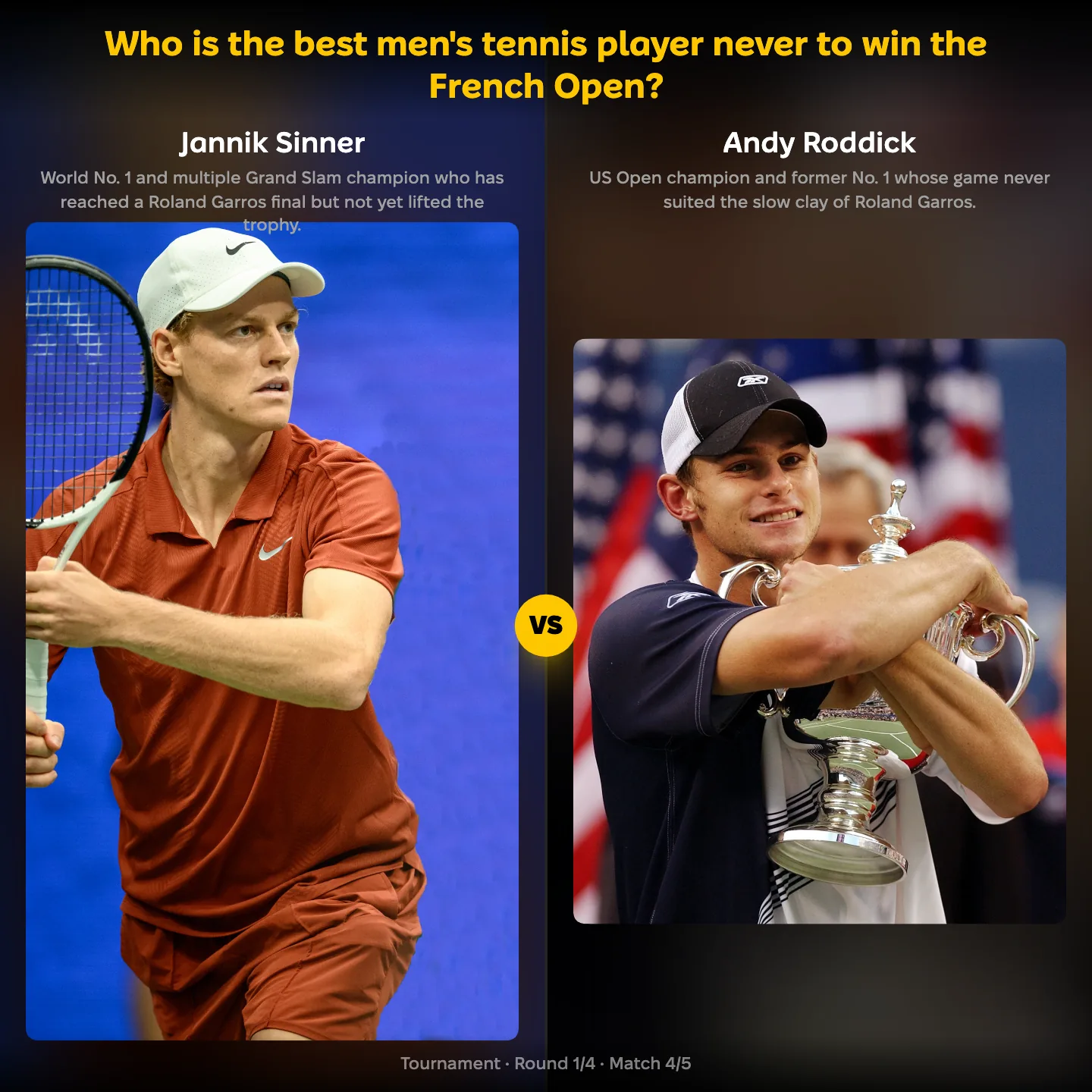
Every long career has a hole in it. Sinner's is Roland-Garros, and this ranking is the club that hole puts him in.
He has come within a match of filling it. The 2025 final in Paris ran five hours and 29 minutes, the longest in the tournament's history, and Alcaraz won it from behind.3
2026 read worse. Sinner arrived having won every clay Masters 1000 event of the spring and went out in the second round on 28 May, in five sets, to a player ranked 56th in the world.1
The company here is genuinely good. Sampras won 14 majors and never won in Paris; the slow clay simply did not suit him, and his best finish there was the 1996 semi-final.7 Sinner has the opposite problem: he wins on clay everywhere except the one place it counts most.
The redhead bracket
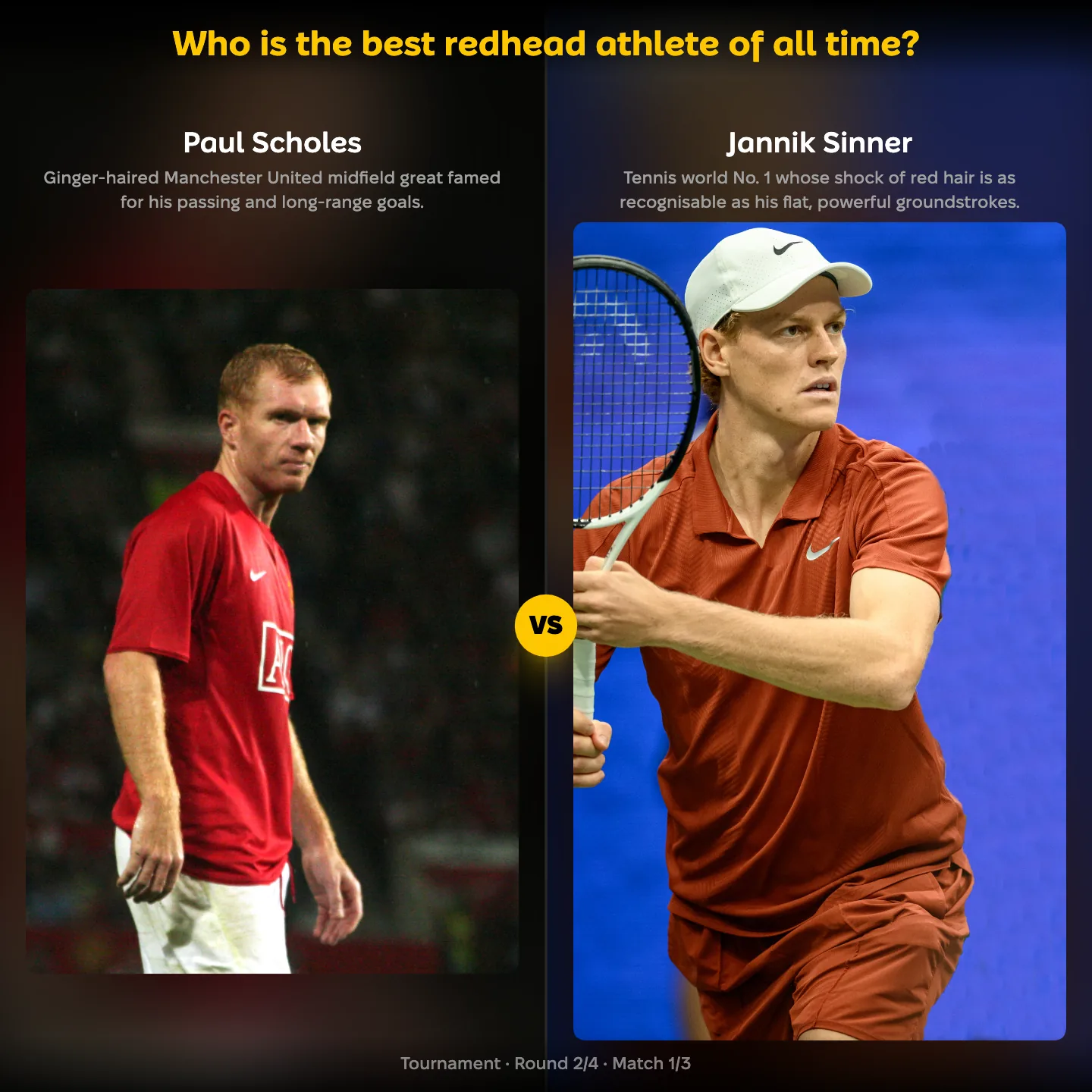
Judge the world's athletes on hair colour alone and Sinner's copper mop turns into a qualification. Paul Scholes and everyone else in the field are in on exactly the same terms.
The skier from San Candido
This ranking is for athletes who reached the top of a sport that was not the first thing they were good at. Sinner qualifies on a childhood rather than on a second career.
He was born in San Candido, in the Dolomites, in 2001, and the Roland-Garros profile of him records that he first excelled as a promising young skier before turning fully to tennis.1
That is also the honest limit of his entry. Bo Jackson and the others on this list arrived in a second sport with a finished first one behind them, and Sinner arrived with a road not taken.

What Paris still decides
Nothing on this page required Sinner to be the best player who ever lived. It required him to be the reason a question is worth asking twice, and on hard courts, on grass, in Italy and inside his own generation he is.
Paris is the exception, and the only one of these questions with a fixture date attached: Roland-Garros 2027 runs from 17 May to 6 June.1
These lists get settled one pair at a time, so filling any of them in takes about a minute.
If a field here is missing a name that belongs in it, start the ranking that has it.
More rankings, more angles
- Federer vs Nadal vs Djokovic — 16 Lists That Split Them — the three careers Sinner is held against
- Sinner vs Alcaraz: Two No. 1s, 14 Different Lists — the rivalry seen from both sides
- Serena Williams Won 23 Majors. The Lists Still Can't Place Her — 23 majors, sixteen questions
- Billie Jean King Won 39 Majors. One Exhibition Made Her Famous — 39 majors, and one exhibition match
Sources
- Roland-Garros (Fédération Française de Tennis) — official Jannik Sinner player profile: his Grand Slam results grid (Wimbledon champion 2025 and 2026, Australian Open 2024 and 2025, US Open 2024, Australian Open semi-final 2026), the first five Masters 1000 titles of 2026 and the career Golden Masters, first Italian to reach world No. 1 in June 2024 aged 22, birth in San Candido and the early skiing, the 2026 second-round defeat by world No. 56 Juan Manuel Cerúndolo on 28 May, and the 2027 tournament dates: rolandgarros.com (checked 2026-08-03)
- Australian Open (Tennis Australia) — official Jannik Sinner player page: singles ranking No. 1 as at 31 July 2026, age 24, 30 career singles titles, career record 365-89, 2026 record 44-3, turned professional 2018: ausopen.com (checked 2026-08-03)
- Roland-Garros (Fédération Française de Tennis) — official Carlos Alcaraz player profile: his seven Grand Slam titles and blank 2026 Roland-Garros and Wimbledon lines, the career Grand Slam completed at the 2026 Australian Open aged 22 years 272 days, the 5hr 29min 2025 Roland-Garros final, the 2025 Wimbledon and US Open finals against Sinner, and the "Big 2" description: rolandgarros.com (checked 2026-08-03)
- Australian Open (Tennis Australia) — official Carlos Alcaraz player page: singles ranking No. 3 as at 31 July 2026: ausopen.com (checked 2026-08-03)
- Australian Open (Tennis Australia) — official Novak Djokovic player page: ten Australian Open titles (2008, 2011, 2012, 2013, 2015, 2016, 2019, 2020, 2021, 2023), 101 career singles titles, career record 1177-238, and ranking No. 5 at 39 as at 31 July 2026: ausopen.com (checked 2026-08-03)
- International Tennis Hall of Fame — Bjorn Borg inductee profile: five consecutive Wimbledon titles from 1976 to 1980 and the 1980 final against John McEnroe, 11 major singles titles in seven years, and retirement at 26: tennisfame.com (checked 2026-08-03)
- International Tennis Hall of Fame — Pete Sampras inductee profile: 14 major titles including seven at Wimbledon, the French Open as the one major he never won, on clay that did not suit him, and the 1996 semi-final as his best finish in Paris: tennisfame.com (checked 2026-08-03)
- Roland-Garros (Fédération Française de Tennis) — official 2026 men's singles final match record: Alexander Zverev beat Flavio Cobolli, seeded 10, in five sets on Court Philippe-Chatrier in 4hr 16min: rolandgarros.com (checked 2026-08-03)
- Roland-Garros (Fédération Française de Tennis) — tournament history feature on the 1976 edition: Adriano Panatta as the second Italian man to win a major after Nicola Pietrangeli's 1959 and 1960 titles in Paris, and his four-set quarter-final win over Bjorn Borg: rolandgarros.com (checked 2026-08-03)
- Davis Cup (International Tennis Federation) — previous champions table: Italy champions in 2023, 2024 and 2025, and the 1976 final won 4-1 against Chile in Santiago: daviscup.com (checked 2026-08-03)