
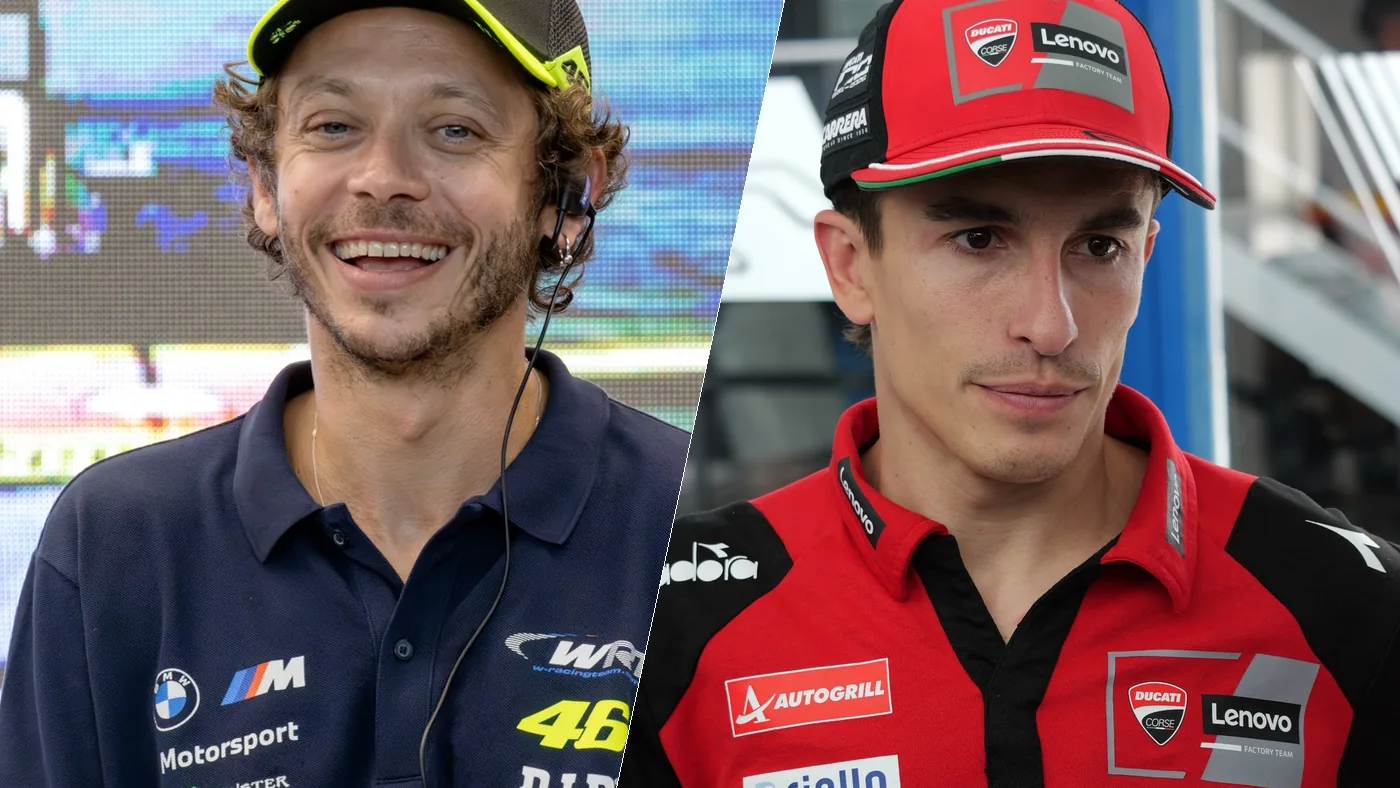
Valentino Rossi and Marc Márquez have won nine world championships each. Seven of those are premier-class titles, and they hold that number jointly too: Márquez drew level in September 2025, taking his seventh MotoGP crown at the Japanese Grand Prix with five rounds still to run.1 By MotoGP's own count, only Giacomo Agostini has more, with eight.2
They never won a title in the same season. Rossi's last arrived in 2009, Márquez's first in 2013, and what the two men actually shared was nine years of racing each other and one afternoon in Malaysia that neither has finished explaining.
Eight of our rankings put one or both of these two riders on the same page as everyone else.
Rossi and Márquez ran out of ways to separate themselves on trophies, so every list that holds both has to reach for a different measure.
Rossi vs Márquez: the question the sport never settles
The broadest question in motorcycle racing puts sixteen riders on one list, and Rossi and Márquez are two of them. Agostini, Mike Hailwood, Mick Doohan, Casey Stoner and Ángel Nieto are on it as well, which is the useful part: it forces the two modern names into company that predates both.
Rossi's case is the record book. His 89 premier-class wins and 199 premier-class podiums are still the highest anyone has managed, from 372 starts.3 Across every class he won 115 grands prix, second only to Agostini's 122, and he is the only rider to have taken titles in 125cc, 250cc, 500cc and MotoGP.4
Márquez's case is concentration. Seven premier-class titles arrived in thirteen seasons of trying, the first of them in 2013 as a rookie, and MotoGP counted his premier-class wins at 73 when he took the 2025 championship — second only to Rossi.2
The counter-argument belongs to neither of them. Agostini won eight premier-class titles and 122 races in an era with fewer riders and more danger, and Hailwood won across four classes in a single decade.
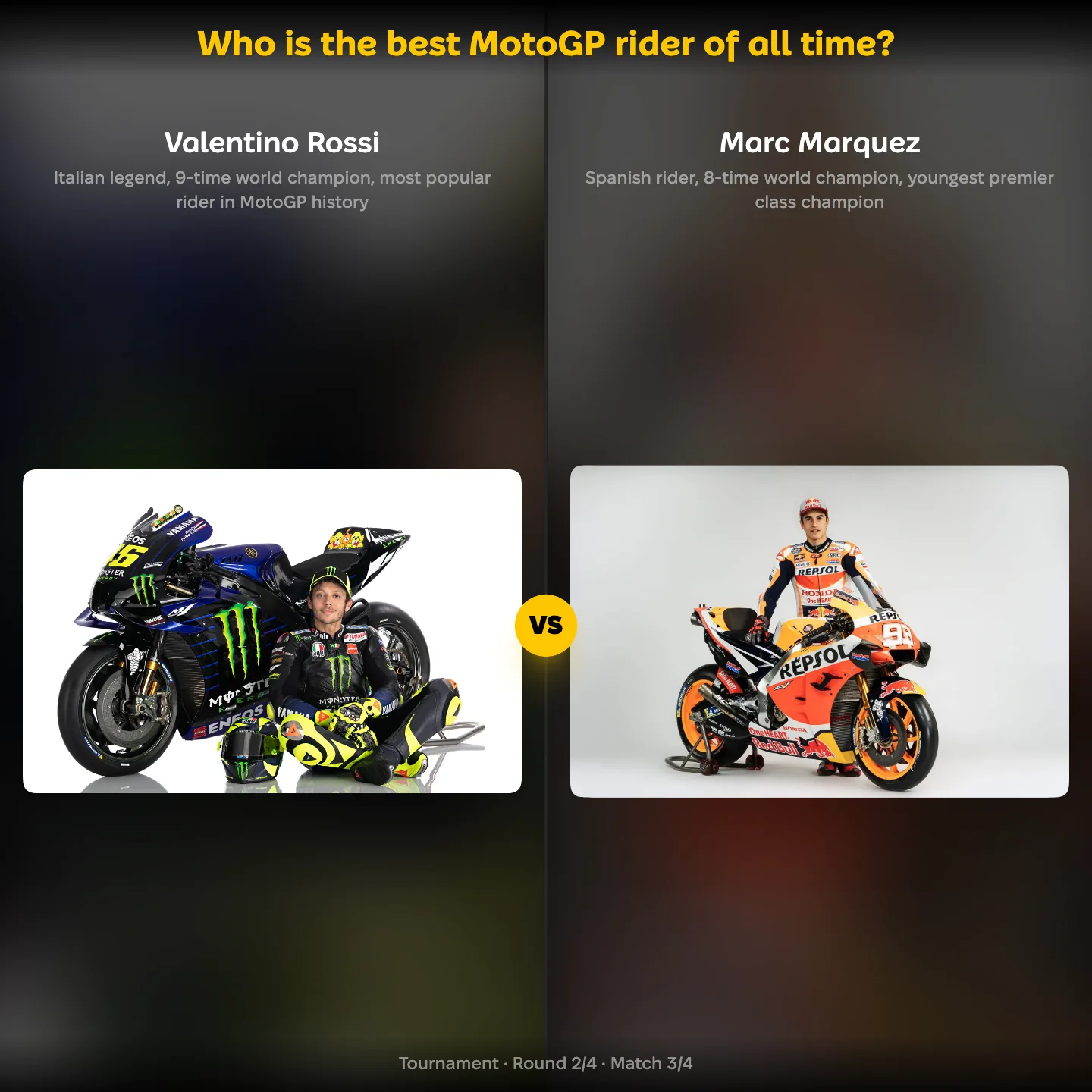
Senna, Schumacher and two riders on a car-heavy list
Widen the question past motorcycles and the pair become two entries among sixteen, most of them on four wheels. Ayrton Senna, Michael Schumacher, Lewis Hamilton, Juan Manuel Fangio, Enzo Ferrari, Dale Earnhardt and Richard Petty are all there.
Rossi travels furthest outside his own sport. The number 46 and the yellow grandstands became shorthand for MotoGP itself during the 2000s, his VR46 team races in the class today, and he is still competing in cars at 47.
Márquez is the harder sell here, and honestly so. His fame is concentrated inside motorcycle racing, where it is enormous, and thins quickly outside it. The 2025 championship changed that a little, because a comeback story travels where a lap record does not.
Neither of them carries this list. Senna's death at Imola in 1994 made him motorsport's defining figure well beyond its own audience, and Schumacher's seven Formula 1 titles did something similar from the other direction. That is the honest shape of a motorsport ranking: two riders, both giants at home, both smaller here.
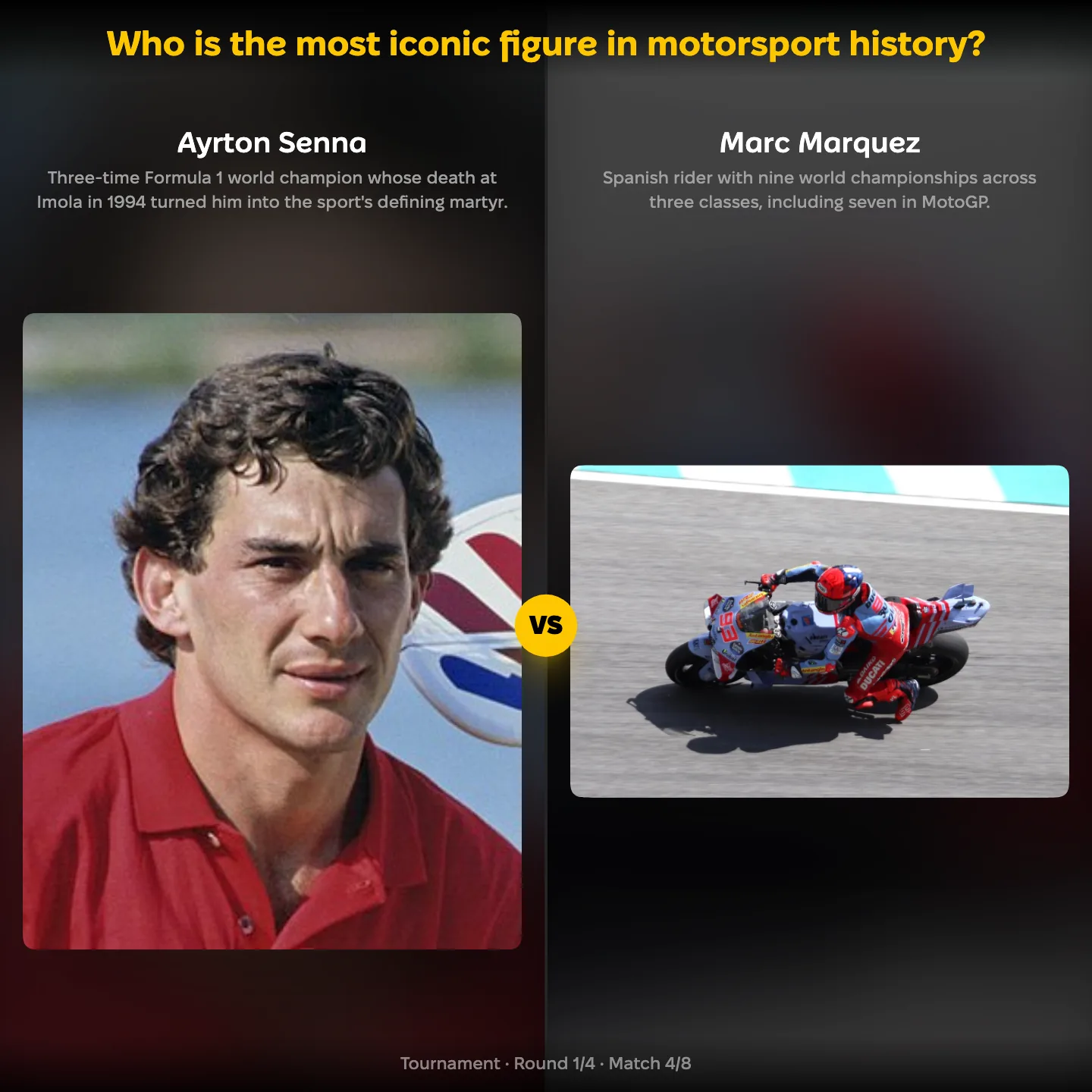
The 2010s: Márquez's decade, and Rossi's three second places
Three riders won the premier class during the 2010s, and Rossi was not one of them. Jorge Lorenzo took the title in 2010, 2012 and 2015, Stoner in 2011, and Márquez won the other six.
Márquez owns the decade on any measure a stopwatch understands. Six championships in seven seasons, starting at 20 years old, is the tightest run of premier-class dominance since Doohan's five in a row in the 1990s.
Rossi's decade is the interesting one. He spent 2011 and 2012 on a Ducati that suited nobody, came back to Yamaha and finished runner-up in 2014, 2015 and 2016 without adding a tenth title. In 2015 the margin was five points.5
Behind those three sit the riders the decade wasted. Andrea Dovizioso finished second to Márquez three years running on a Ducati, Dani Pedrosa won races for thirteen seasons without a premier-class title, and Stoner walked away at 27 while still winning.
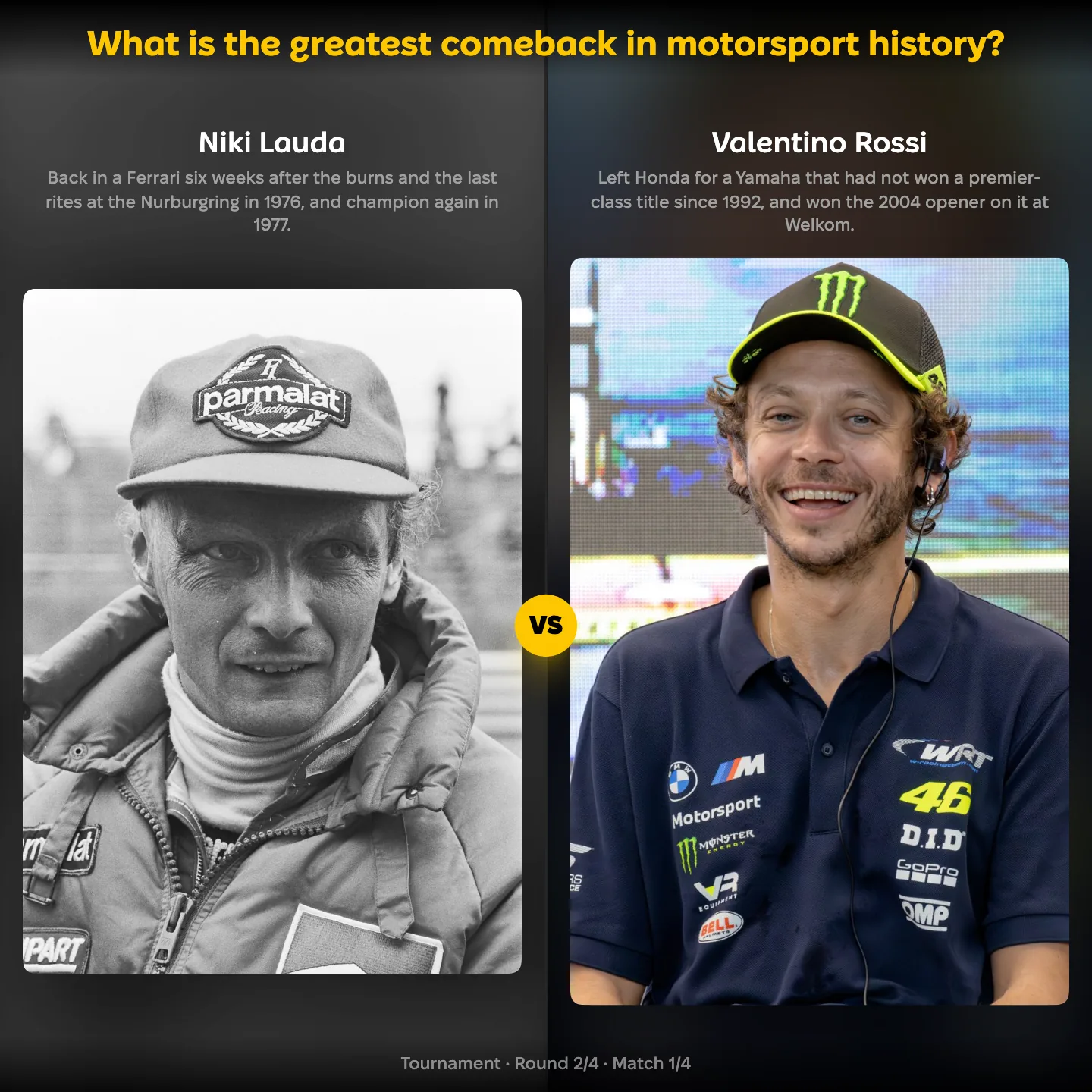
Niki Lauda vs Valentino Rossi: what a comeback actually costs
A comeback ranking that crosses disciplines is a strange place to find these two, and it is where Márquez has his strongest claim of the eight lists here. Niki Lauda, Alex Zanardi, Robert Kubica, Mika Häkkinen, Doohan and Barry Sheene fill the rest of it.
Márquez broke his right humerus at Jerez in July 2020. MotoGP's own accounting of the return runs to five surgeries on the arm and shoulder, 30 races missed and 2,184 days between championships, a six-year gap and the longest anyone has left between MotoGP titles.2 He spent part of it on a satellite Gresini Ducati before the factory seat came.
Rossi's entry is a different kind of recovery and a weaker one. In 2004 he left Honda for a Yamaha that had not won a premier-class title since 1992 and won the opening race at Welkom on it, which is a career rescue rather than a medical one.
Lauda carries the list, and it is not close. He was read the last rites after the Nürburgring in 1976, was back in a Ferrari six weeks later, and won the championship again in 1977. Zanardi's four Paralympic golds after losing both legs sit in the same tier.
Honda: nine premier-class titles for two riders, a decade apart
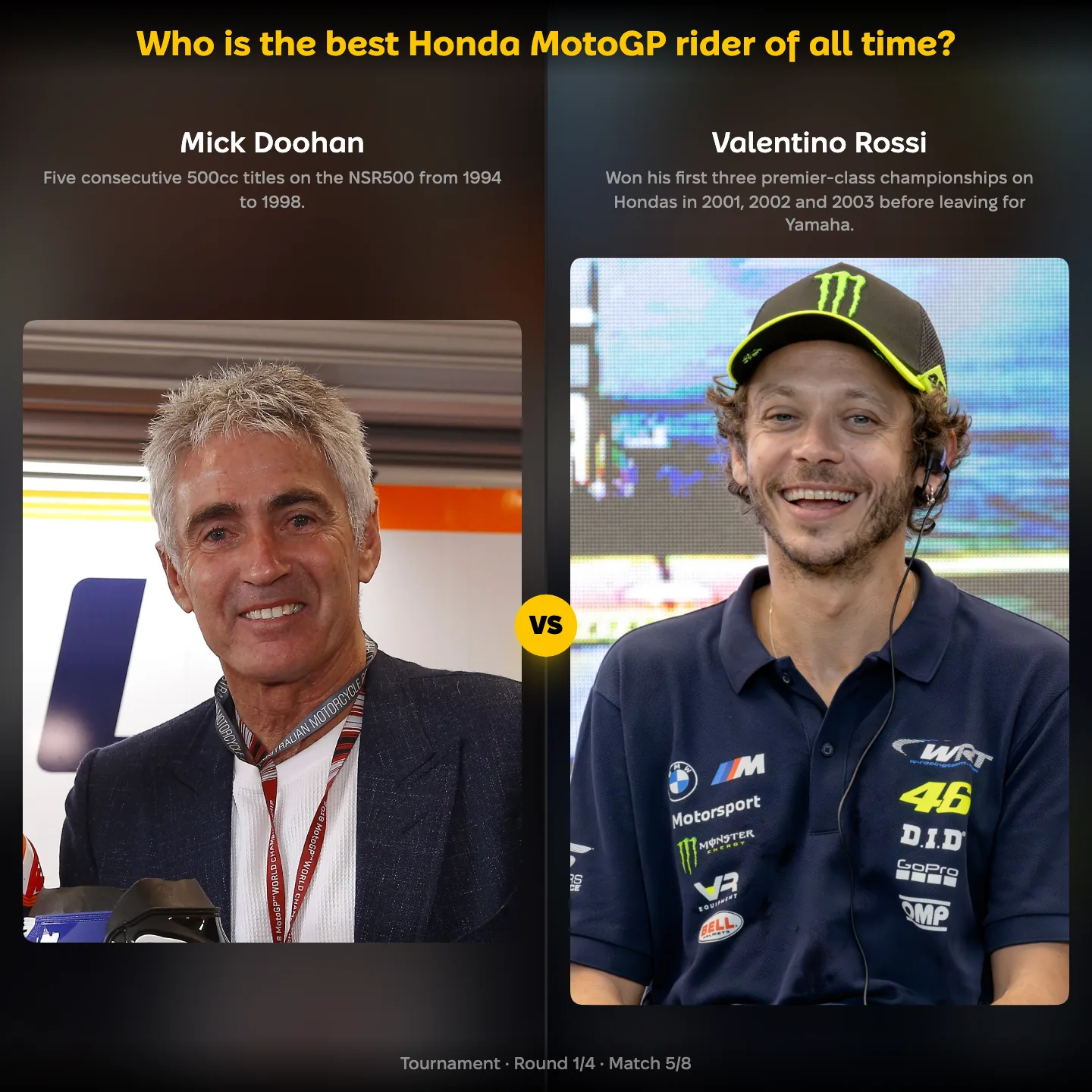
Honda has handed its premier-class bike to both of them, which makes this the one manufacturer list where they can be compared on something close to equal terms.
Rossi won his first three championships on Hondas, in 2001, 2002 and 2003, and then left at the height of it because he wanted the win to be his rather than the bike's. That decision is the reason the 2004 Yamaha story exists at all.
Márquez won six on the RC213V between 2013 and 2019 and stayed until the arm injury had cost him three seasons. He left for Ducati in 2024, and the factory Ducati is where the seventh title came from.
Honda's older riders have a strong case against both. Doohan won five consecutive 500cc titles on the NSR500 from 1994 to 1998, Freddie Spencer gave Honda its first 500cc crown in 1983 and took the 250cc and 500cc titles together in 1985, and Nicky Hayden beat Rossi to the 2006 championship in the Valencia finale.
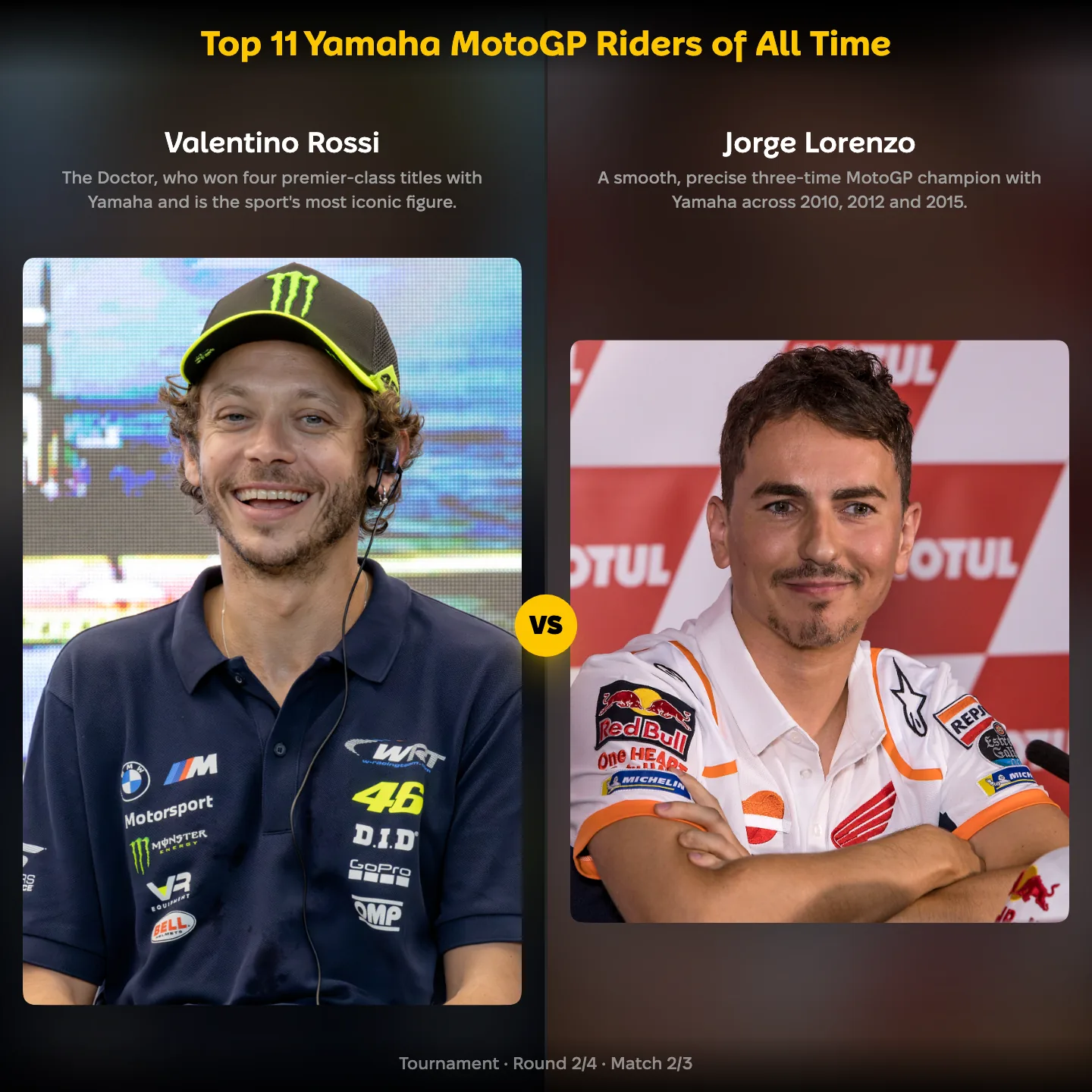
Yamaha's eleven, and the rider who cannot be on the list
Márquez has no way onto this ranking. He has never raced a Yamaha in the premier class, so a manufacturer question is the cleanest way to show what a career spent moving looks like next to one spent staying.
Rossi is the reason the list exists in its current shape. He won four premier-class championships on the M1 between 2004 and 2009, came back to the team in 2013 after the Ducati years, and finished his grand prix career there in 2021.
Jorge Lorenzo is the genuine rival on it, with three titles of his own for Yamaha between 2010 and 2015. Wayne Rainey, Kenny Roberts, Agostini and Fabio Quartararo fill in four more decades of the same garage.
For Márquez the counter-argument is that manufacturer lists reward loyalty, and his career has been built on the opposite instinct. He won six championships for Honda and the seventh for Ducati, which puts him in the small group of riders to take MotoGP titles with more than one factory, and which is exactly why a Yamaha ranking cannot hold him.
Rossi did both. He won three titles for Honda and four for Yamaha, and the fact that he has a claim on two manufacturer lists while Márquez has a claim on two different ones is the tidiest summary of these careers anybody has written.
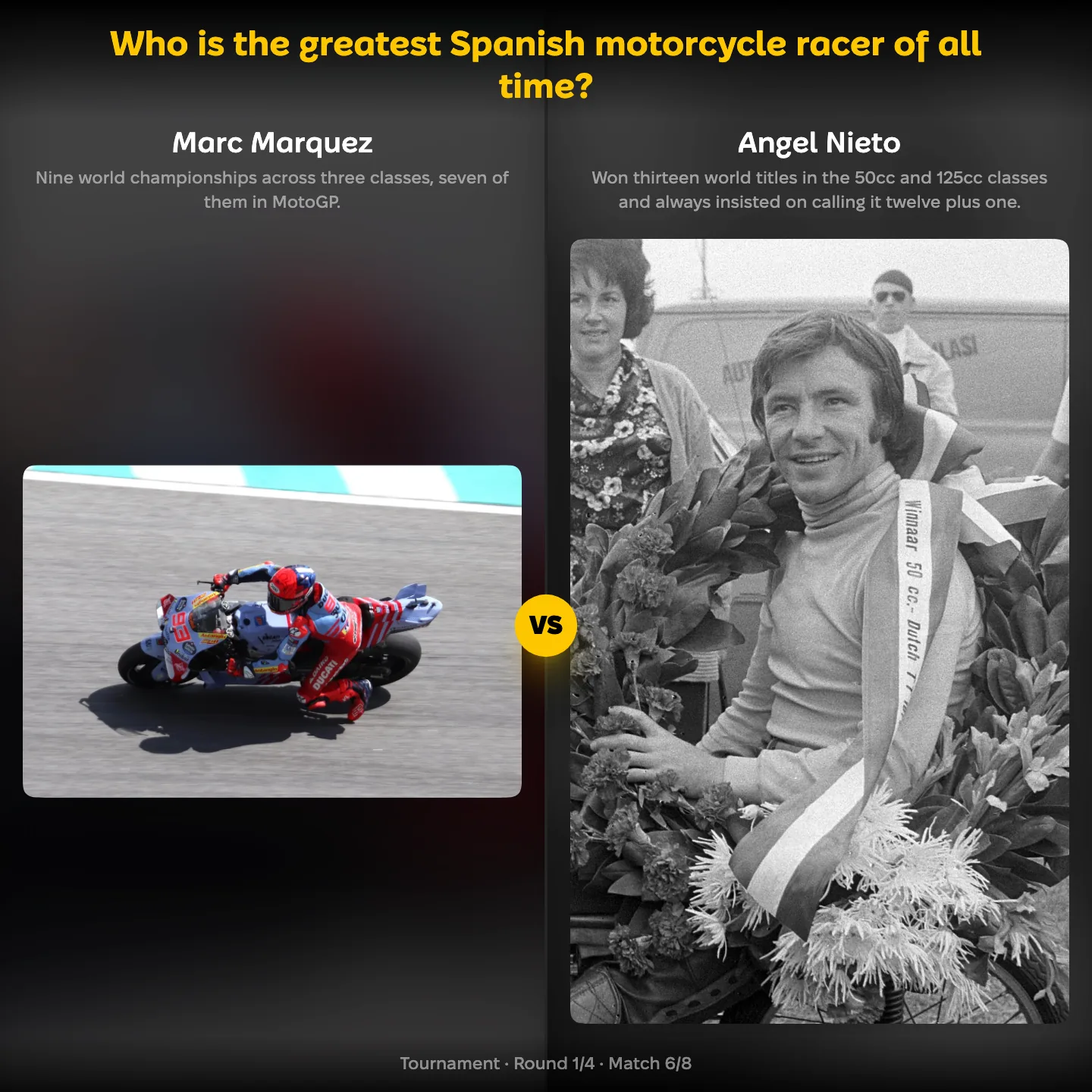
Ángel Nieto vs Marc Márquez: Spain's deepest field
Rossi cannot enter this one, and the absence is worth a moment: Spain produces so many grand prix winners that a national ranking is harder to top than most international ones.
Márquez has the modern case. Nine world championships across 125cc, Moto2 and MotoGP make him the most decorated Spanish rider of the current era.6
Ángel Nieto has the historical one. He won thirteen world titles in the 50cc and 125cc classes, then spent decades correcting anyone who said thirteen, because he considered the number unlucky and preferred twelve plus one. Small habits like that keep a rider in the conversation long after the racing stops.
Then there is the depth, which is what makes a Spanish list harder than it looks. Jorge Lorenzo won three MotoGP titles and two more in 250cc, Dani Pedrosa won three in the smaller classes, Àlex Crivillé became Spain's first premier-class champion in 1999, and Joan Mir and Jorge Martín have taken MotoGP crowns since. Toni Bou has more than thirty indoor and outdoor trials championships in an unbroken run.
Set against that field, Márquez is competing with his own countrymen for a place Rossi never has to defend at home. Italy has produced Agostini and Rossi; Spain has produced a generation at once.
Sepang 2015: the corner that still splits the paddock
Seven of these rankings compare two riders who happened to overlap. This one exists because of something they did to each other.
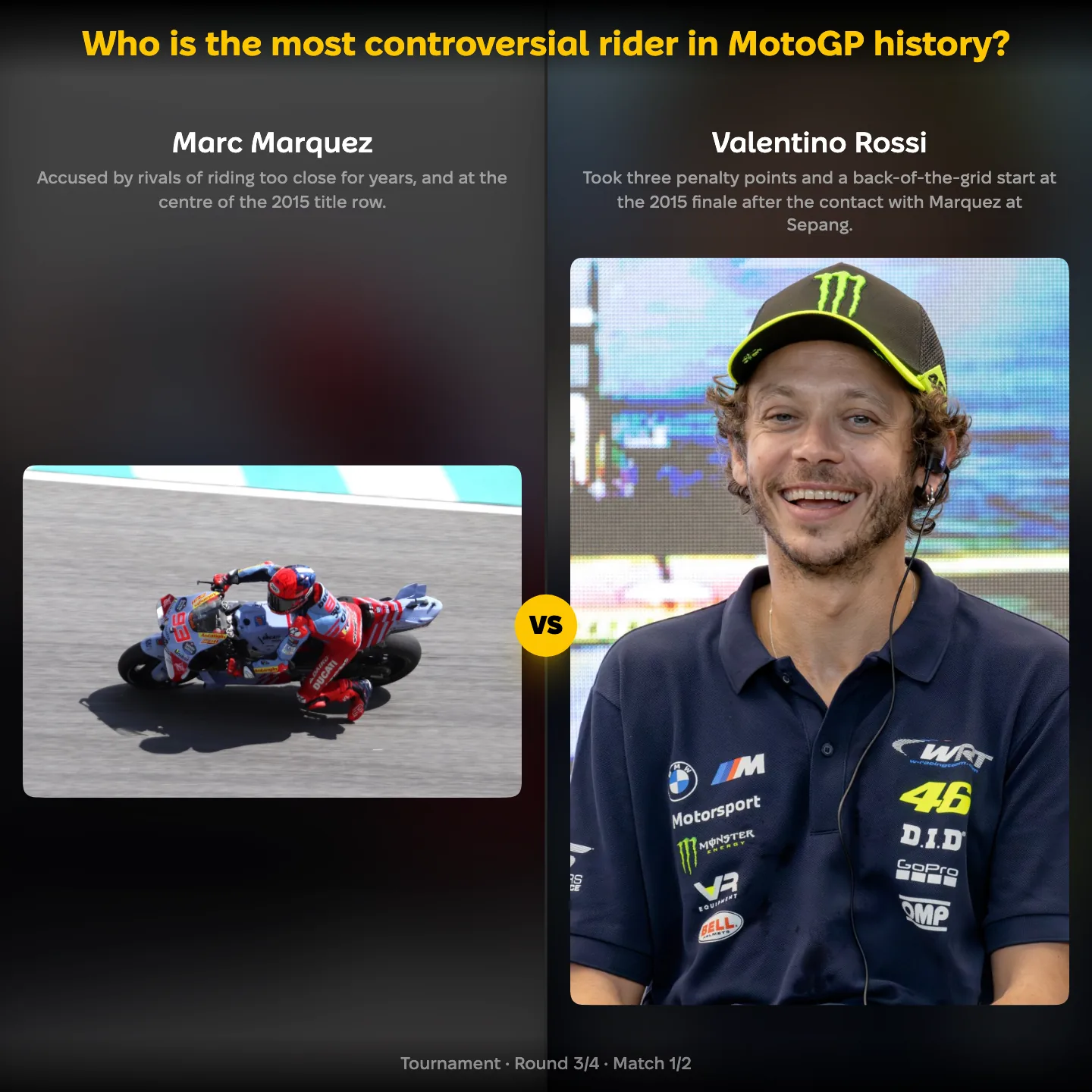
At Sepang in October 2015, with Rossi leading the championship, he ran wide at Turn 14 and brought Márquez across his line. The two made contact and Márquez fell. Race direction gave Rossi three penalty points, which sent him to the back of the grid for the Valencia finale, and the title went to Lorenzo by 370 points to 365.5
What made it permanent was the week before it. Rossi had used the pre-race press conference to accuse Márquez of deliberately riding to help Lorenzo, and no stewards' decision could settle a charge like that.
Ten years on, the two accounts have not converged. Rossi's supporters read the contact as a response to a rider working against him; Márquez's read it as a title leader taking out a rival. Motorsport.com, marking the anniversary in October 2025, reported that the two still barely acknowledge each other in the paddock.9
Márquez has moved first. Asked about it in December 2025, he said he had learned that "it's hard to live with resentment; it's not possible", and at the season gala in Valencia he asked the room for respect for every rider as Rossi appeared on screen.7
MotoGP has never been short of trouble, and most of it had nothing to do with these two. Max Biaggi and Rossi came to blows at Catalunya in 2001. Andrea Iannone served a four-year ban after a 2019 doping test he blamed on contaminated meat. Romano Fenati reached across and grabbed a rival's front brake lever at Misano in 2018 and lost his ride over it. Kenny Roberts tried to set up a breakaway championship in 1979 in a fight over safety and money.
Sepang is different because it decided a championship and then would not close. Biaggi and Rossi shook hands eventually. Fenati served his suspension and came back. The 2015 title has been settled on paper for a decade and is still being re-argued every time the two men are mentioned in the same sentence, which is the definition of a rivalry that outlived its own results.
Same trophies, different careers
Put the eight lists next to each other and the pattern is not that one rider is better. It is that the two of them are strong in different places: Rossi holds the totals and the reach beyond motorcycle racing, Márquez holds the concentrated peaks and the injury years that make them remarkable. The trophy count, the one measure either would have picked, stopped working in September 2025.
The era that produced both is about to close: 2026 is the last MotoGP season on 1000cc engines and Michelin tyres before the switch to 850cc machinery and Pirelli in 2027.8
Order here comes out of pitting two names against each other and repeating until the field sorts itself, which lands somewhere different from asking people to pick a favourite outright.
Think there is a list these two belong on that nobody has made yet? Build it.
More rankings, more angles
- Senna vs Prost, Ranked Side by Side — teammates who stopped speaking at McLaren
- Hamilton vs Schumacher — seven Formula 1 titles each, different eras
- Mario Andretti Won Indy, Daytona and F1 — Once Each — one driver, four disciplines
- Dale Earnhardt vs Jeff Gordon: The Intimidator and Wonderboy — seven titles against 93 wins, on four wheels
Sources
- MotoGP.com — Marc Márquez's 2025 title, clinched at the Japanese Grand Prix: motogp.com (checked 2026-08-30)
- MotoGP.com — "Marc Marquez: his comeback in numbers": 2,184 days between titles, five surgeries on the right arm and shoulder, 30 races missed, 73 premier-class wins, level with Rossi's seven MotoGP titles and one behind Agostini's eight: motogp.com (checked 2026-08-30)
- Wikipedia — Valentino Rossi: nine world championships, 372 premier-class starts, 89 wins, 199 podiums, 55 poles, retirement from MotoGP in 2021, and his 2026 GT World Challenge Europe seat with BMW: en.wikipedia.org (checked 2026-08-30)
- Wikipedia — list of Valentino Rossi's grand prix wins: 115 in total, 12 in 125cc, 14 in 250cc and 89 in the premier class, second all-time behind Giacomo Agostini's 122: en.wikipedia.org (checked 2026-08-30)
- Wikipedia — 2015 MotoGP World Championship: final standings of Lorenzo 370, Rossi 365, and the three penalty points from Sepang that sent Rossi to the back of the grid at Valencia: en.wikipedia.org (checked 2026-08-30)
- Wikipedia — Marc Márquez: nine world championships across 125cc, Moto2 and MotoGP, and the years of each: en.wikipedia.org (checked 2026-08-30)
- Autosport, 3 December 2025 — Márquez on the Sepang feud, including "it's hard to live with resentment; it's not possible" and the Valencia gala moment: autosport.com (checked 2026-08-30)
- Wikipedia — 2026 MotoGP World Championship: the final season on 1000cc engines and Michelin tyres before the 2027 switch to 850cc and Pirelli: en.wikipedia.org (checked 2026-08-30)
- Motorsport.com, 23 October 2025 — ten years on from Sepang, on the contested reading of the contact and the state of the relationship since: motorsport.com (checked 2026-08-30)