
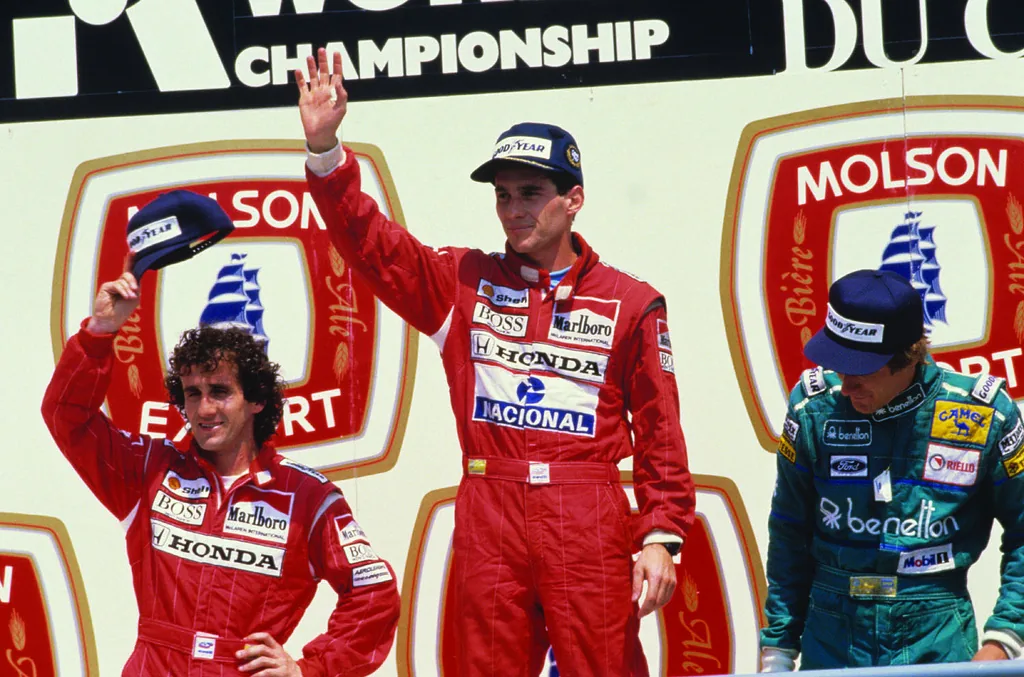
Ayrton Senna and Alain Prost shared a McLaren garage in 1988 and 1989, and Formula 1 has been choosing between them ever since. The sport is running the experiment again in 2026: Kimi Antonelli leads the drivers' championship for Mercedes, and the driver third in it is his own teammate, George Russell.1 Two quick drivers, one team, one trophy. The last time that question was asked at this volume, it finished with both cars in the gravel at Suzuka.
Every ranking that holds these two has to decide first whether it is measuring one lap or one season, and it is that decision, not the drivers, that moves them.
Senna vs Schumacher: the list where both are only entries
The site's broadest motorsport question puts twelve names in one ranking and asks which of them was the greatest. Senna and Prost are two of the twelve.
Senna's case is the one most people reach for. Three world championships, 41 race wins from 161 starts, and 65 pole positions in ten seasons.2
Prost's case is longer rather than louder. He won 51 Grands Prix across four constructors and finished championship runner-up on four separate occasions, which is the least celebrated line in his record.3
Neither man is the safe pick in this company. Lewis Hamilton and Michael Schumacher both reached seven championships, and Juan Manuel Fangio took five in the sport's first decade.
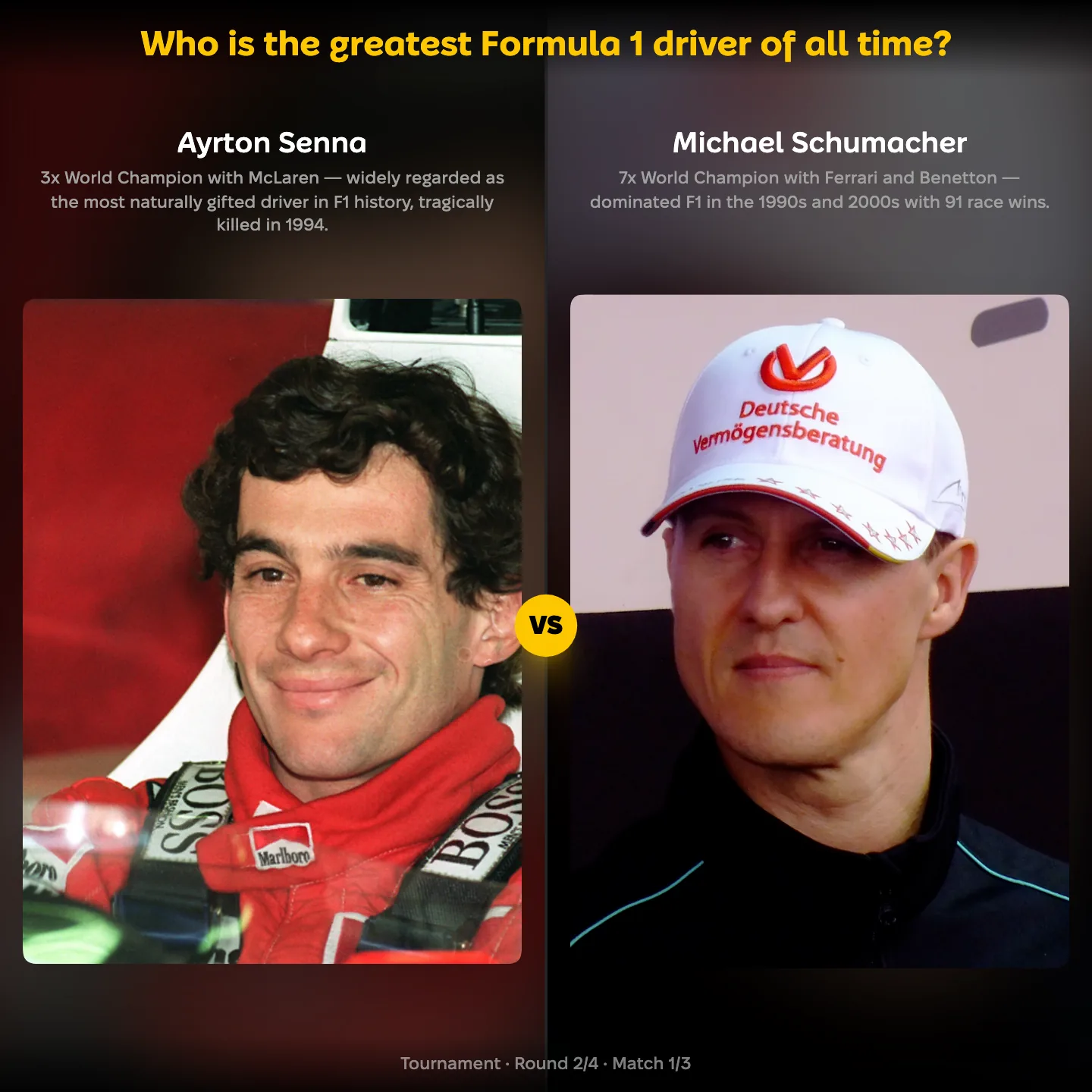
Prost vs Senna in the 1980s: four world titles between them
Narrow the field to the decade they shared and the two of them are still there, alongside eleven others.
Prost owns most of it on paper. Three of his four championships were won inside the decade, in 1985, 1986 and 1989.3
Senna arrived in 1984 and needed four seasons to win his first. From there he took the second half of the decade, and the 1990s opened with him as the reigning champion.
The 1980s belonged to more than two men, though. Nelson Piquet won three championships of his own, Niki Lauda came out of retirement to take a fourth in 1984, and Keke Rosberg was champion in 1982 with a single race victory all year.
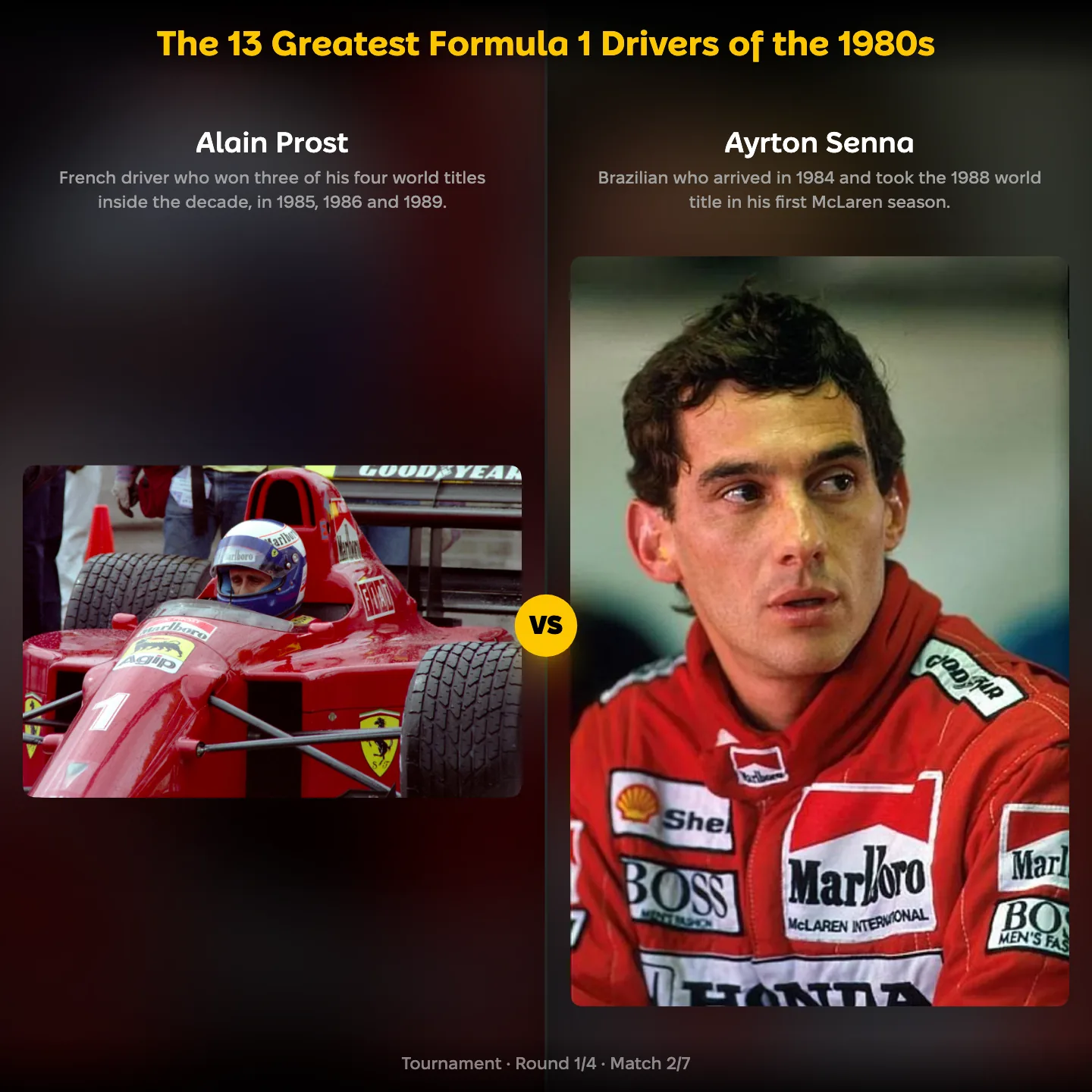
Senna vs Prost: the rivalry the 1980s is named after
One ranking asks which Formula 1 rivalry of the 1980s was the best, and it enters Senna and Prost as a single option. They are competing against other people's feuds.
The McLaren of 1988 is what made theirs unavoidable. The MP4/4 won fifteen of the season's sixteen races, so the championship was settled entirely between two men in identical cars.4 Senna took it eight wins to seven.2
1989 went the other way and ended at Suzuka. The two collided at the chicane; Senna rejoined, won on the road, and was disqualified, and the championship went to Prost.5
Nigel Mansell and Nelson Piquet have a claim on this list too. They spent 1986 and 1987 taking points off each other inside Williams, and Prost's earlier fights with Lauda and René Arnoux are options here as well.
What sets the McLaren feud apart is that it outlived the racing. After Prost retired the two spoke once or twice a week, and Prost was at the last breakfast Senna ate.6
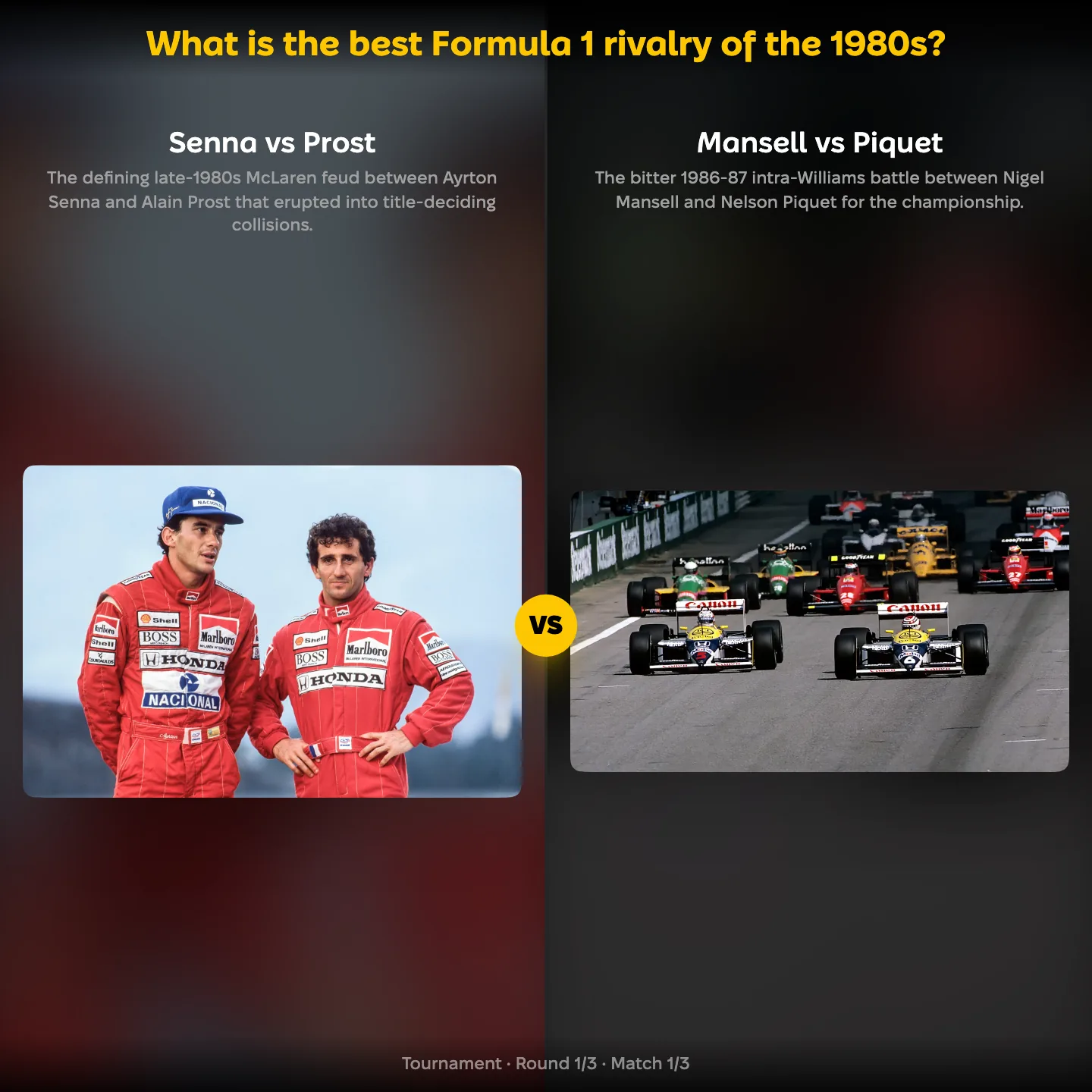
McLaren's Honda years: the era that carries both their names
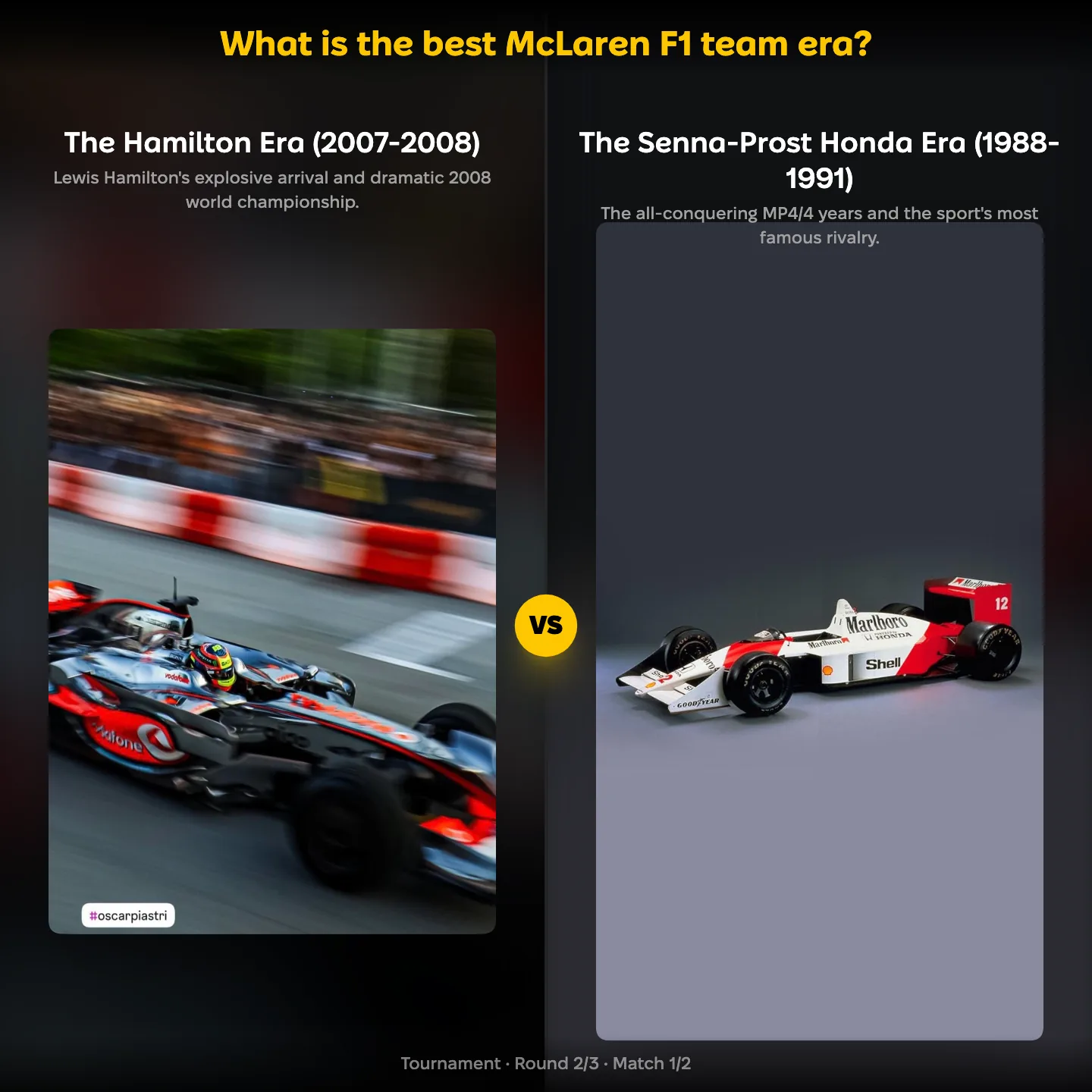
McLaren has its own ranking of team eras, and one of the seven options is named after the pair of them: the Senna-Prost Honda Era.
The team took four consecutive drivers' championships between 1988 and 1991. Senna won three, and the one in between was Prost's.
Prost supplied the volume during his time there. Thirty of those wins came across six McLaren seasons.7
The other eras have their own advocates: Bruce McLaren's founding years, the Mika Häkkinen title run against Ferrari, and the season Lewis Hamilton arrived and won a championship at the second attempt.
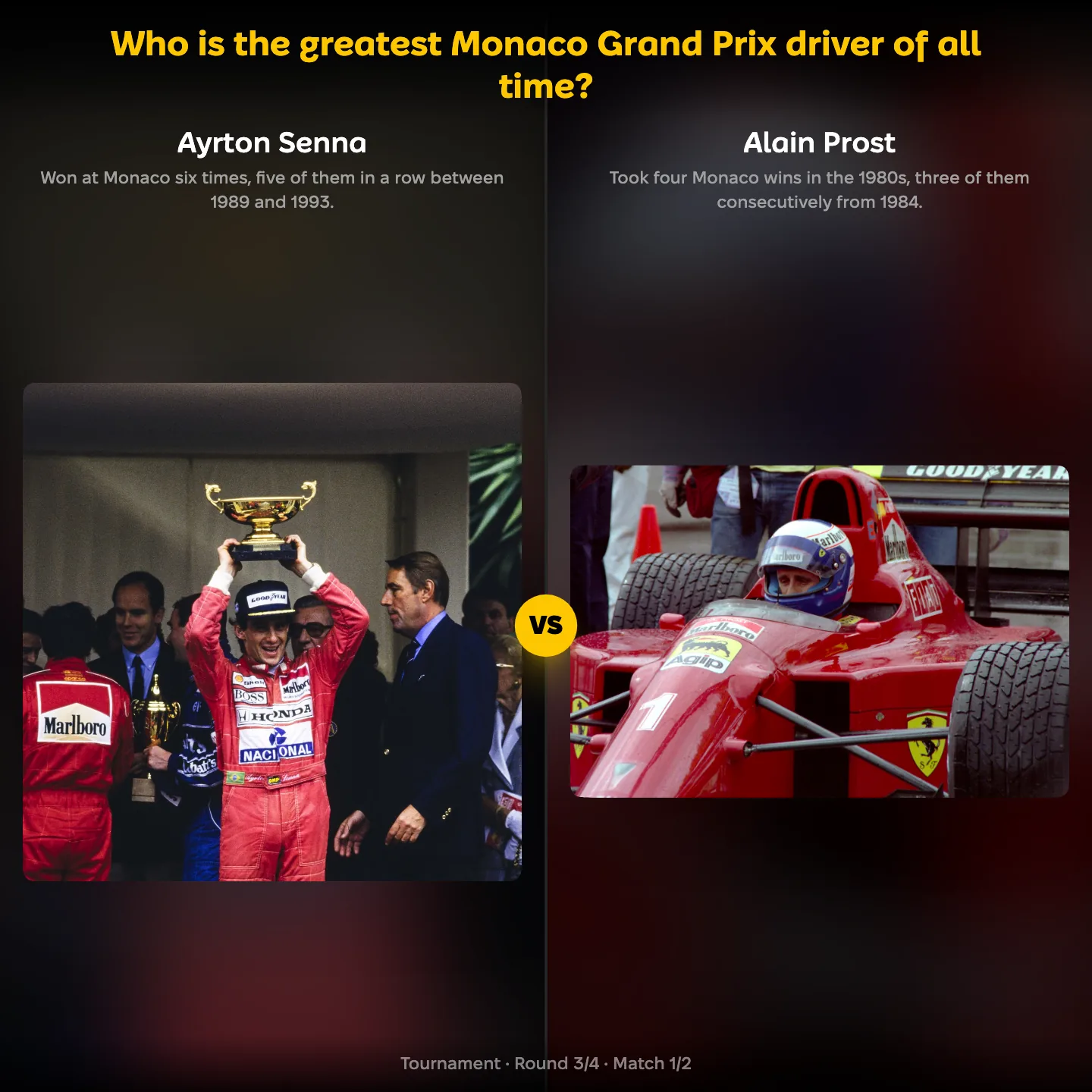
Monaco: six wins for Senna, four for Prost
Monte Carlo tests a skill the rest of the calendar barely asks for, and its winners' list is shaped by that. Barriers on both sides, no room to correct anything, and qualifying that usually decides the race.
Senna holds the record with six victories, including five straight between 1989 and 1993.2
Prost won it four times, in 1984, 1985, 1986 and 1988.8 Three of those came consecutively, and the run started in the wet race where a rookie in a Toleman finished second and everyone learned Senna's name.
Both of them are chasing older company here. Graham Hill won five Monacos in the 1960s and was called King of Monaco for it, Michael Schumacher matched that number, and Charles Leclerc ended the long Monégasque drought in 2024.8
The gift nobody has ever managed to measure
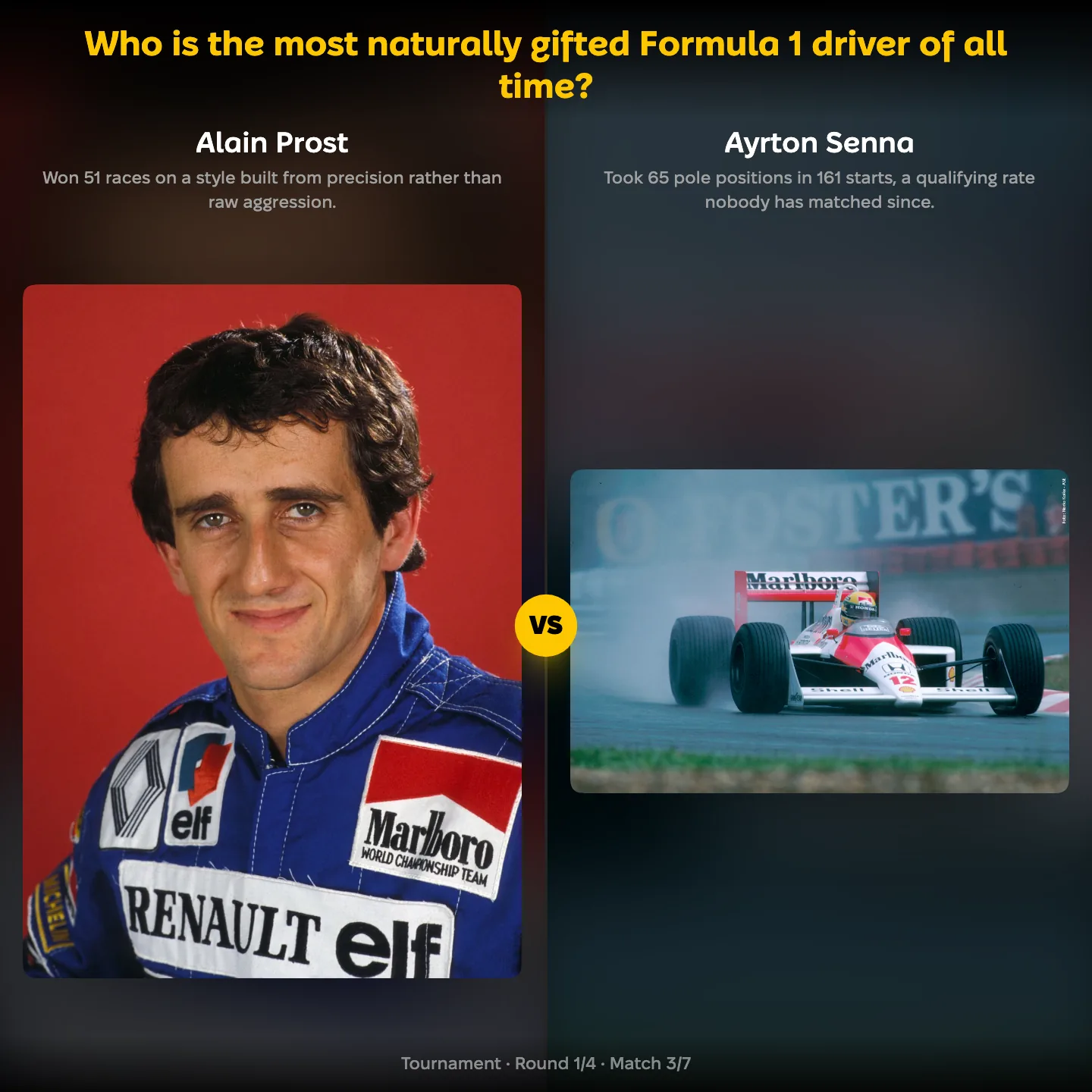
Natural talent is the thing every fan claims to recognise and nobody can put a number on. This ranking asks for it anyway, and Senna and Prost are both on the list.
The evidence usually offered for Senna is qualifying. Martin Brundle, who raced against him in Formula 3, put it more bluntly: "Senna is a genius. I define genius as just the right side of imbalance."2
Prost is the awkward case for a category like this, because his style was built to look like the opposite of a gift. Smooth, unhurried, apparently unremarkable until the results arrived.
Gilles Villeneuve, Jim Clark and Max Verstappen appear here too, stretching the definition in three different directions.
The Professor: Prost's case for thinking faster than driving
Judgement is a different question, and the same names rearrange themselves under it.
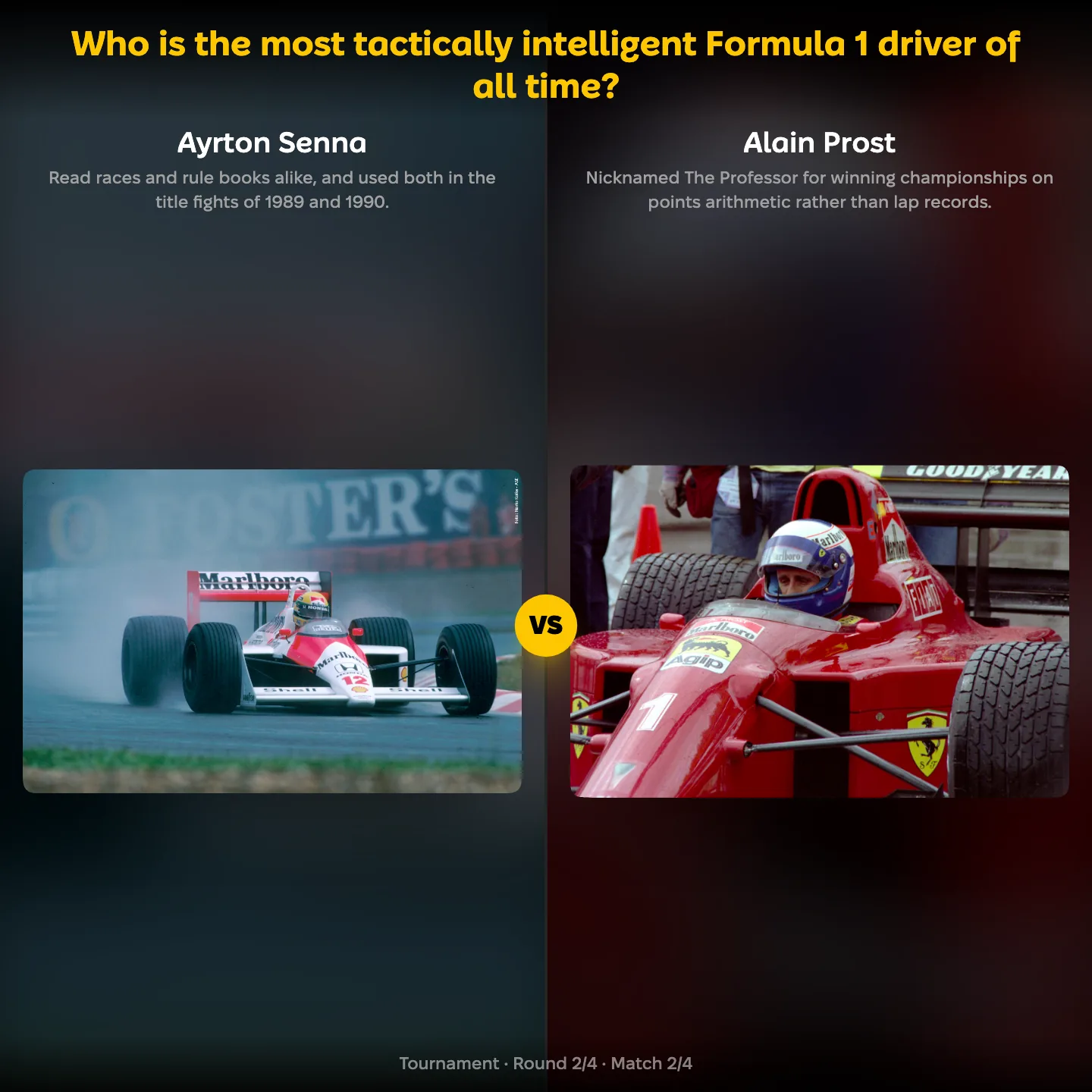
Prost was nicknamed The Professor because he raced to a plan. He worked out what a championship cost in points, drove to that number, and collected four titles without ever leading the sport in pole positions.
Senna belongs in this category too, for a reason that flatters him less. He read regulations as carefully as he read races, and both title deciders of 1989 and 1990 turned on what the rules allowed as much as on what the cars did.
Niki Lauda, Jackie Stewart and Fernando Alonso fill out the top of this one, all of them drivers who treated a season as a problem to be solved rather than a series of races to be won.
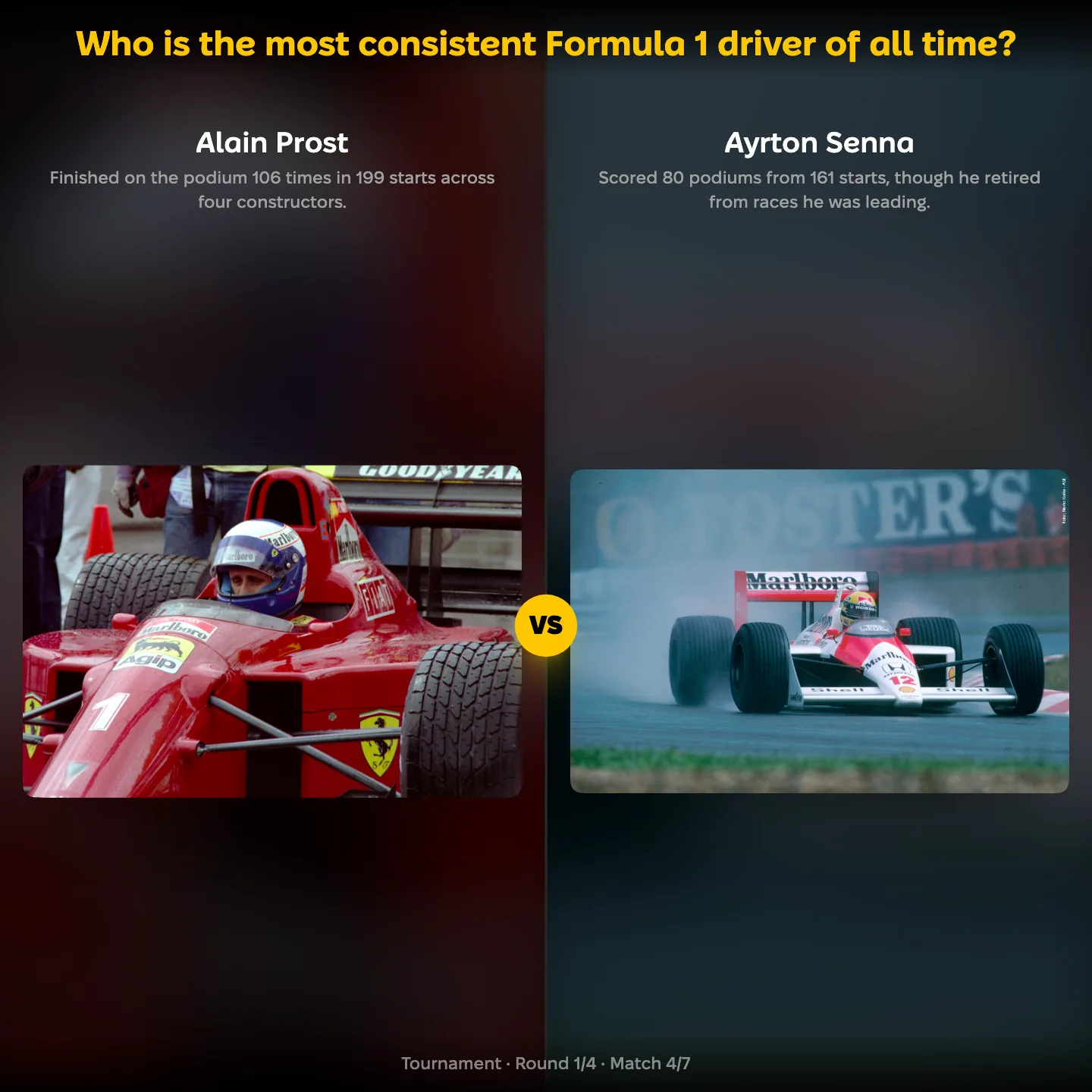
106 podiums from 199 starts: Prost's least famous record
Consistency is the least quotable virtue in motorsport and one of the few that reliably converts into championships.
Prost stood on the podium in more than half the Grands Prix he ever entered, at Renault, McLaren, Ferrari and Williams in turn.3
Senna is the counterweight in this section. He led races he did not finish, and the same appetite that produced all those pole positions produced retirements a more cautious driver would have avoided.
The modern names complicate it further. Lewis Hamilton has scored points in more Grands Prix than anyone, and Sebastian Vettel once won nine races in a row.
Honda: the engine behind four of their championships
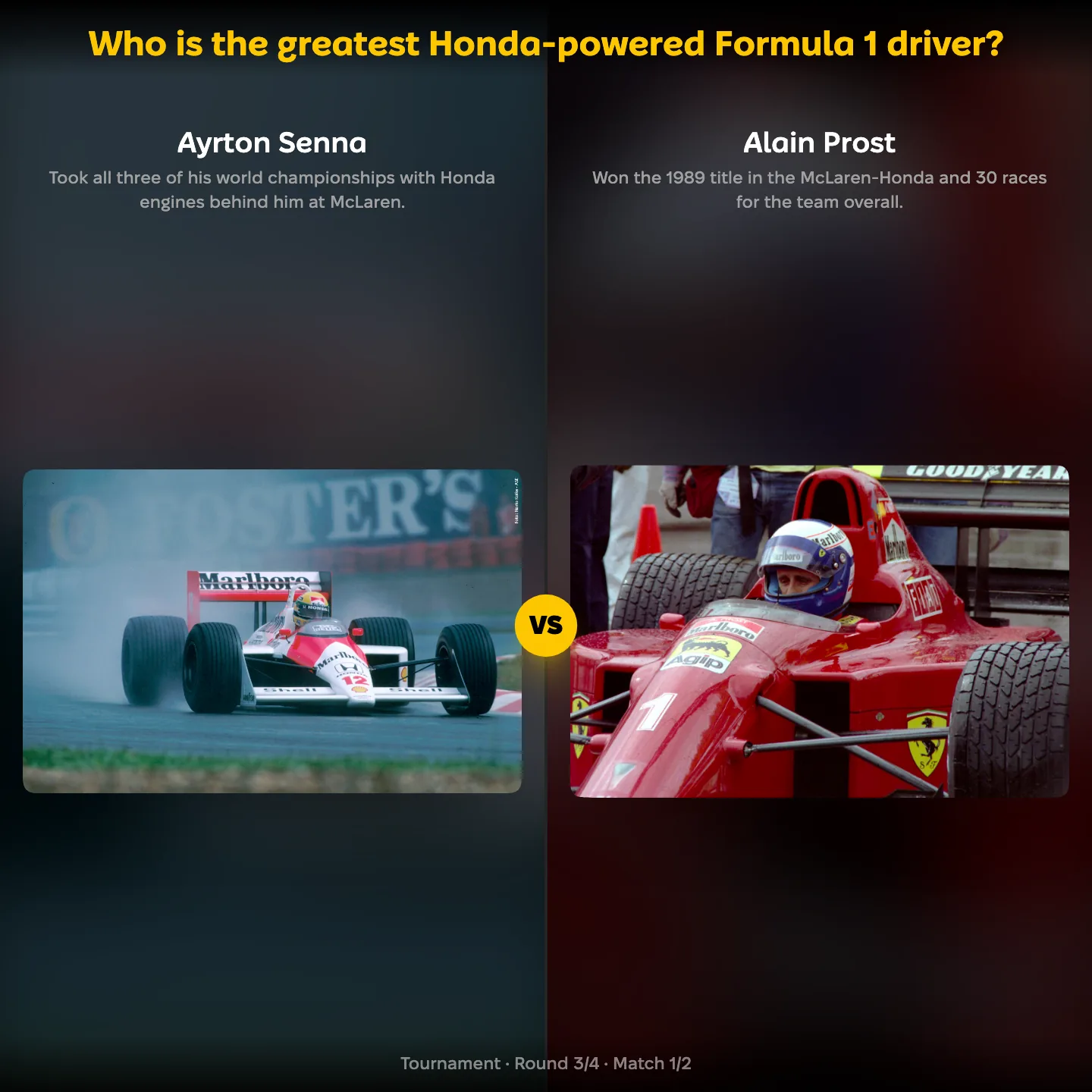
Sort Formula 1 by engine badge instead of by driver and the same two names come back to the front.
Every one of Senna's three world championships was won with a Honda engine behind him, and Prost's 1989 title was too. Four consecutive championships for one manufacturer, split between two drivers who were barely speaking.
Honda's reach goes far wider than McLaren, which is what makes the ranking work. Richie Ginther gave the company its first Grand Prix win in Mexico in 1965, John Surtees won at Monza for the works team in 1967, and Max Verstappen took the 2021 championship with Honda power.
Nelson Piquet and Nigel Mansell also belong here, from the Williams-Honda years that came immediately before McLaren's.
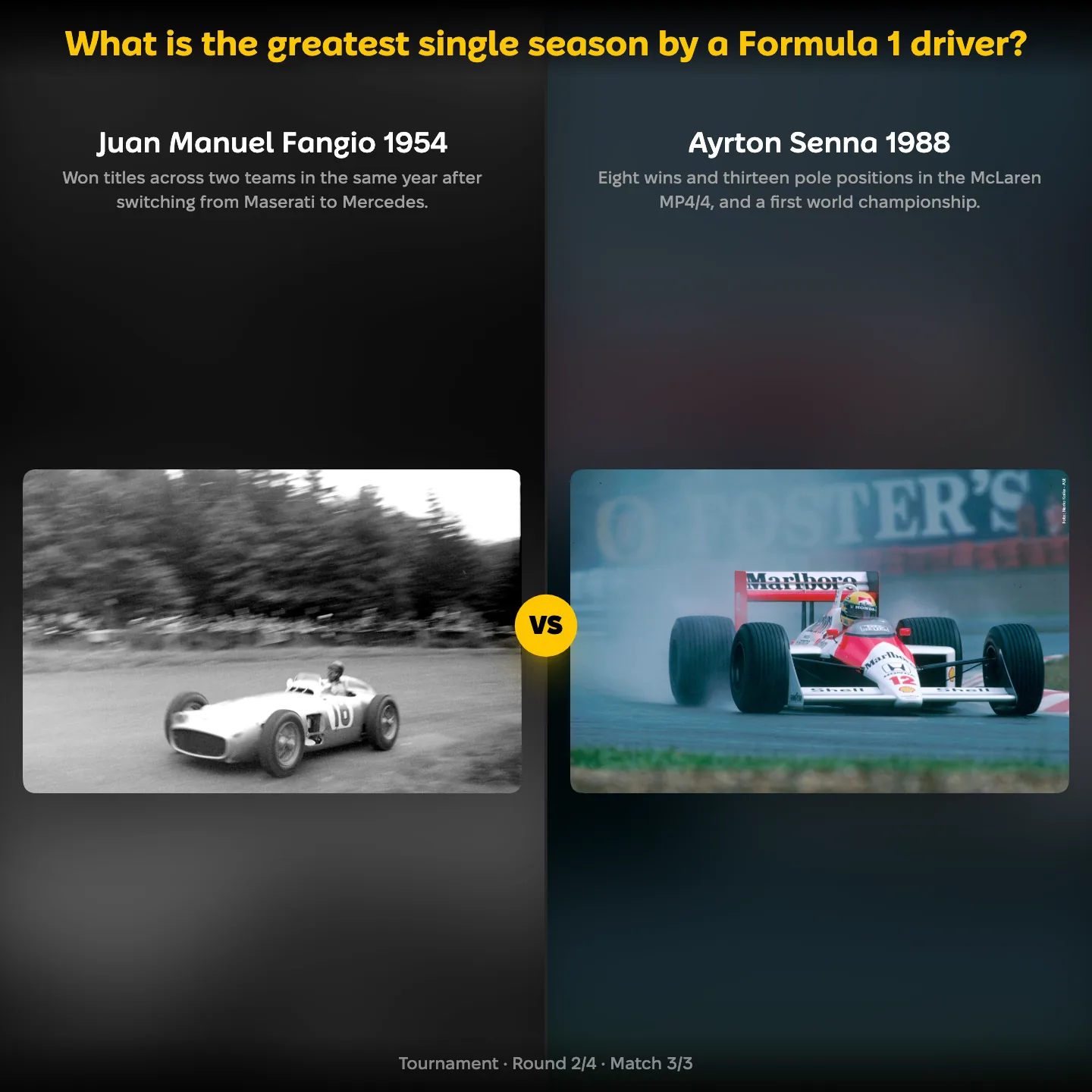
Senna 1988 vs Fangio 1954: when a season is the unit
This ranking changes what is being compared. The options are not drivers but single seasons, which lets Senna and Prost appear as versions of themselves rather than as careers.
Senna 1988 is the entry that needs no explanation, and Prost 1993 is the one that does. He returned from a year out of the sport, won seven races for Williams-Renault, took a fourth championship and retired at the end of it. Senna replaced him in the seat.6
Fangio 1954 is the strangest option on the list. He won the championship after switching mid-season from Maserati to Mercedes, which no modern regulation would permit.
Schumacher's 2004 and Verstappen's 2023 are the statistical answers, and they arrive from an era with twice as many races to win.
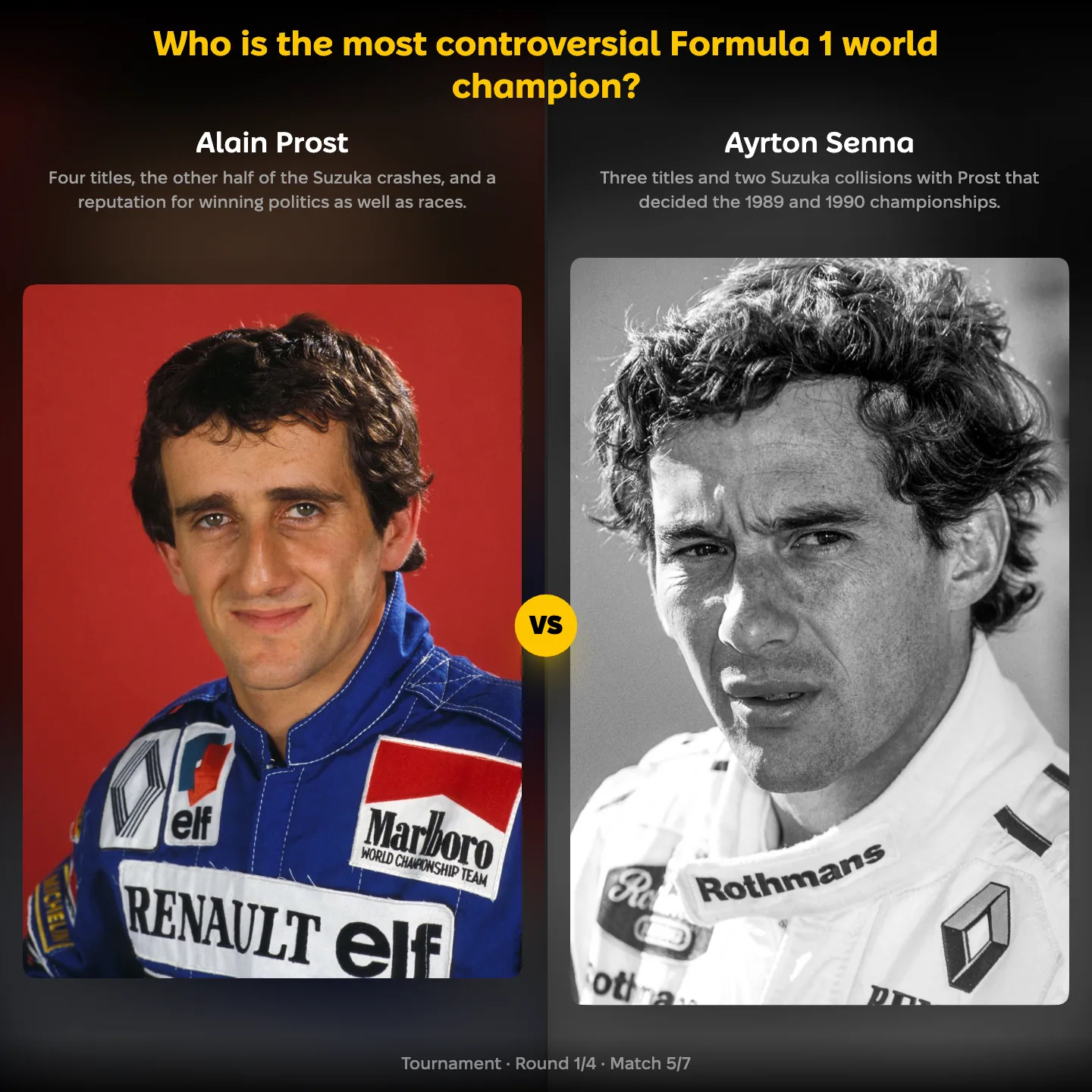
Suzuka 1989 and 1990: two crashes, two championships
Some rankings exist because a subject has a record. This one exists because a subject has a reputation, and Senna and Prost supplied each other with theirs.
The 1989 collision at the chicane was the first act. Prost turned in, the cars locked together, and the stewards took the win away from Senna after he rejoined the circuit through an escape road.5
The 1990 answer came at the first corner of the first lap, with Prost by then at Ferrari. Senna drove into him, both were out, and the championship was over before either car had completed a racing lap. He admitted the intent afterwards.6
Michael Schumacher's two title-deciding collisions and the 2021 finale between Max Verstappen and Lewis Hamilton are the other candidates here. All of them share a shape: a championship settled by contact rather than by pace, and thirty years of disagreement about whether that counts.
The list neither of them gets to skip
Every champion has a case against them, and this ranking collects the cases.
Against Senna: three championships and a reputation that grew past them, helped by a career that ended at its peak rather than fading out.
Against Prost: four titles, most of them won in the fastest car on the grid, and the observation that a driver who plans that carefully is rarely the quickest man in the race.
The company is not flattering to anyone. Nico Rosberg beat Lewis Hamilton over one season in the same machinery and retired five days later, and Jenson Button won the 2009 championship in a car with an aerodynamic advantage nobody else had for half a season.
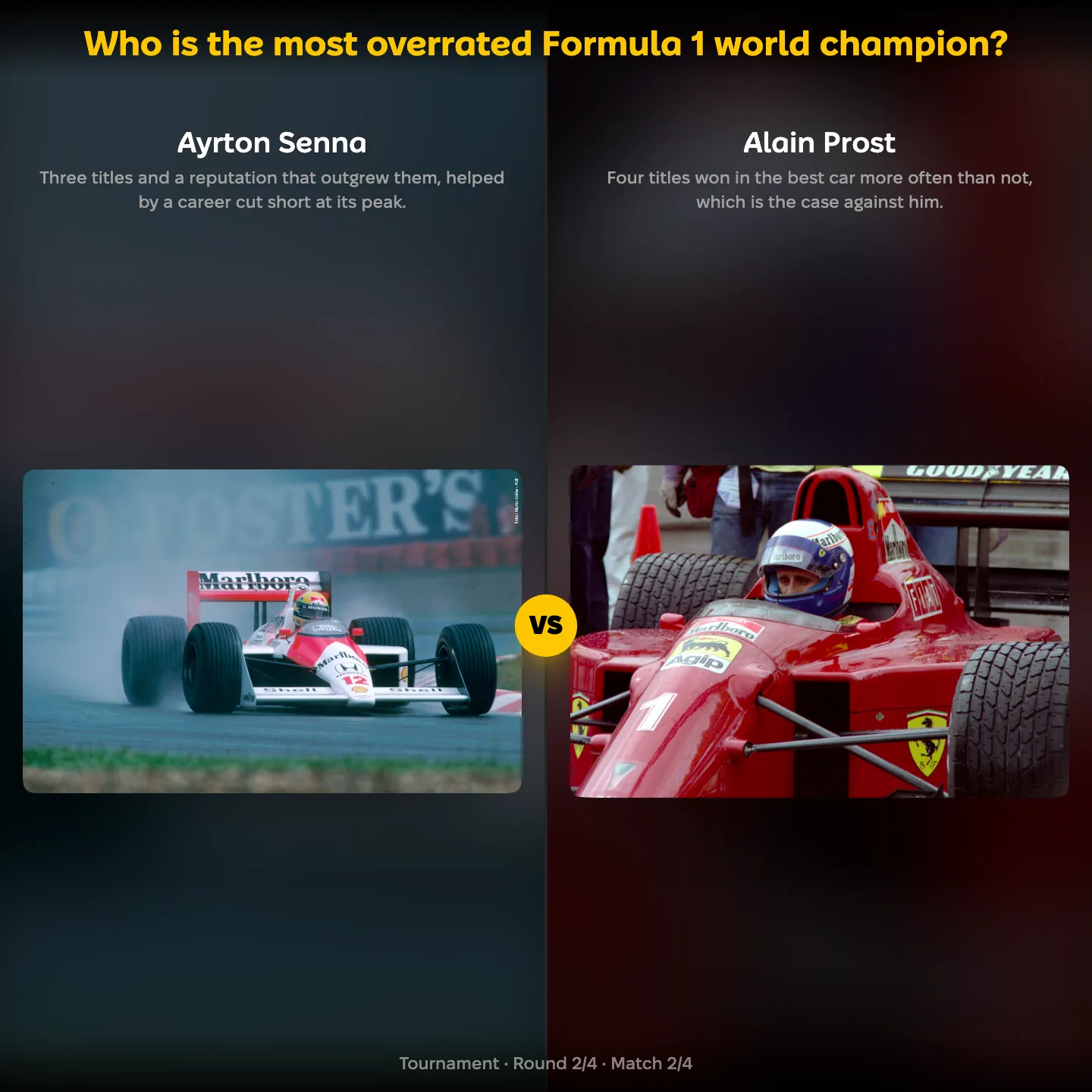
Prost vs Jean Alesi: the French list Senna cannot enter
Some rankings exclude one of them by definition, and the exclusion is the interesting part.
This one asks for the best French karting champion who reached Formula 1. Prost qualifies twice over, as the country's only world champion and as a driver who came up through karting before the junior single-seater ladder existed in its modern form.
Jean Alesi, Pierre Gasly, Esteban Ocon and Jules Bianchi fill the remaining places. None of them came close to Prost's win total.
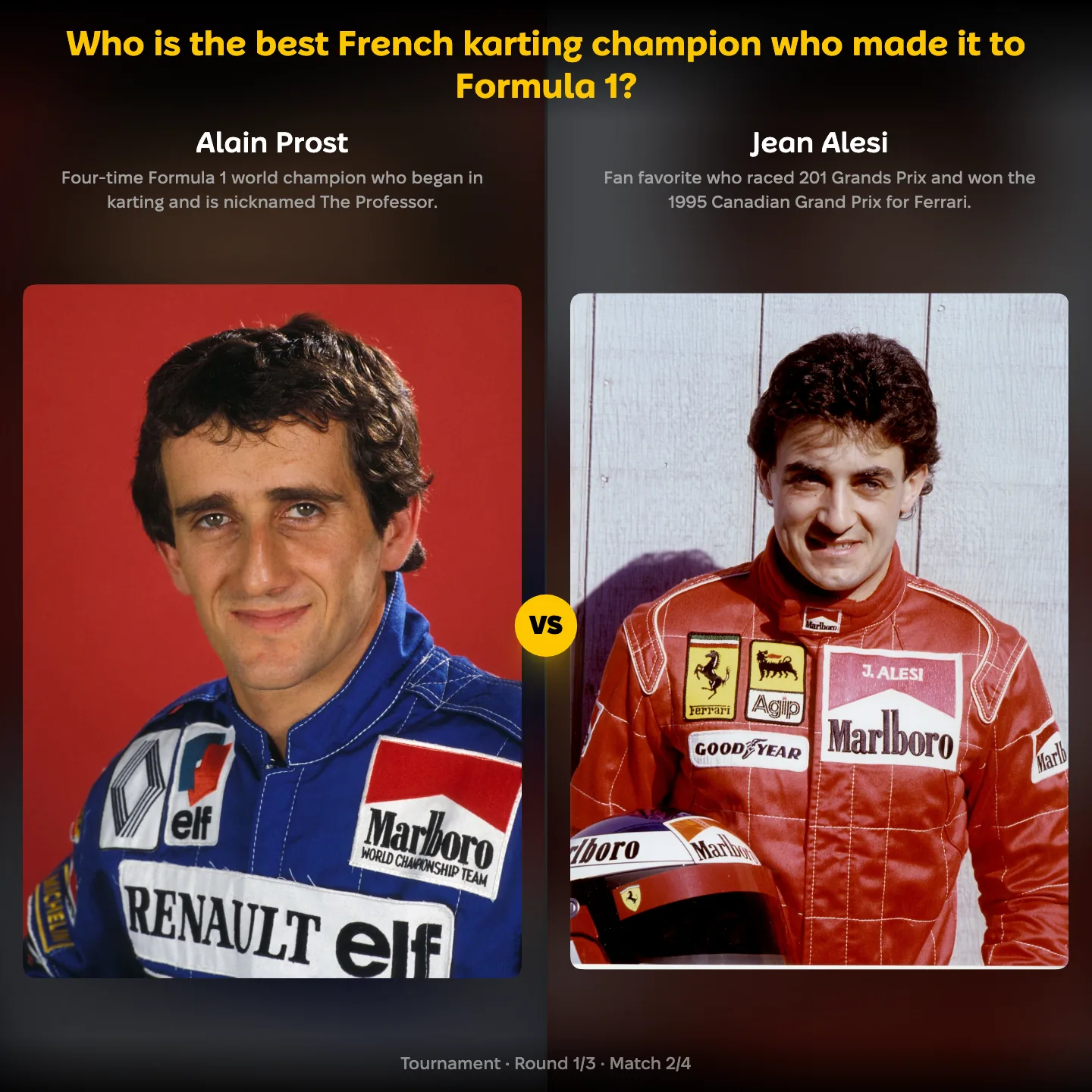
Senna and The Last Dance: when the driver becomes the film
The final ranking is not about drivers at all, and one of them is still on it.
Asif Kapadia's Senna sits among the sixteen options for the best sports documentary ever made, built entirely from archive footage with no talking heads. Prost is in the film, cast by the edit as the antagonist, and has spoken since about how that portrayal followed him around.
The competition is heavy: Hoop Dreams, When We Were Kings, O.J.: Made in America and The Last Dance are all here.
Fourteen questions, two answers
Fourteen rankings, and the pair swap places every time the question changes its unit of measurement: a lap, a race weekend, a season, a career, a decade, a nationality, a film. Nothing about either driver moved between those lists. Only the yardstick did.
Every one of those placements comes out of the same mechanism: two options on screen, one choice, repeated until the comparisons themselves produce a standing.
The 2026 grid will hand somebody the same problem before the season is out. Build the ranking that settles the version of it you care about.
More rankings, more angles
- Hamilton vs Schumacher: Seven Titles Each, One Red Car — the other F1 pairing with a Ferrari between them
- 15 Rankings, One Fernando Alonso — two titles, twenty seasons, and Le Mans on the side
- Mario Andretti Won Indy, Daytona and F1 — Once Each — Indy, Daytona and a world championship, one each
- Rossi vs Márquez: Nine World Titles Each — the same argument, on two wheels
Sources
- RacingNews365 — 2026 Formula 1 drivers' championship standings: racingnews365.com (checked 2026-08-16)
- Formula 1 Hall of Fame — Ayrton Senna: titles, wins, poles, starts, the six Monaco victories, the 1988 eight-to-seven season and the Martin Brundle quotation: formula1.com (checked 2026-08-16)
- International Motorsports Hall of Fame — Alain Prost: 199 starts, 51 wins, 33 poles, 106 podiums, four titles and four runner-up finishes: motorsportshalloffame.com (checked 2026-08-16)
- Honda — 1988 McLaren Honda MP4/4, fifteen wins from sixteen races: global.honda (checked 2026-08-16)
- Formula 1 — "Prost vs Senna: How the infamous Suzuka '89 clash unfolded": formula1.com (checked 2026-08-16)
- Wikipedia — Prost–Senna rivalry: the 1990 Suzuka collision, Prost's 1993 Williams title and retirement, and their later friendship: wikipedia.org (checked 2026-08-16)
- Formula 1 Hall of Fame — Alain Prost: thirty wins across six McLaren seasons: formula1.com (checked 2026-08-16)
- Wikipedia — Monaco Grand Prix: Senna's six wins, Prost's four (1984, 1985, 1986, 1988), Graham Hill and Michael Schumacher on five, Leclerc in 2024: wikipedia.org (checked 2026-08-16)