
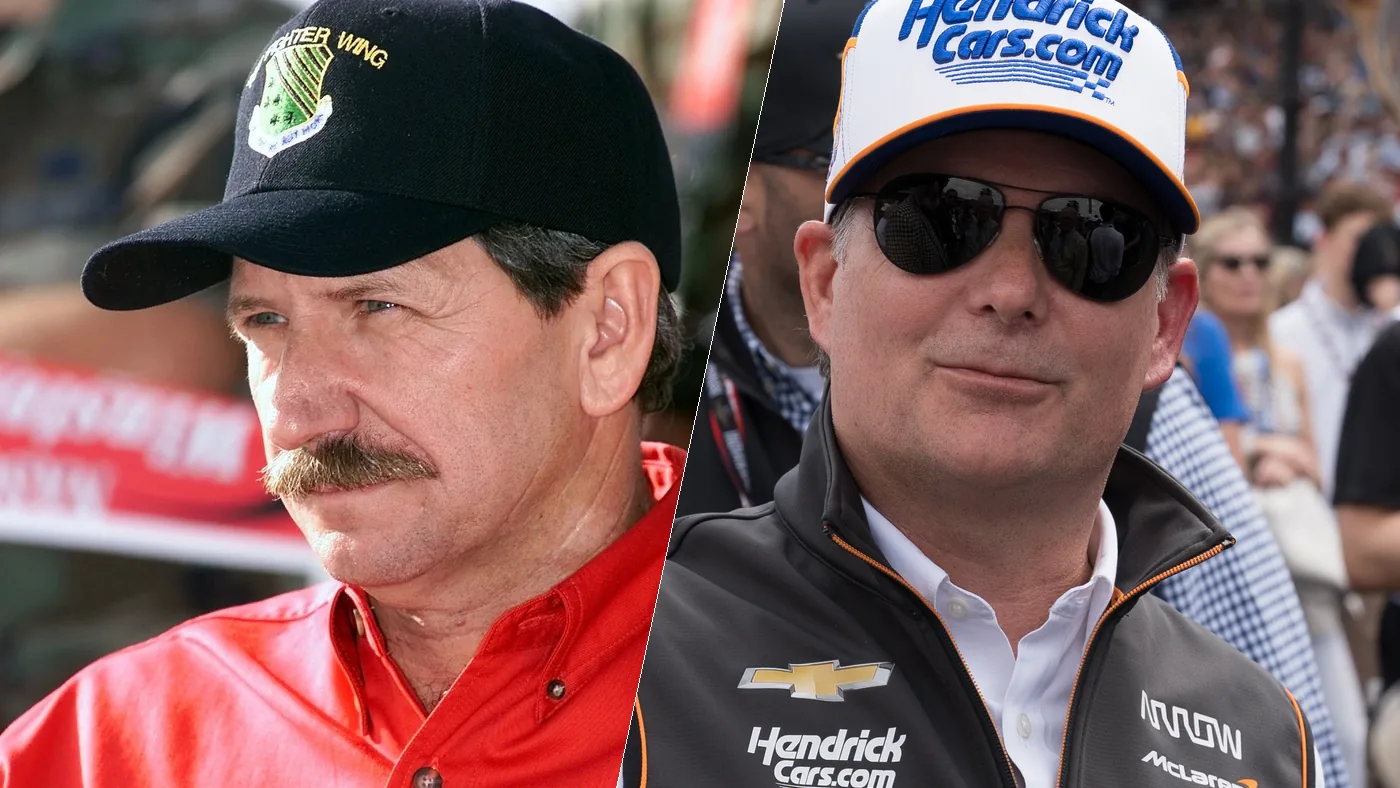
Dale Earnhardt won seven NASCAR Cup championships and 76 races. Jeff Gordon won four championships and 93 races, which puts him third on the all-time list behind Richard Petty and David Pearson.2 They raced each other from Gordon's first Cup start in 1992 until Earnhardt's death in 2001, and between them they hold eleven titles, none of which was settled by a playoff.
That last detail has just become topical. The 2026 Cup Series went back to a season-long Chase on 6 September at Darlington, sixteen drivers scoring across ten races to Homestead on 8 November, with no eliminations and nobody locked in by a single win.3 It is closer to the system that crowned both of these men than anything NASCAR has run in twenty years.
Seven championships against ninety-three wins: Earnhardt and Gordon left the sport two incompatible definitions of great, and a list has to choose one before it can start.
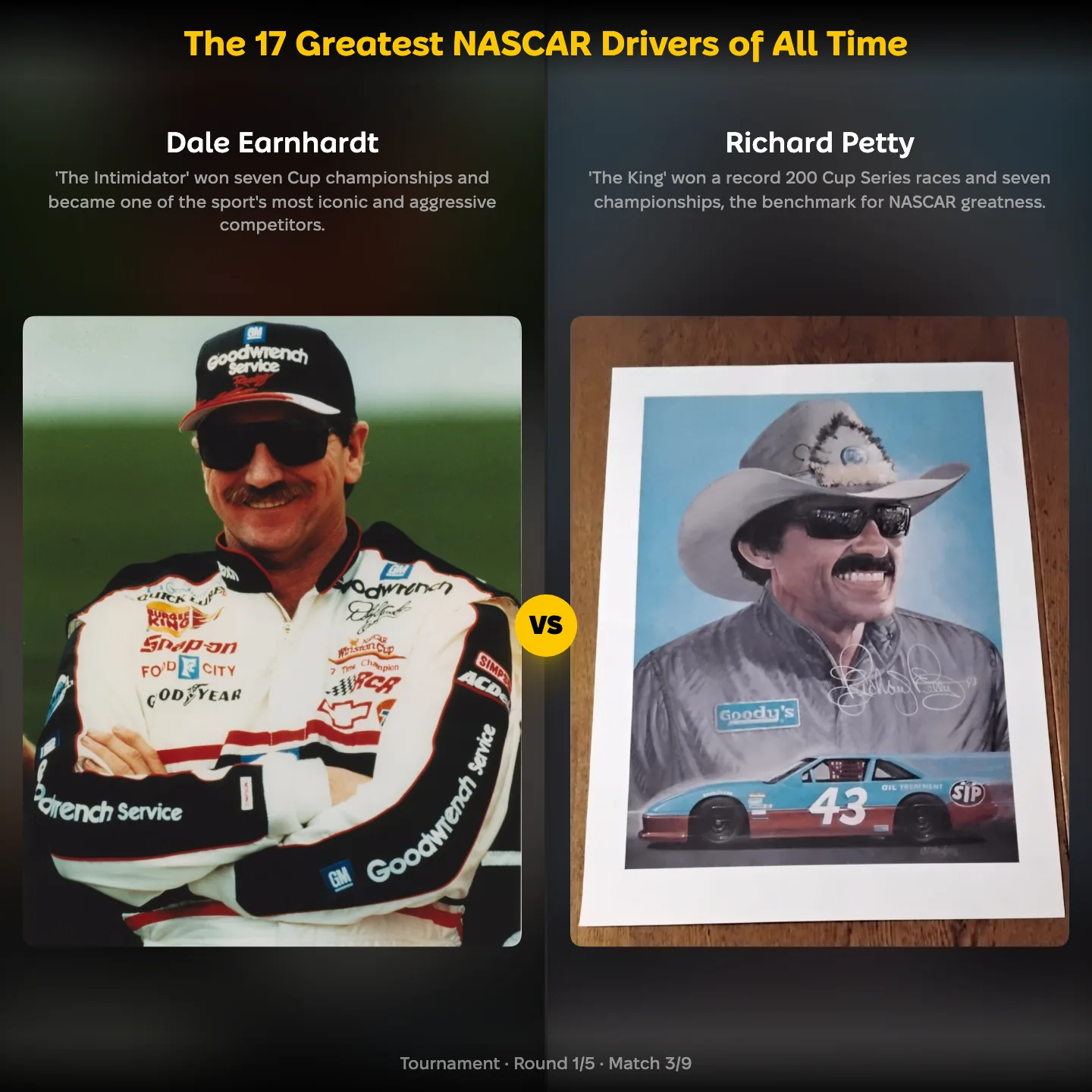
Dale Earnhardt vs Richard Petty: the list both men have to share
The broadest NASCAR question puts Earnhardt and Gordon in the same field as the man who beat them both to the numbers.
Richard Petty won 200 Cup races and seven championships. Earnhardt matched the titles and finished 124 wins short. Gordon closed to within 107 wins and stopped four titles short.
Earnhardt entered the NASCAR Hall of Fame in its inaugural class of 2010; Gordon followed in 2019.45 On any measure that counts trophies, the two of them are separated by three championships.
What complicates the list is that Petty's numbers came from a different sport. His 200 wins were collected on a calendar that ran dirt tracks and two races in a weekend, against fields where a handful of teams had real money. Gordon's 93 came from 805 starts in a 36-race season against forty-three funded cars.
The 1990s: four titles for Earnhardt, 49 wins for Gordon
Cut the question down to ten years and the two careers stop overlapping almost immediately.
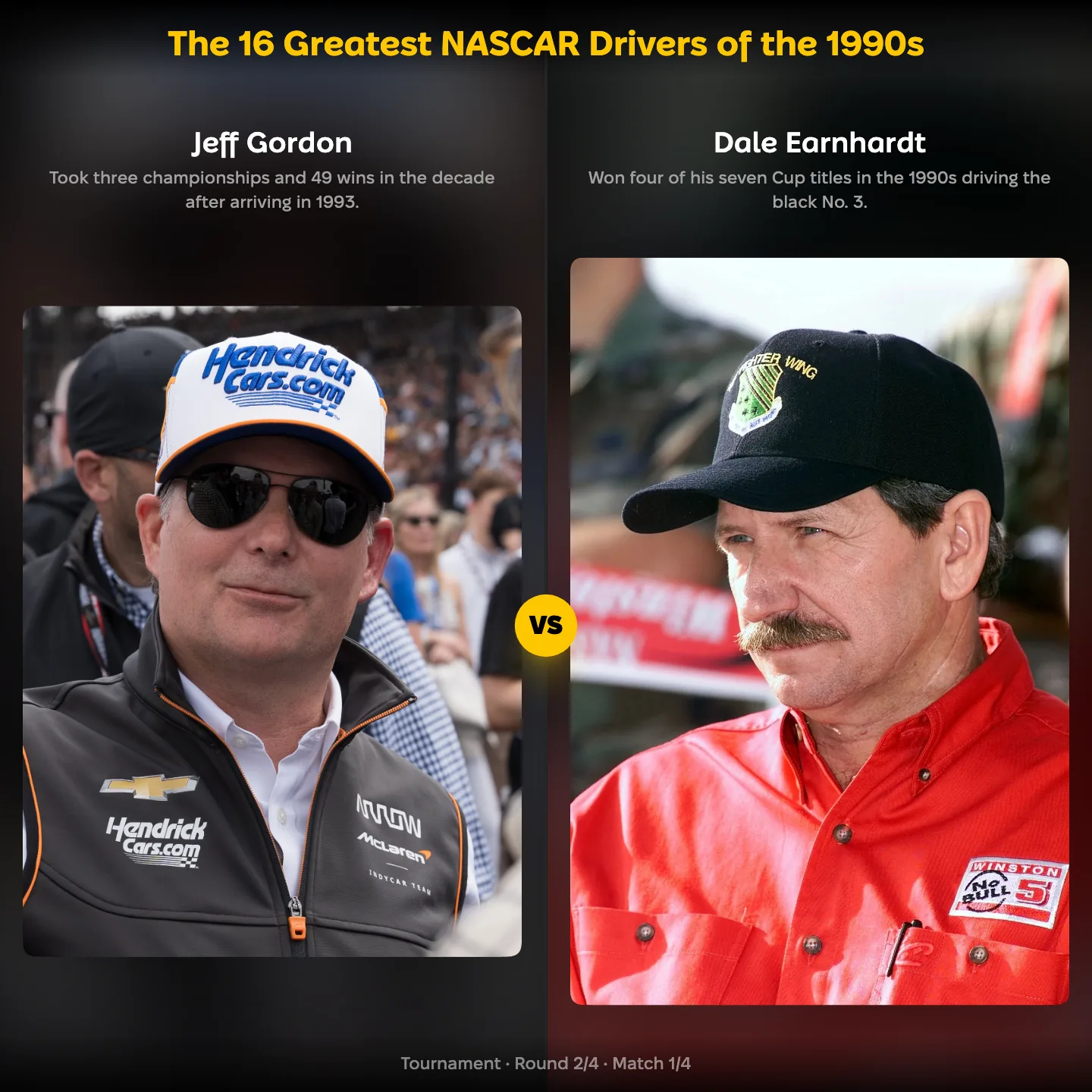
Earnhardt took four of his seven championships in the 1990s, in 1990, 1991, 1993 and 1994.6 He already had three championships behind him when the decade started, and 22 career poles to Gordon's eventual 81.
Gordon arrived in November 1992, won the Rookie of the Year award the following season, and then won 49 races and three championships before the decade ended.2 Nobody in the field won more races in those ten years.
The 1995 season is where the two claims collide. Gordon took the title by 34 points, 4,614 to Earnhardt's 4,580.7 NASCAR's own account of that season records what Earnhardt did with the rest of it: he called Gordon "Wonderboy" and joked that the season-ending banquet would have to serve him milk.1 Earnhardt never won another championship.
Daytona 500: three wins for Gordon, nineteen misses for Earnhardt
Here is the flattest question in the article, and it does not go the way the championship count does.
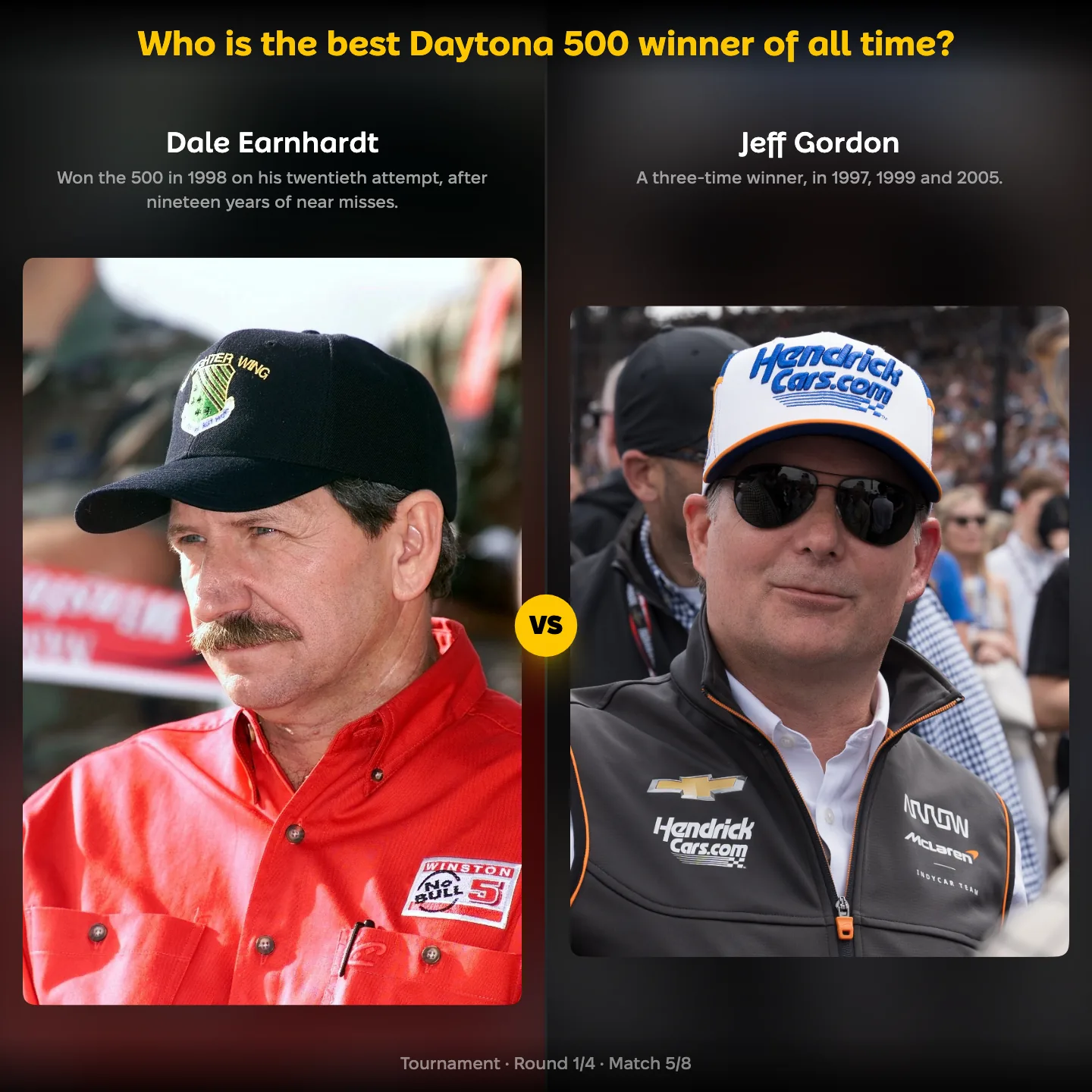
Gordon won the Daytona 500 three times, in 1997, 1999 and 2005.2
Earnhardt won it once. He arrived at Daytona nineteen times without taking the 500, losing it with a cut tire on the last lap in 1990 and to a slower car in the closing miles more than once, before finally winning in 1998 at his twentieth attempt.8 Every crew on pit road came out to shake his hand on the way back to the garage.
The Earnhardt counter-argument is the rest of the superspeedways. He won ten times at Talladega, a track record when he set it in 2000, on circuits where the restrictor plate took horsepower away and left drafting instinct to decide the finish.6
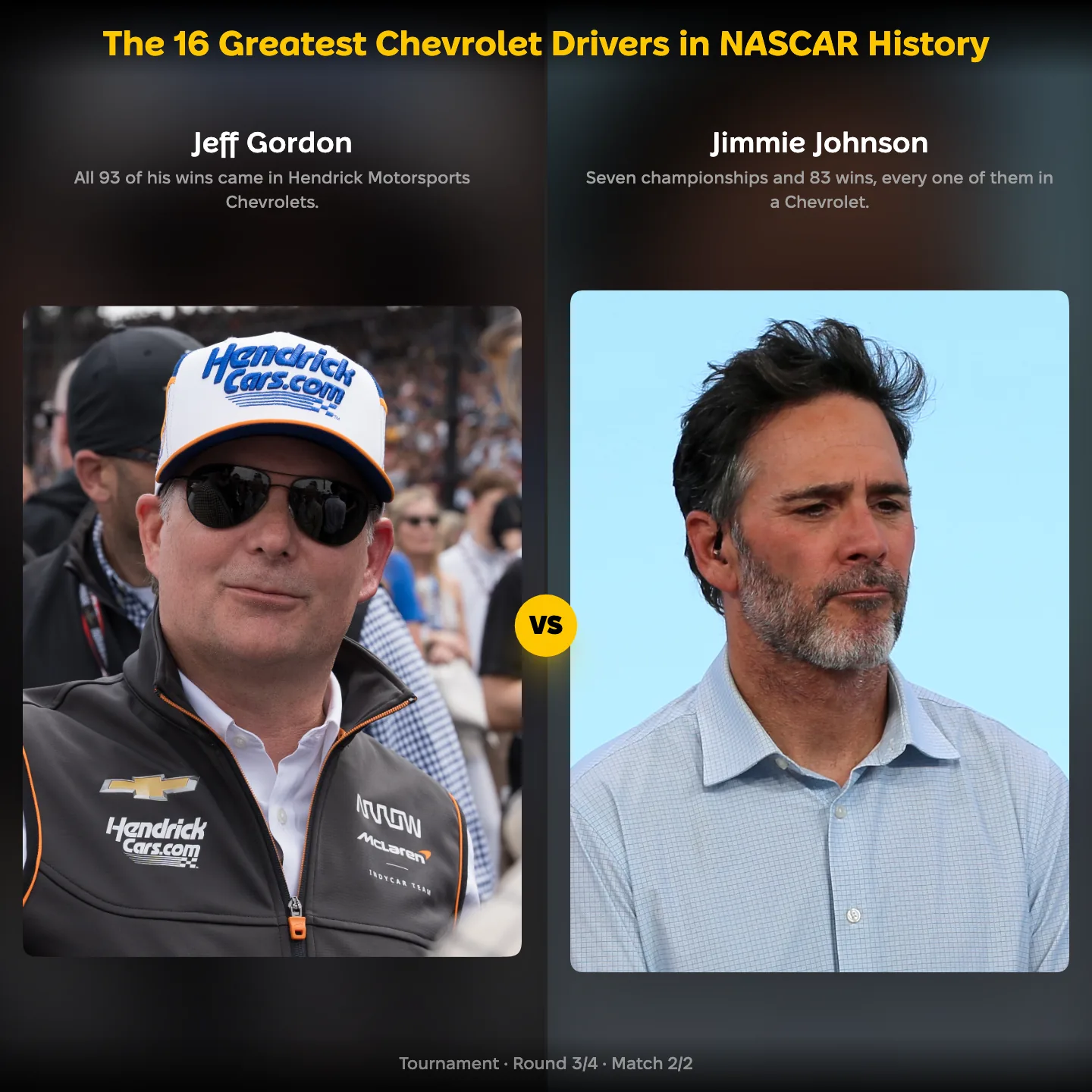
Jeff Gordon vs Jimmie Johnson: the best Chevrolet driver at Hendrick
Restrict the question to one manufacturer and both men qualify twice over, because neither drove anything else that mattered.
All 93 of Gordon's wins came in Hendrick Motorsports Chevrolets, across 23 seasons with one team.2 Earnhardt drove Richard Childress Racing Chevrolets to all but the first of his seven championships.
Jimmie Johnson is the complication. He won seven championships and 83 races for Hendrick, five of those titles in a row, and Gordon was the driver who recommended Hendrick sign him.
Earnhardt's case against both of them is the badge rather than the team. Richard Childress still fields the number he drove, run today by Austin Dillon, and no other car number in the sport carries a driver's reputation thirty years on.
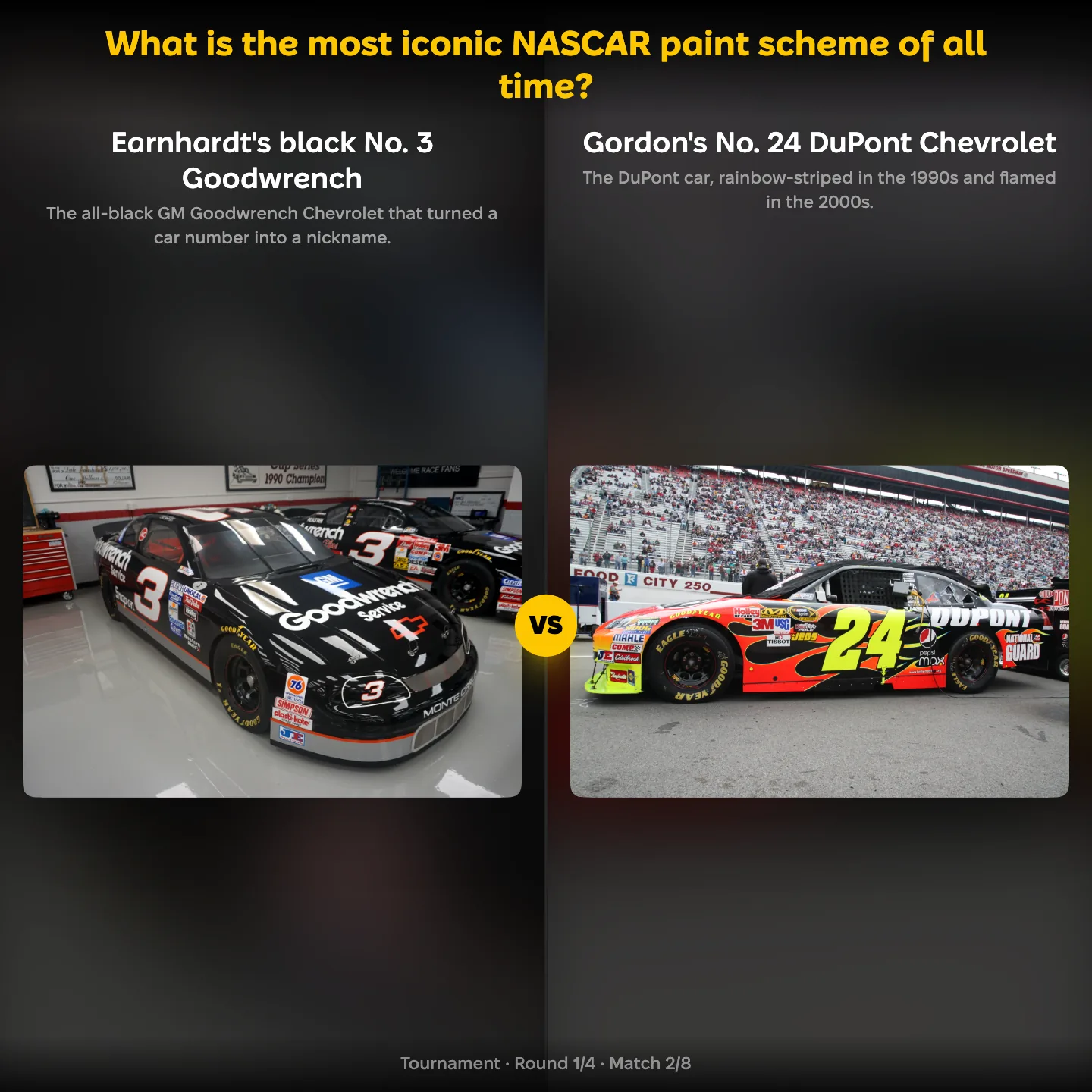
The black No. 3 against the No. 24 DuPont: when the cars do the arguing
One ranking in this set drops Earnhardt and Gordon and puts their cars up instead, which turns out to be the cleanest version of the whole dispute.
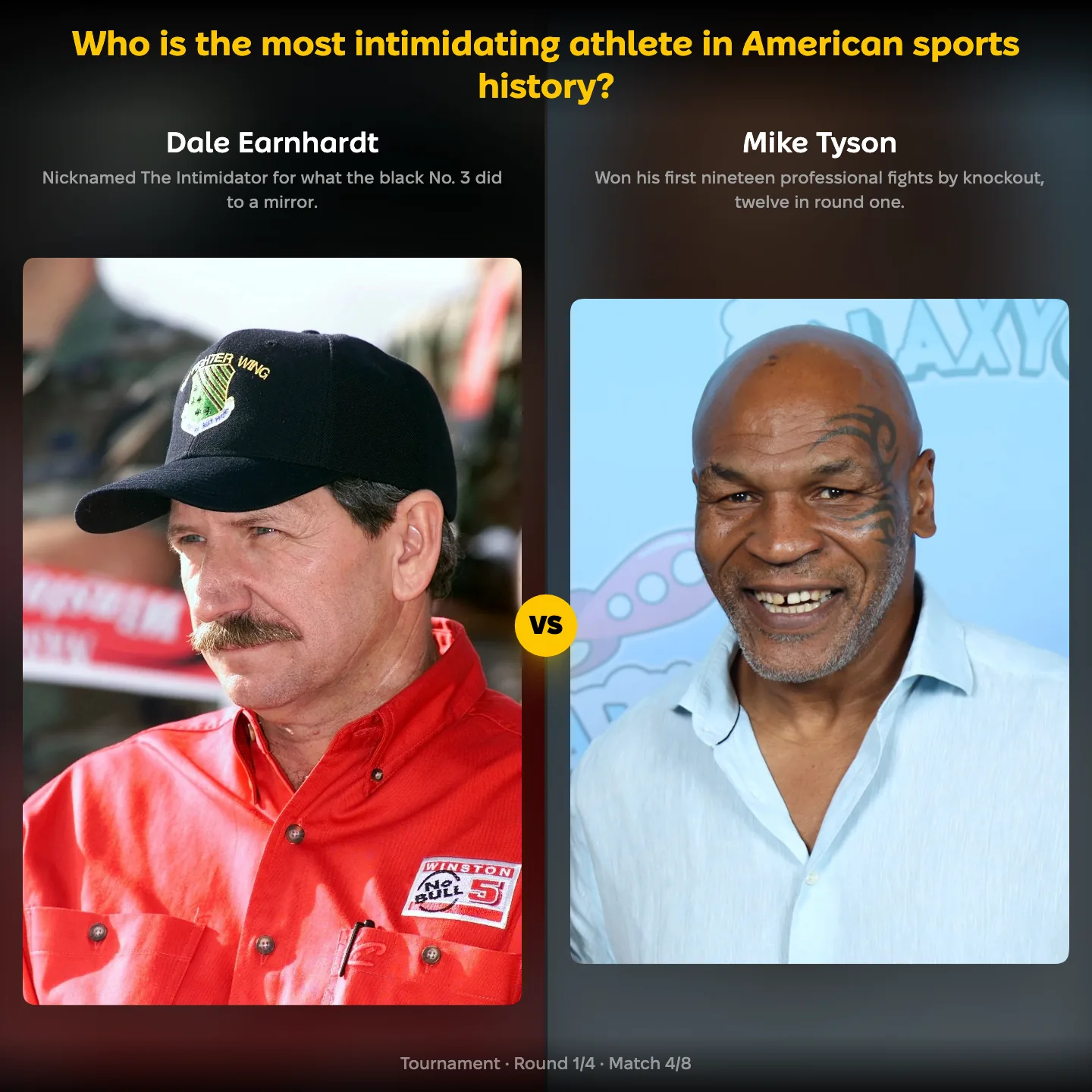
Earnhardt's GM Goodwrench Chevrolet was black, with a single number on the door and almost no other colour. The nickname followed the paint: a mirror full of that car meant something specific to the driver ahead, and The Intimidator stuck to the man because it had already stuck to the machine.
Gordon's DuPont car was the opposite decision. Rainbow stripes in the 1990s, flames in the 2000s, a crew that answered to the name Rainbow Warriors, and a look built for a sponsor selling paint.
The two liveries were also a class argument that NASCAR fans conducted for a decade. Earnhardt came out of Kannapolis, North Carolina, and dropped out of school to go racing; Gordon was born in Vallejo, California, came up through open-wheel midgets and arrived at 21 with a sponsor and a made-for-television grin.5 Neither man designed his own car, and both cars did the talking anyway.
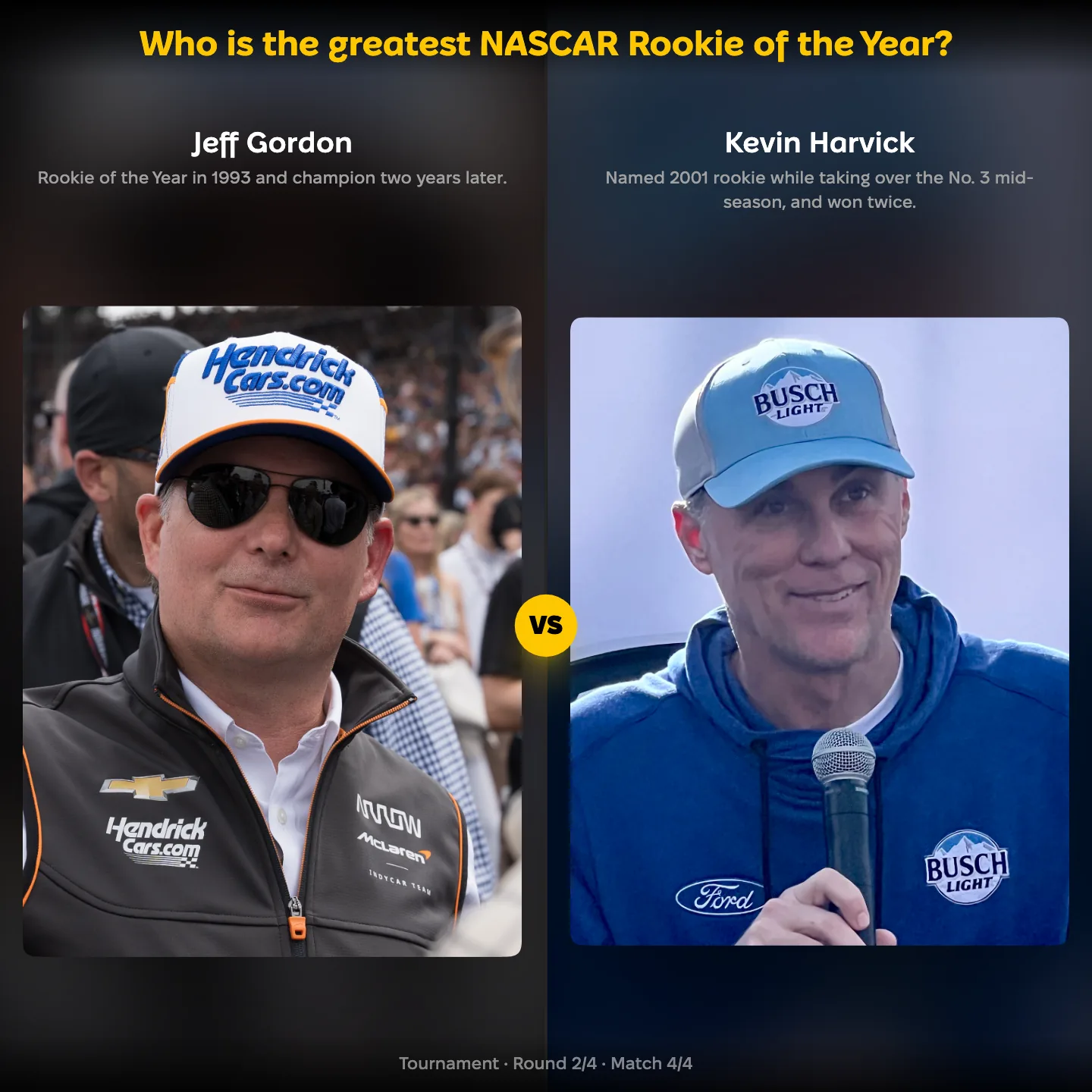
Rookie of the Year: Gordon in 1993, Earnhardt in 1979, Harvick in the No. 3
Both men won this award, and both turned it into a championship almost immediately.
Earnhardt was NASCAR's Rookie of the Year in 1979 and Cup champion in 1980, the only driver in the sport's history to do it in consecutive seasons.6 Gordon took the rookie award in 1993 and the title in 1995.
Kevin Harvick earned his 2001 award in circumstances nobody would want. He was handed Earnhardt's team a week after Earnhardt died, ran the car with the number changed from 3 to 29, won twice and was named Rookie of the Year.
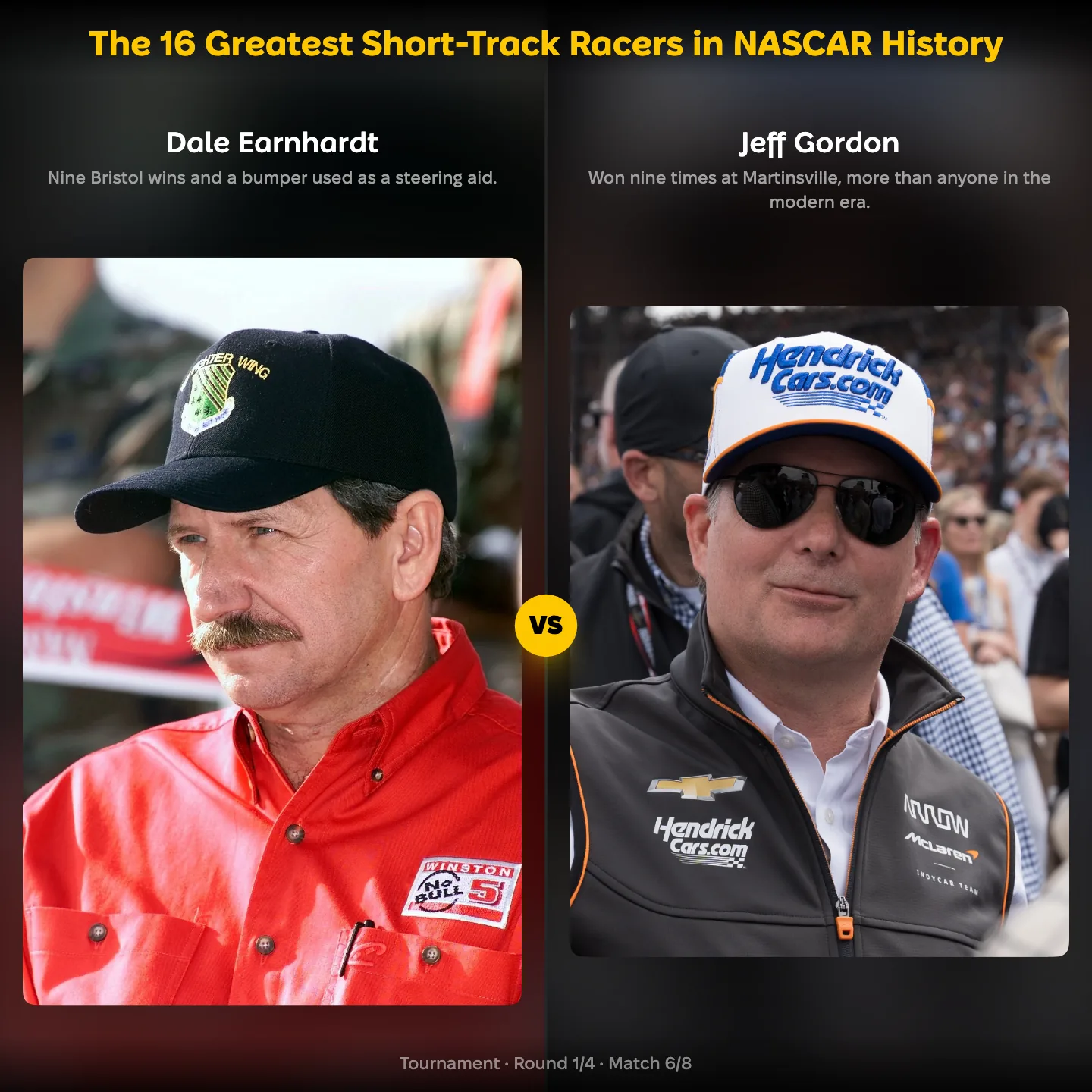
Bristol and Martinsville: nine short-track wins each
The short tracks produce the neatest symmetry in the rivalry and the least agreement about what it means.
Earnhardt won nine times at Bristol, starting in 1979 with the first Cup victory of his career.9 Half a mile, 500 laps, and a driving style that treated the rear bumper as a legal part of the car.
Gordon won nine times at Martinsville, the shortest track on the schedule, where Richard Petty's 15 wins remain the all-time record at any single circuit.
The two figures look identical and describe different skills. Bristol rewards commitment through banked corners at speed; Martinsville rewards braking discipline on a flat paperclip where the fast line is a compromise.
Watkins Glen and Sonoma: the list Earnhardt is not on
Every rivalry has a category where one side simply does not appear, and for Earnhardt it is the two right-hand turns a year NASCAR used to schedule.
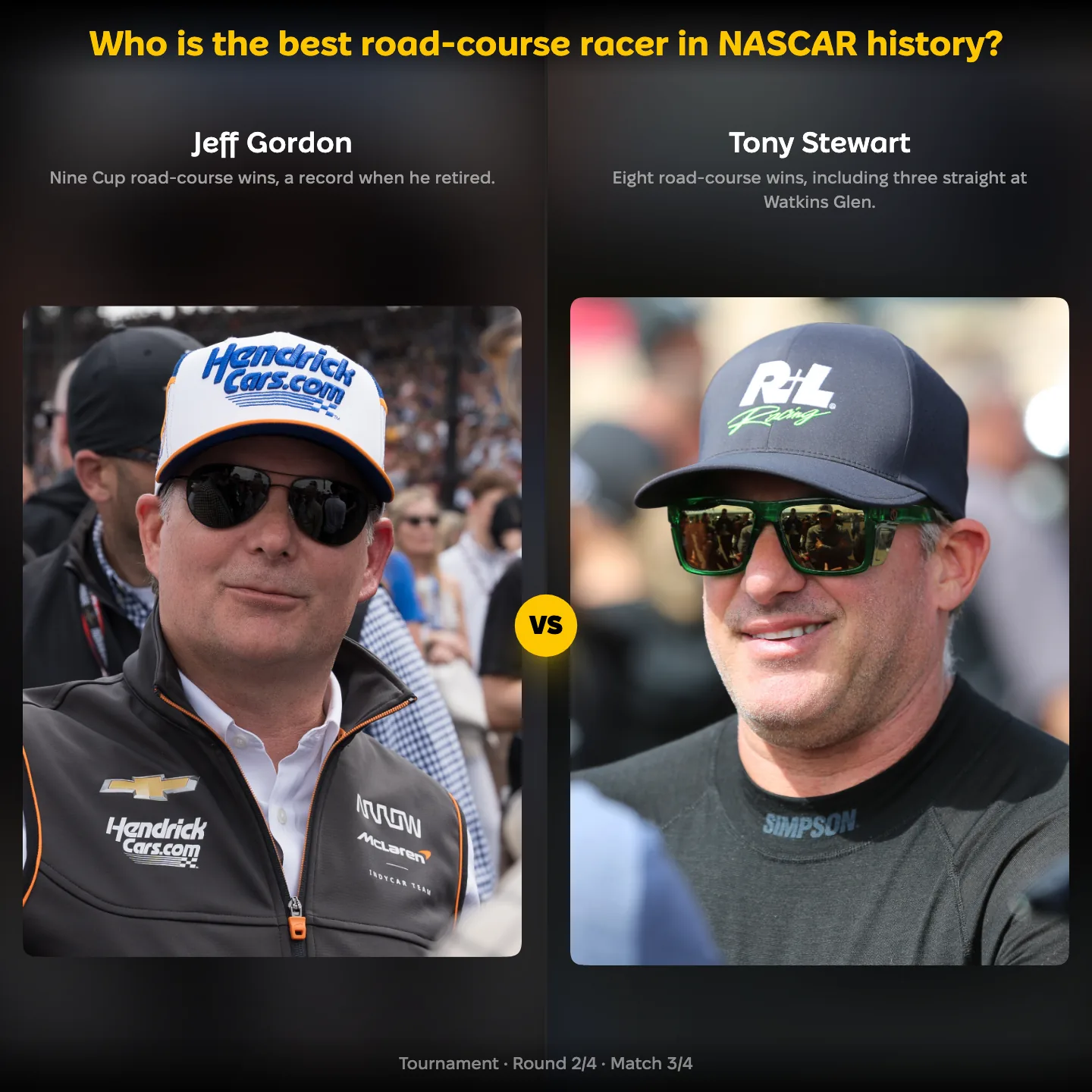
Gordon won nine Cup road-course races, a record that still stands twenty years after his ninth at Sonoma in 2006, and he set it in an era when the schedule offered only two chances a season.10 Hendrick Motorsports noted in June that the modern calendar's six road races now put it within reach of active drivers.
Earnhardt never won on a road course in 676 Cup starts.4 He ran Watkins Glen and Sonoma every year without ever being the man to beat there, and the two dates were the known soft spot in an otherwise complete résumé.
Tony Stewart and Chase Elliott are the names that make Gordon's record look mortal rather than untouchable, and Shane van Gisbergen won a street race on his Cup debut in 2023.
The Intimidator vs Mike Tyson: a nickname that left the sport
Earnhardt is the only stock-car driver most Americans could name without following the sport, and this ranking is why.
The Intimidator was a description of method before it was a marketing line. Earnhardt moved people out of the way, and the men he moved said afterwards that seeing the black car in the mirror changed how they drove. Nothing in Gordon's record produces that sentence.
Mike Tyson won his first nineteen professional fights by knockout, twelve of them in the opening round. Lawrence Taylor changed how NFL offences were built. Bob Gibson refused to speak to opposing hitters.
Gordon's absence here is the point of the section. He won more races than Earnhardt, was booed for years by Earnhardt's fans for exactly that, and still generated nothing anyone would call fear.
Dale Earnhardt Jr. and the fan award neither of them won while racing
Popularity in NASCAR has a ballot, and its winners list is not a list of great drivers.
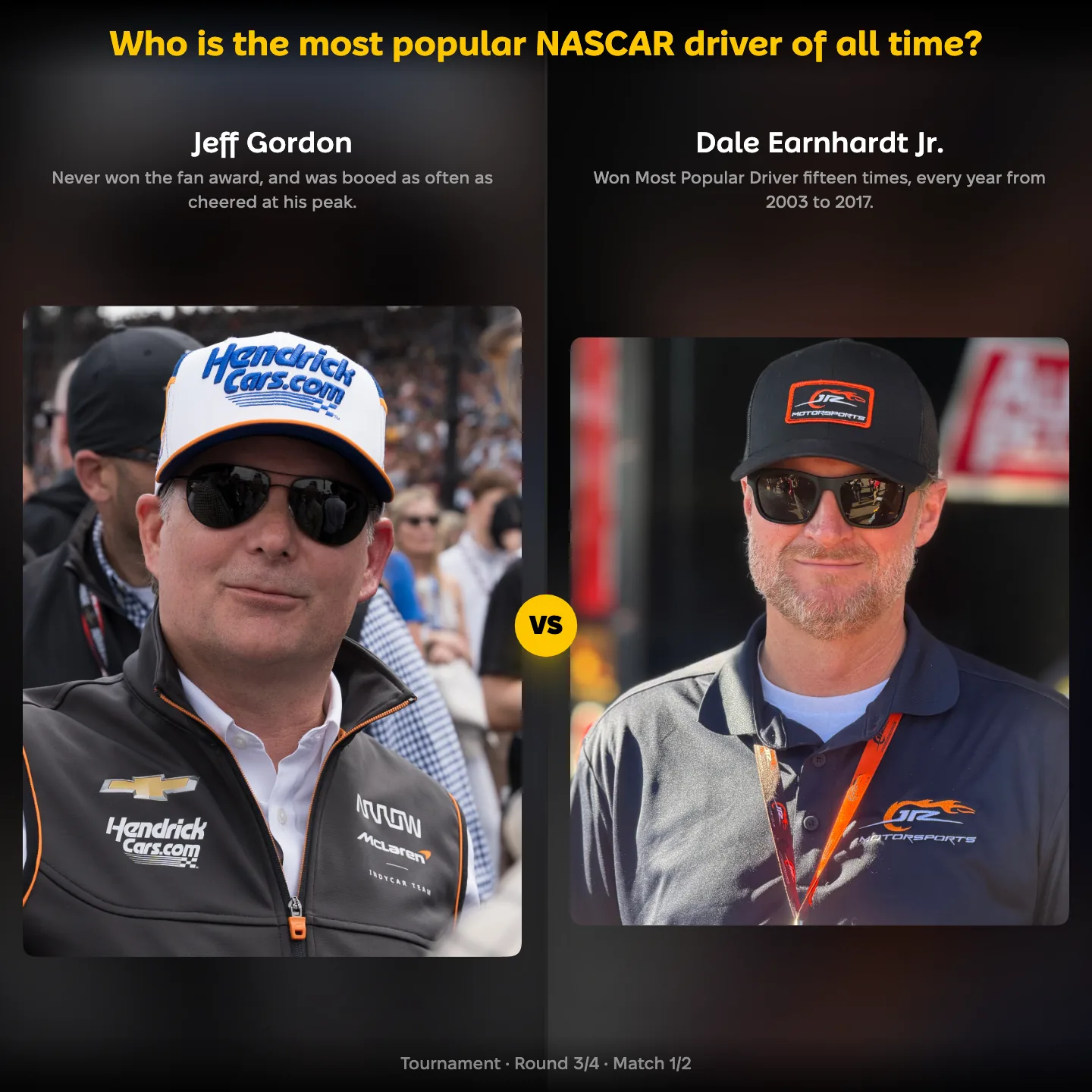
Bill Elliott won the fan-voted Most Popular Driver award sixteen times. Dale Earnhardt Jr. won it fifteen years in a row, from 2003 to 2017, on the strength of a surname and four wins a season at best. Chase Elliott has taken it every year since.11
Earnhardt won it once, in 2001, the year he died. Gordon never won it at all.
Gordon's problem was that he was Californian, 24 years old, winning constantly and sponsored by a chemicals company, in a sport whose fans had spent twenty years cheering for a mill worker from North Carolina.
Mario Andretti, A.J. Foyt and the company outside stock cars
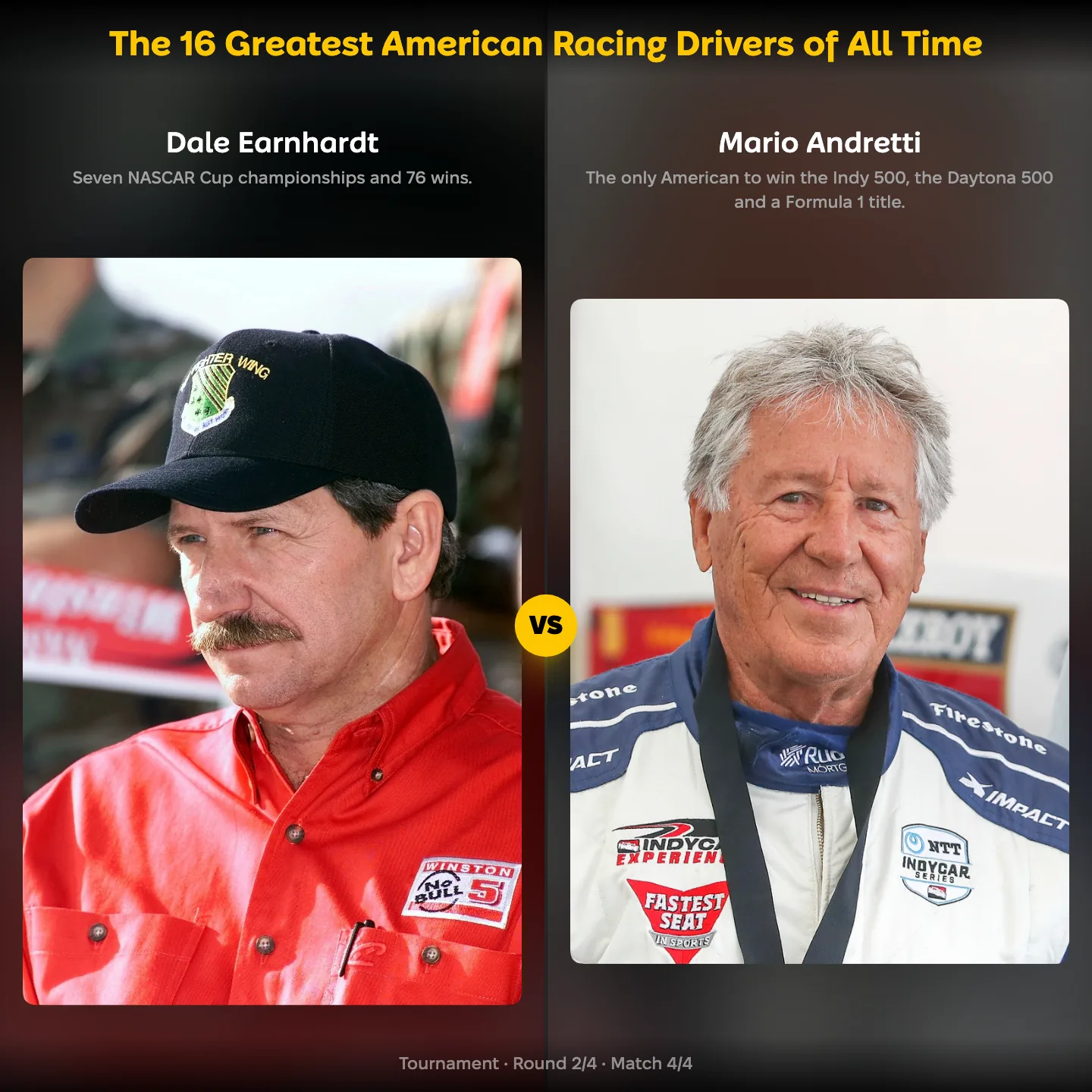
Open the question to American racing as a whole and both men lose their advantage, because the field fills up with drivers who won in several disciplines.
Mario Andretti is the only American with the Indy 500, the Daytona 500 and a Formula 1 title on the same résumé. A.J. Foyt took four Indy 500s, a Le Mans victory and seven national championships.
Earnhardt and Gordon spent their entire careers in stock cars.2
Terry Labonte's two wins and the overrated-champion question
The unflattering ranking in this set has a real case to make against both men, and most such lists manage only one target.
Gordon's four titles came with Hendrick Motorsports resources, Ray Evernham on the pit box for three of them, and a car that was frequently the best on the grid. Earnhardt's seven came with one Daytona 500, a road-course record of zero, and a folk legend that grew considerably after 2001.
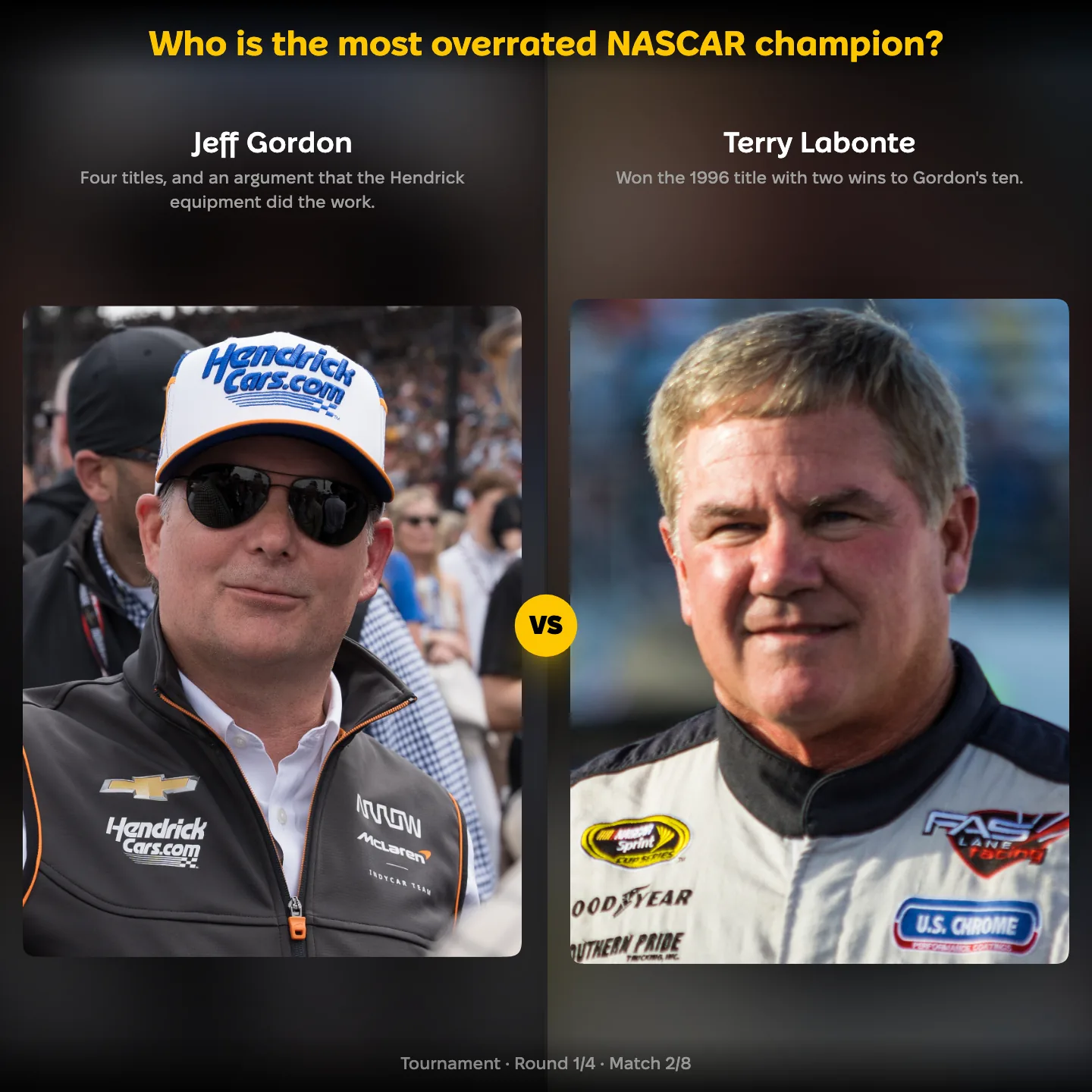
Terry Labonte is the sharper example of what the question is actually asking. He won the 1996 championship with two victories while Gordon, his own teammate, won ten that year under the same roof.
The format did the rest. Both men won titles under season-long points, where consistency beat winning, and the 2026 return to that system will produce the same complaint by November.
Twelve questions, and the pair never line up the same way
Earnhardt's seven titles and Gordon's 93 wins are both real, and no single list can hold both without deciding which one it came to measure. Trophies put Earnhardt ahead. Race wins, road courses and the Daytona 500 put Gordon there. Popularity put a third Earnhardt ahead of both.
Gordon is now vice chairman of Hendrick Motorsports, which means he signs off on cars that race against the number he spent a decade chasing.12
Every ranking here gets decided in pairs, two options at a time, and the head-to-head method explains why that produces a different order than a straight poll would. Anyone who thinks a driver, a car or a season belongs somewhere else in these twelve can write the thirteenth question and let the voting answer it.
More rankings, more angles
- Mario Andretti Won Indy, Daytona and F1 — Once Each — the American who won everything exactly once
- Rossi vs Márquez: Nine World Titles Each — the same argument on two wheels
- Hamilton vs Schumacher — seven championships apiece, and no agreement
Sources
- NASCAR.com, "A star is born: Jeff Gordon's 1995 championship season" — Earnhardt calling Gordon "Wonderboy" and joking that the season-ending banquet would have to serve him milk: nascar.com (checked 2026-09-11)
- FOX Sports — Jeff Gordon bio: 93 wins (third all-time behind Petty's 200 and Pearson's 105), four championships, three Daytona 500s, a record five Brickyard 400s, 81 poles, 1992–2015 at Hendrick Motorsports: foxsports.com (checked 2026-09-11)
- 2026 NASCAR Cup Series — the return of the Chase format, 16 drivers, Darlington on 6 September to Homestead–Miami on 8 November, no eliminations: wikipedia.org (checked 2026-09-11)
- NASCAR Hall of Fame — Dale Earnhardt, inaugural class of 2010: seven championships (1980, 1986, 1987, 1990, 1991, 1993, 1994), 676 starts, 76 wins, 22 poles, 1975–2001: nascarhall.com (checked 2026-09-11)
- NASCAR Hall of Fame — Jeff Gordon, class of 2019: four championships (1995, 1997, 1998, 2001), 805 starts, 93 wins, 81 poles, born in Vallejo, California, 1992–2016: nascarhall.com (checked 2026-09-11)
- Wikipedia — Dale Earnhardt: the 1979 Rookie of the Year season followed by the 1980 championship, the only consecutive pairing in Cup history, and the record tenth Talladega win in 2000: wikipedia.org (checked 2026-09-11)
- Hendrick Motorsports — Jeff Gordon's 1995 championship by the numbers: a 34-point margin, 4,614 to 4,580, the milk toast and the Wonder Boy nickname: hendrickmotorsports.com (checked 2026-09-11)
- HISTORY — Dale Earnhardt wins the 1998 Daytona 500 after twenty years of trying: history.com (checked 2026-09-11)
- Bristol Motor Speedway — Earnhardt's nine Bristol wins, the first in 1979 and also the first Cup win of his career: bristolmotorspeedway.com (checked 2026-09-11)
- Hendrick Motorsports, June 2026 — Gordon's ninth road-course win at Sonoma in 2006 is still the NASCAR record: hendrickmotorsports.com (checked 2026-09-11)
- Motor Racing Network — full list of Cup Series Most Popular Driver award winners: Bill Elliott sixteen, Dale Earnhardt Jr. fifteen straight from 2003 to 2017, Dale Earnhardt in 2001, Chase Elliott from 2018: mrn.com (checked 2026-09-11)
- Hendrick Motorsports — Jeff Gordon's team profile, listing him as vice chairman: hendrickmotorsports.com (checked 2026-09-11)