
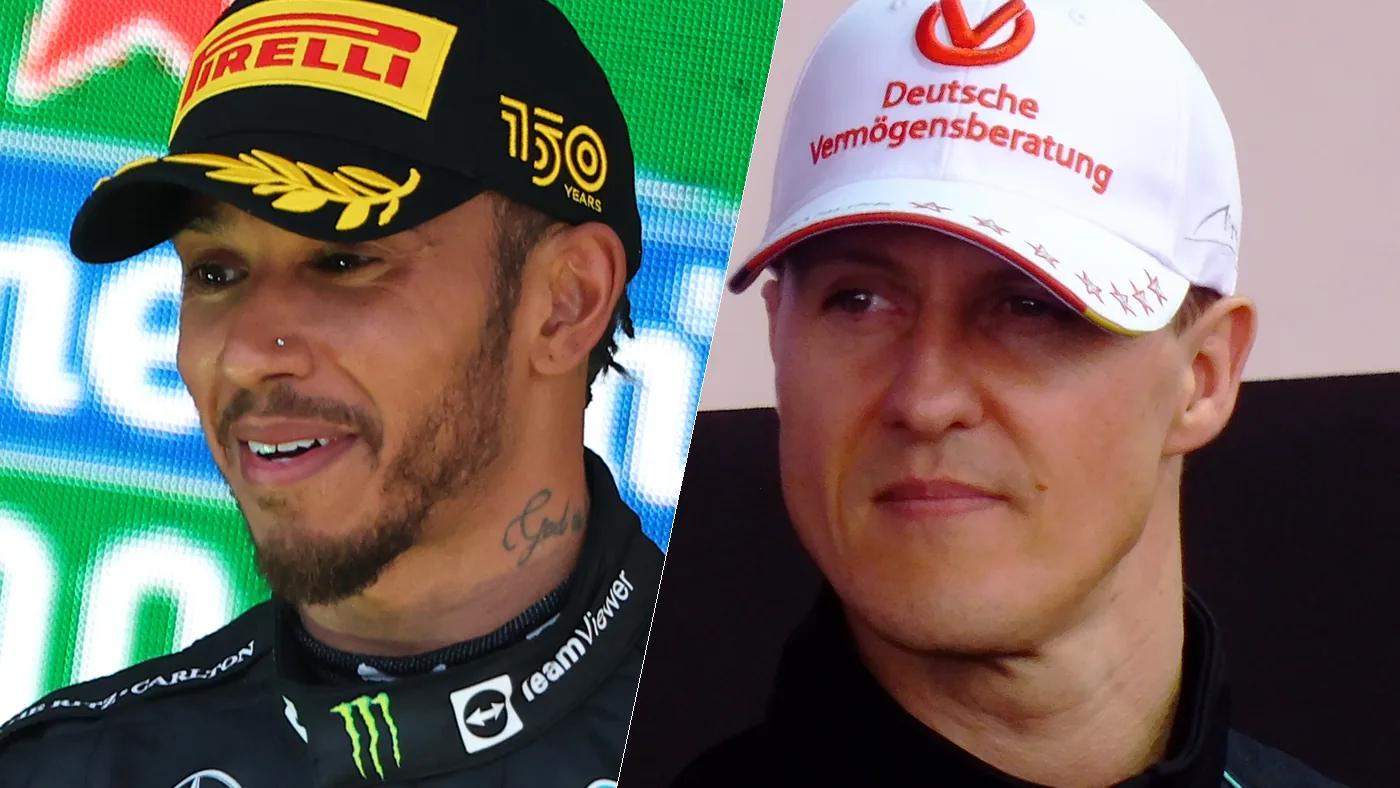
Lewis Hamilton took his first Ferrari victory on 14 June 2026, at Barcelona-Catalunya, the 106th win of his career.3 Michael Schumacher won his first race in a Ferrari at the same circuit, in the rain, on 2 June 1996.4 Thirty years apart, in the same red car, on the same stretch of Catalan tarmac.
They also share the only number that ends most arguments in this sport: seven world championships each. Everything underneath that number pulls in opposite directions.
Fourteen lists put Hamilton and Schumacher in the same seven-title bracket, then split them the moment the question narrows to one team, one decade or one wet afternoon.
Hamilton vs Schumacher: the argument that never closes
Start with the widest question Formula 1 has, and both men are on the list — along with the drivers who make the comparison harder rather than easier.
Hamilton owns the counting stats. He holds the all-time records for wins, poles and podiums, with 106 victories and 207 podium finishes.2 Schumacher's totals were the ones Hamilton overtook: 91 wins, 68 poles, 155 podiums.1
Then Ayrton Senna and Juan Manuel Fangio walk into the room and the counting stops working. Senna died with 41 wins. Fangio started 51 races and won five titles in seven seasons, in cars that killed people regularly.
That is the trouble with a question this broad. It gathers drivers from six decades who never shared a grid, a rulebook or a survival rate, and asks you to put them in order anyway.
Seven titles each, and one number nobody can break the tie with
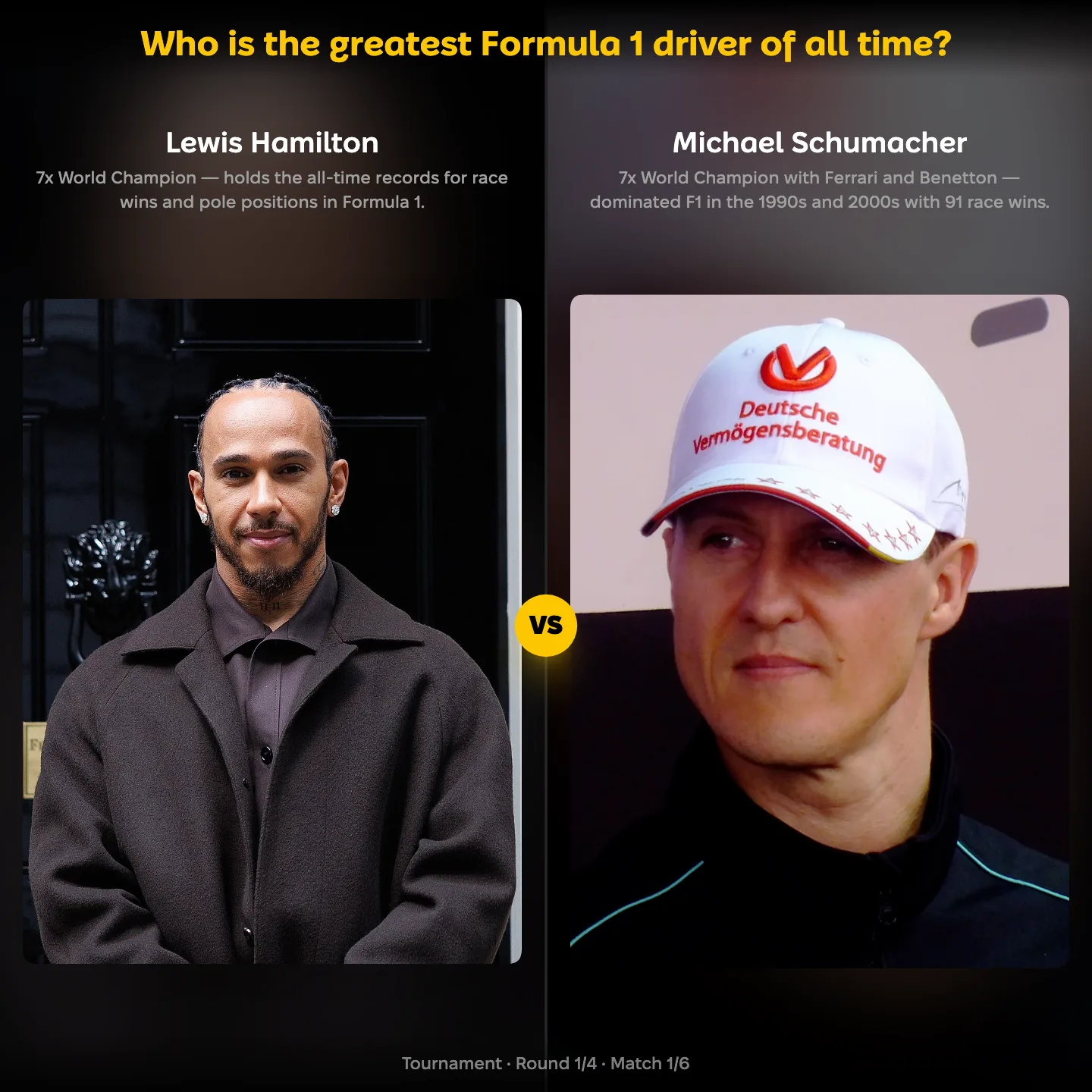
Narrow the question from "best driver" to "best champion" and the field shrinks to men who actually won the thing. Hamilton and Schumacher arrive tied at the top of it.
Schumacher's seven came in two bursts: 1994 and 1995 with Benetton, then five consecutive titles with Ferrari from 2000 to 2004.1 That run of five in a row is the one headline record Hamilton never got near.
Hamilton's seven arrived in 2008, 2014, 2015 and then four straight from 2017 to 2020.2 Four is a long way from ordinary. It is not five.
Fangio is the complication here too, with five titles from a career of 51 starts. Nobody has ever agreed whether that is a smaller achievement or a larger one.
Ferrari: the team Schumacher rebuilt and Hamilton joined
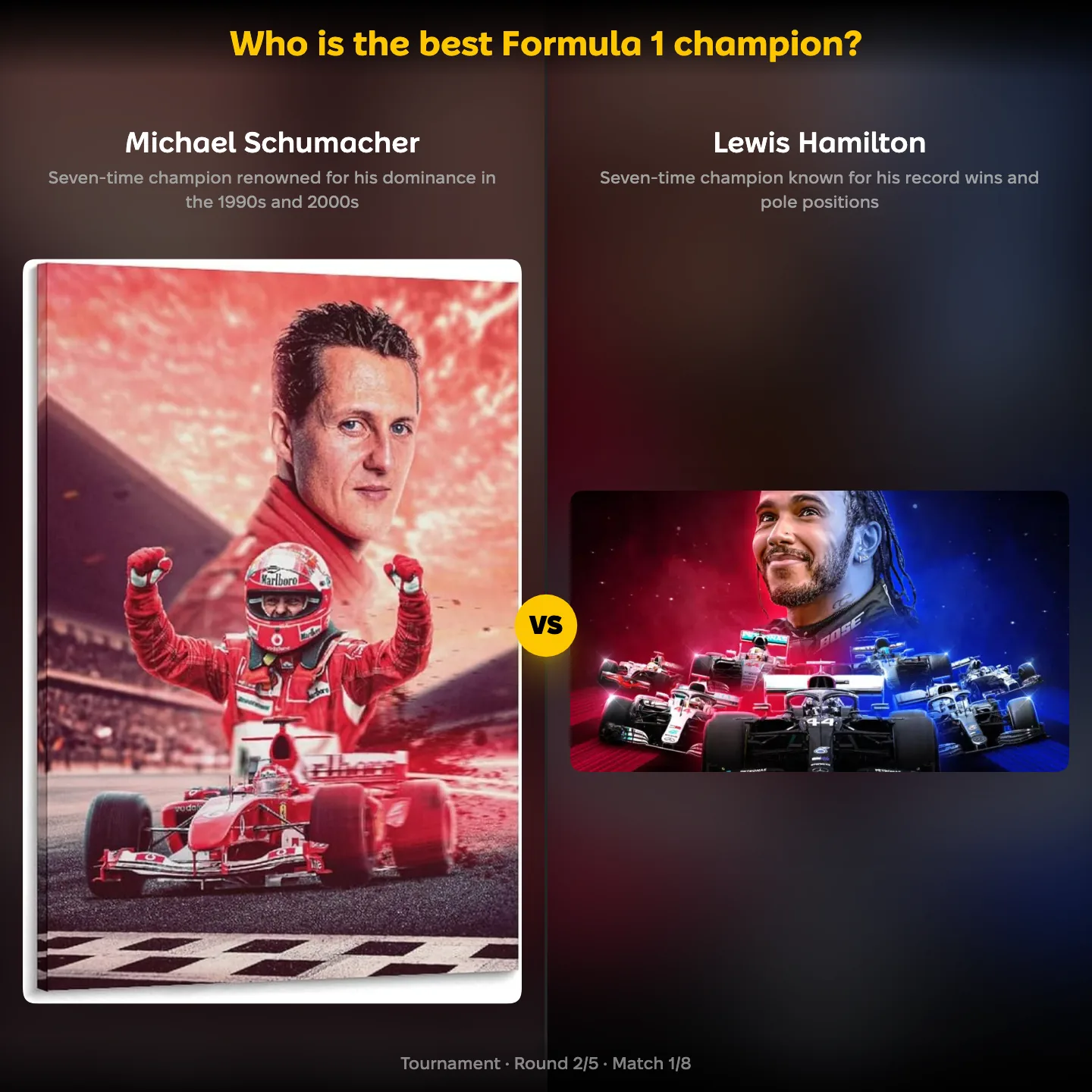
This is the ranking that turned the comparison from a pub argument into a job description. Since 2025 Hamilton drives for Ferrari, the team Schumacher spent eleven seasons defining.2
Schumacher arrived at Maranello in 1996, when Ferrari had not won a drivers' title since 1979. He left in 2006 with five, taken in consecutive years, and a team rebuilt around him from the engineering department outward.1
Hamilton arrived in 2025 as the most decorated driver in the sport's history and waited a season and a half for a win. It came at Barcelona in June 2026, ending a run of nearly two years without one.3
Look past the two of them and the comparison gets harder, not easier. Alberto Ascari won consecutive titles for Ferrari in 1952 and 1953. Niki Lauda won two and survived a fire that should have ended everything. Both Hamilton and Schumacher are entering a story that was already long before either of them showed up.
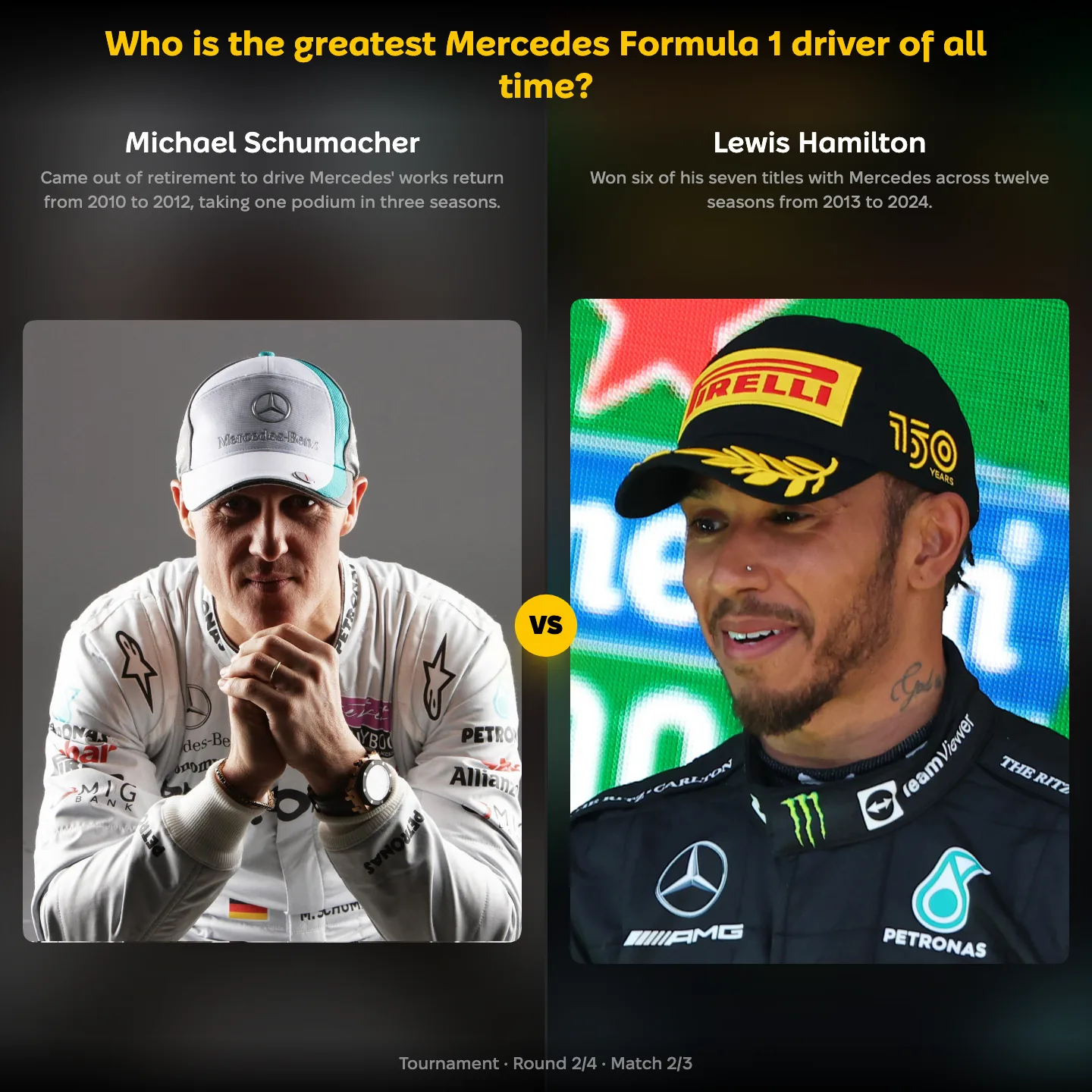
Mercedes: Schumacher opened the seat, Hamilton filled it
At Ferrari, Schumacher came first. At Mercedes it ran the other way, and almost nobody remembers it like that.
Schumacher came out of retirement to drive Mercedes' works return from 2010 to 2012. Three seasons, one podium, no wins.1 It is the least successful chapter of his career by a distance.
Hamilton replaced him for 2013 and stayed twelve years, winning six of his seven titles in the car Schumacher had helped shake down.2
Juan Manuel Fangio complicates this one as well. He won the 1954 and 1955 championships in the Mercedes W196, during a works programme that lasted two seasons and then vanished for fifty-five years.
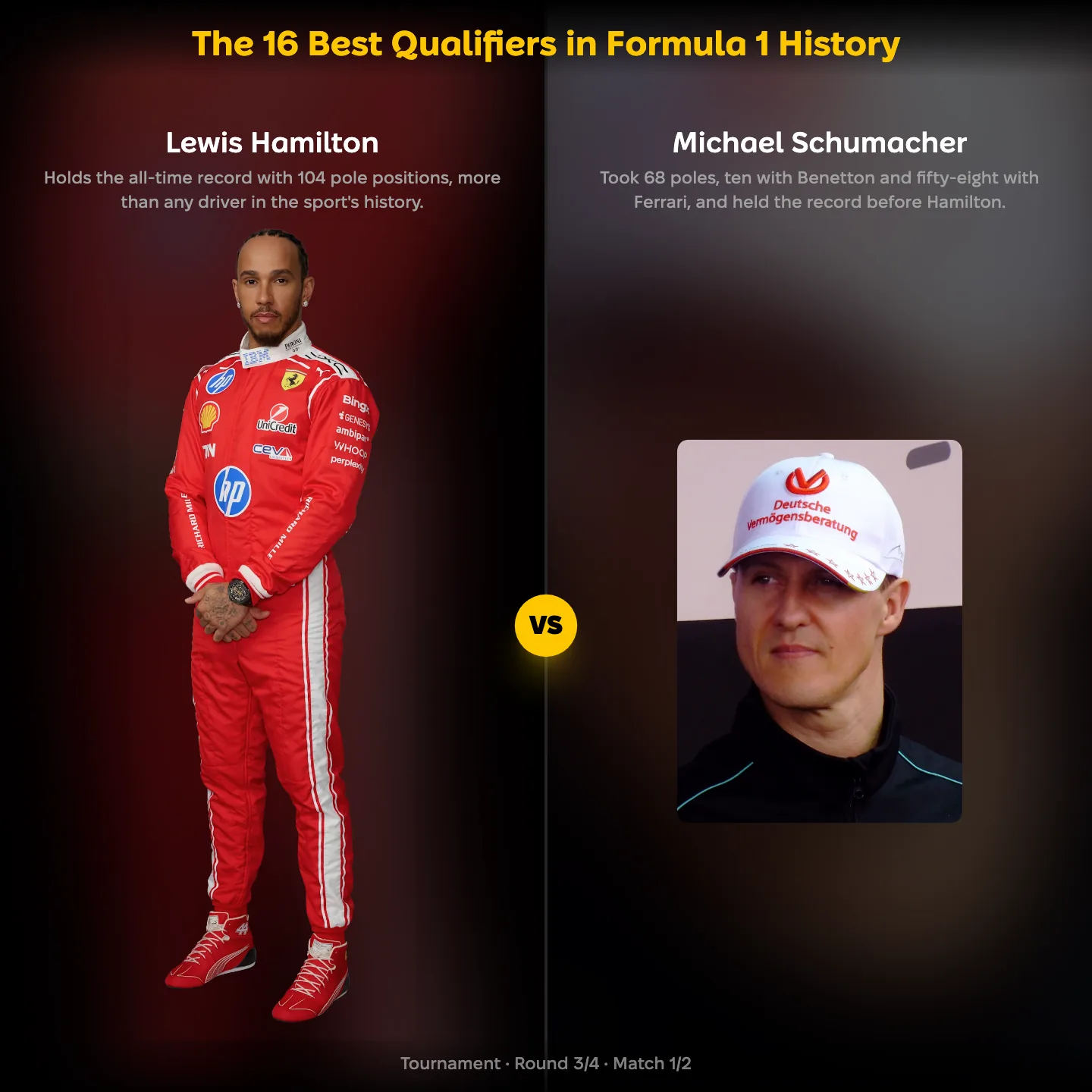
104 poles to 68: the Saturday record
Qualifying is the one discipline where the gap between Hamilton and Schumacher is a plain number, and the number is not close.
Hamilton has 104 pole positions. Schumacher finished on 68, ten of them with Benetton and fifty-eight with Ferrari.21
Senna took 65 in a career cut short at 34. He also produced the single lap most people name first when the subject comes up, at Monaco in 1988, when he put his McLaren 1.4 seconds ahead of a team-mate in identical machinery.
Jim Clark is the outlier that makes raw totals look silly: 33 poles from 72 starts, a rate no full career has matched since.
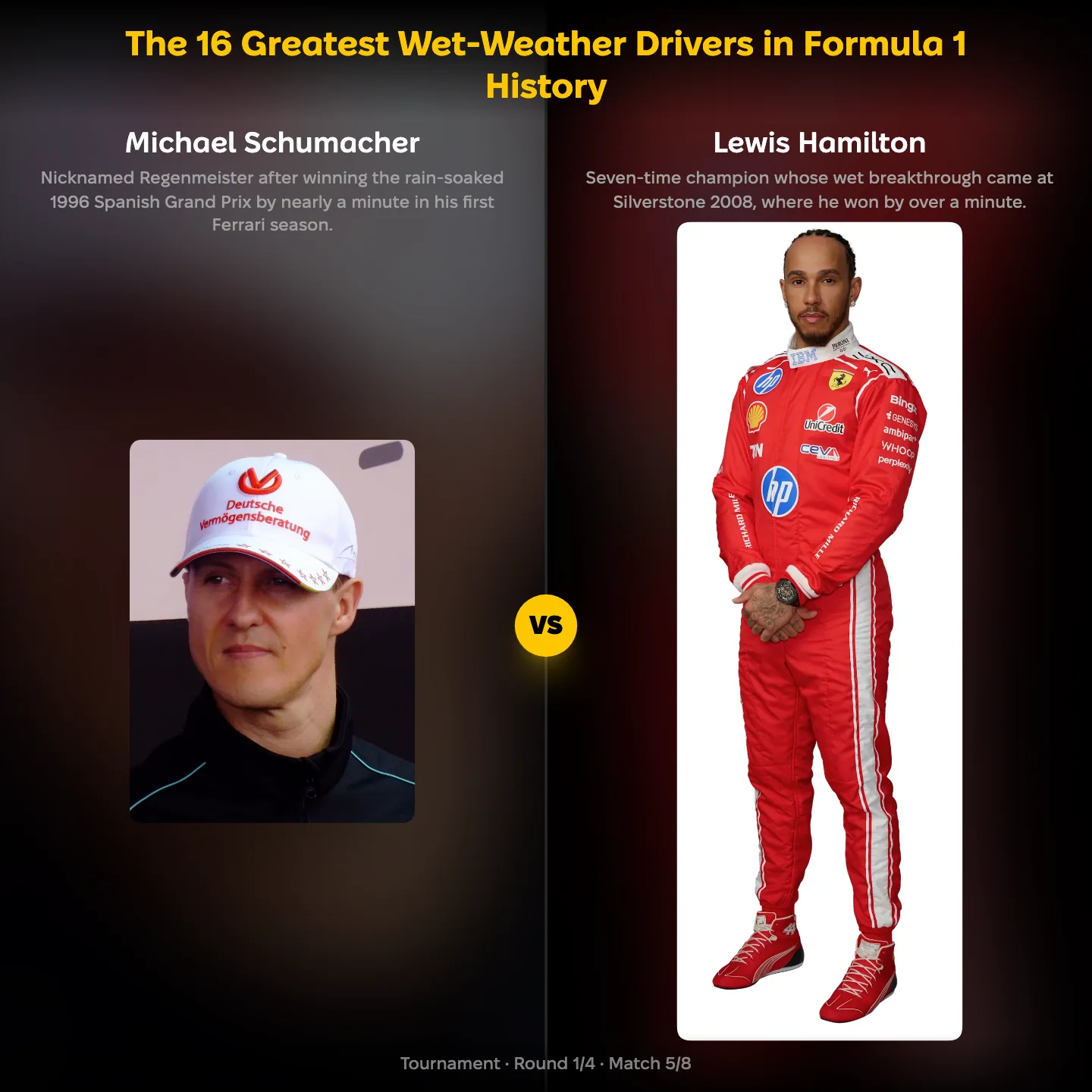
Barcelona in the rain, 1996 and 2026
Both men built a reputation on wet tracks, and both did it at the Circuit de Catalunya, which is why this ranking is the strangest coincidence in the whole comparison.
Schumacher's 1996 Spanish Grand Prix is the drive that made "Regenmeister" stick. Ferrari had given him a car nobody rated, the race started in standing water, and he finished it minutes clear of everyone behind him.4
Hamilton's wet breakthrough came at Silverstone in 2008, where he won by more than a minute in conditions that spun half the field. Eighteen years later he took his first Ferrari win on Schumacher's Barcelona.3
Senna is the name that usually settles this list before it starts, on the strength of one opening lap at Donington in 1993. Jackie Stewart's four-minute win in the 1968 German Grand Prix fog belongs in the conversation too, and it was achieved with a broken wrist.
Rain is the only condition in Formula 1 that reliably outranks the car. That is exactly why the list looks nothing like a championship table.
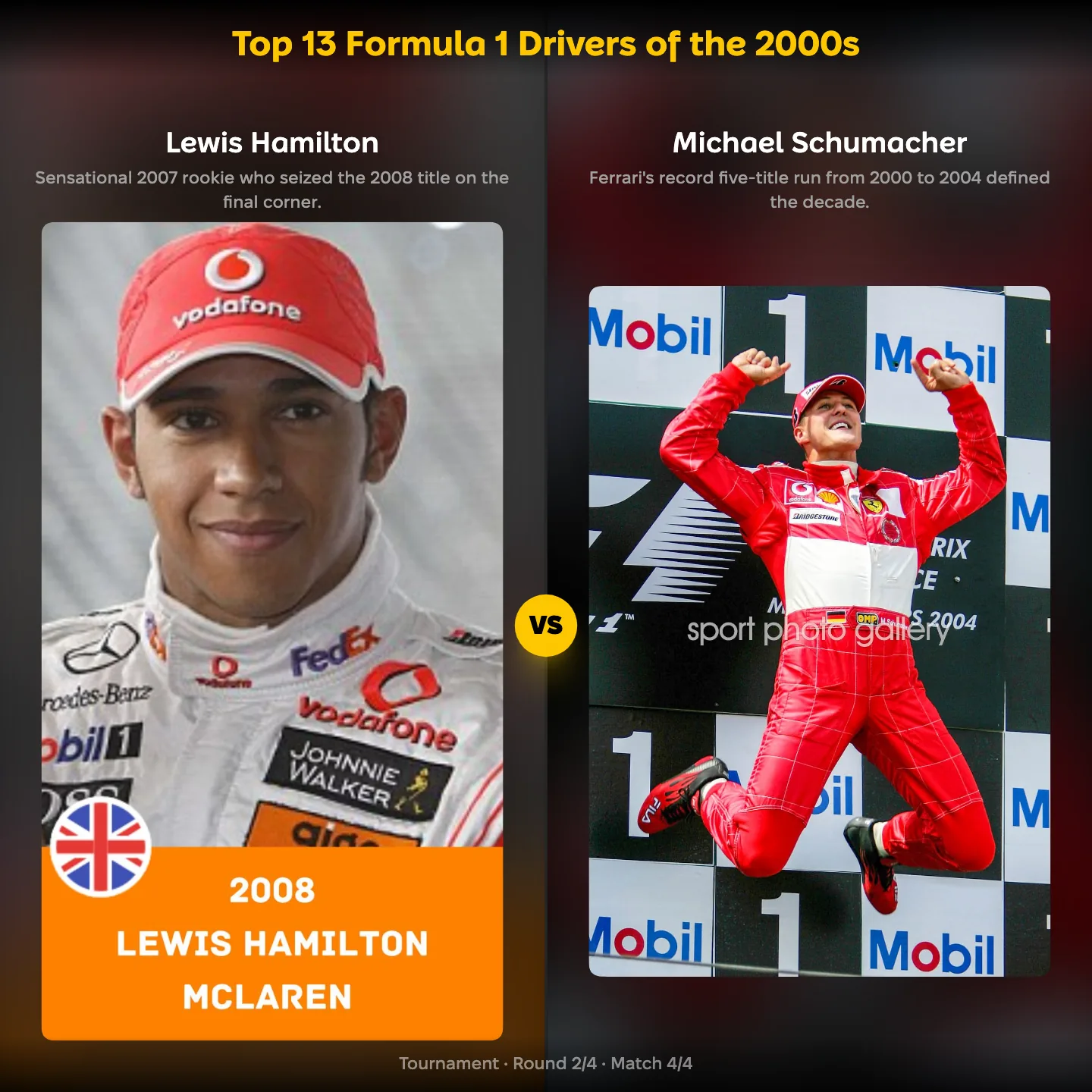
The 2000s: Schumacher's decade, Hamilton's first year in it
Cut the sport into decades and this is the only one that holds both of them, barely.
Schumacher won five championships in the first half of it and finished 2002 on the podium in all seventeen races, something no driver has done before or since.1
Hamilton arrived in 2007, took the title in his second season, and spent the rest of the decade as the sport's newest problem rather than its established one.
They overlapped by a matter of months. Schumacher's last race for Ferrari was in October 2006; Hamilton's first was in March 2007. Everything people believe about the two of them together comes from 2010 to 2012, when Schumacher returned and Hamilton was already winning.
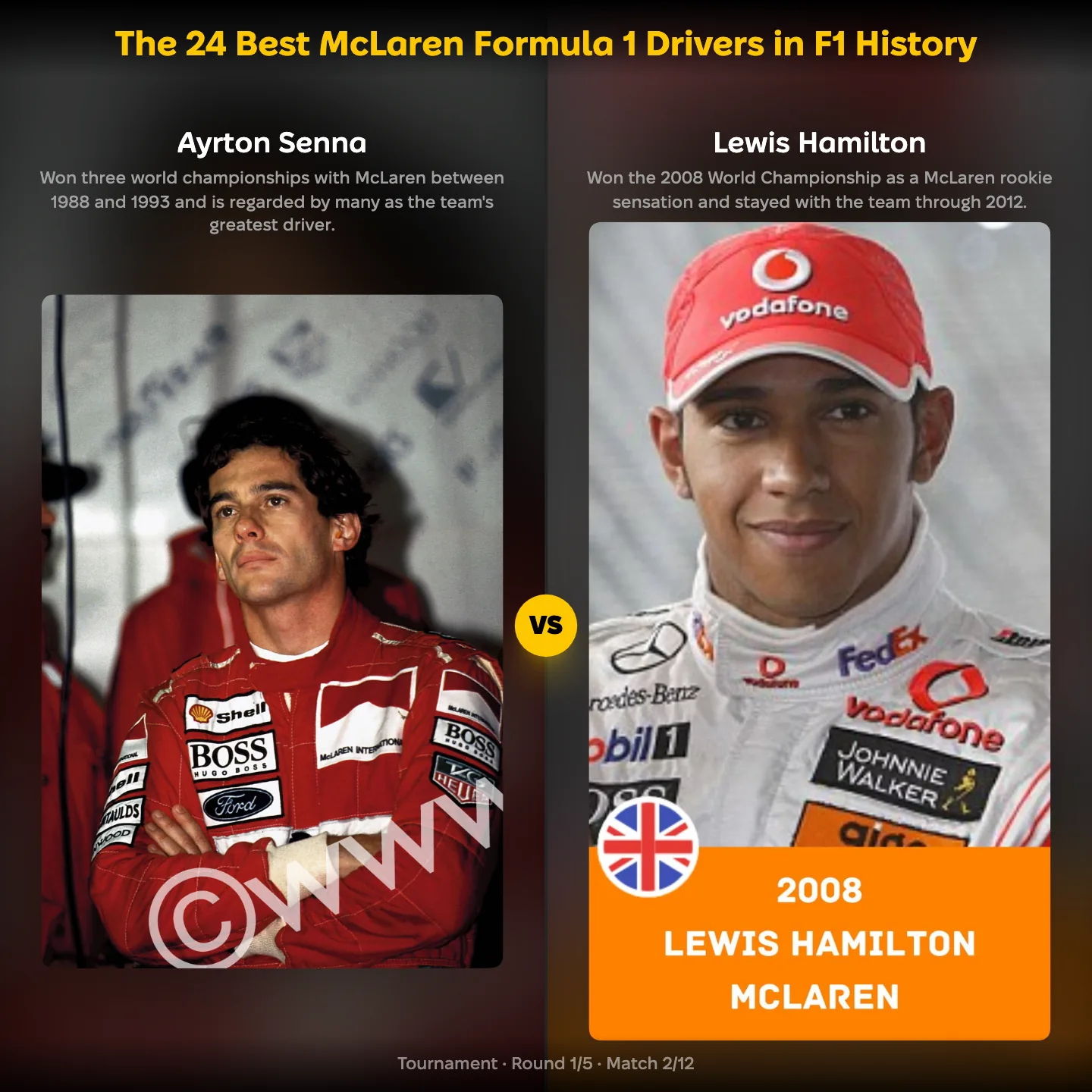
McLaren: a list Schumacher cannot appear on
Some of the distance between these two is not about talent at all. It is about which doors happened to open.
Hamilton spent 2007 to 2012 at McLaren, the team that funded him from the age of thirteen and put him in a race seat at 22.2 He won the 2008 championship there in his second season.
Schumacher never drove for McLaren. Not once in sixteen seasons. The team that produced Senna, Alain Prost and Mika Häkkinen spent most of the 1990s and 2000s trying to beat him instead.
So this ranking has an obvious shape and one absence, and the absence is the interesting part.
Niki Lauda, Alonso, Leclerc — and no Hamilton
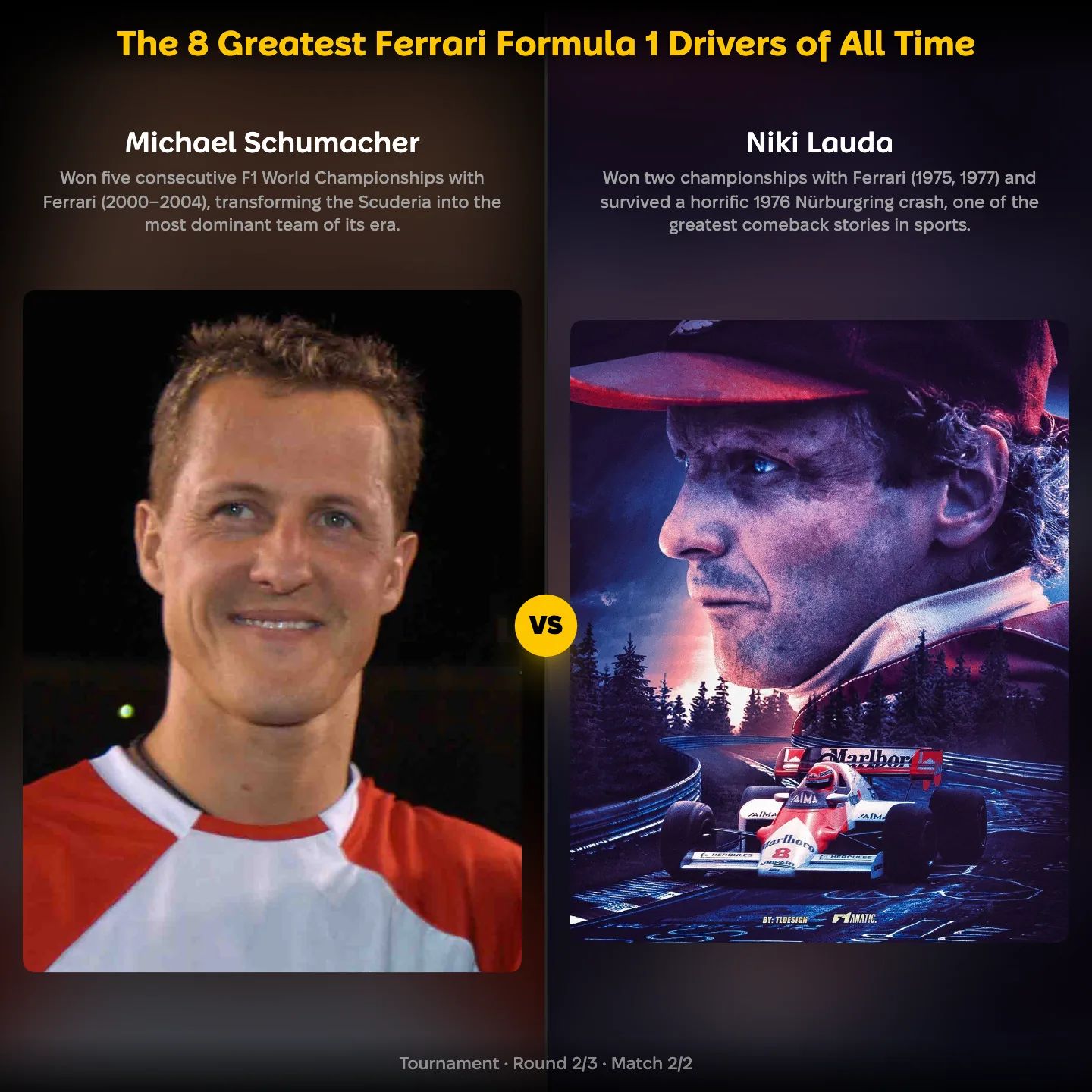
Shorten the same Ferrari question to eight names and Hamilton falls off it. Schumacher does not.
Eleven seasons and five consecutive titles buy a permanent place. A season and a half and one win do not, whatever the seven championships elsewhere on the CV say.1
The company on the shorter list is instructive: Lauda, Kimi Räikkönen, Fernando Alonso, Charles Leclerc, Clay Regazzoni. Ferrari has had a lot of very good drivers and not many who reorganised it.
Champions before 25: Vettel, Hamilton, Verstappen
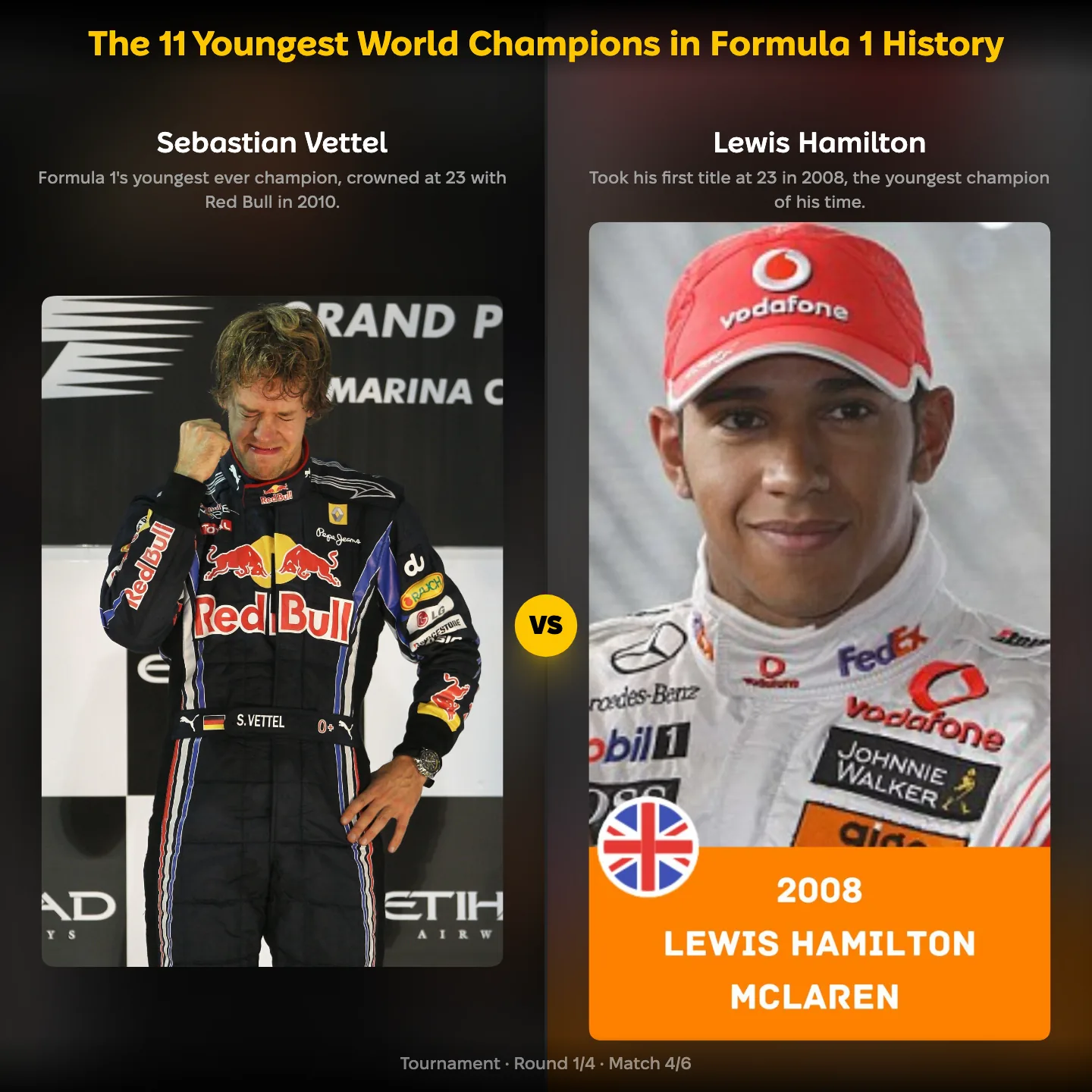
Measure arrival instead of accumulation, and the order rearranges completely.
Hamilton won his first title in 2008, in his second season, at 23. Schumacher's first came in 1994, in his fourth full season, at 25.2
Neither of them is near the top here. Sebastian Vettel took the 2010 championship at 23 years and four months, and Max Verstappen and Fernando Alonso both arrived young enough to matter.
Precocity is the one currency in this sport that nobody can accumulate. You get one attempt at it, and it expires.
Jerez 1997, Abu Dhabi 2021
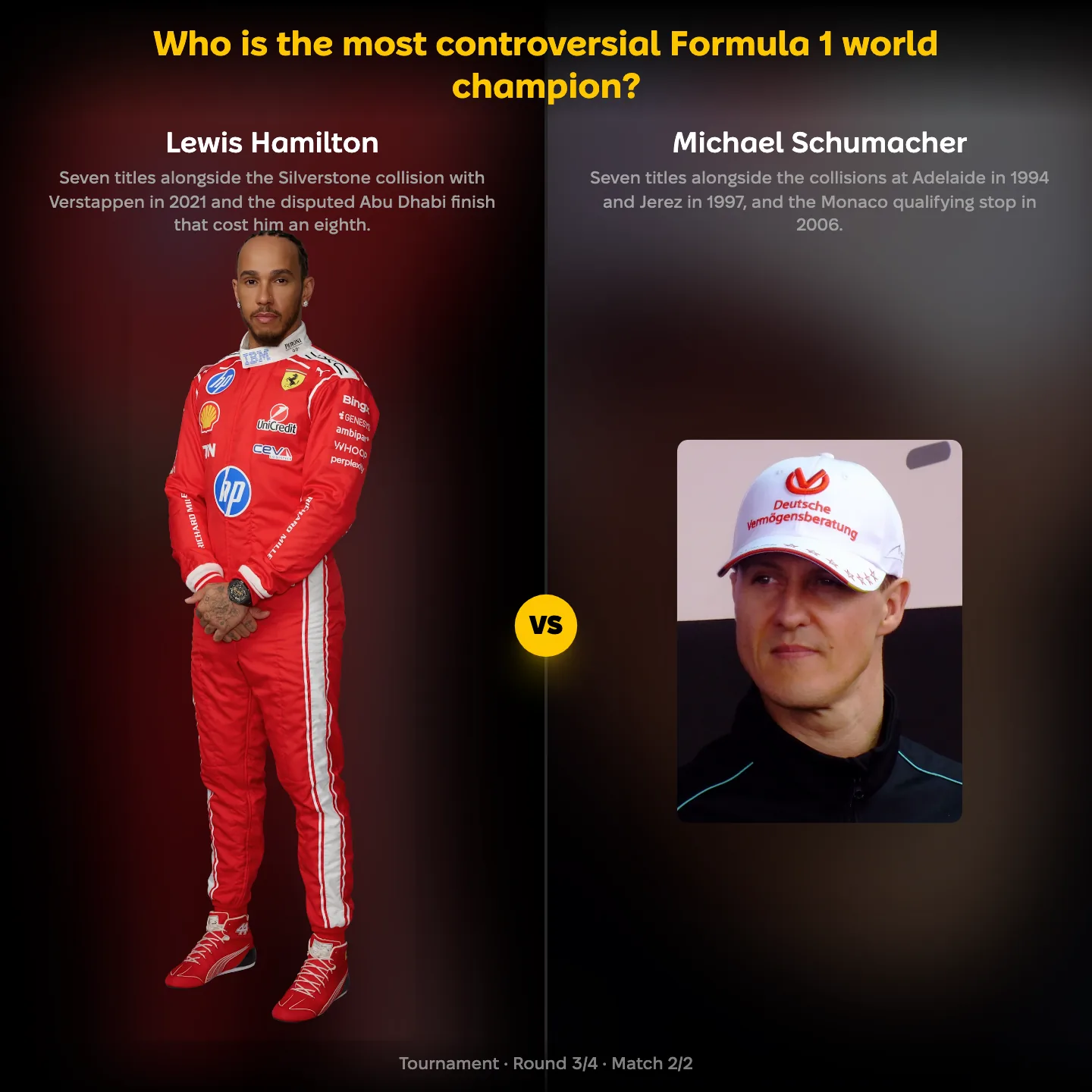
Every great driver in this sport has a file, and both of these files are thick.
Schumacher's is the heavier one. He drove into Damon Hill at Adelaide in 1994 to settle a championship, tried the same thing on Jacques Villeneuve at Jerez in 1997 and was stripped of that season's results for it, and parked his car at Monaco's Rascasse in 2006 to stop anyone beating his qualifying time.
Hamilton's file is written mostly by other people. The 2021 Silverstone collision with Verstappen put a rival in hospital and drew a ten-second penalty; the Abu Dhabi finale that followed was decided by a safety-car restart the FIA later called valid, final and unchangeable.2
There is a real difference between the two records, and it is worth stating plainly: one man's controversies were things he did, the other's were mostly things done around him.
Alain Prost, Ayrton Senna, Nelson Piquet and Fernando Alonso are all on this list for reasons that have aged badly. Formula 1 has never produced a saint at the top of it.
The titles before the titles
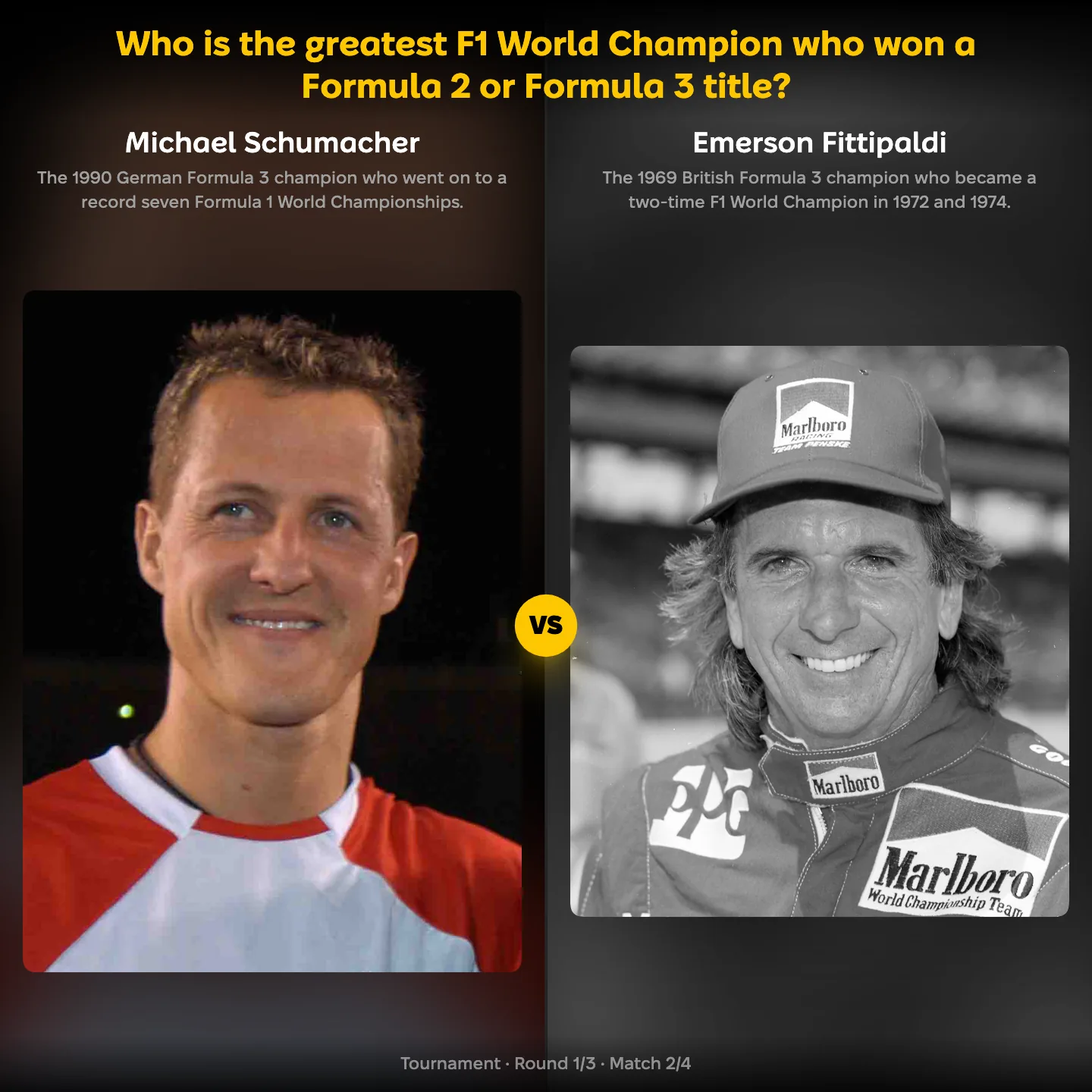
This ranking asks a narrower question: which F1 champion also won a Formula 2 or Formula 3 title on the way up?
Hamilton did it twice, taking Formula 3 Euro Series in 2005 and GP2 in 2006 at the first attempt, then going straight into a McLaren. Schumacher won the German Formula 3 championship in 1990 before Mercedes put him in sportscars.
Emerson Fittipaldi, Nico Rosberg, Prost and Häkkinen fill out a list of eight, which is small enough that being on it means something.
Everyone here started in a kart
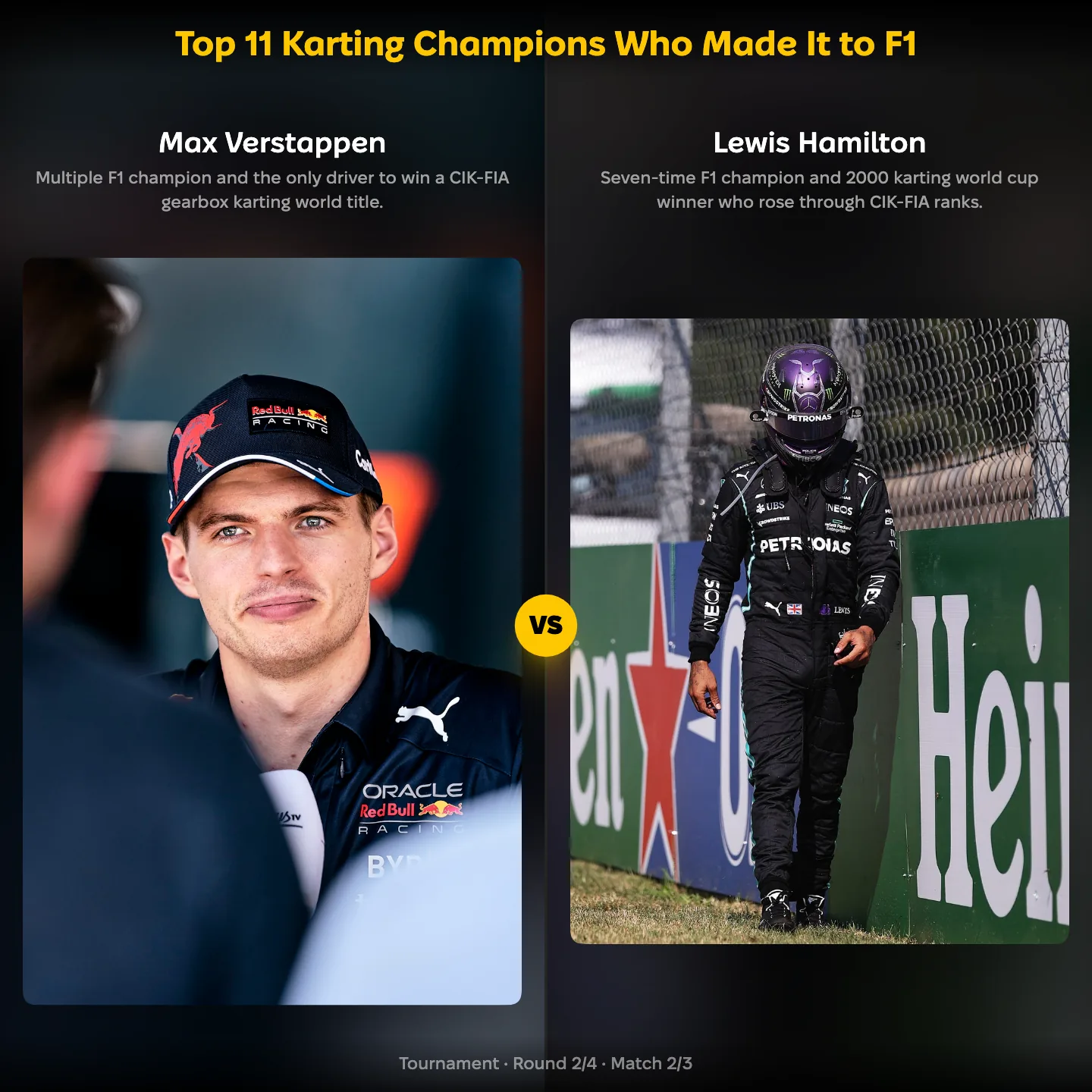
Wind the story back far enough and Hamilton and Schumacher are two children in go-karts, and so is everybody else on this list.
Schumacher was running a kart track's leftovers in Kerpen. Hamilton was winning British cadet championships at eight and being tracked by McLaren by ten.
Neither of them is the obvious answer here, because Max Verstappen, Charles Leclerc and Lando Norris all came through the same pipeline more recently and more completely.
Formula 3, Formula Renault, GP2: the junior record
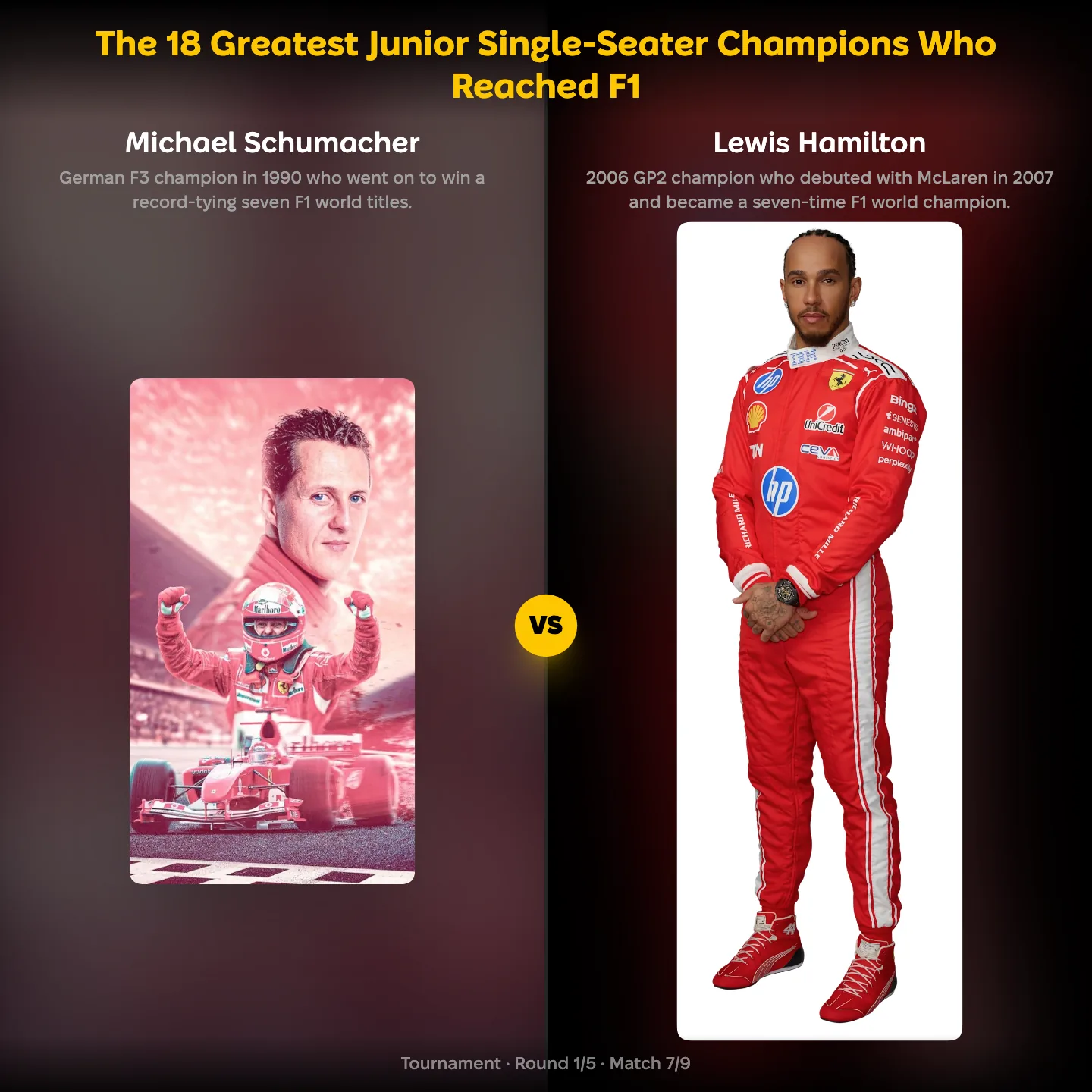
This is the tightest question here, and seven championships count for nothing in it.
Judged only on what they won before Formula 1, Hamilton has the stronger case: Formula Renault UK, Formula 3 Euro Series and GP2, each at or near the first attempt. Schumacher has German Formula 3 and a Mercedes junior contract.
Senna, Fernando Alonso and Charles Leclerc all have comparable junior records, and a couple of drivers on this list never won anything in Formula 1 at all.
Junior form predicts a seat. It does not predict seven championships, and this list is the proof.
Fourteen questions, fourteen different Ferraris
The seven-title tie is the least useful fact about these two men. It is the only place they agree, and every question underneath it hands the advantage to one of them for a different reason: the team, the era, the weather, the Saturday, the age they arrived.
Hamilton is contracted at Ferrari through at least 2027, which means the comparison has years left to move.2 Schumacher's side of it is finished and will not change.
Every ranking above gets decided two names at a time, and an order falls out of the accumulated matchups. The 1000-point scale is what turns those picks into a list.
Fourteen was where we stopped. If you know a question about these two that nobody has asked yet, build the ranking and let people fight over it.
More rankings, more angles
- Ferrari Means Something Different on Every List — the team at the centre of this article, ranked on its own terms
- How Many Ways Can You Rank Fernando Alonso? — the driver who shows up on nearly every list above
- Rossi vs Márquez: Nine World Titles Each — level on titles, split on everything else
- Senna vs Prost: 14 Rankings, One Argument — one McLaren garage, two seasons, forty years of argument
Sources
- Wikipedia — Michael Schumacher: career totals (91 wins, 68 poles, 155 podiums), the 1994–2004 championships, the five consecutive Ferrari titles, the all-podium 2002 season and the 2010–2012 Mercedes return: en.wikipedia.org (checked 2026-08-09)
- Wikipedia — Lewis Hamilton: career totals (106 wins, 104 poles, 207 podiums), the 2008–2020 championships, the McLaren, Mercedes and Ferrari tenures including the contract through 2027, and the 2021 Abu Dhabi ruling: en.wikipedia.org (checked 2026-08-09)
- Formula 1 — 2026 Barcelona-Catalunya Grand Prix race report: Hamilton's first win for Ferrari, 14 June 2026, the 106th of his career: formula1.com (checked 2026-08-09)
- Wikipedia — 1996 Spanish Grand Prix: Schumacher's first Ferrari victory, Circuit de Catalunya, 2 June 1996, in the rain: en.wikipedia.org (checked 2026-08-09)